|
|

Search for ewe again, using less strict matching (45 results)
|
Source: Cleasby/Vigfusson, page b0435, entry 37 View original page image as: [TIFF] [PNG] [View previous entry] [View next entry] |
[Comment on this entry] [View comments] |
The following entry has been hand-corrected once. |
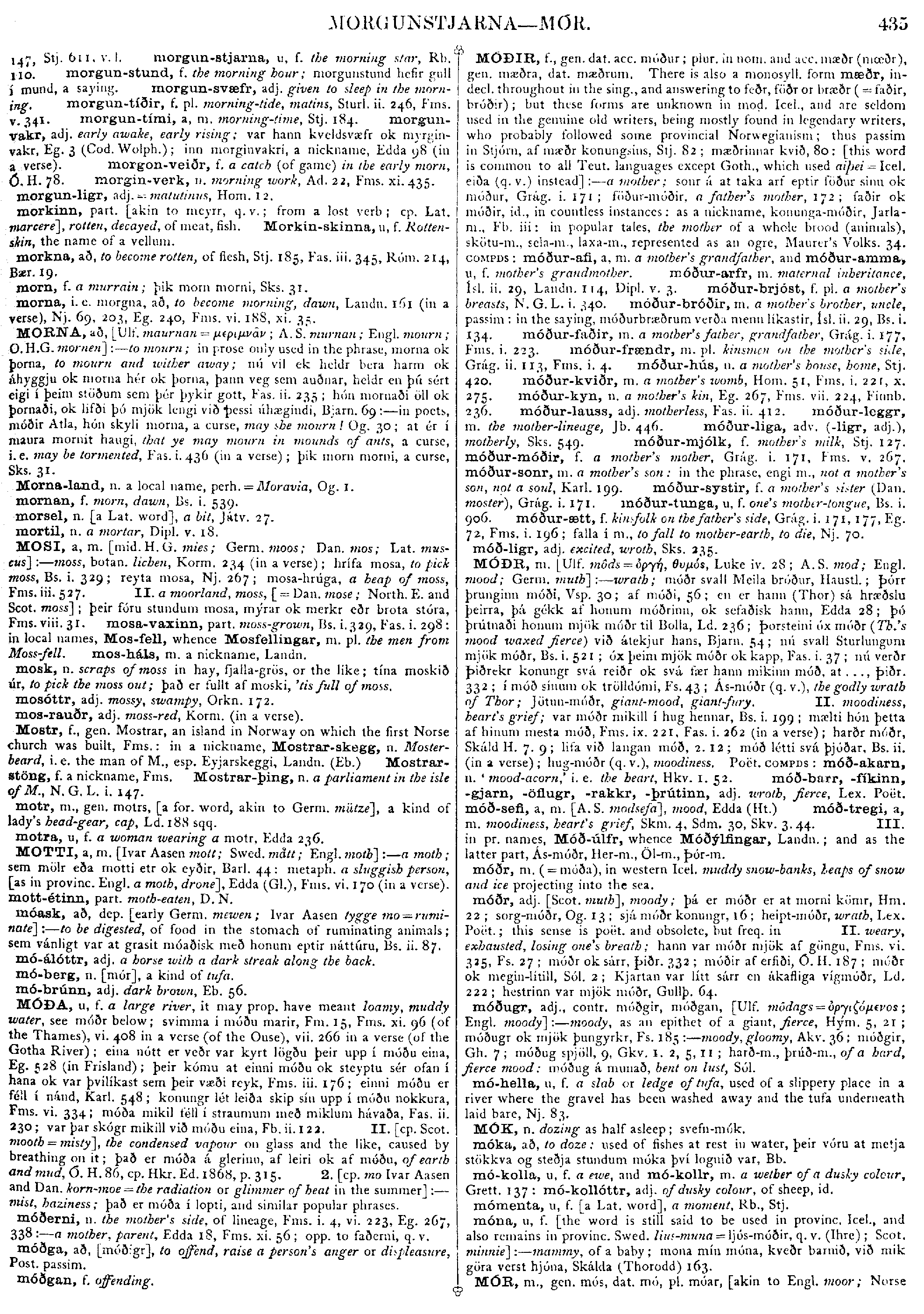
mó-kolla, u, f. a ewe, and mó-kollr, m. a wether of a dusky colour, Grett. 137: mó-kollóttr, adj. of dusky colour, of sheep, id.
|
Source: Cleasby/Vigfusson, page b0501, entry 28 View original page image as: [TIFF] [PNG] [View previous entry] [View next entry] |
[Comment on this entry] [View comments] |
The following entry has been hand-corrected once. |
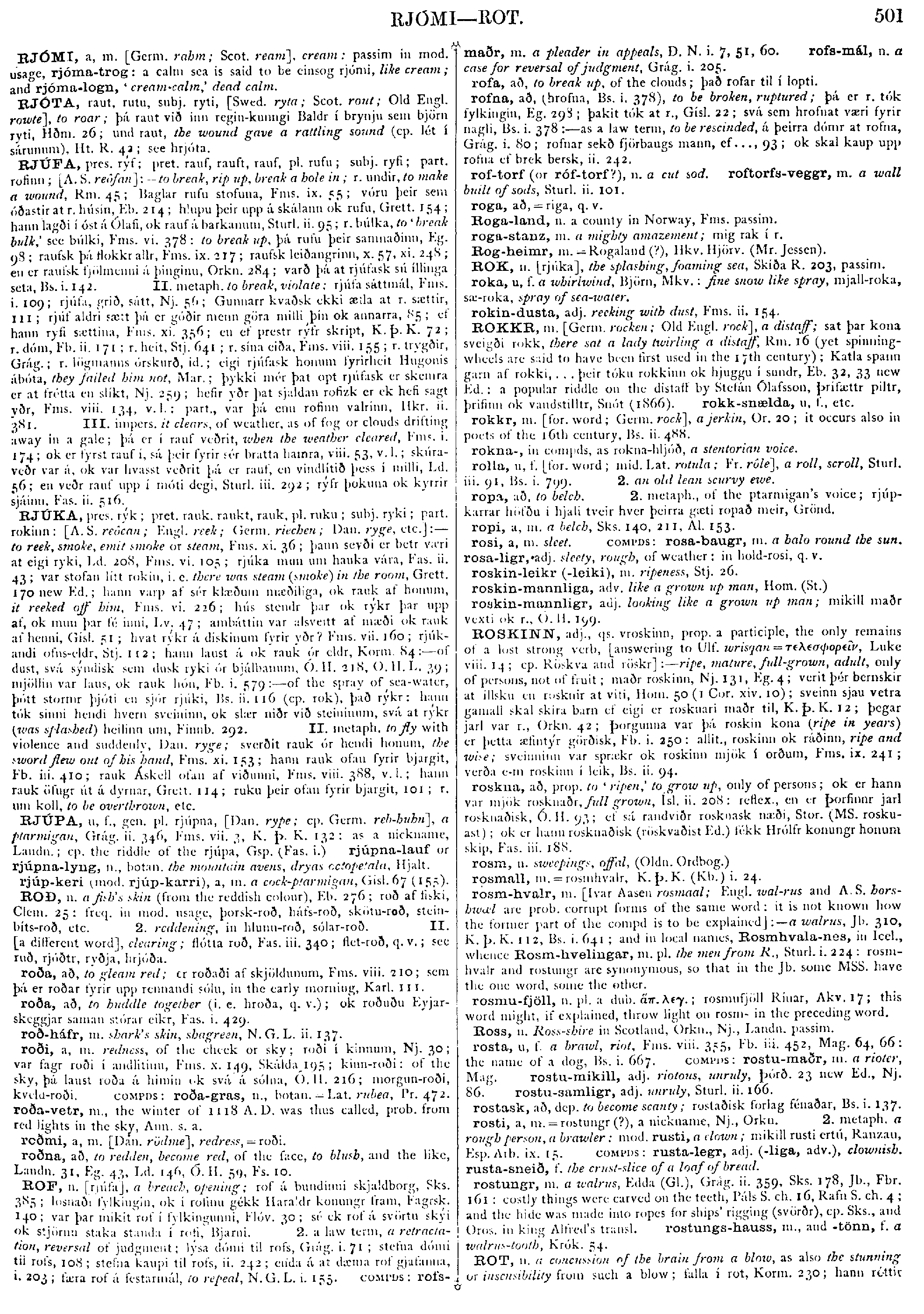
rolla, u, f. [for. word; mid. Lat. rotula; Fr. rôle] , a roll, scroll, Sturl. iii. 91, Bs. i. 799. 2. an old lean scurvy ewe.
|
Source: Cleasby/Vigfusson, page b0566, entry 11 View original page image as: [TIFF] [PNG] [View previous entry] [View next entry] |
[Comment on this entry] [View comments] |
The following entry has been hand-corrected once. |
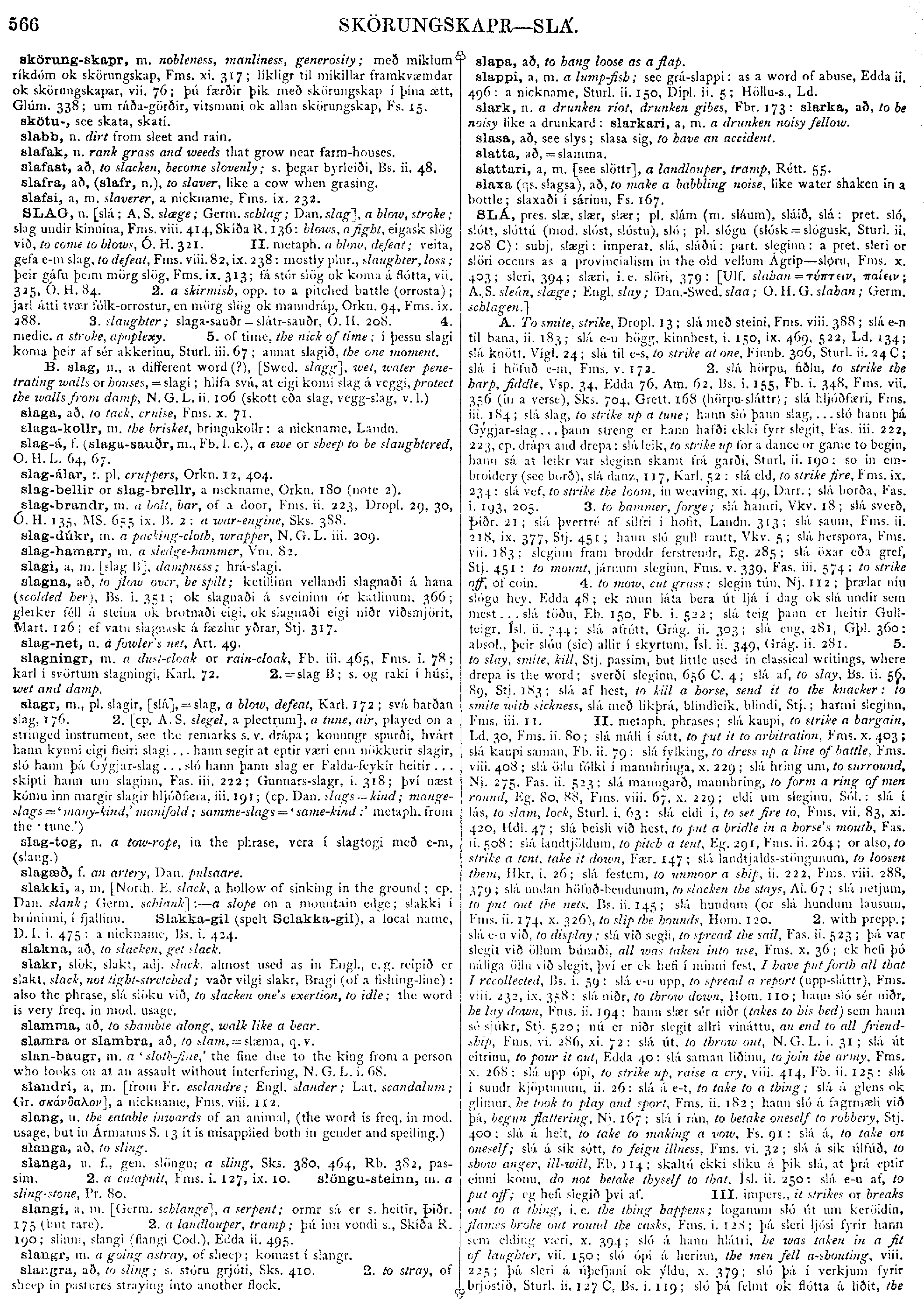
slag-á, f. (slaga-sauðr, m., Fb. l.c.), a ewe or sheep to be slaughtered, O.H.L. 64, 67.
|
Source: Cleasby/Vigfusson, page b0646, entry 3 View original page image as: [TIFF] [PNG] [View previous entry] [View next entry] |
[Comment on this entry] [View comments] |
The following entry has been hand-corrected once. |
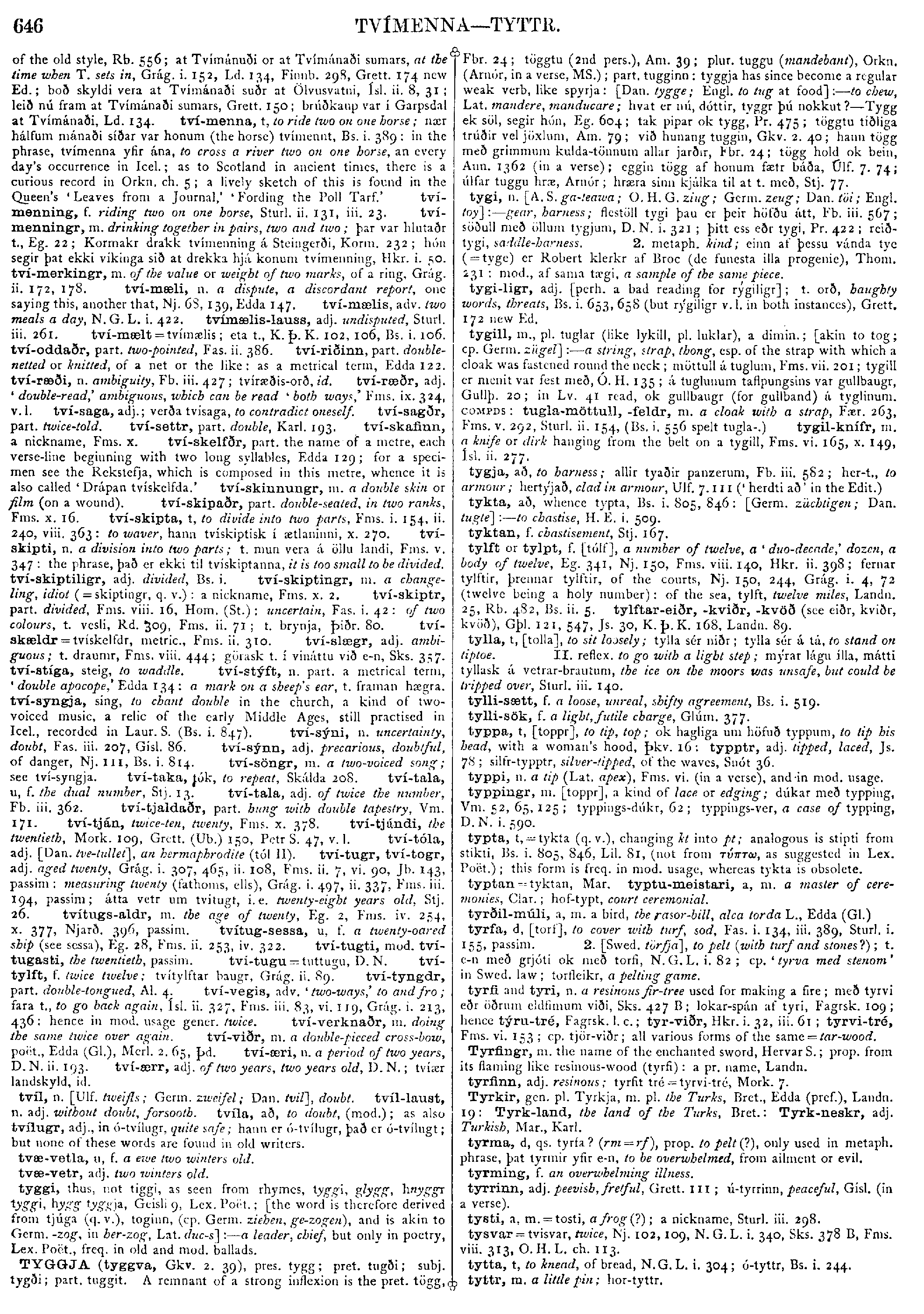
tvæ-vetla, u, f. a ewe two winters old.
|
Source: Cleasby/Vigfusson, page b0652, entry 10 View original page image as: [TIFF] [PNG] [View previous entry] [View next entry] |
[Comment on this entry] [View comments] |
The following entry has been hand-corrected once. |
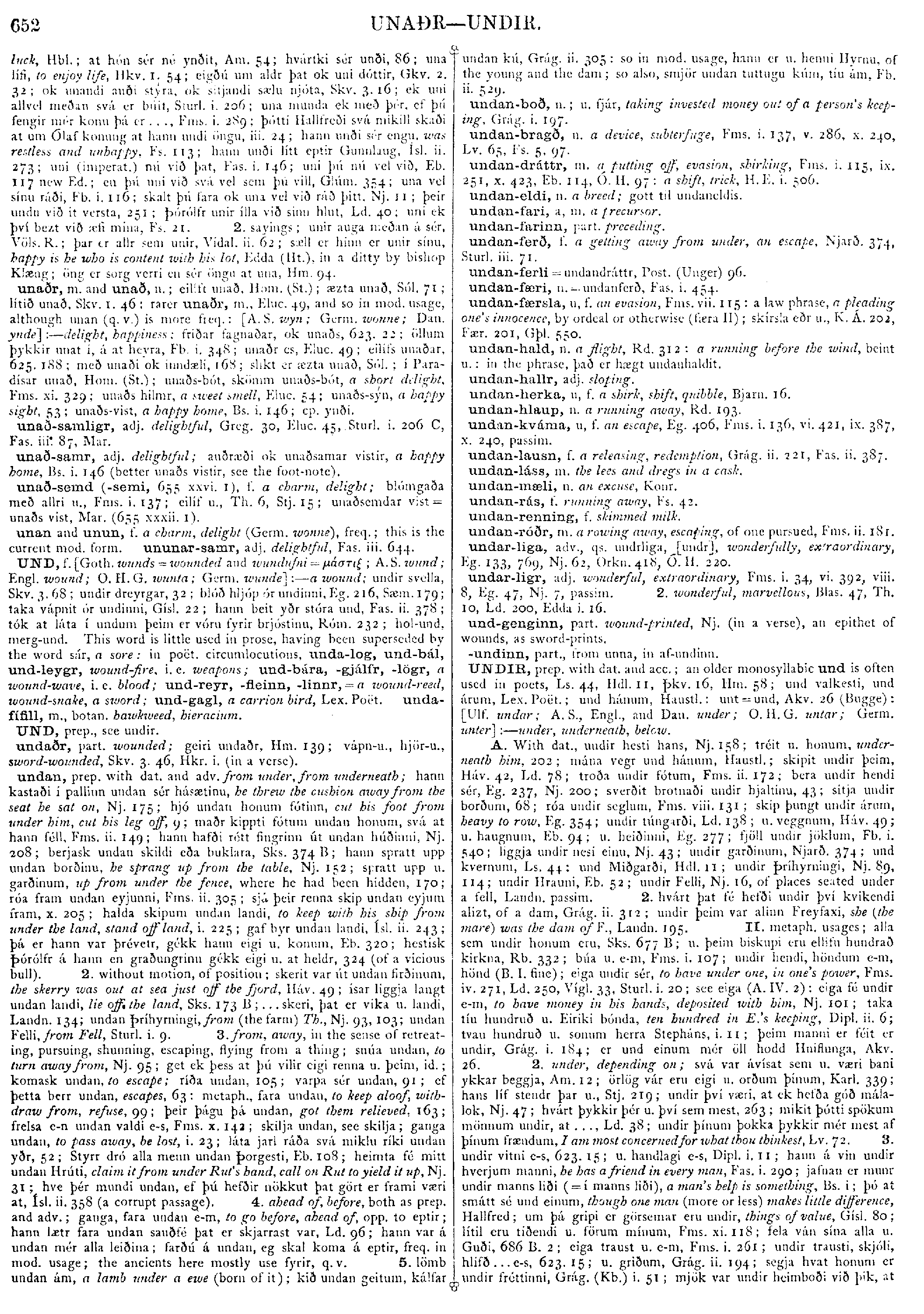
undan, prep. with dat. and adv. from under, from underneath; hann kastaði í pallinn undan sér hásætinu, he threw the cushion away from the seat he sat on, Nj. 175; hjó undan honum fótinn, cut his foot from under him, cut his leg off, 9; madr kippti fótum undan honum, svá at hann féll, Fms. ii. 149; hann hafði rétt fingrinn út undan húðinni, Nj. 208; berjask undan skildi eða buklara, Sks. 374 B; hann spratt upp undan borðinu, he sprang up from the table, Nj. 152; spratt upp u. garðinum, up from under the fence, where he had been hidden, 170; róa fram undan eyjunni, Fms. ii. 305; sjá þeir renna skip undan eyjum fram, x. 205; halda skipum undan landi, to keep with his ship from under the land, stand off land, i. 225; gaf byr undan landi, Ísl. ii. 243; þá er hann var þrévetr, gékk hann eigi u. konum, Eb. 320; hestisk Þórólfr á hann en graðungrinn gékk eigi u. at heldr, 324 (of a vicious bull). 2. without motion, of position; skerit var út undan firðinum, the skerry was out at sea just off the fjord, Háv. 49; ísar liggja langt undan landi, lie off the land, Sks. 173 B; ... skeri, þat er vika u. landi, Landn. 134; undan þríhyrningi, from (the farm) Th., Nj. 93, 103; undan Felli, from Fell, Sturl. i. 9. 3. from, away, in the sense of retreating, pursuing, shunning, escaping, flying from a thing; snúa undan, to turn away from, Nj. 95; get ek þess at þú vilir eigi renna u. þeim, id.; komask undan, to escape; ríða undan. 105; varpa sér undan, 91; ef þetta berr undan, escapes, 63: metaph., fara undan, to keep aloof, withdraw from, refuse, 99; þeir þágu þá undan, got them relieved. 163; frelsa e-n undan valdi e-s, Fms. x. 142; skilja undan, see skilja; ganga undan, to pass away, be lost, i. 23; láta jarl ráða svá miklu ríki undan yðr, 52; Styrr dró alla menn undan Þorgesti, Eb. 108; heimta fé mitt undan Hrúti, claim it from under Rut's hand, call on Rut to yield it up, Nj. 31; hve þér mundi undan, ef þú hefðir nökkut þat gört er frami væri at, Ísl. ii. 358 (a corrupt passage). 4. ahead of, before, both as prep. and adv.; ganga, fara undan e-m, to go before, ahead of, opp. to eptir; hann lætr fara undan sauðfé þat er skjarrast var, Ld. 96; hann var á undan mér alla leiðina; farðú á undan, eg skal koma á eptir, freq. in mod. usage; the ancients here mostly use fyrir, q.v. 5. lömb undan ám, a lamb under a ewe (born of it); kið undan geitum, kálfar undan kú, Grág. ii. 305: so in mod. usage, hann er u. henni Hyrnu, of the young and the dam; so also, smjör undan tuttugu kúm, tíu ám, Fb. ii. 529.
|
Source: Cleasby/Vigfusson, page b0741, entry 1 View original page image as: [TIFF] [PNG] [View previous entry] [View next entry] |
[Comment on this entry] [View comments] |
The following entry has been hand-corrected once. |
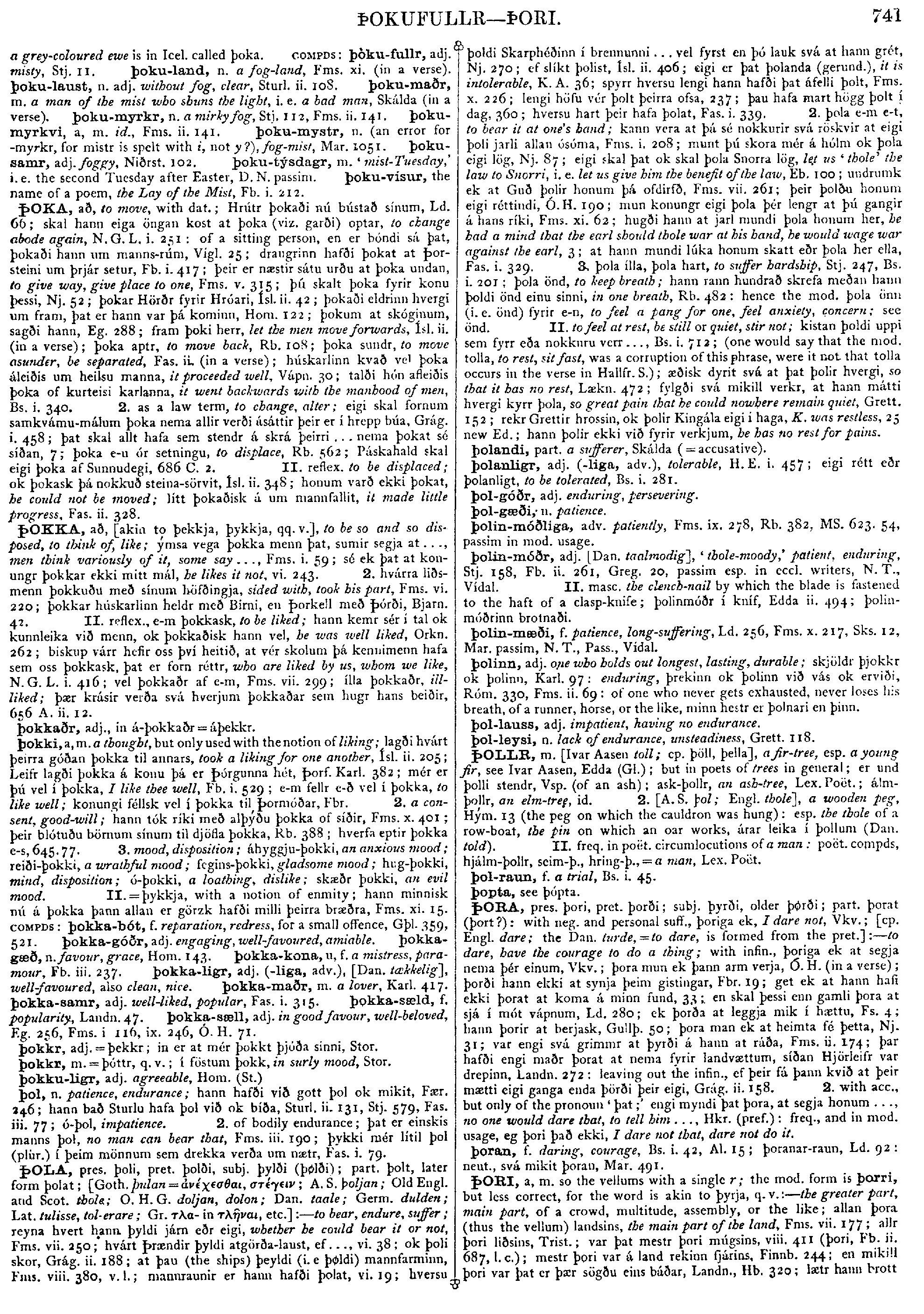
a grey-coloured ewe is in Icel. called þoka. COMPDS: þoku-fullr, adj. misty, Stj. 11. þoku-land, n. a fog-land, Fms. xi. (in a verse). þoku-laust, n. adj. without fog, clear, Sturl. ii. 108. þoku-maðr, m. a man of the mist who shuns the light, i.e. a bad man, Skálda (in a verse). þoku-myrkr, n. a mirky fog, Stj. 112, Fms. ii. 141. þoku-myrkvi, a, m. id., Fms. ii. 141. þoku-mystr, n. (an error for -myrkr, for mistr is spelt with i, not y?), fog-mist, Mar. 1051. þoku-samr, adj. foggy, Niðrst. 102. þoku-týsdagr, m. 'mist-Tuesday,' i.e. the second Tuesday after Easter, D.N. passim. þoku-vísur, the name of a poem, the Lay of the Mist, Fb. i. 212.
|
Source: Cleasby/Vigfusson, page b0759, entry 10 View original page image as: [TIFF] [PNG] [View previous entry] [View next entry] |
[Comment on this entry] [View comments] |
The following entry has been hand-corrected once. |
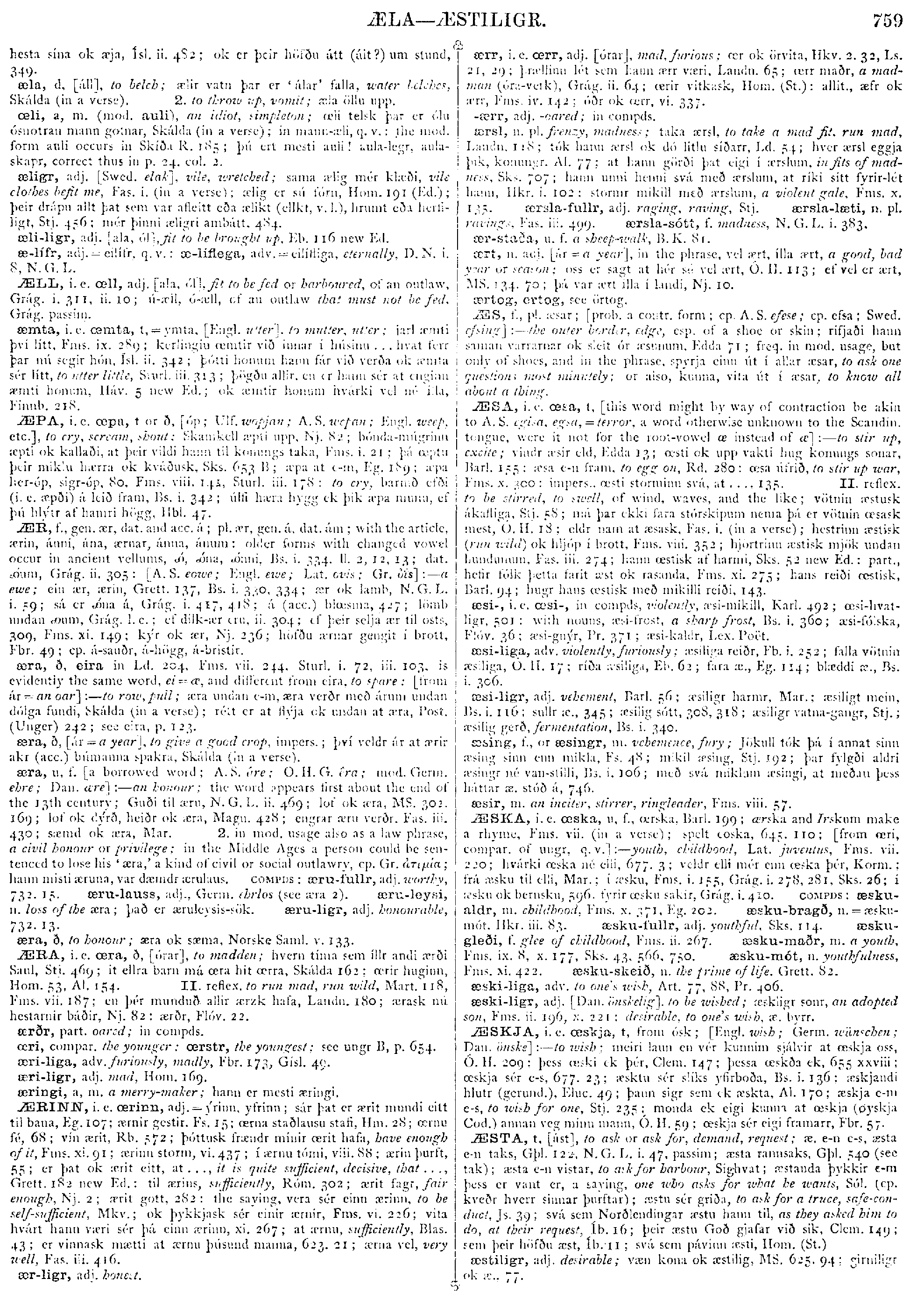
ÆR,
f.,
gen.
ær,
dat.
and
acc.
á;
pl.
ær,
gen.
á,
dat.
ám;
with
the
article,
ærin,
ánni,
ána,
ærnar,
ánna,
ánum:
older
forms
with
changed
vowel
occur
in
ancient
vellums,
 ,
na,
&oalig-acute;nni,
Bs.
i.
334.
ll.
2,
12,
13;
dat.
um,
Grág.
ii.
305:
[A.S.
eowe;
Engl.
ewe;
Lat.
ovis;
Gr.
GREEK]
:--
a
ewe;
ein
ær,
ærin,
Grett.
137,
Bs.
i.
330,
334;
ær
ok
lamb,
N.G.L.
i.
59;
sá
er
na
á,
Grág.
i.
417,
418;
á
(acc.)
blœsma,
427;
lömb
undan
,
na,
&oalig-acute;nni,
Bs.
i.
334.
ll.
2,
12,
13;
dat.
um,
Grág.
ii.
305:
[A.S.
eowe;
Engl.
ewe;
Lat.
ovis;
Gr.
GREEK]
:--
a
ewe;
ein
ær,
ærin,
Grett.
137,
Bs.
i.
330,
334;
ær
ok
lamb,
N.G.L.
i.
59;
sá
er
na
á,
Grág.
i.
417,
418;
á
(acc.)
blœsma,
427;
lömb
undan
 um,
Grág.
l.c.;
ef
dilk-ær
eru,
ii.
304;
ef
þeir
selja
ær
til
osts,
309,
Fms.
xi.
149;
kýr
ok
ær,
Nj.
236;
höfðu
ærnar
gengit
í
brott,
Fbr.
49;
cp.
á-sauðr,
á-högg,
á-bristir.
um,
Grág.
l.c.;
ef
dilk-ær
eru,
ii.
304;
ef
þeir
selja
ær
til
osts,
309,
Fms.
xi.
149;
kýr
ok
ær,
Nj.
236;
höfðu
ærnar
gengit
í
brott,
Fbr.
49;
cp.
á-sauðr,
á-högg,
á-bristir.
|
Source: Cleasby/Vigfusson, page b0771, entry 61 View original page image as: [TIFF] [PNG] [View previous entry] [View next entry] |
[Comment on this entry] [View comments] |
The following entry has been hand-corrected once. |
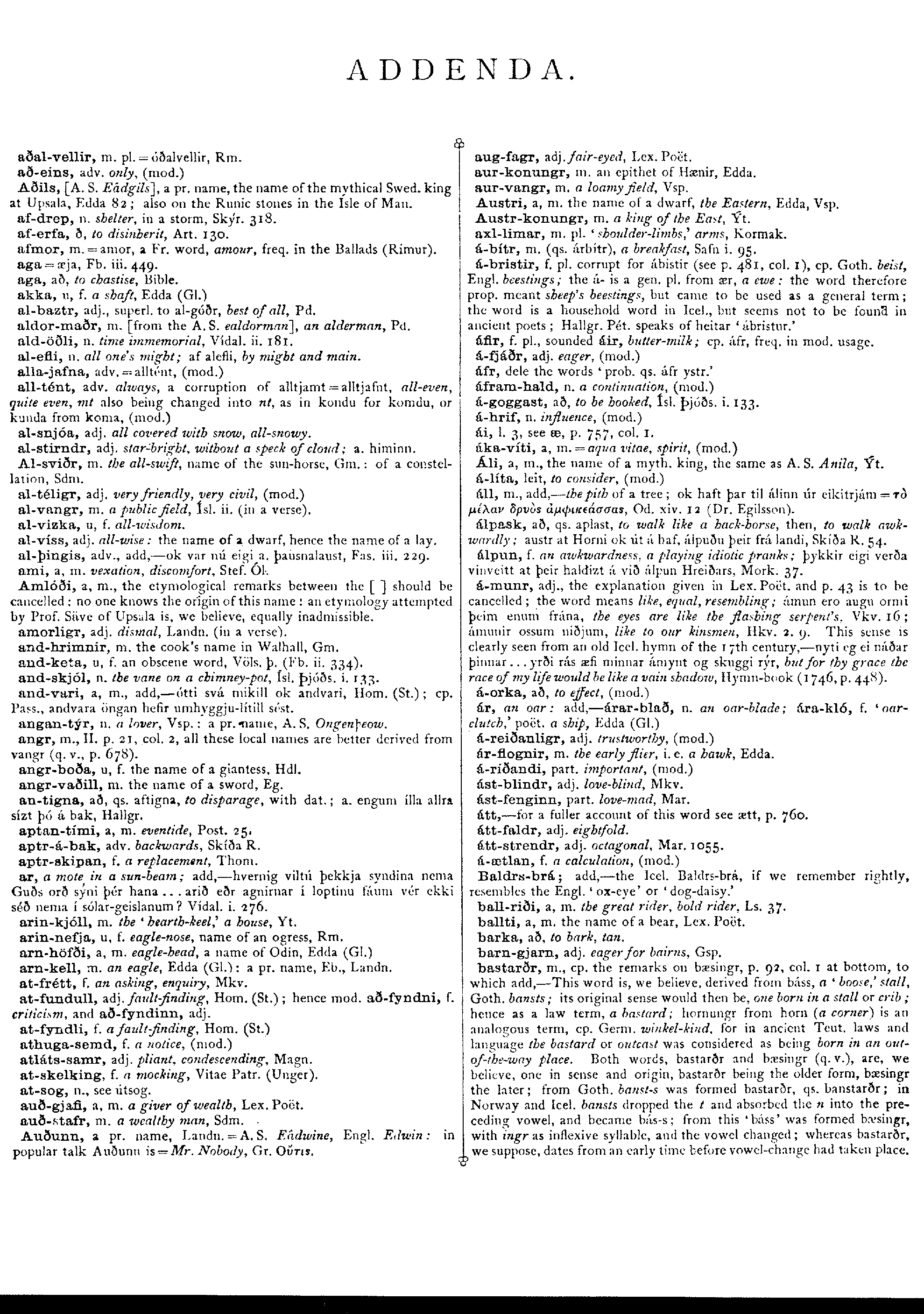
á-bristir, f. pl. corrupt for ábistir (see p. 481, col. 1), cp. Goth. beist, Engl. beestings; the á- is a gen. pl. from ær, a ewe: the word therefore prop. meant sheep's beestings, but came to be used as a general term; the word is a household word in Icel., but seems not to be found in ancient poets; Hallgr. Pét. speaks of heitar 'ábristur.'
| Result Page: |  |
Previous | 1 2 3 4 |
Germanic Lexicon Project (main page)
This search system was written by
Sean Crist
Please consider
volunteering
to correct the data in these online dictionaries.
No rights reserved. Feel free to use these data in any way you please.