|
|

Tip: In the search results, you can click on any word or abbreviation for more information.
|
Source: Cleasby/Vigfusson, page b0480, entry 61 View original page image as: [TIFF] [PNG] [View previous entry] [View next entry] |
[Comment on this entry] [View comments] |
The following entry has been hand-corrected once. |
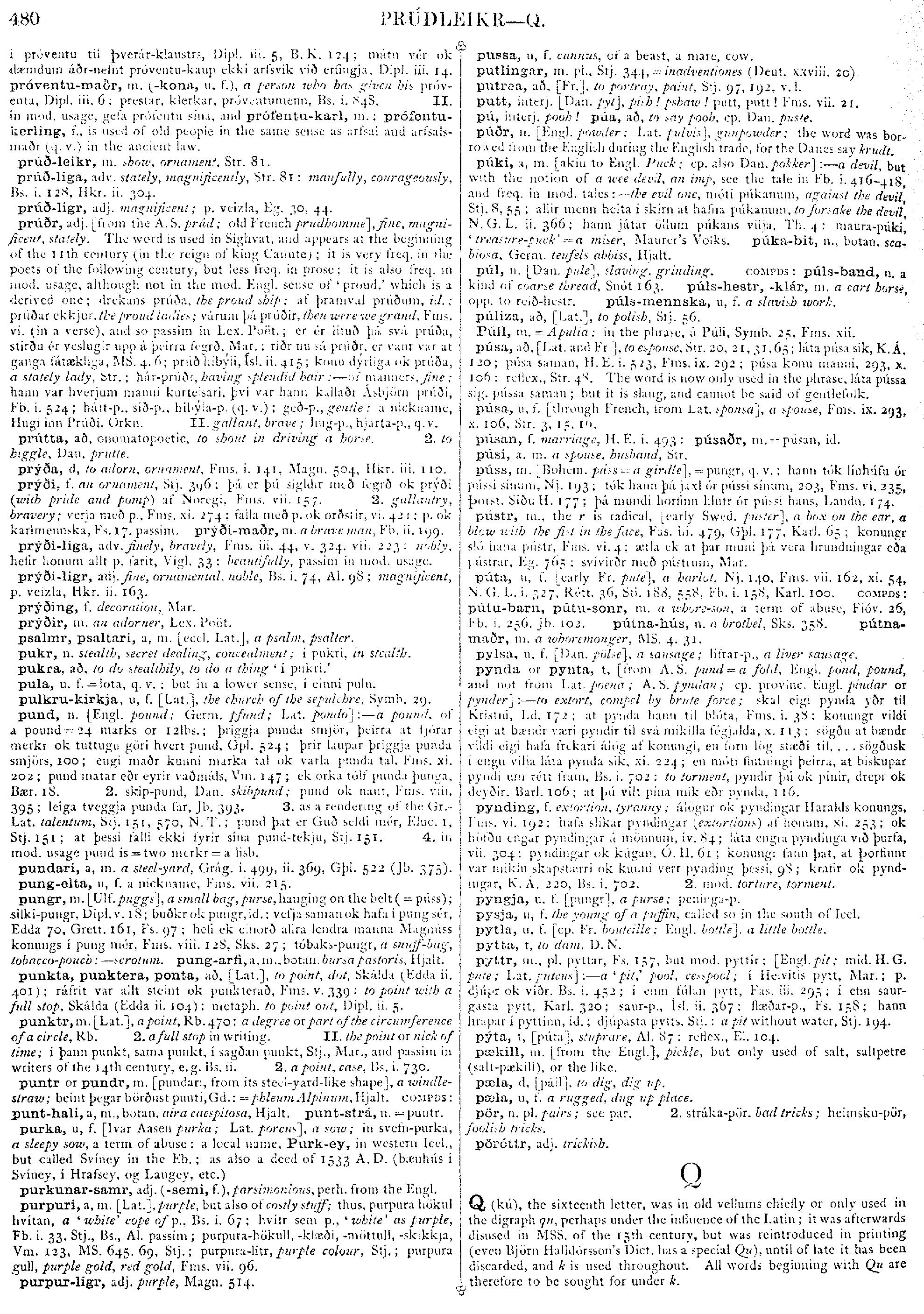
Q (kú), the sixteenth letter, was in old vellums chiefly or only used in the digraph qu, perhaps under the influence of the Latin; it was afterwards disused in MSS. of the 15th century, but was reintroduced in printing (even Björn Halldórsson's Dict. has a special Qu), until of late it has been discarded, and k is used throughout. All words beginning with Qu are therefore to be sought for under k.
|
Source: Cleasby/Vigfusson, page b0481, entry 2 View original page image as: [TIFF] [PNG] [View previous entry] [View next entry] |
[Comment on this entry] [View comments] |
The following entry has been hand-corrected once. |
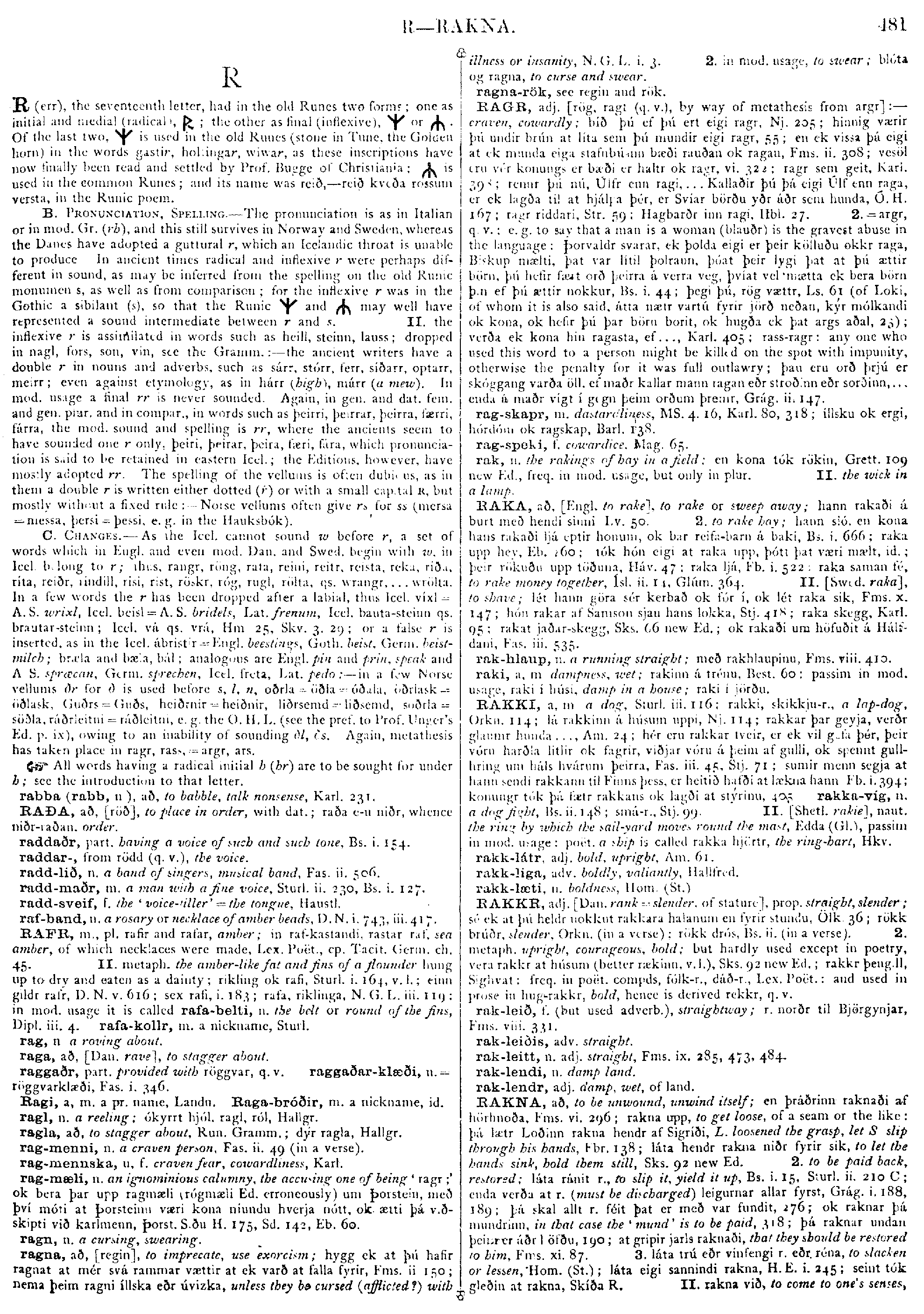
R, (err), the seventeenth letter, had in the old Runes two forms; one as initial and medial (radical), RUNE; the other as final (inflexive), RUNE or RUNE. Of the last two, RUNE is used in the old Runes (stone in Tune, the Golden horn) in the words gastir, hokingar, wiwar, as these inscriptions have now finally been read and settled by Prof. Bugge of Christiana; RUNE is used in the common Runes; and its name was reið, -- reið kveða rossum versta, in the Runic poem. B. PRONUNCIATION, SPELLING. -- The pronunciation is as in Italian or in mod. Gr. (rh), and this still survives in Norway and Sweden, whereas the Danes have adopted a guttural r, which an Icelandic throat is unable to produce In ancient times radical and inflexive r were perhaps different in sound, as may be inferred from the spelling on the old Runic monuments, as well as from comparison; for the inflexive r was in the Gothic a sibilant (s), so that the Runic RUNE and RUNE may well have represented a sound intermediate between r and s. II. the inflexive r is assimilated in words such as heill, steinn, lauss: dropped in nagl, fors, son, vin, see the Gramm. :-- the ancient writers have a double r in nouns and adverbs, such as sárr, stórr, ferr, síðarr, optarr, meirr; even against etymology, as in hárr (high), márr (a mew). In mod. usage a final rr is never sounded. Again, in gen. and dat. fem. and gen. plur. and in compar., in words such as þeirri, þeirrar, þeirra, færri, fárra, the mod. sound and spelling is rr, where the ancients seem to have sounded one r only, þeiri, þeirar, þeira, færi, fára, which pronunciation is said to be retained in eastern Icel.; the Editions, however, have mostly adopted rr. The spelling of the vellums is often dubious, as in them a double r is written either dotted (r) UNCERTAIN or with a small capital R, but mostly without a fixed rule :-- Norse vellums often give rs for ss (mersa = messa, þersi = þessi, e.g. in the Hauksbók). C. CHANGES. -- As the Icel. cannot sound w before r, a set of words which in Engl. and even mod. Dan. and Swed. begin with w, in Icel. belong to r; thus, rangr, röng, rata, reini, reitr, reista, reka, ríða, ríta, reiðr, rindill, risi, rist, röskr, róg, rugl, rölta, qs. wrangr, ... wrölta. In a few words the r has been dropped after a labial, thus Icel. víxl = A.S. wrixl, Icel. beisl = A.S. bridels, Lat. frenum, Icel. bauta-steinn qs. brautar-steinn; Icel. vá qs. vrá, Hm 25, Skv. 3. 29; or a false r is inserted, as in the Icel. ábristir = Engl. beestings, Goth. beist. Germ. beist-milch; bræla and bæla, bál; analogous are Engl. pin and prin, speak and A.S. spræcan, Germ. sprechen, Icel. freta, Lat. pedo :-- in a few Norse vellums ðr for ð is used before s, l, n, oðrla = öðla = óðala, öðrlask = öðlask, Guðrs = Guðs, heiðrnir = heiðnir, liðrsemd = liðsemd, soðrla = söðla, ráðrleitni = ráðleitni, e.g. the O.H.L. (see the pref. to Prof. Unger's Ed. p. ix), owing to an inability of sounding ðl, ðs. Again, metathesis has taken place in ragr, rass, = argr, ars. &FINGER; All words having a radical initial h (hr) are to be sought for under h; see the introduction to that letter.
|
Source: Cleasby/Vigfusson, page b0482, entry 56 View original page image as: [TIFF] [PNG] [View previous entry] [View next entry] |
[Comment on this entry] [View comments] |
The following entry has been hand-corrected once. |
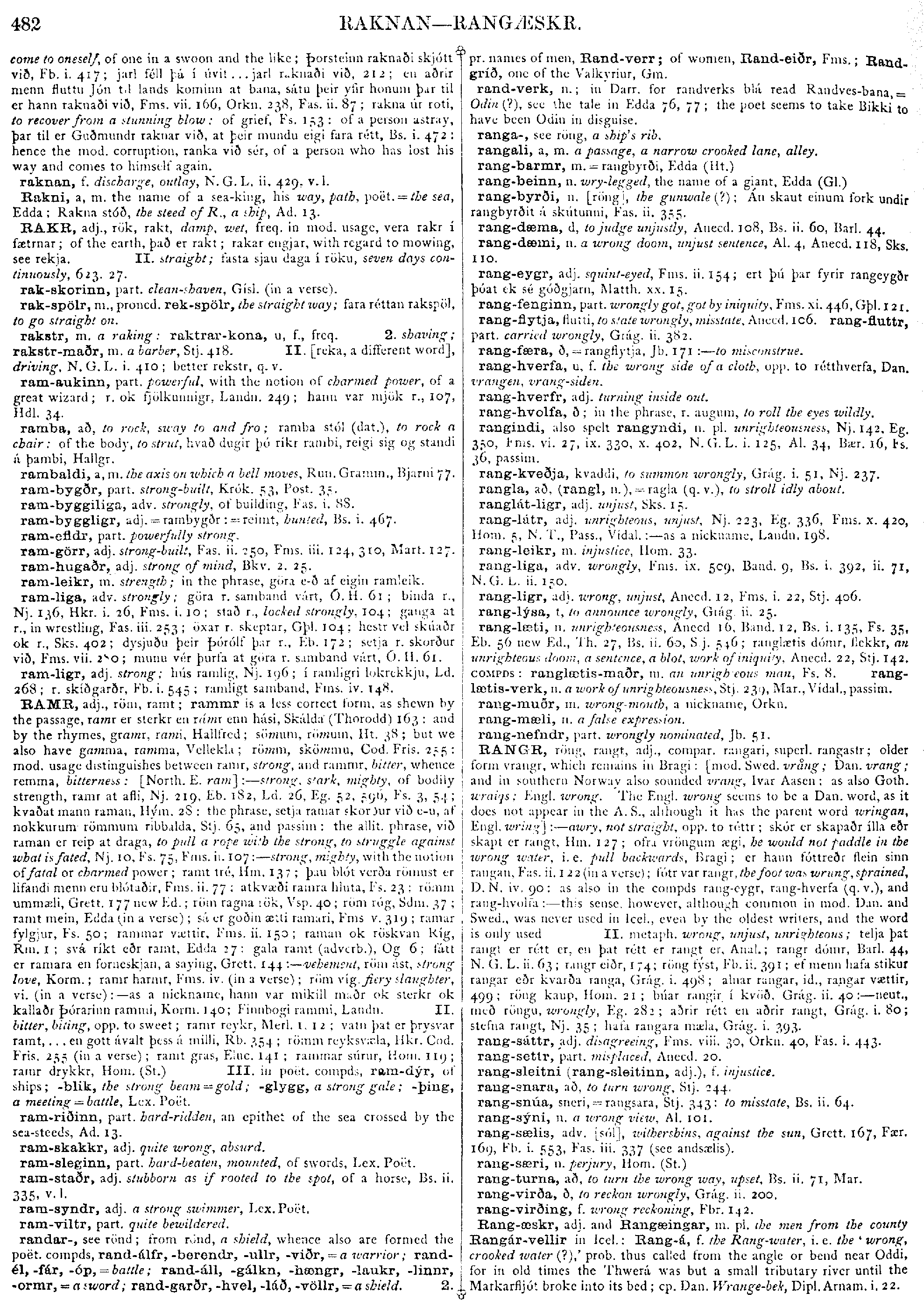
RANGR, röng, rangt, adj., compar. rangari, superl. rangastr; older form vrangr, which remains in Bragi: [mod. Swed. vrång; Dan. vrang; and in southern Norway also sounded vrang, Ivar Aasen; as also Goth. wraiqs: Engl. wrong. The Engl. wrong seems to be a Dan. word, as it does not appear in the A.S., although it has the parent word wringan, Engl. wring] :-- awry, not straight, opp. to réttr; skór er skapaðr ílla eðr skapt er rangt, Hm. 127; ofra vröngnm ægi, he wuuld not paddle in the wrong water, i.e. pull backwards, Bragi; er hann fóttreðr flein sinn rangan. Fas. ii. 122 (in a verse); fótr var rangr, the foot was wrung, sprained, D.N. iv. 90: as also in the compds rang-eygr, rang-hverfa (q.v.), and rang-hvolfa :-- this sense, however, although common in mod. Dan. and Swed., was never used in Icel., even by the oldest writers, and the word is only used II. metaph. wrong, unjust, unrighteous; telja þat rangt er rétt er, en þat rétt er rangt er, Anal.; rangr dómr, Barl. 44, N.G.L. ii. 63; rangr eiðr, 174; röng fýst, Fb. ii. 391; ef menn hafa stikur rangar eðr kvarða ranga, Grág. i. 498; alnar rangar, id., rangar vættir, 499; röng kaup, Hom. 21; búar rangir í kvöð, Grág. ii. 40 :-- neut., með röngu, wrongly, Eg. 282; aðrir rétt en aðrir rangt, Grág. i. 80; stefna rangt, Nj. 35; hafa rangara mæla, Grág. i. 393.
|
Source: Cleasby/Vigfusson, page b0483, entry 4 View original page image as: [TIFF] [PNG] [View previous entry] [View next entry] |
[Comment on this entry] [View comments] |
The following entry has been hand-corrected once. |
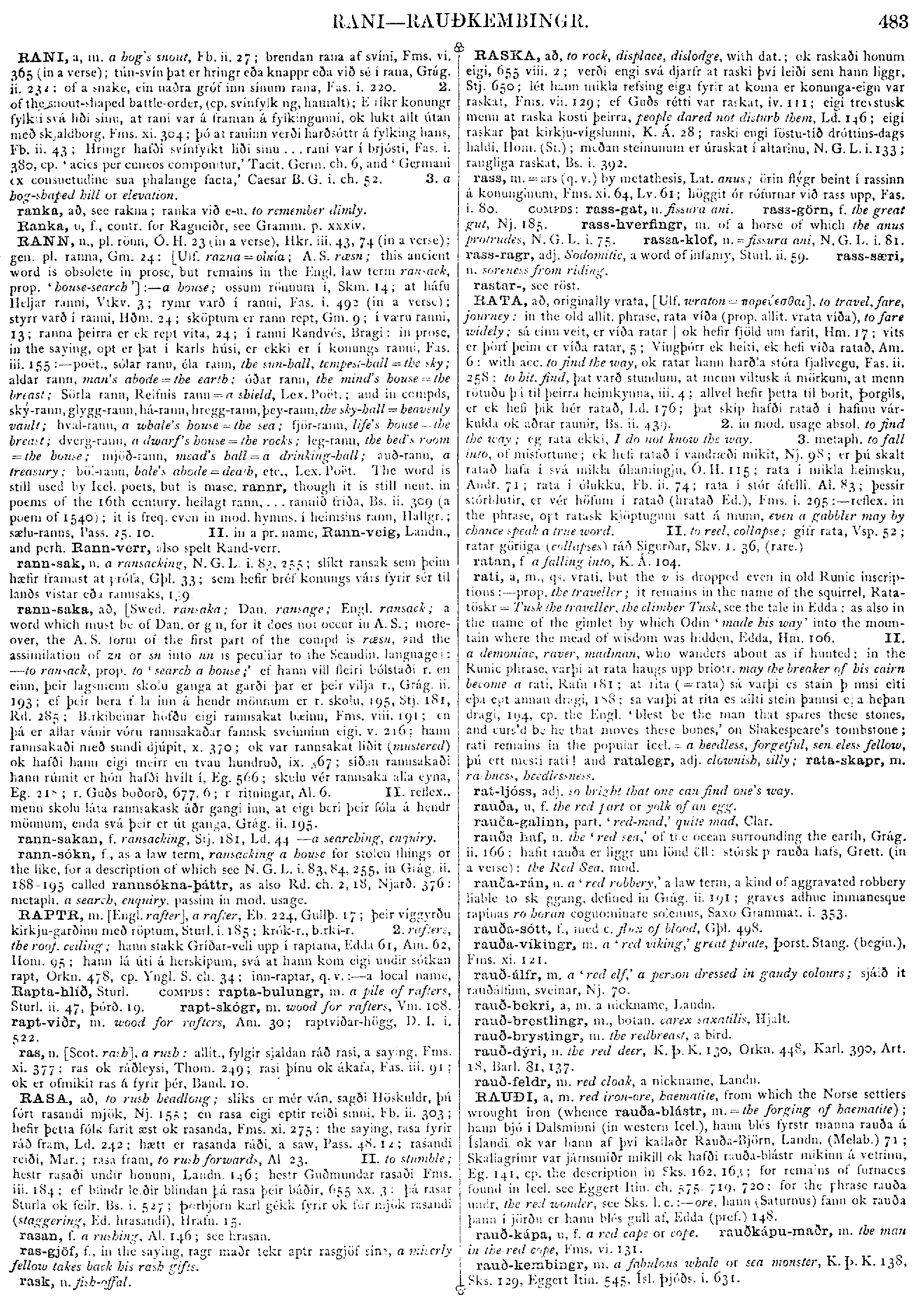
RANN, n., pl. rönn, Ó.H. 23 (in a verse), Hkr. iii. 43, 74 (in a verse); gen. pl. ranna, Gm. 24: [Ulf. razna = GREEK; A.S. ræsn; this ancient word is obsolete in prose, but remains in the Engl. law term ransack, prop. 'house-search'] :-- a house; ossum rönnum í, Skm. 14; at háfu Heljar ranni, Vtkv. 3; rymr varð í ranni, Fas. i. 492 (in a verse); styrr varð í ranni, Hðm. 24; sköptum er rann rept, Gm. 9; í væru ranni, 13; ranna þeirra er ek rept vita, 24; í ranni Randvés, Bragi: in prose, in the saving, opt er þat í karls húsi, er ekki er í konungs ranni, Fas. iii. 155 :-- poët., sólar rann, éla rann, the sun-hall, tempest-hall = the sky; aldar rann, man's abode = the earth; óðar rann, the mind's house = the breast; Sörla rann, Reifnis rann = a shield, Lex. Poët.; and in compds, ský-rann, glygg-rann, há-rann, hregg-rann, þey-rann, the sky-hall = heavenly vault; hval-rann, a whale's home = the sea; fjör-rann, life's house = the breast; dverg-rann, a dwarf's house = the rocks; leg-rann, the bed's room = the house; mjoð-rann, mead's hall = a drinking-hall; auð-rann, a treasury; böl-rann, bale's abode = death, etc., Lex. Poët. The word is still used by Icel. poets, but is masc. rannr, though it is still neut. in poems of the 16th century, heilagt rann, ... rannið friða, Bs. ii. 309 (a poem of 1540); it is freq. even in mod. hymns, í heimsins rann, Hallgr.; sælu-ranns, Pass. 25. 10. II. in a pr. name, Rann-veig, Landn., and perh. Rann-verr, also spelt Rand-verr.
|
Source: Cleasby/Vigfusson, page b0483, entry 18 View original page image as: [TIFF] [PNG] [View previous entry] [View next entry] |
[Comment on this entry] [View comments] |
The following entry has been hand-corrected once. |
RATA, að, originally vrata, [Ulf. wraton = GREEK], to travel, fare, journey: in the old allit. phrase, rata víða (prop. allit. vrata víða), to fare widely; sá einn veit, er víða ratar | ok hefir fjöld um farit, Hm. 17; vits er þörf þeim er víða ratar, 5; Vingþórr ek heiti, ek hefi víða ratað, Am. 6: with acc. to find the way, ok ratar hann harðla stóra fjallvegu, Fas. ii. 258: to hit, find, þat varð stundum, at menn viltusk á mörkum, at menn rötuðu þá til þeirra heimkynna, iii. 4: allvel hefir þetta til borit, Þorgils, er ek hefi þik hér ratað, Ld. 176; þat skip hafði ratað í hafinu várkulda ok aðrar raunir, Bs. ii. 439. 2. in mod. usage absol. to find the way; eg rata ekki, I do not know the way. 3. metaph. to fall into, of misfortune; ek hefi ratað í vandræði mikit, Nj. 98; er þú skalt ratað hafa í svá mikla úhamingju, Ó.H. 115; rata í mikla heimsku, Andr. 71; rata í ólukku, Fb. ii. 74; rata í stór áfelli, Al. 83; þessir stórhlutir, er vér höfum í ratað (hratað Ed.), Fms. i. 295 :-- reflex. in the phrase, opt ratask kjöptugum satt á munn, even a gabbler may by chance speak a true word. II. to reel, collapse; gífr rata, Vsp. 52; ratar görliga (collapses) ráð Sigurðar, Skv. 1. 36, (rare.)
|
Source: Cleasby/Vigfusson, page b0483, entry 20 View original page image as: [TIFF] [PNG] [View previous entry] [View next entry] |
[Comment on this entry] [View comments] |
The following entry has been hand-corrected once. |
rati, a, m., qs. vrati, but the v is dropped even in old Runic inscriptions :-- prop. the traveller; it remains in the name of the squirrel, Rata-töskr = Tusk the traveller, the climber Tusk, see the tale in Edda; as also in the name of the gimlet by which Odin 'made his way' into the mountain where the mead of wisdom was hidden, Edda, Hm. 106. II. a demoniac, raver, madman, who wanders about as if hunted: in the Runic phrase, varþi at rata haugs upp briotr, may the breaker of his cairn become a rati, Rafn 181; at rita (= rata) sá varþi es stain þannsi elti eþa ept annan dragi, 188; sa varþi at rita es ailti stein þannsi eþa heþan dragi, 194, cp. the Engl. 'blest be the man that spares these stones, and curs'd be he that moves these bones,' on Shakespeare's tombstone; rati remains in the popular Icel. = a heedless, forgetful, senseless fellow, þú ert mesti rati! and ratalegr, adj. clownish, silly; rata-skapr, m. rashness, heedlessness.
|
Source: Cleasby/Vigfusson, page b0493, entry 3 View original page image as: [TIFF] [PNG] [View previous entry] [View next entry] |
[Comment on this entry] [View comments] |
The following entry has been hand-corrected once. |
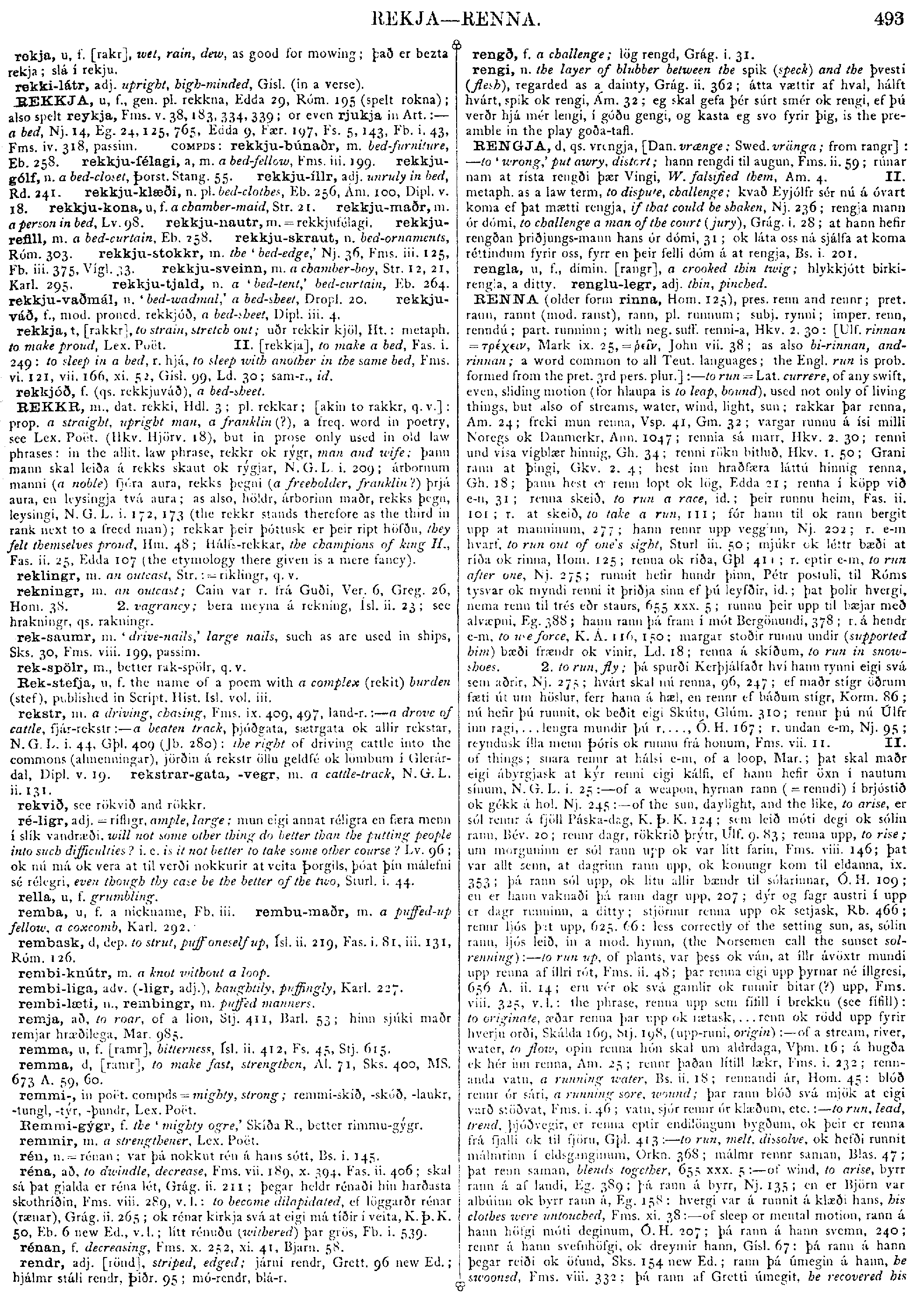
REKKJA, u, f., gen. pl. rekkna, Edda 29, Róm. 195 (spelt rokna); also spelt reykja, Fms. v. 38, 183, 334, 339; or even rjukja in Art. :-- a bed, Nj. 14, Eg. 24, 125, 765, Edda 9, Fær. 197, Fs. 5, 143, Fb. i. 43, Fms. iv. 318, passim. COMPDS: rekkju-búnaðr, m. bed-furniture, Eb. 258. rekkju-félagi, a, m. a bed-fellow, Fms. iii. 199. rekkju-gólf, n. a bed-closet, Þorst. Stang. 55. rekkju-íllr, adj. unruly in bed, Rd. 241. rekkju-klæði, n. pl. bed-clothes, Eb. 256, Ám. 100, Dipl. v. 18. rekkju-kona, u, f. a cbamber-maid, Str. 21. rekkju-maðr, m. a person in bed, Lv. 98. rekkju-nautr, m. = rekkjufélagi. rekkju-refill, m. a bed-curtain, Eb. 258. rekkju-skraut, n. bed-ornaments, Róm. 303. rekkju-stokkr, m. the 'bed-edge,' Nj. 36, Fms. iii. 125, Fb. iii. 375, Vígl. 33. rekkju-sveinn, m. a chamber-boy, Str. 12, 21, Karl. 295. rekkju-tjald, n. a 'bed-tent,' bed-curtain, Eb. 264. rekkju-vaðmál, n. 'bed-wadmal,' a bed-sheet, Dropl. 20. rekkju-váð, f., mod. proncd. rekkjóð, a bed-theet, Dipl. iii. 4.
|
Source: Cleasby/Vigfusson, page b0493, entry 14 View original page image as: [TIFF] [PNG] [View previous entry] [View next entry] |
[Comment on this entry] [View comments] |
The following entry has been hand-corrected once. |
ré-ligr, adj. = rífligr, ample, large; mun eigi annat réligra en færa menn í slík vandræði, will not some other thing do better than the putting people into such difficulties? i.e. is it not better to take some other course? Lv. 96; ok nú má ok vera at til verdi nokkurir at veita Þorgils, þóat þín málefni sé rélegri, even though thy case be the better of the two, Sturl. i. 44.
|
Source: Cleasby/Vigfusson, page b0493, entry 35 View original page image as: [TIFF] [PNG] [View previous entry] [View next entry] |
[Comment on this entry] [View comments] |
The following entry has been hand-corrected once. |
RENNA (older form rinna, Hom. 125), pres. renn and rennr; pret. raun, rannt (mod. ranst), rann, pl. runnum; subj. rynni; imper. renn, renndú; part. runninn; with neg. suff. renni-a, Hkv. 2. 30: [Ulf. rinnan = GREEK, Mark ix. 25, = GREEK, John vii. 38; as also bi-rinnan, and-rinnan; a word common to all Teut. languages; the Engl. run is prob. formed from the pret. 3rd pers. plur.] :-- to run = Lat. currere, of any swift, even, sliding motion (for hlaupa is to leap, bound), used not only of living things, but also of streams, water, wind, light, sun; rakkar þar renna, Am. 24; freki mun renna, Vsp. 41, Gm. 32; vargar runnu á ísi milli Noregs ok Daumerkr, Ann. 1047; rennia sá marr, Hkv. 2. 30; renni und vísa vígblær hinnig, Gh. 34; renni rökn bitluð, Hkv. i. 50; Grani rann at þingi, Gkv. 2. 4; hest inn hraðfæra láttú hinnig renna, Gh.18; þann hest er renn lopt ok lög, Edda 21; renna í köpp við e-n, 31; renna skeið, to run a race, id.; þeir runnu heim, Fas. ii. 101; r. at skeið, to take a run, 111; fór hann til ok rann bergit upp at manninum, 277; hann rennr upp vegginn, Nj. 202; r. e-m hvarf, to run out of one's sight, Sturl iii. 50; mjúkr ok léttr bæði at ríða ok rinna, Hom. 125; renna ok ríða, Gþl 411; r. eptir e-m, to run after one, Nj. 275; runnit hefir hundr þinn, Pétr postuli, til Róms tysvar ok myndi renni it þriðja sinn ef þú leyfðir, id.; þat þolir hvergi, nema renn til trés eðr staurs, 655 xxx. 5; runnu þeir upp til bæjar með alvæpni. Eg. 388; hann rann þá fram í mót Bergönundi, 378; r. á hendr e-m, to use force, K.Á. 116, 150; margar stoðir runnu undir (supported him) bæði frændr ok vinir, Ld. 18; renna á skíðum, to run in snow-shoes. 2. to run, fly; þá spurði Kerþjálfaðr hví hann rynni eigi svá sem aðrir, Nj. 275; hvárt skal nú renna, 96, 247; ef maðr stígr öðrum fæti út um höslur, ferr hann á hæl, en rennr ef báðum stígr, Korm. 86; nú hefir þú runnit, ok beðit eigi Skútu, Glúm. 310; rennr þú nú Úlfr inn ragi, ... lengra mundir þú r. ..., Ó.H. 167; r. undan e-m, Nj. 95; reyndusk ílla menn Þóris ok runnu frá honum, Fms. vii. 11. II. of things; snara rennr at hálsi e-m, of a loop, Mar.; þat skal maðr eigi ábyrgjask at kýr renni eigi kálfi, ef hann hefir öxn í nautum sínum, N.G.L. i. 25 :-- of a weapon, hyrnan rann (= renndi) í brjóstið ok gékk á hol, Nj. 245 :-- of the sun, daylight, and the like, to arise, er sól rennr á fjöll Páska-dag, K.Þ.K. 124; sem leið móti degi ok sólin rann, Bév. 20; rennr dagr, rökkrið þrýtr, Úlf. 9. 83; renna upp, to rise; um mörguninn er sól rann upp ok var lítt farin, Fms. viii. 146; þat var allt senn, at dagrinn rann upp, ok konungr kom til eldanna, ix. 353; þá rann söl upp, ok litu allir bændr til sölarinnar, Ó.H. 109; en er hann vaknaði þa rann dagr upp, 207; dýr og fagr austri í upp er dagr renninn, a ditty; stjörnur renna upp ok setjask, Rb. 466; rennr ljós þat upp, 625. 66: less correctly of the setting sun, as, sólin rann, ljós leið, in a mod. hymn, (the Norsemen call the sunset sol-renning) :-- to run up, of plants, var þess ok ván, at íllr ávöxtr mundi upp renna af íllri rót, Fms. ii. 48; þar renna eigi upp þyrnar né íllgresi, 656 A. ii. 14; eru vér ok svá gamlir ok runnir bitar(?) upp, Fms. viii. 325, v.l.: the phrase, renna upp sem fífill í brekku (see fífill): to originate, æðar renna þar upp ok nætask, ... renn ok rödd upp fyrir hverju orði, Skálda 169, Stj. 198, (upp-runi, origin) :-- of a stream, river, water, to flow, opin renna hón skal um aldrdaga, Vþm, 16; á hugða ek hér inn renna, Am. 25; rennr þaðan lítill lækr, Fms. i. 232; rennanda vatn, a running water, Bs. ii. 18; rennandi ár, Hom. 45: blóð rennr ór sári, a running sore, wound; þar rann blóð svá mjök at eigi varð stöðvat, Fms. i. 46; vatn, sjór rennr ór klæðum, etc. :-- to run, lead, trend. þjóðvegir, er renna eptir endilöngum bygðum, ok þeir er renna frá fjalli ok til fjörn, Gþl. 413 :-- to run, melt, dissolve, ok hefði runnit málmrinn í eldsganginum, Orkn. 368; málmr rennr saman, Blas. 47; þat renn saman, blends together, 655, xxx. 5 :-- of wind, to arise, byrr rann á af landi, Eg. 389; þá rann á byrr, Nj. 135; en er Björn var albúinn ok byrr rann á, Eg. 158: hvergi var á runnit á klaæeth;i hans, his clothes were untouched, Fms. xi. 38 :-- of sleep or mental motion, rann á hann höfgi móti deginum, Ó.H. 207; þá rann á hann svemn, 240; rennr á hann svefnhöfgi, ok dreymir hann, Gísl. 67; þá rann á hann þegar reiði ok öfund, Sks. 154 new Ed.; rann þá úmegin á hann, he swooned, Fms. viii. 332: þá rann af Gretti úmegit, he recovered his
|
Source: Cleasby/Vigfusson, page b0497, entry 4 View original page image as: [TIFF] [PNG] [View previous entry] [View next entry] |
[Comment on this entry] [View comments] |
The following entry has been hand-corrected once. |
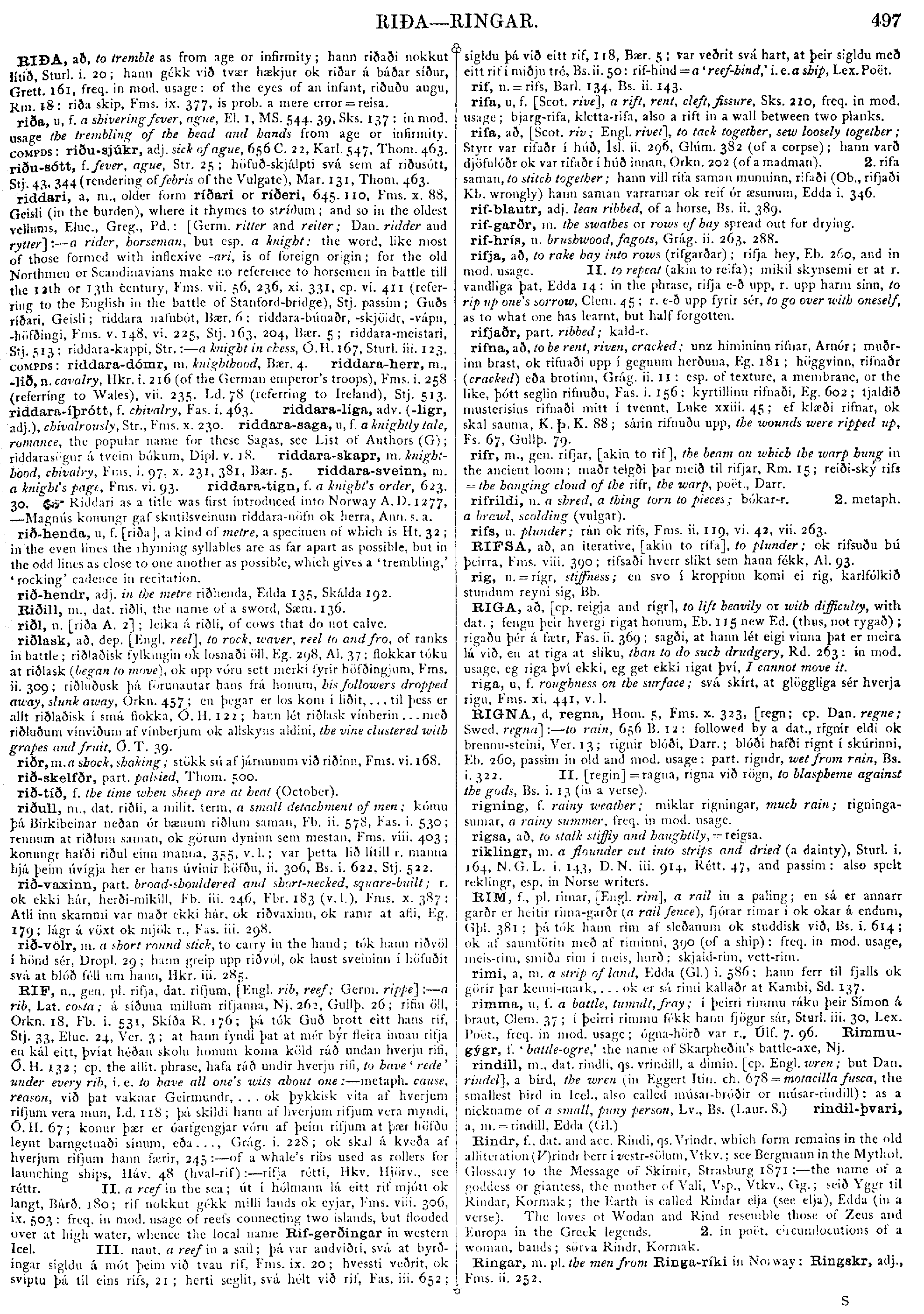
rið-henda, u, f. [riða], a kind of metre, a specimen of which is Ht. 32; in the even lines the rhyming syllables are as far apart as possible, but in the odd lines as close to one another as possible, which gives a 'trembling,' 'rocking' cadence in recitation.
| Result Page: |  |
Previous | 29 30 31 32 33 34 35 36 37 38 39 40 41 42 43 44 45 46 | Next |  |
Germanic Lexicon Project (main page)
This search system was written by
Sean Crist
Please consider
volunteering
to correct the data in these online dictionaries.
No rights reserved. Feel free to use these data in any way you please.