|
|

|
Source: Cleasby/Vigfusson, page b0134, entry 16 View original page image as: [TIFF] [PNG] [View previous entry] [View next entry] |
[Comment on this entry] [View comments] |
The following entry has been hand-corrected once. |
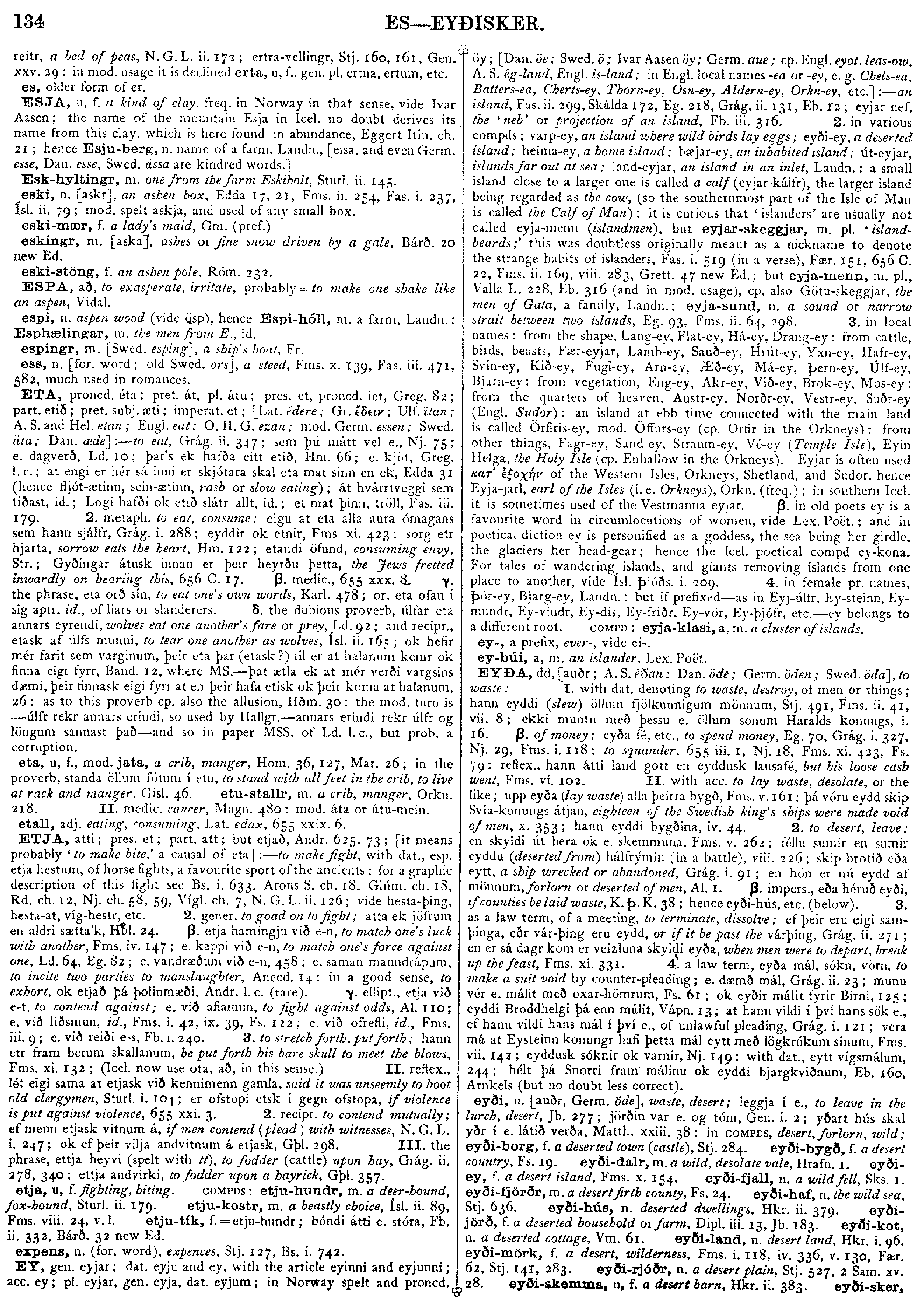
ETJA,
atti;
pres.
et;
part.
att;
but
etjað,
Andr.
625.
73;
[it
means
probably
'to
make
bite,'
a
causal
of
eta]
:--
to
make
fight,
with
dat.,
esp.
etja
hestum,
of
horse
fights,
a
favourite
sport
of
the
ancients;
for
a
graphic
description
of
this
fight
see
Bs.
i.
633.
Arons
S.
ch.
18,
Glúm.
ch.
18,
Rd.
ch.
12,
Nj.
ch.
58,
59,
Vígl.
ch.
7,
N.
G.
L.
ii.
126;
vide
hesta-þing,
hesta-at,
víg-hestr,
etc.
2.
gener.
to
goad
on
to
fight;
atta
ek
jöfrum
en
aldri
sætta'k,
Hbl.
24.
 .
etja
hamingju
við
e-n,
to
match
one's
luck
with
another,
Fms.
iv.
147;
e.
kappi
við
e-n,
to
match
one's
force
against
one,
Ld.
64,
Eg.
82;
e.
vandræðum
við
e-n,
458;
e.
saman
manndrápum,
to
incite
two
parties
to
manslaughter,
Anecd.
14:
in
a
good
sense,
to
exhort,
ok
etjað
þá
þolinmæði,
Andr.
l.c.
(rare).
.
etja
hamingju
við
e-n,
to
match
one's
luck
with
another,
Fms.
iv.
147;
e.
kappi
við
e-n,
to
match
one's
force
against
one,
Ld.
64,
Eg.
82;
e.
vandræðum
við
e-n,
458;
e.
saman
manndrápum,
to
incite
two
parties
to
manslaughter,
Anecd.
14:
in
a
good
sense,
to
exhort,
ok
etjað
þá
þolinmæði,
Andr.
l.c.
(rare).
 .
ellipt.,
etja
við
e-t,
to
contend
against;
e.
við
aflamun,
to
fight
against
odds,
Al.
110;
e.
við
liðsmun,
id.,
Fms.
i.
42,
ix.
39,
Fs.
122;
e.
við
ofrefli,
id.,
Fms.
iii.
9;
e.
við
reiði
e-s,
Fb.
i.
240.
3.
to
stretch
forth,
put
forth;
hann
etr
fram
berum
skallanum,
he
put
forth
his
bare
skull
to
meet
the
blows,
Fms.
xi.
132;
(Icel.
now
use
ota,
að,
in
this
sense.)
II.
reflex.,
lét
eigi
sama
at
etjask
við
kennimenn
gamla,
said
it
was
unseemly
to
hoot
old
clergymen,
Sturl.
i.
104;
er
ofstopi
etsk
í
gegn
ofstopa,
if
violence
is
put
against
violence,
655
xxi.
3.
2.
recipr.
to
contend
mutually;
ef
menn
etjask
vitnum
á,
if
men
contend
(plead)
with
witnesses,
N.
G.
L.
i.
247;
ok
ef
þeir
vilja
andvitnum
á
etjask,
Gþl.
298.
III.
the
phrase,
ettja
heyvi
(spelt
with
tt),
to
fodder
(cattle)
upon
hay,
Grág.
ii.
278,
340;
ettja
andvirki,
to
fodder
upon
a
hayrick,
Gþl.
357.
.
ellipt.,
etja
við
e-t,
to
contend
against;
e.
við
aflamun,
to
fight
against
odds,
Al.
110;
e.
við
liðsmun,
id.,
Fms.
i.
42,
ix.
39,
Fs.
122;
e.
við
ofrefli,
id.,
Fms.
iii.
9;
e.
við
reiði
e-s,
Fb.
i.
240.
3.
to
stretch
forth,
put
forth;
hann
etr
fram
berum
skallanum,
he
put
forth
his
bare
skull
to
meet
the
blows,
Fms.
xi.
132;
(Icel.
now
use
ota,
að,
in
this
sense.)
II.
reflex.,
lét
eigi
sama
at
etjask
við
kennimenn
gamla,
said
it
was
unseemly
to
hoot
old
clergymen,
Sturl.
i.
104;
er
ofstopi
etsk
í
gegn
ofstopa,
if
violence
is
put
against
violence,
655
xxi.
3.
2.
recipr.
to
contend
mutually;
ef
menn
etjask
vitnum
á,
if
men
contend
(plead)
with
witnesses,
N.
G.
L.
i.
247;
ok
ef
þeir
vilja
andvitnum
á
etjask,
Gþl.
298.
III.
the
phrase,
ettja
heyvi
(spelt
with
tt),
to
fodder
(cattle)
upon
hay,
Grág.
ii.
278,
340;
ettja
andvirki,
to
fodder
upon
a
hayrick,
Gþl.
357.
|
Source: Cleasby/Vigfusson, page b0134, entry 17 View original page image as: [TIFF] [PNG] [View previous entry] [View next entry] |
[Comment on this entry] [View comments] |
The following entry has been hand-corrected once. |
etja, u, f. fighting, biting. COMPDS: etju-hundr, m. a deer-hound, fox-hound, Sturl. ii. 179. etju-kostr, m. a beastly choice, Ísl. ii. 89, Fms. viii. 24, v.l. etju-tík, f. = etju-hundr; bóndi átti e. stóra, Fb. ii. 332, Bárð. 32 new Ed.
|
Source: Torp, page b0010, entry 3 View original page image as: [TIFF] [PNG] [View previous entry] [View next entry] |
[Comment on this entry] [View comments] |
The following entry has been hand-corrected once. |
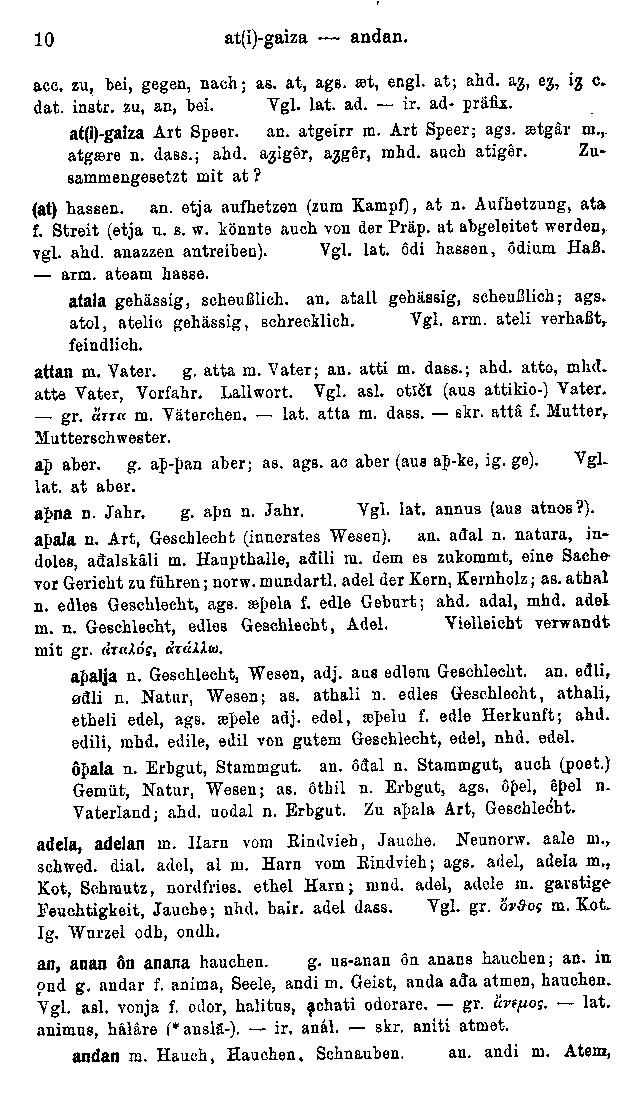
(at) hassen. an. etja aufhetzen (zum Kampf), at n. Aufhetzung, ata f. Streit (etja u. s. w. könnte auch von der Präp. at abgeleitet werden, vgl. ahd. anazzen antreiben). Vgl. lat. ôdi hassen, ôdium Haß. - arm. ateam hasse.
[Translate the German words]
|
Source: Torp, page b0024, entry 1 View original page image as: [TIFF] [PNG] [View previous entry] [View next entry] |
[Comment on this entry] [View comments] |
The following entry has been hand-corrected once. |
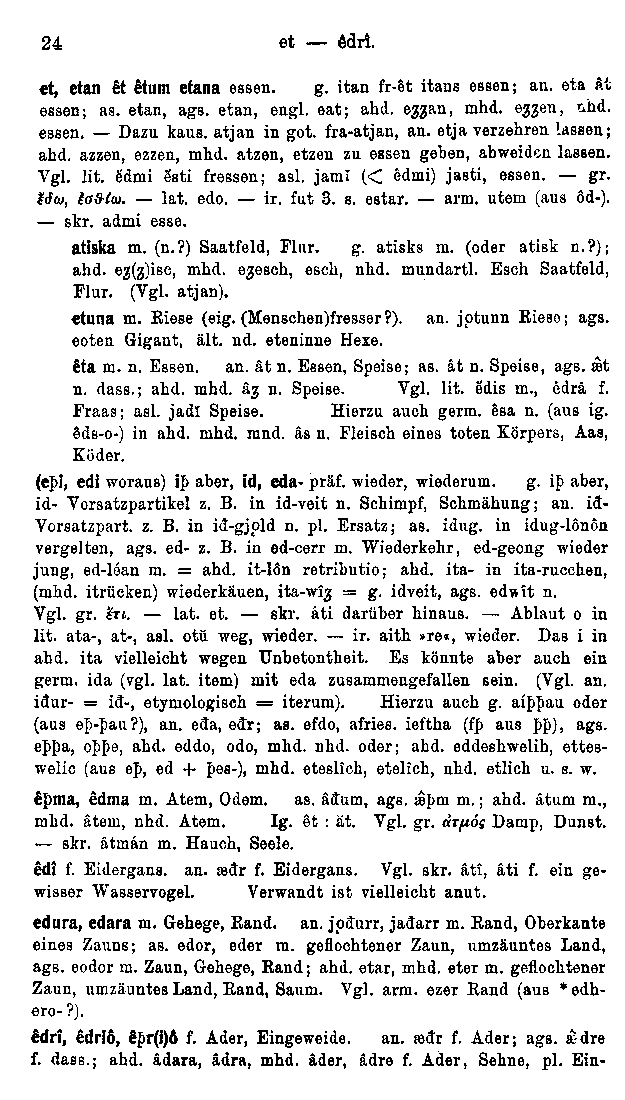
et,
etan
êt
êtum
etana
essen.
g.
itan
fr-êt
itans
essen;
an.
eta
ât
essen;
as.
etan,
ags.
etan,
engl.
eat;
ahd.
e&z-hook;&z-hook;an,
mhd.
e&z-hook;&z-hook;en,
nhd.
essen.
-
Dazu
kaus.
atjan
in
got.
fra-atjan,
an.
etja
verzehren
lassen;
ahd.
azzen,
ezzen,
mhd.
atzen,
etzen
zu
essen
geben,
abweiden
lassen.
Vgl.
lit.
 dmi
sti
fressen;
asl.
jam
dmi
sti
fressen;
asl.
jam (<
êdmi)
jasti,
essen.
-
gr.
[e)'dw,
e)sqi'w].
-
lat.
edo.
-
ir.
fut
3.
s.
estar.
-
arm.
utem
(aus
ôd-).
-
skr.
admi
esse.
(<
êdmi)
jasti,
essen.
-
gr.
[e)'dw,
e)sqi'w].
-
lat.
edo.
-
ir.
fut
3.
s.
estar.
-
arm.
utem
(aus
ôd-).
-
skr.
admi
esse.
[Translate the German words]
|
Source: Cleasby/Vigfusson, page b0008, entry 10 View original page image as: [TIFF] [PNG] [View previous entry] [View next entry] |
[Comment on this entry] [View comments] |
The following entry has been hand-corrected once. |
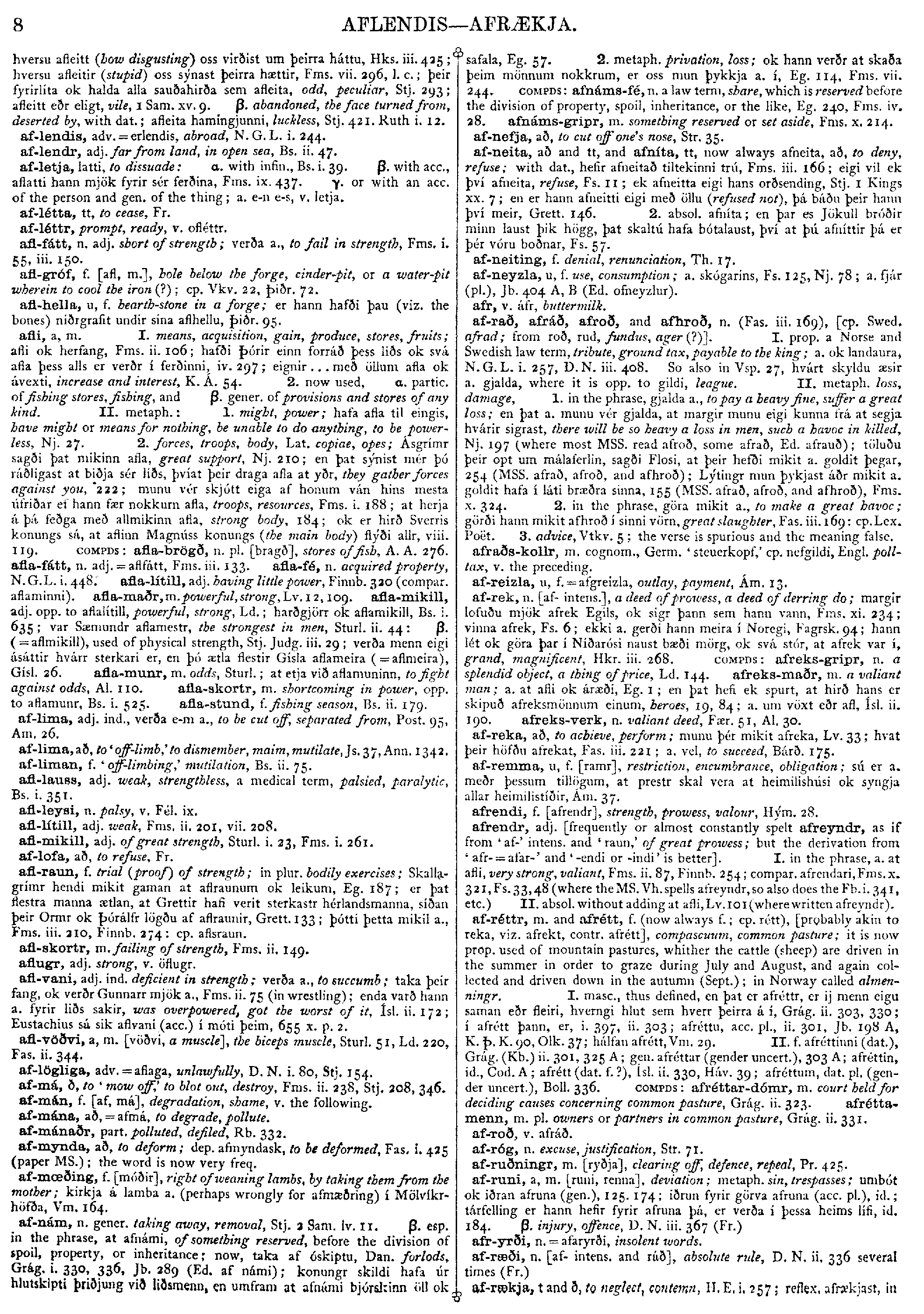
afli,
a,
m.
I.
means,
acquisition,
gain,
produce,
stores,
fruits;
afli
ok
herfang,
Fms.
ii.
106;
hafði
þórir
einn
forráð
þess
liðs
ok
svá
afla
þess
alls
er
verðr
í
ferðinni,
iv.
297;
eignir
...
með
öllum
afla
ok
ávexti,
increase
and
interest,
K.
Á.
54.
2.
now
used,
 .
partic.
of
fishing
stores,
fishing,
and
.
gener.
of
provisions
and
stores
of
any
kind.
II.
metaph.:
1.
might,
power;
hafa
afla
til
eingis,
have
might
or
means
for
nothing,
be
unable
to
do
anything,
to
be
power-
less,
Nj.
27.
2.
forces,
troops,
body,
Lat.
copiae,
opes;
Ásgrímr
sagði
þat
mikinn
afla,
great
support,
Nj.
210;
en
þat
sýnist
mér
þó
ráðligast
at
biðja
sér
liðs,
þvíat
þeir
draga
afla
at
yðr,
they
gather
forces
against
you,
222;
munu
vér
skjótt
eiga
af
honum
ván
hins
mesta
úfriðar
ef
hann
fær
nokkurn
afla,
troops,
resources,
Fms.
i.
188;
at
herja
á
þá
feðga
með
allmikinn
afia,
strong
body,
184;
ok
er
hirð
Sverris
konungs
sá,
at
aflinn
Magnúss
konungs
(the
main
body)
flýði
allr,
viii.
119.
COMPDS:
afla-brögð,
n.
pl.
[bragð],
stores
of
fish,
A.
A.
276.
afla-fátt,
n.
adj.
=
aflfátt,
Fms.
iii.
133.
afla-fé,
n.
acquired
property,
N.
G.
L.
i.
448.
afla-litill,
adj.
having
little
power,
Finnb.
320
(compar.
aflaminni).
afla-maðr,
m.
powerful,
strong,
Lv.
12,
109.
afla-mikill,
adj.
opp.
to
aflalítill,
powerful,
strong,
Ld.;
harðgjörr
ok
aflamikill,
Bs.
i.
635;
var
Sæmundr
afiamestr,
the
strongest
in
men,
Sturl.
ii.
44:
.
(=
aflmikill),
used
of
physical
strength,
Stj.
Judg.
iii.
29;
verða
menn
eigi
ásáttir
hvárr
sterkari
er,
en
þó
ætîa
flestir
Gísla
aflameira
(=
aflmeira),
GÍsl.
26.
afla-munr,
m.
odds,
Sturl.;
at
etja
við
aflamuninn,
to
fight
against
odds,
Al.
110.
afla-skortr,
m.
shortcoming
in
power,
opp.
to
aflamunr,
Bs.
i.
525.
afla-stund,
f.
fishing
season,
Bs.
ii.
.
partic.
of
fishing
stores,
fishing,
and
.
gener.
of
provisions
and
stores
of
any
kind.
II.
metaph.:
1.
might,
power;
hafa
afla
til
eingis,
have
might
or
means
for
nothing,
be
unable
to
do
anything,
to
be
power-
less,
Nj.
27.
2.
forces,
troops,
body,
Lat.
copiae,
opes;
Ásgrímr
sagði
þat
mikinn
afla,
great
support,
Nj.
210;
en
þat
sýnist
mér
þó
ráðligast
at
biðja
sér
liðs,
þvíat
þeir
draga
afla
at
yðr,
they
gather
forces
against
you,
222;
munu
vér
skjótt
eiga
af
honum
ván
hins
mesta
úfriðar
ef
hann
fær
nokkurn
afla,
troops,
resources,
Fms.
i.
188;
at
herja
á
þá
feðga
með
allmikinn
afia,
strong
body,
184;
ok
er
hirð
Sverris
konungs
sá,
at
aflinn
Magnúss
konungs
(the
main
body)
flýði
allr,
viii.
119.
COMPDS:
afla-brögð,
n.
pl.
[bragð],
stores
of
fish,
A.
A.
276.
afla-fátt,
n.
adj.
=
aflfátt,
Fms.
iii.
133.
afla-fé,
n.
acquired
property,
N.
G.
L.
i.
448.
afla-litill,
adj.
having
little
power,
Finnb.
320
(compar.
aflaminni).
afla-maðr,
m.
powerful,
strong,
Lv.
12,
109.
afla-mikill,
adj.
opp.
to
aflalítill,
powerful,
strong,
Ld.;
harðgjörr
ok
aflamikill,
Bs.
i.
635;
var
Sæmundr
afiamestr,
the
strongest
in
men,
Sturl.
ii.
44:
.
(=
aflmikill),
used
of
physical
strength,
Stj.
Judg.
iii.
29;
verða
menn
eigi
ásáttir
hvárr
sterkari
er,
en
þó
ætîa
flestir
Gísla
aflameira
(=
aflmeira),
GÍsl.
26.
afla-munr,
m.
odds,
Sturl.;
at
etja
við
aflamuninn,
to
fight
against
odds,
Al.
110.
afla-skortr,
m.
shortcoming
in
power,
opp.
to
aflamunr,
Bs.
i.
525.
afla-stund,
f.
fishing
season,
Bs.
ii.
|
Source: Cleasby/Vigfusson, page b0021, entry 11 View original page image as: [TIFF] [PNG] [View previous entry] [View next entry] |
[Comment on this entry] [View comments] |
The following entry has been hand-corrected once. |
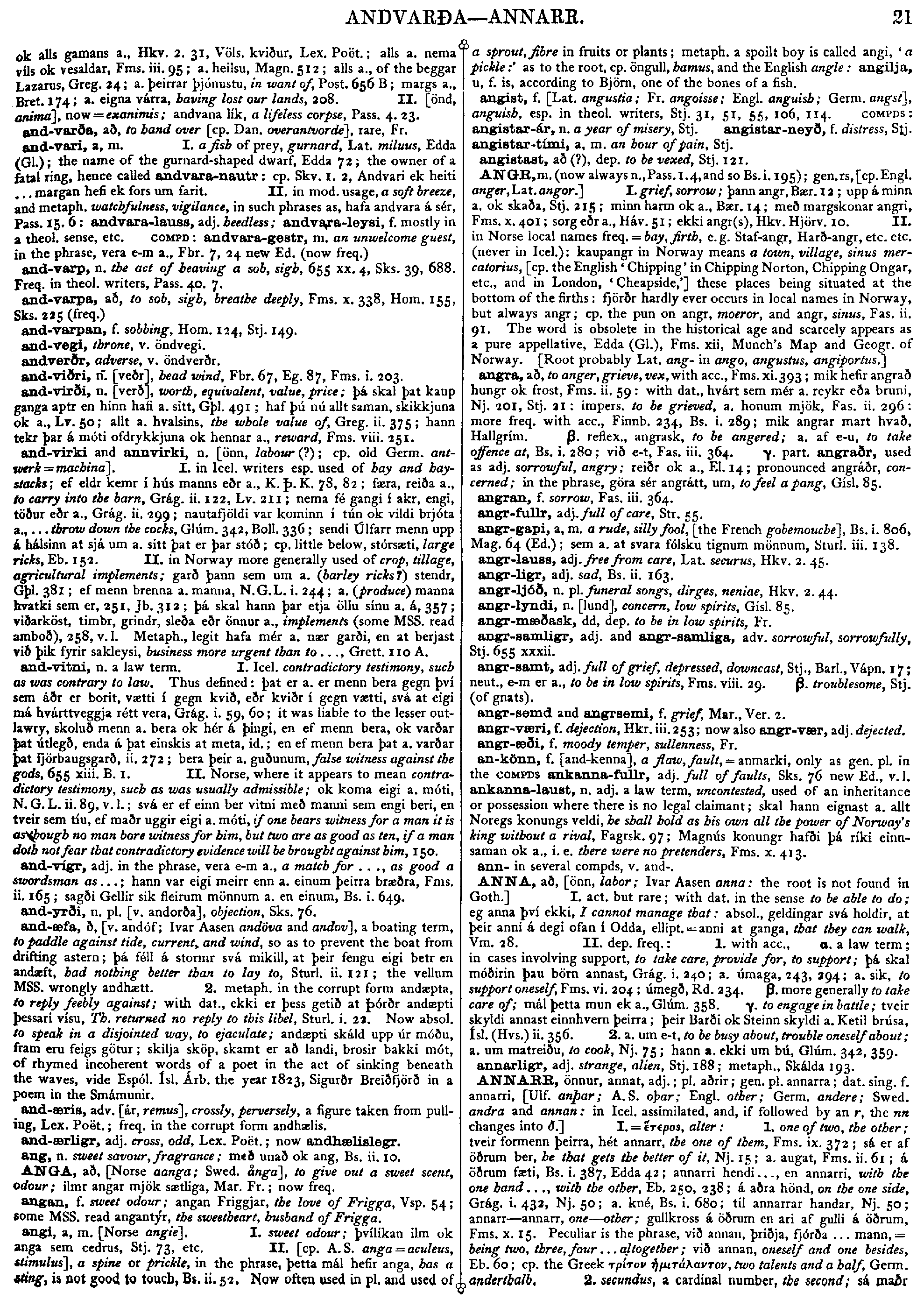
and-virki and annvirki, n. [önn, labour (?); cp. old Germ, ant- werk = machina]. I. in Icel. writers esp. used of bay and bay- stacks; ef eldr kemr í hús manns eðr a., K. Þ. K. 78, 82; færa, reiða a., to carry into the barn, Grág. ii. 122, Lv. 211; nema fé gangi í akr, engi, töður eðr a., Grág. ii. 299; nautafjöldi var kominn í tún ok vildi brjóta a., ... throw down the cocks, Glúm. 342, Boll. 336; sendi Úlfarr menn upp á hálsinn at sjá um a. sitt þat er þar stóð; cp. little below, stórsæti, large ricks, Eb. 152. II. in Norway more generally used of crop, tillage, agricultural implements; garð þann sem um a. (barley ricks? ) stendr, Gþl. 381; ef menn brenna a. manna, N. G. L. i. 244; a. (produce) manna hvatki sem er, 251, Jb. 312; þá skal hann þar etja öllu sinu a. á, 357; viðarköst, timbr, grindr, sleða eðr önnur a., implements (some MSS. read amboð), 258, v. l. Metaph., legit hafa mér a. nær garði, en at berjast við þik fyrir sakleysi, business more urgent than to ..., Grett. 110 A.
|
Source: Cleasby/Vigfusson, page b0029, entry 3 View original page image as: [TIFF] [PNG] [View previous entry] [View next entry] |
[Comment on this entry] [View comments] |
The following entry has been hand-corrected once. |
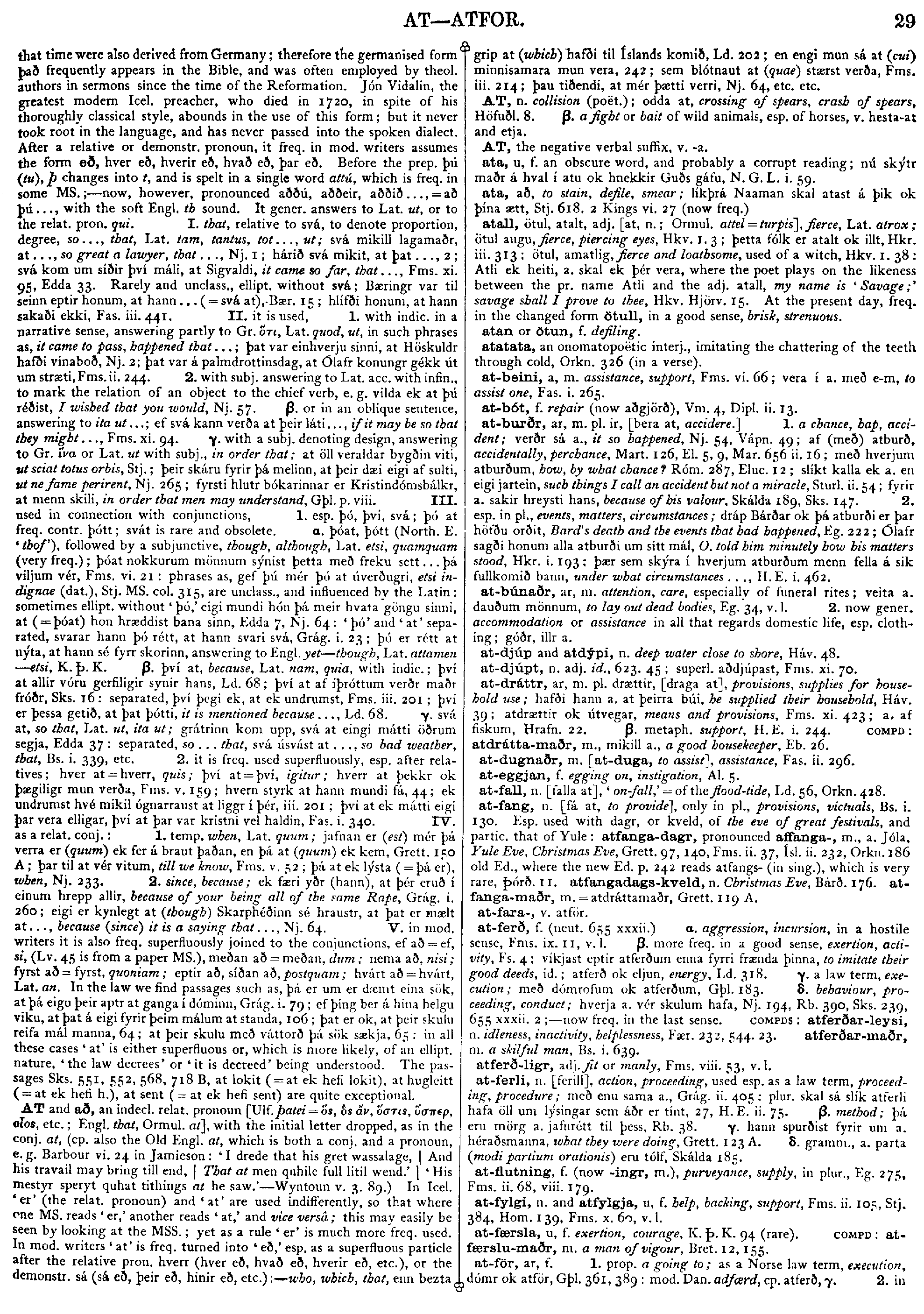
AT,
n.
collision
(poet.);
odda
at,
crossing
of
spears,
crash
of
spears,
Höfuðl.
8.
.
a
fight
or
bait
of
wild
animals,
esp.
of
horses,
v.
hesta-at
and
etja.
|
Source: Cleasby/Vigfusson, page b0091, entry 31 View original page image as: [TIFF] [PNG] [View previous entry] [View next entry] |
[Comment on this entry] [View comments] |
The following entry has been hand-corrected once. |
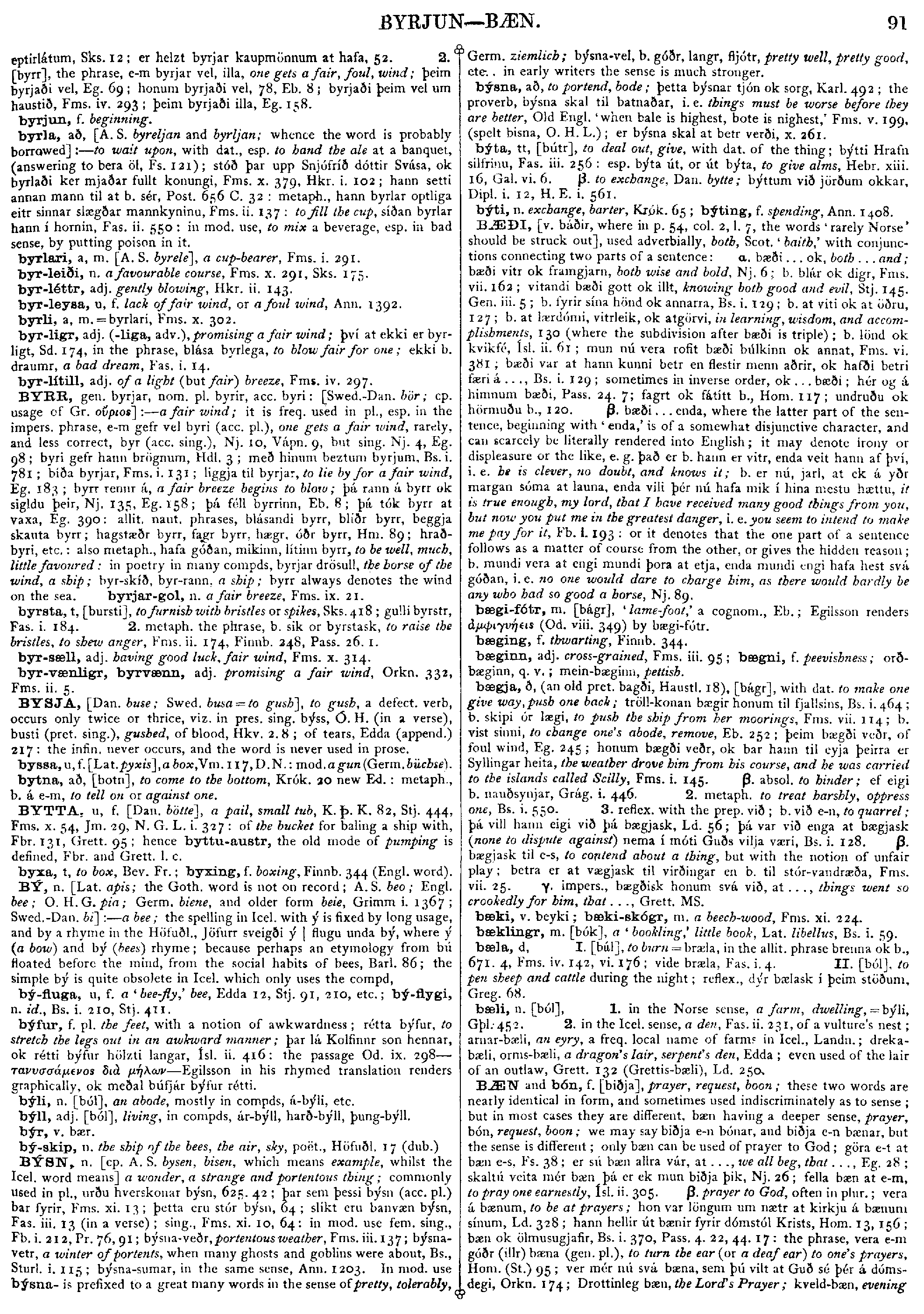
BÆÐI,
[v.
báðir,
where
in
p.
54,
col.
2,
1.
7,
the
words
'rarely
Norse'
should
be
struck
out],
used
adverbially,
both,
Scot.
'
baithh,
'with
conjunctions
connecting
two
parts
of
a
sentence:
a.
bæði,
...
ok,
both
...
and;
bæði
vitr
ok
framgjarn,
both
wise
and
bold,
Nj.
6;
b.
blár
ok
digr,
Fms.
vii.
162;
vitandi
bœði
gott
ok
illt,
knowing
both
good
and
evil,
Stj.
145.
Gen.
iii.
5;
b.
fyrir
sína
hönd
ok
annarra,
Bs.
i.
129;
b.
at
viti
ok
at
öðru,
127;
b.
at
lærdómi,
vitrleik,
ok
atgörvi,
in
learning,
wisdom,
and
accom-
plishments,
130
(where
the
subdivision
after
bæði
is
triple);
b.
lönd
ok
kvikfé,
Ísl.
ii.
61;
mun
nú
vera
rofit
bæði
búlkinn
ok
annat,
Fms.
vi.
381;
bæði
var
at
hann
kunni
betr
en
flestir
menn
aðrir,
ok
hafði
betri
færi
á
...,
Bs.
i.
129;
sometimes
in
inverse
order,
ok
...
bæði;
hér
og
á
himnum
bæði,
Pass.
24.
7;
fagrt
ok
fátítt
b.,
Hom.
117;
undruðu
ok
hörmuðu
b.,
120.
.
bæði...
enda,
where
the
latter
part
of
the
sen-
tence,
beginning
with
'enda,'
is
of
a
somewhat
disjunctive
character,
and
can
scarcely
be
literally
rendered
into
English;
it
may
denote
irony
or
displeasure
or
the
like,
e.
g.
það
er
b.
hann
er
vitr,
enda
veit
hann
af
því,
i.e.
he
is
clever,
no
doubt,
and
knows
it;
b.
er
nú,
jarl,
at
ek
á
yðr
margan
sóma
at
launa,
enda
vili
þér
nú
hafa
mik
í
hina
mestu
hættu,
it
is
true
enough,
my
lord,
that
I
have
received
many
good
things
from
you,
but
now
you
put
me
in
the
greatest
danger,
i.
e.
you
seem
to
intend
to
make
me
pay
for
it,
Fb.
i.
193:
or
it
denotes
that
the
one
part
of
a
sentence
follows
as
a
matter
of
course
from
the
other,
or
gives
the
hidden
reason;
b.
mundi
vera
at
engi
mundi
þora
at
etja,
enda
mundi
engi
hafa
hest
svá
góðan,
i.
e.
no
one
would
dare
to
charge
him,
as
there
would
hardly
be
any
who
had
so
good
a
horse,
Nj.
89.
|
Source: Cleasby/Vigfusson, page b0167, entry 17 View original page image as: [TIFF] [PNG] [View previous entry] [View next entry] |
[Comment on this entry] [View comments] |
The following entry has been hand-corrected once. |
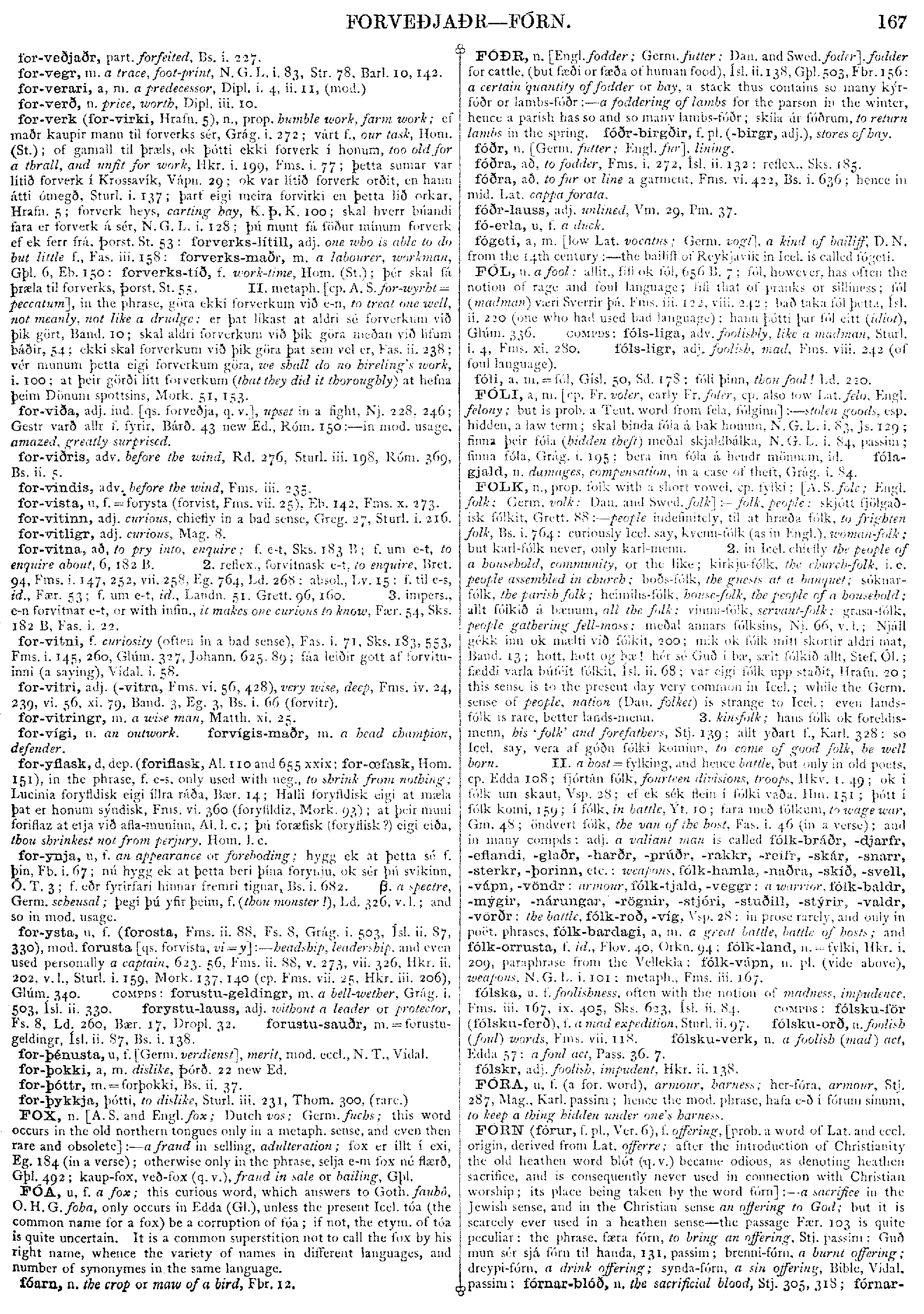
for-yflask, d, dep. (foriflask, Al. 110 and 655 xxix; for-œfask, Hom. 151), in the phrase, f. e-s, only used with neg., to shrink from nothing; Lucinia foryfldisk eigi íllra ráða, Bær. 14; Halli foryfldisk eigi at mæla þat er honum sýndisk, Fms. vi. 360 (foryfildiz, Mork. 93); at þeir muni foriflaz at etja við afla-muninn, Al. l.c.; þú foræfisk (foryflisk?) eigi eiða, thou shrinkest not from perjury, Hom. l.c.
|
Source: Cleasby/Vigfusson, page b0236, entry 7 View original page image as: [TIFF] [PNG] [View previous entry] [View next entry] |
[Comment on this entry] [View comments] |
The following entry has been hand-corrected once. |
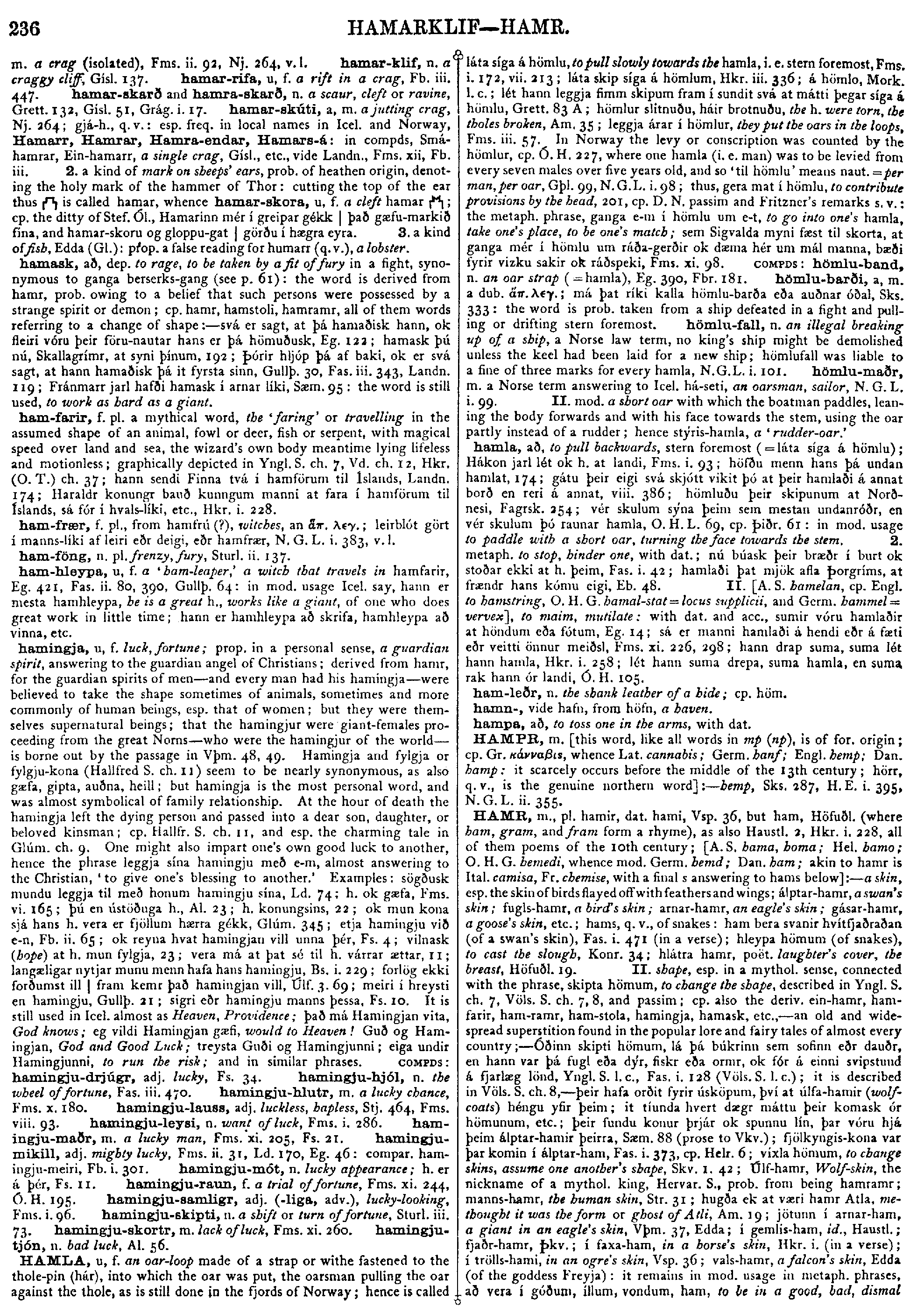
hamingja, u, f. luck, fortune; prop. in a personal sense, a guardian spirit, answering to the guardian angel of Christians; derived from hamr, for the guardian spirits of men -- and every man had his hamingja -- were believed to take the shape sometimes of animals, sometimes and more commonly of human beings, esp. that of women; but they were themselves supernatural beings; that the hamingjur were giant-females proceeding from the great Norns -- who were the hamingjur of the world -- is borne out by the passage in Vþm. 48, 49. Hamingja and fylgja or fylgju-kona (Hallfred S. ch. 11) seem to be nearly synonymous, as also gæfa, gipta, auðna, heill; but hamingja is the most personal word, and was almost symbolical of family relationship. At the hour of death the hamingja left the dying person and passed into a dear son, daughter, or beloved kinsman; cp. Hallfr. S. ch. 11, and esp. the charming tale in Glúm. ch. 9. One might also impart one's own good luck to another, hence the phrase leggja sína hamingju með e-m, almost answering to the Christian, 'to give one's blessing to another.' Examples: sögðusk mundu leggja til með honum hamingju sína, Ld. 74; h. ok gæfa, Fms. vi. 165; þú en ústöðuga h., Al. 23; h. konungsins, 22; ok mun kona sjá hans h. vera er fjöllum hærra gékk, Glúm. 345; etja hamingju við e-n, Fb. ii. 65; ok reyna hvat hamingjan vill unna þér, Fs. 4; vilnask (hope) at h. mun fylgja, 23; vera má at þat sé til h. várrar ættar, 11; langæligar nytjar munu menn hafa hans hamingju, Bs. i. 229; forlög ekki forðumst ill | fram kemr það hamingjan vill, Úlf. 3. 69; meiri í hreysti en hamingju, Gullþ. 21; sigri eðr hamingju manns þessa, Fs. 10. It is still used in Icel. almost as Heaven, Providence; það má Hamingjan vita, God knows; eg vildi Hamingjan gæfi, would to Heaven! Guð og Hamingjan, God and Good Luck; treysta Guði og Hamingjunni; eiga undir Hamingjunni, to run the risk; and in similar phrases. COMPDS: hamingju-drjúgr, adj. lucky, Fs. 34. hamingju-hjól, n. the wheel of fortune, Fas. iii. 470. hamingju-hlutr, m. a lucky chance, Fms. x. 180. hamingju-lauss, adj. luckless, hapless, Stj. 464, Fms. viii. 93. hamingju-leysi, n. want of luck, Fms. i. 286. hamingju-maðr, m. a lucky man, Fms. xi. 205, Fs. 21. hamingju-mikill, adj. mighty lucky, Fms. ii. 31, Ld. 170, Eg. 46: compar. hamingju-meiri, Fb. i. 301. hamingju-mót, n. lucky appearance; h. er á pér, Fs. 11. hamingju-raun, f. a trial of fortune, Fms. xi. 244, Ó. H. 195. hamingju-samligr, adj. (-liga, adv.), lucky-looking, Fms. i. 96. hamingju-skipti, n. a shift or turn of fortune, Sturl. iii. 73. hamingju-skortr, m. lack of luck, Fms. xi. 260. hamingju-tjón, n. bad luck, Al. 56.
| Result Page: | 1 2 | Next |  |
Germanic Lexicon Project (main page)
This search system was written by
Sean Crist
Please consider
volunteering
to correct the data in these online dictionaries.
No rights reserved. Feel free to use these data in any way you please.