|
|

Search for er again, using less strict matching (3706 results)
|
Source: Bosworth/Toller, page b0527, entry 26 View original page image as: [TIFF] [PNG] [View previous entry] [View next entry] |
[Comment on this entry] [View comments] |
The following entry has been hand-corrected once. |
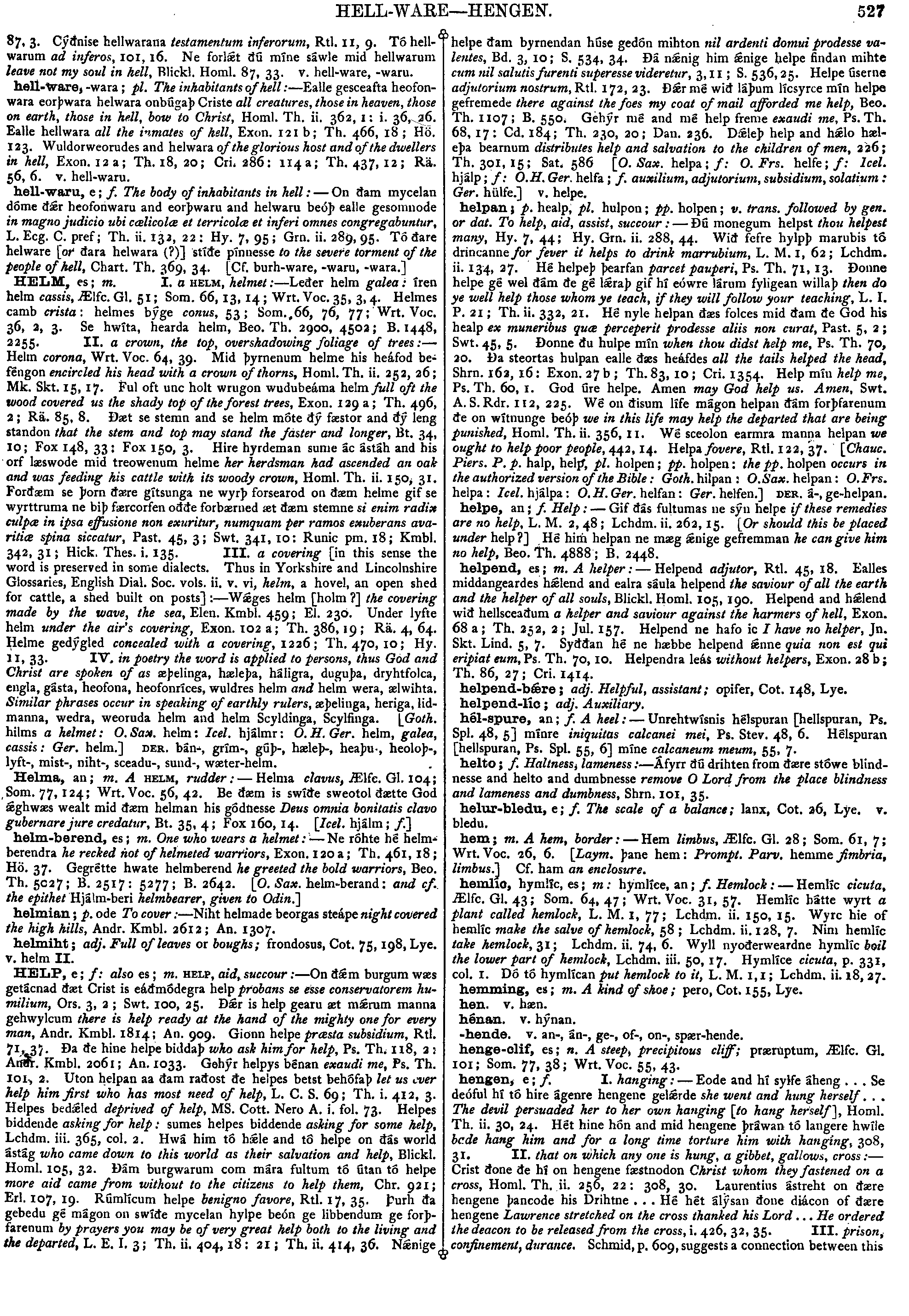
hengen,
e;
f.
I.
hanging
:--
Eode
and
hí
sylfe
áheng
...
Se
deóful
hí
tó
hire
ágenre
hengene
gel rde
she
went
and
hung
herself
...
The
devil
persuaded
her
to
her
own
hanging
[to
hang
herself],
Homl.
Th,
ii.
30,
24.
Hét
hine
hón
and
mid
hengen
þráwan
tó
langere
hwíle
bade
hang
him
and
for
a
long
time
torture
him
with
hanging,
308,
31.
II.
that
on
which
any
one
is
hung,
a
gibbet,
gallows,
cross
:--
Crist
ðone
ðe
hí
on
hengene
fæstnodon
Christ
whom
they
fastened
on
a
cross,
Homl.
Th.
ii.
256,
22:
308,
30.
Laurentius
ástreht
on
ðære
hengen
þancode
his
Drihtne
...
Hé
hét
álýsan
ðone
diácon
of
ðære
hengene
Lawrence
stretched
on
the
cross
thanked
his
Lord
...
He
ordered
the
deacon
to
be
released
from
the
cross,
i.
426,
32,
35.
III.
prison,
confinement,
durance.
Schmid,
p.
609,
suggests
a
connection
between
this
meaning
and
that
given
under
I.
in
the
following
remark:
'Die
grammatische
Bedeutung
des
Wortes
fürht
darauf,
dass
ursprünglich
darunter
das
Anhängen
an
einen
Block
oder
das
Einspannen
in
den
Stock,
als
die
Art
der
Sicherung
eines
Gefangenen,
der
man
sich
bediente,
wenn
Gefängnisse
fehlten,
verstanden
worden
sei.'
Accordingly
he
translates
the
following
passage,
L.
Alf.
pol.
35;
Th.
i.
84,
4
:--
Gif
hé
hine
on
hengenne
[MS.
B.
hengene]
álecgge
'wenn
er
ihn
in
den
Stock
legt,'
which
Thorpe
renders
if
he
lay
him
in
prison.
In
the
latter
sense
it
is
found
L.
C.
S.
35;
Th.
i.
396,
27
:--
Gif
freóndleás
man
swá
geswenced
weorþe
ðæt
hé
borh
næbbe
ðonne
gebúge
hé
hengenne
[MS.
B.
hengene]
and
ðr
gebíde
óþ
ðæt
hé
gá
tó
Godes
ordále
if
a
friendless
man
be
so
distressed
that
he
have
no
surety,
then
let
him
submit
to
prison,
and
there
abide,
until
he
go
to
God's
ordeal.
Cf.
L.
H.
65,
5;
Th.
i.
568,
14,
ponatur
in
hengen.
[Cf.
O.
Sax.
hie
(Krist)
welda
thesa
werold
alla
mid
is
henginnia
alósian,
Hel.
Heyne
5435:
thuo
sprak
theró
maunó
óðer
(the
penitent
thief)
an
thero
benginna
thár
hie
geheftid
stuod,
5591.]
rde
she
went
and
hung
herself
...
The
devil
persuaded
her
to
her
own
hanging
[to
hang
herself],
Homl.
Th,
ii.
30,
24.
Hét
hine
hón
and
mid
hengen
þráwan
tó
langere
hwíle
bade
hang
him
and
for
a
long
time
torture
him
with
hanging,
308,
31.
II.
that
on
which
any
one
is
hung,
a
gibbet,
gallows,
cross
:--
Crist
ðone
ðe
hí
on
hengene
fæstnodon
Christ
whom
they
fastened
on
a
cross,
Homl.
Th.
ii.
256,
22:
308,
30.
Laurentius
ástreht
on
ðære
hengen
þancode
his
Drihtne
...
Hé
hét
álýsan
ðone
diácon
of
ðære
hengene
Lawrence
stretched
on
the
cross
thanked
his
Lord
...
He
ordered
the
deacon
to
be
released
from
the
cross,
i.
426,
32,
35.
III.
prison,
confinement,
durance.
Schmid,
p.
609,
suggests
a
connection
between
this
meaning
and
that
given
under
I.
in
the
following
remark:
'Die
grammatische
Bedeutung
des
Wortes
fürht
darauf,
dass
ursprünglich
darunter
das
Anhängen
an
einen
Block
oder
das
Einspannen
in
den
Stock,
als
die
Art
der
Sicherung
eines
Gefangenen,
der
man
sich
bediente,
wenn
Gefängnisse
fehlten,
verstanden
worden
sei.'
Accordingly
he
translates
the
following
passage,
L.
Alf.
pol.
35;
Th.
i.
84,
4
:--
Gif
hé
hine
on
hengenne
[MS.
B.
hengene]
álecgge
'wenn
er
ihn
in
den
Stock
legt,'
which
Thorpe
renders
if
he
lay
him
in
prison.
In
the
latter
sense
it
is
found
L.
C.
S.
35;
Th.
i.
396,
27
:--
Gif
freóndleás
man
swá
geswenced
weorþe
ðæt
hé
borh
næbbe
ðonne
gebúge
hé
hengenne
[MS.
B.
hengene]
and
ðr
gebíde
óþ
ðæt
hé
gá
tó
Godes
ordále
if
a
friendless
man
be
so
distressed
that
he
have
no
surety,
then
let
him
submit
to
prison,
and
there
abide,
until
he
go
to
God's
ordeal.
Cf.
L.
H.
65,
5;
Th.
i.
568,
14,
ponatur
in
hengen.
[Cf.
O.
Sax.
hie
(Krist)
welda
thesa
werold
alla
mid
is
henginnia
alósian,
Hel.
Heyne
5435:
thuo
sprak
theró
maunó
óðer
(the
penitent
thief)
an
thero
benginna
thár
hie
geheftid
stuod,
5591.]
|
Source: Bosworth/Toller, page b0550, entry 2 View original page image as: [TIFF] [PNG] [View previous entry] [View next entry] |
[Comment on this entry] [View comments] |
The following entry has been hand-corrected once. |
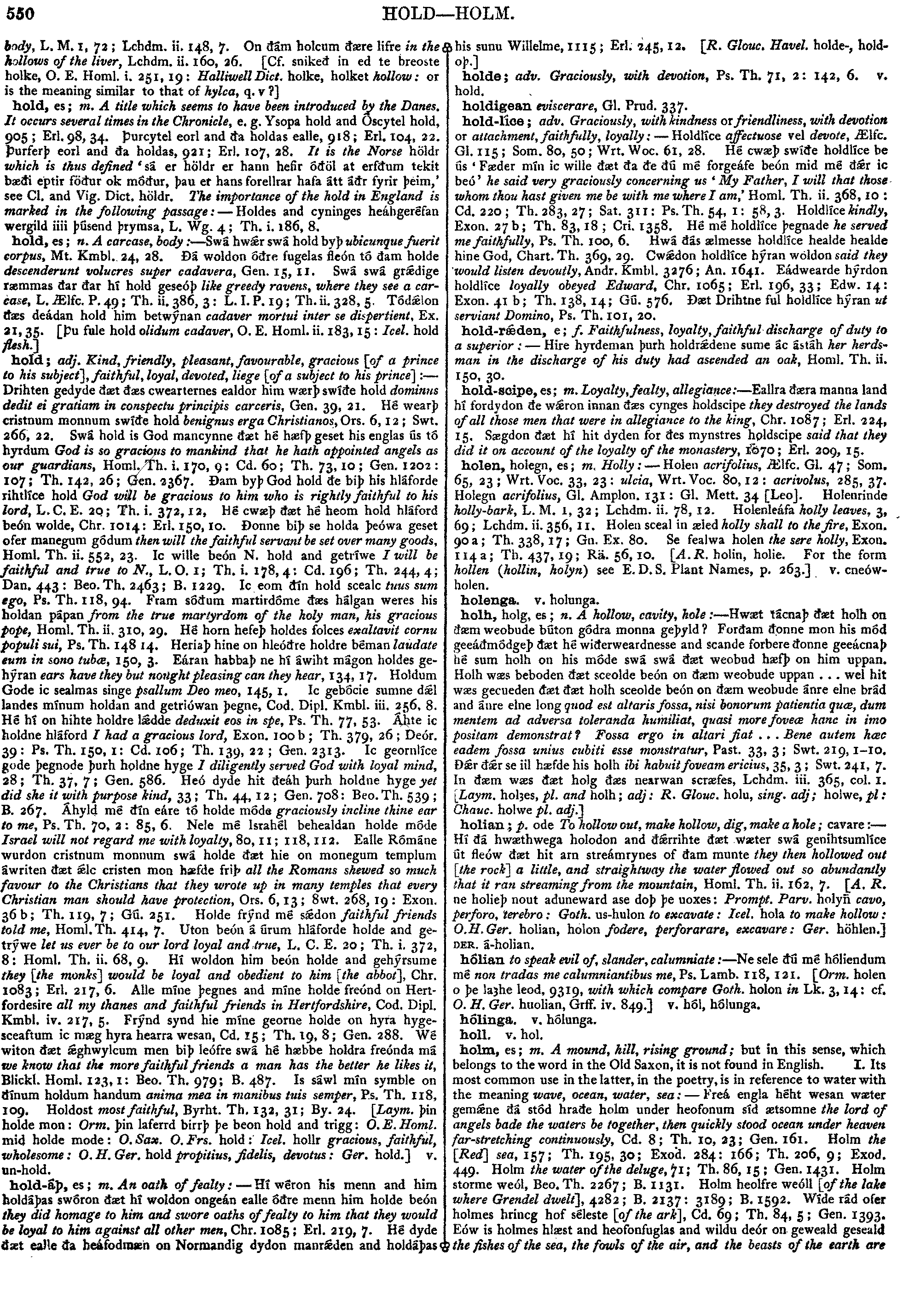
hold, es; m. A title which seems to have been introduced by the Danes. It occurs several times in the Chronicle, e.g. Ysopa hold and Óscytel hold, 905; Erl. 98, 34. Þurcytel eorl and ða holdas ealle, 918; Erl. 104, 22. Þurferþ eorl and ða holdas, 921; Erl. 107, 28. It is the Norse höldr which is thus defined 'sá er höldr er hann hefir óðöl at erfðum tekit bæði eptir föður ok möður, þau er bans forellrar hafa átt áðr fyrir þéim,' see Cl. and Vig. Dict. höldr. The importance of the hold in England is marked in the following passage :-- Holdes and cyninges heáhgeréfan wergild iiii þúsend þrymsa, L. Wg. 4; Th. i. 186, 8.
|
Source: Bosworth/Toller, page b0556, entry 34 View original page image as: [TIFF] [PNG] [View previous entry] [View next entry] |
[Comment on this entry] [View comments] |
The following entry has been hand-corrected once. |
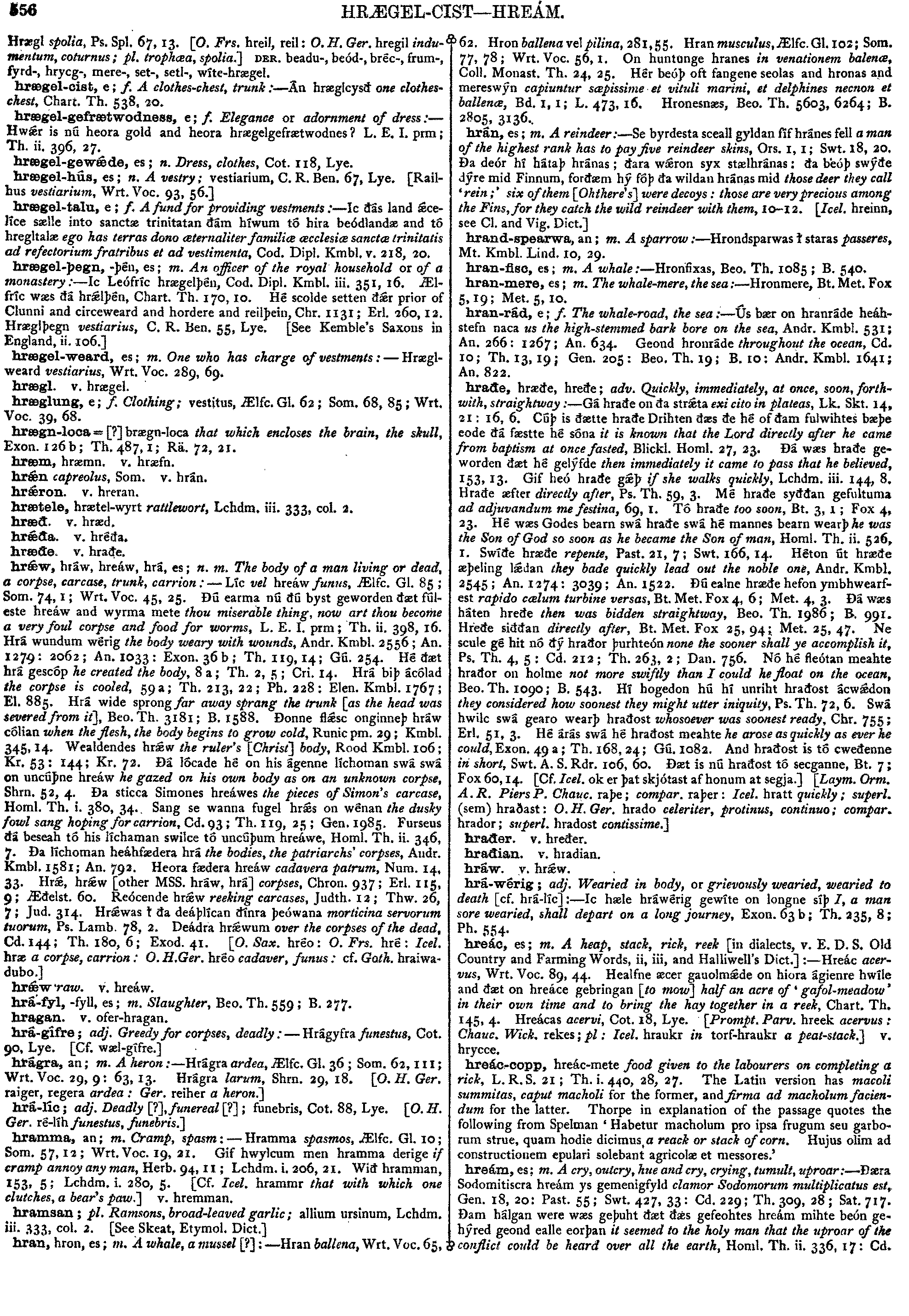
hraðe,
hræðe,
hreðe;
adv.
Quickly,
immediately,
at
once,
soon,
forthwith,
straightway
:--
Gá
hraðe
on
ða
strta
exi
cito
in
plateas,
Lk.
Skt.
14,
21:
16,
6.
Cúþ
is
ðætte
hraðe
Drihten
ðæs
ðe
hé
of
ðam
fulwihtes
bæþe
eode
ðá
fæstte
hé
sóna
it
is
known
that
the
Lord
directly
after
he
came
from
baptism
at
once
fasted,
Blickl.
Homl.
27,
23.
Ðá
wæs
hraðe
geworden
ðæt
hé
gelýfde
then
immediately
it
came
to
pass
that
he
believed,
153,
13.
Gif
heó
hraðe
gþ
if
she
walks
quickly,
Lchdm.
iii.
144,
8.
Hraðe
æfter
directly
after,
Ps.
Th.
59,
3.
Mé
hraðe
syððan
gefultuma
ad
adjuvandum
me
festina,
69,
1.
Tó
hraðe
too
soon,
Bt.
3,
1;
Fox
4,
23.
He
wæs
Godes
bearn
swá
hraðe
swá
he
mannes
bearn
wearþ
he
was
the
Son
of
God
so
soon
as
he
became
the
Son
of
man,
Homl.
Th.
ii.
526,
1.
Swíðe
hræðe
repente,
Past.
21,
7;
Swt.
166,
14.
Héton
út
hræðe
æþeling
ldan
they
bade
quickly
lead
out
the
noble
one,
Andr.
Kmbl.
2545;
An.
1274:
3039;
An.
1522.
Ðú
ealne
hræðe
hefon
ymbhwearfest
rapido
cælum
turbine
versas,
Bt.
Met.
Fox
4,
6;
Met.
4,
3.
Ðá
wæs
háten
hreðe
then
was
bidden
straightway,
Beo.
Th.
1986;
B.
991.
Hreðe
siððan
directly
after,
Bt.
Met.
Fox
25,
94;
Met.
25,
47.
Ne
scule
gé
hit
nó
ðý
hraðor
þurhteón
none
the
sooner
shall
ye
accomplish
it,
Ps.
Th.
4,
5:
Cd.
212;
Th.
263,
2;
Dan.
756.
No
hé
fleótan
meahte
hraðor
on
holme
not
more
swiftly
than
I
could
he
float
on
the
ocean,
Beo.
Th.
1090;
B.
543.
Hí
hogedon
hú
hí
unriht
hraðost
ácwdon
they
considered
how
soonest
they
might
utter
iniquity,
Ps.
Th.
72,
6.
Swá
hwilc
swá
gearo
wearþ
hraðost
whosoever
was
soonest
ready,
Chr.
755;
Erl.
51,
3.
Hé
árás
swá
hé
hraðost
meahte
he
arose
as
quickly
as
ever
he
could,
Exon.
49
a;
Th.
168,
24;
Gú.
1082.
And
hraðost
is
tó
cweðenne
in
short,
Swt.
A.
S.
Rdr.
106,
60.
Ðæt
is
nú
hraðost
tó
secganne.
Bt.
7;
Fox
60,
14.
[Cf.
Icel.
ok
er
þat
skjótast
af
honum
at
segja.]
[Laym.
Orm.
A.
R.
Piers
P.
Chauc.
raþe;
compar.
raþer:
Icel.
hratt
quickly;
superl.
(sem)
hraðast:
O.
H.
Ger.
hrado
celeriter,
protinus,
continuo;
compar.
hrador;
superl.
hradost
contissime.]
|
Source: Bosworth/Toller, page b0599, entry 16 View original page image as: [TIFF] [PNG] [View previous entry] [View next entry] |
[Comment on this entry] [View comments] |
The following entry has been hand-corrected once. |
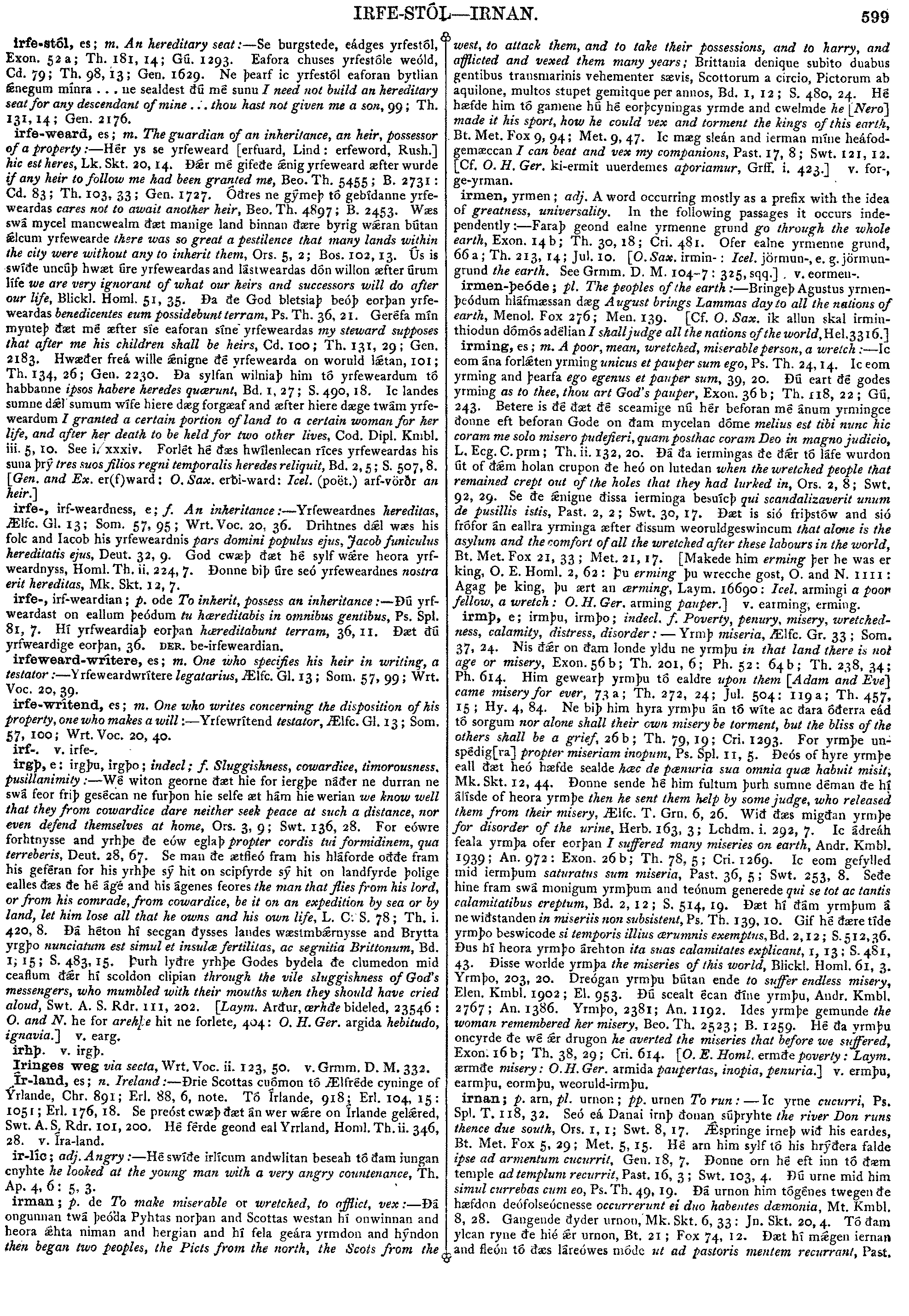
irming,
es
;
m.
A
poor,
mean,
wretched,
miserable
person,
a
wretch
:--
Ic
eom
ána
forlten
yrming
unicus
et
pauper
sum
ego,
Ps.
Th.
24,
14.
Ic
eom
yrming
and
þearfa
ego
egenus
et
pauper
sum,
39,
20.
Ðú
eart
ðé
godes
yrming
as
to
thee,
thou
art
God's
pauper,
Exon.
36
b;
Th.
118,
22;
Gú.
243.
Betere
is
ðé
ðæt
ðé
sceamige
nú
hér
beforan
mé
ánum
yrmingce
ðonne
eft
beforan
Gode
on
ðam
mycelan
dóme
melius
est
tibi
nunc
hic
coram
me
solo
misero
pudefieri,
quam
posthac
coram
Deo
in
magno
judicio,
L.
Ecg.
C.
prm
;
Th,
ii.
132,
20.
Ðá
ða
iermingas
ðe
ðr
tó
láfe
wurdon
út
of
ðm
holan
crupon
ðe
heó
on
lutedan
when
the
wretched
people
that
remained
crept
out
of
the
holes
that
they
had
lurked
in,
Ors.
2,
8;
Swt.
92,
29.
Se
ðe
nigne
ðissa
ierminga
besuícþ
qui
scandalizaverit
unum
de
pusillis
istis,
Past.
2,
2
;
Swt.
30,
17.
Ðæt
is
sió
friþstów
and
sió
frófor
án
eallra
yrminga
æfter
ðissum
weoruldgeswincum
that
alone
is
the
asylum
and
the
comfort
of
all
the
wretched
after
these
labours
in
the
world,
Bt.
Met.
Fox
21,
33
;
Met.
21,
17.
[Makede
him
erming
þer
he
was
er
king,
O.
E.
Homl.
2,
62
:
Þu
erming
þu
wrecche
gost,
O.
and
N.
1111
:
Agag
þe
king,
þu
ært
an
ærming,
Laym.
16690
:
Icel.
armingi
a
poor
fellow,
a
wretch
:
O.
H.
Ger.
arming
pauper.]
v.
earming-,
erming.
|
Source: Bosworth/Toller, page b0604, entry 13 View original page image as: [TIFF] [PNG] [View previous entry] [View next entry] |
[Comment on this entry] [View comments] |
The following entry has been hand-corrected once. |
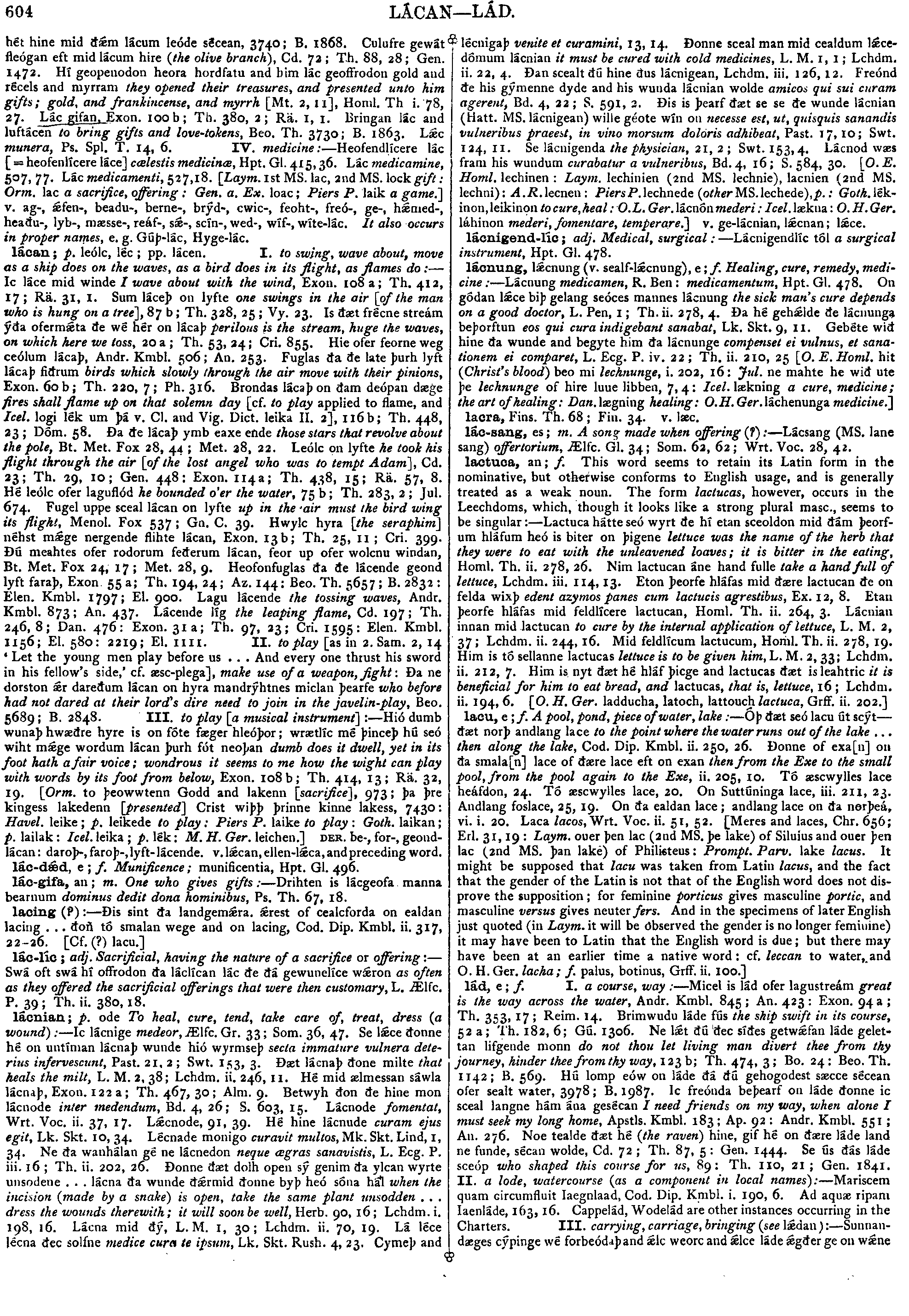
lád,
e;
f.
I.
a
course,
way
:--
Micel
is
lád
ofer
lagustreám
great
is
the
way
across
the
water,
Andr.
Kmbl.
845;
An.
423:
Exon.
94
a;
Th.
353,
17;
Reim.
14.
Brimwudu
láde
fús
the
ship
swift
in
its
course,
52
a;
Th.
182,
6;
Gú.
1306.
Ne
lt
ðú
ðec
síðes
getwfan
láde
gelettan
lifgende
monn
do
not
thou
let
living
man
divert
thee
from
thy
journey,
hinder
thee
from
thy
way,
123
b;
Th.
474,
3;
Bo.
24:
Beo.
Th.
1142
;
B.
569.
Hú
lomp
eów
on
láde
ðá
ðú
gehogodest
sæcce
sécean
ofer
sealt
water,
3978;
B.
1987.
Ic
freónda
beþearf
on
láde
ðonne
ic
sceal
langne
hám
ána
gesécan
I
need
friends
on
my
way,
when
alone
I
must
seek
my
long
home,
Apstls.
Kmbl.
183;
Ap.
92:
Andr.
Kmbl.
551;
An.
276.
Noe
tealde
ðæt
hé
(the
raven)
hine,
gif
hé
on
ðære
láde
land
ne
funde,
sécan
wolde,
Cd.
72;
Th.
87,
5:
Gen.
1444.
Se
ús
ðás
láde
sceóp
who
shaped
this
course
for
us,
89:
Th.
110,
21;
Gen.
1841.
II.
a
lode,
watercourse
(as
a
component
in
local
names)
:--
Mariscem
quam
circumfluit
Iaegnlaad,
Cod.
Dip.
Kmbl.
i.
190,
6.
Ad
aquæ
ripam
Iaenláde,
163,
16.
Cappelád,
Wodelád
are
other
instances
occurring
in
the
Charters.
III.
carrying,
carriage,
bringing
(see
ldan)
:--
Sunnandæges
cýpinge
wé
forbeódaþand
lc
weorc
and
lce
láde
gðer
ge
on
wne
ge
on
horse
ge
on
byrdene
we
forbid
Sunday
traffic
and
all
work
and
all
carrying
(of
goods,
&c.)
both
by
waggon
and
by
horse
and
by
the
man
himself,
L.
N.
P.
L.
55;
Th.
ii.
298,
22.
[The
word
lád
in
this
passage
can
hardly
be
translated
'journeying
;'
for,
in
the
first
place,
such
a
meaning
does
not
well
suit
the
phrase
on
byrdene,
and,
next,
some
journeying
was
allowed.
Thus,
L.
E.
I.
24;
Th.
ii.
420,
21-,
it
is
said
no
secular
work
was
to
be
done
'bútan
hwam
gebyrige
ðæt
hé
nýde
faran
scyle;
ðonne
mót
hé
swá
rídan
swá
rówan
swá
swilce
færelde
faran
swylce
tó
his
wege
gehyrige.'
The
threefold
division
of
the
means
of
carriage
seems
to
be
that
found
in
the
Icelandic
law
where,
dealing
with
the
observance
of
Sunday,
it
is
said
of
the
amount
that
might
be
carried
in
journeying
on
that
day
'er
rétt
at
bera
á
sjálfum
see
(
=
on
byrdene)
eþa
fara
á
skipi
eþa
bera
á
hrossi.']
On
sumon
hé
sceal
láde
ldan
on
some
lands
the
'genéat'
has
to
furnish
means
of
carriage,
L.
R.
S.
2;
Th.
1.
432,
14.
Cf.
436,
5-6
:--
Hé
sceal
beón
gehorsad
ðæt
hé
mge
tó
hláfordes
seáme
ðæt
syllan
oððe
sylf
ldan.
The
word
used
in
both
cases
in
the
Latin
translation
is
summagium,
in
reference
to
which,
and
to
the
English
words
which
it
translates,
may
be
quoted
Thorpe's
explanation
in
his
glossary:
'Lád,
seám,
summagium.
A
service,
which
consisted
in
supplying
the
lord
with
beasts
of
burthen,
or,
as
defined
by
Roquefort
(voce
somey):
"Service
qu'un
vassal
devoit
à
son
seigneur,
et
qui
consistoit
à
faire
faire
quelques
voyages
par
ses
bêtes
de
somme."
See
Spelman
sub
voce,
and
Du
Cange
voce
Sagma.'
The
phrase
láde
ldan
occurs
in
a
similar
passage,
dealing
with
the
duties
of
the
'geneát;
in
Cod.
Dip.
Kmbl.
iii.
450,
31-
:--
Se
geneát
[at
Dyddanham]
sceal
wyrcan
swá
on
lande,
swá
of
lande,
hweðer
swá
man
být
and
rídan,
and
auerian,
and
láde
ldan,
dráfe
drífan,
and
fela
óðra
þinga
dón.
The
later
English
lode
seems
to
keep
this
meaning.
Thus
Prompt.
Parv.
310,
loode
or
caryage
vectura;
lodysmanne
vector,
lator,
vehicularius:
the
verb
lead
is
found
with
the
sense
of
carry,
e.g.
p.
62
cartyn
or
lede
wythe
a
carte;
and
in
the
note,
and
again
in
a
note
on
p.
293,
we
have
the
phrases
'to
lede
dong,'
'to
lede
wheet,'
&c.
See
also
scip-lád.
IV.
Sustenance,
provision,
means
of
subsistence
:--
Ne
sceal
se
dryhtnes
þeów
in
his
módsefan
máre
gelufian
eorþan
htwelan
ðonne
his
ánes
gemet
ðæt
hé
his
líchoman
láde
hæbbe
nor
shall
the
servant
of
the
Lord
love
more
of
earth's
possessions,
than
a
sufficiency
for
himself,
that
he
may
have
sustenance
for
his
body,
Exon.
38
a;
Th.
125,
27;
Gú.
360.
With
this
use
of
lád
may
be
compared
the
later
English
lif-lode
which,
besides
the
meaning
conduct,
has
that
of
sustenance
:--
Heo
tilede
here
lyflode
...
heo
fonden
hem
sustynance
ynow,
R.
Glouc.
41,
22:
Prompt.
Parv.
lyvelode
victus;
lyflode
or
warysone
donativum.
So
O.
H.
Ger.
líb-leita
victus,
annona,
alimonium.
[In
further
illustration
of
lád
the
following
native
and
foreign
words
are
given.
Orm.
Þe
steoressmann
a lokeþþ
till
an
steorrne
þatt
stannt
a
still
...
forr
þatt
he
wile
follhenn
a
þatt
ilike
steorrness
lade
(guidance);
o
lade
on
the
way:
A.
R.
lode
burthen
(v.
III):
Mod.
E.
lode-star:
Icel.
leið.
I.
a
way,
course,
road.
II.
a
levy:
O.
H.
Ger.
leita,
funus,
ducatus;
pl.
exequiæ;
see
also
compounds
of
leiti,
Grff.
ii.
187].
DER.
brim-,
eá-,
ge-,
in-,
lagu-,
líf-,
mere-,
s-,
scip-,
út-,
ýð-lád.
lokeþþ
till
an
steorrne
þatt
stannt
a
still
...
forr
þatt
he
wile
follhenn
a
þatt
ilike
steorrness
lade
(guidance);
o
lade
on
the
way:
A.
R.
lode
burthen
(v.
III):
Mod.
E.
lode-star:
Icel.
leið.
I.
a
way,
course,
road.
II.
a
levy:
O.
H.
Ger.
leita,
funus,
ducatus;
pl.
exequiæ;
see
also
compounds
of
leiti,
Grff.
ii.
187].
DER.
brim-,
eá-,
ge-,
in-,
lagu-,
líf-,
mere-,
s-,
scip-,
út-,
ýð-lád.
|
Source: Bosworth/Toller, page b0613, entry 2 View original page image as: [TIFF] [PNG] [View previous entry] [View next entry] |
[Comment on this entry] [View comments] |
The following entry has been hand-corrected once. |
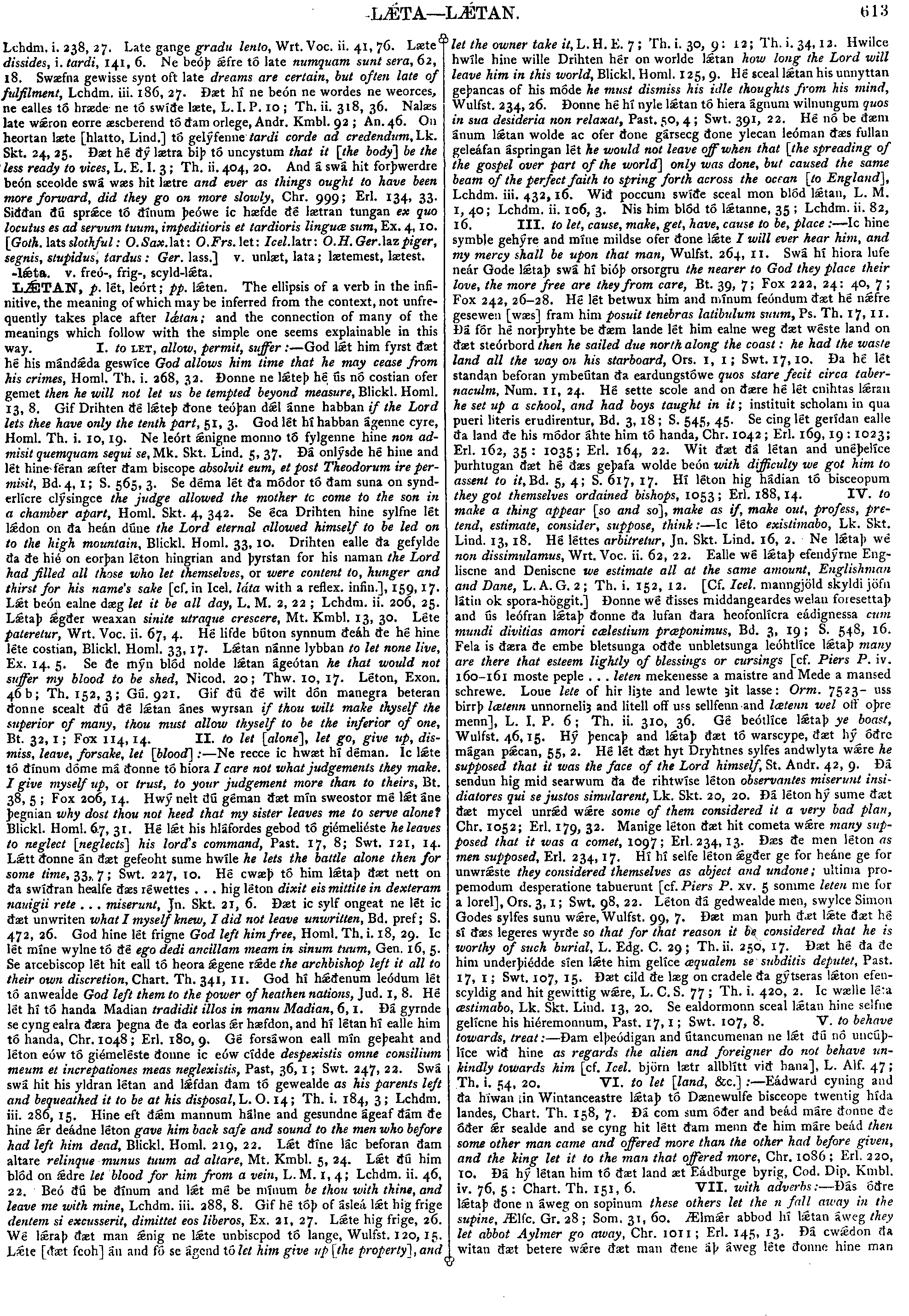
LÆ-acute;TAN,
p.
lét,
leórt;
pp.
lten.
The
ellipsis
of
a
verb
in
the
infinitive,
the
meaning
of
which
may
be
inferred
from
the
context,
not
unfrequently
takes
place
after
ltan;
and
the
connection
of
many
of
the
meanings
which
follow
with
the
simple
one
seems
explainable
in
this
way.
I.
to
LET,
allow,
permit,
suffer
:--
God
lt
him
fyrst
ðæt
hé
his
mándda
geswíce
God
allows
him
time
that
he
may
cease
from
his
crimes,
Homl.
Th.
i.
268,
32.
Ðonne
ne
lteþ
hé
ús
nó
costian
ofer
gemet
then
he
will
not
let
us
be
tempted
beyond
measure,
Blickl.
Homl.
13,
8.
Gif
Drihten
ðé
lteþ
ðone
teóþan
dl
ánne
habban
if
the
Lord
lets
thee
have
only
the
tenth
part,
51,
3.
God
lét
hí
habban
ágenne
cyre,
Homl.
Th.
i.
10,
19.
Ne
leórt
nigne
monno
tó
fylgenne
hine
non
admisit
quemquam
sequi
se,
Mk.
Skt.
Lind.
5,
37.
Ðá
onlýsde
hé
hine
and
lét
hine
féran
æfter
ðam
biscope
absolvit
eum,
et
post
Theodorum
ire
permisit,
Bd.
4,
1;
S.
565,
3.
Se
déma
lét
ða
módor
tó
ðam
suna
on
synderlícre
clýsingce
the
judge
allowed
the
mother
to
come
to
the
son
in
a
chamber
apart,
Homl.
Skt.
4,
342.
Se
éca
Drihten
hine
sylfne
lét
ldon
on
ða
heán
dúne
the
Lord
eternal
allowed
himself
to
be
led
on
to
the
high
mountain,
Blickl.
Homl.
33,
10.
Drihten
ealle
ða
gefylde
ða
ðe
hié
on
eorþan
léton
hingrian
and
þyrstan
for
his
naman
the
Lord
had
filled
all
those
who
let
themselves,
or
were
content
to,
hunger
and
thirst
for
his
name's
sake
[cf.
in
Icel.
láta
with
a
reflex.
infin.],
159,
17.
Lt
beón
ealne
dæg
let
it
be
all
day,
L.
M.
2,
22;
Lchdm.
ii.
206,
25.
Ltaþ
gðer
weaxan
sinite
utraque
crescere,
Mt.
Kmbl.
13,
30.
Léte
pateretur,
Wrt.
Voc.
ii.
67,
4.
Hé
lifde
búton
synnum
ðeáh
ðe
hé
hine
léte
costian,
Blickl.
Homl.
33,
17.
Ltan
nánne
lybban
to
let
none
live,
Ex.
14,
5.
Se
ðe
mýn
blód
nolde
ltan
ágeótan
he
that
would
not
suffer
my
blood
to
be
shed,
Nicod.
20;
Thw.
10,
17.
Léton,
Exon.
46
b;
Th.
152,
3;
Gú.
921.
Gif
ðú
ðé
wilt
dón
manegra
beteran
ðonne
scealt
ðú
ðé
ltan
ánes
wyrsan
if
thou
wilt
make
thyself
the
superior
of
many,
thou
must
allow
thyself
to
be
the
inferior
of
one,
Bt.
32,
1;
Fox
114,
14.
II.
to
let
[alone],
let
go,
give
up,
dismiss,
leave,
forsake,
let
[blood]
:--
Ne
recce
ic
hwæt
hí
déman.
Ic
lte
tó
ðínum
dóme
má
ðonne
tó
hiora
I
care
not
what
judgements
they
make.
I
give
myself
up,
or
trust,
to
your
judgement
more
than
to
theirs,
Bt.
38,
5;
Fox
206,
14.
Hwý
nelt
ðú
géman
ðæt
mín
sweostor
mé
lt
áne
þegnian
why
dost
thou
not
heed
that
my
sister
leaves
me
to
serve
alone?
Blickl.
Homl.
67,
31.
Hé
lt
his
hláfordes
gebod
tó
giémeliéste
he
leaves
to
neglect
[neglects]
his
lord's
command,
Past.
17,
8;
Swt.
121,
14.
Ltt
ðonne
án
ðæt
gefeoht
sume
hwíle
he
lets
the
battle
alone
then
for
some
time,
33,
7;
Swt.
227,
10.
Hé
cwæþ
tó
him
ltaþ
ðæt
nett
on
ða
swíðran
healfe
ðæs
réwettes
...
hig
léton
dixit
eis
mittite
in
dexteram
nauigii
rete
...
miserunt,
Jn.
Skt.
21,
6.
Ðæt
ic
sylf
ongeat
ne
lét
ic
ðæt
unwriten
what
I
myself
knew,
I
did
not
leave
unwritten,
Bd.
pref;
S.
472,
26.
God
hine
lét
frigne
God
left
him
free,
Homl.
Th.
i.
18,
29.
Ic
lét
míne
wylne
tó
ðé
ego
dedi
ancillam
meam
in
sinum
tuum,
Gen.
16,
5.
Se
arcebiscop
lét
hit
eall
tó
heora
gene
rde
the
archbishop
left
it
all
to
their
own
discretion,
Chart.
Th.
341,
11.
God
hí
hðenum
leódum
lét
tó
anwealde
God
left
them
to
the
power
of
heathen
nations,
Jud.
1,
8.
Hé
lét
hí
tó
handa
Madian
tradidit
illos
in
manu
Madian,
6,
1.
Ðá
gyrnde
se
cyng
ealra
ðæra
þegna
ðe
ða
eorlas
r
hæfdon,
and
hí
létan
hí
ealle
him
tó
handa,
Chr.
1048;
Erl.
180,
9.
Gé
forsáwon
eall
mín
geþeaht
and
léton
eów
tó
giémeléste
ðonne
ic
eów
cídde
despexistis
omne
consilium
meum
et
increpationes
meas
neglexistis,
Past,
36,
1;
Swt.
247,
22.
Swá
swá
hit
his
yldran
létan
and
lfdan
ðam
tó
gewealde
as
his
parents
left
and
bequeathed
it
to
be
at
his
disposal,
L.
O.
14;
Th.
i.
184,
3;
Lchdm.
iii.
286,
15.
Hine
eft
ðm
mannum
hálne
and
gesundne
ágeaf
ðám
ðe
hine
r
deádne
léton
gave
him
back
safe
and
sound
to
the
men
who
before
had
left
him
dead,
Blickl.
Homl.
219,
22.
Lt
ðíne
lác
beforan
ðam
altare
relinque
munus
tuum
ad
altare,
Mt.
Kmbl.
5,
24.
Lt
ðú
him
blód
on
dre
let
blood
for
him
from
a
vein,
L.
M.
1,
4;
Lchdm.
ii.
46,
22.
Beó
ðú
be
ðínum
and
lt
mé
be
mínum
be
thou
with
thine,
and
leave
me
with
mine,
Lchdm.
iii.
288,
8.
Gif
hé
tóþ
of
ásleá
lt
hig
frige
dentem
si
excusserit,
dimittet
eos
liberos,
Ex.
21,
27.
Lte
hig
frige,
26.
Wé
lraþ
ðæt
man
nig
ne
lte
unbiscpod
tó
lange,
Wulfst.
120,
15.
Lte
[ðæt
feoh]
án
and
fó
se
ágend
tó
let
him
give
up
[the
property],
and
let
the
owner
take
it,
L.
H.
E.
7;
Th.
i.
30,
9:
12;
Th.
i.
34,
12.
Hwilce
hwíle
hine
wille
Drihten
hér
on
worlde
ltan
how
long
the
Lord
will
leave
him
in
this
world,
Blickl.
Homl.
125,
9.
Hé
sceal
ltan
his
unnyttan
geþancas
of
his
móde
he
must
dismiss
his
idle
thoughts
from
his
mind,
Wulfst.
234,
26.
Ðonne
hé
hí
nyle
ltan
tó
hiera
ágnum
wilnungum
quos
in
sua
desideria
non
relaxat,
Past.
50,
4;
Swt.
391,
22.
Hé
nó
be
ðæm
ánum
ltan
wolde
ac
ofer
ðone
gársecg
ðone
ylecan
leóman
ðæs
fullan
geleáfan
áspringan
lét
he
would
not
leave
off
when
that
[the
spreading
of
the
gospel
over
part
of
the
world]
only
was
done,
but
caused
the
same
beam
of
the
perfect
faith
to
spring
forth
across
the
ocean
[to
England],
Lchdm.
iii.
432,
16.
Wið
poccum
swíðe
sceal
mon
blód
ltan,
L.
M.
1,
40;
Lchdm.
ii.
106,
3.
Nis
him
blód
tó
ltanne,
35;
Lchdm.
ii.
82,
16.
III.
to
let,
cause,
make,
get,
have,
cause
to
be,
place
:--
Ic
hine
symble
gehýre
and
míne
mildse
ofer
ðone
lte
I
will
ever
hear
him,
and
my
mercy
shall
be
upon
that
man,
Wulfst.
264,
11.
Swá
hí
hiora
lufe
neár
Gode
ltaþ
swá
hí
bióþ
orsorgru
the
nearer
to
God
they
place
their
love,
the
more
free
are
they
from
care,
Bt.
39,
7;
Fox
222,
24:
40,
7;
Fox
242,
26-28.
Hé
lét
betwux
him
and
mínum
feóndum
ðæt
hé
nfre
gesewen
[wæs]
fram
him
posuit
tenebras
latibulum
suum,
Ps.
Th.
17,
11.
Ðá
fór
hé
norþryhte
be
ðæm
lande
lét
him
ealne
weg
ðæt
wéste
land
on
ðæt
steórbord
then
he
sailed
due
north
along
the
coast:
he
had
the
waste
land
all
the
way
on
his
starboard,
Ors.
1,
1;
Swt.
17,
10.
Ða
hé
lét
standan
beforan
ymbeútan
ða
eardungstówe
quos
stare
fecit
circa
tabernaculm,
Num.
11,
24.
Hé
sette
scole
and
on
ðære
hé
lét
cnihtas
lran
he
set
up
a
school,
and
had
boys
taught
in
it;
instituit
scholam
in
qua
pueri
literis
erudirentur,
Bd.
3,
18;
S.
545,
45.
Se
cing
lét
gerídan
ealle
ða
land
ðe
his
módor
áhte
him
tó
handa,
Chr.
1042;
Erl.
169,
19:
1023;
Erl.
162,
35:
1035;
Erl.
164,
22.
Wit
ðæt
ðá
létan
and
unéþelíce
þurhtugan
ðæt
hé
ðæs
geþafa
wolde
beón
with
difficulty
we
got
him
to
assent
to
it,
Bd.
5,
4;
S.
617,
17.
Hí
léton
hig
hádian
tó
bisceopum
they
got
themselves
ordained
bishops,
1053;
Erl.
188,
14.
IV.
to
make
a
thing
appear
[so
and
so],
make
as
if,
make
out,
profess,
pretend,
estimate,
consider,
suppose,
think
:--
Ic
léto
existimabo,
Lk.
Skt.
Lind.
13,
18.
Hé
léttes
arbitretur,
Jn.
Skt.
Lind.
16,
2.
Ne
ltaþ
wé
non
dissimulamus,
Wrt.
Voc.
ii.
62,
22.
Ealle
wé
ltaþ
efendýrne
Engliscne
and
Deniscne
we
estimate
all
at
the
same
amount,
Englishman
and
Dane,
L.
A.
G.
2;
Th.
i.
152,
12.
[Cf.
Icel.
manngjöld
skyldi
jöfn
látin
ok
spora-höggit.]
Ðonne
wé
ðisses
middangeardes
welan
foresettaþ
and
ús
leófran
ltaþ
ðonne
ða
lufan
ðara
heofonlícra
eádignessa
cum
mundi
divitias
amori
cælestium
præponimus,
Bd.
3,
19;
S.
548,
16.
Fela
is
ðæra
ðe
embe
bletsunga
oððe
unbletsunga
leóhtlíce
ltaþ
many
are
there
that
esteem
lightly
of
blessings
or
cursings
[cf.
Piers
P.
iv.
160-161
moste
peple
...
leten
mekenesse
a
maistre
and
Mede
a
mansed
schrewe.
Loue
lete
of
hir
lite
and
lewte
it
lasse:
Orm.
7523-
uss
birrþ
lætenn
unnorneli
and
litell
off
uss
sellfenn
and
lætenn
wel
off
oþre
menn],
L.
I.
P.
6;
Th.
ii.
310,
36.
Gé
beótlíce
lætaþ
ye
boast,
Wulfst.
46,
15.
Hý
þencaþ
and
ltaþ
ðæt
tó
warscype,
ðæt
hý
óðre
mágan
pcan,
55,
2.
Hé
lét
ðæt
hyt
Dryhtnes
sylfes
andwlyta
wre
he
supposed
that
it
was
the
face
of
the
Lord
himself,
St.
Andr.
42,
9.
Ðá
sendun
hig
mid
searwum
ða
ðe
rihtwíse
léton
observantes
miserunt
insidiatores
qui
se
justos
simularent,
Lk.
Skt.
20,
20.
Ðá
léton
hý
sume
ðæt
ðæt
mycel
unrd
wre
some
of
them
considered
it
a
very
bad
plan,
Chr.
1052;
Erl.
179,
32.
Manige
léton
ðæt
hit
cometa
wre
many
supposed
that
it
was
a
comet,
1097;
Er1.234,
13.
Ðæs
ðe
men
léton
as
men
supposed,
Erl.
234,
17.
Hí
hí
selfe
léton
gðer
ge
for
heáne
ge
for
unwrste
they
considered
themselves
as
abject
and
undone;
ultima
propemodum
desperatione
tabuerunt
[cf.
Piers
P.
xv.
5
somme
leten
me
for
a
lorel],
Ors.
3,
1;
Swt.
98,
22.
Léton
ðá
gedwealde
men,
swylce
Simon
Godes
sylfes
sunu
wre.
Wulfst.
99,
7.
Ðæt
man
þurh
ðæt
lte
ðæt
hé
sí
ðæs
legeres
wyrðe
so
that
for
that
reason
it
be
considered
that
he
is
worthy
of
such
burial,
L.
Edg.
C.
29;
Th.
ii.
250,
17.
Ðæt
hé
ða
ðe
him
underþiédde
síen
lte
him
gelíce
æqualem
se
subditis
deputet,
Past.
17,
1;
Swt.
107,
15.
Ðæt
cild
ðe
læg
on
cradele
ða
gýtseras
lton
efenscyldig
and
hit
gewittig
wre,
L.
C.
S.
77;
Th.
i.
420,
2.
Ic
wælle
léta
æstimabo,
Lk.
Skt.
Lind.
13,
20.
Se
ealdormonn
sceal
ltan
hine
selfne
gelícne
his
hiéremonnum,
Past.
17,
1;
Swt.
107,
8.
V.
to
behave
towards,
treat
:--
Ðam
elþeódigan
and
útancumenan
ne
lt
ðú
nó
uncúþlíce
wið
hine
as
regards
the
alien
and
foreigner
do
not
behave
unkindly
towards
him
[cf.
Icel.
björn
lætr
allblítt
við
hana],
L.
Alf.
47;
Th.
i.
54,
20.
VI.
to
let
[land,
&c.]
:--
Eádward
cyning
and
ða
híwan
in
Wintanceastre
ltaþ
tó
Dænewulfe
bisceope
twentig
hída
landes,
Chart.
Th.
158,
7.
Ðá
com
sum
óðer
and
beád
máre
ðonne
ðe
óðer
r
sealde
and
se
cyng
hit
létt
ðam
menn
ðe
him
máre
beád
then
some
other
man
came
and
offered
more
than
the
other
had
before
given,
and
the
king
let
it
to
the
man
that
offered
more,
Chr.
1086;
Erl.
220,
10.
Ðá
hý
létan
him
tó
ðæt
land
æt
Eádburge
byrig,
Cod.
Dip.
Kmbl.
iv.
76,
5:
Chart.
Th.
151,
6.
VII.
with
adverbs
:--
Ðás
óðre
ltaþ
ðone
n
áweg
on
sopinum
these
others
let
the
n
fall
away
in
the
supine,
Ælfc.
Gr.
28;
Som.
31,
60.
Ælmr
abbod
hí
ltan
áweg
they
let
abbot
Aylmer
go
away,
Chr.
1011;
Erl.
145,
13.
Ðá
cwdon
ða
witan
ðæt
betere
wre
ðæt
man
ðene
áþ
áweg
léte
ðonne
hine
man
sealde
...
Ðá
lét
hé
ðone
áþ
áweg
then
the
witan
said
that
it
would
be
better
that
the
oath
should
be
dispensed
with
than
that
it
should
be
taken
...
Then
he
omitted
the
oath,
Chart.
Th.
289,
24-30.
Æt
ealre
ðære
hergunge
and
æt
eallum
ðám
hearmum
ðe
r
ðam
gedón
wre
r
ðæt
friþ
geset
wre
man
eall
onweig
lte
and
nán
man
ðæt
ne
wræce
ne
bóte
ne
bidde
as
regards
all
the
harrying
and
all
the
injuries
that
were
done
before
the
peace
was
made,
let
it
all
be
dismissed,
and
let
no
man
avenge
it
or
ask
for
compensation,
L.
Eth.
ii.
6;
Th.
i.
288,
3.
Petrus
cnucode
óþ
ðæt
hí
hine
inn
léton
Peter
knocked
until
they
let
him
in,
Homl.
Th.
i.
382,
23.
Hé
lt
him
eáþelíce
ymbe
ðæt
he
takes
it
easily,
Wulfst.
298,
30:
Homl.
Skt.
4,
342.
[Goth.
létan:
O.
Sax.
látan:
O.
Fries.
léta:
Icel.
láta:
O.
H.
Ger.
lázan.]
DER.
á-,
for-,
ge-,
of-,
on-,
tó-
ltan.
|
Source: Bosworth/Toller, page b0618, entry 5 View original page image as: [TIFF] [PNG] [View previous entry] [View next entry] |
[Comment on this entry] [View comments] |
The following entry has been hand-corrected once. |
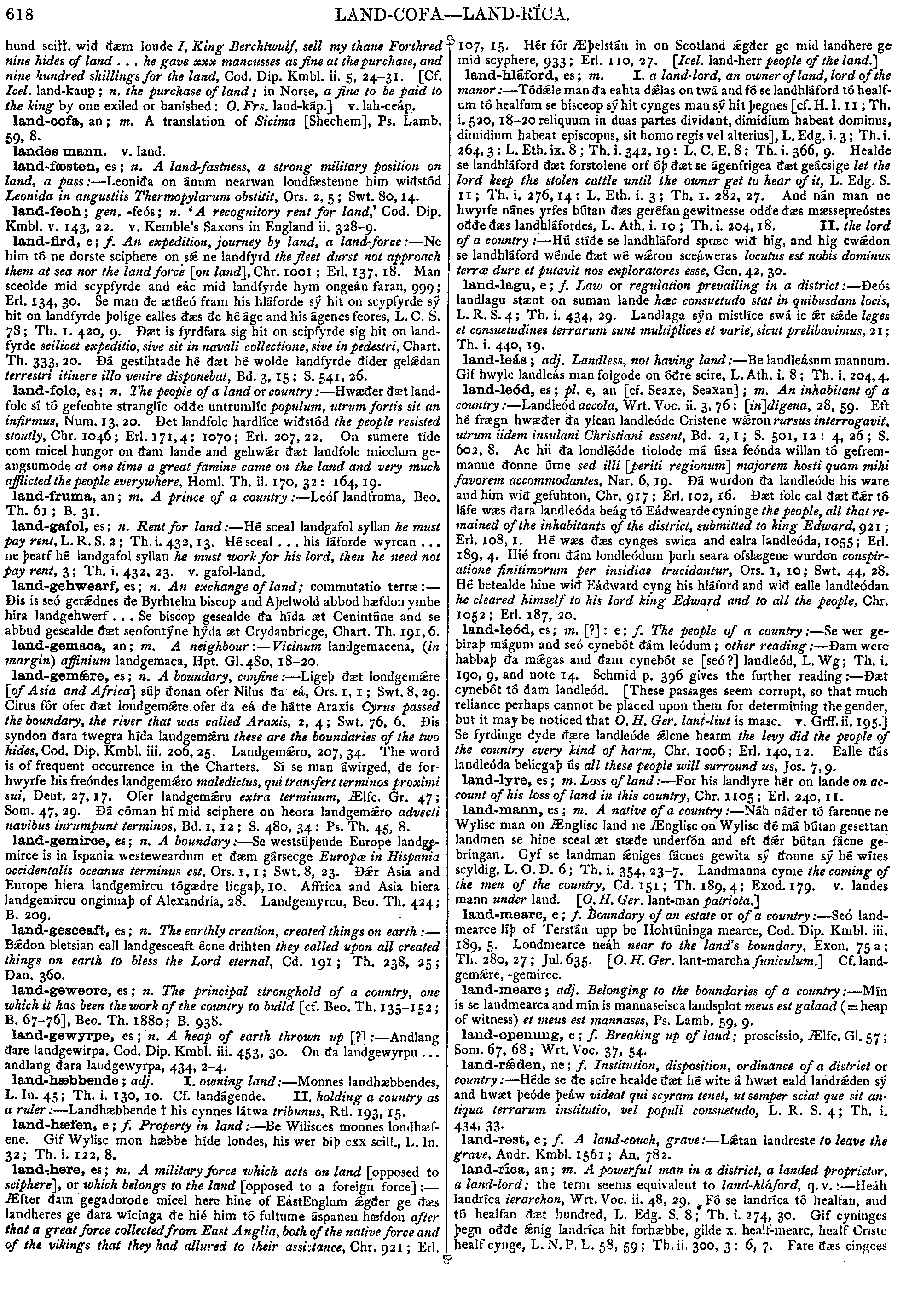
land-fird,
e;
f.
An
expedition,
journey
by
land,
a
land
force
:--
Ne
him
tó
ne
dorste
sciphere
on
s
ne
landfyrd
the
fleet
durst
not
approach
them
at
sea
nor
the
land
force
[on
land],
Chr.
1001;
Er1.
137,
18.
Man
sceolde
mid
scypfyrde
and
eác
mid
landfyrde
hym
ongeán
faran,
999;
Erl.
134,
30.
Se
man
ðe
ætfleó
fram
his
hláforde
sý
hit
on
scypfyrde
sý
hit
on
landfyrde
þolige
ealles
ðæs
ðe
hé
áge
and
his
ágenes
feores,
L.
C.
S.
78;
Th.
1.
420,
9.
Ðæt
is
fyrdfara
sig
hit
on
scipfyrde
sig
hit
on
landfyrde
scilicet
expeditio,
sive
sit
in
navali
collectione,
sive
in
pedestri,
Chart.
Th.
333,
20.
Ðá
gestihtade
hé
ðæt
hé
wolde
landfyrde
ðider
geldan
terrestri
itinere
illo
venire
disponebat,
Bd.
3,
15;
S.
541,
26.
|
Source: Bosworth/Toller, page b0620, entry 20 View original page image as: [TIFF] [PNG] [View previous entry] [View next entry] |
[Comment on this entry] [View comments] |
The following entry has been hand-corrected once. |
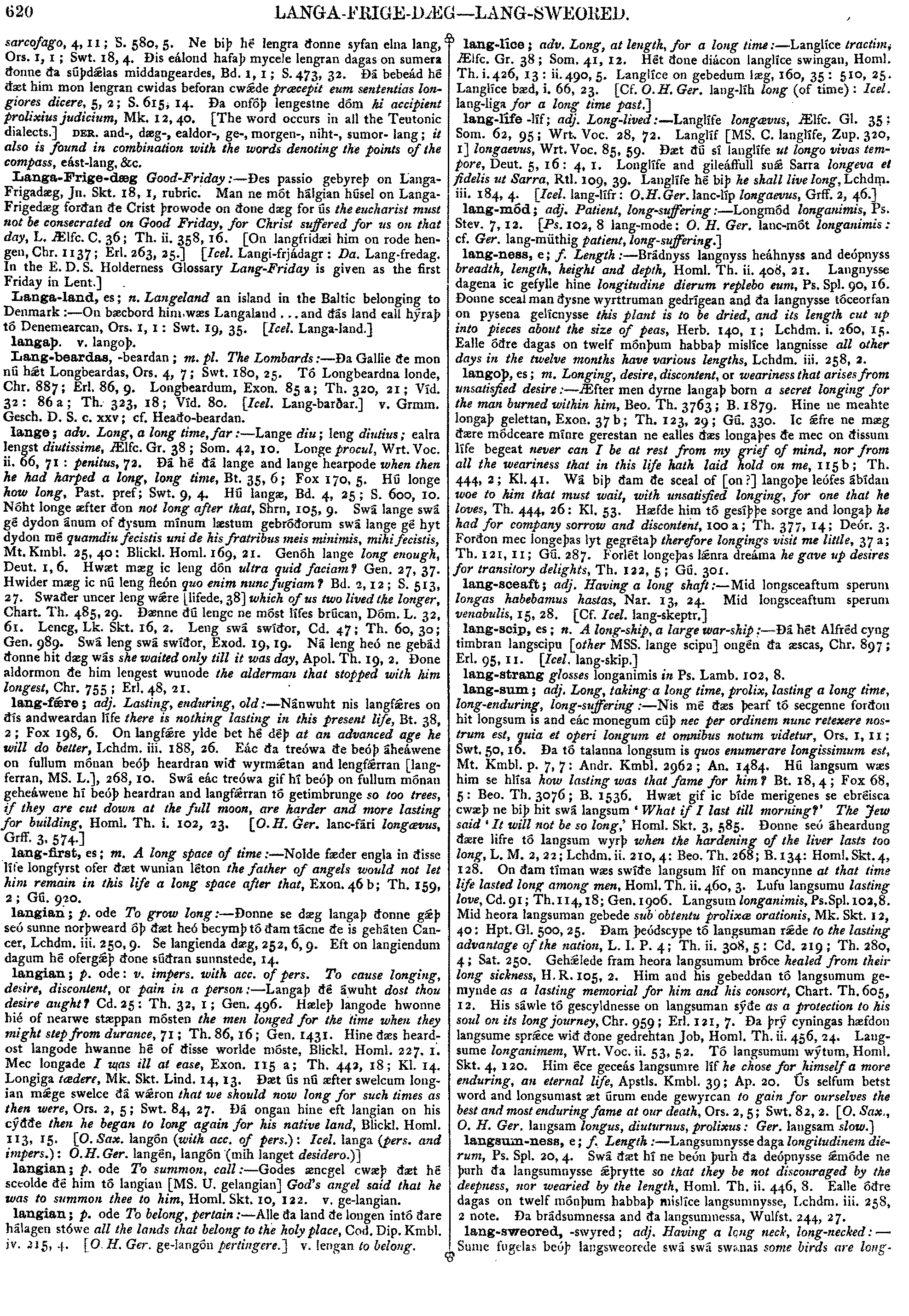
lang-sum;
adj.
Long,
taking
a
long
time,
prolix,
lasting
a
long
time,
long-enduring,
long-suffering
:--
Nis
mé
ðæs
þearf
tó
secgenne
forðon
hit
longsum
is
and
eác
monegum
cúþ
nec
per
ordinem
nunc
retexere
nostrum
est,
quia
et
operi
longum
et
omnibus
notum
videtur,
Ors.
1,
11;
Swt.
50,
16.
Ða
tó
talanna
longsum
is
quos
enumerare
longissimum
est,
Mt.
Kmbl.
p.
7,
7:
Andr.
Kmbl.
2962;
An.
1484.
Hú
langsum
wæs
him
se
hlísa
how
lasting
was
that
fame
for
him?
Bt.
18,
4;
Fox
68,
5:
Beo.
Th.
3076;
B.
1536.
Hwæt
gif
ic
bíde
merigenes
se
ebréisca
cwæþ
ne
biþ
hit
swá
langsum
'What
if
I
last
till
morning?'
The
Jew
said
'It
will
not
be
so
long,'
Homl.
Skt.
3,
585.
Ðonne
seó
áheardung
ðære
lifre
tó
langsum
wyrþ
when
the
hardening
of
the
liver
lasts
too
long,
L.
M.
2,
22;
Lchdm.
ii.
210,
4:
Beo.
Th.
268;
B.134:
Homl.
Skt.
4,
128.
On
ðam
tíman
wæs
swíðe
langsum
líf
on
mancynne
at
that
time
life
lasted
long
among
men,
Homl.
Th.
ii.
460,
3.
Lufu
langsumu
lasting
love,
Cd.
91;
Th.
114,
18;
Gen.
1906.
Langsum
longanimis,
Ps.
Spl.
102,
8.
Mid
heora
langsuman
gebede
sub
obtentu
prolixæ
orationis,
Mk.
Skt.
12,
40:
Hpt.
Gl.
500,
25.
Ðam
þeódscype
tó
langsuman
rde
to
the
lasting
advantage
of
the
nation,
L.
I.
P.
4;
Th.
ii.
308,
5:
Cd.
219;
Th.
280,
4;
Sat.
250.
Gehlede
fram
heora
langsumum
bróce
healed
from
their
long
sickness,
H.
R.
105,
2.
Him
and
his
gebeddan
tó
langsumum
gemynde
as
a
lasting
memorial
for
him
and
his
consort,
Chart.
Th.
605,
12.
His
sáwle
tó
gescyldnesse
on
langsuman
sýðe
as
a
protection
to
his
soul
on
its
long
journey,
Chr.
959;
Er1.
121,
7.
Ða
þrý
cyningas
hæfdon
langsume
sprce
wið
ðone
gedrehtan
Job,
Homl.
Th.
ii.
456,
24.
Langsume
longanimem,
Wrt.
Voc.
ii.
53,
52.
Tó
langsumum
wýtum,
Homl.
Skt.
4,
120.
Him
éce
geceás
langsumre
líf
he
chose
for
himself
a
more
enduring,
an
eternal
life,
Apstls.
Kmbl.
39;
Ap.
20.
Ús
selfum
betst
word
and
longsumast
æt
úrum
ende
gewyrcan
to
gain
for
ourselves
the
best
and
most
enduring
fame
at
our
death,
Ors.
2,
5;
Swt.
82,
2.
[O.
Sax.
O.
H.
Ger.
langsam
longus,
diuturnus,
prolixus:
Ger.
langsam
slow.]
|
Source: Bosworth/Toller, page b0660, entry 5 View original page image as: [TIFF] [PNG] [View previous entry] [View next entry] |
[Comment on this entry] [View comments] |
The following entry has been hand-corrected once. |
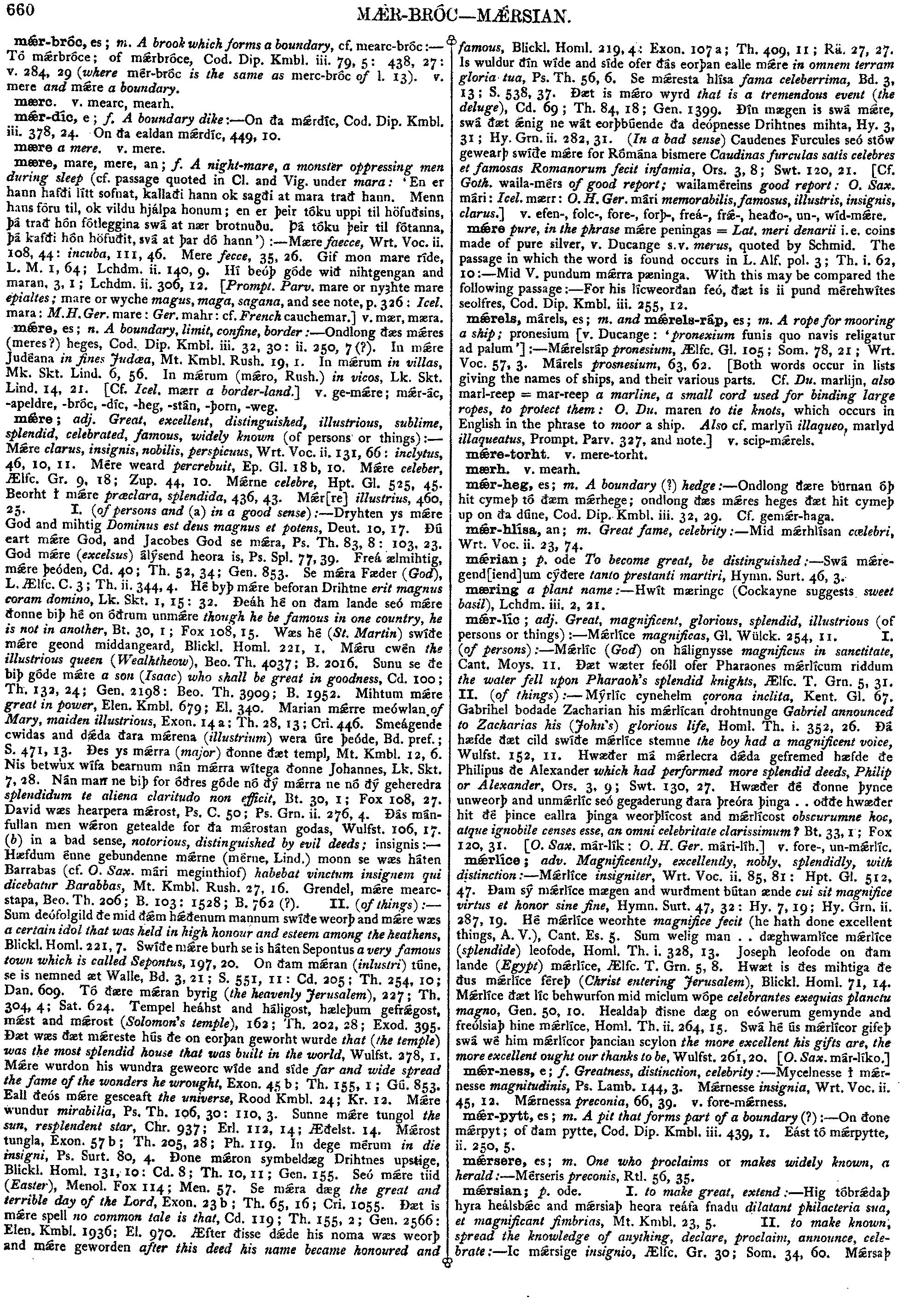
mære,
mare,
mere,
an;
f.
A
night-mare,
a
monster
oppressing
men
during
sleep
(cf.
passage
quoted
in
Cl.
and
Vig.
under
mara;
'En
er
hann
hafði
litt
sofnat,
kallaði
hann
ok
sagði
at
mara
trað
hann.
Menn
hans
fóru
til,
ok
vildu
hjálpa
honum;
en
er
þeir
tóku
uppi
til
höfuðsins,
þá
trað
hón
fótleggina
swá
at
nær
brotnuðu.
Þá
tóku
þeir
til
fótanna,
þá
kafði
hón
höfuðit,
svá
at
þar
dó
hann')
:--
Mære
faecce,
Wrt.
Voc.
ii.
108,
44:
incuba,
111,
46.
Mere
fecce,
35,
26.
Gif
mon
mare
ríde,
L.
M.
1,
64;
Lchdm.
ii.
140,
9.
Hi
beóþ
góde
wið
nihtgengan
and
maran,
3,
1;
Lchdm.
ii.
306,
12.
[Prompt.
Parv.
mare
or
nyhte
mare
epialtes;
mare
or
wyche
magus,
maga,
sagana,
and
see
note,
p.
326:
Icel.
mara:
M.
H.
Ger.
mare:
Ger.
mahr:
cf.
French
cauchemar.]
v.
mær,
mæra.
|
Source: Bosworth/Toller, page b0689, entry 14 View original page image as: [TIFF] [PNG] [View previous entry] [View next entry] |
[Comment on this entry] [View comments] |
The following entry has been hand-corrected once. |
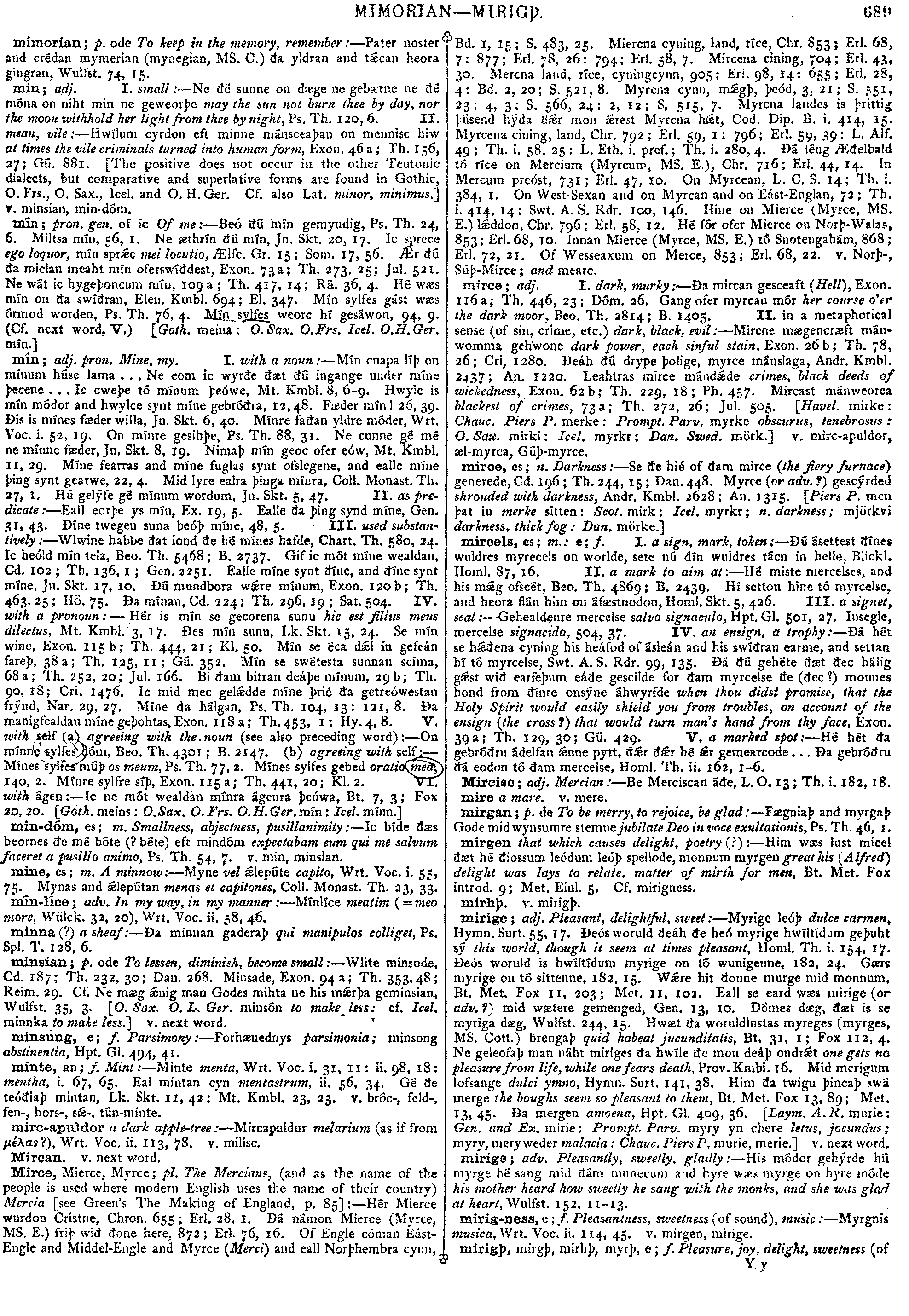
Mirce,
Mierce,
Myrce;
pl.
The
Mercians,
(and
as
the
name
of
the
people
is
used
where
modern
English
uses
the
name
of
their
country)
Mercia
[see
Green's
The
Making
of
England,
p.
85]
:--
Hér
Mierce
wurdon
Cristne,
Chron.
655;
Erl.
28,
1.
Ðá
námon
Mierce
(Myrce,
MS.
E.)
friþ
wið
ðone
here,
872;
Erl.
76,
16.
Of
Engle
cóman
EástEngle
and
Middel-Engle
and
Myrce
(Merci)
and
eall
Norþhembra
cynn,
Bd.
1,
15;
S.
483,
25.
Miercna
cyning,
land,
ríce,
Chr.
853;
Erl.
68,
7:
877;
Erl.
78,
26:
794;
Erl.
58,
7.
Mircena
cining,
704;
Er1.
43,
30.
Mercna
land,
ríce,
cyningcynn,
905;
Erl.
98,
14:
655;
Erl.
28,
4:
Bd.
2,
20;
S.
521,
8.
Myrcna
cynn,
mgþ,
þeód,
3,
21;
S.
551,
23:
4,
3;
S.
566,
24:
2,
12;
S,
515,
7.
Myrcna
landes
is
þrittig
þúsend
hýda
ðr
mon
rest
Myrcna
ht,
Cod.
Dip.
B.
i.
414,
15.
Myrcena
cining,
land,
Chr.
792;
Erl.
59,
1:
796;
Erl.
59,
39:
L.
Alf.
49;
Th.
i.
58,
25:
L.
Eth.
i.
pref.;
Th.
i.
280,
4.
Ðá
féng
Æðelbald
tó
ríce
on
Mercium
(Myrcum,
MS.
E.),
Chr.
716;
Erl.
44,
14.
In
Mercum
preóst,
731;
Erl.
47,
10.
On
Myrcean,
L.
C.
S.
14;
Th.
i.
384,
1.
On
West-Sexan
and
on
Myrcan
and
on
Eást-Englan,
72;
Th.
i.
414,
14:
Swt.
A.
S.
Rdr.
100,
146.
Hine
on
Mierce
(Myrce,
MS.
E.)
lddon,
Chr.
796;
Erl.
58,
12.
Hé
fór
ofer
Mierce
on
Norþ-Walas,
853;
Erl.
68,
10.
Innan
Mierce
(Myrce,
MS.
E.)
tó
Snotengahám,
868;
Erl.
72,
21,
Of
Wesseaxum
on
Merce,
853;
Erl.
68,
22.
v.
Norþ-,
Súþ-Mirce;
and
mearc.
| Result Page: |  |
Previous | 1 2 3 4 5 6 7 8 9 10 11 12 13 14 | Next |  |
Germanic Lexicon Project (main page)
This search system was written by
Sean Crist
Please consider
volunteering
to correct the data in these online dictionaries.
No rights reserved. Feel free to use these data in any way you please.