|
|

Search for er again, using less strict matching (3706 results)
|
Source: Cleasby/Vigfusson, page b0030, entry 29 View original page image as: [TIFF] [PNG] [View previous entry] [View next entry] |
[Comment on this entry] [View comments] |
The following entry has been hand-corrected once. |
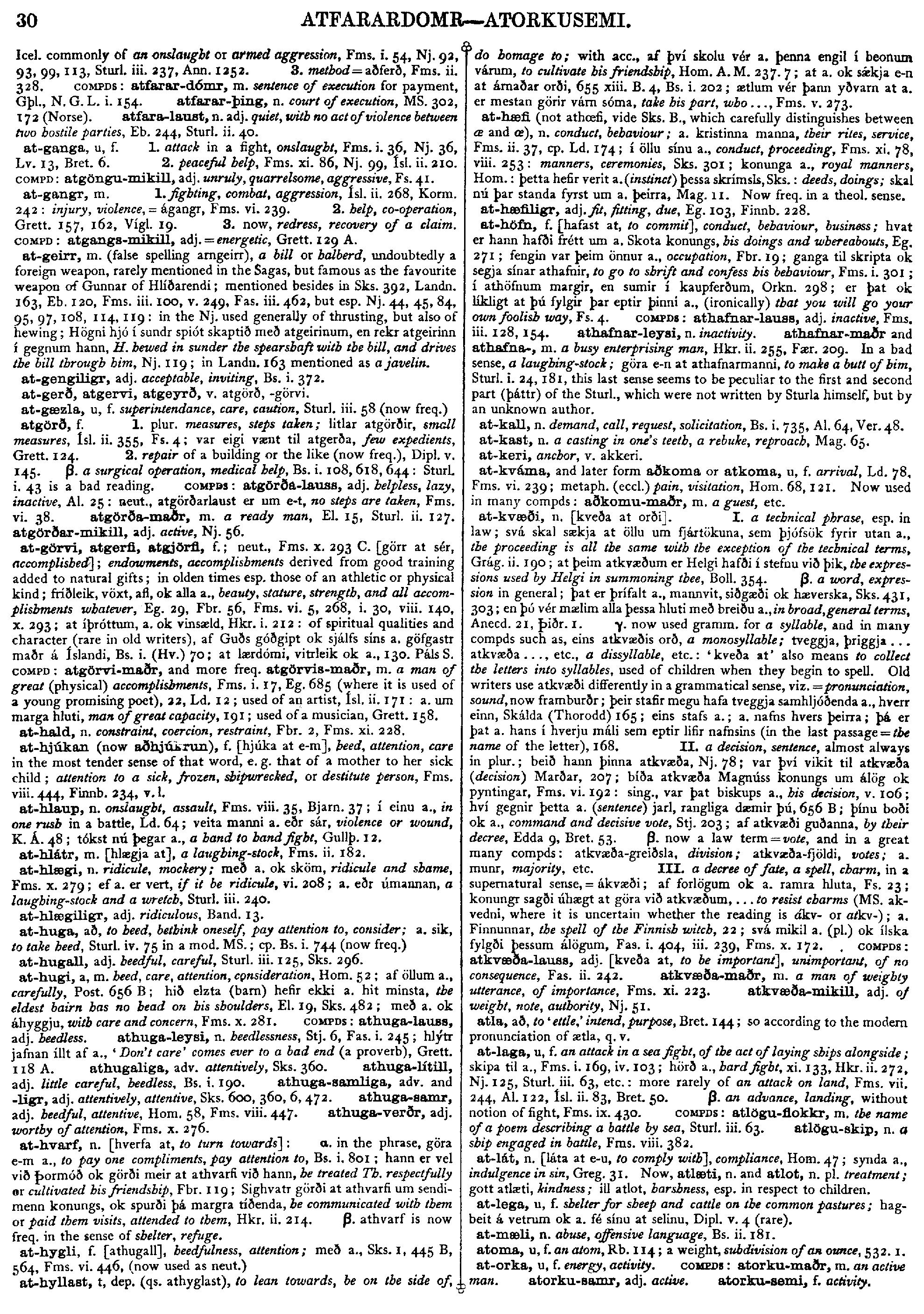
at-kvœði,
n.
[kveða
at
orði].
I.
a
technical
phrase,
esp.
in
law;
svá
skal
sækja
at
öllu
um
fjártökuna,
sem
þjófsök
fyrir
utan
a.,
the
proceeding
is
all
the
same
with
the
exception
of
the
technical
terms,
Grág.
ii.
190;
at
þeim
atkvæðum
er
Helgi
hafði
í
stefnu
við
þik,
the
expres-
sions
used
by
Helgi
in
summoning
thee,
Boll.
354.
 .
a
word,
expres-
sion
in
general;
þat
er
þrífalt
a.,
mannvit,
siðgæði
ok
hæverska,
Sks.
431,
303;
en
þó
vér
mælim
alla
þessa
hluti
með
breiðu
a.,
in
broad,
general
terms,
Anecd.
21,
þiðr.
I.
.
a
word,
expres-
sion
in
general;
þat
er
þrífalt
a.,
mannvit,
siðgæði
ok
hæverska,
Sks.
431,
303;
en
þó
vér
mælim
alla
þessa
hluti
með
breiðu
a.,
in
broad,
general
terms,
Anecd.
21,
þiðr.
I.
 .
now
used
gramm.
for
a
syllable,
and
in
many
compds
such
as,
eins
atkvæðis
orð,
a
monosyllable;
tveggja,
þriggja
...
atkvæða
...,
etc.,
a
dissyllable,
etc.:
'
kveða
at'
also
means
to
collect
the
letters
into
syllables,
used
of
children
when
they
begin
to
spell.
Old
writers
use
atkvæði
differently
in
a
grammatical
sense,
viz.
=
pronunciation,
sound,
now
framburðr;
þeir
stafir
megu
hafa
tveggja
samhljóðenda
a.,
hverr
einn,
Skálda
(Thorodd)
165;
eins
stafs
a.;
a.
nafns
hvers
þeirra;
þá
er
þat
a.
hans
í
hverju
máli
sem
eptir
lifir
nafnsins
(in
the
last
passage
=
the
name
of
the
letter),
168.
II.
a
decision,
sentence,
almost
always
in
plur.;
beið
hann
þinna
atkvæða,
Nj.
78;
var
því
vikit
til
atkvæða
(decision)
Marðar,
207;
bíða
atkvæða
Magnúss
konungs
um
álög
ok
pyntingar,
Fms.
vi.
192:
sing.,
var
þat
biskups
a.,
his
decision,
v.
106;
hvi
gegnir
þetta
a.
(sentence)
jarl,
rangliga
dæmir
þú,
656
B;
þínu
boði
ok
a.,
command
and
decisive
vote,
Stj.
203;
af
atkvæði
guðanna,
by
their
decree,
Edda
9,
Bret.
53.
.
now
a
law
term
=
vote,
and
in
a
great
many
compds:
atkvæða-greiðsla,
division;
atkvzða-fjöldi,
votes;
a.
munr,
majority,
etc.
III.
a
decree
of
fate,
a
spell,
charm,
in
a
supernatural
sense,
=
ákvæði;
af
forlogum
ok
a.
ramra
hluta,
Fs.
23;
konungr
sagði
úhægt
at
göra
við
atkvæðum,
...
to
resist
charms
(MS.
ak-
vedni,
where
it
is
uncertain
whether
the
reading
is
ákv-
or
atkv-);
a.
Finnunnar,
the
spell
of
the
Finnish
witch,
22;
svá
mikil
a.
(pl.)
ok
ilska
fylgði
þessum
álögum,
Fas.
i.
404,
iii.
239,
Fms.
x.
172.,
COMPDS:
atkvæða-lauss,
adj.
[kveða
at,
to
be
important]
,
unimportant,
of
no
consequence,
Fas.
ii.
242.
atkvæða-maðr,
m.
a
man
of
weighty
utterance,
of
importance,
Fms.
xi.
223.
atkvæða-mikill,
adj.
of
weight,
note,
authority,
Nj.
51
.
now
used
gramm.
for
a
syllable,
and
in
many
compds
such
as,
eins
atkvæðis
orð,
a
monosyllable;
tveggja,
þriggja
...
atkvæða
...,
etc.,
a
dissyllable,
etc.:
'
kveða
at'
also
means
to
collect
the
letters
into
syllables,
used
of
children
when
they
begin
to
spell.
Old
writers
use
atkvæði
differently
in
a
grammatical
sense,
viz.
=
pronunciation,
sound,
now
framburðr;
þeir
stafir
megu
hafa
tveggja
samhljóðenda
a.,
hverr
einn,
Skálda
(Thorodd)
165;
eins
stafs
a.;
a.
nafns
hvers
þeirra;
þá
er
þat
a.
hans
í
hverju
máli
sem
eptir
lifir
nafnsins
(in
the
last
passage
=
the
name
of
the
letter),
168.
II.
a
decision,
sentence,
almost
always
in
plur.;
beið
hann
þinna
atkvæða,
Nj.
78;
var
því
vikit
til
atkvæða
(decision)
Marðar,
207;
bíða
atkvæða
Magnúss
konungs
um
álög
ok
pyntingar,
Fms.
vi.
192:
sing.,
var
þat
biskups
a.,
his
decision,
v.
106;
hvi
gegnir
þetta
a.
(sentence)
jarl,
rangliga
dæmir
þú,
656
B;
þínu
boði
ok
a.,
command
and
decisive
vote,
Stj.
203;
af
atkvæði
guðanna,
by
their
decree,
Edda
9,
Bret.
53.
.
now
a
law
term
=
vote,
and
in
a
great
many
compds:
atkvæða-greiðsla,
division;
atkvzða-fjöldi,
votes;
a.
munr,
majority,
etc.
III.
a
decree
of
fate,
a
spell,
charm,
in
a
supernatural
sense,
=
ákvæði;
af
forlogum
ok
a.
ramra
hluta,
Fs.
23;
konungr
sagði
úhægt
at
göra
við
atkvæðum,
...
to
resist
charms
(MS.
ak-
vedni,
where
it
is
uncertain
whether
the
reading
is
ákv-
or
atkv-);
a.
Finnunnar,
the
spell
of
the
Finnish
witch,
22;
svá
mikil
a.
(pl.)
ok
ilska
fylgði
þessum
álögum,
Fas.
i.
404,
iii.
239,
Fms.
x.
172.,
COMPDS:
atkvæða-lauss,
adj.
[kveða
at,
to
be
important]
,
unimportant,
of
no
consequence,
Fas.
ii.
242.
atkvæða-maðr,
m.
a
man
of
weighty
utterance,
of
importance,
Fms.
xi.
223.
atkvæða-mikill,
adj.
of
weight,
note,
authority,
Nj.
51
|
Source: Cleasby/Vigfusson, page b0031, entry 22 View original page image as: [TIFF] [PNG] [View previous entry] [View next entry] |
[Comment on this entry] [View comments] |
The following entry has been hand-corrected once. |
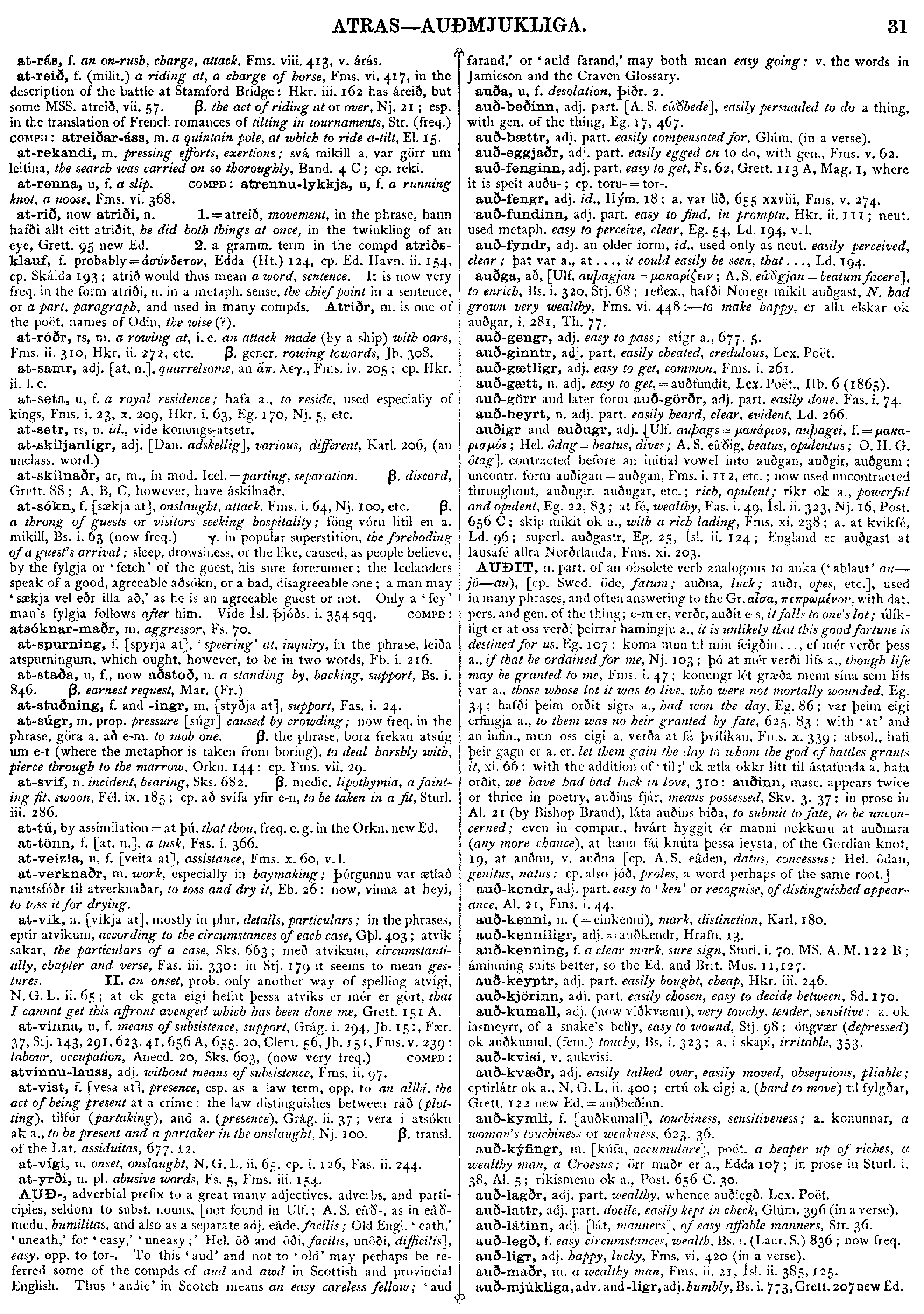
at-vik, n. [víkja at], mostly in plur. details, particulars; in the phrases, eptir atvikum, according to the circumstances of each case, Gþl. 403; atvik sakar, the particulars of a case, Sks. 663; með atvikum, circumstantially, chapter and verse, Fas. iii. 330: in Stj. 179 it seems to mean gestures. II. an onset, prob. only another way of spelling atvígi, N. G. L. ii. 65; at ek geta eigi hefnt þessa atviks er mér er gört, that I cannot get this affront avenged which has been done me, Grett. 151 A.
|
Source: Cleasby/Vigfusson, page b0031, entry 37 View original page image as: [TIFF] [PNG] [View previous entry] [View next entry] |
[Comment on this entry] [View comments] |
The following entry has been hand-corrected once. |
auðga, að, [Ulf. auþagjan = GREEK; A. S. eâðigjan = beatum facere], to enrich, Bs. i. 320, Stj. 68; reflex., hafði Noregr mikit auðgast, N. had grown very wealthy, Fms. vi. 448 :-- to make happy, er alla elskar ok auðgar, i. 281, Th. 77.
|
Source: Cleasby/Vigfusson, page b0031, entry 44 View original page image as: [TIFF] [PNG] [View previous entry] [View next entry] |
[Comment on this entry] [View comments] |
The following entry has been hand-corrected once. |
auðigr and auðugr, adj. [Ulf. auðags = GREEK, auðagei, f. = GREEK; Hel. ódag = beatus, dives; A. S. eâðig, beatus, opulentus; O. H. G. ôtag], contracted before an initial vowel into auðgan, auðgir, auðgum; uncontr. form auðigan = auðgan, Fms. i. 112, etc.; now used uncontracted throughout, auðugir, auðugar, etc.; rich, opulent; ríkr ok a., powerful and opulent, Eg. 22, 83; at fé, wealthy, Fas. i. 49, Ísl. ii. 323, Nj. 16, Post. 656 C; skip mikit ok a., with a rich lading, Fms. xi. 238; a. at kvikfé, Ld. 96; superl. auðgastr, Eg. 25, Ísl. ii. 124; England er auðgast at lausafé allra Norðrlanda, Fms. xi. 203.
|
Source: Cleasby/Vigfusson, page b0031, entry 45 View original page image as: [TIFF] [PNG] [View previous entry] [View next entry] |
[Comment on this entry] [View comments] |
The following entry has been hand-corrected once. |
AUÐIT, n. part. of an obsolete verb analogous to auka ('ablaut' an -- jó -- au), [cp. Swed. öde, fatum; auðna, luck; auðr, opes, etc.], used in many phrases, and often answering to the Gr. GREEK, with dat. pers. and gen. of the thing; e-m er, verðr, auðit e-s, it falls to one's lot; úlíkligt er at oss verði þeirrar hamingju a., it is unlikely that this good fortune is destined for us, Eg. 107; koma mun til mín feigðin..., ef mér verðr þess a., if that be ordained for me, Nj. 103; þó at mér verði lífs a., though life may be granted to me, Fms. i. 47; konungr lét græða menn sína sem lífs var a., those whose lot it was to live, who were not mortally wounded, Eg. 34; hafði þeim orðit sigrs a., had won the day, Eg. 86; var þeim eigi erfingja a., to them was no heir granted by fate, 625. 83: with 'at' and an infin., mun oss eigi a. verða at fá þvílíkan, Fms. x. 339: absol., hafi þeir gagn er a. er, let them gain the day to whom the god of battles grants it, xi. 66: with the addition of 'til;' ek ætla okkr lítt til ástafunda a. hafa orðit, we have had bad luck in love, 310: auðinn, masc. appears twice or thrice in poetry, auðins fjár, means possessed, Skv. 3. 37: in prose in Al. 21 (by Bishop Brand), láta auðins bíða, to submit to fate, to be unconcerned; even in compar., hvárt hyggit ér manni nokkuru at auðnara (any more chance), at hann fái knúta þessa leysta, of the Gordian knot, 19, at auðnu, v. auðna [cp. A. S. eâden, datus, concessus; Hel. ôdan, genitus, natus: cp. also jóð, proles, a word perhaps of the same root.]
|
Source: Cleasby/Vigfusson, page b0031, entry 56 View original page image as: [TIFF] [PNG] [View previous entry] [View next entry] |
[Comment on this entry] [View comments] |
The following entry has been hand-corrected once. |
auð-kýfingr, m. [kúfa, accumulare], poët. a heaper up of riches, a wealthy man, a Croesus; örr maðr er a., Edda 107; in prose in Sturl. i. 38, Al. 5; ríkismenn ok a., Post. 656 C. 30.
|
Source: Cleasby/Vigfusson, page b0032, entry 5 View original page image as: [TIFF] [PNG] [View previous entry] [View next entry] |
[Comment on this entry] [View comments] |
The following entry has been hand-corrected once. |
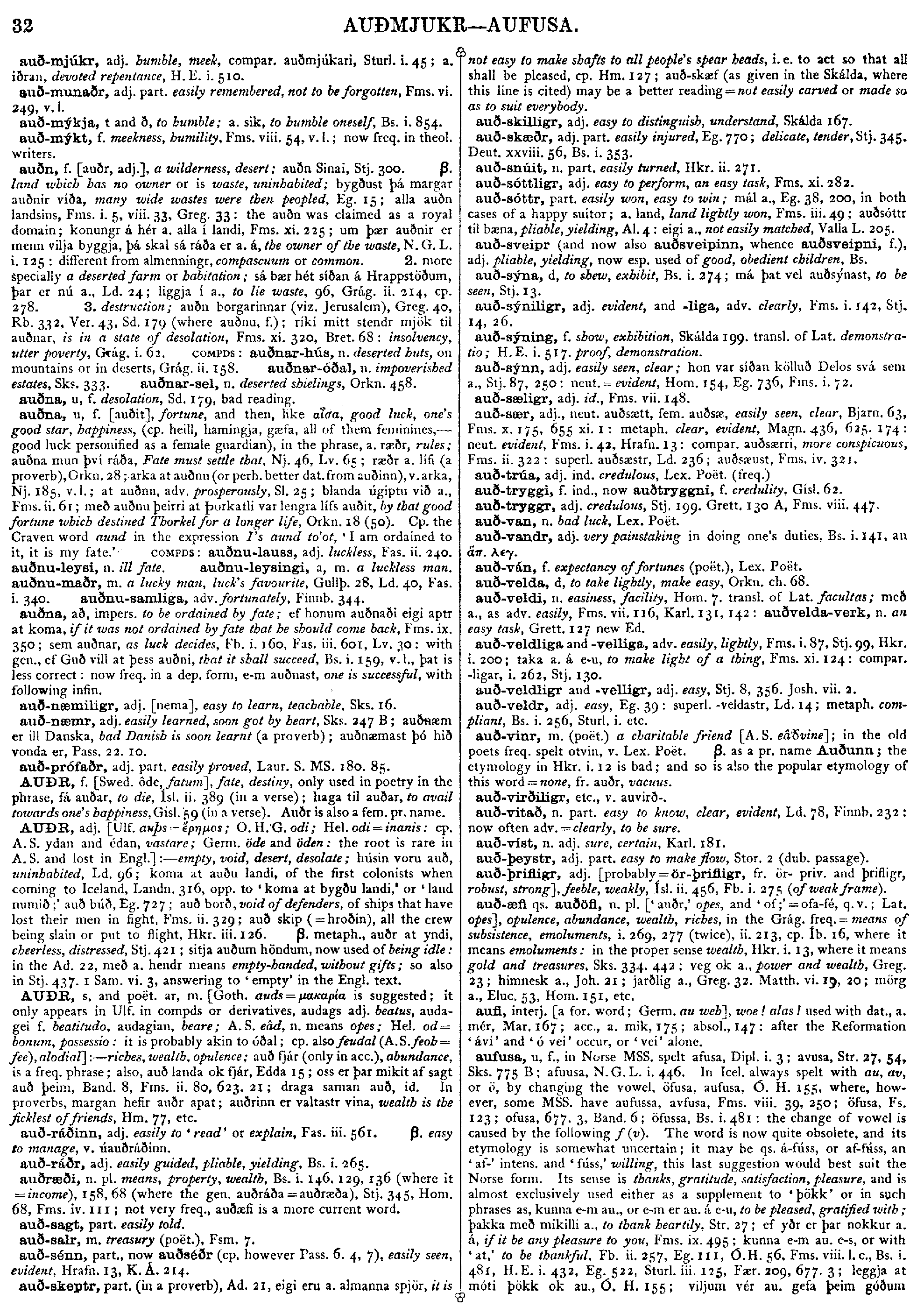
auðn,
f.
[auðr,
adj.],
a
wilderness,
desert;
auðn
Sinai,
Stj.
300.
.
land
which
has
no
owner
or
is
waste,
uninhabited;
bygðust
þá
margar
auðnir
víða,
many
wide
wastes
were
then
peopled,
Eg.
15;
alla
auðn
landsins,
Fms.
i.
5,
viii.
33,
Greg.
33:
the
auðn
was
claimed
as
a
royal
domain;
konungr
á
hér
a.
alla
í
landi,
Fms.
xi.
225;
um
þær
auðnir
er
menn
vilja
byggja,
þá
skal
sá
ráða
er
a.
á,
the
owner
of
the
waste,
N.
G.
L.
i.
125:
different
from
almenningr,
compascuum
or
common.
2.
more
specially
a
deserted
farm
or
habitation;
sá
bær
hét
síðan
á
Hrappstöðum,
þar
er
nú
a.,
Ld.
24;
liggja
í
a.,
to
lie
waste,
96,
Grág.
ii.
214,
cp.
278.
3.
destruction;
auðn
borgarinnar
(viz.
Jerusalem),
Greg.
40,
Rb.
332,
Ver.
43,
Sd.
179
(where
auðnu,
f.);
ríki
mitt
stendr
mjök
til
auðnar,
is
in
a
state
of
desolation,
Fms.
xi.
320,
Bret.
68:
insolvency,
utter
poverty,
Grág.
i.
62.
COMPDS:
auðnar-hús,
n.
deserted
huts,
on
mountains
or
in
deserts,
Grág.
ii.
158.
auðnar-óðal,
n.
impoverished
estates,
Sks.
333.
auðnar-sel,
n.
deserted
shielings,
Orkn.
458.
|
Source: Cleasby/Vigfusson, page b0032, entry 10 View original page image as: [TIFF] [PNG] [View previous entry] [View next entry] |
[Comment on this entry] [View comments] |
The following entry has been hand-corrected once. |
auð-næmr, adj. easily learned, soon got by heart, Sks. 247 B; auðnæm er ill Danska, bad Danish is soon learnt (a proverb); auðnæmast þó hið vonda er, Pass. 22. 10.
|
Source: Cleasby/Vigfusson, page b0032, entry 14 View original page image as: [TIFF] [PNG] [View previous entry] [View next entry] |
[Comment on this entry] [View comments] |
The following entry has been hand-corrected once. |
AUÐR, s, and poët. ar, m. [Goth, auds = GREEK is suggested; it only appears in Ulf. in compds or derivatives, audags adj. beatus, audagei f. beatitudo, audagian, beare; A. S. eâd, n. means opes; Hel. od = bonum, possessio: it is probably akin to óðal; cp. also feudal (A. S. feoh = fee), alodial]: -- riches, wealth, opulence; auð fjár (only in acc.), abundance, is a freq. phrase; also, auð landa ok fjár, Edda 15; oss er þar mikit af sagt auð þeim, Band. 8, Fms. ii. 80, 623. 21; draga saman auð, id. In proverbs, margan hefir auðr apat; auðrinn er valtastr vina, wealth is the ficklest of friends, Hm. 77 etc.
|
Source: Cleasby/Vigfusson, page b0032, entry 53 View original page image as: [TIFF] [PNG] [View previous entry] [View next entry] |
[Comment on this entry] [View comments] |
The following entry has been hand-corrected once. |
aufusa, u, f., in Norse MSS. spelt afusa, Dipl. i. 3; avusa, Str. 27, 54, Sks. 775 B; afuusa, N. G. L. i. 446. In Icel. always spelt with au, av, or ö, by changing the vowel, öfusa, aufusa, Ó. H. 155, where, however, some MSS. have aufussa, avfusa, Fms. viii. 39, 250; öfusa, Fs. 123; ofusa, 677. 3, Band. 6; öfussa, Bs. i. 481: the change of vowel is caused by the following f (v). The word is now quite obsolete, and its etymology is somewhat uncertain; it may be qs. á-fúss, or af-fúss, an 'af-' intens. and 'fúss,' willing, this last suggestion would best suit the Norse form. Its sense is thanks, gratitude, satisfaction, pleasure, and is almost exclusively used either as a supplement to 'þökk' or in such phrases as, kunna e-m au., or e-m er au. á e-u, to be pleased, gratified with; þakka með mikilli a., to thank heartily, Str. 27; ef yðr er þar nokkur a. á, if it be any pleasure to you, Fms. ix. 495; kunna e-m au. e-s, or with 'at,' to be thankful, Fb. ii. 257, Eg. 111, Ó. H. 56, Fms. viii. 1. c., Bs. i. 481, H. E. i. 432, Eg. 522, Sturl. iii. 125, Fær. 209, 677. 3; leggja at móti þökk ok au., Ó. H. 155; viljum vér au. gefa þeim góðum
| Result Page: |  |
Previous | 9 10 11 12 13 14 15 16 17 18 19 20 21 22 23 24 25 26 27 | Next |  |
Germanic Lexicon Project (main page)
This search system was written by
Sean Crist
Please consider
volunteering
to correct the data in these online dictionaries.
No rights reserved. Feel free to use these data in any way you please.