|
|

|
Source: Bosworth/Toller, page b0251, entry 14 View original page image as: [TIFF] [PNG] [View previous entry] [View next entry] |
[Comment on this entry] [View comments] |
The following entry has been hand-corrected once. |
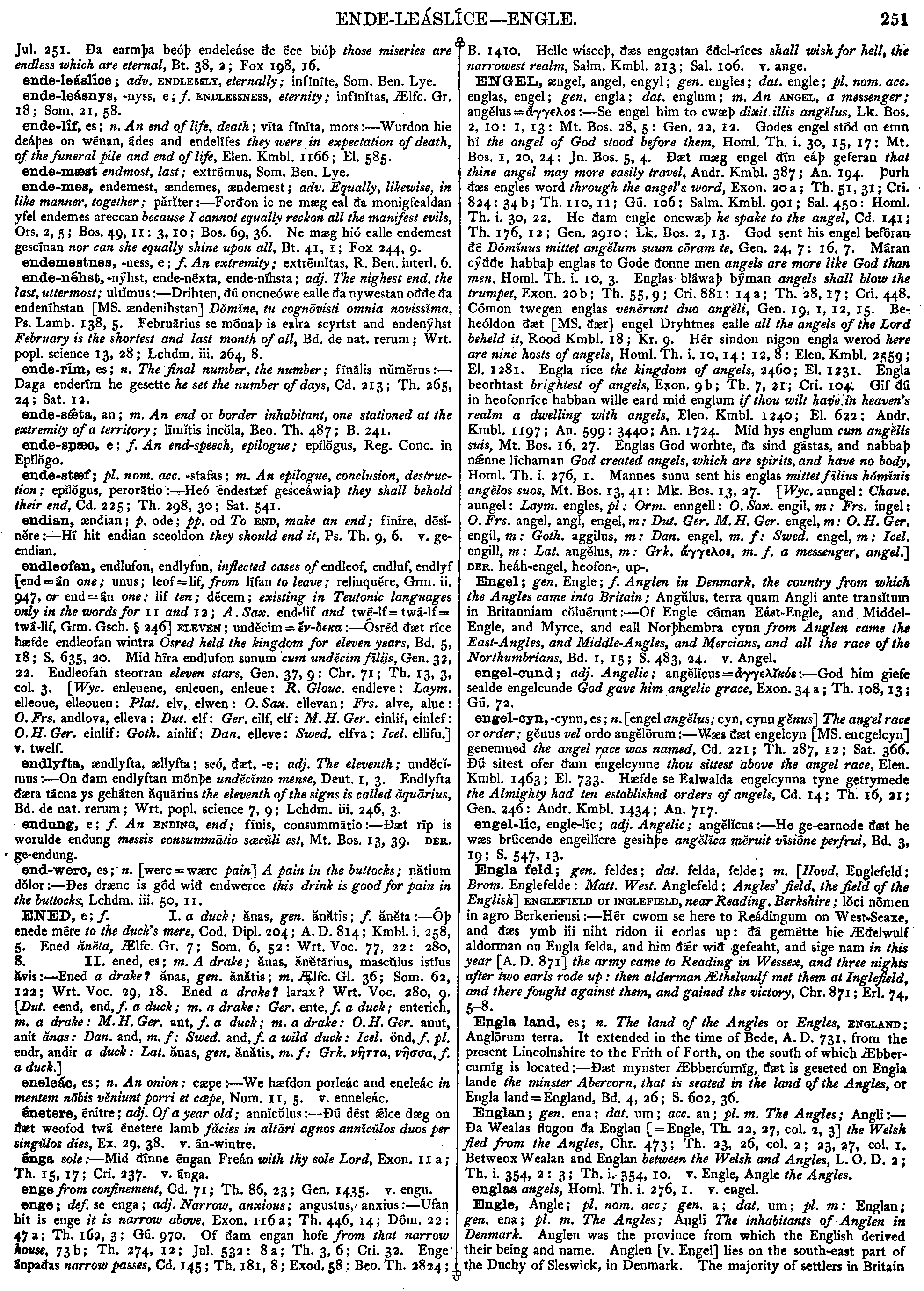
endleofan,
endlufon,
endlyfun,
inflected
cases
of
endleof,
endluf,
endlyf
[end
=
an
one;
unus;
leof=lif,
from
lífan
to
leave;
relinqu re,
Grm.
ii.
947,
or
end
=
án
one;
lif
ten;
dcem;
existing
in
Teutonic
languages
only
in
the
words
for
11
and
12;
A.
Sax.
end-lif
and
twé-lf
=
twá-lf=
twá-lif,
Grm.
Gsch.
§246]
ELEVEN
;
undcim
=
GREEK
:--
Ósréd
ðæt
rice
hæfde
endleofan
wintra
Osred
held
the
kingdom
for
eleven
years,
Bd.
5,
18;
S.
635,
20.
Mid
híra
endlufon
sunum
cum
undecim
filiis,
Gen.
32,
22.
Endleofan
steorran
eleven
stars,
Gen.
37,
9:
Chr.
71;
Th.
13,
3,
col.
3.
[Wyc.
enleuene,
enleuen,
enleue:
R.
Glouc.
endleve:
Laym.
elleoue,
elleouen:
Plat.
elv,
elwen:
O.
Sax.
ellevan;
Frs.
alve,
alue:
O.
Frs.
andlova,
elleva:
Dat.
elf:
Ger.
eilf,
elf:
M.
H.
Ger.
einlif,
einlef:
O.
H.
Ger.
einlif:
Goth.
ainlif:
Dan.
elleve:
Swed.
elfva:
Icel.
ellifu.]
v.
twelf.
re,
Grm.
ii.
947,
or
end
=
án
one;
lif
ten;
dcem;
existing
in
Teutonic
languages
only
in
the
words
for
11
and
12;
A.
Sax.
end-lif
and
twé-lf
=
twá-lf=
twá-lif,
Grm.
Gsch.
§246]
ELEVEN
;
undcim
=
GREEK
:--
Ósréd
ðæt
rice
hæfde
endleofan
wintra
Osred
held
the
kingdom
for
eleven
years,
Bd.
5,
18;
S.
635,
20.
Mid
híra
endlufon
sunum
cum
undecim
filiis,
Gen.
32,
22.
Endleofan
steorran
eleven
stars,
Gen.
37,
9:
Chr.
71;
Th.
13,
3,
col.
3.
[Wyc.
enleuene,
enleuen,
enleue:
R.
Glouc.
endleve:
Laym.
elleoue,
elleouen:
Plat.
elv,
elwen:
O.
Sax.
ellevan;
Frs.
alve,
alue:
O.
Frs.
andlova,
elleva:
Dat.
elf:
Ger.
eilf,
elf:
M.
H.
Ger.
einlif,
einlef:
O.
H.
Ger.
einlif:
Goth.
ainlif:
Dan.
elleve:
Swed.
elfva:
Icel.
ellifu.]
v.
twelf.
|
Source: Bosworth/Toller, page d0190, entry 10 View original page image as: [TIFF] [PNG] [View previous entry] [View next entry] |
[Comment on this entry] [View comments] |
The following entry has been hand-corrected once. |
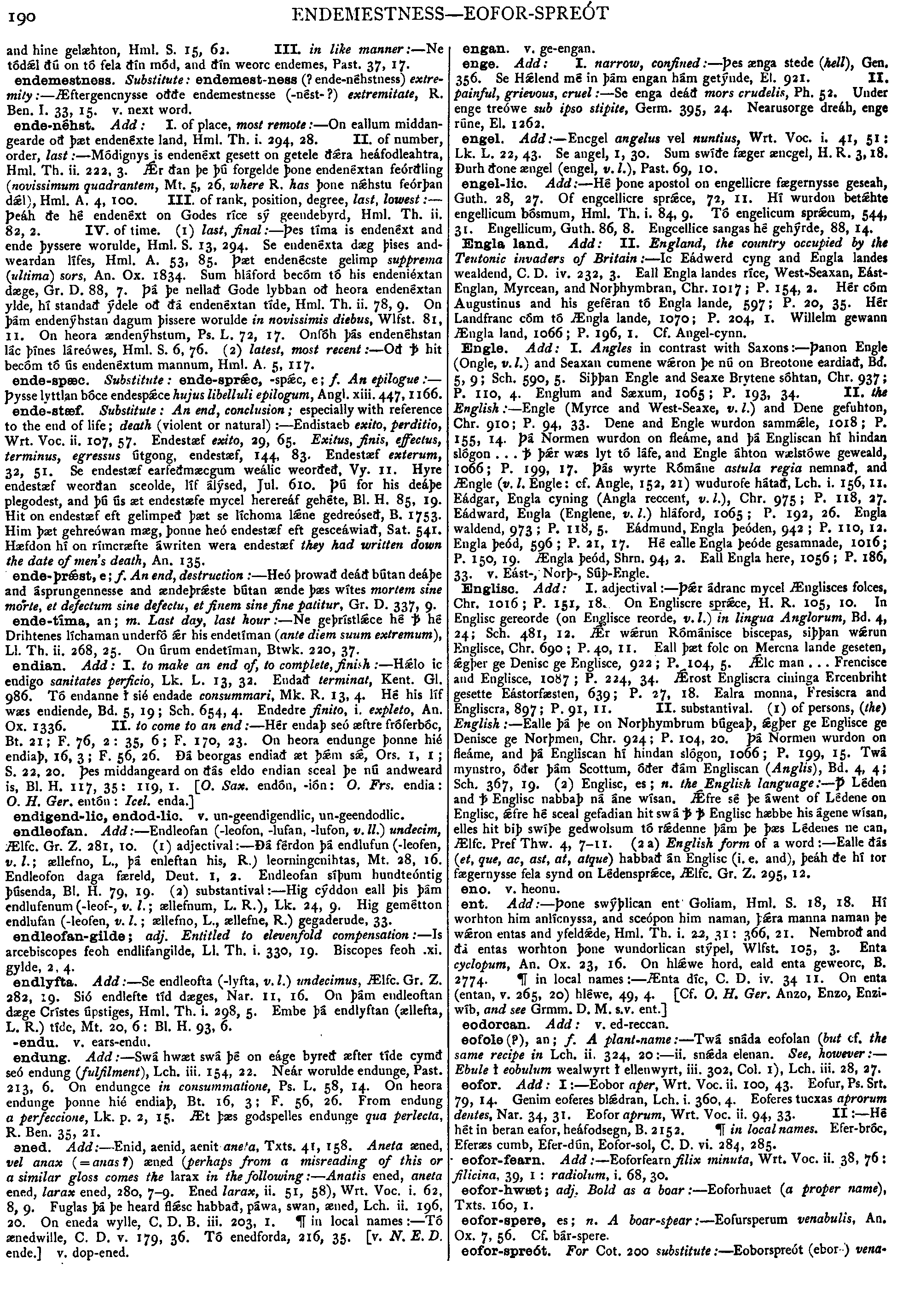
endleofan. Add :-- Endleofan (-leofon, -lufan, -lufon, v. ll.) undecim, Ælfc. Gr. Z. 281, 10. (1) adjectival :-- Ðá férdon þá endlufun (-leofen, v. l. ; ællefno, L., þá enleftan his, R.) leorningcnihtas, Mt. 28, 16. Endleofon daga færeld, Deut. 1, 2. Endleofan síþum hundteóntig þúsenda, Bl. H. 79, 19. (2) substantival :-- Hig cýddon eall þis þám endlufenum (-leof-, v. l. ; ællefnum, L. R.), Lk. 24, 9. Hig gemétton endlufan (-leofen, v. l.; ællefno, L., ællefne, R.) gegaderude, 33.
|
Source: Bosworth/Toller, page b0016, entry 29 View original page image as: [TIFF] [PNG] [View previous entry] [View next entry] |
[Comment on this entry] [View comments] |
The following entry has been hand-corrected once. |
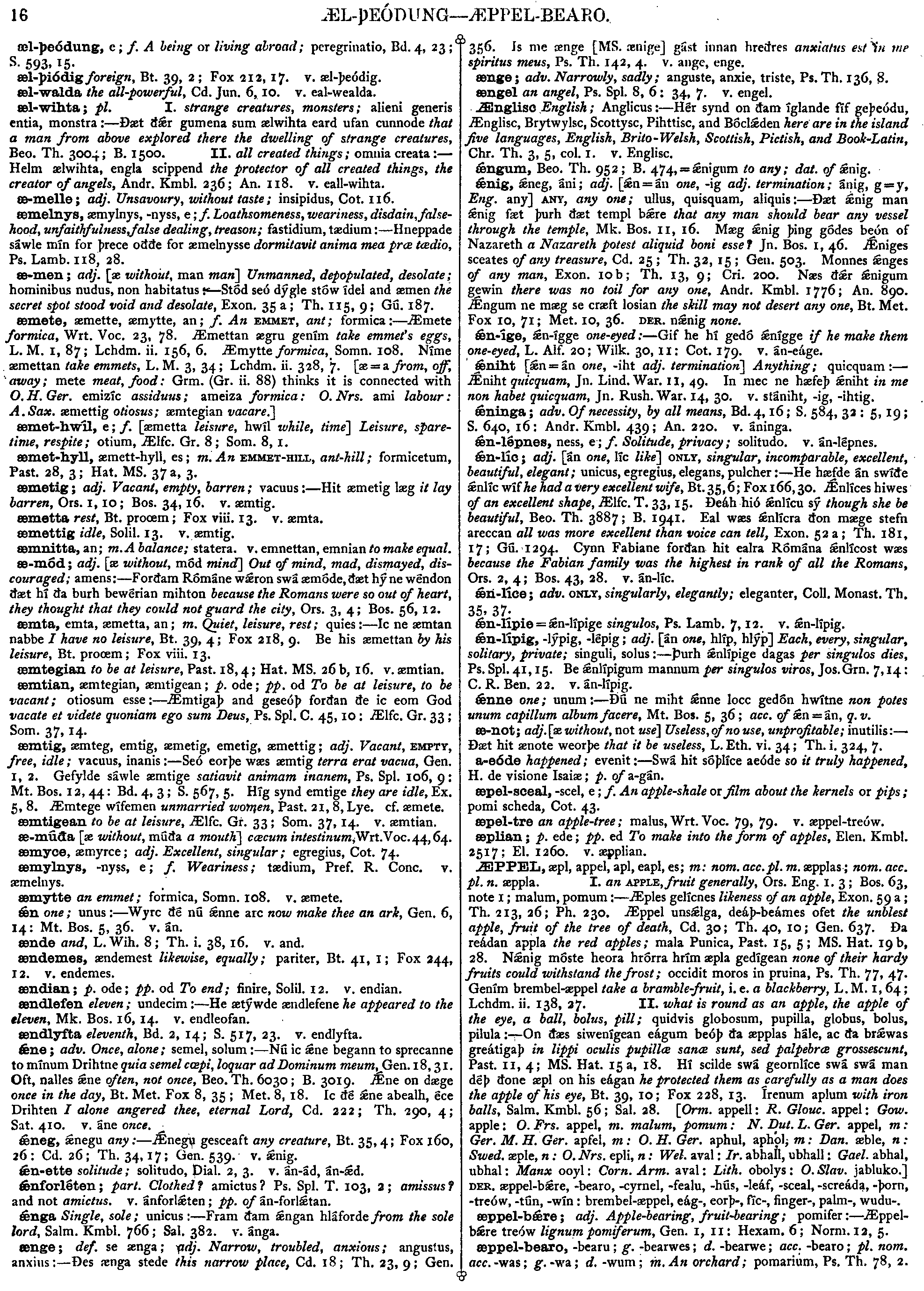
ændlefen eleven; undecim :-- He ætýwde ændlefene he appeared to the eleven, Mk. Bos. 16, 14. v. endleofan.
|
Source: Bosworth/Toller, page b0246, entry 23 View original page image as: [TIFF] [PNG] [View previous entry] [View next entry] |
[Comment on this entry] [View comments] |
The following entry has been hand-corrected once. |
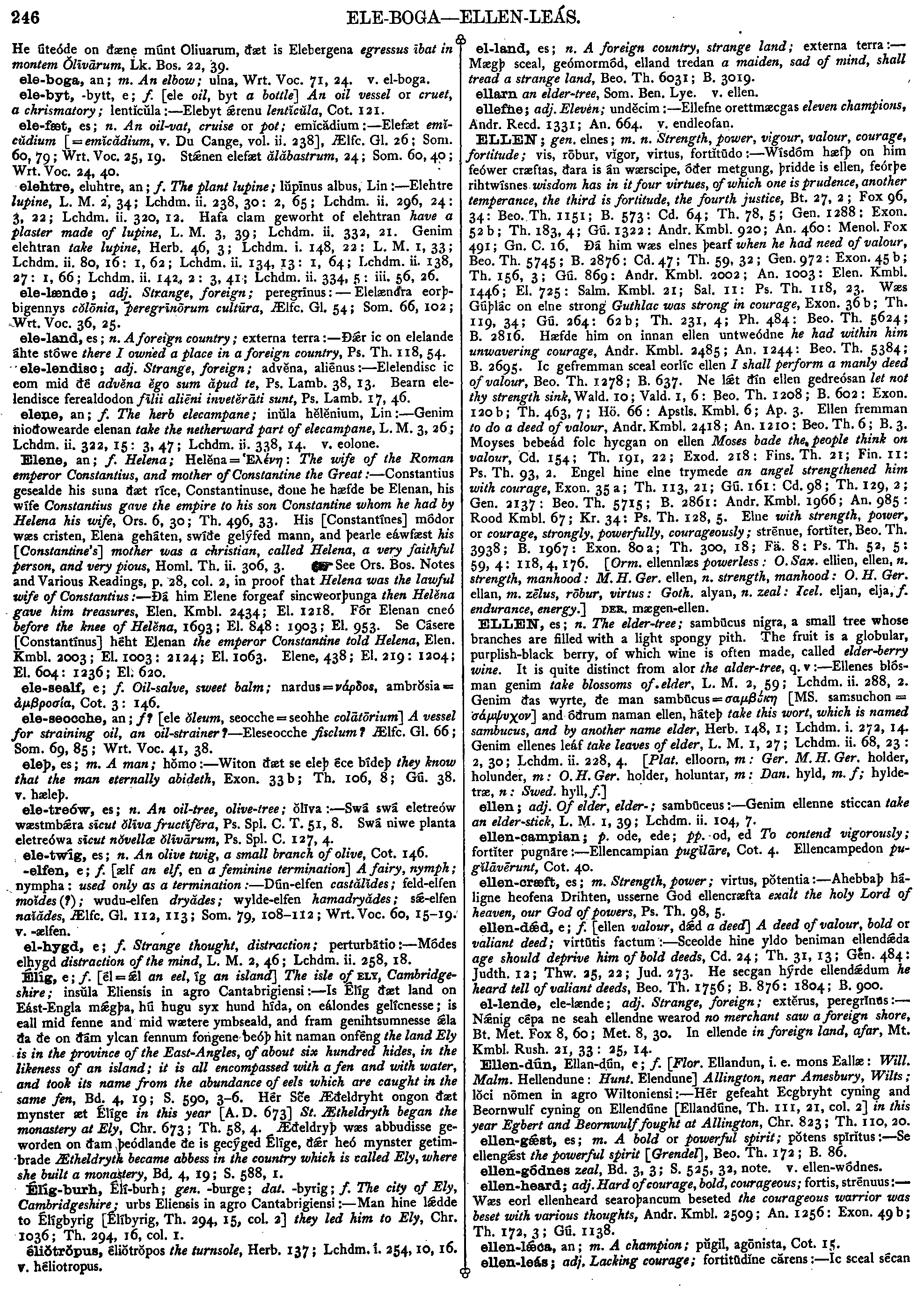
ellefne;
adj.
Eleven;
undcim
:--
Ellefne
orettmæcgas
eleven
champions,
Andr.
Recd.
1331;
An.
664.
v.
endleofan.
|
Source: Bosworth/Toller, page b0878, entry 3 View original page image as: [TIFF] [PNG] [View previous entry] [View next entry] |
[Comment on this entry] [View comments] |
The following entry has been hand-corrected once. |
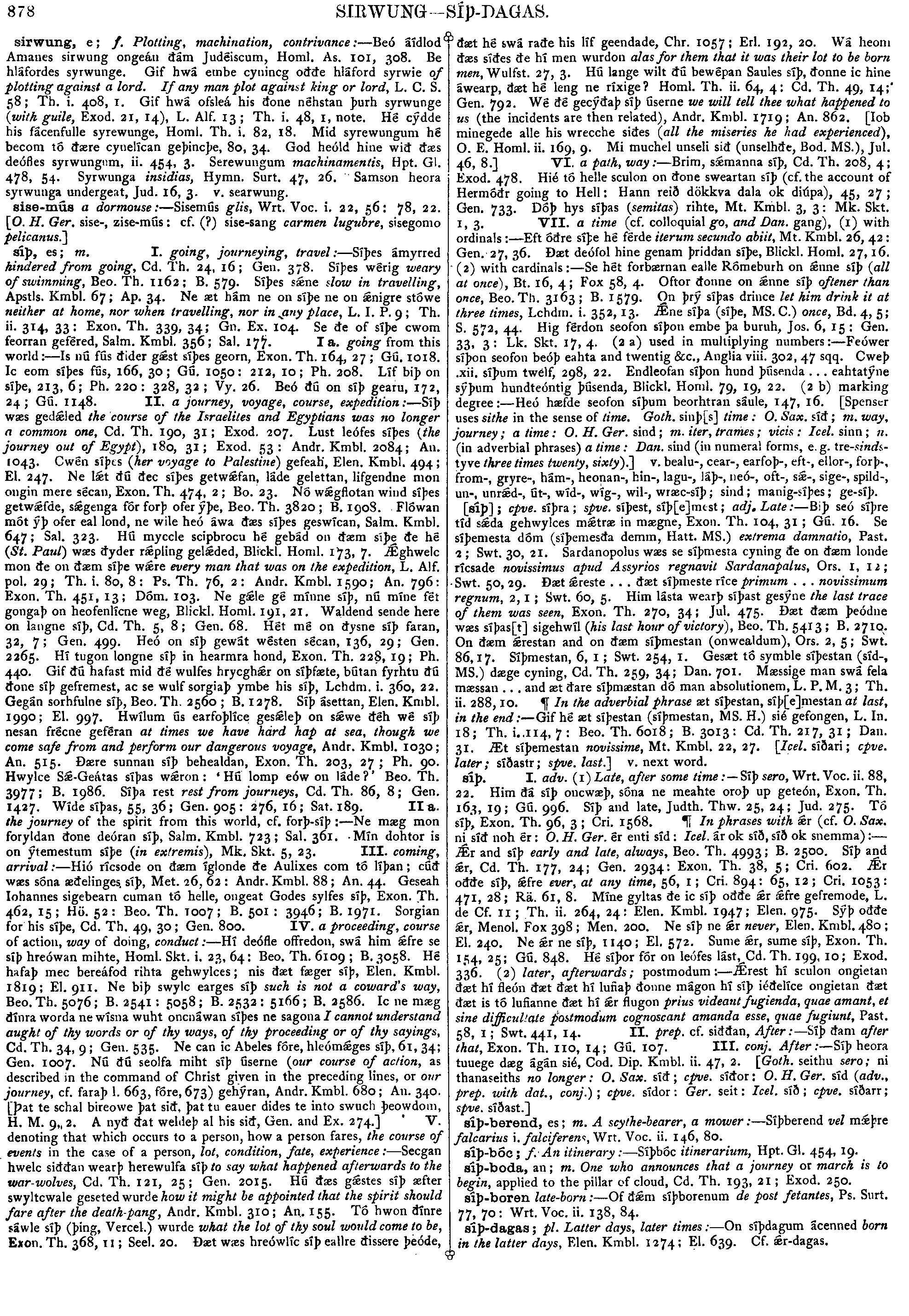
síþ,
es
;
m.
I.
going,
journeying,
travel
:--Síþes
ámyrred
hindered
from
going,
Cd.
Th.
24,
16
;
Gen.
378.
Síþes
wérig
weary
of
swimming,
Beo.
Th.
1162
;
B.
579.
Síþes
s ne
slow
in
travelling,
Apstls.
Kmbl.
67
;
Ap.
34.
Ne
æt
hám
ne
on
síþe
ne
on
nigre
stówe
neither
at
home,
nor
when
travelling,
nor
in
any
place,
L.
I.
P.
9
;
Th.
ii.
314,
33
:
Exon.
Th.
339,
34
;
Gn.
Ex.
104.
Se
ðe
of
síþe
cwom
feorran
geféred,
Salm.
Kmbl.
356
;
Sal.
177.
Ia.
going
from
this
world
:--Is
nú
fús
ðider
gst
síþes
georn,
Exon.
Th.
164,
27
;
Gú.
1018.
Ic
eom
síþes
fús,
166,
30
;
Gú.
1050
:
212,
10
;
Ph.
208.
Líf
biþ
on
síþe,
213,
6
;
Ph.
220
:
328,
32
;
Vy.
26.
Beó
ðú
on
síþ
gearu,
172,
24
;
Gú.
1148.
II.
a
journey,
voyage,
course,
expedition
:--Síþ
wæs
gedled
the
course
of
the
Israelites
and
Egyptians
was
no
longer
a
common
one,
Cd.
Th.
190,
31
;
Exod.
207.
Lust
leófes
síþes
(the
journey
out
of
Egypt),
180,
31
;
Exod.
53
:
Andr.
Kmbl.
2084
;
An.
1043.
Cwén
siþes
(her
voyage
to
Palestine)
gefeah,
Elen.
Kmbl.
494
;
El.
247.
Ne
lt
ðú
ðec
síþes
getwfan,
láde
gelettan,
lifgendne
mon
ongin
mere
sécan,
Exon.
Th.
474,
2
;
Bo.
23.
Nó
wgflotan
wind
síþes
getwfde,
sgenga
fór
forþ
ofer
ýþe,
Beo.
Th.
3820
;
B.
1908.
Flówan
mót
ýþ
ofer
eal
lond,
ne
wile
heó
áwa
ðæs
síþes
geswícan,
Salm.
Kmbl.
647
;
Sal.
323.
Hú
myccle
scipbrocu
hé
gebád
on
ðæm
síþe
ðe
hé
(St.
Paul)
wæs
ðyder
rpling
gelded,
Blickl.
Homl.
173,
7.
Æ-acute;ghwelc
mon
ðe
on
ðæm
síþe
wre
every
man
that
was
on
the
expedition,
L.
Alf.
pol.
29
;
Th.
i.
80,
8
:
Ps.
Th.
76,
2
:
Andr.
Kmbl.
1590
;
An.
796
:
Exon.
Th.
451,
13
;
Dóm.
103.
Ne
gle
gé
mínne
síþ,
nú
míne
fét
gongaþ
on
heofenlícne
weg,
Blickl.
Homl.
191,
21.
Waldend
sende
here
on
langne
síþ,
Cd.
Th.
5,
8
;
Gen.
68.
Hét
mé
on
ðysne
síþ
faran,
32,
7
;
Gen.
499.
Heó
on
síþ
gewát
wésten
sécan,
136,
29
;
Gen.
2265.
Hí
tugon
longne
síþ
in
hearmra
hond,
Exon.
Th.
228,
19
;
Ph.
440.
Gif
ðú
hafast
mid
ðé
wulfes
hrycghr
on
síþfæte,
bútan
fyrhtu
ðú
ðone
síþ
gefremest,
ac
se
wulf
sorgiaþ
ymbe
his
síþ,
Lchdm.
i.
360,
22.
Gegán
sorhfulne
síþ,
Beo.
Th.
2560
;
B.
1278.
Síþ
ásettan,
Elen.
Kmbl.
1990
;
El.
997.
Hwílum
ús
earfoþlíce
gesleþ
on
swe
ðéh
wé
síþ
nesan
frécne
geféran
at
times
we
have
hard
hap
at
sea,
though
we
come
safe
from
and
perform
our
dangerous
voyage,
Andr.
Kmbl.
1030
;
An.
515.
Ðære
sunnan
síþ
behealdan,
Exon.
Th.
203,
27
;
Ph.
90.
Hwylce
S-Geátas
síþas
wron
:
'Hú
lomp
eów
on
láde
?'
Beo.
Th.
3977
;
B.
1986.
Síþa
rest
rest
from
journeys,
Cd.
Th.
86,
8
;
Gen.
1427.
Wíde
síþas,
55,
36
;
Gen.
905
:
276,
16
;
Sat.
189.
IIa.
the
journey
of
the
spirit
from
this
world,
cf.
forþ-síþ
:--Ne
mæg
mon
foryldan
ðone
deóran
síþ,
Salm.
Kmbl.
723
;
Sal.
361.
Mín
dohtor
is
on
ýtemestum
síþe
(in
extremis),
Mk.
Skt.
5,
23.
III.
coming,
arrival
:--Hió
rícsode
on
ðæm
íglonde
ðe
Aulixes
com
tó
líþan
;
cúð
wæs
sóna
æðelinges
síþ,
Met.
26,
62
:
Andr.
Kmbl.
88
;
An.
44.
Geseah
Iohannes
sigebearn
cuman
tó
helle,
ongeat
Godes
sylfes
síþ,
Exon.
Th.
462,
15
;
Hö.
52
:
Beo.
Th.
1007
;
B.
501
:
3946
;
B.
1971.
Sorgian
for
his
síþe,
Cd.
Th.
49,
30
;
Gen.
800.
IV.
a
proceeding,
course
of
action,
way
of
doing,
conduct
:--Hí
deófle
offredon,
swá
him
fre
se
síþ
hreówan
mihte,
Homl.
Skt.
i.
23,
64
:
Beo.
Th.
6109
;
B.
3058.
Hé
hafaþ
mec
bereáfod
rihta
gehwylces
;
nis
ðæt
fæger
síþ,
Elen.
Kmbl.
1819
;
El.
911.
Ne
biþ
swylc
earges
síþ
such
is
not
a
coward's
way,
Beo.
Th.
5076
;
B.
2541
:
5058
;
B.
2532
:
5166
;
B.
2586.
Ic
ne
mæg
ðínra
worda
ne
wísna
wuht
oncnáwan
síþes
ne
sagona
I
cannot
understand
aught
of
thy
words
or
of
thy
ways,
of
thy
proceeding
or
of
thy
sayings,
Cd.
Th.
34,
9
;
Gen.
535.
Ne
can
ic
Abeles
fóre,
hleómges
síþ,
61,
34
;
Gen.
1007.
Nú
ðú
seolfa
miht
síþ
úserne
(our
course
of
action,
as
described
in
the
command
of
Christ
given
in
the
preceding
lines,
or
our
journey,
cf.
faraþ
l.
663,
fóre,
673)
gehýran,
Andr.
Kmbl.
680
;
An.
340.
[Þat
te
schal
bireowe
þat
sið,
þat
tu
eauer
dides
te
into
swuch
þeowdom,
H.
M.
9,
2.
A
nyð
ðat
weldeþ
al
his
sið,
Gen.
and
Ex.
274.]
V.
denoting
that
which
occurs
to
a
person,
how
a
person
fares,
the
course
of
events
in
the
case
of
a
person,
lot,
condition,
fate,
experience
:--Secgan
hwelc
siððan
wearþ
herewulfa
síþ
to
say
what
happened
afterwards
to
the
war-wolves,
Cd.
Th.
121,
25
;
Gen.
2015.
Hú
ðæs
gstes
síþ
æfter
swyltcwale
geseted
wurde
how
it
might
be
appointed
that
the
spirit
should
fare
after
the
death-pang,
Andr.
Kmbl.
310
;
An.
155.
Tó
hwon
ðínre
sáwle
síþ
(þing,
Vercel.)
wurde
what
the
lot
of
thy
soul
would
come
to
be,
Exon.
Th.
368,
11
;
Seel.
20.
Ðæt
wæs
hreówlíc
síþ
eallre
ðissere
þeóde,
ðæt
hé
swá
raðe
his
líf
geendade,
Chr.
1057
;
Erl.
192,
20.
Wá
heom
ðæs
síðes
ðe
hí
men
wurdon
alas
for
them
that
it
was
their
lot
to
be
born
men,
Wulfst.
27,
3.
Hú
lange
wilt
ðú
bewépan
Saules
síþ,
ðonne
ic
hine
áwearp,
ðæt
hé
leng
ne
ríxige
?
Homl.
Th.
ii.
64,
4
:
Cd.
Th.
49,
14
;
Gen.
792.
Wé
ðé
gecýðaþ
síþ
úserne
we
will
tell
thee
what
happened
to
us
(the
incidents
are
then
related),
Andr.
Kmbl.
1719
;
An.
862.
[Iob
minegede
alle
his
wrecche
siðes
(all
the
miseries
he
had
experienced),
O.
E.
Homl.
ii.
169,
9.
Mi
muchel
unseli
sið
(unselhðe,
Bod.
MS.),
Jul.
46,
8.]
VI.
a
path,
way
:--Brim,
smanna
síþ,
Cd.
Th.
208,
4
;
Exod.
478.
Hié
tó
helle
sculon
on
ðone
sweartan
síþ
(cf.
the
account
of
Hermóðr
going
to
Hell
:
Hann
reið
dökkva
dala
ok
diúpa),
45,
27
;
Gen.
733.
Dóþ
hys
síþas
(semitas)
rihte,
Mt.
Kmbl.
3,
3
:
Mk.
Skt.
I.
3.
VII.
a
time
(cf.
colloquial
go,
and
Dan.
gang),
(1)
with
ordinals
:--Eft
óðre
síþe
hé
férde
iterum
secundo
abiit,
Mt.
Kmbl.
26,
42
:
Gen.
27,
36.
Ðæt
deófol
hine
genam
þriddan
síþe,
Blickl.
Homl.
27,
16.
(2)
with
cardinals
:--Se
hét
forbærnan
ealle
Rómeburh
on
nne
síþ
(all
at
once),
Bt.
16,
4
;
Fox
58,
4.
Oftor
ðonne
on
nne
síþ
oftener
than
once,
Beo.
Th.
3163
;
B.
1579.
On
þrý
síþas
drince
let
him
drink
it
at
three
times,
Lchdm.
i.
352,
13.
Æ-acute;ne
síþa
(síþe,
MS.
C.)
once,
Bd.
4,
5
;
S.
572,
44.
Hig
férdon
seofon
síþon
embe
þa
buruh,
Jos.
6,
15
:
Gen.
33,
3
:
Lk.
Skt.
17,
4.
(2
a)
used
in
multiplying
numbers
:--Feówer
síþon
seofon
beóþ
eahta
and
twentig
&c.,
Anglia
viii.
302,
47
sqq.
Cweþ
.xii.
síþum
twélf,
298,
22.
Endleofan
síþon
hund
þúsenda
.
.
.
eahtatýne
sýþum
hundteóntig
þúsenda,
Blickl.
Homl.
79,
19,
22.
(2
b)
marking
degree
:--Heó
hæfde
seofon
síþum
beorhtran
sáule,
147,
16.
[Spenser
uses
sithe
in
the
sense
of
time.
Goth.
sinþ[s]
time
:
O.
Sax.
síð
;
m.
way,
journey
;
a
time
:
O.
H.
Ger.
sind
;
m.
iter,
trames
;
vicis
:
Icel.
sinn
;
n.
(in
adverbial
phrases)
a
time
;
Dan.
sind
(in
numeral
forms,
e.
g.
tre-sinds-tyve
three
times
twenty,
sixty).]
v.
bealu-,
cear-,
earfoþ-,
eft-,
ellor-,
forþ-,
from-,
gryre-,
hám-,
heonan-,
hin-,
lagu-,
láþ-,
neó-,
oft-,
s-,
sige-,
spild-,
un-,
unrd-,
út-,
wíd-,
wíg-,
wil-,
wræc-síþ
;
sind
;
manig-síþes
;
ge-síþ.
ne
slow
in
travelling,
Apstls.
Kmbl.
67
;
Ap.
34.
Ne
æt
hám
ne
on
síþe
ne
on
nigre
stówe
neither
at
home,
nor
when
travelling,
nor
in
any
place,
L.
I.
P.
9
;
Th.
ii.
314,
33
:
Exon.
Th.
339,
34
;
Gn.
Ex.
104.
Se
ðe
of
síþe
cwom
feorran
geféred,
Salm.
Kmbl.
356
;
Sal.
177.
Ia.
going
from
this
world
:--Is
nú
fús
ðider
gst
síþes
georn,
Exon.
Th.
164,
27
;
Gú.
1018.
Ic
eom
síþes
fús,
166,
30
;
Gú.
1050
:
212,
10
;
Ph.
208.
Líf
biþ
on
síþe,
213,
6
;
Ph.
220
:
328,
32
;
Vy.
26.
Beó
ðú
on
síþ
gearu,
172,
24
;
Gú.
1148.
II.
a
journey,
voyage,
course,
expedition
:--Síþ
wæs
gedled
the
course
of
the
Israelites
and
Egyptians
was
no
longer
a
common
one,
Cd.
Th.
190,
31
;
Exod.
207.
Lust
leófes
síþes
(the
journey
out
of
Egypt),
180,
31
;
Exod.
53
:
Andr.
Kmbl.
2084
;
An.
1043.
Cwén
siþes
(her
voyage
to
Palestine)
gefeah,
Elen.
Kmbl.
494
;
El.
247.
Ne
lt
ðú
ðec
síþes
getwfan,
láde
gelettan,
lifgendne
mon
ongin
mere
sécan,
Exon.
Th.
474,
2
;
Bo.
23.
Nó
wgflotan
wind
síþes
getwfde,
sgenga
fór
forþ
ofer
ýþe,
Beo.
Th.
3820
;
B.
1908.
Flówan
mót
ýþ
ofer
eal
lond,
ne
wile
heó
áwa
ðæs
síþes
geswícan,
Salm.
Kmbl.
647
;
Sal.
323.
Hú
myccle
scipbrocu
hé
gebád
on
ðæm
síþe
ðe
hé
(St.
Paul)
wæs
ðyder
rpling
gelded,
Blickl.
Homl.
173,
7.
Æ-acute;ghwelc
mon
ðe
on
ðæm
síþe
wre
every
man
that
was
on
the
expedition,
L.
Alf.
pol.
29
;
Th.
i.
80,
8
:
Ps.
Th.
76,
2
:
Andr.
Kmbl.
1590
;
An.
796
:
Exon.
Th.
451,
13
;
Dóm.
103.
Ne
gle
gé
mínne
síþ,
nú
míne
fét
gongaþ
on
heofenlícne
weg,
Blickl.
Homl.
191,
21.
Waldend
sende
here
on
langne
síþ,
Cd.
Th.
5,
8
;
Gen.
68.
Hét
mé
on
ðysne
síþ
faran,
32,
7
;
Gen.
499.
Heó
on
síþ
gewát
wésten
sécan,
136,
29
;
Gen.
2265.
Hí
tugon
longne
síþ
in
hearmra
hond,
Exon.
Th.
228,
19
;
Ph.
440.
Gif
ðú
hafast
mid
ðé
wulfes
hrycghr
on
síþfæte,
bútan
fyrhtu
ðú
ðone
síþ
gefremest,
ac
se
wulf
sorgiaþ
ymbe
his
síþ,
Lchdm.
i.
360,
22.
Gegán
sorhfulne
síþ,
Beo.
Th.
2560
;
B.
1278.
Síþ
ásettan,
Elen.
Kmbl.
1990
;
El.
997.
Hwílum
ús
earfoþlíce
gesleþ
on
swe
ðéh
wé
síþ
nesan
frécne
geféran
at
times
we
have
hard
hap
at
sea,
though
we
come
safe
from
and
perform
our
dangerous
voyage,
Andr.
Kmbl.
1030
;
An.
515.
Ðære
sunnan
síþ
behealdan,
Exon.
Th.
203,
27
;
Ph.
90.
Hwylce
S-Geátas
síþas
wron
:
'Hú
lomp
eów
on
láde
?'
Beo.
Th.
3977
;
B.
1986.
Síþa
rest
rest
from
journeys,
Cd.
Th.
86,
8
;
Gen.
1427.
Wíde
síþas,
55,
36
;
Gen.
905
:
276,
16
;
Sat.
189.
IIa.
the
journey
of
the
spirit
from
this
world,
cf.
forþ-síþ
:--Ne
mæg
mon
foryldan
ðone
deóran
síþ,
Salm.
Kmbl.
723
;
Sal.
361.
Mín
dohtor
is
on
ýtemestum
síþe
(in
extremis),
Mk.
Skt.
5,
23.
III.
coming,
arrival
:--Hió
rícsode
on
ðæm
íglonde
ðe
Aulixes
com
tó
líþan
;
cúð
wæs
sóna
æðelinges
síþ,
Met.
26,
62
:
Andr.
Kmbl.
88
;
An.
44.
Geseah
Iohannes
sigebearn
cuman
tó
helle,
ongeat
Godes
sylfes
síþ,
Exon.
Th.
462,
15
;
Hö.
52
:
Beo.
Th.
1007
;
B.
501
:
3946
;
B.
1971.
Sorgian
for
his
síþe,
Cd.
Th.
49,
30
;
Gen.
800.
IV.
a
proceeding,
course
of
action,
way
of
doing,
conduct
:--Hí
deófle
offredon,
swá
him
fre
se
síþ
hreówan
mihte,
Homl.
Skt.
i.
23,
64
:
Beo.
Th.
6109
;
B.
3058.
Hé
hafaþ
mec
bereáfod
rihta
gehwylces
;
nis
ðæt
fæger
síþ,
Elen.
Kmbl.
1819
;
El.
911.
Ne
biþ
swylc
earges
síþ
such
is
not
a
coward's
way,
Beo.
Th.
5076
;
B.
2541
:
5058
;
B.
2532
:
5166
;
B.
2586.
Ic
ne
mæg
ðínra
worda
ne
wísna
wuht
oncnáwan
síþes
ne
sagona
I
cannot
understand
aught
of
thy
words
or
of
thy
ways,
of
thy
proceeding
or
of
thy
sayings,
Cd.
Th.
34,
9
;
Gen.
535.
Ne
can
ic
Abeles
fóre,
hleómges
síþ,
61,
34
;
Gen.
1007.
Nú
ðú
seolfa
miht
síþ
úserne
(our
course
of
action,
as
described
in
the
command
of
Christ
given
in
the
preceding
lines,
or
our
journey,
cf.
faraþ
l.
663,
fóre,
673)
gehýran,
Andr.
Kmbl.
680
;
An.
340.
[Þat
te
schal
bireowe
þat
sið,
þat
tu
eauer
dides
te
into
swuch
þeowdom,
H.
M.
9,
2.
A
nyð
ðat
weldeþ
al
his
sið,
Gen.
and
Ex.
274.]
V.
denoting
that
which
occurs
to
a
person,
how
a
person
fares,
the
course
of
events
in
the
case
of
a
person,
lot,
condition,
fate,
experience
:--Secgan
hwelc
siððan
wearþ
herewulfa
síþ
to
say
what
happened
afterwards
to
the
war-wolves,
Cd.
Th.
121,
25
;
Gen.
2015.
Hú
ðæs
gstes
síþ
æfter
swyltcwale
geseted
wurde
how
it
might
be
appointed
that
the
spirit
should
fare
after
the
death-pang,
Andr.
Kmbl.
310
;
An.
155.
Tó
hwon
ðínre
sáwle
síþ
(þing,
Vercel.)
wurde
what
the
lot
of
thy
soul
would
come
to
be,
Exon.
Th.
368,
11
;
Seel.
20.
Ðæt
wæs
hreówlíc
síþ
eallre
ðissere
þeóde,
ðæt
hé
swá
raðe
his
líf
geendade,
Chr.
1057
;
Erl.
192,
20.
Wá
heom
ðæs
síðes
ðe
hí
men
wurdon
alas
for
them
that
it
was
their
lot
to
be
born
men,
Wulfst.
27,
3.
Hú
lange
wilt
ðú
bewépan
Saules
síþ,
ðonne
ic
hine
áwearp,
ðæt
hé
leng
ne
ríxige
?
Homl.
Th.
ii.
64,
4
:
Cd.
Th.
49,
14
;
Gen.
792.
Wé
ðé
gecýðaþ
síþ
úserne
we
will
tell
thee
what
happened
to
us
(the
incidents
are
then
related),
Andr.
Kmbl.
1719
;
An.
862.
[Iob
minegede
alle
his
wrecche
siðes
(all
the
miseries
he
had
experienced),
O.
E.
Homl.
ii.
169,
9.
Mi
muchel
unseli
sið
(unselhðe,
Bod.
MS.),
Jul.
46,
8.]
VI.
a
path,
way
:--Brim,
smanna
síþ,
Cd.
Th.
208,
4
;
Exod.
478.
Hié
tó
helle
sculon
on
ðone
sweartan
síþ
(cf.
the
account
of
Hermóðr
going
to
Hell
:
Hann
reið
dökkva
dala
ok
diúpa),
45,
27
;
Gen.
733.
Dóþ
hys
síþas
(semitas)
rihte,
Mt.
Kmbl.
3,
3
:
Mk.
Skt.
I.
3.
VII.
a
time
(cf.
colloquial
go,
and
Dan.
gang),
(1)
with
ordinals
:--Eft
óðre
síþe
hé
férde
iterum
secundo
abiit,
Mt.
Kmbl.
26,
42
:
Gen.
27,
36.
Ðæt
deófol
hine
genam
þriddan
síþe,
Blickl.
Homl.
27,
16.
(2)
with
cardinals
:--Se
hét
forbærnan
ealle
Rómeburh
on
nne
síþ
(all
at
once),
Bt.
16,
4
;
Fox
58,
4.
Oftor
ðonne
on
nne
síþ
oftener
than
once,
Beo.
Th.
3163
;
B.
1579.
On
þrý
síþas
drince
let
him
drink
it
at
three
times,
Lchdm.
i.
352,
13.
Æ-acute;ne
síþa
(síþe,
MS.
C.)
once,
Bd.
4,
5
;
S.
572,
44.
Hig
férdon
seofon
síþon
embe
þa
buruh,
Jos.
6,
15
:
Gen.
33,
3
:
Lk.
Skt.
17,
4.
(2
a)
used
in
multiplying
numbers
:--Feówer
síþon
seofon
beóþ
eahta
and
twentig
&c.,
Anglia
viii.
302,
47
sqq.
Cweþ
.xii.
síþum
twélf,
298,
22.
Endleofan
síþon
hund
þúsenda
.
.
.
eahtatýne
sýþum
hundteóntig
þúsenda,
Blickl.
Homl.
79,
19,
22.
(2
b)
marking
degree
:--Heó
hæfde
seofon
síþum
beorhtran
sáule,
147,
16.
[Spenser
uses
sithe
in
the
sense
of
time.
Goth.
sinþ[s]
time
:
O.
Sax.
síð
;
m.
way,
journey
;
a
time
:
O.
H.
Ger.
sind
;
m.
iter,
trames
;
vicis
:
Icel.
sinn
;
n.
(in
adverbial
phrases)
a
time
;
Dan.
sind
(in
numeral
forms,
e.
g.
tre-sinds-tyve
three
times
twenty,
sixty).]
v.
bealu-,
cear-,
earfoþ-,
eft-,
ellor-,
forþ-,
from-,
gryre-,
hám-,
heonan-,
hin-,
lagu-,
láþ-,
neó-,
oft-,
s-,
sige-,
spild-,
un-,
unrd-,
út-,
wíd-,
wíg-,
wil-,
wræc-síþ
;
sind
;
manig-síþes
;
ge-síþ.
|
Source: Bosworth/Toller, page b1209, entry 17 View original page image as: [TIFF] [PNG] [View previous entry] [View next entry] |
[Comment on this entry] [View comments] |
The following entry has been hand-corrected once. |
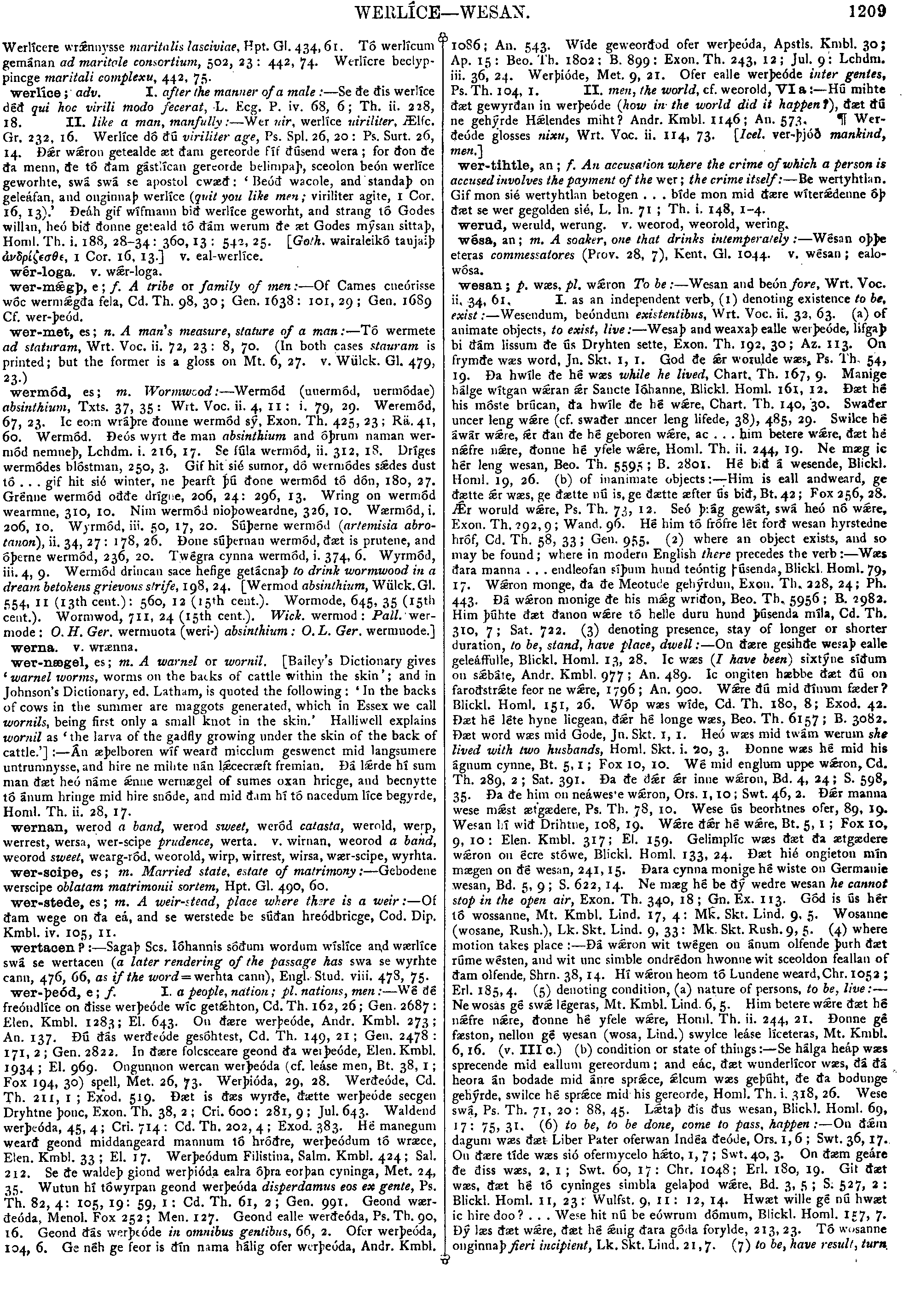
wesan;
p.
wæs,
pl.
wron
To
be:--Wesan
and
beón
fore,
Wrt.
Voc.
ii.
34,
61.
I.
as
an
independent
verb,
(1)
denoting
existence
to
be,
exist:--Wesendum,
beóndum
existentibus,
Wrt.
Voc.
ii.
32,
63.
(a)
of
animate
objects,
to
exist,
live:--Wesaþ
and
weaxaþ
ealle
werþeóde,
lifgaþ
bi
ðám
lissum
ðe
ús
Dryhten
sette,
Exon.
Th.
192,
30;
Az.
113.
On
frymðe
wæs
word,
Jn.
Skt.
1,
1.
God
ðe
r
worulde
wæs,
Ps.
Th.
54,
19.
Ða
hwíle
ðe
hé
wæs
while
he
lived,
Chart.
Th.
167,
9.
Manige
hálge
wítgan
wran
r
Sancte
Ióhanne,
Blickl.
Homl.
161,
12.
Ðæt
hé
his
móste
brúcan,
ða
hwíle
ðe
hé
wre,
Chart.
Th.
140,
30.
Swaðer
uncer
leng
wre
(cf.
swaðer
uncer
leng
lifede,
38),
485,
29.
Swilce
hé
áwár
wre,
r
ðan
ðe
hé
geboren
wre,
ac
.
.
.
him
betere
wre,
ðæt
hé
nfre
nre,
ðonne
hé
yfele
wre,
Homl.
Th.
ii.
244,
19.
Ne
mæg
ic
hér
leng
wesan,
Beo.
Th.
5595;
B.
2801.
Hé
bið
á
wesende,
Blickl.
Homl.
19,
26.
(b)
of
inanimate
objects:--Him
is
eall
andweard,
ge
ðætte
r
wæs,
ge
ðætte
nú
is,
ge
ðætte
æfter
ús
bið,
Bt.
42;
Fox
256,
28.
Æ-acute;r
woruld
wre,
Ps.
Th.
73,
12.
Seó
þrág
gewát,
swá
heó
nó
wre,
Exon.
Th.
292,
9;
Wand.
96.
Hé
him
tó
frófre
lét
forð
wesan
hyrstedne
hróf,
Cd.
Th.
58,
33;
Gen.
955.
(2)
where
an
object
exists,
and
so
may
be
found;
where
in
modern
English
there
precedes
the
verb:--Wæs
ðara
manna
.
.
.
endleofan
síþum
hund
teóntig
þúsenda,
Blickl.
Homl.
79,
17.
Wron
monge,
ða
ðe
Meotude
gehýrdun,
Exon.
Th.
228,
24;
Ph.
443.
Ðá
wron
monige
ðe
his
mg
wriðon,
Beo.
Th.
5956;
B.
2982.
Him
þúhte
ðæt
ðanon
wre
tó
helle
duru
hund
þúsenda
míla,
Cd.
Th.
310,
7;
Sat.
722.
(3)
denoting
presence,
stay
of
longer
or
shorter
duration,
to
be,
stand,
have
place,
dwell:--On
ðære
gesihðe
wesaþ
ealle
geleáffulle,
Blickl.
Homl.
13,
28.
Ic
wæs
(I
have
been)
sixtýne
síðum
on
sbáte,
Andr.
Kmbl.
977;
An.
489.
Ic
ongiten
hæbbe
ðæt
ðú
on
faroðstrte
feor
ne
wre,
1796;
An.
900.
Wre
ðú
mid
ðínum
fæder?
Blickl.
Homl.
151,
26.
Wóp
wæs
wíde,
Cd.
Th.
180,
8;
Exod.
42.
Ðæt
hé
léte
hyne
licgean,
ðr
hé
longe
wæs,
Beo.
Th.
6157;
B.
3082.
Ðæt
word
wæs
mid
Gode,
Jn.
Skt.
1,
1.
Heó
wæs
mid
twám
werum
she
lived
with
two
husbands,
Homl.
Skt.
i.
20,
3.
Ðonne
wæs
hé
mid
his
ágnum
cynne,
Bt.
5,
1;
Fox
10,
10.
Wé
mid
englum
uppe
wron,
Cd.
Th.
289,
2;
Sat.
391.
Ða
ðe
ðr
r
inne
wron,
Bd.
4,
24;
S.
598,
35.
Ða
ðe
him
on
neáweste
wron,
Ors.
1,
10;
Swt.
46,
2.
Ðr
manna
wese
mst
ætgædere,
Ps.
Th.
78,
10.
Wese
ús
beorhtnes
ofer,
89,
19.
Wesan
hí
wið
Drihtne,
108,
19.
Wre
ðr
hé
wre,
Bt.
5,
1;
Fox
10,
9,
10:
Elen.
Kmbl.
317;
El.
159.
Gelimplíc
wæs
ðæt
ða
ætgædere
wron
on
écre
stówe,
Blickl.
Homl.
133,
24.
Ðæt
hié
ongieton
mín
mægen
on
ðé
wesan,
241,
15.
Ðara
cynna
monige
hé
wiste
on
Germanie
wesan,
Bd.
5,
9;
S.
622,
14.
Ne
mæg
hé
be
ðý
wedre
wesan
he
cannot
stop
in
the
open
air,
Exon.
Th.
340,
18;
Gn.
Ex.
113.
Gód
is
ús
hér
tó
wossanne,
Mt.
Kmbl.
Lind.
17,
4:
Mk.
Skt.
Lind.
9,
5.
Wosanne
(wosane,
Rush.),
Lk.
Skt.
Lind.
9,
33:
Mk.
Skt.
Rush.
9,
5.
(4)
where
motion
takes
place:--Ðá
wron
wit
twégen
on
ánum
olfende
þurh
ðæt
rúme
wésten,
and
wit
unc
simble
ondrédon
hwonne
wit
sceoldon
feallan
of
ðam
olfende,
Shrn.
38,
14.
Hí
wron
heom
tó
Lundene
weard,
Chr.
1052;
Erl.
185,
4.
(5)
denoting
condition,
(a)
nature
of
persons,
to
be,
live:--Ne
wosas
gé
sw
légeras,
Mt.
Kmbl.
Lind.
6,
5.
Him
betere
wre
ðæt
hé
nfre
nre,
ðonne
hé
yfele
wre,
Homl.
Th.
ii.
244,
21.
Ðonne
gé
fæston,
nellon
gé
wesan
(wosa,
Lind.)
swylce
leáse
líceteras,
Mt.
Kmbl.
6,
16.
(v.
III
c.)
(b)
condition
or
state
of
things:--Se
hálga
heáp
wæs
sprecende
mid
eallum
gereordum;
and
eác,
ðæt
wunderlícor
wæs,
ðá
ðá
heora
án
bodade
mid
ánre
sprce,
lcum
wæs
geþúht,
ðe
ða
bodunge
gehýrde,
swilce
hé
sprce
mid
his
gereorde,
Homl.
Th.
i.
318,
26.
Wese
swá,
Ps.
Th.
71,
20:
88,
45.
Ltaþ
ðis
ðus
wesan,
Blickl.
Homl.
69,
17:
75,
31.
(6)
to
be,
to
be
done,
come
to
pass,
happen:--On
ðm
dagum
wæs
ðæt
Liber
Pater
oferwan
Indéa
ðeóde,
Ors.
1,
6;
Swt.
36,
17.
On
ðære
tíde
wæs
sió
ofermycelo
hto,
1,
7;
Swt.
40,
3.
On
ðæm
geáre
ðe
ðiss
wæs,
2,
1;
Swt.
60,
17:
Chr.
1048;
Erl.
180,
19.
Git
ðæt
wæs,
ðæt
hé
tó
cyninges
simbla
gelaþod
wre,
Bd.
3,
5;
S.
527,
2:
Blickl.
Homl.
11,
23:
Wulfst.
9,
11:
12,
14.
Hwæt
wille
gé
nú
hwæt
ic
hire
doo?
.
.
.
Wese
hit
nú
be
eówrum
dómum,
Blickl.
Homl.
157,
7.
Ðý
læs
ðæt
wre,
ðæt
hé
nig
ðara
góda
forylde,
213,
23.
Tó
wosanne
onginnaþ
fieri
incipient,
Lk.
Skt.
Lind.
21,
7.
(7)
to
be,
have
result,
turn
Germanic Lexicon Project (main page)
This search system was written by
Sean Crist
Please consider
volunteering
to correct the data in these online dictionaries.
No rights reserved. Feel free to use these data in any way you please.