|
|

|
Source: Cleasby/Vigfusson, page b0005, entry 1 View original page image as: [TIFF] [PNG] [View previous entry] [View next entry] |
[Comment on this entry] [View comments] |
The following entry has been hand-corrected once. |
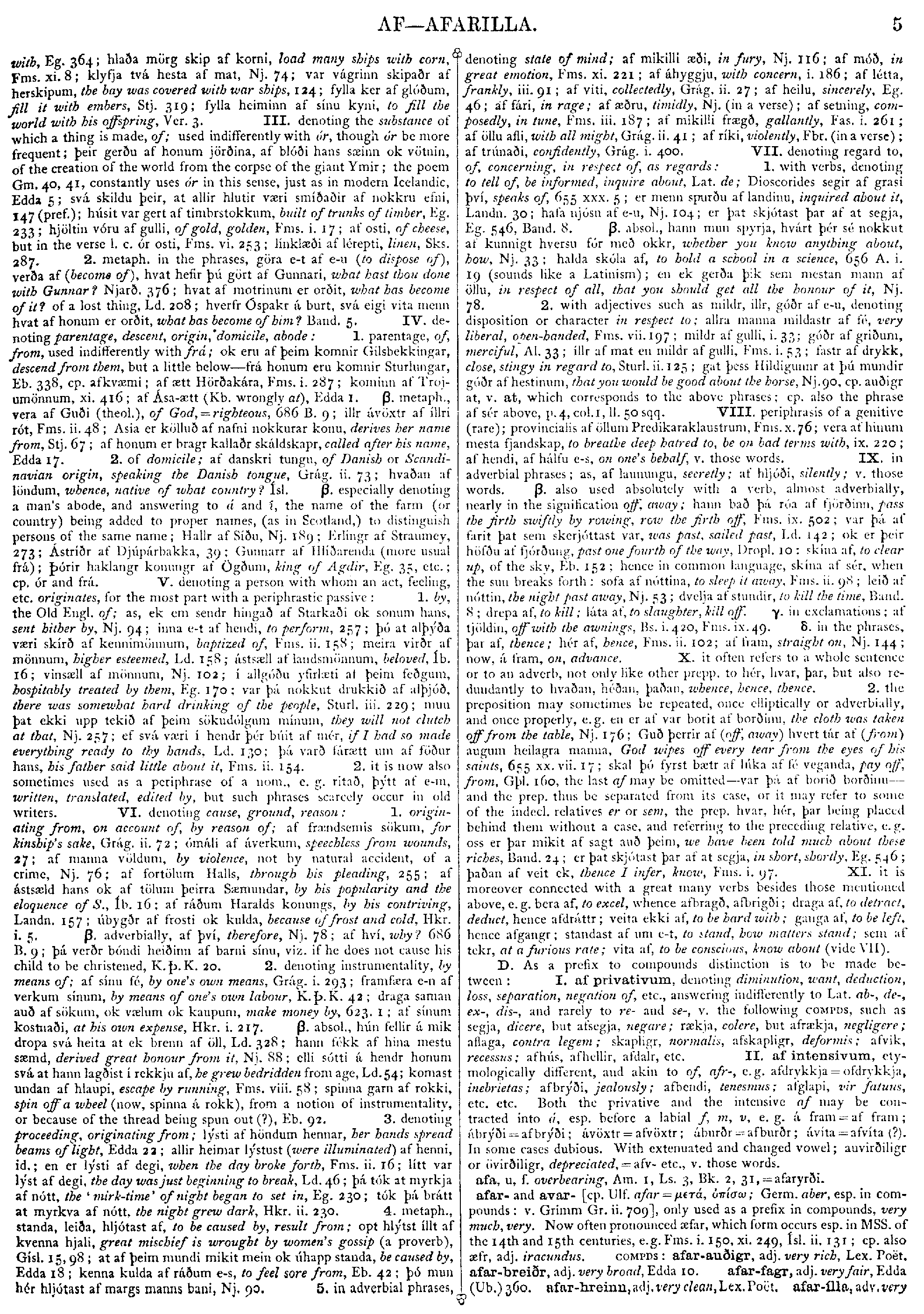
with,
Eg.
364;
hlaða
mörg
skip
af
korni,
load
many
ships
with
corn,
Fms.
xi.
8;
klyfja
tvá
hesta
af
mat,
Nj.
74;
var
vágrinn
skipaðr
af
herskipum,
the
bay
was
covered
with
war
ships,
124;
fylla
ker
af
glóðum,
fill
it
with
embers,
Stj.
319;
fylla
heiminn
af
sínu
kyni,
to
fill
the
world
with
his
offspring,
Ver.
3.
III.
denoting
the
substance
of
which
a
thing
is
made,
of;
used
indifferently
with
ór,
though
ór
be
more
frequent;
þeir
gerðu
af
honum
jörðina,
af
blóði
hans
sæinn
ok
vötnin,
of
the
creation
of
the
world
from
the
corpse
of
the
giant
Ymir;
the
poem
Gm.
40,
41,
constantly
uses
ór
in
this
sense,
just
as
in
modern
Icelandic,
Edda
5;
svá
skildu
þeir,
at
allir
hlutir
væri
smíðaðir
af
nokkru
efni,
147
(pref.);
húsit
var
gert
af
timbrstokkum,
built
of
trunks
of
timber,
Eg.
233;
hjöhin
vóru
af
gulli,
of
gold,
golden,
Fms.
i.
17;
af
osti,
of
cheese,
but
in
the
verse
1.
c.
ór
osti,
Fms.
vi.
253;
línklæði
af
lérepti,
linen,
Sks.
287.
2.
metaph.
in
the
phrases,
göra
e-t
af
e-ti
(to
dispose
of),
verða
af
(become
of),
hvat
hefir
þú
gört
af
Gunnari,
what
hast
thou
done
with
Gunnar?
Njarð.
376;
hvat
af
motrinuni
er
orðit,
what
has
become
of
it?
of
a
lost
thing,
Ld.
208;
hverfr
Óspakr
á
burt,
svá
eigi
vita
menn
hvat
af
honum
er
orðit,
what
has
become
of
him?
Band.
5.
IV.
de-
noting
parentage,
descent,
origin,
domicile,
abode:
1.
parentage,
of,
from,
used
indifferently
with
frá;
ok
eru
af
þeim
komnir
Gilsbekkingar,
descend
from
them,
but
a
little
below
--
frá
honum
eru
konmir
Sturlungar,
Eb.
338,
cp.
afkvæmi;
af
ætt
Hörðakára,
Fms.
i.
287;
kominn
af
Troj-
umönnum,
xi.
416;
af
Ása-ætt
(Kb.
wrongly
at),
Edda
I.
 .
metaph.,
vera
af
Guði
(theol.),
of
God,
=
righteous,
686
B.
9;
illr
ávöxtr
af
íllri
rót,
Fms.
ii.
48;
Asia
er
kölluð
af
nafni
nokkurar
konu,
derives
her
name
from,
Stj.
67;
af
honum
er
bragr
kallaðr
skáldskapr,
called
after
his
name,
Edda
17.
2.
of
domicile;
af
danskri
tungu,
of
Danish
or
Scandi-
navian
origin,
speaking
the
Danish
tongue,
Grág.
ii.
73;
hvaðan
af
löndum,
whence,
native
of
what
country?
Ísl.
.
especially
denoting
a
man's
abode,
and
answering
to
á
and
í,
the
name
of
the
farm
(or
country)
being
added
to
proper
names,
(as
in
Scotland,)
to
distinguish
persons
of
the
same
name;
Hallr
af
Síðu,
Nj.
189;
Erlingr
af
Straumey,
273;
Ástríðr
af
Djúpárbakka,
39;
Gunnarr
af
Hlíðarenda
(more
usual
frá);
þorir
haklangr
konungr
af
Ögðum,
king
of
Agdir,
Eg.
35,
etc.;
cp.
ór
and
frá.
V.
denoting
a
person
with
whom
an
act,
feeling,
etc.
originates,
for
the
most
part
with
a
periphrastic
passive:
1.
by,
the
Old
Engl.
of;
as,
ek
em
sendr
hingað
af
Starkaði
ok
sonum
hans,
sent
hither
by,
Nj.
94;
inna
e-t
af
hendi,
to
perform,
257;
þó
at
alþýða
væri
skírð
af
kennimönnum,
baptized
of,
Fms.
ii.
158;
meira
virðr
af
mönnum,
higher
esteemed,
Ld.
158;
ástsæll
af
landsmönnum,
beloved,
íb.
16;
vinsæll
af
mönnum,
Nj.
102;
í
allgóðu
yfirlæti
af
þeim
feðgum,
hospitably
treated
by
them,
Eg.
170;
var
þá
nokkut
drukkið
af
alþjóð,
there
was
somewhat
hard
drinking
of
the
people,
Sturl.
iii.
229;
mun
þat
ekki
upp
tekið
af
þeim
sükudólgum
mínum,
they
will
not
clutch
at
that,
Nj.
257;
ef
svá
væri
í
hendr
þér
búit
af
mér,
if
í
had
so
made
everything
ready
to
thy
hands,
Ld.
130;
þá
varð
fárætt
um
af
föður
hans,
his
father
said
little
about
it,
Fms.
ii.
154.
2.
it
is
now
also
sometimes
used
as
a
periphrase
of
a
nom.,
e.
g.
ritað,
þýtt
af
e-m,
written,
translated,
edited
by,
but
such
phrases
scarcely
occur
in
old
writers.
VI.
denoting
cause,
ground,
reason:
1.
origin-
ating
from,
on
account
of,
by
reason
of;
af
frændsemis
sökum,
for
kinship's
sake,
Grág.
ii.
72;
ómáli
af
áverkum,
speechless
from
wounds,
27;
af
manna
völdum,
by
violence,
not
by
natural
accident,
of
a
crime,
Nj.
76;
af
fortölum
Halls,
through
his
pleading,
255;
af
ástsæld
hans
ok
af
tölum
þeirra
Sæmundar,
by
his
popularity
and
the
eloquence
of
S.,
Íb.
16;
af
ráðum
Haralds
konungs,
by
his
contriving,
Landn.
157;
úbygðr
af
frosti
ok
kulda,
because
of
frost
and
cold,
Hkr.
i.
5.
.
adverbially,
af
því,
therefore,
Nj.
78;
af
hví,
why?
686
B.
9;
þá
verðr
bóndi
heiðinn
af
barni
sínu,
viz.
if
he
does
not
cause
his
child
to
be
christened,
K.
þ.
K.
20.
2.
denoting
instrumentality,
by
means
of;
af
sinu
fé,
by
one's
own
means,
Grág.
i.
293;
framfæra
e-n
af
verkum
sinum,
by
means
of
one's
own
labour,
K.
þ.
K.
42;
draga
saman
auð
af
sökum,
ok
vælum
ok
kaupum,
make
money
by,
623.
I;
af
sínum
kostnaði,
at
hi
s
own
expense,
Hkr.
i.
217.
.
absol.,
hún
fellir
á
mik
dropa
svá
heita
at
ek
brenn
af
öll,
Ld.
328;
hann
fékk
af
hina
mestu
sæmd,
derived
great
honotur
from
it,
Nj.
88;
elli
sótti
á
hendr
honum
svá
at
hann
lagðist
í
rekkjn
af,
he
grew
bedridden
from
age,
Ld.
54;
komast
undan
af
hlaupi,
escape
by
running,
Fms.
viii.
58;
spinna
garn
af
rokki,
spin
off
a
wheel
(now,
spinna
á
rokk),
from
a
notion
of
instrumentality,
or
because
of
the
thread
being
spun
out
(?),
Eb.
92.
3.
denoting
proceeding,
originating
from;
lýsti
af
höndum
hennar,
her
hands
spread
beams
of
light,
Edda
22;
allir
heimar
lýstust
(were
illuminated)
af
henni,
id.;
en
er
lýsti
af
degi,
when
the
day
broke
forth,
Fms.
ii.
16;
lítt
var
lýst
af
degi,
the
day
was
just
beginning
to
break,
Ld.
46;
þá
tók
at
myrkja
af
nótt,
the
'mirk-time'
of
night
began
to
set
in,
Eg.
230;
tók
þá
brátt
at
myrkva
af
nótt,
the
night
grew
dark,
Hkr.
ii.
230.
4.
metaph.,
standa,
leiða,
hljótast
af,
to
be
caused
by,
result
from;
opt
hlýtst
íllt
af
kvenna
hjali,
great
mischief
is
wrought
by
women's
gossip
(a
proverb),
Gísl.
15,
98;
at
af
þeim
mundi
mikit
mein
ok
úhapp
standa,
be
caused
by,
Edda
18;
kenna
kulda
af
ráðum
e-s,
to
feel
sore
from,
Eb.
42;
þó
mun
her
hljótast
af
margs
manns
bani,
Nj,
90.
5.
in
adverbial
phrases,
denoting
state
of
mind;
af
mikilli
æði,
in
fury,
Nj.
116;
af
móð,
in
great
emotion,
Fms.
xi.
221;
af
áhyggju,
with
concern,
i.
186;
af
létta,
frankly,
iii.
91;
af
viti,
collectedly,
Grág.
ii.
27;
af
heilu,
sincerely,
Eg.
46;
áf
fári,
in
rage;
af
æðru,
timidly,
Nj.
(in
a
verse);
af
setning,
com-
posedly,
in
tune,
Fms.
iii.
187;
af
mikilli
frægð,
gallantly,
Fas.
i.
261;
af
öllu
afli,
with
all
might,
Grág.
ii.
41;
af
riki,
violently,
Fbr.
(in
a
verse);
af
trúnaði,
confidently,
Grág.
i.
400.
VII.
denoting
regard
to,
of,
concerning,
in
respect
of,
as
regards:
1.
with
verbs,
denoting
to
tell
of,
be
informed,
inquire
about,
Lat.
de;
Dioscorides
segir
af
grasi
því,
speaks
of,
655
xxx.
5;
er
menu
spurðu
af
landinu,
inquired
about
it,
Landn.
30;
halda
njósn
af
e-u,
Nj.
104;
er
þat
skjótast
þar
af
at
segja,
Eg.
546,
Band.
8.
.
absol.,
hann
mun
spyrja,
hvárt
þér
sé
nokkut
af
kunnigt
hversu
for
með
okkr,
whether
you
know
anything
about,
how,
Nj.
33;
halda
skóla
af,
to
hold
a
school
in
a
science,
656
A.
i.
19
(sounds
like
a
Latinism);
en
ek
gerða
þik
sera
mestan
mann
af
öllu,
in
respect
of
all,
that
you
should
get
all
the
honour
of
it,
Nj.
78.
2.
with
adjectives
such
as
mildr,
illr,
góðrafe-u,
denoting
disposition
or
character
in
respect
to;
alira
manna
mildastr
af
fo,
very
liberal,
often-banded,
Fms.
vii.
197;
mildr
af
gulli,
i.
33;
góðr
af
griðum,
merciful,
Al.
33;
íllr
af
mat
en
mildr
af
gulli,
Fms.
i.
53;
fastr
af
drykk,
close,
stingy
in
regard
to,
Sturl.
ii.
125;
gat
þess
Hildigunnr
at
þú
mundir
góðr
af
hestinum,
that
you
would
be
good
about
the
horse,
Nj.
90,
cp.
auðigr
at,
v.
at,
which
corresponds
to
the
above
phrases;
cp.
also
the
phrase
af
sér
above,
p.
4,
col.
I,
ll.
50
sqq.
VIII.
periphrasis
of
a
genitive
(rare);
provincialis
af
öllum
Predikaraklaustrum,
Fms.
x.
76;
vera
af
hinum
mesta
fjandskap,
to
breathe
deep
hatred
to,
be
on
bad
terms
with,
ix.
220;
af
hendi,
af
hálfu
e-s,
on
one's
behalf,
v.
those
words.
IX.
in
adverbial
phrases;
as,
af
launungu,
secretly;
at"
hljóði,
silently;
v.
those
words.
.
also
used
absolutely
with
a
verb,
almost
adverbially,
nearly
in
the
signification
off,
away;
hann
bað
þá
róa
af
fjörðinn,
pass
the
firth
swiftly
by
rowing,
row
the
firth
off,
Fms.
ix.
502;
var
pá
af
farit
þat
seni
skerjóttast
var,
was
past,
sailed
past,
Ld.
142;
ok
er
þeir
höfðu
af
fjórðung,
past
one
fourth
of
the
way,
Dropl.
10:
skína
af,
to
clear
up,
of
the
skv,
Eb.
152;
hence
in
common
language,
skína
af
sér,
when
the
sun
breaks
forth:
sofa
af
nóttina,
to
sleep
it
away,
Fms.
ii.
98;
leið
af
nóttin,
the
night
past
away,
Nj.
53;
dvelja
af
stundir,
to
kill
the
time,
Band.
8;
drepa
af,
to
kill;
láta
af,
to
slaughter,
kill
off;
.
metaph.,
vera
af
Guði
(theol.),
of
God,
=
righteous,
686
B.
9;
illr
ávöxtr
af
íllri
rót,
Fms.
ii.
48;
Asia
er
kölluð
af
nafni
nokkurar
konu,
derives
her
name
from,
Stj.
67;
af
honum
er
bragr
kallaðr
skáldskapr,
called
after
his
name,
Edda
17.
2.
of
domicile;
af
danskri
tungu,
of
Danish
or
Scandi-
navian
origin,
speaking
the
Danish
tongue,
Grág.
ii.
73;
hvaðan
af
löndum,
whence,
native
of
what
country?
Ísl.
.
especially
denoting
a
man's
abode,
and
answering
to
á
and
í,
the
name
of
the
farm
(or
country)
being
added
to
proper
names,
(as
in
Scotland,)
to
distinguish
persons
of
the
same
name;
Hallr
af
Síðu,
Nj.
189;
Erlingr
af
Straumey,
273;
Ástríðr
af
Djúpárbakka,
39;
Gunnarr
af
Hlíðarenda
(more
usual
frá);
þorir
haklangr
konungr
af
Ögðum,
king
of
Agdir,
Eg.
35,
etc.;
cp.
ór
and
frá.
V.
denoting
a
person
with
whom
an
act,
feeling,
etc.
originates,
for
the
most
part
with
a
periphrastic
passive:
1.
by,
the
Old
Engl.
of;
as,
ek
em
sendr
hingað
af
Starkaði
ok
sonum
hans,
sent
hither
by,
Nj.
94;
inna
e-t
af
hendi,
to
perform,
257;
þó
at
alþýða
væri
skírð
af
kennimönnum,
baptized
of,
Fms.
ii.
158;
meira
virðr
af
mönnum,
higher
esteemed,
Ld.
158;
ástsæll
af
landsmönnum,
beloved,
íb.
16;
vinsæll
af
mönnum,
Nj.
102;
í
allgóðu
yfirlæti
af
þeim
feðgum,
hospitably
treated
by
them,
Eg.
170;
var
þá
nokkut
drukkið
af
alþjóð,
there
was
somewhat
hard
drinking
of
the
people,
Sturl.
iii.
229;
mun
þat
ekki
upp
tekið
af
þeim
sükudólgum
mínum,
they
will
not
clutch
at
that,
Nj.
257;
ef
svá
væri
í
hendr
þér
búit
af
mér,
if
í
had
so
made
everything
ready
to
thy
hands,
Ld.
130;
þá
varð
fárætt
um
af
föður
hans,
his
father
said
little
about
it,
Fms.
ii.
154.
2.
it
is
now
also
sometimes
used
as
a
periphrase
of
a
nom.,
e.
g.
ritað,
þýtt
af
e-m,
written,
translated,
edited
by,
but
such
phrases
scarcely
occur
in
old
writers.
VI.
denoting
cause,
ground,
reason:
1.
origin-
ating
from,
on
account
of,
by
reason
of;
af
frændsemis
sökum,
for
kinship's
sake,
Grág.
ii.
72;
ómáli
af
áverkum,
speechless
from
wounds,
27;
af
manna
völdum,
by
violence,
not
by
natural
accident,
of
a
crime,
Nj.
76;
af
fortölum
Halls,
through
his
pleading,
255;
af
ástsæld
hans
ok
af
tölum
þeirra
Sæmundar,
by
his
popularity
and
the
eloquence
of
S.,
Íb.
16;
af
ráðum
Haralds
konungs,
by
his
contriving,
Landn.
157;
úbygðr
af
frosti
ok
kulda,
because
of
frost
and
cold,
Hkr.
i.
5.
.
adverbially,
af
því,
therefore,
Nj.
78;
af
hví,
why?
686
B.
9;
þá
verðr
bóndi
heiðinn
af
barni
sínu,
viz.
if
he
does
not
cause
his
child
to
be
christened,
K.
þ.
K.
20.
2.
denoting
instrumentality,
by
means
of;
af
sinu
fé,
by
one's
own
means,
Grág.
i.
293;
framfæra
e-n
af
verkum
sinum,
by
means
of
one's
own
labour,
K.
þ.
K.
42;
draga
saman
auð
af
sökum,
ok
vælum
ok
kaupum,
make
money
by,
623.
I;
af
sínum
kostnaði,
at
hi
s
own
expense,
Hkr.
i.
217.
.
absol.,
hún
fellir
á
mik
dropa
svá
heita
at
ek
brenn
af
öll,
Ld.
328;
hann
fékk
af
hina
mestu
sæmd,
derived
great
honotur
from
it,
Nj.
88;
elli
sótti
á
hendr
honum
svá
at
hann
lagðist
í
rekkjn
af,
he
grew
bedridden
from
age,
Ld.
54;
komast
undan
af
hlaupi,
escape
by
running,
Fms.
viii.
58;
spinna
garn
af
rokki,
spin
off
a
wheel
(now,
spinna
á
rokk),
from
a
notion
of
instrumentality,
or
because
of
the
thread
being
spun
out
(?),
Eb.
92.
3.
denoting
proceeding,
originating
from;
lýsti
af
höndum
hennar,
her
hands
spread
beams
of
light,
Edda
22;
allir
heimar
lýstust
(were
illuminated)
af
henni,
id.;
en
er
lýsti
af
degi,
when
the
day
broke
forth,
Fms.
ii.
16;
lítt
var
lýst
af
degi,
the
day
was
just
beginning
to
break,
Ld.
46;
þá
tók
at
myrkja
af
nótt,
the
'mirk-time'
of
night
began
to
set
in,
Eg.
230;
tók
þá
brátt
at
myrkva
af
nótt,
the
night
grew
dark,
Hkr.
ii.
230.
4.
metaph.,
standa,
leiða,
hljótast
af,
to
be
caused
by,
result
from;
opt
hlýtst
íllt
af
kvenna
hjali,
great
mischief
is
wrought
by
women's
gossip
(a
proverb),
Gísl.
15,
98;
at
af
þeim
mundi
mikit
mein
ok
úhapp
standa,
be
caused
by,
Edda
18;
kenna
kulda
af
ráðum
e-s,
to
feel
sore
from,
Eb.
42;
þó
mun
her
hljótast
af
margs
manns
bani,
Nj,
90.
5.
in
adverbial
phrases,
denoting
state
of
mind;
af
mikilli
æði,
in
fury,
Nj.
116;
af
móð,
in
great
emotion,
Fms.
xi.
221;
af
áhyggju,
with
concern,
i.
186;
af
létta,
frankly,
iii.
91;
af
viti,
collectedly,
Grág.
ii.
27;
af
heilu,
sincerely,
Eg.
46;
áf
fári,
in
rage;
af
æðru,
timidly,
Nj.
(in
a
verse);
af
setning,
com-
posedly,
in
tune,
Fms.
iii.
187;
af
mikilli
frægð,
gallantly,
Fas.
i.
261;
af
öllu
afli,
with
all
might,
Grág.
ii.
41;
af
riki,
violently,
Fbr.
(in
a
verse);
af
trúnaði,
confidently,
Grág.
i.
400.
VII.
denoting
regard
to,
of,
concerning,
in
respect
of,
as
regards:
1.
with
verbs,
denoting
to
tell
of,
be
informed,
inquire
about,
Lat.
de;
Dioscorides
segir
af
grasi
því,
speaks
of,
655
xxx.
5;
er
menu
spurðu
af
landinu,
inquired
about
it,
Landn.
30;
halda
njósn
af
e-u,
Nj.
104;
er
þat
skjótast
þar
af
at
segja,
Eg.
546,
Band.
8.
.
absol.,
hann
mun
spyrja,
hvárt
þér
sé
nokkut
af
kunnigt
hversu
for
með
okkr,
whether
you
know
anything
about,
how,
Nj.
33;
halda
skóla
af,
to
hold
a
school
in
a
science,
656
A.
i.
19
(sounds
like
a
Latinism);
en
ek
gerða
þik
sera
mestan
mann
af
öllu,
in
respect
of
all,
that
you
should
get
all
the
honour
of
it,
Nj.
78.
2.
with
adjectives
such
as
mildr,
illr,
góðrafe-u,
denoting
disposition
or
character
in
respect
to;
alira
manna
mildastr
af
fo,
very
liberal,
often-banded,
Fms.
vii.
197;
mildr
af
gulli,
i.
33;
góðr
af
griðum,
merciful,
Al.
33;
íllr
af
mat
en
mildr
af
gulli,
Fms.
i.
53;
fastr
af
drykk,
close,
stingy
in
regard
to,
Sturl.
ii.
125;
gat
þess
Hildigunnr
at
þú
mundir
góðr
af
hestinum,
that
you
would
be
good
about
the
horse,
Nj.
90,
cp.
auðigr
at,
v.
at,
which
corresponds
to
the
above
phrases;
cp.
also
the
phrase
af
sér
above,
p.
4,
col.
I,
ll.
50
sqq.
VIII.
periphrasis
of
a
genitive
(rare);
provincialis
af
öllum
Predikaraklaustrum,
Fms.
x.
76;
vera
af
hinum
mesta
fjandskap,
to
breathe
deep
hatred
to,
be
on
bad
terms
with,
ix.
220;
af
hendi,
af
hálfu
e-s,
on
one's
behalf,
v.
those
words.
IX.
in
adverbial
phrases;
as,
af
launungu,
secretly;
at"
hljóði,
silently;
v.
those
words.
.
also
used
absolutely
with
a
verb,
almost
adverbially,
nearly
in
the
signification
off,
away;
hann
bað
þá
róa
af
fjörðinn,
pass
the
firth
swiftly
by
rowing,
row
the
firth
off,
Fms.
ix.
502;
var
pá
af
farit
þat
seni
skerjóttast
var,
was
past,
sailed
past,
Ld.
142;
ok
er
þeir
höfðu
af
fjórðung,
past
one
fourth
of
the
way,
Dropl.
10:
skína
af,
to
clear
up,
of
the
skv,
Eb.
152;
hence
in
common
language,
skína
af
sér,
when
the
sun
breaks
forth:
sofa
af
nóttina,
to
sleep
it
away,
Fms.
ii.
98;
leið
af
nóttin,
the
night
past
away,
Nj.
53;
dvelja
af
stundir,
to
kill
the
time,
Band.
8;
drepa
af,
to
kill;
láta
af,
to
slaughter,
kill
off;
 .
in
exclamations;
af
tjöldin,
off
with
the
awnings,
Bs.
i.
420,
Fins,
ix.
49.
.
in
exclamations;
af
tjöldin,
off
with
the
awnings,
Bs.
i.
420,
Fins,
ix.
49.
 .
in
the
phrases,
þar
af,
thence;
hér
af,
hence,
Fms.
ii.
102;
af
fram,
straight
on,
Nj.
144;
now,
á
fram,
on,
advance.
X.
it
often
refers
to
a
whole
sentence
or
to
an
adverb,
not
only
like
other
prepp.
to
hér,
hvar,
þar,
but
also
re-
dundantly
to
héðan,
ru'-ðan,
þaðan,
whence,
hence,
thence.
2.
the
preposition
may
sometimes
be
repeated,
once
elliptically
or
adverbially,
and
once
properly,
e.
g.
en
er
af
var
borit
at
borðinu,
the
cloth
was
taken
off
from
the
table,
Nj.
176;
Guð
þerrir
af
(off,
away)
hvert
tár
af
(from)
augum
heilagra
manna,
God
wipes
off
every
tear
from
the
eyes
of
his
saints,
655
xx.
vii.
17;
skal
þó
fyrst
bætr
af
lúka
af
fé
vegaiula,
pay
off,
from,
Gþl.
160,
the
last
af
may
be
omitted
--
var
þá
af
borið
borðinu
--
and
the
prep.
thus
be
separated
from
its
case,
or
it
may
refer
to
some
of
the
indecl.
relatives
er
or
sem,
the
prep.
hvar,
hér,
þar
being
placed
behind
them
without
a
case,
and
referring
to
the
preceding
relative,
e.
g.
oss
er
þar
mikit
af
sagt
auð
þeim,
we
have
been
told
much
about
these
riches,
Band.
24;
er
þat
skjótast
þar
af
at
segja,
in
short,
shortly.
Eg.
546;
þaðan
af
veit
ek,
thence
í
infer,
know,
Fms.
i.
97.
XI.
it
is
moreover
connected
with
a
great
many
verbs
besides
those
mentioned
above,
e.
g.
bera
af,
to
excel,
whence
afbragð,
afbrigði;
draga
af,
to
detract,
deduct,
hence
afdráttr;
veita
ekki
af,
to
be
hard
with;
ganga
at,
to
be
left,
hence
afgangr;
standast
af
um
e-t,
to
stand,
how
matters
stand;
sem
af
tekr,
at
a
furious
rate;
vita
af,
to
be
conscious,
know
about
(vide
VII).
D.
As
a
prefix
to
compounds
distinction
is
to
be
made
be-
tween:
I.
af
privativum,
denoting
diminution,
want,
deduction,
loss,
separation,
negation
of,
etc.,
answering
indifferently
to
Lat.
ab-,
de-,
ex-,
dis-,
and
rarely
to
re-
and
se-,
v.
the
following
COMPDS,
such
as
segja,
dicere,
but
afsegja,
negare;
rækja,
colere,
but
afrækja,
negligere;
aflaga,
contra
legem;
skapligr,
normalis,
afskapligr,
deformis;
afvik,
recessus;
afhús,
afhellir,
afdalr,
etc.
II.
af
intensivum,
ety-
mologically
different,
and
akin
to
of,
afr-,
e.
g.
afdrykkja
=
ofdrykkja,
inebrietas;
afbrýði,
jealously;
afbendi,
tenesmus;
afglapi,
vir
fatuus,
etc.
etc.
Both
the
privative
and
the
intensive
af
may
be
con-
tracted
into
á,
esp.
before
a
labial
f,
m,
v,
e.
g.
á
fram
=
af
fram;
ábrýði
=
afbrýði;
ávöxtr
=
afvöxtr;
áburðr
=
afburðr;
ávíta
=
afvíta
(?).
In
some
cases
dubious.
With
extenuated
and
changed
vowel;
auvirðiligr
or
övirðiligr,
depreciated,
=
afv-
etc.,
v.
those
.
in
the
phrases,
þar
af,
thence;
hér
af,
hence,
Fms.
ii.
102;
af
fram,
straight
on,
Nj.
144;
now,
á
fram,
on,
advance.
X.
it
often
refers
to
a
whole
sentence
or
to
an
adverb,
not
only
like
other
prepp.
to
hér,
hvar,
þar,
but
also
re-
dundantly
to
héðan,
ru'-ðan,
þaðan,
whence,
hence,
thence.
2.
the
preposition
may
sometimes
be
repeated,
once
elliptically
or
adverbially,
and
once
properly,
e.
g.
en
er
af
var
borit
at
borðinu,
the
cloth
was
taken
off
from
the
table,
Nj.
176;
Guð
þerrir
af
(off,
away)
hvert
tár
af
(from)
augum
heilagra
manna,
God
wipes
off
every
tear
from
the
eyes
of
his
saints,
655
xx.
vii.
17;
skal
þó
fyrst
bætr
af
lúka
af
fé
vegaiula,
pay
off,
from,
Gþl.
160,
the
last
af
may
be
omitted
--
var
þá
af
borið
borðinu
--
and
the
prep.
thus
be
separated
from
its
case,
or
it
may
refer
to
some
of
the
indecl.
relatives
er
or
sem,
the
prep.
hvar,
hér,
þar
being
placed
behind
them
without
a
case,
and
referring
to
the
preceding
relative,
e.
g.
oss
er
þar
mikit
af
sagt
auð
þeim,
we
have
been
told
much
about
these
riches,
Band.
24;
er
þat
skjótast
þar
af
at
segja,
in
short,
shortly.
Eg.
546;
þaðan
af
veit
ek,
thence
í
infer,
know,
Fms.
i.
97.
XI.
it
is
moreover
connected
with
a
great
many
verbs
besides
those
mentioned
above,
e.
g.
bera
af,
to
excel,
whence
afbragð,
afbrigði;
draga
af,
to
detract,
deduct,
hence
afdráttr;
veita
ekki
af,
to
be
hard
with;
ganga
at,
to
be
left,
hence
afgangr;
standast
af
um
e-t,
to
stand,
how
matters
stand;
sem
af
tekr,
at
a
furious
rate;
vita
af,
to
be
conscious,
know
about
(vide
VII).
D.
As
a
prefix
to
compounds
distinction
is
to
be
made
be-
tween:
I.
af
privativum,
denoting
diminution,
want,
deduction,
loss,
separation,
negation
of,
etc.,
answering
indifferently
to
Lat.
ab-,
de-,
ex-,
dis-,
and
rarely
to
re-
and
se-,
v.
the
following
COMPDS,
such
as
segja,
dicere,
but
afsegja,
negare;
rækja,
colere,
but
afrækja,
negligere;
aflaga,
contra
legem;
skapligr,
normalis,
afskapligr,
deformis;
afvik,
recessus;
afhús,
afhellir,
afdalr,
etc.
II.
af
intensivum,
ety-
mologically
different,
and
akin
to
of,
afr-,
e.
g.
afdrykkja
=
ofdrykkja,
inebrietas;
afbrýði,
jealously;
afbendi,
tenesmus;
afglapi,
vir
fatuus,
etc.
etc.
Both
the
privative
and
the
intensive
af
may
be
con-
tracted
into
á,
esp.
before
a
labial
f,
m,
v,
e.
g.
á
fram
=
af
fram;
ábrýði
=
afbrýði;
ávöxtr
=
afvöxtr;
áburðr
=
afburðr;
ávíta
=
afvíta
(?).
In
some
cases
dubious.
With
extenuated
and
changed
vowel;
auvirðiligr
or
övirðiligr,
depreciated,
=
afv-
etc.,
v.
those
|
Source: Cleasby/Vigfusson, page b0034, entry 35 View original page image as: [TIFF] [PNG] [View previous entry] [View next entry] |
[Comment on this entry] [View comments (1)] |
The following entry has been hand-corrected once. |
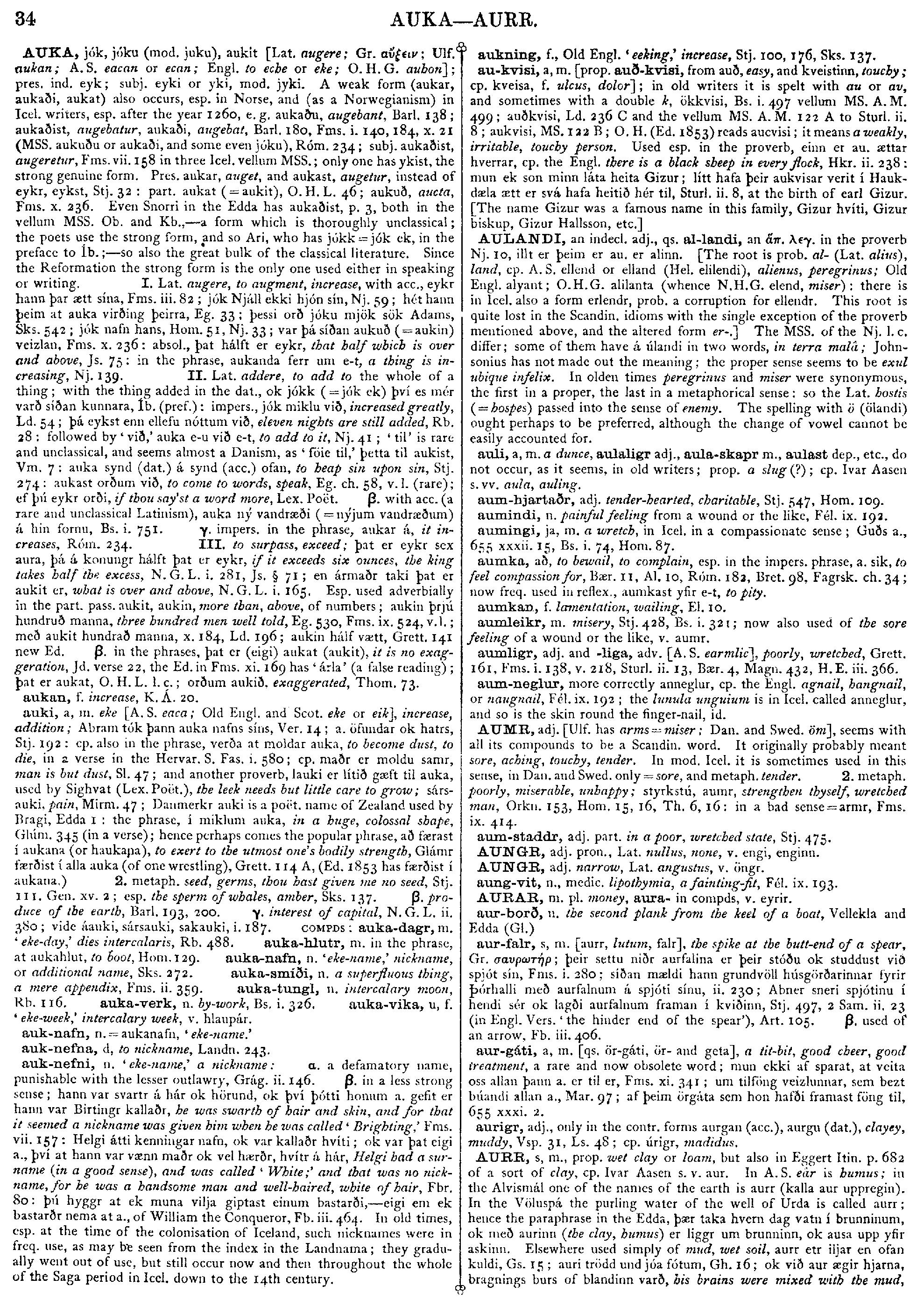
AUSA,
jós,
josu
(mod.
jusu),
ausit;
pres.
ind.
eyss;
subj.
eysi
or
ysi,
mod.
jysi
(hauriret),
cp.
Lat.
haurio,
haus-it;
not
found
in
Goth,
or
in
Germ.
I.
to
sprinkle,
with
dat.
of
the
liquid,
and
the
object
in
acc.
or
with
a
prep.;
Þær
taka
hvern
dag
vatn
í
brunninum,
ok
ausa
(viz.
Því)
upp
yfir
askinn,
.
.
.
pour
it
over
the
ash-boughs,
Edda.
II;
ef
maðr
eyss
eldi
(fire,
embers,)
Grág.
ii.
128;
a.
síld
ór
netjum,
to
empty
the
nets
of
the
herrings,
GÞl.
427:
a.
út,
to
pour
out,
fé,
Grett.
126.
2.
ausa
moldu,
to
sprinkle
with
mould,
bury;
hlóðu
Þeir
at
grjóti
ok
jósu
at
moldu,
Eg.
300;
er
hann
höfðu
moldu
ausit,
Bjarn.
II;
salr
ausinn
moldu,
his
chamber
sprinkled
with
mould
(poët.),
Hervar.
S.;
ausinn
haugi,
Ýt.
26.
.
ausa
vatni
is
a
standing
phrase
for
a
sort
of
baptism
used
in
the
last
centuries,
at
least,
of
the
heathen
age.
The
child
when
born
was
sprinkled
with
water
and
named,
yet
without
the
intervention
of
a
priest;
this
rite
is
mentioned
as
early
as
in
the
Hávamál,
one
of
the
very
oldest
mythological
didactic
poems
on
record,
where
it
is
attributed
even
to
Odin;
ef
ek
skal
Þegn
ungan
verpa
vatni
á,
if
I
am
to
throw
water
on
a
young
thane,
159;
Jósu
vatni
Jarl
létu
heita,
Jóð
ól
Edda
jósu
vatni,
hörvi
svartan,
hétu
Þræl,
Rm.
7,
31;
sá
var
siðr
göfigra
manna,
at
vanda
menn
mjök
til
at
ausa
vatni
ok
gefa
nafn;...
Sigurðr
jarl
jós
sveininn
vatni
ok
kallaði
Hákon,
Hkr.
i.
118;
Eiríkr
ok
Gunn-
hildr
áttu
son
er
Haraldr
konungr
jós
vatni
ok
gaf
nafn
sitt,
122;
eptir
um
daginn
jós
Hákon
konungr
Þann
svein
vatni
ok
gaf
nafn
sitt,
135,
Fms.
i.
66,
xi.
2;
fæddi
Þóra
sveinbarn
ok
var
Grimr
nefndr
er
vatni
var
ausinn,
Eb.
26;
enn
áttu
Þau
Skallagrímr
son,
sá
var
vatni
ausinn
ok
nafn
gefit
ok
kallaðr
Egill,
Eg.
146,
147,
166,
Ld.
108,
Gísl.
32
(of
Snorre
Gode);
and
so
in
many
instances
from
Icel.,
Norway,
and
the
Orkneys,
all
of
them
of
the
heathen
age.
The
Christian
term
is
skíra,
q.
v.
3.
metaph.
of
scolding
or
abuse;
hrópi
ok
rógi
ef
Þú
eyss
á
holl
regin,
Ls.
4;
ausa
sauri
á
e-n,
to
bespatter
with
foul
language,
ausask
sauri
á
(recipr.),
Bjarn.
33;
a.
e-m
e-u
í
augu
upp,
to
throw
in
one's
face,
Eg.
576;
hann
jós
upp
(poured
out)
Þar
fyrir
alÞýðu
öllum
glæpum
föður
síns,
Mart.
80;
um
verka
Þann
er
hverr
jós
á
annan,
Bjarn.
42.
II.
of
a
horse,
to
kick
or
lash
out
with
his
hinder
feet,
opp.
to
prjóna,
to
rear
up
and
strike
with
the
fore
feet;
hestrinn
tók
at
frýsa,
blása
ok
ausa,
Greg.
49;
at
merrin
eysi,
Sturl.
ii.
40
C.
III.
to
pump,
esp.
a
ship,
with
the
ship
in
acc.;
Hallfreðr
jós
at
sínum
hlut,
Fs.
113,
Grett.
95
A,
Fbr.
173,
N.
G.
L.
i.
102:
a.
bát
sinn,
to
make
water,
Fms.
vii.
331.
|
Source: Cleasby/Vigfusson, page b0036, entry 11 View original page image as: [TIFF] [PNG] [View previous entry] [View next entry] |
[Comment on this entry] [View comments] |
The following entry has been hand-corrected once. |
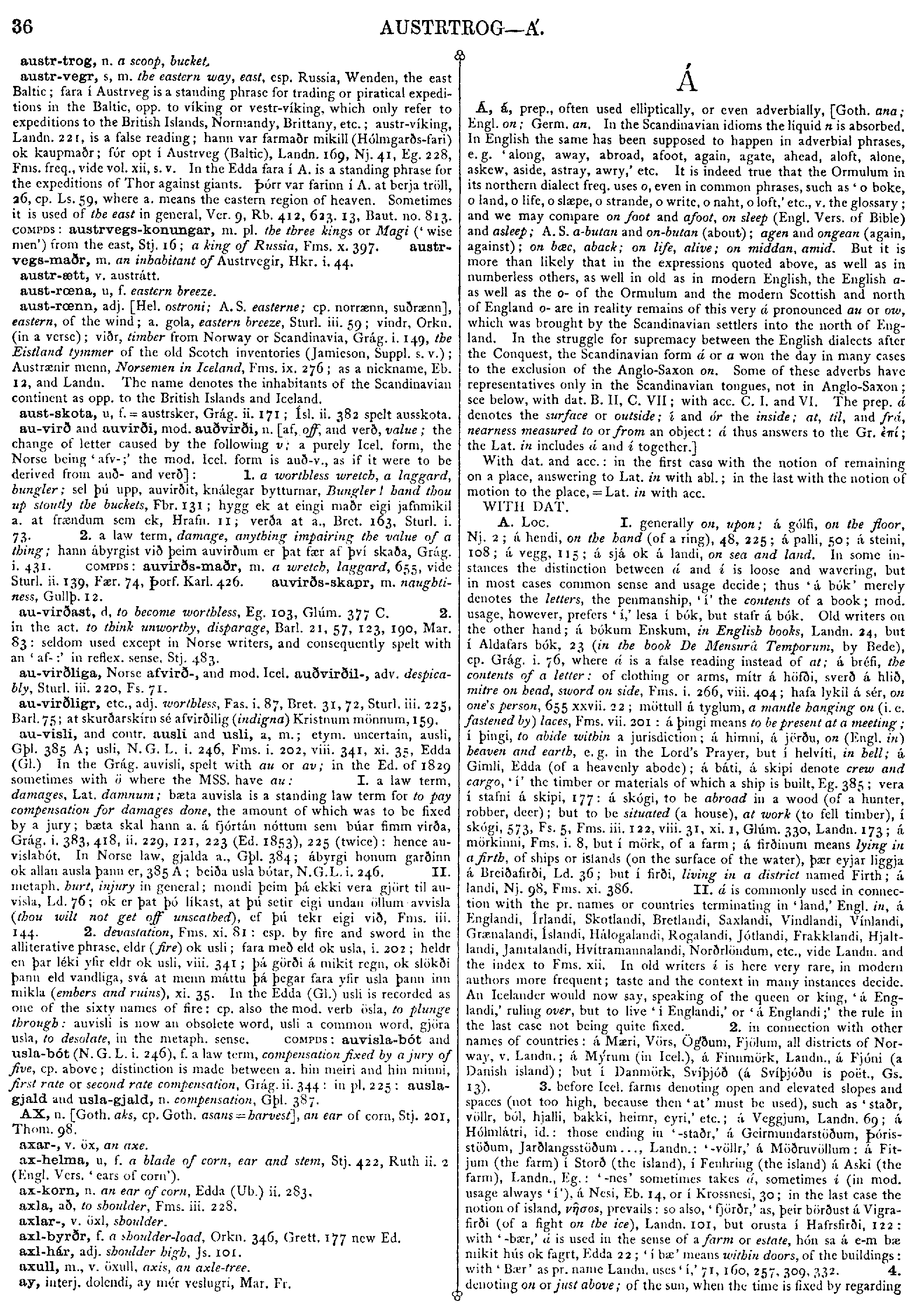
au-visli, and contr. ausli and usli, a, m.; etym. uncertain, ausli, Gþl. 385 A; usli, N. G. L. i. 246, Fms. i. 202, viii. 341, xi. 35, Edda (Gl.) In the Grág. auvisli, spelt with au or av; in the Ed. of 1829 sometimes with ö where the MSS. have au I. a law term, damages, Lat. damnum; bæta auvisla is a standing law term for to pay compensation for damages done, the amount of which was to be fixed by a jury; bæta skal hann a. á fjórtán nóttum sem búar fimm virða, Grág. i. 383, 418, ii. 229, 121, 223 (Ed. 1853), 225 (twice): hence auvislabót. In Norse law, gjalda a., Gþl. 384; ábyrgi honum garðinn ok allan ausla þann er, 385 A; beiða usla bótar, N. G. L. i. 246. II. metaph. hurt, injury in general; mondi þeim þá ekki vera gjört til auvisla, Ld. 76; ok er þat þó líkast, at þú setir eigi undan öllum avvisla (thou wilt not get off unscathed), ef þú tekr eigi við, Fms. iii. 144. 2. devastation, Fms. xi. 81: esp. by fire and sword in the alliterative phrase, eldr (fire) ok usli; fara með eld ok usla, i. 202; heldr en þar léki yfir eldr ok usli, viii. 341; þá görði á mikit regn, ok slökði þann eld vandliga, svá at menn máttu þá þegar fara yfir usla þann inn mikla (embers and ruins), xi. 35. In the Edda (Gl.) usli is recorded as one of the sixty names of fire: cp. also the mod. verb ösla, to plunge through: auvisli is now an obsolete word, usli a common word, gjöra usla, to desolate, in the metaph. sense. COMPDS: auvisla-bót and usla-bót (N. G. L. i. 246), f. a law term, compensation fixed by a jury of five, cp. above; distinction is made between a. hin meiri and hin minni, first rate or second rate compensation, Grág. ii. 344: in pl. 225: ausla-gjald and usla-gjald, n. compensation, Gþl. 387.
|
Source: Cleasby/Vigfusson, page b0050, entry 9 View original page image as: [TIFF] [PNG] [View previous entry] [View next entry] |
[Comment on this entry] [View comments] |
The following entry has been hand-corrected once. |
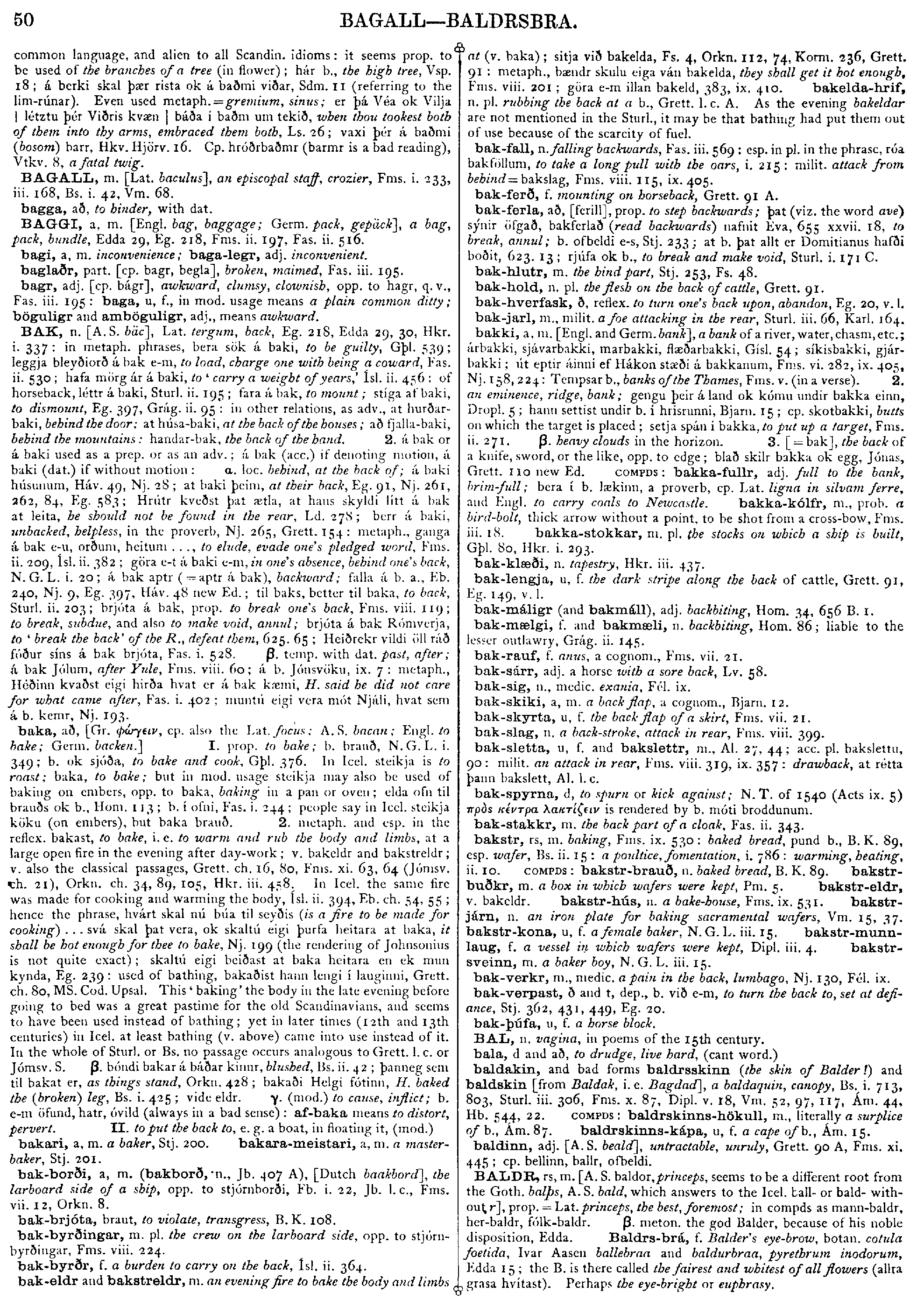
baka,
að,
[Gr.
GREEK,
cp.
also
the
Lat.
focus;
A.
S.
bacan;
Engl.
to
bake;
Germ.
backen.]
1.
prop.
to
bake;
b.
brauð,
N.
G.
L.
i.
349;
b.
ok
sjóða,
to
bake
and
cook,
Gþl.
376.
In
Icel.
steikja
is
to
roast;
baka,
to
bake;
but
in
mod.
usage
steikja
may
also
be
used
of
baking
on
embers,
opp.
to
baka,
baking
in
a
pan
or
oven;
elda
ofn
til
brauðs
ok
b.,
Hom.
113;
b.
í
ofni,
Fas.
i.
244;
people
say
in
Icel.
steikja
köku
(on
embers),
but
baka
brauð.
2.
metaph.
and
esp.
in
the
reflex.
bakast,
to
bake,
i.
e.
to
warm
and
rub
the
body
and
limbs,
at
a
large
open
fire
in
the
evening
after
day-work;
v.
bakeldr
and
bakstreldr;
v.
also
the
classical
passages,
Grett.
ch.
16,
80,
Fms.
xi.
63,
64
(Jómsv.
ch.
21),
Orkn.
ch.
34,
89,
105,
Hkr.
iii.
458.
In
Icel.
the
same
fire
was
made
for
cooking
and
warming
the
body,
Ísl.
ii.
394,
Eb.
ch.
54,
55;
hence
the
phrase,
hvárt
skal
nú
búa
til
seyðis
(is
a
fire
to
be
made
for
cooking)
...
svá
skal
þat
vera,
ok
skaltú
eigi
þurfa
heitara
at
baka,
it
shall
be
hot
enough
for
thee
to
bake,
Nj.
199
(the
rendering
of
Johnsonius
is
not
quite
exact);
skaltú
eigi
beiðast
at
baka
heitara
en
ek
mun
kynda,
Eg.
239:
used
of
bathing,
bakaðist
hann
lengi
í
lauginni,
Grett.
ch.
80,
MS.
Cod.
Upsal.
This
'baking'
the
body
in
the
late
evening
before
going
to
bed
was
a
great
pastime
for
the
old
Scandinavians,
and
seems
to
have
been
used
instead
of
bathing;
yet
in
later
times
(12th
and
13th
centuries)
in
Icel.
at
least
bathing
(v.
above)
came
into
use
instead
of
it.
In
the
whole
of
Sturl.
or
Bs.
no
passage
occurs
analogous
to
Grett.
l.
c.
or
Jómsv.
S.
.
bóndi
bakar
á
báðar
kinnr,
blushed,
Bs.
ii.
42;
þanneg
sem
til
bakat
er,
as
things
stand,
Orkn.
428;
bakaði
Helgi
fótinn,
H.
baked
the
(broken)
leg,
Bs.
i.
425;
vide
eldr.
.
(mod.)
to
cause,
inflict;
b.
e-m
öfund,
hatr,
óvild
(always
in
a
bad
sense):
af-baka
means
to
distort,
pervert.
II.
to
put
the
back
to,
e.
g.
a
boat,
in
floating
it,
(mod.)
|
Source: Cleasby/Vigfusson, page b0101, entry 22 View original page image as: [TIFF] [PNG] [View previous entry] [View next entry] |
[Comment on this entry] [View comments] |
The following entry has not been hand-corrected. However, the page is reserved and someone is correcting it. |
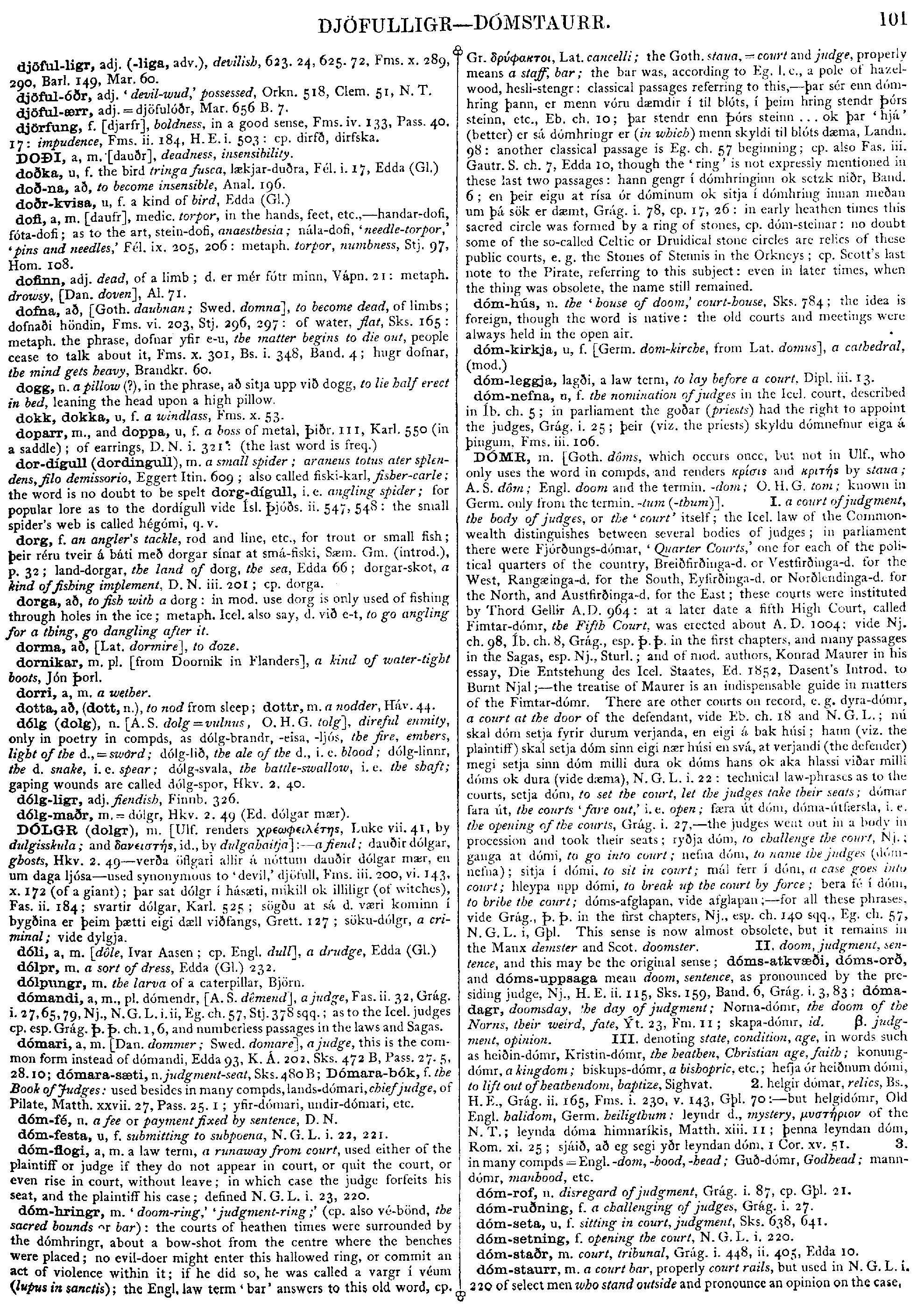
dólg (dolg), n. [A. S. dolg = vidnus, O. H. G. tolg~] , direful enmity, only in poetry in compds, as dólg-brandr, -eisa, -Ijos, the fire, embers, light of the d., = swdrd; dólg-lið, the ale of the d., i. e. blood; dólg-linnr, the d. snake, i. e. spear; dolg-. svala, the battle-swallow, i. e. the shaft; gaping wounds are called dólg-spor, Hkv. 2. 40.
|
Source: Cleasby/Vigfusson, page b0120, entry 8 View original page image as: [TIFF] [PNG] [View previous entry] [View next entry] |
[Comment on this entry] [View comments] |
The following entry has been hand-corrected once. |
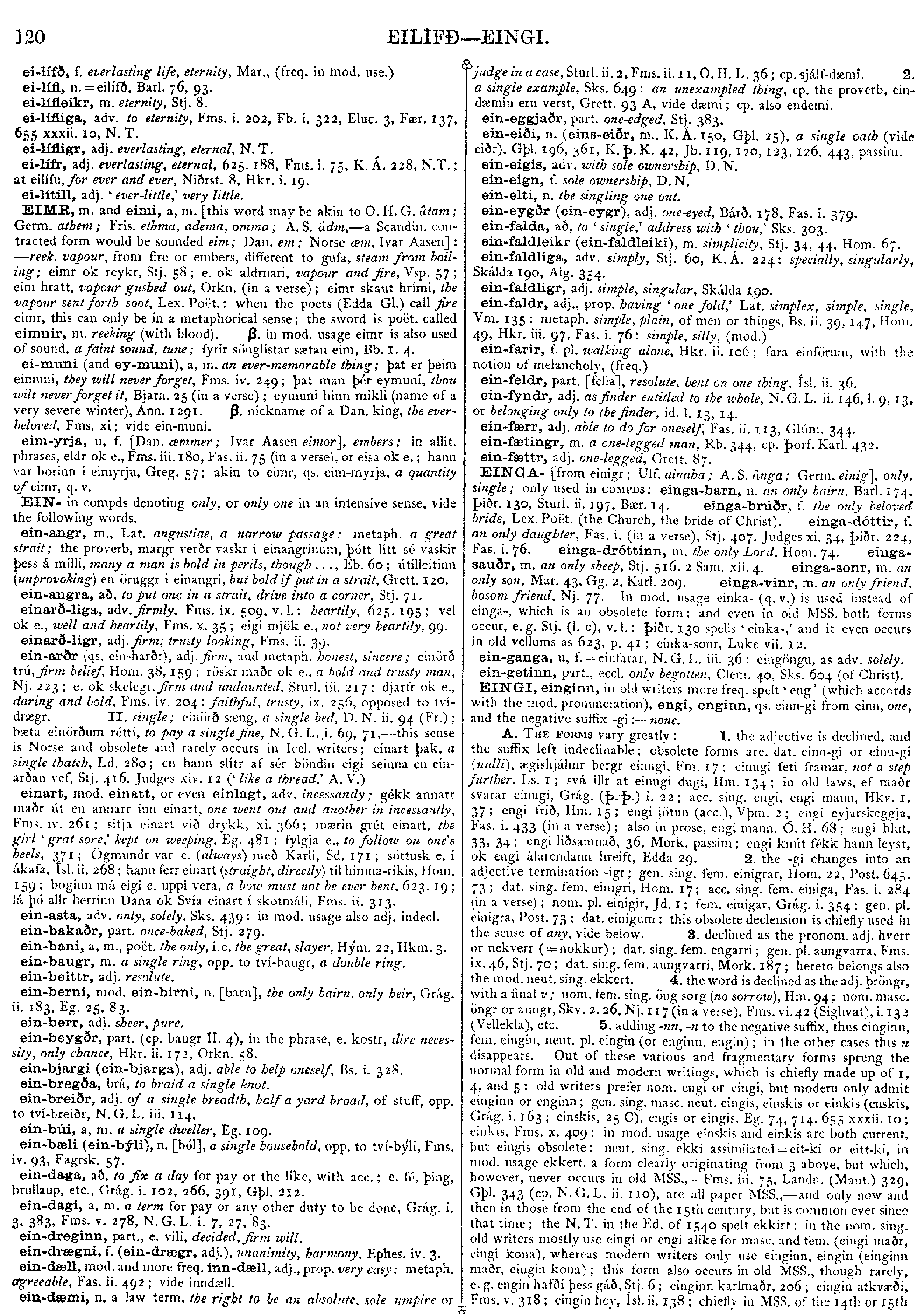
EIMR,
m.
and
eimi,
a,
m.
[this
word
may
be
akin
to
O.
H.
G.
âtam;
Germ.
athem;
Fris.
ethma,
adema,
omma;
A.
S.
âdm,--a
Scandin.
contracted
form
would
be
sounded
eim;
Dan.
em;
Norse
æm,
Ivar
Aasen]
:--
reek,
vapour,
from
fire
or
embers,
different
to
gufa,
steam
from
boiling;
eimr
ok
reykr,
Stj.
58;
e.
ok
aldrnari,
vapour
and
fire,
Vsp.
57;
eim
hratt,
vapour
gushed
out,
Orkn.
(in
a
verse);
eimr
skaut
hrími,
the
vapour
sent
forth
soot,
Lex.
Poët.:
when
the
poets
(Edda
Gl.)
call
fire
eimr,
this
can
only
be
in
a
metaphorical
sense;
the
sword
is
poët,
called
eimnir,
m.
reeking
(with
blood).
.
in
mod.
usage
eimr
is
also
used
of
sound,
a
faint
sound,
tune;
fyrir
sönglistar
sætan
eim,
Bb.
1.
4.
|
Source: Cleasby/Vigfusson, page b0120, entry 10 View original page image as: [TIFF] [PNG] [View previous entry] [View next entry] |
[Comment on this entry] [View comments] |
The following entry has been hand-corrected once. |
eim-yrja, u, f. [Dan. æmmer; Ivar Aasen eimor], embers; in allit. phrases, eldr ok e., Fms. iii. 180, Fas. ii. 75 (in a verse), or eisa ok e.; hann var borinn í eimyrju, Greg. 57; akin to eimr, qs. eim-myrja, a quantity of eimr, q.v.
|
Source: Cleasby/Vigfusson, page b0124, entry 2 View original page image as: [TIFF] [PNG] [View previous entry] [View next entry] |
[Comment on this entry] [View comments] |
The following entry has been hand-corrected once. |
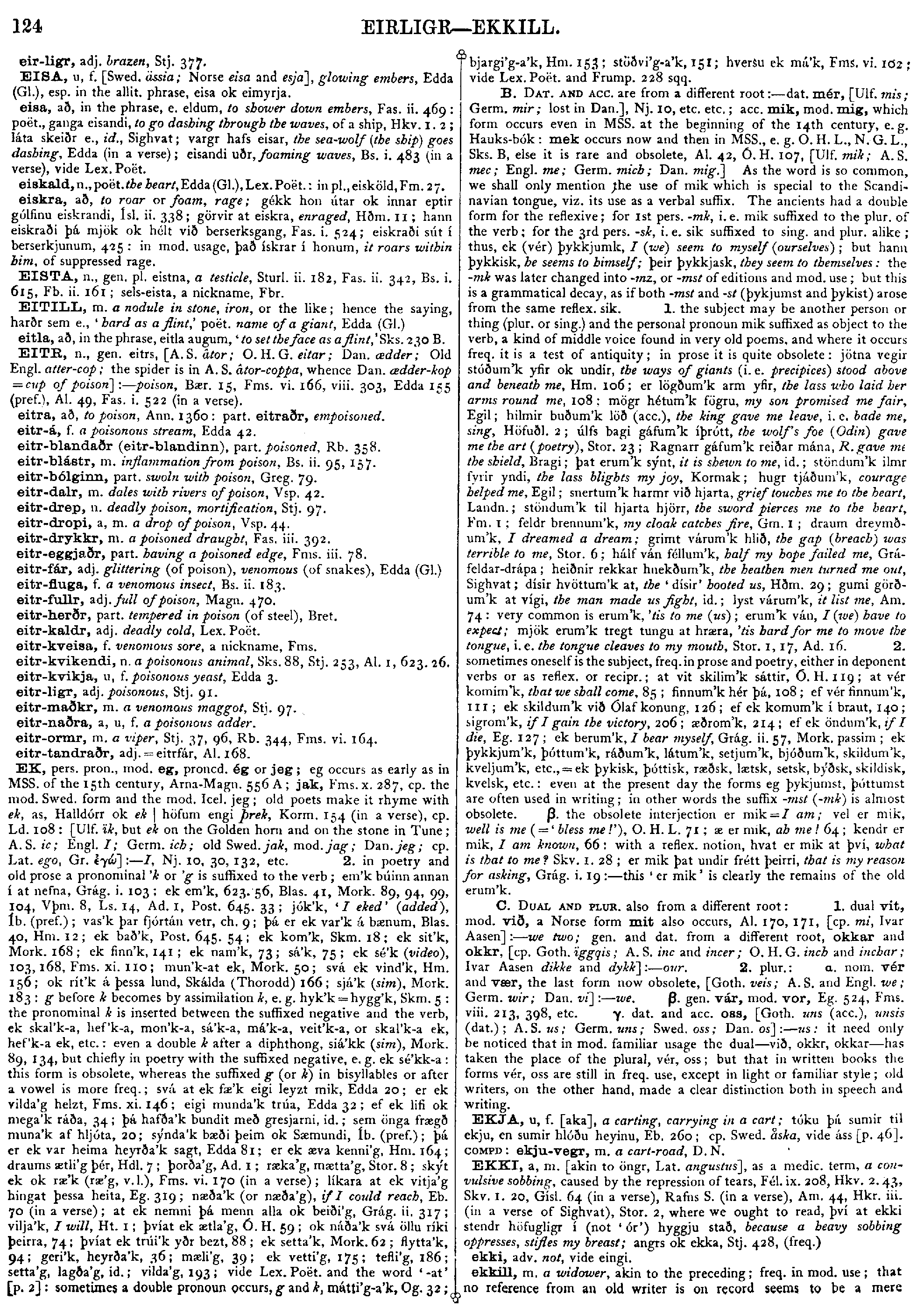
EISA, u, f. [Swed. ässia; Norse eisa and esja], glowing embers, Edda (Gl.), esp. in the allit. phrase, eisa ok eimyrja.
|
Source: Cleasby/Vigfusson, page b0124, entry 3 View original page image as: [TIFF] [PNG] [View previous entry] [View next entry] |
[Comment on this entry] [View comments] |
The following entry has been hand-corrected once. |
eisa, að, in the phrase, e. eldum, to shower down embers, Fas. ii. 469: poët., ganga eisandi, to go dashing through the waves, of a ship, Hkv. 1. 2; láta skeiðr e., id., Sighvat; vargr hafs eisar, the sea-wolf (the ship) goes dashing, Edda (in a verse); eisandi uðr, foaming waves, Bs. i. 483 (in a verse), vide Lex. Poët.
|
Source: Cleasby/Vigfusson, page b0125, entry 10 View original page image as: [TIFF] [PNG] [View previous entry] [View next entry] |
[Comment on this entry] [View comments] |
The following entry has been hand-corrected once. |
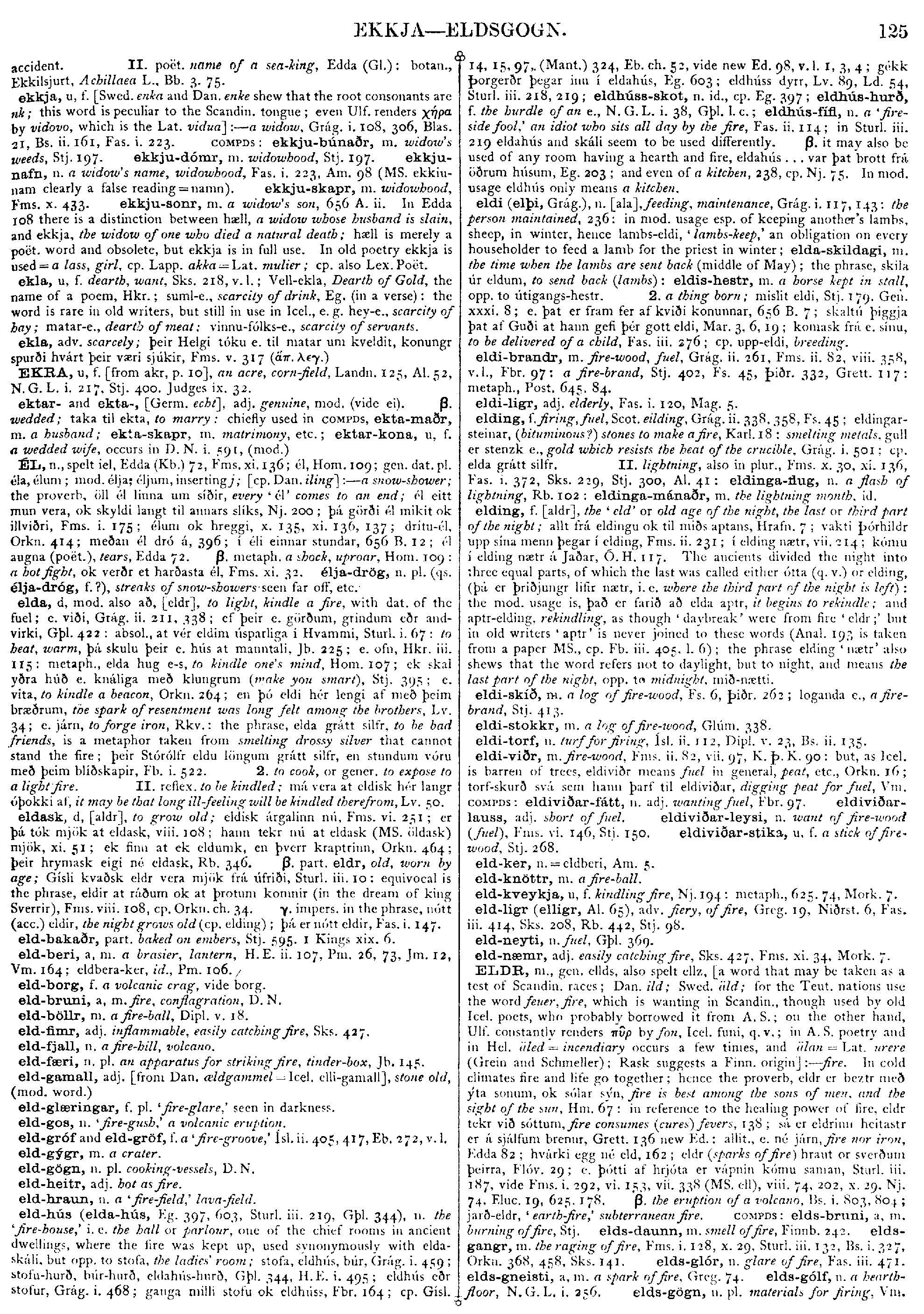
eld-bakaðr, part. baked on embers, Stj. 595. 1 Kings xix. 6.
| Result Page: |  |
Previous | 1 2 3 | Next |  |
Germanic Lexicon Project (main page)
This search system was written by
Sean Crist
Please consider
volunteering
to correct the data in these online dictionaries.
No rights reserved. Feel free to use these data in any way you please.