|
|

Tip: In the search results, you can click on any word or abbreviation for more information.
|
Source: Cleasby/Vigfusson, page b0117, entry 1 View original page image as: [TIFF] [PNG] [View previous entry] [View next entry] |
[Comment on this entry] [View comments] |
The following entry has been hand-corrected once. |
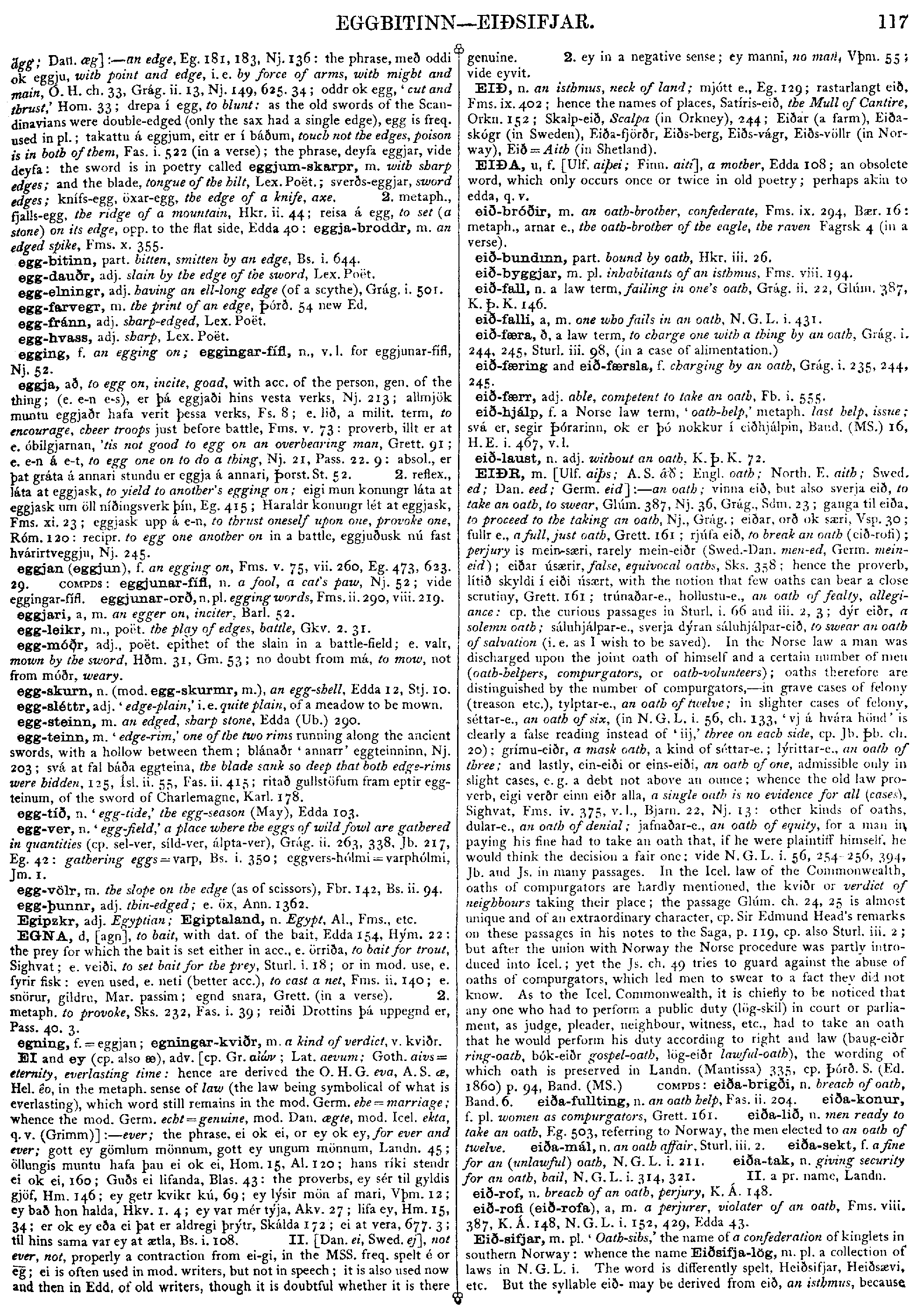
ägg; Dan. æg] :-- an edge, Eg. 181, 183, Nj. 136: the phrase, með oddi ok eggju, with point and edge, i.e. by force of arms, with might and main, Ó. H. ch. 33, Grág. ii. 13, Nj. 149, 625. 34; oddr ok egg, 'cut and thrust,' Hom. 33; drepa í egg, to blunt: as the old swords of the Scandinavians were double-edged (only the sax had a single edge), egg is freq. used in pl.; takattu á eggjum, eitr er í báðum, touch not the edges, poison is in both of them, Fas. i. 522 (in a verse); the phrase, deyfa eggjar, vide deyfa: the sword is in poetry called eggjum-skarpr, m. with sharp edges; and the blade, tongue of the hilt, Lex. Poët.; sverðs-eggjar, sword edges; knífs-egg, öxar-egg, the edge of a knife, axe. 2. metaph., fjalls-egg, the ridge of a mountain, Hkr. ii. 44; reisa á egg, to set (a stone) on its edge, opp. to the flat side, Edda 40: eggja-broddr, m. an edged spike, Fms. x. 355.
|
Source: Cleasby/Vigfusson, page b0117, entry 2 View original page image as: [TIFF] [PNG] [View previous entry] [View next entry] |
[Comment on this entry] [View comments] |
The following entry has been hand-corrected once. |
egg-bitinn, part. bitten, smitten by an edge, Bs. i. 644.
|
Source: Cleasby/Vigfusson, page b0117, entry 3 View original page image as: [TIFF] [PNG] [View previous entry] [View next entry] |
[Comment on this entry] [View comments] |
The following entry has been hand-corrected once. |
egg-dauðr, adj. slain by the edge of the sword, Lex. Poët.
|
Source: Cleasby/Vigfusson, page b0117, entry 4 View original page image as: [TIFF] [PNG] [View previous entry] [View next entry] |
[Comment on this entry] [View comments] |
The following entry has been hand-corrected once. |
egg-elningr, adj. having an ell-long edge (of a scythe), Grág. i. 501.
|
Source: Cleasby/Vigfusson, page b0117, entry 5 View original page image as: [TIFF] [PNG] [View previous entry] [View next entry] |
[Comment on this entry] [View comments] |
The following entry has been hand-corrected once. |
egg-farvegr, m. the print of an edge, Þórð. 54 new Ed.
|
Source: Cleasby/Vigfusson, page b0117, entry 20 View original page image as: [TIFF] [PNG] [View previous entry] [View next entry] |
[Comment on this entry] [View comments] |
The following entry has been hand-corrected once. |
egg-völr, m. the slope on the edge (as of scissors), Fbr. 142, Bs. ii. 94.
|
Source: Cleasby/Vigfusson, page b0124, entry 19 View original page image as: [TIFF] [PNG] [View previous entry] [View next entry] |
[Comment on this entry] [View comments] |
The following entry has been hand-corrected once. |
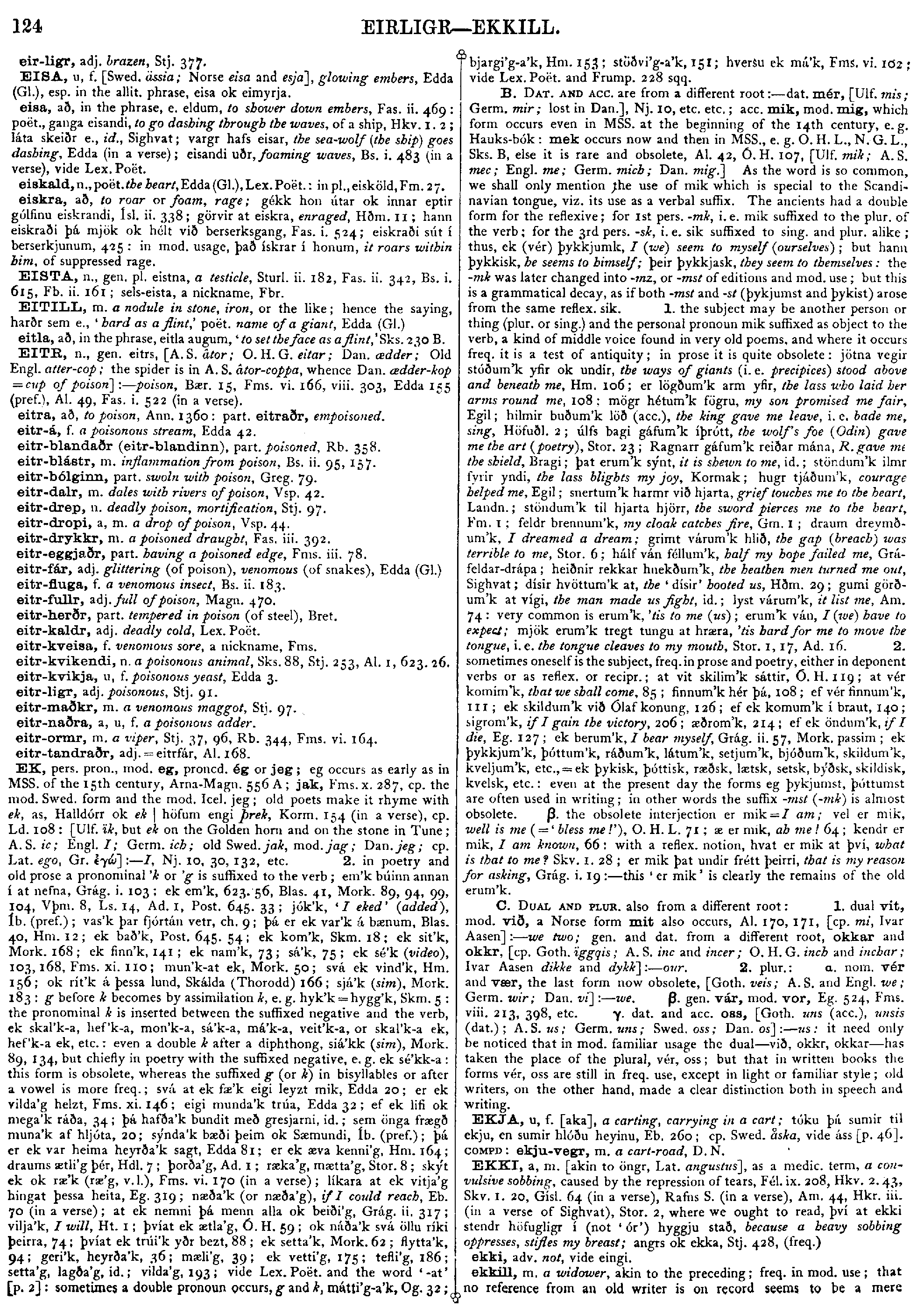
eitr-eggjaðr, part. having a poisoned edge, Fms. iii. 78.
|
Source: Cleasby/Vigfusson, page b0135, entry 35 View original page image as: [TIFF] [PNG] [View previous entry] [View next entry] |
[Comment on this entry] [View comments] |
The following entry has been hand-corrected once. |
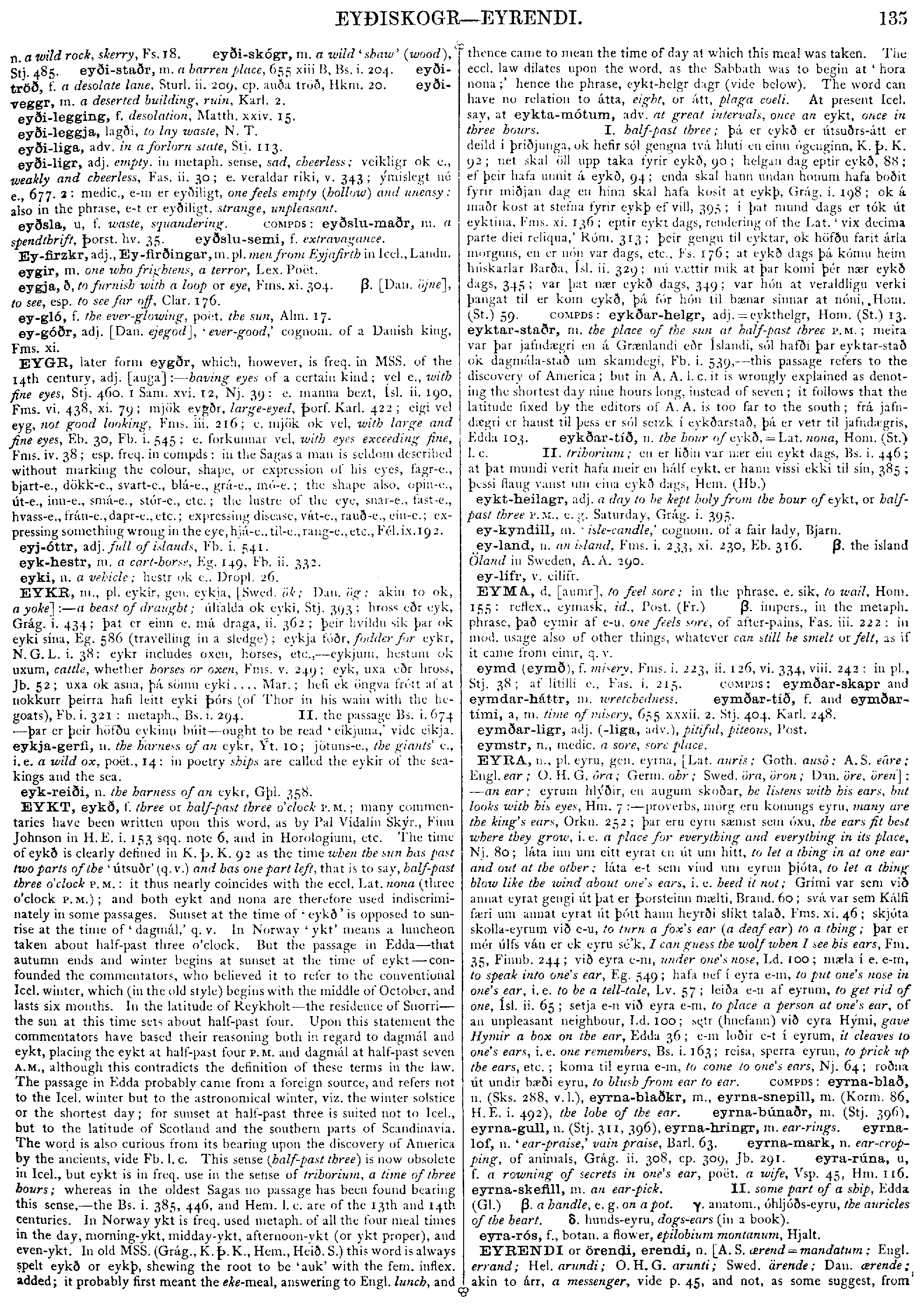
EYRIR,
m.,
gen.
eyris,
dat.
and
acc.
eyri;
pl.
aurar,
gen.
aura,
dat.
aurum;
a
word
prob.
of
foreign
origin,
from
Lat.
aurum,
Fr.
or,
Engl.
ore;
(A.
S.
ora
is,
however,
prob.
Danish.)
The
first
coins
known
in
Scandinavia
were
Roman
or
Byzantine,
then
Saxon
or
English;
as
the
old
word
baugr
(q.v.)
denoted
unwrought,
uncoined
gold
and
silver,
so
eyrir
prob.
originally
meant
a
certain
coin:
I.
an
ounce
of
silver
or
its
amount
in
money,
the
eighth
part
of
a
mark;
an
eyrir
is
=
sixty
pennies
(penningar)
=
three
ertog;
tuttugu
penningar
vegnir
í
örtug,
þrír
örtugar
í
eyri.
átta
aurar
í
mörk,
732.
16;
silfr
svá
slegit
at
sextigir
penninga
görði
eyri
veginn,
Grág.
i.
500;
penning,
þat
skal
hinn
tíundi
(prob.
a
false
reading,
x
instead
of
lx)
hlutr
eyris,
357;
hálfs
eyris
met
ek
hverjan,
I
value
each
at
a
half
eyrir,
Glúm,
(in
a
verse);
leigja
skip
þrem
aurum,
to
hire
a
boat
for
three
aurar,
Korm.;
einn
eyrir
þess
fjár
heitir
alaðsfestr,
Grág.
i.
88:
the
phrase,
goldinn
liverr
eyrir,
every
ounce
paid;
galt
Guðmundr
hvern
eyri
þá
þegar,
Sturl.
i.
141;
gjalda
tvá
aura
fyrir
einn,
to
pay
two
for
one,
Grág.
i.
396,
ii.
234;
verðr
þá
at
hálfri
mörk
vaðmála
eyrir,
then
the
eyrir
amounts
to
half
a
mark
in
wadmal,
i.
500;
brent
silfr,
ok
er
eyririnn
at
mörk
lögaura,
pure
silver,
the
ounce
of
which
amounts
to
a
mark
in
lögaurar,
392;
hring
er
stendr
sex
aura,
a
ring
worth
or
weighing
six
aurar,
Fms.
ii.
246;
hence
baugr
tví-eyringr,
tvítug-eyringr,
a
ring
weighing
two
or
twenty
aurar,
Eb.,
Glúm.
 .
as
a
weight
of
other
things
beside
silver;
hagl
hvert
vá
eyri,
every
hail-stone
weighed
an
ounce,
Fms.
i.
175;
stæltr
lé
ok
vegi
áttjan
aura,
eggelningr,
þeir
skulu
þrír
fyrir
tvá
aura,
a
scythe
of
wrought
steel
and
weighing
eighteen
aurar,
an
ell-long
edge,
three
such
cost
two
aurar
(in
silver),
the
proportion
between
the
weight
in
wrought
iron
and
the
worth
in
silver
being
1:28,
Grág.
i.
501.
.
as
a
weight
of
other
things
beside
silver;
hagl
hvert
vá
eyri,
every
hail-stone
weighed
an
ounce,
Fms.
i.
175;
stæltr
lé
ok
vegi
áttjan
aura,
eggelningr,
þeir
skulu
þrír
fyrir
tvá
aura,
a
scythe
of
wrought
steel
and
weighing
eighteen
aurar,
an
ell-long
edge,
three
such
cost
two
aurar
(in
silver),
the
proportion
between
the
weight
in
wrought
iron
and
the
worth
in
silver
being
1:28,
Grág.
i.
501.
 .
the
amount
of
an
ounce,
without
any
notion
of
the
medium
of
payment,
hence
such
phrases
as,
tólf
aura
silfrs,
twelve
aurar
to
be
paid
in
silver,
Nj.
54;
eyrir
brendr,
burnt
eyrir,
i.e.
an
eyrir
sterling,
pure
silver,
D.
N.
II.
money
in
general;
skal
þar
sinn
eyri
hverjum
dæma,
to
every
one
his
due,
his
share,
Grág.
i.
125;
in
proverbs,
ljósir
aurar
verða
at
löngum
trega,
bright
silver
brings
long
woe,
Sl.
34;
margr
verðr
af
aurum
api,
Hm.
74;
illr
af
aurum,
a
miser,
Jd.
36;
vára
aura,
our
money,
Vkv.
13;
leggja
aura,
to
lay
up
money,
Eg.
(in
a
verse);
gefin
til
aura
(=
til
fjár),
wedded
to
money,
Ísl.
ii.
254
(in
a
verse);
telja
e-m
aura,
to
tell
out
money
to
one,
Skv.
3.
37,
cp.
39:
the
phrase,
hann
veit
ekki
aura
sinna
tal,
he
knows
not
the
tale
of
his
aurar,
of
boundless
wealth.
Mar.
88:
the
allit.
phrase,
lönd
(land,
estate)
ok
lausir
aurar
(movables,
cp.
Dan.
lösöre,
Swed.
lösören),
Eg.
2;
hafa
fyrirgört
löndum
ok
lausum
eyri,
K.
Á.
94.
2.
money
or
specie;
the
allit.
phrase,
aurar
ok
óðal,
money
and
estates,
N.
G.
L.
i.
48;
ef
hann
vill
taka
við
aurum
slíkum
(such
payment)
sem
váttar
vitu
at
hann
reiddi
honum,
93;
þeim
aurum
öllum
(all
valuables)
sem
til
bús
þeirra
vóru
keyptir,
Grág.
i.
412;
Flosi
spurði
í
hverjum
aurum
hann
vildi
fyrir
hafa,
F.
asked
in
what
money
he
wished
to
he
paid,
Nj.
259;
lögaurar,
such
money
as
is
legal
tender;
þú
skalt
gjalda
mér
vaðmál,
ok
skilrað
hann
frá
aðra
aura,
other
kinds
of
payment,
Grág.
i.
392;
útborinn
eyrir,
in
the
phrase,
mér
er
það
enginn
utborinn
(or
útburðar-)
eyrir,
I
do
not
want
to
part
with
it,
offer
it
for
sale;
eyrir
vaðmála,
payment
in
wadmal
(stuff),
300,
Bs.
i.
639:
for
the
double
standard,
the
one
woollen
(ells),
the
other
metal
(rings
or
coin),
and
the
confusion
between
them,
see
Dasent's
Burnt
Njal,
vol.
ii.
p.
397
sqq.:
at
different
times
and
places
the
ell
standard
varied
much,
and
we
hear
of
three,
six,
nine,
twelve
ell
standards
(vide
alin,
p.
13):
in
such
phrases
as
'mörk
sex
álna
aura,'
the
word
'mörk'
denotes
the
amount,
'sex
álna'
the
standard,
and
'aura'
the
payment
=
payment
of
'a
mark
of
six
ells,'
cp.
a
pound
sterling,
K.
Þ.
K.
172;
hundrað
(the
amount)
þriggja
álna
(the
standard)
aura,
Sturl.
i.
141,
163,
Boll.
362,
Ísl.
ii.
28;
mörk
sex
álna
eyris,
Fsk.
10,
N.
G.
L.
i.
65,
101,
389,
390;
þrem
mörkum
níu
álna
eyris,
387-389;
sex
merkr
tólf
álna
eyrir,
81.
.
in
various
compds,
etc.;
land-aurar,
land
tax,
Jb.
ch.
i,
Ó.
H.
54;
öfundar-eyrir,
money
which
brings
envy,
Fs.
12;
sak-metinn
e.,
sak-eyrir,
sakar-eyrir,
money
payable
in
fines,
Fms.
vii.
300;
ómaga-eyrir,
the
money
of
an
orphan,
K.
Þ.
K.
158,
Grág.
ii.
288;
liksöngs-eyrir,
a
'lyke-fee,'
burial
fee
(to
the
clergyman);
vísa-eyrir,
a
tax:
góðr
e.,
good
payment,
D.
N.;
verð-aurar,
articles
used
for
payment,
id.;
forn-gildr
e.,
standard,
sterling
payment,
id.;
færi-eyrir
=
lausir
aurar,
Skv.
3.
50;
flytjandi
e.,
id.,
Fr.;
kaupmanna
e.,
trade
money;
búmanna
e.,
D.
N.;
Norrænn
e.,
Norse
money,
Lv.
25;
Hjaltenzkr
e.,
Shetland
money,
D.
N.
(vide
Fritzner
s.v.);
fríðr
e.,
'kind,'
i.e.
sheep
and
cattle,
Grág.
COMPDS:
I.
pl.,
aura-dagr,
m.
pay-day,
D.
N.
aura-lag,
n.
the
standard
of
money,
Fms.
vii.
300,
304.
aura-lán,
n.
worldly
luck,
656
i.
3.
aura-lógan,
f.
the
squandering
of
money,
655
iii.
1.
aura-lykt,
n.
payment,
D.
N.
aura-skortr,
m.
scarcity
of
money,
D.
N.
aura-taka,
u,
f.
receipt
of
money,
N.
G.
L.
i.
93,
Gþl.
298.
II.
sing.,
eyris-bót,
f.
fine
of
an
eyrir,
Grág.
i.
158.
eyris-kaup,
n.
a
bargain
to
the
amount
of
an
eyrir,
Gþl.
511.
eyris-land,
n.
land
giving
the
rent
of
an
eyrir,
Fms.
x.
146.
eyris-skaði,
a,
m.
loss
to
the
amount
of
an
eyrir,
Jb.
166.
eyris-tíund,
f.
tithe
of
an
eyrir,
K.
Þ.
K.
148.
eyris-tollr,
m.
toll
of
an
eyrir,
H.
E.
ii.
95.
.
the
amount
of
an
ounce,
without
any
notion
of
the
medium
of
payment,
hence
such
phrases
as,
tólf
aura
silfrs,
twelve
aurar
to
be
paid
in
silver,
Nj.
54;
eyrir
brendr,
burnt
eyrir,
i.e.
an
eyrir
sterling,
pure
silver,
D.
N.
II.
money
in
general;
skal
þar
sinn
eyri
hverjum
dæma,
to
every
one
his
due,
his
share,
Grág.
i.
125;
in
proverbs,
ljósir
aurar
verða
at
löngum
trega,
bright
silver
brings
long
woe,
Sl.
34;
margr
verðr
af
aurum
api,
Hm.
74;
illr
af
aurum,
a
miser,
Jd.
36;
vára
aura,
our
money,
Vkv.
13;
leggja
aura,
to
lay
up
money,
Eg.
(in
a
verse);
gefin
til
aura
(=
til
fjár),
wedded
to
money,
Ísl.
ii.
254
(in
a
verse);
telja
e-m
aura,
to
tell
out
money
to
one,
Skv.
3.
37,
cp.
39:
the
phrase,
hann
veit
ekki
aura
sinna
tal,
he
knows
not
the
tale
of
his
aurar,
of
boundless
wealth.
Mar.
88:
the
allit.
phrase,
lönd
(land,
estate)
ok
lausir
aurar
(movables,
cp.
Dan.
lösöre,
Swed.
lösören),
Eg.
2;
hafa
fyrirgört
löndum
ok
lausum
eyri,
K.
Á.
94.
2.
money
or
specie;
the
allit.
phrase,
aurar
ok
óðal,
money
and
estates,
N.
G.
L.
i.
48;
ef
hann
vill
taka
við
aurum
slíkum
(such
payment)
sem
váttar
vitu
at
hann
reiddi
honum,
93;
þeim
aurum
öllum
(all
valuables)
sem
til
bús
þeirra
vóru
keyptir,
Grág.
i.
412;
Flosi
spurði
í
hverjum
aurum
hann
vildi
fyrir
hafa,
F.
asked
in
what
money
he
wished
to
he
paid,
Nj.
259;
lögaurar,
such
money
as
is
legal
tender;
þú
skalt
gjalda
mér
vaðmál,
ok
skilrað
hann
frá
aðra
aura,
other
kinds
of
payment,
Grág.
i.
392;
útborinn
eyrir,
in
the
phrase,
mér
er
það
enginn
utborinn
(or
útburðar-)
eyrir,
I
do
not
want
to
part
with
it,
offer
it
for
sale;
eyrir
vaðmála,
payment
in
wadmal
(stuff),
300,
Bs.
i.
639:
for
the
double
standard,
the
one
woollen
(ells),
the
other
metal
(rings
or
coin),
and
the
confusion
between
them,
see
Dasent's
Burnt
Njal,
vol.
ii.
p.
397
sqq.:
at
different
times
and
places
the
ell
standard
varied
much,
and
we
hear
of
three,
six,
nine,
twelve
ell
standards
(vide
alin,
p.
13):
in
such
phrases
as
'mörk
sex
álna
aura,'
the
word
'mörk'
denotes
the
amount,
'sex
álna'
the
standard,
and
'aura'
the
payment
=
payment
of
'a
mark
of
six
ells,'
cp.
a
pound
sterling,
K.
Þ.
K.
172;
hundrað
(the
amount)
þriggja
álna
(the
standard)
aura,
Sturl.
i.
141,
163,
Boll.
362,
Ísl.
ii.
28;
mörk
sex
álna
eyris,
Fsk.
10,
N.
G.
L.
i.
65,
101,
389,
390;
þrem
mörkum
níu
álna
eyris,
387-389;
sex
merkr
tólf
álna
eyrir,
81.
.
in
various
compds,
etc.;
land-aurar,
land
tax,
Jb.
ch.
i,
Ó.
H.
54;
öfundar-eyrir,
money
which
brings
envy,
Fs.
12;
sak-metinn
e.,
sak-eyrir,
sakar-eyrir,
money
payable
in
fines,
Fms.
vii.
300;
ómaga-eyrir,
the
money
of
an
orphan,
K.
Þ.
K.
158,
Grág.
ii.
288;
liksöngs-eyrir,
a
'lyke-fee,'
burial
fee
(to
the
clergyman);
vísa-eyrir,
a
tax:
góðr
e.,
good
payment,
D.
N.;
verð-aurar,
articles
used
for
payment,
id.;
forn-gildr
e.,
standard,
sterling
payment,
id.;
færi-eyrir
=
lausir
aurar,
Skv.
3.
50;
flytjandi
e.,
id.,
Fr.;
kaupmanna
e.,
trade
money;
búmanna
e.,
D.
N.;
Norrænn
e.,
Norse
money,
Lv.
25;
Hjaltenzkr
e.,
Shetland
money,
D.
N.
(vide
Fritzner
s.v.);
fríðr
e.,
'kind,'
i.e.
sheep
and
cattle,
Grág.
COMPDS:
I.
pl.,
aura-dagr,
m.
pay-day,
D.
N.
aura-lag,
n.
the
standard
of
money,
Fms.
vii.
300,
304.
aura-lán,
n.
worldly
luck,
656
i.
3.
aura-lógan,
f.
the
squandering
of
money,
655
iii.
1.
aura-lykt,
n.
payment,
D.
N.
aura-skortr,
m.
scarcity
of
money,
D.
N.
aura-taka,
u,
f.
receipt
of
money,
N.
G.
L.
i.
93,
Gþl.
298.
II.
sing.,
eyris-bót,
f.
fine
of
an
eyrir,
Grág.
i.
158.
eyris-kaup,
n.
a
bargain
to
the
amount
of
an
eyrir,
Gþl.
511.
eyris-land,
n.
land
giving
the
rent
of
an
eyrir,
Fms.
x.
146.
eyris-skaði,
a,
m.
loss
to
the
amount
of
an
eyrir,
Jb.
166.
eyris-tíund,
f.
tithe
of
an
eyrir,
K.
Þ.
K.
148.
eyris-tollr,
m.
toll
of
an
eyrir,
H.
E.
ii.
95.
|
Source: Cleasby/Vigfusson, page b0141, entry 9 View original page image as: [TIFF] [PNG] [View previous entry] [View next entry] |
[Comment on this entry] [View comments] |
The following entry has been hand-corrected once. |
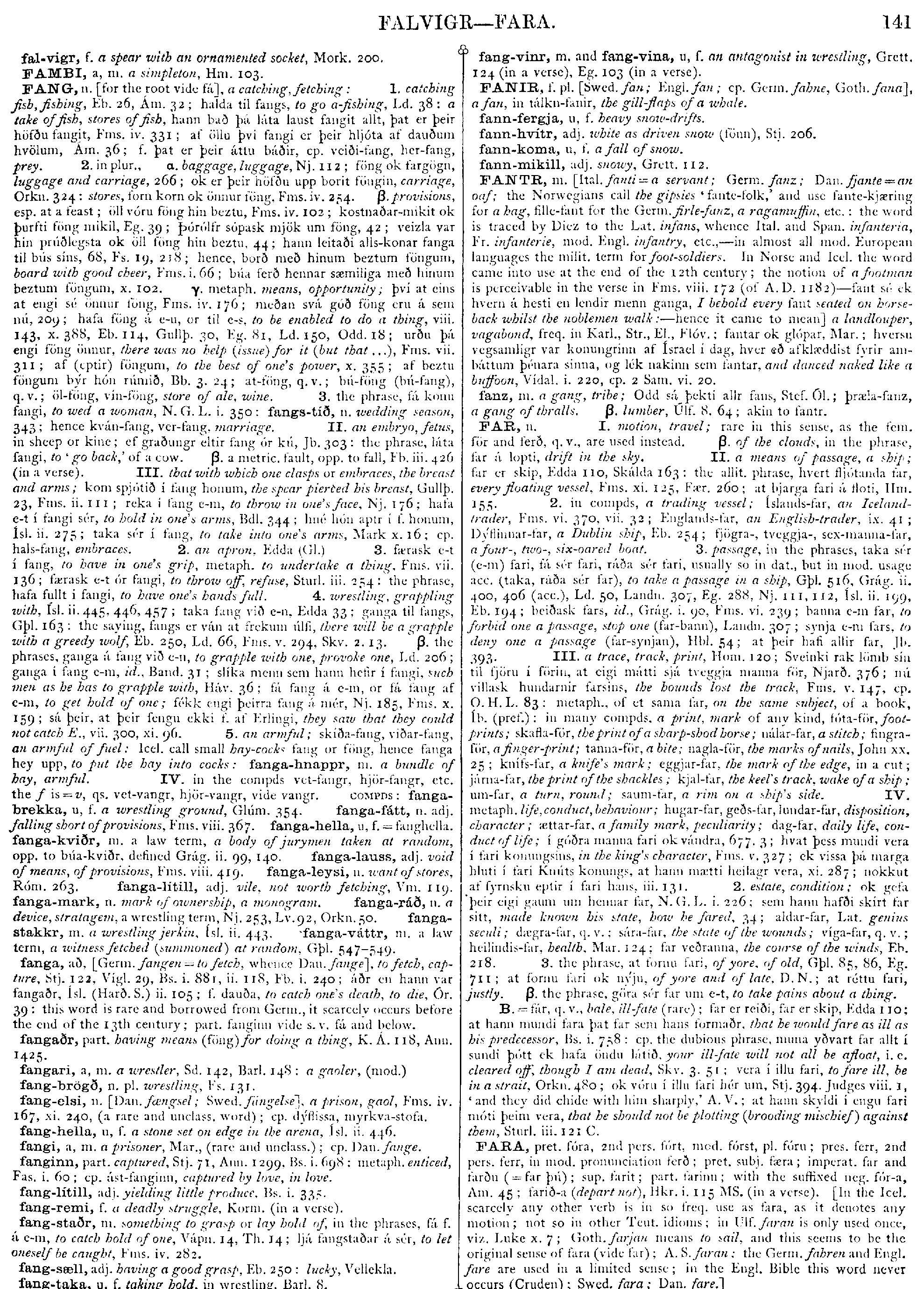
fang-hella, u, f. a stone set on edge in the arena, Ísl. ii. 446.
|
Source: Cleasby/Vigfusson, page b0141, entry 25 View original page image as: [TIFF] [PNG] [View previous entry] [View next entry] |
[Comment on this entry] [View comments] |
The following entry has been hand-corrected once. |
FAR,
n.
I.
motion,
travel;
rare
in
this
sense,
as
the
fem.
för
and
ferð,
q.v.,
are
used
instead.
.
of
the
clouds,
in
the
phrase,
far
á
lopti,
drift
in
the
sky.
II.
a
means
of
passage,
a
ship;
far
er
skip,
Edda
110,
Skálda
163:
the
allit.
phrase,
hvert
fljótanda
far,
every
floating
vessel,
Fms.
xi.
125,
Fær.
260;
at
bjarga
fari
á
floti,
Hm.
155.
2.
in
compds,
a
trading
vessel;
Íslands-far,
an
Iceland-trader,
Fms.
vi.
370,
vii.
32;
Englands-far,
an
English-trader,
ix.
41;
Dýrlinnar-far,
a
Dublin
ship,
Eb.
254;
fjögra-,
tveggja-,
sex-manna-far,
a
four-,
two-,
six-oared
boat.
3.
passage,
in
the
phrases,
taka
sér
(e-m)
fari,
fá
sér
fari,
ráða
sér
fari,
usually
so
in
dat.,
but
in
mod.
usage
acc.
(taka,
ráða
sér
far),
to
take
a
passage
in
a
ship,
Gþl.
516,
Grág.
ii.
400,
406
(acc.),
Ld.
50,
Landn.
307,
Eg.
288,
Nj.
111,
112,
Ísl.
ii.
199,
Eb.
194;
beiðask
fars,
id.,
Grág.
i.
90,
Fms.
vi.
239;
banna
e-m
far,
to
forbid
one
a
passage,
stop
one
(far-bann),
Landn.
307;
synja
e-m
fars,
to
deny
one
a
passage
(far-synjan),
Hbl.
54;
at
þeir
hafi
allir
far,
Jb.
393.
III.
a
trace,
track,
print,
Hom.
120;
Sveinki
rak
lömb
sín
til
fjöru
í
förin,
at
eigi
mátti
sjá
tveggja
manna
för,
Njarð.
376;
nú
villask
hundarnir
farsins,
the
hounds
lost
the
track,
Fms.
v.
147,
cp.
O.
H.
L.
83:
metaph.,
of
et
sama
far,
on
the
same
subject,
of
a
book,
Íb.
(pref.):
in
many
compds,
a
print,
mark
of
anv
kind,
fóta-för,
footprints;
skafla-för,
the
print
of
a
sharp-shod
horse;
nálar-far,
a
stitch;
fingra-för,
a
finger-print;
tanna-för,
a
bite;
nagla-för,
the
marks
of
nails,
John
xx.
25;
knífs-far,
a
knife's
mark;
eggjar-far,
the
mark
of
the
edge,
in
a
cut;
járna-far,
the
print
of
the
shackles;
kjal-far,
the
keel's
track,
wake
of
a
ship;
um-far,
a
turn,
round;
saum-far,
a
rim
on
a
ship's
side.
IV.
metaph.
life,
conduct,
behaviour;
hugar-far,
geðs-far,
lundar-far,
disposition,
character;
ættar-far,
a
family
mark,
peculiarity;
dag-far,
daily
life,
conduct
of
life;
í
góðra
manna
fari
ok
vándra,
677.
3;
hvat
þess
mundi
vera
í
fari
konungsins,
in
the
king's
character,
Fms.
v.
327;
ek
vissa
þá
marga
hluti
í
fari
Knúts
konungs,
at
hann
mætti
heilagr
vera,
xi.
287;
nokkut
af
fyrnsku
eptir
í
fari
hans,
iii.
131.
2.
estate,
condition;
ok
gefa
þeir
eigi
gaum
um
hennar
far,
N.
G.
L.
i.
226;
sem
hann
hafði
skírt
far
sitt,
made
known
his
state,
how
he
fared,
34;
aldar-far,
Lat.
genius
seculi;
dægra-far,
q.v.:
sára-far,
the
state
of
the
wounds;
víga-far,
q.v.;
heilindis-far,
health,
Mar.
124;
far
veðranna,
the
course
of
the
winds,
Eb.
218.
3.
the
phrase,
at
forni
fari,
of
yore,
of
old,
Gþl.
85,
86,
Eg.
711;
at
fornu
fari
ok
nýju,
of
yore
and
of
late,
D.
N.;
at
réttu
fari,
justly.
.
the
phrase,
göra
sér
far
um
e-t,
to
take
pains
about
a
thing.
| Result Page: |  |
Previous | 1 2 3 4 5 6 7 8 9 10 11 12 13 14 | Next |  |
Germanic Lexicon Project (main page)
This search system was written by
Sean Crist
Please consider
volunteering
to correct the data in these online dictionaries.
No rights reserved. Feel free to use these data in any way you please.