|
|

|
Source: Bosworth/Toller, page b0018, entry 31 View original page image as: [TIFF] [PNG] [View previous entry] [View next entry] |
[Comment on this entry] [View comments] |
The following entry has been hand-corrected once. |
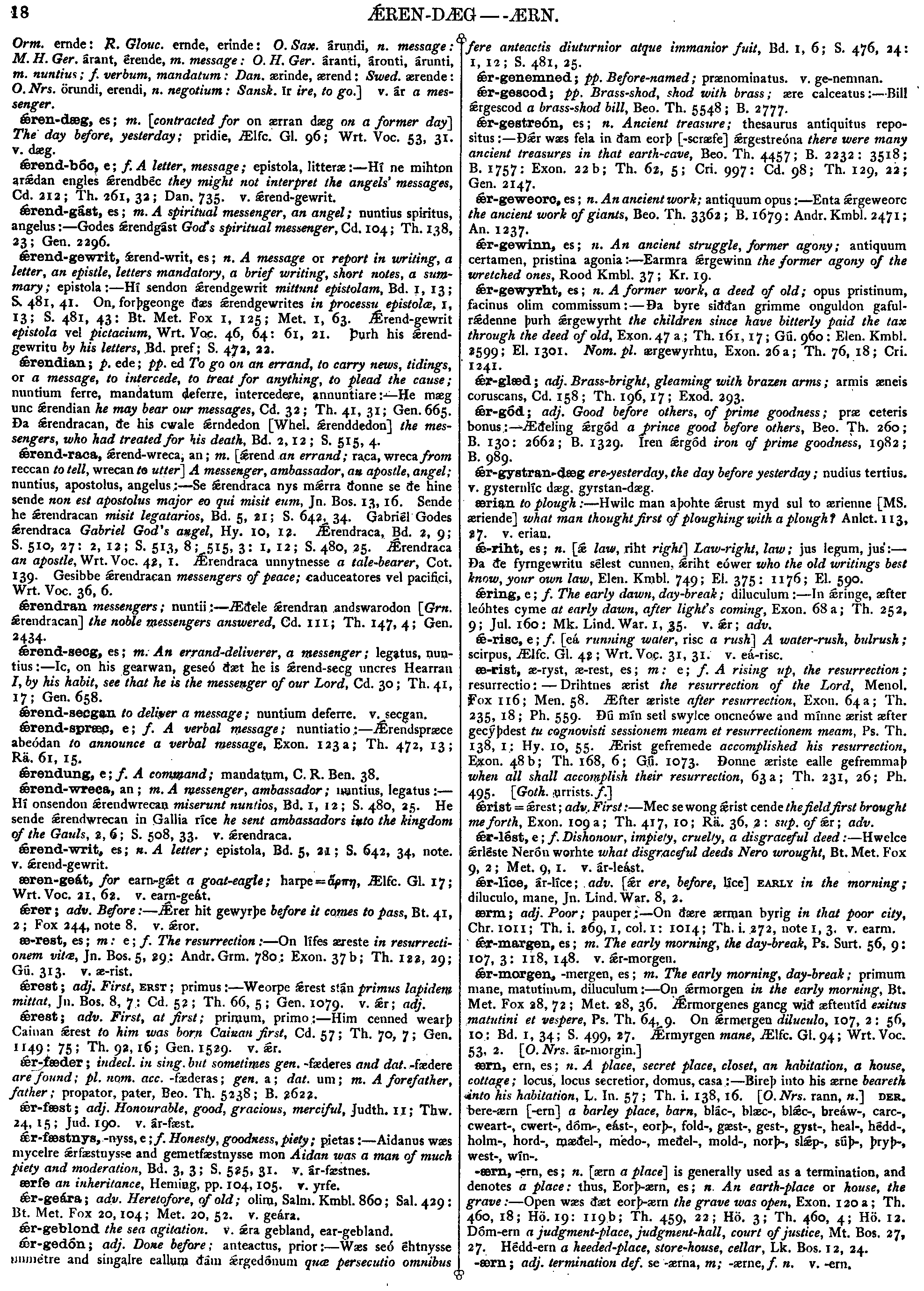
 r-gewinn,
es;
n.
An
ancient
struggle,
former
agony;
antiquum
certamen,
pristina
agonia
:--
Earmra
rgewinn
the
former
agony
of
the
wretched
ones,
Rood
Kmbl.
37;
Kr.
19.
r-gewinn,
es;
n.
An
ancient
struggle,
former
agony;
antiquum
certamen,
pristina
agonia
:--
Earmra
rgewinn
the
former
agony
of
the
wretched
ones,
Rood
Kmbl.
37;
Kr.
19.
|
Source: Bosworth/Toller, page b0038, entry 13 View original page image as: [TIFF] [PNG] [View previous entry] [View next entry] |
[Comment on this entry] [View comments] |
The following entry has been hand-corrected once. |
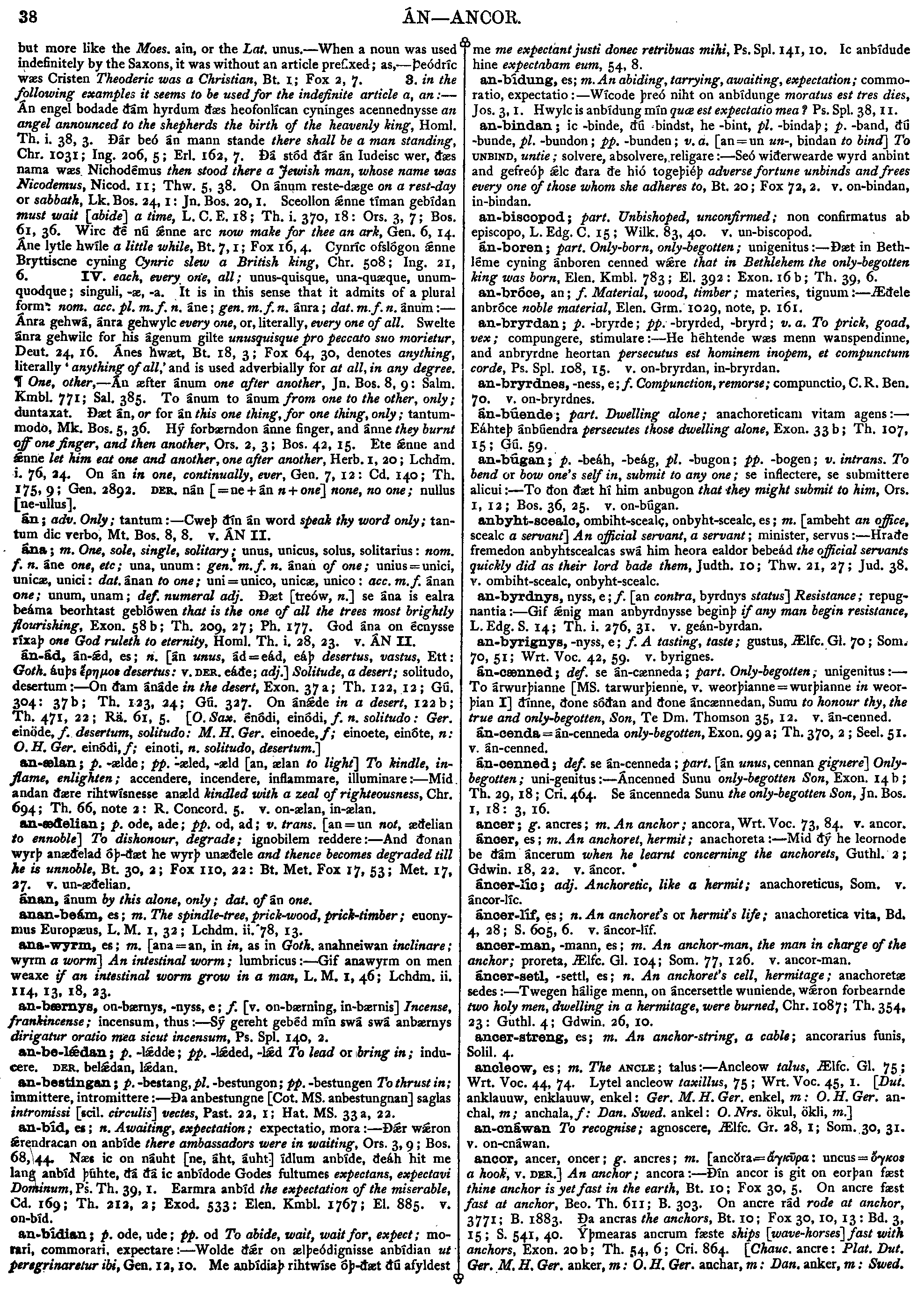
an-bíd,
es;
n.
Awaiting,
expectation;
expectatio,
mora
:--
Ðr
wæron
rendracan
on
anbíde
there
ambassadors
were
in
waiting,
Ors.
3,
9;
Bos.
68,
44.
Næs
ic
on
náuht
[ne,
áht,
áuht]
ídlum
anbíde,
ðeáh
hit
me
lang
anbíd
þúhte,
ðá
ðá
ic
anbídode
Godes
fultumes
expectans,
expectavi
Dominum,
Ps.
Th.
39,
1.
Earmra
anbíd
the
expectation
of
the
miserable,
Cd.
169;
Th.
212,
2;
Exod.
533:
Elen.
Kmbl.
1767;
El.
885.
v.
on-bíd.
|
Source: Bosworth/Toller, page b0234, entry 2 View original page image as: [TIFF] [PNG] [View previous entry] [View next entry] |
[Comment on this entry] [View comments] |
The following entry has been hand-corrected once. |
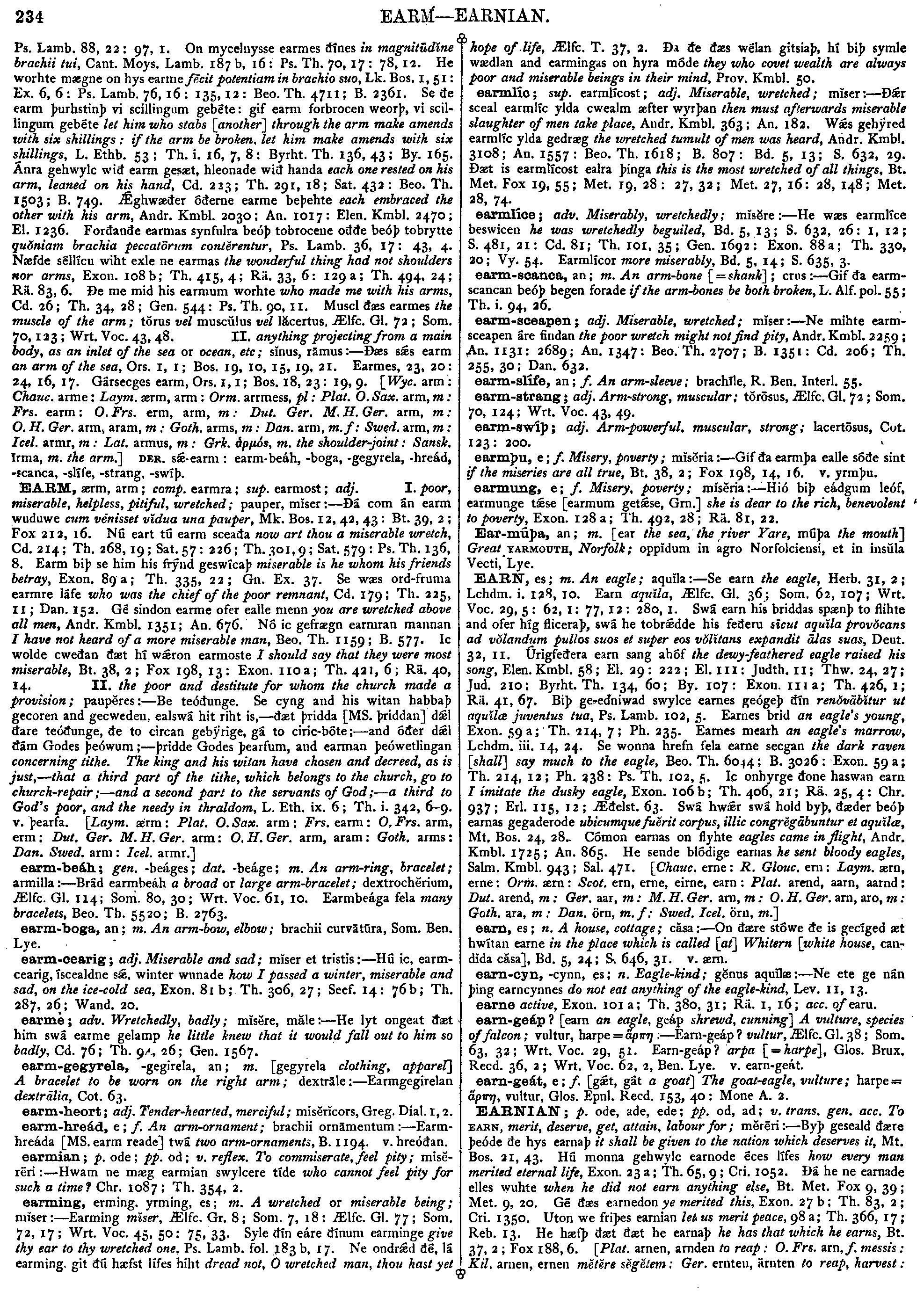
EARM,
ærm,
arm;
comp.
earmra;
sup.
earmost;
adj.
I.
poor,
miserable,
helpless,
pitiful,
wretched;
pauper,
m ser
:--
Ðá
com
án
earm
wuduwe
cum
v
ser
:--
Ðá
com
án
earm
wuduwe
cum
v nisset
vdua
una
pauper,
Mk.
Bos.
12,
42,
43:
Bt.
39,
2;
Fox
212,
16.
Nú
eart
tú
earm
sceaða
now
art
thou
a
miserable
wretch,
Cd.
214;
Th.
268,
19;
Sat.
57:
226;
Th.
301,
9;
Sat.
579:
Ps.
Th.
136,
8.
Earm
biþ
se
him
his
frýnd
geswícaþ
miserable
is
he
whom
his
friends
betray,
Exon.
89
a;
Th.
335,
22;
Gn.
Ex.
37.
Se
wæs
ord-fruma
earmre
láfe
who
was
the
chief
of
the
poor
remnant,
Cd.
179;
Th.
225,
11;
Dan.
152.
Gé
sindon
earme
ofer
ealle
menn
you
are
wretched
above
all
men,
Andr.
Kmbl.
1351;
An.
676.
Nó
ic
gefrægn
earmran
mannan
I
have
not
heard
of
a
more
miserable
man,
Beo.
Th.
1159;
B.
577.
Ic
wolde
cweðan
ðæt
hi
wron
earmoste
I
should
say
that
they
were
most
miserable,
Bt.
38,
2;
Fox
198,
13:
Exon.
110
a;
Th.
421,
6;
Rä.
40,
14.
II.
the
poor
and
destitute
for
whom
the
church
made
a
provision;
paup
nisset
vdua
una
pauper,
Mk.
Bos.
12,
42,
43:
Bt.
39,
2;
Fox
212,
16.
Nú
eart
tú
earm
sceaða
now
art
thou
a
miserable
wretch,
Cd.
214;
Th.
268,
19;
Sat.
57:
226;
Th.
301,
9;
Sat.
579:
Ps.
Th.
136,
8.
Earm
biþ
se
him
his
frýnd
geswícaþ
miserable
is
he
whom
his
friends
betray,
Exon.
89
a;
Th.
335,
22;
Gn.
Ex.
37.
Se
wæs
ord-fruma
earmre
láfe
who
was
the
chief
of
the
poor
remnant,
Cd.
179;
Th.
225,
11;
Dan.
152.
Gé
sindon
earme
ofer
ealle
menn
you
are
wretched
above
all
men,
Andr.
Kmbl.
1351;
An.
676.
Nó
ic
gefrægn
earmran
mannan
I
have
not
heard
of
a
more
miserable
man,
Beo.
Th.
1159;
B.
577.
Ic
wolde
cweðan
ðæt
hi
wron
earmoste
I
should
say
that
they
were
most
miserable,
Bt.
38,
2;
Fox
198,
13:
Exon.
110
a;
Th.
421,
6;
Rä.
40,
14.
II.
the
poor
and
destitute
for
whom
the
church
made
a
provision;
paup res
:--
Be
teóðunge.
Se
cyng
and
his
witan
habbaþ
gecoren
and
gecweden,
ealswá
hit
riht
is,--ðæt
þridda
[MS.
þriddan]
ðl
ðare
teóðunge,
ðe
to
circan
gebýrige,
gá
to
ciric-bóte;--and
óðer
dl
ðám
Godes
þeówum;--þridde
Godes
þearfum,
and
earman
þeówetlingan
concerning
tithe.
The
king
and
his
witan
have
chosen
and
decreed,
as
is
just,--that
a
third
part
of
the
tithe,
which
belongs
to
the
church,
go
to
church-repair;--and
a
second
part
to
the
servants
of
God;--a
third
to
God's
poor,
and
the
needy
in
thraldom,
L.
Eth.
ix.
6;
Th.
i.
342,
6-9.
v.
þearfa.
[Laym,
ærm:
Plat.
O.
Sax.
arm:
Frs.
earm:
O.
Frs.
arm,
erm:
Dut.
Ger.
M.
H.
Ger.
arm:
O.
H.
Ger.
arm,
aram:
Goth.
arms:
Dan.
Swed.
arm:
Icel.
armr.]
res
:--
Be
teóðunge.
Se
cyng
and
his
witan
habbaþ
gecoren
and
gecweden,
ealswá
hit
riht
is,--ðæt
þridda
[MS.
þriddan]
ðl
ðare
teóðunge,
ðe
to
circan
gebýrige,
gá
to
ciric-bóte;--and
óðer
dl
ðám
Godes
þeówum;--þridde
Godes
þearfum,
and
earman
þeówetlingan
concerning
tithe.
The
king
and
his
witan
have
chosen
and
decreed,
as
is
just,--that
a
third
part
of
the
tithe,
which
belongs
to
the
church,
go
to
church-repair;--and
a
second
part
to
the
servants
of
God;--a
third
to
God's
poor,
and
the
needy
in
thraldom,
L.
Eth.
ix.
6;
Th.
i.
342,
6-9.
v.
þearfa.
[Laym,
ærm:
Plat.
O.
Sax.
arm:
Frs.
earm:
O.
Frs.
arm,
erm:
Dut.
Ger.
M.
H.
Ger.
arm:
O.
H.
Ger.
arm,
aram:
Goth.
arms:
Dan.
Swed.
arm:
Icel.
armr.]
|
Source: Bosworth/Toller, page b0289, entry 24 View original page image as: [TIFF] [PNG] [View previous entry] [View next entry] |
[Comment on this entry] [View comments] |
The following entry has been hand-corrected once. |
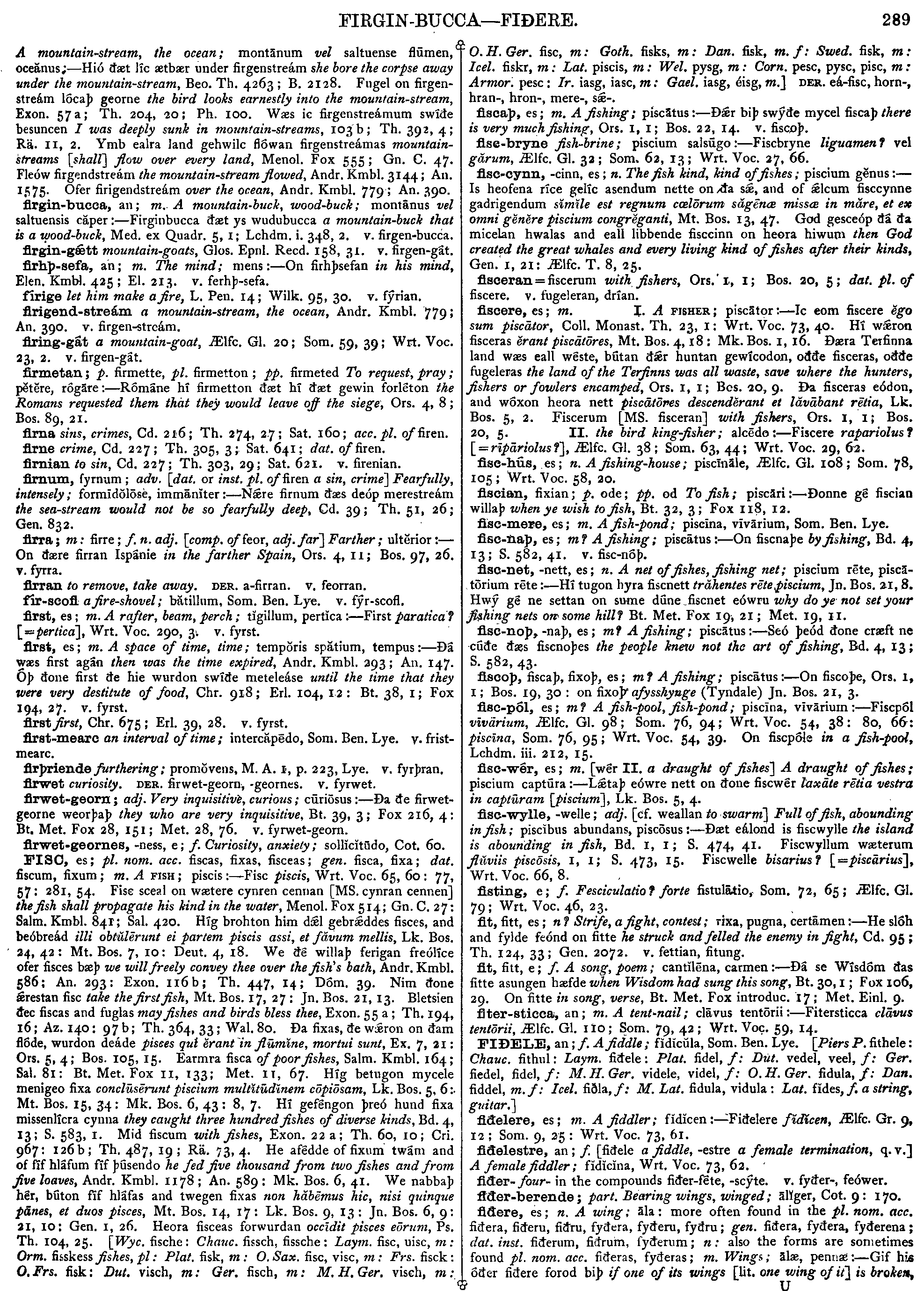
FISC,
es;
pl.
nom.
acc.
fiscas,
fixas,
fisceas;
gen.
fisca,
fixa;
dat.
fiscum,
fixum;
m.
A
FISH;
piscis
:--
Fisc
piscis,
Wrt.
Voc.
65,
60:
77,
57:
281,
54.
Fisc
sceal
on
wætere
cynren
cennan
[MS.
cynran
cennen]
the
fish
shall
propagate
his
kind
in
the
water,
Menol.
Fox
514;
Gn.
C.
27:
Salm.
Kmbl.
841;
Sal.
420.
Híg
brohton
him
dl
gebrddes
fisces,
and
beóbreád
illi
obt lrunt
ei
partem
piscis
assi,
et
f
lrunt
ei
partem
piscis
assi,
et
f vum
mellis,
Lk.
Bos.
24,
42:
Mt.
Bos.
7,
10:
Deut.
4,
18.
We
ðé
willaþ
ferigan
freólíce
ofer
fisces
bæþ
we
will
freely
convey
thee
over
the
fish's
bath,
Andr.
Kmbl.
586;
An.
293:
Exon.
116b;
Th.
447,
14;
Dóm.
39.
Nim
ðone
restan
fisc
take
the
first
fish,
Mt.
Bos.
17,
27:
Jn.
Bos.
21,
13.
Bletsien
ðec
fiscas
and
fuglas
may
fishes
and
birds
bless
thee,
Exon.
55a;
Th.
194,
16;
Az.
140:
97b;
Th.
364,
33;
Wal.
80.
Ða
fixas,
ðe
wron
on
ðam
flóde,
wurdon
deáde
pisces
qu
UNCERTAIN
rant
in
fl
vum
mellis,
Lk.
Bos.
24,
42:
Mt.
Bos.
7,
10:
Deut.
4,
18.
We
ðé
willaþ
ferigan
freólíce
ofer
fisces
bæþ
we
will
freely
convey
thee
over
the
fish's
bath,
Andr.
Kmbl.
586;
An.
293:
Exon.
116b;
Th.
447,
14;
Dóm.
39.
Nim
ðone
restan
fisc
take
the
first
fish,
Mt.
Bos.
17,
27:
Jn.
Bos.
21,
13.
Bletsien
ðec
fiscas
and
fuglas
may
fishes
and
birds
bless
thee,
Exon.
55a;
Th.
194,
16;
Az.
140:
97b;
Th.
364,
33;
Wal.
80.
Ða
fixas,
ðe
wron
on
ðam
flóde,
wurdon
deáde
pisces
qu
UNCERTAIN
rant
in
fl mne,
mortui
sunt,
Ex.
7,
21:
Ors.
5,
4;
Bos.
105,
15.
Earmra
fisca
of
poor
fishes,
Salm.
Kmbl.
164;
Sal.
81:
Bt.
Met.
Fox
11,
133;
Met.
11,
67.
Híg
betugon
mycele
menigeo
fixa
conclsrunt
piscium
multtdnem
c
mne,
mortui
sunt,
Ex.
7,
21:
Ors.
5,
4;
Bos.
105,
15.
Earmra
fisca
of
poor
fishes,
Salm.
Kmbl.
164;
Sal.
81:
Bt.
Met.
Fox
11,
133;
Met.
11,
67.
Híg
betugon
mycele
menigeo
fixa
conclsrunt
piscium
multtdnem
c pisam,
Lk.
Bos.
5,
6:
Mt.
Bos.
15,
34:
Mk.
Bos.
6,
43:
8,
7.
Hí
geféngon
þreó
hund
fixa
missenlícra
cynna
they
caught
three
hundred
fishes
of
diverse
kinds,
Bd.
4,
13;
S.
583,
1.
Mid
fiscum
with
fishes,
Exon.
22a;
Th.
60,
10;
Cri.
967:
126b;
Th.
487,
19;
Rä.
73,
4.
He
afédde
of
fixum
twám
and
of
fíf
hláfum
fíf
þúsendo
he
fed
five
thousand
from
two
fishes
and
from
five
loaves,
Andr.
Kmbl.
1178;
An.
589:
Mk.
Bos.
6,
41.
We
nabbaþ
hér,
búton
fíf
hláfas
and
twegen
fixas
non
hbmus
hic,
nisi
quinque
p
pisam,
Lk.
Bos.
5,
6:
Mt.
Bos.
15,
34:
Mk.
Bos.
6,
43:
8,
7.
Hí
geféngon
þreó
hund
fixa
missenlícra
cynna
they
caught
three
hundred
fishes
of
diverse
kinds,
Bd.
4,
13;
S.
583,
1.
Mid
fiscum
with
fishes,
Exon.
22a;
Th.
60,
10;
Cri.
967:
126b;
Th.
487,
19;
Rä.
73,
4.
He
afédde
of
fixum
twám
and
of
fíf
hláfum
fíf
þúsendo
he
fed
five
thousand
from
two
fishes
and
from
five
loaves,
Andr.
Kmbl.
1178;
An.
589:
Mk.
Bos.
6,
41.
We
nabbaþ
hér,
búton
fíf
hláfas
and
twegen
fixas
non
hbmus
hic,
nisi
quinque
p nes,
et
duos
pisces,
Mt.
Bos.
14,
17:
Lk.
Bos.
9,
13:
Jn.
Bos.
6,
9:
21,
10:
Gen.
1,
26.
Heora
fisceas
forwurdan
occ
nes,
et
duos
pisces,
Mt.
Bos.
14,
17:
Lk.
Bos.
9,
13:
Jn.
Bos.
6,
9:
21,
10:
Gen.
1,
26.
Heora
fisceas
forwurdan
occ dit
pisces
erum,
Ps.
Th.
104,
25.
[Wyc.
fische:
Chauc.
fissch,
fissche:
Laym.
fisc,
uisc,
m:
Orm.
fisskess
fishes,
pl:
Plat.
fisk,
m:
O.
Sax.
fisc,
visc,
m:
Frs.
fisck:
O.
Frs.
fisk:
Dut.
visch,
m:
Ger.
fisch,
m:
M.
H.
Ger.
visch,
m:
O.
H.
Ger.
fisc,
m:
Goth.
fisks,
m:
Dan.
fisk,
m.
f:
Swed.
fisk,
m:
Icel.
fiskr,
m:
Lat.
piscis,
m:
Wel.
pysg,
m:
Corn.
pesc,
pysc,
pise,
m:
Armor.
pesc:
Ir.
iasg,
iasc,
m:
Gael,
iasg,
éisg,
m.]
DER.
eá-fisc,
horn-,
hran-,
hron-,
mere-,
s-.
dit
pisces
erum,
Ps.
Th.
104,
25.
[Wyc.
fische:
Chauc.
fissch,
fissche:
Laym.
fisc,
uisc,
m:
Orm.
fisskess
fishes,
pl:
Plat.
fisk,
m:
O.
Sax.
fisc,
visc,
m:
Frs.
fisck:
O.
Frs.
fisk:
Dut.
visch,
m:
Ger.
fisch,
m:
M.
H.
Ger.
visch,
m:
O.
H.
Ger.
fisc,
m:
Goth.
fisks,
m:
Dan.
fisk,
m.
f:
Swed.
fisk,
m:
Icel.
fiskr,
m:
Lat.
piscis,
m:
Wel.
pysg,
m:
Corn.
pesc,
pysc,
pise,
m:
Armor.
pesc:
Ir.
iasg,
iasc,
m:
Gael,
iasg,
éisg,
m.]
DER.
eá-fisc,
horn-,
hran-,
hron-,
mere-,
s-.
|
Source: Bosworth/Toller, page b0417, entry 26 View original page image as: [TIFF] [PNG] [View previous entry] [View next entry] |
[Comment on this entry] [View comments] |
The following entry has been hand-corrected once. |
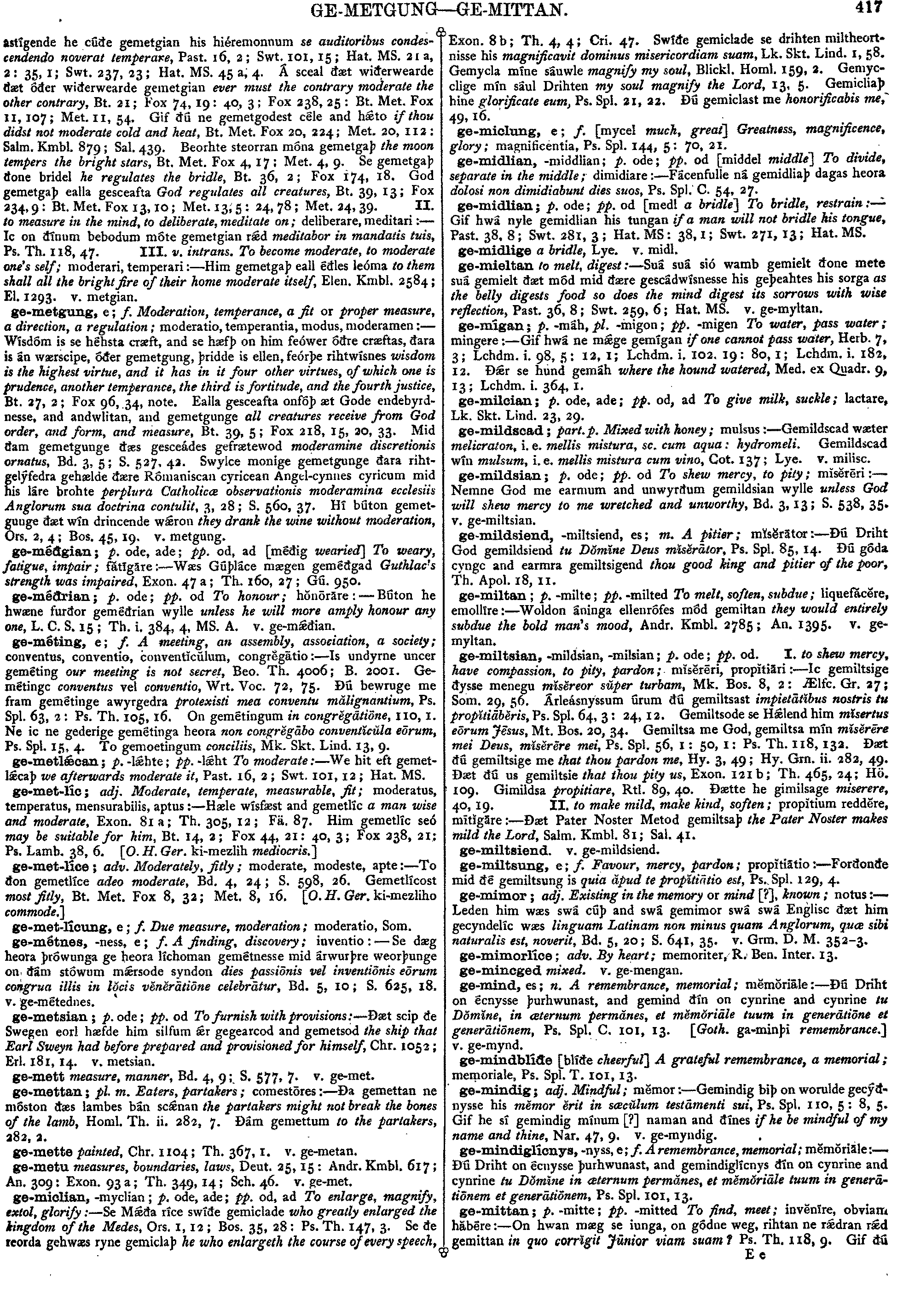
ge-mildsiend,
-miltsiend,
es;
m.
A
pitier;
msrtor
:--
Ðú
Driht
God
gemildsiend
tu
D mne
Deus
msrtor,
Ps.
Spl.
85,
14.
Ðú
góda
cyngc
and
earmra
gemiltsigend
thou
good
king
and
pitier
of
the
poor,
Th.
Apol.
18,
11.
mne
Deus
msrtor,
Ps.
Spl.
85,
14.
Ðú
góda
cyngc
and
earmra
gemiltsigend
thou
good
king
and
pitier
of
the
poor,
Th.
Apol.
18,
11.
|
Source: Bosworth/Toller, page b0456, entry 14 View original page image as: [TIFF] [PNG] [View previous entry] [View next entry] |
[Comment on this entry] [View comments] |
The following entry has been hand-corrected once. |
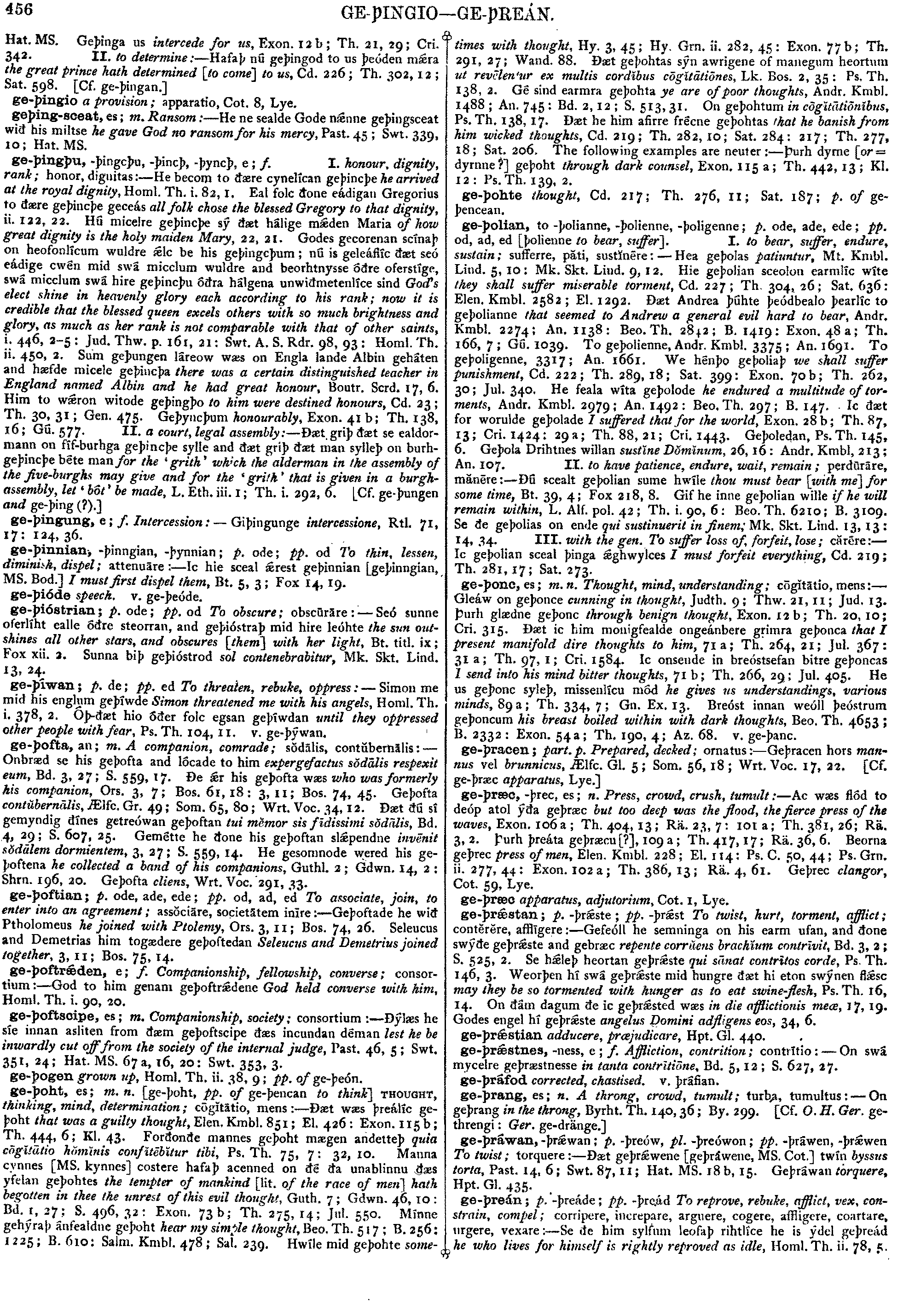
ge-þoht,
es;
m.
n.
[ge-þoht,
pp.
of
ge-þencan
to
think]
THOUGHT,
thinking,
mind,
determination;
cgttio,
mens
:--
Ðæt
wæs
þreálíc
ge-þoht
that
was
a
guilty
thought,
Elen.
Kmbl.
851;
El.
426:
Exon.
115
b;
Th.
444,
6;
Kl.
43.
Forðonðe
mannes
geþoht
mægen
andetteþ
quia
cgttio
hmnis
conftbtur
tibi,
Ps.
Th.
75,
7:
32,
10.
Manna
cynnes
[MS.
kynnes]
costere
hafaþ
acenned
on
ðé
ða
unablinnu
ðæs
yfelan
geþohtes
the
tempter
of
mankind
[lit.
of
the
race
of
men]
hath
begotten
in
thee
the
unrest
of
this
evil
thought,
Guth.
7;
Gdwn.
46,
10:
Bd.
1,
27:
S.
496,
32:
Exon.
73
b;
Th.
275,
14;
Jul.
550.
Mínne
gehýraþ
ánfealdne
geþoht
hear
my
simple
thought,
Beo.
Th.
517;
B.
256:
1225;
B.
610:
Salm.
Kmbl.
478;
Sal.
239.
Hwíle
mid
geþohte
sometimes
with
thought,
Hy.
3,
45;
Hy.
Grn.
ii.
282,
45:
Exon.
77
b;
Th.
291,
27;
Wand.
88.
Ðæt
geþohtas
sýn
awrigene
of
manegum
heortum
ut
revlentur
ex
meltis
cordbus
cgttines,
Lk.
Bos.
2,
35:
Ps.
Th.
138,
2.
Gé
sind
earmra
geþohta
ye
are
of
poor
thoughts,
Andr.
Kmbl.
1488;
An.
745:
Bd.
2,
12;
S.
513,
31.
On
geþohtum
in
cgttinbus,
Ps.
Th.
138,
17.
Ðæt
he
him
afirre
frécne
geþohtas
that
he
banish
from
him
wicked
thoughts,
Cd.
219;
Th.
282,
10;
Sat.
284:
217;
Th.
277,
18;
Sat.
206.
The
following
examples
are
neuter
:--
Þurh
dyrne
[or
=
dyrnne?]
geþoht
through
dark
counsel,
Exon.
115
a;
Th.
442,
13;
Kl.
12:
Ps.
Th.
139,
2.
|
Source: Bosworth/Toller, page b0527, entry 10 View original page image as: [TIFF] [PNG] [View previous entry] [View next entry] |
[Comment on this entry] [View comments] |
The following entry has been hand-corrected once. |
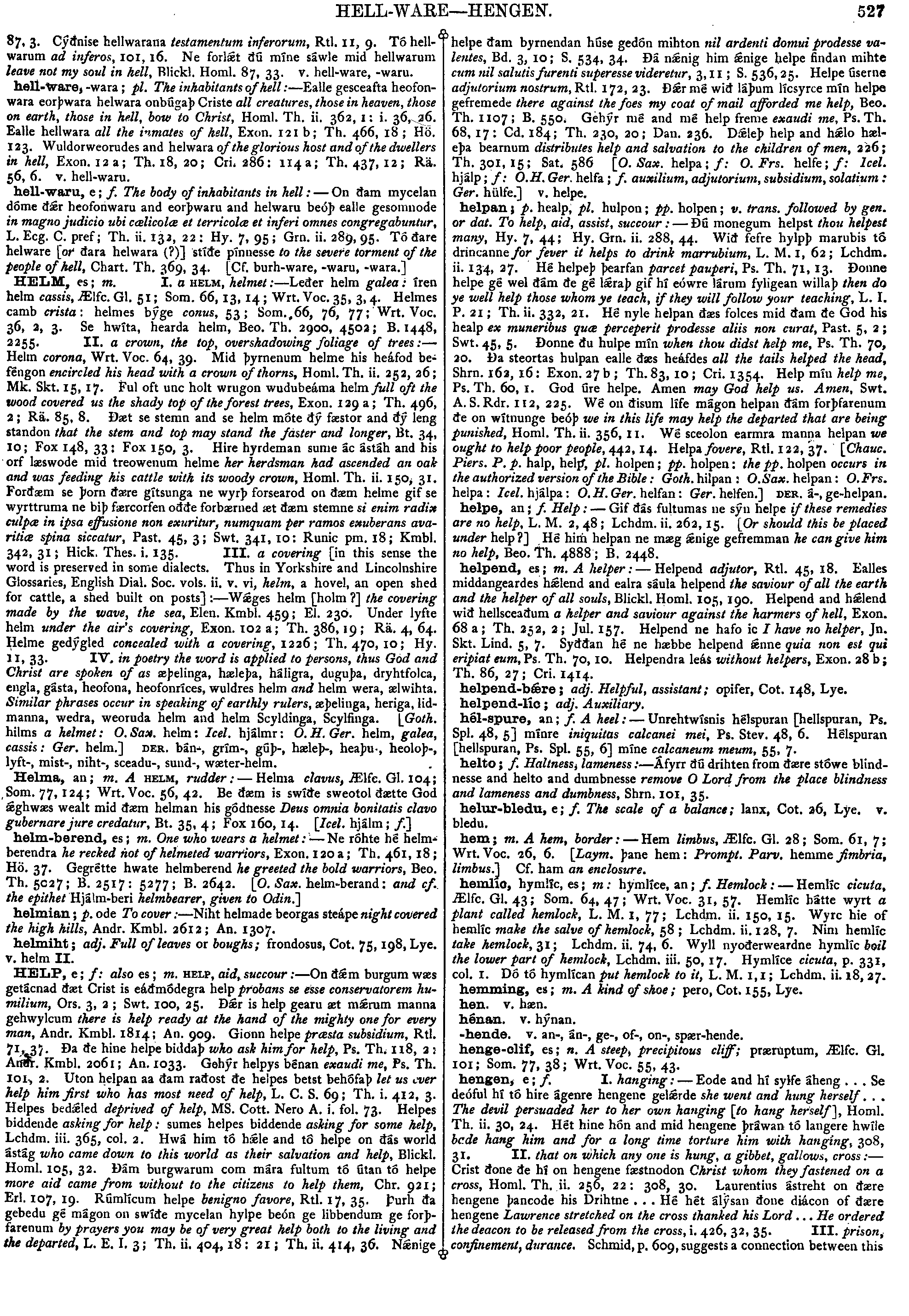
helpan;
p.
healp,
pl.
hulpon;
pp.
holpen;
v.
trans.
followed
by
gen.
or
dat.
To
help,
aid,
assist,
succour
:--
Ðú
monegum
helpst
thou
helpest
many,
Hy.
7,
44;
Hy.
Grn.
ii.
288,
44.
Wið
fefre
hylpþ
marubis
tó
drincanne
for
fever
it
helps
to
drink
marrubium,
L.
M.
1,
62;
Lchdm.
ii.
134,
27.
Hé
helpeþ
þearfan
parcet
pauperi,
Ps.
Th.
71,
13.
Ðonne
helpe
gé
wel
ðám
ðe
gé
lraþ
gif
hí
eówre
lárum
fyligean
willaþ
then
do
ye
well
help
those
whom
ye
teach,
if
they
will
follow
your
teaching,
L.
I.
P.
21;
Th.
ii.
332,
21.
Hé
nyle
helpan
ðæs
folces
mid
ðam
ðe
God
his
healp
ex
muneribus
quæ
perceperit
prodesse
aliis
non
curat,
Past.
5,
2;
Swt.
45,
5.
Ðonne
ðu
hulpe
mín
when
thou
didst
help
me,
Ps.
Th.
70,
20.
Ða
steortas
hulpan
ealle
ðæs
heáfdes
all
the
tails
helped
the
head,
Shrn.
162,
16:
Exon.
27
b;
Th.
83,
10;
Cri.
1354.
Help
mín
help
me,
Ps.
Th.
60,
1.
God
úre
helpe.
Amen
may
God
help
us.
Amen,
Swt.
A.
S.
Rdr.
112,
225.
Wé
on
ðisum
lífe
mágon
helpan
ðám
forþfarenum
ðe
on
wítnunge
beóþ
we
in
this
life
may
help
the
departed
that
are
being
punished,
Homl.
Th.
ii.
356,
11.
Wé
sceolon
earmra
manna
helpan
we
ought
to
help
poor
people,
442,
14.
Helpa
fovere,
Rtl.
122,
37.
[Chauc.
Piers.
P.
p.
halp,
help,
pl.
holpen;
pp.
holpen:
the
pp.
holpen
occurs
in
the
authorized
version
of
the
Bible:
Goth.
hilpan:
O.
Sax.
helpan:
O.
Frs.
helpa:
Icel.
hjálpa:
O.
H.
Ger.
helfan:
Ger.
helfen.]
DER.
á-,
ge-helpan.
|
Source: Bosworth/Toller, page b0543, entry 3 View original page image as: [TIFF] [PNG] [View previous entry] [View next entry] |
[Comment on this entry] [View comments] |
The following entry has been hand-corrected once. |
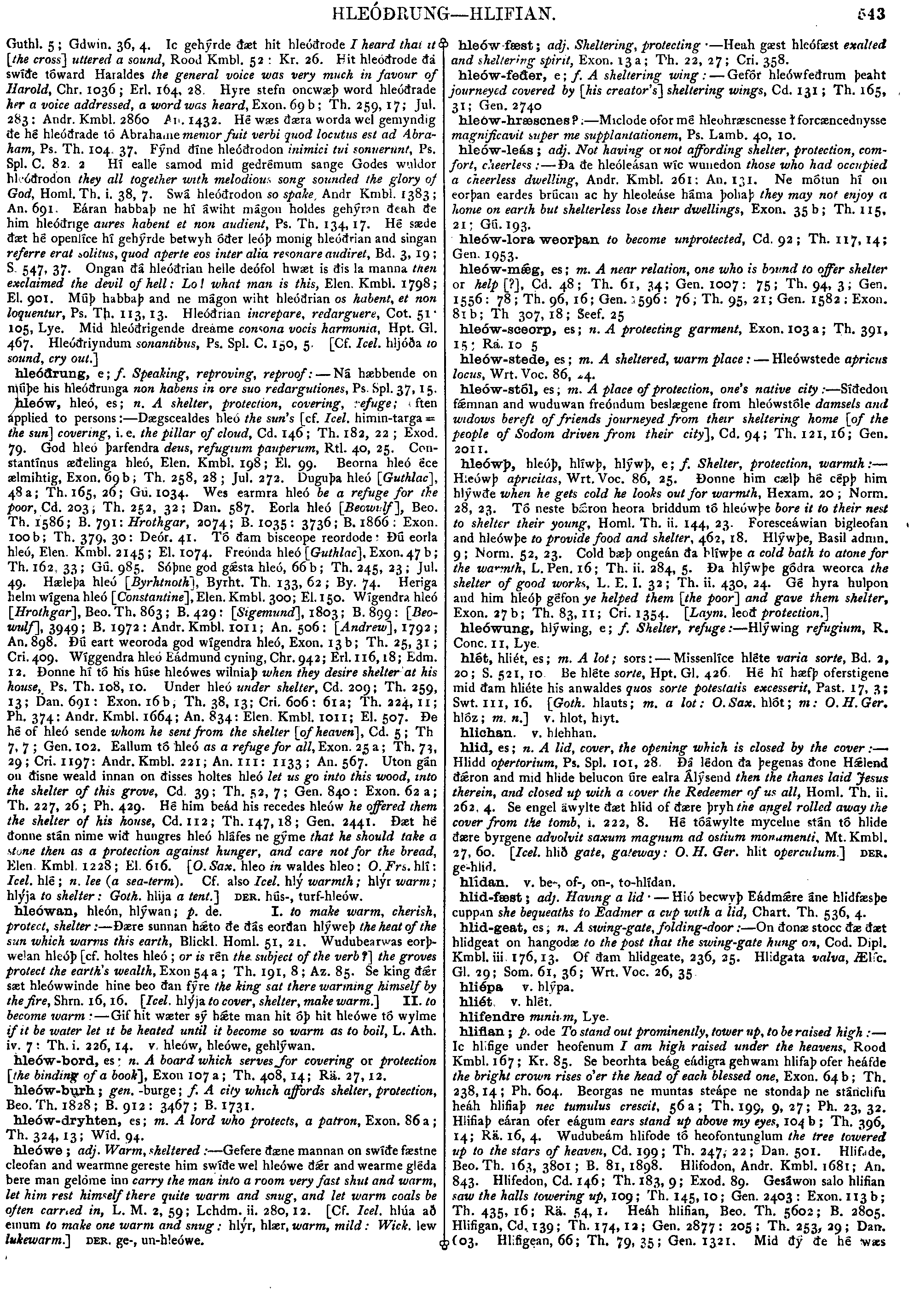
hleów,
hleó,
es;
n.
A
shelter,
protection,
covering,
refuge;
often
applied
to
persons
:--
Dægscealdes
hleó
the
sun's
[cf.
Icel.
himin-targa
=
the
sun]
covering,
i.e.
the
pillar
of
cloud,
Cd.
146;
Th.
182,
22;
Exod.
79.
God
hleó
þarfendra
deus,
refugium
pauperum,
Rtl.
40,
25.
Constantínus
æðelinga
hleó,
Elen.
Kmbl.
198;
El.
99.
Beorna
hleó
éce
ælmihtig,
Exon.
69
b;
Th.
258,
28;
Jul.
272.
Duguþa
hleó
[Guthlac],
48
a;
Th.
165,
26;
Gú.
1034.
Wes
earmra
hleó
be
a
refuge
for
the
poor,
Cd.
203;
Th.
252,
32;
Dan.
587.
Eorla
hleó
[Beowulf],
Beo.
Th.
1586;
B.
791:
Hrothgar,
2074;
B.
1035:
3736;
B.
1866:
Exon.
100
b;
Th.
379,
30:
Deór.
41.
Tó
ðam
bisceope
reordode:
Ðú
eorla
hleó,
Elen.
Kmbl.
2145;
El.
1074.
Freónda
hleó
[Guthlac],
Exon.
47
b;
Th.
162,
33;
Gú.
985.
Sóþne
god
gsta
hleó,
66
b;
Th.
245,
23;
Jul.
49.
Hæleþa
hleó
[Byrhtnoth],
Byrht.
Th.
133,
62;
By.
74.
Heriga
helm
wígena
hleó
[Constantine],
Elen.
Kmbl.
300;
El.
150.
Wígendra
hleó
[Hrothgar],
Beo.
Th.
863;
B.
429:
[Sigemund],
1803;
B.
899:
[Beowulf],
3949;
B.
1972:
Andr.
Kmbl.
1011;
An.
506:
[Andrew],
1792;
An.
898.
Ðú
eart
weoroda
god
wígendra
hleó,
Exon.
13
b;
Th.
25,
31;
Cri.
409,
Wíggendra
hleó
Eádmund
cyning,
Chr.
942;
Erl.
116,
18;
Edm.
12.
Ðonne
hí
tó
his
húse
hleówes
wilniaþ
when
they
desire
shelter
at
his
house,
Ps.
Th.
108,
10.
Under
hleó
under
shelter,
Cd.
209;
Th.
259,
13;
Dan.
691:
Exon.
16
b,
Th.
38,
13;
Cri.
606:
61
a;
Th.
224,
11;
Ph.
374:
Andr.
Kmbl.
1664;
An.
834:
Elen.
Kmbl.
1011;
El.
507.
Ðe
hé
of
hleó
sende
whom
he
sent
from
the
shelter
[of
heaven],
Cd.
5;
Th.
7,
7;
Gen.
102.
Eallum
tó
hleó
as
a
refuge
for
all,
Exon.
25
a;
Th.
73,
29;
Cri.
1197:
Andr.
Kmbl.
221;
An.
111:
1133;
An.
567.
Uton
gán
on
ðisne
weald
innan
on
ðisses
holtes
hleó
let
us
go
into
this
wood,
into
the
shelter
of
this
grove,
Cd.
39;
Th.
52,
7;
Gen.
840:
Exon.
62
a;
Th.
227,
26;
Ph.
429.
Hé
him
beád
his
recedes
hleów
he
offered
them
the
shelter
of
his
house,
Cd.
112;
Th.
147,
18;
Gen.
2441.
Ðæt
hé
ðonne
stán
nime
wið
hungres
hleó
hláfes
ne
gýme
that
he
should
take
a
stone
then
as
a
protection
against
hunger,
and
care
not
for
the
bread,
Elen.
Kmbl.
1228;
El.
616.
[O.
Sax.
hleo
in
waldes
hleo:
O.
Frs.
hlí:
Icel.
hlé;
n.
lee
(a
sea-term.)
Cf.
also
Icel.
hlý
warmth;
hlýr
warm;
hlýja
to
shelter:
Goth.
hlija
a
tent.]
DER.
hús-,
turf-hleów.
|
Source: Bosworth/Toller, page b0585, entry 6 View original page image as: [TIFF] [PNG] [View previous entry] [View next entry] |
[Comment on this entry] [View comments] |
The following entry has been hand-corrected once. |
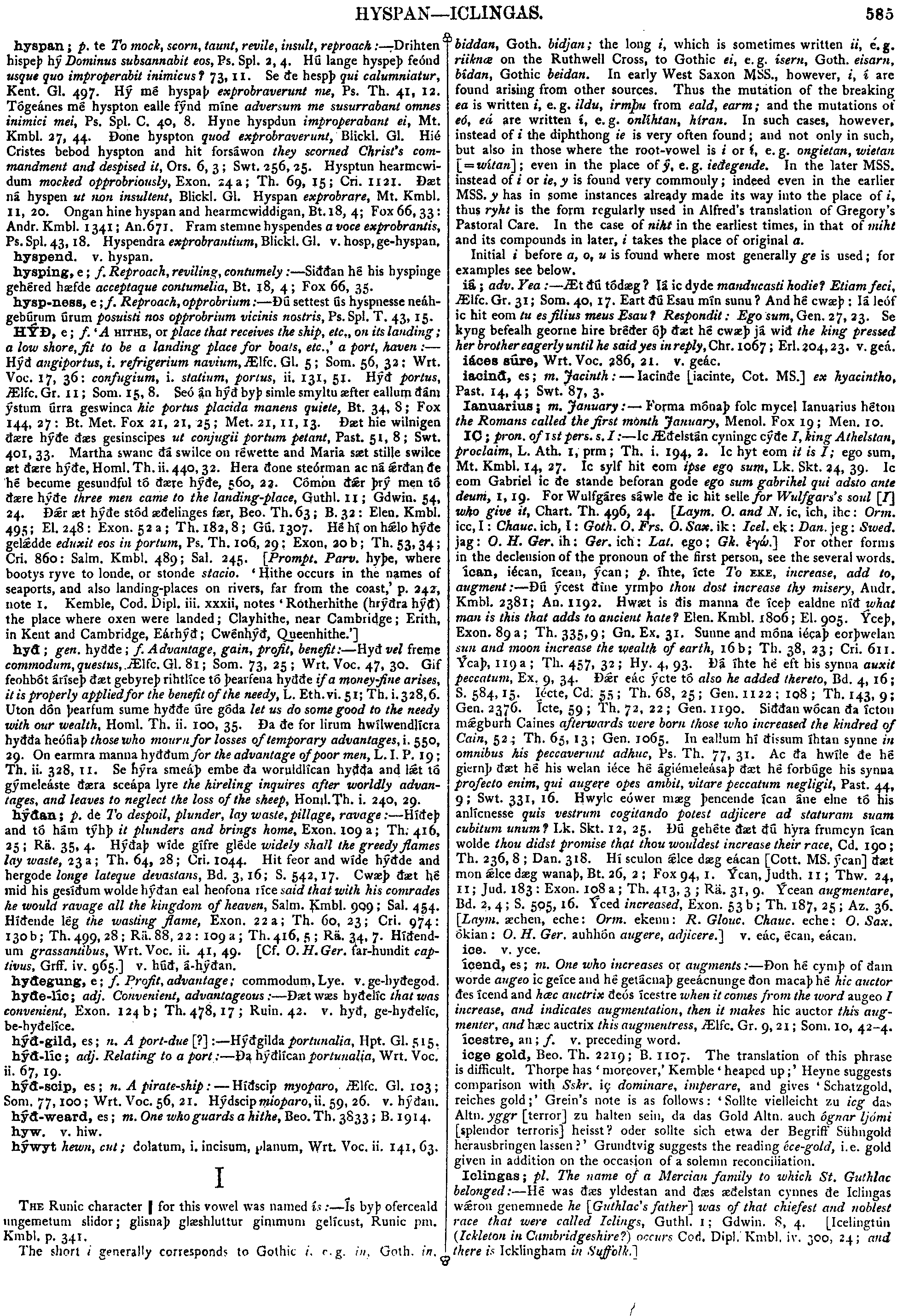
hyð;
gen.
hyððe
;
f.
Advantage,
gain,
profit,
benefit
:--
Hyð
vel
freme
commodum,
questus,
Ælfc.
Gl.
81;
Som.
73,
25
;
Wrt.
Voc.
47,
30.
Gif
feohbót
áríseþ
ðæt
gebyreþ
rihtlíce
tó
þearfena
hyððe
if
a
money-fine
arises,
it
is
properly
applied
for
the
benefit
of
the
needy,
L.
Eth.
vi.
51;
Th.
i.
328,
6.
Uton
dón
þearfum
sume
hyððe
úre
góda
let
us
do
some
good
to
the
needy
with
our
wealth,
Homl.
Th.
ii.
100,
35.
Ða
ðe
for
lirum
hwílwendlícra
hyðða
heófiaþ
those
who
mourn
for
losses
of
temporary
advantages,
i.
550,
29.
On
earmra
manna
hyððum
for
the
advantage
of
poor
men,
L.
I.
P.
19
;
Th.
ii.
328,
11.
Se
hýra
smeáþ
embe
ða
woruldlícan
hyðða
and
lt
tó
gýmeleáste
ðæra
sceápa
lyre
the
hireling
inquires
after
worldly
advantages,
and
leaves
to
neglect
the
loss
of
the
sheep,
Homl.Th.
i.
240,
29.
|
Source: Bosworth/Toller, page b0681, entry 11 View original page image as: [TIFF] [PNG] [View previous entry] [View next entry] |
[Comment on this entry] [View comments] |
The following entry has been hand-corrected once. |
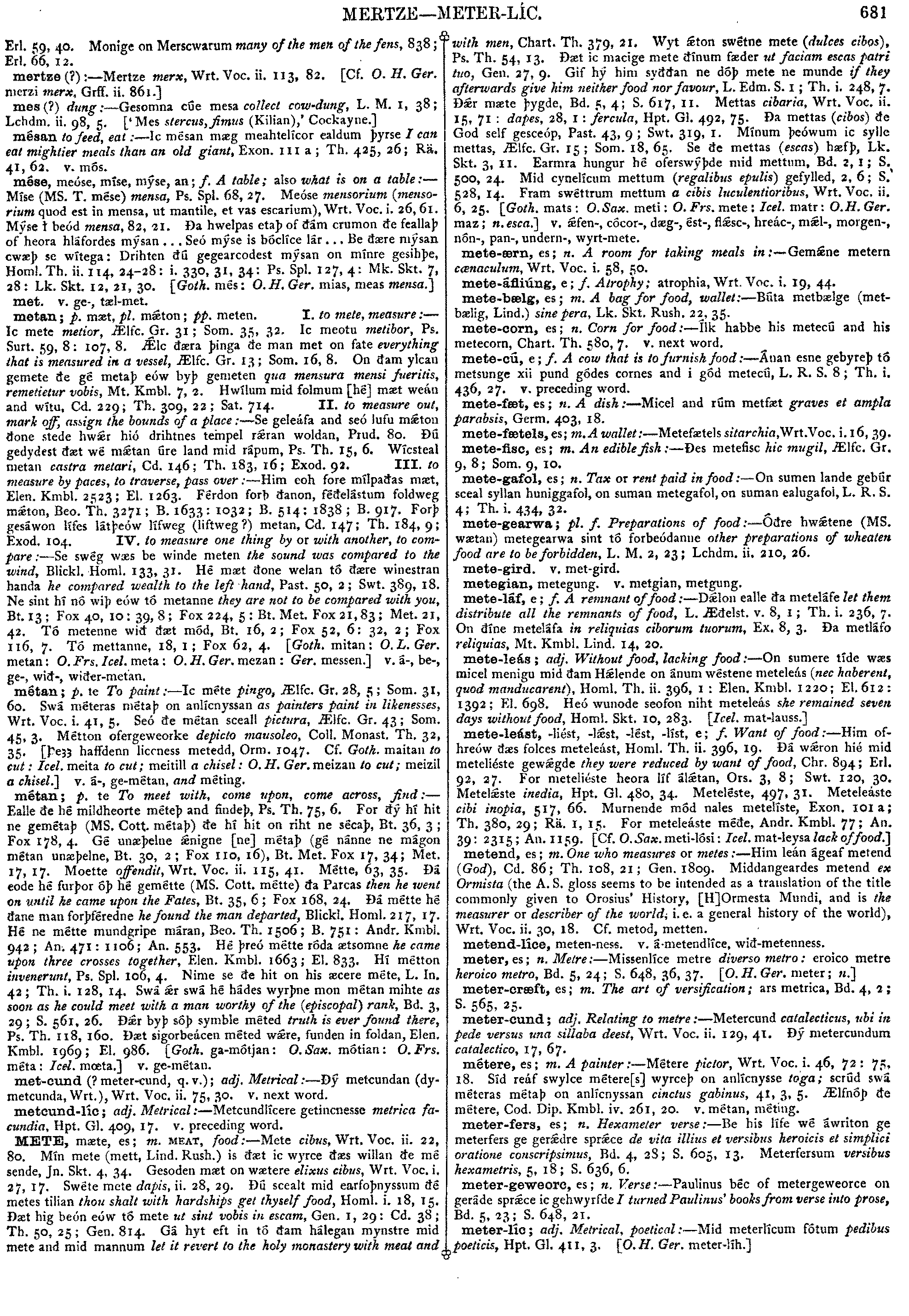
METE,
mæte,
es;
m.
MEAT,
food
:--
Mete
cibus,
Wrt.
Voc.
ii.
22,
80.
Mín
mete
(mett,
Lind.
Rush.)
is
ðæt
ic
wyrce
ðæs
willan
ðe
mé
sende,
Jn.
Skt.
4,
34.
Gesoden
mæt
on
wætere
elixus
cibus,
Wrt.
Voc.
i.
27,
17.
Swéte
mete
dapis,
ii.
28,
29.
Ðú
scealt
mid
earfoþnyssum
ðé
metes
tilian
thou
shalt
with
hardships
get
thyself
food,
Homl.
i.
18,
15.
Ðæt
hig
beón
eów
tó
mete
ut
sint
vobis
in
escam,
Gen.
1,
29:
Cd.
38
;
Th.
50,
25;
Gen.
814.
Gá
hyt
eft
in
tó
ðam
hálegan
mynstre
mid
mete
and
mid
mannum
let
it
revert
to
the
holy
monastery
with
meat
and
with
men,
Chart.
Th.
379,
21.
Wyt
ton
swétne
mete
(dulces
cibos),
Ps.
Th.
54,
13.
Ðæt
ic
macige
mete
ðínum
fæder
ut
faciam
escas
patri
tuo,
Gen.
27,
9.
Gif
hý
him
syððan
ne
dóþ
mete
ne
munde
if
they
afterwards
give
him
neither
food
nor
favour,
L.
Edm.
S.
1;
Th.
i.
248,
7.
Ðr
mæte
þygde,
Bd.
5,
4;
S.
617,
11.
Mettas
cibaria,
Wrt.
Voc.
ii.
15,
71:
dapes,
28,
1:
fercula,
Hpt.
Gl.
492,
75.
Ða
mettas
(cibos)
ðe
God
self
gesceóp,
Past.
43,
9;
Swt.
319,
1.
Mínum
þeówum
ic
sylle
mettas,
Ælfc.
Gr.
15;
Som.
18,
65.
Se
ðe
mettas
(escas)
hæfþ,
Lk.
Skt.
3,
11.
Earmra
hungur
hé
oferswýþde
mid
mettum,
Bd.
2,
1;
S.
500,
24.
Mid
cynelícum
mettum
(regalibus
epulis)
gefylled,
2,
6;
S.
528,
14.
Fram
swéttrum
mettum
a
cibis
luculentioribus,
Wrt.
Voc.
ii.
6,
25.
[Goth.
mats:
O.
Sax.
meti:
O.
Frs.
mete:
Icel.
matr:
O.
H.
Ger.
maz;
n.
esca.]
v.
fen-,
cócor-,
dæg-,
ést-,
flsc-,
hreác-,
ml-,
morgen-,
nón-,
pan-,
undern-,
wyrt-mete.
| Result Page: | 1 2 3 4 | Next |  |
Germanic Lexicon Project (main page)
This search system was written by
Sean Crist
Please consider
volunteering
to correct the data in these online dictionaries.
No rights reserved. Feel free to use these data in any way you please.