|
|

Tip: In the search results, you can click on any word or abbreviation for more information.
|
Source: Bosworth/Toller, page b0376, entry 12 View original page image as: [TIFF] [PNG] [View previous entry] [View next entry] |
[Comment on this entry] [View comments] |
The following entry has been hand-corrected once. |
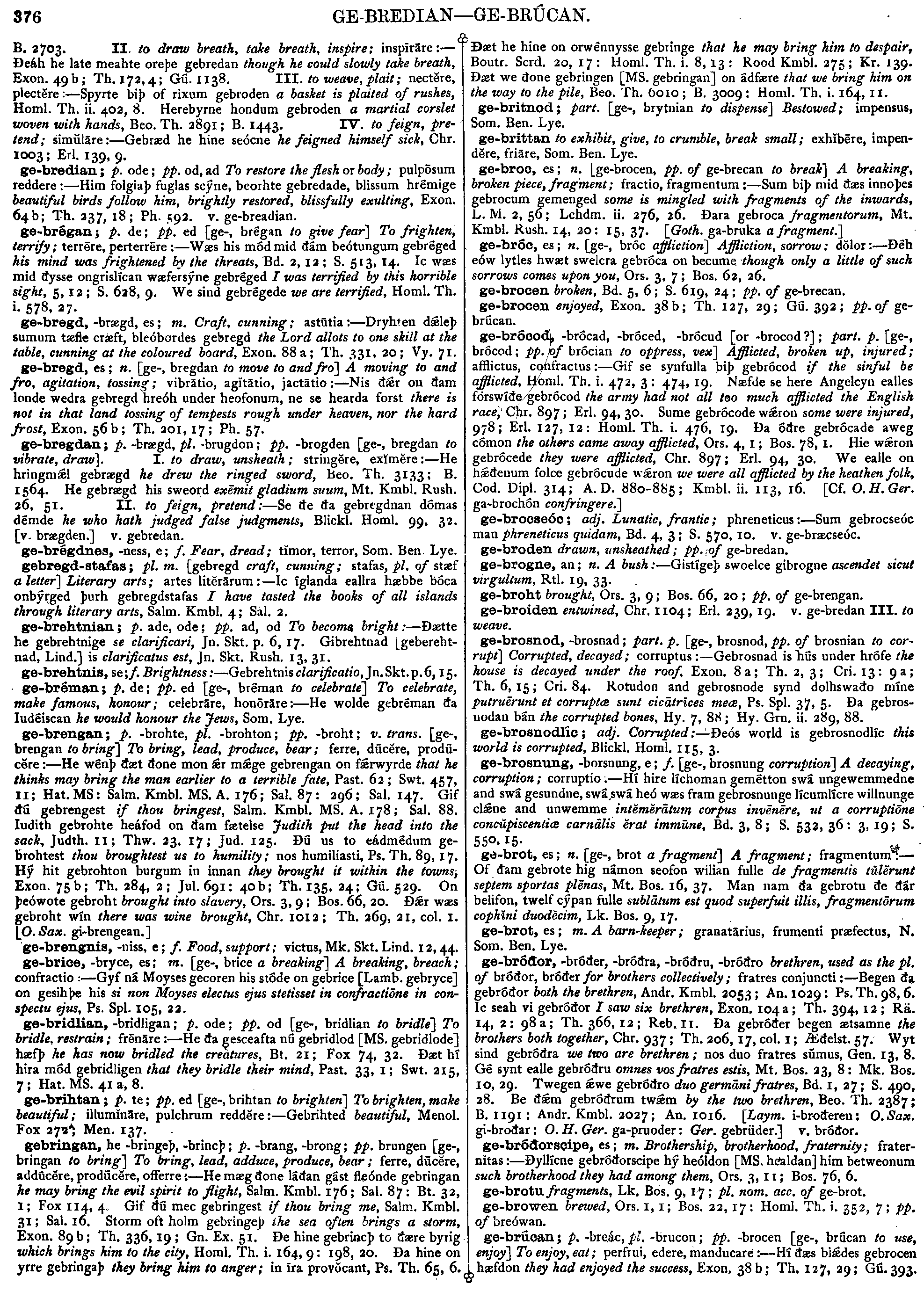
ge-brengan;
p.
-brohte,
pl.
-brohton;
pp.
-broht;
v.
trans,
[ge-,
brengan
to
bring]
To
bring,
lead,
produce,
bear;
ferre,
d c
c re,
prodcre
:--
He
wénþ
ðæt
ðone
mon
re,
prodcre
:--
He
wénþ
ðæt
ðone
mon
 r
mge
gebrengan
on
frwyrde
that
he
thinks
may
bring
the
man
earlier
to
a
terrible
fate,
Past.
62;
Swt.
457,
11;
Hat.
MS:
Salm.
Kmbl.
MS.
A.
176;
Sal.
87:
296;
Sal.
147.
Gif
dfi
gebrengest
if
thou
bringest,
Salm.
Kmbl.
MS.
A.
178;
Sal.
88.
Iudith
gebrohte
heáfod
on
ðám
fætelse
Judith
put
the
head
into
the
sack,
Judth.
11;
Thw.
23,
17;
Jud.
125.
Ðú
us
to
eádmédum
gebrohtest
thou
broughtest
us
to
humility;
nos
humiliasti,
Ps.
Th.
89,
17.
Hý
hit
gebrohton
burgum
in
innan
they
brought
it
within
the
towns,
Exon.
75
b;
Th.
284,
2;
Jul.
691:
40
b;
Th.
135,
24;
Gú.
529.
On
þeówote
gebroht
brought
into
slavery,
Ors.
3,
9;
Bos.
66,
20.
Ðr
wæs
gebroht
wín
there
was
wine
brought,
Chr.
1012;
Th.
269,
21,
col.
I.
[O.
Sax.
gi-brengean.]
r
mge
gebrengan
on
frwyrde
that
he
thinks
may
bring
the
man
earlier
to
a
terrible
fate,
Past.
62;
Swt.
457,
11;
Hat.
MS:
Salm.
Kmbl.
MS.
A.
176;
Sal.
87:
296;
Sal.
147.
Gif
dfi
gebrengest
if
thou
bringest,
Salm.
Kmbl.
MS.
A.
178;
Sal.
88.
Iudith
gebrohte
heáfod
on
ðám
fætelse
Judith
put
the
head
into
the
sack,
Judth.
11;
Thw.
23,
17;
Jud.
125.
Ðú
us
to
eádmédum
gebrohtest
thou
broughtest
us
to
humility;
nos
humiliasti,
Ps.
Th.
89,
17.
Hý
hit
gebrohton
burgum
in
innan
they
brought
it
within
the
towns,
Exon.
75
b;
Th.
284,
2;
Jul.
691:
40
b;
Th.
135,
24;
Gú.
529.
On
þeówote
gebroht
brought
into
slavery,
Ors.
3,
9;
Bos.
66,
20.
Ðr
wæs
gebroht
wín
there
was
wine
brought,
Chr.
1012;
Th.
269,
21,
col.
I.
[O.
Sax.
gi-brengean.]
|
Source: Bosworth/Toller, page b0377, entry 20 View original page image as: [TIFF] [PNG] [View previous entry] [View next entry] |
[Comment on this entry] [View comments (1)] |
The following entry has been hand-corrected once. |
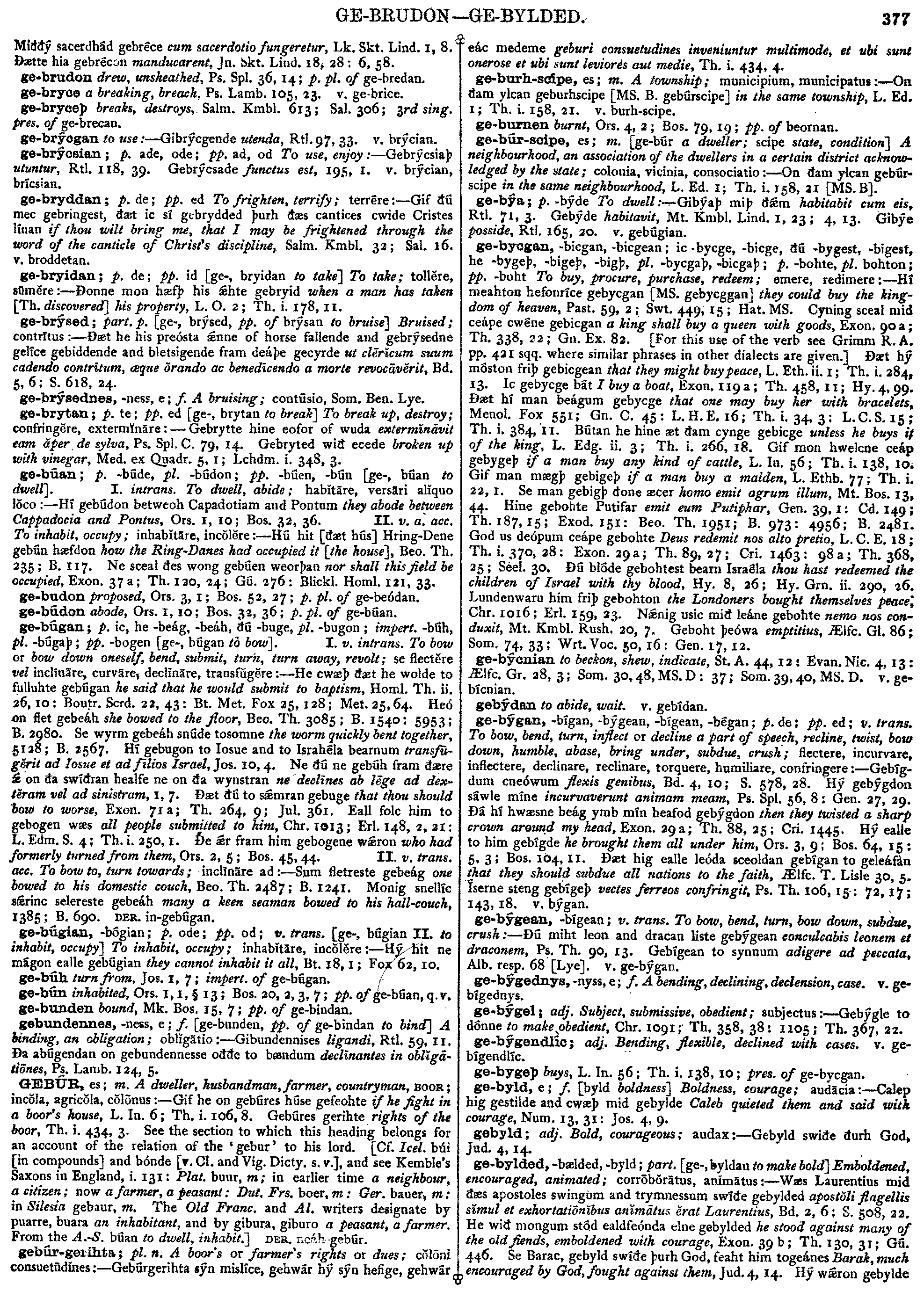
GEBÚR,
es;
m.
A
dweller,
husbandman,
farmer,
countryman,
BOOR;
inc la,
agricla,
cl
la,
agricla,
cl nus
:--
Gif
he
on
gebúres
húse
gefeohte
if
he
fight
in
a
boor's
house,
L.
In.
6;
Th.
i.
106,
8.
Gebúres
gerihte
rights
of
the
boor,
Th.
i.
434,
3.
See
the
section
to
which
this
heading
belongs
for
an
account
of
the
relation
of
the
'gebur'
to
his
lord.
[Cf.
Icel.
búi
[in
compounds]
and
bónde
[v.
Cl.
and
Vig.
Dicty.
s.
v.],
and
see
Kemblé
s
Saxons
in
England,
i.
131
:
Plat.
buur,
m;
in
earlier
time
a
neighbour,
a
citizen;
now
a
farmer,
a
peasant
:
Dut.
Frs.
boer.
m
:
Ger.
bauer,
m
:
in
Silesia
gebaur,
m.
The
Old
Franc.
and
Al.
writers
designate
by
puarre,
buara
an
inhabitant,
and
by
gibura,
giburo
a
peasant,
a
farmer.
From
the
A.-S.
búan
to
dwell,
inhabit.]
DER.
neáh-gebúr.
nus
:--
Gif
he
on
gebúres
húse
gefeohte
if
he
fight
in
a
boor's
house,
L.
In.
6;
Th.
i.
106,
8.
Gebúres
gerihte
rights
of
the
boor,
Th.
i.
434,
3.
See
the
section
to
which
this
heading
belongs
for
an
account
of
the
relation
of
the
'gebur'
to
his
lord.
[Cf.
Icel.
búi
[in
compounds]
and
bónde
[v.
Cl.
and
Vig.
Dicty.
s.
v.],
and
see
Kemblé
s
Saxons
in
England,
i.
131
:
Plat.
buur,
m;
in
earlier
time
a
neighbour,
a
citizen;
now
a
farmer,
a
peasant
:
Dut.
Frs.
boer.
m
:
Ger.
bauer,
m
:
in
Silesia
gebaur,
m.
The
Old
Franc.
and
Al.
writers
designate
by
puarre,
buara
an
inhabitant,
and
by
gibura,
giburo
a
peasant,
a
farmer.
From
the
A.-S.
búan
to
dwell,
inhabit.]
DER.
neáh-gebúr.
|
Source: Bosworth/Toller, page b0490, entry 30 View original page image as: [TIFF] [PNG] [View previous entry] [View next entry] |
[Comment on this entry] [View comments] |
The following entry has been hand-corrected once. |
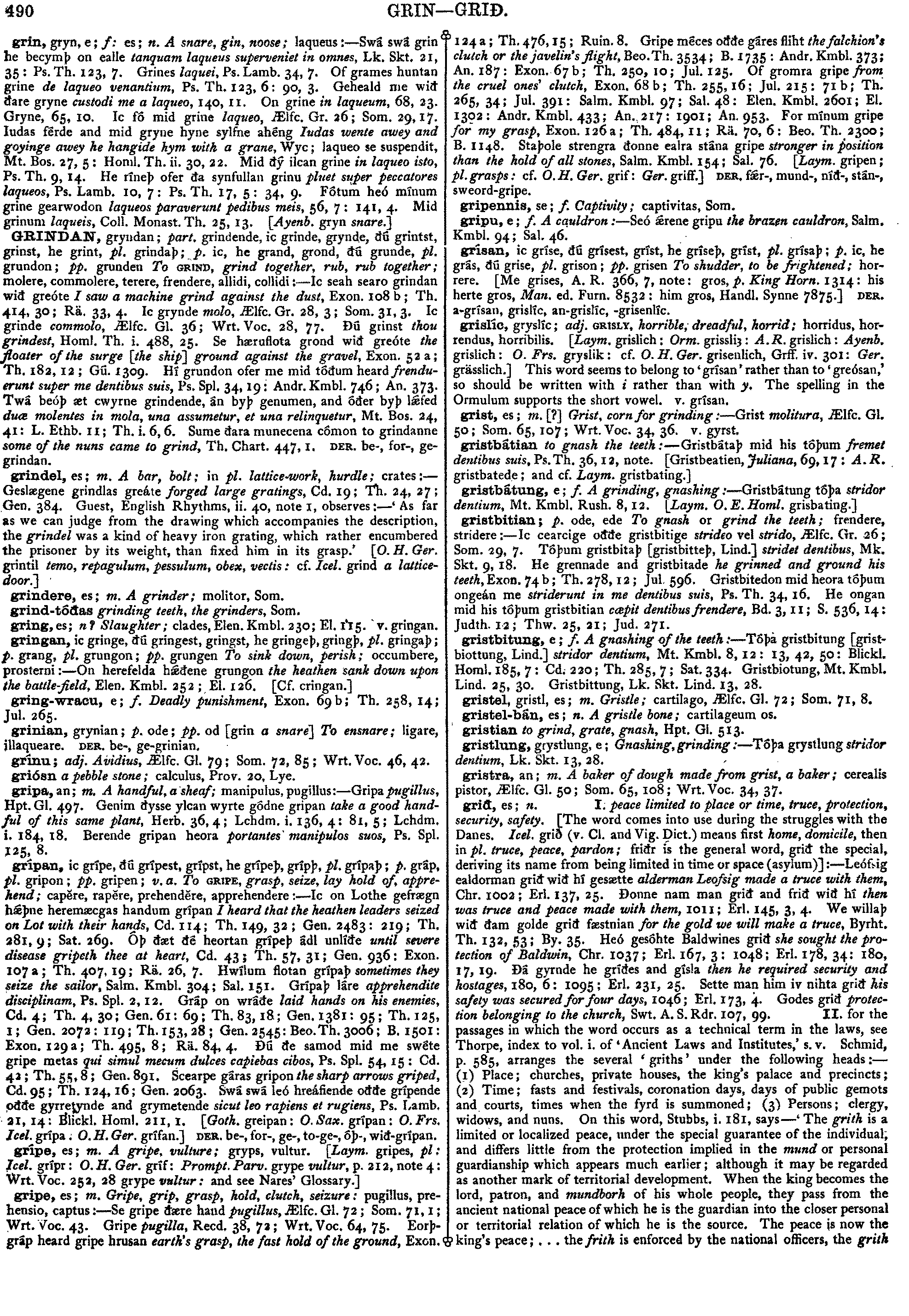
grið,
es;
n.
I.
peace
limited
to
place
or
time,
truce,
protection,
security,
safety.
[The
word
comes
into
use
during
the
struggles
with
the
Danes.
Icel.
grið
(v.
Cl.
and
Vig.
Dict.)
means
first
home,
domicile,
then
in
pl.
truce,
peace,
pardon;
friðr
is
the
general
word,
grið
the
special,
deriving
its
name
from
being
limited
in
time
or
space
(asylum)]
:--
Leófsig
ealdorman
grið
wið
hí
gesætte
alderman
Leofsig
made
a
truce
with
them,
Chr.
1002;
Erl.
137,
25.
Ðonne
nam
man
grið
and
frið
wið
hí
then
was
truce
and
peace
made
with
them,
1011;
Erl.
145,
3,
4.
We
willaþ
wið
ðam
golde
grið
fæstnian
for
the
gold
we
will
make
a
truce,
Byrht.
Th.
132,
53;
By.
35.
Heó
gesóhte
Baldwines
grið
she
sought
the
protection
of
Baldwin,
Chr.
1037;
Erl.
167,
3:
1048;
Erl.
178,
34:
180,
17,
19.
Ðá
gyrnde
he
gríðes
and
gísla
then
he
required
security
and
hostages,
180,
6:
1095;
Erl.
231,
25.
Sette
man
him
iv
nihta
grið
his
safety
was
secured
for
four
days,
1046;
Erl.
173,
4.
Godes
grið
protection
belonging
to
the
church,
Swt.
A.
S.
Rdr.
107,
99.
II.
for
the
passages
in
which
the
word
occurs
as
a
technical
term
in
the
laws,
see
Thorpe,
index
to
vol.
i.
of
'Ancient
Laws
and
Institutes,'
s.
v.
Schmid,
p.
585,
arranges
the
several
'griths'
under
the
following
heads
:--
(1)
Place;
churches,
private
houses,
the
king's
palace
and
precincts;
(2)
Time;
fasts
and
festivals,
coronation
days,
days
of
public
gemots
and
courts,
times
when
the
fyrd
is
summoned;
(3)
Persons;
clergy,
widows,
and
nuns.
On
this
word,
Stubbs,
i.
181,
says-'The
grith
is
a
limited
or
localized
peace,
under
the
special
guarantee
of
the
individual;
and
differs
little
from
the
protection
implied
in
the
mund
or
personal
guardianship
which
appears
much
earlier;
although
it
may
be
regarded
as
another
mark
of
territorial
development.
When
the
king
becomes
the
lord,
patron,
and
mundborh
of
his
whole
people,
they
pass
from
the
ancient
national
peace
of
which
he
is
the
guardian
into
the
closer
personal
or
territorial
relation
of
which
he
is
the
source.
The
peace
is
now
the
king's
peace;
...
the
frith
is
enforced
by
the
national
officers,
the
grith
by
the
king's
personal
servants:
the
one
is
official,
the
other
personal;
the
one
the
business
of
the
country,
the
other
that
of
the
court.
The
special
peace
is
further
extended
to
places
where
the
national
peace
is
not
fully
provided
for:
the
great
highways
...
are
under
the
king's
peace.'
[A.
R.
Laym.
griþ:
Orm.
griþþ.]
DER.
cyric-,
hlnes-,
hád-,
hand-grið.
|
Source: Bosworth/Toller, page b0507, entry 14 View original page image as: [TIFF] [PNG] [View previous entry] [View next entry] |
[Comment on this entry] [View comments] |
The following entry has been hand-corrected once. |
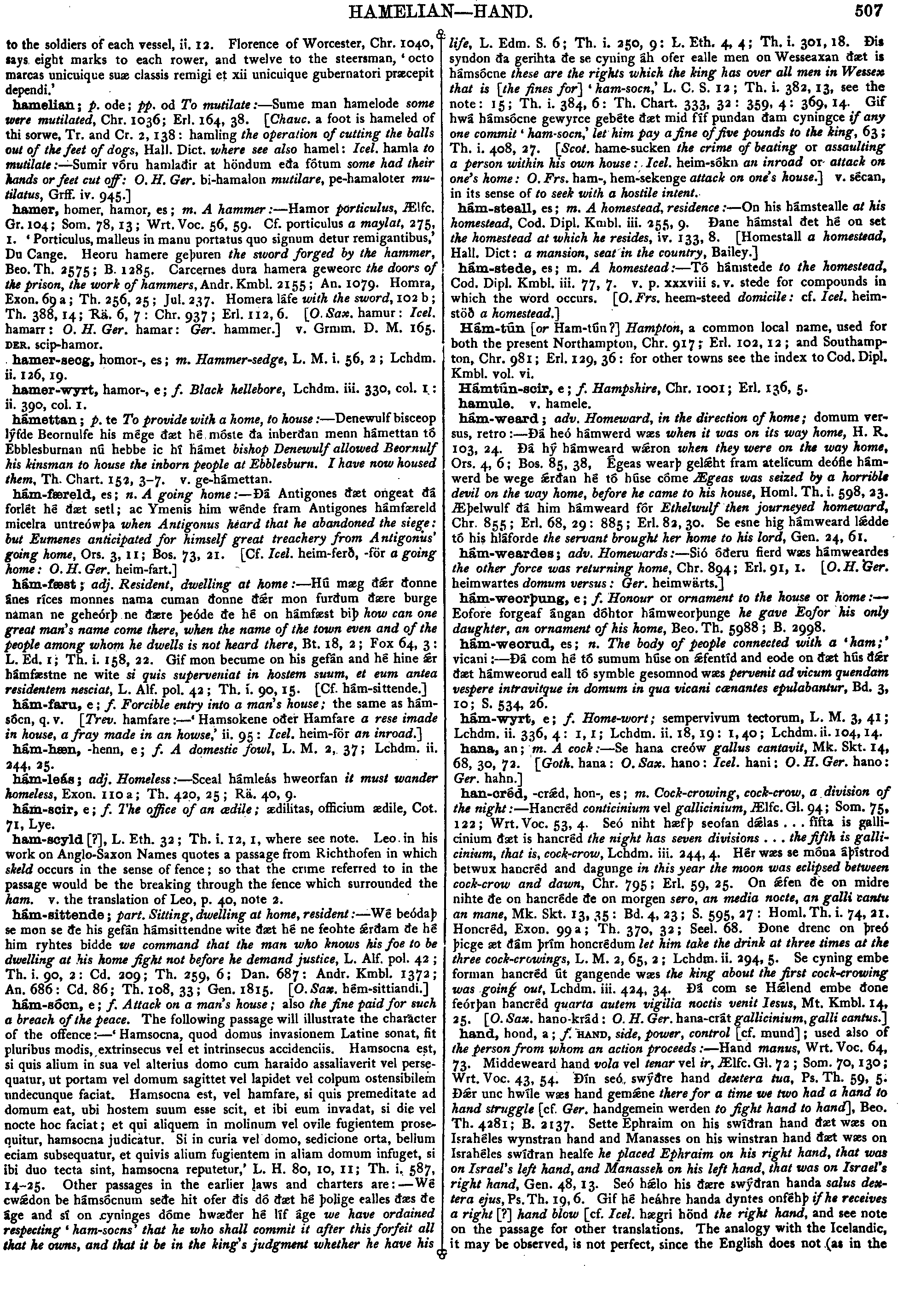
hám-sócn,
e;
f.
Attack
on
a
man's
house;
also
the
fine
paid
for
such
a
breach
of
the
peace.
The
following
passage
will
illustrate
the
character
of
the
offence
:--
'
Hamsocna,
quod
domus
invasionem
Latine
sonat,
fit
pluribus
modis,
extrinsecus
vel
et
intrinsecus
accidenciis.
Hamsocna
est,
si
quis
alium
in
sua
vel
alterius
domo
cum
haraido
assaliaverit
vel
persequatur,
ut
portam
vel
domum
sagittet
vel
lapidet
vel
colpum
ostensibilem
undecunque
faciat.
Hamsocna
est,
vel
hamfare,
si
quis
premeditate
ad
domum
eat,
ubi
hostem
suum
esse
scit,
et
ibi
eum
invadat,
si
die
vel
nocte
hoc
faciat;
et
qui
aliquem
in
molinum
vel
ovile
fugientem
prosequitur,
hamsocna
judicatur.
Si
in
curia
vel
domo,
sedicione
orta,
bellum
eciam
subsequatur,
et
quivis
alium
fugientem
in
aliam
domum
infuget,
si
ibi
duo
tecta
sint,
hamsocna
reputetur,'
L.
H.
80,
10,
11;
Th.
i.
587,
14-25.
Other
passages
in
the
earlier
laws
and
charters
are
:--
Wé
cwdon
be
hámsócnum
seðe
hit
ofer
ðis
dó
ðæt
hé
þolige
ealles
ðæs
ðe
áge
and
sí
on
cyninges
dóme
hwæðer
hé
líf
áge
we
have
ordained
respecting
'ham-socns'
that
he
who
shall
commit
it
after
this
forfeit
all
that
he
owns,
and
that
it
be
in
the
king's
judgment
whether
he
have
his
life,
L.
Edm.
S.
6;
Th.
i.
250,
9:
L.
Eth.
4,
4;
Th.
i.
301,
18.
Ðis
syndon
ða
gerihta
ðe
se
cyning
áh
ofer
ealle
men
on
Wesseaxan
ðæt
is
hámsócne
these
are
the
rights
which
the
king
has
over
all
men
in
Wessex
that
is
[the
fines
for]
'ham-socn,'
L.
C.
S.
12;
Th.
i.
382,
13,
see
the
note:
15;
Th.
i.
384,
6:
Th.
Chart.
333,
32:
359,
4:
369,
14.
Gif
hwá
hámsócne
gewyrce
gebéte
ðæt
mid
fíf
pundan
ðam
cyningce
if
any
one
commit
'ham-socn,'
let
him
pay
a
fine
of
five
pounds
to
the
king,
63;
Th.
i.
408,
27.
[Scot.
hame-sucken
the
crime
of
beating
or
assaulting
a
person
within
his
own
house:
Icel.
heim-sókn
an
inroad
or
attack
on
one's
home:
O.
Frs.
ham-,
hem-sekenge
attack
on
one's
house.]
v.
sécan,
in
its
sense
of
to
seek
with
a
hostile
intent.
|
Source: Bosworth/Toller, page b0520, entry 10 View original page image as: [TIFF] [PNG] [View previous entry] [View next entry] |
[Comment on this entry] [View comments] |
The following entry has been hand-corrected once. |
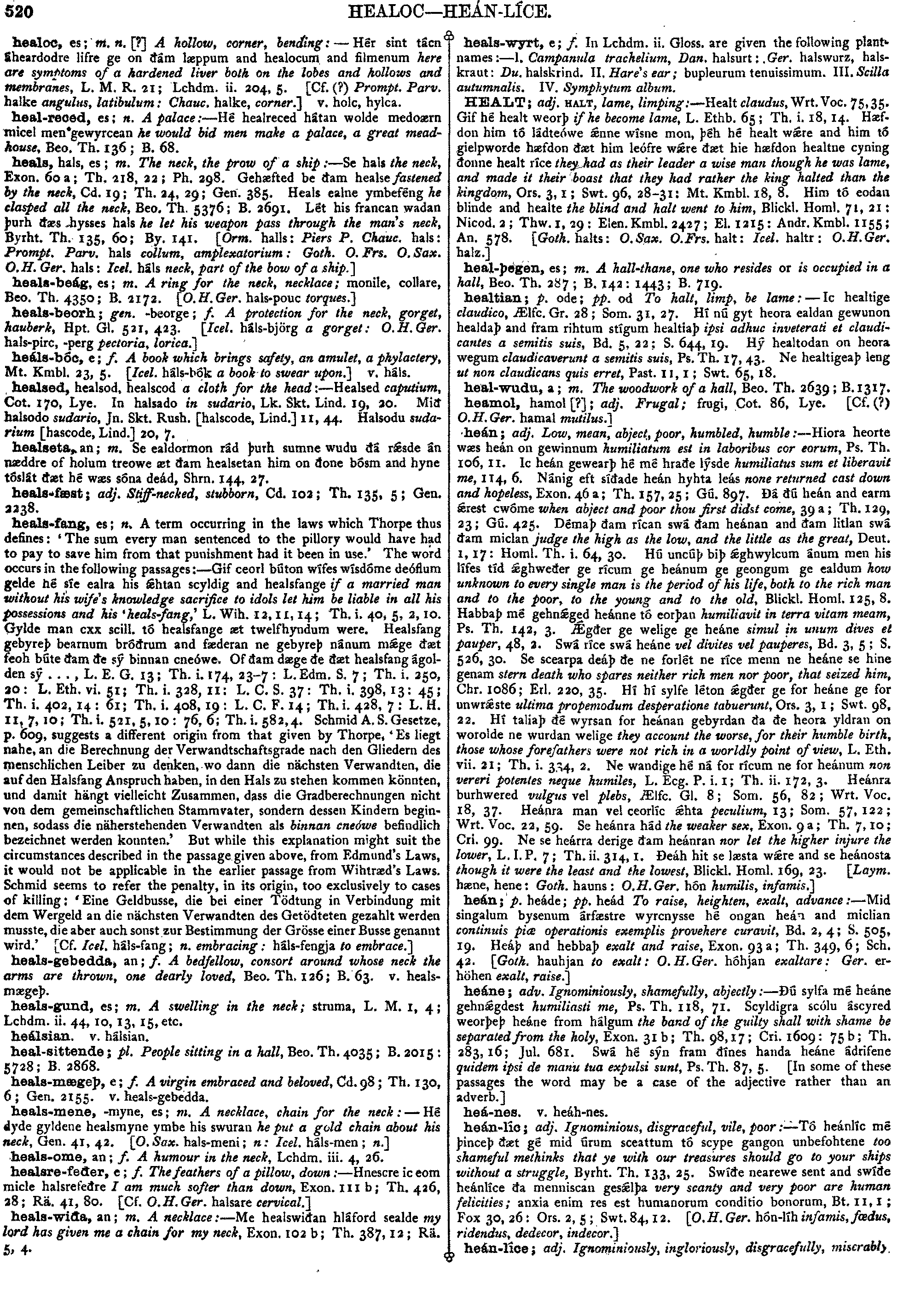
heals-fang,
es;
n.
A
term
occurring
in
the
laws
which
Thorpe
thus
defines:
'The
sum
every
man
sentenced
to
the
pillory
would
have
had
to
pay
to
save
him
from
that
punishment
had
it
been
in
use.'
The
word
occurs
in
the
following
passages
:--
Gif
ceorl
búton
wífes
wísdóme
deóflum
gelde
hé
síe
ealra
his
htan
scyldig
and
healsfange
if
a
married
man
without
his
wife's
knowledge
sacrifice
to
idols
let
him
be
liable
in
all
his
possessions
and
his
'heals-fang,'
L.
Wih.
12,
11,
14;
Th.
i.
40,
5,
2,
10.
Gylde
man
cxx
scill.
tó
healsfange
æt
twelfhyndum
were.
Healsfang
gebyreþ
bearnum
bróðrum
and
fæderan
ne
gebyreþ
nánum
mge
ðæt
feoh
búte
ðam
ðe
sý
binnan
cneówe.
Of
ðam
dæge
ðe
ðæt
healsfang
ágolden
sý...,
L.
E.
G.
13;
Th.
i.
174,
23-7:
L.
Edm.
S.
7;
Th.
i.
250,
20:
L.
Eth.
vi.
51;
Th.
i.
328,
11;
L.
C.
S.
37:
Th.
i.
398,
13:
45;
Th.
i.
402,
14:
61;
Th.
i.
408,
19:
L.
C.
F.14;
Th.
i.
428,
7:
L.
H.
11,
7,
10;
Th.
i.
521,
5,
10:
76,
6;
Th.
i.
582,
4.
Schmid
A.
S.
Gesetze,
p.
609,
suggests
a
different
origin
from
that
given
by
Thorpe,
'Es
liegt
nahe,
an
die
Berechnung
der
Verwandtschaftsgrade
nach
den
Gliedern
des
menschlichen
Leiber
zu
denken,
wo
dann
die
nächsten
Verwandten,
die
auf
den
Halsfang
Anspruch
haben,
in
den
Hals
zu
stehen
kommen
könnten,
und
damit
hängt
vielleicht
Zusammen,
dass
die
Gradberechnungen
nicht
von
dem
gemeinschaftlichen
Stammvater,
sondern
dessen
Kindern
beginnen,
sodass
die
näherstehenden
Verwandten
als
binnan
cneówe
befindlich
bezeichnet
werden
konnten.'
But
while
this
explanation
might
suit
the
circumstances
described
in
the
passage
given
above,
from
Edmund's
Laws,
it
would
not
be
applicable
in
the
earlier
passage
from
Wihtræd's
Laws.
Schmid
seems
to
refer
the
penalty,
in
its
origin,
too
exclusively
to
cases
of
killing:
'Eine
Geldbusse,
die
bei
einer
Tödtung
in
Verbindung
mit
dem
Wergeld
an
die
nächsten
Verwandten
des
Getödteten
gezahlt
werden
musste,
die
aber
auch
sonst
zur
Bestimmung
der
Grösse
einer
Busse
genannt
wird.'
[Cf.
Icel.
háls-fang;
n.
embracing:
háls-fengja
to
embrace.]
|
Source: Bosworth/Toller, page b0570, entry 1 View original page image as: [TIFF] [PNG] [View previous entry] [View next entry] |
[Comment on this entry] [View comments (3)] |
The following entry has been hand-corrected once. |
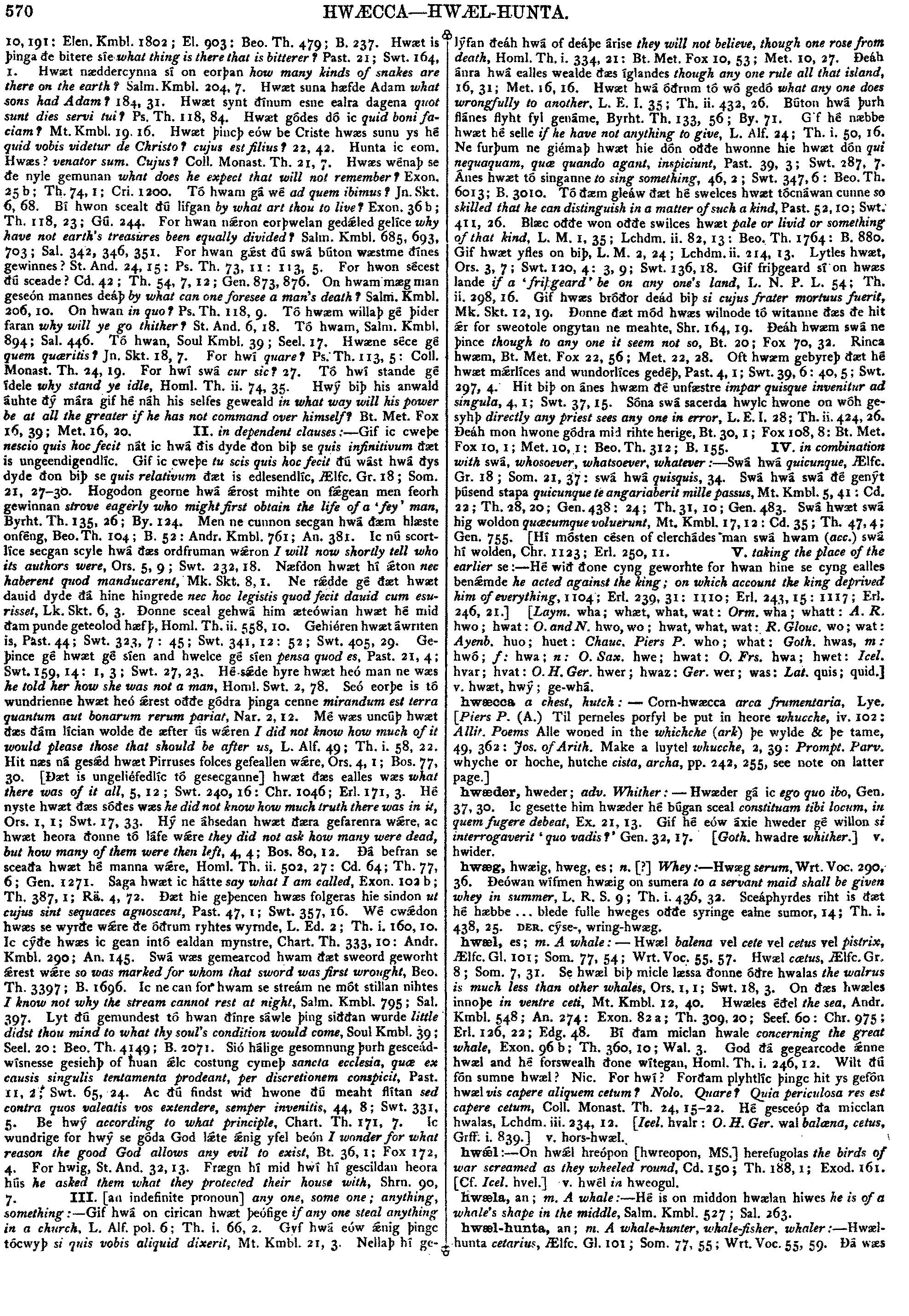
10,
191:
Elen.
Kmbl.
1802;
El.
903:
Beo.
Th.
479;
B.
237.
Hwæt
is
þinga
ðe
bitere
síe
what
thing
is
there
that
is
bitterer?
Past.
21;
Swt.
164,
1.
Hwæt
næddercynna
sí
on
eorþan
how
many
kinds
of
snakes
are
there
on
the
earth?
Salm.
Kmbl.
204,
7.
Hwæt
suna
hæfde
Adam
what
sons
had
Adam?
184,
31.
Hwæt
synt
ðínum
esne
ealra
dagena
quot
sunt
dies
servi
tui?
Ps.
Th.
118,
84.
Hwæt
gódes
dó
ic
quid
boni
faciam?
Mt.
Kmbl.
19,
16.
Hwæt
þincþ
eów
be
Criste
hwæs
sunu
ys
hé
quid
vobis
videtur
de
Christo?
cujus
est
filius?
22,
42.
Hunta
ic
eom.
Hwæs?
venator
sum.
Cujus?
Coll.
Monast.
Th.
21,
7.
Hwæs
wénaþ
se
ðe
nyle
gemunan
what
does
he
expect
that
will
not
remember?
Exon.
25
b;
Th.
74,
1;
Cri.
1200.
Tó
hwam
gá
wé
ad
quem
ibimus?
Jn.
Skt.
6,
68.
Bí
hwon
scealt
ðú
lifgan
by
what
art
thou
to
live?
Exon.
36
b;
Th.
118,
23;
Gú.
244.
For
hwan
nron
eorþwelan
gedled
gelíce
why
have
not
earth's
treasures
been
equally
divided?
Salm.
Kmbl.
685,
693,
703;
Sal.
342,
346,
351.
For
hwan
gst
ðú
swá
búton
wæstme
ðínes
gewinnes?
St.
And.
24,
15:
Ps.
Th.
73,
11:
113,
5.
For
hwon
sécest
ðú
sceade?
Cd.
42;
Th.
54,
7,
12;
Gen.
873,
876.
On
hwam
mæg
man
geseón
mannes
deáþ
by
what
can
one
foresee
a
man's
death?
Salm.
Kmbl.
206,
10.
On
hwan
in
quo?
Ps.
Th.
118,
9.
Tó
hwæm
willaþ
gé
þider
faran
why
will
ye
go
thither?
St.
And.
6,
18.
Tó
hwam,
Salm.
Kmbl.
894;
Sal.
446.
Tó
hwan,
Soul
Kmbl.
39;
Seel.
17.
Hwæne
séce
gé
quem
quæritis?
Jn.
Skt.
18,
7.
For
hwí
quare?
Ps.
Th.
113,
5:
Coll.
Monast.
Th.
24,
19.
For
hwí
swá
cur
sic?
27.
Tó
hwi
stande
gé
ídele
why
stand
ye
idle,
Homl.
Th.
ii.
74,
35.
Hwý
biþ
his
anwald
áuhte
ðý
mára
gif
hé
náh
his
selfes
geweald
in
what
way
will
his
power
be
at
all
the
greater
if
he
has
not
command
over
himself?
Bt.
Met.
Fox
16,
39;
Met.
16,
20.
II.
in
dependent
clauses
:--
Gif
ic
cweþe
nescio
quis
hoc
fecit
nát
ic
hwá
ðis
dyde
ðon
biþ
se
quis
infinitivum
ðæt
is
ungeendigendlíc.
Gif
ic
cweþe
tu
scis
quis
hoc
fecit
ðú
wást
hwá
ðys
dyde
ðon
biþ
se
quis
relativum
ðæt
is
edlesendlíc,
Ælfc.
Gr.
18;
Som.
21,
27-30.
Hogodon
georne
hwá
rost
mihte
on
fgean
men
feorh
gewinnan
strove
eagerly
who
might
first
obtain
the
life
of
a
'fey'
man,
Byrht.
Th.
135,
26;
By.
124.
Men
ne
cunnon
secgan
hwá
dæm
hlæste
onféng,
Beo.
Th.
104;
B.
52:
Andr.
Kmbl.
761;
An.
381.
Ic
nú
scortlíce
secgan
scyle
hwá
ðæs
ordfruman
wron
I
will
now
shortly
tell
who
its
authors
were,
Ors.
5,
9;
Swt.
232,
18.
Næfdon
hwæt
hí
ton
nec
haberent
quod
manducarent,
Mk.
Skt.
8,
1.
Ne
rdde
gé
ðæt
hwæt
dauid
dyde
ðá
hine
hingrede
nec
hoc
legistis
quod
fecit
dauid
cum
esurisset,
Lk.
Skt.
6,
3.
Ðonne
sceal
gehwá
him
æteówian
hwæt
hé
mid
ðam
punde
geteolod
hæfþ,
Homl.
Th.
ii.
558,
10.
Gehiéren
hwæt
áwriten
is,
Past.
44;
Swt.
323,
7:
45;
Swt.
341,
12:
52;
Swt.
405,
29.
Geþince
gé
hwæt
gé
síen
and
hwelce
gé
síen
pensa
quod
es,
Past.
21,
4;
Swt.
159,
14:
1,
3;
Swt.
27,
23.
Hé
sde
hyre
hwæt
heó
man
ne
wæs
he
told
her
how
she
was
not
a
man,
Homl.
Swt.
2,
78.
Seó
eorþe
is
tó
wundrienne
hwæt
heó
rest
oððe
gódra
þinga
cenne
mirandum
est
terra
quantum
aut
bonarum
rerum
pariat,
Nar.
2,
12.
Mé
wæs
uncúþ
hwæt
ðæs
ðám
lícian
wolde
ðe
æfter
ús
wren
I
did
not
know
how
much
of
it
would
please
those
that
should
be
after
us,
L.
Alf.
49;
Th.
i.
58,
22.
Hit
næs
ná
gesd
hwæt
Pirruses
folces
gefeallen
wre,
Ors.
4,
1;
Bos.
77,
30.
[Ðæt
is
ungeliéfedlíc
tó
gesecganne]
hwæt
ðæs
ealles
wæs
what
there
was
of
it
all,
5,
12;
Swt.
240,
16:
Chr.
1046;
Erl.
171,
3.
Hé
nyste
hwæt
ðæs
sóðes
wæs
he
did
not
know
how
much
truth
there
was
in
it,
Ors.
1,
1;
Swt.
17,
33.
Hý
ne
áhsedan
hwæt
ðæra
gefarenra
wre,
ac
hwæt
heora
ðonne
tó
láfe
wre
they
did
not
ask
how
many
were
dead,
but
how
many
of
them
were
then
left,
4,
4;
Bos.
80,
12.
Ðá
befran
se
sceaða
hwæt
hé
manna
wre.
Homl.
Th.
ii.
502,
27:
Cd.
64;
Th.
77,
6;
Gen.
1271.
Saga
hwæt
ic
hátte
say
what
I
am
called,
Exon.
102
b;
Th.
387,
1;
Rä.
4,
72,
Ðæt
hie
geþencen
hwæs
folgeras
hie
sindon
ut
cujus
sint
sequaces
agnoscant,
Past.
47,
1;
Swt.
357,
16.
Wé
cwdon
hwæs
se
wyrðe
wre
ðe
óðrum
ryhtes
wyrnde,
L.
Ed.
2;
Th.
i.
160,
10.
Ic
cýðe
hwæs
ic
gean
intó
ealdan
mynstre,
Chart.
Th.
333,
10:
Andr.
Kmbl.
290;
An.
145.
Swá
wæs
gemearcod
hwam
ðæt
sweord
geworht
rest
wre
so
was
marked
for
whom
that
sword
was
first
wrought,
Beo.
Th.
3397;
B.
1696.
Ic
ne
can
for
hwam
se
streám
ne
mót
stillan
nihtes
I
know
not
why
the
stream
cannot
rest
at
night,
Salm.
Kmbl.
795;
Sal.
397.
Lyt
ðú
gemundest
tó
hwan
ðínre
sáwle
þing
siððan
wurde
little
didst
thou
mind
to
what
thy
soul's
condition
would
come,
Soul
Kmbl.
39;
Seel.
20:
Beo.
Th.
4149;
B.
2071.
Sió
hálige
gesomnung
þurh
gesceádwísnesse
gesiehþ
of
huan
lc
costung
cymeþ
sancta
ecclesia,
quæ
ex
causis
singulis
tentamenta
prodeant,
per
discretionem
conspicit,
Past.
11,
2;
Swt.
65,
24.
Ac
ðú
findst
wið
hwone
ðú
meaht
flítan
sed
contra
quos
valeatis
vos
extendere,
semper
invenitis,
44,
8;
Swt.
331,
5.
Be
hwý
according
to
what
principle,
Chart.
Th.
171,
7.
Ic
wundrige
for
hwý
se
góda
God
lte
nig
yfel
beón
I
wonder
for
what
reason
the
good
God
allows
any
evil
to
exist,
Bt.
36,
1;
Fox
172,
4.
For
hwig,
St.
And.
32,
13.
Frægn
hí
mid
hwí
hí
gescildan
heora
hús
he
asked
them
what
they
protected
their
house
with,
Shrn.
90,
7.
III.
[an
indefinite
pronoun]
any
one,
some
one;
anything,
something
:--
Gif
hwá
on
cirican
hwæt
þeófige
if
any
one
steal
anything
in
a
church,
L.
Alf.
pol.
6;
Th.
i.
66,
2.
Gyf
hwá
eów
nig
þingc
tócwyþ
si
quis
vobis
aliquid
dixerit,
Mt.
Kmbl.
21,
3.
Nellaþ
hí
gelýfan
ðeáh
hwá
of
deáþe
árise
they
will
not
believe,
though
one
rose
from
death,
Homl.
Th.
i.
334,
21:
Bt.
Met.
Fox
10,
53;
Met.
10,
27.
Ðeáh
ánra
hwá
ealles
wealde
ðæs
íglandes
though
any
one
rule
all
that
island,
16,
31;
Met.
16,
16.
Hwæt
hwá
óðrum
tó
wó
gedó
what
any
one
does
wrongfully
to
another,
L.
E.
I.
35;
Th.
ii.
432,
26.
Búton
hwá
þurh
flánes
flyht
fyl
genáme,
Byrht.
Th.
133,
56;
By.
71.
Gif
hé
næbbe
hwæt
hé
selle
if
he
have
not
anything
to
give,
L.
Alf.
24;
Th.
i.
50,
16.
Ne
furþum
ne
giémaþ
hwæt
hie
dón
oððe
hwonne
hie
hwæt
dón
qui
nequaquam,
quæ
quando
agant,
inspiciunt,
Past.
39,
3;
Swt.
287,
7.
Ánes
hwæt
tó
singanne
to
sing
something,
46,
2;
Swt.
347,
6:
Beo.
Th.
6013;
B.
3010.
Tó
ðæm
gleáw
ðæt
hé
swelces
hwæt
tócnáwan
cunne
so
skilled
that
he
can
distinguish
in
a
matter
of
such
a
kind,
Past.
52,
10;
Swt.
411,
26.
Blæc
oððe
won
oððe
swilces
hwæt
pale
or
livid
or
something
of
that
kind,
L.
M.
1,
35;
Lchdm.
ii.
82,
13:
Beo.
Th.
1764:
B.
880.
Gif
hwæt
yfles
on
biþ,
L.
M.
2,
24;
Lchdm.
ii.
214,
13.
Lytles
hwæt,
Ors.
3,
7;
Swt.
120,
4:
3,
9;
Swt.
136,
18.
Gif
friþgeard
sí
on
hwæs
lande
if
a
'friþgeard'
be
on
any
one's
land,
L.
N.
P.
L.
54;
Th.
ii.
298,
16.
Gif
hwæs
bróðor
deád
biþ
si
cujus
frater
mortuus
fuerit,
Mk.
Skt.
12,
19.
Ðonne
ðæt
mód
hwæs
wilnode
tó
witanne
ðæs
ðe
hit
r
for
sweotole
ongytan
ne
meahte,
Shr.
164,
19.
Ðeáh
hwæm
swá
ne
þince
though
to
any
one
it
seem
not
so,
Bt.
20;
Fox
70,
32.
Rinca
hwæm,
Bt.
Met.
Fox
22,
56;
Met.
22,
28.
Oft
hwæm
gebyreþ
ðæt
hé
hwæt
mrlíces
and
wundorlíces
gedéþ,
Past.
4,
1;
Swt.
39,
6:
40,
5;
Swt.
297,
4.
Hit
biþ
on
ánes
hwæm
ðé
unfæstre
impar
quisque
invenitur
ad
singula,
4,
1;
Swt.
37,
15.
Sóna
swá
sacerda
hwylc
hwone
on
wóh
gesyhþ
directly
any
priest
sees
any
one
in
error,
L.
E.
I.
28;
Th.
ii.
424,
26.
Ðeáh
mon
hwone
gódra
mid
rihte
herige,
Bt.
30,
1;
Fox
108,
8:
Bt.
Met.
Fox
10,
1;
Met.
10,
1:
Beo.
Th.
312;
B.
155.
IV.
in
combination
with
swá,
whosoever,
whatsoever,
whatever
:--
Swá
hwá
quicunque,
Ælfc.
Gr.
18;
Som.
21,
37:
swá
hwá
quisquis,
34.
Swá
hwá
swá
ðé
genýt
þúsend
stapa
quicunque
té
angariaberit
mille
passus,
Mt.
Kmbl.
5,
41:
Cd.
22;
Th.
28,
20;
Gen.
438:
24;
Th.
31,
10;
Gen.
483.
Swá
hwæt
swá
hig
woldon
quæcumque
voluerunt,
Mt.
Kmbl.
17,
12:
Cd.
35;
Th.
47,
4;
Gen.
755.
[Hí
mósten
césen
of
clerchádes
man
swá
hwam
(acc.)
swá
hí
wolden,
Chr.
1123;
Erl.
250,
ii.
V.
taking
the
place
of
the
earlier
se
:--
Hé
wið
ðone
cyng
geworhte
for
hwan
hine
se
cyng
ealles
benmde
he
acted
against
the
king;
on
which
account
the
king
deprived
him
of
everything,
1104;
Erl.
239,
31:
1110;
Erl.
243,
15:
1117;
Erl.
246,
21.]
[Laym.
wha;
whæt,
what,
wat:
Orm.
wha;
whatt:
A.
R.
hwo;
hwat:
O.
and
N.
hwo,
wo;
hwat,
what,
wat:
R.
Glouc.
wo;
wat:
Ayenb.
huo;
huet:
Chauc.
Piers
P.
who;
what:
Goth.
hwas,
m:
hwó;
f:
hwa;
n:
O.
Sax.
hwe;
hwat:
O.
Frs.
hwa;
hwet:
Icel.
hvar;
hvat:
O.
H.
Ger.
hwer;
hwaz:
Ger.
wer;
was:
Lat.
quis;
quid.]
v.
hwæt,
hwý;
ge-whá.
|
Source: Bosworth/Toller, page b0585, entry 18 View original page image as: [TIFF] [PNG] [View previous entry] [View next entry] |
[Comment on this entry] [View comments] |
The following entry has been hand-corrected once. |
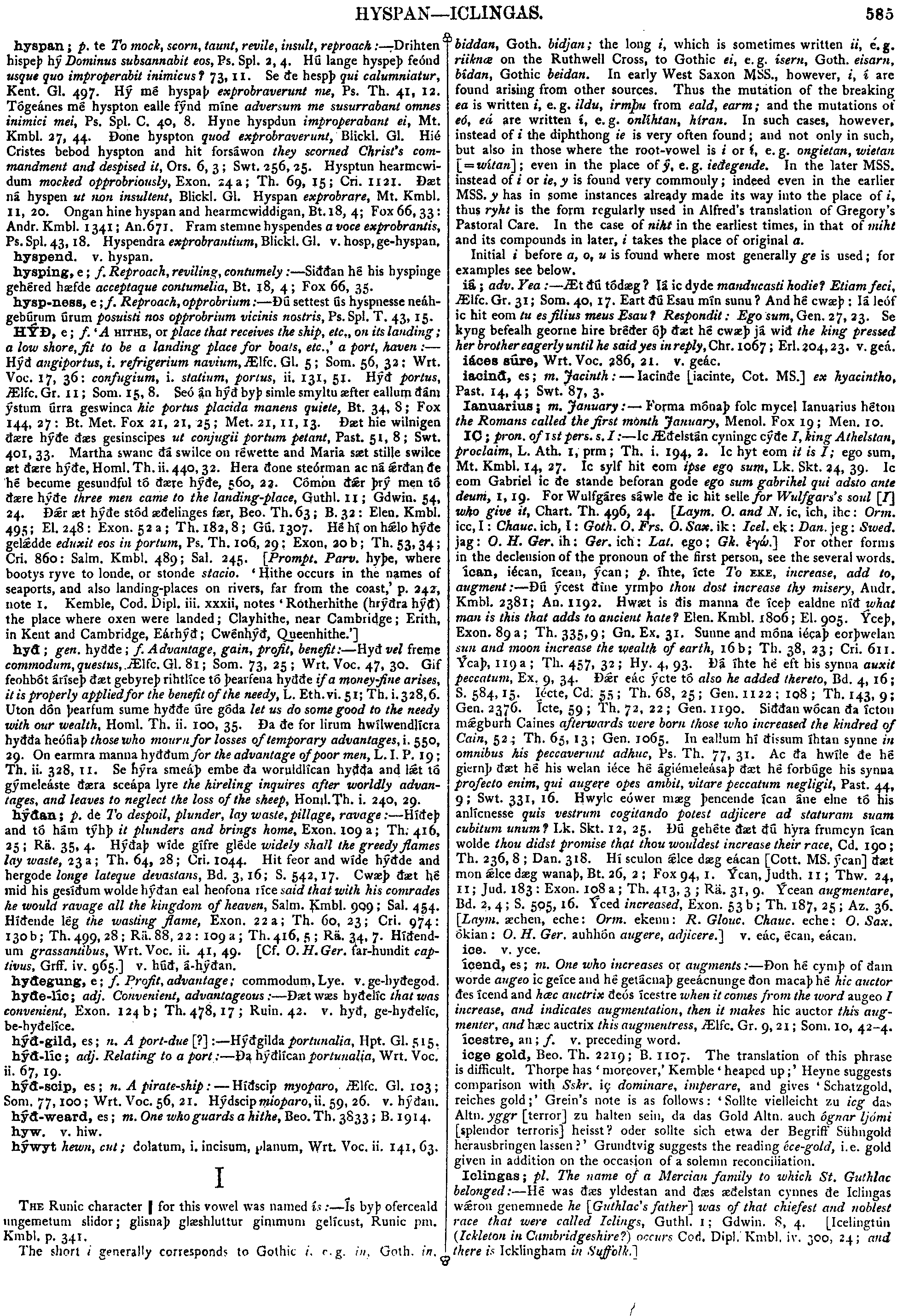
The short i generally corresponds to Gothic i. e. g. in, Goth, in. biddan, Goth. bidjan; the long i, which is sometimes written ii, e. g. riiknæ on the Ruthwell Cross, to Gothic ei, e.g. isern, Goth. eisarn, bidan, Gothic beidan. In early West Saxon MSS., however, i, í are found arising from other sources. Thus the mutation of the breaking ea is written i, e. g. ildu, irmþu from eald, earm; and the mutations of eó, eá are written í, e. g. onlíhtan, híran. In such cases, however, instead of i the diphthong ie is very often found; and not only in such, but also in those where the root-vowel is i or í, e. g. ongietan, wietan [ = wítan] ; even in the place of ý, e. g. ieðegende. In the later MSS. instead of i or ie, y is found very commonly; indeed even in the earlier MSS. y has in some instances already made its way into the place of i, thus ryht is the form regularly used in Alfred's translation of Gregory's Pastoral Care. In the case of niht in the earliest times, in that of miht and its compounds in later, i takes the place of original a.
|
Source: Bosworth/Toller, page b0591, entry 25 View original page image as: [TIFF] [PNG] [View previous entry] [View next entry] |
[Comment on this entry] [View comments] |
The following entry has been hand-corrected once. |
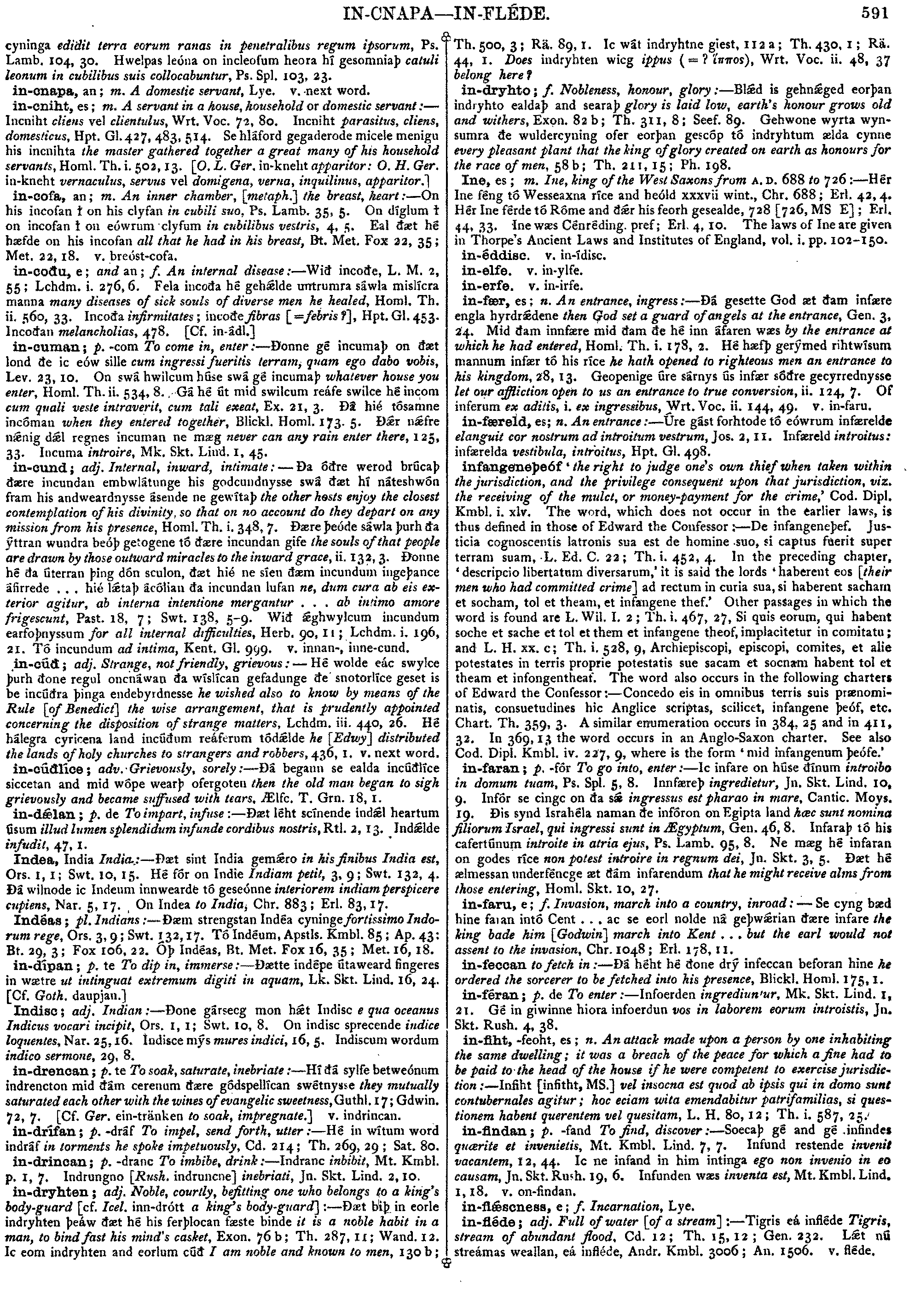
infangeneþeóf 'the right to judge one's own thief when taken within the jurisdiction, and the privilege consequent upon that jurisdiction, viz. the receiving of the mulct, or money-payment for the crime,' Cod. Dipl. Kmbl. i. xlv. The word, which does not occur in the earlier laws, is thus defined in those of Edward the Confessor :-- De infangeneþef. Justicia cognoscentis latronis sua est de homine suo, si captus fuerit super terram suam, L. Ed. C. 22 ; Th. i. 452, 4. In the preceding chapter, 'descripcio libertatum diversarum,' it is said the lords 'haberent eos [their men who had committed crime] ad rectum in curia sua, si haberent sacham et socham, tol et theam, et infangene thef.' Other passages in which the word is found are L. Wil. I. 2 ; Th. i. 467, 27, Si quis eorum, qui habent soche et sache et tol et them et infangene theof, implacitetur in comitatu ; and L. H. xx. c; Th. i. 528, 9, Archiepiscopi, episcopi, comites, et alie potestates in terris proprie potestatis sue sacam et socnam habent tol et theam et infongentheaf. The word also occurs in the following charters of Edward the Confessor :-- Concedo eis in omnibus terris suis prænominatis, consuetudines hic Anglice scriptas, scilicet, infangene þeóf, etc. Chart. Th. 359, 3. A similar enumeration occurs in 384, 25 and in 411, 32. In 369, 13 the word occurs in an Anglo-Saxon charter. See also Cod. Dipl. Kmbl. iv. 227, 9, where is the form 'mid infangenum þeófe.'
|
Source: Bosworth/Toller, page b0603, entry 2 View original page image as: [TIFF] [PNG] [View previous entry] [View next entry] |
[Comment on this entry] [View comments] |
The following entry has been hand-corrected once. |
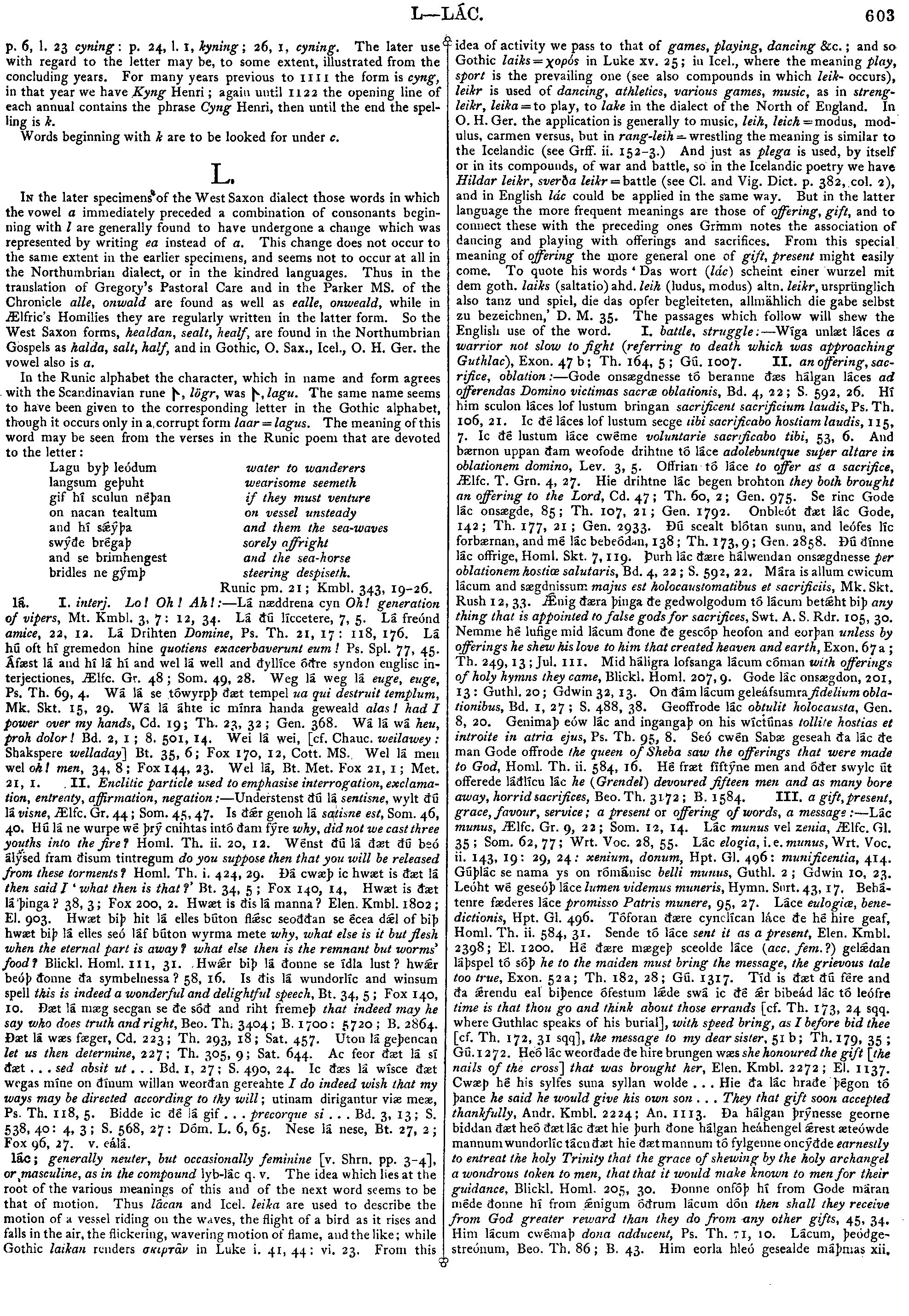
L In the later specimens of the West Saxon dialect those words in which the vowel a immediately preceded a combination of consonants beginning with 1 are generally found to have undergone a change which was represented by writing ea instead of a. This change does not occur to the same extent in the earlier specimens, and seems not to occur at all in the Northumbrian dialect, or in the kindred languages. Thus in the translation of Gregory's Pastoral Care and in the Parker MS. of the Chronicle alle, onwald are found as well as ealle, onweald, while in Ælfric's Homilies they are regularly written in the latter form. So the West Saxon forms, healdan, sealt, healf, are found in the Northumbrian Gospels as halda, salt, half, and in Gothic, O. Sax., Icel., O. H. Ger. the vowel also is a.
|
Source: Bosworth/Toller, page b0604, entry 12 View original page image as: [TIFF] [PNG] [View previous entry] [View next entry] |
[Comment on this entry] [View comments (1)] |
The following entry has been hand-corrected once. |
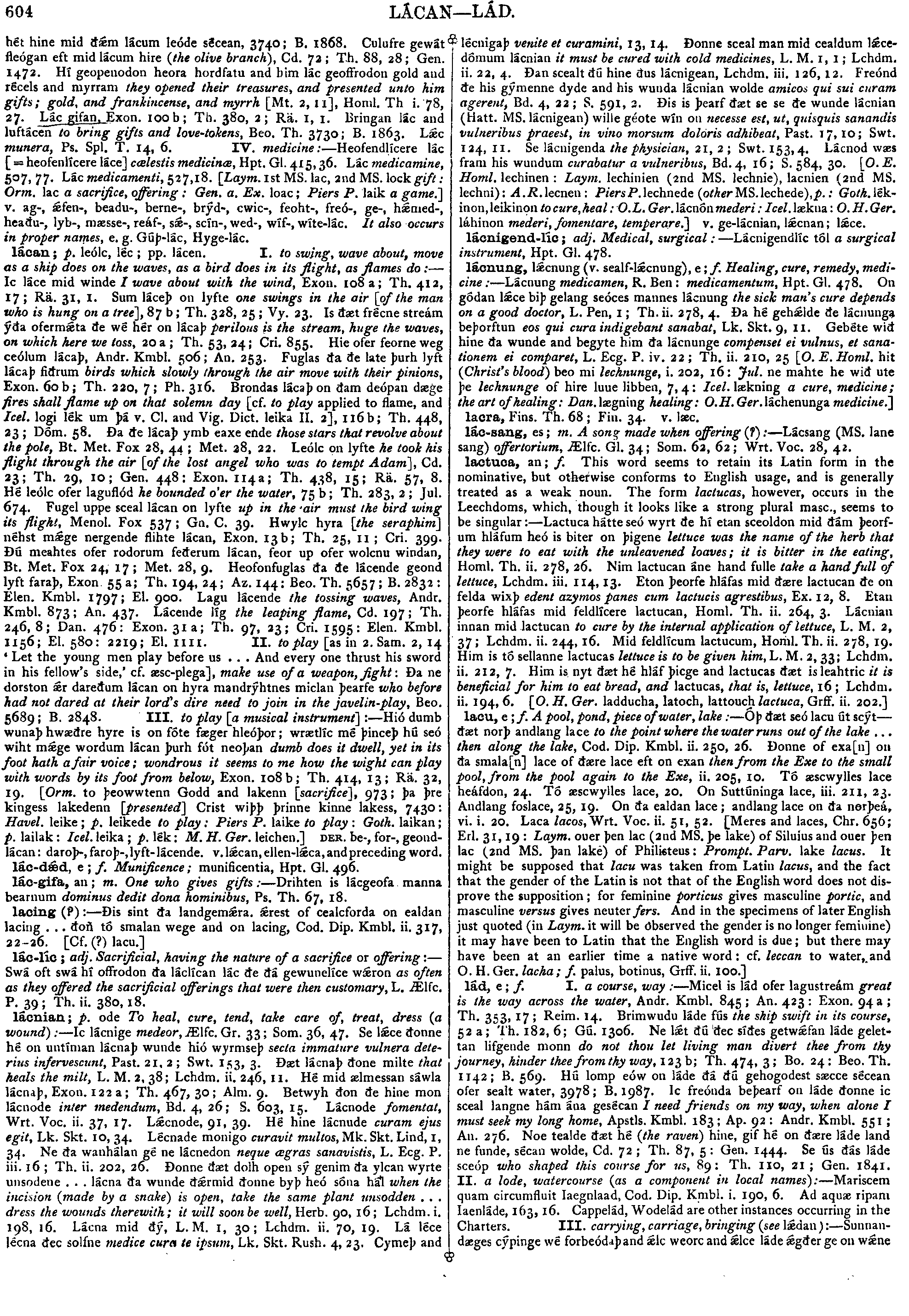
lacu, e; f. A pool, pond, piece of water, lake :-- Óþ ðæt seó lacu út scýtðæt norþ andlang lace to the point where the water runs out of the lake ... then along the lake, Cod. Dip. Kmbl. ii. 250, 26. Ðonne of exa[n] on ða smala[n] lace of ðære lace eft on exan then from the Exe to the small pool, from the pool again to the Exe, ii. 205, 10. Tó æscwylles lace heáfdon, 24. Tó æscwylles lace, 20. On Suttúninga lace, iii. 211, 23. Andlang foslace, 25, 19. On ða ealdan lace; andlang lace on ða norþeá, vi. i. 20. Laca lacos, Wrt. Voc. ii. 51, 52. [Meres and laces, Chr. 656; Erl. 31, 19: Laym. ouer þen lac (and MS. þe lake) of Siluius and ouer þen lac (2nd MS. þan lake) of Philisteus: Prompt. Parv. lake locus. It might be supposed that lacu was taken from Latin lacus, and the fact that the gender of the Latin is not that of the English word does not disprove the supposition; for feminine porticus gives masculine portic, and masculine versus gives neuter fers. And in the specimens of later English just quoted (in Laym. it will be observed the gender is no longer feminine) it may have been to Latin that the English word is due; but there may have been at an earlier time a native word: cf. leccan to water, and O. H. Ger. lacha; f. palus, botinus, Grff. ii. 100.]
| Result Page: |  |
Previous | 1 2 3 4 5 6 7 8 9 10 11 | Next |  |
Germanic Lexicon Project (main page)
This search system was written by
Sean Crist
Please consider
volunteering
to correct the data in these online dictionaries.
No rights reserved. Feel free to use these data in any way you please.