|
|

Search for eall again, using less strict matching (1310 results)
|
Source: Bosworth/Toller, page b0027, entry 2 View original page image as: [TIFF] [PNG] [View previous entry] [View next entry] |
[Comment on this entry] [View comments] |
The following entry has been hand-corrected once. |
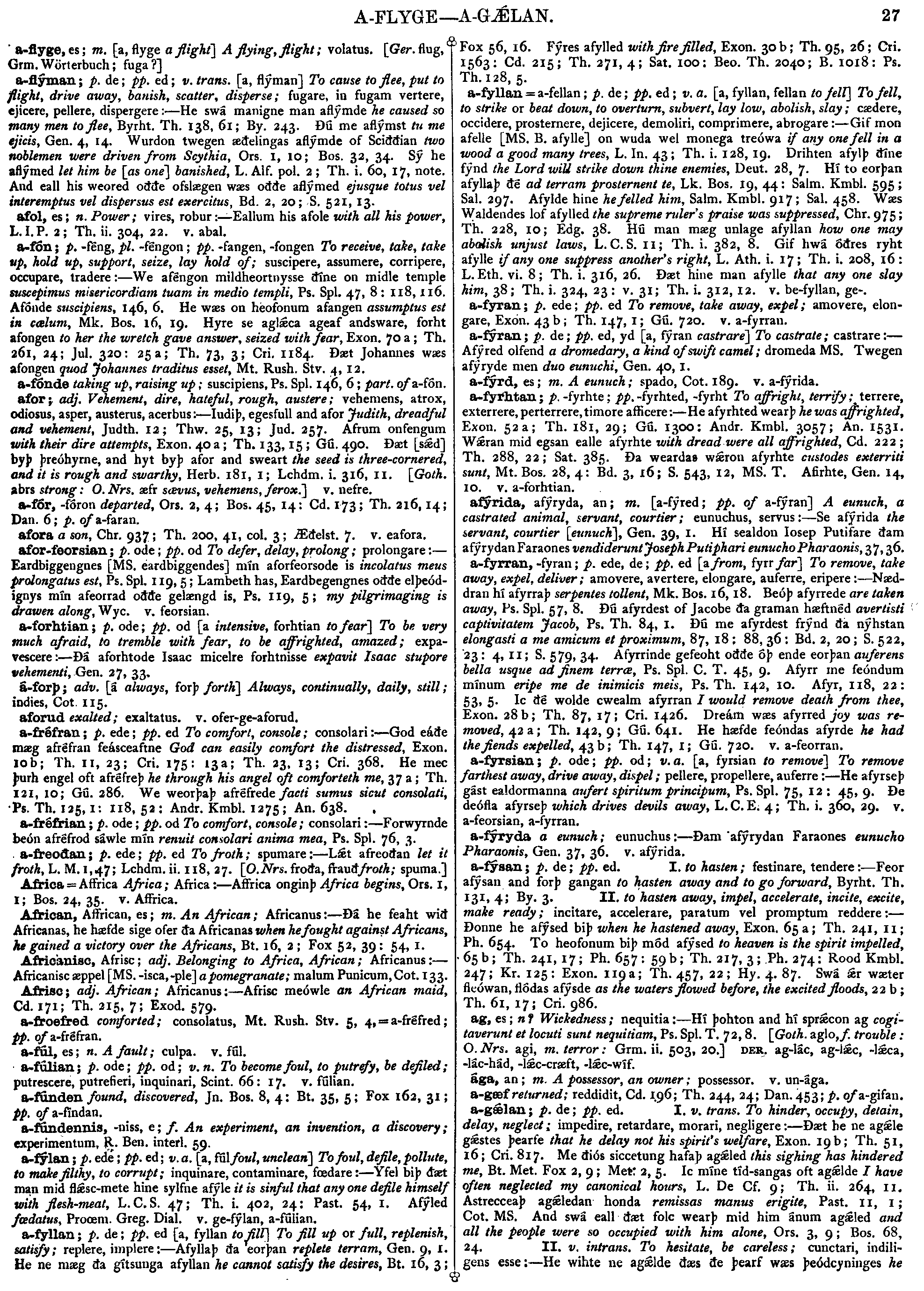
a-flýman; p. de; pp. ed; v. trans, [a, flýman] To cause to flee, put to flight, drive away, banish, scatter, disperse; fugare, in fugam vertere, ejicere, pellere, dispergere :-- He swá manigne man aflýmde he caused so many men to flee. Byrht. Th. 138, 61; By. 243. Ðú me aflýmst tu me ejicis, Gen. 4, 14. Wurdon twegen æðelingas aflýmde of Sciððian two noblemen were driven from Scythia, Ors. 1, 10; Bos. 32, 34. Sý he aflýmed let him be [as one] banished, L. Alf. pol. 2 ; Th. i. 60, 17, note. And eall his weored oððe ofslægen wæs oððe aflýmed ejusque totus vel interemptus vel dispersus est exercitus, Bd. 2, 20; S. 521, 13.
|
Source: Bosworth/Toller, page b0027, entry 40 View original page image as: [TIFF] [PNG] [View previous entry] [View next entry] |
[Comment on this entry] [View comments] |
The following entry has been hand-corrected once. |
a-g lan;
p.
de;
pp.
ed.
I.
v.
trans.
To
hinder,
occupy,
detain,
delay,
neglect;
impedire,
retardare,
morari,
negligere
:--
Ðæt
he
ne
agle
gstes
þearfe
that
he
delay
not
his
spirit's
welfare,
Exon.
19b;
Th.
51,
16;
Cri.
817.
Me
ðiós
siccetung
hafaþ
agled
this
sighing
has
hindered
me.
Bt.
Met.
Fox
2,
9;
Met:
2,
5.
Ic
míne
tíd-sangas
oft
aglde
I
have
often
neglected
my
canonical
hours,
L.
De
Cf.
9;
Th.
ii.
264,
n.
Astrecceaþ
agledan
honda
remissas
manus
erigite,
Past,
11,
1;
Cot.
MS.
And
swá
eall
ðæt
folc
wearþ
mid
him
ánum
agled
and
all
the
people
were
so
occupied
with
him
alone.
Ors.
3,
9;
Bos.
68,
24.
II.
v.
intrans.
To
hesitate,
be
careless;
cunctari,
indili-gens
esse
:--
He
wihte
ne
aglde
ðæs
ðe
þearf
wæs
þeódcyninges
he
lan;
p.
de;
pp.
ed.
I.
v.
trans.
To
hinder,
occupy,
detain,
delay,
neglect;
impedire,
retardare,
morari,
negligere
:--
Ðæt
he
ne
agle
gstes
þearfe
that
he
delay
not
his
spirit's
welfare,
Exon.
19b;
Th.
51,
16;
Cri.
817.
Me
ðiós
siccetung
hafaþ
agled
this
sighing
has
hindered
me.
Bt.
Met.
Fox
2,
9;
Met:
2,
5.
Ic
míne
tíd-sangas
oft
aglde
I
have
often
neglected
my
canonical
hours,
L.
De
Cf.
9;
Th.
ii.
264,
n.
Astrecceaþ
agledan
honda
remissas
manus
erigite,
Past,
11,
1;
Cot.
MS.
And
swá
eall
ðæt
folc
wearþ
mid
him
ánum
agled
and
all
the
people
were
so
occupied
with
him
alone.
Ors.
3,
9;
Bos.
68,
24.
II.
v.
intrans.
To
hesitate,
be
careless;
cunctari,
indili-gens
esse
:--
He
wihte
ne
aglde
ðæs
ðe
þearf
wæs
þeódcyninges
he
|
Source: Bosworth/Toller, page b0028, entry 5 View original page image as: [TIFF] [PNG] [View previous entry] [View next entry] |
[Comment on this entry] [View comments] |
The following entry has been hand-corrected once. |
a-gþ;
happens
:--
Hit
agþ
eall
swá
it
happens
so
as
[also],
Deut.
13,
2.
v.
agán,
gán,
hit
gþ.
|
Source: Bosworth/Toller, page b0028, entry 10 View original page image as: [TIFF] [PNG] [View previous entry] [View next entry] |
[Comment on this entry] [View comments (2)] |
The following entry has been hand-corrected once. |
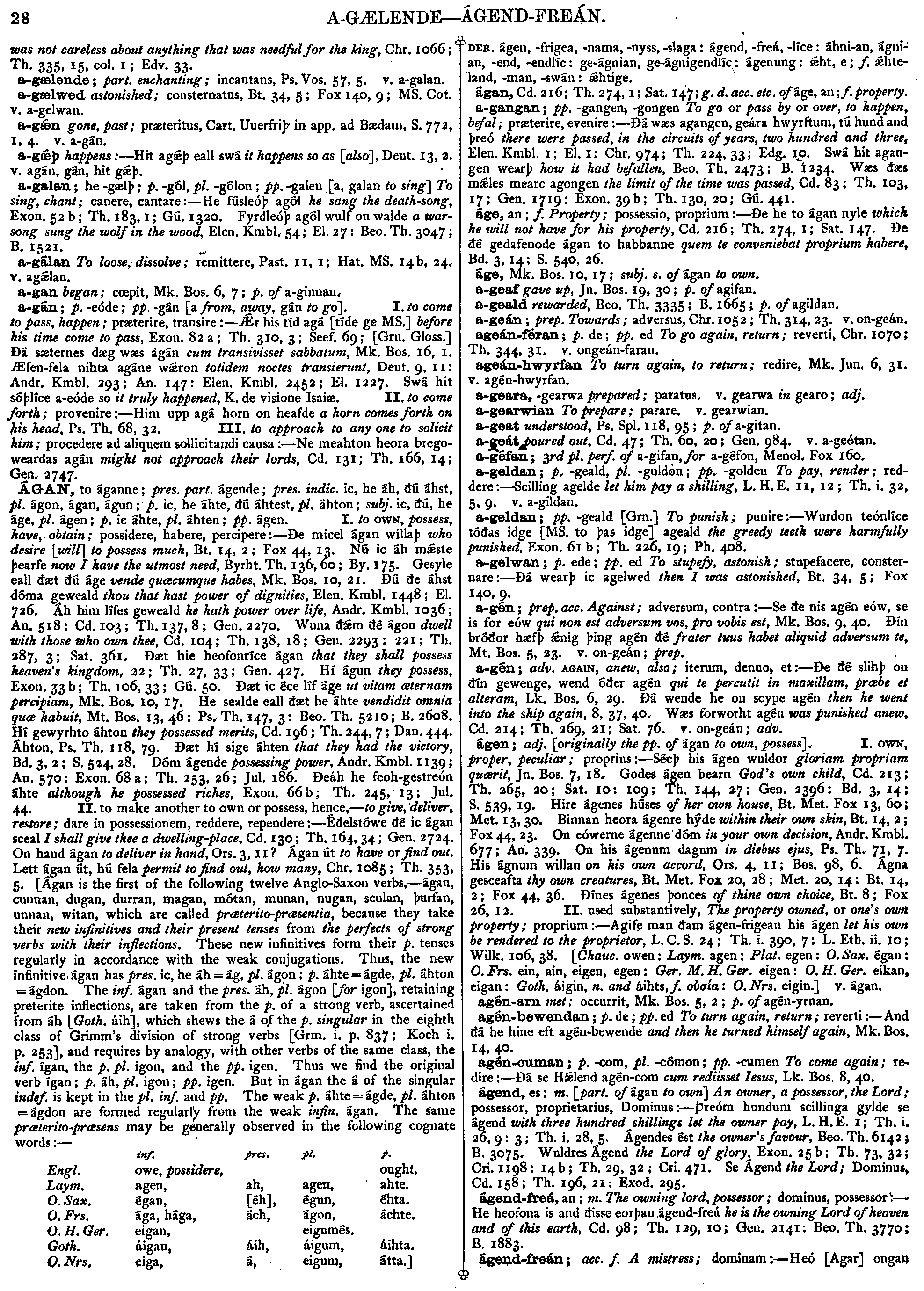
AGAN,
to
áganne;
pres.
part,
ágende;
pres.
indic,
ic,
he
áh,
ðú
áhst,
pl.
ágon,
ágan,
águn;
p.
ic,
he
áhte,
ðú
ahtest,
pl.
áhton;
subj.
ic,
ðú,
he
áge,
pl.
ágen;
p.
ic
áhte,
pl.
áhten;
pp.
ágen.
I.
to
OWN,
possess,
have,
obtain;
possidere,
habere,
percipere
:--
Ðe
micel
ágan
willaþ
who
desire
[will]
to
possess
much,
Bt.
14,
2;
Fox
44,
13.
Nú
ic
áh
mste
þearfe
Now
I
have
the
utmost
need,
Byrht.
Th.
136,
60;
By.
175.
Gesyle
eall
ðæt
ðú
age
vende
quæcumque
habes,
Mk.
Bos.
10,
21.
Ðú
ðe
áhst
dóma
geweald
thou
that
hast
power
of
dignities,
Elen.
Kmbl.
1448;
El.
726.
Áh
him
lífes
geweald
he
hath
power
over
life,
Andr.
Kmbl.
1036;
An.
518
:
Cd.
103;
Th.
137,
8
;
Gen.
2270.
Wuna
ðm
ðé
ágon
dwell
with
those
who
own
thee,
Cd.
104;
Th.
138,
18;
Gen.
2293
:
221;
Th.
287,
3;
Sat.
361.
Ðæt
hie
heofonríce
ágan
that
they
shall
possess
heaven's
kingdom,
22;
Th.
27,
33;
Gen.
427.
Hí
águn
they
possess,
Exon.
33
b;
Th.
106,
33;
Gú.
50.
Ðæt
ic
éce
líf
áge
ut
vitam
æternam
percipiam,
Mk.
Bos.
10,
17.
He
sealde
eall
ðæt
he
áhte
vendidit
omnia
quæ
habuit,
Mt.
Bos.
13,
46:
Ps,
Th.
147,
3:
Beo.
Th.
5210;
B.
2608.
Hi
gewyrhto
áhton
They
possessed
merits,
Cd.
196;
Th.
244,
7;
Dan.
444.
Áhton,
Ps.
Th.
118,
79.
Ðæt
hí
sige
áhten
that
they
had
the
victory,
Bd.
3,
2
;
S.
524,
28.
Dóm
ágende
possessing
power.
Andr.
Kmbl.
1139;
An.
570:
Exon.
68
a;
Th.
253,
26;
Jul.
186.
Ðeáh
he
feoh-gestreón
áhte
although
he
possessed
riches,
Exon.
66b;
Th.
245,
13;
Jul.
44.
II.
to
make
another
to
own
or
possess,
hence,
--
to
give,
deliver,
restore;
dare
in
possessionem,
reddere,
rependere
:--
Éðelstówe
ðé
ic
ágan
sceal
I
shall
give
thee
a
dwelling-place,
Cd.
130;
Th.
164,
34;
Gen.
2724.
On
hand
ágan
to
deliver
in
hand,
Ors.
3,
11?
Ágan
út
to
have
or
find
out.
Lett
ágan
ut,
hú
fela
permit
to
find
out,
how
many,
Chr.
1085;
Th.
353,
5.
Ágan
ERROR
is
the
first
of
the
following
twelve
Anglo-Saxon
verbs,
--
ágan,
cunnan,
dugan,
durran,
magan,
mótan,
munan,
nugan,
sculan,
þurfan,
unnan,
witan,
which
are
called
præterito-præsentia,
because
they
take
their
new
infinitives
and
their
present
tenses
from
the
perfects
of
strong
verbs
with
their
inflections.
These
new
infinitives
form
their
p.
tenses
regularly
in
accordance
with
the
weak
conjugations.
Thus,
the
new
infinitive.
ágan
has
pres.
ic,
he
áh
=
ág,
pl.
ágon;
p.
áhte
=
ágde,
pl.
áhton
=
ágdon.
The
inf.
ágan
and
the
pres.
áh,
pl.
ágon
[for
igon],
retaining
preterite
inflections,
are
taken
from
the
p.
of
a
strong
verb,
ascertained
from
áh
[Goth,
áih],
which
shews
the
á
of
the
p.
singular
in
the
eighth
class
of
Grimm's
division
of
strong
verbs
[Grm.
i.
p.
837;
Koch
i.
p.
253],
and
requires
by
analogy,
with
other
verbs
of
the
same
class,
the
inf.
ígan,
the
p.
pl.
igon,
and
the
pp.
igen.
Thus
we
find
the
original
verb
ígan;
p.
áh,
pl.
igon;
pp.
igen.
But
in
ágan
the
á
of
the
singular
indef.
is
kept
in
the
pl.
inf.
and
pp.
The
weak
p.
áhte
=
ágde,
pl.
áhton=ágdon
are
formed
regularly
from
the
weak
infin.
ágan.
The
same
præterito-præsens
may
be
generally
observed
in
the
following
cognate
words
:--
inf.
pres.
pl.
p.
Engl.
owe,
possidere,
ought.
Laym
agen,ah,agen,ahte.
O.
Sax.
égan,[éh],égunéhta
O.
Frs.
ága,
hága,ách,ágonáchte.
O.
H.
Ger.
eigan,eigumés.
Goth.
áigan,áih,áigum,áihta.
O.
Nrs.
eiga,á,eigum,átta.
ERR
???
|
Source: Bosworth/Toller, page b0031, entry 9 View original page image as: [TIFF] [PNG] [View previous entry] [View next entry] |
[Comment on this entry] [View comments] |
The following entry has been hand-corrected once. |
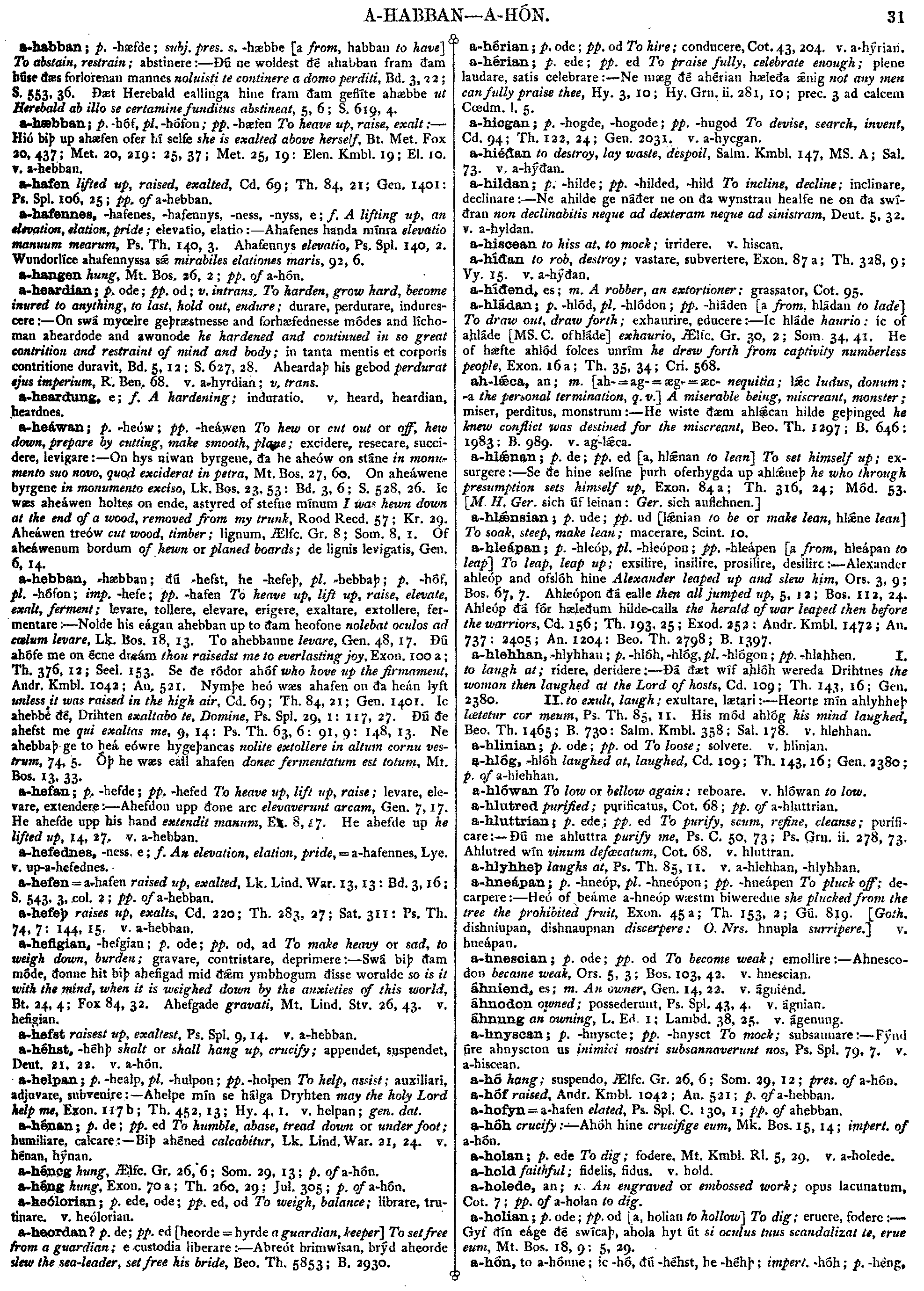
a-hebban, -hæbban; ðú -hefst, he -hefeþ, pl. -hebbaþ; p. -hóf, pl. -hófon; imp. -hefe; pp. -hafen To heave up, lift up, raise, elevate, exalt, ferment; levare, tollere, elevare, erigere, exaltare, extollere, fer-mentare :-- Nolde his eágan ahebban up to ðam heofone nolebat oculos ad cælum levare, Lk. Bos. 18, 13. To ahebbanne levare, Gen. 48, 17. Ðú ahófe me on écne dreám thou raisedst me to everlasting joy, Exon. 100 a; Th. 376, 12; Seel. 153. Se ðe ródor ahóf who hove up the firmament, Andr. Kmbl. 1042; Au. 521. Nymþe heó wæs ahafen on ða heán lyft unless it was raised in the high air, Cd. 69; Th. 84, 21; Gen. 1401. Ic ahebbé ðé, Drihten exaltabo te, Domine, Ps. Spl. 29, 1: 117, 27. Ðú ðe ahefst me qui exaltas me, 9, 14: Ps. Th. 63, 6: 91, 9: 148, 13. Ne ahebbaþ ge to heá eówre hygeþancas nolite extollere in altum cornu vestrum, 74, 5. Óþ he wæs eall ahafen donec fermentatum est totum, Mt. Bos. 13, 33.
|
Source: Bosworth/Toller, page b0032, entry 19 View original page image as: [TIFF] [PNG] [View previous entry] [View next entry] |
[Comment on this entry] [View comments] |
The following entry has been hand-corrected once. |
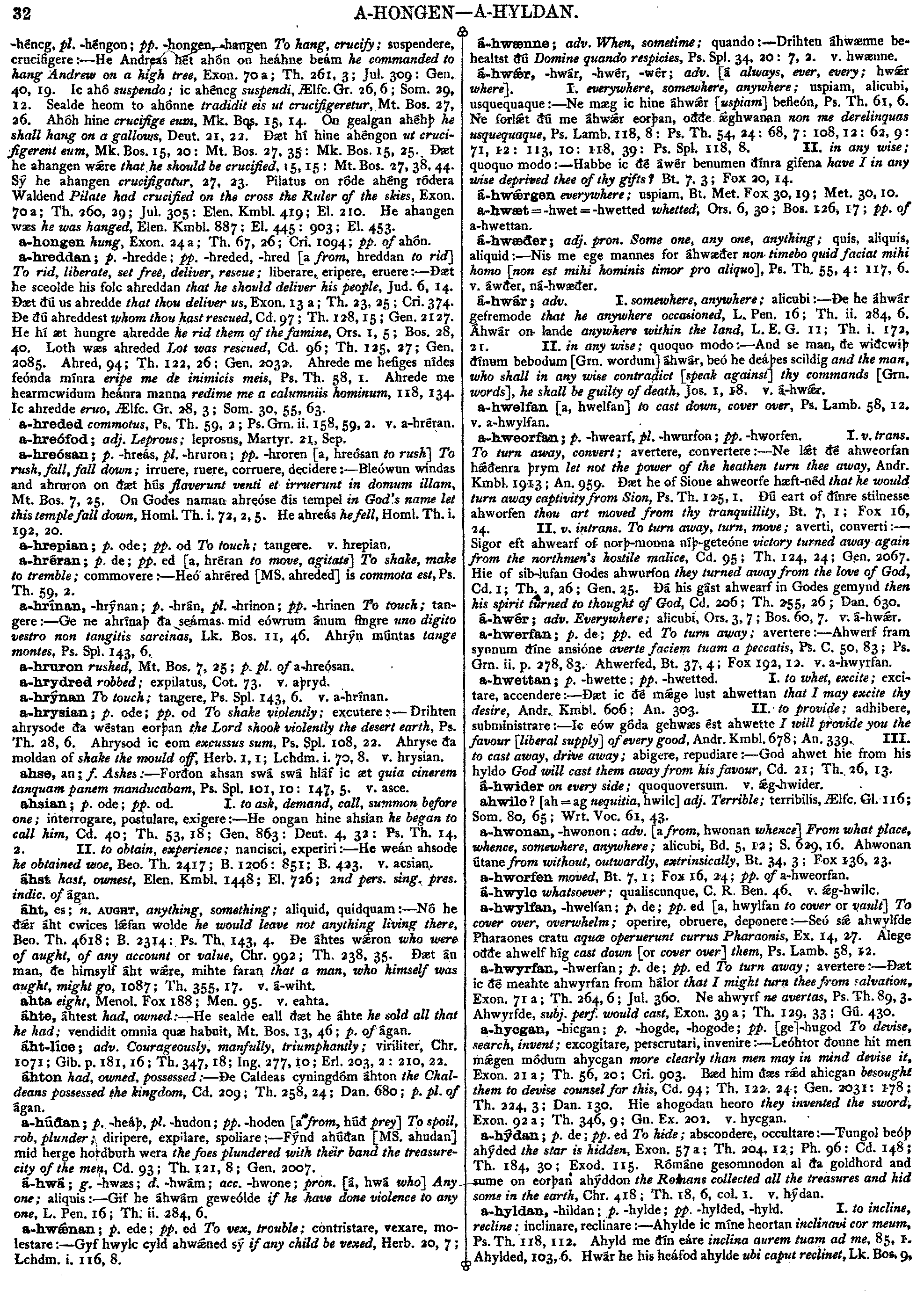
áhte, áhtest had, owned :-- He sealde eall ðæt he áhte he sold all that he had; vendidit ornnia quæ habuit, Mt. Bos. 13, 46; p. of ágan.
|
Source: Bosworth/Toller, page b0034, entry 39 View original page image as: [TIFF] [PNG] [View previous entry] [View next entry] |
[Comment on this entry] [View comments (1)] |
The following entry has been hand-corrected once. |
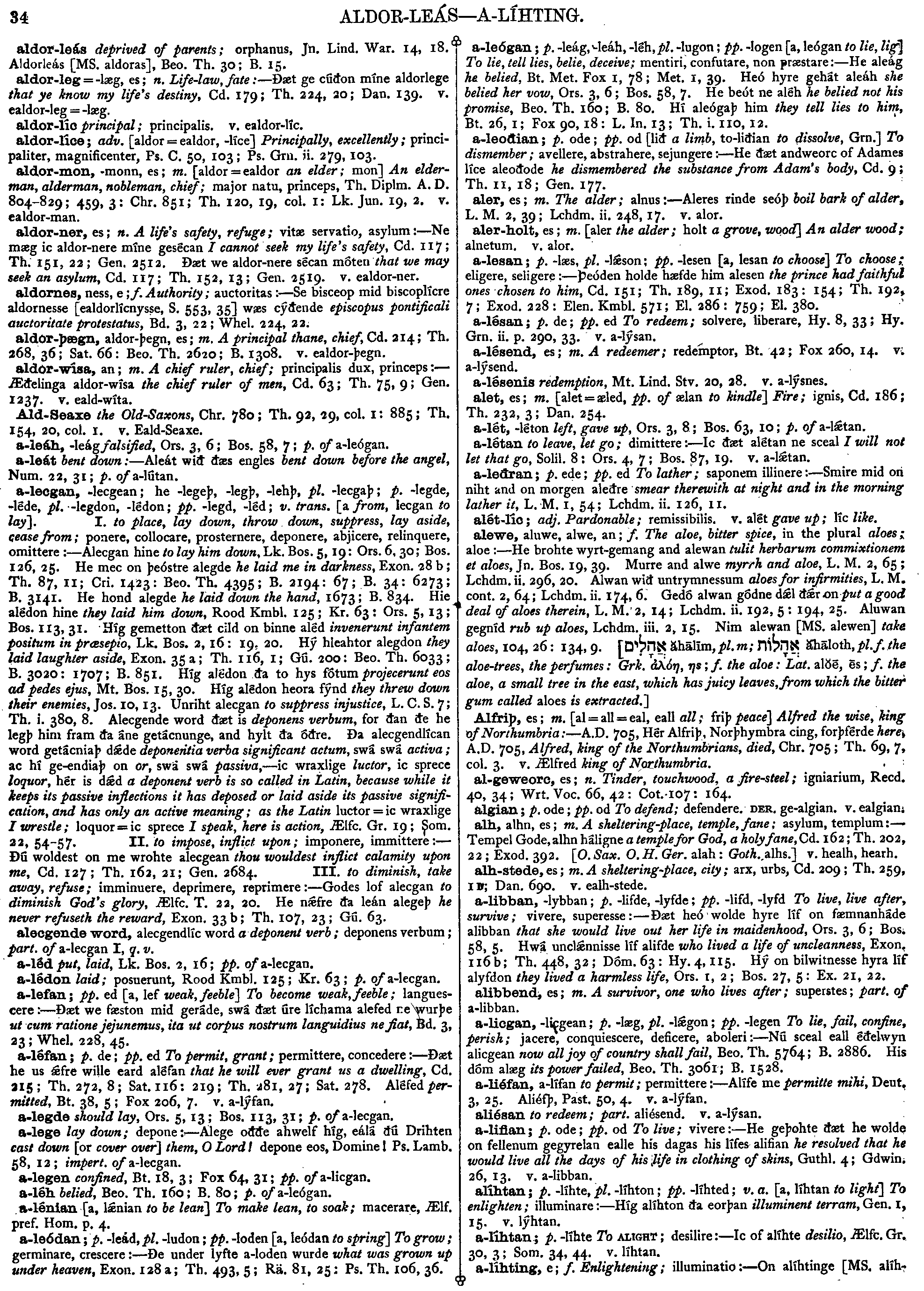
AlfriÞ, es; m. [al = all = eal, eall all; friþ peace] Alfred the wise, king of Northumbria :-- A. D. 705, Hér Alfriþ, Norþhymbra cing, forþférde here, A. D. 705, Alfred, king of the Northumbrians, died, Chr. 705; Th. 69, 7, col. 3. v. Ælfred king of Northumbria.
|
Source: Bosworth/Toller, page b0034, entry 46 View original page image as: [TIFF] [PNG] [View previous entry] [View next entry] |
[Comment on this entry] [View comments] |
The following entry has been hand-corrected once. |
a-licgan,
-licgean;
p.
-læg,
pl.
-lgon;
pp.
-legen
To
lie,
fail,
confine,
perish;
jacere,
conquiescere,
deficere,
aboleri
:--
Nú
sceal
eall
éðelwyn
alicgean
now
all
joy
of
country
shall
fail,
Beo.
Th.
5764;
B.
2886.
His
dóm
alæg
its
power
failed,
Beo.
Th.
3061;
B.
1528.
|
Source: Bosworth/Toller, page b0035, entry 7 View original page image as: [TIFF] [PNG] [View previous entry] [View next entry] |
[Comment on this entry] [View comments] |
The following entry has been hand-corrected once. |
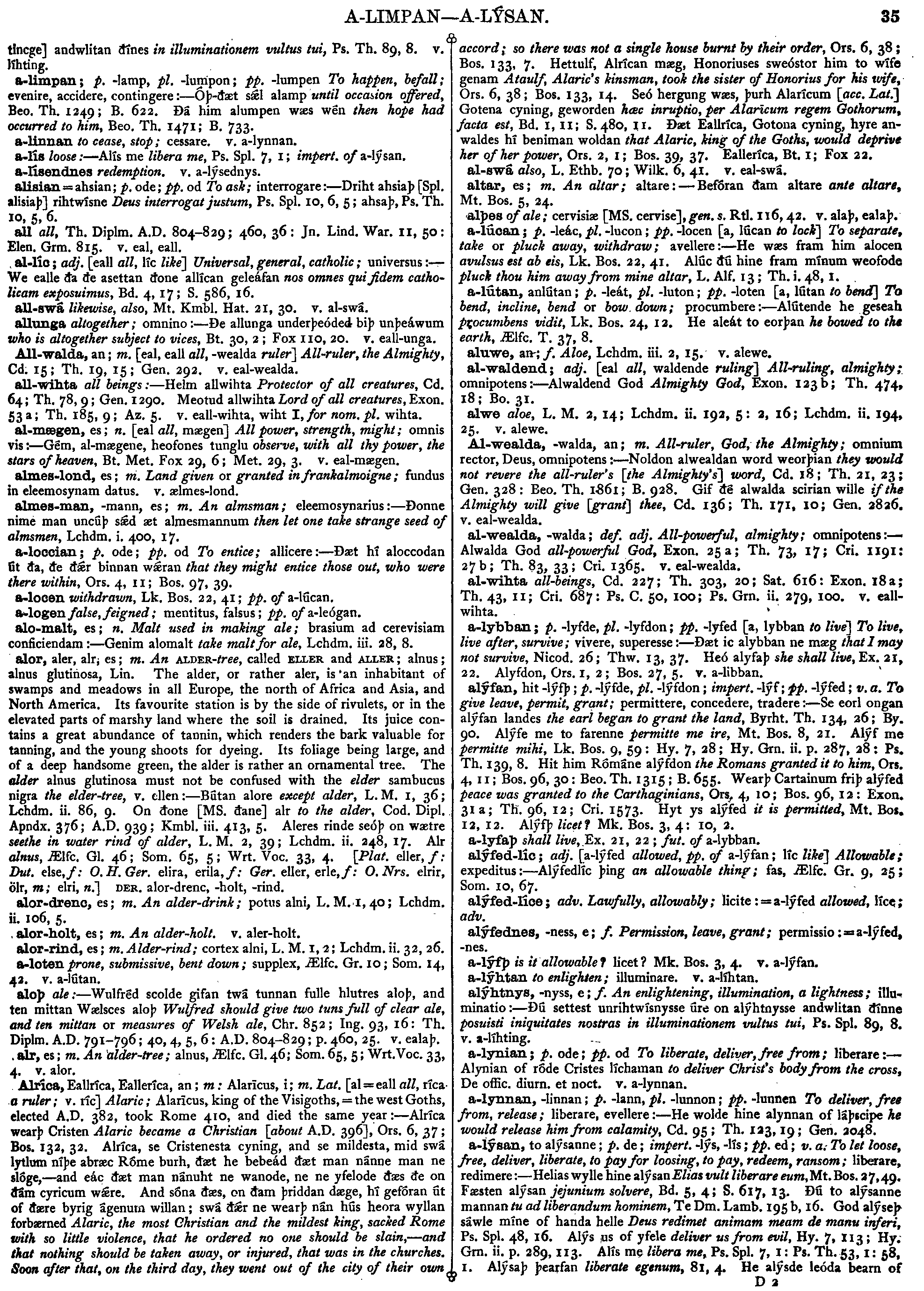
all all, Th. Diplm. A. D. 804-829; 460, 36: Jn. Lind. War. 11, 50: Elen. Grm. 815. v. eal, eall.
|
Source: Bosworth/Toller, page b0035, entry 8 View original page image as: [TIFF] [PNG] [View previous entry] [View next entry] |
[Comment on this entry] [View comments (1)] |
The following entry has been hand-corrected once. |
al-líc; aaj. [eall all, líc like] Universal, general, catholic; universus :-- we ealle ða ðe asettan ðone allícan geleáfan nos omnes qui fidem catholicam exposuimus, Bd. 4, 17; S. 586, 16.
| Result Page: |  |
Previous | 1 2 3 4 5 6 7 8 9 10 11 12 | Next |  |
Germanic Lexicon Project (main page)
This search system was written by
Sean Crist
Please consider
volunteering
to correct the data in these online dictionaries.
No rights reserved. Feel free to use these data in any way you please.