|
|

Tip: In the search results, you can click on any word or abbreviation for more information.
|
Source: Bosworth/Toller, page b0220, entry 13 View original page image as: [TIFF] [PNG] [View previous entry] [View next entry] |
[Comment on this entry] [View comments (1)] |
The following entry has been hand-corrected once. |
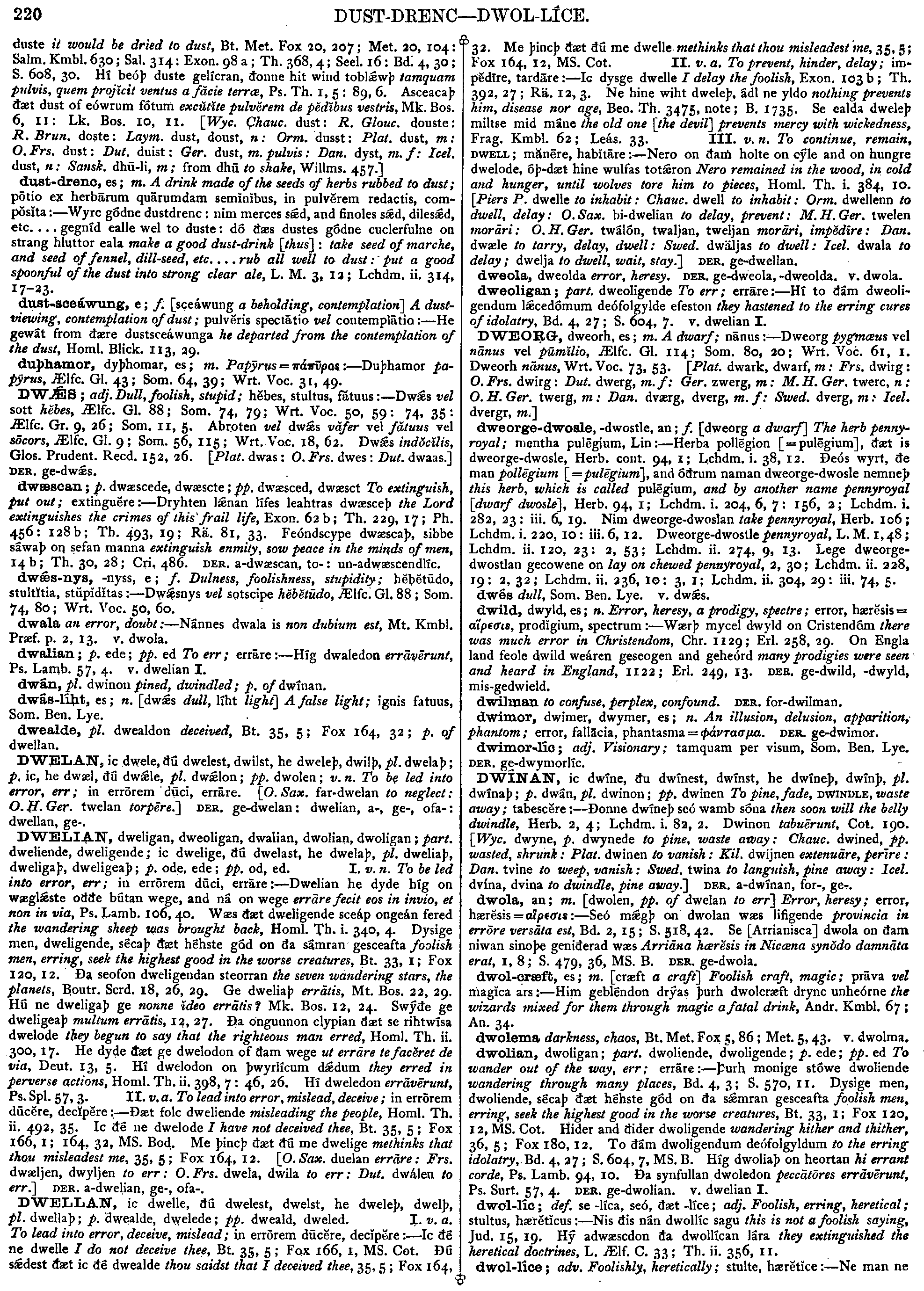
DWELLAN,
dweligan,
dweoligan,
dwalian,
dwolian,
dwoligan;
part.
dweliende,
dweligende;
ic
dwelige,
ðú
dwelast,
he
dwelaþ,
pl.
dweliaþ,
dweligaþ,
dweligeaþ;
p.
ode,
ede;
pp.
od,
ed.
I.
v.
n.
To
be
led
into
error,
err;
in
err rem
d
rem
d ci,
err
ci,
err re
:--
Dwelian
he
dyde
híg
on
wægl
re
:--
Dwelian
he
dyde
híg
on
wægl ste
oððe
bútan
wege,
and
ná
on
wege
errre
fecit
eos
in
invio,
et
non
in
via,
Ps.
Lamb.
106,
40.
Wæs
ðæt
dweligende
sceáp
ongeán
fered
the
wandering
sheep
was
brought
back,
Homl.
Th.
i.
340,
4.
Dysige
men,
dweligende,
sécaþ
ðæt
héhste
gód
on
ða
sámran
gesceafta
foolish
men,
erring,
seek
the
highest
good
in
the
worse
creatures,
Bt.
33,
1;
Fox
120,
12.
Ða
seofon
dweligendan
steorran
the
seven
wandering
stars,
the
planets,
Boutr.
Scrd.
18,
26,
29.
Ge
dweliaþ
errtis,
Mt.
Bos.
22,
29.
Hú
ne
dweligaþ
ge
nonne
ste
oððe
bútan
wege,
and
ná
on
wege
errre
fecit
eos
in
invio,
et
non
in
via,
Ps.
Lamb.
106,
40.
Wæs
ðæt
dweligende
sceáp
ongeán
fered
the
wandering
sheep
was
brought
back,
Homl.
Th.
i.
340,
4.
Dysige
men,
dweligende,
sécaþ
ðæt
héhste
gód
on
ða
sámran
gesceafta
foolish
men,
erring,
seek
the
highest
good
in
the
worse
creatures,
Bt.
33,
1;
Fox
120,
12.
Ða
seofon
dweligendan
steorran
the
seven
wandering
stars,
the
planets,
Boutr.
Scrd.
18,
26,
29.
Ge
dweliaþ
errtis,
Mt.
Bos.
22,
29.
Hú
ne
dweligaþ
ge
nonne
 deo
errtis?
Mk.
Bos.
12,
24.
Swýðe
ge
dweligeaþ
multum
errtis,
14,
27.
Ða
ongunnon
clypian
ðæt
se
rihtwísa
dwelode
they
begun
to
say
that
the
righteous
man
erred,
Homl.
Th.
ii.
300,
17.
He
dyde
ðæt
ge
dwelodon
of
ðam
wege
ut
errre
te
fac
deo
errtis?
Mk.
Bos.
12,
24.
Swýðe
ge
dweligeaþ
multum
errtis,
14,
27.
Ða
ongunnon
clypian
ðæt
se
rihtwísa
dwelode
they
begun
to
say
that
the
righteous
man
erred,
Homl.
Th.
ii.
300,
17.
He
dyde
ðæt
ge
dwelodon
of
ðam
wege
ut
errre
te
fac ret
de
via,
Deut.
13,
5.
Hí
dwelodon
on
þwyrlícum
ddum
they
erred
in
perverse
actions,
Homl.
Th.
ii.
398,
7:
46,
26.
Hí
dweledon
errv
ret
de
via,
Deut.
13,
5.
Hí
dwelodon
on
þwyrlícum
ddum
they
erred
in
perverse
actions,
Homl.
Th.
ii.
398,
7:
46,
26.
Hí
dweledon
errv runt,
Ps.
Spl.
57,
3.
II.
v.
a.
To
lead
into
error,
mislead,
deceive;
in
errrem
dcre,
decpre
:--
Ðæt
folc
dweliende
misleading
the
people,
Homl.
Th.
ii.
492,
35.
Ic
ðé
ne
dwelode
I
have
not
deceived
thee,
Bt.
35,
5;
Fox
166,
1;
164,
32,
MS.
Bod.
Me
þincþ
ðæt
ðú
me
dwelige
methinks
that
thou
misleadest
me,
35,
5;
Fox
164,
12.
[O.
Sax.
duelan
errre:
Frs.
dwæljen,
dwyljen
to
err:
O.
Frs.
dwela,
dwila
to
err:
Dut.
dwálen
to
err.]
DER.
a-dwelian,
ge-,
ofa-.
runt,
Ps.
Spl.
57,
3.
II.
v.
a.
To
lead
into
error,
mislead,
deceive;
in
errrem
dcre,
decpre
:--
Ðæt
folc
dweliende
misleading
the
people,
Homl.
Th.
ii.
492,
35.
Ic
ðé
ne
dwelode
I
have
not
deceived
thee,
Bt.
35,
5;
Fox
166,
1;
164,
32,
MS.
Bod.
Me
þincþ
ðæt
ðú
me
dwelige
methinks
that
thou
misleadest
me,
35,
5;
Fox
164,
12.
[O.
Sax.
duelan
errre:
Frs.
dwæljen,
dwyljen
to
err:
O.
Frs.
dwela,
dwila
to
err:
Dut.
dwálen
to
err.]
DER.
a-dwelian,
ge-,
ofa-.
|
Source: Bosworth/Toller, page b0811, entry 19 View original page image as: [TIFF] [PNG] [View previous entry] [View next entry] |
[Comment on this entry] [View comments] |
The following entry has been hand-corrected once. |
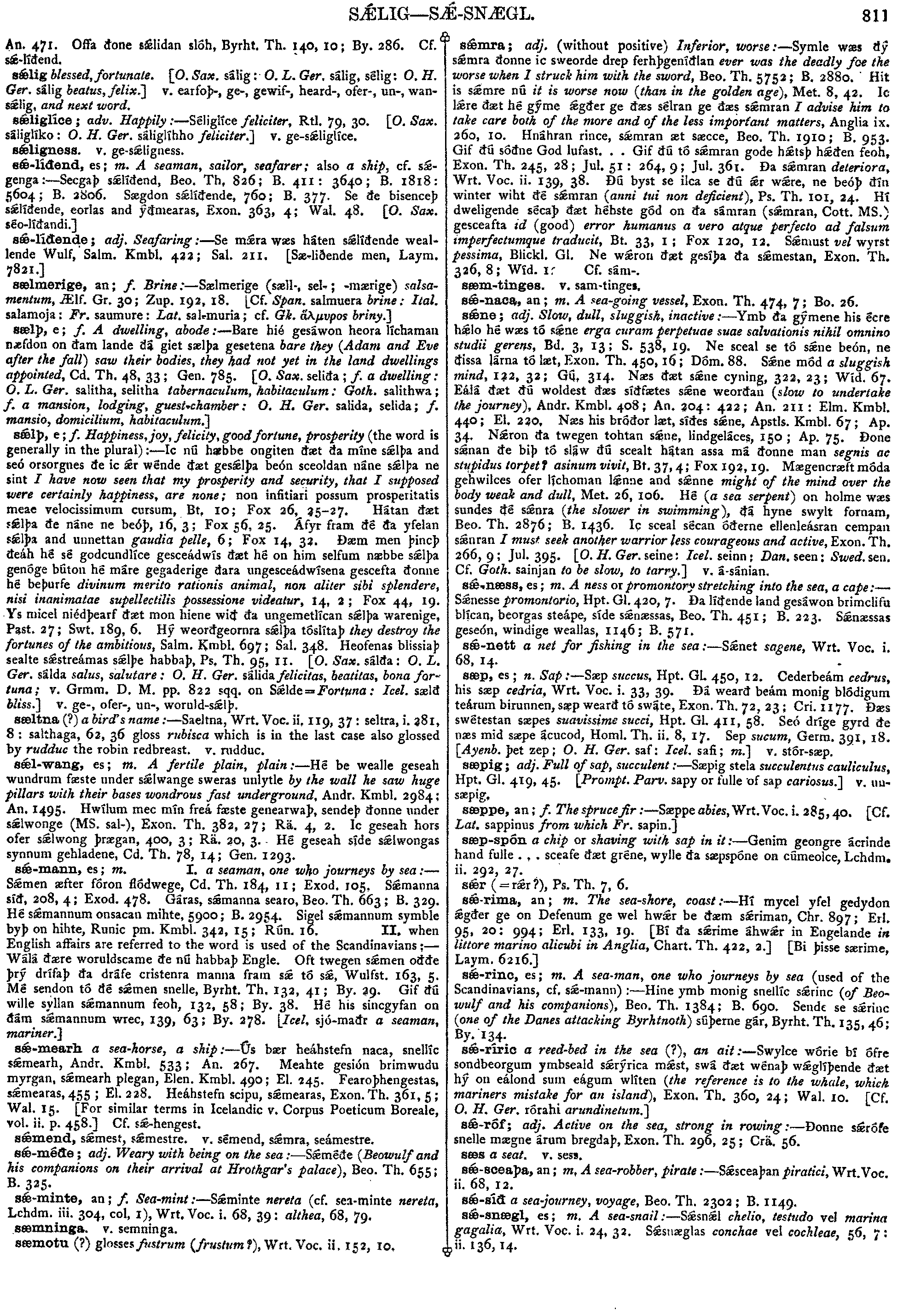
smra;
adj.
(without
positive)
Inferior,
worse
:--
Symle
wæs
ðý
smra
ðonne
ic
sweorde
drep
ferhþgeníðlan
ever
was
the
deadly
foe
the
worse
when
I
struck
him
with
the
sword,
Beo.
Th.
5752;
B.
2880.
Hit
is
smre
nú
it
is
worse
now
(than
in
the
golden
age).
Met.
8,
42.
Ic
lre
ðæt
hé
gýme
ðter
ge
ðæs
sélran
ge
ðæs
smran
I
advise
him
to
take
care
both
of
the
more
and
of
the
less
important
matters,
Anglia
ix.
260,
10.
Hnáhran
rince,
smran
æt
sæcce,
Beo.
Th.
1910;
B.
953.
Gif
ðú
sóðne
God
lufast.
.
.
Gif
ðú
tó
smran
gode
htsþ
hðen
feoh.
Exon.
Th.
245,
28;
Jul.
51
:
264,
9;
Jul.
361.
Ða
smran
deteriora,
Wrt.
Voc.
ii.
139,
38.
Ðú
byst
se
ilca
se
ðú
r
ware,
ne
beóþ
ðín
winter
wiht
ðé
smran
(anni
tui
non
deficient).
Ps.
Th.
101,
24.
Hí
dweligende
sécaþ
ðæt
héhste
gód
on
ða
sámran
(smran,
Cote.
MS.
)
gesceafta
id
(good)
error
humanus
a
vero
atque
perfecto
ad
falsum
imperfectumque
traducit,
Bt.
33,
1;
Fox
120,
12.
Smust
vel
wyrst
pessima,
Blickl.
Gl.
Ne
wron
ðæt
gesíba
ða
smestan,
Exon.
Th.
326,
8;
Wíd.
1
Cf.
sám-.
|
Source: Bosworth/Toller, page b1261, entry 10 View original page image as: [TIFF] [PNG] [View previous entry] [View next entry] |
[Comment on this entry] [View comments] |
The following entry has been hand-corrected once. |
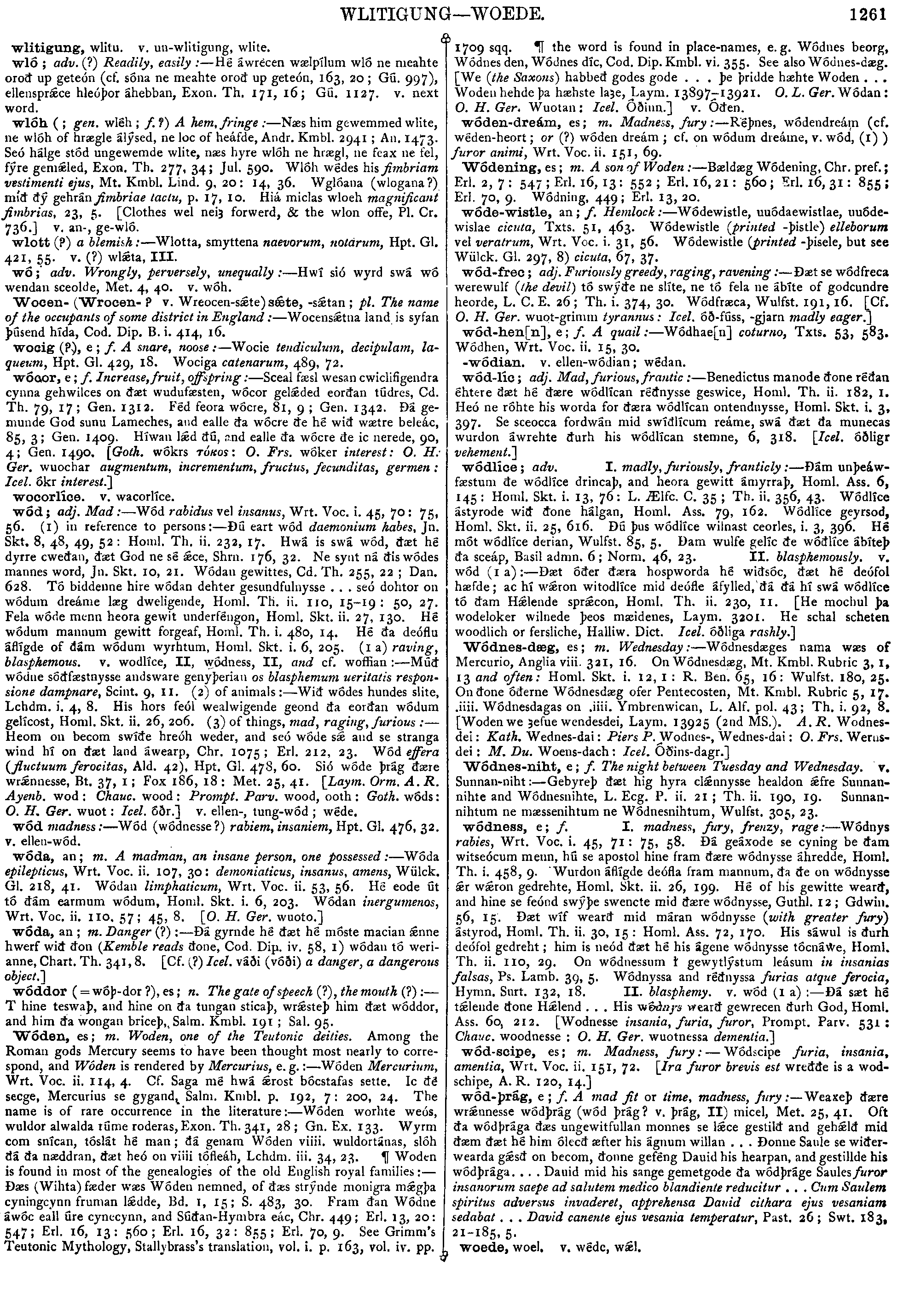
wód;
adj.
Mad:
--
Wód
rabidus
vel
insanus,
Wrt.
Voc.
i.
45,
70:
75,
56.
(I)
in
reference
to
persons
:--
Ðú
eart
wód
daemonium
habes.
Jn.
Skt.
8,
48,
49,
52
:
Homl.
Th.
ii.
232,
17.
Hwá
is
swá
wód,
ðæt
hé
dyrre
cweðan,
ðæt
God
ne
sé
ce,
Shrn.
176,
32.
Ne
syut
ná
ðiswódes
mannes
word,
Jn.
Skt.
10,
21.
Wódan
gewittes,
Cd.
Th.
255,
22
;
Dan.
628.
Tó
biddenne
hire
wódan
dehter
gesundfulnysse
.
.
.
seó
dohtor
on
wódum
dreáme
læg
dweligende,
Homl.
Th.
ii.
110,
15-19:
50,
27.
Fela
wóde
menn
heora
gewit
underféngon,
Homl.
Skt.
ii.
27,
130.
Hé
wódum
mannum
gewitt
forgeaf,
Homl.
Th.
i.
480,
14.
Hé
ða
deóflu
áfligde
of
dám
wódum
wyrhtum,
Homl.
Skt.
i.
6,
205.
(l
a)
raving,
blasphemous,
v.
wodlíce,
II,
wódness,
II,
and
cf.
woffian
:--
Múð
wódne
sóðfæstnysse
andsware
genyþerian
os
blasphemum
veritatis
responsione
dampnare,
Scint.
9,
II.
(2)
of
animals
:--
Wið
wódes
hundes
slite,
Lchdm.
i.
4,
8.
His
hors
feól
wealwigende
geond
ða
eorðan
wódum
gelícost,
Homl.
Skt.
ii.
26,
206.
(3)
of
things,
mad,
raging,
furious
:--
Heom
on
becom
swiðe
hreóh
weder,
and
seó
wóde
s
and
se
stranga
wind
hí
on
ðæt
land
áwearp,
Chr.
1075;
Erl.
212,
23.
Wóð
effera
(fluctuum
ferocitas,
Ald.
42),
Hpt.
Gl.
478,
60.
Sió
wóde
þrág
ðære
wrnnesse,
Bt.
37,
I;
Fox
186,
18
:
Met.
25,
41.
[Laym.
Orm.
A.
R.
Ayenb.
wod
:
Chauc.
wood
:
Prompt.
Parv.
wood,
coen
:
Goth.
wóds:
O.
H.
Ger.
wuce:
Icel.
óðr.]
v.
ellen-,
tung-wód
;
wéde.
|
Source: Bosworth/Toller, page d0161, entry 21 View original page image as: [TIFF] [PNG] [View previous entry] [View next entry] |
[Comment on this entry] [View comments] |
The following entry has been hand-corrected once. |
dwelian.
Add:
I.
intrans.
(1)
to
go
astray,
(a)
literal
:--
Hé
on
ðám
holte
dwelode
(wandered),
oð
þæt
hine
wulfas
tótron,
Hml.
Th.
i.
384,
10.
Hé
án
(sceáp),
þe
ðr
losode
and
dwelede,
sóhte,
R.
Ben.
51,
19.
Heó
began
faran
...
swilce
heó
dweliende
þyder
cóme
...
Heó
cwæð
mid
wóplicre
stefne:
'Dweliende,
leóf,
ic
cóm
hyder,'
Hml.
A.
196,
24-29.
Dweli(ende)
erraneam,
 errantem
(ovem),
An.
Ox.
347.
(b)
figurative
:--
Nú
ic
wæs
of
þám
rihtan
wege
mínes
ingeþances,
ac
betere
hit
bið
errantem
(ovem),
An.
Ox.
347.
(b)
figurative
:--
Nú
ic
wæs
of
þám
rihtan
wege
mínes
ingeþances,
ac
betere
hit
bið
 ic
eft
fare
út
of
þysum
porte,
ðy
ls
ic
tó
swíðe
dwelige,
Hml.
S.
23,
553.
Ðá
ðe
fyligað
þre
gýtsunge,
hí
dweliað
fram
Godes
geleáfon,
Hml.
Th.
i.
256,
18.
Ðá,
þe
lífes
weg
ldan
cunnan,
gebringan
on
rihtwege
þá,
þe
r
dweledan
(-odan,
v.
l.),
Wlfst.
75,
2.
Sé
ðe
færð
on
sóðre
lufe
ne
mæg
hé
dwelian;
heó
gewissað
and
gelt,
Hml.
Th.
i.
52,
15.
Dweliende
exorbitans
(a
recto
religionis
tramite),
An.
Ox.
3697:
4619.
(2)
of
inaccurate
conception,
to
mistake,
err
:--
Swíþe
raþe
þé
bið
cúþ
wit
ne
dwelgaþ,
Bl.
H.
189,
6.
Sume
gedwolmenn
cwdon
...
ac
hí
dwelodon
mid
þre
segene
(they
were
mistaken
in
what
they
said),
Hml.
Th.
i.
486,
7.
Ne
dwela
ðú
on
ídel
...
and
ne
wén
ðú
ná
be
þé
þú
ungewítnod
beó,
Hml.
S.
25,
157.
(2
a)
of
madness
:--
Seó
dohtor
on
wódum
dreáme
læg
dweligende,
Hml.
Th.
ii.
110,
19.
(3)
of
wrong
conduct,
to
err
:--
Þú
dwelast,
geneálc
and
geoffra
þíne
lác,
Hml.
S.
14,
33.
Mid
þám
Francum
þe
þá
swíðost
dweledon
on
deófles
biggencgum,
29,
165.
Hié
on
hðnum
þeáwum
dwelgende
wron,
Bl.
H.
201,
20.
Dryhten,
þú
gecyrst
ðá
dweliendan,
Hml.
S.
30,
68.
II.
trans.
To
lead
astray.
(1)
physical
:--
Ðá
genipu
hit
dweliað,
Sal.
K.
148,
5.
(2)
moral
:--
Hý
dwelode
deófol,
Wlfst.
11,
8:
156,
8.
Hí
ne
gelýfdan
on
riht
...
ac
mid
manegum
gedwyldum
dwelodan
(-edon,
v.
l.)
þá
Crístenan,
Hml.
S.
3,
357.
Þá
dwolmen
dwelodon
þone
cásere,
312.
Cf.
dwolian.
ic
eft
fare
út
of
þysum
porte,
ðy
ls
ic
tó
swíðe
dwelige,
Hml.
S.
23,
553.
Ðá
ðe
fyligað
þre
gýtsunge,
hí
dweliað
fram
Godes
geleáfon,
Hml.
Th.
i.
256,
18.
Ðá,
þe
lífes
weg
ldan
cunnan,
gebringan
on
rihtwege
þá,
þe
r
dweledan
(-odan,
v.
l.),
Wlfst.
75,
2.
Sé
ðe
færð
on
sóðre
lufe
ne
mæg
hé
dwelian;
heó
gewissað
and
gelt,
Hml.
Th.
i.
52,
15.
Dweliende
exorbitans
(a
recto
religionis
tramite),
An.
Ox.
3697:
4619.
(2)
of
inaccurate
conception,
to
mistake,
err
:--
Swíþe
raþe
þé
bið
cúþ
wit
ne
dwelgaþ,
Bl.
H.
189,
6.
Sume
gedwolmenn
cwdon
...
ac
hí
dwelodon
mid
þre
segene
(they
were
mistaken
in
what
they
said),
Hml.
Th.
i.
486,
7.
Ne
dwela
ðú
on
ídel
...
and
ne
wén
ðú
ná
be
þé
þú
ungewítnod
beó,
Hml.
S.
25,
157.
(2
a)
of
madness
:--
Seó
dohtor
on
wódum
dreáme
læg
dweligende,
Hml.
Th.
ii.
110,
19.
(3)
of
wrong
conduct,
to
err
:--
Þú
dwelast,
geneálc
and
geoffra
þíne
lác,
Hml.
S.
14,
33.
Mid
þám
Francum
þe
þá
swíðost
dweledon
on
deófles
biggencgum,
29,
165.
Hié
on
hðnum
þeáwum
dwelgende
wron,
Bl.
H.
201,
20.
Dryhten,
þú
gecyrst
ðá
dweliendan,
Hml.
S.
30,
68.
II.
trans.
To
lead
astray.
(1)
physical
:--
Ðá
genipu
hit
dweliað,
Sal.
K.
148,
5.
(2)
moral
:--
Hý
dwelode
deófol,
Wlfst.
11,
8:
156,
8.
Hí
ne
gelýfdan
on
riht
...
ac
mid
manegum
gedwyldum
dwelodan
(-edon,
v.
l.)
þá
Crístenan,
Hml.
S.
3,
357.
Þá
dwolmen
dwelodon
þone
cásere,
312.
Cf.
dwolian.
|
Source: Bosworth/Toller, page d0317, entry 1 View original page image as: [TIFF] [PNG] [View previous entry] [View next entry] |
[Comment on this entry] [View comments] |
The following entry has been hand-corrected once. |
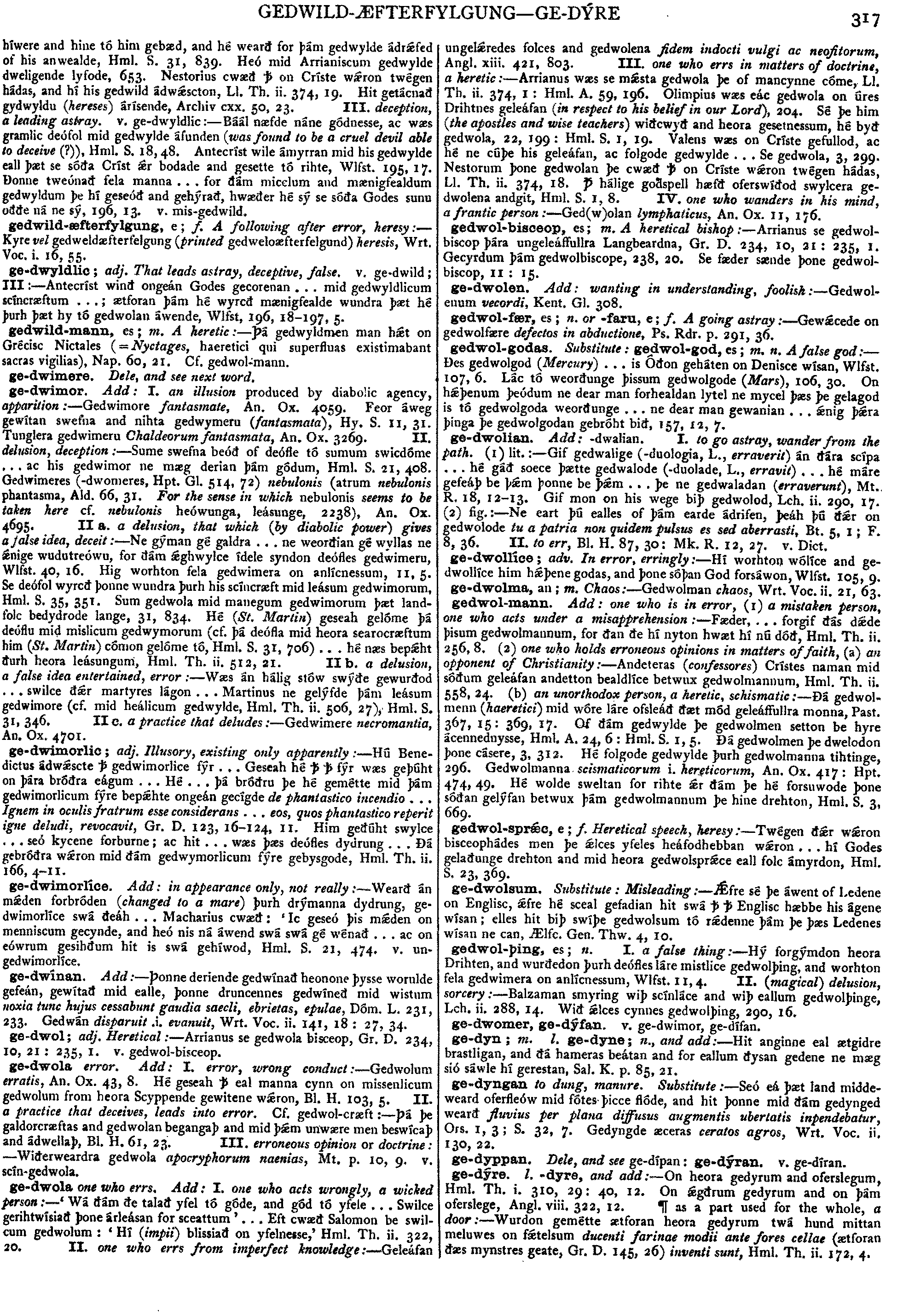
híwere
and
hine
tó
him
gebæd,
and
hé
wearð
for
þám
gedwylde
ádrfed
of
his
anwealde,
Hml.
S.
31,
839.
Heó
mid
Arrianiscum
gedwylde
dweligende
lyfode,
653.
Nestorius
cwæð
on
Críste
wron
twégen
hádas,
and
hí
his
gedwild
ádwscton,
Ll.
Th.
ii.
374,
19.
Hit
getácnað
gydwyldu
(hereses)
árísende,
Archiv
cxx.
50,
23.
III.
deception,
a
leading
astray,
v.
ge-dwyldlic
:--
Báál
næfde
náne
gódnesse,
ac
wæs
gramlic
deófol
mid
gedwylde
áfunden
(was
found
to
be
a
cruel
devil
able
to
deceive
(?)),
Hml.
S.
18,
48.
Antecríst
wile
ámyrran
mid
his
gedwylde
eall
þæt
se
sóða
Críst
r
bodade
and
gesette
tó
rihte,
Wlfst.
195,
17.
Ðonne
tweónað
fela
manna
.
.
.
for
ðám
micclum
and
mænigfealdum
gedwyldum
þe
hí
geseóð
and
gehýrað,
hwæðer
hé
sý
se
sóða
Godes
sunu
oððe
ná
ne
sý,
196,
13.
v.
mis-gedwild.
|
Source: Bosworth/Toller, page d0499, entry 15 View original page image as: [TIFF] [PNG] [View previous entry] [View next entry] |
[Comment on this entry] [View comments (1)] |
The following entry has been hand-corrected once. |
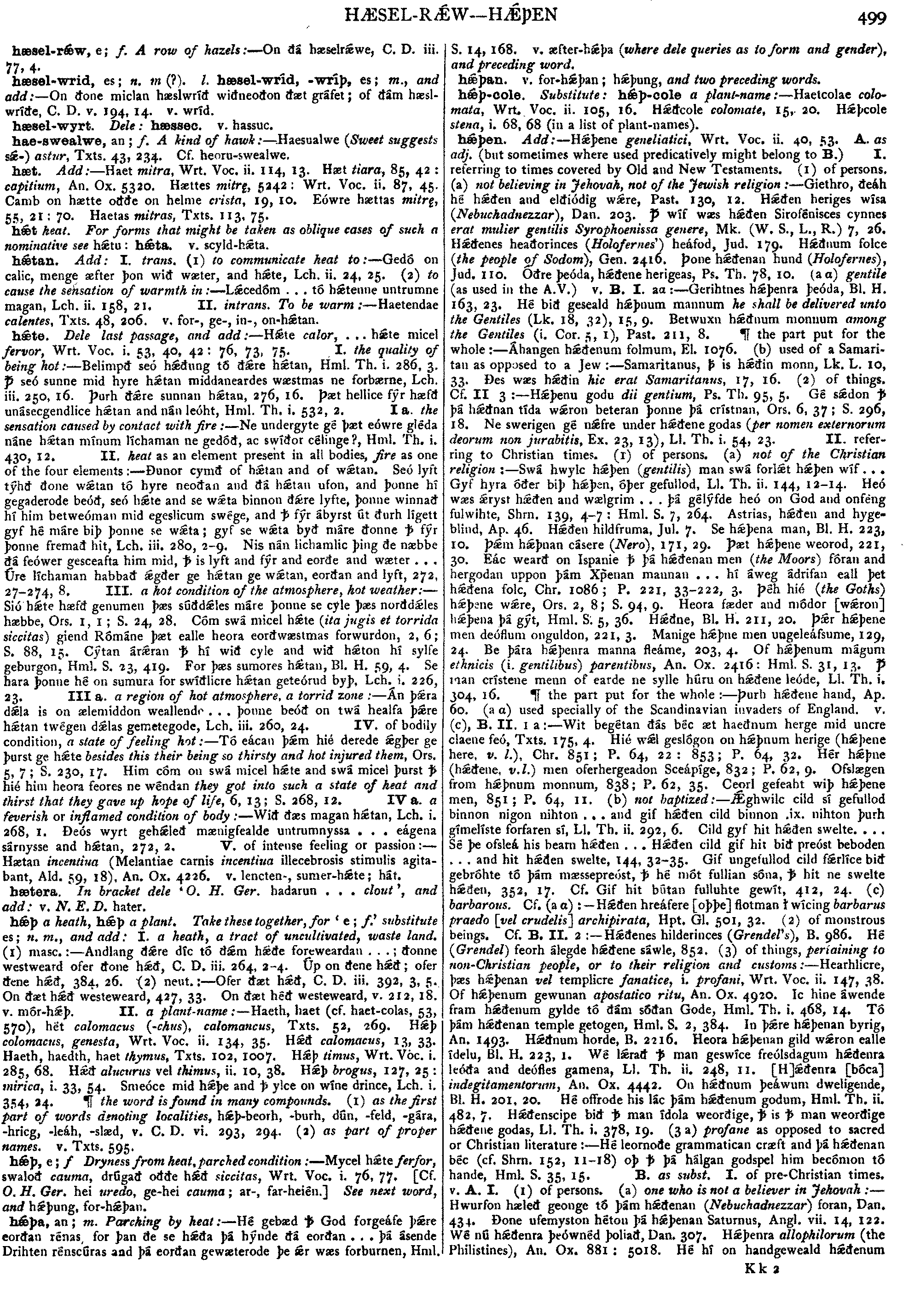
hþen.
Add;
--
Hþene
geneliatici.
Wrt.
Voc.
ii.
40,
53.
A.
as
adj.
(but
sometimes
where
used
predicatively
might
belong
to
B.
)
I.
referring
to
times
covered
by
Old
and
New
Testaments.
(1)
of
persons,
(a)
not
believing
in
Jehovah,
not
of
the
Jewish
religion
:--
Giethro,
ðeáh
hé
hðen
and
elðiódig
wre,
Past.
130,
12.
Hðen
heriges
wísa
(Nebuchadnezzar),
Dan.
203.
Þ-bar;
wíf
wæs
hðen
Sirofénisces
cynnes
erat
mulier
gentilis
Syrophoenissa
genere,
Mk.
(W.
S.
,
L.
,
R.
)
7,
26.
Hðenes
heaðorinces
(Holofernes')
heáfod,
Jud.
179.
Hðnum
folce
(the
people
of
Sodom),
Gen.
2416.
Þone
hðenan
hund
(Holofernes),
Jud.
no.
Óðre
þeóda,
hðene
herigeas,
Ps.
Th.
78,
10.
(a
 )
gentile
(as
used
in
the
A.
V.
)
v.
B.
I.
a
:--
Gerihtnes
hþenra
þeóda,
Bl.
H.
163,
23.
Hé
bid
geseald
hþnum
mannum
he
shall
be
delivered
unto
the
Gentiles
(Lk.
18,
32),
15,
9.
Betwuxn
hðnum
monnum
among
the
Gentiles
(i.
Cor.
5,
l),
Past.
211,
8.

the
part
put
for
the
whole
:--
Áhangen
hðenum
folmum,
El.
1076.
(b)
used
of
a
Samaritan
as
opposed
to
a
Jew
:--
Samaritanus,
is
hðin
monn,
Lk.
L.
10,
33.
Des
wæs
hðin
hic
erat
Samaritanus,
17,
16.
(2)
of
things.
Cf.
II
3
:--
Hþenu
godu
dii
gentium,
Ps.
Th.
95,
5.
Ge
sdon
þá
hðnan
tída
wron
beteran
þonne
þá
crístnan,
Ors.
6,
37
;
S.
296,
18.
Ne
swerigen
gé
nfre
under
hðene
godas
(per
nomen
exlernorum
deorum
non
jurabitis.
Ex.
23,
13),
Ll.
Th.
i.
54,
23.
II.
referring
to
Christian
times,
(1)
of
persons,
(a)
not
of
the
Christian
religion
:--
Swá
hwylc
hþen
(gentilis)
man
swá
forlt
hþen
wíf.
.
.
Gyf
hyra
óðer
biþ
hþan,
óþer
gefullod,
Ll.
Th.
ii.
144,
12-14.
Heó
wæs
ryst
hðen
and
wælgrim
.
.
.
þá
gélýfde
heó
on
God
and
onféng
fulwihte,
Shrn.
139,
4-7
:
Hml.
S.
7,
264.
Astrias,
hðen
and
hygeblind,
Ap.
46.
Hðen
hildfruma,
Jul.
7.
Se
hþena
man,
Bl.
H.
223,
10.
Þm
hþnan
cásere
(Nero),
171,
29.
Þæt
hþene
weorod,
221,
30.
Eác
wearð
on
Ispanie
þá
hðenan
men
(the
Moors)
fóran
and
hergodan
uppon
þám
Xpenan
mannan
.
.
.
hí
áweg
ádrifan
eall
þet
hðena
folc,
Chr.
1086;
P.
221,
33-222,
3.
Þén
hié
(the
Goths)
hþene
wre,
Ors.
2,
8;
S.
94,
9.
Heora
fæder
and
módor
[wron]
hþena
þá
gýt,
Hml.
S:
5,
36.
Hdne,
Bl.
H.
211,
20.
Þr
hþene
men
deóflum
onguldon,
221,
3.
Manige
hþne
men
ungeleáfsume,
129,
24.
Be
þára
hþenra
manna
fleáme,
203,
4.
Of
hþenum
mágum
ethnicis
(i.
gentilibus)
parentibus,
An.
Ox.
2416:
Hml.
S.
31,
13.
Þ-bar;
man
crístene
menn
of
earde
ne
sylle
húru
on
hðene
leóde,
Ll.
Th.
i.
304,
16.

the
part
put
for
the
whole
:--
Þurl.
hðene
hand,
Ap.
60.
(a
a)
used
specially
of
the
Scandinavian
invaders
of
England
,
v.
(c),
B.
II.
I
a
:--
Wit
begétan
ðás
béc
æt
haeðnum
herge
mid
uncre
claene
feó,
Txts.
175,
4.
Hié
wl
geslógon
on
hþnum
herige
(hþene
here,
v.
l.),
Chr.
851;
P.
64,
22:
853;
P.
64,
32.
Hér
hþne
(hðene,
v.
l.)
men
oferhergeadon
Sceápíge,
832
;
P.
62,
9.
Ofslægen
from
hþnum
monnum,
838;
P.
62,
35.
Ceprl
gefeaht
wiþ
hþene
men,
851;
P.
64,
11.
(b)
not
baptized
:--
Æ-acute;ghwilc
cild
sí
gefullod
binnon
nigon
nihton
.
.
.
and
gif
hðen
cild
binnon
.ix.
nihton
þurh
gímelíste
forfaren
sí.
Ll.
Th.
ii.
292,
6.
Cild
gyf
hit
hðen
swelte.
.
.
.
Sé
þe
ofsleá
his
beam
hðen
.
.
.
Hðen
cild
gif
hit
bið
preóst
beboden
.
.
.
and
hit
hðen
swelte,
144,
32-35.
Gif
ungefullod
cild
frlíce
bið
gebróhte
tó
þám
mæssepreóst,
hé
mót
fullian
sóna,
hit
ne
swelte
hden,
352,
17.
Cf.
Gif
hit
bútan
fulluhte
gewit,
412,
24.
(c)
barbarous.
Cf.
(a
)
:--
Hðen
hreáfere
[oþþe]
flotman
wícing
barbarus
praedo
[vel
crudelis]
archipirata,
Hpt.
Gl.
501,
32.
(2)
of
monstrous
beings.
Cf.
B.
II.
2
:--
Hðenes
hilderinces
(Grendel's),
B.
986.
Hé
(Grendel)
feorh
álegde
hðene
sáwle,
852.
(3)
of
things,
pertaining
to
non-Christian
people,
or
to
their
religion
and
customs
:--
Hearhlicre,
þæs
hþenan
vel
templicre
fanatice,
i.
profani.
Wrt.
Voc.
ii.
147,
38.
Of
hþenum
gewunan
apostatico
ritu,
An.
Ox.
4920.
Ic
hine
áwende
fram
heth;enum
gylde
tó
ðám
sóðan
Gode,
Hml.
Th.
i.
468,
14.
Tó
þám
hðenan
temple
getogen,
Hml.
S.
2,
384.
In
þre
hþenan
byrig,
An.
1493.
Hðnum
horde,
B.
2216.
Heora
hþenan
gild
wron
ealle
ídelu,
Bl.
H.
223,
i.
We
lrað
man
geswíce
freólsdagutn
hðen
ra
leóða
and
deófles
gamena,
Ll.
Th.
ii.
248,
11.
[H]ðenra
[bóca]
indegitamentorum,
An.
Ox.
4442.
On
hðnum
þeáwum
dweligende,
Bl.
H.
201,
20.
Hé
offrode
his
lác
þám
hðenum
godum,
Hml.
Th.
ii.
482,
7.
Hðenscipe
bið
I
a
man
ídola
weorðige,
is
man
weorttige
hðene
godas,
Ll.
Th.
i.
378,
19.
(3
a)
profane
as
opposed
to
sacred
or
Christian
literature
:--
Hé
leornoðe
grammatical,
craeft
and
þá
hðenan
béc
(cf.
Shrn.
152,
11-18)
oþ
þá
hálgan
godspel
him
becómon
tó
hande.
Hml.
S.
35,
15.
B.
as
subst.
I.
of
pre-Christian
times.
v.
A.
I.
(1)
of
persons,
(a)
one
who
is
not
a
believer
in
Jehovah
:--
Hwurfon
hæleð
geonge
tó
þám
hðenan
(Nebuchadnezzar)
foran,
Dan.
434.
Ðone
ufemyston
héton
þá
hþenan
Saturnus,
Angl.
vii.
14,
122.
Wé
nú
hðenra
þeównéd
þoliað,
Dan.
307.
Hþenra
allophilorum
(the
Philistines),
An.
Ox.
881
:
5018.
Hé
hí
on
handgeweald
hðenum
)
gentile
(as
used
in
the
A.
V.
)
v.
B.
I.
a
:--
Gerihtnes
hþenra
þeóda,
Bl.
H.
163,
23.
Hé
bid
geseald
hþnum
mannum
he
shall
be
delivered
unto
the
Gentiles
(Lk.
18,
32),
15,
9.
Betwuxn
hðnum
monnum
among
the
Gentiles
(i.
Cor.
5,
l),
Past.
211,
8.

the
part
put
for
the
whole
:--
Áhangen
hðenum
folmum,
El.
1076.
(b)
used
of
a
Samaritan
as
opposed
to
a
Jew
:--
Samaritanus,
is
hðin
monn,
Lk.
L.
10,
33.
Des
wæs
hðin
hic
erat
Samaritanus,
17,
16.
(2)
of
things.
Cf.
II
3
:--
Hþenu
godu
dii
gentium,
Ps.
Th.
95,
5.
Ge
sdon
þá
hðnan
tída
wron
beteran
þonne
þá
crístnan,
Ors.
6,
37
;
S.
296,
18.
Ne
swerigen
gé
nfre
under
hðene
godas
(per
nomen
exlernorum
deorum
non
jurabitis.
Ex.
23,
13),
Ll.
Th.
i.
54,
23.
II.
referring
to
Christian
times,
(1)
of
persons,
(a)
not
of
the
Christian
religion
:--
Swá
hwylc
hþen
(gentilis)
man
swá
forlt
hþen
wíf.
.
.
Gyf
hyra
óðer
biþ
hþan,
óþer
gefullod,
Ll.
Th.
ii.
144,
12-14.
Heó
wæs
ryst
hðen
and
wælgrim
.
.
.
þá
gélýfde
heó
on
God
and
onféng
fulwihte,
Shrn.
139,
4-7
:
Hml.
S.
7,
264.
Astrias,
hðen
and
hygeblind,
Ap.
46.
Hðen
hildfruma,
Jul.
7.
Se
hþena
man,
Bl.
H.
223,
10.
Þm
hþnan
cásere
(Nero),
171,
29.
Þæt
hþene
weorod,
221,
30.
Eác
wearð
on
Ispanie
þá
hðenan
men
(the
Moors)
fóran
and
hergodan
uppon
þám
Xpenan
mannan
.
.
.
hí
áweg
ádrifan
eall
þet
hðena
folc,
Chr.
1086;
P.
221,
33-222,
3.
Þén
hié
(the
Goths)
hþene
wre,
Ors.
2,
8;
S.
94,
9.
Heora
fæder
and
módor
[wron]
hþena
þá
gýt,
Hml.
S:
5,
36.
Hdne,
Bl.
H.
211,
20.
Þr
hþene
men
deóflum
onguldon,
221,
3.
Manige
hþne
men
ungeleáfsume,
129,
24.
Be
þára
hþenra
manna
fleáme,
203,
4.
Of
hþenum
mágum
ethnicis
(i.
gentilibus)
parentibus,
An.
Ox.
2416:
Hml.
S.
31,
13.
Þ-bar;
man
crístene
menn
of
earde
ne
sylle
húru
on
hðene
leóde,
Ll.
Th.
i.
304,
16.

the
part
put
for
the
whole
:--
Þurl.
hðene
hand,
Ap.
60.
(a
a)
used
specially
of
the
Scandinavian
invaders
of
England
,
v.
(c),
B.
II.
I
a
:--
Wit
begétan
ðás
béc
æt
haeðnum
herge
mid
uncre
claene
feó,
Txts.
175,
4.
Hié
wl
geslógon
on
hþnum
herige
(hþene
here,
v.
l.),
Chr.
851;
P.
64,
22:
853;
P.
64,
32.
Hér
hþne
(hðene,
v.
l.)
men
oferhergeadon
Sceápíge,
832
;
P.
62,
9.
Ofslægen
from
hþnum
monnum,
838;
P.
62,
35.
Ceprl
gefeaht
wiþ
hþene
men,
851;
P.
64,
11.
(b)
not
baptized
:--
Æ-acute;ghwilc
cild
sí
gefullod
binnon
nigon
nihton
.
.
.
and
gif
hðen
cild
binnon
.ix.
nihton
þurh
gímelíste
forfaren
sí.
Ll.
Th.
ii.
292,
6.
Cild
gyf
hit
hðen
swelte.
.
.
.
Sé
þe
ofsleá
his
beam
hðen
.
.
.
Hðen
cild
gif
hit
bið
preóst
beboden
.
.
.
and
hit
hðen
swelte,
144,
32-35.
Gif
ungefullod
cild
frlíce
bið
gebróhte
tó
þám
mæssepreóst,
hé
mót
fullian
sóna,
hit
ne
swelte
hden,
352,
17.
Cf.
Gif
hit
bútan
fulluhte
gewit,
412,
24.
(c)
barbarous.
Cf.
(a
)
:--
Hðen
hreáfere
[oþþe]
flotman
wícing
barbarus
praedo
[vel
crudelis]
archipirata,
Hpt.
Gl.
501,
32.
(2)
of
monstrous
beings.
Cf.
B.
II.
2
:--
Hðenes
hilderinces
(Grendel's),
B.
986.
Hé
(Grendel)
feorh
álegde
hðene
sáwle,
852.
(3)
of
things,
pertaining
to
non-Christian
people,
or
to
their
religion
and
customs
:--
Hearhlicre,
þæs
hþenan
vel
templicre
fanatice,
i.
profani.
Wrt.
Voc.
ii.
147,
38.
Of
hþenum
gewunan
apostatico
ritu,
An.
Ox.
4920.
Ic
hine
áwende
fram
heth;enum
gylde
tó
ðám
sóðan
Gode,
Hml.
Th.
i.
468,
14.
Tó
þám
hðenan
temple
getogen,
Hml.
S.
2,
384.
In
þre
hþenan
byrig,
An.
1493.
Hðnum
horde,
B.
2216.
Heora
hþenan
gild
wron
ealle
ídelu,
Bl.
H.
223,
i.
We
lrað
man
geswíce
freólsdagutn
hðen
ra
leóða
and
deófles
gamena,
Ll.
Th.
ii.
248,
11.
[H]ðenra
[bóca]
indegitamentorum,
An.
Ox.
4442.
On
hðnum
þeáwum
dweligende,
Bl.
H.
201,
20.
Hé
offrode
his
lác
þám
hðenum
godum,
Hml.
Th.
ii.
482,
7.
Hðenscipe
bið
I
a
man
ídola
weorðige,
is
man
weorttige
hðene
godas,
Ll.
Th.
i.
378,
19.
(3
a)
profane
as
opposed
to
sacred
or
Christian
literature
:--
Hé
leornoðe
grammatical,
craeft
and
þá
hðenan
béc
(cf.
Shrn.
152,
11-18)
oþ
þá
hálgan
godspel
him
becómon
tó
hande.
Hml.
S.
35,
15.
B.
as
subst.
I.
of
pre-Christian
times.
v.
A.
I.
(1)
of
persons,
(a)
one
who
is
not
a
believer
in
Jehovah
:--
Hwurfon
hæleð
geonge
tó
þám
hðenan
(Nebuchadnezzar)
foran,
Dan.
434.
Ðone
ufemyston
héton
þá
hþenan
Saturnus,
Angl.
vii.
14,
122.
Wé
nú
hðenra
þeównéd
þoliað,
Dan.
307.
Hþenra
allophilorum
(the
Philistines),
An.
Ox.
881
:
5018.
Hé
hí
on
handgeweald
hðenum
|
Source: Bosworth/Toller, page d0637, entry 32 View original page image as: [TIFF] [PNG] [View previous entry] [View next entry] |
[Comment on this entry] [View comments] |
The following entry has been hand-corrected once. |
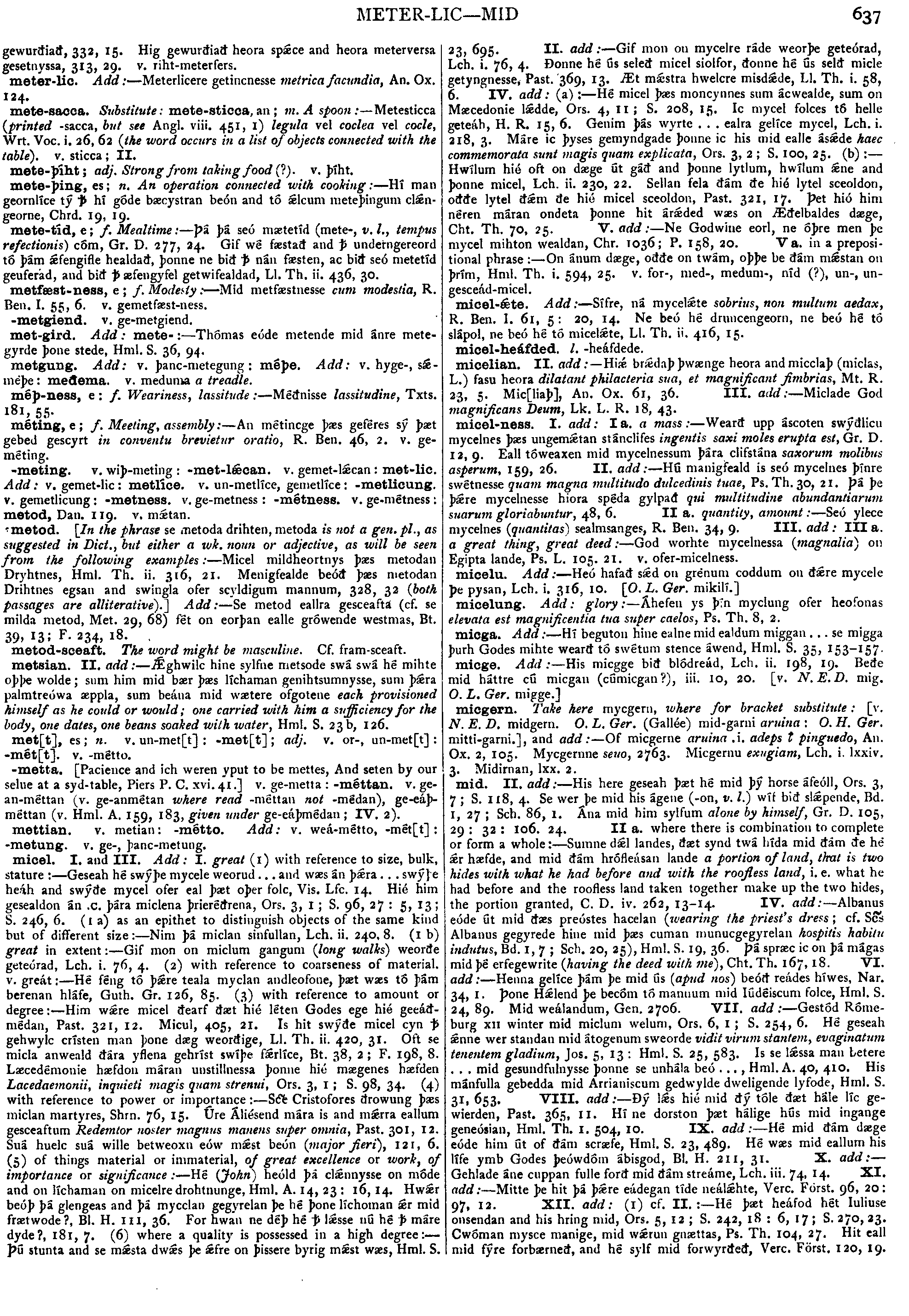
mid.
II.
add
:--
His
here
geseah
þæt
hé
mid
þý
horse
áfeóll,
Ors.
3,
7
;
S.
118,
4.
Se
wer
þe
mid
his
ágene
(-on,
v.
l.)
wíf
bið
slpende,
Bd.
1,
27
;
Sch.
86,
1.
Ána
mid
him
sylfum
alone
by
himself,
Gr.
D.
105,
29
:
32
:
106.
24.
II
a.
where
there
is
combination
to
complete
or
form
a
whole
:--
Sumne
dl
landes,
ðæt
synd
twá
hída
mid
ðám
ðe
hé
r
hæfde,
and
mid
ðám
hrófleásan
lande
a
portion
of
land,
that
is
two
hides
with
what
he
had
before
and
with
the
roofless
land,
i.
e.
what
he
had
before
and
the
roofless
land
taken
together
make
up
the
two
hides,
the
portion
granted,
C.
D.
iv.
262,
13-14.
IV.
add
:--
Albanus
eóde
út
mid
ðæs
preóstes
hacelan
(wearing
the
priest's
dress;
cf.
S
UNCERTAIN
s
Albanus
gegyrede
hine
mid
þæs
cuman
munucgegyrelan
hospitis
habitu
indutus,
Bd.
1,
7
;
Sch.
20,
25),
Hml.
S.
19,
36.
Þá
spræc
ic
on
þá
mágas
mid
þé
erfegewrite
(having
the
deed
with
me),
Cht.
Th.
167,
18.
VI.
add
:--
Henna
gelíce
þám
þe
mid
ús
(
apud
nos
)
beóð
reádes
híwes,
Nar.
34,
1.
Þone
Hlend
þe
becóm
tó
mannum
mid
Iúdéiscum
folce,
Hml.
S.
24,
89.
Mid
weálandum,
Gen.
2706.
VII.
add
:--
Gestód
Róme burg
xii
winter
mid
miclum
welum,
Ors.
6,
1;
S.
254,
6.
Hé
geseah
nne
wer
standan
mid
átogenum
sweorde
vidit
virum
stantem,
evaginatum
tenentem
gladium,
Jos.
5,
13
:
Hml.
S.
25,
583.
Is
se
lssa
man
betere
.
.
.
mid
gesundfulnysse
þonne
se
unhála
beó
.
.
.
,
Hml.
A.
40,
410.
His
mánfulla
gebedda
mid
Arrianiscum
gedwylde
dweligende
lyfode,
Hml.
S.
31,
653.
VIII.
add
:--
Ðý
ls
hié
mid
ðý
tóle
ðæt
hále
líc
gewierden,
Past.
365,
11.
Hí
ne
dorston
þæt
hálige
hús
mid
ingange
geneósian,
Hml.
Th.
i.
504,
10.
IX.
add
:--
Hé
mid
ðám
dæge
eóde
him
út
of
ðám
scræfe,
Hml.
S.
23,
489.
Hé
wæs
mid
eallum
his
lífe
ymb
Godes
þeówdóm
ábisgod,
Bl.
H.
211,
31.
X.
add
:--
Gehlade
áne
cuppan
fulle
forð
mid
ðám
streáme,
Lch.
iii.
74,
14.
XI.
add
:--
Mitte
þe
hit
þá
þre
eádegan
tíde
neálhte,
Verc.
Först.
96,
20:
97,
12.
XII.
add:
(l)
cf.
II.
:--
Hé
þæt
heáfod
hét
Iuliuse
onsendan
and
his
hring
mid,
Ors.
5,
12
;
S.
242,
18
:
6,
17;
S.
270,
23.
Cwóman
mysce
manige,
mid
wrun
gnættas,
Ps.
Th.
104,
27.
Hit
eall
mid
fýre
forbærneð,
and
hé
sylf
mid
forwyrðeð,
Verc,
Först,
120,
19.
burg
xii
winter
mid
miclum
welum,
Ors.
6,
1;
S.
254,
6.
Hé
geseah
nne
wer
standan
mid
átogenum
sweorde
vidit
virum
stantem,
evaginatum
tenentem
gladium,
Jos.
5,
13
:
Hml.
S.
25,
583.
Is
se
lssa
man
betere
.
.
.
mid
gesundfulnysse
þonne
se
unhála
beó
.
.
.
,
Hml.
A.
40,
410.
His
mánfulla
gebedda
mid
Arrianiscum
gedwylde
dweligende
lyfode,
Hml.
S.
31,
653.
VIII.
add
:--
Ðý
ls
hié
mid
ðý
tóle
ðæt
hále
líc
gewierden,
Past.
365,
11.
Hí
ne
dorston
þæt
hálige
hús
mid
ingange
geneósian,
Hml.
Th.
i.
504,
10.
IX.
add
:--
Hé
mid
ðám
dæge
eóde
him
út
of
ðám
scræfe,
Hml.
S.
23,
489.
Hé
wæs
mid
eallum
his
lífe
ymb
Godes
þeówdóm
ábisgod,
Bl.
H.
211,
31.
X.
add
:--
Gehlade
áne
cuppan
fulle
forð
mid
ðám
streáme,
Lch.
iii.
74,
14.
XI.
add
:--
Mitte
þe
hit
þá
þre
eádegan
tíde
neálhte,
Verc.
Först.
96,
20:
97,
12.
XII.
add:
(l)
cf.
II.
:--
Hé
þæt
heáfod
hét
Iuliuse
onsendan
and
his
hring
mid,
Ors.
5,
12
;
S.
242,
18
:
6,
17;
S.
270,
23.
Cwóman
mysce
manige,
mid
wrun
gnættas,
Ps.
Th.
104,
27.
Hit
eall
mid
fýre
forbærneð,
and
hé
sylf
mid
forwyrðeð,
Verc,
Först,
120,
19.
|
Source: Bright's OE Grammar, page b0270, entry 2 View original page image as: [TIFF] [PNG] [View previous entry] [View next entry] |
[Comment on this entry] [View comments] |
The following entry has been hand-corrected once. |
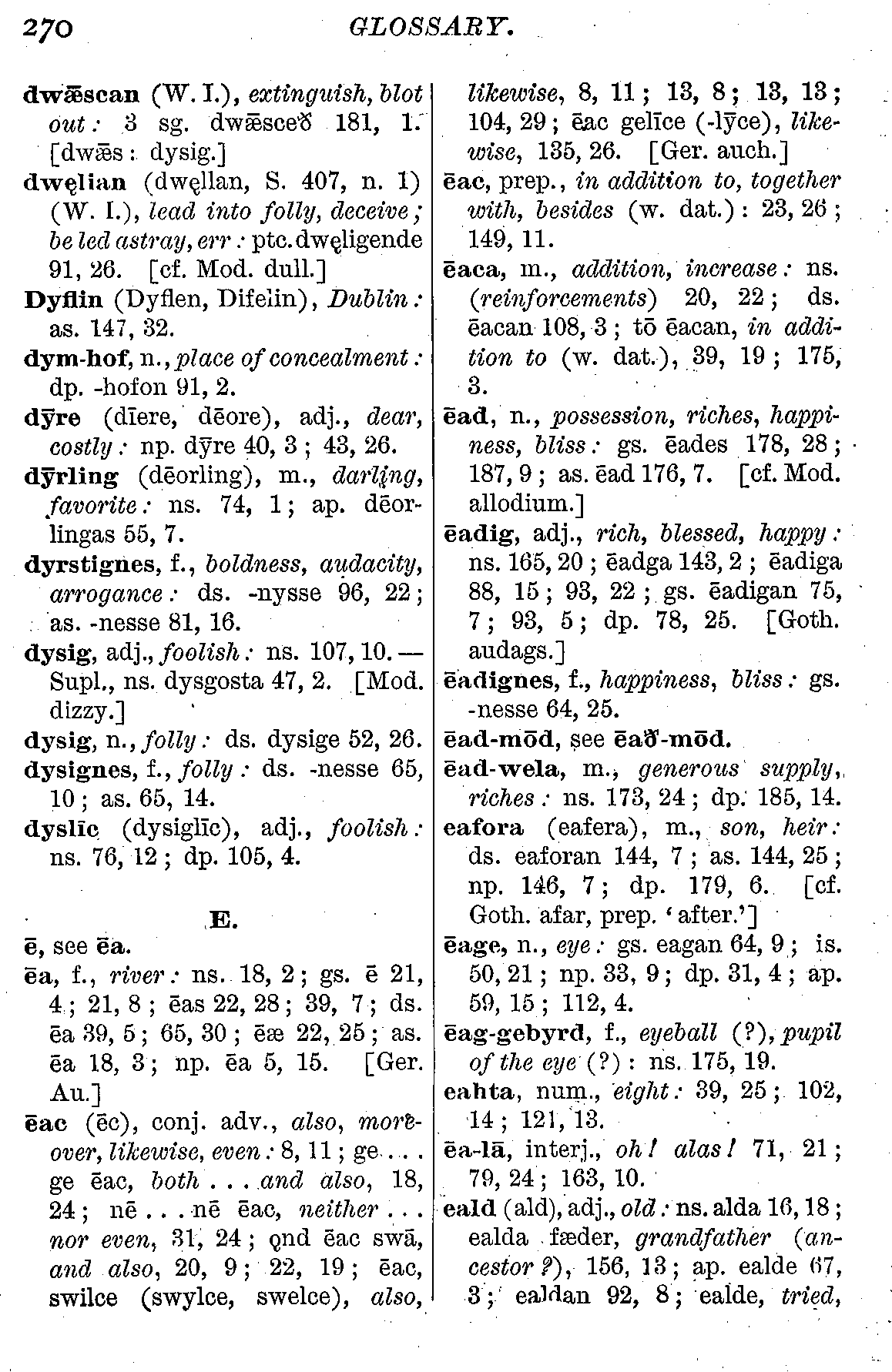
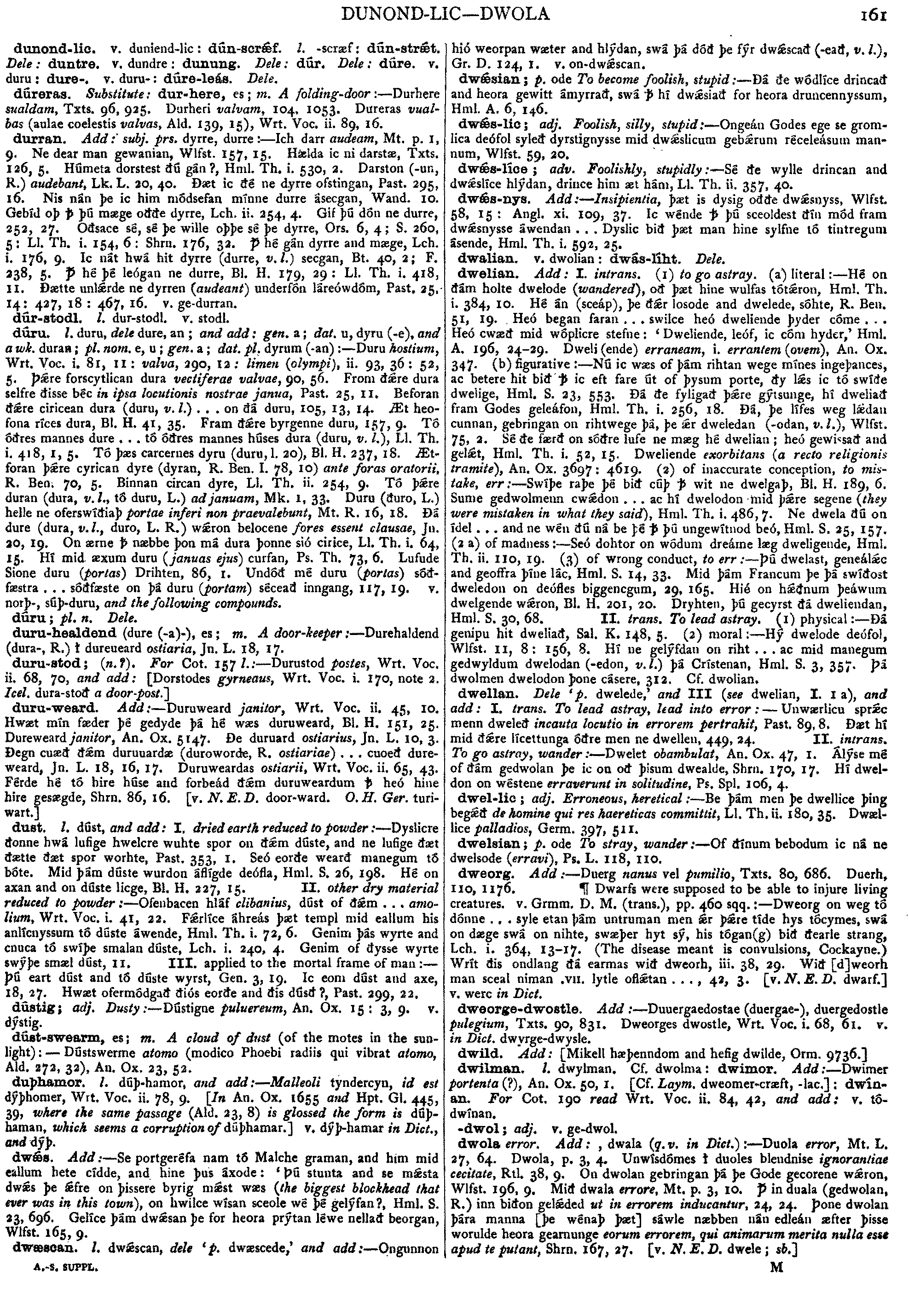
dwelian (dwellan) WI lead into folly, deceive; be led astray, err
- ptc dweligende
Germanic Lexicon Project (main page)
This search system was written by
Sean Crist
Please consider
volunteering
to correct the data in these online dictionaries.
No rights reserved. Feel free to use these data in any way you please.