|
|

Tip: In the search results, you can click on any word or abbreviation for more information.
|
Source: Bosworth/Toller, page b0807, entry 2 View original page image as: [TIFF] [PNG] [View previous entry] [View next entry] |
[Comment on this entry] [View comments] |
The following entry has been hand-corrected once. |
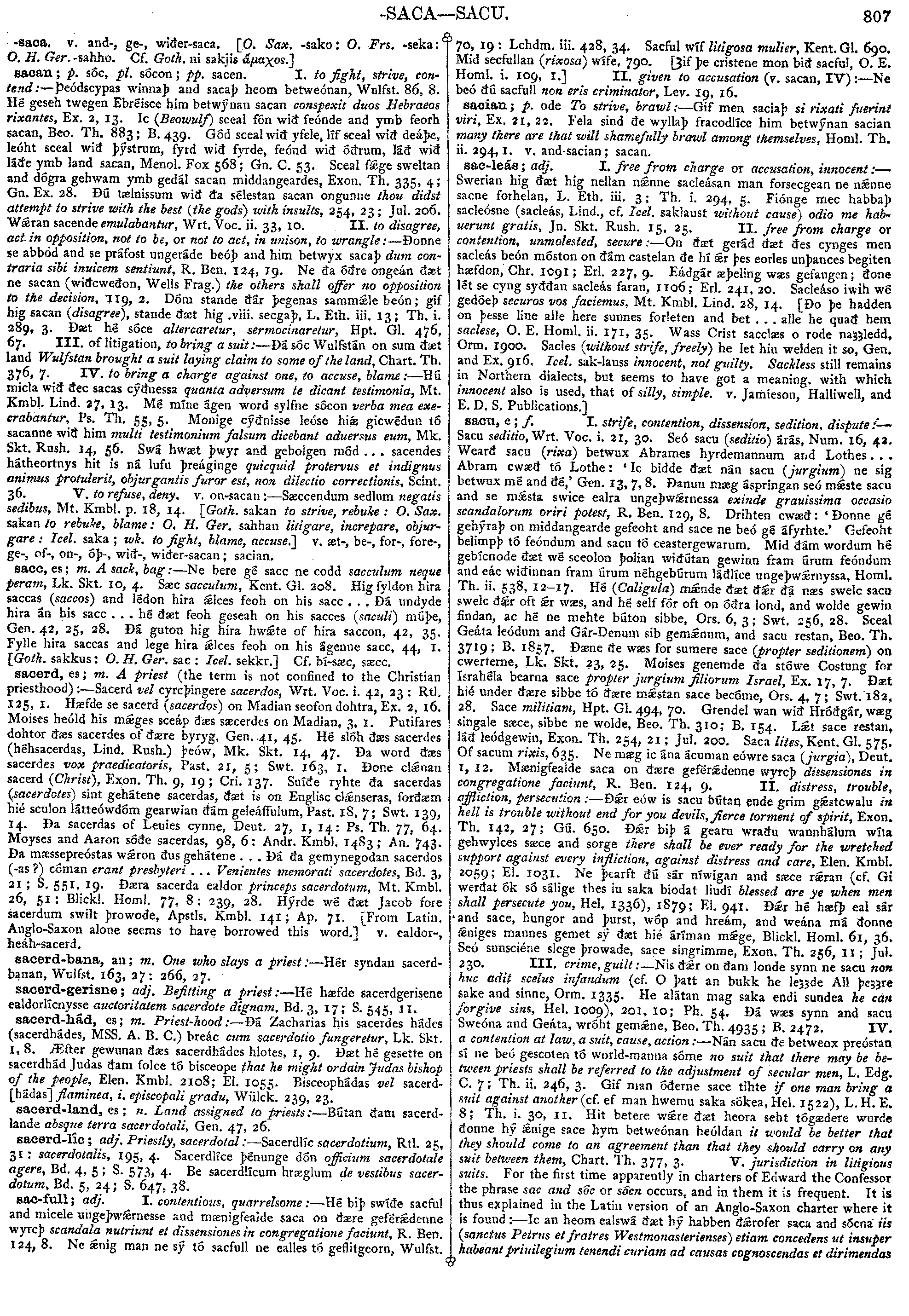
sacan;
p.
sóc,
pl.
sócon;
pp.
sacen.
I.
to
fight,
strive,
contend
:--
Þeódscypas
winnaþ
and
sacaþ
heom
betweónan,
Wulfst.
86,
8.
Hé
geseh
twegen
Ebréisce
him
betwýnan
sacan
conspexit
duos
Hebraeos
rixantes,
Ex.
2,
13.
Ic
(Beowulf)
sceal
fón
wið
feónde
and
ymb
feorh
sacan,
Beo.
Th.
883;
B.
439.
Gód
sceal
wið
yfele,
líf
sceal
wið
deáþe,
leóht
sceal
wið
þýstrum,
fyrd
wið
fyrde,
feónd
wið
óðrum,
láð
wið
láðe
ymb
land
sacan,
Menol.
Fox
568;
Gn.
C.
53.
Sceal
f ge
sweltan
and
dógra
gehwam
ymb
gedál
sacan
middangeardes,
Exon.
Th.
335,
4;
Gn.
Ex.
28.
Ðú
tælnissum
wið
ða
sélestan
sacan
ongunne
thou
didst
attempt
to
strive
with
the
best
(the
gods)
with
insults,
254,
23;
Jul.
206.
Wran
sacende
emulabantur,
Wrt.
Voc.
ii.
33,
10.
II.
to
disagree,
act
in
opposition,
not
to
be,
or
not
to
act,
in
unison,
to
wrangle
:--
Ðonne
se
abbod
and
se
práfost
ungeráde
beóþ
and
him
betwyx
sacaþ
dum
contraria
sibi
inuicem
sentiunt,
R.
Ben.
124,
19.
Ne
ða
óðre
ongeán
ðæt
ne
sacan
(wiðcweðon,
Wells
Frag.)
the
others
shall
offer
no
opposition
to
the
decision,
119,
2.
Dóm
stande
ðár
þegenas
sammle
beón;
gif
hig
sacan
(disagree),
stande
ðæt
hig
.viii.
secgaþ,
L.
Eth.
iii.
13;
Th.
i.
289,
3.
Ðæt
hé
sóce
altercaretur,
sermocinaretur,
Hpt.
Gl.
476,
67.
III.
of
litigation,
to
bring
a
suit
:--
Ðá
sóc
Wulfstán
on
sum
ðæt
land
Wulfstan
brought
a
suit
laying
claim
to
some
of
the
land,
Chart.
Th.
376,
7.
IV.
to
bring
a
charge
against
one,
to
accuse,
blame
:--
Hú
micla
wið
ðec
sacas
cýðnessa
quanta
adversum
te
dicant
testimonia,
Mt.
Kmbl.
Lind.
27,
13.
Mé
míne
ágen
word
sylfne
sócon
verba
mea
execrabantur,
Ps.
Th.
55,
5.
Monige
cýðnisse
leóse
hi
gicwédun
tó
sacanne
wið
him
multi
testimonium
falsum
dicebant
aduersus
eum,
Mk.
Skt.
Rush.
14,
56.
Swá
hwæt
þwyr
and
gebolgen
mód
...
sacendes
hátheortnys
hit
is
ná
lufu
þreáginge
quicquid
protervus
et
indignus
animus
protulerit,
objurgantis
furor
est,
non
dilectio
correctionis,
Scint.
36.
V.
to
refuse,
deny.
v.
on-sacan
:--
Sæccendum
sedlum
negatis
sedibus,
Mt.
Kmbl.
p.
18,
14.
[Goth.
sakan
to
strive,
rebuke
:
O.
Sax.
sakan
to
rebuke,
blame
:
O.
H.
Ger.
sahhan
litigare,
increpare,
objurgare
:
Icel.
saka;
wk.
to
fight,
blame,
accuse.]
v.
æt-,
be-,
for-,
fore-,
ge-,
of-,
on-,
óþ-,
wið-,
wiðer-sacan;
sacian.
ge
sweltan
and
dógra
gehwam
ymb
gedál
sacan
middangeardes,
Exon.
Th.
335,
4;
Gn.
Ex.
28.
Ðú
tælnissum
wið
ða
sélestan
sacan
ongunne
thou
didst
attempt
to
strive
with
the
best
(the
gods)
with
insults,
254,
23;
Jul.
206.
Wran
sacende
emulabantur,
Wrt.
Voc.
ii.
33,
10.
II.
to
disagree,
act
in
opposition,
not
to
be,
or
not
to
act,
in
unison,
to
wrangle
:--
Ðonne
se
abbod
and
se
práfost
ungeráde
beóþ
and
him
betwyx
sacaþ
dum
contraria
sibi
inuicem
sentiunt,
R.
Ben.
124,
19.
Ne
ða
óðre
ongeán
ðæt
ne
sacan
(wiðcweðon,
Wells
Frag.)
the
others
shall
offer
no
opposition
to
the
decision,
119,
2.
Dóm
stande
ðár
þegenas
sammle
beón;
gif
hig
sacan
(disagree),
stande
ðæt
hig
.viii.
secgaþ,
L.
Eth.
iii.
13;
Th.
i.
289,
3.
Ðæt
hé
sóce
altercaretur,
sermocinaretur,
Hpt.
Gl.
476,
67.
III.
of
litigation,
to
bring
a
suit
:--
Ðá
sóc
Wulfstán
on
sum
ðæt
land
Wulfstan
brought
a
suit
laying
claim
to
some
of
the
land,
Chart.
Th.
376,
7.
IV.
to
bring
a
charge
against
one,
to
accuse,
blame
:--
Hú
micla
wið
ðec
sacas
cýðnessa
quanta
adversum
te
dicant
testimonia,
Mt.
Kmbl.
Lind.
27,
13.
Mé
míne
ágen
word
sylfne
sócon
verba
mea
execrabantur,
Ps.
Th.
55,
5.
Monige
cýðnisse
leóse
hi
gicwédun
tó
sacanne
wið
him
multi
testimonium
falsum
dicebant
aduersus
eum,
Mk.
Skt.
Rush.
14,
56.
Swá
hwæt
þwyr
and
gebolgen
mód
...
sacendes
hátheortnys
hit
is
ná
lufu
þreáginge
quicquid
protervus
et
indignus
animus
protulerit,
objurgantis
furor
est,
non
dilectio
correctionis,
Scint.
36.
V.
to
refuse,
deny.
v.
on-sacan
:--
Sæccendum
sedlum
negatis
sedibus,
Mt.
Kmbl.
p.
18,
14.
[Goth.
sakan
to
strive,
rebuke
:
O.
Sax.
sakan
to
rebuke,
blame
:
O.
H.
Ger.
sahhan
litigare,
increpare,
objurgare
:
Icel.
saka;
wk.
to
fight,
blame,
accuse.]
v.
æt-,
be-,
for-,
fore-,
ge-,
of-,
on-,
óþ-,
wið-,
wiðer-sacan;
sacian.
|
Source: Bosworth/Toller, page b0829, entry 1 View original page image as: [TIFF] [PNG] [View previous entry] [View next entry] |
[Comment on this entry] [View comments] |
The following entry has been hand-corrected once. |
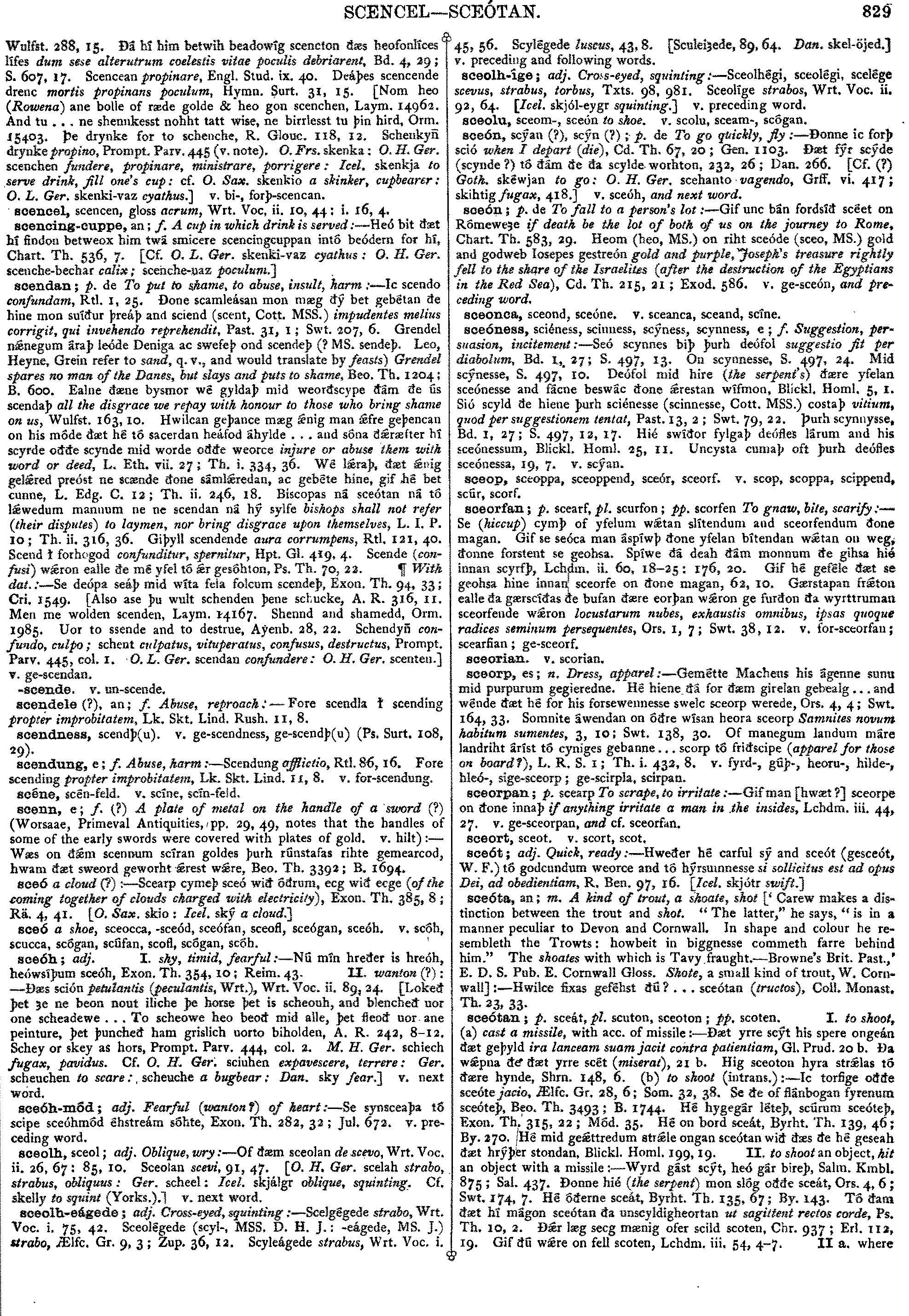
Wulfst. 288, 15. Ðá hí him betwih beadowíg scencton ðæs heofonlíces lífes dum sese alterutrum coelestis vitae poculis debriarent, Bd. 4, 29 ; S. 607, 17. Scencean propinare, Engl. Stud. ix. 40. Deáþes scencende drenc mortis propinans poculum, Hymn. Surt. 31, 15. [Nom heo (Rowena) ane bolle of ræde golde & heo gon scenchen, Laym. 14962. And tu . . . ne shennkesst nohht tatt wise, ne birrlesst tu þin hird, Orm. 15403. Þe drynke for to schenche, R. Glouc. 118, 12. Schenkyn drynke propino, Prompt. Parv. 445 (v. note). O. Frs. skenka : O. H. Ger. scenchen fundere, propinare, ministrare, porrigere: Icel. skenkja to serve drink, fill one's cup: cf. O. Sax. skenkio a skinker, cupbearer; O. L. Ger. skenki-vaz cyathus.] v. bi-, forþ-scencan.
|
Source: Bosworth/Toller, page b0843, entry 9 View original page image as: [TIFF] [PNG] [View previous entry] [View next entry] |
[Comment on this entry] [View comments] |
The following entry has been hand-corrected once. |
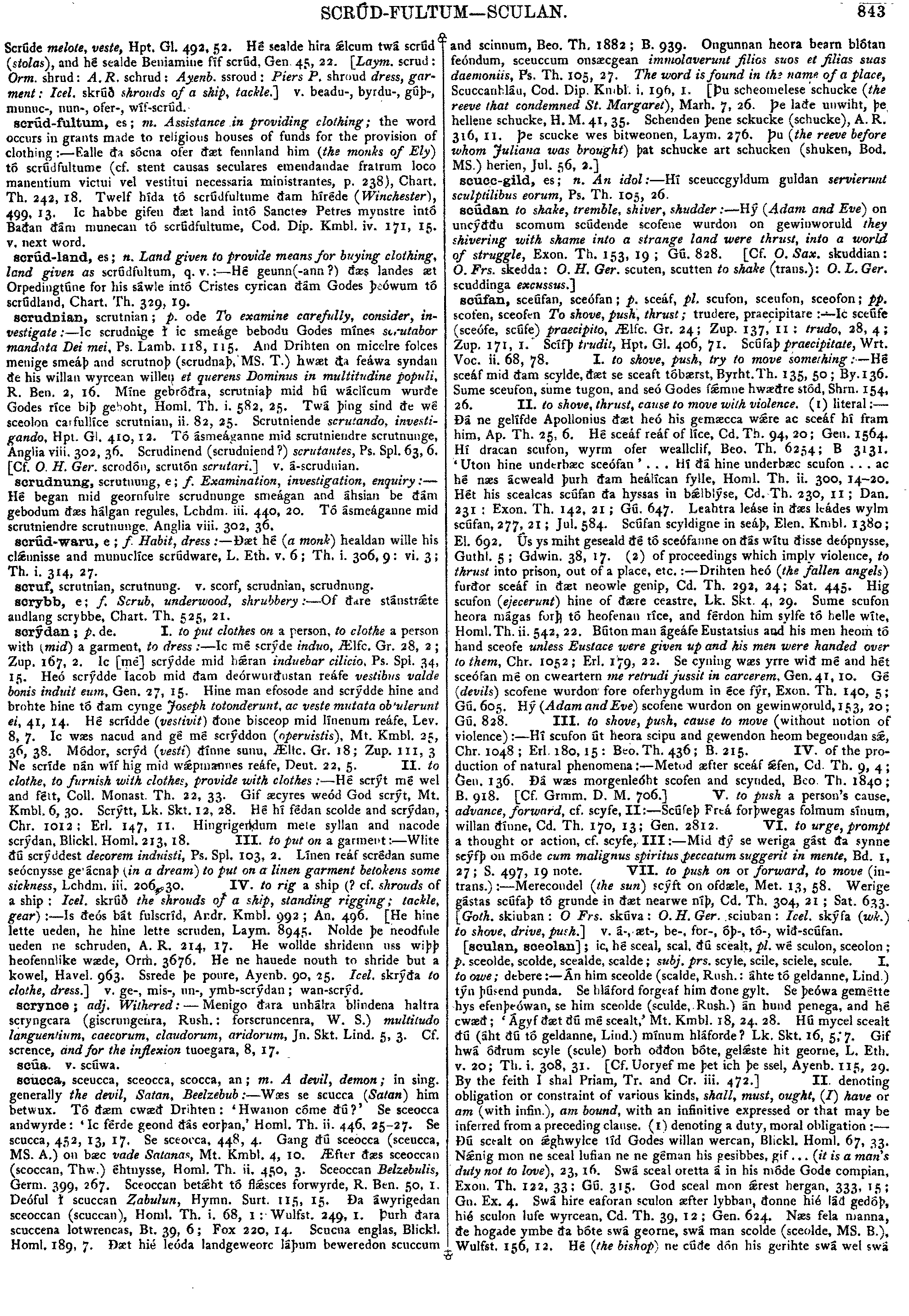
scrýdan
;
p.
de.
I.
to
put
clothes
on
a
person,
to
clothe
a
person
with
(mid)
a
garment,
to
dress
:--
Ic
mé
scrýde
induo,
Ælfc.
Gr.
28,
2
;
Zup.
167,
2.
Ic
[mé]
scrýdde
mid
hran
induebar
cilicio.
Ps.
Spl.
34,
15.
Heó
scrýdde
Iacob
mid
ðam
deórwurðustan
reáfe
vestibus
valde
bonis
induit
eum,
Gen.
27,
15.
Hine
man
efosode
and
scrýdde
hine
and
brohte
hine
tó
ðam
cynge
Joseph
totonderunt,
ac
veste
mutata
ob'ulerunt
et,
41,
14.
Hé
scrídde
(vestivit)
ðone
bisceop
mid
línenum
reáfe,
Lev.
8,
7.
Ic
wæs
nacud
and
gé
mé
scrýddon
(operuistis).
Mt.
Kmbl.
25,
36,
38.
Módor,
scrýd
(vesti)
ðínne
sunu,
Æltc.
Gr.
18;
Zup.
111,
3.
Ne
scríde
nán
wíf
hig
mid
wpmannes
reáfe,
Deut.
22,
5.
II.
to
clothe,
to
furnish
with
clothes,
provide
with
clothes
:--
Hé
scrýt
mé
wel
and
félt,
Coll.
Monast.
Th.
22,
33.
Gif
æcyres
weód
God
scrýt,
Mt.
Kmbl.
6,
30.
Scrýtt,
Lk.
Skt.
12,
28.
Hé
ní
fédan
scolde
and
scrýdan,
Chr.
1012
;
Erl.
147,
11.
Hingrigendumger.
dum
mele
syllan
and
nacode
scrýdan,
Blickl.
Homl.
213,
18.
III.
to
put
on
a
garment
:--
Wlite
ðú
scrýddest
decorem
induisti,
Ps.
Spl.
103,
2.
Linen
reáf
scrédan
sume
seócnysse
ge'
ácnaþ
(in
a
dream)
to
put
on
a
linen
garment
betokens
some
sickness,
Lchdm.
iii.
206.
30.
IV.
to
rig
a
ship
(?
cf.
shrouds
of
a
ship
:
Icel.
skrúð
the
shrouds
of
a
ship,
standing
rigging;
tackle,
gear)
:--
Is
ðeós
bát
fulscríd,
Ardr.
Kmbl.
992
;
An.
496.
[He
hine
lette
ueden,
he
hine
lette
scruden,
Laym.
8945.
Nolde
þe
neodfule
ueden
ne
schruden,
A.
R.
214,
17.
He
wollde
shridenn
uss
wiþþ
heofennlike
wæde,
Orm.
3676.
He
ne
hauede
nouth
to
shride
but
a
kowel,
Havel.
963.
Ssrede
þe
poure,
Ayenb.
90,
25.
Icel.
skrýða
to
clothe,
dress.]
v.
ge-,
mis-,
un-,
ymb-scrýdan
;
wan-scrýd.
|
Source: Bosworth/Toller, page b0884, entry 10 View original page image as: [TIFF] [PNG] [View previous entry] [View next entry] |
[Comment on this entry] [View comments] |
The following entry has been hand-corrected once. |
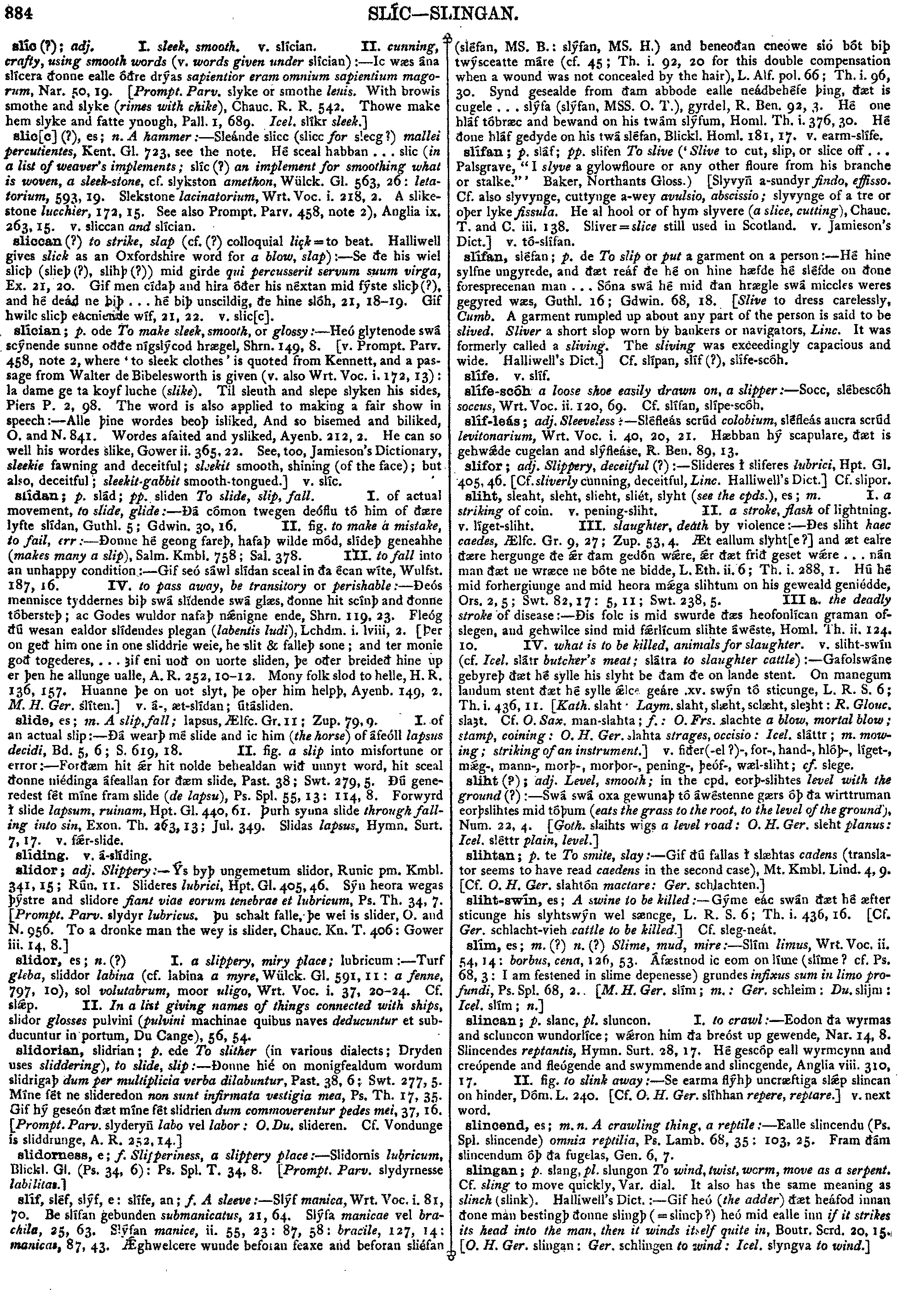
slidorian, slidrian; p. ede To slither (in various dialects; Dryden uses sliddering), to slide, slip :-- Ðonne hié on monigfealdum wordum slidrigaþ dum per multiplicia verba dilabuntur. Past. 38, 6; Swt. 277, 5. Míne fét ne slideredon non sunt infirmata vestigia mea, Ps. Th. 17, 35. Gif hy geseón ðæt mine fét slidrien dum commoverentur pedes mei, 37, 16. [Prompt. Parv. slyderyn labo vel labor: 0. Du. slideren. Cf. Vondunge is sliddrunge, A. R. 252, 14.]
|
Source: Bosworth/Toller, page b0885, entry 6 View original page image as: [TIFF] [PNG] [View previous entry] [View next entry] |
[Comment on this entry] [View comments] |
The following entry has been hand-corrected once. |
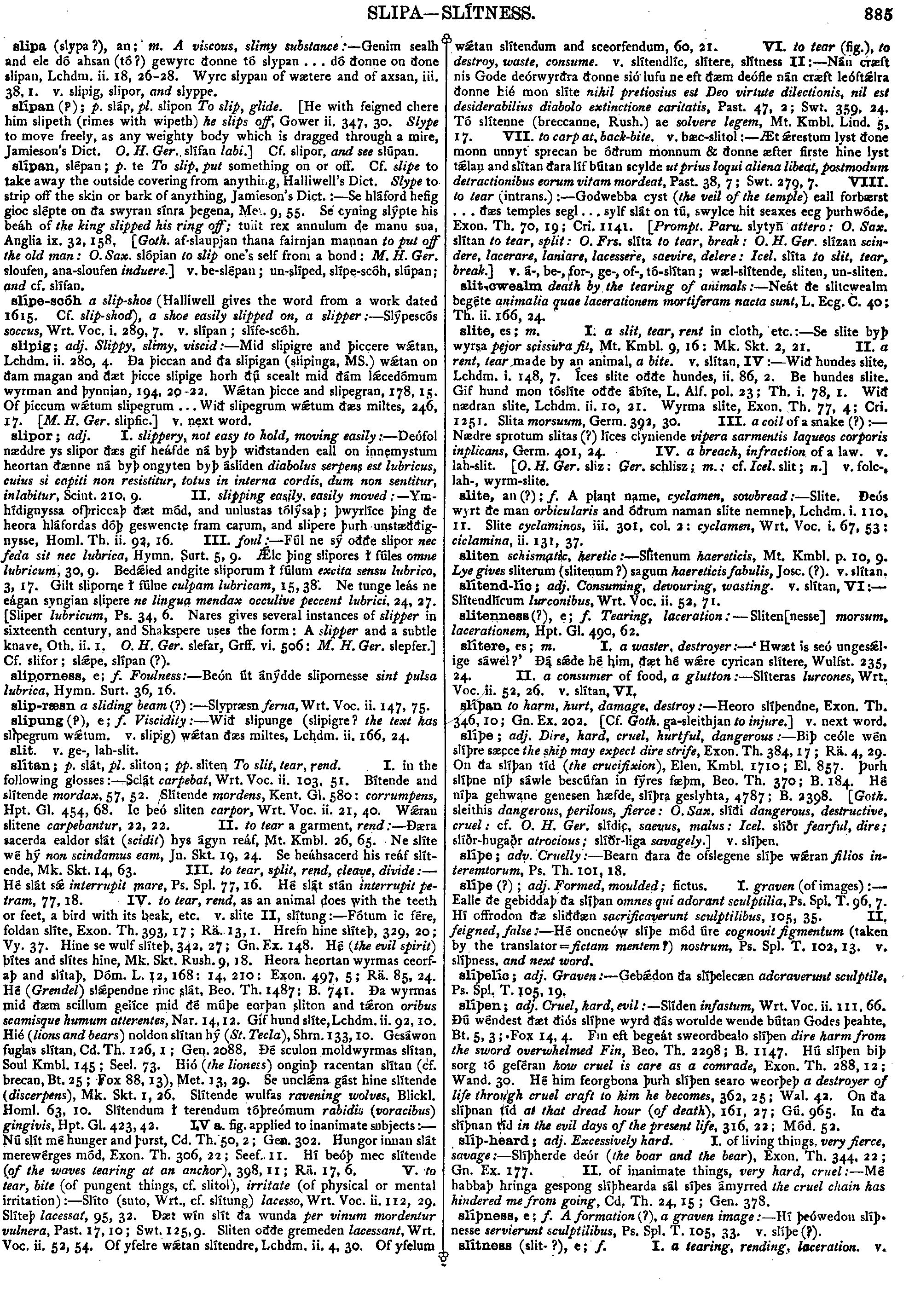
slipor;
adj.
I.
slippery,
not
easy
to
hold,
moving
easily
:--
Deófol
næddre
ys
slipor
ðæs
gif
heáfde
ná
byþ
wiðstanden
eall
on
innemystum
heortan
ðænne
ná
byþ
ongyten
byþ
ásliden
diabolus
serpens
est
lubricus,
cuius
si
capiti
non
resistitur,
totus
in
interna
cordis,
dum
non
sentitur,
inlabitur,
Scint.
210,
9.
II.
slipping
easily,
easily
moved
:--
Ym-hídignyssa
ofþriccaþ
ðæt
mód,
and
unlustas
tólýsaþ;
þwyrlice
þing
ðe
heora
hláfordas
dóþ
geswencte
fram
carum,
and
slipere
þurh
unstæððig-nysse,
Homl.
Th.
ii.
92,
16.
III.
foul
:--
Fúl
ne
sý
oððe
slipor
nec
feda
sit
nec
lubrica.
Hymn.
Surt.
5,
9.
Æ-acute;lc
þing
slipores
 fúles
omne
lubricum,
30,
9.
Bedled
andgite
sliporum
fúlum
excita
sensu
lubrico,
3,
17.
Gilt
sliporne
fúlne
culpam
lubricant,
15,
38.
Ne
tunge
leás
ne
eágan
syngian
slipere
ne
lingua
mendax
occulive
peccent
lubrici,
24,
27.
[Sliper
lubricum,
Ps.
34,
6.
Nares
gives
several
instances
of
slipper
in
sixteenth
century,
and
Shskspere
uses
the
form:
A
slipper
and
a
subtle
knave,
Oth.
ii.
1.
O.
H.
Ger.
slefar,
Grff.
vi.
506:
M.
H.
Ger.
slepfer.]
Cf.
slifor
;
slpe,
slípan
(?).
sliporness,
e;
f.
Foulness
:--
Beón
út
ánýdde
slipornesse
sint
pulsa
lubrica,
Hymn.
Surt.
36,
16.
fúles
omne
lubricum,
30,
9.
Bedled
andgite
sliporum
fúlum
excita
sensu
lubrico,
3,
17.
Gilt
sliporne
fúlne
culpam
lubricant,
15,
38.
Ne
tunge
leás
ne
eágan
syngian
slipere
ne
lingua
mendax
occulive
peccent
lubrici,
24,
27.
[Sliper
lubricum,
Ps.
34,
6.
Nares
gives
several
instances
of
slipper
in
sixteenth
century,
and
Shskspere
uses
the
form:
A
slipper
and
a
subtle
knave,
Oth.
ii.
1.
O.
H.
Ger.
slefar,
Grff.
vi.
506:
M.
H.
Ger.
slepfer.]
Cf.
slifor
;
slpe,
slípan
(?).
sliporness,
e;
f.
Foulness
:--
Beón
út
ánýdde
slipornesse
sint
pulsa
lubrica,
Hymn.
Surt.
36,
16.
|
Source: Bosworth/Toller, page b0887, entry 4 View original page image as: [TIFF] [PNG] [View previous entry] [View next entry] |
[Comment on this entry] [View comments (1)] |
The following entry has been hand-corrected once. |
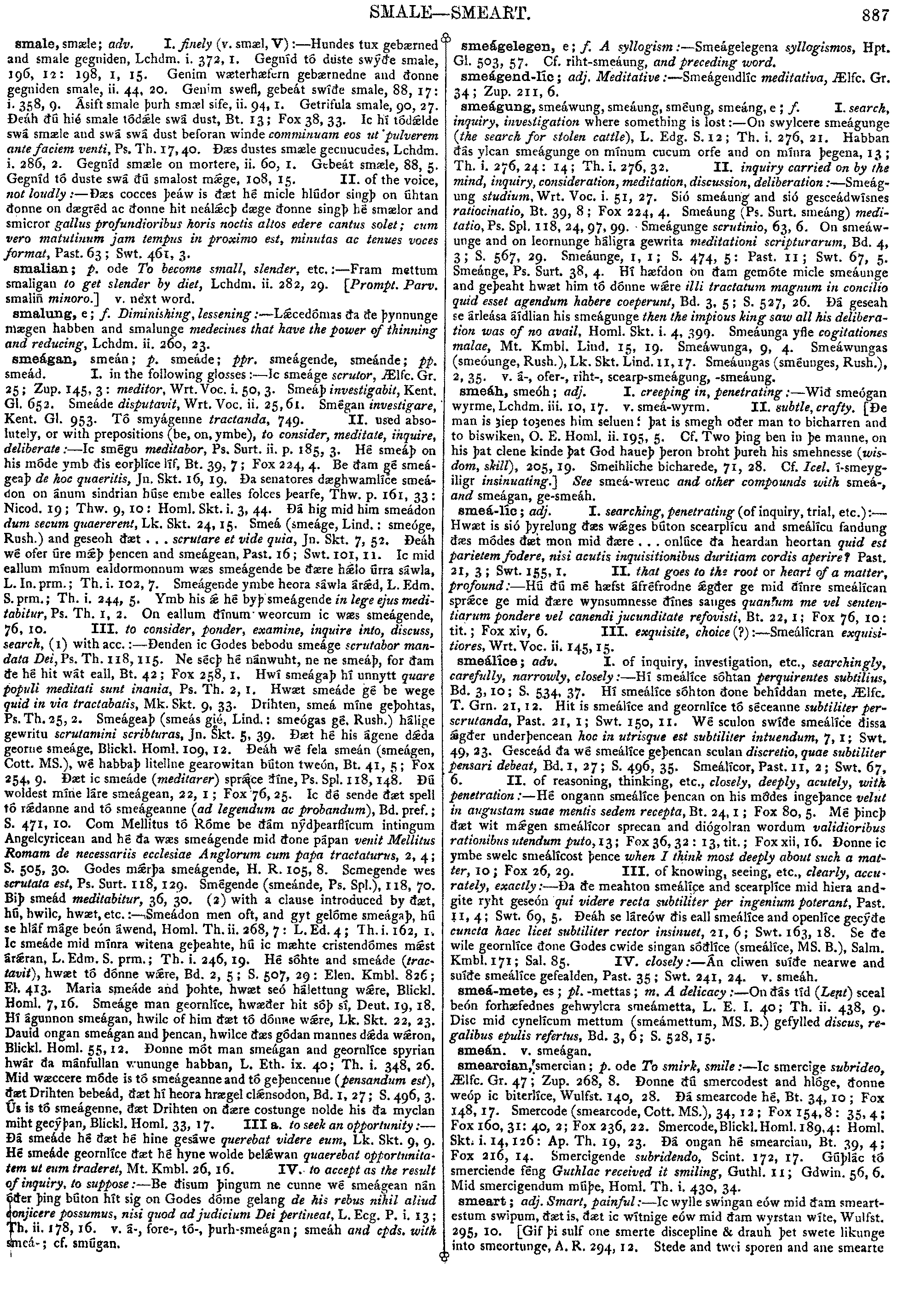
smeágan,
smeán;
p.
smeáde;
ppr.
smeágende,
smeánde;
pp.
smeád.
I.
in
the
following
glosses
:--
Ic
smeáge
scrutor,
Ælfc.
Gr.
25
;
Zup.
145,
3
:
meditor.
Wrt.
Voc.
i.
50,
3.
Smeáþ
investigabit,
Kent.
Gl.
652.
Smeáde
disputavit,
Wrt.
Voc.
ii.
25,
61.
Smegan
investigare,
'
Kent.
Gl.
953.
Tó
smyágenne
tractanda,
749.
II.
used
absolutely,
or
with
prepositions
(be,
on,
ymbe),
to
consider,
meditate,
inquire,
deliberate
:--
Ic
smégu
meditabor,
Ps.
Surt.
ii.
p.
185,
3.
Hé
smeáþ
on
his
móde
ymb
ðis
eorþlíce
líf.
Bt.
39,
7
;
Fox
224,
4.
Be
ðam
gé
smeá
 geaþ
de
hoc
quaeritis,
Jn.
Skt.
16,
19.
Ða
senatores
dæghwamlíce
smeádon
on
ánum
sindrian
búse
embe
ealles
folces
þearfe,
Thw.
p.
161,
33
;
Nicod.
19;
Thw.
9,
10:
Homl.
Skt.
i.
3,
44.
Ðá
big
mid
him
smeádon
dum
secum
quaererent,
Lk.
Skt.
24,
15.
Smeá
(smeáge,
Lind.
:
smeoge,
Rush.
)
and
geseoh
diet
.
.
.
scrutare
et
vide
quia,
Jn.
Skt.
7,
52.
Ðeáh
wé
ofer
úre
mþ
þencen
and
smeágean,
Past.
16;
Swt.
101,
ii.
Ic
mid
eallum
mínum
ealdormonnum
wæs
smeágende
be
ðære
hlo
úrra
sáwla,
L.
In.
prm.
;
Th.
i.
102,
7.
Smeágende
ymbe
heora
sáwla
árd,
L.
Edm.
S.
prm.
;
Th.
i.
244,
5.
Ymb
his
hé
byþ
smeágende
in
lege
ejus
meditabitur,
Ps.
Th.
1,
2.
On
eallum
ðínum
weorcum
ic
wæs
smeágende,
76,
10.
III.
to
consider,
ponder,
examine,
inquire
into,
discuss,
search,
(l)
with
acc.
:--
Ðenden
ic
Godes
bebodu
smeáge
scrutabor
mandata
Dei,
Ps.
Th.
118,
115.
Ne
sécþ
hé
nánwuht,
ne
ne
smeáþ,
for
ðam
ðe
hé
hit
wát
eall.
Bt.
42
;
Fox
258,
1.
Hwí
smeágaþ
hí
unnytt
quare
populi
meditati
sunt
inania,
Ps.
Th.
2,
Hwæt
smeáde
gé
be
wege
quid
in
via
tractabatis,
Mk.
Skt.
9,
33.
Drihten,
smeá
míne
geþohtas,
Ps.
Th.
25,
2.
Smeágeaþ
(smeás
gié.
Lind.
:
smeógas
gé.
Rush.
)
hálige
gewritu
scrutamini
scribturas,
Jn.
Skt.
5,
39.
Ðæt
hé
his
ágene
dda
georne
smeáge,
Blickl.
Homl.
109,
12.
Ðeáh
wé
fela
smeán
(smeágen,
Cote.
MS.
),
wé
habbaþ
litellne
gearowitan
búton
tweón.
Bt.
41,
5
;
Fox
254,
9.
Ðæt
ic
smeáde
(meditarer)
sprce
ðíne,
Ps.
Spl.
118,
148.
Ðú
woldest
míne
láre
srneágean,
22,
1;
Fox
76,
25.
Ic
dé
sende
ðæt
spell
tó
rdanne
and
tó
smeágeanne
(ad
legendum
ac
probandum).
Bd.
pref.
;
S.
471,
10.
Com
Mellitus
tó
Róme
be
ðám
nýdþearflícum
intingum
Angelcyriceau
and
hé
ða
wæs
smeágende
mid
ðone
pápan
venit
Mellitus
Romam
de
necessariis
ecclesiae
Anglorum
cum
papa
tractaturus,
2,
4;
S.
505,
30.
Godes
mrþa
smeágende,
H.
R.
105,
8.
Scmegende
wes
scrutata
est,
Ps.
Surt.
118,
129.
Smégende
(smeánde,
Ps.
Spl.
),
118,
70.
Biþ
smeád
meditabitur,
36,
30.
(2)
with
a
clause
introduced
by
ðæt,
hú,
hwilc,
hwæt,
etc.
:--
Smeádon
men
oft,
and
gyt
gelóme
smeágaþ,
hú
se
hláf
máge
beón
áwend.
Homl.
Th.
ii.
268,
7
:
L.
Ed.
4;
Th.
i.
162,
1.
Ic
smeáde
mid
mínra
witena
geþeahte,
hú
ic
mæhte
cristendómes
mst
árran,
L.
Edm.
S.
prm.
;
Th.
i.
246,
19.
Hé
sóhte
and
smeáde
(trac-tavit),
hwæt
tó
dónne
wre.
Bd.
2,
5;
S.
507,
29:
Elen.
Kmbl.
826;
EK
413.
Maria
smeáde
and
þohte,
hwæt
seó
hálettung
wre.
Blickl.
Homl.
7,
16.
Smeáge
man
geornlíce,
hwæðer
hit
sóþ
sí,
Deut.
19,
18.
Hí
águnnon
smeágan,
hwilc
of
him
ðæt
tó
dónne
wre,
Lk.
Skt.
22,
23.
Dauid
ongan
smeágan
and
þencan,
hwilce
ðæs
gódan
mannes
dda
wron,
Blickl.
Homl.
55,
12.
Ðonne
mót
man
smeágan
and
geornlíce
spyrian
hwár
ða
mánfullan
vununge
habban,
L.
Eth.
ix.
40;
Th.
i.
348,
26.
Mid
wæccere
móde
is
tó
smeágeanne
and
tó
geþencenue
(pensandum
est),
ðæt
Drihten
bebeád,
dæt
hí
heora
hrægel
clnsodon.
Bd.
1,
27;
S.
496,
3.
Ús
is
tó
smeágenne,
ðæt
Drihten
on
ðære
costunge
nolde
his
ða
myclan
miht
gecýþan,
Blickl.
Homl.
33,
17.
III
a.
to
seek
an
opportunity
:--
Ðá
smeáde
he
ðæt
hé
hine
gesáwe
querebat
videre
eum.
Lk.
Skt.
9,
9.
Hé
smeáde
geornlíce
ðæt
hé
hyne
wolde
belwan
quaerebat
opportunita-tem
ut
eum
traderet,
Mt.
Kmbl.
26,
16.
IV.
to
accept
as
the
result
of
inquiry,
to
suppose
:--
Be
ðisum
þingum
ne
cunne
wé
smeágean
nán
óðer
þing
búton
hít
sig
on
Godes
dóme
gelang
de
his
rebus
nihil
aliud
conjicere
possumus,
nisi
quod
adjudicium
Dei
pertineat,
L.
Ecg.
P.
i.
13;
Th.
ii.
178,
16.
v.
á-,
fore-,
tó-,
þurh-smeágan;
smeán
and
cpds.
with
smeá-;
cf.
smúgan.
geaþ
de
hoc
quaeritis,
Jn.
Skt.
16,
19.
Ða
senatores
dæghwamlíce
smeádon
on
ánum
sindrian
búse
embe
ealles
folces
þearfe,
Thw.
p.
161,
33
;
Nicod.
19;
Thw.
9,
10:
Homl.
Skt.
i.
3,
44.
Ðá
big
mid
him
smeádon
dum
secum
quaererent,
Lk.
Skt.
24,
15.
Smeá
(smeáge,
Lind.
:
smeoge,
Rush.
)
and
geseoh
diet
.
.
.
scrutare
et
vide
quia,
Jn.
Skt.
7,
52.
Ðeáh
wé
ofer
úre
mþ
þencen
and
smeágean,
Past.
16;
Swt.
101,
ii.
Ic
mid
eallum
mínum
ealdormonnum
wæs
smeágende
be
ðære
hlo
úrra
sáwla,
L.
In.
prm.
;
Th.
i.
102,
7.
Smeágende
ymbe
heora
sáwla
árd,
L.
Edm.
S.
prm.
;
Th.
i.
244,
5.
Ymb
his
hé
byþ
smeágende
in
lege
ejus
meditabitur,
Ps.
Th.
1,
2.
On
eallum
ðínum
weorcum
ic
wæs
smeágende,
76,
10.
III.
to
consider,
ponder,
examine,
inquire
into,
discuss,
search,
(l)
with
acc.
:--
Ðenden
ic
Godes
bebodu
smeáge
scrutabor
mandata
Dei,
Ps.
Th.
118,
115.
Ne
sécþ
hé
nánwuht,
ne
ne
smeáþ,
for
ðam
ðe
hé
hit
wát
eall.
Bt.
42
;
Fox
258,
1.
Hwí
smeágaþ
hí
unnytt
quare
populi
meditati
sunt
inania,
Ps.
Th.
2,
Hwæt
smeáde
gé
be
wege
quid
in
via
tractabatis,
Mk.
Skt.
9,
33.
Drihten,
smeá
míne
geþohtas,
Ps.
Th.
25,
2.
Smeágeaþ
(smeás
gié.
Lind.
:
smeógas
gé.
Rush.
)
hálige
gewritu
scrutamini
scribturas,
Jn.
Skt.
5,
39.
Ðæt
hé
his
ágene
dda
georne
smeáge,
Blickl.
Homl.
109,
12.
Ðeáh
wé
fela
smeán
(smeágen,
Cote.
MS.
),
wé
habbaþ
litellne
gearowitan
búton
tweón.
Bt.
41,
5
;
Fox
254,
9.
Ðæt
ic
smeáde
(meditarer)
sprce
ðíne,
Ps.
Spl.
118,
148.
Ðú
woldest
míne
láre
srneágean,
22,
1;
Fox
76,
25.
Ic
dé
sende
ðæt
spell
tó
rdanne
and
tó
smeágeanne
(ad
legendum
ac
probandum).
Bd.
pref.
;
S.
471,
10.
Com
Mellitus
tó
Róme
be
ðám
nýdþearflícum
intingum
Angelcyriceau
and
hé
ða
wæs
smeágende
mid
ðone
pápan
venit
Mellitus
Romam
de
necessariis
ecclesiae
Anglorum
cum
papa
tractaturus,
2,
4;
S.
505,
30.
Godes
mrþa
smeágende,
H.
R.
105,
8.
Scmegende
wes
scrutata
est,
Ps.
Surt.
118,
129.
Smégende
(smeánde,
Ps.
Spl.
),
118,
70.
Biþ
smeád
meditabitur,
36,
30.
(2)
with
a
clause
introduced
by
ðæt,
hú,
hwilc,
hwæt,
etc.
:--
Smeádon
men
oft,
and
gyt
gelóme
smeágaþ,
hú
se
hláf
máge
beón
áwend.
Homl.
Th.
ii.
268,
7
:
L.
Ed.
4;
Th.
i.
162,
1.
Ic
smeáde
mid
mínra
witena
geþeahte,
hú
ic
mæhte
cristendómes
mst
árran,
L.
Edm.
S.
prm.
;
Th.
i.
246,
19.
Hé
sóhte
and
smeáde
(trac-tavit),
hwæt
tó
dónne
wre.
Bd.
2,
5;
S.
507,
29:
Elen.
Kmbl.
826;
EK
413.
Maria
smeáde
and
þohte,
hwæt
seó
hálettung
wre.
Blickl.
Homl.
7,
16.
Smeáge
man
geornlíce,
hwæðer
hit
sóþ
sí,
Deut.
19,
18.
Hí
águnnon
smeágan,
hwilc
of
him
ðæt
tó
dónne
wre,
Lk.
Skt.
22,
23.
Dauid
ongan
smeágan
and
þencan,
hwilce
ðæs
gódan
mannes
dda
wron,
Blickl.
Homl.
55,
12.
Ðonne
mót
man
smeágan
and
geornlíce
spyrian
hwár
ða
mánfullan
vununge
habban,
L.
Eth.
ix.
40;
Th.
i.
348,
26.
Mid
wæccere
móde
is
tó
smeágeanne
and
tó
geþencenue
(pensandum
est),
ðæt
Drihten
bebeád,
dæt
hí
heora
hrægel
clnsodon.
Bd.
1,
27;
S.
496,
3.
Ús
is
tó
smeágenne,
ðæt
Drihten
on
ðære
costunge
nolde
his
ða
myclan
miht
gecýþan,
Blickl.
Homl.
33,
17.
III
a.
to
seek
an
opportunity
:--
Ðá
smeáde
he
ðæt
hé
hine
gesáwe
querebat
videre
eum.
Lk.
Skt.
9,
9.
Hé
smeáde
geornlíce
ðæt
hé
hyne
wolde
belwan
quaerebat
opportunita-tem
ut
eum
traderet,
Mt.
Kmbl.
26,
16.
IV.
to
accept
as
the
result
of
inquiry,
to
suppose
:--
Be
ðisum
þingum
ne
cunne
wé
smeágean
nán
óðer
þing
búton
hít
sig
on
Godes
dóme
gelang
de
his
rebus
nihil
aliud
conjicere
possumus,
nisi
quod
adjudicium
Dei
pertineat,
L.
Ecg.
P.
i.
13;
Th.
ii.
178,
16.
v.
á-,
fore-,
tó-,
þurh-smeágan;
smeán
and
cpds.
with
smeá-;
cf.
smúgan.
|
Source: Bosworth/Toller, page b0901, entry 5 View original page image as: [TIFF] [PNG] [View previous entry] [View next entry] |
[Comment on this entry] [View comments (1)] |
The following entry has been hand-corrected once. |
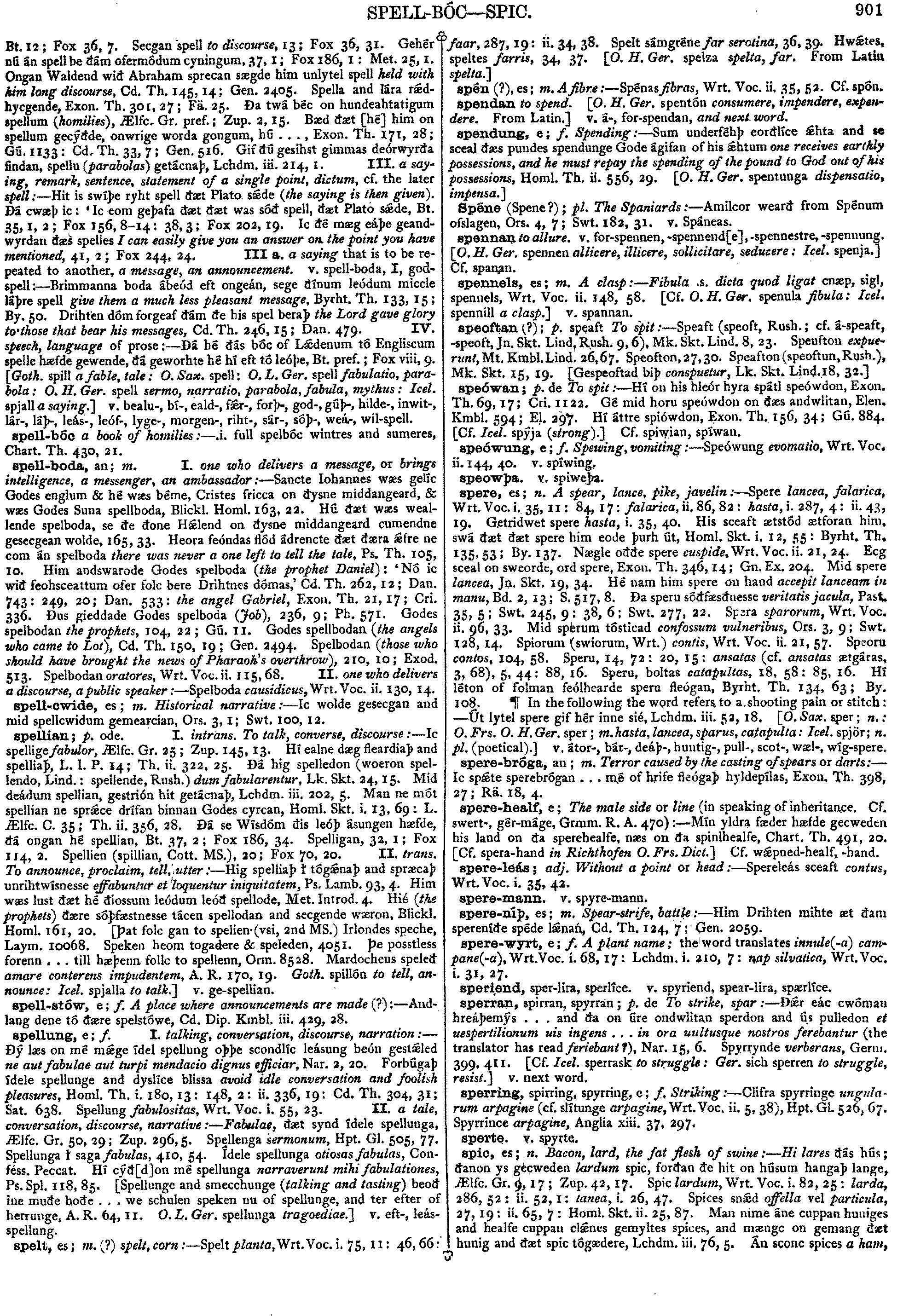
spellian;
p.
ode.
I.
intrans.
To
talk,
converse,
discourse
:--
Ic
spellige
fabalor,
Ælfc.
Gr.
25
;
Zup.
145,
13.
Hí
ealne
dæg
fleardiaþ
and
spelliaþ,
L.
1.
P.
14;
Th.
ii.
322,
25.
Ðá
hig
spelledon
(woeron
spellendo,
Lind.
:
spellende,
Rush.)
dum
fabularentur,
Lk.
Skt.
24,
15.
Mid
deádum
spellian,
gestrión
hit
getácnaþ,
Lchdm.
iii.
202,
5.
Man
ne
mót
spellian
ne
sprce
drífan
binnan
Godes
cyrcan,
Homl.
Skt.
i.
13,
69:
L.
Ælfc.
C.
35;
Th.
ii.
356,
28.
Ðá
se
Wísdóm
ðis
leóþ
ásungen
hæfde,
ðá
ongan
hé
spellian,
Bt.
37,
2;
Fox
186,
34.
Spelligan,
32,
1;
Fox
114,
2.
Spellien
(spillian,
Cote.
MS.),
20;
Fox
70,
20.
II.
trans.
To
announce,
proclaim,
tell,
utter
:--
Hig
spelliaþ
UNCERTAIN
tógnaþ
and
spræcaþ
unrihtwísnesse
effabuntur
et
loquentur
iniquitatem,
Ps.
Lamb.
93,
4.
Him
wæs
lust
ðæt
hé
ðiossum
leódum
leóð
spellode,
Met.
Introd.
4.
Hié
(the
prophets)
ðære
sóþfæstnesse
tácen
spellodan
and
secgende
wæron.
Blickl.
Homl.
161,
20.
[Þat
folc
gan
to
spelien
(vsi,
2nd
MS.)
Irlondes
speche,
Laym.
10068.
Speken
heom
togadere
&
speleden,
4051.
Þe
posstless
forenn
.
.
.
till
hæþenn
follc
to
spellenn,
Orm.
8528.
Mardocheus
speleð
amare
conterens
impudentem,
A.
R.
170,
19.
Goth.
spillón
to
tell,
announce:
Icel.
spjalla
to
talk.]
v.
ge-spellian.
|
Source: Bosworth/Toller, page b0905, entry 7 View original page image as: [TIFF] [PNG] [View previous entry] [View next entry] |
[Comment on this entry] [View comments (1)] |
The following entry has been hand-corrected once. |
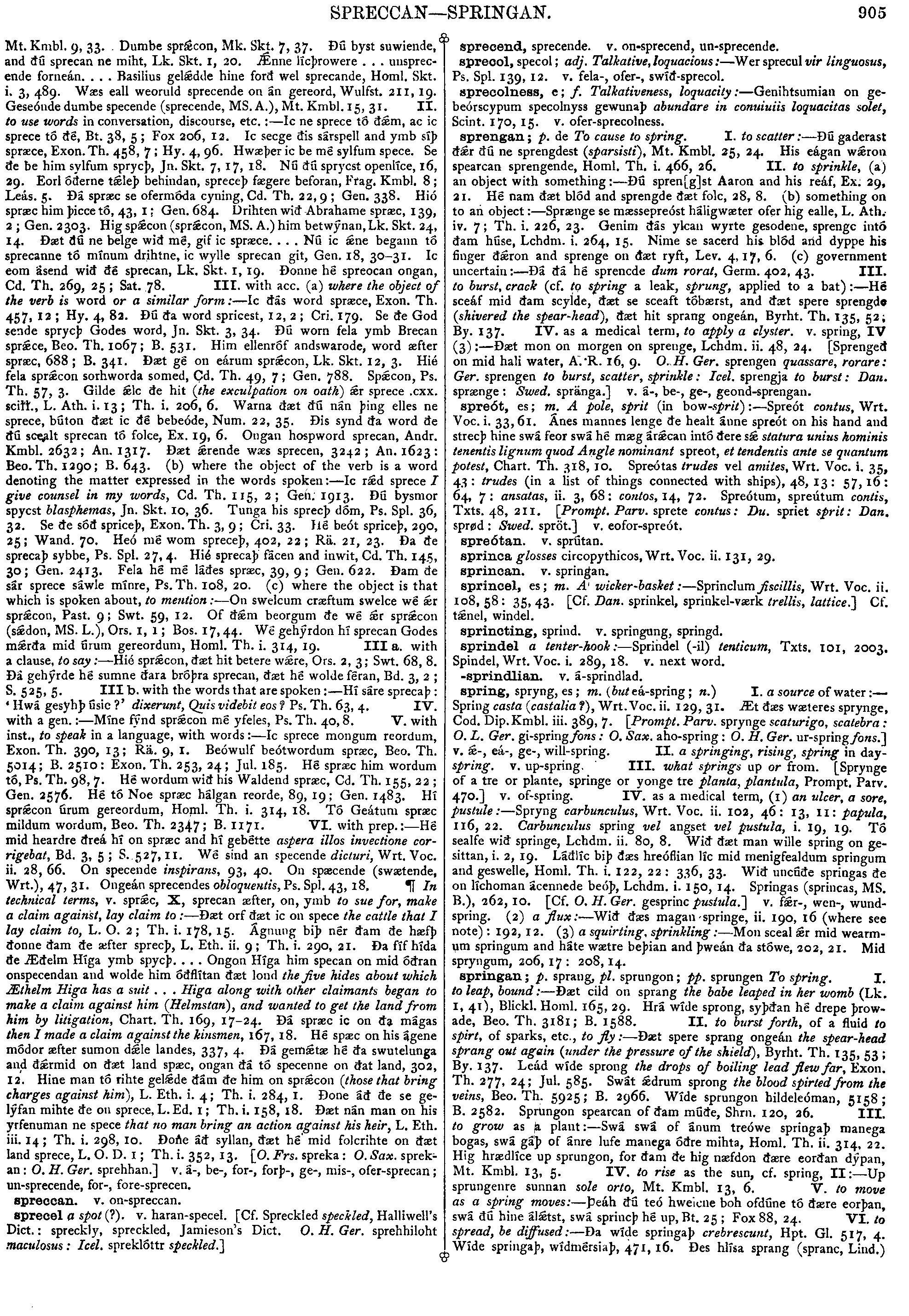
sprengan;
p.
de
To
cause
to
spring.
I.
to
scatter:--Ðú
gaderast
ðr
ðú
ne
sprengdest
(sparsisti),
Mt.
Kmbl.
25,
24.
His
eágan
wron
spearcan
sprengende,
Homl.
Th.
i.
466,
26.
II.
to
sprinkle,
(a)
an
object
with
something:--Ðú
spren[g]st
Aaron
and
his
reáf,
Ex.
29,
21.
Hé
nam
ðæt
blód
and
sprengde
ðæt
folc,
28,
8.
(b)
something
on
to
an
object:--Sprænge
se
mæssepreóst
háligwæter
ofer
hig
ealle,
L.
Ath.
iv.
7;
Th.
i.
226,
23.
Genim
ðás
ylcan
wyrte
gesodene,
sprengc
intó
ðam
húse,
Lchdm.
i.
264,
15.
Nime
se
sacerd
his
blód
arid
dyppe
his
finger
ðron
and
sprenge
on
dæt
ryft,
Lev.
4,
17,
6.
(c)
government
uncertain:--Ðá
ðá
hé
sprencde
dum
rorat,
Germ.
402,
43.
III.
to
burst,
crack
(cf.
to
spring
a
leak,
sprung,
applied
to
a
bat):--Hé
sceáf
mid
ðam
scylde,
ðæt
se
sceaft
tóbærst,
and
ðæt
spere
sprengde
(shivered
the
spear-head),
ðæt
hit
sprang
ongeán,
Byrht.
Th.
135,
52;
By.
137.
IV.
as
a
medical
term,
to
apply
a
clyster,
v.
spring,
IV
(3):--Ðæt
mon
on
morgen
on
sprenge,
Lchdm.
ii.
48,
24.
[Sprengeð
on
mid
hali
water,
A.
R.
16,
9.
O.
H.
Ger.
sprengen
quassare,
rorare:
Ger.
sprengen
to
burst,
scatter,
sprinkle:
Icel.
sprengja
to
burst:
Dan.
sprænge:
Swed.
spränga.]
v.
á-,
be-,
ge-,
geond-sprengan.
|
Source: Bosworth/Toller, page b0917, entry 1 View original page image as: [TIFF] [PNG] [View previous entry] [View next entry] |
[Comment on this entry] [View comments (1)] |
The following entry has been hand-corrected once. |
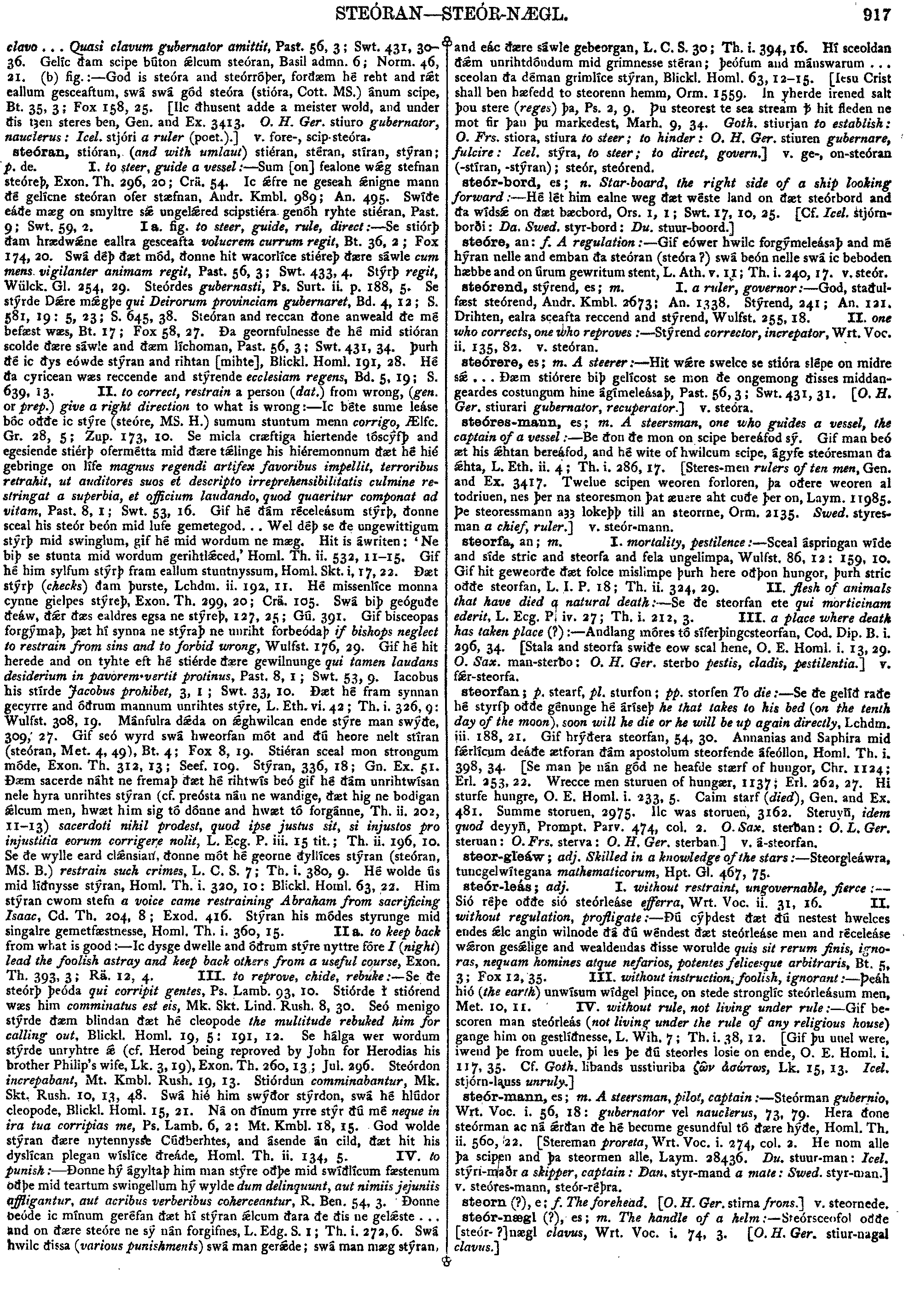
steóran,
stióran,
(and
with
umlaut)
stiéran,
stéran,
stíran,
stýran;
p.
de.
I.
to
steer,
guide
a
vessel:?-Sum
[on]
fealone
wg
stefnan
steóreþ,
Exon.
Th.
296,
20;
Crii.
54.
Ic
fre
ne
geseah
nigne
mann
ðé
gelícne
steóran
ofer
stæfnan,
Andr.
Kmbl.
989;
An.
495.
Swíðe
eáðe
mæg
on
smyltre
s
ungelred
scipstiéra
genóh
ryhte
stiéran,
Past.
9;
Swt.
59,
2.
Ia.
fig.
to
steer,
guide,
rule,
direct:?-Se
stiórþ
ðam
hrædwne
eallra
gesceafta
volucrem
currum
regit,
Bt.
36,
2;
Fox
174,
20.
Swá
déþ
ðæt
mód,
ðonne
hit
wacorlíce
stiéreþ
ðære
sáwle
cum
mens
vigilanter
animam
regit,
Past.
56,
3;
Swt.
433,
4.
Stýrþ
regit,
Wülck.
Gl.
254,
29.
Steórdes
gubernasti,
Ps.
Surt.
ii.
p.
188,
5.
Se
stýrde
Dre
mgþe
qui
Deirorum
provinciam
gubernaret,
Bd.
4,
12;
S.
581,
19:
5,
23;
S.
645,
38.
Steóran
and
reccan
ðone
anweald
ðe
mé
befæst
wæs,
Bt.
17;
Fox
58,
27.
Ða
geornfulnesse
ðe
hé
mid
stióran
scolde
ðære
sáwle
and
ðæm
líchoman,
Past.
56,
3;
Swt.
431,
34.
Þurh
ðé
ic
ðys
eówde
stýran
and
rihtan
[mihte],
Blickl.
Homl.
191,
28.
Hé
ða
cyricean
wæs
reccende
and
stýrende
ecclesiam
regens,
Bd.
5,
19;
S.
639,
13.
II.
to
correct,
restrain
a
person
(dat.)
from
wrong,
(gen.
or
prep.)
give
a
right
direction
to
what
is
wrong:--Ic
béte
sume
leáse
bóc
oððe
ic
stýre
(steóre,
MS.
H.)
sumum
stuntum
menn
corrigo,
Ælfc.
Gr.
28,
5;
Zup.
173,
10.
Se
micla
cræftiga
hiertende
tóscýfþ
and
egesiende
stiérþ
ofermétta
mid
ðære
tlinge
his
hiéremonnum
ðæt
hé
hié
gebringe
on
lífe
magnus
regendi
artifex
favoribus
impellit,
terroribus
retrahit,
ut
auditores
suos
et
descripto
irreprehensibilitatis
culmine
restringat
a
superbia,
et
officium
laudando,
quod
quaeritur
componat
ad
vitam,
Past.
8,
1;
Swt.
53,
16.
Gif
hé
ðám
réceleásum
stýrþ,
ðonne
sceal
his
steór
beón
mid
lufe
gemetegod.
.
.
Wel
déþ
se
ðe
ungewittigum
stýrþ
mid
swinglum,
gif
hé
mid
wordum
ne
mæg.
Hit
is
áwriten:
'Ne
biþ
se
stunta
mid
wordum
gerihtlced,'
Homl.
Th.
ii.
532,
11-15.
Gif
hé
him
sylfum
stýrþ
fram
eallum
stuntnyssum,
Homl.
Skt.
i.
17,
22.
Ðæt
stýrþ
(checks)
ðam
þurste,
Lchdm.
ii.
192,
11.
Hé
missenlíce
monna
cynne
gielpes
stýreþ,
Exon.
Th.
299,
20;
Crä.
105.
Swá
biþ
geóguðe
ðeáw,
ðr
ðæs
ealdres
egsa
ne
stýreþ,
127,
25;
Gú.
391.
Gif
bisceopas
forgýmaþ,
þæt
hí
synna
ne
stýraþ
ne
unriht
forbeódaþ
if
bishops
neglect
to
restrain
from
sins
and
to
forbid
wrong,
Wulfst.
176,
29.
Gif
hé
hit
herede
and
on
tyhte
eft
hé
stiérde
ðære
gewilnunge
qui
tamen
laudans
desiderium
in
pavoremvertit
protinus,
Past.
8,
1;
Swt.
53,
9.
Iacobus
his
stírde
Jacobus
prohibet,
3,
1;
Swt.
33,
10.
Ðæt
hé
fram
synnan
gecyrre
and
óðrum
mannum
unrihtes
stýre,
L.
Eth.
vi.
42;
Th.
i.
326,
9:
Wulfst.
308,
19.
Mánfulra
dda
on
ghwilcan
ende
stýre
man
swýðe,
309,
27.
Gif
seó
wyrd
swá
hweorfan
mót
and
ðú
heore
nelt
stíran
(steóran,
Met.
4,
49),
Bt.
4;
Fox
8,
19.
Stiéran
sceal
mon
strongum
móde,
Exon.
Th.
312,
13;
Seef.
109.
Stýran,
336,
18;
Gn.
Ex.
51.
Ðæm
sacerde
náht
ne
fremaþ
ðæt
hé
rihtwís
beó
gif
hé
ðám
unrihtwísan
nele
hyra
unrihtes
stýran
(cf.
preósta
nán
ne
wandige,
ðæt
hig
ne
bodigan
lcum
men,
hwæt
him
sig
tó
dónne
and
hwæt
tó
forgánne,
Th.
ii.
202,
11-13)
sacerdoti
nihil
prodest,
quod
ipse
justus
sit,
si
injustos
pro
injustitia
eorum
corrigere
nolit,
L.
Ecg.
P.
iii.
15
tit.;
Th.
ii.
196,
10.
Se
ðe
wylle
eard
clnsian,
ðonne
mót
hé
georne
ðyllíces
stýran
(steóran,
MS.
B.)
restrain
such
crimes,
L.
C.
S.
7;
Th.
i.
380,
9.
Hé
wolde
ús
mid
líðnysse
stýran,
Homl.
Th.
i.
320,
10:
Blickl.
Homl.
63,
22.
Him
stýran
cwom
stefn
a
voice
came
restraining
Abraham
from
sacrificing
Isaac,
Cd.
Th.
204,
8;
Exod.
416.
Stýran
his
módes
styrunge
mid
singalre
gemetfæstnesse,
Homl.
Th.
i.
360,
15.
II
a.
to
keep
back
from
what
is
good:--Ic
dysge
dwelle
and
óðrum
stýre
nyttre
fóre
I
(night)
lead
the
foolish
astray
and
keep
back
others
from
a
useful
course,
Exon.
Th.
393,
3;
Rä.
12,
4.
III.
to
reprove,
chide,
rebuke:?-Se
ðe
steórþ
þeóda
qui
corripit
gentes,
Ps.
Lamb.
93,
10.
Stiórde
stiórend
wæs
him
comminatus
est
eis,
Mk.
Skt.
Lind.
Rush.
8,
30.
Seó
menigo
stýrde
ðæm
blindan
ðæt
hé
cleopode
the
multitude
rebuked
him
for
calling
out,
Blickl.
Homl.
19,
5:
191,
12.
Se
hálga
wer
wordum
stýrde
unryhtre
(cf.
Herod
being
reproved
by
John
for
Herodias
his
brother
Philip's
wife,
Lk.
3,
19),
Exon.
Th.
260,
13;
Jul.
296.
Steórdon
increpabant,
Mt.
Kmbl.
Rush.
19,
13.
Stiórdun
comminabantur,
Mk.
Skt.
Rush.
10,
13,
48.
Swá
hié
him
swýðor
stýrdon,
swá
hé
hlúdor
cleopode,
Blickl.
Homl.
15,
21.
Ná
on
ðínum
yrre
stýr
ðú
mé
neque
in
ira
tua
corripias
me,
Ps.
Lamb.
6,
2:
Mt.
Kmbl.
18,
15.
God
wolde
stýran
ðære
nytennyse
Cúðberhtes,
and
ásende
án
cild,
ðæt
hit
his
dyslícan
plegan
wíslíce
ðreáde,
Homl.
Th.
ii.
134,
5.
IV.
to
punish:?-Ðonne
hý
ágyltaþ
him
man
stýre
oðþe
mid
swíðlícum
fæstenum
oðþe
mid
teartum
swingellum
hý
wylde
dum
delinquunt,
aut
nimiis
jejuniis
affligantur,
aut
acribus
verberibus
coherceantur,
R.
Ben.
54,
3.
Ðonne
beóde
ic
mínum
geréfan
ðæt
hí
stýran
lcum
ðara
ðe
ðis
ne
gelste
.
.
.
and
on
ðære
steóre
ne
sý
nán
forgifnes,
L.
Edg.
S.
1;
Th.
i.
272,
6.
Swá
hwilc
ðissa
(various
punishments)
swá
man
gerde;
swá
man
mæg
stýran,
and
eác
ðære
sáwle
gebeorgan,
L.
C.
S.
30;
Th.
i.
394,
16.
Hí
sceoldan
ðm
unrihtdóndum
mid
grimnesse
stéran;
þeófum
and
mánswarum
.
.
.
sceolan
ða
déman
grimlíce
stýran,
Blickl.
Homl.
63,
12-15.
[Iesu
Crist
shall
ben
hæfedd
to
steorenn
hemm,
Orm.
1559.
In
yherde
irened
salt
þou
stere
(reges)
þa,
Ps.
2,
9.
Þu
steorest
te
sea
stream
 hit
fleden
ne
mot
fir
þan
þu
markedest,
Marh.
9,
34.
Goth.
stiurjan
to
establish:
O.
Frs.
stiora,
stiura
to
steer;
to
hinder:
O.
H.
Ger.
stiuren
gubernare,
fulcire:
Icel.
stýra,
to
steer;
to
direct,
govern.]
v.
ge-,
on-steóran
(-stíran,
-stýran);
steór,
steórend.
hit
fleden
ne
mot
fir
þan
þu
markedest,
Marh.
9,
34.
Goth.
stiurjan
to
establish:
O.
Frs.
stiora,
stiura
to
steer;
to
hinder:
O.
H.
Ger.
stiuren
gubernare,
fulcire:
Icel.
stýra,
to
steer;
to
direct,
govern.]
v.
ge-,
on-steóran
(-stíran,
-stýran);
steór,
steórend.
|
Source: Bosworth/Toller, page b0928, entry 4 View original page image as: [TIFF] [PNG] [View previous entry] [View next entry] |
[Comment on this entry] [View comments] |
The following entry has been hand-corrected once. |
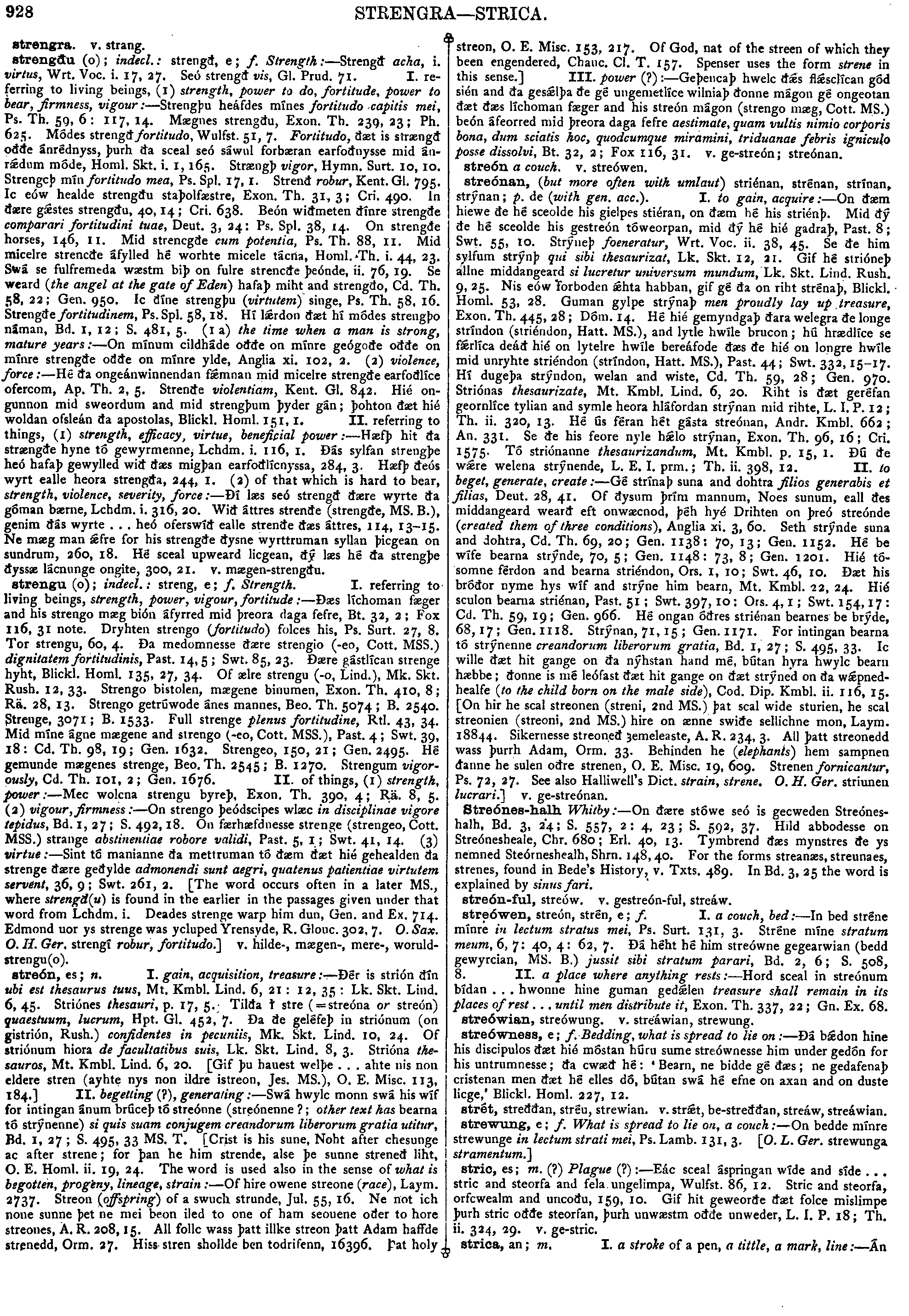
streón,
es;
n.
I.
gain,
acquisition,
treasure:--
Ðér
is
strión
ðín
ubi
est
thesaurus
tuus.
Mt.
Kmbl.
Lind.
6,
21:
12,
35
:
Lk.
Skt.
Lind.
6,
45.
Striónes
thesauri,
p.
17,
5.
Tilða
stre
(=
streóna
or
streón)
quaestuum,
lucrum,
Hpt.
Gl.
452,
7.
Ða
ðe
geléfeþ
in
striónum
(on
gistrión,
Rush.)
confidentes
in
pecuniis,
Mk.
Skt.
Lind.
10,
24.
Of
striónum
hiora
de
facultatibus
suis,
Lk.
Skt.
Lind.
8,
3.
Strióna
thesauros.
Mt.
Kmbl.
Lind.
6,
20.
[Gif
þu
hauest
welþe
.
.
.
ahte
nis
non
eldere
stren
(ayhte
nys
non
ildre
istreon,
Jes.
MS.),
O.
E.
Misc.
113,
184.]
II.
begetting(?),
generating:--
Swá
hwylc
monn
swá
his
wíf
for
intingan
ánum
brúceþ
tó
streónne
(streónenne
?;
other
text
has
bearna
tó
strýnenne)
si
quis
suam
conjugem
creandorum
liberorum
gratia
utitur,
Bd.
1,
27
;
S.
495,
33
MS.
T.
[Crist
is
his
sune,
Noht
after
chesunge
ac
after
strene;
for
þan
he
him
strende,
alse
þe
sunne
streneð
liht,
O.E.
Homl.
ii
19,
24.
The
word
is
used
also
in
the
sense
of
what
is
begotten,progeny,
lineage,
strain
:--Of
hire
owene
streone
(race),
Laym.
2737.
Streon
(offspring)
of
a
swuch
strunde,
Jul.
55,
16.
Ne
not
ich
none
sunne
þet
ne
mei
beon
iled
to
one
of
ham
seouene
oðer
to
hore
streones,
A.R.
208,
15.
All
follc
wass
þatt
illke
streon
þatt
Adam
haffde
strenedd,
Orm.
27.
Hiss
stren
shollde
ben
todrifenn,
16396.
Þat
holy
streon,
O.E.
Misc.
153,
217.
Of
God,
nat
of
the
streen
of
which
they
been
engendered,
Chauc.
Cl.
T.
157.
Spenser
uses
the
form
strene
in
this
sense.]
III.
power
(?):--
Geþencaþ
hwelc
ðs
flsclícan
gód
sién
and
ða
geslþa
ðe
géungemetlíce
wilniaþ
ðonne
mágon
gé
ongeotan
ðæt
ð
æs
líchoman
fæger
and
his
streón
mágon
(strengo
mæg
Cott.
MS.)
beón
áfeorred
mid
þreora
daga
fefre
aestimate,
quam
vultis
nimio
corporis
bona,
dum
sciatis
hoc,
quodcumque
miramini,
triduanae
febris
igniculo
posse
dissolvi,
Bt.
32,
2;
Fox
116,
31.
v.
ge-streón;
streónan.
| Result Page: |  |
Previous | 1 2 3 4 5 6 7 8 9 10 11 12 13 14 15 | Next |  |
Germanic Lexicon Project (main page)
This search system was written by
Sean Crist
Please consider
volunteering
to correct the data in these online dictionaries.
No rights reserved. Feel free to use these data in any way you please.