|
|

Tip: In the search results, you can click on any word or abbreviation for more information.
|
Source: Bosworth/Toller, page b0007, entry 42 View original page image as: [TIFF] [PNG] [View previous entry] [View next entry] |
[Comment on this entry] [View comments] |
The following entry has been hand-corrected once. |
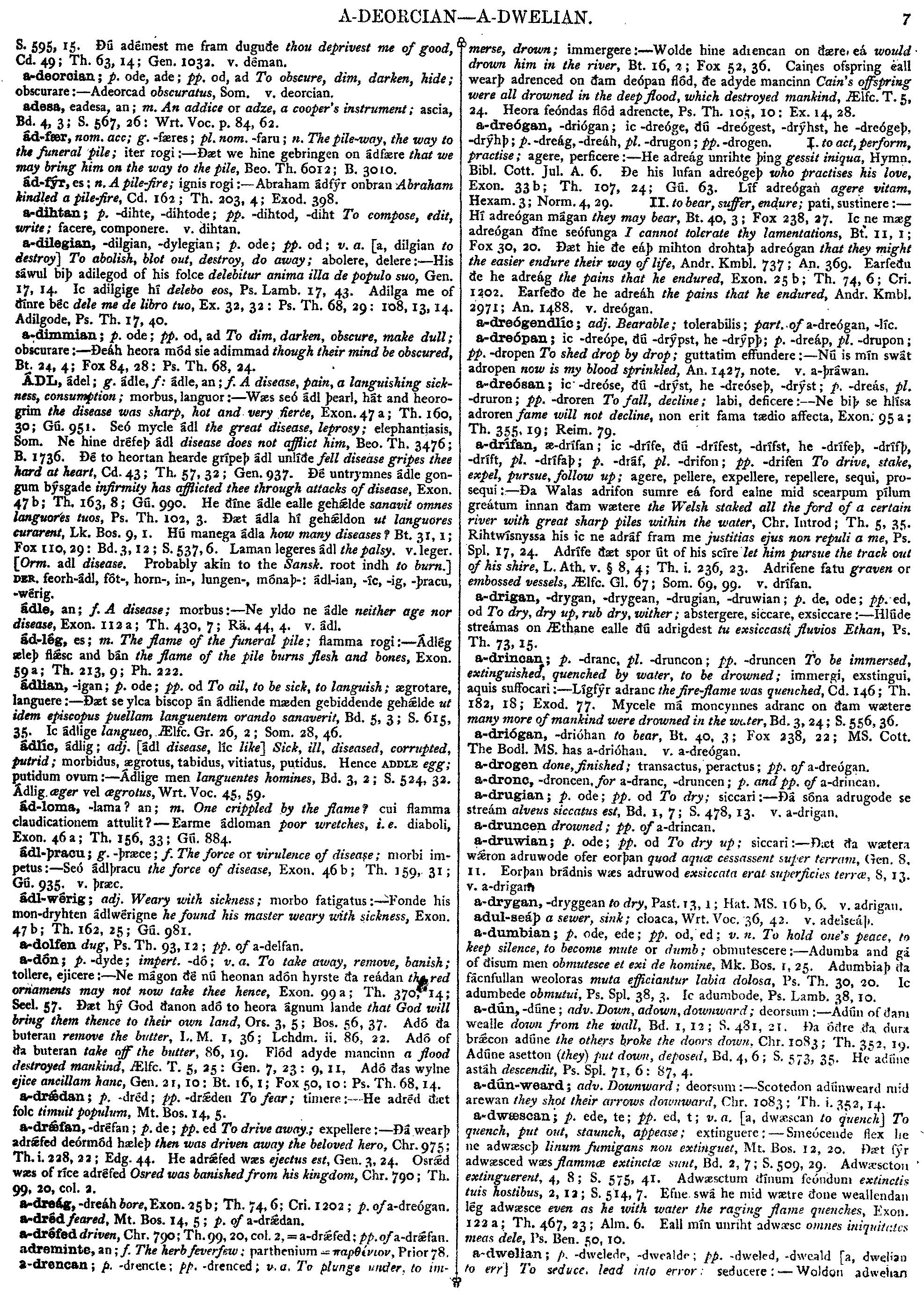
a-dún,
-dúne;
adv.
Down,
adown,
downward;
deorsum
:--
Adún
of
ðam
wealle
down
from
the
wall,
Bd.
1,
12;
S.
481,
21.
Ða
óðre
ða
dura
br con
adúne
the
others
broke
the
doors
down,
Chr.
1083;
Th.
352,
19.
Adúne
asetton
(they)
put
down,
deposed,
Bd.
4,
6;
S.
573,
35.
He
adúne
astáh
descendit,
Ps.
Spl.
71,
6:
87,
4.
con
adúne
the
others
broke
the
doors
down,
Chr.
1083;
Th.
352,
19.
Adúne
asetton
(they)
put
down,
deposed,
Bd.
4,
6;
S.
573,
35.
He
adúne
astáh
descendit,
Ps.
Spl.
71,
6:
87,
4.
|
Source: Bosworth/Toller, page b0076, entry 16 View original page image as: [TIFF] [PNG] [View previous entry] [View next entry] |
[Comment on this entry] [View comments] |
The following entry has been hand-corrected once. |
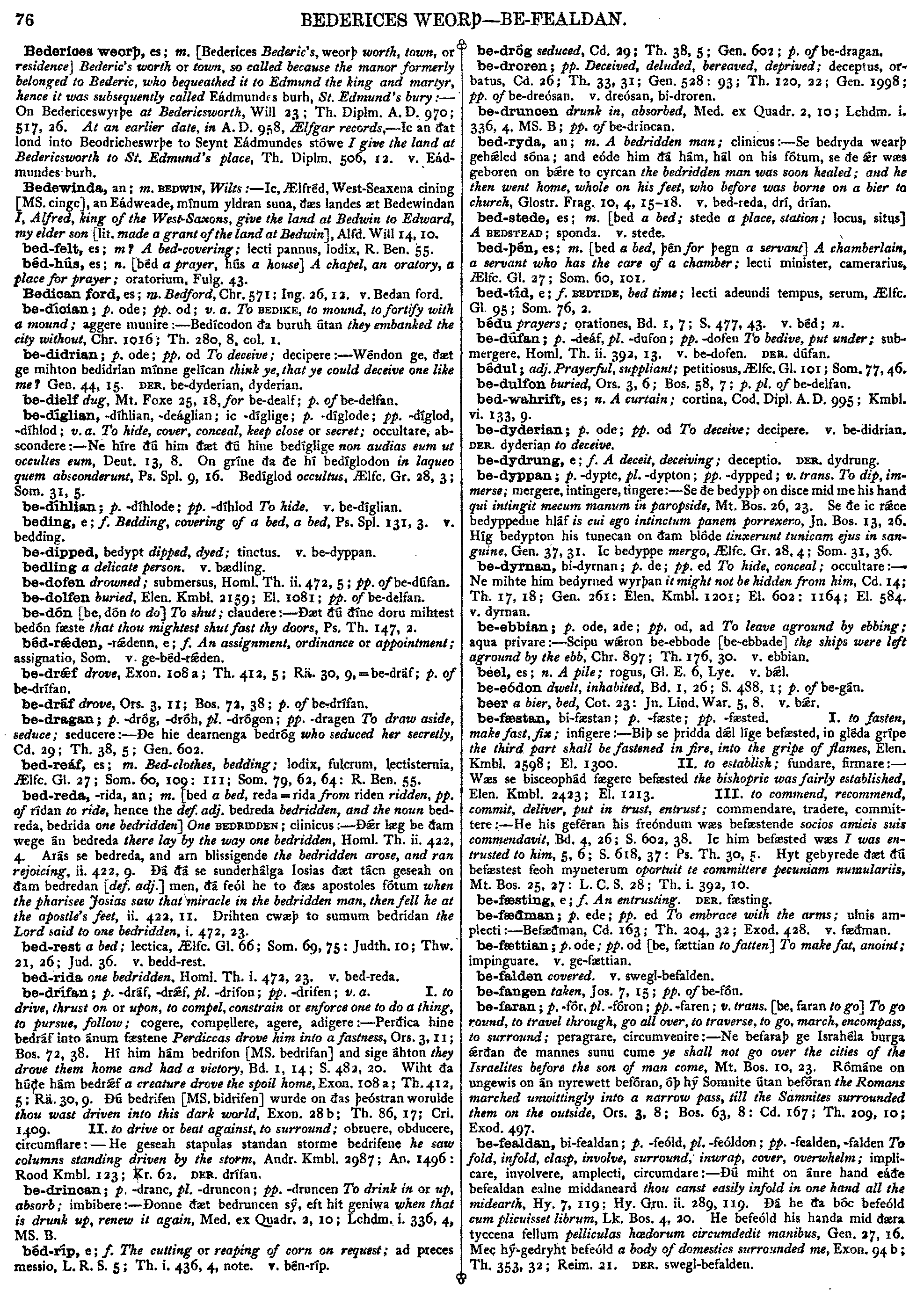
be-dón [be, dón to do] To shut; claudere :-- Ðæt ðú ðíne doru mihtest bedón fæste that thou mightest shut fast thy doors, Ps. Th. 147, 2.
|
Source: Bosworth/Toller, page b0096, entry 26 View original page image as: [TIFF] [PNG] [View previous entry] [View next entry] |
[Comment on this entry] [View comments] |
The following entry has been hand-corrected once. |
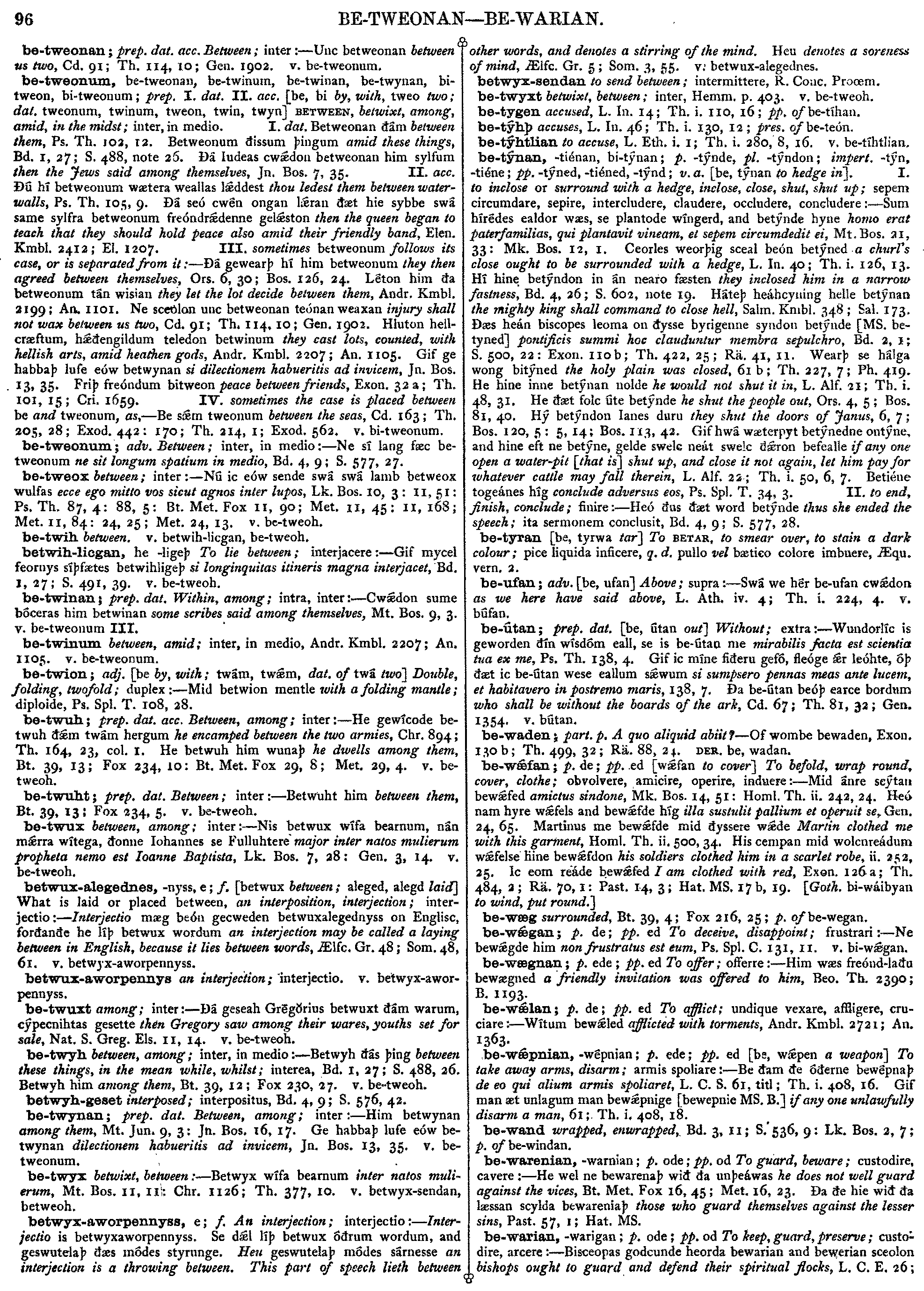
be-týnan,
-tiénan,
bi-týnan;
p.
-týnde,
pl.
-týndon;
impert.
-týn,
-tiéne;
pp.
-týned,
-tiéned,
-týnd;
v.
a.
[be,
týnan
to
hedge
in].
I.
to
inclose
or
surround
with
a
hedge,
inclose,
close,
shut,
shut
up;
sepem
circumdare,
sepire,
intercludere,
claudere,
occludere,
concludere
:--
Sum
hírédes
ealdor
wæs,
se
plantode
wíngerd,
and
betýnde
hyne
homo
erat
paterfamilias,
qui
plantavit
vineam,
et
sepem
circumdedit
ei,
Mt.
Bos.
21,
33
:
Mk.
Bos.
12,
1.
Ceorles
weorþig
sceal
beón
betýned
a
churl's
close
ought
to
be
surrounded
with
a
hedge,
L.
In.
40;
Th.
i.
126,
13.
Hí
hine
betýndon
in
án
nearo
fæsten
they
inclosed
him
in
a
narrow
fastness,
Bd.
4,
26;
S.
602,
note
19.
Háteþ
heáhcyning
helle
betýnan
the
mighty
king
shall
command
to
close
hell,
Salm.
Kmbl.
348;
Sal.
173.
Ðæs
heán
biscopes
leoma
on
ðysse
byrigenne
syndon
betýnde
[MS.
betyned]
pontificis
summi
hoc
clauduntur
membra
sepulchro,
Bd.
2,
1;
S.
500,
22
:
Exon.
110
b;
Th.
422,
25;
Rä.
41,
11.
Wearþ
se
hálga
wong
bitýned
the
holy
plain
was
closed,
61
b;
Th.
227,
7;
Ph.
419.
He
hine
inne
betýnan
nolde
he
would
not
shut
it
in,
L.
Alf.
21;
Th.
i.
48,
31.
He
ðæt
folc
úte
betýnde
he
shut
the
people
out,
Ors.
4,
5;
Bos.
81,
40.
Hý
betýndon
Ianes
duru
they
shut
the
doors
of
Janus,
6,
7;
Bos.
120,
5
:
5,
14;
Bos.
113,
42.
Gif
hwá
wæterpyt
betýnedne
ontýne,
and
hine
eft
ne
betýne,
gelde
swelc
neát
swelc
ðron
befealle
if
any
one
open
a
water-pit
[that
is]
shut
up,
and
close
it
not
again,
let
him
pay
for
whatever
cattle
may
fall
therein,
L.
Alf.
22;
Th.
i.
50,
6,
7.
Betiéne
togeánes
híg
conclude
adversus
eos,
Ps.
Spl.
T.
34,
3.
II.
to
end,
finish,
conclude;
finire
:--
Heó
ðus
ðæt
word
betýnde
thus
she
ended
the
speech;
ita
sermonem
conclusit,
Bd.
4,
9;
S.
577,
28.
|
Source: Bosworth/Toller, page b0121, entry 24 View original page image as: [TIFF] [PNG] [View previous entry] [View next entry] |
[Comment on this entry] [View comments] |
The following entry has been hand-corrected once. |
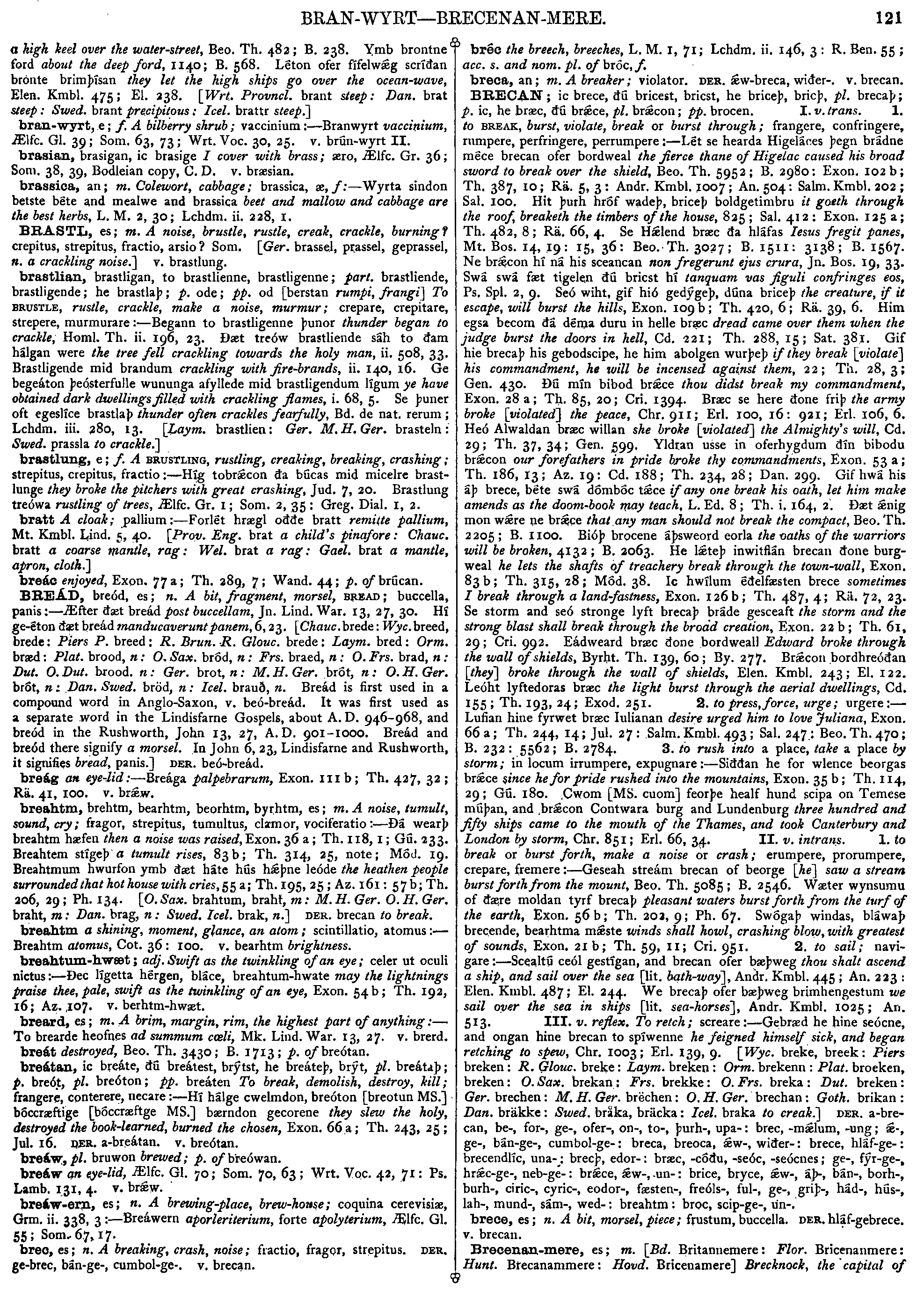
BRECAN;
ic
brece,
ðú
bricest,
bricst,
he
briceþ,
bricþ,
pl.
brecaþ;
p.
ic,
he
bræc,
ðú
brce,
pl.
brcon;
pp.
brocen.
I.
v.
trans.
1.
to
BREAK,
burst,
violate,
break
or
burst
through;
frangere,
confringere,
rumpere,
perfringere,
perrurnpere
:--
Lét
se
hearda
Higeláces
þegn
brádne
méce
brecan
ofer
bordweal
the
fierce
thane
of
Higelac
caused
his
broad
sword
to
break
over
the
shield.
Beo.
Th.
5952;
B.
2980:
Exon.
102
b;
Th.
387,
10;
Rä.
5,
3:
Andr.
Kmbl.
1007;
An.
504:
Salm.
Kmbl.
202
;
Sal.
100.
Hit
þurh
hróf
wadeþ,
briceþ
boldgetimbru
it
goeth
through
the
roof,
breaketh
the
timbers
of
the
house,
825
;
Sal.
412
:
Exon.
125
a;
Th.
482,
8;
Rä.
66,
4.
Se
Hlend
bræc
ða
hláfas
Iesus
fregit
panes,
Mt.
Bos.
14,
19:
15,
36:
Beo.
Th.
3027;
B.
1511:
3138;
B.
1567.
Ne
brcon
hí
ná
his
sceancan
non
fregernt
ejus
crura,
Jn.
Bos.
19,
33.
Swá
swá
fæt
tigelen
ðú
bricst
hi
tanquam
vas
figuli
confringes
eos,
Ps.
Spl.
2,
9.
Seó
wiht,
gif
hió
gedýgeþ,
dúna
briceþ
the
creature,
if
it
escape,
will
burst
the
hills,
Exon.
109
b;
Th.
420,
6;
Rä.
39,
6.
Him
egsa
becom
ðá
déma
duru
in
helle
bræc
dread
came
over
them
when
the
judge
burst
the
doors
in
hell.
Cd.
221;
Th.
288,
15;
Sat.
381.
Gif
hie
brecaþ
his
gebodscipe,
he
him
abolgen
wurþeþ
if
they
break
[violate]
his
commandment,
he
will
be
incensed
against
them,
22;
Th.
28,
3;
Gen.
430.
Ðú
mín
bibod
brce
thou
didst
break
my
commandment,
Exon.
28
a;
Th.
85,
20;
Cri.
1394.
Bræc
se
here
ðone
friþ
the
army
broke
[violated]
the
peace,
Chr.
911;
Erl.
100,
16:
921;
Erl.
106,
6.
Heó
Alwaldan
bræc
willan
she
broke
[violated]
the
Almighty's
will,
Cd.
29;
Th.
37,
34;
Gen.
599.
Yldran
usse
in
oferhygdum
ðín
bibodu
brcon
our
forefathers
in
pride
broke
thy
commandments,
Exon.
53
a;
Th.
186,
13;
Az.
19:
Cd.
188;
Th.
234,
28;
Dan.
299.
Gif
hwá
his
áþ
brece,
béte
swá
dómbóc
tce
if
any
one
break
his
oath,
let
him
make
amends
as
the
doom-book
may
teach,
L.
Ed.
8
;
Th.
i.
164,
2.
Ðæt
nig
mon
wre
ne
brce
that
any
man
should
not
break
the
compact,
Beo.
Th.
2205
;
B.
1100.
Bióþ
brocene
áþsweord
eorla
the
oaths
of
the
warriors
will
be
broken,
4132
;
B.
2063.
He
lteþ
inwitfán
UNCERTAIN
brecan
ðone
burg-weal
he
lets
the
shafts
of
treachery
break
through
the
town-wall,
Exon.
83b;
Th.
315,
28;
Mód.
38.
Ic
hwílum
éðelfæsten
brece
sometimes
I
break
through
a
land-fastness,
Exon.
126
b;
Th.
487,
4;
Rä.
72,
23.
Se
storm
and
seó
stronge
lyft
brecaþ
bráde
gesceaft
the
storm
and
the
strong
blast
shall
break
through
the
broad
creation,
Exon.
22
b
;
Th.
61,
29;
Cri.
992.
Eádweard
bræc
ðone
bordweall
Edward
broke
through
the
wall
of
shields,
Byrht.
Th.
139,
60;
By.
277.
Brcon
bordhreóðan
[they]
broke
through
the
wall
of
shields.
Elen.
Kmbl.
243;
El.
122.
Leóht
lyftedoras
bræc
the
light
burst
through
the
aerial
dwellings,
Cd.
155
;
Th.
193,
24;
Exod.
251.
2.
to
press,
force,
urge;
urgere
:--
Lufian
hine
fyrwet
bræc
lulianan
desire
urged
him
to
love
Juliana,
Exon.
66
a;
Th.
244,
14;
Jul.
27:
Salm.
Kmbl.
493;
Sal.
247:
Beo.
Th.
470;
B.
232:
5562;
B.
2784.
3.
to
rush
into
a
place,
take
a
place
by
storm;
in
locum
irrumpere,
expugnare
:--
Siððan
he
for
wlence
beorgas
brce
since
he
for
pride
rushed
into
the
mountains,
Exon.
35
b;
Th.
114,
29;
Gú.
180.
Cwom
[MS.
cuom]
feorþe
healf
hund
scipa
on
Temese
múþan,
and
brcon
Contwara
burg
and
Lundenburg
three
hundred
and
fifty
ships
came
to
the
mouth
of
the
Thames,
and
took
Canterbury
and
London
by
storm,
Chr.
851;
Erl.
66,
34.
II.
v.
intrans.
1.
to
break
or
burst
forth,
make
a
noise
or
crash;
erumpere,
prorumpere,
crepare,
fremere
:--
Geseah
streám
brecan
of
beorge
[he]
saw
a
stream
burst
forth
from
the
mount,
Bec.
Th.
5085
;
B.
2546.
Wæter
wynsumu
of
ðære
moldan
tyrf
brecaþ
pleasant
waters
burst
forth
from
the
turf
of
the
earth,
Exon.
56
b;
Th.
202,
9;
Ph.
67.
Swógaþ
windas,
bláwaþ
brecende,
bearhtma
mste
winds
shall
howl,
crashing
blow,
with
greatest
of
sounds,
Exon.
21
b;
Th.
59,
II;
Cri.
951.
2.
to
sail;
navi-gare
:--
Scealtú
ceól
gestígan,
and
brecan
ofer
bæþweg
thou
shalt
ascend
a
ship,
and
sail
over
the
sea
[lit.
bath-way],
Andr.
Kmbl.
445
;
An.
223
:
Elen.
Kmbl.
487;
El.
244.
We
brecaþ
ofer
bæþweg
brimhengestum
we
sail
over
the
sea
in
ships
[lit.
sea-horses].
Andr.
Kmbl.
1025;
An.
513.
III.
v.
reflex.
To
retch;
screare
:--
Gebræd
he
hine
seócne,
and
ongan
hine
brecan
to
spíwenne
he
feigned
himself
sick,
and
began
retching
to
spew,
Chr.
1003;
Erl.
139,
9.
[Wyc.
breke,
breek:
Piers
breken:
R.
Glouc.
breke:
Laym.
breken:
Orm.
brekenn:
Plat.
broeken,
breken:
O.
Sax.
brekan:
Frs.
brekke:
O.
Frs.
breka:
Dut.
breken:
Ger.
brechen:
M.
H.
Ger.
brëchen:
O.
H.
Ger.
brechan:
Goth.
brikan
:
Dan.
bräkke:
Swed.
bråka,
bräcka:
Icel.
braka
to
creak.]
DER.
a-brecan,
be-,
for-,
ge-,
ofer-,
on-,
to-,
þurh-,
upa-:
brec,
-mlum,
-ung;
-,
ge-,
bán-ge-,
cumbol-ge-:
breca,
breoca,
w-,
wiðer-:
brece,
hláf-ge-:
brecendlíc,
una-:
brecþ,
edor-:
bræc,
-cóðu,
-seóc,
-seócnes;
ge-,
fýr-ge-,
hrc-ge-,
neb-ge-:
brce,
w-,
-un-:
brice,
bryce,
w-,
áþ-,
bán-,
borh-,
burh-,
ciric-,
cyric-,
eodor-,
fæsten-,
freóls-,
ful-,
ge-,
griþ-,
hád-,
hús-,
lah-,
mund-,
sám-,
wed-:
breahtm:
broc,
scip-ge-,
un-.
|
Source: Bosworth/Toller, page b0209, entry 9 View original page image as: [TIFF] [PNG] [View previous entry] [View next entry] |
[Comment on this entry] [View comments] |
The following entry has been hand-corrected once. |
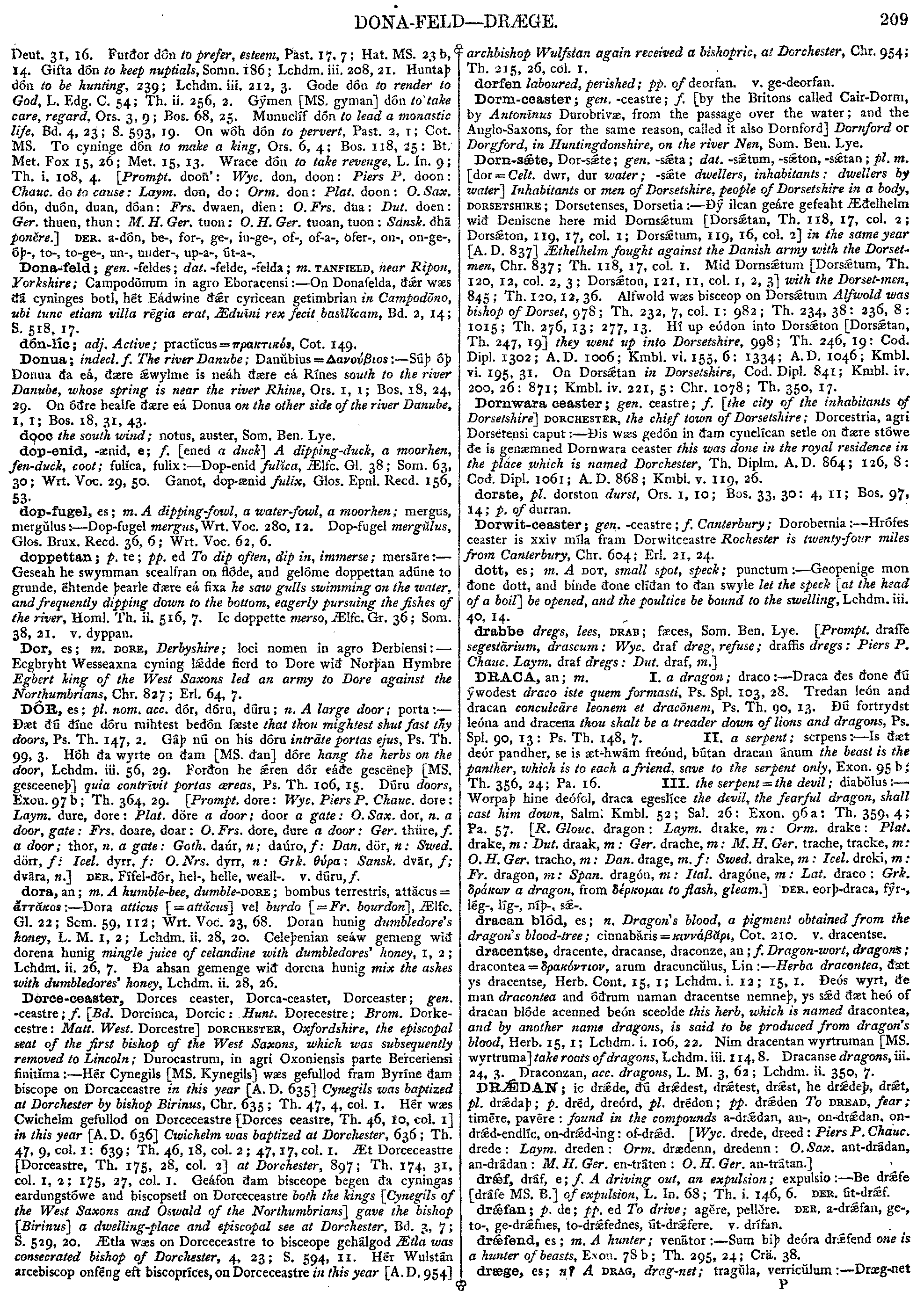
DÓR,
es;
pl.
nom.
acc.
dór,
dóru,
dúru;
n.
A
large
door;
porta
:--
Ðæt
ðú
ðíne
dóru
mihtest
bedón
fæste
that
thou
mightest
shut
fast
thy
doors,
Ps.
Th.
147,
2.
Gáþ
nú
on
his
dóru
intr te
portas
ejus,
Ps.
Th.
99,
3.
Hóh
ða
wyrte
on
ðam
[MS.
ðan]
dóre
hang
the
herbs
on
the
door,
Lchdm.
iii.
56,
29.
Forðon
he
ren
dór
eáðe
gescéneþ
[MS.
gesceeneþ]
quia
contr
te
portas
ejus,
Ps.
Th.
99,
3.
Hóh
ða
wyrte
on
ðam
[MS.
ðan]
dóre
hang
the
herbs
on
the
door,
Lchdm.
iii.
56,
29.
Forðon
he
ren
dór
eáðe
gescéneþ
[MS.
gesceeneþ]
quia
contr vit
portas
æreas,
Ps.
Th.
106,
15.
Dúru
doors,
Exon.
97
b;
Th.
364,
29.
[Prompt.
dore:
Wyc.
Piers
P.
Chauc.
dore:
Laym.
dure,
dore:
Plat.
döre
a
door;
door
a
gate:
O.
Sax.
dor,
n.
a
door,
gate:
Frs.
doare,
doar:
O.
Frs.
dore,
dure
a
door:
Ger.
thüre,
f.
a
door;
thor,
n.
a
gate:
Goth.
daúr,
n;
daúro,
f:
Dan.
dör,
n:
Swed.
dörr,
f:
Icel.
dyrr,
f:
O.
Nrs.
dyrr,
n:
Grk.
vit
portas
æreas,
Ps.
Th.
106,
15.
Dúru
doors,
Exon.
97
b;
Th.
364,
29.
[Prompt.
dore:
Wyc.
Piers
P.
Chauc.
dore:
Laym.
dure,
dore:
Plat.
döre
a
door;
door
a
gate:
O.
Sax.
dor,
n.
a
door,
gate:
Frs.
doare,
doar:
O.
Frs.
dore,
dure
a
door:
Ger.
thüre,
f.
a
door;
thor,
n.
a
gate:
Goth.
daúr,
n;
daúro,
f:
Dan.
dör,
n:
Swed.
dörr,
f:
Icel.
dyrr,
f:
O.
Nrs.
dyrr,
n:
Grk.
 &upsilon-tonos;
 :
Sansk.
dvr,
f;
dvra,
n.]
DER.
Fífel-dór,
hel-,
helle,
weall-.
v.
dúru,
f.
:
Sansk.
dvr,
f;
dvra,
n.]
DER.
Fífel-dór,
hel-,
helle,
weall-.
v.
dúru,
f.
|
Source: Bosworth/Toller, page b0219, entry 13 View original page image as: [TIFF] [PNG] [View previous entry] [View next entry] |
[Comment on this entry] [View comments] |
The following entry has been hand-corrected once. |
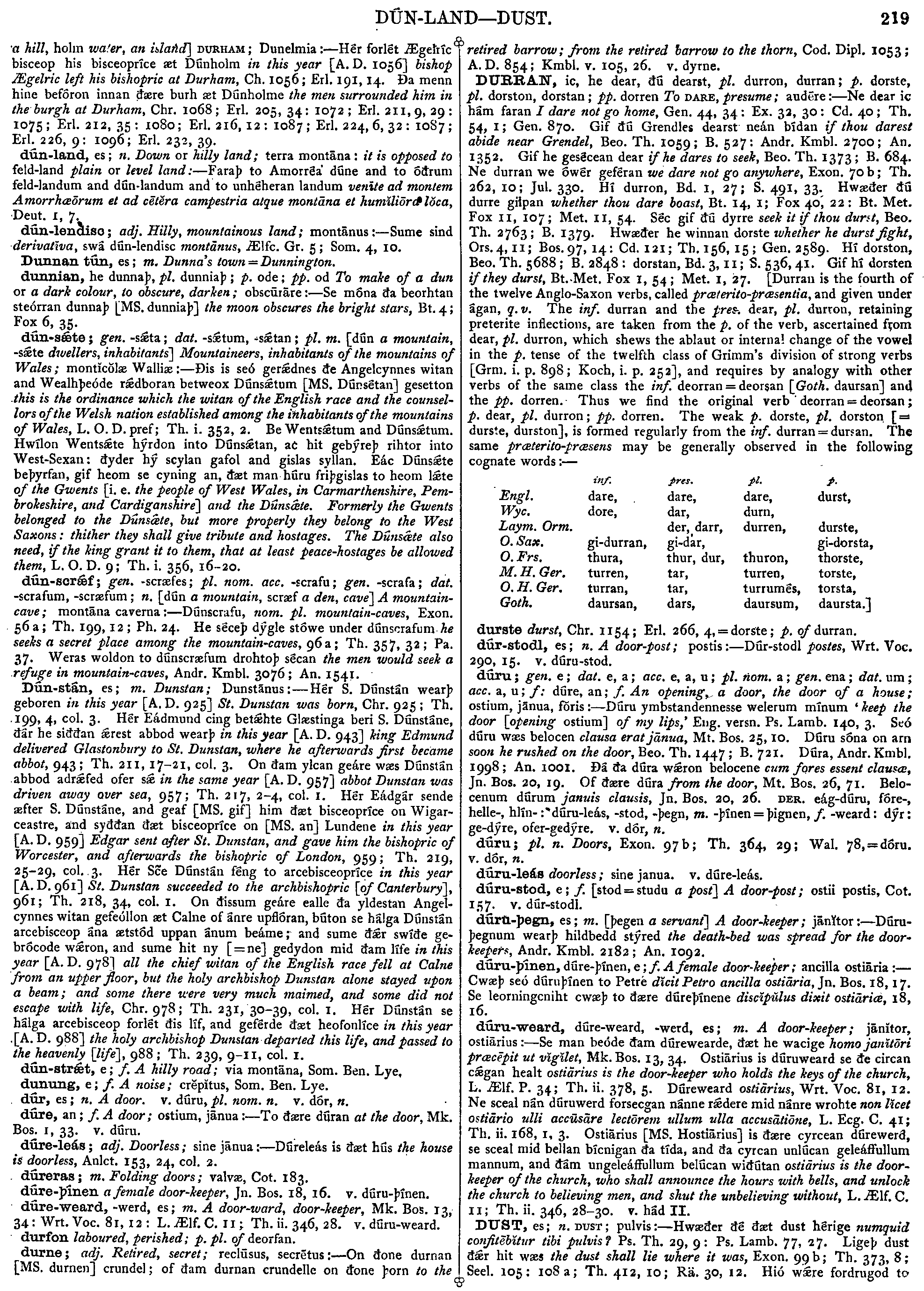
dúreras; m. Folding doors; valvæ, Cot. 183.
|
Source: Bosworth/Toller, page b0219, entry 23 View original page image as: [TIFF] [PNG] [View previous entry] [View next entry] |
[Comment on this entry] [View comments] |
The following entry has been hand-corrected once. |
dúru; pl. n. Doors, Exon. 97 b; Th. 364, 29; Wal. 78, = dóru. v. dór, n.
|
Source: Bosworth/Toller, page b0357, entry 25 View original page image as: [TIFF] [PNG] [View previous entry] [View next entry] |
[Comment on this entry] [View comments] |
The following entry has been hand-corrected once. |
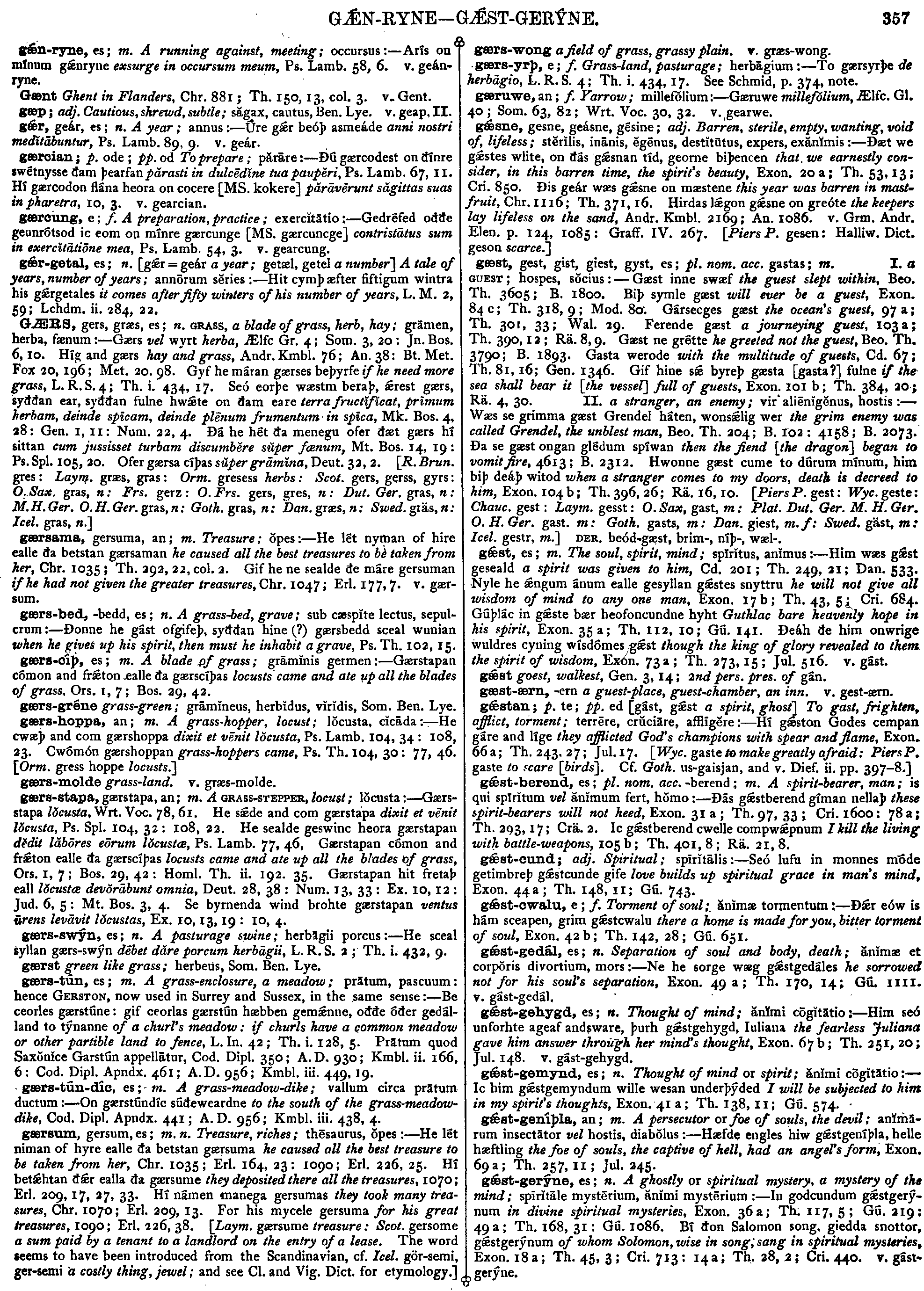
gæst,
gest,
gist,
giest,
gyst,
es;
pl.
nom.
acc.
gastas;
m.
I.
a
GUEST;
hospes,
s cius
:--
Gæst
inne
swæf
the
guest
slept
within,
Beo.
Th.
3605;
B.
1800.
Biþ
symle
gæst
will
ever
be
a
guest,
Exon.
84
c;
Th.
318,
9;
Mod.
80.
Gársecges
gæst
the
ocean's
guest,
97
a;
Th.
301,
33;
Wal.
29.
Ferende
gæst
a
journeying
guest,
103
a;
Th.
390,
12;
Rä.
8,
9.
Gæst
ne
grétte
he
greeted
not
the
guest,
Beo.
Th.
3790;
B.
1893.
Gasta
werode
with
the
multitude
of
guests,
Cd.
67;
Th.
81,
16;
Gen.
1346.
Gif
hine
s
byreþ
gæsta
[gasta?]
fulne
if
the
sea
shall
bear
it
[the
vessel]
full
of
guests,
Exon.
101
b;
Th.
384,
20;
Rä.
4,
30.
II.
a
stranger,
an
enemy;
vir
ali
cius
:--
Gæst
inne
swæf
the
guest
slept
within,
Beo.
Th.
3605;
B.
1800.
Biþ
symle
gæst
will
ever
be
a
guest,
Exon.
84
c;
Th.
318,
9;
Mod.
80.
Gársecges
gæst
the
ocean's
guest,
97
a;
Th.
301,
33;
Wal.
29.
Ferende
gæst
a
journeying
guest,
103
a;
Th.
390,
12;
Rä.
8,
9.
Gæst
ne
grétte
he
greeted
not
the
guest,
Beo.
Th.
3790;
B.
1893.
Gasta
werode
with
the
multitude
of
guests,
Cd.
67;
Th.
81,
16;
Gen.
1346.
Gif
hine
s
byreþ
gæsta
[gasta?]
fulne
if
the
sea
shall
bear
it
[the
vessel]
full
of
guests,
Exon.
101
b;
Th.
384,
20;
Rä.
4,
30.
II.
a
stranger,
an
enemy;
vir
ali n
n g
g nus,
hostis
:--
Wæs
se
grimma
gæst
Grendel
háten,
wonslig
wer
the
grim
enemy
was
called
Grendel,
the
unblest
man,
Beo.
Th.
204;
B.
102
:
4158;
B.
2073.
Ða
se
gæst
ongan
glédum
spíwan
then
the
fiend
[the
dragon]
began
to
vomit
fire,
4613;
B.
2312.
Hwonne
gæst
cume
to
dúrum
mínum,
him
biþ
ðeáþ
witod
when
a
stranger
comes
to
my
doors,
death
is
decreed
to
him,
Exon.
104
b;
Th.
396,
26;
Rä.
16,
10.
[Piers
P.
gest
:
Wyc.
geste
:
Chauc.
gest
:
Laym.
gesst
:
O.
Sax.
gast,
m
:
Plat.
Dut.
Ger.
M.
H.
Ger.
O.
H.
Ger.
gast.
m
:
Goth.
gasts,
m
:
Dan.
giest,
m.
f
:
Swed.
gäst,
m
:
Icel.
gestr,
m.]
DER.
beód-gæst,
brim-,
níþ-,
wæl-.
nus,
hostis
:--
Wæs
se
grimma
gæst
Grendel
háten,
wonslig
wer
the
grim
enemy
was
called
Grendel,
the
unblest
man,
Beo.
Th.
204;
B.
102
:
4158;
B.
2073.
Ða
se
gæst
ongan
glédum
spíwan
then
the
fiend
[the
dragon]
began
to
vomit
fire,
4613;
B.
2312.
Hwonne
gæst
cume
to
dúrum
mínum,
him
biþ
ðeáþ
witod
when
a
stranger
comes
to
my
doors,
death
is
decreed
to
him,
Exon.
104
b;
Th.
396,
26;
Rä.
16,
10.
[Piers
P.
gest
:
Wyc.
geste
:
Chauc.
gest
:
Laym.
gesst
:
O.
Sax.
gast,
m
:
Plat.
Dut.
Ger.
M.
H.
Ger.
O.
H.
Ger.
gast.
m
:
Goth.
gasts,
m
:
Dan.
giest,
m.
f
:
Swed.
gäst,
m
:
Icel.
gestr,
m.]
DER.
beód-gæst,
brim-,
níþ-,
wæl-.
|
Source: Bosworth/Toller, page b0507, entry 2 View original page image as: [TIFF] [PNG] [View previous entry] [View next entry] |
[Comment on this entry] [View comments] |
The following entry has been hand-corrected once. |
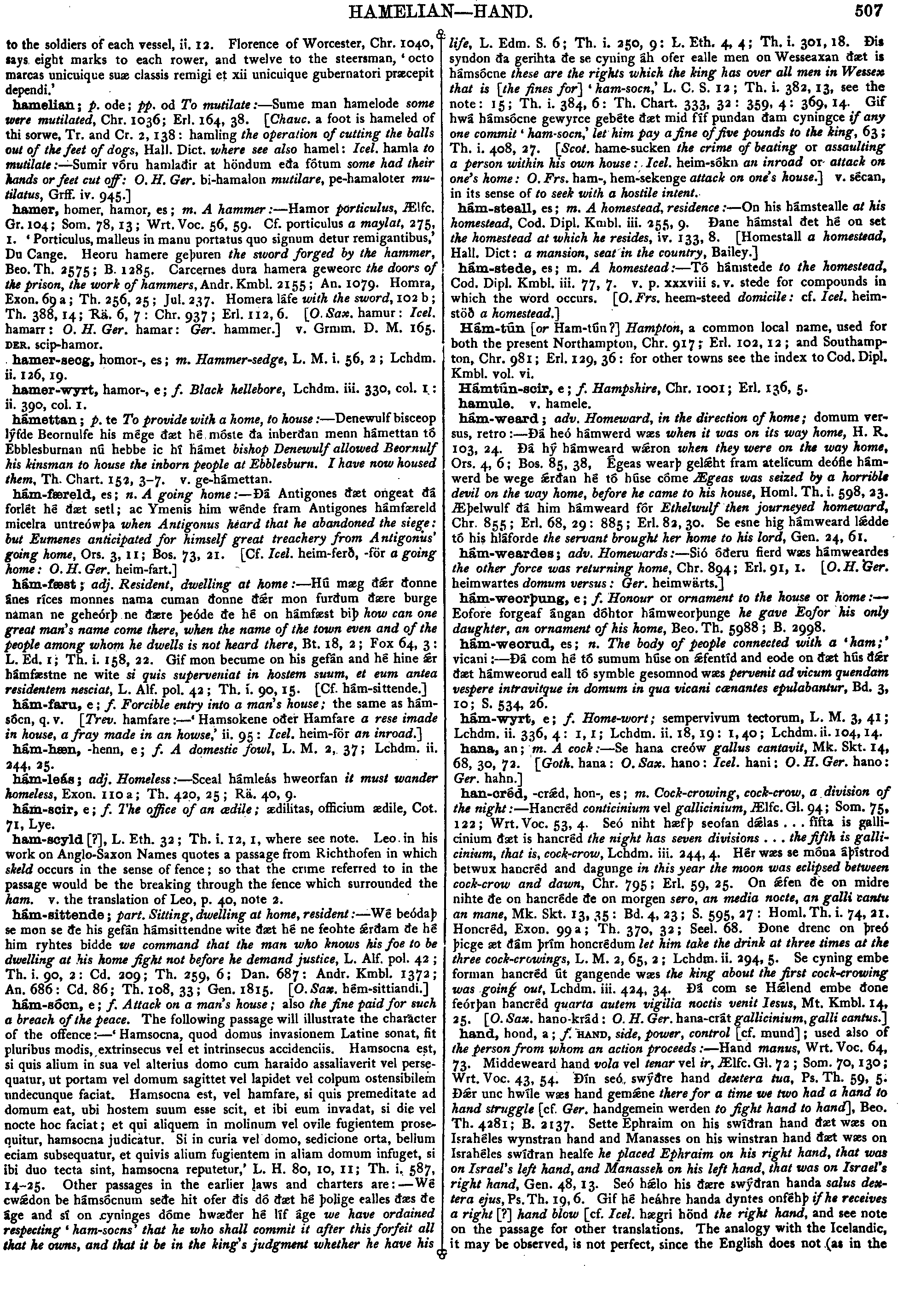
hamer, homer, hamor, es; m. A hammer :-- Hamor porticulus, Ælfc. Gr. 104; Som. 78, 13; Wrt. Voc. 56, 59. Cf. porticulus a maylat, 275, 1. 'Porticulus, malleus in manu portatus quo signum detur remigantibus,' Du Cange. Heoru hamere geþuren the sword forged by the hammer, Beo. Th. 2575; B. 1285. Carcernes dura hamera geweorc the doors of the prison, the work of hammers, Andr. Kmbl. 2155; An. 1079. Homra, Exon. 69 a; Th. 256, 25; Jul. 237. Homera láfe with the sword, 102 b; Th. 388,14; Rä. 6, 7: Chr. 937; Erl. 112, 6. [O. Sax. hamur: Icel. hamarr: O. H. Ger. hamar: Ger. hammer.] v. Grmm. D. M. 165. DER. scip-hamor.
|
Source: Bosworth/Toller, page b0544, entry 14 View original page image as: [TIFF] [PNG] [View previous entry] [View next entry] |
[Comment on this entry] [View comments] |
The following entry has been hand-corrected once. |
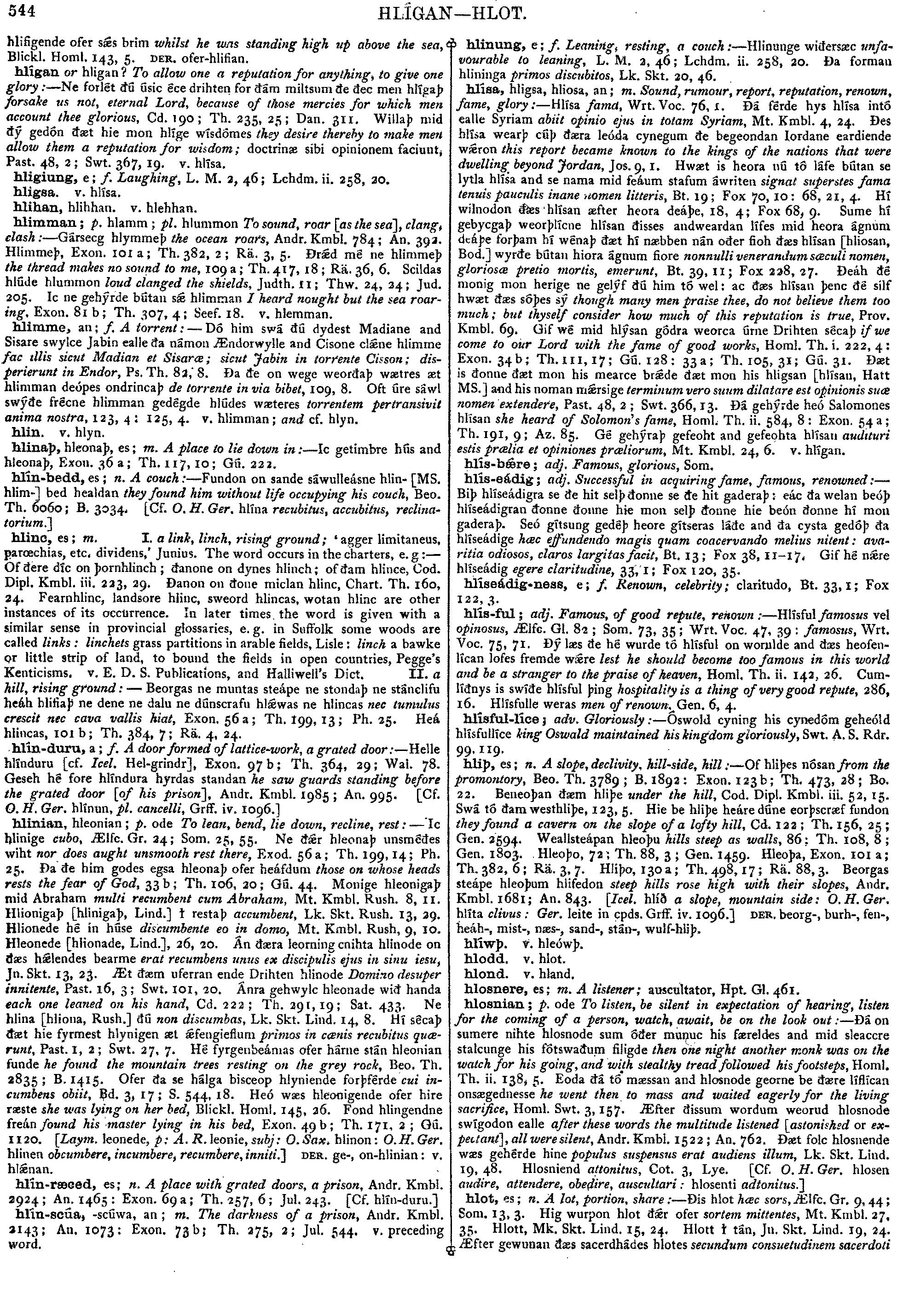
hlín-ræced, es; n. A place with grated doors, a prison, Andr. Kmbl. 2924; An. 1465: Exon. 69 a; Th. 257, 6; Jul. 243. [Cf. hlín-duru.]
| Result Page: | 1 2 3 4 5 | Next |  |
Germanic Lexicon Project (main page)
This search system was written by
Sean Crist
Please consider
volunteering
to correct the data in these online dictionaries.
No rights reserved. Feel free to use these data in any way you please.