|
|

|
Source: Bosworth/Toller, page b0223, entry 16 View original page image as: [TIFF] [PNG] [View previous entry] [View next entry] |
[Comment on this entry] [View comments] |
The following entry has been hand-corrected once. |
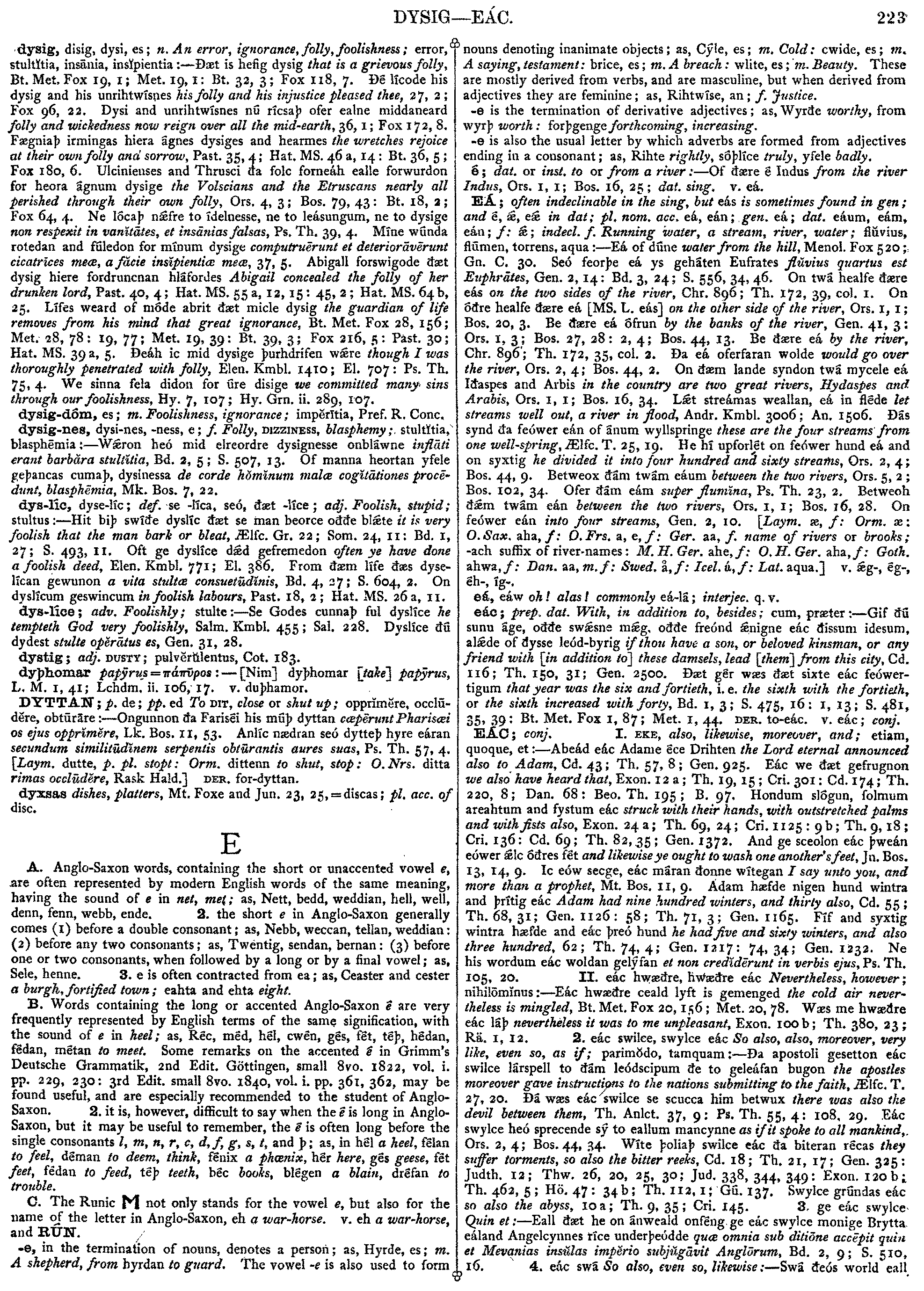
EÁ;
often
indeclinable
in
the
sing,
but
eás
is
sometimes
found
in
gen;
and
é,
 ,
ein
dat;
pl.
nom.
acc.
eá,
eán;
gen.
eá;
dat.
eáum,
eám,
eán;
f;
;
indecl.
f.
Running
water,
a
stream,
river,
water;
fl
,
ein
dat;
pl.
nom.
acc.
eá,
eán;
gen.
eá;
dat.
eáum,
eám,
eán;
f;
;
indecl.
f.
Running
water,
a
stream,
river,
water;
fl vius,
fl
vius,
fl men,
torrens,
aqua
:--
Eá
of
dúne
water
from
the
hill,
Menol.
Fox
520;
Gn.
C.
30.
Seó
feorþe
eá
ys
geháten
Eufrates
flvius
quartus
est
Euphr
men,
torrens,
aqua
:--
Eá
of
dúne
water
from
the
hill,
Menol.
Fox
520;
Gn.
C.
30.
Seó
feorþe
eá
ys
geháten
Eufrates
flvius
quartus
est
Euphr tes,
Gen.
2,
14:
Bd.
3,
24;
S.
556,
34,
46.
On
twá
healfe
ðære
eás
on
the
two
sides
of
the
river,
Chr.
896;
Th.
172,
39,
col.
1.
On
óðre
healfe
ðære
eá
[MS.
L.
eás]
on
the
other
side
of
the
river,
Ors.
1.
1;
Bos.
20,
3.
Be
ðære
eá
ófrun
by
the
banks
of
the
river,
Gen.
41,
3:
Ors.
1,
3;
Bos.
27,
28:
2,
4;
Bos.
44,
13.
Be
ðære
eá
by
the
river.
Chr.
896;
Th.
172,
35,
col.
2.
Ða
eá
oferfaran
wolde
would
go
over
the
river,
Ors.
2,
4;
Bos.
44,
2.
On
ðæm
lande
syndon
twá
mycele
eá
Iðaspes
and
Arbis
in
the
country
are
two
great
rivers,
Hydaspes
and
Arabis,
Ors.
1,
1;
Bos.
16,
34.
Lt
streámas
weallan,
eá
in
fléde
let
streams
well
out,
a
river
in
flood,
Andr.
Kmbl.
3006;
An.
1506.
Ðás
synd
ða
feówer
eán
of
ánum
wyllspringe
these
are
the
four
streams
from
one
well-spring,
Ælfc.
T.
25,
19.
He
hí
upforlét
on
feówer
hund
eá
and
on
syxtig
he
divided
it
into
four
hundred
and
sixty
streams.
Ors.
2,
4;
Bos.
44,
9.
Betweox
ðám
twám
eáum
between
the
two
rivers,
Ors.
5,
2
;
Bos.
102,
34.
Ofer
ðám
eám
super
flum
tes,
Gen.
2,
14:
Bd.
3,
24;
S.
556,
34,
46.
On
twá
healfe
ðære
eás
on
the
two
sides
of
the
river,
Chr.
896;
Th.
172,
39,
col.
1.
On
óðre
healfe
ðære
eá
[MS.
L.
eás]
on
the
other
side
of
the
river,
Ors.
1.
1;
Bos.
20,
3.
Be
ðære
eá
ófrun
by
the
banks
of
the
river,
Gen.
41,
3:
Ors.
1,
3;
Bos.
27,
28:
2,
4;
Bos.
44,
13.
Be
ðære
eá
by
the
river.
Chr.
896;
Th.
172,
35,
col.
2.
Ða
eá
oferfaran
wolde
would
go
over
the
river,
Ors.
2,
4;
Bos.
44,
2.
On
ðæm
lande
syndon
twá
mycele
eá
Iðaspes
and
Arbis
in
the
country
are
two
great
rivers,
Hydaspes
and
Arabis,
Ors.
1,
1;
Bos.
16,
34.
Lt
streámas
weallan,
eá
in
fléde
let
streams
well
out,
a
river
in
flood,
Andr.
Kmbl.
3006;
An.
1506.
Ðás
synd
ða
feówer
eán
of
ánum
wyllspringe
these
are
the
four
streams
from
one
well-spring,
Ælfc.
T.
25,
19.
He
hí
upforlét
on
feówer
hund
eá
and
on
syxtig
he
divided
it
into
four
hundred
and
sixty
streams.
Ors.
2,
4;
Bos.
44,
9.
Betweox
ðám
twám
eáum
between
the
two
rivers,
Ors.
5,
2
;
Bos.
102,
34.
Ofer
ðám
eám
super
flum na,
Ps.
Th.
23,
2.
Betweoh
ðm
twám
eán
between
the
two
rivers,
Ors.
1,
1;
Bos.
16,
28.
On
feówer
eán
into
four
streams,
Gen.
2,
10.
[Laym,
æ,
f:
Orm.
æ:
O.
Sax.
aha,
f:
O.
Frs.
a,
e
f:
Ger.
aa,
f.
name
of
rivers
or
brooks;
-ach
suffix
of
river-names:
M.
H.
Ger.
ahe,
f:
O.
H.
Ger.
aha,
f:
Goth.
ahwa,
f;
Dan.
aa,
m.
f:
Swed.
å.
f;
Icel.
á,
f:
Lat.
aqua.]
v.
g-,
ég-,
éh-,
íg-.
na,
Ps.
Th.
23,
2.
Betweoh
ðm
twám
eán
between
the
two
rivers,
Ors.
1,
1;
Bos.
16,
28.
On
feówer
eán
into
four
streams,
Gen.
2,
10.
[Laym,
æ,
f:
Orm.
æ:
O.
Sax.
aha,
f:
O.
Frs.
a,
e
f:
Ger.
aa,
f.
name
of
rivers
or
brooks;
-ach
suffix
of
river-names:
M.
H.
Ger.
ahe,
f:
O.
H.
Ger.
aha,
f:
Goth.
ahwa,
f;
Dan.
aa,
m.
f:
Swed.
å.
f;
Icel.
á,
f:
Lat.
aqua.]
v.
g-,
ég-,
éh-,
íg-.
|
Source: Bosworth/Toller, page b0242, entry 8 View original page image as: [TIFF] [PNG] [View previous entry] [View next entry] |
[Comment on this entry] [View comments] |
The following entry has been hand-corrected once. |
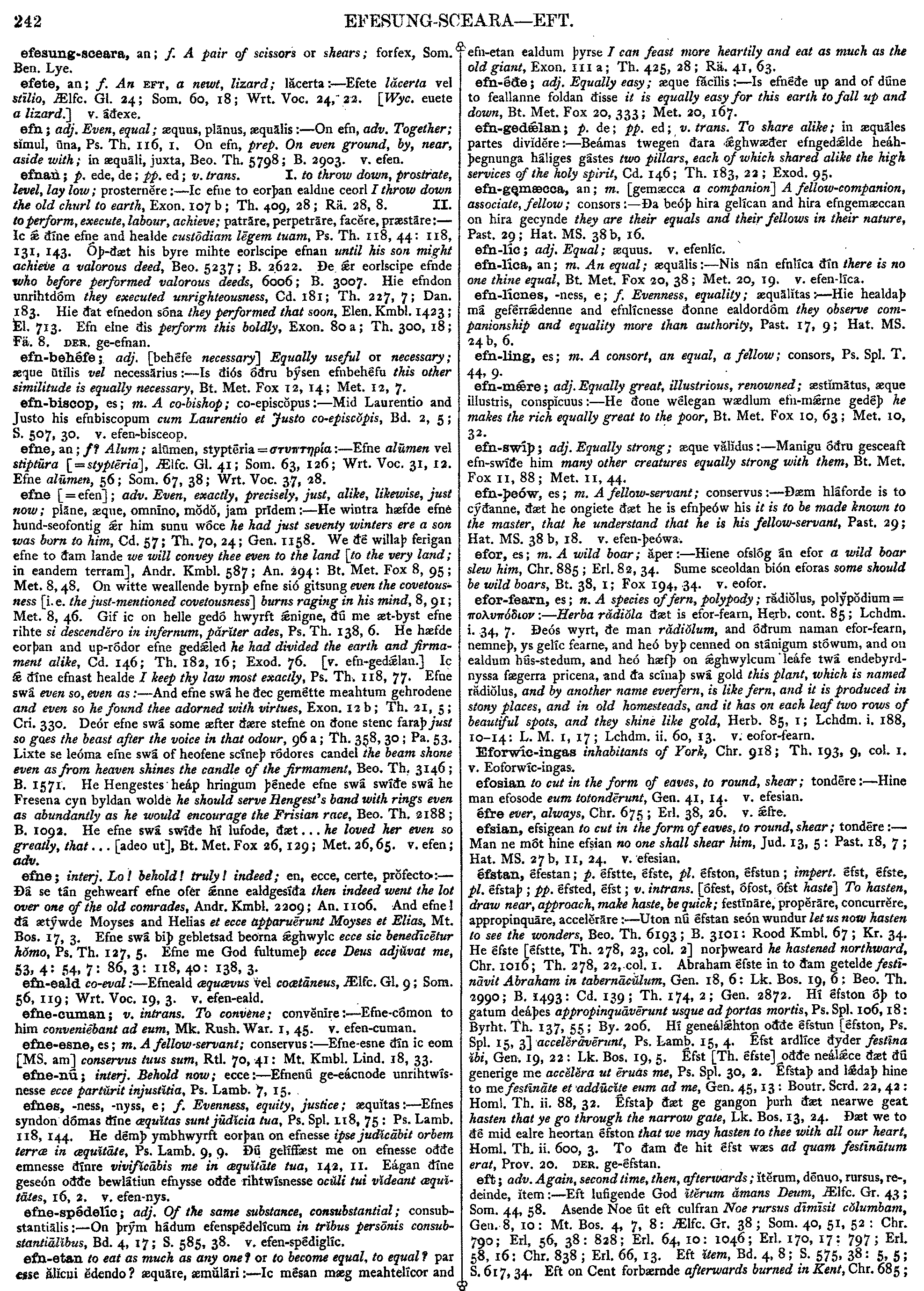
efne
[
=
efen];
adv.
Even,
exactly,
precisely,
just,
alike,
likewise,
just
now;
plne,
æque,
omn no,
m
no,
m d,
jam
prdem
:--
He
wintra
hæfde
efne
hund-seofontig
r
him
sunu
wóce
he
had
just
seventy
winters
ere
a
son
was
born
to
him,
Cd.
57;
Th.
70,
24;
Gen.
1158.
We
ðé
willaþ
ferigan
efne
to
ðam
lande
we
will
convey
thee
even
to
the
land
[to
the
very
land;
in
eandem
terram],
Andr.
Kmbl.
587;
An.
294:
Bt.
Met.
Fox
8,
95;
Met.
8,
48.
On
witte
weallende
byrnþ
efne
sió
gitsung
even
the
covetousness
[i.
e.
the
just-mentioned
covetousness]
burns
raging
in
his
mind,
8,
91;
Met.
8,
46.
Gif
ic
on
helle
gedó
hwyrft
nigne,
ðú
me
æt-byst
efne
rihte
si
descend
d,
jam
prdem
:--
He
wintra
hæfde
efne
hund-seofontig
r
him
sunu
wóce
he
had
just
seventy
winters
ere
a
son
was
born
to
him,
Cd.
57;
Th.
70,
24;
Gen.
1158.
We
ðé
willaþ
ferigan
efne
to
ðam
lande
we
will
convey
thee
even
to
the
land
[to
the
very
land;
in
eandem
terram],
Andr.
Kmbl.
587;
An.
294:
Bt.
Met.
Fox
8,
95;
Met.
8,
48.
On
witte
weallende
byrnþ
efne
sió
gitsung
even
the
covetousness
[i.
e.
the
just-mentioned
covetousness]
burns
raging
in
his
mind,
8,
91;
Met.
8,
46.
Gif
ic
on
helle
gedó
hwyrft
nigne,
ðú
me
æt-byst
efne
rihte
si
descend ro
in
infernum,
p
ro
in
infernum,
p rter
ades,
Ps.
Th.
138,
6.
He
hæfde
eorþan
and
up-ródor
efne
gedled
he
had
divided
the
earth
and
firmament
alike,
Cd.
146;
Th.
182,
16;
Exod.
76.
[v.
efn-gedlan.]
Ic
ðíne
efnast
healde
I
keep
thy
law
most
exactly,
Ps.
Th.
118,
77.
Efne
swá
even
so,
even
as
:--
And
efne
swá
he
ðec
gemétte
meahtum
gehrodene
and
even
so
he
found
thee
adorned
with
virtues,
Exon.
12
b;
Th.
21,
5;
Cri.
330.
Deór
efne
swá
some
æfter
ðære
stefne
on
ðone
stenc
faraþ
just
so
goes
the
beast
after
the
voice
in
that
odour,
96
a;
Th.
358,
30;
Pa.
53.
Lixte
se
leóma
efne
swá
of
heofene
scíneþ
ródores
candel
the
beam
shone
even
as
from
heaven
shines
the
candle
of
the
firmament,
Beo.
Th.
3146;
B.
1571.
He
Hengestes
heáp
hringum
þénede
efne
swá
swíðe
swá
he
Fresena
cyn
byldan
wolde
he
should
serve
Hengest's
band
with
rings
even
as
abundantly
as
he
would
encourage
the
Frisian
race,
Beo.
Th.
2188;
B.
1092.
He
efne
swá
swíðe
hí
lufode,
ðæt
...
he
loved
her
even
so
greatly,
that
...
[adeo
ut],
Bt.
Met.
Fox
26,
129;
Met.
26,
65.
v.
efen;
adv.
rter
ades,
Ps.
Th.
138,
6.
He
hæfde
eorþan
and
up-ródor
efne
gedled
he
had
divided
the
earth
and
firmament
alike,
Cd.
146;
Th.
182,
16;
Exod.
76.
[v.
efn-gedlan.]
Ic
ðíne
efnast
healde
I
keep
thy
law
most
exactly,
Ps.
Th.
118,
77.
Efne
swá
even
so,
even
as
:--
And
efne
swá
he
ðec
gemétte
meahtum
gehrodene
and
even
so
he
found
thee
adorned
with
virtues,
Exon.
12
b;
Th.
21,
5;
Cri.
330.
Deór
efne
swá
some
æfter
ðære
stefne
on
ðone
stenc
faraþ
just
so
goes
the
beast
after
the
voice
in
that
odour,
96
a;
Th.
358,
30;
Pa.
53.
Lixte
se
leóma
efne
swá
of
heofene
scíneþ
ródores
candel
the
beam
shone
even
as
from
heaven
shines
the
candle
of
the
firmament,
Beo.
Th.
3146;
B.
1571.
He
Hengestes
heáp
hringum
þénede
efne
swá
swíðe
swá
he
Fresena
cyn
byldan
wolde
he
should
serve
Hengest's
band
with
rings
even
as
abundantly
as
he
would
encourage
the
Frisian
race,
Beo.
Th.
2188;
B.
1092.
He
efne
swá
swíðe
hí
lufode,
ðæt
...
he
loved
her
even
so
greatly,
that
...
[adeo
ut],
Bt.
Met.
Fox
26,
129;
Met.
26,
65.
v.
efen;
adv.
|
Source: Bosworth/Toller, page b0248, entry 1 View original page image as: [TIFF] [PNG] [View previous entry] [View next entry] |
[Comment on this entry] [View comments] |
The following entry has been hand-corrected once. |
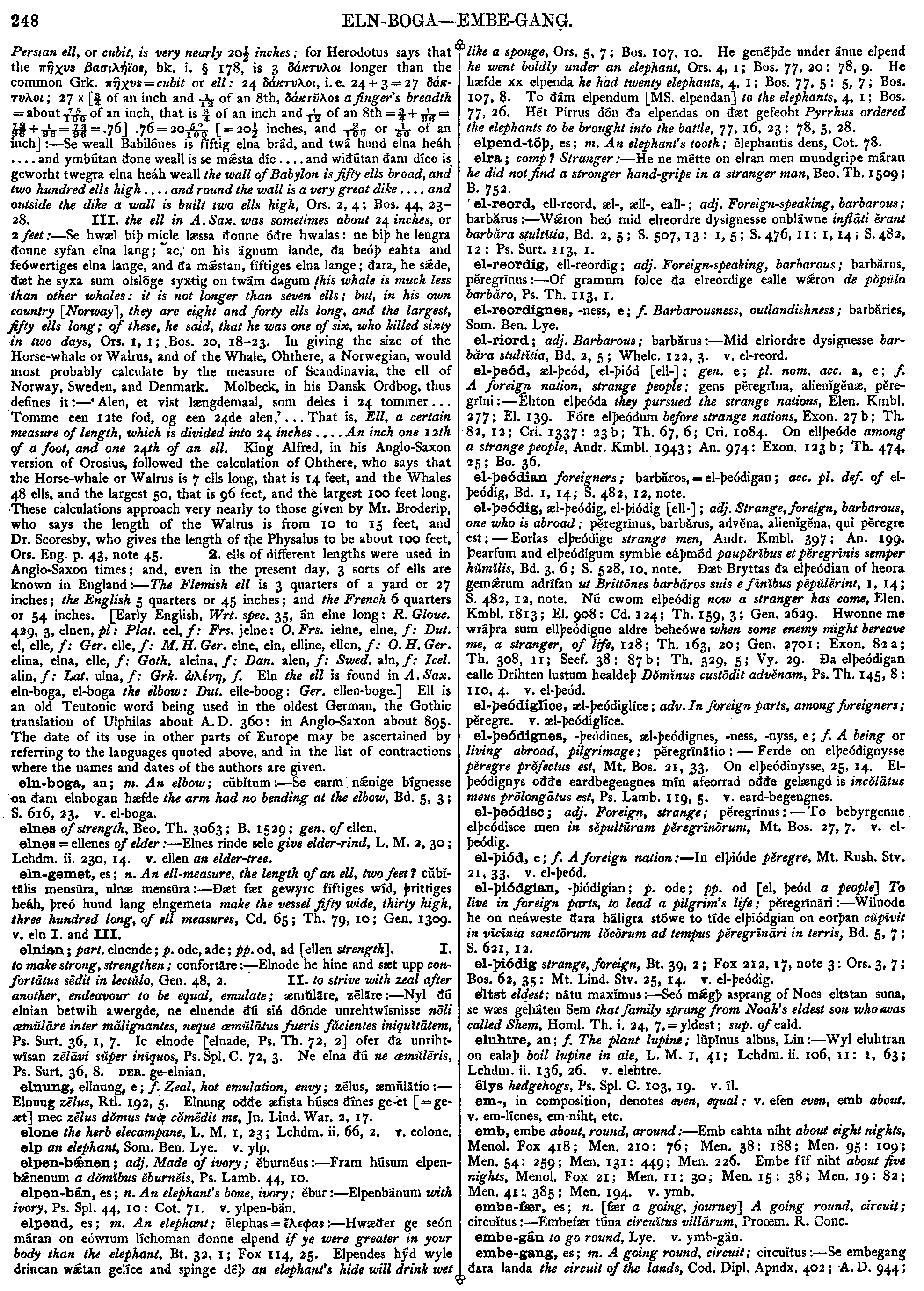
Persian
ell,
or
cubit,
is
very
nearly
20-1/2
inches;
for
Herodotus
says
that
the
GREEK,
bk.
i.
§
178,
is
3
GREEK
longer
than
the
common
Grk.
GREEK
=
cubit
or
ell:
24
GREEK,
i.
e.
24
+
3
=
27
GREEK;
27
×
3/4
of
an
inch
and
1/12
of
an
8th,
GREEK
a
finger's
breadth
=
about
75/100
of
an
inch,
that
is
3/4
of
an
inch
and
1/12
of
an
8th
=
3/4
+
1/96
=
72/96
+
1/96
=
.76]
.76
=
20-50/100
[
=
20-1/2
inches,
and
2/100
or
1/50
of
an
inch]
:--
Se
weall
Babilónes
is
fíftig
elna
brád,
and
twá
hund
elna
heáh
...
and
ymbútan
ðone
weall
is
se
msta
díc
...
and
wiðútan
ðani
díce
is
geworht
twegra
elna
heáh
weall
the
wall
of
Babylon
is
fifty
ells
broad,
and
two
hundred
ells
high
...
and
round
the
wall
is
a
very
great
dike
...
and
outside
the
dike
a
wall
is
built
two
ells
high,
Ors.
2,
4;
Bos.
44,
23-28.
III.
the
ell
in
A.
Sax.
was
sometimes
about
24
inches,
or
2
feet
:--
Se
hwæl
biþ
micle
læssa
ðonne
óðre
hwalas:
ne
biþ
he
lengra
ðonne
syfan
elna
lang;
ac,
on
his
ágnum
lande,
ða
beóþ
eahta
and
feówertiges
elna
lange,
and
ða
mstan,
fíftiges
elna
lange;
ðara,
he
sde,
ðæt
he
syxa
sum
ofslóge
syxtig
on
twám
dagum
this
whale
is
much
less
than
other
whales:
it
is
not
longer
than
seven
ells;
but,
in
his
own
country
[Norway],
they
are
eight
and
forty
ells
long,
and
the
largest,
fifty
ells
long;
of
these,
he
said,
that
he
was
one
of
six,
who
killed
sixty
in
two
days.
Ors.
1,
1;
Bos.
20,
18-23.
In
giving
the
size
of
the
Horse-whale
or
Walrus,
and
of
the
Whale,
Ohthere,
a
Norwegian,
would
most
probably
calculate
by
the
measure
of
Scandinavia,
the
ell
of
Norway,
Sweden,
and
Denmark.
Molbeck,
in
his
Dansk
Ordbog,
thus
defines
it
:--
'Alen,
et
vist
længdemaal,
som
deles
i
24
tommer
...
Tomme
een
12te
fod,
og
een
24de
alen,'
...
That
is,
Ell,
a
certain
measure
of
length,
which
is
divided
into
24
inches
...
An
inch
one
12th
of
a
foot,
and
one
24th
of
an
ell.
King
Alfred,
in
his
Anglo-Saxon
version
of
Orosius,
followed
the
calculation
of
Ohthere,
who
says
that
the
Horse-whale
or
Walrus
is
7
ells
long,
that
is
14
feet,
and
the
Whales
48
ells,
and
the
largest
50,
that
is
96
feet,
and
the
largest
100
feet
long.
These
calculations
approach
very
nearly
to
those
given
by
Mr.
Broderip,
who
says
the
length
of
the
Walrus
is
from
10
to
15
feet,
and
Dr.
Scoresby,
who
gives
the
lengen
of
the
Physalus
to
be
about
100
feet,
Ors.
Eng.
p.
43,
note
45.
2.
ells
of
different
lengths
were
used
in
Anglo-Saxon
times;
and,
even
in
the
present
day,
3
sorts
of
ells
are
known
in
England
:--
The
Flemish
ell
is
3
quarters
of
a
yard
or
27
inches;
the
English
5
quarters
or
45
inches;
and
the
French
6
quarters
or
54
inches.
[Early
English,
Wrt.
spec.
35,
án
elne
long:
R.
Glouc.
429,
3,
elnen,
pl:
Plat.
eel,
f:
Frs.
jelne;
O.
Frs.
ielne,
elne,
f:
Dut.
el,
elle,
f:
Ger.
elle,
f:
M.
H.
Ger.
elne,
eln,
elline,
ellen,
f:
O.
H.
Ger.
elina,
elna,
elle,
f:
Goth.
aleina,
f:
Dan.
alen,
f:
Swed.
aln,
f:
Icel.
alin,
f:
Lat.
ulna.
f:
Grk.
GREEK,
f.
Eln
the
ell
is
found
in
A.
Sax.
eln-boga,
el-boga
the
elbow:
Dut.
elle-boog:
Ger.
ellen-boge.]
Ell
is
an
old
Teutonic
word
being
used
in
the
oldest
German,
the
Gothic
translation
of
Ulphilas
about
A.
D.
360:
in
Anglo-Saxon
about
895.
The
date
of
its
use
in
other
parts
of
Europe
may
be
ascertained
by
referring
to
the
languages
quoted
above,
and
in
the
list
of
contractions
where
the
names
and
dates
of
the
authors
are
given.
|
Source: Bosworth/Toller, page b0249, entry 35 View original page image as: [TIFF] [PNG] [View previous entry] [View next entry] |
[Comment on this entry] [View comments] |
The following entry has been hand-corrected once. |
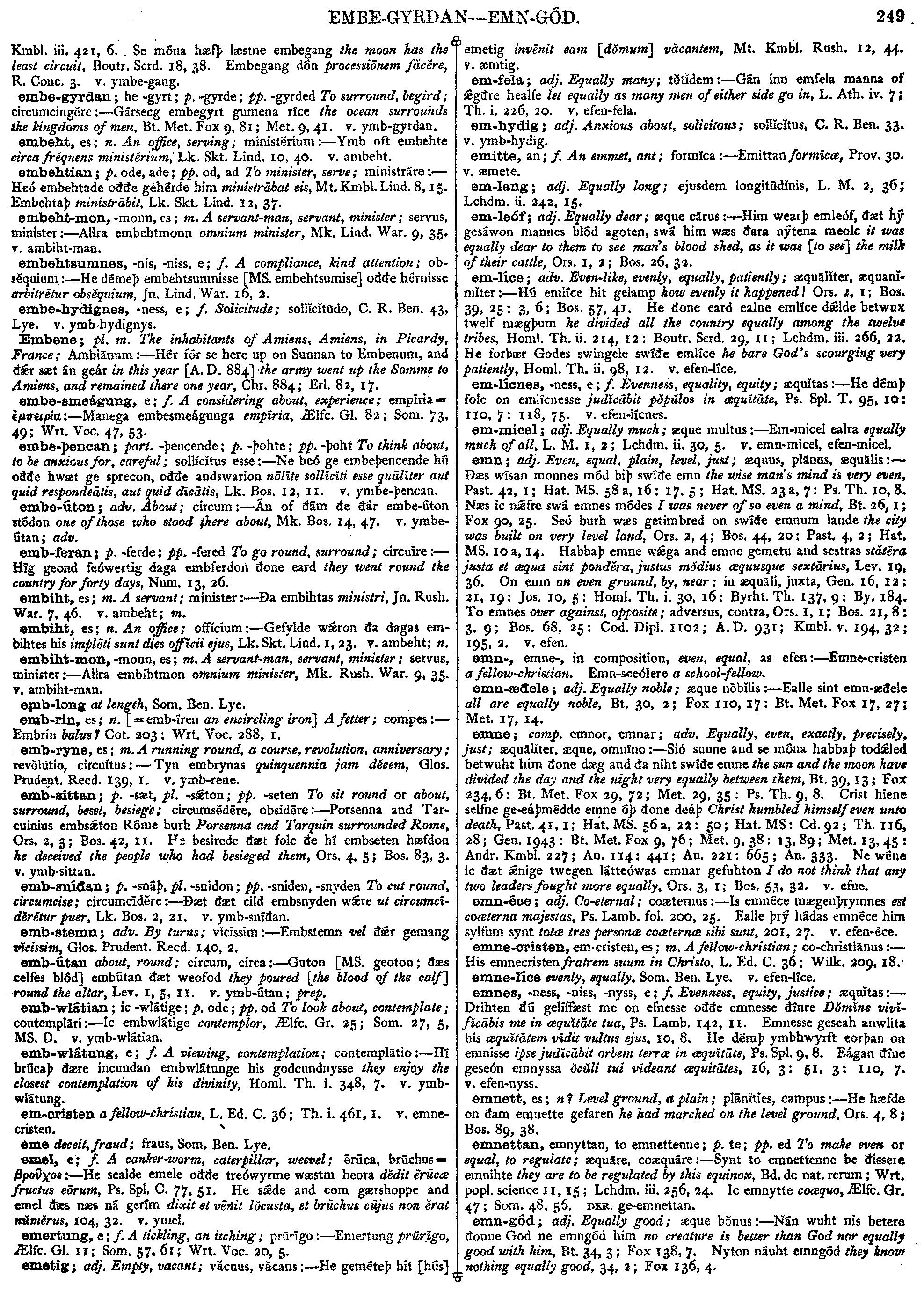
em-líce;
adv.
Even-like,
evenly,
equally,
patiently;
æqulter,
æquanmter
:--
Hú
emlíce
hit
gelamp
how
evenly
it
happened!
Ors.
2,
1;
Bos.
39,
25:
3,
6;
Bos.
57,
41.
He
ðone
eard
ealne
emlíce
dlde
betwux
twelf
mægþum
he
divided
all
the
country
equally
among
the
twelve
tribes,
Homl.
Th.
ii.
214,
12:
Boutr.
Scrd.
29,
ll;
Lchdm.
iii.
266,
22.
He
forbær
Godes
swingele
swíðe
emlíce
he
bare
God's
scourging
very
patiently.
Homl.
Th.
ii.
98,
12.
v.
efen-líce.
|
Source: Bosworth/Toller, page b0249, entry 41 View original page image as: [TIFF] [PNG] [View previous entry] [View next entry] |
[Comment on this entry] [View comments] |
The following entry has been hand-corrected once. |
emne;
comp.
emnor,
emnar;
adv.
Equally,
even,
exactly,
precisely,
just;
æqulter,
æque,
omnno
:--
Sió
sunne
and
se
móna
habbaþ
todled
betwuht
him
ðone
dæg
and
ða
niht
swíðe
emne
the
sun
and
the
moon
have
divided
the
day
and
the
night
very
equally
between
them,
Bt.
39,
13;
Fox
234,
6:
Bt.
Met.
Fox
29,
72;
Met.
29,
35:
Ps.
Th.
9,
8.
Crist
hiene
selfne
ge-eáþmédde
emne
óþ
ðone
deáþ
Christ
humbled
himself
even
unto
death.
Past.
41,
1;
Hat.
MS.
56
a,
22:
50;
Hat.
MS:
Cd.
92;
Th.
116,
28;
Gen.
1943:
Bt.
Met.
Fox
9,
76;
Met.
9,
38:
13,
89;
Met.
13,
45:
Andr.
Kmbl.
227;
An.
114:
441;
An.
221:
665;
An.
333.
Ne
wéne
ic
ðæt
nige
twegen
látteówas
emnar
gefuhton
I
do
not
think
that
any
two
leaders
fought
more
equally.
Ors.
3,
1;
Bos.
53,
32.
v.
efne.
|
Source: Bosworth/Toller, page b0250, entry 34 View original page image as: [TIFF] [PNG] [View previous entry] [View next entry] |
[Comment on this entry] [View comments] |
The following entry has been hand-corrected once. |
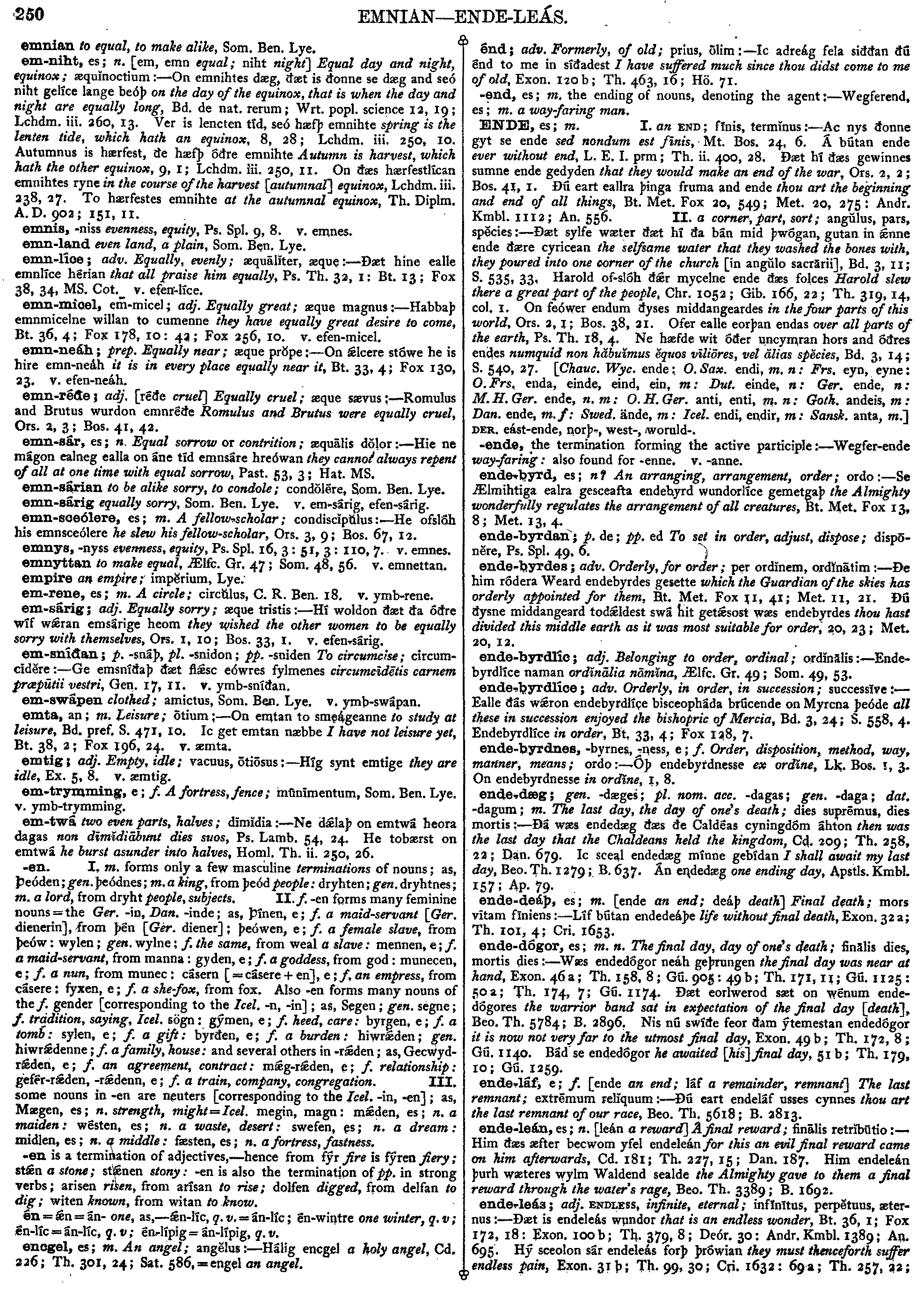
ende-byrdes;
adv.
Orderly,
for
order;
per
ordinem,
ordntim
:--
Ðe
him
ródera
Weard
endebyrdes
gesette
which
the
Guardian
of
the
skies
has
orderly
appointed
for
them,
Bt.
Met.
Fox
11,
41;
Met.
11,
21.
Ðú
ðysne
middangeard
todldest
swá
hit
getsost
wæs
endebyrdes
thou
hast
divided
this
middle
earth
as
it
was
most
suitable
for
order,
20,
23;
Met.
20,
12.
|
Source: Bosworth/Toller, page b0268, entry 27 View original page image as: [TIFF] [PNG] [View previous entry] [View next entry] |
[Comment on this entry] [View comments] |
The following entry has been hand-corrected once. |
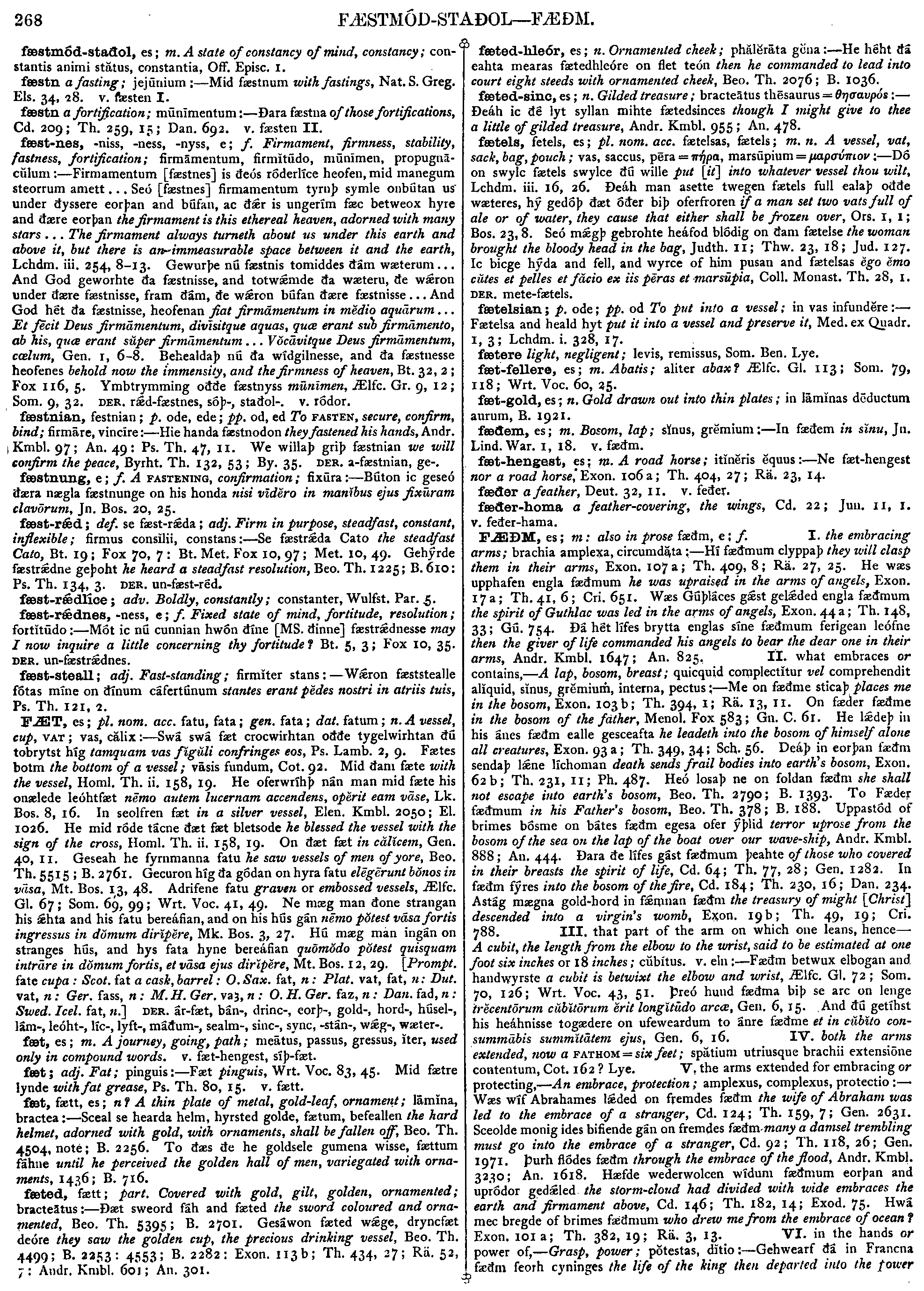
FÆÐM,
es;
m:
also
in
prose
fæðm,
e;
f.
I.
the
embracing
arms;
brachia
amplexa,
circumdta
:--
Hí
fæðmum
clyppaþ
they
will
clasp
them
in
their
arms,
Exon.
107
a;
Th.
409,
8;
Rä.
27,
25.
He
wæs
upphafen
engla
fæðmum
he
was
upraised
in
the
arms
of
angels,
Exon.
17
a;
Th.
41,
6;
Cri.
651.
Wæs
Gúþláces
gst
gelded
engla
fæðmum
the
spirit
of
Guthlac
was
led
in
the
arms
of
angels,
Exon,
44
a;
Th.
148,
33;
Gú.
754.
Ðá
hét
lífes
brytta
englas
síne
fæðmum
ferigean
leófne
then
the
giver
of
life
commanded
his
angels
to
bear
the
dear
one
in
their
arms,
Andr.
Kmbl.
1647;
An.
825.
II.
what
embraces
or
contains,-A
lap,
bosom,
breast;
quicquid
complecttur
vel
comprehendit
alquid,
snus,
grmium,
interna,
pectus
:--
Me
on
fæðme
sticaþ
places
me
in
the
bosom,
Exon.
103
b;
Th.
394,
1;
Rä.
13,
11.
On
fæder
fæðme
in
the
bosom
of
the
father,
Menol.
Fox
583;
Gn.
C.
61.
He
ldeþ
in
his
ánes
fæðm
ealle
gesceafta
he
leadeth
into
the
bosom
of
himself
alone
all
creatures,
Exon.
93
a;
Th.
349,
34;
Sch.
56.
Deáþ
in
eorþan
fæðm
sendaþ
lne
líchoman
death
sends
frail
bodies
into
earth's
bosom,
Exon.
62
b;
Th.
231,
11;
Ph.
487.
Heó
losaþ
ne
on
foldan
fæðm
she
shall
not
escape
into
earth's
bosom,
Beo.
Th.
2790;
B.
1393.
To
Fæder
fæðmum
in
his
Father's
bosom,
Beo.
Th.
378;
B.
188.
Uppastód
of
brimes
bósme
on
bátes
fæðm
egesa
ofer
ýþlid
terror
uprose
front
the
bosom
of
the
sea
on
the
lap
of
the
boat
over
our
wave-ship,
Andr.
Kmbl.
888;
An.
444.
Ðara
ðe
lífes
gást
fæðmum
þeahte
of
those
who
covered
in
their
breasts
the
spirit
of
life,
Cd.
64;
Th.
77,
28;
Gen.
1282.
In
fæðm
fýres
into
the
bosom
of
the
fire,
Cd.
184;
Th.
230,
16;
Dan.
234,
Astág
mægna
gold-hord
in
fmnan
fæðm
the
treasury
of
might
[Christ]
descended
into
a
virgin's
womb,
Exon.
19
b;
Th.
49,
19;
Cri.
788.
III.
that
part
of
the
arm
on
which
one
leans,
hence-A
cubit,
the
length
from
the
elbow
to
the
wrist,
said
to
be
estimated
at
one
foot
six
inches
or
18
inches;
cbtus.
v.
eln
:--
Fæðm
betwux
elbogan
and
handwyrste
a
cubit
is
betwixt
the
elbow
and
wrist,
Ælfc.
Gl.
72;
Som.
70,
126;
Wrt.
Voc.
43,
51.
Þreó
hund
fæðma
biþ
se
arc
on
lenge
trcent rum
cbtrum
rit
longtdo
arcæ,
Gen.
6,
15.
And
ðú
getíhst
his
heáhnisse
togædere
on
ufeweardum
to
ánre
fæðme
et
in
cbto
consummbis
summttem
ejus,
Gen.
6,
16.
IV.
both
the
arms
extended,
now
a
FATHOM
=
six
feet;
sptium
utriusque
brachii
extensine
contentum,
Cot.
162?
Lye.
V.
the
arms
extended
for
embracing
or
protecting,-An
embrace,
protection;
amplexus,
complexus,
protectio
:--
Wæs
wíf
Abrahames
lded
on
fremdes
fæðm
the
wife
of
Abraham
was
led
to
the
embrace
of
a
stranger,
Cd.
124;
Th.
159,
7;
Gen.
2631.
Sceolde
monig
ides
bifiende
gán
on
fremdes
fæðm
many
a
damsel
trembling
must
go
into
the
embrace
of
a
stranger,
Cd.
92;
Th.
118,
26;
Gen.
1971.
Þurh
flódes
fæðm
through
the
embrace
of
the
flood,
Andr.
Kmbl.
3230;
An.
1618.
Hæfde
wederwolcen
wídum
fæðmum
eorþan
and
upródor
gedled
the
storm-cloud
had
divided
with
wide
embraces
the
earth
and
firmament
above,
Cd.
146;
Th.
182,
14;
Exod.
75.
Hwá
mec
bregde
of
brimes
fæðmum
who
drew
me
from
the
embrace
of
ocean?
Exon.
101
a;
Th.
382,
19;
Rä.
3,
13.
VI.
in
the
hands
or
power
of-Grasp,
power;
ptestas,
dtio
:--
Gehwearf
ðá
in
Francna
fæðm
feorh
cyninges
the
life
of
the
king
then
departed
into
the
power
[grasp]
of
the
Franks,
Beo.
Th.
2424;
B.
1210.
Gé
of
feónda
fæðme
weorþen
ye
escape
from
the
power
of
enemies,
Cd.
158;
Th.
196,
20;
Exod.
294.
Ðe
ic
alýsde
feóndum
of
fæðme
which
I
released
from
the
power
of
foes,
Exon.
29
b;
Th.
91,
2;
Cri.
1486.
VII.
what
is
extended,-An
expanse,
abyss,
deep;
expansum,
tractus,
superfcies,
abyssus,
profundum
:--
Siððan
leóhtes
weard
ofer
ealne
foldan
fæðm
fýr
onsendeþ
after
that
the
guardian
of
light
shall
send
fire
over
all
the
expanse
of
earth,
Exon.
116
b;
Th.
448,
14;
Dóm.
54.
Bodiaþ
beorhtne
geleáfan
ofer
foldan
fæðm
preach
the
bright
faith
throughout
the
expanse
of
the
earth,
Andr.
Kmbl.
671;
An.
336.
Se
bráda
s
bræc
on
eorþan
fæðm
the
broad
sea
broke
on
to
the
tract
of
earth,
Exon.
24
b;
Th.
70,
32;
Cri.
1147.
Swá
hie
wið
eorþan
fæðm
þúsend
wintra
ðr
eardodon
as
if
they
had
rested
there
on
the
plain
of
earth
a
thousand
winters,
Beo.
Th.
6091;
B.
3049.
Hie
on
flódes
fæðm
ceólum
lácaþ
they
sail
in
ships
on
the
expanse
of
the
food,
Andr.
Kmbl.
503;
An.
252.
[Chauc.
fadmen,
pl.
fathoms:
Laym.
ueðme
fathom:
Plat.
fadem,
faem
a
thread,
cubit:
O.
Sax.
faðmós,
pl.
m.
the
hands
and
arms:
Dut.
vadem,
vaam,
f.
a
fathom:
Kil.
vadem
flum
quod
intra
mnus
extensas
contn
rum
cbtrum
rit
longtdo
arcæ,
Gen.
6,
15.
And
ðú
getíhst
his
heáhnisse
togædere
on
ufeweardum
to
ánre
fæðme
et
in
cbto
consummbis
summttem
ejus,
Gen.
6,
16.
IV.
both
the
arms
extended,
now
a
FATHOM
=
six
feet;
sptium
utriusque
brachii
extensine
contentum,
Cot.
162?
Lye.
V.
the
arms
extended
for
embracing
or
protecting,-An
embrace,
protection;
amplexus,
complexus,
protectio
:--
Wæs
wíf
Abrahames
lded
on
fremdes
fæðm
the
wife
of
Abraham
was
led
to
the
embrace
of
a
stranger,
Cd.
124;
Th.
159,
7;
Gen.
2631.
Sceolde
monig
ides
bifiende
gán
on
fremdes
fæðm
many
a
damsel
trembling
must
go
into
the
embrace
of
a
stranger,
Cd.
92;
Th.
118,
26;
Gen.
1971.
Þurh
flódes
fæðm
through
the
embrace
of
the
flood,
Andr.
Kmbl.
3230;
An.
1618.
Hæfde
wederwolcen
wídum
fæðmum
eorþan
and
upródor
gedled
the
storm-cloud
had
divided
with
wide
embraces
the
earth
and
firmament
above,
Cd.
146;
Th.
182,
14;
Exod.
75.
Hwá
mec
bregde
of
brimes
fæðmum
who
drew
me
from
the
embrace
of
ocean?
Exon.
101
a;
Th.
382,
19;
Rä.
3,
13.
VI.
in
the
hands
or
power
of-Grasp,
power;
ptestas,
dtio
:--
Gehwearf
ðá
in
Francna
fæðm
feorh
cyninges
the
life
of
the
king
then
departed
into
the
power
[grasp]
of
the
Franks,
Beo.
Th.
2424;
B.
1210.
Gé
of
feónda
fæðme
weorþen
ye
escape
from
the
power
of
enemies,
Cd.
158;
Th.
196,
20;
Exod.
294.
Ðe
ic
alýsde
feóndum
of
fæðme
which
I
released
from
the
power
of
foes,
Exon.
29
b;
Th.
91,
2;
Cri.
1486.
VII.
what
is
extended,-An
expanse,
abyss,
deep;
expansum,
tractus,
superfcies,
abyssus,
profundum
:--
Siððan
leóhtes
weard
ofer
ealne
foldan
fæðm
fýr
onsendeþ
after
that
the
guardian
of
light
shall
send
fire
over
all
the
expanse
of
earth,
Exon.
116
b;
Th.
448,
14;
Dóm.
54.
Bodiaþ
beorhtne
geleáfan
ofer
foldan
fæðm
preach
the
bright
faith
throughout
the
expanse
of
the
earth,
Andr.
Kmbl.
671;
An.
336.
Se
bráda
s
bræc
on
eorþan
fæðm
the
broad
sea
broke
on
to
the
tract
of
earth,
Exon.
24
b;
Th.
70,
32;
Cri.
1147.
Swá
hie
wið
eorþan
fæðm
þúsend
wintra
ðr
eardodon
as
if
they
had
rested
there
on
the
plain
of
earth
a
thousand
winters,
Beo.
Th.
6091;
B.
3049.
Hie
on
flódes
fæðm
ceólum
lácaþ
they
sail
in
ships
on
the
expanse
of
the
food,
Andr.
Kmbl.
503;
An.
252.
[Chauc.
fadmen,
pl.
fathoms:
Laym.
ueðme
fathom:
Plat.
fadem,
faem
a
thread,
cubit:
O.
Sax.
faðmós,
pl.
m.
the
hands
and
arms:
Dut.
vadem,
vaam,
f.
a
fathom:
Kil.
vadem
flum
quod
intra
mnus
extensas
contn tur,
mensra
mnuum
expensrum,
ulna,
passus:
Ger.
faden,
fadem,
m.
a
thread,
cubit:
M.
H.
Ger.
vadem,
vaden,
m:
O.
H.
Ger.
fadam,
fadum,
m.
n.
flum:
Dan.
favn,
m.
f:
Swed.
famn,
m:
Icel.
faðmr,
m.
a
fathom.]
DER.
heoru-fæðm,
lagu-,
wæl-.
tur,
mensra
mnuum
expensrum,
ulna,
passus:
Ger.
faden,
fadem,
m.
a
thread,
cubit:
M.
H.
Ger.
vadem,
vaden,
m:
O.
H.
Ger.
fadam,
fadum,
m.
n.
flum:
Dan.
favn,
m.
f:
Swed.
famn,
m:
Icel.
faðmr,
m.
a
fathom.]
DER.
heoru-fæðm,
lagu-,
wæl-.
|
Source: Bosworth/Toller, page b0287, entry 34 View original page image as: [TIFF] [PNG] [View previous entry] [View next entry] |
[Comment on this entry] [View comments] |
The following entry has been hand-corrected once. |
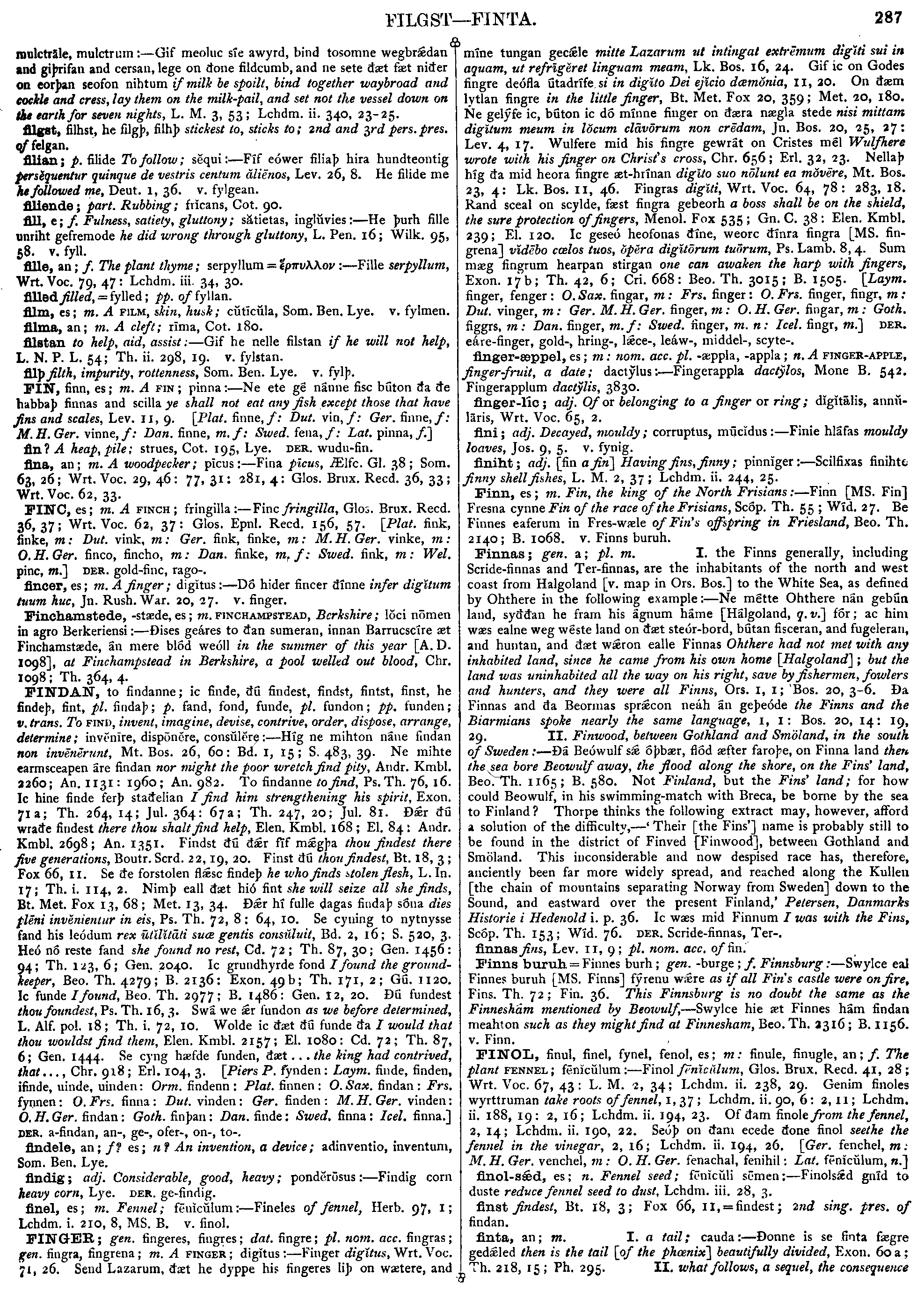
finta,
an;
m.
I.
a
tail;
cauda
:--
Ðonne
is
se
finta
fægre
gedled
then
is
the
tail
[of
the
phoenix]
beautifully
divided,
Exon.
60a;
Th.
218,
15;
Ph.
295.
II.
what
follows,
a
sequel,
the
consequence
|
Source: Bosworth/Toller, page b0296, entry 33 View original page image as: [TIFF] [PNG] [View previous entry] [View next entry] |
[Comment on this entry] [View comments] |
The following entry has been hand-corrected once. |
FOLC,
es;
n.
[Folc
being
a
neuter
noun,
and
a
monosyllable,
has
the
nom.
and
acc.
pl.
the
same
as
the
nom.
and
acc.
sing:
it
is
a
collective
noun
in
English,
and
has
not
the
plural
form
folks
but
by
a
modern
corruption]
The
FOLK,
people,
common
people,
multitude,
a
people,
tribe,
family;
pplus,
gens,
ntio,
vulgus,
plebs,
cves,
hmnes,
exerctus,
multtdo
:--
Twá
folc
beóþ
todled,
and
ðæt
folc
oferswíþ
ðæt
óðer
folc
two
nations
shall
be
divided,
and
the
one
folk
shall
overcome
the
other
folk,
Gen.
25,
23.
Ðæt
folc
wæs
Zachariam
geanbídigende
rat
plebs
expectans
Zachriam,
Lk.
Bos.
1,
21.
Micel
folc
mid
hym
cum
eo
turbo
multa,
Mt.
Bos.
26,
47.
Hie
awerede
ðæt
folc
the
people
defended
it,
Chr.
921;
Erl.
106,
10,
33.
Gif
folces
man
syngaþ
if
a
man
of
the
people
sin,
Lev.
4,
27.
Ðæs
folces
hlísa
the
people's
praise,
Bt.
30,
1;
Fox
108,
16.
He
slóh
folces
Denigea
fýftyne
men
he
slew
of
the
Danes'
folk
fifteen
men,
Beo.
Th.
3168;
B.
1582.
Folces
hyrde
the
people's
shepherd,
Beo.
Th.
1224;
B.
610:
3668;
B.
1832:
5282;
B.
2644.
Eallum
folce
to
friþe
to
the
peace
of
all
the
people,
L.
Edg.
S.
15;
Th.
i.
278,
7.
Eádmund
cyning
cýþ
eallum
folce
Edmund
king
makes
known
to
all
people,
L.
Edm.
S;
Th.
i.
246,
17.
Se
ðe
sý
folce
ungetrýwe
he
who
may
be
untrue
to
the
people,
L.
C.
S.
25;
Th.
i.
390,
17.
Man
swencte
ðæt
earme
folc
one
harassed
the
poor
people,
Chr.
999;
Erl.
135,
32.
Se
eorl
earfoþlíce
gestylde
ðæt
folc
the
earl
hardly
stilled
the
people,
Chr.
1052;
Erl.
187,
4,
3.
Þurh
úre
folc
throughout
our
folk,
L.
In.
prm;
Th.
i.
102,
9.
Beó
se
þeóf
útlah
wið
eall
folc
let
the
thief
be
an
outlaw
to
all
people,
L.
C.
S.
30;
Th.
i.
394,
24.
He
gesóhte
Súþ-Dena
folc
he
sought
the
people
of
the
South-Danes,
Beo.
Th.
931;
B.
463:
1049;
B.
522:
1390;
B.
693:
2362;
B.
1179.
Folce
gestépte
sunu
Óhtheres
with
people
he
supported
Ohthere's
son,
Beo.
Th.
4776;
B.
2393.
Ða
folc
fhþe
towehton
the
people
excited
enmity,
5888;
B.
2948:
2849;
B.
1422.
Freáwine
folca
friend
of
peoples,
864;
B.
430:
4038;
B.
2017:
4849;
B.
2429.
Folcum
gefrge
famed
among
nations,
109;
B.
55:
530;
B.
262:
3715;
B.
1855.
Mec
wolcna
strengu
ofer
folc
byreþ
the
clouds'
strength
bears
me
over
people,
Exon.
103a;
Th.
390,
5;
Rä.
8,
6.
Folgad
folcum
followed
by
peoples,
Cd.
226;
Th.
300,
4;
Sat.
559.
[Laym.
folc,
uolc:
Orm.
follc:
O.
Sax.
folk,
folc,
n:
Frs.
folck:
O.
Frs.
folk,
n:
Dut.
Ger.
volk,
n:
M.
H.
Ger.
volc,
m:
O.
H.
Ger.
folc,
folch,
folk,
n;
Dan.
Swed.
folk,
n:
Icel.
fólk,
n.]
DER.
dryht-folc,
here-,
mægen-,
sige-,
súþ-,
wíd-.
|
Source: Bosworth/Toller, page b0318, entry 31 View original page image as: [TIFF] [PNG] [View previous entry] [View next entry] |
[Comment on this entry] [View comments] |
The following entry has been hand-corrected once. |
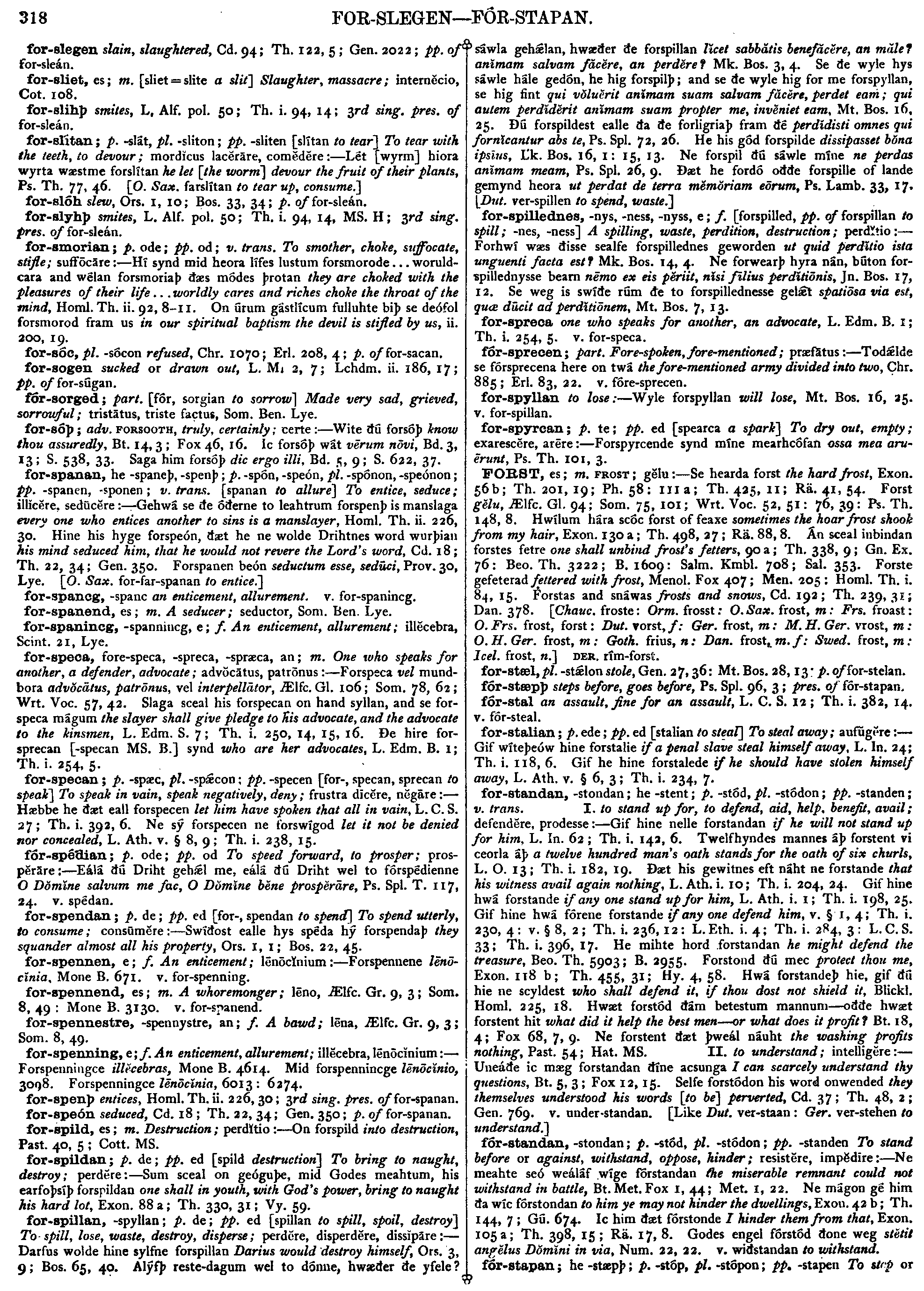
fór-sprecen;
part.
Fore-spoken,
fore-mentioned;
præftus
:--
Todlde
se
fórsprecena
here
on
twá
the
fore-mentioned
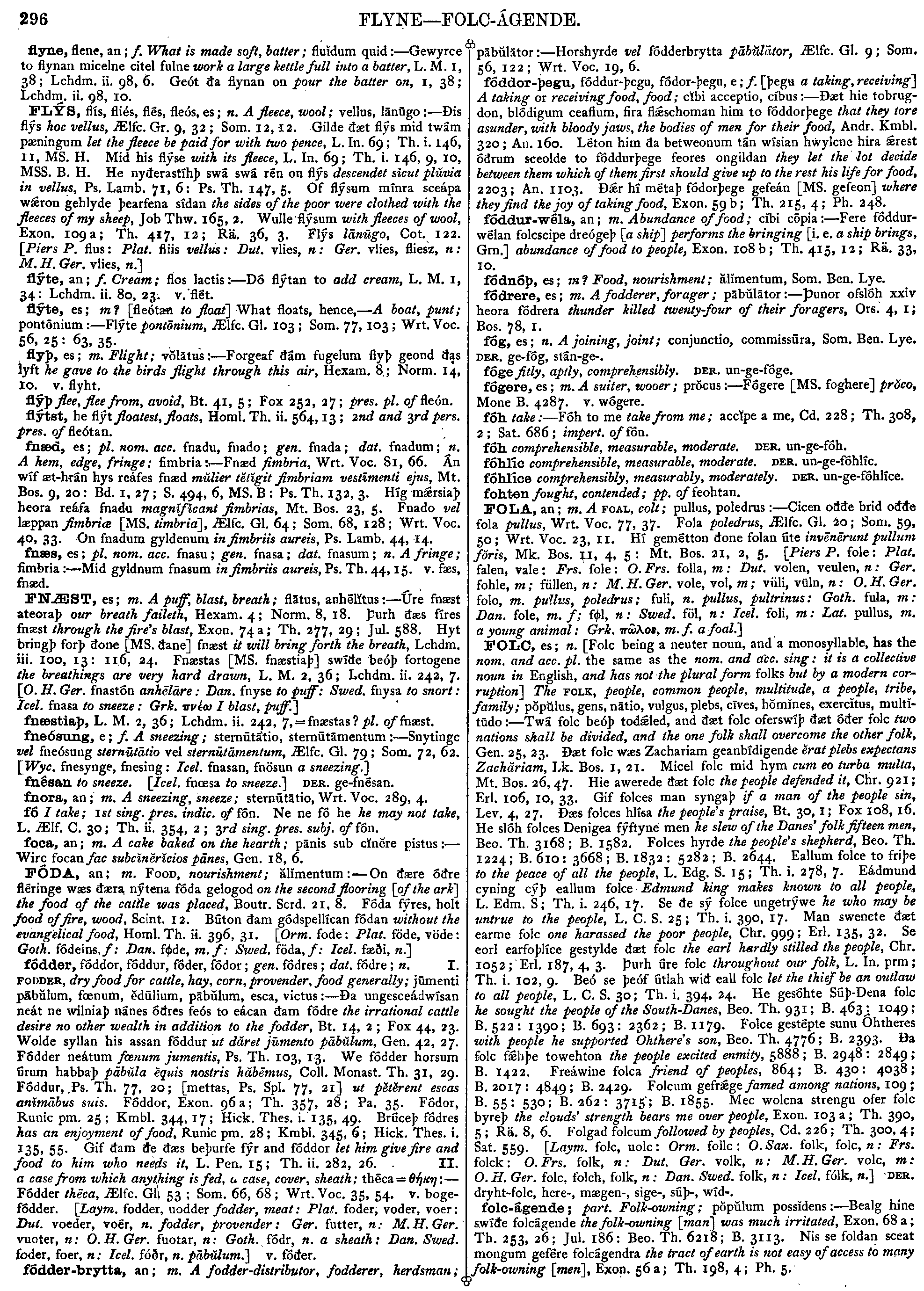
army
divided
into
two,
Chr.
885;
Erl.
83,
22.
v.
fóre-sprecen.
| Result Page: |  |
Previous | 1 2 3 4 5 6 7 8 9 10 | Next |  |
Germanic Lexicon Project (main page)
This search system was written by
Sean Crist
Please consider
volunteering
to correct the data in these online dictionaries.
No rights reserved. Feel free to use these data in any way you please.