|
|

|
Source: Cleasby/Vigfusson, page b0236, entry 14 View original page image as: [TIFF] [PNG] [View previous entry] [View next entry] |
[Comment on this entry] [View comments] |
The following entry has been hand-corrected once. |
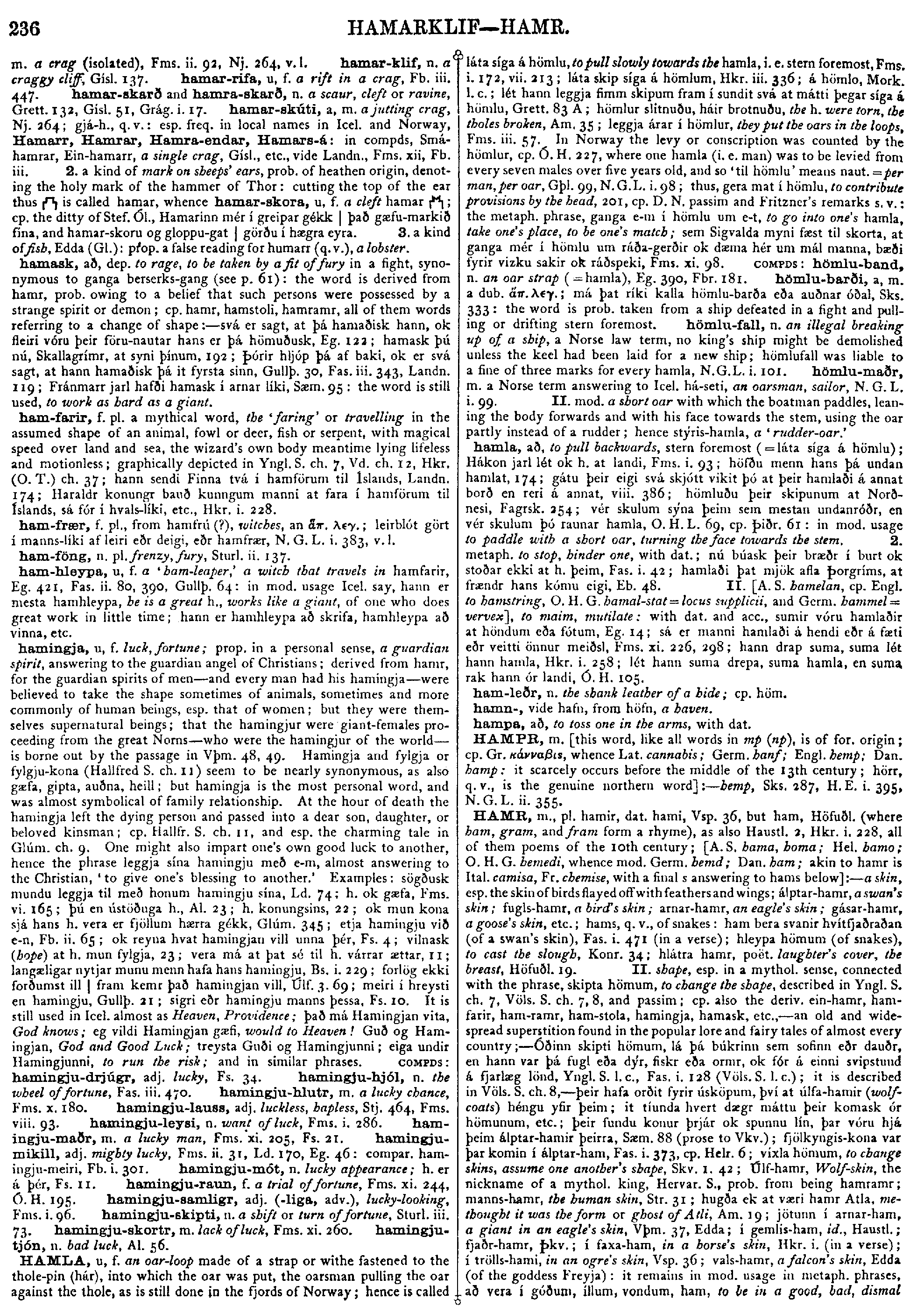
HAMR, m., pl. hamir, dat. hami, Vsp. 36, but ham, Höfuðl. (where ham, gram, and fram form a rhyme), as also Haustl. 2, Hkr. i. 228, all of them poems of the 10th century; [A. S. hama, homa; Hel. hamo; O. H. G. hemedi, whence mod. Germ. hemd; Dan. ham; akin to hamr is Ital. camisa, Fr. chemise, with a final s answering to hams below] :-- a skin, esp. the skin of birds flayed off with feathers and wings; álptar-hamr, a swan's skin; fugls-hamr, a bird's skin; arnar-hamr, an eagle's skin; gásar-hamr, a goose's skin, etc.; hams, q.v., of snakes: ham bera svanir hvítfjaðraðan (of a swan's skin), Fas. i. 471 (in a verse); hleypa hömum (of snakes), to cast the slough, Konr. 34; hlátra hamr, poët. laughter's cover, the breast, Höfuðl. 19. II. shape, esp. in a mythol. sense, connected with the phrase, skipta hömum, to change the shape, described in Yngl. S. ch. 7, Völs. S. ch. 7, 8, and passim; cp. also the deriv. ein-hamr, ham-farir, ham-ramr, ham-stola, hamingja, hamask, etc., -- an old and widespread superstition found in the popular lore and fairy tales of almost every country; -- Óðinn skipti hömum, lá þá búkrinn sem sofinn eðr dauðr, en hann var þá fugl eða dýr, fiskr eða ormr, ok fór á einni svipstund á fjarlæg lönd, Yngl. S. l.c., Fas. i. 128 (Völs. S. l.c.); it is described in Völs. S. ch. 8, -- þeir hafa orðit fyrir úsköpum, því at úlfa-hamir (wolf-coats) héngu yfir þeim; it tíunda hvert dægr máttu þeir komask ór hömunum, etc.; þeir fundu konur þrjár ok spunnu lín, þar vóru hjá þeim álptar-hamir þeirra, Sæm. 88 (prose to Vkv.); fjölkyngis-kona var þar komin í álptar-ham, Fas. i. 373, cp. Helr. 6; víxla hömum, to change skins, assume one another's shape, Skv. 1. 42; Úlf-hamr, Wolf-skin, the nickname of a mythol. king, Hervar. S., prob. from being hamramr; manns-hamr, the human skin, Str. 31; hugða ek at væri hamr Atla, methought it was the form or ghost of Atli, Am. 19; jötunn í arnar-ham, a giant in an eagle's skin, Vþm. 37, Edda; í gemlis-ham, id., Haustl.; fjaðr-hamr, Þkv.; í faxa-ham, in a horse's skin, Hkr. i. (in a verse); í trölls-hami, in an ogre's skin, Vsp. 36; vals-hamr, a falcon's skin, Edda (of the goddess Freyja): it remains in mod. usage in metaph. phrases, að vera í góðum, íllum, vondum, ham, to be in a good, bad, dismal
|
Source: Cleasby/Vigfusson, page b0272, entry 1 View original page image as: [TIFF] [PNG] [View previous entry] [View next entry] |
[Comment on this entry] [View comments] |
The following entry has been hand-corrected once. |
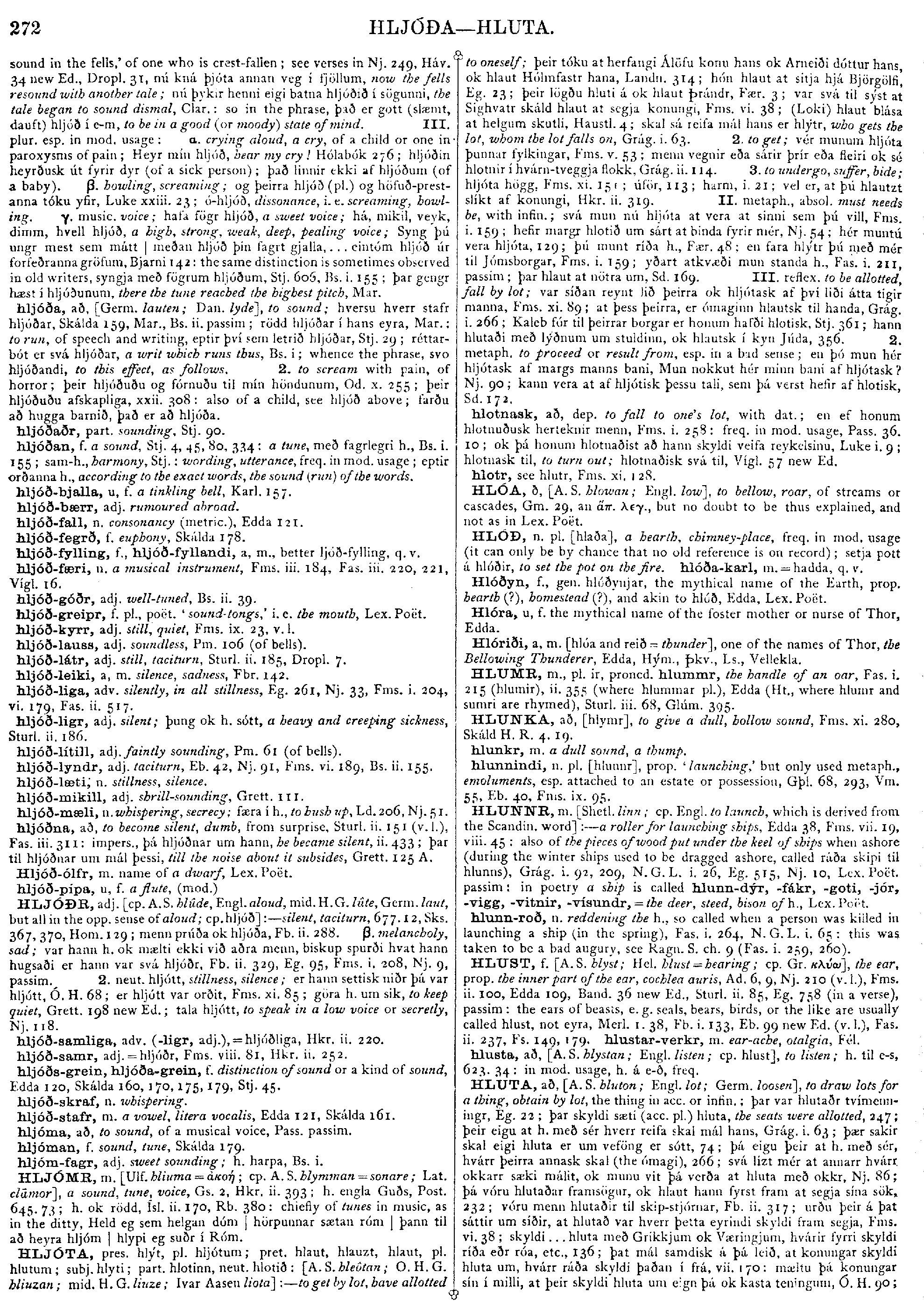
sound
in
the
fells,'
of
one
who
is
crest-fallen;
see
verses
in
Nj.
249,
Háv.
34
new
Ed.,
Dropl.
31,
nú
kná
þjóta
annan
veg
í
fjöllum,
now
the
fells
resound
with
another
tale;
nú
þykir
henni
eigi
batna
hljóðið
í
sögunni,
the
tale
began
to
sound
dismal,
Clar.:
so
in
the
phrase,
það
er
gott
(slæmt,
dauft)
hljóð
í
e-m,
to
be
in
a
good
(or
moody)
state
of
mind.
III.
plur.
esp.
in
mod.
usage:
 .
crying
aloud,
a
cry,
of
a
child
or
one
in
paroxysms
of
pain;
Heyr
mín
hljóð,
hear
my
cry!
Hólabók
276;
hljóðin
heyrðusk
út
fyrir
dyr
(of
a
sick
person);
það
linnir
ekki
af
hljóðum
(of
a
baby).
.
crying
aloud,
a
cry,
of
a
child
or
one
in
paroxysms
of
pain;
Heyr
mín
hljóð,
hear
my
cry!
Hólabók
276;
hljóðin
heyrðusk
út
fyrir
dyr
(of
a
sick
person);
það
linnir
ekki
af
hljóðum
(of
a
baby).
 .
howling,
screaming;
og
þeirra
hljóð
(pl.)
og
höfuð-prestanna
tóku
yfir,
Luke
xxiii.
23;
ó-hljóð,
dissonance,
i.e.
screaming,
howling.
.
howling,
screaming;
og
þeirra
hljóð
(pl.)
og
höfuð-prestanna
tóku
yfir,
Luke
xxiii.
23;
ó-hljóð,
dissonance,
i.e.
screaming,
howling.
 .
music.
voice;
hafa
fögr
hljóð,
a
sweet
voice;
há,
mikil,
veyk,
dimm,
hvell
hljóð,
a
high,
strong,
weak,
deep,
pealing
voice;
Syng
þú
ungr
mest
sem
mátt
|
meðan
hljóð
þín
fagrt
gjalla,
...
eintóm
hljóð
úr
forfeðranna
gröfum,
Bjarni
142:
the
same
distinction
is
sometimes
observed
in
old
writers,
syngja
með
fögrum
hljóðum,
Stj.
606,
Bs.
i.
155;
þar
gengr
hæst
í
hljóðunum,
there
the
tune
reached
the
highest
pitch,
Mar.
.
music.
voice;
hafa
fögr
hljóð,
a
sweet
voice;
há,
mikil,
veyk,
dimm,
hvell
hljóð,
a
high,
strong,
weak,
deep,
pealing
voice;
Syng
þú
ungr
mest
sem
mátt
|
meðan
hljóð
þín
fagrt
gjalla,
...
eintóm
hljóð
úr
forfeðranna
gröfum,
Bjarni
142:
the
same
distinction
is
sometimes
observed
in
old
writers,
syngja
með
fögrum
hljóðum,
Stj.
606,
Bs.
i.
155;
þar
gengr
hæst
í
hljóðunum,
there
the
tune
reached
the
highest
pitch,
Mar.
|
Source: Cleasby/Vigfusson, page b0277, entry 47 View original page image as: [TIFF] [PNG] [View previous entry] [View next entry] |
[Comment on this entry] [View comments] |
The following entry has been hand-corrected once. |
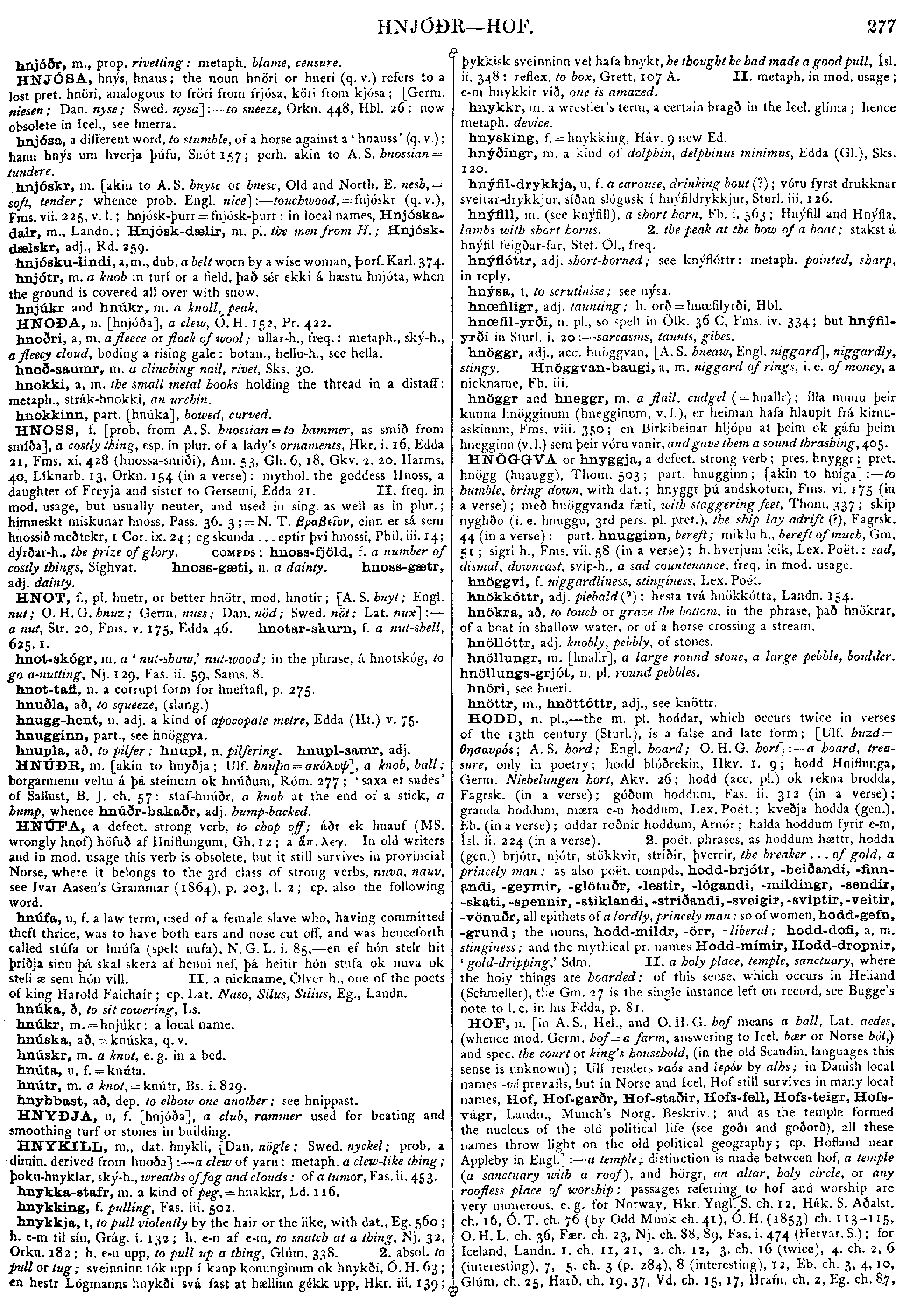
HNÖGGVA or hnyggja, a defect. strong verb; pres. hnyggr; pret. hnögg (hnaugg), Thom. 503; part. hnugginn; [akin to hníga] :-- to humble, bring down, with dat.; hnyggr þú andskotum, Fms. vi. 175 (in a verse); með hnöggvanda fæti, with staggering feet, Thom. 337; skip nyghðo (i.e. hnuggu, 3rd pers. pl. pret.), the ship lay adrift (?), Fagrsk. 44 (in a verse) :-- part. hnugginn, bereft; miklu h., bereft of much, Gm. 51; sigri h., Fms. vii. 58 (in a verse); h. hverjum leik, Lex. Poët.: sad, dismal, downcast, svip-h., a sad countenance, freq. in mod. usage.
|
Source: Cleasby/Vigfusson, page b0365, entry 16 View original page image as: [TIFF] [PNG] [View previous entry] [View next entry] |
[Comment on this entry] [View comments] |
The following entry has been hand-corrected once. |
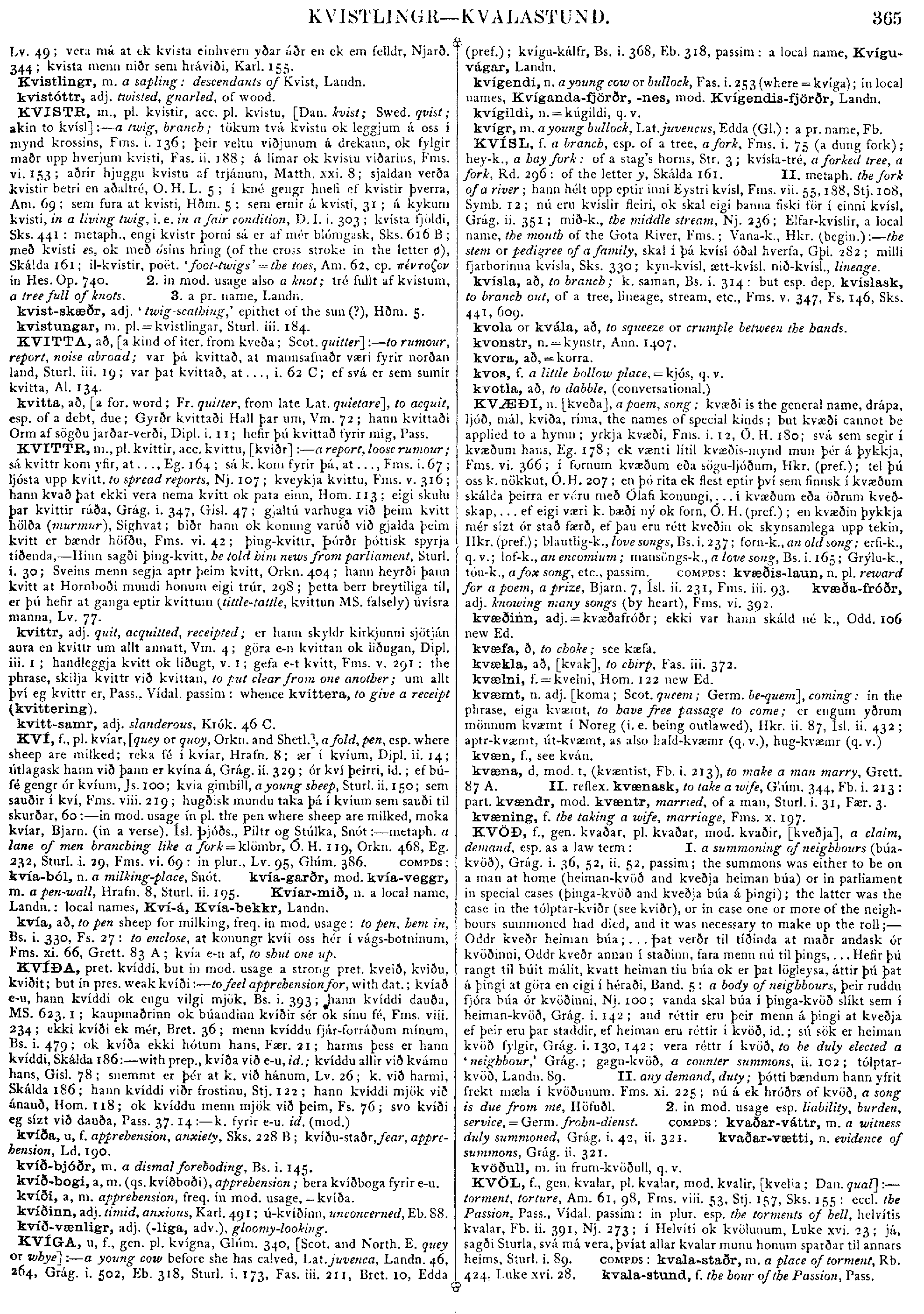
kvíð-bjóðr, m. a dismal foreboding, Bs. i. 145.
|
Source: Cleasby/Vigfusson, page b0468, entry 28 View original page image as: [TIFF] [PNG] [View previous entry] [View next entry] |
[Comment on this entry] [View comments] |
The following entry has been hand-corrected once. |
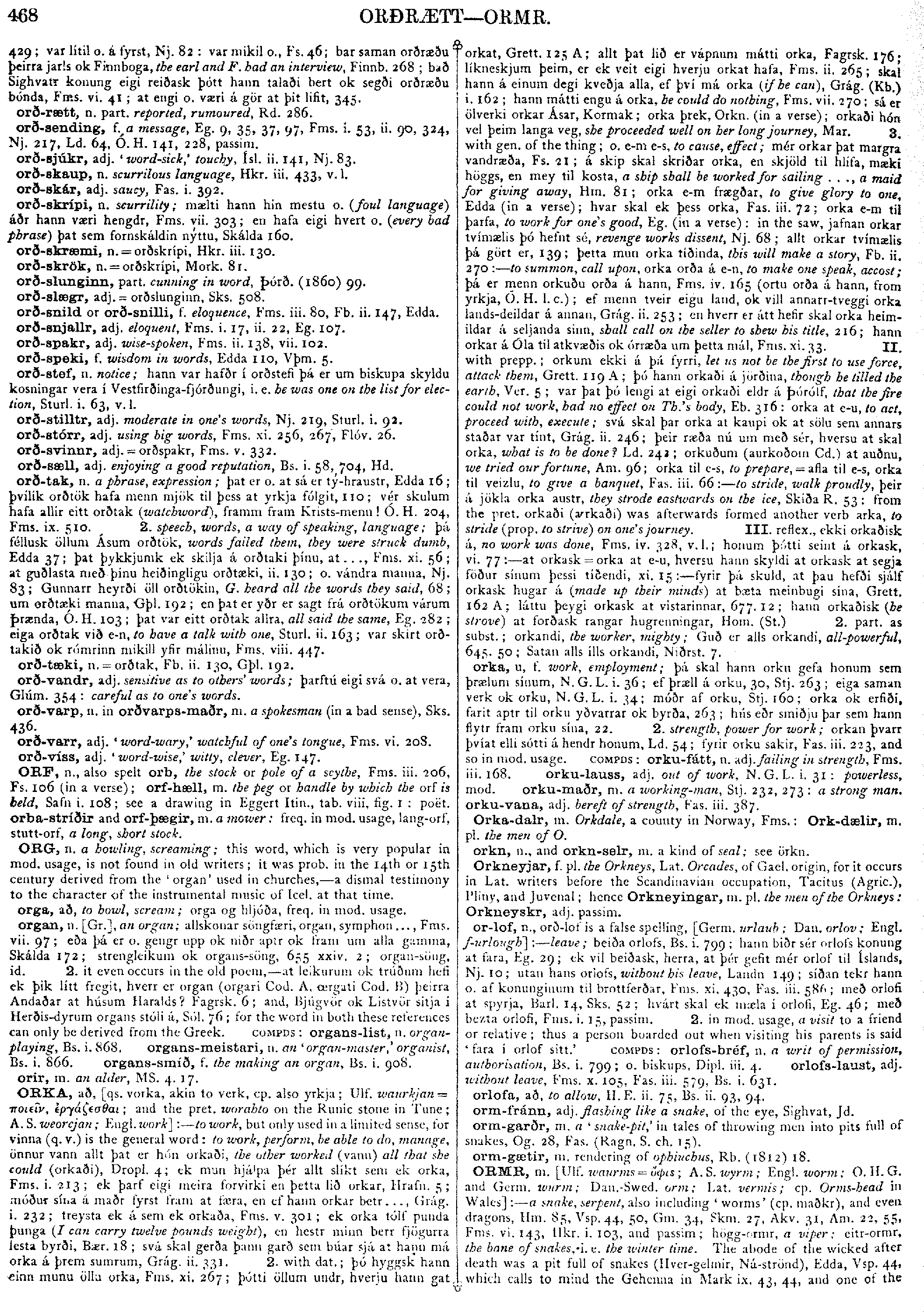
ORG, n. a howling, screaming; this word, which is very popular in mod. usage, is not found in old writers; it was prob. in the 14th or 15th century derived from the 'organ' used in churches, -- a dismal testimony to the character of the instrumental music of Icel. at that time.
|
Source: Cleasby/Vigfusson, page b0576, entry 16 View original page image as: [TIFF] [PNG] [View previous entry] [View next entry] |
[Comment on this entry] [View comments] |
The following entry has been hand-corrected once. |
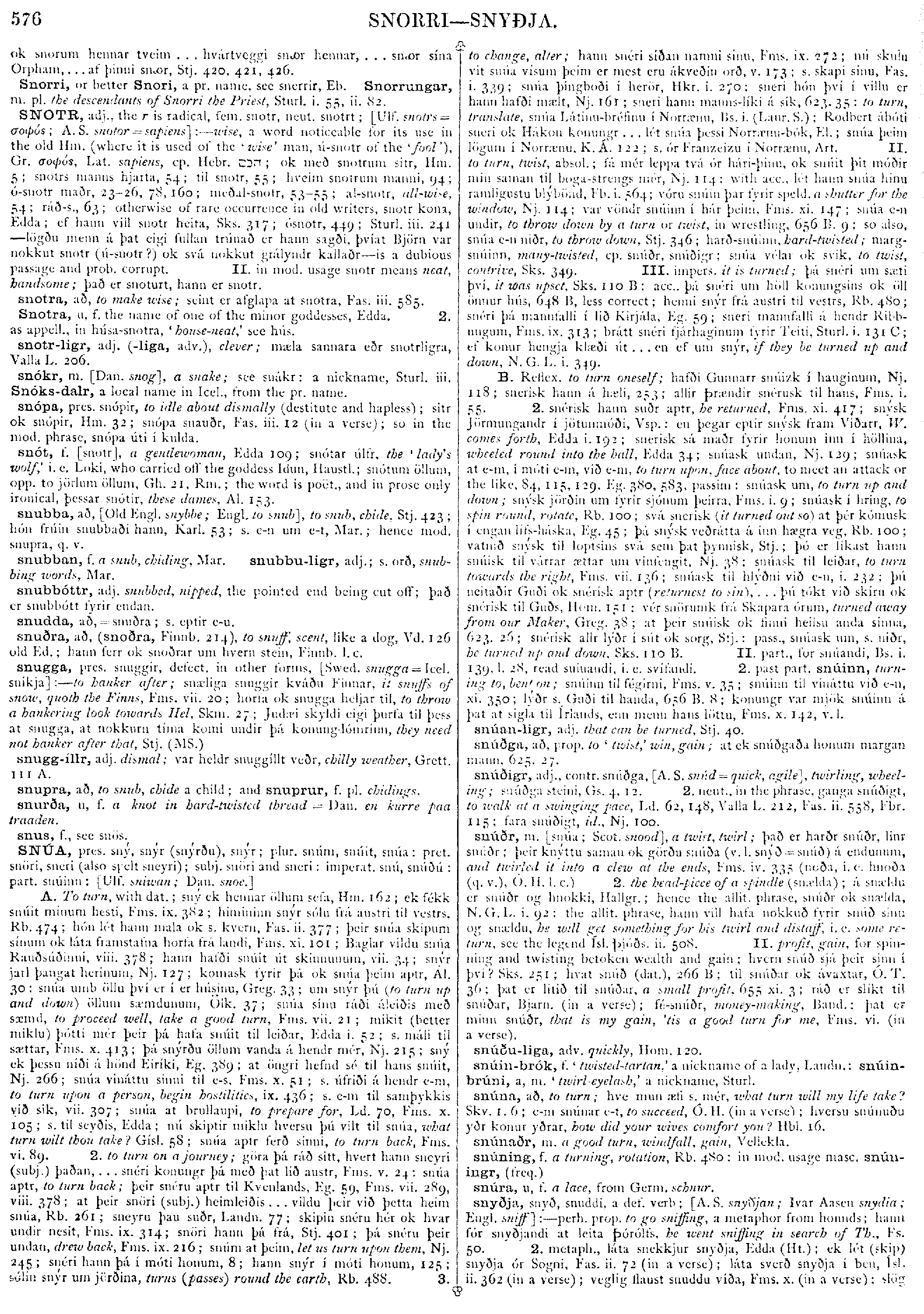
snugg-íllr, adj. dismal; var heldr snuggíllt veðr, chilly weather, Grett. 111 A.
|
Source: Cleasby/Vigfusson, page b0631, entry 67 View original page image as: [TIFF] [PNG] [View previous entry] [View next entry] |
[Comment on this entry] [View comments] |
The following entry has been hand-corrected once. |
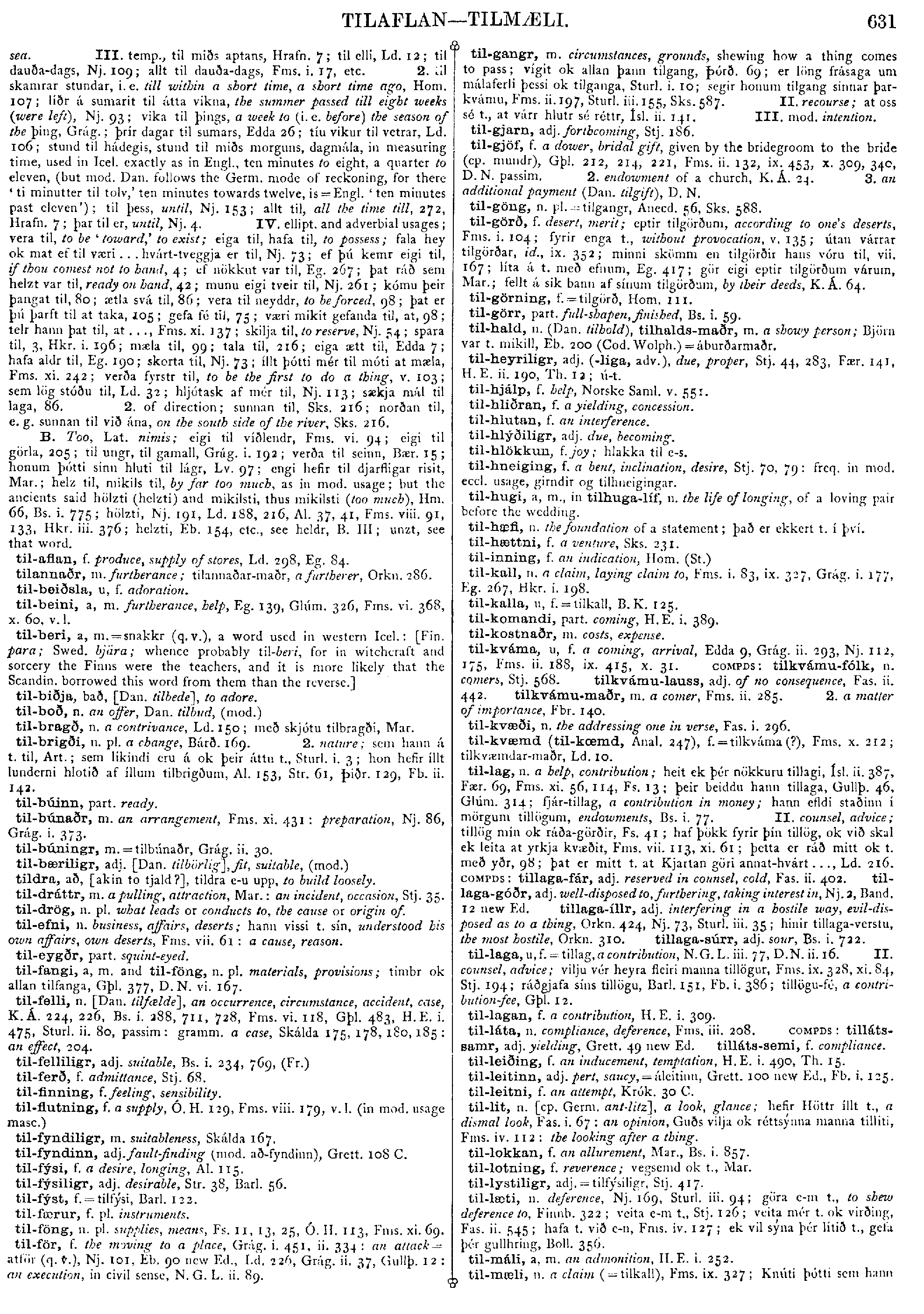
til-lit, n. [cp. Germ. ant-litz], a look, glance; hefir Höttr íllt t., a dismal look, Fas. i. 67: an opinion, Guðs vilja ok réttsýnna manna tilliti, Fms. iv. 112: the looking after a thing.
|
Source: Cleasby/Vigfusson, page b0637, entry 29 View original page image as: [TIFF] [PNG] [View previous entry] [View next entry] |
[Comment on this entry] [View comments] |
The following entry has been hand-corrected once. |
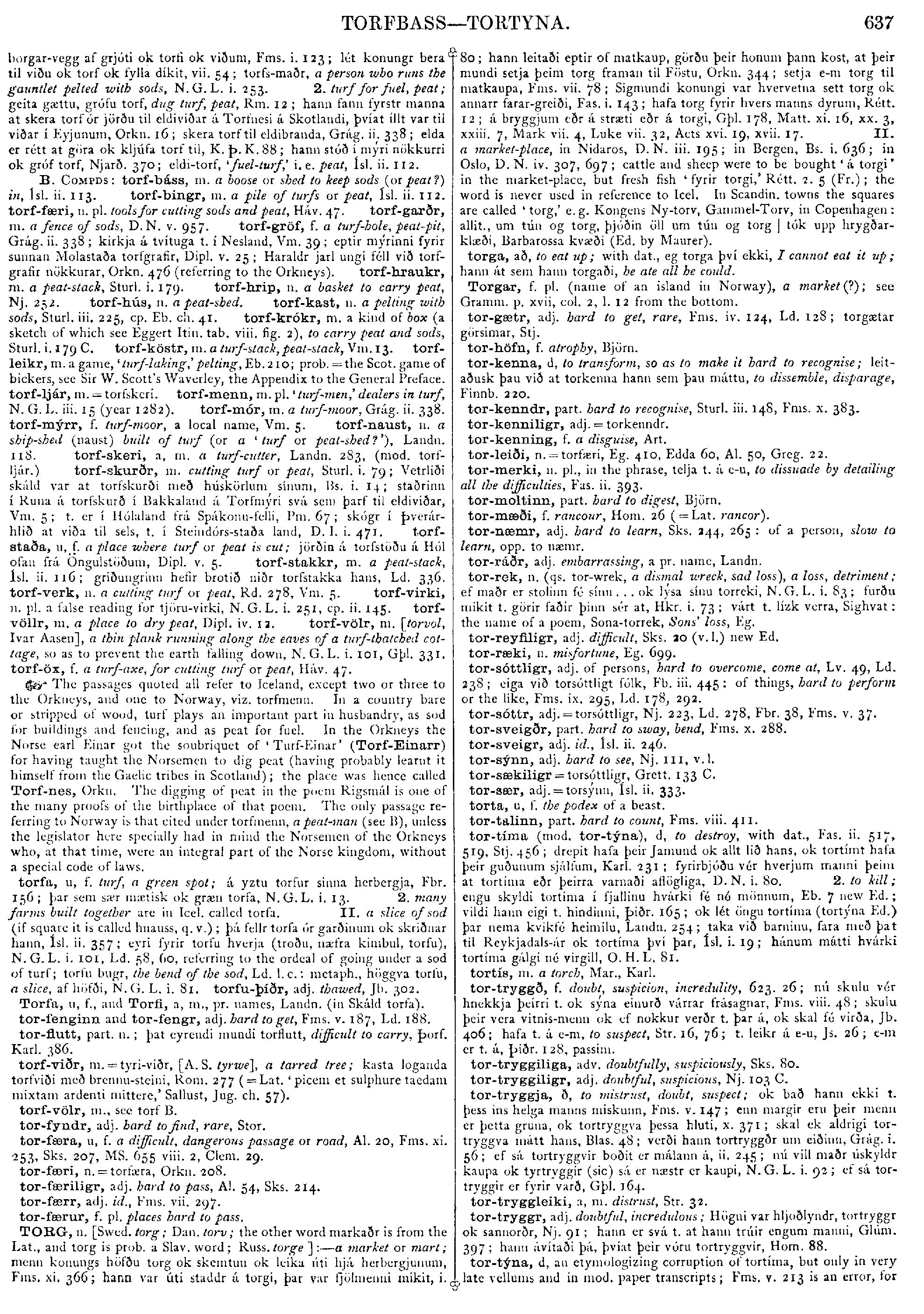
tor-rek, n. (qs. tor-wrek, a dismal wreck, sad loss), a loss, detriment; ef maðr er stolinn fé sínn ... ok lýsa sínu torreki, N.G.L. i. 83; furðu mikit t. görir faðir þinn sér at, Hkr. i. 73; várt t. lízk verra, Sighvat: the name of a poem, Sona-torrek, Sons' loss, Eg.
|
Source: Cleasby/Vigfusson, page b0639, entry 24 View original page image as: [TIFF] [PNG] [View previous entry] [View next entry] |
[Comment on this entry] [View comments] |
The following entry has been hand-corrected once. |
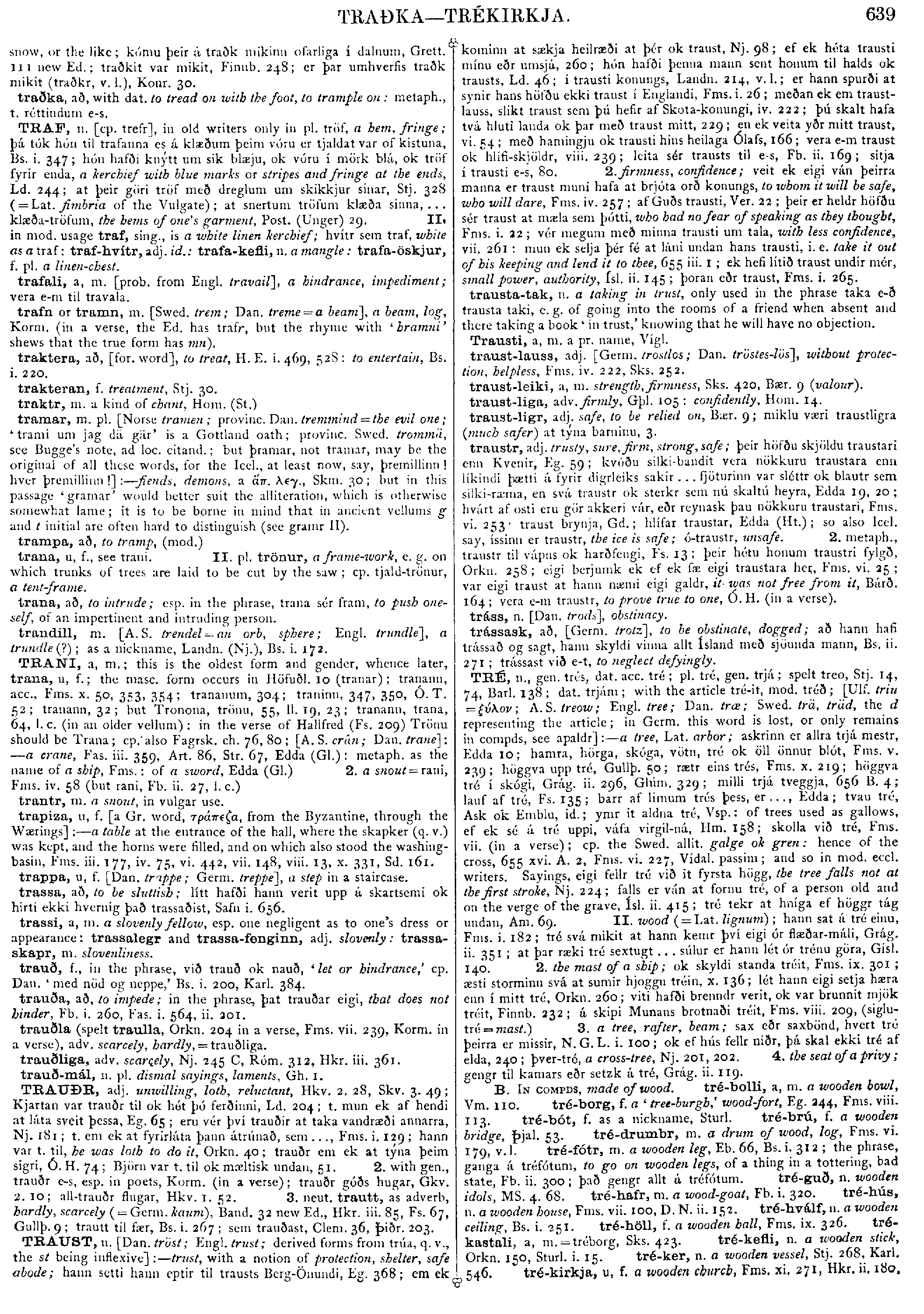
trauð-mál, n. pl. dismal sayings, laments, Gh. 1.
|
Source: Cleasby/Vigfusson, page b0640, entry 8 View original page image as: [TIFF] [PNG] [View previous entry] [View next entry] |
[Comment on this entry] [View comments] |
The following entry has been hand-corrected once. |
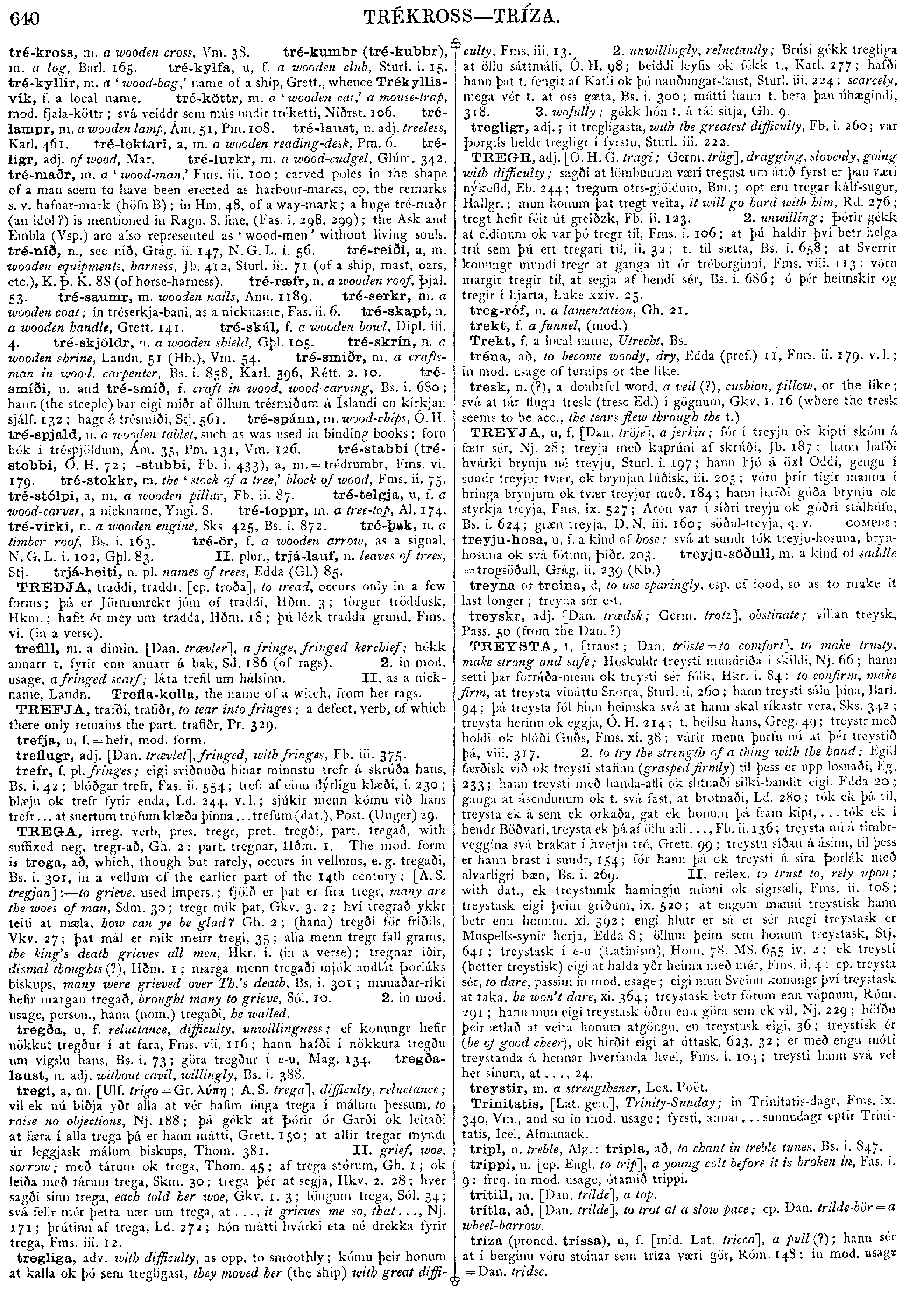
TREGA, irreg. verb, pres. tregr, pret. tregði, part. tregað, with suffixed neg. tregr-að, Gh. 2: part. tregnar, Hðm. 1. The mod. form is trega, að, which, though but rarely, occurs in vellums, e.g. tregaði, Bs. i. 301, in a vellum of the earlier part of the 14th century; [A.S. tregjan] :-- to grieve, used impers.; fjölð er þat er fíra tregr, many are the woes of man, Sdm. 30; tregr mik þat, Gkv. 3. 2; hví tregrað ykkr teiti at mæla, how can ye be glad? Gh. 2; (hana) tregði för friðils, Vkv. 27; þat mál er mik meirr tregi, 35; alla menn tregr fall grams, the king's death grieves all men, Hkr. i. (in a verse); tregnar iðir, dismal thoughts(?), Hðm. 1; marga menn tregaði mjök andlát Þorláks biskups, many were grieved over Th.'s death, Bs. i. 301; munaðar-ríki hefir margan tregað, brought many to grieve, Sól. 10. 2. in mod. usage, person., hann (nom.) tregaði, he wailed.
| Result Page: |  |
Previous | 1 2 3 | Next |  |
Germanic Lexicon Project (main page)
This search system was written by
Sean Crist
Please consider
volunteering
to correct the data in these online dictionaries.
No rights reserved. Feel free to use these data in any way you please.