|
|

Search for dicens again, using less strict matching (29 results)
|
Source: Bosworth/Toller, page d0551, entry 6 View original page image as: [TIFF] [PNG] [View previous entry] [View next entry] |
[Comment on this entry] [View comments (1)] |
The following entry has been hand-corrected once. |
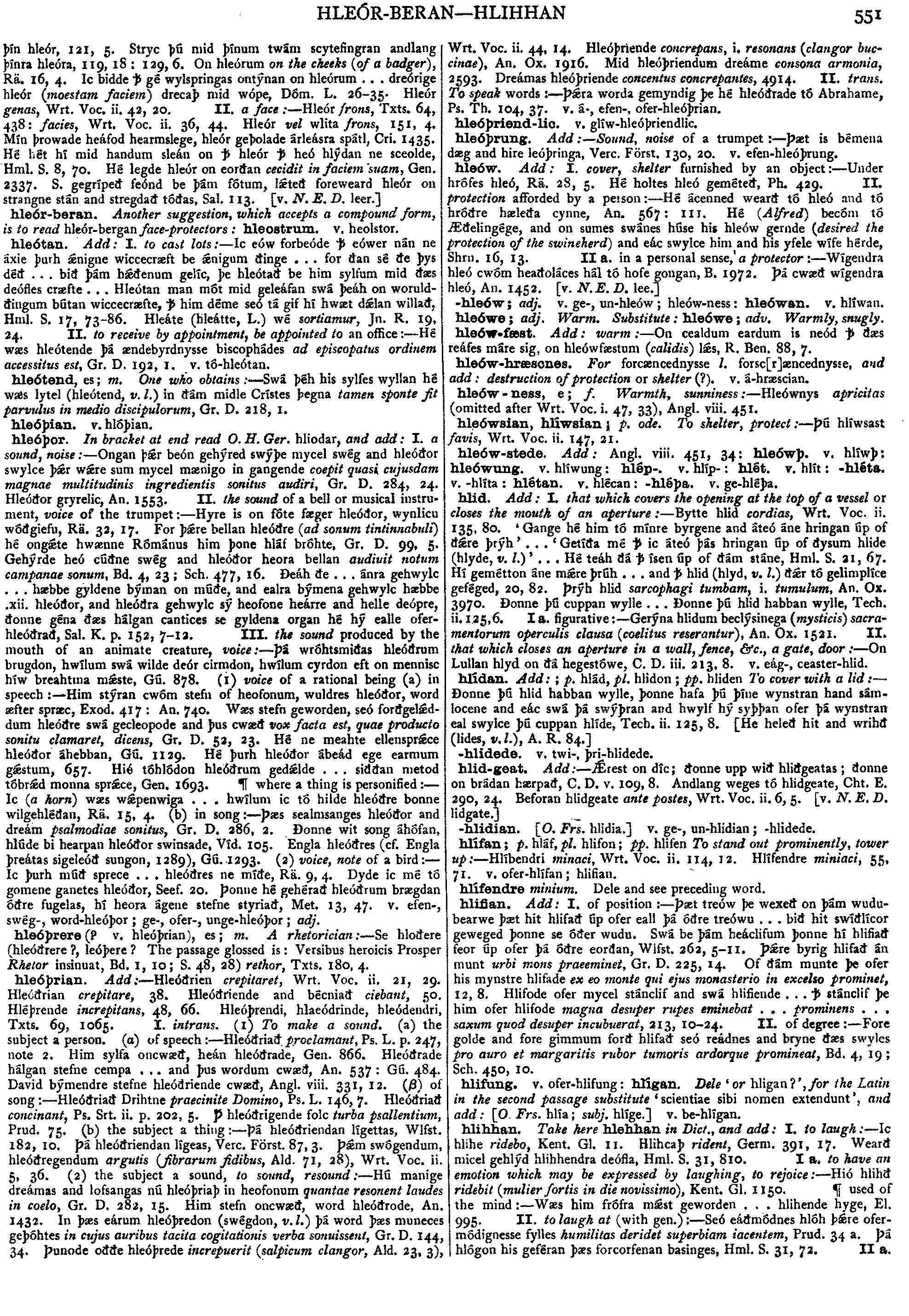
hleóþor.
In
bracket
at
end
read
O.
H.
Ger.
hliodar,
and
add:
I.
a
sound,
noise
:--
Ongan
þ r
beón
geh
r
beón
geh red
swþe
mycel
sw
red
swþe
mycel
sw g
and
hleó
g
and
hleó or
swylce
þr
wre
sum
mycel
mænigo
in
gangende
coepit
quasi
cujusdam
magnae
multitudinis
ingredientis
sonitus
audiri,
Gr.
D.
284,
24.
Hleóor
gryrelic,
An.
1553.
II.
the
sound
of
a
bell
or
musical
instrument,
voice
of
the
trumpet
:--
Hyre
is
on
f
or
swylce
þr
wre
sum
mycel
mænigo
in
gangende
coepit
quasi
cujusdam
magnae
multitudinis
ingredientis
sonitus
audiri,
Gr.
D.
284,
24.
Hleóor
gryrelic,
An.
1553.
II.
the
sound
of
a
bell
or
musical
instrument,
voice
of
the
trumpet
:--
Hyre
is
on
f te
fæger
hleóor,
wynlicu
wgiefu,
Rä.
32,
17.
For
þre
bellan
hleóre
(ad
sonum
tintinnabuli)
h
ongte
hwænne
Rm
te
fæger
hleóor,
wynlicu
wgiefu,
Rä.
32,
17.
For
þre
bellan
hleóre
(ad
sonum
tintinnabuli)
h
ongte
hwænne
Rm nus
him
þone
hlf
brhte.
Gr.
D.
99,
5.
Gehrde
heó
c
nus
him
þone
hlf
brhte.
Gr.
D.
99,
5.
Gehrde
heó
c ne
swg
and
hleóor
heora
bellan
audiuit
notum
campanae
sonum,
Bd.
4,
23
;
Sch.
477,
16.
Ðeáh
e
.
.
.
nra
gehwylc
.
.
.
hæbbe
gyldene
bman
on
me,
and
ealra
bmena
gehwylc
hæbbe
.xii.
hleóor,
and
hleóra
gehwylc
s
heofone
heárre
and
helle
deópre,
onne
gna
æs
hlgan
cantices
se
gyldena
organ
h
h
ealle
ofer-hleóe,
Sal.
K.
p.
152,
7-12.
III.
thr
sound
produced
by
the
mouth
of
an
animate
creature,
voice
:--
Þ
wrhtsmias
hleórum
brugdon,
hw
ne
swg
and
hleóor
heora
bellan
audiuit
notum
campanae
sonum,
Bd.
4,
23
;
Sch.
477,
16.
Ðeáh
e
.
.
.
nra
gehwylc
.
.
.
hæbbe
gyldene
bman
on
me,
and
ealra
bmena
gehwylc
hæbbe
.xii.
hleóor,
and
hleóra
gehwylc
s
heofone
heárre
and
helle
deópre,
onne
gna
æs
hlgan
cantices
se
gyldena
organ
h
h
ealle
ofer-hleóe,
Sal.
K.
p.
152,
7-12.
III.
thr
sound
produced
by
the
mouth
of
an
animate
creature,
voice
:--
Þ
wrhtsmias
hleórum
brugdon,
hw lum
sw
wilde
deór
cirmdon,
hwlum
cyrdon
eft
on
mennisc
hw
breahtma
mste,
G.
878.
(l)
voice
of
a
rational
being
(a)
in
speech
:--
Him
stran
cwm
stefn
of
heofonum,
wuldres
hleóor,
word
æfter
spræc,
Exod.
417
:
An.
740.
Wæs
stefn
geworden,
seó
forgeld-dum
hleóre
sw
gecleopode
and
þus
cwæ
vox
facta
est,
quae
producto
sonitu
clamaret,
dicens,
Gr.
D.
53,
23.
H
ne
meahte
ellensprce
hleóor
hebban,
G.
1129.
H
þurh
hleóor
beád
ege
earmum
gstum,
657.
Hié
thldon
hleórum
gedlde
.
.
.
sian
metod
tbrd
monna
sprce,
Gen.
1693.

where
a
thing
is
personified
:--
Ic
(a
horn)
wæs
wpenwiga
.
.
.
hwlum
ic
t
hilde
hleóre
bonne
wilgehlan,
Rä.
15,
4.
(b)
in
song
:--
Þæs
sealmsanges
hleóor
and
dreám
psalmodiae
sonitus,
Gr.
D.
286,
2.
Ðonne
wit
song
hfan.
.
,
hlde
bi
hearpan
hleóor
swinsade,
Vd.
105.
Engla
hleóres
(cf.
Engla
þreátas
sigeleó
sungon,
1289),
G.
1293.
(2)
voice,
note
of
a
bird
:--
Ic
þurh
m
sprece
.
.
.
hleóres
ne
me,
R.
9,
4.
Dyde
ic
m
t
gomene
ganetes
hleóor,
Scef.
20.
Þonne
h
gehra
hleórum
brægdan
re
fugelas,
h
heora
gene
stefne
styria,
Met.
13,
47.
v.
efen-,
swg,
word-hleóþor
;
ge-,
ofer-,
unge-hleóþor;
adj.
lum
sw
wilde
deór
cirmdon,
hwlum
cyrdon
eft
on
mennisc
hw
breahtma
mste,
G.
878.
(l)
voice
of
a
rational
being
(a)
in
speech
:--
Him
stran
cwm
stefn
of
heofonum,
wuldres
hleóor,
word
æfter
spræc,
Exod.
417
:
An.
740.
Wæs
stefn
geworden,
seó
forgeld-dum
hleóre
sw
gecleopode
and
þus
cwæ
vox
facta
est,
quae
producto
sonitu
clamaret,
dicens,
Gr.
D.
53,
23.
H
ne
meahte
ellensprce
hleóor
hebban,
G.
1129.
H
þurh
hleóor
beád
ege
earmum
gstum,
657.
Hié
thldon
hleórum
gedlde
.
.
.
sian
metod
tbrd
monna
sprce,
Gen.
1693.

where
a
thing
is
personified
:--
Ic
(a
horn)
wæs
wpenwiga
.
.
.
hwlum
ic
t
hilde
hleóre
bonne
wilgehlan,
Rä.
15,
4.
(b)
in
song
:--
Þæs
sealmsanges
hleóor
and
dreám
psalmodiae
sonitus,
Gr.
D.
286,
2.
Ðonne
wit
song
hfan.
.
,
hlde
bi
hearpan
hleóor
swinsade,
Vd.
105.
Engla
hleóres
(cf.
Engla
þreátas
sigeleó
sungon,
1289),
G.
1293.
(2)
voice,
note
of
a
bird
:--
Ic
þurh
m
sprece
.
.
.
hleóres
ne
me,
R.
9,
4.
Dyde
ic
m
t
gomene
ganetes
hleóor,
Scef.
20.
Þonne
h
gehra
hleórum
brægdan
re
fugelas,
h
heora
gene
stefne
styria,
Met.
13,
47.
v.
efen-,
swg,
word-hleóþor
;
ge-,
ofer-,
unge-hleóþor;
adj.
|
Source: Bosworth/Toller, page d0556, entry 38 View original page image as: [TIFF] [PNG] [View previous entry] [View next entry] |
[Comment on this entry] [View comments] |
The following entry has been hand-corrected once. |
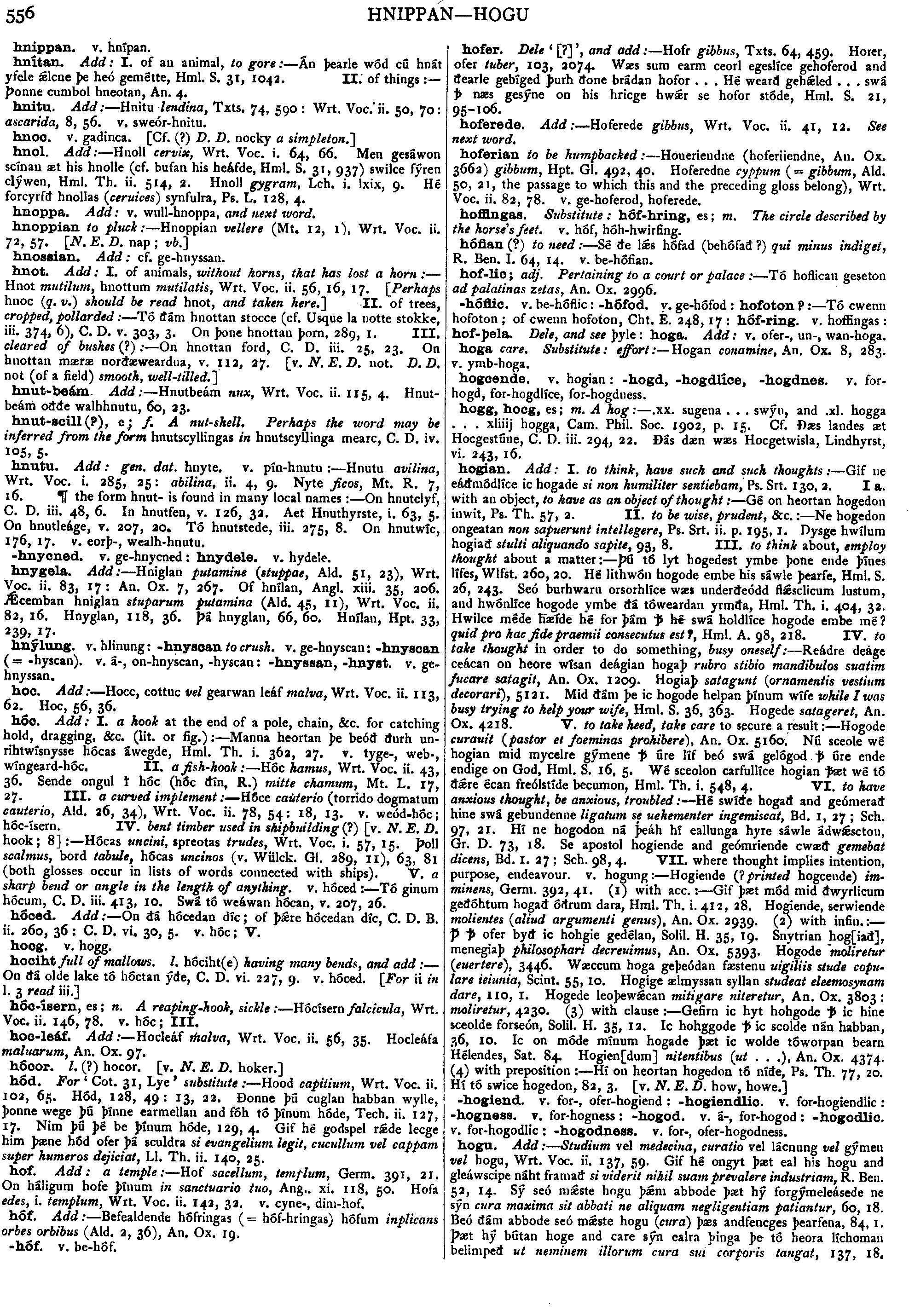
hogian.
Add:
I.
to
think,
have
such
and
such
thoughts
:--
Gif
ne
eámdlce
ic
hogade
si
non
humiliter
sentiebam,
Ps.
Srt.
130,
2.
I
a.
with
an
object,
to
hove
as
an
object
of
thought
:--
G
on
heortan
hogedon
inwit,
Ps.
Th.
57,
2.
II.
to
be
wise,
prudent,
&c.
:--
Ne
hogedon
ongeatan
noa
sapuerunt
intellegere,
Ps.
Srt.
ii.
p.
195,
1.
Dysge
hwlum
hogia
stulti
aliquando
sapite,
93,
8.
III.
to
think
about,
employ
thought
about
a
matter
:--
Þ
t
lyt
hogedest
ymbe
þone
ende
þnes
lfes,
Wlfst.
260,
20.
H
lihthwn
hogode
embe
his
swle
þearfe,
Hml.
S.
26,
243.
Seó
burhwaru
orsorhlce
wæs
undereódd
flsclicum
lustum,
and
hwnlce
hogode
ymbe
tweardan
yrma,
Hml.
Th.
i.
404,
32.
Hwilce
mde
hæfde
h
for
þm
 h
sw
holdlce
hogode
embe
m
?
quid
pro
hac
fide
praemii
consecutus
est?
Hml.
A.
98,
218.
IV.
to
take
thought
in
order
to
do
something,
busy
oneself
:--
Reádre
deáge
ceácan
on
heore
wsan
deágian
hogaþ
rubro
stibio
mandibulos
suatim
fucare
satagit,
An.
Ox.
1209.
Hogiaþ
satagunt
(ornamentis
vestium
decor
art),
5121.
Mid
m
þe
ic
hogode
helpan
þnum
wfe
while
I
was
busy
trying
to
help
your
wife,
Hml.
S.
36,
363.
Hogede
satageret,
An.
Ox.
4218.
V.
to
take
heed,
take
care
to
secure
a
result
:--
Hogode
curauit
(pastor
et
foeminas
prohibere),
An.
Ox.
5160.
N
sceole
w
hogian
mid
mycelre
gmene
re
lf
beó
sw
gelgod
re
ende
endige
on
God,
Hml.
S.
16,
5.
W
sceolon
carfullce
hogian
þæt
w
t
re
can
freólstde
becumon,
Hml.
Th.
i.
548,
4.
VI.
to
have
anxious
thought,
be
anxious,
troubled
:--
H
swe
hoga
and
geómera
hine
sw
gebundenne
ligatum
se
uehementer
ingemiscat,
Bd.
I.
27
;
Sch.
97,
21.
H
ne
hogodon
n
þeáh
h
eallunga
hyre
swle
dwscton,
Gr.
D.
73,
18.
Se
apostol
hogiende
and
geómriende
cwæ
gemebat
dicens,
Bd.
l,
27
;
Sch.
98,
4.
VII.
where
thought
implies
intention,
purpose,
endeavour,
v.
hogung
:--
Hogiende
(?
printed
hogcende)
im-minens,
Germ.
392,
41.
(l)
with
acc.
:--
Gif
þæt
md
mid
wyrlicum
gehtum
hoga
rum
dara,
Hml.
Th.
i.
412,
28.
Hogiende,
serwiende
molientes
(aliud
argumenti
genus).
An.
Ox.
2939.
(2)
with
infin.
:--
ofer
by
ic
hohgie
gedlan,
Solil.
H.
35,
19.
Snytrian
hog[ia],
menegiaþ
philosophari
decreuimus,
An.
Ox.
5393.
Hogode
molirelur
(euertere),
3446.
Wæccum
hoga
geþeódan
fæstenu
uigiliis
stude
copu-lare
ieiunia,
Scint.
55,
10.
Hogige
ælmyssan
syllan
studeat
eleemosynam
dare,
110,
I.
Hogede
leoþewcan
mitigare
nileretur,
An.
Ox.
3803
:
moliretur,
4230.
(3)
with
clause
:--
Gefirn
ic
hyt
hohgode
ic
hine
sceolde
forseón,
Solil.
H.
35,
12.
Ic
hohggode
ic
scolde
nn
habban,
36,
10.
Ic
on
mde
mnum
hogade
þæt
ic
wolde
tworpan
bearn
Hlendes,
Sat.
84.
Hogien[dum]
nitentibus
(ut
.
.
.
),
An.
Ox.
4374.
(4)
with
preposition
:--
H
on
heortan
hogedon
t
ne,
Ps.
Th.
77,
20.
H
t
swice
hogedon,
82,
3.
[v.
N.
E.
D.
how,
howe.]
h
sw
holdlce
hogode
embe
m
?
quid
pro
hac
fide
praemii
consecutus
est?
Hml.
A.
98,
218.
IV.
to
take
thought
in
order
to
do
something,
busy
oneself
:--
Reádre
deáge
ceácan
on
heore
wsan
deágian
hogaþ
rubro
stibio
mandibulos
suatim
fucare
satagit,
An.
Ox.
1209.
Hogiaþ
satagunt
(ornamentis
vestium
decor
art),
5121.
Mid
m
þe
ic
hogode
helpan
þnum
wfe
while
I
was
busy
trying
to
help
your
wife,
Hml.
S.
36,
363.
Hogede
satageret,
An.
Ox.
4218.
V.
to
take
heed,
take
care
to
secure
a
result
:--
Hogode
curauit
(pastor
et
foeminas
prohibere),
An.
Ox.
5160.
N
sceole
w
hogian
mid
mycelre
gmene
re
lf
beó
sw
gelgod
re
ende
endige
on
God,
Hml.
S.
16,
5.
W
sceolon
carfullce
hogian
þæt
w
t
re
can
freólstde
becumon,
Hml.
Th.
i.
548,
4.
VI.
to
have
anxious
thought,
be
anxious,
troubled
:--
H
swe
hoga
and
geómera
hine
sw
gebundenne
ligatum
se
uehementer
ingemiscat,
Bd.
I.
27
;
Sch.
97,
21.
H
ne
hogodon
n
þeáh
h
eallunga
hyre
swle
dwscton,
Gr.
D.
73,
18.
Se
apostol
hogiende
and
geómriende
cwæ
gemebat
dicens,
Bd.
l,
27
;
Sch.
98,
4.
VII.
where
thought
implies
intention,
purpose,
endeavour,
v.
hogung
:--
Hogiende
(?
printed
hogcende)
im-minens,
Germ.
392,
41.
(l)
with
acc.
:--
Gif
þæt
md
mid
wyrlicum
gehtum
hoga
rum
dara,
Hml.
Th.
i.
412,
28.
Hogiende,
serwiende
molientes
(aliud
argumenti
genus).
An.
Ox.
2939.
(2)
with
infin.
:--
ofer
by
ic
hohgie
gedlan,
Solil.
H.
35,
19.
Snytrian
hog[ia],
menegiaþ
philosophari
decreuimus,
An.
Ox.
5393.
Hogode
molirelur
(euertere),
3446.
Wæccum
hoga
geþeódan
fæstenu
uigiliis
stude
copu-lare
ieiunia,
Scint.
55,
10.
Hogige
ælmyssan
syllan
studeat
eleemosynam
dare,
110,
I.
Hogede
leoþewcan
mitigare
nileretur,
An.
Ox.
3803
:
moliretur,
4230.
(3)
with
clause
:--
Gefirn
ic
hyt
hohgode
ic
hine
sceolde
forseón,
Solil.
H.
35,
12.
Ic
hohggode
ic
scolde
nn
habban,
36,
10.
Ic
on
mde
mnum
hogade
þæt
ic
wolde
tworpan
bearn
Hlendes,
Sat.
84.
Hogien[dum]
nitentibus
(ut
.
.
.
),
An.
Ox.
4374.
(4)
with
preposition
:--
H
on
heortan
hogedon
t
ne,
Ps.
Th.
77,
20.
H
t
swice
hogedon,
82,
3.
[v.
N.
E.
D.
how,
howe.]
|
Source: Bosworth/Toller, page d0666, entry 12 View original page image as: [TIFF] [PNG] [View previous entry] [View next entry] |
[Comment on this entry] [View comments] |
The following entry has been hand-corrected once. |
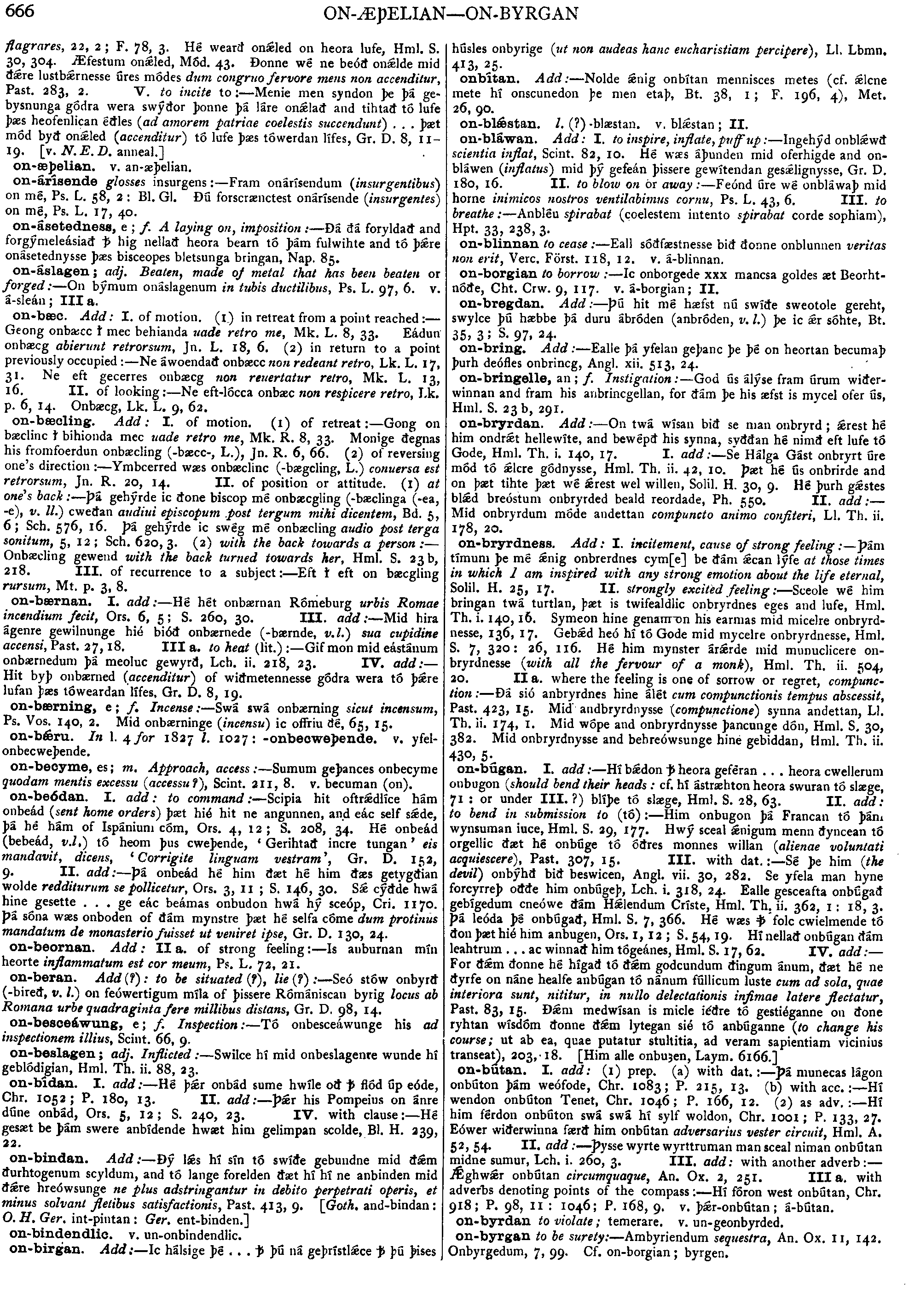
on-beódan.
I.
add:
to
command
:--
Scipia
hit
oftr dlíce
hám
onbeád
(sent
nome
orders)
þæt
hié
hit
ne
angunnen,
and
eác
self
sde,
þá
hé
hám
of
Ispánium
cóm,
Ors.
4,
12;
S.
308,
34.
Hé
onbeád
(bebeád,
v.
l.)
tó
heom
þus
cweþende,
'Gerihtað
incre
tungan'
eis
mandavit,
dicens,
'Corrigite
linguam
vestram',
Gr.
D.
152,
9.
II.
add
:--
Þá
onbeád
hé
him
ðæt
hé
him
ðæs
getygðian
wolde
redditurum
se
pollicetur,
Ors.
3,
11
;
S.
146,
30.
S
cýðde
hwá
hine
gesette
.
.
.
ge
eác
beámas
onbudon
hwá
hý
sceóp,
Cri.
1170.
Þá
sóna
wæs
onboden
of
ðám
mynstre
þæt
hé
selfa
cóme
dum
protinus
mandatum
de
monasterio
fuisset
ut
veniret
ipse,
Gr.
D.
130,
24.
dlíce
hám
onbeád
(sent
nome
orders)
þæt
hié
hit
ne
angunnen,
and
eác
self
sde,
þá
hé
hám
of
Ispánium
cóm,
Ors.
4,
12;
S.
308,
34.
Hé
onbeád
(bebeád,
v.
l.)
tó
heom
þus
cweþende,
'Gerihtað
incre
tungan'
eis
mandavit,
dicens,
'Corrigite
linguam
vestram',
Gr.
D.
152,
9.
II.
add
:--
Þá
onbeád
hé
him
ðæt
hé
him
ðæs
getygðian
wolde
redditurum
se
pollicetur,
Ors.
3,
11
;
S.
146,
30.
S
cýðde
hwá
hine
gesette
.
.
.
ge
eác
beámas
onbudon
hwá
hý
sceóp,
Cri.
1170.
Þá
sóna
wæs
onboden
of
ðám
mynstre
þæt
hé
selfa
cóme
dum
protinus
mandatum
de
monasterio
fuisset
ut
veniret
ipse,
Gr.
D.
130,
24.
|
Source: Bosworth/Toller, page d0678, entry 12 View original page image as: [TIFF] [PNG] [View previous entry] [View next entry] |
[Comment on this entry] [View comments] |
The following entry has been hand-corrected once. |
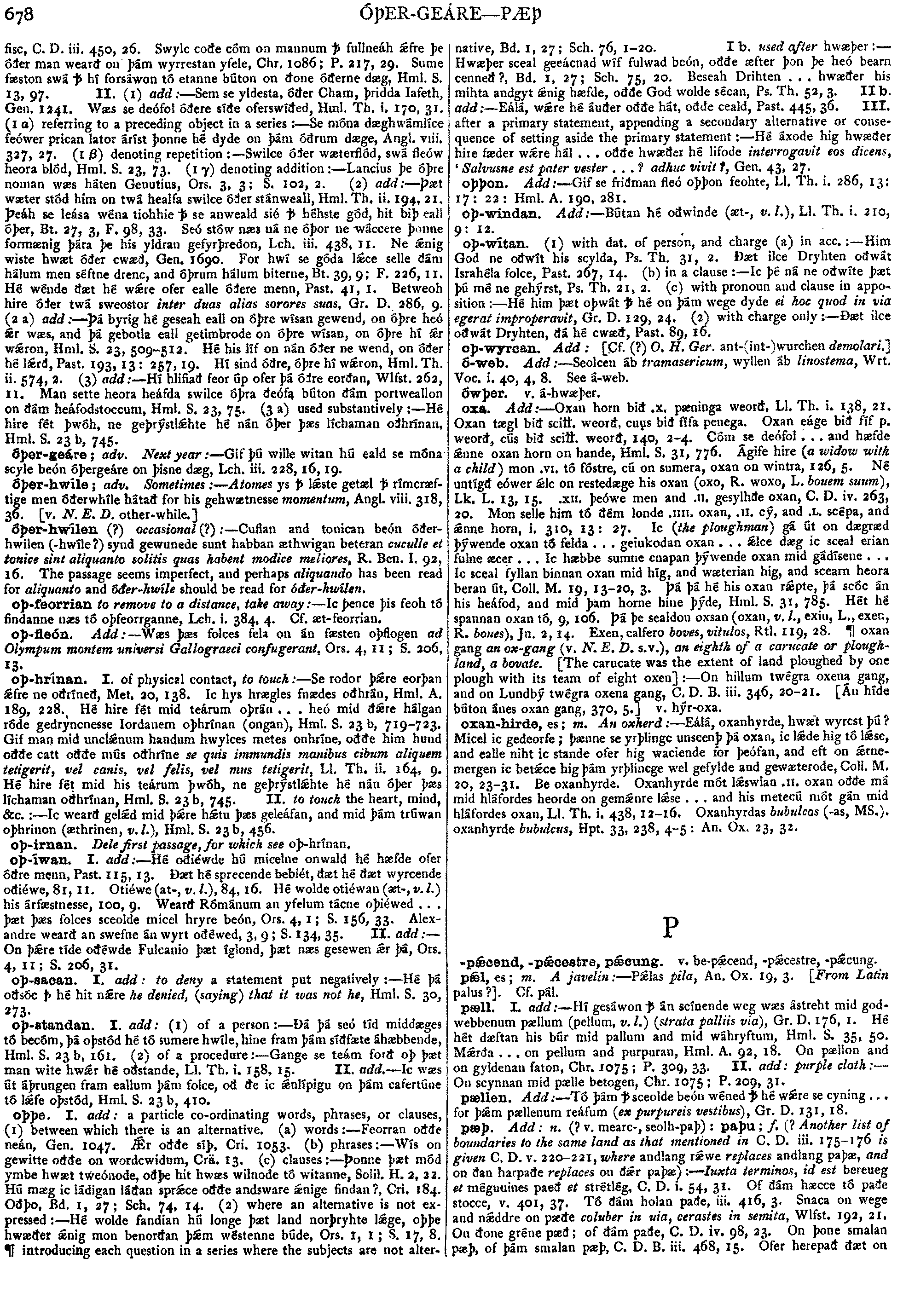
oþþe.
I.
add:
a
particle
co-ordinating
words,
phrases,
or
clauses,
(1)
between
which
there
is
an
alternative,
(a)
words
:--
Feorran
oððe
neán,
Gen.
1047.
Æ-acute;r
oððe
síþ,
Cri.
1053.
(b)
phrases
:--
Wís
on
gewitte
oððe
on
wordcwidum,
Crä.
13.
(c)
clauses
:--
Þonne
þæt
mód
ymbe
hwæt
tweónode,
oðþe
hit
hwæs
wilnode
tó
witanne,
Solil.
H.
2,
22.
Hú
mæg
ic
ládigan
láðan
sprce
oððe
andsware
nige
findan
?,
Cri.
184.
Oðþo,
Bd.
1,
27;
Sch.
74,
14.
(2)
where
an
alternative
is
not
expressed
:--
Hé
wolde
fandian
hú
longe
þæt
land
norþryhte
lge,
oþþe
hwæðer
nig
mon
benorðan
þm
wéstenne
búde,
Ors.
1,
1;
S.
17,
8.

introducing
each
question
in
a
series
where
the
subjects
are
not
alternative,
Bd.
1,
27;
Sch.
76,
1-20.
I
b.
used
after
hwæþer
:--
Hwæþer
sceal
geeácnad
wíf
fulwad
beón,
oððe
æfter
þon
þe
heó
bearn
cenneð?,
Bd.
1,
27;
Sch.
75,
20.
Beseah
Drihten
.
.
.
hwæðer
his
mihta
andgyt
nig
hæfde,
oððe
God
wolde
sécan,
Ps.
Th.
52,
3.
II
b.
add
:--
Eálá,
wre
hé
áuðer
oððe
hát,
oððe
ceald,
Past.
445,
36.
III.
after
a
primary
statement,
appending
a
secondary
alternative
or
consequence
of
setting
aside
the
primary
statement
:--
Hé
áxode
hig
hwæðer
hire
fæder
wre
hál
.
.
.
oððe
hwæðer
hé
lifode
interrogavit
eos
dicens,
'Salvusne
est
pater
vester.
.
.
?
adhuc
vivit
?,
Gen.
43,
27.
|
Source: Bosworth/Toller, page d0692, entry 15 View original page image as: [TIFF] [PNG] [View previous entry] [View next entry] |
[Comment on this entry] [View comments] |
The following entry has been hand-corrected once. |
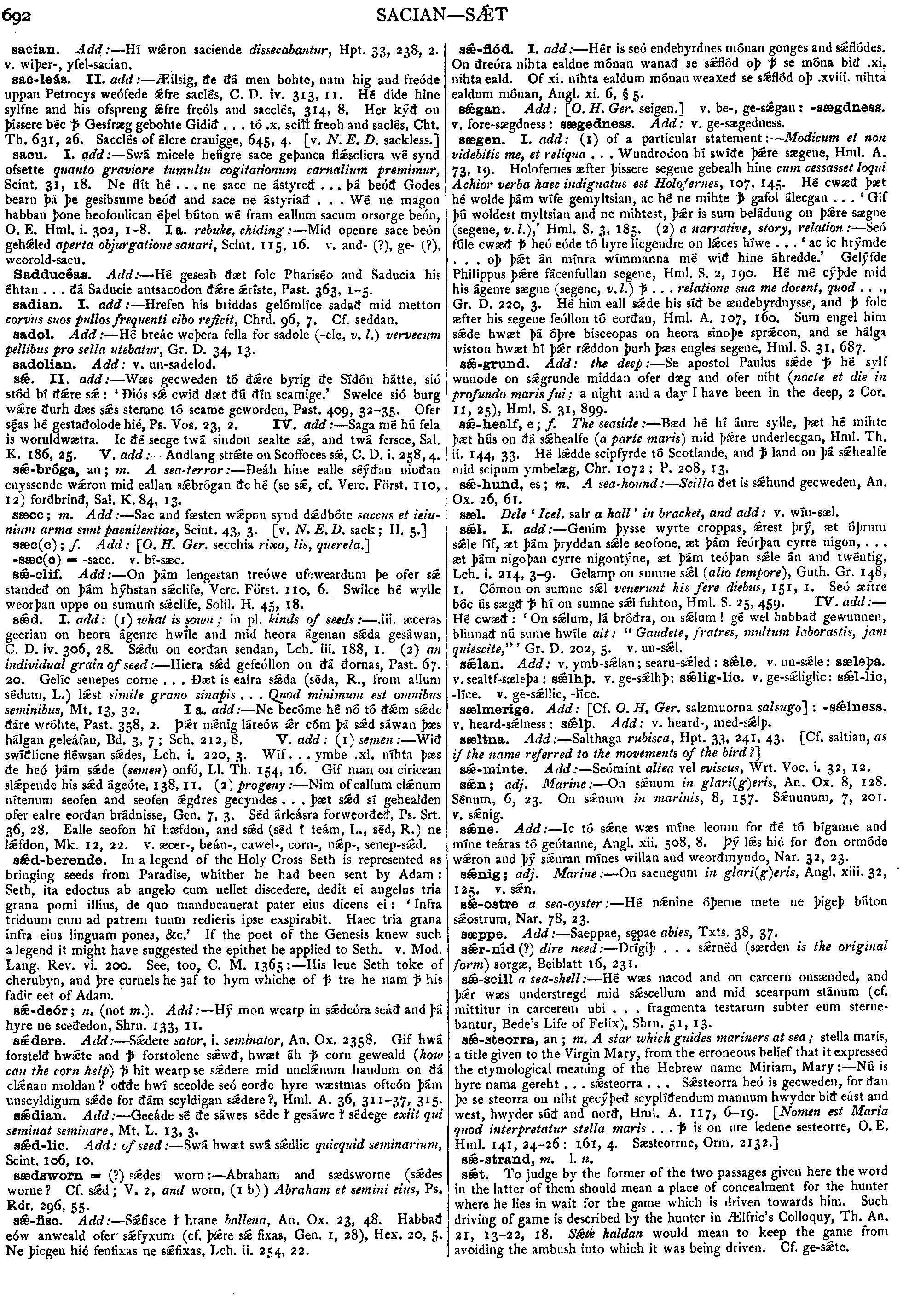
sd-berende.
In
a
legend
of
the
Holy
Cross
Seth
is
represented
as
bringing
seeds
from
Paradise,
whither
he
had
been
sent
by
Adam:
Seth,
ita
edoctus
ab
angelo
cum
uellet
discedere,
dedit
ei
angelus
tria
grana
pomi
illius,
de
quo
manducauerat
pater
eius
dicens
ei:
'Infra
triduum
cum
ad
patrem
tuum
redieris
ipse
exspirabit.
Haec
tria
grana
infra
eius
linguam
pones,
&c.'
If
the
poet
of
the
Genesis
knew
such
a
legend
it
might
have
suggested
the
epithet
he
applied
to
Seth.
v.
Mod.
Lang.
Rev.
vi.
200.
See,
too,
C.
M.
1365
:--
His
leue
Seth
toke
of
cherubyn,
and
þre
curnels
he
 af
to
hym
whiche
of
tre
he
nam
his
fadir
eet
of
Adam.
af
to
hym
whiche
of
tre
he
nam
his
fadir
eet
of
Adam.
|
Source: Bosworth/Toller, page d0701, entry 7 View original page image as: [TIFF] [PNG] [View previous entry] [View next entry] |
[Comment on this entry] [View comments] |
The following entry has been hand-corrected once. |
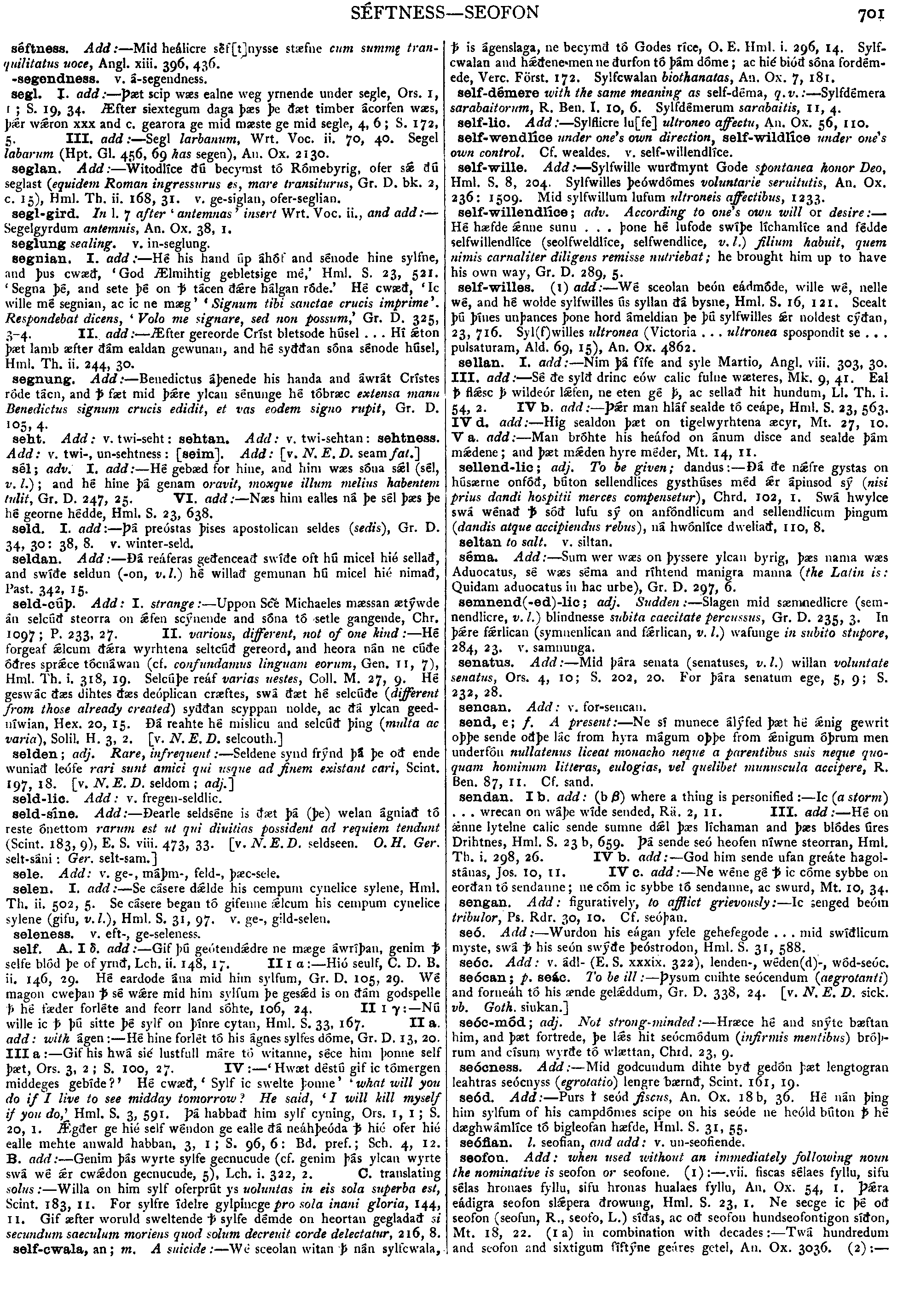
segnian.
I.
add
:--
Hé
his
hand
úp
áhóf
and
sénode
hine
sylfne,
and
þus
cwæð,
'God
Ælmihtig
gebletsige
mé,'
Hml.
S.
23,
521.
'Segna
þé,
and
sete
þé
on
tácen
ðre
hálgan
róde.'
Hé
cwæd,
'Ic
wille
mé
segnian,
ac
ic
ne
mæg'
'Signum
tibi
sanctae
crucis
imprime'.
Respondebat
dicens,
'Volo
me
signare,
sed
non
possum,'
Gr.
D.
325,
3-4.
II.
add
:--
Æfter
gereorde
Críst
bletsode
húsel
.
.
.
Hí
ton
þæt
lamb
æfter
ðám
ealdan
gewunan,
and
hé
syððan
sóna
sénode
húsel,
Hml.
Th.
ii.
244,
30.
|
Source: Bosworth/Toller, page d0721, entry 27 View original page image as: [TIFF] [PNG] [View previous entry] [View next entry] |
[Comment on this entry] [View comments (1)] |
The following entry has been hand-corrected once. |
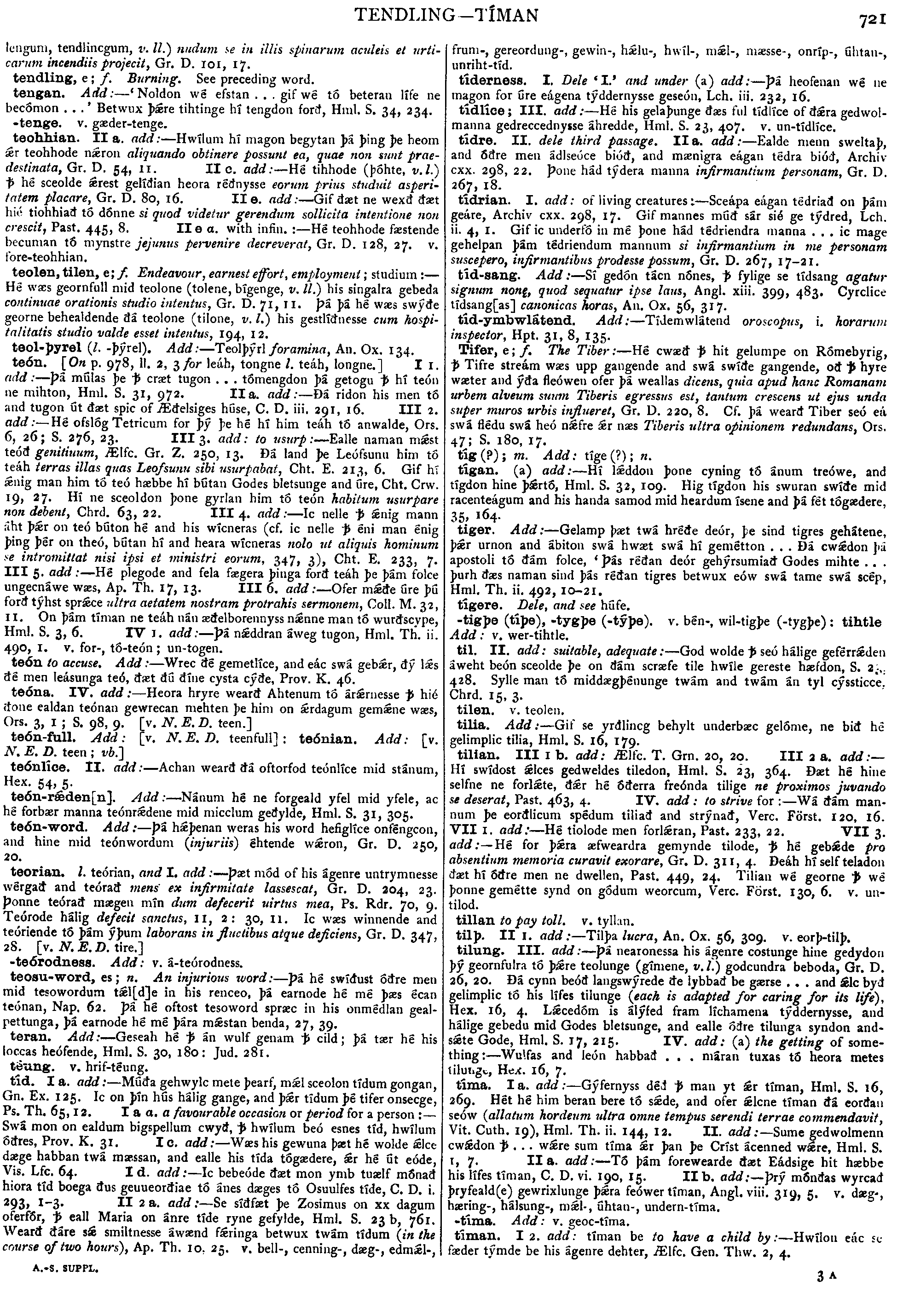
Tifer,
e;
f.
Tie
Tiber
:--
Hé
cwæð
hit
gelumpe
on
Rómebyrig,
Tifre
streám
wæs
upp
gangende
and
swá
swíðe
gangende,
oð
hyre
wæter
and
ýða
fleówen
ofer
þá
weallas
dicens,
quia
apud
hanc
Romanam
urbem
alveum
suum
Tiberis
egressus
est,
tantum
crescens
ut
ejus
unda
super
muros
urbis
influeret,
Gr.
D.
220,
8.
Cf.
þá
wearð
Tiber
seó
eá
swá
flédu
swá
heó
nfre
r
næs
Tiberis
ultra
opinionem
redundans,
Ors.
47;
S.
180,
17.
|
Source: Bosworth/Toller, page d0747, entry 48 View original page image as: [TIFF] [PNG] [View previous entry] [View next entry] |
[Comment on this entry] [View comments] |
The following entry has been hand-corrected once. |
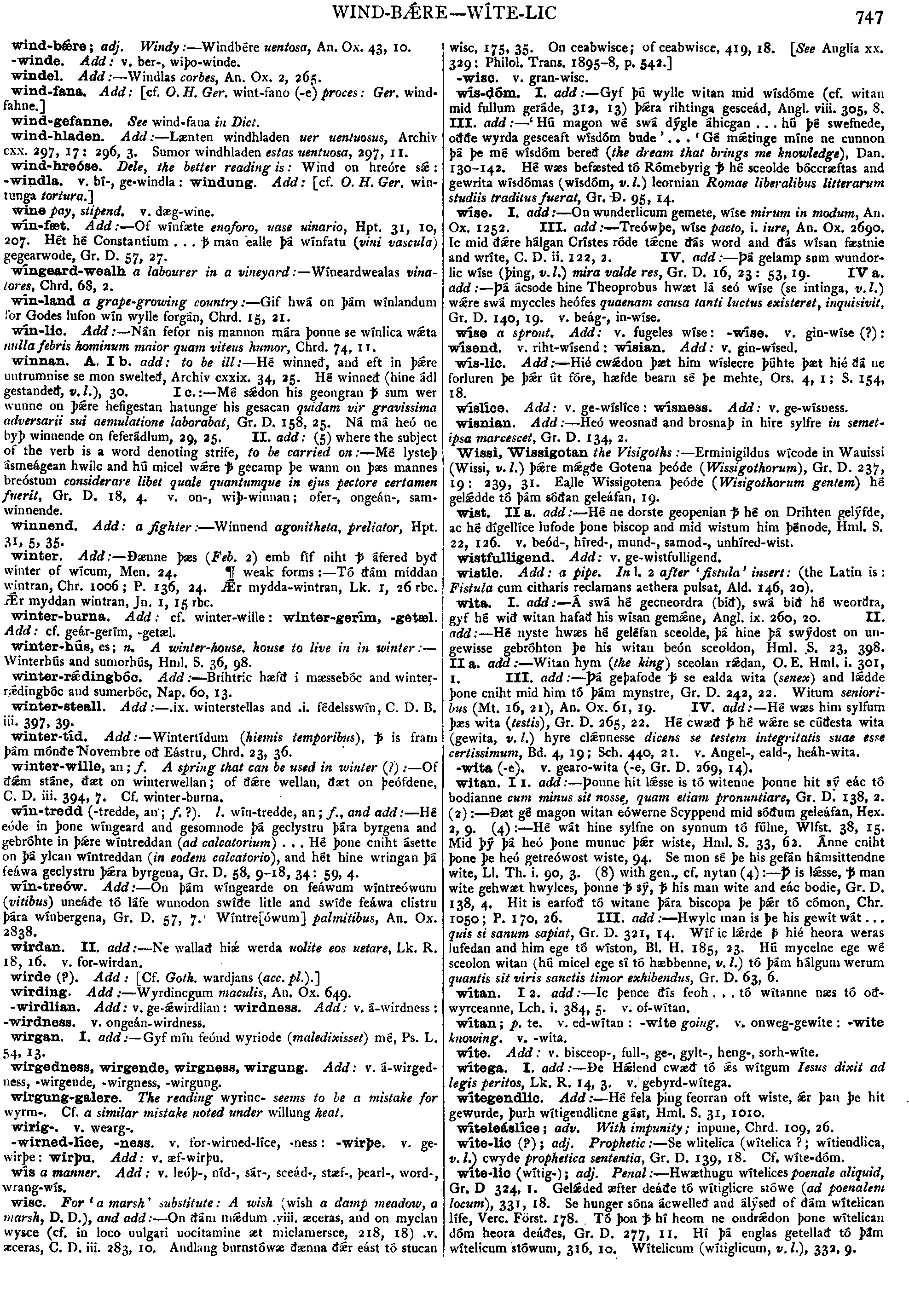
wita.
I.
add
:--
Á
swá
hé
gecneordra
(bið),
swá
bið
hé
weorðra,
gyf
hé
wið
witan
hafað
his
wísan
gemne,
Angl.
ix.
260,
20.
II.
add
:--
Hé
nyste
hwæs
hé
geléfan
sceolde,
þá
hine
þá
swýdost
on
un-gewisse
gebróhton
þe
his
witan
beón
sceoldon.
Hml.
S.
23,
398.
II
a.
add
:--
Witan
hym
(the
king)
sceolan
rdan,
O.
E.
Hml.
i.
301,
l.
III.
add
:--
Þá
geþafode
se
ealda
wita
(senex)
and
ldde
þone
cniht
mid
him
tó
þám
mynstre,
Gr.
D.
242,
22.
Witum
senioribus
(Mt.
16,
21),
An.
Ox.
61,
19.
IV.
add
:--
Hé
wæs
him
sylfum
þæs
wita
(testis),
Gr.
D.
265,
22.
Hé
cwæð
hé
wre
se
cúðesta
wita
(gewita,
v.l.)
hyre
clnnesse
dicens
se
testem
integritatis
suae
esse
certissimum,
Bd.
4,
19;
Sch.
440,
21.
v.
Angel-,
eald-,
heáh-wita.
| Result Page: |  |
Previous | 1 2 3 |
Germanic Lexicon Project (main page)
This search system was written by
Sean Crist
Please consider
volunteering
to correct the data in these online dictionaries.
No rights reserved. Feel free to use these data in any way you please.