|
|

deað (6 results)
Search for death again, using less strict matching (899 results)
|
Source: Cleasby/Vigfusson, page b0411, entry 32 View original page image as: [TIFF] [PNG] [View previous entry] [View next entry] |
[Comment on this entry] [View comments] |
The following entry has been hand-corrected once. |
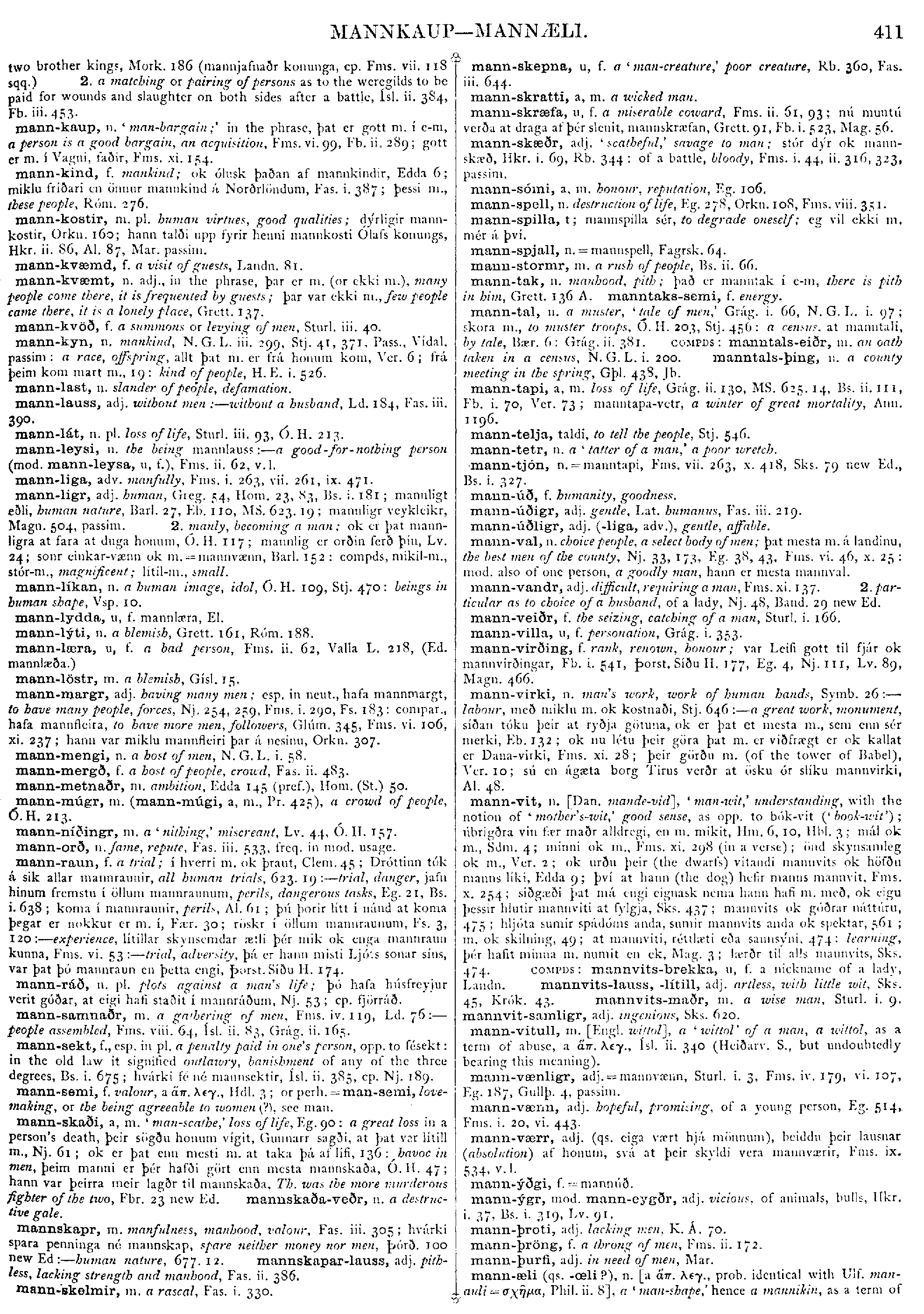
mann-skaði, a, m. 'man-scathe,' loss of life, Eg. 90: a great loss in a person's death, þeir sögðn honum vígit, Gunnarr sagði, at þat var lítill m., Nj. 61; ok er þat enn mesti m. at taka þá af lífi, 136: havoc in men, þeim manni er þér hafði gört enn mesta mannskaða, Ó.H. 47; hann var þeirra meir lagðr til mannskada, Th. was the more murderous fighter of the two, Fbr. 23 new Ed. mannskaða-veðr, n. a destructive gale.
|
Source: Cleasby/Vigfusson, page b0430, entry 12 View original page image as: [TIFF] [PNG] [View previous entry] [View next entry] |
[Comment on this entry] [View comments] |
The following entry has not been hand-corrected. However, the page is reserved and someone is correcting it. |
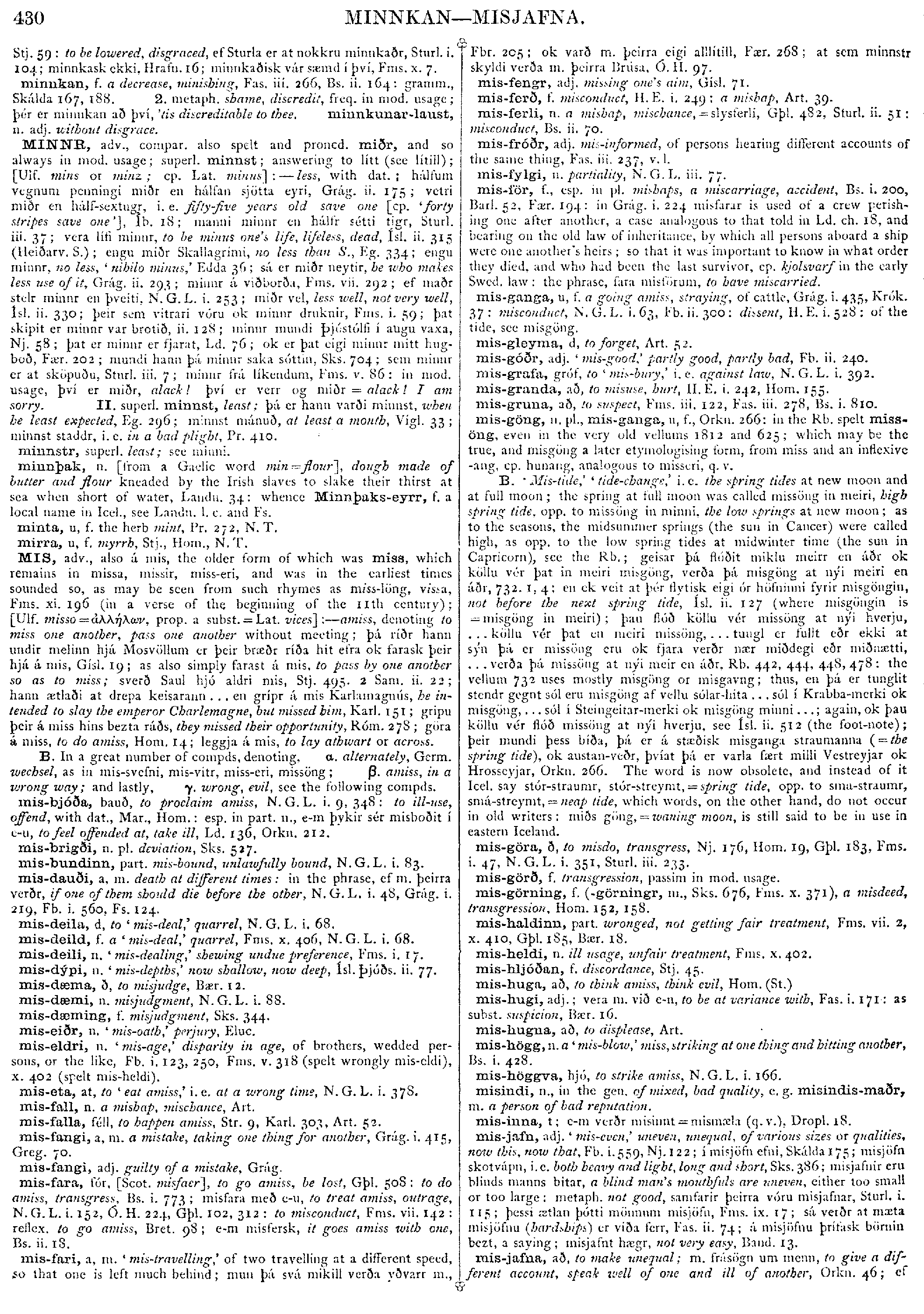
mis-dauði, a, m. death at different times: in the phrase, ef in. peirra verðr, if one of them should die before the other, N. G. L. i. 48, Grág. i. 219, Fb. i. 560, Fs. 124.
|
Source: Cleasby/Vigfusson, page b0432, entry 27 View original page image as: [TIFF] [PNG] [View previous entry] [View next entry] |
[Comment on this entry] [View comments] |
The following entry has been hand-corrected once. |
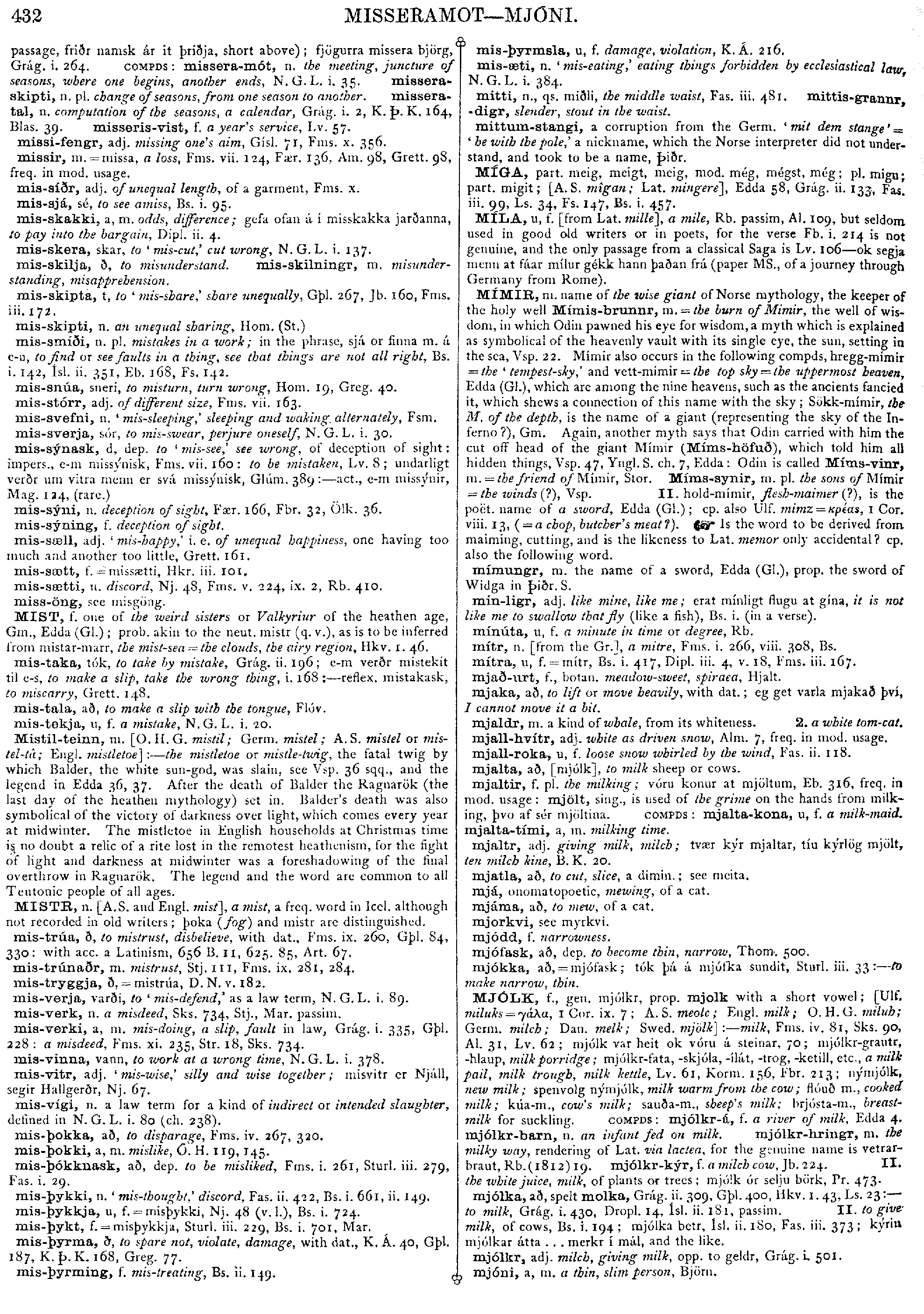
Mistil-teinn, m. [O.H.G. mistil; Germ. mistel; A.S. mistel or mislel-tâ; Engl. mistletoe] :-- the mistletoe or mistle-twig, the fatal twig by which Balder, the white sun-god, was slain, see Vsp. 36 sqq., and the legend in Edda 36, 37. After the death of Balder the Ragnarök (the last day of the heathen mythology) set in. Balder's death was also symbolical of the victory of darkness over light, which comes every year at midwinter. The mistletoe in English households at Christmas time is, no doubt a relic of a rite lost in the remotest heathenism, for the fight of light and darkness at midwinter was a foreshadowing of the final overthrow in Ragnarök. The legend and the word are common to all Teutonic people of all ages.
|
Source: Cleasby/Vigfusson, page b0434, entry 1 View original page image as: [TIFF] [PNG] [View previous entry] [View next entry] |
[Comment on this entry] [View comments] |
The following entry has been hand-corrected once. |
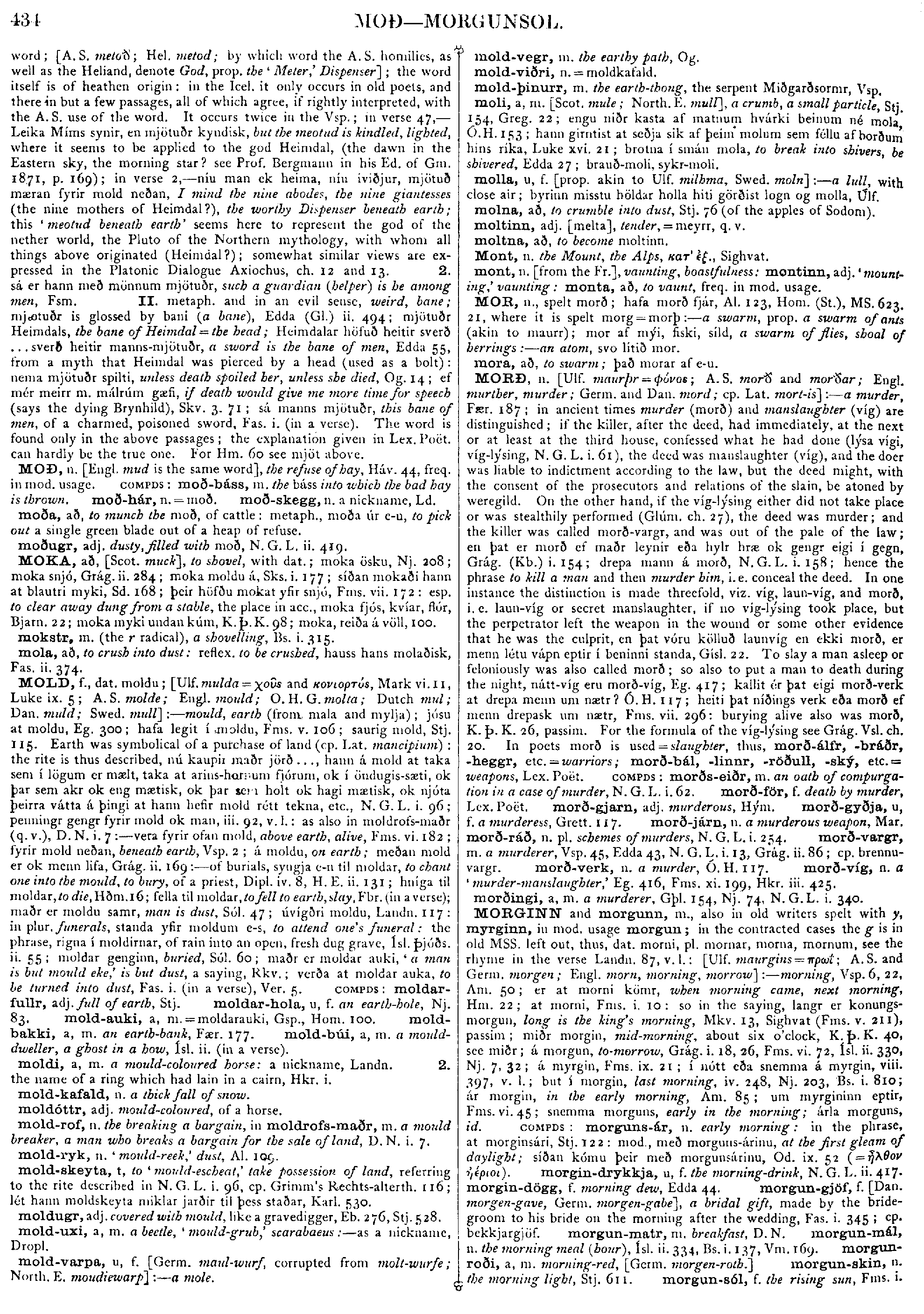
word;
[A.S.
metoð;
Hel.
metod;
by
which
word
the
A.S.
homilies,
as
well
as
the
Heliand,
denote
God,
prop.
the
'Meter,'
Dispenser];
the
word
itself
is
of
heathen
origin:
in
the
Icel.
it
only
occurs
in
old
poets,
and
there
in
but
a
few
passages,
all
of
which
agree,
if
rightly
interpreted,
with
the
A.S.
use
of
the
word.
It
occurs
twice
in
the
Vsp.;
in
verse
47,
--
Leika
Míms
synir,
en
mjötuðr
kyndisk,
but
the
meotud
is
kindled,
lighted,
where
it
seems
to
be
applied
to
the
god
Heimdal,
(the
dawn
in
the
Eastern
sky,
the
morning
star?
see
Prof.
Bergmann
in
his
Ed.
of
Gm.
1871,
p.
169);
in
verse
2,
--
níu
man
ek
heima,
níu
íviðjur,
mjötuð
mæran
fyrir
mold
neðan,
I
mind
the
nine
abodes,
the
nine
giantesses
(the
nine
mothers
of
Heimdal?),
the
worthy
Dispenser
beneath
earth;
this
'meotud
beneath
earth'
seems
here
to
represent
the
god
of
the
nether
world,
the
Pluto
of
the
Northern
mythology,
with
whom
all
things
above
originated
(Heimdal?);
somewhat
similar
views
are
expressed
in
the
Platonic
Dialogue
Axiochus,
ch.
12
and
13.
2.
sá
er
hann
með
mönnum
mjötuðr,
such
a
guardian
(helper)
is
he
among
men,
Fsm.
II.
metaph.
and
in
an
evil
sense,
weird,
bane;
mj tuðr
is
glossed
by
bani
(a
bane),
Edda
(Gl.)
ii.
494;
mjötuðr
Heimdals,
the
bane
of
Heimdal
=
the
head;
Heimdalar
höfuð
heitir
sverð
...
sverð
heitir
manns-mjötuðr,
a
sword
is
the
bane
of
men,
Edda
55,
from
a
myth
that
Heimdal
was
pierced
by
a
head
(used
as
a
bolt):
nema
mjötuðr
spilti,
unless
death
spoiled
her,
unless
she
died,
Og.
14;
ef
mér
meirr
m.
málrúm
gæfi,
if
death
would
give
me
more
time
for
speech
(says
the
dying
Brynhild),
Skv.
3.
71;
sá
manns
mjötuðr,
this
bane
of
men,
of
a
charmed,
poisoned
sword,
Fas.
i.
(in
a
verse).
The
word
is
found
only
in
the
above
passages;
the
explanation
given
in
Lex.
Poët,
can
hardly
be
the
true
one.
For
Hm.
60
see
mjöt
above.
tuðr
is
glossed
by
bani
(a
bane),
Edda
(Gl.)
ii.
494;
mjötuðr
Heimdals,
the
bane
of
Heimdal
=
the
head;
Heimdalar
höfuð
heitir
sverð
...
sverð
heitir
manns-mjötuðr,
a
sword
is
the
bane
of
men,
Edda
55,
from
a
myth
that
Heimdal
was
pierced
by
a
head
(used
as
a
bolt):
nema
mjötuðr
spilti,
unless
death
spoiled
her,
unless
she
died,
Og.
14;
ef
mér
meirr
m.
málrúm
gæfi,
if
death
would
give
me
more
time
for
speech
(says
the
dying
Brynhild),
Skv.
3.
71;
sá
manns
mjötuðr,
this
bane
of
men,
of
a
charmed,
poisoned
sword,
Fas.
i.
(in
a
verse).
The
word
is
found
only
in
the
above
passages;
the
explanation
given
in
Lex.
Poët,
can
hardly
be
the
true
one.
For
Hm.
60
see
mjöt
above.
|
Source: Cleasby/Vigfusson, page b0434, entry 30 View original page image as: [TIFF] [PNG] [View previous entry] [View next entry] |
[Comment on this entry] [View comments] |
The following entry has been hand-corrected once. |
MORÐ, n. [Ulf. maurþr = GREEK; A.S. morð and morðar; Engl. murther, murder; Germ. and Dan. mord; cp. Lat. mort-is] :-- a murder, Fær. 187; in ancient times murder (morð) and manslaughter (víg) are distinguished; if the killer, after the deed, had immediately, at the next or at least at the third house, confessed what he had done (lýsa vígi, víg-lýsing, N.G.L. i. 6l), the deed was manslaughter (víg), and the doer was liable to indictment according to the law, but the deed might, with the consent of the prosecutors and relations of the slain, be atoned by weregild. On the other hand, if the víg-lýsing either did not take place or was stealthily performed (Glúm. ch. 27), the deed was murder; and the killer was called morð-vargr, and was out of the pale of the law; en þat er morð ef maðr leynir eða hylr hræ ok gengr eigi í gegn, Grág. (Kb.) i. 154; drepa mann á morð, N.G.L. i. 158; hence the phrase to kill a man and then murder him, i.e. conceal the deed. In one instance the distinction is made threefold, viz. víg, laun-víg, and morð, i.e. laun-víg or secret manslaughter, if no víg-lýsing took place, but the perpetrator left the weapon in the wound or some other evidence that he was the culprit, en þat vóru kölluð launvíg en ekki morð, er menn létu vápn eptir í beninni standa, Gísl. 22. To slay a man asleep or feloniously was also called morð; so also to put a man to death during the night, nátt-víg eru morð-víg, Eg. 417; kallit ér þat eigi morð-verk at drepa menn um nætr? Ó.H. 117; heiti þat níðings verk eða morð ef menn drepask um nætr, Fms. vii. 296: burying alive also was morð, K.Þ.K. 26, passim. For the formula of the víg-lýsing see Grág. Vsl. ch. 20. In poets morð is used = slaughter, thus, morð-álfr, -bráðr, -heggr, etc. = warriors; morð-bál, -linnr, -röðull, -ský, etc. = weapons, Lex. Poët. COMPDS: morðs-eiðr, m. an oath of compurgation in a case of murder, N.G.L. i. 62. morð-för, f. death by murder, Lex. Poët. morð-gjarn, adj. murderous, Hým. morð-gyðja, u, f. a murderess, Grett. 117. morð-járn, n. a murderous weapon, Mar. morð-ráð, n. pl. schemes of murders, N.G.L. i. 254. morð-vargr, m. a murderer, Vsp. 45, Edda 43, N.G.L. i. 13, Grág. ii. 86; cp. brennu-vargr. morð-verk, n. a murder, Ó.H. 117. morð-víg, n. a 'murder-manslaughter,' Eg. 416, Fms. xi. 199, Hkr. iii. 425.
|
Source: Cleasby/Vigfusson, page b0441, entry 43 View original page image as: [TIFF] [PNG] [View previous entry] [View next entry] |
[Comment on this entry] [View comments] |
The following entry has not been hand-corrected. However, the page is reserved and someone is correcting it. |
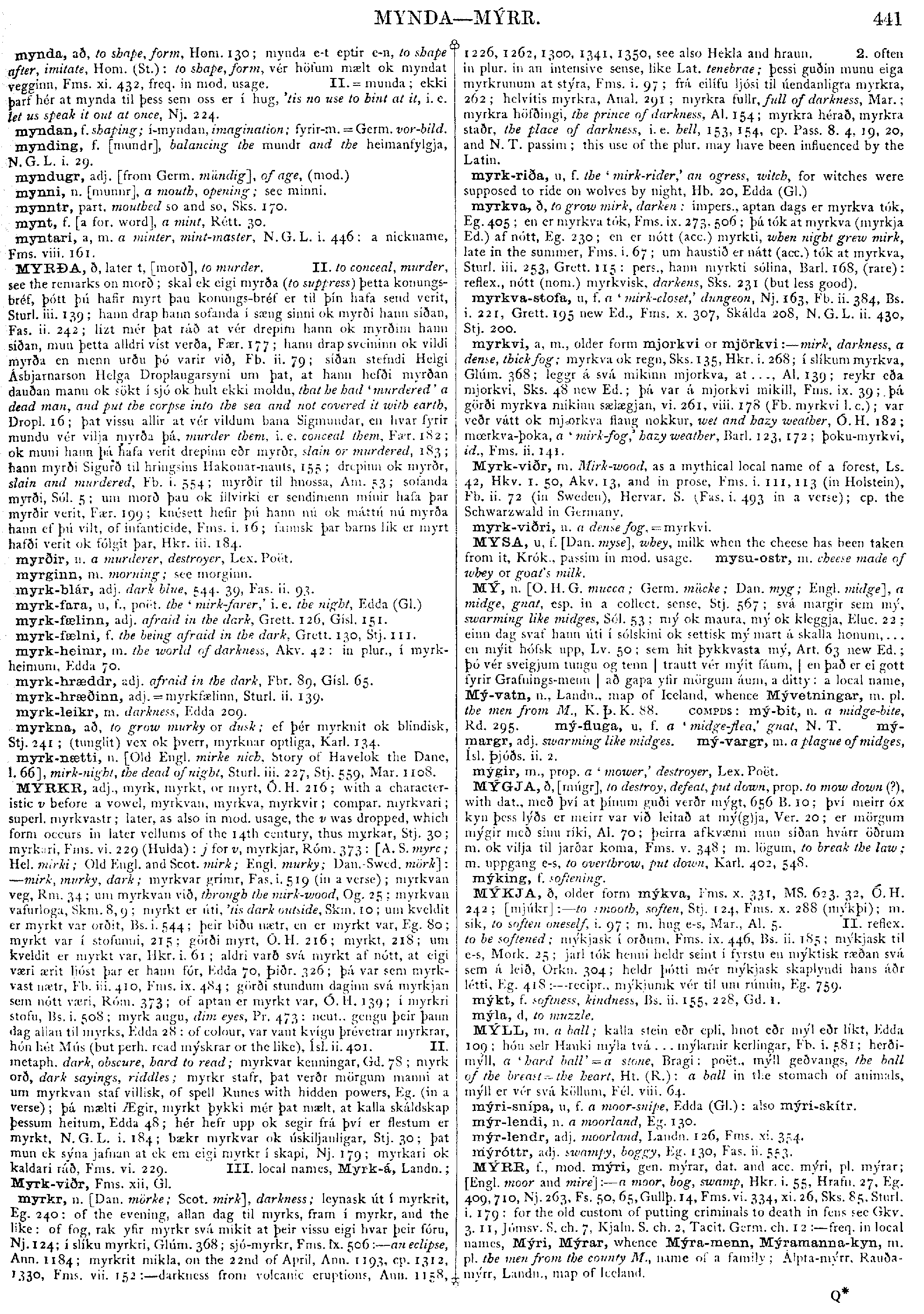
MÝRR, f., mod. myri, gen. myrar, dat. and acc. myri, pl. myrar; [Engl. m oor and mire] :-- a moor, bog, swamp, Hkr. i. 55, Hrafn. 27, Eg. 409, 710, Nj. 203, Fs. 50, 65, Gullþ. 14, Fms. vi. 334, xi. 26, Sks. 85, Sturl. i. 179: for the old custom of putting criminals to death in fens see Gkv. 3. II, Jonisv. S. ch. 7, Kjaln. S. ch. 2, Tacit. Germ. ch. 12 :-- freq. in local names, Myri, Myrar, whence Mýra-menn, Mýramanna-kyn, in. pl. the men from the county M., n. une of a family; Alpta-nivrr, Ranða- im'rr, Landn., map of Iceland.
|
Source: Cleasby/Vigfusson, page b0448, entry 2 View original page image as: [TIFF] [PNG] [View previous entry] [View next entry] |
[Comment on this entry] [View comments] |
The following entry has been hand-corrected once. |
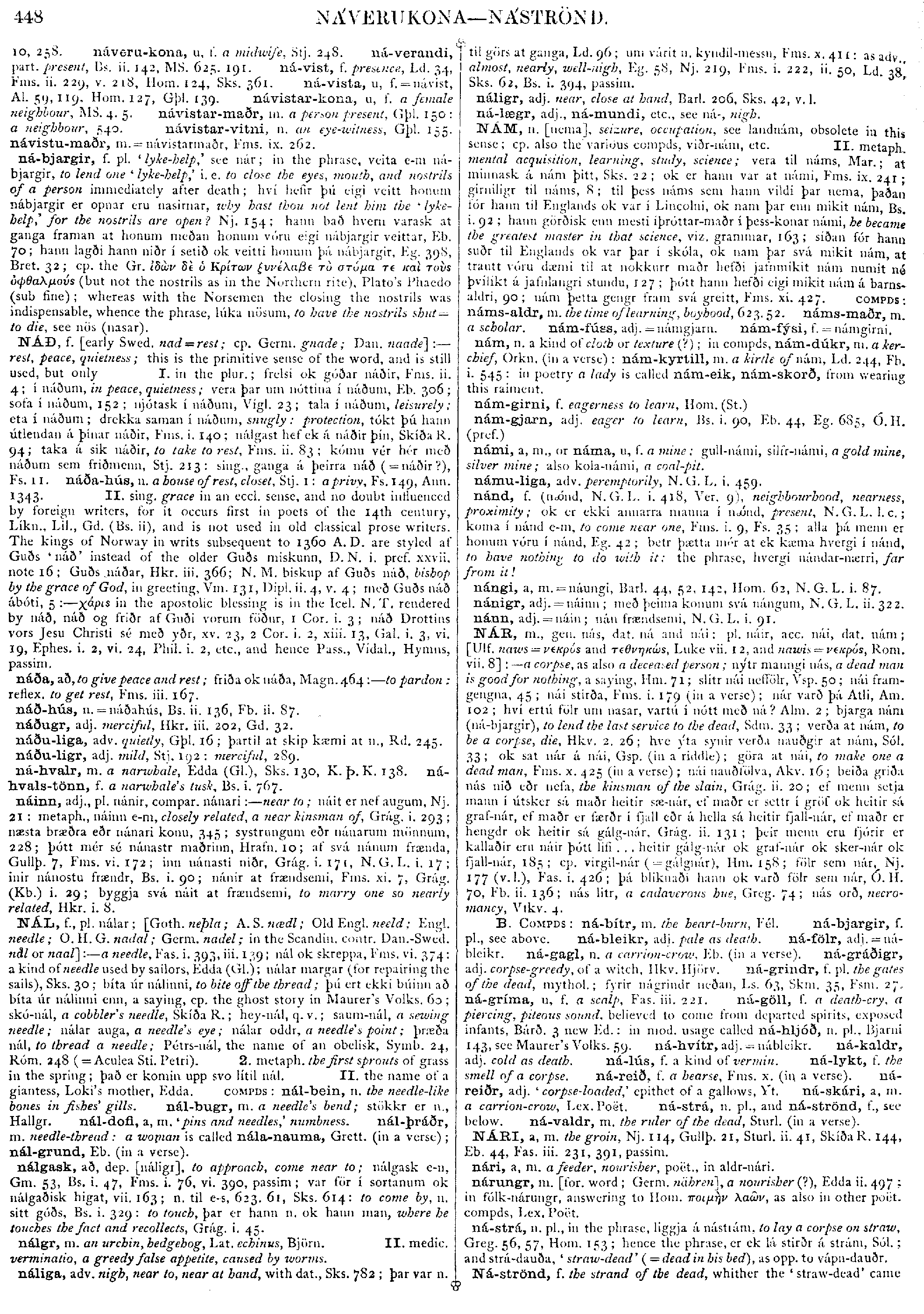
ná-bjargir, f. pl. 'lyke-help,' see nár; in the phrase, veita e-m nábjargir, to lend one 'lyke-help,' i. e. to close the eyes, mouth, and nostrils of a person immediately after death; hví hefir þú eigi veitt honum nábjargir er opnar eru nasirnar, why hast thou not lent him the 'lyke-help,' for the nostrils are open? Nj. 154; hann bað hvern varask at ganga framan at honum meðan honum vóru eigi nábjargir veittar, Eb. 70; hann lagði hann niðr í setið ok veitti honum þá nábjargir, Eg. 398, Bret. 32; cp. the Gr. GREEK (but not the nostrils as in the Northern rite), Plato's Phaedo (sub fine); whereas with the Norsemen the closing the nostrils was indispensable, whence the phrase, lúka nösum, to have the nostrils shut = to die, see nös (nasar).
|
Source: Cleasby/Vigfusson, page b0448, entry 27 View original page image as: [TIFF] [PNG] [View previous entry] [View next entry] |
[Comment on this entry] [View comments] |
The following entry has been hand-corrected once. |
NÁR, m., gen. nás, dat. ná and nái: pl. náir, acc. nái, dat. nám; [Ulf. naws = GREEK and GREEK, Luke vii. 12, and nawis = GREEK, Rom. vii. 8] :-- a corpse, as also a deceased person; nýtr manngi nás, a dead man is good for nothing, a saying, Hm. 71; slítr nái neffölr, Vsp. 50; nái fram-gengna, 45; nái stirða, Fms. i. 179 (in a verse); nár varð þá Atli, Am. 102; hví ertú fölr um nasar, vartú í nótt með ná? Alm. 2; bjarga nám (ná-bjargir), to lend the last service to the dead, Sdm. 33: verða at nám, to be a corpse, die, Hkv. 2. 26; hve ýta synir verða nauðgir at nám, Sól. 33; ok sat nár á nái, Gsp. (in a riddle); göra at nái, to make one a dead man. Fms. x. 425 (in a verse); nái nauðfölva, Akv. 16; beiða griða nás nið eðr nefa, the kinsman of the slain, Grág. ii. 20; ef menn setja mann í útsker sá maðr heitir sæ-nár, ef maðr er settr í gröf ok heitir sá graf-nár, ef maðr er færðr í fjall eðr á hella sá heitir fjall-nár, ef maðr er hengdr ok heitir sá gálg-nár, Grág. ii. 131; þeir menn eru fjórir er kallaðir eru náir þótt lifi . . . heitir gálg-nár ok graf-nár ok sker-nár ok fjall-nár, 185; cp. virgil-nár ( = gálgnár), Hm. 158; fölr sem nár, Nj. 177 (v. l.), Fas. i. 426; þá bliknaði hann ok varð fölr sem nár, Ó. H. 70, Fb. ii. 136; nás litr, a cadaverous hue, Greg. 74; nás orð, necromancy, Vtkv. 4. B. COMPDS: ná-bítr, m. the heart-burn, Fél. ná-bjargir, f. pl., see above. ná-bleikr, adj. pale as death. ná-fölr, adj. = nábleikr. ná-gagl, n. a carrion-crow, Eb. (in a verse). ná-gráðigr, adj. corpse-greedy, of a witch, Hkv. Hjörv. ná-grindr, f. pl. the gates of the dead, mythol.; fyrir nágrindr neðan, Ls. 63, Skm. 35, Fsm. 27, ná-gríma, u, f. a scalp, Fas. iii. 221. ná-göll, f. a death-cry, a piercing, piteous sound, believed to come from departed spirits, exposed infants, Bárð. 3 new Ed.: in mod. usage called ná-hljóð, n. pl., Bjarni 143, see Maurer's Volks. 59. ná-hvítr, adj. = nábleikr. ná-kaldr, adj. cold as death. ná-lús, f. a kind of vermin. na-lykt, f. the smell of a corpse. ná-reið, f. a hearse, Fms. x. (in a verse). ná-reiðr, adj. 'corpse-loaded,' epithet of a gallows, Yt. ná-skári, a, m. a carrion-crow, Lex. Poët. ná-strá, n. pl., and ná-strönd, f., see below. ná-valdr, m. the ruler of the dead, Sturl. (in a verse).
|
Source: Cleasby/Vigfusson, page b0449, entry 1 View original page image as: [TIFF] [PNG] [View previous entry] [View next entry] |
[Comment on this entry] [View comments] |
The following entry has been hand-corrected once. |
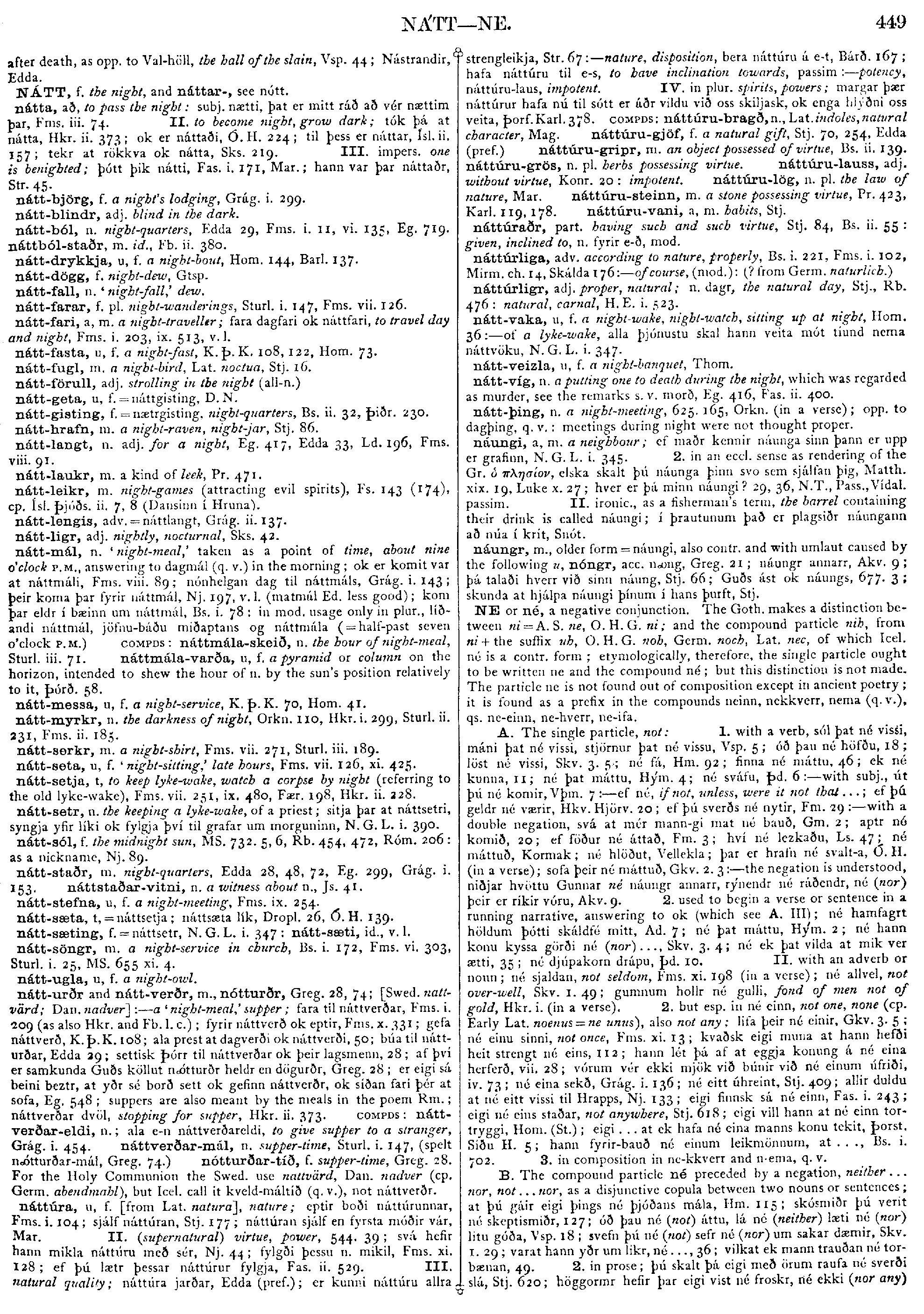
after death, as opp. to Val-höll, the hall of the slain, Vsp. 44; Nástrandir, Edda.
|
Source: Cleasby/Vigfusson, page b0449, entry 44 View original page image as: [TIFF] [PNG] [View previous entry] [View next entry] |
[Comment on this entry] [View comments] |
The following entry has been hand-corrected once. |
nátt-víg, n. a putting one to death during the night, which was regarded as murder, see the remarks s. v. morð, Eg. 416, Fas. ii. 400.
| Result Page: |  |
Previous | 55 56 57 58 59 60 61 62 63 64 65 66 67 68 69 70 | Next |  |
Germanic Lexicon Project (main page)
This search system was written by
Sean Crist
Please consider
volunteering
to correct the data in these online dictionaries.
No rights reserved. Feel free to use these data in any way you please.