|
|

deað (6 results)
Search for death again, using less strict matching (899 results)
|
Source: Cleasby/Vigfusson, page b0097, entry 45 View original page image as: [TIFF] [PNG] [View previous entry] [View next entry] |
[Comment on this entry] [View comments] |
The following entry has not been hand-corrected. However, the page is reserved and someone is correcting it. |
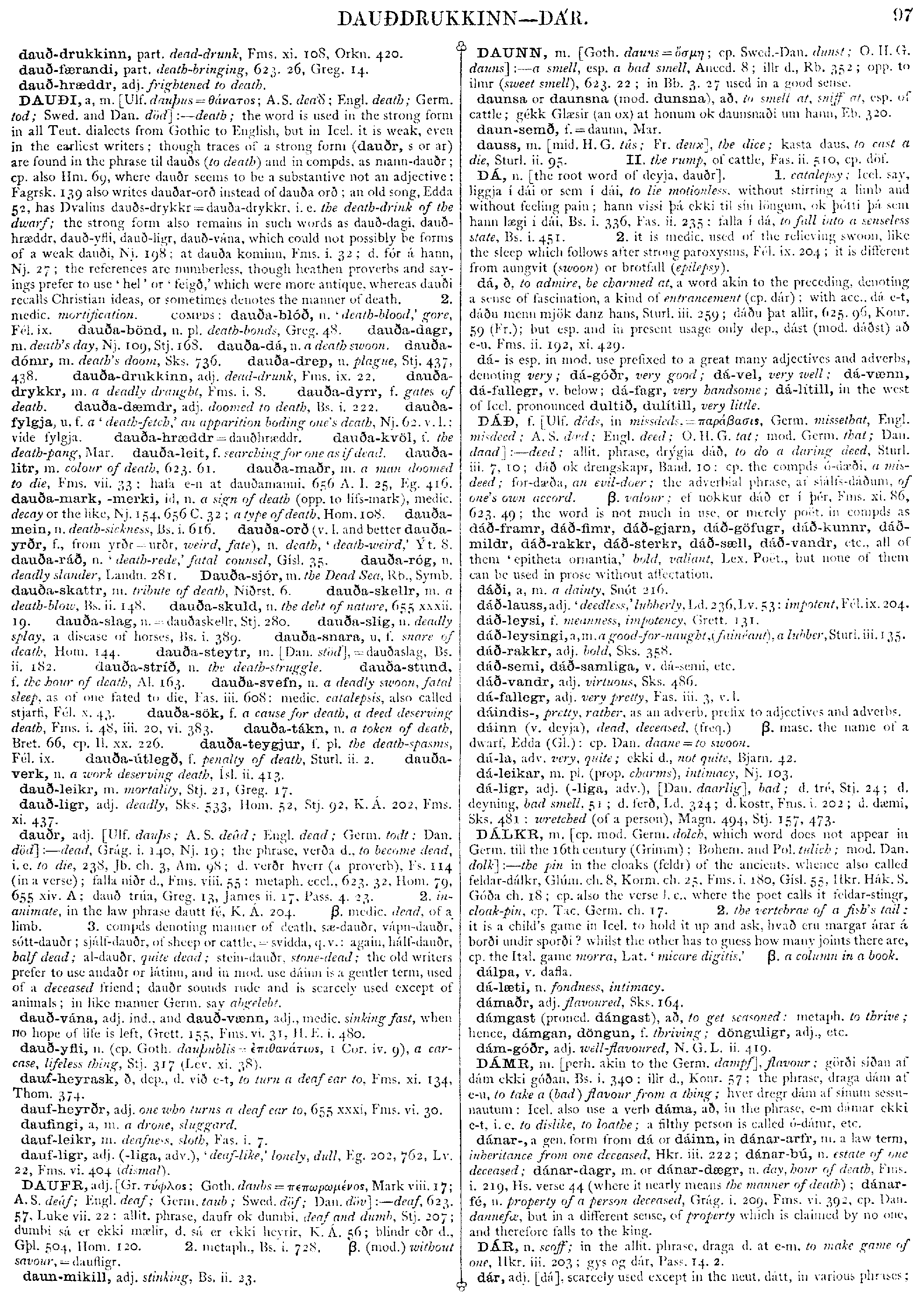
dánar-, a gen. form from dá or damn, in dánar-arfr, m. a law term, inheritance from one deceased, Hkr. iii. 222: dánar-bú, n. estate of one deceased; dánar-dagr, m. or dánar-dœgr, n. day, hour of death, Fins, i. 219, Hs. verse 44 (where it nearly means the manner of death); dánar- fé, n. property of a person deceased, Grúg. i. 209, Fms. vi. 392, cp. Dan. dannefæ, but in a different sense, of property which is claimed by no one, and therefore falls to the king.
|
Source: Cleasby/Vigfusson, page b0099, entry 21 View original page image as: [TIFF] [PNG] [View previous entry] [View next entry] |
[Comment on this entry] [View comments] |
The following entry has not been hand-corrected. However, the page is reserved and someone is correcting it. |
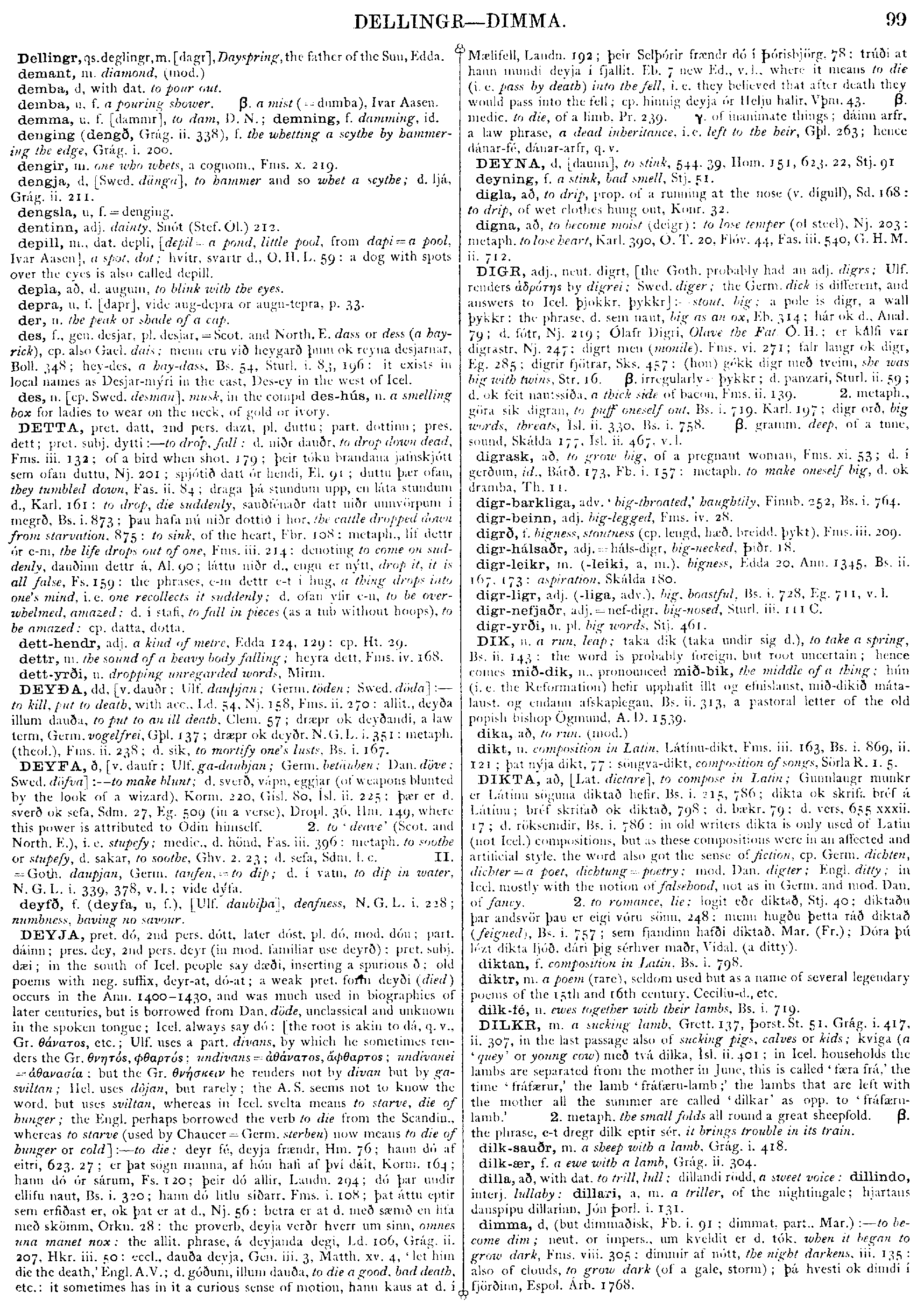
DEYÐA, dd, [v. dauor; lilt", danjyan; Germ, tö de w; Swed. doda] :-- to kill, put to death, with acc. . Ld. 54, Nj. 158, Fms. ii. 270: allit., deyða ilium dauða, to put to an ill death, Clem. 57; dnepr ok deyðandi, a law term, Gvim. vogelfrei, Gþl. 137; dræpr ok deyðr, N. G. I., i. 351: metaph. (theol.), Fms. ii. 238; d. sik, to mortify one's lusts, Bs. i. 167.
|
Source: Cleasby/Vigfusson, page b0099, entry 24 View original page image as: [TIFF] [PNG] [View previous entry] [View next entry] |
[Comment on this entry] [View comments] |
The following entry has not been hand-corrected. However, the page is reserved and someone is correcting it. |
DEYJA, pret. do, 2nd pers. dótt, later dost, pl. do, mod. don; prut, dáinn; pres. dey, 2nd pers. deyr (in mod. familiar use deyrð): pret. sub), daei; in the south of Icel. people say dæði, inserting a spurious ö: old poems with neg. suffix, deyr-at, dó-at; a weak pret. forTn deyði (died) occurs in the Ann. 1400-1430, and was much used in biographies of later centuries, but is borrowed from Dan. d u d e, unclassical and unknown in the spoken tongue; Icel. alwavs say do: [the root is akin to dá, q. v., Gr. ôávaros, etc.; Ulf. uses a part, divans, by which lie sometimes ren- ders the Gr. 6vrjrós, (þôapTÓs; iindivans = åOávaros, á(/)öapros; undiiianei -- åQavaaía; but the Gr. Orfiaictiv he renders not by divan but by ga- sviltan; llel. uses do/an, but rarely; the A. S. seems not to know the word, but uses sviltan, whereas in Icel. svelta means to starve, die of hanger; the Engl. perhaps borrowed the verb to die from the Scandiu., whereas to starve (used by Chaucer = Germ, sterben) now means to die of hunger or co ld] :-- to die: deyr fé, deyja frændr, Hin. 76; hann do af eitri, 623. 27; er þat sügn manna, af hón hati af því dáit, Korin. 164; hann do ór sárum, Fs. 120; þeir dó allir, Landn. 294; do bar undir ellifu naut, Bs. i. 320; hann dó litlu síðarr. Fms. i. 108; þat áttu eptir sem erfiðast er, ok þat er at d., Nj. 56: betra er at d. með sa'mð en hta nieð sköinm, Orkn. 28: the proverb, deyia verðr hverr inn sinn, om/ies nna manet nox: the allit. phrase, á deyjanda degi, l. d. 106, Grug. ii. 207, Hkr. iii. 50: eccl., dauða deyia. Gen. iii. 3, Matth. xv. 4, 'let him die the death, ' Engl. A. V.; d. góðuni, ilium dauða, to die a good, bad death, etc.: it sometimes has in it a curious sense of motion, hann kaus at cl. í 'Mælifell, Landn. 192; þeir Selþórir fr. Tndr dó í Jx'irisbjiirg. 78; trnði at hann inundi deyia í fjallit. Kb. 7 new Kd., v. I., where it means to die (i. e. pass by death) into the fell, i. e. they believed that after death they would pass into the fell; cp. hinnig deyja ór lleliu halir, Vþm. 43. 3- medic, to die, of a limb, Pr. 239. "y- "^ inanimate things; dáinn arfr, a law phrase, a dead inheritance, i. e. left to the heir, Gþl. 263; hence dúnar-fé, dánar-arfr, q. v.
|
Source: Cleasby/Vigfusson, page b0100, entry 20 View original page image as: [TIFF] [PNG] [View previous entry] [View next entry] |
[Comment on this entry] [View comments] |
The following entry has not been hand-corrected. However, the page is reserved and someone is correcting it. |
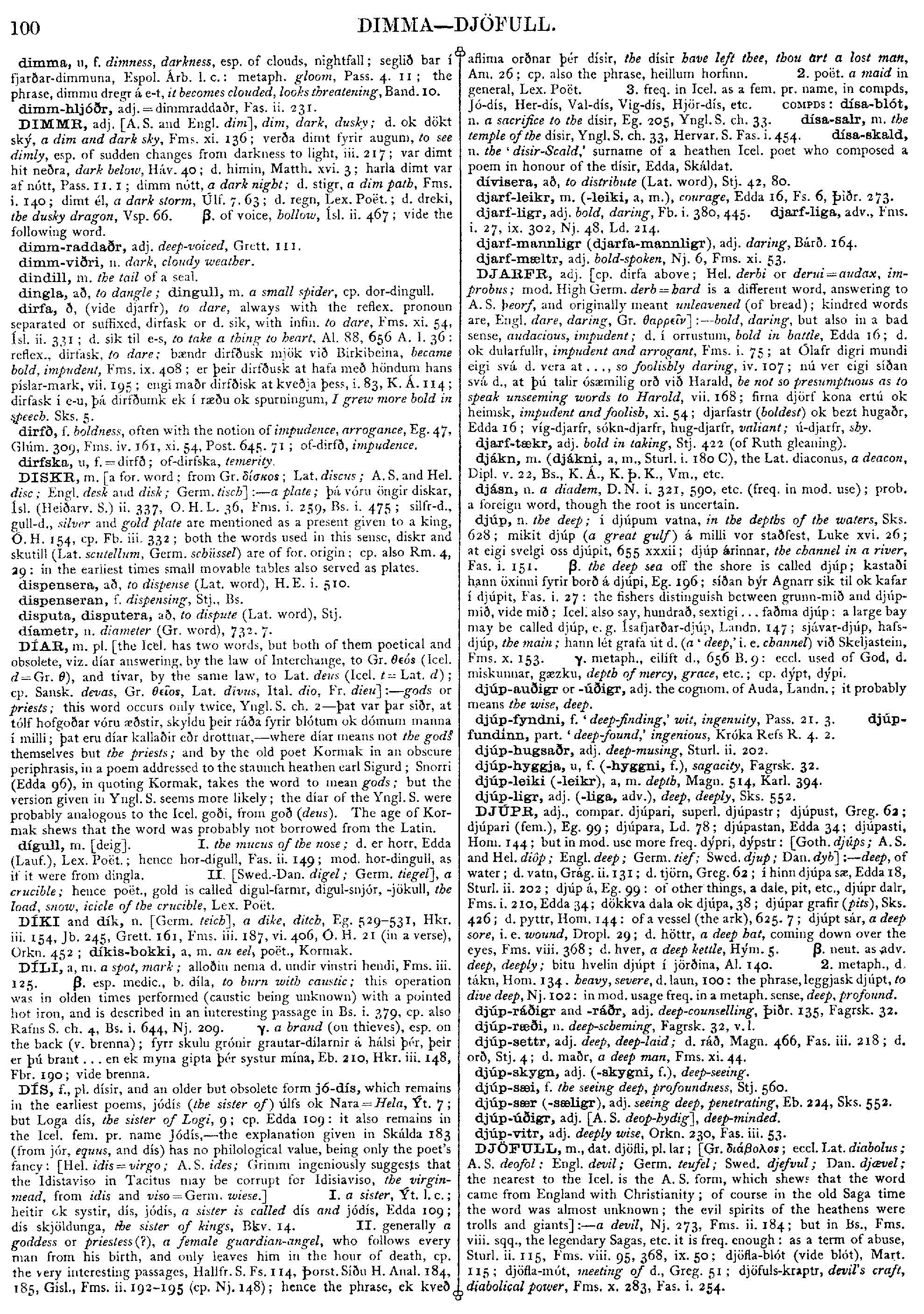
DÍS, f., pl. disir, and an older but obsolete form jó-dís, which remains in the earliest poems, jódís (the sister of) úlfs ok Nara = 7/ ela, Ýt. 7; but Loga dis, the sister of Logi, 9; cp. Edda 109: it also remains in the Icel. fern. pr. name Jódís, -- the explanation given in Skálda 183 (from jór, equus, and dis) has no philological value, being only the poet's fancy: [Hel. idis = virgo; A. S. ides; Grimm ingeniously suggests that the Idistaviso in Tacitus may be corrupt for Idisiaviso, the virgin- mead, from idi s and visa = Germ, w ie s e.] I. a sister, Ýt. I. e.; heitir ek systir, dis, jodis, a sister is called dis a nd jódís, Edda 109; dis skjöldunga, the sister of kings, Bkv. 14. II. generally a goddess or priestess (?), a female guardian-angel, who follows every man from his birth, and only leaves him in the hour of death, cp. the very interesting passages, Hallfr. S. Fs. 114, þorst. Síðu H. Anal. 184, 185, Gísl., Fms. ii. 192-195 (cp. Nj. 148); hence the phrase, ek kveð aflima orðnar þér disir, the disir have left thee, tbou art a lost matt, Am. 26; cp. also the phrase, heillum horfinn. 2. poet, a maid in general, Lex. Poët. 3. freq. in Icel. as a fern. pr. name, in compds, Jó-dís, Her-dís, Val-dís, Vig-dís, Hjör-dís, etc. COMPDS: dísa-blót, n. a sacrifice to the disir, Eg. 205, Yngl. S. ch. 33. disa-salr, m. th e temple of the disir, Yngl. S. ch. 33, Hervar. S. Fas. i. 454. disa-skald, n. the ' disir-Scald, ' surname of a heathen Icel. poet who composed a poem in honour of the disir, Edda, Skáldat.
|
Source: Cleasby/Vigfusson, page b0103, entry 1 View original page image as: [TIFF] [PNG] [View previous entry] [View next entry] |
[Comment on this entry] [View comments] |
The following entry has not been hand-corrected. However, the page is reserved and someone is correcting it. |
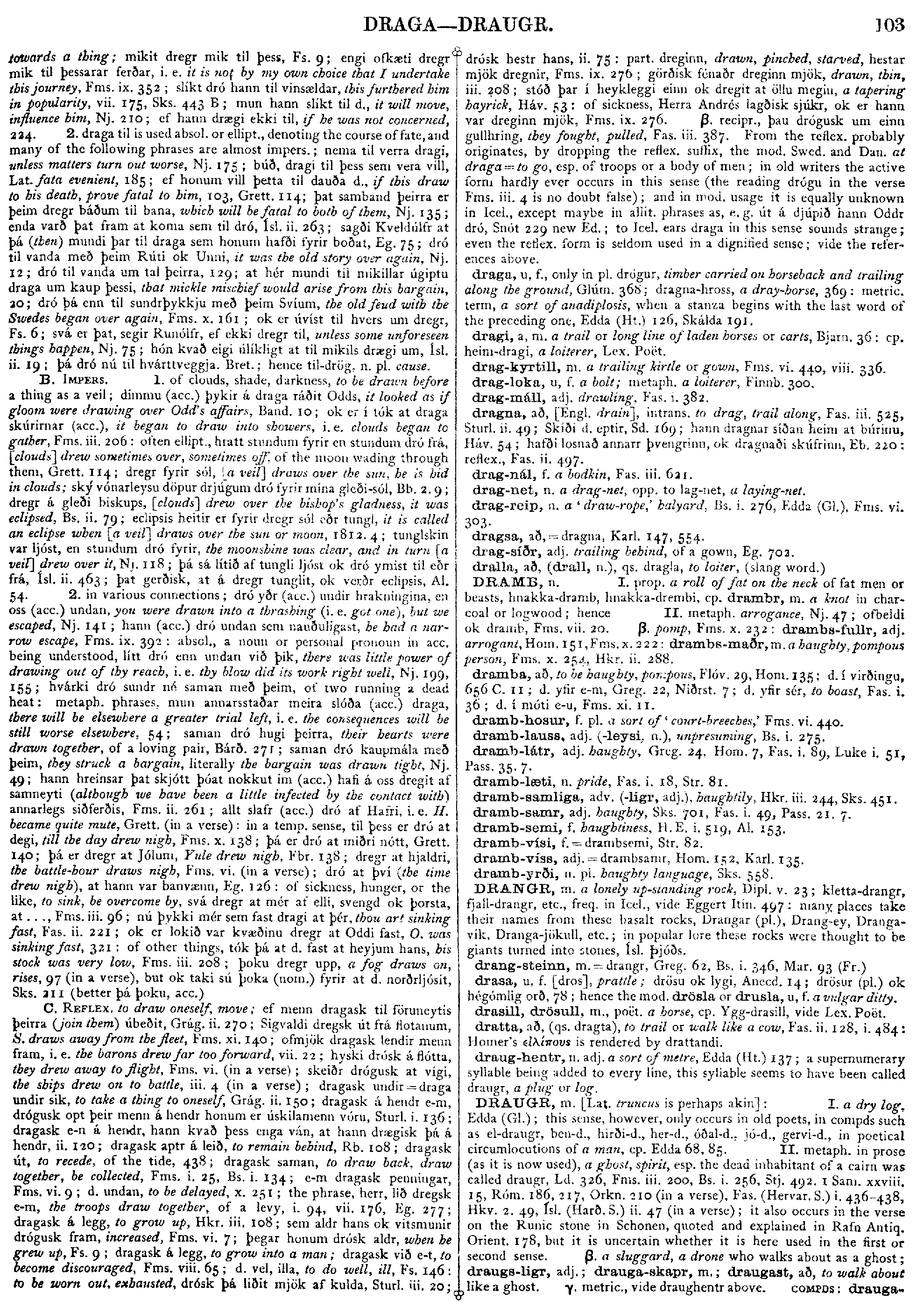
iatvards a thing; mikit dregr mik til þess, Fs. 9; engi ofkæti dregr' mik til þessarar ferðar, i. e. it i s no(by my own choice that í -undertake this journey, Fms. ix. 352; slíkt dró hann til vinsældar, ibis furthered him in popularity, vii. 175, Sks. 443 B; mun hann slikt til d., it will move, influence him, Nj. 210; ef hann drægi ekki til, if he was not concerned, 224. 2. dragatil isusedabsol. or ellipt., denoting the course of fate, and many of the following phrases are almost impers.; nema til verra dragi, unless matters turn out worse, Nj. 175; búð, dragi til þess sem vera vill, Lat. y at a evenient, 185; ef honum vill þetta til dauða d., if ibis draw to his death, prove fatal to him, 103, Grett. 114; þat samband þeirra er þeim dregr báðum til bana, which will be fatal to both of them, Nj. 135; enda varð þat fram at koma sem til dró, Ísl. ii. 263; sagði Kveldúlfr at þá (then) mundi þar ti! draga sem honum hafði fyrir boðat, Eg. 75; dró til vanda með þeim Rúti ok Unni, it was the old story over again, Nj. 12; dró til vanda um tai þeirra, 129; at her mundi til nnkillar ugiptu draga um kaup þessi, that mickle mischief would arise from this bargain, 30; dró þá enn til sundrþykkju með þeim Svíum, the old feud with the Swedes began over again, Fms. x. 161; ok er úvíst til hvers um dregr, Fs. 6; svá er þat, segir Runólfr, ef ekki dregr til, unless some unforeseen things happen, Nj. 75; hón kvað eigi tilikligt at til mikils drsegi um, Ísl. ii. 19; þá dró nú til hvárttveggja. Bret.; hence til-drög. n. pl. cause. B. IMPERS. 1. of clouds, shade, darkness, to be drav-'n before a thing as a veil; dimmu (acc.) þykir á draga ráðit Odds, it looked as if gloom were drawing over Odd's affairs, Band. 10; ok er í lók at draga skurirnar (acc.), it began to draw into showers, i. e. clouds began to gather, Fms. iii. 206: often ellipt., hratt stundum fyrir en stundum dró frá, [clouds] drew sometimes over, sometiin. es off, of the moon wading through them, Grett. 114; dregr fyrir sol, a veil] draws over (be sun, be is bid in clouds; sky vónarleysu döpur drjugum dró iyrir mína gleði-sól, Bb. 2. 9; dregr á gleði biskups, [clouds'] drew over the bishop's gladness, it was eclipsed, Bs. ii. 79; eclipsis heitir er fyrir dregr sól rðr tungl, it is called an eclipse when [a veif] draws over the sun or moon, 1812. 4; tunglskin var Ijost, en stundum dró fyrir, the moonshine was clear, and in turn [a veil] drew over it, Nj. 118; þá sá lítið af tungli Ijóst ok dró ymist til eor frá, Ísl. ii. 463; þat gerðisk, at á dregr tunglit, ok verðr eclipsis, A]. 54. 2. in various connections; dró yðr (acc.) undir hrakningina, en oss (acc.) undan, you were drawn into a thrashing (i. e. got one] , but we escaped, Nj. 141; hann (acc.) dró undan sem r. auðuligast, he bad a nar- row escape, Fms. ix. 392: absol., a noun or personal pronoun in acc. being understood, lítt dró enn undan við þik, there ivas little power of drawing out of thy reach, i. e. thy blow did its work right well. Nj. 199, 155; hvárki dró sundr nó saman með þeim, of two running a dead heat: metaph. phrases, mun annarsstaðar meira slóða (acc.) draga, there will be elsewhere a greater trial left, i. e. the consequences will be still worse elsewhere, 54; saman dró hugi þeirra, their hearts were drawn together, of a loving pair, Bárð. 271; saman dró kaupmála með þeim, they struck a bargain, literally the bargain was drawn tight, Nj. 49; hann hreinsar þat skjótt þóat nokkut im (acc.) hafi á oss dregit af samneyti (although we have been a little infected by the contact witb) annarlegs siðferðis, Fms. ii. 261; allt slafr (acc.) dro af Hafri, i. e. //. became quite mute, Grett. (in a verse): in a temp, sense, til þess er dró at degi, till the day drew nigh, Fms. x. 138; þá er dró at miðri nótt, Grett. 140; þá er dregr at Joluni, Yule drew nigh, Fbr. 138; dregr at hjaldri, the battle-hour draws nigh, Fms. vi. (in a verse); dró at því (the time drew nigh), at hann var banvænn, Eg. 126: of sickness, hunger, or the like, to sink, be overcome by, svá dregr at mér af elli, svengd ok þorsta, at..., Fms. iii. 96; nú þvkki mér sem fast dragi at þér, th ow art sinking fast, Fas. ii. 221; ok er lokið var kvæðinu dregr at Oddi fast, O. was sinking fast, 321: of other things, tók þá at d. fast at heyjum bans, hi s s to ek was very low, Fms. iii. 208; þoku dregr upp, a fog draws on, rises, 97 (in a verse), but ok taki sú poka (nom.) fyrir at d. norðrljósit, Sks. an (better þá þoku, acc.) C. REFLEX, to draw oneself, move; ef menn dragask til föruneytis þeirra (Join them) úbeðit, Grág. ii. 270; Sigvaldi dregsk út frá flotanum, 8. draws away from the fleet, Fms. xi. 140; ofmjök dragask lendir menn fram, i. e. the barons drew far too forward, vii. 22; hyski drósk á flótta, they drew away to flight, Fms. vi. (in a verse); skeiðr drógusk at vigi, the ship s drewon tobattle, iii. 4 (in a verse); dragask undir -- draga undir sik, to take a thing tooneself, Grág. ii. 150; dragask á hendr e-m, drógusk opt þeir menn á hendr honum er uskilamenn voru, Sturl. i. 136; dragask e-n á heridr, hann kvað þess enga van, at hann drægisk þá á hendr, ii. 120; dragask aptr á leið, to remain behind, Rb. 108; dragask út, to recede, of the tide, 438; dragask saman, to draw back, draw together, be collected, Fms. i. 25, Bs. i. 134; e-m dragask peimingar, Fms. vi. 9; d. undan, to be delayed, x. 251; the phrase, herr, lið dregsk e-m, the troops draw together, of a levy, i. 94, vii. 176, Eg. 277; dragask á legg, t o gro w up, Hkr. iii. 108; sem aldr hans ok vitsmunir drógusk fram, increased, Fms. vi. 7; þegar honum drósk aldr, when he grew up, Fs. 9; dragask á legg, to grow into a man; dragask við e-t, t o become discouraged, Fms. via. 65; d. vel, ilia, to do well, ill, Fs. 146: to be worn out, exhausted, drósk þá liðit mjök af kulda, Stud. üi. 20; drósk hestr hans, ii. 75 •' part, dreginn, drawn, pinched, starved, hestar mjök dregnir, Fms. ix. 276; görðisk fénaðr dreginn mjök, drawn, thin, iii. 208; stóð þar í heykleggi einn ok dregit at o!lu megin, a tapering hayrick, Háv. 53: of sickness, Herra Andrés lagðisk sjúkr, ok er hann var dreginn mjök, Fms. ix. 276. /3. recipr., þau drógusk um einn gullhring, they fought, pulled. Fas. iii. 387. From the reflex, probably originates, by dropping the reflex, suffix, the mod. Swed. and Dan. at draga -- to go, esp. of troops or a body of men; in old writers the active form hardly ever occurs in this sense (the reading drogu in the verse Fms. iii. 4 is no doubt false); and in rrod. usage it is equally unknown in Icel., except maybe in allit. phrases as, e. g. út á djúpið hann Oddr dró, Snot 229 new Ed.; to Icel. ears draga in this sense sounds strange; even the rerlex. form is seldom used in a dignified sense; vide the refer- ences above.
|
Source: Cleasby/Vigfusson, page b0105, entry 16 View original page image as: [TIFF] [PNG] [View previous entry] [View next entry] |
[Comment on this entry] [View comments] |
The following entry has not been hand-corrected. However, the page is reserved and someone is correcting it. |
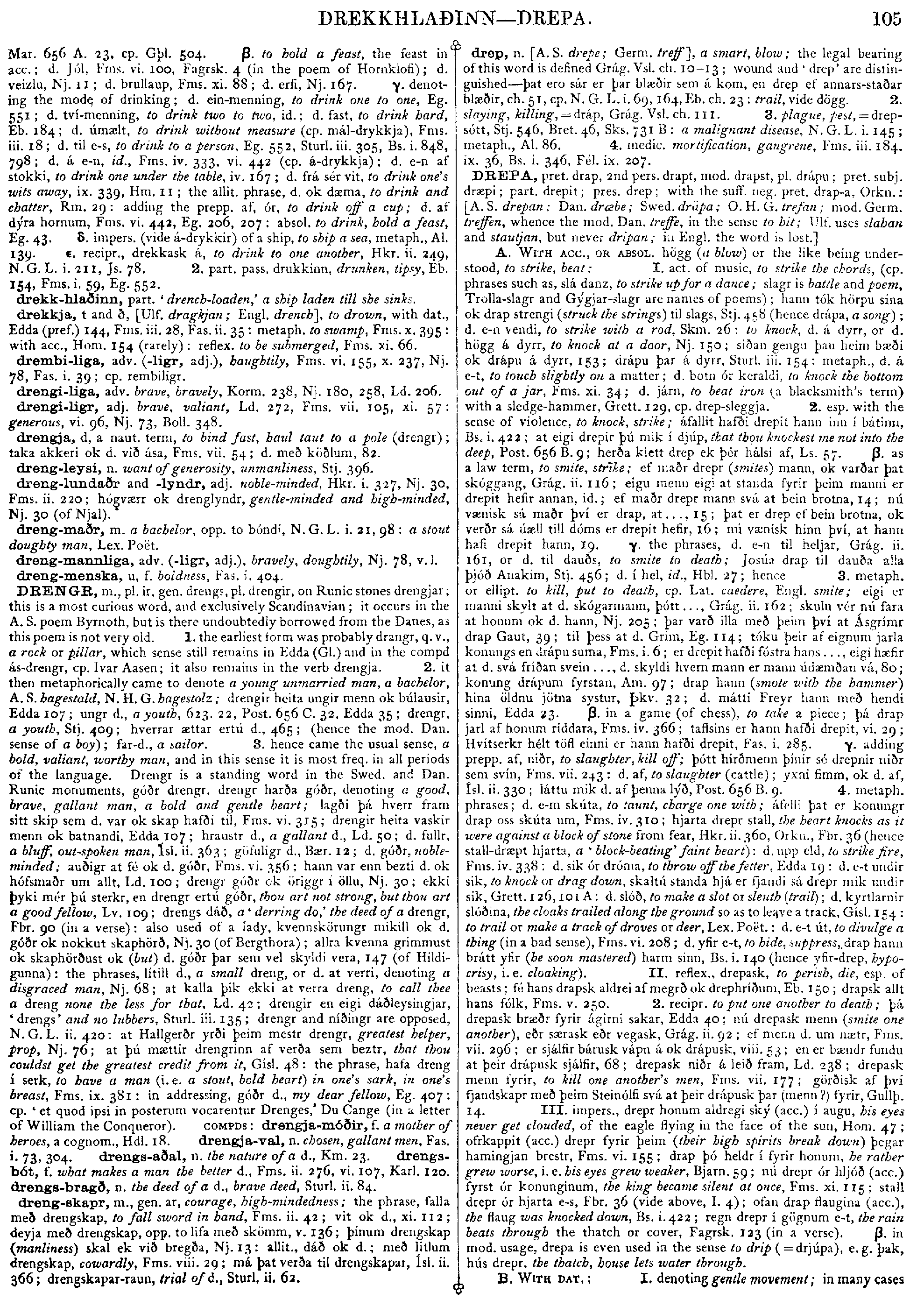
DREPA, pret. drap, 2nd pers. drapt, mod. drapst, pl. drápu; pret. subj. draepi; part, drepit; pres. drep; with the suft". neg. pret. drap-a. Orkn.: [A. S. drepan; Dan. drœbe; Swed. drapa; O. H. G. trefan; mod. Germ. treffen, whence the mod. Dan. treffe, in the sense to hit; Ulf. uses slahan and stautjan, but never dripan; in Engl. the word is lost.] A. WITH ACC., OR ABSOL. högg (a blow) or the like being under- stood, to strike, beat: I. act. of music, to strike the chords, (cp. phrases such as, slá danz, to strike up for a dance; slagr is battle and poem, Trolla-slagr and Gygjar-slagr are names of poems); hann tók hörpu sína ok drap strengi (struck the strings) til slags, Stj. 458 (hence drápa, a so?ig); d. e-n vendi, t o s trike with a rod, Skm. 26: to knock, å. á dyrr, or d. hogg á dyrr, to knock at a door, Nj. 150; síðan gengu þau heim bæði ok drápu á dyrr, 153; cirápu þar á dyrr, Sturl. iii. 154: metaph., d. á e-t, to tou c h slightly on a matter; d. botn or keraldi, to knock the bottom out of a jar, Fms. xi. 34; d. jam, to beat iron (a blacksmith's term) with a sledge-hammer, Grett. 129, cp. drep-sleggja. 2. esp. with the sense of violence, to knock, strike; áfallit hafði drepit hann inn í bátinn, Bs. i. 422; at eigi drepir þú mik í djúp, that thou knockest me not into the deep, Post. 6568. 9; herða klett drep ek þór hálsi af, Ls. 57. p. as a law term, to smite, strike; ef maðr drepr (smites) mann, ok varðar þat skóggang, Grág. ii. 116; eigu menu eigi at standa fyrir þeim inanni er drepit hefir annan, id.; ef maðr drepr mann svá at bein brotna, 14; nú vænisk sá maðr því er drap, at..., 15; þat er drep cf bein brotna, ok verðr sá úæll till dóms er drepit hefir, 16; mi vænisk hinn því, at hann hafi drepit hann, 19. y- tnc phrases, d. e-n til heljar, Grág. ii. 161, or d. til dauðs, to smite todeath; Josua drap til dauða alia þjóð Anakim, Stj. 456; d. í hel, id., Hbl. 27; hence 3. metaph. or ellipt. to kill, pwt todeath, cp. Lat. caedere, Engl. smite; eigi er manni skylt at d. skógarmann, þótt..., Grág. ii. 162; skulu vór mi fara at honum ok d. hann, Nj. 205; þar varð ilia með þeim því at Ásgrímr drap Gaut, 39; til þess at d. Grim, Eg. 114; tóku þeir af eignum jarla konungs en drápu suma, Fms. i. 6; er drepit hafði fóstra hans ..., eigi hæfir at d. svá fríðan svein ..., d. skyldi hvern mann er mann údæmðan vá, 80; konung drápum fyrstan, Am. 97; drap hann (smote with the hammer) hina öldnu jötna systur, ^kv. 32; d. mátti Freyr hann með hendi sinni, Edda 23. p. in a game (of chess), to take a piece; þá drap jarl af honum riddara, Fms. iv. 366; îaflsins er hann hafði drepit, vi. 29; Hvítserkr hélt töfl einni er hann hafði drepit, Fas. i. 285. y. adding prepp. af, niðr, to slaughter, kill off'; þótt hirðmenn þínir so drepnir niðr sem svín, Fms. vii. 243: d. af, to slaughter (cattle); yxni fimm, ok d. af, Ísl. ii. 330; láttu mik d. af þenna lyð, Post. 656 B. 9. 4. metaph. phrases; d. e-m skúta, to taunt, charge one with; áfelli þat er konungr drap oss skvita um, Fms. iv. 310; hjarta drepr stall, the heart knocks as it were against a block of stone from fear, Hkr. ii. 360, Orkn., Fbr. 36 (hence stall-dræpt hjarta, a ' block-beating'faint heart): d. upp eld, to strike fire, Fms. iv. 338: d. sik or droma, to throw off the fetter, Edda 19: d. e-t undir sik, to kn oc k or dra g- down, skahii standa hjá er fjandi sá drepr mik undir sik, Grett. 126, 101 A: d. slóð, to make a slot or sleuth (trail); d. kyrtlarnir slóðina, the cloaks trailed along the ground so as to lea. vea track, Gísl. 154: to trail or w ake a tr ac k of droves or deer, Lex. Poët.: d. e-t út, to divulge a thing (in a bad sense), Fms. vi. 208; d. yfir e-t, to hide, suppress,, dTzp hann brátt yfir (he soo n mastered) harm sinn, Bs. i. 140 (hence yfir-drep, hyp o- c ri s y, i. e. cloaking). II. reflex., drepask, to perish, die, esp. of beasts; fé hans drapsk aldrei af megrð ok drephríðum, Eb. 150; drapsk allt hans folk, Fms. v. 250. 2. recipr. to put one another to death; þá drepask bræðr fyrir ágirni sakar, Edda 40; mi drepask merm (smite one another), eðr særask eðr vegask, Grág. ii. 92; ef menu d. um nætr, Fms. vii. 296; er sjálfir bárusk vápn á ok drápusk, viii. 53; en er bændr fundu at þeir drápusk sjálfir, 68; drepask niðr á ieið fram, Ld. 238; drepask menn fyrir, to killone another's men, Fms. vii. 17?! görðisk af því fjandskapr með þeim Steinólfi svá at þeir drápusk þar (menn ?) fyrir, Gullþ. 14. III. impers., drepr honum aldregi ský (acc.) í augu, hi s eyes never get clouded, of the eagle flying in the face of the sun, Hom. 47; ofrkappit (acc.) drepr fyrir þeim (their high spirits break down) þegar hamingjan brestr, Fms. vi. 155; drap þó heldr í fyrir honum, he rather grew worse, i. e. his eyes . gr ew weaker, Bjarn. 59; nú drcpr ór hljóð (acc.) fyrst or konunginum, the kin g" became silent at once, Fms. xi. 115; stall drepr or hjarta e-s, Fbr. 36 (vide above, I. 4); ofan drap flaugina (acc.), the flaug wa s knocked down, Bs. 1. 422; regn drepr í gögnum e-t, the rain beats through the thatch or cover, Fagrsk. 123 (in a verse). p. in mod. usage, drepa is even used in the sense to drip (= drjupa), e. g. þak, hús drepr, the thatch, house lets water B. WITH DAT,; I. denoting gentle movement; in many cases
|
Source: Cleasby/Vigfusson, page b0107, entry 36 View original page image as: [TIFF] [PNG] [View previous entry] [View next entry] |
[Comment on this entry] [View comments] |
The following entry has not been hand-corrected. However, the page is reserved and someone is correcting it. |
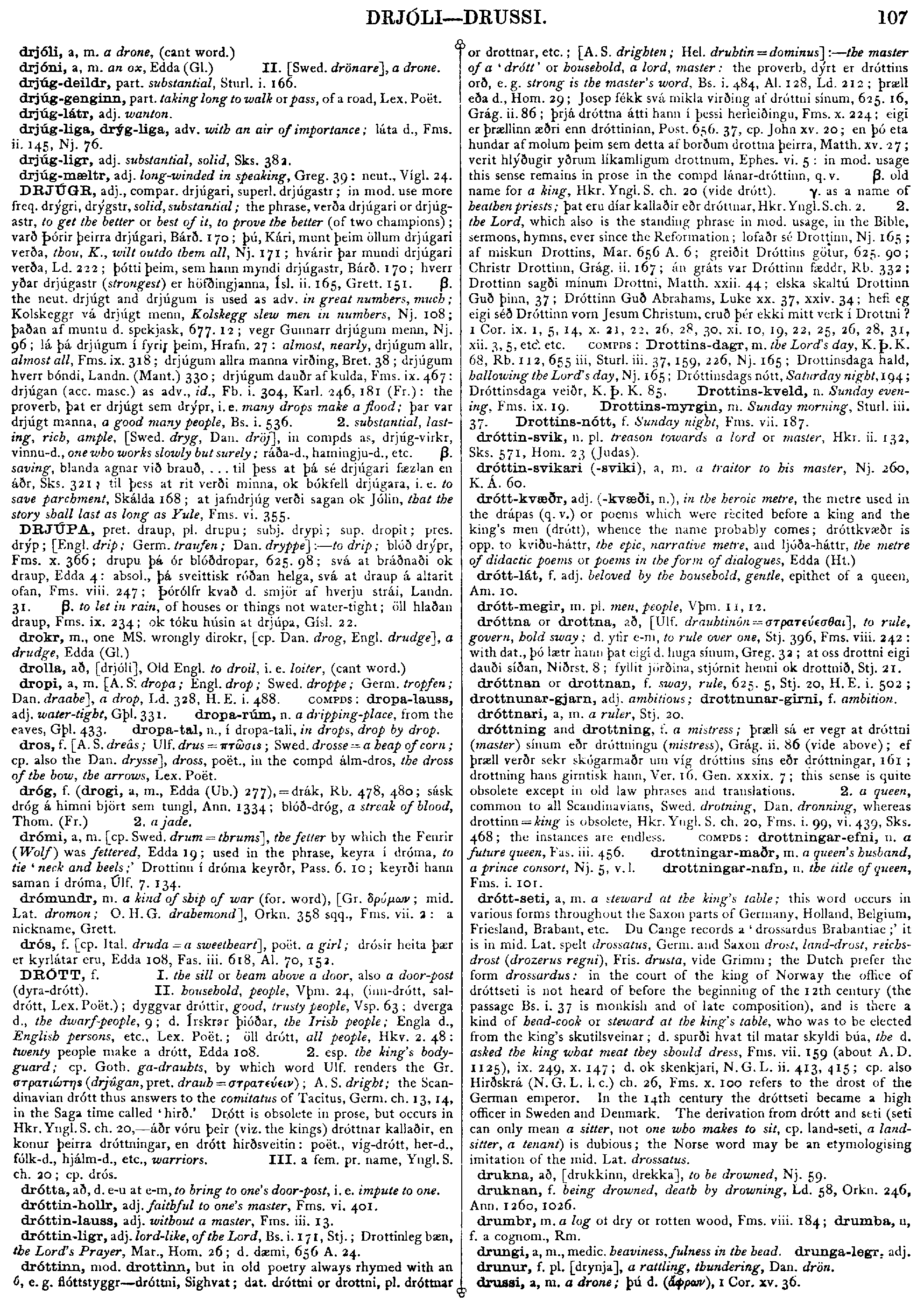
druknan, f. being drowned, death by drowning, Ld. 58, Orkn. 246, Ann. 1260, 1026.
|
Source: Cleasby/Vigfusson, page b0108, entry 1 View original page image as: [TIFF] [PNG] [View previous entry] [View next entry] |
[Comment on this entry] [View comments] |
The following entry has not been hand-corrected. However, the page is reserved and someone is correcting it. |
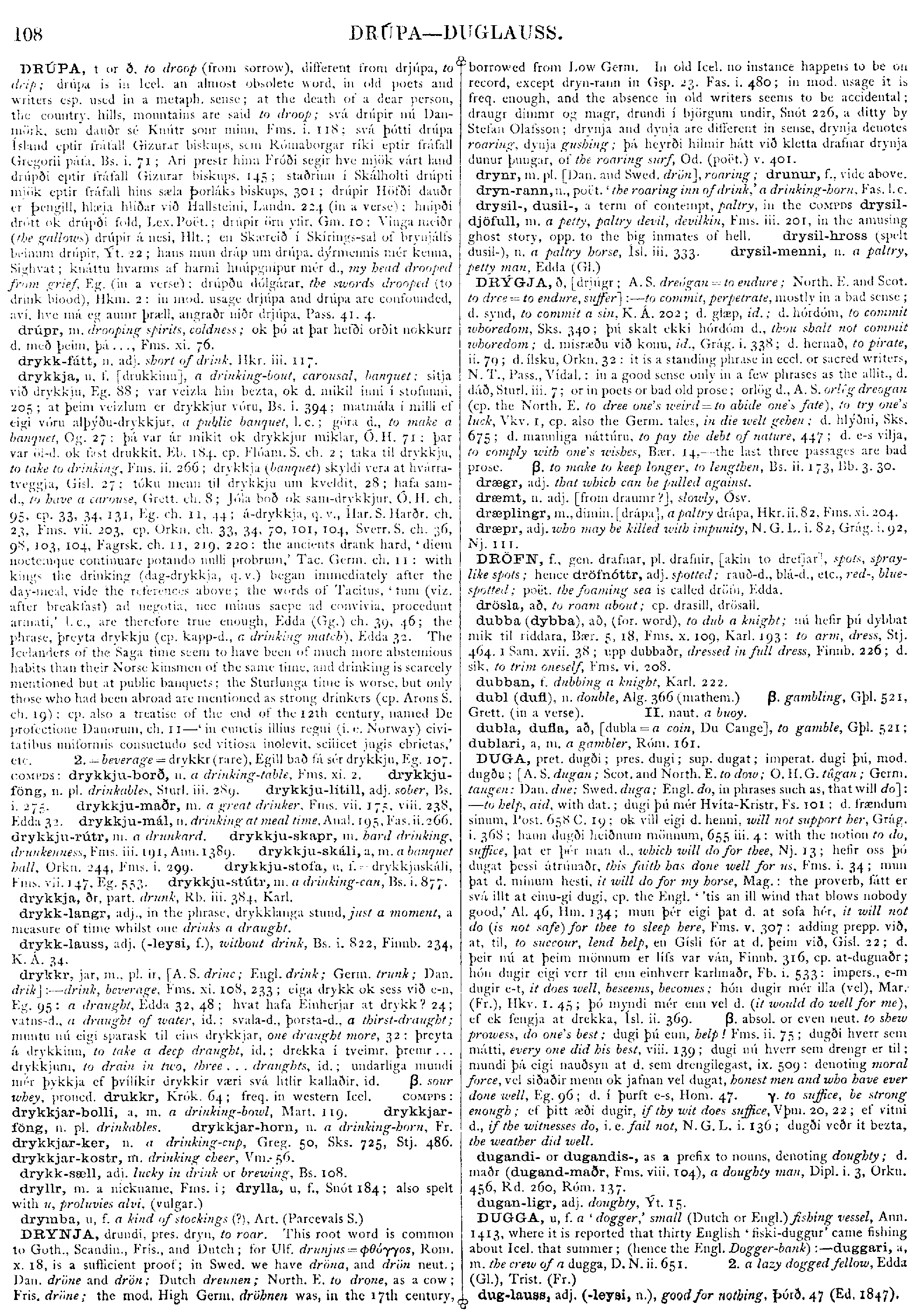
DRÚPA, t or ð, to droop (from sorrow), different from drjiipa, to di'i['; dnipa is in Icel. an almost obsolete word, in old poets and writers esp. used in a metaph. sense; at the death of a dear person, the country, hills, mountains are said to droop; svá dnipir mi Dan- inurk, sein dauðr sé Kiu'itr sour minn. Fms. i. IlS: svá. þótti drúpa Island eptir íïátal! Gizur. ir biskups, sun Romaborgar riki eptir trafall Gregurii piifa, Bs. i. 71; Ari preslr hinn Króði segir hve müik várt land drúpði eptir fr. ifall Gi/urar biskups. 145; staðrinn í Skálholti dnipti ni'uk eptir fn'tfall bins s;tla þorlúks biskups, 301; dnipir Hiïfði dauðr er þengill, hlæia hliðar við Hallsíeini, Landn. 224 (in a verse): hnípði dn'itt ok dnipði fold, Lex. Poët.: dnipir orn ylir, Gm. io; Vinga inciðr (/be g(dl'nv*) dnipir;'i nesi, Hit.; en Ska-rcið í Skirings-sal of brvnjfilts bi-inum dnipir. "ft. 22; lians nnin drup um drnpa, dynnennis nier kenna, Si^'hvat; kni'ittu livarms af harmi hniipgnipur mer d., my bead drooped fi-'im grief. Eg. (in a verse): drúpðu dólgúrar, the swords drooped (to drink blood), Hkm. 2: in mod. usage drjiipa and drnpa are confounded, avi, live inn eg aumr þræll, angraðr uiðr drjiípa, Pass. 41. 4.
|
Source: Cleasby/Vigfusson, page b0114, entry 5 View original page image as: [TIFF] [PNG] [View previous entry] [View next entry] |
[Comment on this entry] [View comments] |
The following entry has not been hand-corrected. However, the page is reserved and someone is correcting it. |
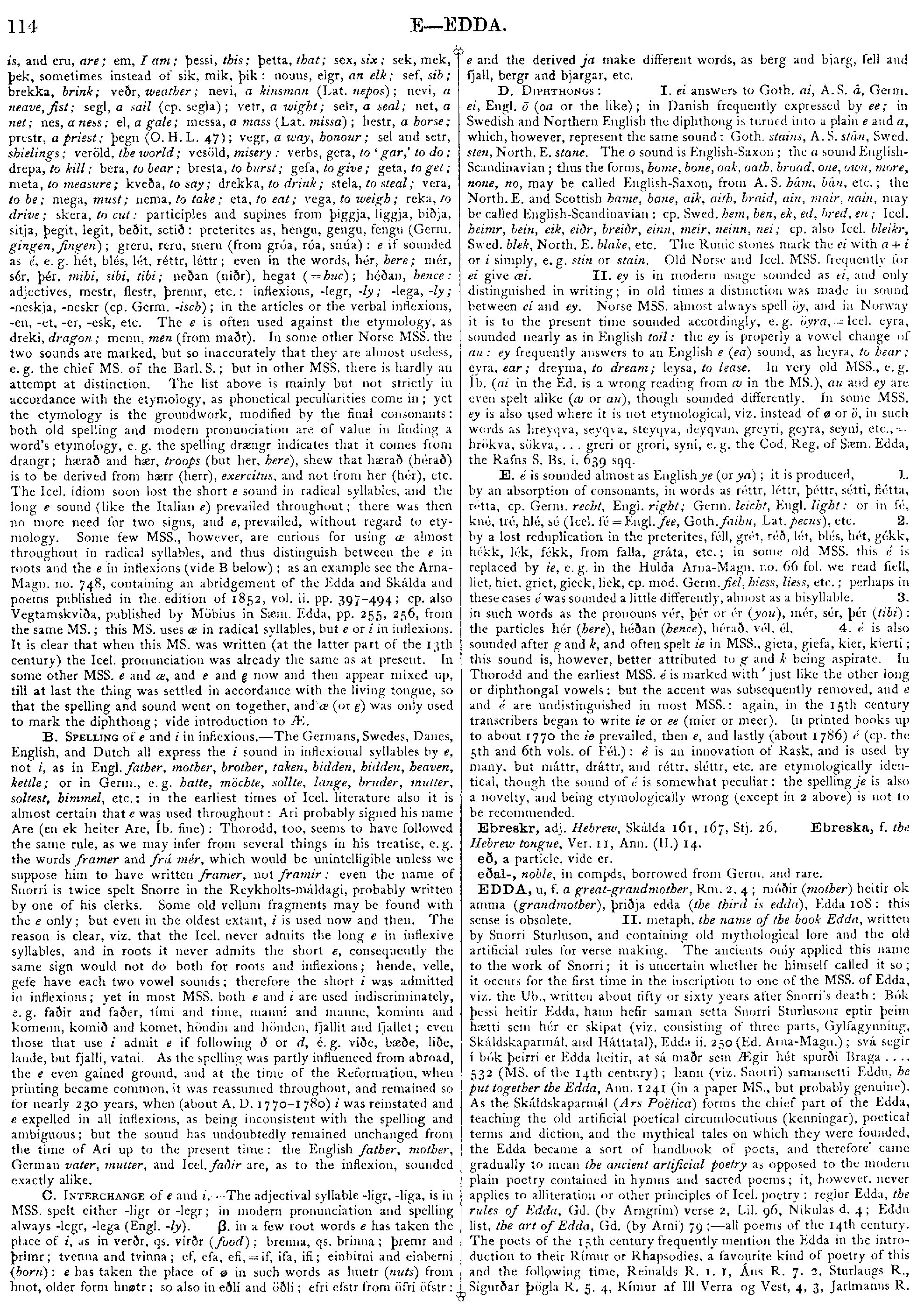
EDDA, u, f. a great-grandmother, Rm. 2. 4; móðir (mother) heitir ok amma (grandmother), þriðja edda (the third is edda), Edda 108: this sense is obsolete. II. metaph. the name of the book Edda, written by Snorri Sturluson, and containing old mythological lore and the old artificial rules for verse making. The ancients only applied this name to the work of Snorri; it is uncertain whether he himself called it so; it occurs for the first time in the inscription to one of the MSS. of Edda, vi/, . the Ub., written about fifty or sixty years after Snorri's death: Bók þessi heitir Edda, hann hefir saman setta Snorri Sturlusonr eptir þeim hætti sem her er skipat (vi'/, . consisting of three parts, Gylfagynning, Skáldskaparmál, and Háttatal), Edda ii. 250 (Ed. Arna-Magn.); sva segir i bók þeirri er Edda heitir, at sá maðr sem Ægir hot spurði Braga ... . 532 (MS. of the 14111 century); hann (viz. Snorri) samansetti Eddu, he put together the Edda, Ann. 1241 (in a paper MS., but probably genuine). As the Skáldskaparmál (Ars Poe'tica) forms the chief part of the Edda, teaching the old artificial poetical circumlocutions (kenningar), poetical terms and diction, and the mythical tales on which they were founded, the Edda became a sort of handbook of poets, and therefore' came gradually to mean the ancient artificial poetry as opposed to the modern plain poetry contained in hymns and sacred poems; it, however, never applies to alliteration or other principles of Icel. poetry: reglur Edda, the rules of Edda, Gd. (by Arngrim) verse 2, Lil. 96, Nikulas d. 4; Eddu list, the art of Edda, (id. (by Arni) 79; -- all poems of the 141)1 century. The poets of the 15th century frequently mention the Edda in the intro- duction to their Rimur or Rhapsodies, a favourite kind of poetry of this and the following time, Reinalds R. i. I, Áns R. 7. 2, Sturlaugs R., Sigurðar þögla R. 5. 4, Rimur af 111 Verra og Vest, 4, 3, Jarlmanns R.
|
Source: Cleasby/Vigfusson, page b0125, entry 2 View original page image as: [TIFF] [PNG] [View previous entry] [View next entry] |
[Comment on this entry] [View comments] |
The following entry has been hand-corrected once. |
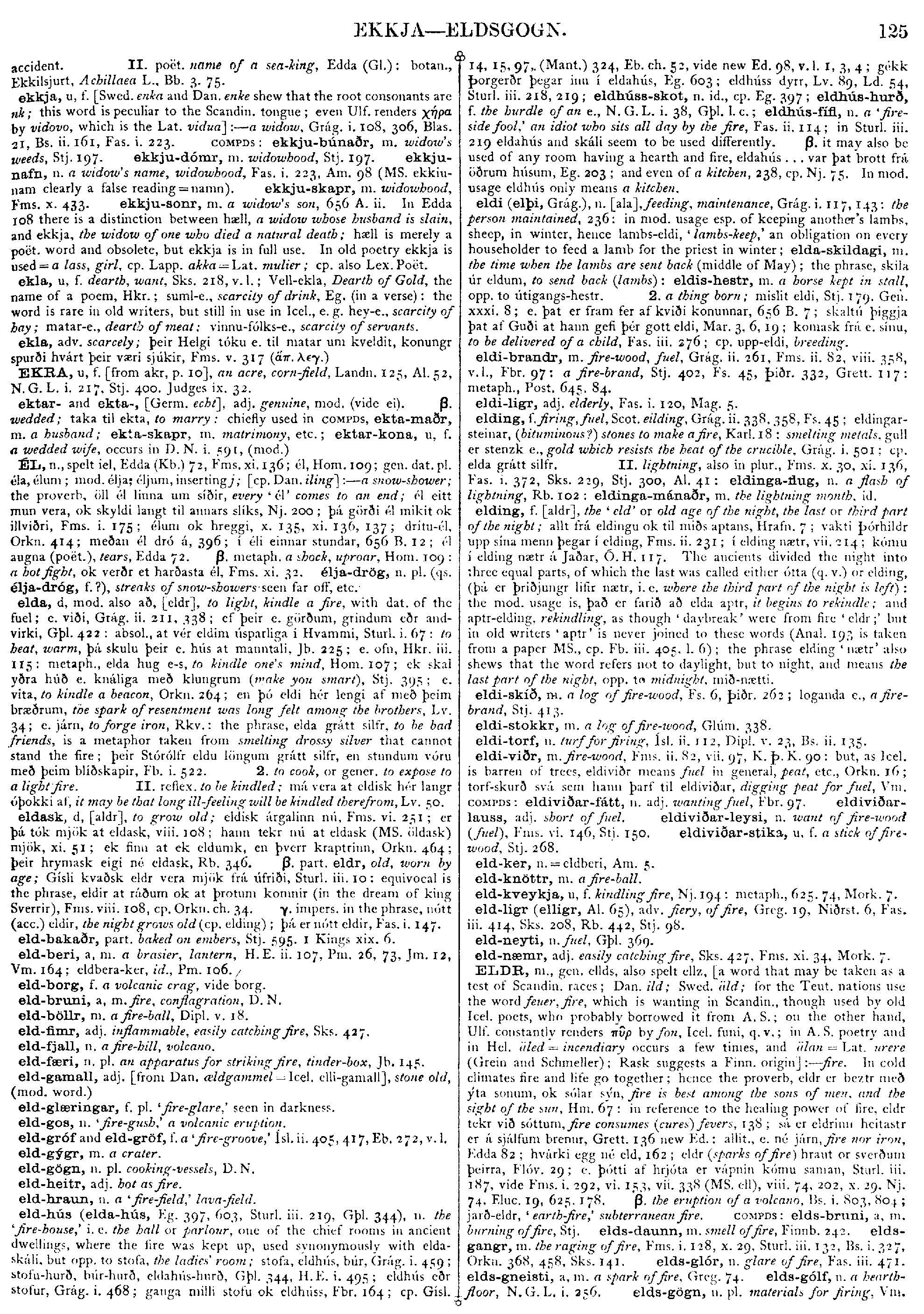
ekkja, u, f. [Swed. enka and Dan. enke shew that the root consonants are nk; this word is peculiar to the Scandin. tongue; even Ulf. renders GREEK by vidovo, which is the Lat. vidua] :-- a widow, Grág. i. 108, 306, Blas. 21, Bs. ii. 161, Fas. i. 223. COMPDS: ekkju-búnaðr, m. widow's weeds, Stj. 197. ekkju-dómr, m. widowhood, Stj. 197. ekkju-nafn, n. a widow's name, widowhood, Fas. i. 223, Am. 98 (MS. ekkiunam clearly a false reading = namn). ekkju-skapr, m. widowhood, Fms. x. 433. ekkju-sonr, m. a widow's son, 656 A. ii. In Edda 108 there is a distinction between hæll, a widow whose husband is slain, and ekkja, the widow of one who died a natural death; hæll is merely a poët. word and obsolete, but ekkja is in full use. In old poetry ekkja is used = a lass, girl, cp. Lapp. akka = Lat. mulier; cp. also Lex. Poët.
| Result Page: |  |
Previous | 46 47 48 49 50 51 52 53 54 55 56 57 58 59 60 61 62 63 64 | Next |  |
Germanic Lexicon Project (main page)
This search system was written by
Sean Crist
Please consider
volunteering
to correct the data in these online dictionaries.
No rights reserved. Feel free to use these data in any way you please.