|
|

Tip: In the search results, you can click on any word or abbreviation for more information.
|
Source: Cleasby/Vigfusson, page b0016, entry 7 View original page image as: [TIFF] [PNG] [View previous entry] [View next entry] |
[Comment on this entry] [View comments] |
The following entry has been hand-corrected once. |
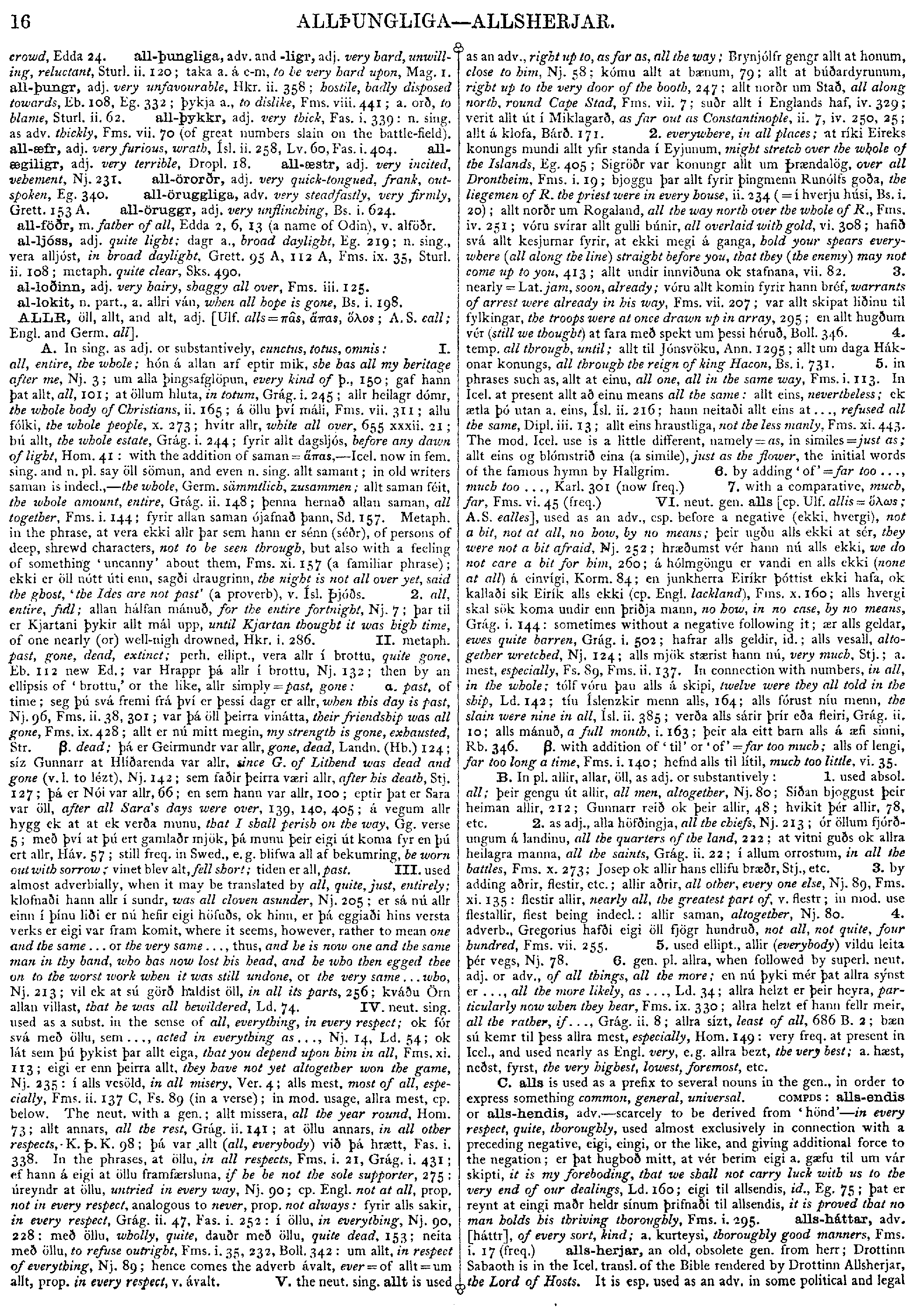
A.
In
sing,
as
adj.
or
substantively,
cunctus,
totus,
omnis:
I.
all,
entire,
the
whole;
hón
á
allan
arf
eptir
mik,
she
has
all
my
heritage
after
me,
Nj.
3;
um
alla
þingsafglöpun,
every
kind
of
þ.,
150;
gaf
hann
þat
allt,
all,
101;
at
öllum
hluta,
in
totum,
Grág.
i.
245;
allr
heilagr
dómr,
the
whole
body
of
Christians,
ii.
165;
á
öllu
því
máli,
Fms.
vii.
311;
allu
fólki,
thewhole
people,
x.
273;
hvitr
allr,
white
all
over,
655
xxxii.
21;
bú
allt,
thewhole
estate,
Grág.
i.
244;
fyrir
allt
dagsljós,
before
any
dawn
of
light,
Hom.
41:
with
the
addition
of
saman
=
GREEK
--
Icel.
now
in
fem.
sing.
and
n.
pl.
say
öll
sömun,
and
even
n.
sing.
allt
samant;
in
old
writers
saman
is
indecl.,
--
the
whole,
Germ,
sänmtlich,
zusammen;
allt
saman
féit,
thewhole
amount,
entire,
Grág.
ii.
148;
þenna
hernað
allan
saman,
all
together,
Fms.
i.
144;
fyrir
allan
saman
ójafnað
þann,
Sd.
157.
Metaph.
in
the
phrase,
at
vera
ekki
allr
þar
sem
hann
er
sénn
(séðr),
of
persons
of
deep,
shrewd
characters,
not
to
be
seen
through,
but
also
with
a
feeling
of
something
'uncanny'
about
them,
Fms.
xi.
157
(a
familiar
phrase);
ekki
er
oil
nótt
úti
enn,
sagði
draugrinn,
the
night
is
not
all
over
yet,
said
the
ghost,
'the
Ides
are
not
past'
(a
proverb),
v.
Ísl.
þjóðs.
2.
all,
entire,
full;
allan
hálfan
mánuð,
for
the
entire
fortnight,
Nj.
7;
þar
til
er
Kjartani
þykir
allt
mál
upp,
until
Kjartan
thought
it
was
high
time,
of
one
nearly
(or)
well-nigh
drowned,
Hkr.
i.
286.
II.
metaph.
past,
gone,
dead,
extinct;
perh.
ellipt.,
vera
allr
í
brottu,
quite
gone,
Eb.
112
new
Ed.;
var
Hrappr
þá
allr
í
brottu,
Nj.
132;
then
by
an
ellipsis
of
'brottu,'
or
the
like,
allr
simply
==
past,
gone:
 .
past,
of
time;
seg
þú
svá
fremi
frá
því
er
þessi
dagr
er
allr,
when
this
day
is
past,
Nj.
96,
Fms.
ii.
38,
301;
var
þá
öll
þeirra
vinátta,
their
friendship
was
all
gone,
Fms.
ix.
428;
allt
er
mi
mitt
megin,
my
strength
is
gone,
exhausted,
Str.
.
past,
of
time;
seg
þú
svá
fremi
frá
því
er
þessi
dagr
er
allr,
when
this
day
is
past,
Nj.
96,
Fms.
ii.
38,
301;
var
þá
öll
þeirra
vinátta,
their
friendship
was
all
gone,
Fms.
ix.
428;
allt
er
mi
mitt
megin,
my
strength
is
gone,
exhausted,
Str.
 .
dead;
þá
er
Geirmundr
var
allr,
gone,
dead,
Landn.
(Hb.)
124;
siz
Gunnarr
at
Hlíðarenda
var
allr,
since
G.
of
Lithend
was
dead
and
gone
(v.
l.
to
lézt),
Nj.
142;
sem
faðir
þeirra
væri
allr,
after
his
death,
Stj.
127;
þá
er
Nói
var
allr,
66;
en
sem
hann
var
allr,
100;
eptir
þat
er
Sara
var
öll,
after
all
Sara's
days
were
over,
139,
140,
405;
á
vegum
allr
hygg
ek
at
at
ek
verða
munu,
that
I
shall
perish
on
the
way,
Gg.
verse
5;
með
því
at
þú
ert
gamlaðr
mjök,
þá
munu
þeir
eigi
út
koma
fyr
en
þú
ert
allr,
Háv.
57;
still
freq.
in
Swed.,
e.
g.
blifwa
all
af
bekumring,
be
worn
out
with
sorrow;
vinet
blev
alt,
fell
short;
tiden
er
all,
past.
III.
used
almost
adverbially,
when
it
may
be
translated
by
all,
quite,
just,
entirely;
klofnaði
hann
allr
í
sundr,
was
all
cloven
asunder,
Nj.
205;
er
sá
nú
allr
einn
í
þínu
liði
er
nú
hefir
eigi
höfuðs,
ok
hinn,
er
þá
eggiaði
hins
versta
verks
er
eigi
var
fram
komit,
where
it
seems,
however,
rather
to
mean
one
and
the
same
...
or
the
very
same
...,
thus,
and
he
is
now
one
and
the
same
man
in
thy
band,
who
has
now
lost
his
bead,
and
he
who
then
egged
tbee
on
to
the
worst
work
when
it
was
still
undone,
or
the
very
same,
...
who,
Nj.
213;
vil
ek
at
sú
görð
häldist
öll,
in
all
its
parts,
256;
kváðu
Örn
allan
villast,
that
he
was
all
bewildered,
Ld.
74.
IV.
neut.
sing,
used
as
a
subst.
in
the
sense
of
all,
everything,
in
every
respect;
ok
for
svá
með
öllu,
sem
...,
acted
in
everything
as...,
Nj.
14,
Ld.
54;
ok
lát
sem
þú
þykist
þar
allt
eiga,
that
you
depend
upon
him
in
all,
Fms.
xi.
113;
eigi
er
enn
þeirra
allt,
they
have
not
yet
altogether
won
the
game,
Nj.
235:
í
alls
vesöld,
in
all
misery,
Ver.
4;
alls
mest,
most
of
all,
espe-
cially,
Fms.
ii.
137
C,
Fs.
89
(in
a
verse);
in
mod.
usage,
allra
mest,
cp.
below.
The
neut.
with
a
gen.;
allt
missera,
all
the
year
round,
Hom.
73;
allt
annars,
all
the
rest,
Grág.
ii.
141;
at
öllu
annars,
in
all
other
respects,
-
K.
Þ.
K.
98;
þá
var
allt
(all,
everybody)
við
þá
hrætt,
Fas.
i.
338.
In
the
phrases,
at
öllu,
in
all
respects,
Fms.
i.
21,
Grág.
i.
431;
ef
hann
á
eigi
at
öllu
framfærsluna,
if
he
be
not
the
sole
supporter,
275:
úreyndr
at
öllu,
untried
in
every
way,
Nj.
90;
cp.
Engl.
not
at
all,
prop.
not
in
every
respect,
analogous
to
never,
prop,
not
always:
fyrir
alls
sakir,
in
every
respect,
Grág.
ii.
47,
Fas.
i.
252:
í
öllu,
in
everything,
Nj.
90,
228:
með
öllu,
wholly,
quite,
dauðr
með
öllu,
quite
dead,
153;
neita
með
öllu,
to
refuse
outright,
Fms.
i.
35,
232,
Boll.
342:
um
allt,
in
respect
of
everything,
Nj.
89;
hence
comes
the
adverb
ávalt,
ever
=
of
allt
=
um
allt,
prop,
in
every
respect,
v.
ávalt.
V.
the
neut.
sing,
allt
is
used
as
an
adv.,
right
up
to,
as
far
as,
all
the
way;
Brynjólfr
gengr
allt
at
honum,
close
to
him,
Nj.
58;
kómu
allt
at
bænum,
79;
allt
at
búðardyrunum,
right
up
to
the
very
door
of
the
booth,
247;
allt
norðr
urn
Stað,
all
along
north,
round
Cape
Stad,
Fms.
vii.
7;
suðr
allt
í
Englands
haf,
iv.
329;
verit
allt
út
í
Miklagarð,
as
far
out
as
Constantinople,
ii.
7,
iv.
250,
25;
allt
á
klofa,
Bárð.
171.
2.
everywhere,
in
all
places;
at
riki
Eireks
konungs
mundi
allt
yfir
standa
í
Eyjunum,
might
stretch
over
the
whole
of
the
Islands,
Eg.
405;
Sigröðr
var
konungr
allt
um
Þrændalög,
over
all
Drontheim,
Fms.
i.
19;
bjoggu
þar
allt
fyrir
þingmenn
Runólfs
goða,
the
liegemen
of
R.
the
priest
were
in
every
house,
ii.
-234
(=
í
hverju
húsi,
Bs.
i.
20);
allt
norðr
um
Rogaland,
all
the
way
north
over
the
whole
of
R.,
Fms.
iv.
251;
vóru
svirar
allt
gulli
búnir,
all
overlaid
with
gold,
vi.
308;
hafið
svá
allt
kesjurnar
fyrir,
at
ekki
megi
á
ganga,
hold
your
spears
every-
where
(all
along
the
line)
straight
before
you,
that
they
(the
enemy)
may
not
come
up
to
you,
413;
allt
imdir
innviðuna
ok
stafnana,
vii.
82.
3.
nearly
=
Lat.
jam,
soon,
already;
vóru
allt
komin
fyrir
hann
bréf,
warrants
of
arrest
were
already
in
his
way,
Fms.
vii.
207;
var
allt
skipat
liðinu
til
fylkingar,
the
troops
were
at
once
drawn
up
in
array,
295;
en
allt
hugðum
vér
(still
we
thought)
at
fara
með
spekt
um
þessi
héruð,
Boll.
346.
4.
temp.
all
through,
until;
allt
til
Júnsvöku,
Ann.
1295;
allt
um
daga
Hák-
onar
konungs,
all
through
the
reign
of
king
Hacon,
Bs.
i.
731.
5.
in
phrases
such
as,
allt
at
einu,
all
one,
all
in
the
same
way,
Fms.
i.
113.
In
Icel.
at
present
allt
að
einu
means
all
the
same:
allt
eins,
nevertheless;
ek
ætla
þó
utan
a.
eins,
Ísl.
ii.
216;
hann
neitaði
allt
eins
at...,
refused
all
the
same,
Dipl.
iii.
13;
allt
eins
hraustliga,
not
the
less
manly,
Fms.
xi.
443.
The
mod.
Icel.
use
is
a
little
different,
namely
=
as,
in
similes
=
just
as;
allt
eins
og
blómstrið
eina
(a
simile),
just
as
the
flower,
the
initial
words
of
the
famous
hymn
by
Hallgrim.
6.
by
adding
'of'
=
far
too
...,
much
too
...,
Karl.
301
(now
freq.)
7.
with
a
comparative,
much,
far,
Fms.
vi.
45
(freq.)
VI.
neut.
gen.
alls
[cp.
Ulf.
allis
=
GREEK;
A.
S.
ealles],
used
as
an
adv.,
esp.
before
a
negative
(ekki,
hvergi),
not
a
bit,
not
at
all,
no
how,
by
no
means;
þeir
ugðu
alls
ekki
at
sér,
they
were
not
a
bit
afraid,
Nj.
252;
hræðumst
vér
hann
nú
alls
ekki,
we
do
not
care
a
bit
for
him,
260;
á
hólmgöngu
er
vandi
en
alls
ekki
(none
at
all)
á
einvigi,
Korm.
84;
en
junkherra
Eiríkr
þóttíist
ekki
hafa,
ok
kallaði
sik
Eirik
alls
ekki
(cp.
Engl.
lackland),
Fms.
x.
160;
alls
hvergi
skal
sök
koma
undir
enn
þriðja
mann,
no
how,
in
no
case,
by
no
means,
Grág.
i.
144:
sometimes
without
a
negative
following
it;
ær
alls
geldar,
ewes
quite
barren,
Grág.
i.
502;
hafrar
alls
geldir,
id.;
alls
vesall,
alto-
gether
wretched,
Nj.
124;
alls
mjök
stærist
hann
nú,
very
much,
Stj.;
a.
mest,
especially,
Fs.
89,
Fms.
ii.
137.
In
connection
with
numbers,
in
all,
in
the
whole;
tólf
vóru
þau
alls
á
skipi,
twelve
were
they
all
told
in
the
ship,
Ld.
142;
tíu
Íslenzkir
menn
alls,
164;
alls
fórust
níu
menn,
the
slain
were
nine
in
all,
Ísl.
ii.
385;
verða
alls
sárir
þrír
eða
fleiri,
Grág.
ii.
10;
alls
mánuð,
a
full
month,
i.
163;
þeir
ala
eitt
barn
alls
á
aefi
sinni,
Rb.
346.
.
with
addition
of
'til'
or
'of'
=
far
too
much;
alls
of
lengi,
far
too
long
a
time,
Fms.
i.
140;
hefnd
alls
til
lítil,
much
too
little,
vi.
35.
B.
In
pl.
allir,
allar,
öll,
as
adj.
or
substantively:
1.
used
absol.
all;
þeir
gengu
út
allir,
all
men,
altogether,
Nj.
80;
Síðan
bjoggust
þeir
heiman
allir,
212;
Gunnarr
reið
ok
beir
allir,
48;
hvikit
þér
allir,
78,
etc.
2.
as
adj.,
alla
höfðingja,
all
the
chiefs,
Nj.
213;
ór
öllum
fjórð-
ungum
á
landinu,
all
the
quarters
of
the
land,
222;
at
vitni
guðs
ok
allra
heilagra
manna,
all
the
saints,
Grág.
ii.
22;
í
allum
orrostum,
in
all
the
battles,
Fms.
x.
273;
Josep
ok
allir
hans
ellifu
bræðr,
Stj.,
etc.
3.
by
adding
aðrir,
flestir,
etc.;
allir
aðrir,
all
other,
everyone
else,
Nj.
89,
Fms.
xi.
135:
flestir
allir,
nearly
all,
the
greatest
part
of,
v.
flestr;
in
mod.
use
flestallir,
flest
being
indecl.:
allir
saman,
altogether,
Nj.
80.
4.
adverb.,
Gregorius
hafði
eigi
öll
fjögr
hundruð,
not
all,
not
quite,
four
hundred,
Fms.
vii.
255.
5.
used
ellipt.,
allir
(everybody)
vildu
leita
þér
vegs,
Nj.
78.
6.
gen.
pl.
allra,
when
followed
by
superl.
neut.
adj.
or
adv.,
of
all
things,
all
the
more;
en
nú
þyki
mér
þat
allra
sýnst
er
...,
all
the
more
likely,
as
...,
Ld.
34;
allra
helzt
er
þeir
heyra,
par-
ticularly
now
when
they
hear,
Fms.
ix.
330;
allra
helzt
ef
hann
fellr
meir,
all
the
rather,
if
...,
Grág.
ii.
8;
allra
sízt,
least
of
all,
686
B.
2;
bæn
sú
kemr
til
þess
allra
mest,
especially,
Hom.
149:
very
freq.
at
present
in
Icel.,
and
used
nearly
as
Engl.
very,
e.
g.
allra
bezt,
the
very
best;
a.
hæst,
neðst,
fyrst,
the
very
highest,
lowest,
foremost,
etc.
C.
alls
is
used
as
a
prefix
to
several
nouns
in
the
gen.,
in
order
to
express
something
common,
general,
universal.
COMPDS:
alls-endis
or
alls-hendis,
adv.
--
scarcely
to
be
derived
from
'hönd'
--
in
every
respect,
quite,
thoroughly,
used
almost
exclusively
in
connection
with
a
preceding
negative,
eigi,
eingi,
or
the
like,
and
giving
additional
force
to
the
negation;
er
þat
hugboð
mitt,
at
vér
berim
eigi
agæfu
til
um
vár
skipti,
it
is
my
foreboding,
that
we
shall
not
carry
luck
with
us
to
the
very
end
of
our
dealings,
Ld.
160;
eigi
til
allsendis,
id.,
Eg.
75;
þat
er
reynt
at
eingi
maðr
heldr
sínum
þrifnaði
til
allsendis,
it
is
proved
that
no
man
holds
his
thriving
thoroughly,
Fms.
i.
295.
alls-háttar,
adv.
[háttr],
of
every
sort,
kind;
a.
kurteysi,
thoroughly
good
manners,
Fms.
i.
17
(freq.)
alls-herjar,
an
old,
obsolete
gen.
from
herr;
Drottinn
Sabaoth
is
in
the
Icel.
transl.
of
the
Bible
rendered
by
Drottinn
AUsherjar,
the
Lord
of
Hosts.
It
is
esp.
used
as
an
adv.
in
some
political
and
legal
.
dead;
þá
er
Geirmundr
var
allr,
gone,
dead,
Landn.
(Hb.)
124;
siz
Gunnarr
at
Hlíðarenda
var
allr,
since
G.
of
Lithend
was
dead
and
gone
(v.
l.
to
lézt),
Nj.
142;
sem
faðir
þeirra
væri
allr,
after
his
death,
Stj.
127;
þá
er
Nói
var
allr,
66;
en
sem
hann
var
allr,
100;
eptir
þat
er
Sara
var
öll,
after
all
Sara's
days
were
over,
139,
140,
405;
á
vegum
allr
hygg
ek
at
at
ek
verða
munu,
that
I
shall
perish
on
the
way,
Gg.
verse
5;
með
því
at
þú
ert
gamlaðr
mjök,
þá
munu
þeir
eigi
út
koma
fyr
en
þú
ert
allr,
Háv.
57;
still
freq.
in
Swed.,
e.
g.
blifwa
all
af
bekumring,
be
worn
out
with
sorrow;
vinet
blev
alt,
fell
short;
tiden
er
all,
past.
III.
used
almost
adverbially,
when
it
may
be
translated
by
all,
quite,
just,
entirely;
klofnaði
hann
allr
í
sundr,
was
all
cloven
asunder,
Nj.
205;
er
sá
nú
allr
einn
í
þínu
liði
er
nú
hefir
eigi
höfuðs,
ok
hinn,
er
þá
eggiaði
hins
versta
verks
er
eigi
var
fram
komit,
where
it
seems,
however,
rather
to
mean
one
and
the
same
...
or
the
very
same
...,
thus,
and
he
is
now
one
and
the
same
man
in
thy
band,
who
has
now
lost
his
bead,
and
he
who
then
egged
tbee
on
to
the
worst
work
when
it
was
still
undone,
or
the
very
same,
...
who,
Nj.
213;
vil
ek
at
sú
görð
häldist
öll,
in
all
its
parts,
256;
kváðu
Örn
allan
villast,
that
he
was
all
bewildered,
Ld.
74.
IV.
neut.
sing,
used
as
a
subst.
in
the
sense
of
all,
everything,
in
every
respect;
ok
for
svá
með
öllu,
sem
...,
acted
in
everything
as...,
Nj.
14,
Ld.
54;
ok
lát
sem
þú
þykist
þar
allt
eiga,
that
you
depend
upon
him
in
all,
Fms.
xi.
113;
eigi
er
enn
þeirra
allt,
they
have
not
yet
altogether
won
the
game,
Nj.
235:
í
alls
vesöld,
in
all
misery,
Ver.
4;
alls
mest,
most
of
all,
espe-
cially,
Fms.
ii.
137
C,
Fs.
89
(in
a
verse);
in
mod.
usage,
allra
mest,
cp.
below.
The
neut.
with
a
gen.;
allt
missera,
all
the
year
round,
Hom.
73;
allt
annars,
all
the
rest,
Grág.
ii.
141;
at
öllu
annars,
in
all
other
respects,
-
K.
Þ.
K.
98;
þá
var
allt
(all,
everybody)
við
þá
hrætt,
Fas.
i.
338.
In
the
phrases,
at
öllu,
in
all
respects,
Fms.
i.
21,
Grág.
i.
431;
ef
hann
á
eigi
at
öllu
framfærsluna,
if
he
be
not
the
sole
supporter,
275:
úreyndr
at
öllu,
untried
in
every
way,
Nj.
90;
cp.
Engl.
not
at
all,
prop.
not
in
every
respect,
analogous
to
never,
prop,
not
always:
fyrir
alls
sakir,
in
every
respect,
Grág.
ii.
47,
Fas.
i.
252:
í
öllu,
in
everything,
Nj.
90,
228:
með
öllu,
wholly,
quite,
dauðr
með
öllu,
quite
dead,
153;
neita
með
öllu,
to
refuse
outright,
Fms.
i.
35,
232,
Boll.
342:
um
allt,
in
respect
of
everything,
Nj.
89;
hence
comes
the
adverb
ávalt,
ever
=
of
allt
=
um
allt,
prop,
in
every
respect,
v.
ávalt.
V.
the
neut.
sing,
allt
is
used
as
an
adv.,
right
up
to,
as
far
as,
all
the
way;
Brynjólfr
gengr
allt
at
honum,
close
to
him,
Nj.
58;
kómu
allt
at
bænum,
79;
allt
at
búðardyrunum,
right
up
to
the
very
door
of
the
booth,
247;
allt
norðr
urn
Stað,
all
along
north,
round
Cape
Stad,
Fms.
vii.
7;
suðr
allt
í
Englands
haf,
iv.
329;
verit
allt
út
í
Miklagarð,
as
far
out
as
Constantinople,
ii.
7,
iv.
250,
25;
allt
á
klofa,
Bárð.
171.
2.
everywhere,
in
all
places;
at
riki
Eireks
konungs
mundi
allt
yfir
standa
í
Eyjunum,
might
stretch
over
the
whole
of
the
Islands,
Eg.
405;
Sigröðr
var
konungr
allt
um
Þrændalög,
over
all
Drontheim,
Fms.
i.
19;
bjoggu
þar
allt
fyrir
þingmenn
Runólfs
goða,
the
liegemen
of
R.
the
priest
were
in
every
house,
ii.
-234
(=
í
hverju
húsi,
Bs.
i.
20);
allt
norðr
um
Rogaland,
all
the
way
north
over
the
whole
of
R.,
Fms.
iv.
251;
vóru
svirar
allt
gulli
búnir,
all
overlaid
with
gold,
vi.
308;
hafið
svá
allt
kesjurnar
fyrir,
at
ekki
megi
á
ganga,
hold
your
spears
every-
where
(all
along
the
line)
straight
before
you,
that
they
(the
enemy)
may
not
come
up
to
you,
413;
allt
imdir
innviðuna
ok
stafnana,
vii.
82.
3.
nearly
=
Lat.
jam,
soon,
already;
vóru
allt
komin
fyrir
hann
bréf,
warrants
of
arrest
were
already
in
his
way,
Fms.
vii.
207;
var
allt
skipat
liðinu
til
fylkingar,
the
troops
were
at
once
drawn
up
in
array,
295;
en
allt
hugðum
vér
(still
we
thought)
at
fara
með
spekt
um
þessi
héruð,
Boll.
346.
4.
temp.
all
through,
until;
allt
til
Júnsvöku,
Ann.
1295;
allt
um
daga
Hák-
onar
konungs,
all
through
the
reign
of
king
Hacon,
Bs.
i.
731.
5.
in
phrases
such
as,
allt
at
einu,
all
one,
all
in
the
same
way,
Fms.
i.
113.
In
Icel.
at
present
allt
að
einu
means
all
the
same:
allt
eins,
nevertheless;
ek
ætla
þó
utan
a.
eins,
Ísl.
ii.
216;
hann
neitaði
allt
eins
at...,
refused
all
the
same,
Dipl.
iii.
13;
allt
eins
hraustliga,
not
the
less
manly,
Fms.
xi.
443.
The
mod.
Icel.
use
is
a
little
different,
namely
=
as,
in
similes
=
just
as;
allt
eins
og
blómstrið
eina
(a
simile),
just
as
the
flower,
the
initial
words
of
the
famous
hymn
by
Hallgrim.
6.
by
adding
'of'
=
far
too
...,
much
too
...,
Karl.
301
(now
freq.)
7.
with
a
comparative,
much,
far,
Fms.
vi.
45
(freq.)
VI.
neut.
gen.
alls
[cp.
Ulf.
allis
=
GREEK;
A.
S.
ealles],
used
as
an
adv.,
esp.
before
a
negative
(ekki,
hvergi),
not
a
bit,
not
at
all,
no
how,
by
no
means;
þeir
ugðu
alls
ekki
at
sér,
they
were
not
a
bit
afraid,
Nj.
252;
hræðumst
vér
hann
nú
alls
ekki,
we
do
not
care
a
bit
for
him,
260;
á
hólmgöngu
er
vandi
en
alls
ekki
(none
at
all)
á
einvigi,
Korm.
84;
en
junkherra
Eiríkr
þóttíist
ekki
hafa,
ok
kallaði
sik
Eirik
alls
ekki
(cp.
Engl.
lackland),
Fms.
x.
160;
alls
hvergi
skal
sök
koma
undir
enn
þriðja
mann,
no
how,
in
no
case,
by
no
means,
Grág.
i.
144:
sometimes
without
a
negative
following
it;
ær
alls
geldar,
ewes
quite
barren,
Grág.
i.
502;
hafrar
alls
geldir,
id.;
alls
vesall,
alto-
gether
wretched,
Nj.
124;
alls
mjök
stærist
hann
nú,
very
much,
Stj.;
a.
mest,
especially,
Fs.
89,
Fms.
ii.
137.
In
connection
with
numbers,
in
all,
in
the
whole;
tólf
vóru
þau
alls
á
skipi,
twelve
were
they
all
told
in
the
ship,
Ld.
142;
tíu
Íslenzkir
menn
alls,
164;
alls
fórust
níu
menn,
the
slain
were
nine
in
all,
Ísl.
ii.
385;
verða
alls
sárir
þrír
eða
fleiri,
Grág.
ii.
10;
alls
mánuð,
a
full
month,
i.
163;
þeir
ala
eitt
barn
alls
á
aefi
sinni,
Rb.
346.
.
with
addition
of
'til'
or
'of'
=
far
too
much;
alls
of
lengi,
far
too
long
a
time,
Fms.
i.
140;
hefnd
alls
til
lítil,
much
too
little,
vi.
35.
B.
In
pl.
allir,
allar,
öll,
as
adj.
or
substantively:
1.
used
absol.
all;
þeir
gengu
út
allir,
all
men,
altogether,
Nj.
80;
Síðan
bjoggust
þeir
heiman
allir,
212;
Gunnarr
reið
ok
beir
allir,
48;
hvikit
þér
allir,
78,
etc.
2.
as
adj.,
alla
höfðingja,
all
the
chiefs,
Nj.
213;
ór
öllum
fjórð-
ungum
á
landinu,
all
the
quarters
of
the
land,
222;
at
vitni
guðs
ok
allra
heilagra
manna,
all
the
saints,
Grág.
ii.
22;
í
allum
orrostum,
in
all
the
battles,
Fms.
x.
273;
Josep
ok
allir
hans
ellifu
bræðr,
Stj.,
etc.
3.
by
adding
aðrir,
flestir,
etc.;
allir
aðrir,
all
other,
everyone
else,
Nj.
89,
Fms.
xi.
135:
flestir
allir,
nearly
all,
the
greatest
part
of,
v.
flestr;
in
mod.
use
flestallir,
flest
being
indecl.:
allir
saman,
altogether,
Nj.
80.
4.
adverb.,
Gregorius
hafði
eigi
öll
fjögr
hundruð,
not
all,
not
quite,
four
hundred,
Fms.
vii.
255.
5.
used
ellipt.,
allir
(everybody)
vildu
leita
þér
vegs,
Nj.
78.
6.
gen.
pl.
allra,
when
followed
by
superl.
neut.
adj.
or
adv.,
of
all
things,
all
the
more;
en
nú
þyki
mér
þat
allra
sýnst
er
...,
all
the
more
likely,
as
...,
Ld.
34;
allra
helzt
er
þeir
heyra,
par-
ticularly
now
when
they
hear,
Fms.
ix.
330;
allra
helzt
ef
hann
fellr
meir,
all
the
rather,
if
...,
Grág.
ii.
8;
allra
sízt,
least
of
all,
686
B.
2;
bæn
sú
kemr
til
þess
allra
mest,
especially,
Hom.
149:
very
freq.
at
present
in
Icel.,
and
used
nearly
as
Engl.
very,
e.
g.
allra
bezt,
the
very
best;
a.
hæst,
neðst,
fyrst,
the
very
highest,
lowest,
foremost,
etc.
C.
alls
is
used
as
a
prefix
to
several
nouns
in
the
gen.,
in
order
to
express
something
common,
general,
universal.
COMPDS:
alls-endis
or
alls-hendis,
adv.
--
scarcely
to
be
derived
from
'hönd'
--
in
every
respect,
quite,
thoroughly,
used
almost
exclusively
in
connection
with
a
preceding
negative,
eigi,
eingi,
or
the
like,
and
giving
additional
force
to
the
negation;
er
þat
hugboð
mitt,
at
vér
berim
eigi
agæfu
til
um
vár
skipti,
it
is
my
foreboding,
that
we
shall
not
carry
luck
with
us
to
the
very
end
of
our
dealings,
Ld.
160;
eigi
til
allsendis,
id.,
Eg.
75;
þat
er
reynt
at
eingi
maðr
heldr
sínum
þrifnaði
til
allsendis,
it
is
proved
that
no
man
holds
his
thriving
thoroughly,
Fms.
i.
295.
alls-háttar,
adv.
[háttr],
of
every
sort,
kind;
a.
kurteysi,
thoroughly
good
manners,
Fms.
i.
17
(freq.)
alls-herjar,
an
old,
obsolete
gen.
from
herr;
Drottinn
Sabaoth
is
in
the
Icel.
transl.
of
the
Bible
rendered
by
Drottinn
AUsherjar,
the
Lord
of
Hosts.
It
is
esp.
used
as
an
adv.
in
some
political
and
legal
|
Source: Cleasby/Vigfusson, page b0037, entry 2 View original page image as: [TIFF] [PNG] [View previous entry] [View next entry] |
[Comment on this entry] [View comments] |
The following entry has been hand-corrected once. |
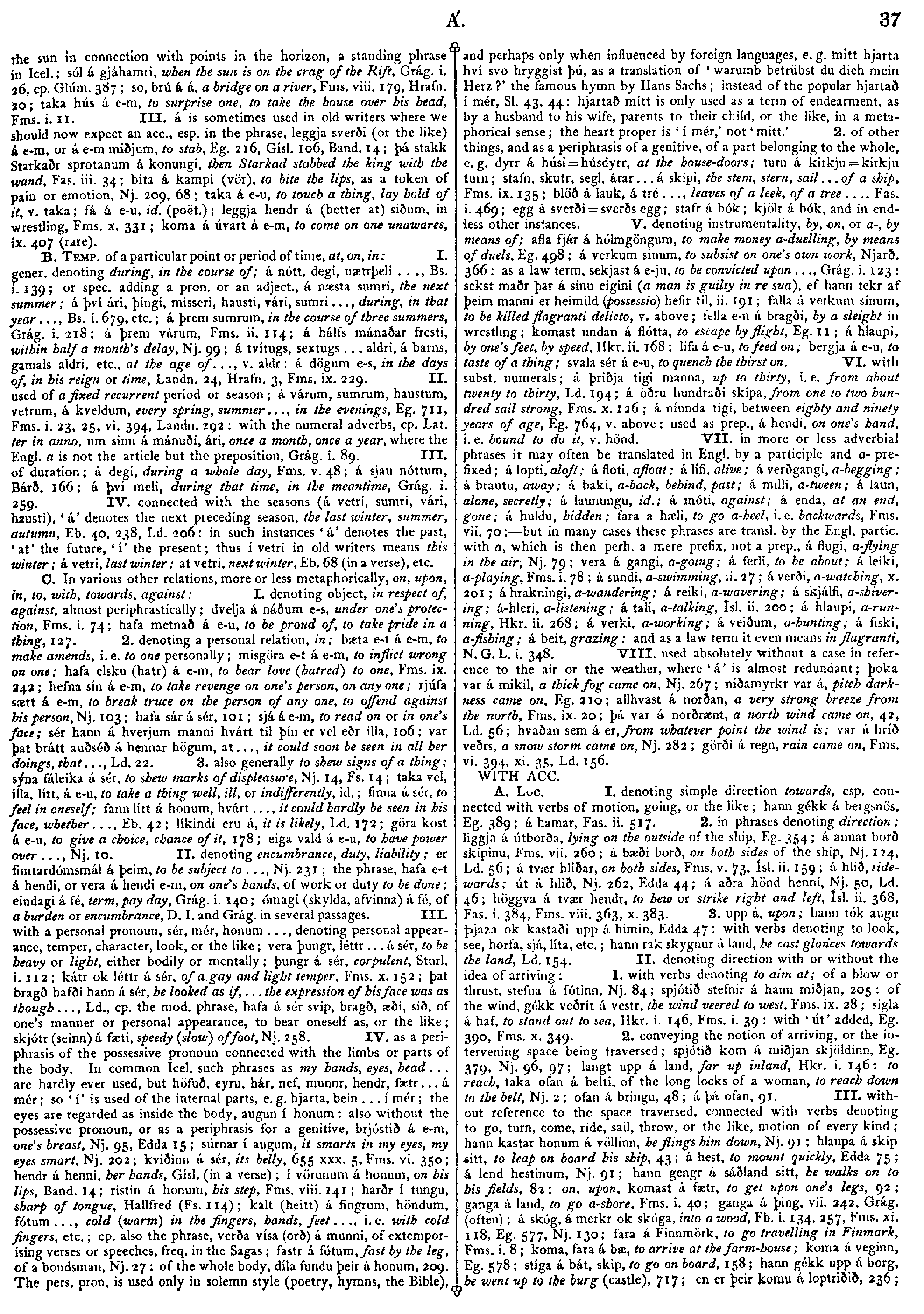
B. TEMP. of a particular point or period of time, at, on, in: I. gener. denoting during, in the course of; á nótt, degi, nætrþeli ..., Bs. i. 139; or spec. adding a pron. or an adject., á næsta sumri, the next summer; á því ári, þingi, misseri, hausti, vári, sumri ..., during, in that year ..., Bs. i. 679, etc.; á þrem sumrum, in the course of three summers, Grág. i. 218; á þrem várum, Fms. ii. 114; á hálfs mánaðar fresti, within half a month's delay, Nj. 99; á tvítugs, sextugs ... aldri, á barns, gamals aldri, etc., at the age of ..., v. aldr: á dögum e-s, in the days of, in his reign or time, Landn. 24, Hrafn. 3, Fms. ix. 229. II. used of a fixed recurrent period or season; á várum, sumrum, haustum, vetrum, á kveldum, every spring, summer ..., in the evenings, Eg. 711, Fms. i. 23, 25, vi. 394, Landn. 292: with the numeral adverbs, cp. Lat. ter in anno, um sinn á mánuði, ári, once a month, once a year, where the Engl. a is not the article but the preposition, Grág. i. 89. III. of duration; á degi, during a whole day, Fms. v. 48; á sjau nóttum, Bárð. 166; á því meli, during that time, in the meantime, Grág. i. 259. IV. connected with the seasons (á vetri, sumri, vári, hausti), 'á' denotes the next preceding season, the last winter, summer, autumn, Eb. 40, 238, Ld. 206: in such instances 'á' denotes the past, 'at' the future, 'í' the present; thus í vetri in old writers means this winter; á vetri, last winter; at vetri, next winter, Eb. 68 (in a verse), etc.
|
Source: Cleasby/Vigfusson, page b0041, entry 131 View original page image as: [TIFF] [PNG] [View previous entry] [View next entry] |
[Comment on this entry] [View comments] |
The following entry has been hand-corrected once. |
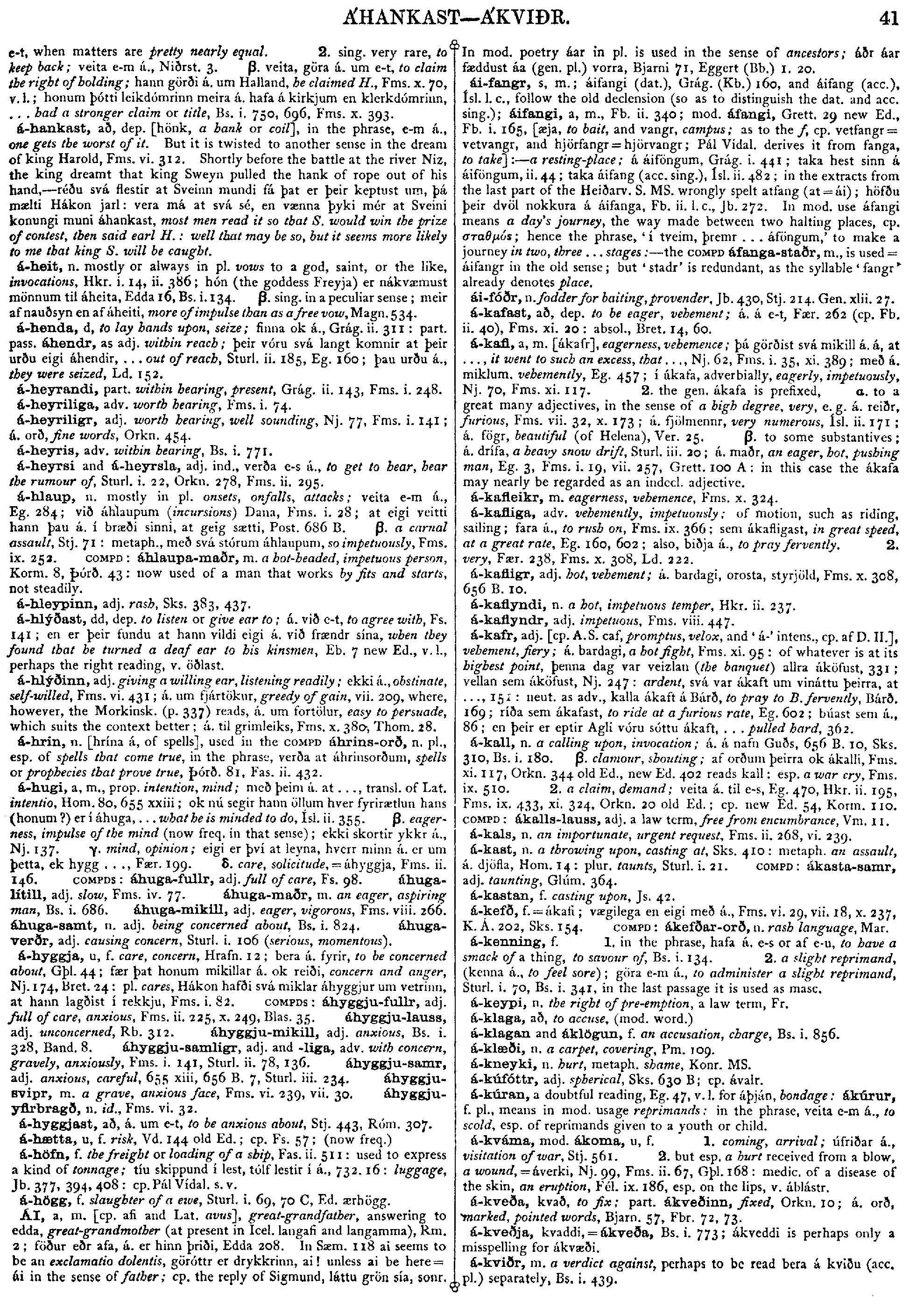
ÁR, n. [Goth. jêr; A. S. gear; Engl. year; Germ. jabr; the Scandin. idioms all drop the j, as in ungr, young; cp. also the Gr. GREEK; Lat. hora; Ulf. renders not only GREEK but also sometimes GREEK and GREEK by jêr]. I. a year, = Lat. annus, divided into twelve lunar months, each of 30 days, with four intercalary days, thus making 364 days; as the year was reckoned about the middle of the 10th century (the original calculation probably only reckoned 360 days, and made up the difference by irregular intercalary months). About the year 960 Thorstein Surt introduced the sumarauki (intercalary week), to be inserted every seventh year, thus bringing the year up to 365 days. After the introduction of Christianity (A. D. 1000) the sumarauki was made to harmonize with the Julian calendar; but from A. D. 1700 with the Gregorian calendar; v. the words sumarauki, hlaupár, mánuðr, vika, etc., Íb. ch. 4, Rb. 6, Fms. i. 67; telja árum, to count the time by years, Vsp. 6; í ári, used adverb., at present, as yet, Ó. H. 41, 42 (in a verse). II. = Lat. annona, plenty, abundance, fruitfulness; the phrase, friðr ok ár, Fms. vii. 174, Hkr. Yngl. ch. 8-12; ár ok fésæla, Hkr. l. c.; þá var ár urn öll lönd, id.; létu hlaða skip mörg af korni ok annarri gæzku, ok flytja svá ár í Dan- mörku, Fms. xi. 8, Sks. 323, Fas. i. 526, Hom. 68; gott ár, Eg. 39; blota til árs, Fms. i. 34. III. the name of the Rune RUNE (a), Skálda 176; in the A. S. and Goth. Runes the j has the name jêr, gêr, according to the Germ. and Engl. pronunciation of this word; vide p. 2, col. 1. COMPDS: ára-tal, n. and ára-tala, u, f. number of years; fimtugr at áratali, Stj. 110, Rb. 484, Mar. 656 A. i. 29; hann (Ari Frodi) hafði áratal fyrst til þess er Kristni kom á Ísland, en síðan allt til sinna daga, Hkr. (pref.), seems to mean that Ari in respect of chronology divided his Íslendingabók into two periods, that before and that after the introduction of Christianity; Stj. 112 (periode). árs-bót, f. = árbót, Bs. i. 343, q. v.
|
Source: Cleasby/Vigfusson, page b0041, entry 141 View original page image as: [TIFF] [PNG] [View previous entry] [View next entry] |
[Comment on this entry] [View comments] |
The following entry has been hand-corrected once. |
ár-dagar, m. pl. [A. S. geardagas], í árdaga, in days of yore, Ls. 25 (poët.)
|
Source: Cleasby/Vigfusson, page b0093, entry 30 View original page image as: [TIFF] [PNG] [View previous entry] [View next entry] |
[Comment on this entry] [View comments] |
The following entry has been hand-corrected once. |
DAGR,
m.,
irreg.
dat.
degi,
pl.
dagar:
[the
kindred
word
dœgr
with
a
vowel
change
from
ó
(dóg)
indicates
a
lost
root
verb
analogous
to
ala,
ól,
cp.
dalr
and
dælir;
this
word
is
common
to
all
Teutonic
dialects;
Goth.
dags;
A.S.
dag;
Engl.
day;
Swed.-Dan.
dag;
Germ,
tag;
the
Lat.
dies
seems
to
be
identical,
although
no
interchange
has
taken
place]
:--
a
day;
in
different
senses:
1.
the
natural
day
:--
sayings
referring
to
the
day,
at
kveldi
skal
dag
leyfa,
at
eventide
shall
the
day
be
praised,
Hm.
80
;
allir
dagar
eiga
kveld
um
síðir;
mörg
eru
dags
augu,
vide
auga;
enginn
dagr
til
enda
tryggr,
no
day
can
be
trusted
till
its
end;
allr
dagr
til
stefnu,
Grág.
i.
395,
443,
is
a
law
phrase,
--
for
summoning
was
lawful
only
if
performed
during
the
day;
this
phrase
is
also
used
metaph.
=
'plenty
of
time'
or
the
like:
popular
phrases
as
to
the
daylight
are
many
--
dagr
rennr,
or
rennr
upp,
and
kemr
upp,
the
day
rises,
Bm.
1;
dagr
í
austri,
day
in
the
east,
where
the
daylight
first
appears;
dagsbrún,
'day's
brow,'
is
the
first
streak
of
daylight,
the
metaphor
taken
from
the
human
face;
lysir
af
degi,
it
brightens
from
the
day,
i.e.
daylight
is
appearing;
dagr
ljómar,
the
day
gleams;
fyrir
dag,
before
day;
móti
degi,
undir
dag,
about
daybreak;
komið
at
degi,
id.,
Fms.
viii.
398;
dagr
á
lopti,
day
in
the
sky;
árla,
snemma
dags,
early
in
the
morning,
Pass.
15.
17;
dagr
um
allt
lopt,
etc.;
albjartr
dagr,
hábjartr
d.,
full
day,
broad
daylight;
hæstr
dagr,
high
day;
önd-verðr
d.,
the
early
day
=
forenoon,
Am.
50;
miðr
dagr,
midday,
Grág.
i.
413,
446,
Sks.
217,
219;
áliðinn
dagr,
late
in
the
day,
Fas.
i.
313;
hallandi
dagr,
declining
day;
at
kveldi
dags,
síð
dags,
late
in
the
day,
Fms.
i.
69.
In
the
evening
the
day
is
said
to
set,
hence
dag-sett,
dag-setr,
and
dagr
setzt;
in
tales,
ghosts
and
spirits
come
out
with
nightfall,
but
dare
not
face
the
day;
singing
merry
songs
after
nightfall
is
not
safe,
það
kallast
ekki
Kristnum
leyft
að
kveða
þegar
dagsett
er,
a
ditty;
Syrpuvers
er
mestr
galdr
er
í
fólginn,
ok
eigi
er
lofat
at
kveða
eptir
dagsetr,
Fas.
iii.
206,
Ísl.
Þjóðs.
ii.
7,
8:
the
daylight
is
symbolical
of
what
is
true
or
clear
as
day,
hence
the
word
dagsanna,
or
satt
sem
dagr,
q.v.
2.
of
different
days;
í
dag,
to-day,
Grág.
i.
16,
18,
Nj.
36,
Ld.
76,
Fms.
vi.
151;
í
gær-dag,
yesterday;
í
fyrra
dag,
the
day
before
yesterday,
Háv.
50;
í
hinni-fyrra
dag,
the
third
day;
annars
dags,
Vígl.
23,
Pass.
50.
I;
hindra
dags,
the
hinder
day,
the
day
after
to-mor-
row,
Hm.
109;
dag
eptir
dag,
day
after
day,
Hkr.
ii.
313;
dag
frá
degi,
from
day
to
day,
Fms.
ii.
230;
hvern
dag
frá
öðrum,
id.,
Fms.
viii.
182;
annan
dag
frá
öðrum.
id.,
Eg.
277;
um
daginn,
during
the
day;
á
dögunum.
the
other
day;
nótt
ok
dag,
night
and
day;
liðlangan
dag,
the
'life-long'
day;
dögunum
optar,
more
times
than
there
are
days,
i.e.
over
and
over
again,
Fms.
x.
433;
á
deyjanda
degi,
on
one's
day
of
death,
Grág.
i.
402.
.
regu-dagr,
a
rainy
day:
sólskins-dagr,
a
sunny
day;
sumar-
dagr,
a
summer
day;
vetrar-dagr,
a
winter
day;
hátíðis-dagr,
a
feast
day;
fegins-dagr,
a
day
of
joy;
dóms-dagr,
the
day
of
doom,
judgment
day,
Gl.
82,
Fms.
viii.
98;
hamingju-dagr,
heilla-dagr,
a
day
of
happiness;
gleði-
dagr,
id.;
brúðkaups-dagr,
bridal-day;
burðar-dagr,
a
birthday.
3.
in
pl.
days
in
the
sense
of
times;
aðrir
dagar,
Fms.
i.
216;
ek
ætlaða
ekki
at
þessir
dagar
mundu
verða,
sem
nú
eru
orðnir,
Nj.
171;
góðir
dagar,
happy
days,
Fms.
xi.
286,
270;
sjá
aldrei
glaðan
dag
(sing.),
never
to
see
glad
days.
.
á
e-s
dögum,
um
e-s
daga
eptir
e-s
daga,
esp.
of
the
lifetime
or
reign
of
kings,
Fms.;
but
in
Icel.
also
used
of
the
lög-
sögumaðr,
Jb.
repeatedly;
vera
á
dögum,
to
be
alive;
eptir
minn
dag,
'after
my
day,'
i.e.
when
I
am
dead.
 .
calendar
days,
e.g.
Hvita-
dagar,
the
White
days,
i.e.
Whitsuntide;
Hunda-dagar,
the
Dog
days;
Banda-dagr,
Vincula
Petri;
Höfuð-dagr,
Decap.
Johannis;
Geisla-dagr,
Epiphany;
Imbru-dagar,
Ember
days;
Gang-dagar,
'Ganging
days,'
Ro-
gation
days;
Dýri-dagr,
Corpus
Christi;
etc.
4.
of
the
week-
days;
the
old
names
being
Sunnu-d.
or
Drottins-d.,
Mána-d.,
Týs-d.,
Öðins-d.,
Þórs-d.,
Frjá-d.,
Laugar-d.
or
Þvátt-d.
It
is
hard
to
understand
how
the
Icel.
should
be
the
one
Teut.
people
that
have
disused
the
old
names
of
the
week-days;
but
so
it
was,
vide
Jóns
S.
ch.
24;
fyrir
bauð
hann
at
eigna
daga
vitrum
mönnum
heiðnum,
svá
sem
at
kalla
Týrsdag
.
calendar
days,
e.g.
Hvita-
dagar,
the
White
days,
i.e.
Whitsuntide;
Hunda-dagar,
the
Dog
days;
Banda-dagr,
Vincula
Petri;
Höfuð-dagr,
Decap.
Johannis;
Geisla-dagr,
Epiphany;
Imbru-dagar,
Ember
days;
Gang-dagar,
'Ganging
days,'
Ro-
gation
days;
Dýri-dagr,
Corpus
Christi;
etc.
4.
of
the
week-
days;
the
old
names
being
Sunnu-d.
or
Drottins-d.,
Mána-d.,
Týs-d.,
Öðins-d.,
Þórs-d.,
Frjá-d.,
Laugar-d.
or
Þvátt-d.
It
is
hard
to
understand
how
the
Icel.
should
be
the
one
Teut.
people
that
have
disused
the
old
names
of
the
week-days;
but
so
it
was,
vide
Jóns
S.
ch.
24;
fyrir
bauð
hann
at
eigna
daga
vitrum
mönnum
heiðnum,
svá
sem
at
kalla
Týrsdag
|
Source: Cleasby/Vigfusson, page b0095, entry 1 View original page image as: [TIFF] [PNG] [View previous entry] [View next entry] |
[Comment on this entry] [View comments] |
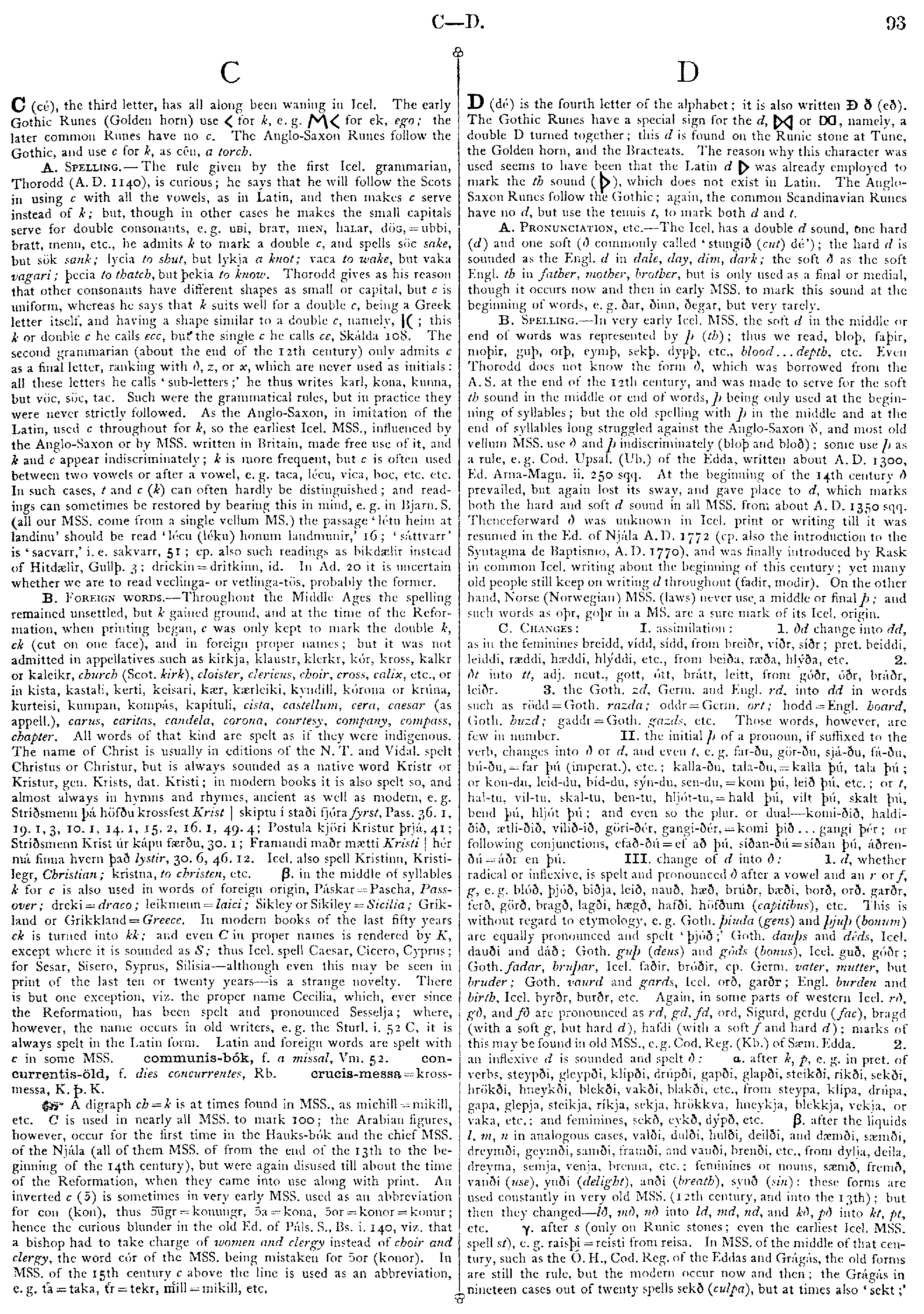
The following entry has been hand-corrected once. |
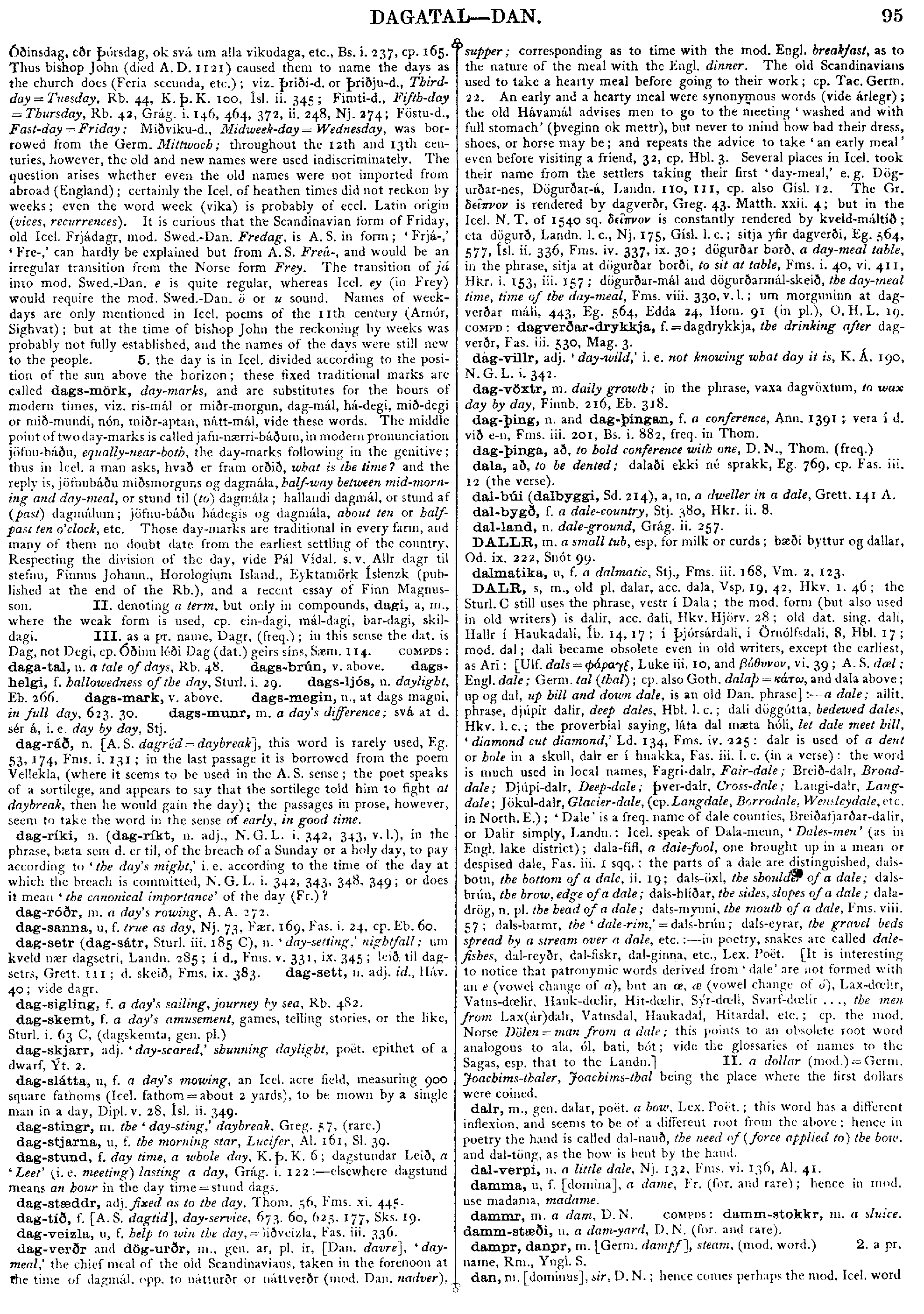
Óðinsdag, eðr Þórsdag, ok svá um alla vikudaga, etc., Bs. i. 237, cp. 165. Thus bishop John (died A.D. 1121) caused them to name the days as the church does (Feria sccunda, etc.); viz. Þriði-d. or Þriðju-d., Third-day = Tuesday, Rb. 44, K.Þ.K. 100, Ísl. ii. 345; Fimti-d., Fifth-day -- Thursday, Rb. 42, Grág. i. 146, 464, 372, ii. 248, Nj. 274; Föstu-d., Fast-day = Friday; Miðviku-d., Midweek-day = Wednesday, was borrowed from the Germ. Mittwoch; throughout the 12th and 13th centuries, however, the old and new names were used indiscriminately. The question arises whether even the old names were not imported from abroad (England); certainly the Icel. of heathen times did not reckon by weeks; even the word week (vika) is probably of eccl. Latin origin (vices, recurrences). It is curious that the Scandinavian form of Friday, old Icel. Frjádagr, mod. Swed.-Dan. Fredag, is A.S. in form; 'Frjá-,' 'Fre-,' can hardly be explained but from A.S. Freâ-, and would be an irregular transition from the Norse form Frey. The transition of ja into mod. Swed.-Dan. e is quite regular, whereas Icel. ey (in Frey) would require the mod. Swed.-Dan. ö or u sound. Names of weekdays are only mentioned in Icel. poems of the 11th century (Arnór, Sighvat); but at the time of bishop John the reckoning by weeks was probably not fully established, and the names of the days were still new to the people. 5. the day is in Icel. divided according to the posi- tion of the sun above the horizon; these fixed traditional marks are called dags-mörk, day-marks, and are substitutes for the hours of modern times, viz. ris-mál or miðr-morgun, dag-mál, há-degi, mið-degi or mið-mundi, nón, miðr-aptan, nátt-mál, vide these words. The middle point of two day-marks is called jafn-nærri-báðum, in modern pronunciation jöfnu-báðu, equally-near-both, the day-marks following in the genitive; thus in Icel. a man asks, hvað er fram orðið, what is the time? and the reply is, jöfnubáðu miðsmorguns og dagmála, half-way between mid-morn- ing and day-meal, or stund til (to) dagmála; hallandi dagmál, or stund af (past) dagmálum; jöfnu-báðu hádegis og dagmúla, about ten or half- past ten o'clock, etc. Those day-marks are traditional in every farm, and many of them no doubt date from the earliest settling of the country. Respecting the division of the day, vide Pál Vídal. s.v. Allr dagr til stefnu, Finnus Johann., Horologium Island., Eyktamörk Íslenzk (published at the end of the Rb.), and a recent essay of Finn Magnusson. II. denoting a term, but only in compounds, dagi, a, m., where the weak form is used, cp. ein-dagi, mál-dagi, bar-dagi, skil- dagi. III. jis a pr. name, Dagr, (freq.); in this sense the dat. is Dag, not Degi, cp. Óðinn léði Dag (dat.) geirs síns, Sæm. 114. COMPDS: daga-tal, n. a tale of days, Rb. 48. dags-brun, v. above. dags- helgi, f. hallowedness of the day, Sturl. i. 29. dags-ljós, n. daylight, Eb. 266. dags-mark, v. above. dags-megin, n., at dags magni, in full day, 623. 30. dags-munr, m. a day's difference; svá at d. sér á, i.e. day by day, Stj.
|
Source: Cleasby/Vigfusson, page b0110, entry 19 View original page image as: [TIFF] [PNG] [View previous entry] [View next entry] |
[Comment on this entry] [View comments] |
The following entry has been hand-corrected once. |
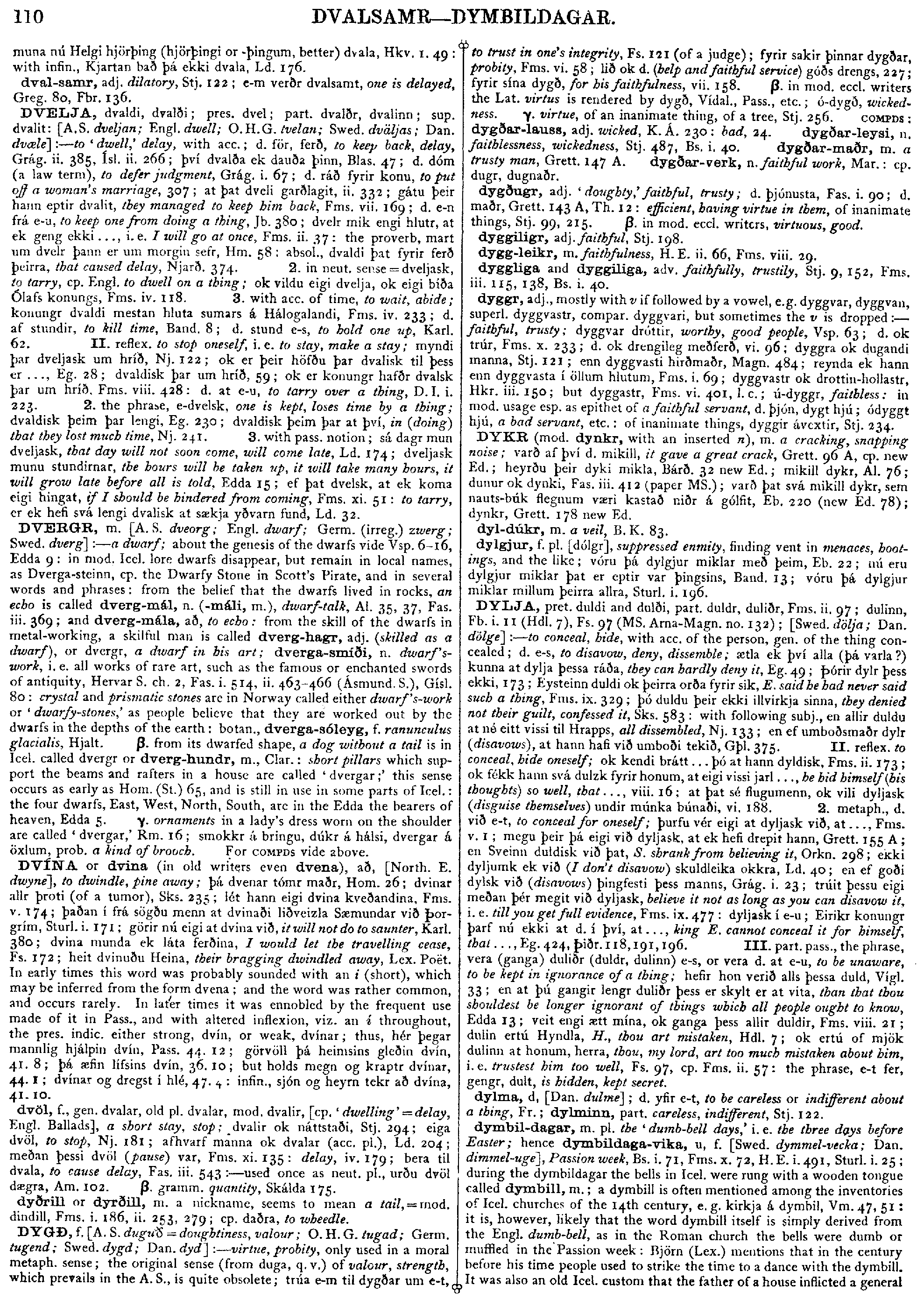
dymbil-dagar, m. pl. the 'dumb-bell days,' i.e. the three days before Easter; hence dymbildaga-vika, u, f. [Swed. dymmel-vecka; Dan. dimmel-uge], Passion week, Bs. i. 71, Fms. x. 72, H. E. i. 491, Sturl. i. 25; during the dymbildagar the bells in Icel. were rung with a wooden tongue called dymbill, m.; a dymbill is often mentioned among the inventories of Icel. churches of the 14th century, e.g. kirkja á dymbil, Vm. 47, 51: it is, however, likely that the word dymbill itself is simply derived from the Engl. dumb-bell, as in the Roman church the bells were dumb or muffled in the Passion week: Björn (Lex.) mentions that in the century before his time people used to strike the time to a dance with the dymbill. It was also an old Icel. custom that the father of a house inflicted a general
|
Source: Cleasby/Vigfusson, page b0122, entry 1 View original page image as: [TIFF] [PNG] [View previous entry] [View next entry] |
[Comment on this entry] [View comments] |
The following entry has been hand-corrected once. |
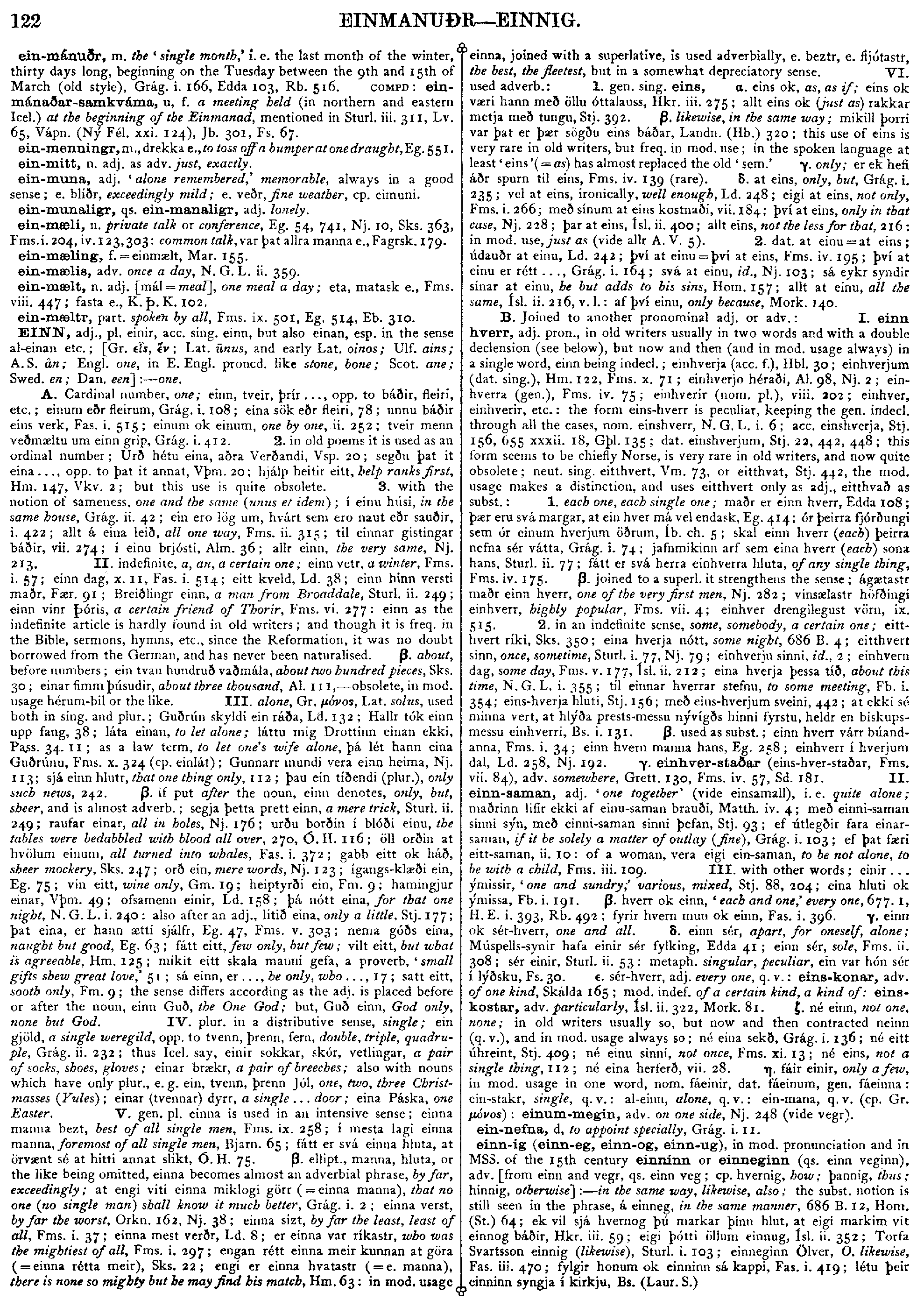
ein-mánuðr, m. the 'single month,' i.e. the last month of the winter, thirty days long, beginning on the Tuesday between the 9th and 15th of March (old style), Grág. i. 166, Edda 103, Rb. 516. COMPD: einmánaðar-samkváma, u, f. a meeting held (in northern and eastern Icel.) at the beginning of the Einmanad, mentioned in Sturl. iii. 311, Lv. 65, Vápn. (Ný Fél. xxi. 124), Jb. 301, Fs. 67.
|
Source: Cleasby/Vigfusson, page b0126, entry 22 View original page image as: [TIFF] [PNG] [View previous entry] [View next entry] |
[Comment on this entry] [View comments] |
The following entry has not been hand-corrected. However, the page is reserved and someone is correcting it. |
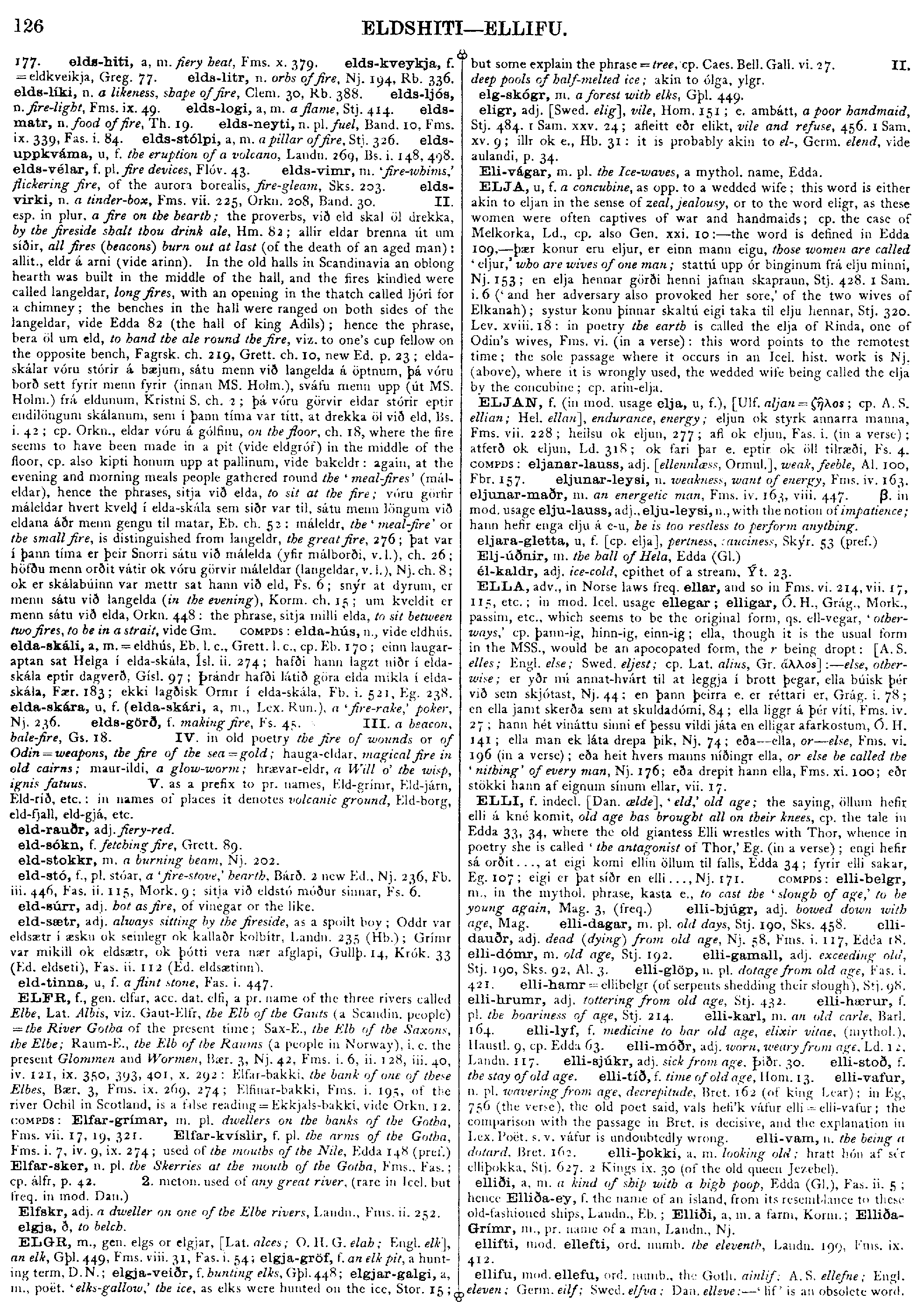
ELLI, f. indecl. [Dan. Æ lde], 'e ld, ' o ld age; the saying, öllum hefir elli á kné komit, o ld age has brought all on their knees, cp. the tale in Edda 33, 34, where the old giantess Elli wrestles with Thor, whence in poetry she is called ' the antagonist of Thor, ' Eg. (in a verse); engi hefir sá orðit..., at eigi korni ellin ollum til falls, Edda 34; fyrir elli sakar, Eg. 107; eigi er þat síðr en elli..., Nj. 171. COMPDS: elli-belgr, m., in the mythol. phrase, kasta e., t o cas t the 'slough of age, ' to be young again, Mag. 3, (freq.) elli-bjúgr, adj. bowed down with age, Mag. elli-dagar, m. pl. o ld days, Stj. 190, Sks. 458. elli- dauðr, adj. de a d (dying] from old age, Nj. 58, Fms. i. 117, Edda 18. elli-dómr, m. o ld age, Stj. 192. elli-gamall, adj. exceeding oltl, Stj. 190, Sks. 92, Al. 3. elli-glöp, n. pl. dotage from old age, Fas. i. 421. elli-hamr -- eliibclgr (of serpents shedding their slough), Stj. 98. elli-hrumr, adj. tottering from old age, Stj. 432. elli-hærur, f. pl. the hoariness of age, Stj. 214. elli-karl, in. an old carle, Barl. 164. elli-lyf, f. medicine to bar old age, elixir vitae, (mythol.). Haustl. 9, cp. Edda 63. elli-móðr, adj. worn, weary from age, Ld. 1 i, Landn. 117. elli-sjukr, adj. sick from age. fjiðr. 30. elli-stoð, f. the stay of old age. elli-tíð, f. time of old age, Mom. 13. elli-vafur, n. pl. wavering from age, decrepitude, Bret. 162 (of king Lear); in Eg1 756 (the verse), the oíd poet said, vals hell'k váfur elli -- elli-vafur; the comparison with the passage in Brtt. is decisive, and the explanation in Lex. Poët. s. v. vafur is undoubtedly wrong. elli-vam, n. the being a dotard, Bret. 1(12. elli-Jiokki, a, in. looking old; hratt hón af st'r clliþokka, Stj. 627. 2 Kings ix. 30 (of the old queen Jezebel).
|
Source: Cleasby/Vigfusson, page b0143, entry 14 View original page image as: [TIFF] [PNG] [View previous entry] [View next entry] |
[Comment on this entry] [View comments] |
The following entry has been hand-corrected once. |
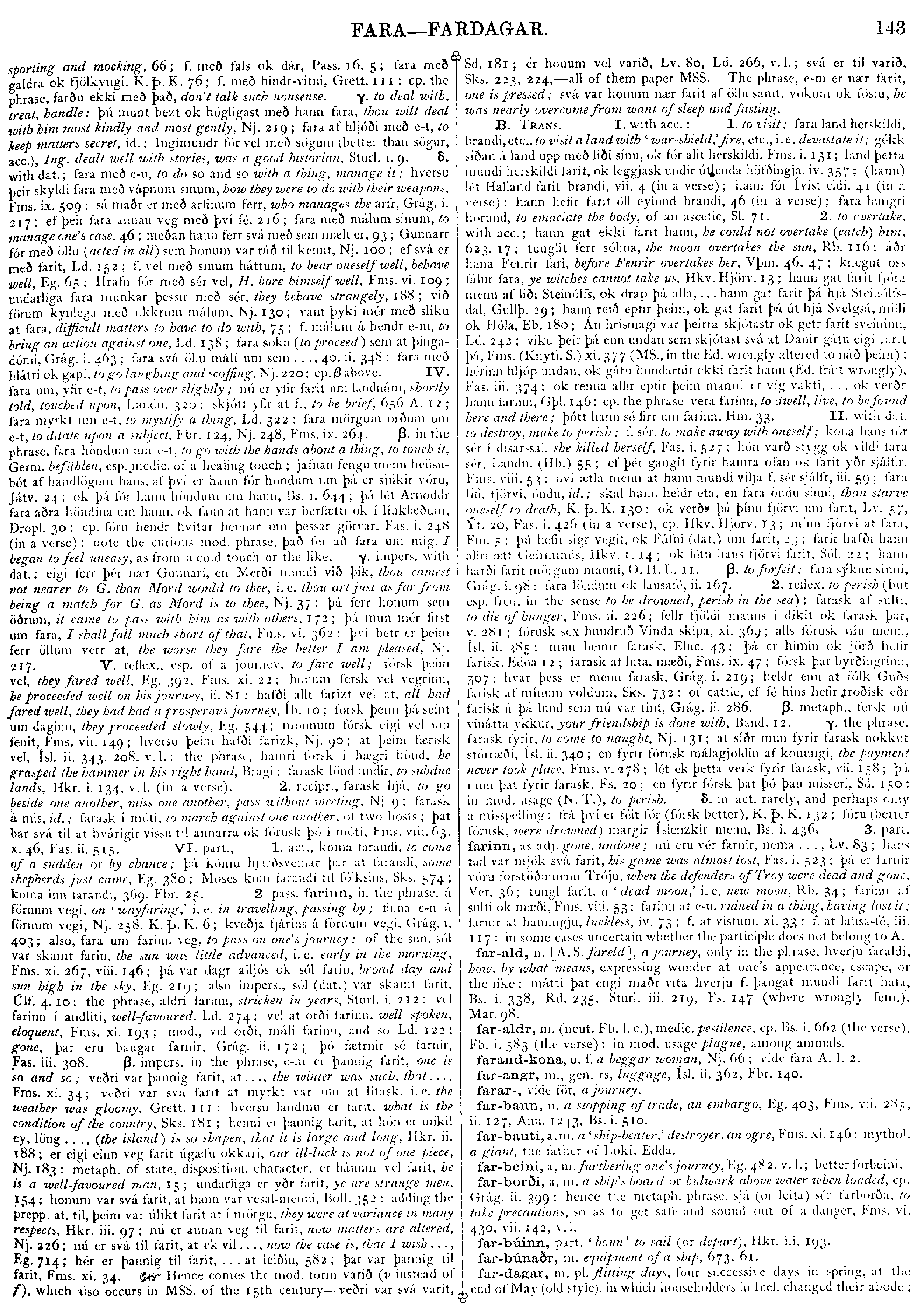
far-dagar, m. pl. flitting days, four successive days in spring, at the end of May (old style), in which householders in Icel. changed their abode;
| Result Page: |  |
Previous | 14 15 16 17 18 19 20 21 22 23 24 25 26 27 28 29 30 31 | Next |  |
Germanic Lexicon Project (main page)
This search system was written by
Sean Crist
Please consider
volunteering
to correct the data in these online dictionaries.
No rights reserved. Feel free to use these data in any way you please.