|
|

Tip: In the search results, you can click on any word or abbreviation for more information.
|
Source: Bosworth/Toller, page d0143, entry 13 View original page image as: [TIFF] [PNG] [View previous entry] [View next entry] |
[Comment on this entry] [View comments] |
The following entry has been hand-corrected once. |
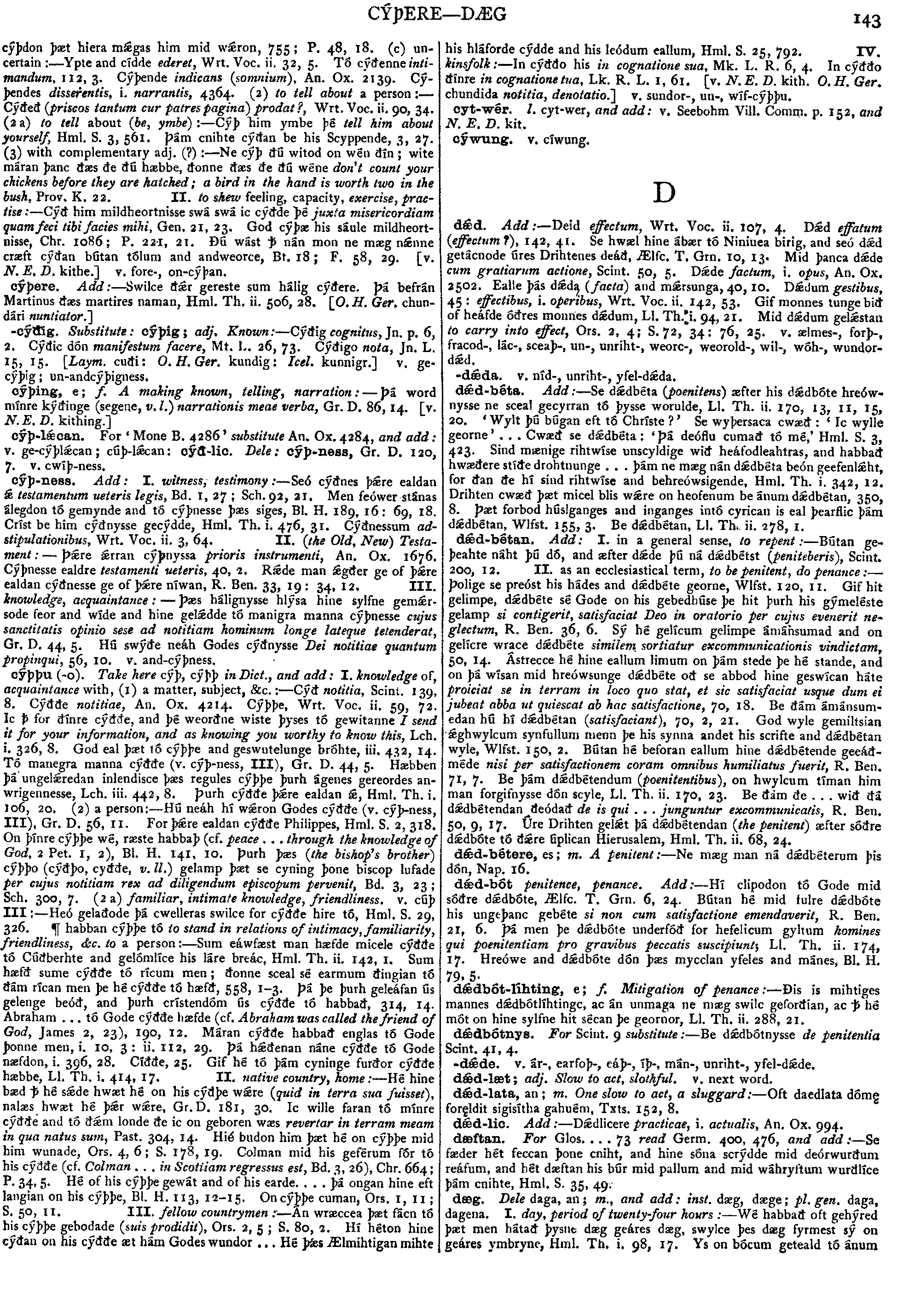
d d-béta.
Add:--Se
ddbéta
(poenitens)
æfter
his
ddbóte
hreównysse
ne
sceal
gecyrran
tó
þysse
worulde,
Ll.
Th.
ii.
170,
13,
11,
15,
20.
'Wylt
þú
búgan
eft
tó
Chríste?'
Se
wyþersaca
cwæð:
'Ic
wylle
georne'
.
.
.
Cwæð
se
ddbéta:
'Þá
deóflu
cumað
tó
mé,'
Hml.
S.
3,
423.
Sind
mænige
rihtwíse
unscyldige
wið
heáfodleahtras,
and
habbað
hwæðere
stíðe
drohtnunge
.
.
.
þám
ne
mæg
nán
ddbéta
beón
geefenlht,
for
ðan
ðe
hí
sind
rihtwíse
and
behreówsigende,
Hml.
Th.
i.
342,
12.
Drihten
cwæð
þæt
micel
blis
wre
on
heofenum
be
ánum
ddbétan,
350,
8.
Þæt
forbod
húslganges
and
inganges
intó
cyrican
is
eal
þearflic
þám
ddbétan,
Wlfst.
155,
3.
Be
ddbétan,
Ll.
Th.
ii.
278,
1.
d-béta.
Add:--Se
ddbéta
(poenitens)
æfter
his
ddbóte
hreównysse
ne
sceal
gecyrran
tó
þysse
worulde,
Ll.
Th.
ii.
170,
13,
11,
15,
20.
'Wylt
þú
búgan
eft
tó
Chríste?'
Se
wyþersaca
cwæð:
'Ic
wylle
georne'
.
.
.
Cwæð
se
ddbéta:
'Þá
deóflu
cumað
tó
mé,'
Hml.
S.
3,
423.
Sind
mænige
rihtwíse
unscyldige
wið
heáfodleahtras,
and
habbað
hwæðere
stíðe
drohtnunge
.
.
.
þám
ne
mæg
nán
ddbéta
beón
geefenlht,
for
ðan
ðe
hí
sind
rihtwíse
and
behreówsigende,
Hml.
Th.
i.
342,
12.
Drihten
cwæð
þæt
micel
blis
wre
on
heofenum
be
ánum
ddbétan,
350,
8.
Þæt
forbod
húslganges
and
inganges
intó
cyrican
is
eal
þearflic
þám
ddbétan,
Wlfst.
155,
3.
Be
ddbétan,
Ll.
Th.
ii.
278,
1.
|
Source: Bosworth/Toller, page d0156, entry 9 View original page image as: [TIFF] [PNG] [View previous entry] [View next entry] |
[Comment on this entry] [View comments] |
The following entry has been hand-corrected once. |
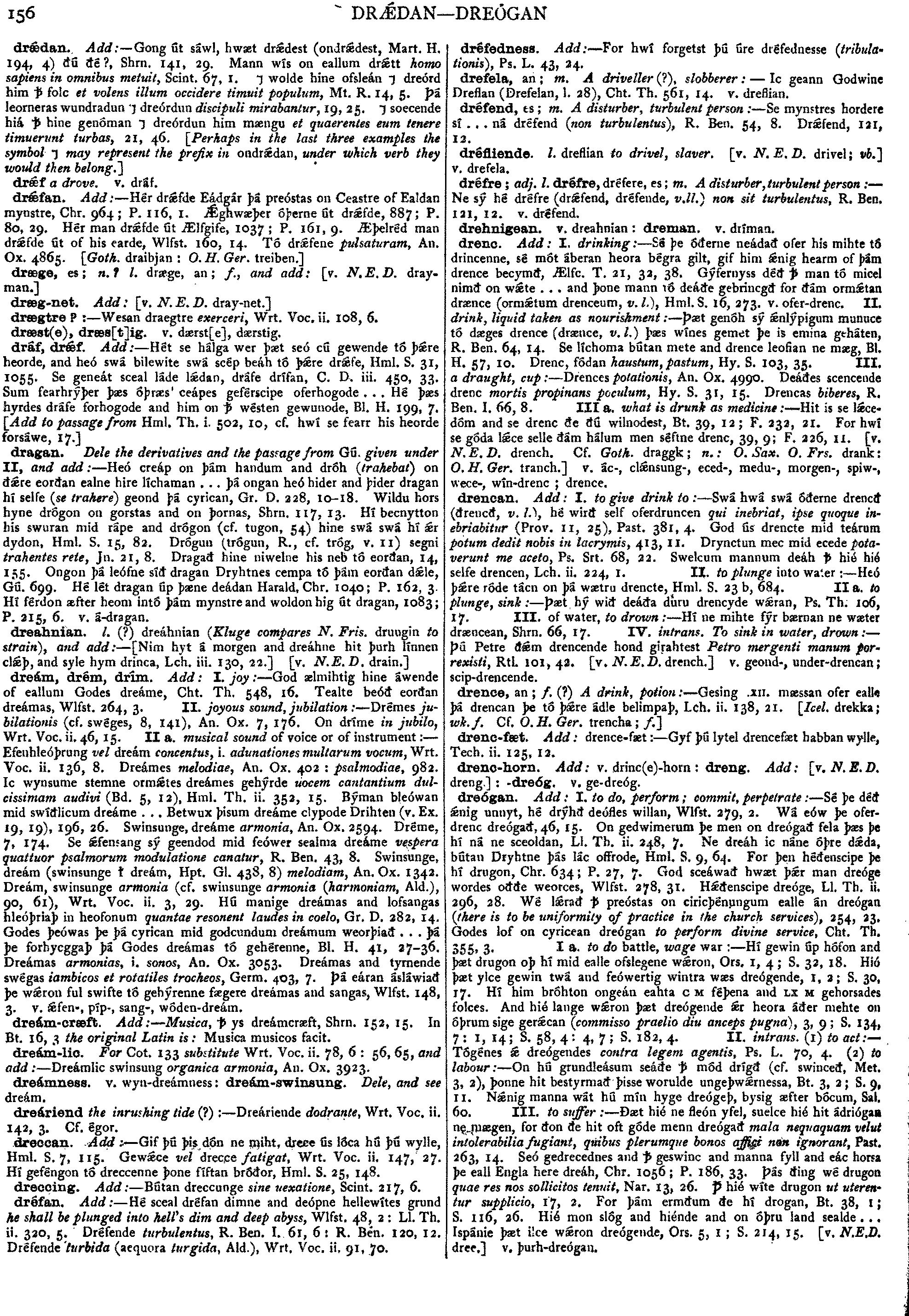
dragan.
Dele
the
derivatives
and
the
passage
from
Gú.
given
under
II,
and
add:--Heó
creáp
on
þám
handum
and
dróh
(trahebat)
on
ðre
eorðan
ealne
hire
líchaman
.
.
.
þá
ongan
heó
hider
and
þider
dragan
hí
selfe
(se
trahere)
geond
þá
cyrican,
Gr.
D.
228,
10-18.
Wildu
hors
hyne
drógon
on
gorstas
and
on
þornas,
Shrn.
117,
13.
Hí
becnytton
his
swuran
mid
rápe
and
drógon
(cf.
tugon,
54)
hine
swá
swá
hí
r
dydon,
Hml.
S.
15,
82.
Drógun
(trógun,
R.,
cf.
tróg,
v.
11)
segni
trahentes
rete,
Jn.
21,
8.
Dragað
hine
niwelne
his
neb
tó
eorðan,
14,
155.
Ongon
þá
leófne
síð
dragan
Dryhtnes
cempa
tó
þám
eorðan
dle,
Gú.
699.
Hé
lét
dragan
úp
þæne
deádan
Harald,
Chr.
1040;
P.
162,
3.
Hí
férdon
æfter
heom
intó
þám
mynstre
and
woldon
hig
út
dragan,
1083;
P.
215,
6.
v.
á-dragan.
|
Source: Bosworth/Toller, page d0156, entry 11 View original page image as: [TIFF] [PNG] [View previous entry] [View next entry] |
[Comment on this entry] [View comments] |
The following entry has been hand-corrected once. |
dreám,
drém,
drím.
Add:
I.
joy:--God
ælmihtig
hine
áwende
of
eallum
Godes
dreáme,
Cht.
Th.
548,
16.
Tealte
beóð
eorðan
dreámas,
Wlfst.
264,
3.
II.
joyous
sound,
jubilation:--Drémes
jubilationis
(cf.
swéges,
8,
141),
An.
Ox.
7,
176.
On
dríme
in
jubilo,
Wrt.
Voc.
ii.
46,
15.
II
a.
musical
sound
of
voice
or
of
instrument:--Efenhleóþrung
vel
dreám
concentus,
i.
adunationes
multarum
vocum,
Wrt.
Voc.
ii.
136,
8.
Dreámes
melodiae,
An.
Ox.
402:
psalmodiae,
982.
Ic
wynsume
stemne
ormtes
dreámes
gehýrde
uocem
cantantium
dulcissimam
audivi
(Bd.
5,
12),
Hml.
Th.
ii.
352,
15.
Býman
bleówan
mid
swíðlicum
dreáme
.
.
.
Betwux
þisum
dreáme
clypode
Drihten
(v.
Ex.
19,
19),
196,
26.
Swinsunge,
dreáme
armonia,
An.
Ox.
2594.
Dréme,
7,
174.
Se
fensang
sý
geendod
mid
feówer
sealma
dreáme
vespera
quattuor
psalmorum
modulatione
canatur,
R.
Ben.
43,
8.
Swinsunge,
dreám
(swinsunge
 dreám,
Hpt.
Gl.
438,
8)
melodiam,
An.
Ox.
1342.
Dreám,
swinsunge
armonia
(cf.
swinsunge
armonia
(harmoniam,
Ald.),
90,
61),
Wrt.
Voc.
ii.
3,
29.
Hú
manige
dreámas
and
lofsangas
hleóþriaþ
in
heofonum
quantae
resonent
laudes
in
coelo,
Gr.
D.
282,
14.
Godes
þeówas
þe
þá
cyrican
mid
godcundum
dreámum
weorþiað
.
.
.
þá
þe
forhycggaþ
þá
Godes
dreámas
tó
gehérenne,
Bl.
H.
41,
27-36.
Dreámas
armonias,
i.
sonos,
An.
Ox.
3053.
Dreámas
and
tymende
swégas
iambicos
et
rotatiles
trocheos,
Germ.
403,
7.
Þá
eáran
ásláwiað
þe
wron
ful
swifte
tó
gehýrenne
fægere
dreámas
and
sangas,
Wlfst.
148,
3.
v.
fen-,
píp-,
sang-,
wóden-dreám.
dreám,
Hpt.
Gl.
438,
8)
melodiam,
An.
Ox.
1342.
Dreám,
swinsunge
armonia
(cf.
swinsunge
armonia
(harmoniam,
Ald.),
90,
61),
Wrt.
Voc.
ii.
3,
29.
Hú
manige
dreámas
and
lofsangas
hleóþriaþ
in
heofonum
quantae
resonent
laudes
in
coelo,
Gr.
D.
282,
14.
Godes
þeówas
þe
þá
cyrican
mid
godcundum
dreámum
weorþiað
.
.
.
þá
þe
forhycggaþ
þá
Godes
dreámas
tó
gehérenne,
Bl.
H.
41,
27-36.
Dreámas
armonias,
i.
sonos,
An.
Ox.
3053.
Dreámas
and
tymende
swégas
iambicos
et
rotatiles
trocheos,
Germ.
403,
7.
Þá
eáran
ásláwiað
þe
wron
ful
swifte
tó
gehýrenne
fægere
dreámas
and
sangas,
Wlfst.
148,
3.
v.
fen-,
píp-,
sang-,
wóden-dreám.
|
Source: Bosworth/Toller, page d0157, entry 16 View original page image as: [TIFF] [PNG] [View previous entry] [View next entry] |
[Comment on this entry] [View comments] |
The following entry has been hand-corrected once. |
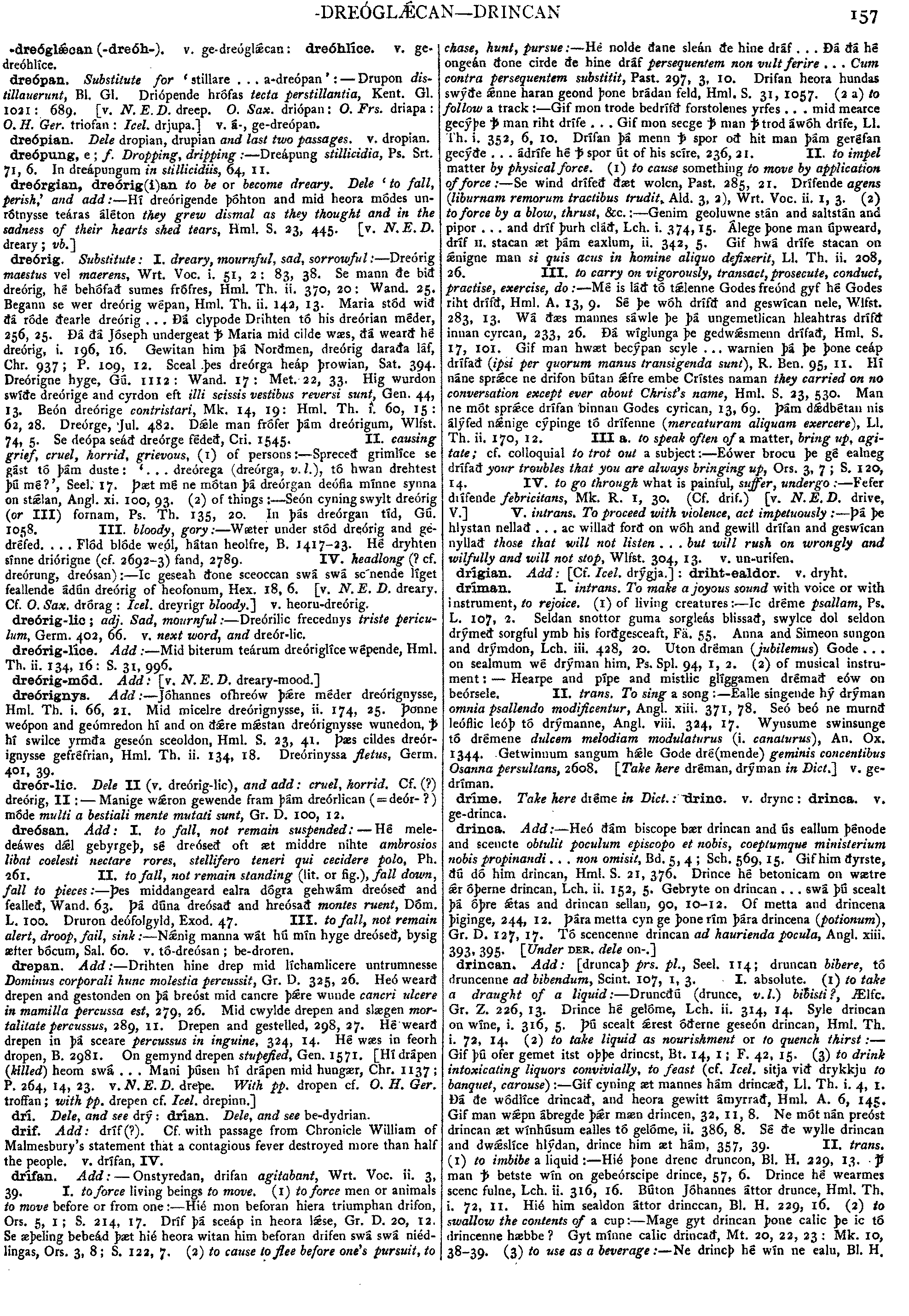
drífan.
Add:--Onstyredan,
drifan
agitabant,
Wrt.
Voc.
ii.
3,
39.
I.
to
force
living
beings
to
move.
(1)
to
force
men
or
animals
to
move
before
or
from
one:--Hié
mon
beforan
hiera
triumphan
drifon,
Ors.
5,
1;
S.
214,
17.
Dríf
þá
sceáp
in
heora
lse,
Gr.
D.
20,
12.
Se
æþeling
bebeád
þæt
hié
heora
witan
him
beforan
drifen
swá
swá
niédlingas,
Ors.
3,
8;
S.
122,
7.
(2)
to
cause
to
flee
before
one's
pursuit,
to
chase,
hunt,
pursue:--Hé
nolde
ðane
sleán
ðe
hine
dráf
.
.
.
Ðá
ðá
hé
ongeán
ðone
cirde
ðe
hine
dráf
persequentem
non
vult
ferire
.
.
.
Cum
contra
persequentem
substitit,
Past.
297,
3,
10.
Drifan
heora
hundas
swýðe
nne
haran
geond
þone
brádan
feld,
Hml.
S.
31,
1057.
(2
a)
to
follow
a
track:--Gif
mon
trode
bedrífð
forstolenes
yrfes
.
.
.
mid
mearce
gecýþe
 man
riht
drífe
.
.
.
Gif
mon
secge
man
trod
áwóh
drífe,
Ll.
Th.
i.
352,
6,
10.
Drífan
þá
menn
spor
oð
hit
man
þám
geréfan
gecýðe
.
.
.
ádrífe
hé
spor
út
of
his
scíre,
236,
21.
II.
to
impel
matter
by
physical
force.
(1)
to
cause
something
to
move
by
application
of
force:--Se
wind
drífeð
ðæt
wolcn,
Past.
285,
21.
Drífende
agens
(liburnam
remorum
tractibus
trudit,
Ald.
3,
2),
Wrt.
Voc.
ii.
1,
3.
(2)
to
force
by
a
blow,
thrust,
&c.:--Genim
geoluwne
stán
and
saltstán
and
pipor
.
.
.
and
dríf
þurh
cláð,
Lch.
i.
374,
15.
Álege
þone
man
úpweard,
dríf
ii.
stacan
æt
þám
eaxlum,
ii.
342,
5.
Gif
hwá
drífe
stacan
on
nigne
man
si
quis
acus
in
homine
aliquo
defixerit,
Ll.
Th.
ii.
208,
26.
III.
to
carry
on
vigorously,
transact,
prosecute,
conduct,
practise,
exercise,
do:--Mé
is
láð
tó
tlenne
Godes
freónd
gyf
hé
Godes
riht
drífð,
Hml.
A.
13,
9.
Sé
þe
wóh
drífð
and
geswícan
nele,
Wlfst.
283,
13.
Wá
ðæs
mannes
sáwle
þe
þá
ungemetlican
hleahtras
drífð
innan
cyrcan,
233,
26.
Ðá
wíglunga
þe
gedwsmenn
drífað,
Hml.
S.
17,
101.
Gif
man
hwæt
becýpan
scyle
.
.
.
warnien
þá
þe
þone
ceáp
drífað
(ipsi
per
quorum
manus
transigenda
sunt),
R.
Ben.
95,
11.
Hí
náne
sprce
ne
drifon
bútan
fre
embe
Crístes
naman
they
carried
on
no
conversation
except
ever
about
Christ's
name,
Hml.
S.
23,
530.
Man
ne
mót
sprce
drífan
binnan
Godes
cyrican,
13,
69.
Þám
ddbétan
nis
álýfed
nnige
cýpinge
tó
drífenne
(mercaturam
aliquam
exercere),
Ll.
Th.
ii.
170,
12.
III
a.
to
speak
often
of
a
matter,
bring
up,
agitate;
cf.
colloquial
to
trot
out
a
subject:--Eówer
brocu
þe
gé
ealneg
drífað
your
troubles
that
you
are
always
bringing
up,
Ors.
3,
7;
S.
120,
14.
IV.
to
go
through
what
is
painful,
suffer,
undergo:--Fefer
drífende
febricitans,
Mk.
R.
1,
30.
(Cf.
drif.)
[v.
N.
E.
D.
drive,
V.]
V.
intrans.
To
proceed
with
violence,
act
impetuously:--Þá
þe
hlystan
nellað
.
.
.
ac
willað
forð
on
wóh
and
gewill
drífan
and
geswícan
nyllað
those
that
will
not
listen
.
.
.
but
will
rush
on
wrongly
and
wilfully
and
will
not
stop,
Wlfst.
304,
13.
v.
un-urifen.
man
riht
drífe
.
.
.
Gif
mon
secge
man
trod
áwóh
drífe,
Ll.
Th.
i.
352,
6,
10.
Drífan
þá
menn
spor
oð
hit
man
þám
geréfan
gecýðe
.
.
.
ádrífe
hé
spor
út
of
his
scíre,
236,
21.
II.
to
impel
matter
by
physical
force.
(1)
to
cause
something
to
move
by
application
of
force:--Se
wind
drífeð
ðæt
wolcn,
Past.
285,
21.
Drífende
agens
(liburnam
remorum
tractibus
trudit,
Ald.
3,
2),
Wrt.
Voc.
ii.
1,
3.
(2)
to
force
by
a
blow,
thrust,
&c.:--Genim
geoluwne
stán
and
saltstán
and
pipor
.
.
.
and
dríf
þurh
cláð,
Lch.
i.
374,
15.
Álege
þone
man
úpweard,
dríf
ii.
stacan
æt
þám
eaxlum,
ii.
342,
5.
Gif
hwá
drífe
stacan
on
nigne
man
si
quis
acus
in
homine
aliquo
defixerit,
Ll.
Th.
ii.
208,
26.
III.
to
carry
on
vigorously,
transact,
prosecute,
conduct,
practise,
exercise,
do:--Mé
is
láð
tó
tlenne
Godes
freónd
gyf
hé
Godes
riht
drífð,
Hml.
A.
13,
9.
Sé
þe
wóh
drífð
and
geswícan
nele,
Wlfst.
283,
13.
Wá
ðæs
mannes
sáwle
þe
þá
ungemetlican
hleahtras
drífð
innan
cyrcan,
233,
26.
Ðá
wíglunga
þe
gedwsmenn
drífað,
Hml.
S.
17,
101.
Gif
man
hwæt
becýpan
scyle
.
.
.
warnien
þá
þe
þone
ceáp
drífað
(ipsi
per
quorum
manus
transigenda
sunt),
R.
Ben.
95,
11.
Hí
náne
sprce
ne
drifon
bútan
fre
embe
Crístes
naman
they
carried
on
no
conversation
except
ever
about
Christ's
name,
Hml.
S.
23,
530.
Man
ne
mót
sprce
drífan
binnan
Godes
cyrican,
13,
69.
Þám
ddbétan
nis
álýfed
nnige
cýpinge
tó
drífenne
(mercaturam
aliquam
exercere),
Ll.
Th.
ii.
170,
12.
III
a.
to
speak
often
of
a
matter,
bring
up,
agitate;
cf.
colloquial
to
trot
out
a
subject:--Eówer
brocu
þe
gé
ealneg
drífað
your
troubles
that
you
are
always
bringing
up,
Ors.
3,
7;
S.
120,
14.
IV.
to
go
through
what
is
painful,
suffer,
undergo:--Fefer
drífende
febricitans,
Mk.
R.
1,
30.
(Cf.
drif.)
[v.
N.
E.
D.
drive,
V.]
V.
intrans.
To
proceed
with
violence,
act
impetuously:--Þá
þe
hlystan
nellað
.
.
.
ac
willað
forð
on
wóh
and
gewill
drífan
and
geswícan
nyllað
those
that
will
not
listen
.
.
.
but
will
rush
on
wrongly
and
wilfully
and
will
not
stop,
Wlfst.
304,
13.
v.
un-urifen.
|
Source: Bosworth/Toller, page d0161, entry 5 View original page image as: [TIFF] [PNG] [View previous entry] [View next entry] |
[Comment on this entry] [View comments] |
The following entry has been hand-corrected once. |
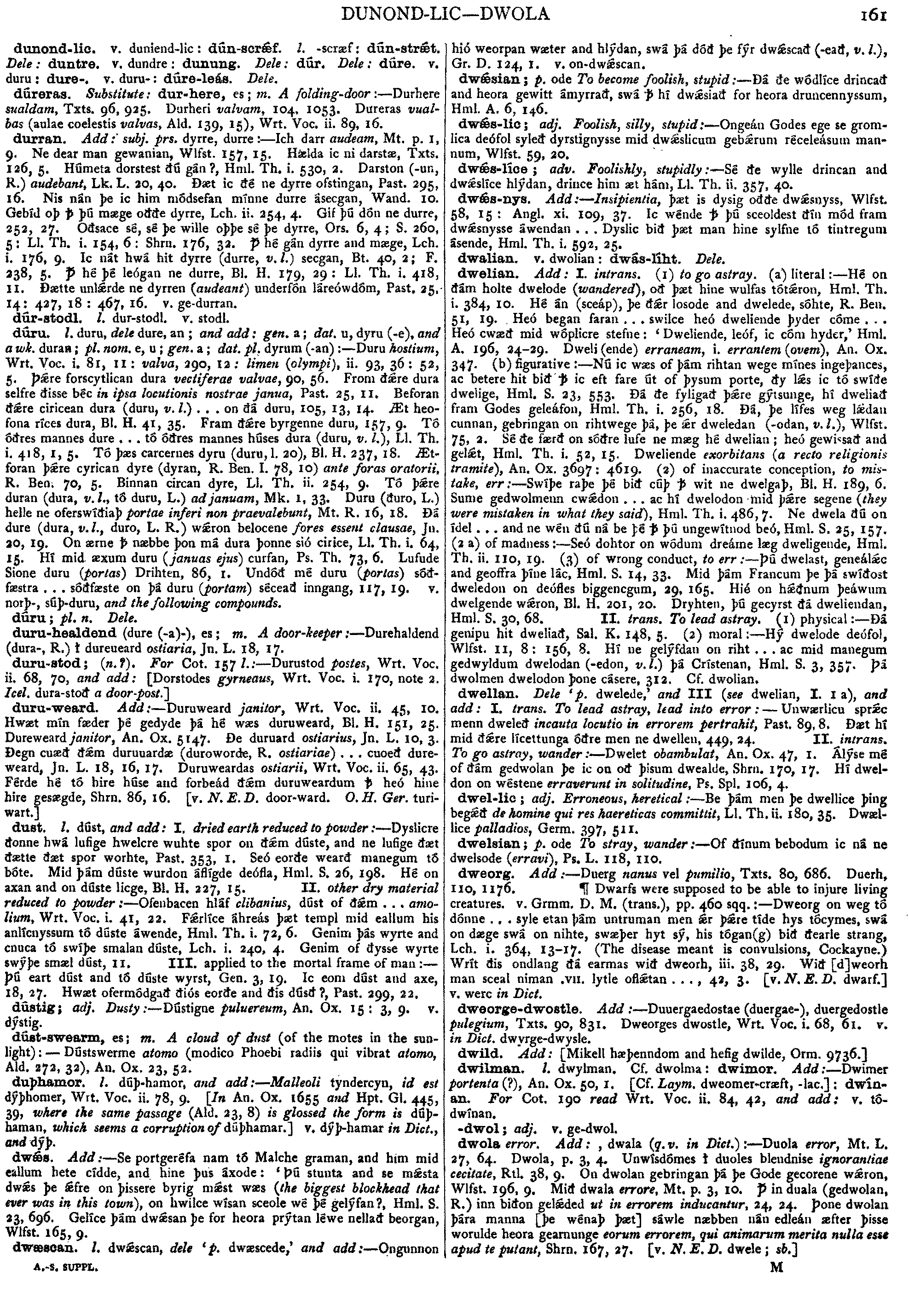
dúru.
l.
duru,
dele
dure,
an;
and
add:
gen.
a;
dat.
u,
dyru
(-e),
and
a
wk.
duran;
pl.
nom.
e,
u;
gen.
a;
dat.
pl.
dyrum
(-an)
:--
Duru
hostium,
Wrt.
Voc.
i.
81,
11:
valva,
290,
12:
limen
(olympi),
ii.
93,
36:
52,
5.
Þre
forscytlican
dura
vectiferae
valvae,
90,
56.
From
ðre
dura
selfre
ðisse
béc
in
ipsa
locutionis
nostrae
janua,
Past.
25,
11.
Beforan
ðre
ciricean
dura
(duru,
v.
l.)
...
on
ðá
duru,
105,
13,
14.
Æt
heofona
ríces
dura,
Bl.
H.
41,
35.
Fram
ðre
byrgenne
duru,
157,
9.
Tó
óðres
mannes
dure
...
tó
óðres
mannes
húses
dura
(duru,
v.
l.),
Ll.
Th.
i.
418,
1,
5.
Tó
þæs
carcernes
dyru
(duru,
l.
20),
Bl.
H.
237,
18.
Ætforan
þre
cyrican
dyre
(dyran,
R.
Ben.
I.
78,
10)
ante
foras
oratorii,
R.
Beo.
70,
5.
Binnan
circan
dyre,
Ll.
Th.
ii.
254,
9.
Tó
þre
duran
(dura,
v.
l.,
tó
duru,
L.)
ad
januam,
Mk.
1,
33.
Duru
(ðuro,
L.)
helle
ne
oferswíðiaþ
portae
inferi
non
praevalebunt,
Mt.
R.
16,
18.
Ðá
dure
(dura,
v.
l.,
duro,
L.
R.)
wron
belocene
fores
essent
clausae,
Jn.
20,
19.
On
ærne
næbbe
þon
má
dura
þonne
sió
cirice,
Ll.
Th.
i.
64,
15.
Hí
mid
æxum
duru
(januas
ejus)
curfan,
Ps.
Th.
73,
6.
Lufude
Sione
duru
(portas)
Drihten,
86,
1.
Undóð
mé
duru
(portas)
sóðfæstra
...
sóðfæste
on
þá
duru
(portam)
sécead
inngang,
117,
19.
v.
norþ-,
súþ-duru,
and
the
following
compounds.
|
Source: Bosworth/Toller, page d0169, entry 3 View original page image as: [TIFF] [PNG] [View previous entry] [View next entry] |
[Comment on this entry] [View comments] |
The following entry has been hand-corrected once. |
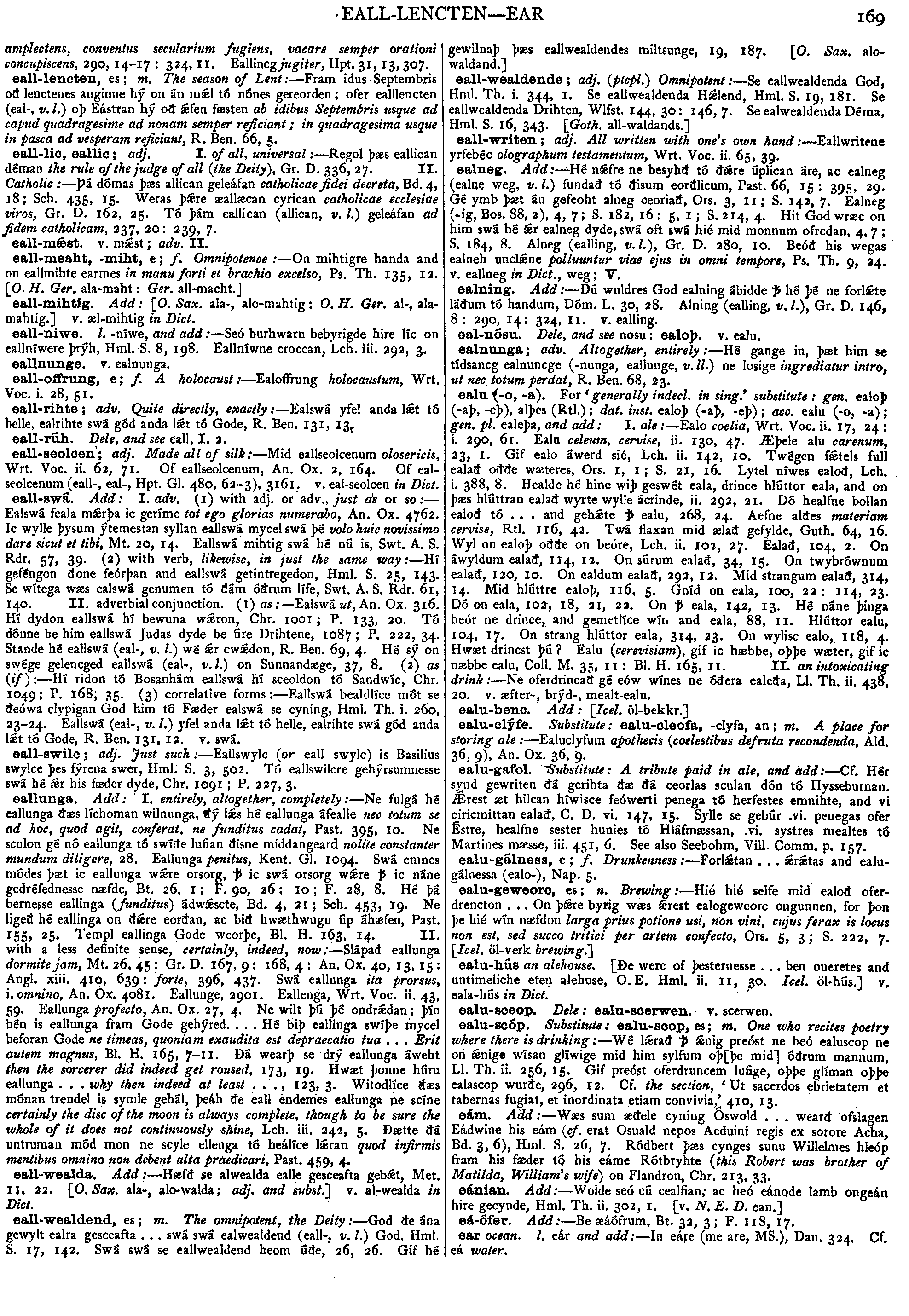
eall-lic,
eallic;
adj.
I.
of
all,
universal:--Regol
þæs
eallican
déman
the
rule
of
the
judge
of
all
(the
Deity),
Gr.
D.
336,
27.
II.
Catholic:--Þá
dómas
þæs
allican
geleáfan
catholicae
fidei
decreta,
Bd.
4,
18;
Sch.
435,
15.
Weras
þre
æallæcan
cyrican
catholicae
ecclesiae
viros,
Gr.
D.
162,
25.
Tó
þám
eallican
(allican,
v.
l.)
geleáfan
ad
fidem
catholicam,
237,
20:
239,
7.
|
Source: Bosworth/Toller, page d0172, entry 16 View original page image as: [TIFF] [PNG] [View previous entry] [View next entry] |
[Comment on this entry] [View comments] |
The following entry has been hand-corrected once. |
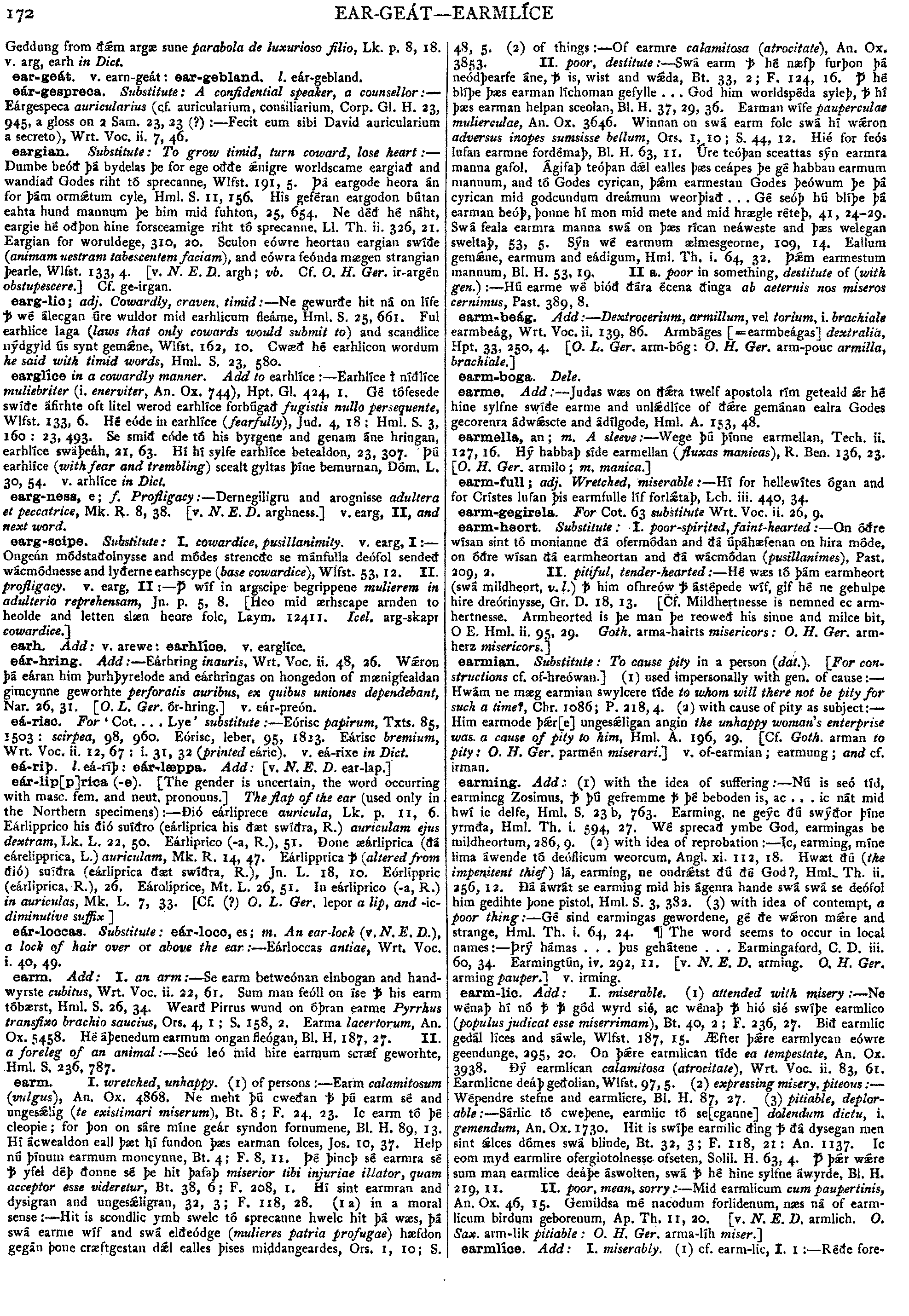
earm.
I.
wretched,
unhappy.
(1)
of
persons:--Earm
calamitosum
(vulgus),
An.
Ox.
4868.
Ne
meht
þú
cweðan
þú
earm
sé
and
ungeslig
(te
existimari
miserum),
Bt.
8;
F.
24,
23.
Ic
earm
tó
þé
cleopie;
for
þon
on
sáre
míne
geár
syndon
fornumene,
Bl.
H.
89,
13.
Hí
ácwealdon
eall
þæt
hí
fundon
þæs
earman
folces,
Jos.
10,
37.
Help
nú
þínum
earmum
moncynne,
Bt.
4;
F.
8,
11.
Þé
þincþ
sé
earmra
sé
yfel
déþ
ðonne
sé
þe
hit
þafaþ
miserior
tibi
injuriae
illator,
quam
acceptor
esse
videretur,
Bt.
38,
6;
F.
208,
1.
Hí
sint
earmran
and
dysigran
and
ungesligran,
32,
3;
F.
118,
28.
(1
a)
in
a
moral
sense:--Hit
is
scondlic
ymb
swelc
tó
sprecanne
hwelc
hit
þá
wæs,
þá
swá
earme
wíf
and
swá
elðeódge
(mulieres
patria
profugae)
hæfdon
gegán
þone
cræftgestan
dl
ealles
þises
middangeardes,
Ors.
1,
10;
S.
48,
5.
(2)
of
things:--Of
earmre
calamitosa
(atrocitate),
An.
Ox.
3853.
II.
poor,
destitute:--Swá
earm
hé
næfþ
furþon
þá
neódþearfe
áne,
is,
wist
and
wda,
Bt.
33,
2;
F.
124,
16.
Þ-bar;
hé
blíþe
þæs
earman
líchoman
gefylle
.
.
.
God
him
worldspéda
syleþ,
hí
þæs
earman
helpan
sceolan,
Bl.
H.
37,
29,
36.
Earman
wífe
pauperculae
mulierculae,
An.
Ox.
3646.
Winnan
on
swá
earm
folc
swá
hí
wron
adversus
inopes
sumsisse
bellum,
Ors.
1,
10;
S.
44,
12.
Hié
for
feós
lufan
earmne
fordémaþ,
Bl.
H.
63,
11.
Úre
teóþan
sceattas
sýn
earmra
manna
gafol.
Ágifaþ
teóþan
dl
ealles
þæs
ceápes
þe
gé
habban
earmum
mannum,
and
tó
Godes
cyrican,
þm
earmestan
Godes
þeówum
þe
þá
cyrican
mid
godcundum
dreámum
weorþiað
.
.
.
Gé
seóþ
hú
blíþe
þá
earman
beóþ,
þonne
hí
mon
mid
mete
and
mid
hrægle
réteþ,
41,
24-29.
Swá
feala
earmra
manna
swá
on
þæs
rícan
neáweste
and
þæs
welegan
sweltaþ,
53,
5.
Sýn
wé
earmum
ælmesgeorne,
109,
14.
Eallum
gemne,
earmum
and
eádigum,
Hml.
Th.
i.
64,
32.
Þm
earmestum
mannum,
Bl.
H.
53,
19.
II
a.
poor
in
something,
destitute
of
(with
gen.):--Hú
earme
wé
bióð
ðára
écena
ðinga
ab
aeternis
nos
miseros
cernimus,
Past.
389,
8.
|
Source: Bosworth/Toller, page d0224, entry 8 View original page image as: [TIFF] [PNG] [View previous entry] [View next entry] |
[Comment on this entry] [View comments] |
The following entry has been hand-corrected once. |
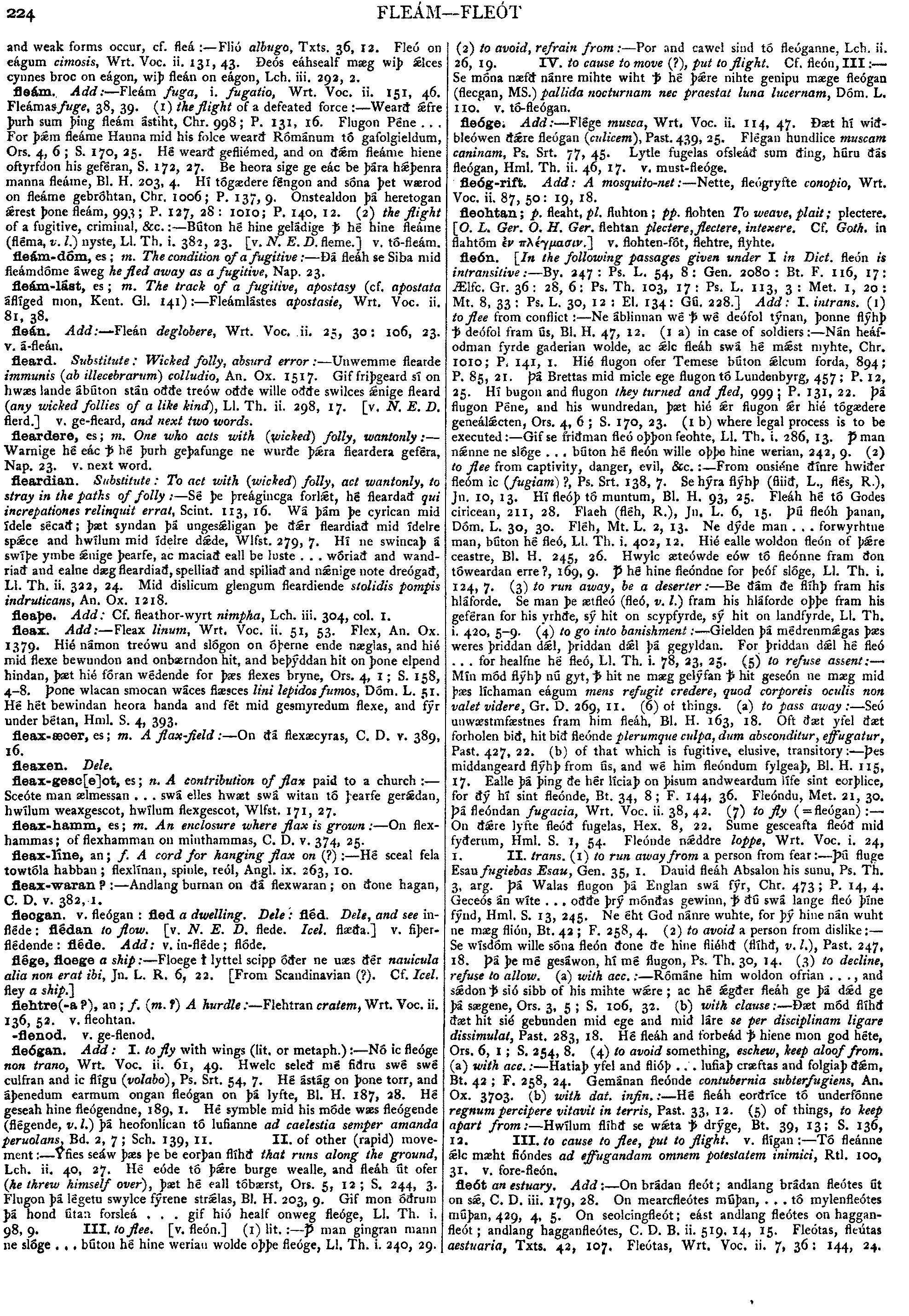
fleardian.
Substitute:
To
act
with
(wicked)
folly,
act
wantonly,
to
stray
in
the
paths
of
folly
:--
Sé
þe
þreágincga
forlt,
hé
fleardað
qui
increpationes
relinquit
errat,
Scint.
113,
16.
Wá
þám
þe
cyrican
mid
ídele
sécað;
þæt
syndan
þá
ungesligan
þe
ðr
fleardiað
mid
ídelre
spiéce
and
hwílum
mid
ídelre
dde.
Wlfst.
279,
7.
Hí
ne
swincaþ
á
swíþe
ymbe
nige
þearfe,
ac
maciað
eall
be
luste
.
.
.
wóriað
and
wandriaið
and
ealne
dæg
fleardiað,
spelliað
and
spiliað
and
nnige
note
dreógað,
Ll.
Th.
ii.
322,
24.
Mid
dislicum
glengum
fleardiende
stolidis
pompis
indruticans,
An.
Ox.
1218.
|
Source: Bosworth/Toller, page d0226, entry 19 View original page image as: [TIFF] [PNG] [View previous entry] [View next entry] |
[Comment on this entry] [View comments] |
The following entry has been hand-corrected once. |
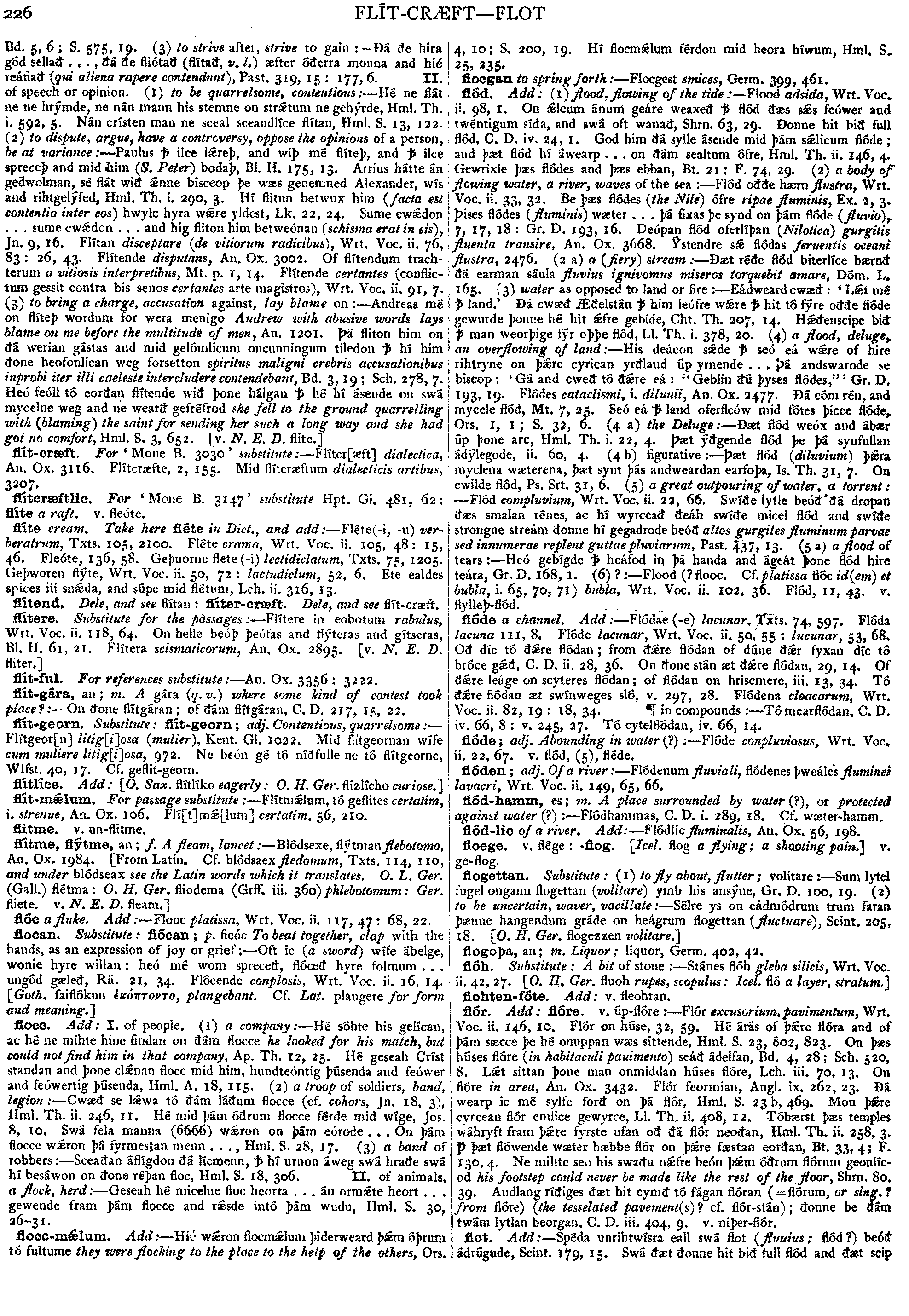
flód.
Add:
(1)
flood,
flowing
of
the
tide
:--
Flood
adsida,
Wrt.
Voc.
ii.
98,
l.
On
lcum
ánum
geáre
weaxeð
flód
ðæs
ss
feówer
and
twéntigum
síða,
and
swá
oft
wanað,
Shrn.
63,
29.
Ðonne
hit
bið
full
flód,
C.
D.
iv.
24,
l.
God
him
ðá
sylle
ásende
mid
þám
slicum
flóde
;
and
þæt
flód
hí
áwearp
.
.
.
on
ðám
sealtum
ófre,
Hml.
Th.
ii.
146,
4.
Gewrixle
þæs
flódes
and
þæs
ebban,
Bt.
21;
F.
74,
29.
(2)
a
body
of
flowing
water,
a
river,
waves
of
the
sea
:--
Flód
oððe
hærn
flustra,
Wrt.
Voc.
ii.
33,
32.
Be
þæs
fiódes
(the
Nile)
ófre
ripae
fluminis,
Ex.
2,
3.
Þises
flódes
(fluminis)
wæter
.
.
.
þá
fixas
þe
synd
on
þám
flóde
(fluvio),
7,
17,
18
:
Gr.
D.
193,
16.
Deópan
flód
oferlíþan
(Nilotica)
gurgitis
fluenta
transire,
An.
Ox.
3668.
Ýstendre
s
flðdas
feruentis
oceani
flustra,
2476.
(2
a)
a
(fiery)
stream
:--
Ðæt
réðe
flód
biterlíce
bærnð
ðá
earman
sáula
fluvius
ignivomus
miseros
torquebit
amare,
Dóm.
L.
165.
(3)
water
as
opposed
to
land
or
fire
:--
Eádweard
cwæð
:
'Lt
mé
land.'
Ðá
cwæð
Æðelstán
him
leófre
wre
hit
tó
fýre
oððe
flóde
gewurde
þonne
hé
hit
fre
gebide,
Cht.
Th.
207,
14.
Hðenscipe
bið
man
weorþige
fýr
oþþe
flód,
Ll.
Th.
i.
378,
20.
(4)
a
flood,
deluge,
an
overflowing
of
land
:--
His
deácon
sde
seó
eá
wre
of
hire
rihtryne
on
þre
cyrican
yrðland
úp
yrnende
.
.
.
Þá
andswarode
se
biscop
:
'
Gá
and
cweð
tó
ðre
eá
:
"Geblin
ðú
þyses
flódes,"'
Gr.
D.
193,
19.
Flódes
cataclismi,
i.
diluuii,
An.
Ox.
2477.
Ðá
cóm
rén,
and
mycele
flód,
Mt.
7,
25.
Seó
eá
land
oferfleów
mid
fótes
þicce
flóde,
Ors.
l,
I
;
S.
32,
6.
(4
a)
the
Deluge
:--
Ðæt
flód
weóx
and
ábær
úp
þone
arc,
Hml.
Th.
i.
22,
4.
Þaelig;t
ýðgende
flód
þe
þá
synfullan
ádýlegode,
ii.
60,
4.
(4
b)
figurative
:--
Þæt
flód
(diluvium)
þra
myclena
wæterena,
þæt
synt
þás
andweardan
earfoþa,
Is.
Th.
31,
7.
On
cwilde
flód,
Ps.
Srt.
31,
6.
(5)
a
great
outpouring
of
water,
a
torrent
:--
Flód
compluvium,
Wrt.
Voc.
ii.
22,
66.
Swiðe
lytle
beóð
ðá
dropan
ðæs
smalan
rénes,
ac
hí
wyrceait
ðeáh
swíðe
micel
flód
and
swíðe
strongne
streám
ðonne
hí
gegadrode
beóð
altos
gurgites
fluminum
parvae
sed
innumerae
replent
guttae
pluviarum,
Past.
.
5.
37,
13.
(5
a)
a
flood
of
tears
:--
Heó
gebfgde
heáfod
in
þá
handa
and
ágeát
þone
flód
hire
teára,
Gr.
D.
168,
l.
(6)
?
:--
Flood
(?
flooc.
Cf.
platissa
flóc
id(em)
it
bubla,
i.
65,
70,
71
bubla,
Wrt.
Voc.
ii.
102,
36.
Flód,
II,
43.
v.
flylleþ-flód.
|
Source: Bosworth/Toller, page d0234, entry 10 View original page image as: [TIFF] [PNG] [View previous entry] [View next entry] |
[Comment on this entry] [View comments] |
The following entry has been hand-corrected once. |
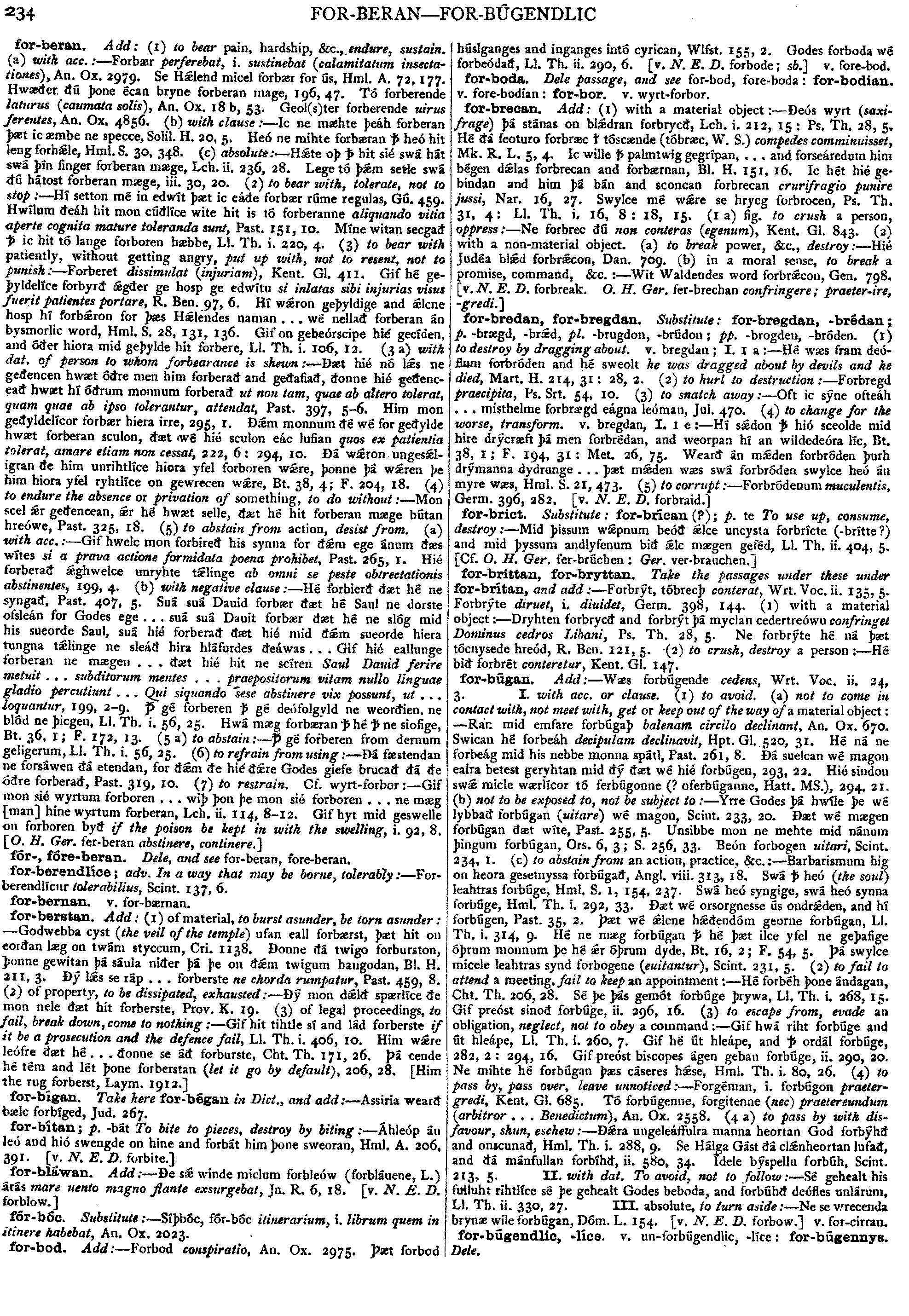
for-bod. Add: -- Forbod conspiratio, An. Ox. 2975. Þæt forbod húslganges and inganges intó cyrican, Wlfst. 155, 2. Godes forboda wé forbeódað, Ll. Th. ii. 290, 6. [v. N. E. D. forbode; si.] v. fore-bod.
| Result Page: |  |
Previous | 1 2 3 4 5 6 7 8 9 10 11 12 13 14 | Next |  |
Germanic Lexicon Project (main page)
This search system was written by
Sean Crist
Please consider
volunteering
to correct the data in these online dictionaries.
No rights reserved. Feel free to use these data in any way you please.