|
|

Tip: In the search results, you can click on any word or abbreviation for more information.
|
Source: Bosworth/Toller, page b0175, entry 1 View original page image as: [TIFF] [PNG] [View previous entry] [View next entry] |
[Comment on this entry] [View comments] |
The following entry has been hand-corrected once. |
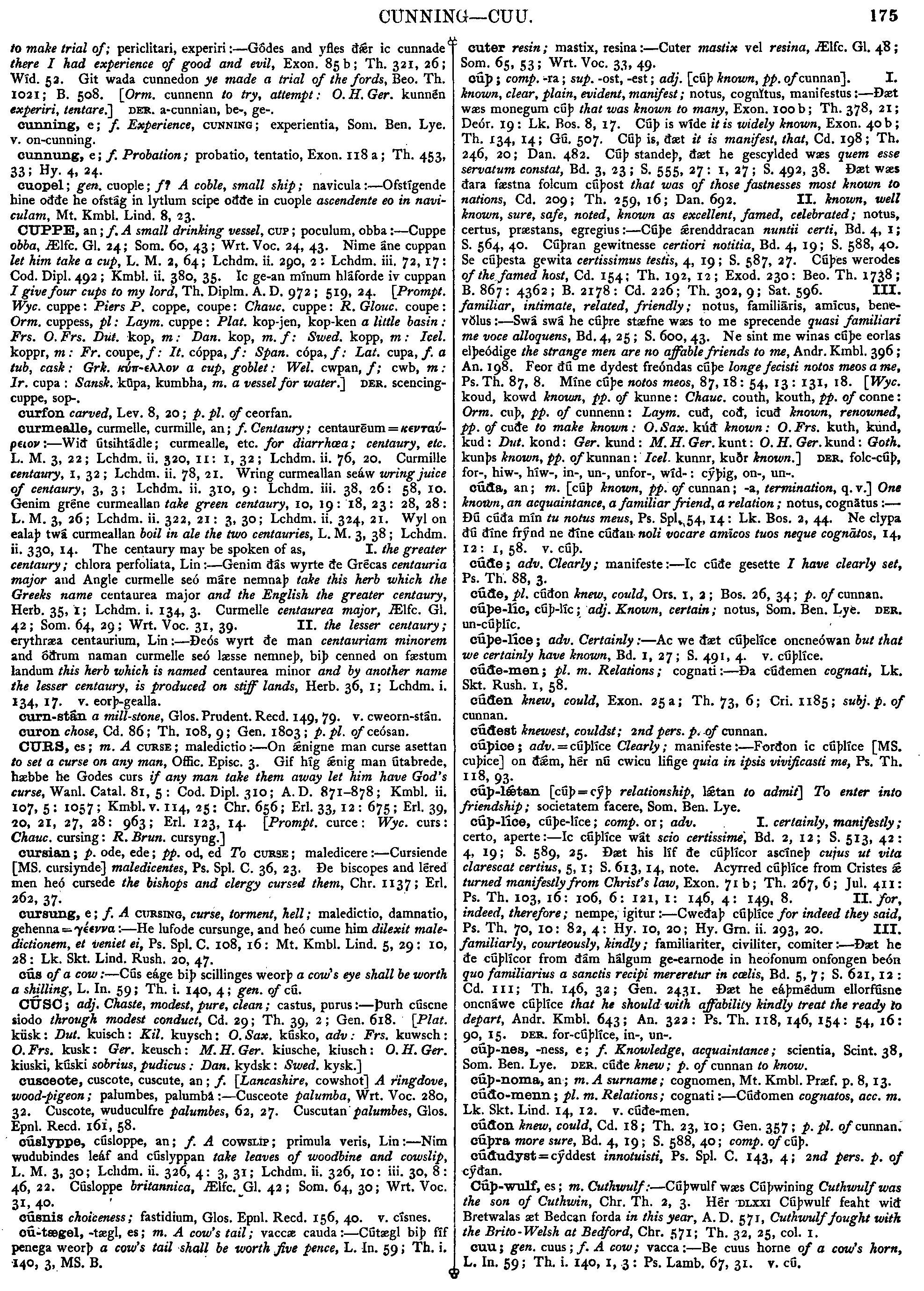
to
make
trial
of;
periclitari,
experiri
:--
Gódes
and
yfles
ð r
ic
cunnade
there
I
had
experience
of
good
and
evil,
Exon.
85b;
Th.
321,
26;
Wíd.
52.
Git
wada
cunnedon
ye
made
a
trial
of
the
fords,
Beo.
Th.
1021;
B.
508.
[Orm.
cunnenn
to
try,
attempt:
O.
H.
Ger.
kunnén
experiri,
tentare.]
DER.
a-cunnian,
be-,
ge-.
r
ic
cunnade
there
I
had
experience
of
good
and
evil,
Exon.
85b;
Th.
321,
26;
Wíd.
52.
Git
wada
cunnedon
ye
made
a
trial
of
the
fords,
Beo.
Th.
1021;
B.
508.
[Orm.
cunnenn
to
try,
attempt:
O.
H.
Ger.
kunnén
experiri,
tentare.]
DER.
a-cunnian,
be-,
ge-.
|
Source: Bosworth/Toller, page b0206, entry 33 View original page image as: [TIFF] [PNG] [View previous entry] [View next entry] |
[Comment on this entry] [View comments] |
The following entry has been hand-corrected once. |
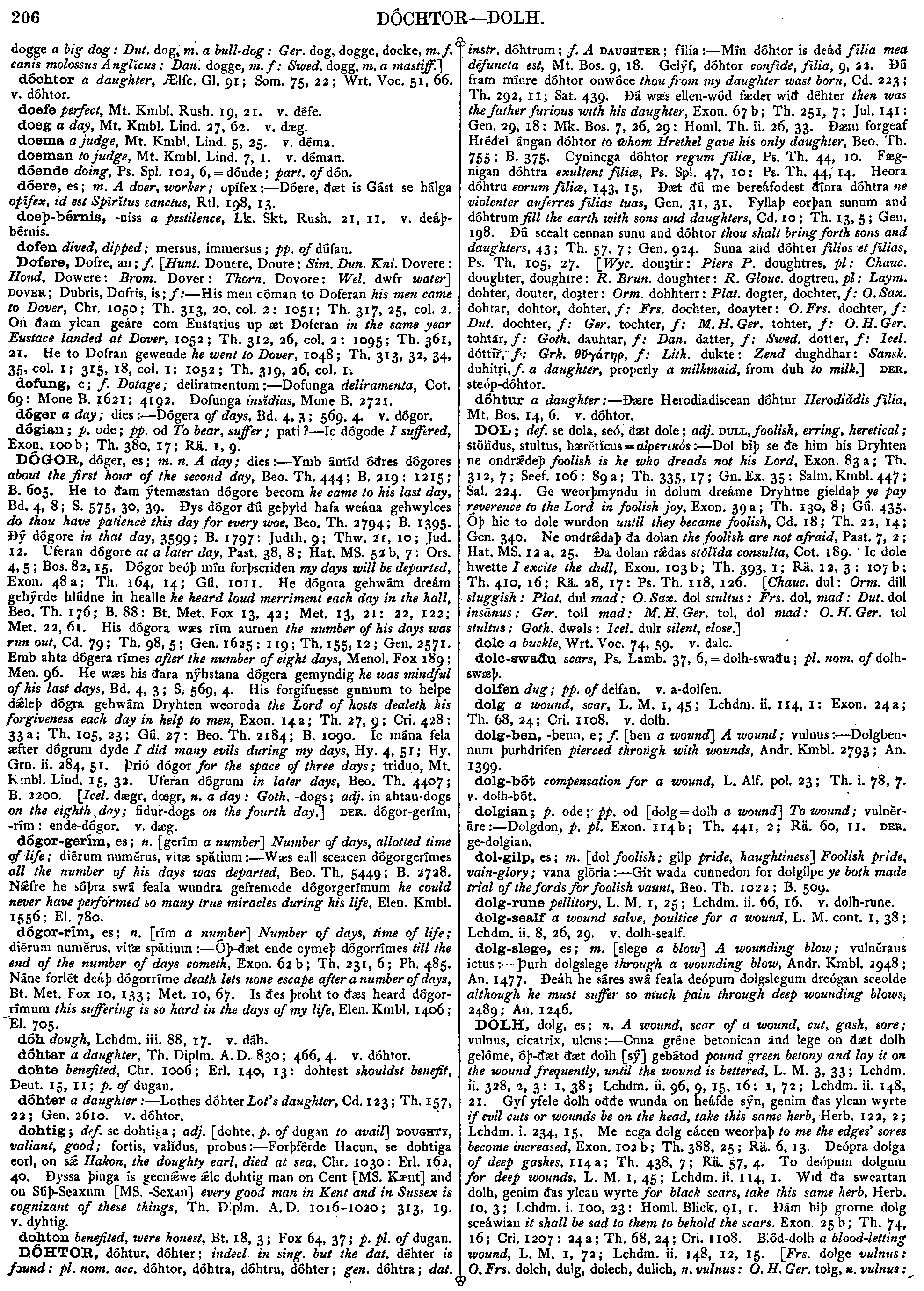
dol-gilp,
es;
m.
[dol
foolish;
gilp
pride,
haughtiness]
Foolish
pride,
vain-glory;
vana
gl ria
:--
Git
wada
cunnedon
for
dolgilpe
ye
both
made
trial
of
the
fords
for
foolish
vaunt,
Beo.
Th.
1022;
B.
509.
ria
:--
Git
wada
cunnedon
for
dolgilpe
ye
both
made
trial
of
the
fords
for
foolish
vaunt,
Beo.
Th.
1022;
B.
509.
|
Source: Bosworth/Toller, page b0271, entry 5 View original page image as: [TIFF] [PNG] [View previous entry] [View next entry] |
[Comment on this entry] [View comments] |
The following entry has been hand-corrected once. |
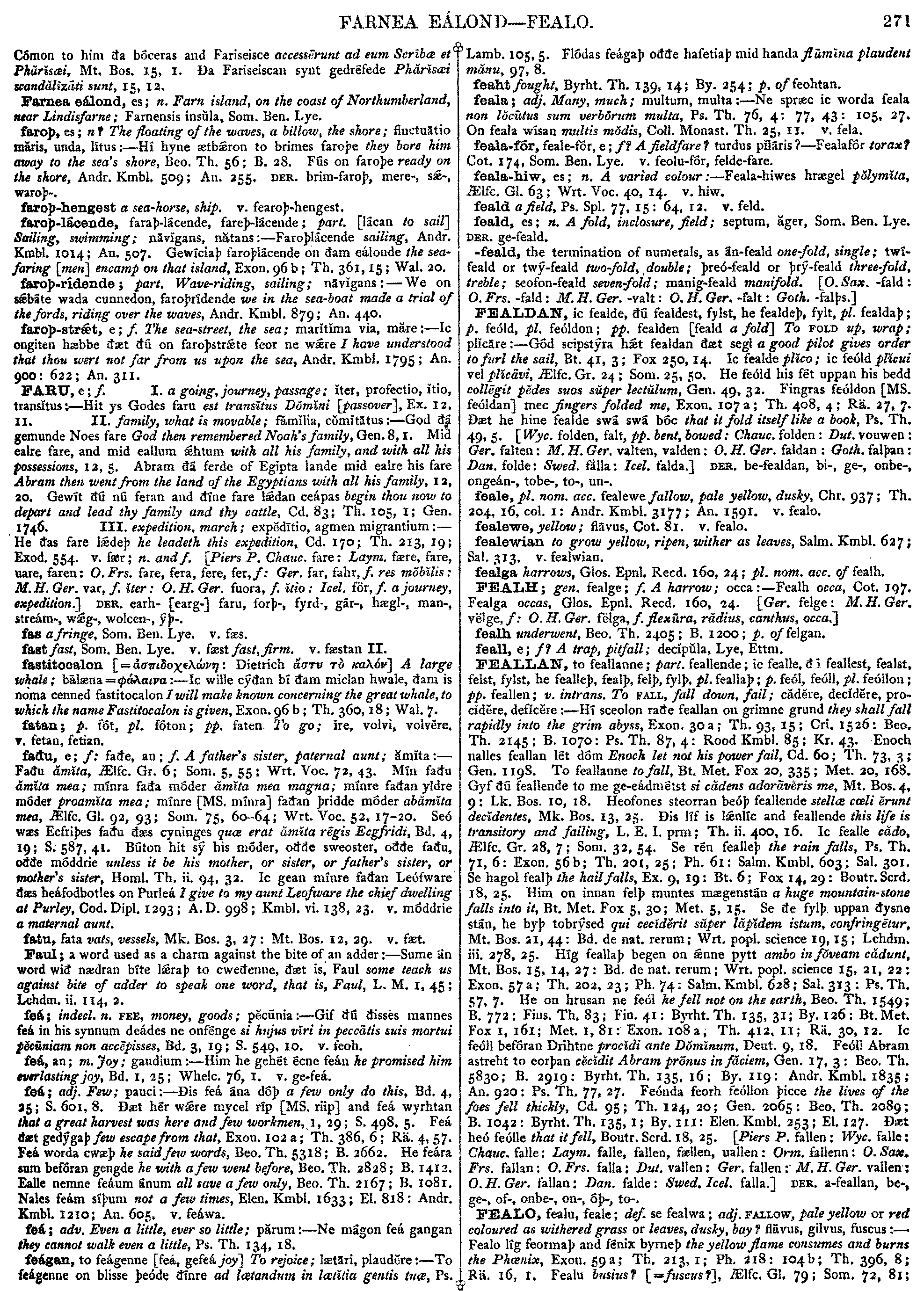
faroþ-ridende;
part.
Wave-riding,
sailing;
n v
v gans
:--
We
on
sbáte
wada
cunnedon,
faroþrídende
we
in
the
sea-boat
made
a
trial
of
the
fords,
riding
over
the
waves,
Andr.
Kmbl.
879;
An.
440.
gans
:--
We
on
sbáte
wada
cunnedon,
faroþrídende
we
in
the
sea-boat
made
a
trial
of
the
fords,
riding
over
the
waves,
Andr.
Kmbl.
879;
An.
440.
|
Source: Bosworth/Toller, page b1149, entry 16 View original page image as: [TIFF] [PNG] [View previous entry] [View next entry] |
[Comment on this entry] [View comments] |
The following entry has been hand-corrected once. |
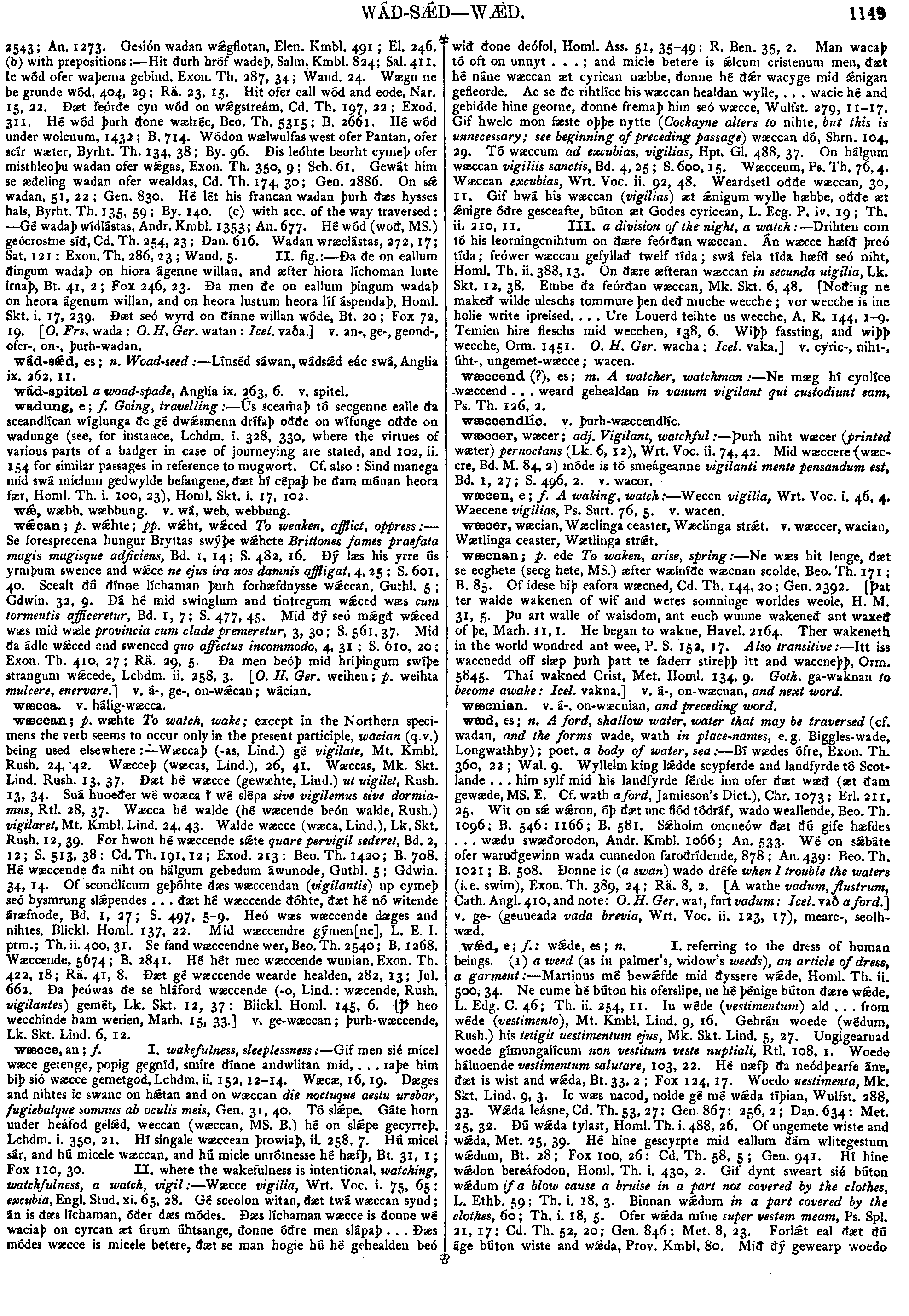
wæd,
es;
n.
A
ford,
shallow
water,
water
that
may
be
traversed
(cf.
wadan,
and
the
forms
wade,
wath
in
place-names,
e.g.
Biggles-wade,
Longwathby);
poet,
a
body
of
water,
sea
:--
Bí
wædes
ófre,
Exon.
Th.
360,
22;
Wal.
9.
Wyllelm
king
ldde
scypferde
and
landfyrde
tó
Scotlande
...
him
sylf
mid
his
landfyrde
férde
inn
ofer
ðæt
wæð
(æt
ðam
gewæde,
MS.
E.
Cf.
wath
a
ford,
Jamieson's
Dict.),
Chr.
1073;
Erl.
211,
25.
Wit
on
s
wron,
óþ
ðæt
unc
flód
tódráf,
wado
weallende,
Beo.
Th.
1096;
B.
546:
1166;
B.
581.
Sholm
oncneów
ðæt
ðú
gife
hæfdes
...
wædu
swæðorodon,
Andr.
Kmbl.
1066;
An.
533.
Wé
on
sbáte
ofer
waruðgewinn
wada
cunnedon
faroðrídende,
878;
An.
439:
Beo.
Th.
1021;
B.
508.
Ðonne
ic
(a
swan)
wado
dréfe
when
I
trouble
the
waters
(i.e.
swim),
Exon.
Th.
389,
24;
Rä.
8,
2.
[A
wathe
vadum,
flustrum,
Cath.
Angl.
410,
and
note:
O.
H.
Ger.
wat,
furt
vadum:
Icel.
vað
a
ford.]
v.
ge-
(geuueada
vada
brevia,
Wrt.
Voc.
ii.
123,
17),
mearc-,
seolh-wæd.
|
Source: Bosworth/Toller, page b1169, entry 11 View original page image as: [TIFF] [PNG] [View previous entry] [View next entry] |
[Comment on this entry] [View comments] |
The following entry has been hand-corrected once. |
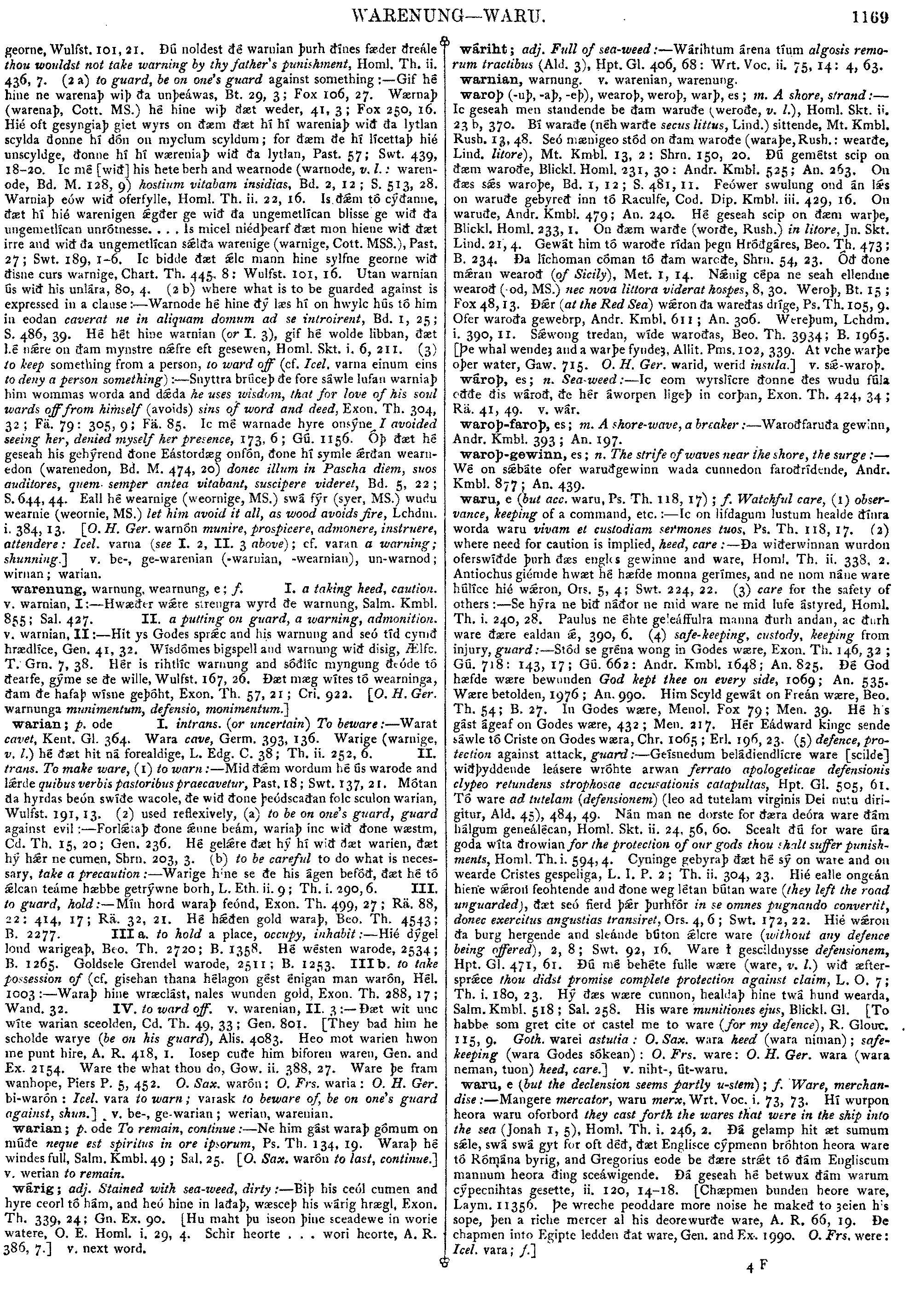
waroþ-gewinn,
es;
n.
The
strife
of
waves
near
the
shore,
the
surge:
--
Wé
on
sbáte
ofer
waruðgewinn
wada
cunnedon
faroðrídende,
Andr.
Kmbl.
877
;
An.
439.
|
Source: Bosworth/Toller, page b1259, entry 12 View original page image as: [TIFF] [PNG] [View previous entry] [View next entry] |
[Comment on this entry] [View comments] |
The following entry has been hand-corrected once. |
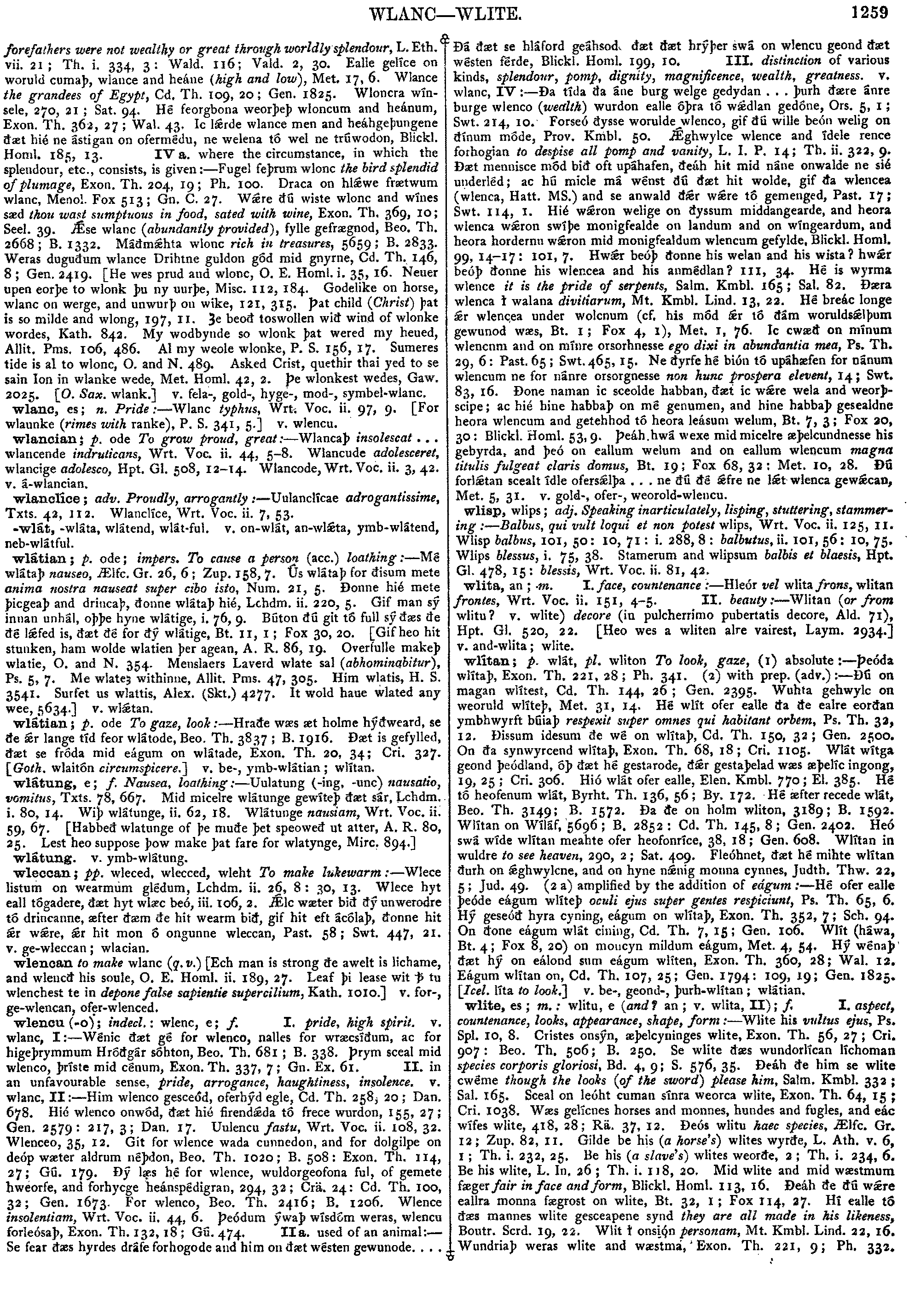
wlencu
(-o);
indecl.:
wlenc,
e;
f.
I.
pride,
high
spirit.
v.
wlanc,
I:--Wénic
ðæt
gé
for
wlenco,
nalles
for
wræcsíðum,
ac
for
higeþrymmum
Hróðgár
sóhton,
Beo.
Th.
681;
B.
338.
Þrym
sceal
mid
wlenco,
þríste
mid
cénum,
Exon.
Th.
337,
7;
Gn.
Ex.
61.
II.
in
an
unfavourable
sense,
pride,
arrogance,
haughtiness,
insolence.
v.
wlanc,
II:--Him
wlenco
gesceód,
oferhýd
egle,
Cd.
Th.
258,
20;
Dan.
678.
Hié
wlenco
onwód,
ðæt
hié
firendda
tó
frece
wurdon,
155,
27;
Gen.
2579:
217,
3;
Dan.
17.
Uulencu
fastu,
Wrt.
Voc.
ii.
108,
32.
Wlenceo,
35,
12.
Git
for
wlence
wada
cunnedon,
and
for
dolgilpe
on
deóp
wæter
aldrum
néþdon,
Beo.
Th.
1020;
B.
508:
Exon.
Th.
114,
27;
Gú.
179.
Ðý
læs
hé
for
wlence,
wuldorgeofona
ful,
of
gemete
hweorfe,
and
forhycge
heánspédigran,
294,
32;
Crä.
24:
Cd.
Th.
100,
32;
Gen.
1673.
For
wlenco,
Beo.
Th.
2416;
B.
1206.
Wlence
insolentiam,
Wrt.
Voc.
ii.
44,
6.
Þeódum
ýwaþ
wísdóm
weras,
wlencu
forleósaþ,
Exon.
Th.
132,
18;
Gú.
474.
II
a.
used
of
an
animal:--Se
fear
ðæs
hyrdes
dráfe
forhogode
and
him
on
ðæt
wésten
gewunode.
.
.
.
Ðá
ðæt
se
hláford
geáhsod
ðæt
ðæt
hrýþer
swá
on
wlencu
geond
ðæt
wésten
férde,
Blickl.
Homl.
199,
10.
III.
distinction
of
various
kinds,
splendour,
pomp,
dignity,
magnificence,
wealth,
greatness.
v.
wlanc,
IV:--ÐÐa
tída
ða
áne
burg
welge
gedydan
.
.
.
þurh
ðære
ánre
burge
wlenco
(wealth)
wurdon
ealle
óþra
tó
wdlan
gedóne,
Ors.
5,
1;
Swt.
214,
10.
Forseó
ðysse
worulde
wlenco,
gif
ðú
wille
beón
welig
on
ðínum
móde,
Prov.
Kmbl.
50.
Æ-acute;ghwylce
wlence
and
ídele
rence
forhogian
to
despise
all
pomp
and
vanity,
L.
I.
P.
14;
Th.
ii.
322,
9.
Ðæt
mennisce
mód
bið
oft
upáhafen,
ðeáh
hit
mid
náne
onwalde
ne
sié
underléd;
ac
hú
micle
má
wénst
ðú
ðæt
hit
wolde,
gif
ða
wlencea
(wlenca,
Hatt.
MS.)
and
se
anwald
ðr
wre
tó
gemenged,
Past.
17;
Swt.
114,
1.
Hié
wron
welige
on
ðyssum
middangearde,
and
heora
wlenca
wron
swíþe
monigfealde
on
landum
and
on
wíngeardum,
and
heora
hordernu
wron
mid
monigfealdum
wlencum
gefylde,
Blickl.
Homl.
99,
14-17:
101,
7.
Hwr
beóþ
ðonne
his
welan
and
his
wista?
hwr
beóþ
ðonne
his
wlencea
and
his
anmédlan?
111,
34.
Hé
is
wyrma
wlence
it
is
the
pride
of
serpents,
Salm.
Kmbl.
165;
Sal.
82.
Ðæra
wlenca
 walana
divitiarum,
Mt.
Kmbl.
Lind.
13,
22.
Hé
breác
longe
r
wlencea
under
wolcnum
(cf.
his
mód
r
tó
ðám
woruldslþum
gewunod
wæs,
Bt.
1;
Fox
4,
1),
Met.
1,
76.
Ic
cwæð
on
mínum
wlencum
and
on
mínre
orsorhnesse
ego
dixi
in
abundantia
mea,
Ps.
Th.
29,
6:
Past.
65;
Swt.
465,
15.
Ne
ðyrfe
hé
bión
tó
upáhæfen
for
nánum
wlencum
ne
for
nánre
orsorgnesse
non
huuc
prospera
elevent,
14;
Swt.
83,
16.
Ðone
naman
ic
sceolde
habban,
ðæt
ic
wre
wela
and
weorþscipe;
ac
hié
hine
habbaþ
on
mé
genumen,
and
hine
habbaþ
gesealdne
heora
wlencum
and
getehhod
tó
heora
leásum
welum,
Bt.
7,
3;
Fox
20,
30:
Blickl.
Homl.
53,
9.
Þeáh
hwá
wexe
mid
micelre
æþelcundnesse
his
gebyrda,
and
þeó
on
eallum
welum
and
on
eallum
wlencum
magnet
titulis
fulgeat
claris
domus,
Bt.
19;
Fox
68,
32:
Met.
10,
28.
Ðú
forltan
scealt
ídle
oferslþa
.
.
.
ne
ðú
ðé
fre
ne
lt
wlenca
gewcan,
Met.
5,
31.
v.
gold-,
ofer-,
weorold-wlencu.
walana
divitiarum,
Mt.
Kmbl.
Lind.
13,
22.
Hé
breác
longe
r
wlencea
under
wolcnum
(cf.
his
mód
r
tó
ðám
woruldslþum
gewunod
wæs,
Bt.
1;
Fox
4,
1),
Met.
1,
76.
Ic
cwæð
on
mínum
wlencum
and
on
mínre
orsorhnesse
ego
dixi
in
abundantia
mea,
Ps.
Th.
29,
6:
Past.
65;
Swt.
465,
15.
Ne
ðyrfe
hé
bión
tó
upáhæfen
for
nánum
wlencum
ne
for
nánre
orsorgnesse
non
huuc
prospera
elevent,
14;
Swt.
83,
16.
Ðone
naman
ic
sceolde
habban,
ðæt
ic
wre
wela
and
weorþscipe;
ac
hié
hine
habbaþ
on
mé
genumen,
and
hine
habbaþ
gesealdne
heora
wlencum
and
getehhod
tó
heora
leásum
welum,
Bt.
7,
3;
Fox
20,
30:
Blickl.
Homl.
53,
9.
Þeáh
hwá
wexe
mid
micelre
æþelcundnesse
his
gebyrda,
and
þeó
on
eallum
welum
and
on
eallum
wlencum
magnet
titulis
fulgeat
claris
domus,
Bt.
19;
Fox
68,
32:
Met.
10,
28.
Ðú
forltan
scealt
ídle
oferslþa
.
.
.
ne
ðú
ðé
fre
ne
lt
wlenca
gewcan,
Met.
5,
31.
v.
gold-,
ofer-,
weorold-wlencu.
|
Source: Bosworth/Toller, page d0136, entry 14 View original page image as: [TIFF] [PNG] [View previous entry] [View next entry] |
[Comment on this entry] [View comments] |
The following entry has been hand-corrected once. |
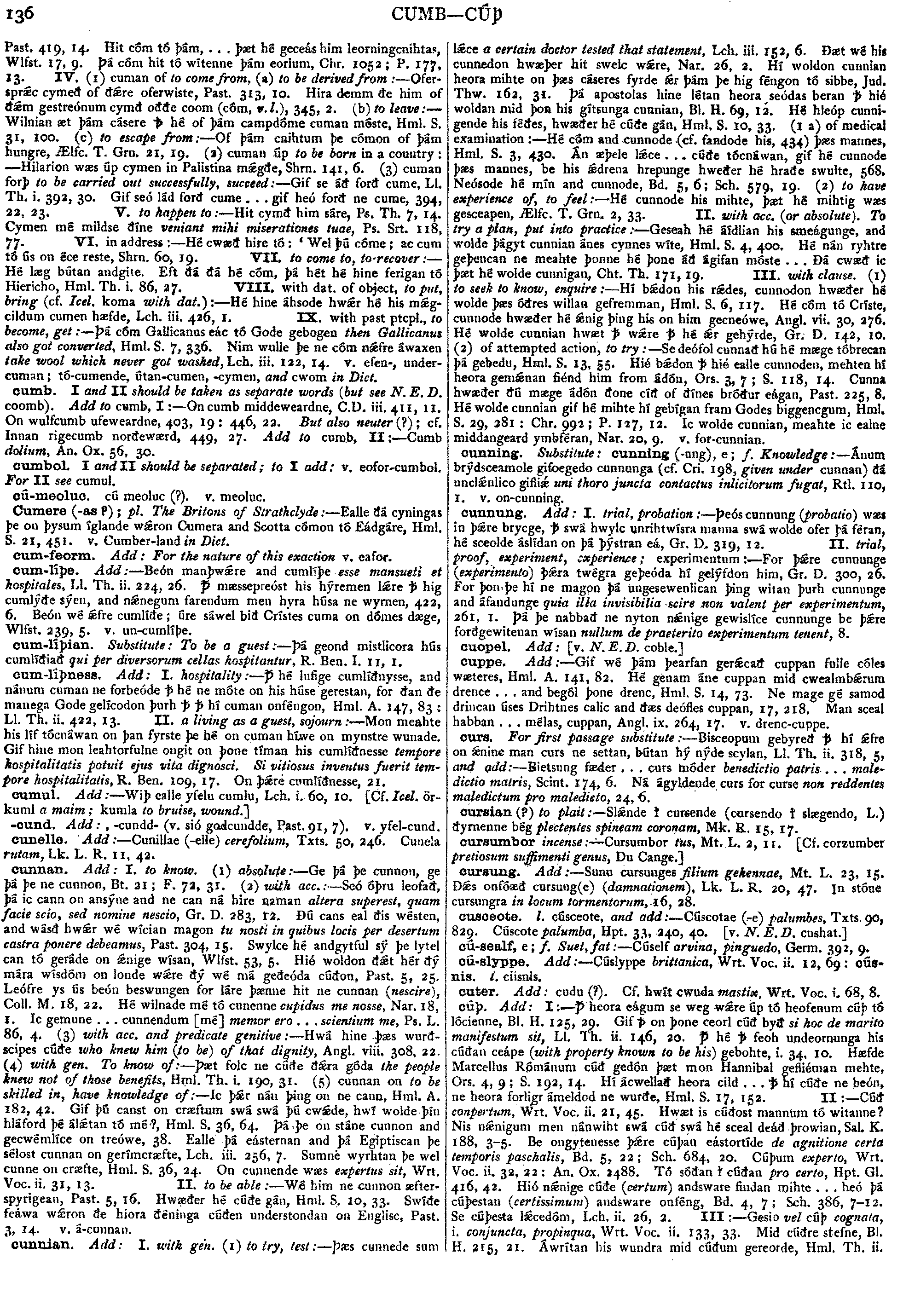
cunnian.
Add:
I.
with
gen.
(1)
to
try,
test:--Þæs
cunnede
sum
lce
a
certain
doctor
tested
that
statement,
Lch.
iii.
152,
6.
Ðæt
wé
his
cunnedon
hwæþer
hit
swelc
wre,
Nar.
26,
2.
Hí
woldon
cunnian
heora
mihte
on
þæs
cáseres
fyrde
r
þám
þe
hig
féngon
tó
sibbe,
Jud.
Thw.
162,
31.
Þá
apostolas
hine
létan
heora
seódas
beran
 hié
woldan
mid
þon
his
gítsunga
cunnian,
Bl.
H.
69,
12.
Hé
hleóp
cunnigende
his
féðes,
hwæðer
hé
cúðe
gán,
Hml.
S.
10,
33.
(I
a)
of
medical
examination:--Hé
cóm
and
cunnode
(cf.
fandode
his,
434)
þæs
mannes,
Hml.
S.
3,
430.
Án
æþele
lce
.
.
.
cúðe
tócnáwan,
gif
hé
cunnode
þæs
mannes,
be
his
drena
hrepunge
hweðer
hé
hraðe
swulte,
568.
Neósode
hé
mín
and
cunnode,
Bd.
5,
6;
Sch.
579,
19.
(2)
to
have
experience
of,
to
feel:--Hé
cunnode
his
mihte,
þæt
hé
mihtig
wæs
gesceapen,
Ælfc.
T.
Grn.
2,
33.
II.
with
acc.
(or
absolute).
To
try
a
plan,
put
into
practice:--Geseah
hé
áídlian
his
smeágunge,
and
wolde
þágyt
cunnian
ánes
cynnes
wíte,
Hml.
S.
4,
400.
Hé
nán
ryhtre
geþencan
ne
meahte
þonne
hé
þone
áð
ágifan
móste
.
.
.
Ðá
cwæð
ic
þæt
hé
wolde
cunnigan,
Cht.
Th.
171,
19.
III.
with
clause.
(1)
to
seek
to
know,
enquire:--Hí
bdon
his
rdes,
cunnodon
hwæðer
hé
wolde
þæs
óðres
willan
gefremman,
Hml.
S.
6,
117.
Hé
cóm
tó
Críste,
cunnode
hwæðer
hé
nig
þing
his
on
him
gecneówe,
Angl.
vii.
30,
276.
Hé
wolde
cunnian
hwæt
wre
hé
r
gehýrde,
Gr.
D.
142,
10.
(2)
of
attempted
action,
to
try:--Se
deófol
cunnað
hú
hé
mæge
tóbrecan
þá
gebedu,
Hml.
S.
13,
55.
Hié
bdon
hié
ealle
cunnoden,
mehten
hí
heora
gemnan
fiénd
him
from
ádón,
Ors.
3,
7;
S.
118,
14.
Cunna
hwæðer
ðú
mæge
ádón
ðone
cíð
of
ðínes
bróður
eágan,
Past.
225,
8.
Hé
wolde
cunnian
gif
hé
mihte
hí
gebígan
fram
Godes
biggencgum,
Hml.
S.
29,
281:
Chr.
992;
P.
127,
12.
Ic
wolde
cunnian,
meahte
ic
ealne
middangeard
ymbféran,
Nar.
20,
9.
v.
for-cunnian.
hié
woldan
mid
þon
his
gítsunga
cunnian,
Bl.
H.
69,
12.
Hé
hleóp
cunnigende
his
féðes,
hwæðer
hé
cúðe
gán,
Hml.
S.
10,
33.
(I
a)
of
medical
examination:--Hé
cóm
and
cunnode
(cf.
fandode
his,
434)
þæs
mannes,
Hml.
S.
3,
430.
Án
æþele
lce
.
.
.
cúðe
tócnáwan,
gif
hé
cunnode
þæs
mannes,
be
his
drena
hrepunge
hweðer
hé
hraðe
swulte,
568.
Neósode
hé
mín
and
cunnode,
Bd.
5,
6;
Sch.
579,
19.
(2)
to
have
experience
of,
to
feel:--Hé
cunnode
his
mihte,
þæt
hé
mihtig
wæs
gesceapen,
Ælfc.
T.
Grn.
2,
33.
II.
with
acc.
(or
absolute).
To
try
a
plan,
put
into
practice:--Geseah
hé
áídlian
his
smeágunge,
and
wolde
þágyt
cunnian
ánes
cynnes
wíte,
Hml.
S.
4,
400.
Hé
nán
ryhtre
geþencan
ne
meahte
þonne
hé
þone
áð
ágifan
móste
.
.
.
Ðá
cwæð
ic
þæt
hé
wolde
cunnigan,
Cht.
Th.
171,
19.
III.
with
clause.
(1)
to
seek
to
know,
enquire:--Hí
bdon
his
rdes,
cunnodon
hwæðer
hé
wolde
þæs
óðres
willan
gefremman,
Hml.
S.
6,
117.
Hé
cóm
tó
Críste,
cunnode
hwæðer
hé
nig
þing
his
on
him
gecneówe,
Angl.
vii.
30,
276.
Hé
wolde
cunnian
hwæt
wre
hé
r
gehýrde,
Gr.
D.
142,
10.
(2)
of
attempted
action,
to
try:--Se
deófol
cunnað
hú
hé
mæge
tóbrecan
þá
gebedu,
Hml.
S.
13,
55.
Hié
bdon
hié
ealle
cunnoden,
mehten
hí
heora
gemnan
fiénd
him
from
ádón,
Ors.
3,
7;
S.
118,
14.
Cunna
hwæðer
ðú
mæge
ádón
ðone
cíð
of
ðínes
bróður
eágan,
Past.
225,
8.
Hé
wolde
cunnian
gif
hé
mihte
hí
gebígan
fram
Godes
biggencgum,
Hml.
S.
29,
281:
Chr.
992;
P.
127,
12.
Ic
wolde
cunnian,
meahte
ic
ealne
middangeard
ymbféran,
Nar.
20,
9.
v.
for-cunnian.
|
Source: Bosworth/Toller, page d0306, entry 17 View original page image as: [TIFF] [PNG] [View previous entry] [View next entry] |
[Comment on this entry] [View comments] |
The following entry has been hand-corrected once. |
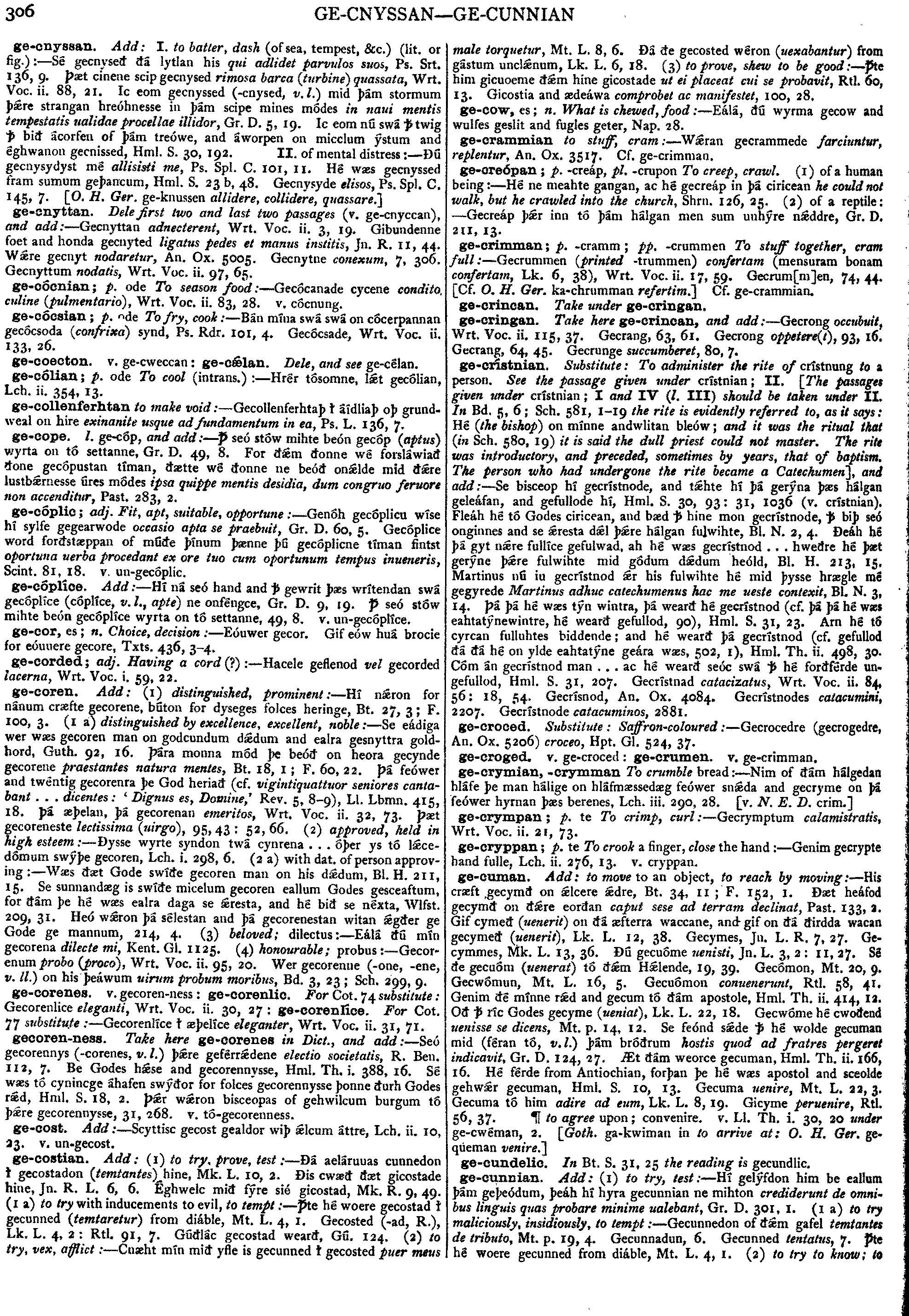
ge-costian.
Add:
(1)
to
try,
prove,
test
:--
Ðá
aeláruuas
cunnedon
gecostadon
(temtantes)
hine,
Mk.
L.
10,
2.
Ðis
cwæð
ðæt
gicostade
hine,
Jn.
R.L.
6,
6.
Éghwelc
mið
fýre
sié
gicostad,
Mk.
R.
9,
49
(1
a)
to
try
with
inducements
to
evil,
to
tempt
:--
te
hé
woere
gecostad
gecunned
(temtaretur)
from
diáble,
Mt.
L.
4,
1.
Gecosted
(-ad,
R.),
Lk.
L.
4,
2:
Rtl.
91,
7.
Gúdlác
gecostad
wearð,
Gú.
124.
(2)
to
try,
vex,
afflict
:--
Cnæht
mín
mið
yfle
is
gecunned
gecosted
puer
meus
male
torquetur,
Mt.
L.
8,
6.
Ðá
ðe
gecosted
wéron
(uexabantur)
from
gástum
unclnum,
Lk.
L.
6,
18.
(3)
to
prove,
shew
to
be
good
:--
te
him
gicuoeme
ðm
hine
gicostade
ut
ei
placeat
cui
se
probavit,
Rtl.
60,
13.
Gicostia
and
ædeáwa
comprobet
ac
manifestet,
100,
28.
|
Source: Bosworth/Toller, page d0398, entry 14 View original page image as: [TIFF] [PNG] [View previous entry] [View next entry] |
[Comment on this entry] [View comments (1)] |
The following entry has been hand-corrected once. |
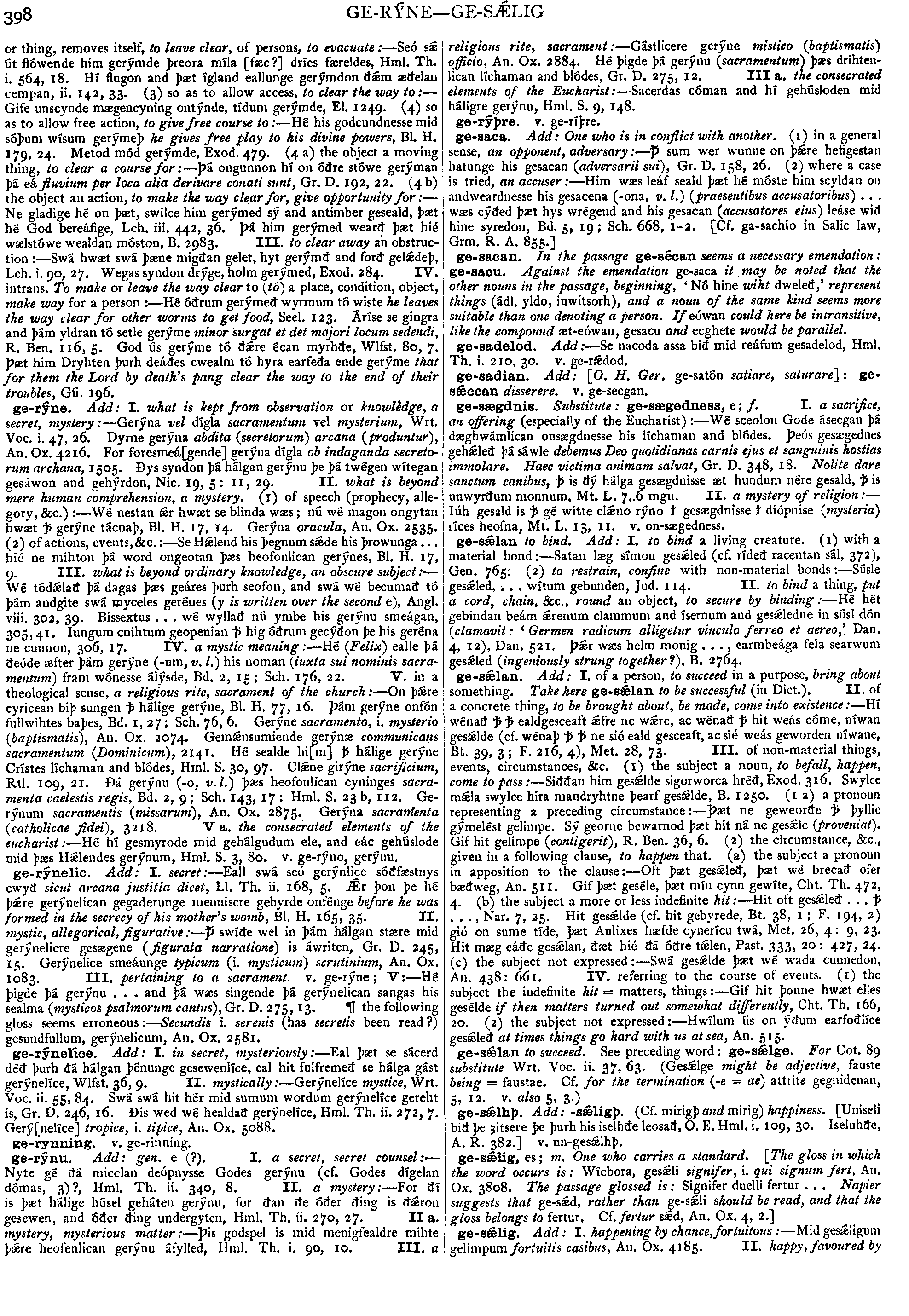
ge-slan.
Add:
I.
of
a
person,
to
succeed
in
a
purpose,
bring
about
something.
Take
here
ge-slan
to
be
successful
(in
Dict.
).
II.
of
a
concrete
thing,
to
be
brought
about,
be
made,
come
into
existence
:--
Hi
wénað
ILLEGIBLE
ealdgesceaft
fre
ne
wre,
ac
wénað
ji
hit
weás
cóme,
níwan
geslde
(cf.
wénaþ
-þ
f
ne
sié
eald
gesceaft,
ac
sié
weás
geworden
níwane,
Bt-
ILLEGIBLE
F-
216,
4),
Met.
28,
73.
III.
of
non-material
things,
events,
circumstances,
&
c.
(1)
the
subject
a
noun,
to
befall,
happen,
come
to
pass
:--
Siððan
him
geslde
sigorworca
hréð,
Exod.
316.
Swylce
mla
swylce
hira
mandryhtne
þearf
geslde,
B.
1250.
(l
a)
a
pronoun
representing
a
preceding
circumstance
:--
Þæt
ne
geweorðe
H
þyllic
gýmelést
gelimpe.
Sý
georne
bewarnod
þæt
hit
ná
ne
gesle
(proveniat).
Gif
hit
gelimpe
(contigerit),
R.
Ben.
36,
6.
(2)
the
circumstance,
&
c.
,
given
in
a
following
clause,
to
happen
that,
(a)
the
subject
a
pronoun
in
apposition
to
the
clause:--
Oft
þæt
gesleð,
þæt
wé
brecað
ofer
bæðweg,
An.
511.
Gif
þæt
gesgle,
þæt
mín
cynn
gewíte,
Cht.
Th.
472,
4.
(b)
the
subject
a
more
or
less
indefinite
hit:
--
Hit
oft
gesleð.
ILLEGIBLE
,
Nar.
7,
25.
Hit
geslde
(cf.
hit
gebyrede
,
Bt.
38,1
;
F.
194,
2)
gió
on
sume
tide,
þæt
Aulixes
hæfde
cynerlcu
twá,
Met.
26,
4
:
9,
23.
Hit
mæg
eáðe
geslan,
ðæt
hié
ðá
ððre
tlen,
Past.
333,
20
:
4271
24.
(c)
the
subject
not
expressed
:--
Swá
geslde
þæt
wé
wada
cunnedon,
An.
438:
661.
IV.
referring
to
the
course
of
events.
(1)
the
subject
the
indefinite
hit
=
matters,
things
:--
Gif
hit
bonne
hwæt
elles
gesélde
if
then
matters
turned
out
somewhat
differently,
Cht.
Th.
166,
20.
(2)
the
subject
not
expressed
:--
Hwílum
us
on
ýclum
earfoðlíce
gesleð
at
times
things
go
hard
with
us
at
sea,
An.
515.
|
Source: Bosworth/Toller, page d0740, entry 40 View original page image as: [TIFF] [PNG] [View previous entry] [View next entry] |
[Comment on this entry] [View comments] |
The following entry has been hand-corrected once. |
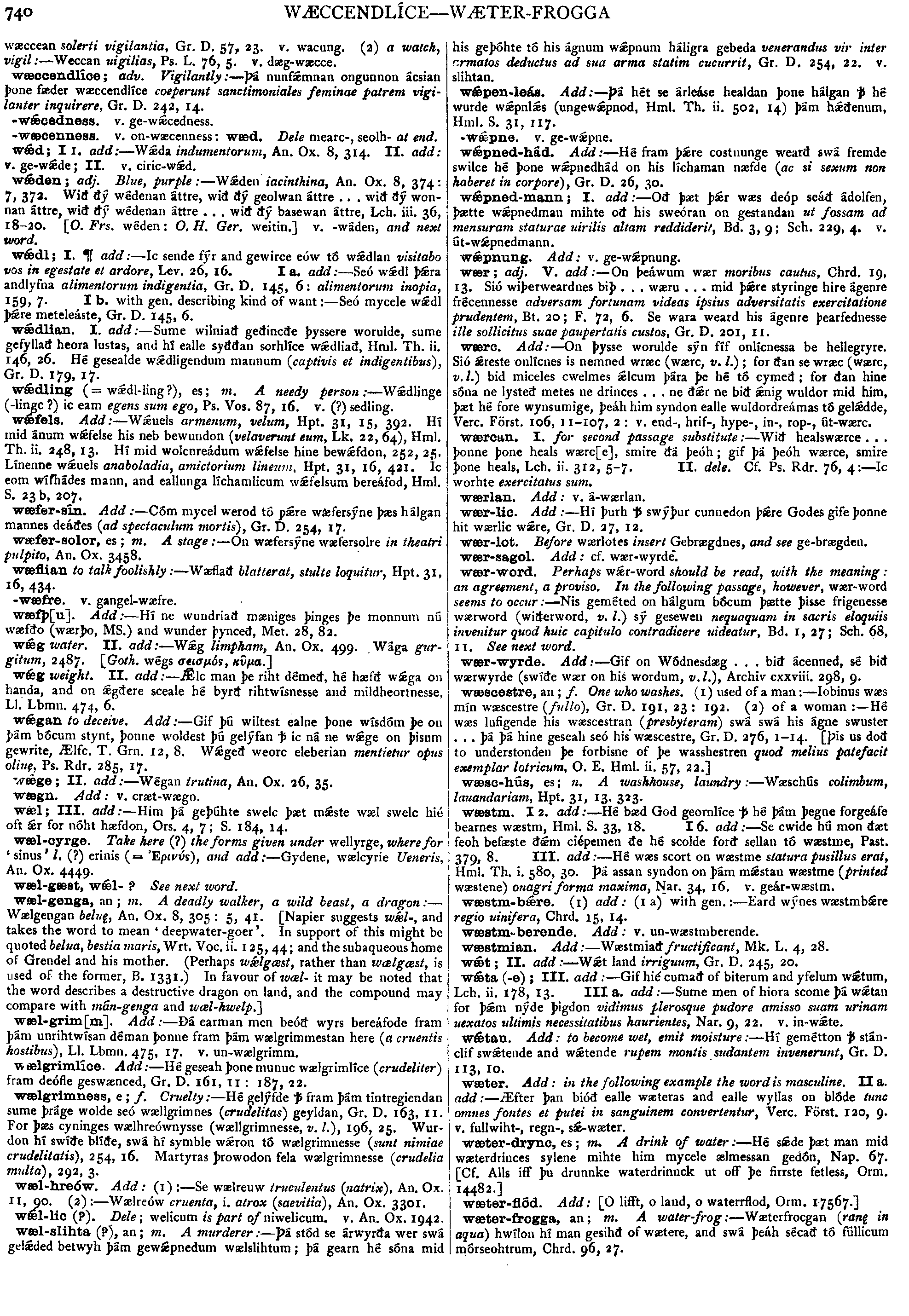
wær-lic.
Add:
--
Hí
þurh
swýþur
cunnedon
þre
Godes
gife
þonne
hit
wærlic
wre,
Gr.
D.
27,
12.
Germanic Lexicon Project (main page)
This search system was written by
Sean Crist
Please consider
volunteering
to correct the data in these online dictionaries.
No rights reserved. Feel free to use these data in any way you please.