|
|

Tip: In the search results, you can click on any word or abbreviation for more information.
|
Source: Cleasby/Vigfusson, page b0641, entry 12 View original page image as: [TIFF] [PNG] [View previous entry] [View next entry] |
[Comment on this entry] [View comments] |
The following entry has been hand-corrected once. |
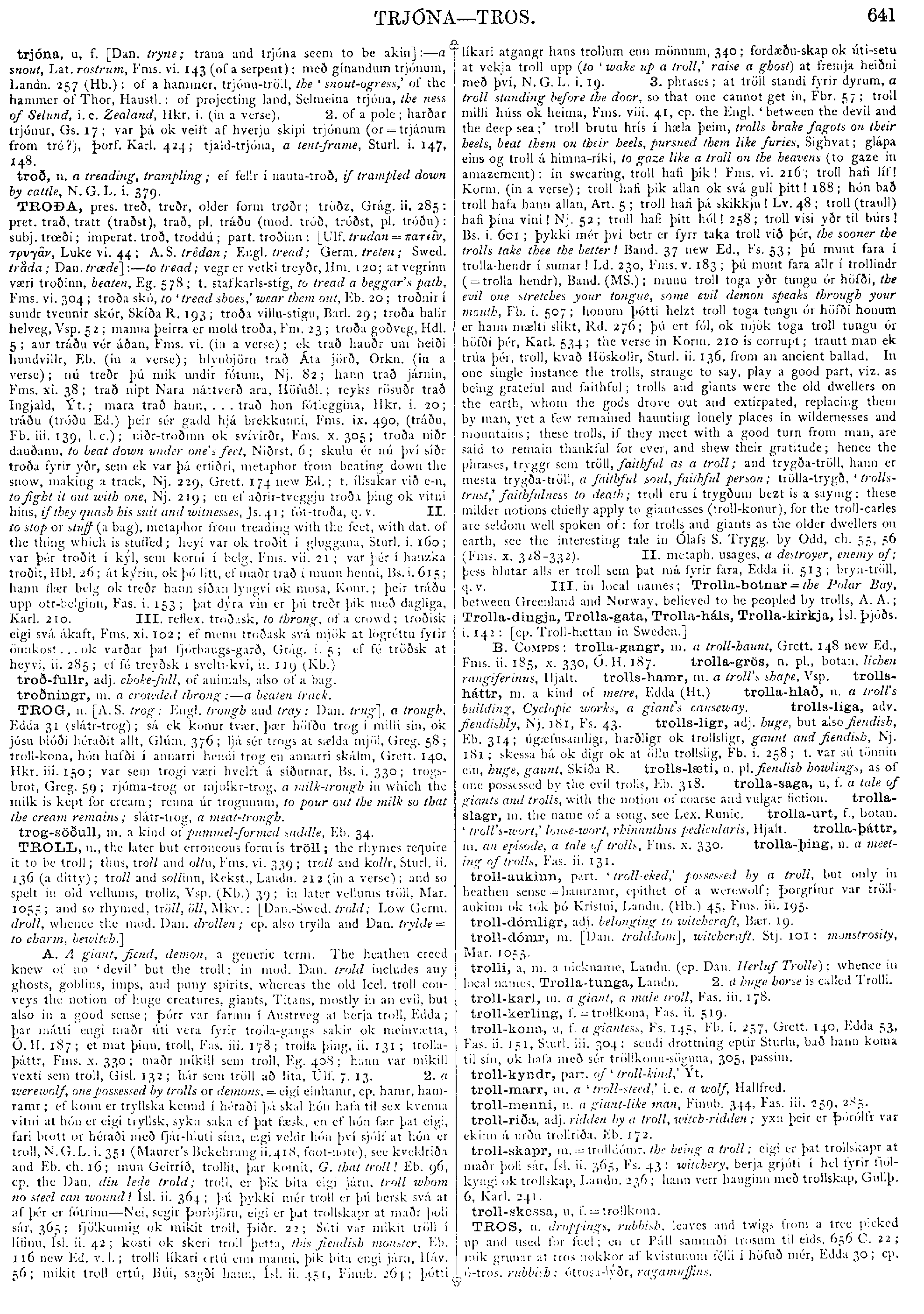
trolli, a, m. a nickname, Landn. (cp. Dan. Herluf Trolle); whence in local names, Trolla-tunga, Landn. 2. a huge horse is called Trolli.
|
Source: Cleasby/Vigfusson, page b0641, entry 22 View original page image as: [TIFF] [PNG] [View previous entry] [View next entry] |
[Comment on this entry] [View comments] |
The following entry has been hand-corrected once. |
TROS, n. droppings, rubbish, leaves and twigs from a tree picked up and used for fuel; en er Páll samnaði trosum til elds, 656 C. 22; mik grunar at tros nokkor af kvistunum félli í höfuð mér, Edda 30; cp. ó-tros. rubbish; ótrosa-lýðr, ragamuffins.
|
Source: Cleasby/Vigfusson, page b0643, entry 9 View original page image as: [TIFF] [PNG] [View previous entry] [View next entry] |
[Comment on this entry] [View comments] |
The following entry has been hand-corrected once. |
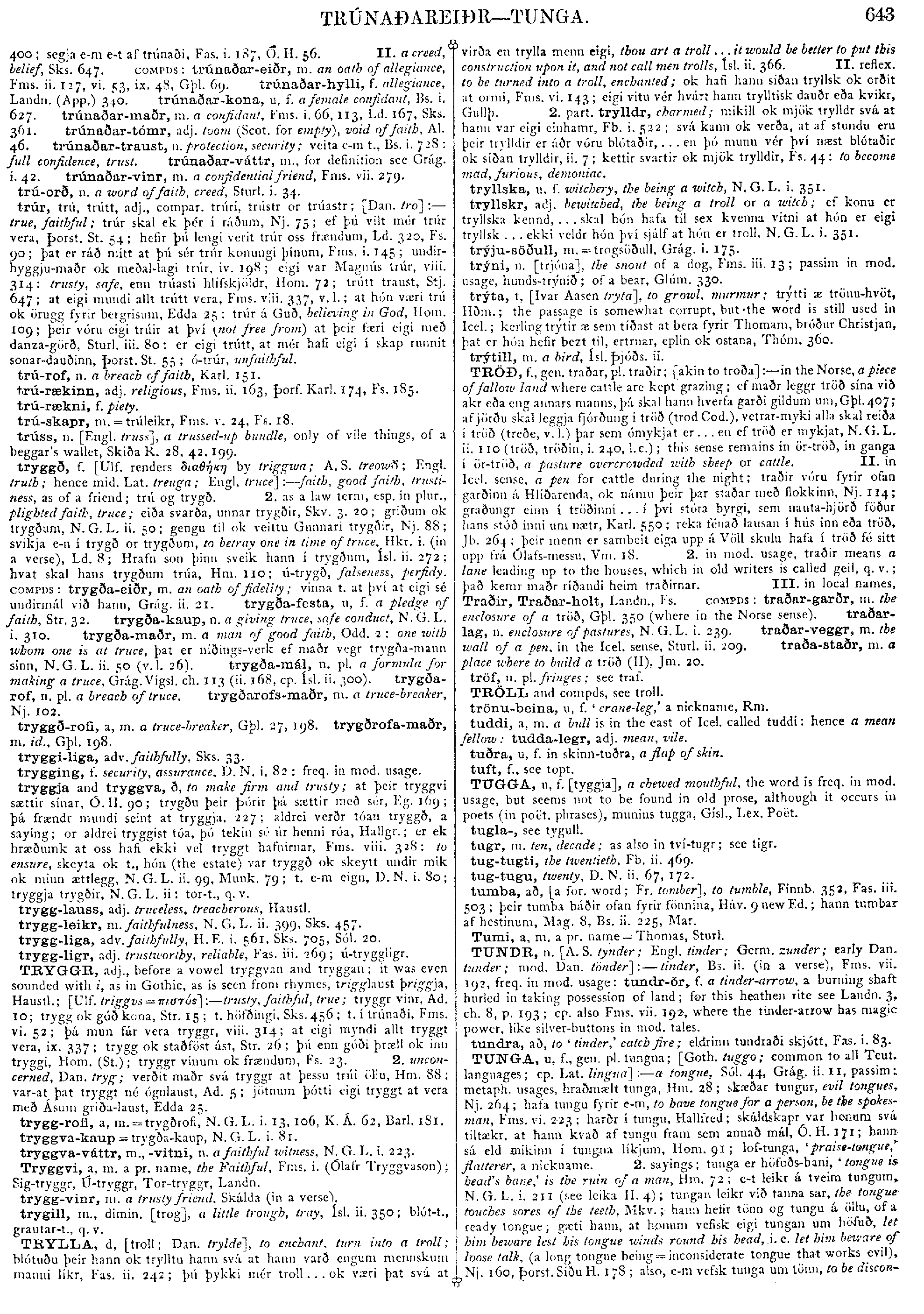
tryggð, f. [Ulf. renders GREEK by triggwa; A.S. treowð; Engl. truth; hence mid. Lat. treuga; Engl. truce] :-- faith, good faith, trustiness, as of a friend; trú og trygð. 2. as a law term, esp. in plur., plighted faith, truce; eiða svarða, unnar trygðir, Skv. 3. 20; griðum ok trygðum, N.G.L. ii. 50; gengu til ok veittu Gunnari trygðir, Nj. 88; svíkja e-n í trygð or trygðum, to betray one in time of truce, Hkr. i. (in a verse), Ld. 8; Hrafn son þinn sveik hann í trygðum, Ísl. ii. 272; hvat skal hans trygðum trúa, Hm. 110; ú-trygð, falseness, perfidy. COMPDS: trygða-eiðr, m. an oath of fidelity; vinna t. at því at eigi sé undirmál við hann, Grág. ii. 21. trygða-festa, u, f. a pledge of faith, Str. 32. trygða-kaup, n. a giving truce, safe conduct, N.G.L. i. 310. trygða-maðr, m. a man of good faith, Odd. 2: one with whom one is at truce, þat er níðings-verk ef maðr vegr trygða-mann sinn, N.G.L. ii. 50 (v.l. 26). trygða-mál, n. pl. a formula for making a truce, Grág. Vígsl. ch. 113 (ii. 168, cp. Ísl. ii. 300). trygða-rof, n. pl. a breach of truce. trygðarofs-maðr, m. a truce-breaker, Nj. 102.
|
Source: Cleasby/Vigfusson, page b0643, entry 46 View original page image as: [TIFF] [PNG] [View previous entry] [View next entry] |
[Comment on this entry] [View comments] |
The following entry has been hand-corrected once. |
TUNDR,, n. [A.S. tynder; Engl. tinder; Germ. zunder; early Dan. tunder; mod. Dan. tönder] :-- tinder, Bs. ii. (in a verse), Fms. vii. 192, freq. in mod. usage: tundr-ör, f. a tinder-arrow, a burning shaft hurled in taking possession of land; for this heathen rite see Landn. 3, ch. 8, p. 193; cp. also Fms. vii. 192, where the tinder-arrow has magic power, like silver-buttons in mod. tales.
|
Source: Cleasby/Vigfusson, page b0643, entry 48 View original page image as: [TIFF] [PNG] [View previous entry] [View next entry] |
[Comment on this entry] [View comments] |
The following entry has been hand-corrected once. |
TUNGA, u, f., gen. pl. tungna; [Goth. tuggo; common to all Teut. languages; cp. Lat. lingua] :-- a tongue, Sól. 44, Grág. ii 11, passim: metaph. usages, hraðmælt tunga, Hm. 28; skæðar tungur, evil tongues, Nj. 264; hafa tungu fyrir e-m, to have tongue for a person, be the spokesman, Fms. vi. 223; harðr í tungu, Hallfred; skáldskapr var honum svá tiltækr, at hann kvað af tungu fram sem annað mál, Ó.H. 171; hann sá eld mikinn í tungna líkjum, Hom. 91; lof-tunga, 'praise-tongue,' flatterer, a nickname. 2. sayings; tunga er höfuðs-bani, 'tongue is head's bane,' is the ruin of a man, Hm. 72; e-t leikr á tveim tungum, N.G.L. i. 211 (see leika II. 4); tungan leikr við tanna sar, the tongue touches sores of the teeth, Mkv.; hann hefir tönn og tungu á öllu, of a ready tongue; gæti hann, at honum vefisk eigi tungan um hófuð, let him beware lest his tongue winds round his head, i.e. let him beware of loose talk, (a long tongue being = inconsiderate tongue that works evil), Nj. 160, Þorst. Síðu H. 178; also, e-m vefsk tunga um tönn, to be discon-
|
Source: Cleasby/Vigfusson, page b0644, entry 2 View original page image as: [TIFF] [PNG] [View previous entry] [View next entry] |
[Comment on this entry] [View comments] |
The following entry has been hand-corrected once. |
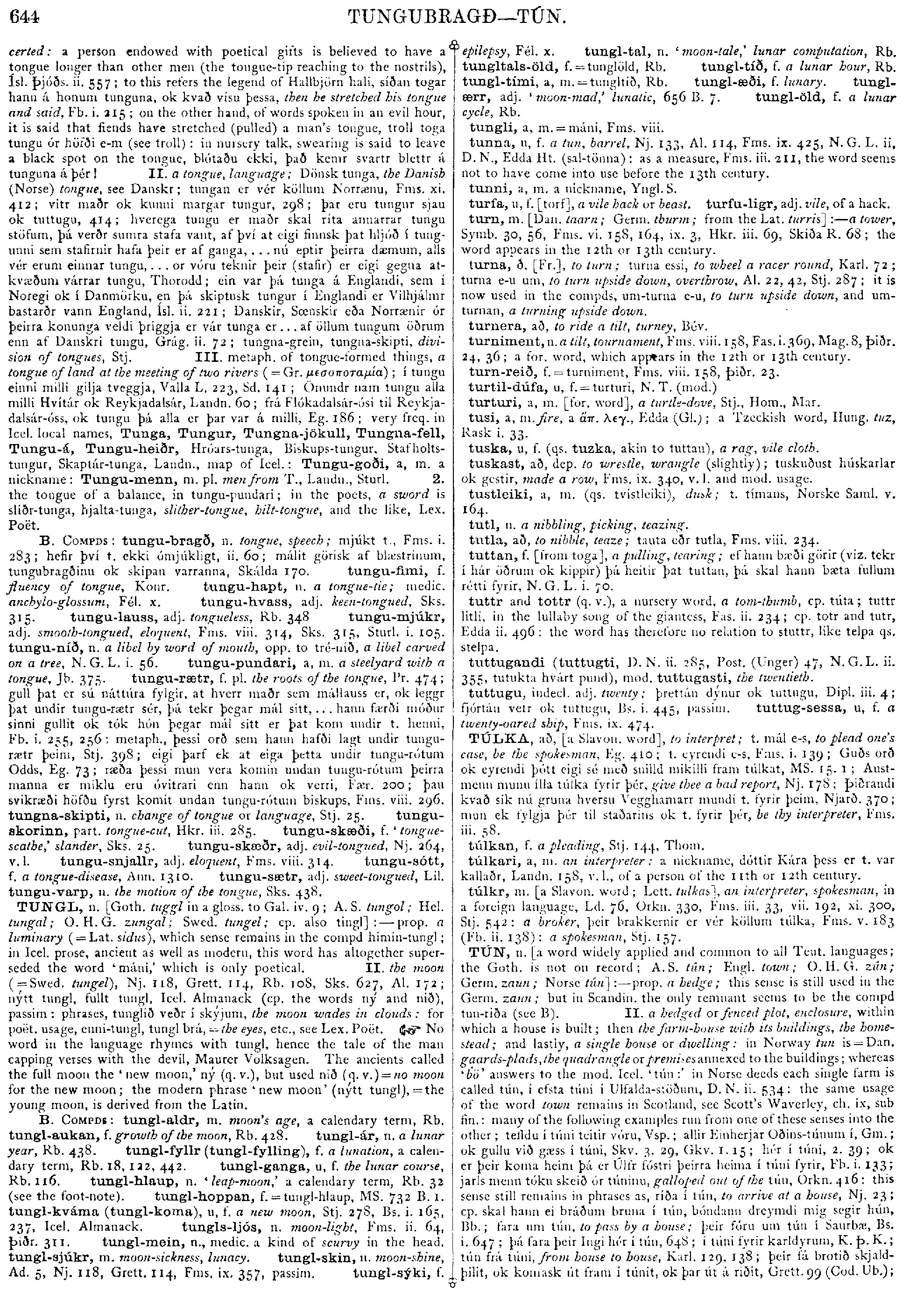
TUNGL, n. [Goth. tuggl in a gloss, to Gal. iv. 9; A.S. tungol; Hel. tungal; O.H.G. zungal; Swed. tungel; cp. also tingl] :-- prop. a luminary (= Lat. sidus), which sense remains in the compd himin-tungl; in Icel. prose, ancient as well as modern, this word has altogether superseded the word 'máni,' which is only poetical. II. the moon(= Swed. tungel), Nj. 118, Grett. 114, Rb. 108, Sks. 627, Al. 172; nýtt tungl, fullt tungl, Icel. Almanack (cp. the words ný and nið), passim: phrases, tunglið veðr í skýjum, the moon wades in clouds: for poët, usage, enni-tungl, tungl brá, = the eyes, etc., see Lex. Poët. No word in the language rhymes with tungl, hence the tale of the man capping verses with the devil, Maurer Volksagen. The ancients called the full moon the 'new moon,' ný (q.v.), but used nið (q.v.) = no moon for the new moon; the modern phrase 'new moon' (nýtt tungl), = the young moon, is derived from the Latin. B. COMPDS: tungl-aldr, m. moon's age, a calendary term, Rb. tungl-aukan, f. growth of the moon, Rb. 428. tungl-ár, n. a lunar year, Rb. 438. tungl-fyllr (tungl-fylling), f. a lunation, a calendary term, Rb. 18, 122, 442. tungl-ganga, u, f. the lunar course, Rb. 116. tungl-hlaup, n. 'leap-moon,' a calendary term, Rb. 32 (see the foot-note). tungl-hoppan, f. = tungl-hlaup, MS. 732 B. I. tungl-kváma (tungl-koma), u, f. a new moon, Stj. 278, Bs. i. 165, 237, Icel. Almanack. tungls-ljós, n. moon-light, Fms. ii. 64, Þiðr. 311. tungl-mein, n., medic, a kind of scurvy in the head. tungl-sjúkr, m. moon-sickness, lunacy. tungl-skin, n. moon-shine, Ad. 5, Nj. 118, Grett. 114, Fms. ix. 357, passim. tungl-sýki, f. epilepsy, Fél. x. tungl-tal, n. 'moon-tale,' lunar computation, Rb. tungltals-öld, f. = tunglöld, Rb. tungl-tíð, f. a lunar hour, Rb. tungl-tími, a, m. = tungltið, Rb. tungl-æði, f. lunary. tungl-ærr, adj. 'moon-mad,' lunatic, 656 B. 7. tungl-öld, f. a lunar cycle, Rb.
|
Source: Cleasby/Vigfusson, page b0644, entry 21 View original page image as: [TIFF] [PNG] [View previous entry] [View next entry] |
[Comment on this entry] [View comments] |
The following entry has been hand-corrected once. |
tuttr and tottr (q.v.), a nursery word, a tom-thumb, cp. túta; tuttr litli, in the lullaby song of the giantess, Fas. ii. 234; cp. totr and tutr, Edda ii. 496: the word has therefore no relation to stuttr, like telpa qs. stelpa.
|
Source: Cleasby/Vigfusson, page b0644, entry 28 View original page image as: [TIFF] [PNG] [View previous entry] [View next entry] |
[Comment on this entry] [View comments] |
The following entry has been hand-corrected once. |
TÚN, n. [a word widely applied and common to all Teut. languages; the Goth. is not on record; A.S. tûn; Engl. town; O.H.G. zûn; Germ. zaun; Norse tûn] :-- prop. a hedge; this sense is still used in the Germ. zaun; but in Scandin. the only remnant seems to be the compd tun-riða (see B). II. a hedged or fenced plot, enclosure, within which a house is built; then the farm-house with its buildings, the homestead; and lastly, a single house or dwelling: in Norway tun is = Dan. gaards-plads, the quadrangle or premises annexed to the buildings; whereas 'bö' answers to the mod. Icel. 'tún:' in Norse deeds each single farm is called tún, í efsta túni í Ulfalda-stöðum, D.N. ii. 534: the same usage of the word town remains in Scotland, see Scott's Waverley, ch. ix, sub fin.: many of the following examples run from one of these senses into the other; tefldu í túni teitir vóru, Vsp.; allir Einherjar Oðins-túnum í, Gm.; ok gullu við gæss í túni, Skv. 3. 29, Gkv. 1. 15; hér í túni, 2. 39; ok er þeir koma heim þá er Úlfr fóstri þeirra heima í túni fyrir, Fb. i. 133; jarls menn tóku skeið ór túninu, galloped out of the tún, Orkn. 416: this sense still remains in phrases as, ríða í tún, to arrive at a house, Nj. 23; cp. skal hann ei bráðum bruna í tún, bóndann dreymdi mig segir hún, Bb.; fara um tún, to pass by a house; þeir fóru um tún í Saurbæ, Bs. i. 647; þá fara þeir Ingi hér í tún, 648; í túni fyrir karldyrum, K.Þ.K.; tún frá túni, from house to house, Karl. 129, 138; þeir fá brotið skjaldþilit, ok komask út fram í túnit, ok þar út á riðit, Grett, 99 (Cod. Ub.);
|
Source: Cleasby/Vigfusson, page b0645, entry 1 View original page image as: [TIFF] [PNG] [View previous entry] [View next entry] |
[Comment on this entry] [View comments] |
The following entry has been hand-corrected once. |
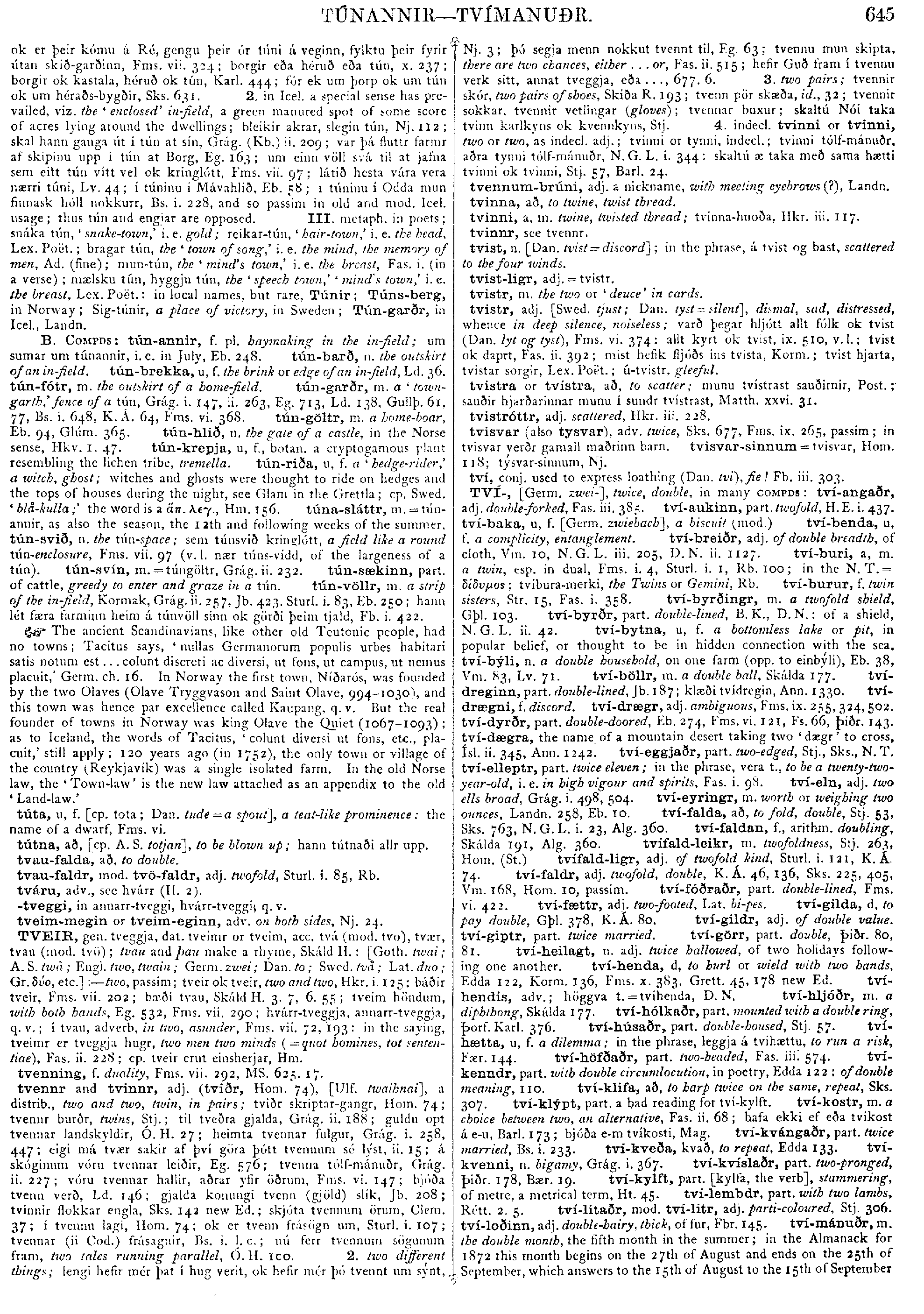
ok er þeir kómu á Ré, gengu þeir ór túni á veginn, fylktu þeir fyrir útan skíð-garðinn, Fms. vii. 324; borgir eða héruð eða tún, x. 237; borgir ok kastala, héruð ok tún, Karl. 444; fór ek um þorp ok um tún ok um héraðs-bygðir, Sks. 631. 2. in Icel. a special sense has prevailed, viz. the 'enclosed' in-field, a green manured spot of some score of acres lying around the dwellings; bleikir akrar, slegin tún, Nj. 112; skal hann ganga út í tún at sín, Grág. (Kb.) ii. 209; var þá fluttr farmr af skipinu upp í tún at Borg, Eg. 163; um einn völl svá til at jafna sem eitt tún vítt vel ok kringlótt, Fms. vii. 97; látið hesta vára vera nærri túni, Lv. 44; í túninu í Mávahlíð, Eb. 58; í túninu í Odda mun finnask hóll nokkurr, Bs. i. 228, and so passim in old and mod. Icel. usage; thus tún and engiar are opposed. III. metaph. in poets; snáka tún, 'snake-town,' i.e. gold; reikar-tún, 'hair-town' i.e. the head, Lex. Poët.; bragar tún, the 'town of song,' i.e. the mind, the memory of men, Ad. (fine); mun-tún, the 'mind's town,' i.e. the breast, Fas. i. (in a verse); mælsku tún, hyggju tún, the 'speech town,' 'mind's town,' i.e. the breast. Lex. Poët.: in local names, but rare, Túnir: Túns-berg, in Norway; Sig-túnir, a place of victory, in Sweden; Tún-garðr, in Icel., Landn. B. COMPDS: tún-annir, f. pl. haymaking in the in-field; um sumar um túnannir, i.e. in July, Eb. 248. tún-barð, n. the outskirt of an in-field. tún-brekka, u, f. the brink or edge of an in-field, Ld. 36. tún-fótr, m. the outskirt of a home-field, tún-garðr, m. a 'town-garth,' fence of a tún, Grág. i. 147, ii. 263, Eg. 713, Ld. 138, Gullþ. 61, 77, Bs. i. 648, K.Á. 64, Fms. vi. 368. tún-göltr, m. a home-boar, Eb. 94, Glúm. 365. tún-hlið, n. the gate of a castle, in the Norse sense, Hkv. I. 47. tún-krepja, u, f., botan. a cryptogamous plant resembling the lichen tribe, tremella. tún-riða, u, f. a 'hedge-rider,' a witch, ghost; witches and ghosts were thought to ride on hedges and the tops of houses during the night, see Glam in the Grettla; cp. Swed. 'blå-kulla;' the word is a GREEK., Hm. 156. túna-sláttr, m. = túnannir, as also the season, the 12th and following weeks of the summer. tún-svið, n. the tún-space; sem túnsvið kringlótt, a field like a round tún-enclosure, Fms. vii. 97 (v.l. nær túns-vídd, of the largeness of a tún). tún-svín, m. = túngöltr, Grág. ii. 232. tún-sækinn, part. of cattle, greedy to enter and graze in a tún. tún-völlr, m. a strip of the in-field, Kormak, Grág. ii. 257, Jb. 423. Stud. i. 83, Eb. 250; hann lét færa farminn heim á túnvöll sinn ok görði þeim tjald, Fb. i. 422. &FINGER; The ancient Scandinavians, like other old Teutonic people, had no towns; Tacitus says, 'nullas Germanorum populis urbes habitari satis notum est... colunt discreti ac diversi, ut fons, ut campus, ut nemus placuit,' Germ. ch. 16. In Norway the first town, Níðarós, was founded by the two Olaves (Olave Tryggvason and Saint Olave, 994-1030), and this town was hence par excellence called Kaupang, q.v. But the real founder of towns in Norway was king Olave the Quiet (1067-1093); as to Iceland, the words of Tacitus, 'colunt diversi ut fons, etc., placuit,' still apply; 120 years ago (in 1752), the only town or village of the country (Reykjavík) was a single isolated farm. In the old Norse law, the 'Town-law' is the new law attached as an appendix to the old 'Land-law.'
|
Source: Cleasby/Vigfusson, page b0645, entry 2 View original page image as: [TIFF] [PNG] [View previous entry] [View next entry] |
[Comment on this entry] [View comments] |
The following entry has been hand-corrected once. |
túta, u, f. [cp. tota; Dan. tude = a spout], a teat-like prominence: the name of a dwarf, Fms. vi.
| Result Page: |  |
Previous | 223 224 225 226 227 228 229 230 231 232 233 234 235 236 237 238 239 240 241 | Next |  |
Germanic Lexicon Project (main page)
This search system was written by
Sean Crist
Please consider
volunteering
to correct the data in these online dictionaries.
No rights reserved. Feel free to use these data in any way you please.