|
|

|
Source: Cleasby/Vigfusson, page b0239, entry 4 View original page image as: [TIFF] [PNG] [View previous entry] [View next entry] |
[Comment on this entry] [View comments] |
The following entry has been hand-corrected once. |
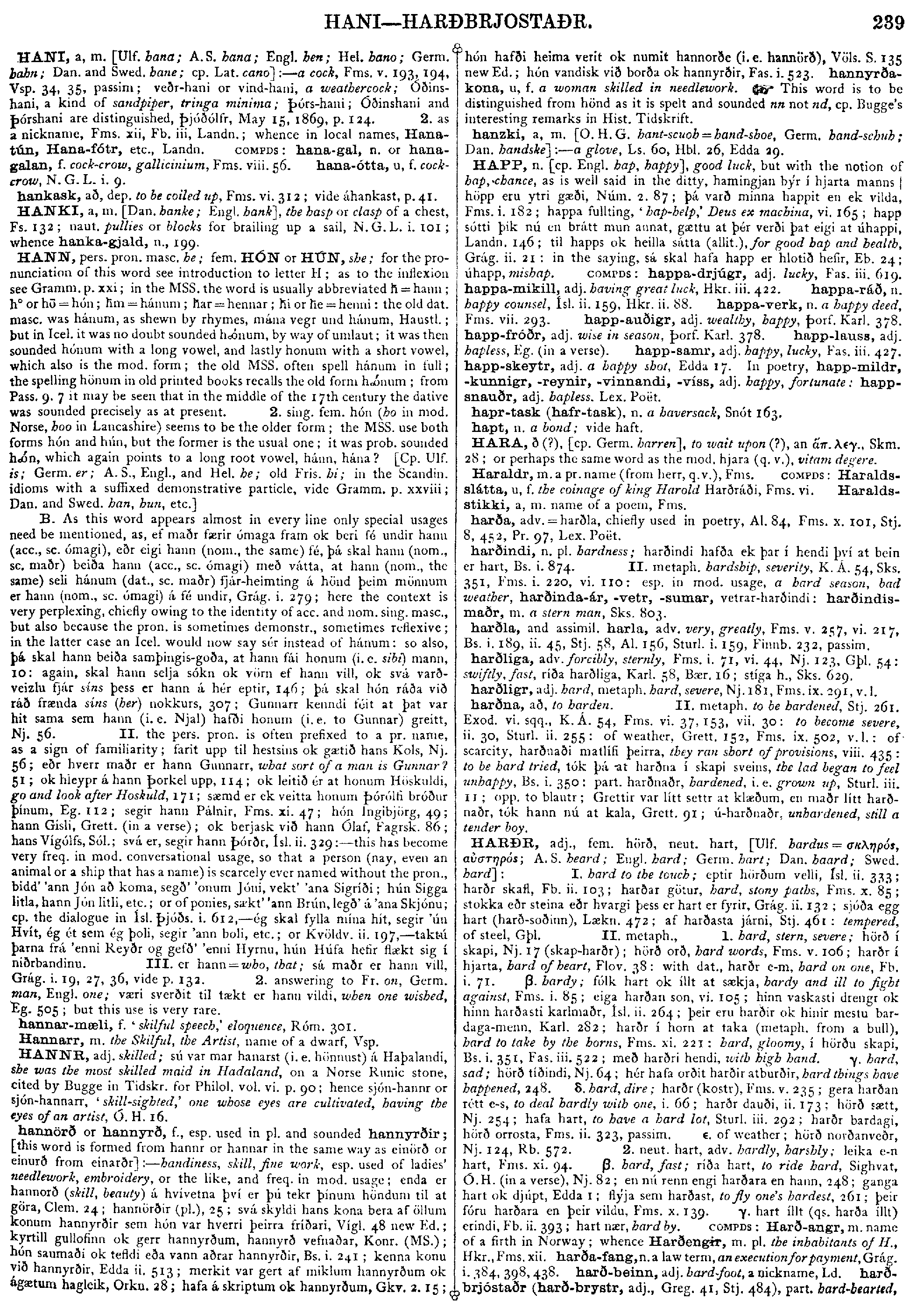
HANN,
pers.
pron.
masc.
he;
fem.
HÓN
or
HÚN,
she;
for
the
pronunciation
of
this
word
see
introduction
to
letter
H;
as
to
the
inflexion
see
Gramm.
p.
xxi;
in
the
MSS.
the
word
is
usually
abbreviated
&h-bar;
=
hann;
hº
or
h =
hón;
&h-bar;m
=
hánum;
&h-bar;ar
=
hennar;
&h-bar;i
or
&h-bar;e
=
henni:
the
old
dat.
masc.
was
hánum,
as
shewn
by
rhymes,
mána
vegr
und
hánum,
Haustl.;
but
in
Icel.
it
was
no
doubt
sounded
h
=
hón;
&h-bar;m
=
hánum;
&h-bar;ar
=
hennar;
&h-bar;i
or
&h-bar;e
=
henni:
the
old
dat.
masc.
was
hánum,
as
shewn
by
rhymes,
mána
vegr
und
hánum,
Haustl.;
but
in
Icel.
it
was
no
doubt
sounded
h num,
by
way
of
umlaut;
it
was
then
sounded
hónum
with
a
long
vowel,
and
lastly
honum
with
a
short
vowel,
which
also
is
the
mod.
form;
the
old
MSS.
often
spell
hánum
in
full;
the
spelling
hönum
in
old
printed
books
recalls
the
old
form
hnum;
from
Pass.
9.
7
it
may
be
seen
that
in
the
middle
of
the
17th
century
the
dative
was
sounded
precisely
as
at
present.
2.
sing.
fem.
hón
(ho
in
mod.
Norse,
hoo
in
Lancashire)
seems
to
be
the
older
form;
the
MSS.
use
both
forms
hón
and
hún,
but
the
former
is
the
usual
one;
it
was
prob.
sounded
hn,
which
again
points
to
a
long
root
vowel,
hánn,
hána?
[Cp.
Ulf.
is;
Germ.
er;
A.
S.,
Engl.,
and
Hel.
he;
old
Fris.
hi;
in
the
Scandin.
idioms
with
a
suffixed
demonstrative
particle,
vide
Gramm.
p.
xxviii;
Dan.
and
Swed.
han,
hun,
etc.]
num,
by
way
of
umlaut;
it
was
then
sounded
hónum
with
a
long
vowel,
and
lastly
honum
with
a
short
vowel,
which
also
is
the
mod.
form;
the
old
MSS.
often
spell
hánum
in
full;
the
spelling
hönum
in
old
printed
books
recalls
the
old
form
hnum;
from
Pass.
9.
7
it
may
be
seen
that
in
the
middle
of
the
17th
century
the
dative
was
sounded
precisely
as
at
present.
2.
sing.
fem.
hón
(ho
in
mod.
Norse,
hoo
in
Lancashire)
seems
to
be
the
older
form;
the
MSS.
use
both
forms
hón
and
hún,
but
the
former
is
the
usual
one;
it
was
prob.
sounded
hn,
which
again
points
to
a
long
root
vowel,
hánn,
hána?
[Cp.
Ulf.
is;
Germ.
er;
A.
S.,
Engl.,
and
Hel.
he;
old
Fris.
hi;
in
the
Scandin.
idioms
with
a
suffixed
demonstrative
particle,
vide
Gramm.
p.
xxviii;
Dan.
and
Swed.
han,
hun,
etc.]
|
Source: Cleasby/Vigfusson, page b0239, entry 5 View original page image as: [TIFF] [PNG] [View previous entry] [View next entry] |
[Comment on this entry] [View comments] |
The following entry has been hand-corrected once. |
B. As this word appears almost in every line only special usages need be mentioned, as, ef maðr færir ómaga fram ok beri fé undir hann (acc., sc. ómagi), eðr eigi hann (nom., the same) fé, þá skal hann (nom., sc. maðr) beiða hann (acc., sc. ómagi) með vátta, at hann (nom., the same) seli hánum (dat., sc. maðr) fjár-heimting á hönd þeim mönnum er hann (nom., sc. ómagi) á fé undir, Grág. i. 279; here the context is very perplexing, chiefly owing to the identity of acc. and nom. sing, masc., but also because the pron. is sometimes demonstr., sometimes reflexive; in the latter case an Icel. would now say sér instead of hánum: so also, þá skal hann beiða samþingis-goða, at hanu fái honum (i.e. sibi) mann, 10: again, skal hann selja sókn ok vörn ef hann vill, ok svá varðveizlu fjár síns þess er hann á hér eptir, 146; þá skal hón ráða við ráð frænda síns (her) nokkurs, 307; Gunnarr kenndi féit at þat var hit sama sem hann (i.e. Njal) hafði honum (i.e. to Gunnar) greitt, Nj. 56. II. the pers. pron. is often prefixed to a pr. name, as a sign of familiarity; farit upp til hestsins ok gætið hans Kols, Nj. 56; eðr hverr maðr er hann Gunnarr, what sort of a man is Gunnar? 51; ok hleypr á hann Þorkel upp, 114; ok leitið ér at honum Höskuldi, go and look after Hoskuld, 171; sæmd er ek veitta honum Þórólfi bróður þínum, Eg. 112; segir hann Pálnir, Fms. xi. 47; hón Ingibjörg, 49; hann Gísli, Grett. (in a verse); ok berjask við hann Ólaf, Fagrsk. 86; hans Vígólfs, Sól.; svá er, segir hann Þórðr, Ísl. ii. 329 :-- this has become very freq. in mod. conversational usage, so that a person (nay, even an animal or a ship that has a name) is scarcely ever named without the pron., bidd' 'ann Jón að koma, segð' 'onum Jóni, vekt' 'ana Sigríði; hún Sigga litla, hann Jón litli, etc.; or of ponies, sækt' 'ann Brún, legð' á 'ana Skjónu; cp. the dialogue in Ísl. Þjóðs. i. 612, -- ég skal fylla mína hít, segir 'ún Hvít, ég ét sem ég þoli, segir 'ann boli, etc.; or Kvöldv. ii. 197, -- taktú þarna frá 'enni Reyðr og gefð' 'enni Hyrnu, hún Húfa hefir flækt sig í niðrbandinu. III. er hann = who, that; sá maðr er hann vill, Grág. i. 19, 27, 36, vide p. 132. 2. answering to Fr. on, Germ. man, Engl. one; væri sverðit til tækt er hann vildi, when one wished, Eg. 505; but this use is very rare.
|
Source: Cleasby/Vigfusson, page b0239, entry 9 View original page image as: [TIFF] [PNG] [View previous entry] [View next entry] |
[Comment on this entry] [View comments] |
The following entry has been hand-corrected once. |
hannörð or hannyrð, f., esp. used in pl. and sounded hannyrðir; [this word is formed from hannr or hannar in the same way as einörð or einurð from einarðr] :-- handiness, skill, fine work, esp. used of ladies' needlework, embroidery, or the like, and freq. in mod. usage; enda er hannorð (skill, beauty) á hvívetna því er þú tekr þínum höndum til at göra, Clem. 24; hannörðir (pl.), 25; svá skyldi hans kona bera af öllum konum hannyrðir sem hón var hverri þeirra fríðari, Vígl. 48 new Ed.; kyrtill gullofinn ok gerr hannyrðum, hannyrð vefnaðar, Konr. (MS.); hón saumaði ok tefldi eða vann aðrar hannyrðir, Bs. i. 241; kenna konu við hannyrðir, Edda ii. 513; merkit var gert af miklum hannyrðum ok ágætum hagleik, Orkn. 28; hafa á skriptum ok hannyrðum, Gkv. 2. 15; hón hafði heima verit ok numit hannorðe (i.e. hannörð), Völs. S. 135 new Ed.; hón vandisk við borða ok hannyrðir, Fas. i. 523. hannyrða-kona, u, f. a woman skilled in needlework. UNCERTAIN This word is to be distinguished from hönd as it is spelt and sounded nn not nd, cp. Bugge's interesting remarks in Hist. Tidskrift.
|
Source: Cleasby/Vigfusson, page b0239, entry 11 View original page image as: [TIFF] [PNG] [View previous entry] [View next entry] |
[Comment on this entry] [View comments] |
The following entry has been hand-corrected once. |
HAPP, n. [cp. Engl. hap, happy], good luck, but with the notion of hap, chance, as is well said in the ditty, hamingjan býr í hjarta manns | höpp eru ytri gæði, Núm. 2. 87; þá varð minna happit en ek vilda, Fms. i. 182; happa fullting, 'hap-help,' Deus ex machina, vi. 165; happ sótti þik nú en brátt mun annat, gættu at þér verði þat eigi at úhappi, Landn. 146; til happs ok heilla sátta (allit.), for good hap and health, Grág. ii. 21: in the saying, sá skal hafa happ er hlotið hefir, Eb. 24; úhapp, mishap. COMPDS: happa-drjúgr, adj. lucky, Fas. iii. 619. happa-mikill, adj. having great luck, Hkr. iii. 422. happa-ráð, n. happy counsel, Ísl. ii. 159, Hkr. ii. 88. happa-verk, n. a happy deed, Fms. vii. 293. happ-auðigr, adj. wealthy, happy, Þorf. Karl. 378. happ-fróðr, adj. wise in season, Þorf. Karl. 378. happ-lauss, adj. hapless, Eg. (in a verse). happ-samr, adj. happy, lucky, Fas. iii. 427. happ-skeytr, adj. a happy shot, Edda 17. In poetry, happ-mildr, -kunnigr, -reynir, -vinnandi, -víss, adj. happy, fortunate: happ-snauðr, adj. hapless. Lex. Poët.
|
Source: Cleasby/Vigfusson, page b0239, entry 14 View original page image as: [TIFF] [PNG] [View previous entry] [View next entry] |
[Comment on this entry] [View comments] |
The following entry has been hand-corrected once. |
HARA, ð (?), [cp. Germ. harren], to wait upon (?), an GREEK, Skm. 28; or perhaps the same word as the mod. hjara (q.v.), vitam degere.
|
Source: Cleasby/Vigfusson, page b0241, entry 21 View original page image as: [TIFF] [PNG] [View previous entry] [View next entry] |
[Comment on this entry] [View comments] |
The following entry has been hand-corrected once. |
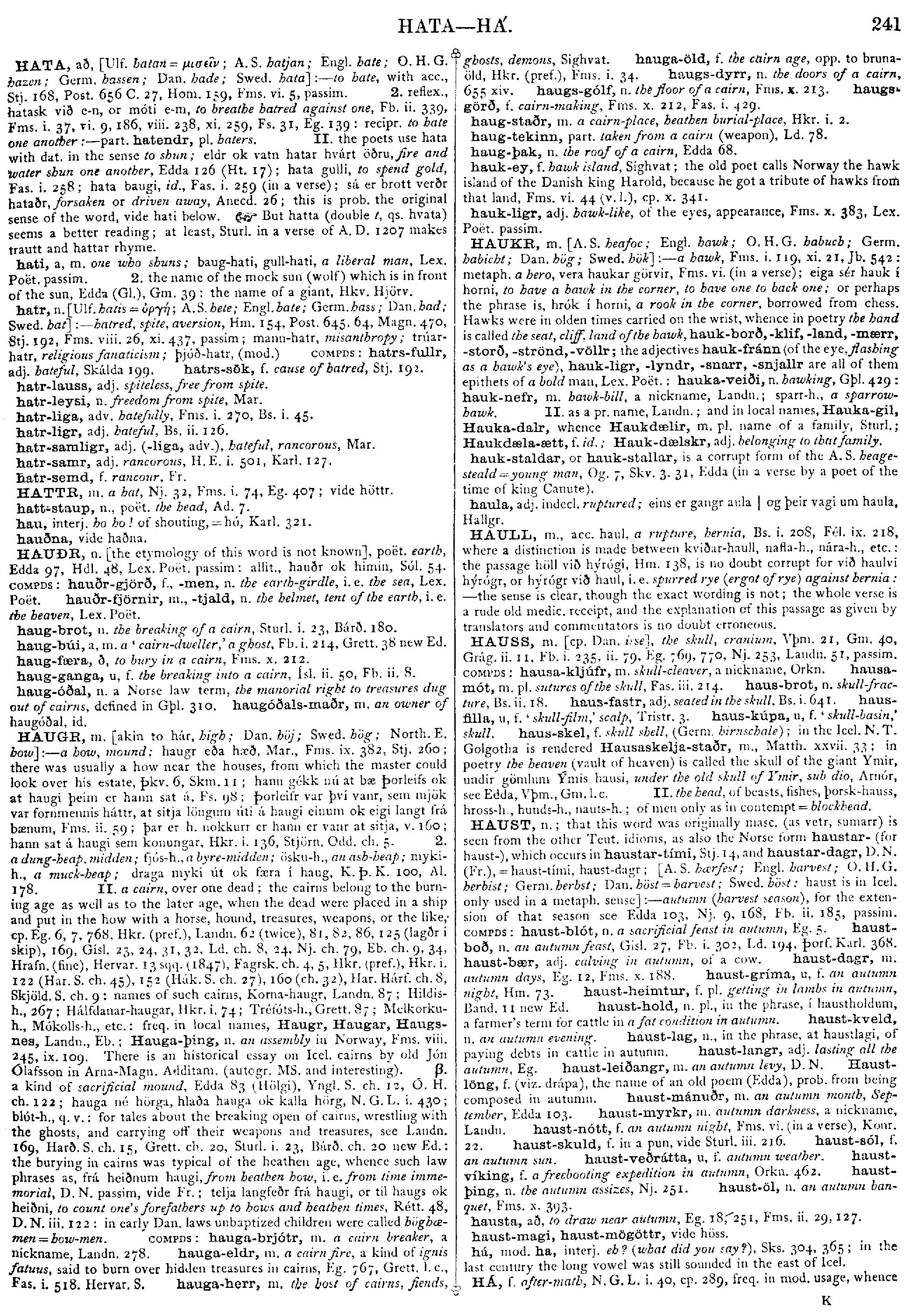
HAUGR,
m.
[akin
to
hár,
high;
Dan.
höj;
Swed.
hog;
North.
E.
how]
:--
a
how,
mound;
haugr
eða
hæð,
Mar.,
Fms.
ix.
382,
Stj.
260;
there
was
usually
a
how
near
the
houses,
from
which
the
master
could
look
over
his
estate,
Þkv.
6,
Skm.
11;
hann
gékk
nú
at
bæ
Þorleifs
ok
at
haugi
þeim
er
hann
sat
a.,
Fs.
98;
Þorleifr
var
því
vanr,
sem
mjök
var
fornmennis
háttr,
at
sitja
löngum
úti
á
haugi
einum
ok
eigi
langt
frá
bænum,
Fms.
ii.
59;
þar
er
h.
nokkurr
er
hann
er
vanr
at
sitja,
v.
160;
hann
sat
á
haugi
sem
konungar,
Hkr.
i.
136,
Stjörn.
Odd.
ch.
5.
2.
a
dung-heap.
midden;
fjós-h.,
a
byre-midden;
ösku-h.,
an
ash-heap;
myki-h.,
a
muck-heap;
draga
myki
út
ok
færa
í
haug,
K.
Þ.
K.
100,
Al.
178.
II.
a
cairn,
over
one
dead;
the
cairns
belong
to
the
burning
age
as
well
as
to
the
later
age,
when
the
dead
were
placed
in
a
ship
and
put
in
the
how
with
a
horse,
hound,
treasures,
weapons,
or
the
like,
cp.
Eg.
6,
7,
768.
Hkr.
(pref.),
Landn.
62
(twice),
81,
82,
86,
125
(lagðr
í
skip),
169,
Gísl.
23,
24,
31,
32,
Ld.
ch.
8,
24,
Nj.
ch.
79,
Eb.
ch.
9,
34,
Hrafn.
(fine),
Hervar.
13
sqq.
(1847),
Fagrsk.
ch.
4,
5,
Hkr.
(pref.),
Hkr.
i.
122
(Har.
S.
ch.
45),
152
(Hák.
S.
ch.
27),
160
(ch.
32),
Har.
Hárf.
ch.
8,
Skjöld.
S.
ch.
9:
names
of
such
cairns,
Korna-haugr,
Landn.
87;
Hildis-h.,
267;
Hálfdanar-haugar,
Hkr.
i.
74;
Tréfóts-h.,
Grett.
87;
Melkorku-h.,
Mókolls-h.,
etc.:
freq.
in
local
names,
Haugr,
Haugar,
Haugs-nes,
Landn.,
Eb.;
Hauga-þing,
n.
an
assembly
in
Norway,
Fms.
viii.
245,
ix.
109.
There
is
an
historical
essay
on
Icel.
cairns
by
old
Jón
Ólafsson
in
Arna-Magn.
Additam.
(autogr.
MS.
and
interesting).
 .
a
kind
of
sacrificial
mound,
Edda
83
(Hölgi),
Yngl.
S.
ch.
12,
Ó.
H.
ch.
122;
hauga
né
hörga,
hlaða
hauga
ok
kalla
hörg,
N.
G.
L.
i.
430;
blót-h.,
q.v.:
for
tales
about
the
breaking
open
of
cairns,
wrestling
with
the
ghosts,
and
carrying
off
their
weapons
and
treasures,
see
Landn.
169,
Harð.
S.
ch.
15,
Grett.
ch.
20,
Sturl.
i.
23,
Bárð.
ch.
20
new
Ed.:
the
burying
in
cairns
was
typical
of
the
heathen
age,
whence
such
law
phrases
as,
frá
heiðnum
haugi,
from
heathen
how,
i.e.
from
time
immemorial,
D.
N.
passim,
vide
Fr.;
telja
langfeðr
frá
haugi,
or
til
haugs
ok
heiðni,
to
count
one's
forefathers
up
to
hows
and
heathen
times,
Rétt.
48,
D.
N.
iii.
122:
in
early
Dan.
laws
unbaptized
children
were
called
höghæmen
=
how-men.
COMPDS:
hauga-brjótr,
m.
a
cairn
breaker,
a
nickname,
Landn.
278.
hauga-eldr,
m.
a
cairn
fire,
a
kind
of
ignis
fatuus,
said
to
burn
over
hidden
treasures
in
cairns,
Eg.
767,
Grett.
l.c.,
Fas.
i.
518.
Hervar.
S.
hauga-herr,
m.
the
host
of
cairns,
fiends,
ghosts,
demons,
Sighvat.
hauga-öld,
f.
the
cairn
age,
opp.
to
bruna-öld,
Hkr.
(pref.),
Fms.
i.
34.
haugs-dyrr,
n.
the
doors
of
a
cairn,
655
xiv.
haugs-gólf,
n.
the
floor
of
a
cairn,
Fms.
x.
213.
haugs-görð,
f.
cairn-making,
Fms.
x.
212,
Fas.
i.
429.
.
a
kind
of
sacrificial
mound,
Edda
83
(Hölgi),
Yngl.
S.
ch.
12,
Ó.
H.
ch.
122;
hauga
né
hörga,
hlaða
hauga
ok
kalla
hörg,
N.
G.
L.
i.
430;
blót-h.,
q.v.:
for
tales
about
the
breaking
open
of
cairns,
wrestling
with
the
ghosts,
and
carrying
off
their
weapons
and
treasures,
see
Landn.
169,
Harð.
S.
ch.
15,
Grett.
ch.
20,
Sturl.
i.
23,
Bárð.
ch.
20
new
Ed.:
the
burying
in
cairns
was
typical
of
the
heathen
age,
whence
such
law
phrases
as,
frá
heiðnum
haugi,
from
heathen
how,
i.e.
from
time
immemorial,
D.
N.
passim,
vide
Fr.;
telja
langfeðr
frá
haugi,
or
til
haugs
ok
heiðni,
to
count
one's
forefathers
up
to
hows
and
heathen
times,
Rétt.
48,
D.
N.
iii.
122:
in
early
Dan.
laws
unbaptized
children
were
called
höghæmen
=
how-men.
COMPDS:
hauga-brjótr,
m.
a
cairn
breaker,
a
nickname,
Landn.
278.
hauga-eldr,
m.
a
cairn
fire,
a
kind
of
ignis
fatuus,
said
to
burn
over
hidden
treasures
in
cairns,
Eg.
767,
Grett.
l.c.,
Fas.
i.
518.
Hervar.
S.
hauga-herr,
m.
the
host
of
cairns,
fiends,
ghosts,
demons,
Sighvat.
hauga-öld,
f.
the
cairn
age,
opp.
to
bruna-öld,
Hkr.
(pref.),
Fms.
i.
34.
haugs-dyrr,
n.
the
doors
of
a
cairn,
655
xiv.
haugs-gólf,
n.
the
floor
of
a
cairn,
Fms.
x.
213.
haugs-görð,
f.
cairn-making,
Fms.
x.
212,
Fas.
i.
429.
|
Source: Cleasby/Vigfusson, page b0241, entry 25 View original page image as: [TIFF] [PNG] [View previous entry] [View next entry] |
[Comment on this entry] [View comments] |
The following entry has been hand-corrected once. |
hauk-ey, f. hawk island, Sighvat; the old poët calls Norway the hawk island of the Danish king Harold, because he got a tribute of hawks from that land, Fms. vi. 44 (v.l.), cp. x. 341.
|
Source: Cleasby/Vigfusson, page b0241, entry 31 View original page image as: [TIFF] [PNG] [View previous entry] [View next entry] |
[Comment on this entry] [View comments] |
The following entry has been hand-corrected once. |
HAUSS, m. [cp. Dan. isse], the skull, cranium, Vþm. 21, Gm. 40, Grág. ii. 11, Fb. i. 235, ii. 79, Eg. 769, 770, Nj. 253, Landn. 51, passim. COMPDS: hausa-kljúfr, m. skull-cleaver, a nickname, Orkn. hausa-mót, m. pl. sutures of the skull, Fas. iii. 214, haus-brot, n. skull-fracture, Bs. ii. 18. haus-fastr, adj. seated in the skull, Bs. i. 641. haus-filla, u, f. 'skull-film,' scalp, Tristr. 3. haus-kúpa, u, f. 'skull-basin,' skull. haus-skel, f. skull shell, (Germ. hirnschale); in the Icel. N. T. Golgotha is rendered Hausaskelja-staðr, m., Matth. xxvii. 33; in poetry the heaven (vault of heaven) is called the skull of the giant Ymir, undir gömlum Ýmis hausi, under the old skull of Ymir, sub dio, Arnór, see Edda, Vþm., Gm. l.c. II. the head, of beasts, fishes, þorsk-hauss, hross-h., hunds-h., nauts-h.; of men only as in contempt = blockhead.
|
Source: Cleasby/Vigfusson, page b0241, entry 36 View original page image as: [TIFF] [PNG] [View previous entry] [View next entry] |
[Comment on this entry] [View comments] |
The following entry has been hand-corrected once. |
HÁ, f, after-math, N. G. L. i. 40, cp. 289, freq. in mod. usage, whence
|
Source: Cleasby/Vigfusson, page b0242, entry 6 View original page image as: [TIFF] [PNG] [View previous entry] [View next entry] |
[Comment on this entry] [View comments] |
The following entry has been hand-corrected once. |
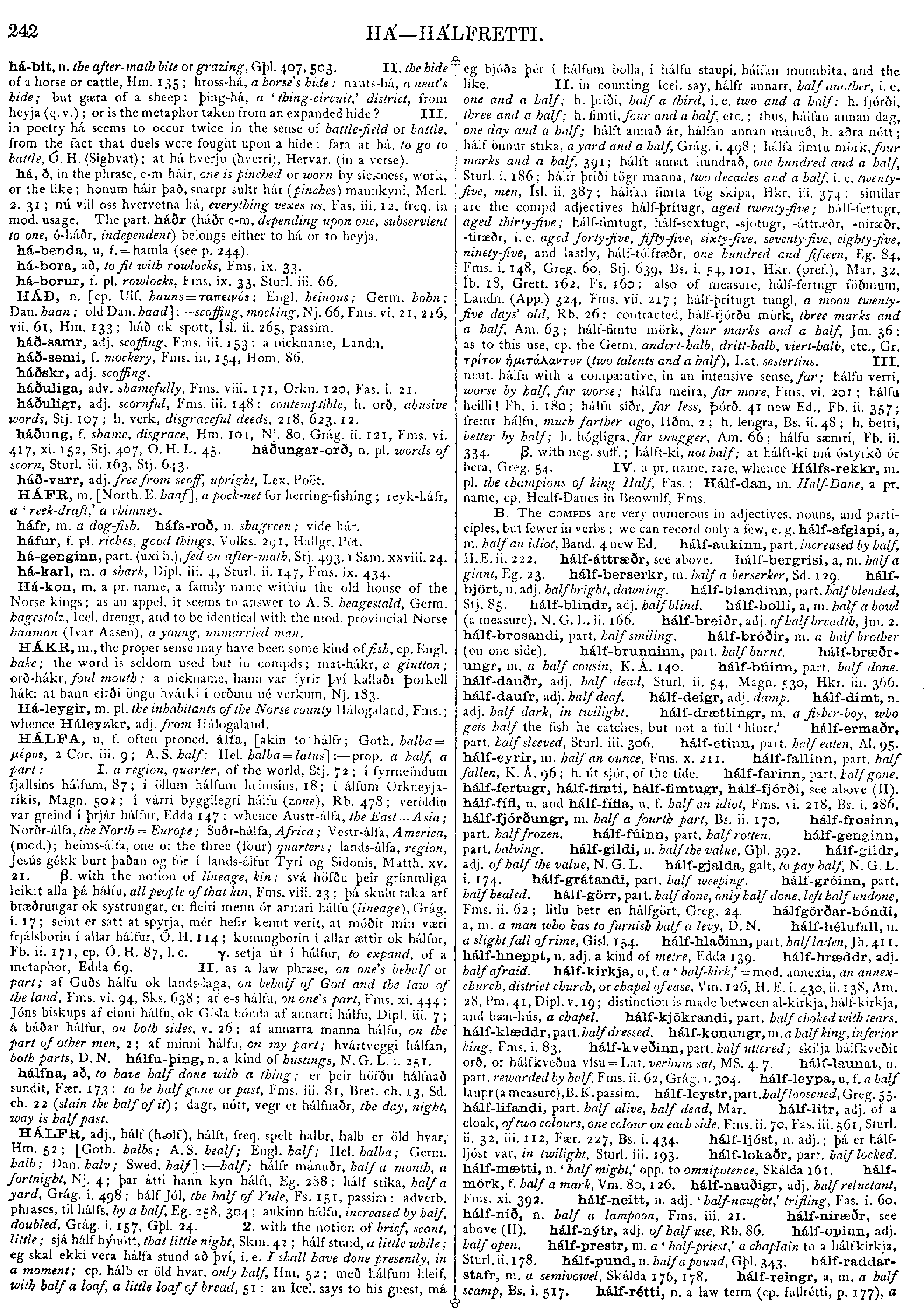
HÁÐ, n. [cp. Ulf. hauns = GREEK; Engl. heinous; Germ. hohn; Dan. haan; old Dan. haad] :-- scoffing, mocking, Nj. 66, Fms. vi. 21, 216, vii. 61, Hm. 133; háð ok spott, Ísl. ii. 265, passim.
| Result Page: |  |
Previous | 107 108 109 110 111 112 113 114 115 116 117 118 119 120 121 122 123 124 125 | Next |  |
Germanic Lexicon Project (main page)
This search system was written by
Sean Crist
Please consider
volunteering
to correct the data in these online dictionaries.
No rights reserved. Feel free to use these data in any way you please.