|
|

|
Source: Cleasby/Vigfusson, page b0247, entry 25 View original page image as: [TIFF] [PNG] [View previous entry] [View next entry] |
[Comment on this entry] [View comments] |
The following entry has been hand-corrected once. |
heiðni, f. heathendom, Fms. i. 47, passim: heathen worship, heathen practice, fremja h., N. G. L. i. 182; en síðar fám vetrum vas sú heiðni af numin sem önnur, Íb. 12, Nj. 160: the heathen age, Friðrekr kom í heiðni hér, Íb. 13: a heathen country, Fb. i. 343.
|
Source: Cleasby/Vigfusson, page b0257, entry 3 View original page image as: [TIFF] [PNG] [View previous entry] [View next entry] |
[Comment on this entry] [View comments] |
The following entry has been hand-corrected once. |
HÉRAÐ
or
hierat,
n.,
pl.
héruð
or
héröð,
spelt
hieroþ
in
the
vellum,
656
C.
9,
673
A.
53,
and
in
O.
H.
L.
Cod.
Upsal.
hærað,
see
p.
113:
[hérað
is
undoubtedly
derived
from
herr
(A.
S.
here),
a
host,
and
not
from
hér,
here;
the
long
vowel
(é)
is
prob.
caused
by
the
characteristic
j
in
her-r
(herj-);
so
that
hierað
(hérað),
through
the
after
effect
of
the
i
sound,
stands
for
heriað;
cp.
Dan.
herred,
Swed.
härad:
the
Old
Engl.
and
Scot.
law
term
heriot
may
also
be
connected
with
the
Scandin.
word,
in
which
case
the
original
sense
of
hérað
might
be
a
tax
to
be
paid
to
the
lord
in
lieu
of
military
service:
the
inflex.
-að
is
derived
from
auðr,
óðal,
as
has
been
suggested
by
the
old
commentators,
e.g.
Björn
á
Skarðsá]
:--
a
county,
district:
1.
in
Sweden
esp.
the
word
had
and
still
has
a
fixed
legal
sense,
county,
jurisdiction,
or
the
like,
cp.
Swed.
härads-höfding
=
justice
of
peace,
härads-ting
=
assize,
härads-fogde
=
bailiff:
so
in
local
names,
e.g.
Dan.
Thy-herred
in
Jutland,
Kvenna-hérað,
Vetta-h.,
in
Norway,
Hálfs.
S.,
Fb.
iii.
2.
in
Norway
hérað,
country,
was
usually
opp.
to
bær,
town,
and
answers
to
Icel.
sveit
in
mod.
usage;
í
bæ
ok
í
héraði,
D.
N.
iii.
35,
101;
hérað
eðr
kaupstaði,
Fms.
vii.
187;
í
héraði
né
í
kaupangi,
N.
G.
L.
ii.
39;
allt
þat
er
í
kaupangi
er
gört
þá
skal
þat
at
kaupangrs-rétti
sækja,
en
allt
þat
er
í
héraði
er
gört
millum
héraðs-manna
ok
bíar-manna,
þá
skal
þat
allt
at
héraðs-rétti
sækja,
N.
G.
L.
ii.
88
and
passim;
ef
maðr
á
hús
í
kaupangi
en
bæ
í
héraði,
id.;
cp.
héraðs-dómr,
-höldr,
-kirkja,
-menn,
-prestr,
-réttr,
-þing,
etc.,
below.
3.
in
Icel.
the
sense
varies,
but
is
for
the
most
part
merely
geographical,
a
district,
valley,
fjord,
country,
as
bordered
by
mountains
or
within
the
same
river-basin;
thus
the
Skaga-fjörðr,
Eyja-fjördr
are
each
a
hérað,
and
the
former
is
specially
so
called,
see
Sturl.
passim,
Grett.
153
(hann
sendi
þegar
eptir
mönnum
upp
í
Hérað);
whence
Héraðs-vötn,
n.
pl.
Herad
water,
a
river
of
that
county,
Landn.;
so
Fljótsdals-hérað,
in
the
east
of
Icel.,
Hrafn.
2,
3;
cp.
þeir
riðu
ór
héraði,
Sturl.
iii.
158;
ef
maðr
ríðr
um
fjöll
þau
er
vatnföll
deilir
af
á
millum
héraða,
Grág.
(Kb.)
ii.
61,
65;
í
héraði
því
(dale)
er
Reykja-dalr
heitir,
Sturl.
i.
130.
 .
gener.
a
neighbourhood;
Gunnarr
reið
um
héraðit
at
bjóða
mönnum,
Nj.
49.
4.
generally
a
district;
í
Svíþjóð
eru
stór
héruð
mörg,
Hkr.
i.
5;
í
héraði
því
er
Mesopotamia
heitir,
623.
52;
fjarlæg
héruð,
Fms.
x.
374;
sam-héraðs,
within
the
same
district;
utan-héraðs,
outside
the
district;
innan-h.,
inside,
passim;
í
öllum
héruðum
Gyðinga,
656
C.
9;
í
héraði
því
er
á
Fjóni
heitir,
Fms.
xi.
43;
Galilea-hérað,
Campania-h.,
Cappadokia-h.,
Post.,
etc.
.
gener.
a
neighbourhood;
Gunnarr
reið
um
héraðit
at
bjóða
mönnum,
Nj.
49.
4.
generally
a
district;
í
Svíþjóð
eru
stór
héruð
mörg,
Hkr.
i.
5;
í
héraði
því
er
Mesopotamia
heitir,
623.
52;
fjarlæg
héruð,
Fms.
x.
374;
sam-héraðs,
within
the
same
district;
utan-héraðs,
outside
the
district;
innan-h.,
inside,
passim;
í
öllum
héruðum
Gyðinga,
656
C.
9;
í
héraði
því
er
á
Fjóni
heitir,
Fms.
xi.
43;
Galilea-hérað,
Campania-h.,
Cappadokia-h.,
Post.,
etc.
|
Source: Cleasby/Vigfusson, page b0257, entry 4 View original page image as: [TIFF] [PNG] [View previous entry] [View next entry] |
[Comment on this entry] [View comments] |
The following entry has been hand-corrected once. |
B. COMPDS: héraðs-bóndi, a, m. a franklin, Eg. 516, Sturl. iii. 259. héraðs-bót, f. a bettering the affairs of a district, Lv. 45, Fs. 51 (where = mod. landhreinsun). héraðs-brestr, m., for the pun see Glúm. 375. héraðs-bygð, f. a county and its people, Lv. 49, Sturl. iii. 81. héraðs-deild, f. a county quarrel, Sturl. ii. 154. héraðs-dómr, m. a county court, Grág. i. 117, 452. héraðs-fleygr, adj. (-fleyttr, N. G. L. i. 352), rumoured abroad, of news; þá eru sakir héraðfleygjar er meiri hlutr hefir spurt þingheyjanda í þeim hrepp er sakir koma upp ok hyggi menn at satt sé, Grág. ii. 101. héraðs-flótti, a, m. flight or exile from a district, Korm. 48. héraðs-fundr, m. a county assize, Nj. 120, Sturl. iii. 160. héraðs-færsla, u, f. a passing on the poor from one district to another, Grág. i. 229. héraðs-hæfr, adj. = héraðsvært, N. G. L. ii. 454. héraðs-höfðingi, a, m. a chieftain, = goði (q.v.), Eb. 156, Fs. 80; cp. yfirmaðr héraðs, 4. héraðs-höldr, m. a Norse term, a country franklin ( =Icel. sveitabóndi), Fagrsk. ch. 16. héraðs-íseta, u, f. = héraðsvist, Sturl. iii. 260. héraðs-kirkja, u, f. a parish church (Norse), N. G. L. i. 344, Fms. x. 153. héraðs-kona, u, f. a woman of the county (Norse), N. G. L. i. 234. héraðs-konungr, m. a kinglet, Hkr. i. 46. héraðs-lýðr, m. people of the district, 625. 72. héraðs-menn, m. pl. men of the district, Grág. i. 253; in Norse sense country-people, as opp. to bæjarmenn, town-people, Gþl. 264, N. G. L. ii. 88, passim. héraðs-prestr, m. a parish priest, N. G. L. i. 346. héraðs-réttr, m. = héraðsdómr, N. G. L. ii. 88. héraðs-riddari, a, m. a knight of the district, Róm. 309. héraðs-ríkr, adj. of influence in one's district, Ld. 298, Grett. 121 A, Ísl. ii. 402. héraðs-rækr, adj. banished from the district, Grág. i. 501. héraðs-sekr, adj. a law term, exiled from a district or jurisdiction, opp. to exiled from the country, Nj. 156, Sturl. i. 145, ii. 92; hann var görr h. svá víða sem vötn féllu til Skagafjarðar, Fs. 34; hann var h. ok skyldi búa eigi nær en í Hörgár-dal, Glúm. 390, cp. Landn. 286. héraðs-sekt, f. exile, the being héraðs-sekr, opp. to utanferðir, Nj. 189, 256, Grett. 120, Sturl. ii. 255. héraðs-sókn, f. a county action (suit), opp. to a suit in alþingi, Grág. i. 452, Jb. 10, 353. héraðs-stefna, u, f. a county assize (Norse), D. N. iii. 120. héraðs-stjórn, f. county government, Ísl. ii. 125; talaði Einarr langt erindi um h., Glúm. 372 (public affairs). héraðs-takmark, n. the borders of a territory, Grág. ii. 404. héraðs-vist, f. abiding within a certain h., Eb. 252; láta h. sína = to be héraðssekr, Grett. 120, Nj. 228. héraðs-vært, n. adj.; eiga h., being at liberty to reside within a district, Glúm. 382, not being héraðssekr. héraðs-þing, n. a county assize (cp. Swed. härads ting), Eb. 12; used as synonymous with várþing, in opp. to alþingi, Grág. ii. 96, Fms. i. 77, Jb. (Norse), N. G. L. ii. 138.
|
Source: Cleasby/Vigfusson, page b0265, entry 38 View original page image as: [TIFF] [PNG] [View previous entry] [View next entry] |
[Comment on this entry] [View comments] |
The following entry has been hand-corrected once. |
HJARL, n., only poët. a land, country, Lex. Poët. COMPDS: hjarl-stríðandi, part. a champion fighting for the land, Lex. Poët. hjarl-þvengr, m., poët. a snake.
|
Source: Cleasby/Vigfusson, page b0274, entry 47 View original page image as: [TIFF] [PNG] [View previous entry] [View next entry] |
[Comment on this entry] [View comments] |
The following entry has been hand-corrected once. |
HLÆJA, pres. hlær, pl. hlægjum; pret. hló (qs. hlóg), 2nd pers. hlótt, mod. hlóst; pl. hlógu, mod. hlóu; pret. subj. hlægi; imperat. hlæ, hlaeðu; part. hleginn; [Ulf. hlahjan; A. S. hlihan; Engl. laugh; Hel. hlahan; O. H. G. hlahhan; old Frank, hlaka; Germ. lachen; Dan. le] :-- to laugh, Hðm. 20, Skv. 3. 30, Am. 61, Akv. 24; h. hátt, to laugh loud, Skv. 2. 15; Grímr var ekki kátr, ok aldri hló hann síðan Helgi var fallinn, Dropl. 27; Grímr skelldi upp ok hló, 31; hví hlóttu nú? Fms. vi. 390; hló Vigfúss at? Halli mælti, þat er vani þeirra feðga at hlæja, þá er vígahugr er á þeim, Glúm. 367; hón hlaer við hvert orð, Nj. 18; h. dátt, to laugh heartily; skelli-hlægja, to roar with laughter; h. hlátr, Hildigunnr hló kalda-hlátr, Nj.: phrases, þá hló marmennill, then the merman laughed, of a sudden, unreasonable burst of laughter, Fas. Hálfs. S. ch. 7, Ísl. Þjóðs. i. 133: as also Merlin (1869), ch. 23; hugr hlaer, one's heart laughs; at minn hugr hlægja við honum, Fas. i. 195; hlær mér þess hugr, Fms. xi. 96; þau tíðendi er þeim hló hugr við, ix. 494, v.l.; löngum hlaer lítið vit, long laugh, little wit; hleginn, laughed at, Niðrst. 6. 2. with prep.; hlæja at e-u, to laugh at a thing; Hrútr hló at ok gékk í braut, Nj. 10; allt fólk hló at þeim, Fms. ix. 494, Glúm. 366, passim (at-hlægi). II. metaph. of a country, the hills are said to laugh in welcoming a guest and to droop at his going away; Drúpir Höfði, dauðr er Þengill, hlægja hlíðir við Hallsteini, Landn. (in a verse); Há þóttu mér hlaegja ... of Noreg allan | klif meðan Ólafr lifði, Sighvat: the blunt edge is said to laugh in one's face, síðan tók ek hein ór pússi mínum ok reið ek í eggina, svá at exin var svá slæ, at hón hló móti mér áðr en við skildum, Sturl. ii. 62.
|
Source: Cleasby/Vigfusson, page b0282, entry 24 View original page image as: [TIFF] [PNG] [View previous entry] [View next entry] |
[Comment on this entry] [View comments] |
The following entry has been hand-corrected once. |
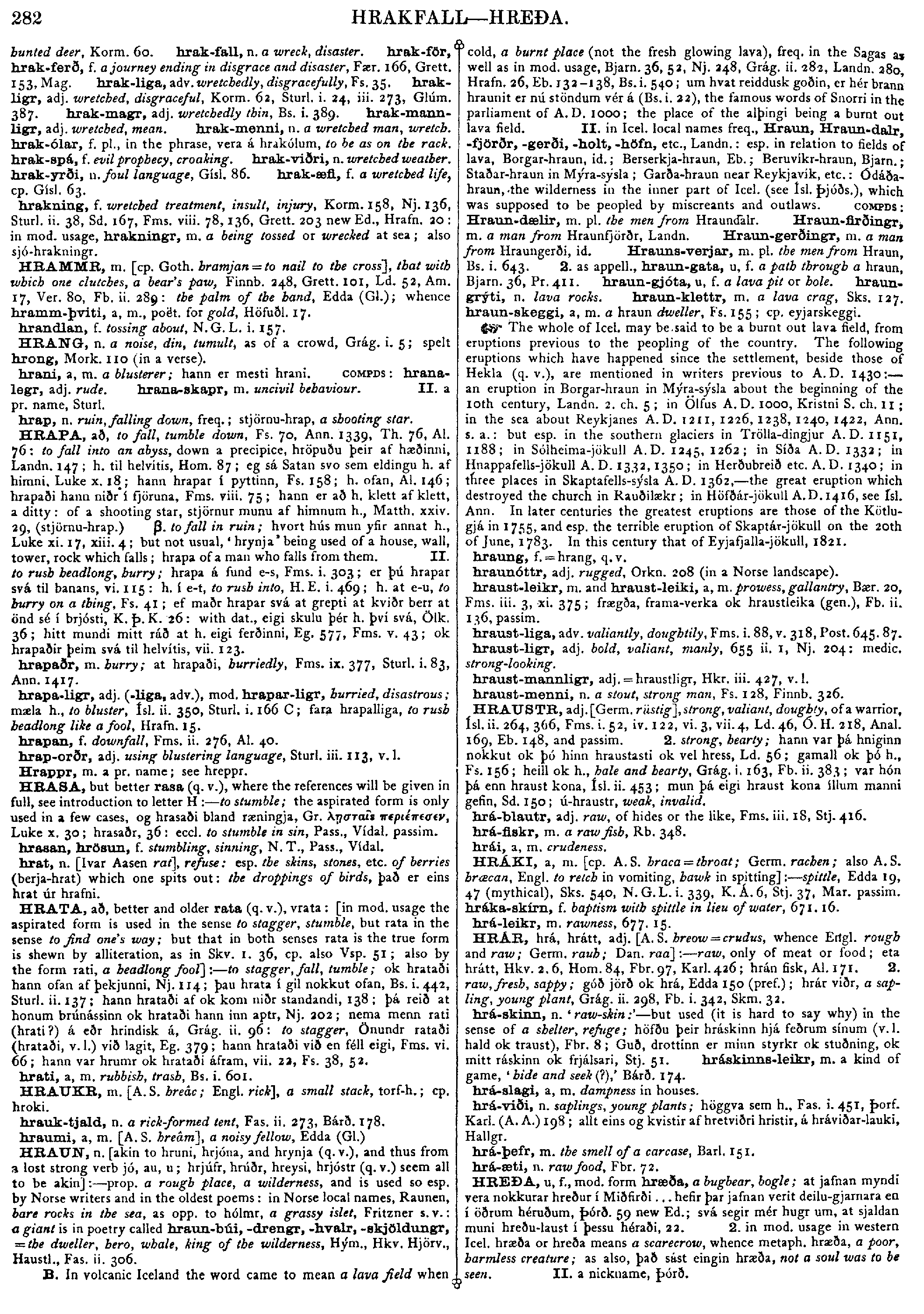
UNCERTAIN The whole of Icel. may be said to be a burnt out lava field, from eruptions previous to the peopling of the country. The following eruptions which have happened since the settlement, beside those of Hekla (q.v.), are mentioned in writers previous to A.D. 1430 :-- an eruption in Borgar-hraun in Mýra-sýsla about the beginning of the 10th century, Landn. 2. ch. 5; in Ölfus A.D. 1000, Kristni S. ch. 11; in the sea about Reykjanes A.D. 1211, 1226, 1238, 1240, 1422, Ann. s.a.: but esp. in the southern glaciers in Trölla-dingjur A.D. 1151, 1188; in Sólheima-jökull A.D. 1245, 1262; in Síða A.D. 1332; in Hnappafells-jökull A.D. 1332, 1350; in Herðubreið etc. A.D. 1340; in three places in Skaptafells-sýsla A.D. 1362, -- the great eruption which destroyed the church in Rauðilækr; in Höfðár-jökull A.D. 1416, see Ísl. Ann. In later centuries the greatest eruptions are those of the Kötlu-gjá in 1755, and esp. the terrible eruption of Skaptár-jökull on the 20th of June, 1783. In this century that of Eyjafjalla-jökull, 1821.
|
Source: Cleasby/Vigfusson, page b0315, entry 27 View original page image as: [TIFF] [PNG] [View previous entry] [View next entry] |
[Comment on this entry] [View comments] |
The following entry has been hand-corrected once. |
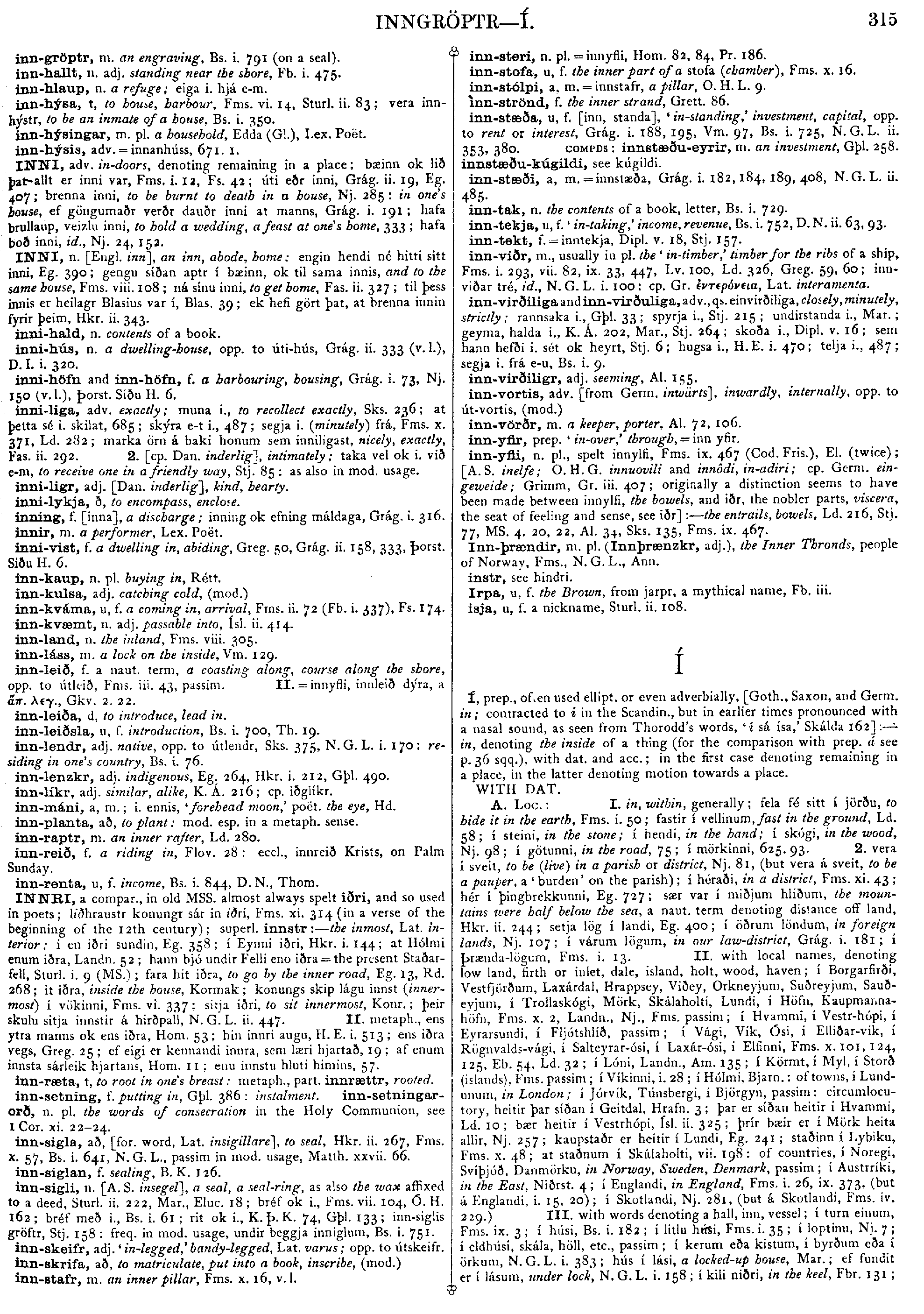
inn-lendr, adj. native, opp. to útlendr, Sks. 375, N. G. L. i. 170: residing in one's country, Bs. i. 76.
|
Source: Cleasby/Vigfusson, page b0318, entry 7 View original page image as: [TIFF] [PNG] [View previous entry] [View next entry] |
[Comment on this entry] [View comments] |
The following entry has been hand-corrected once. |
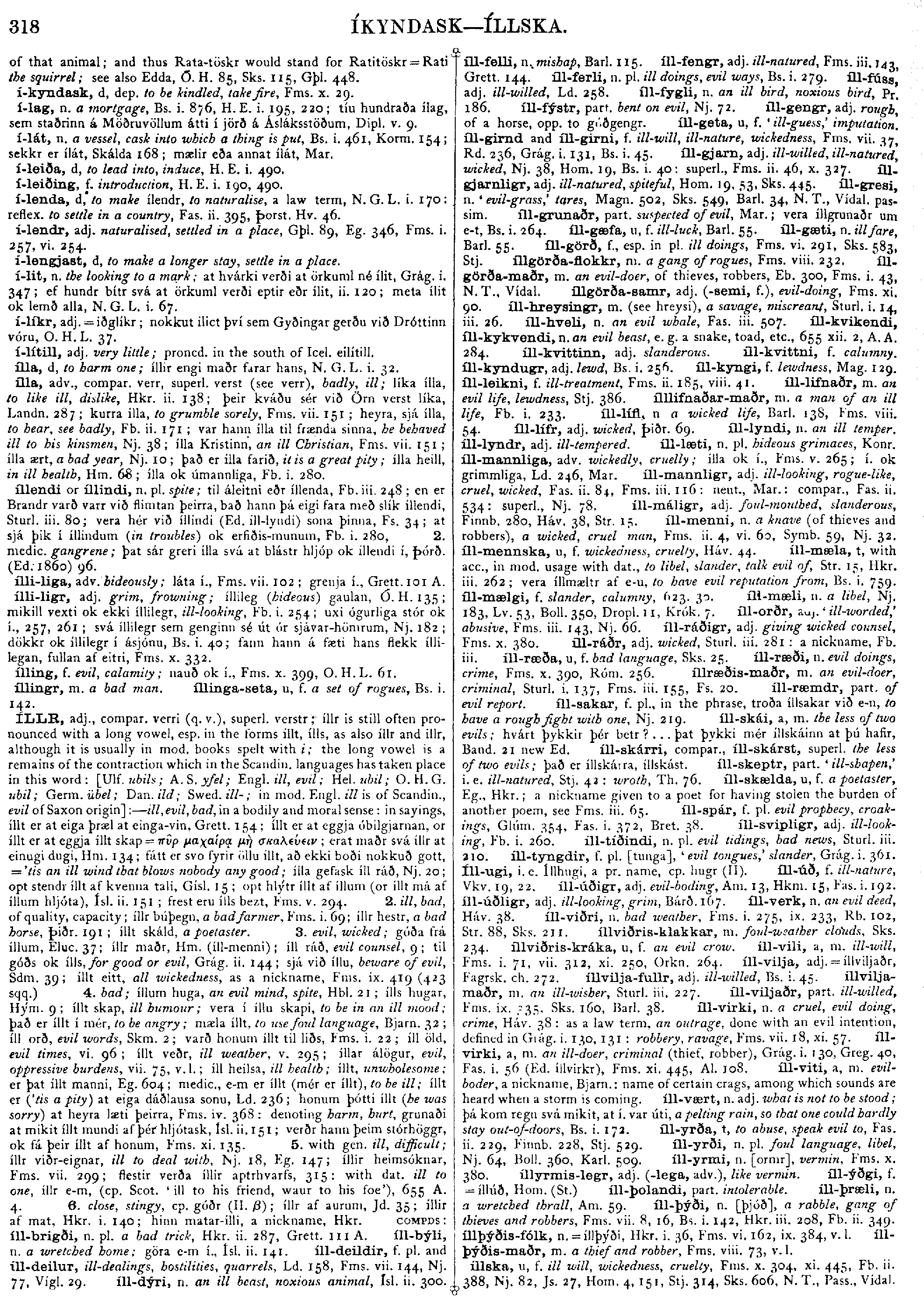
í-lenda, d, to make ílendr, to naturalise, a law term, N. G. L. i. 170: reflex. to settle in a country, Fas. ii. 395, Þorst. Hv. 46.
|
Source: Cleasby/Vigfusson, page b0320, entry 9 View original page image as: [TIFF] [PNG] [View previous entry] [View next entry] |
[Comment on this entry] [View comments] |
The following entry has been hand-corrected once. |
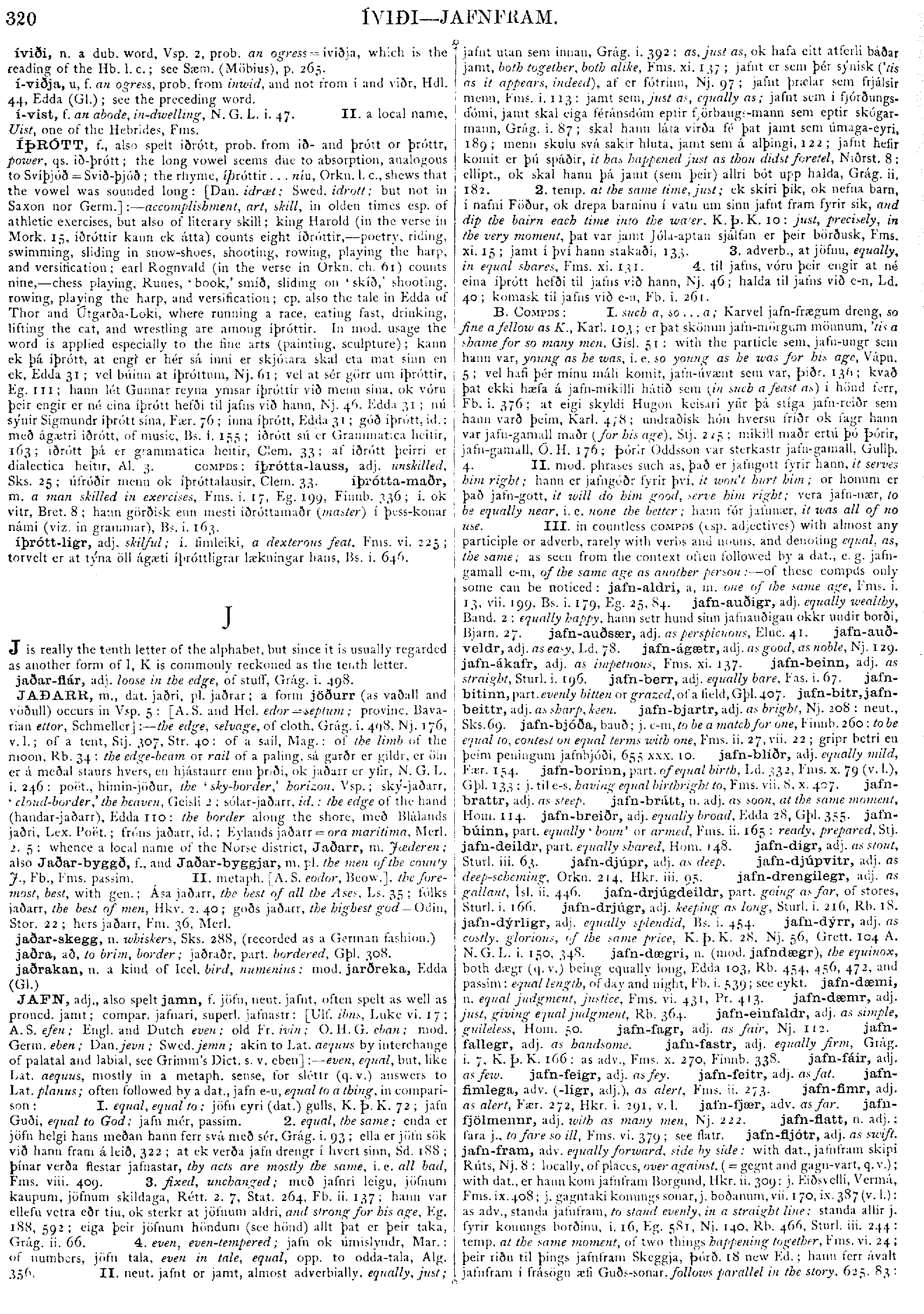
JAÐARR, m., dat. jaðri, pl. jaðrar; a form jöðurr (as vaðall and vöðull) occurs in Vsp. 5: [A. S. and Hel. edor = septum; provinc. Bavarian ettor, Schmeller] :-- the edge, selvage, of cloth, Grág. i. 408, Nj. 176, v.l.; of a tent, Stj. 307, Str. 40: of a sail, Mag.: of the limb of the moon, Rb. 34: the edge-beam or rail of a paling, sá garðr er gildr, er öln er á meðal staurs hvers, en hjástaurr enn þriði, ok jaðarr er yfir, N. G. L. i. 246: poët., himin-jöður, the 'sky-border,' horizon, Vsp.; ský-jaðarr, 'cloud-border,' the heaven, Geisli 2; sólar-jaðarr, id.: the edge of the hand (handar-jaðarr), Edda 110: the border along the shore, með Blálands jaðri, Lex. Poët.; fróns jaðarr, id.; Eylands jaðarr = ora maritima, Merl. 2. 5: whence a local name of the Norse district, Jaðarr, m. Jæderen; also Jaðar-byggð, f., and Jaðar-byggjar, m. pl. the men of the country J., Fb., Fms. passim. II. metaph. [A. S. eodor, Beow.], the foremost, best, with gen.; Ása jaðarr, the best of all the Ases, Ls. 35: fólks jaðarr, the best of men, Hkv. 2. 40; goðs jaðarr, the highest god -- Odin, Stor. 22; hers jaðarr, Fm. 36, Merl.
|
Source: Cleasby/Vigfusson, page b0327, entry 35 View original page image as: [TIFF] [PNG] [View previous entry] [View next entry] |
[Comment on this entry] [View comments] |
The following entry has been hand-corrected once. |
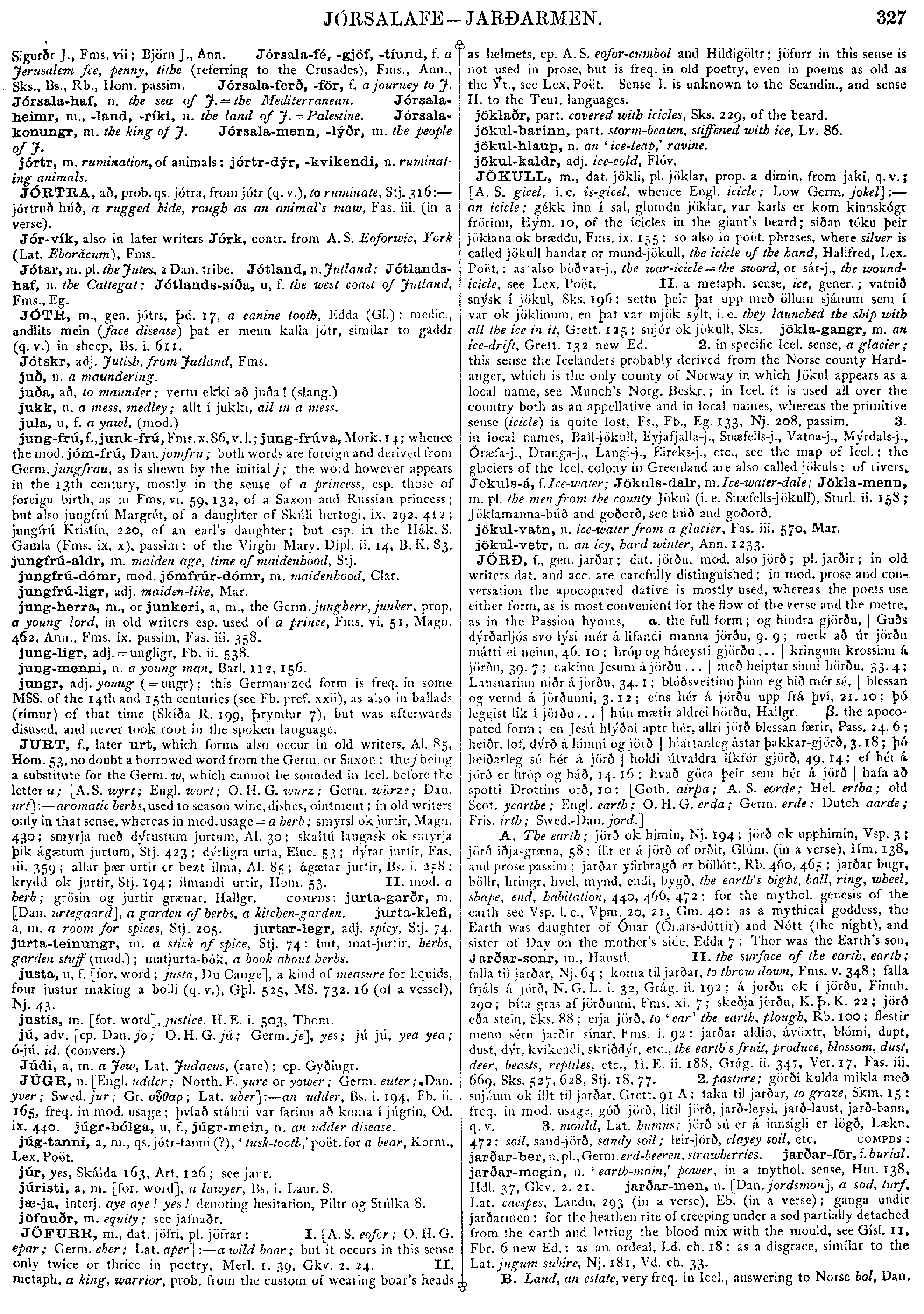
JÖKULL, m., dat. jökli, pl. jöklar, prop. a dimin. from jaki, q.v.; [A. S. gicel, i.e. îs-gicel, whence Engl. icicle; Low Germ. jokel] :-- an icicle; gékk inn í sal, glumdu jöklar, var karls er kom kinnskógr frörinn, Hým. 10, of the icicles in the giant's beard; síðan tóku þeir jöklana ok bræddu, Fms. ix. 155: so also in poët. phrases, where silver is called jökull handar or mund-jökull, the icicle of the hand, Hallfred, Lex. Poët.: as also böðvar-j., the war-icicle = the sword, or sár-j., the wound-icicle, see Lex. Poët. II. a metaph. sense, ice, gener.; vatnið snýsk í jökul, Sks. 196; settu þeir þat upp með öllum sjánum sem í var ok jöklinum, en þat var mjök sýlt, i.e. they launched the ship with all the ice in it, Grett. 125: snjór ok jökull, Sks. jökla-gangr, m. an ice-drift, Grett. 132 new Ed. 2. in specific Icel. sense, a glacier; this sense the Icelanders probably derived from the Norse county Hardanger, which is the only county of Norway in which Jökul appears as a local name, see Munch's Norg. Beskr.; in Icel. it is used all over the country both as an appellative and in local names, whereas the primitive sense (icicle) is quite lost, Fs., Fb., Eg. 133, Nj. 208, passim. 3. in local names, Ball-jökull, Eyjafjalla-j., Snæfells-j., Vatna-j., Mýrdals-j., Öræfa-j., Dranga-j., Langi-j., Eireks-j., etc., see the map of Icel.; the glaciers of the Icel. colony in Greenland are also called jökuls: of rivers, Jökuls-á, f. Ice-water; Jökuls-dalr, m. Ice-water-dale; Jökla-menn, m. pl. the men from the county Jökul (i.e. Snæfells-jökull), Sturl. ii. 158; Jöklamanna-búð and goðorð, see búð and goðorð.
| Result Page: |  |
Previous | 30 31 32 33 34 35 36 37 38 39 40 41 42 43 | Next |  |
Germanic Lexicon Project (main page)
This search system was written by
Sean Crist
Please consider
volunteering
to correct the data in these online dictionaries.
No rights reserved. Feel free to use these data in any way you please.