|
|

|
Source: Bosworth/Toller, page d0434, entry 13 View original page image as: [TIFF] [PNG] [View previous entry] [View next entry] |
[Comment on this entry] [View comments] |
The following entry has been hand-corrected once. |
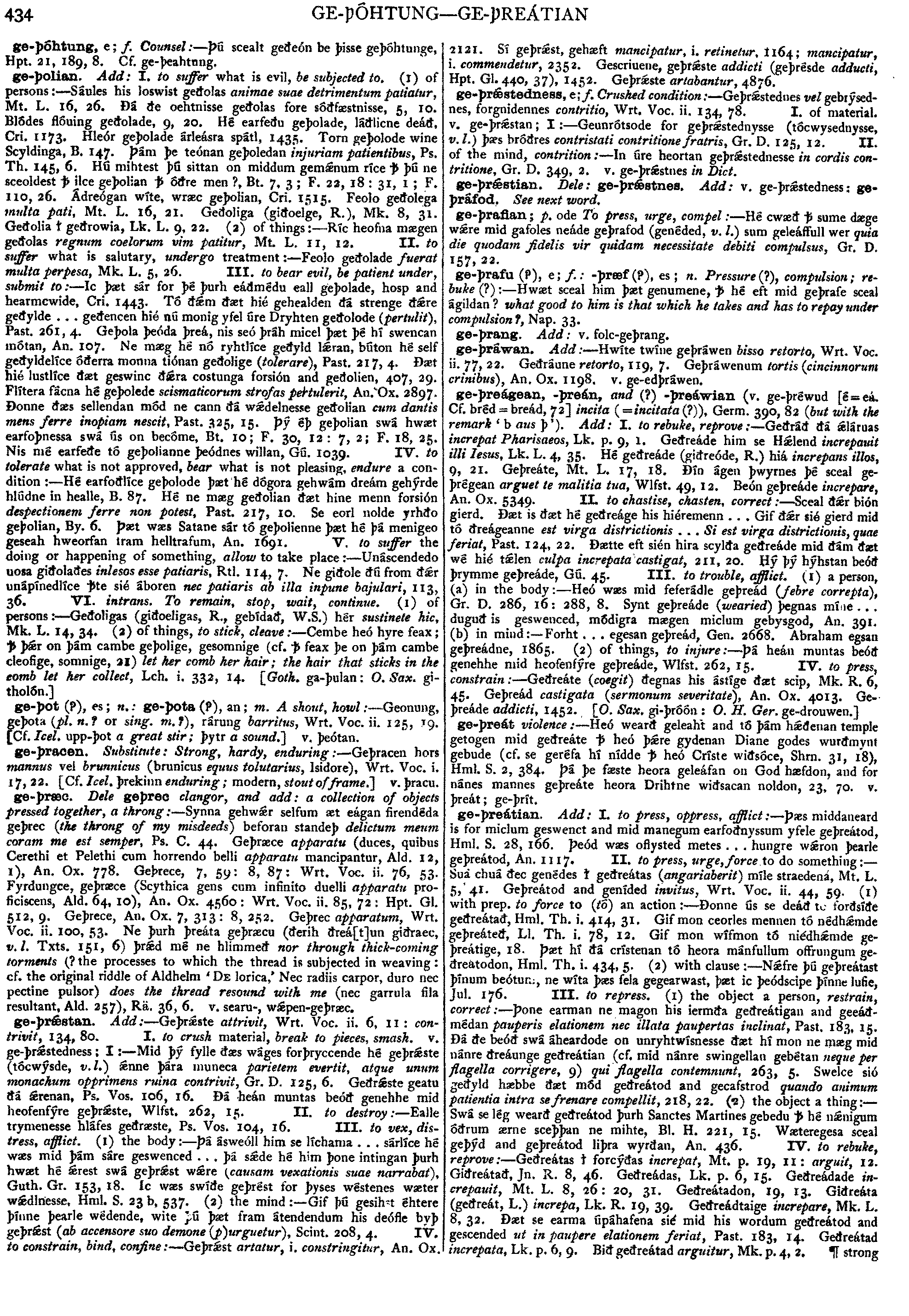
ge-þreágean,
-þreán,
and
(?)
-þreawian
(v.
ge-þréwud
[é
=
eá.
Cf.
bréd
=
breád,
72]
incita
(
=incitata
(?)),
Germ.
390,
82
(but
with
the
remark
'b
aus
þ').
Add;
I.
to
rebuke,
reprove
:--
Geðráð
ðá
 láruas
increpat
Pharisaeos,
Lk.
p.
9,
1.
Geðreáde
him
se
Hlend
increpauit
illi
Iesus,
Lk.
L.
4,
35.
Hé
geðreáde
(giðreóde,
R.)
hiá
increpans
illos,
9,
21.
Geþreáte,
Mt.
L.
17,
18.
Ðín
ágen
þwyrnes
þé
sceal
geþrégean
arguet
te
malitia
tua,
Wlfst.
49,
12.
Beón
geþreáde
increpare,
An.
Ox.
5349.
II.
to
chastise,
chasten,
correct
:--
Sceal
ðr
bión
gierd.
Ðæt
is
ðæt
hé
geðreáge
his
hiéremenn
...
Gif
ðr
sié
gierd
mid
tó
ðreágeanne
est
virga
districtionis
...
Si
est
virga
districtionis,
quae
feriat,
Past.
124,
22.
Ðætte
eft
sién
hira
scylða
geðreáde
mid
ðám
ðæt
wé
hié
tlen
culpa
increpata
castigat,
211,
20.
Hý
þý
hýhstan
beóð
þrymme
geþreáde,
Gú.
45.
III.
to
trouble,
afflict.
(1)
a
person,
(a)
in
the
body
:--
Heó
wæs
mid
feferádle
geþreád
(febre
correpta),
Gr.
D.
286,
16:
288,
8.
Synt
geþreáde
(wearied)
þegnas
míne
...
duguð
is
geswenced,
módigra
mægen
miclum
gebysgod,
An.
391.
(b)
in
mind
:--
Forht
...
egesan
geþreád,
Gen.
2668.
Abraham
egsan
geþreadne,
1865.
(2)
of
things,
to
injure
:--
Þá
heán
muntas
beóð
genehhe
mid
heofenfýre
geþreáde,
Wlfst.
262,
15.
IV.
to
press,
constrain
:--
Geðreáte
(coegit)
ðegnas
his
ástíge
ðæt
scip,
Mk.
R.
6,
45.
Geþreád
castigata
(sermonum
severitate),
An.
Ox.
4013.
Geþreáde
addicti,
1452.
[O.
Sax.
gi-þróón:
O.
H.
Ger.
ge-drouwen.]
láruas
increpat
Pharisaeos,
Lk.
p.
9,
1.
Geðreáde
him
se
Hlend
increpauit
illi
Iesus,
Lk.
L.
4,
35.
Hé
geðreáde
(giðreóde,
R.)
hiá
increpans
illos,
9,
21.
Geþreáte,
Mt.
L.
17,
18.
Ðín
ágen
þwyrnes
þé
sceal
geþrégean
arguet
te
malitia
tua,
Wlfst.
49,
12.
Beón
geþreáde
increpare,
An.
Ox.
5349.
II.
to
chastise,
chasten,
correct
:--
Sceal
ðr
bión
gierd.
Ðæt
is
ðæt
hé
geðreáge
his
hiéremenn
...
Gif
ðr
sié
gierd
mid
tó
ðreágeanne
est
virga
districtionis
...
Si
est
virga
districtionis,
quae
feriat,
Past.
124,
22.
Ðætte
eft
sién
hira
scylða
geðreáde
mid
ðám
ðæt
wé
hié
tlen
culpa
increpata
castigat,
211,
20.
Hý
þý
hýhstan
beóð
þrymme
geþreáde,
Gú.
45.
III.
to
trouble,
afflict.
(1)
a
person,
(a)
in
the
body
:--
Heó
wæs
mid
feferádle
geþreád
(febre
correpta),
Gr.
D.
286,
16:
288,
8.
Synt
geþreáde
(wearied)
þegnas
míne
...
duguð
is
geswenced,
módigra
mægen
miclum
gebysgod,
An.
391.
(b)
in
mind
:--
Forht
...
egesan
geþreád,
Gen.
2668.
Abraham
egsan
geþreadne,
1865.
(2)
of
things,
to
injure
:--
Þá
heán
muntas
beóð
genehhe
mid
heofenfýre
geþreáde,
Wlfst.
262,
15.
IV.
to
press,
constrain
:--
Geðreáte
(coegit)
ðegnas
his
ástíge
ðæt
scip,
Mk.
R.
6,
45.
Geþreád
castigata
(sermonum
severitate),
An.
Ox.
4013.
Geþreáde
addicti,
1452.
[O.
Sax.
gi-þróón:
O.
H.
Ger.
ge-drouwen.]
|
Source: Bosworth/Toller, page d0434, entry 15 View original page image as: [TIFF] [PNG] [View previous entry] [View next entry] |
[Comment on this entry] [View comments] |
The following entry has been hand-corrected once. |
ge-þreátian.
Add:
I.
to
press,
oppress,
afflict
:--
Þæs
middaneard
is
for
miclum
geswenct
and
mid
manegum
earfoðnyssum
yfele
geþreátod,
Hml.
S.
28,
166.
Þeód
wæs
oflysted
metes
...
hungre
wron
þearle
geþreátod,
An.
1117.
II.
to
press,
urge,
force
to
do
something
:--
Sua
chuá
ðec
genédes
 geðreátas
(angariaberit)
míle
straedena.
Mt.
L.
5,
41.
Geþreátod
and
geníded
invitus,
Wrt.
Voc.
ii.
44,
59.
(1)
with
prep,
to
force
to
(tó)
an
action
:--
Ðonne
ús
se
deáð
tó
forðsíðe
geðreátað,
Hml.
Th.
i.
414,
31.
Gif
mon
ceorles
mennen
tó
nédhmde
geþreáteð,
Ll.
Th.
i.
78,
12.
Gif
mon
wífmon
tó
niédhmde
geþreátige,
18.
Þæt
hí
ðá
crístenan
tó
heora
mánfullum
offrungum
geðreátodon,
Hml.
Th.
i.
434,
5.
(2)
with
clause
:--
Nfre
þú
geþreátast
þínum
beótum,
ne
wíta
þæs
fela
gegearwast,
þæt
ic
þeódscipe
þínne
lufie,
Jul.
176.
III.
to
repress.
(1)
the
object
a
person,
restrain,
correct
:--
Þone
earman
ne
magon
his
iermða
geðreátigan
and
geeáðmédan
pauperis
elationem
nec
illata
paupertas
inclinat,
Past.
183,
15.
Ðá
ðe
beóð
swá
áheardode
on
unryhtwísnesse
ðæt
hí
mon
ne
mæg
mid
nánre
ðreáunge
geðreátian
(cf.
mid
nánre
swingellan
gebétan
neque
per
flagella
corrigere,
9)
qui
flagella
contemnunt,
263,
5.
Swelce
sió
geðyld
hæbbe
ðæt
mód
geðreátod
and
gecafstrod
quando
animum
patientia
intra
se
frenare
compellit,
218,
22.
(2)
the
object
a
thing
:--
Swá
se
lég
wearð
geðreátod
þurh
Sanctes
Martines
gebedu
geðreátas
(angariaberit)
míle
straedena.
Mt.
L.
5,
41.
Geþreátod
and
geníded
invitus,
Wrt.
Voc.
ii.
44,
59.
(1)
with
prep,
to
force
to
(tó)
an
action
:--
Ðonne
ús
se
deáð
tó
forðsíðe
geðreátað,
Hml.
Th.
i.
414,
31.
Gif
mon
ceorles
mennen
tó
nédhmde
geþreáteð,
Ll.
Th.
i.
78,
12.
Gif
mon
wífmon
tó
niédhmde
geþreátige,
18.
Þæt
hí
ðá
crístenan
tó
heora
mánfullum
offrungum
geðreátodon,
Hml.
Th.
i.
434,
5.
(2)
with
clause
:--
Nfre
þú
geþreátast
þínum
beótum,
ne
wíta
þæs
fela
gegearwast,
þæt
ic
þeódscipe
þínne
lufie,
Jul.
176.
III.
to
repress.
(1)
the
object
a
person,
restrain,
correct
:--
Þone
earman
ne
magon
his
iermða
geðreátigan
and
geeáðmédan
pauperis
elationem
nec
illata
paupertas
inclinat,
Past.
183,
15.
Ðá
ðe
beóð
swá
áheardode
on
unryhtwísnesse
ðæt
hí
mon
ne
mæg
mid
nánre
ðreáunge
geðreátian
(cf.
mid
nánre
swingellan
gebétan
neque
per
flagella
corrigere,
9)
qui
flagella
contemnunt,
263,
5.
Swelce
sió
geðyld
hæbbe
ðæt
mód
geðreátod
and
gecafstrod
quando
animum
patientia
intra
se
frenare
compellit,
218,
22.
(2)
the
object
a
thing
:--
Swá
se
lég
wearð
geðreátod
þurh
Sanctes
Martines
gebedu
 hé
nnigum
óðrum
ærne
sceþþan
ne
mihte,
Bl.
H.
221,
15.
Wæteregesa
sceal
geþýd
and
geþreátod
liþra
wyrðan,
An.
436.
IV.
to
rebuke,
reprove
:--
Geðreátas
forcýðas
increpat,
Mt.
p.
19,
11:
arguit,
12.
Giðreátað,
Jn.
R.
8,
46.
Geðreádas,
Lk.
p.
6,
15.
Geðreadade
increpauit,
Mt.
L.
8,
26:
20,
31.
Geðreátadon,
19,
13.
Giðreáta
(geðreát,
L.)
increpa,
Lk.
R.
19,
39.
Geðreádtaige
increpare,
Mk.
L.
8,
32.
Ðæt
se
earma
úpáhafena
sié
mid
his
wordum
geðreátod
and
gescended
ne
in
paupere
elationem
feriat,
Past.
183,
14.
Geðreátad
increpata.
Lk.
p.
6,
9.
Bið
geðreátad
arguitur,
Mk.
p.
4,
2.

strong
hé
nnigum
óðrum
ærne
sceþþan
ne
mihte,
Bl.
H.
221,
15.
Wæteregesa
sceal
geþýd
and
geþreátod
liþra
wyrðan,
An.
436.
IV.
to
rebuke,
reprove
:--
Geðreátas
forcýðas
increpat,
Mt.
p.
19,
11:
arguit,
12.
Giðreátað,
Jn.
R.
8,
46.
Geðreádas,
Lk.
p.
6,
15.
Geðreadade
increpauit,
Mt.
L.
8,
26:
20,
31.
Geðreátadon,
19,
13.
Giðreáta
(geðreát,
L.)
increpa,
Lk.
R.
19,
39.
Geðreádtaige
increpare,
Mk.
L.
8,
32.
Ðæt
se
earma
úpáhafena
sié
mid
his
wordum
geðreátod
and
gescended
ne
in
paupere
elationem
feriat,
Past.
183,
14.
Geðreátad
increpata.
Lk.
p.
6,
9.
Bið
geðreátad
arguitur,
Mk.
p.
4,
2.

strong
|
Source: Bosworth/Toller, page d0460, entry 1 View original page image as: [TIFF] [PNG] [View previous entry] [View next entry] |
[Comment on this entry] [View comments] |
The following entry has been hand-corrected once. |
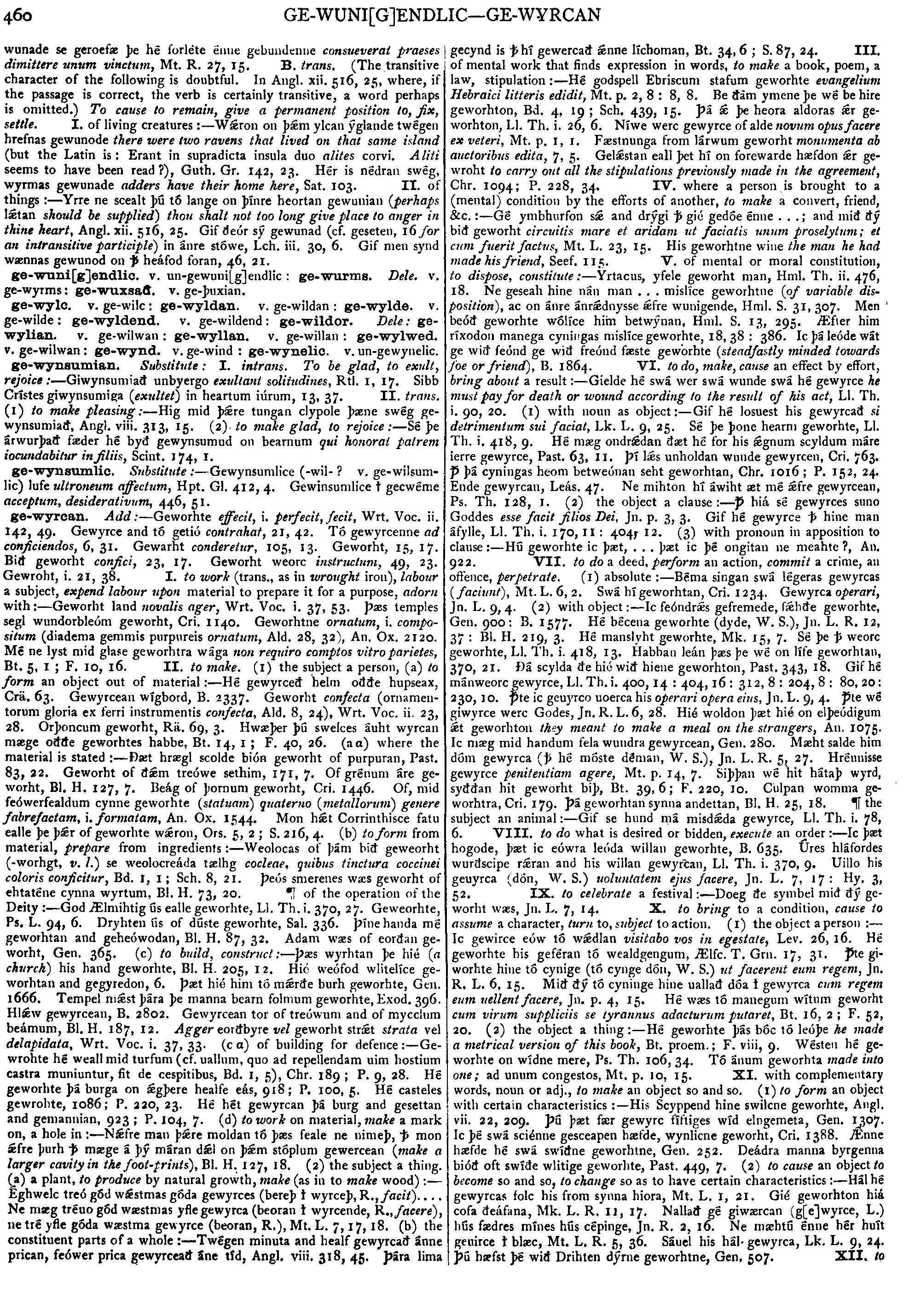
wunade
se
geroefæ
þe
h forlte
nne
gebundenne
consueverat
praeses
dimittere
umim
vinctum,
Mt.
R.
27,
15.
B.
trans.
(The
transitive
character
of
the
following
is
doubtful.
In
Angl.
xii.
516,
25,
where,
if
the
passage
is
correct,
the
verb
is
certainly
transitive,
a
word
perhaps
is
omitted.)
To
cause
to
remain,
give
a
permanent
position
to,
fix,
settle.
I.
of
living
creatures
:--
W
forlte
nne
gebundenne
consueverat
praeses
dimittere
umim
vinctum,
Mt.
R.
27,
15.
B.
trans.
(The
transitive
character
of
the
following
is
doubtful.
In
Angl.
xii.
516,
25,
where,
if
the
passage
is
correct,
the
verb
is
certainly
transitive,
a
word
perhaps
is
omitted.)
To
cause
to
remain,
give
a
permanent
position
to,
fix,
settle.
I.
of
living
creatures
:--
W ron
on
þm
ylcan
ron
on
þm
ylcan
 glande
twgen
hrefnas
gewunode
there
were
two
ravens
that
lived
on
that
same
island
(but
the
Latin
is:
Erant
in
supradicta
insula
duo
clites
corvi.
Aliti
seems
to
have
been
read
?),
Guth.
Gr.
142,
23.
Hr
is
ndran
swg,
wyrmas
gewunade
adders
have
their
home
here,
Sat.
103.
II.
of
things
:--
Yrre
ne
scealt
þ
glande
twgen
hrefnas
gewunode
there
were
two
ravens
that
lived
on
that
same
island
(but
the
Latin
is:
Erant
in
supradicta
insula
duo
clites
corvi.
Aliti
seems
to
have
been
read
?),
Guth.
Gr.
142,
23.
Hr
is
ndran
swg,
wyrmas
gewunade
adders
have
their
home
here,
Sat.
103.
II.
of
things
:--
Yrre
ne
scealt
þ t
t lange
on
þ
lange
on
þ nre
heortan
gewunian
(perhaps
ltan
should
be
supplied)
thou
shall
not
loo
long
give
place
to
anger
in
thine
heart,
Angl.
xii.
516,
25.
Gif
nre
heortan
gewunian
(perhaps
ltan
should
be
supplied)
thou
shall
not
loo
long
give
place
to
anger
in
thine
heart,
Angl.
xii.
516,
25.
Gif
 eór
s
gewunad
(cf.
geseten,
16
for
an
intransitive
participle)
in
eór
s
gewunad
(cf.
geseten,
16
for
an
intransitive
participle)
in
 nre
stwe,
Lch.
iii.
30,
6.
Gif
men
synd
wænnas
gewunod
on
heáfod
foran,
46,
21.
nre
stwe,
Lch.
iii.
30,
6.
Gif
men
synd
wænnas
gewunod
on
heáfod
foran,
46,
21.
|
Source: Bosworth/Toller, page d0462, entry 22 View original page image as: [TIFF] [PNG] [View previous entry] [View next entry] |
[Comment on this entry] [View comments] |
The following entry has been hand-corrected once. |
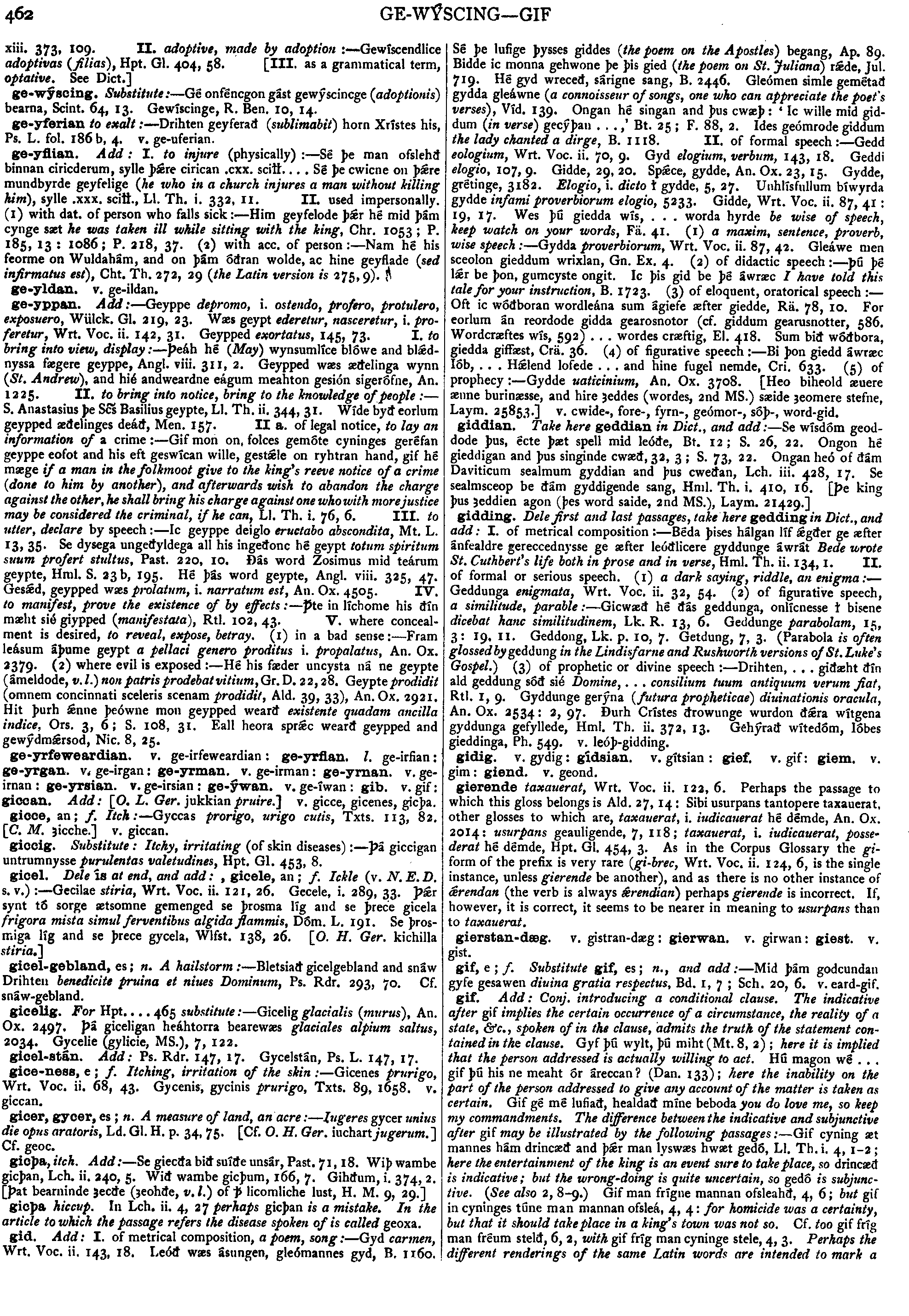
gierende
taxauerat,
Wrt.
Voc.
ii.
122,
6.
Perhaps
the
passage
to
which
this
gloss
belongs
is
Ald.
27,
14:
Sibi
usurpans
tantopere
taxauerat,
other
glosses
to
which
are,
taxauerat,
i.
iudicauerat
h
dmde,
An.
Ox.
2014:
usurpans
geauligende,
7,
118;
taxauerat,
i.
iudicauerat,
posse-derat
h
dmde,
Hpt.
Gl.
454,
3.
As
in
the
Corpus
Glossary
the
gi-
form
of
the
prefix
is
very
rare
(gi-brec,
Wrt.
Voc.
ii.
124,
6,
is
the
single
instance,
unless
gierende
be
another),
and
as
there
is
no
other
instance
of
rendan
(the
verb
is
always
rendian)
perhaps
gierende
is
incorrect.
If,
however,
it
is
correct,
it
seems
to
be
nearer
in
meaning
to
usurpans
than
to
taxauerat.
|
Source: Bosworth/Toller, page d0467, entry 18 View original page image as: [TIFF] [PNG] [View previous entry] [View next entry] |
[Comment on this entry] [View comments (1)] |
The following entry has been hand-corrected once. |
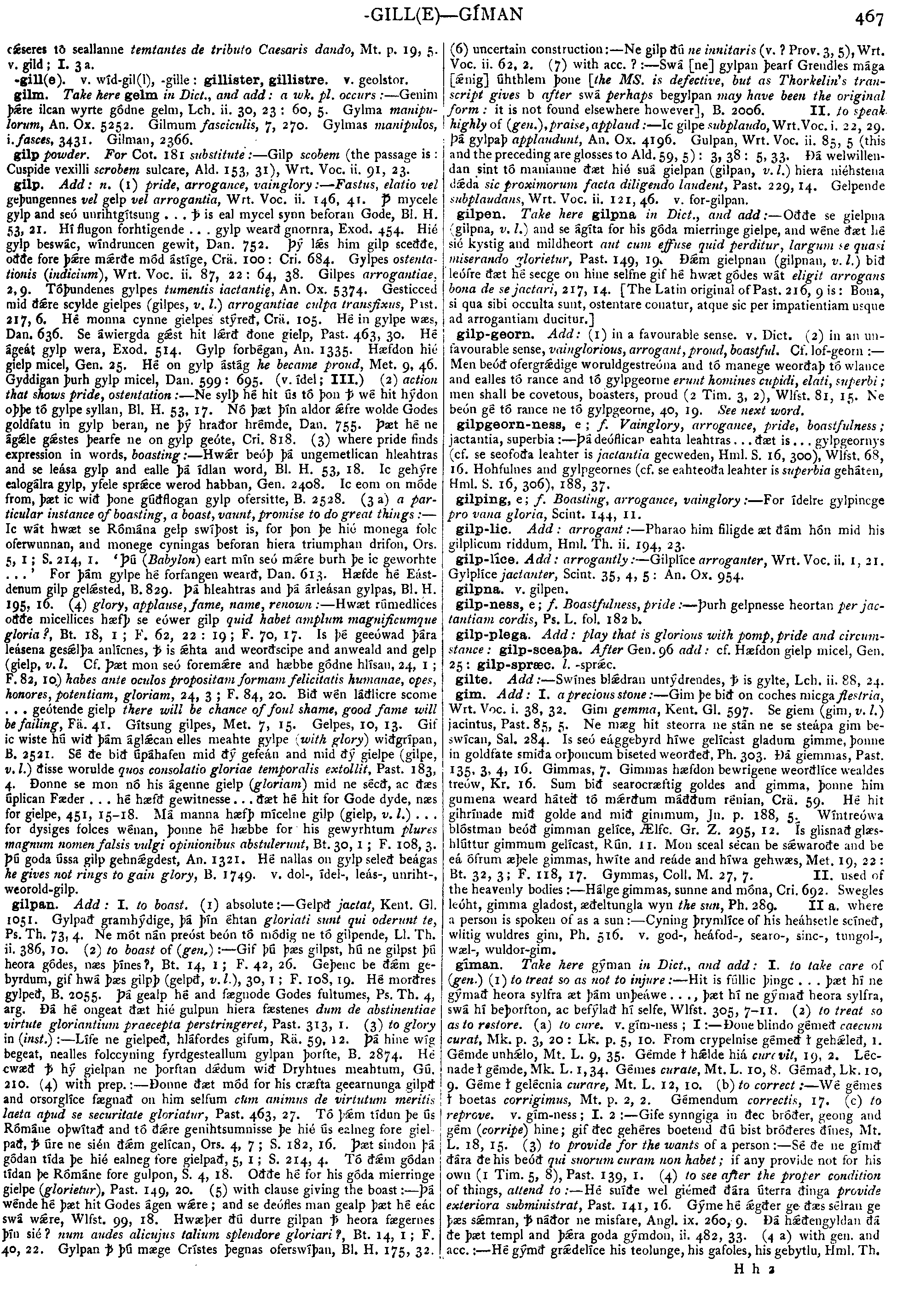
gman.
Take
here
gman
in
Dict.,
and
add:
I.
to
take
care
of
(gen.)
(l)
to
treat
so
as
not
to
injure
:--
Hit
is
fllic
þingc
.
.
.
þæt
h
ne
gma
heora
sylfra
æt
þm
unþeáwe.
.
.
,
þæt
h
ne
gma
heora
sylfra,
sw
h
beþorfton,
ac
befla
h
selfe,
Wlfst.
305,
7-11.
(2)
to
treat
so
as
to
restore.
(a)
to
cure.
v.
gm-ness;
I
:--
Ðone
blindo
gme
caecum
curat,
Mk.
p.
3,
20
:
Lk.
p.
5,
10.
From
crypelnise
gme
gehle,
l.
Gmde
unhlo,
Mt.
L.
9,
35.
Gmde
hlde
hiá
curUNCERTAINvit,
19,
2.
Lc-
nade
gmde,
Mk.
L.
1,
34.
Gmes
curate,
Mt.
L.
10,
8.
Gma,
Lk.
10,
l
9.
Gme
gelcnia
curare,
Mt.
L.
12,
10.
(b)
to
correct
:--
W
gmes
boetas
corrigimus,
Mt.
p.
2,
2.
Gmendum
correctis,
17,
(c)
to
reprove,
v.
gm-ness
;
I.
2
:--
Gife
synngiga
in
ec
brer,
geong
and
gm
(corripe)
hine;
gif
ec
gehres
boetend
bist
breres
nes,
Mt.
L.
18,
15.
(3)
to
provide
for
the
wants
of
a
person
:--
S
e
ne
gm
ra
e
his
beó
dui
suorum
curam
non
habet;
if
any
provide
not
for
his
own
(1
Tim.
5,
8),
Past.
139,
l.
(4)
to
see
after
the
proper
condition
of
things,
attend
to
:--
H
sue
wel
giéme
ra
terra
inga
provide
exteriora
subministrat,
Past.
141,
16.
Gme
h
ger
ge
æs
slran
ge
þæs
smran,
nor
ne
misfare,
Angl.
ix.
260,
9.
Ð
hengylclan
e
þæt
templ
and
þra
goda
gmdon,
ii.
482,
33.
(4
a)
with
gen.
and
acc.
:--
H
gm
grdelce
his
teolunge,
his
gafoles,
his
gebytlu,
Hml.
Th.
|
Source: Bosworth/Toller, page d0489, entry 17 View original page image as: [TIFF] [PNG] [View previous entry] [View next entry] |
[Comment on this entry] [View comments] |
The following entry has been hand-corrected once. |
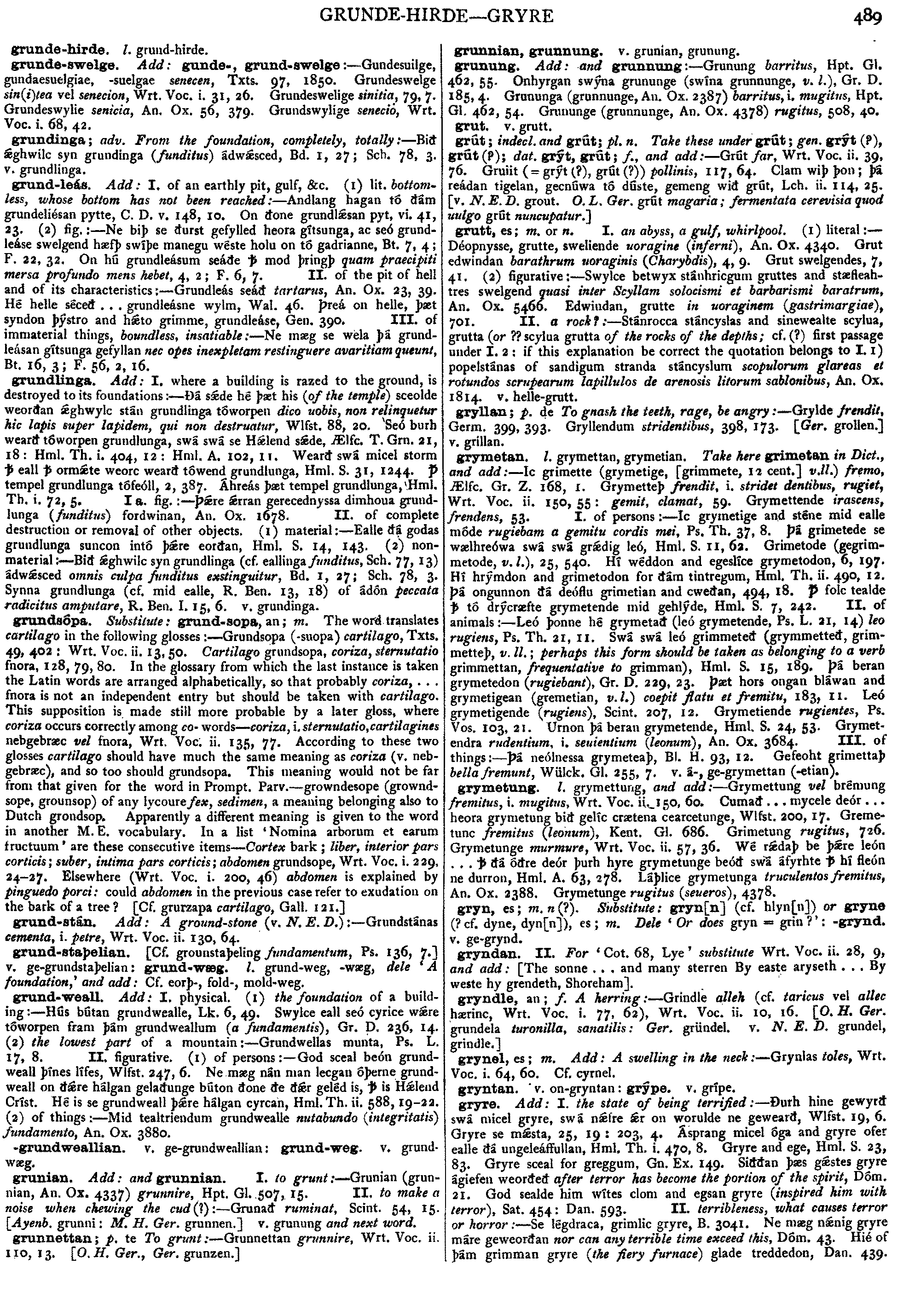
grutt, es; m. or n. I. an abyss, a gulf, whirlpool. (1) literal :-- Déopnysse, grutte, sweliende uoragine (inferni), An. Ox. 4340. Grut edwindan barathrum uoraginis (Charybdis), 4, 9. Grut swelgendes, 7, 41. (2) figurative :-- Swylce betwyx stánhricgum gruttes and stæfleahtres swelgend quasi inter Scyllam solocismi et barbarismi baratrum, An. Ox. 5466. Edwindan, grutte in uoraginem (gastrimargiae), 701. II. a rock ? :-- Stánrocca stáncyslas and sinewealte scylua, grutta (or ?? scylua grutta of the rocks of the depths; cf. (?) first passage under I. 2: if this explanation be correct the quotation belongs to I. 1) popelstánas of sandigum stranda stáncyslum scopulorum glareas et rotundos scrupearum lapillulos de arenosis litorum sablonibus, An. Ox. 1814. v. helle-grutt.
|
Source: Bosworth/Toller, page d0598, entry 31 View original page image as: [TIFF] [PNG] [View previous entry] [View next entry] |
[Comment on this entry] [View comments (1)] |
The following entry has been hand-corrected once. |
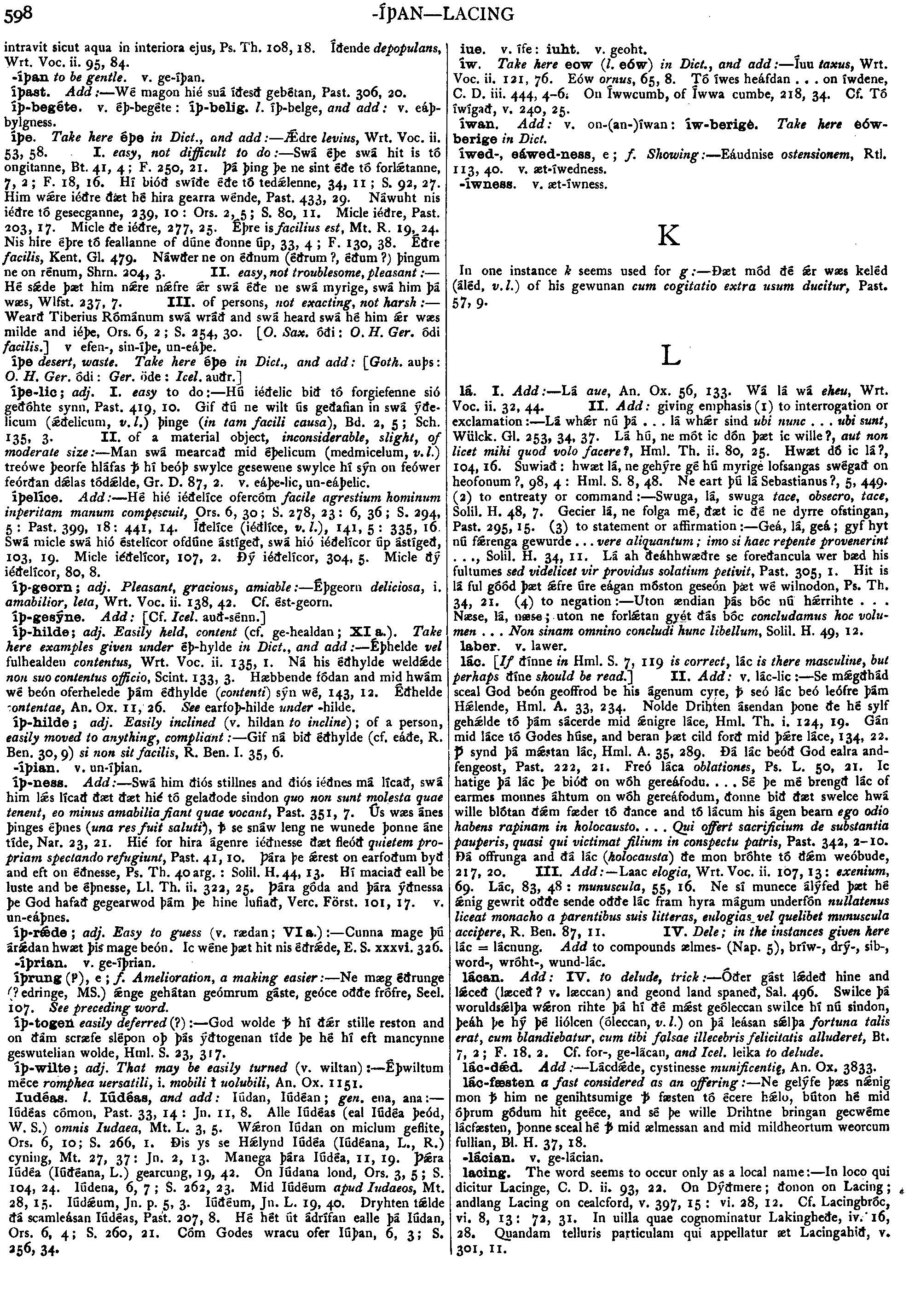
lác.
[If
ðínne
in
Hml.
S.
7,
119
is
correct,
lác
is
there
masculine,
but
perhaps
ðíne
should
be
read.]
II.
Add;
v.
lác-lic
:--
Se
mgðhád
sceal
God
beón
geoffrod
be
his
ágenum
eyre,
seó
lác
beo
leófre
þám
Hlende,
Hml.
A.
33,
234.
Nolde
Drihten
ásendan
þone
ðe
hé
sylf
gehlde
tó
þám
sácerde
mid
nigre
láce,
Hml.
Th.
i.
124,
19.
Gán
mid
láce
tó
Godes
húse,
and
beran
þæt
cild
forð
mid
þre
láce,
134,
22.
synd
þá
mstan
lác,
Hml.
A.
35,
289.
Ðá
lác
beóð
God
ealra
andfengeost,
Past.
222,
21.
Freó
láca
oblationes,
Ps.
L.
50,
21.
Ic
hatige
þá
lác
þe
bióð
on
wóh
gereáfodu.
...
Sé
þe
mé
brengð
lác
of
earmes
monnes
áhtum
on
wóh
gereáfodum,
ðonne
bið
dæt
swelce
hwá
wille
blótan
ðm
fæder
tó
ðance
and
tó
lácum
his
ágen
bearn
ego
odio
habens
rapinam
in
holocausto.
...
Qui
offert
sacrificium
de
substantia
pauperis,
quasi
qui
victimat
filium
in
conspectu
patris,
Past.
342,
2-10.
Ðá
offrunga
and
ðá
lác
(holocausta)
ðe
mon
bróhte
tó
ðm
weóbude,
217,
20.
III.
Add
:--
Laac
elogia,
Wrt.
Voc.
ii.
107,
13:
exenium,
69.
Lác,
83,
48:
munuscula,
55,
16.
Ne
sí
munece
álýféd
þæt
hé
nig
gewrit
oððe
sende
oððe
lác
fram
hyra
mágum
underfón
nullatenus
liceat
monacho
a
parentibus
suis
litteras,
eulogias
vel
quelibet
munuscula
accipere,
R.
Ben.
87,
11.
IV.
Dele;
in
tie
instances
given
here
lác
=
lácnung.
Add
to
compounds
ælmes-
(Nap.
5),
bríw-,
drý-,
sib-,
word-,
wróht-,
wund-lác.
|
Source: Bosworth/Toller, page d0611, entry 31 View original page image as: [TIFF] [PNG] [View previous entry] [View next entry] |
[Comment on this entry] [View comments] |
The following entry has been hand-corrected once. |
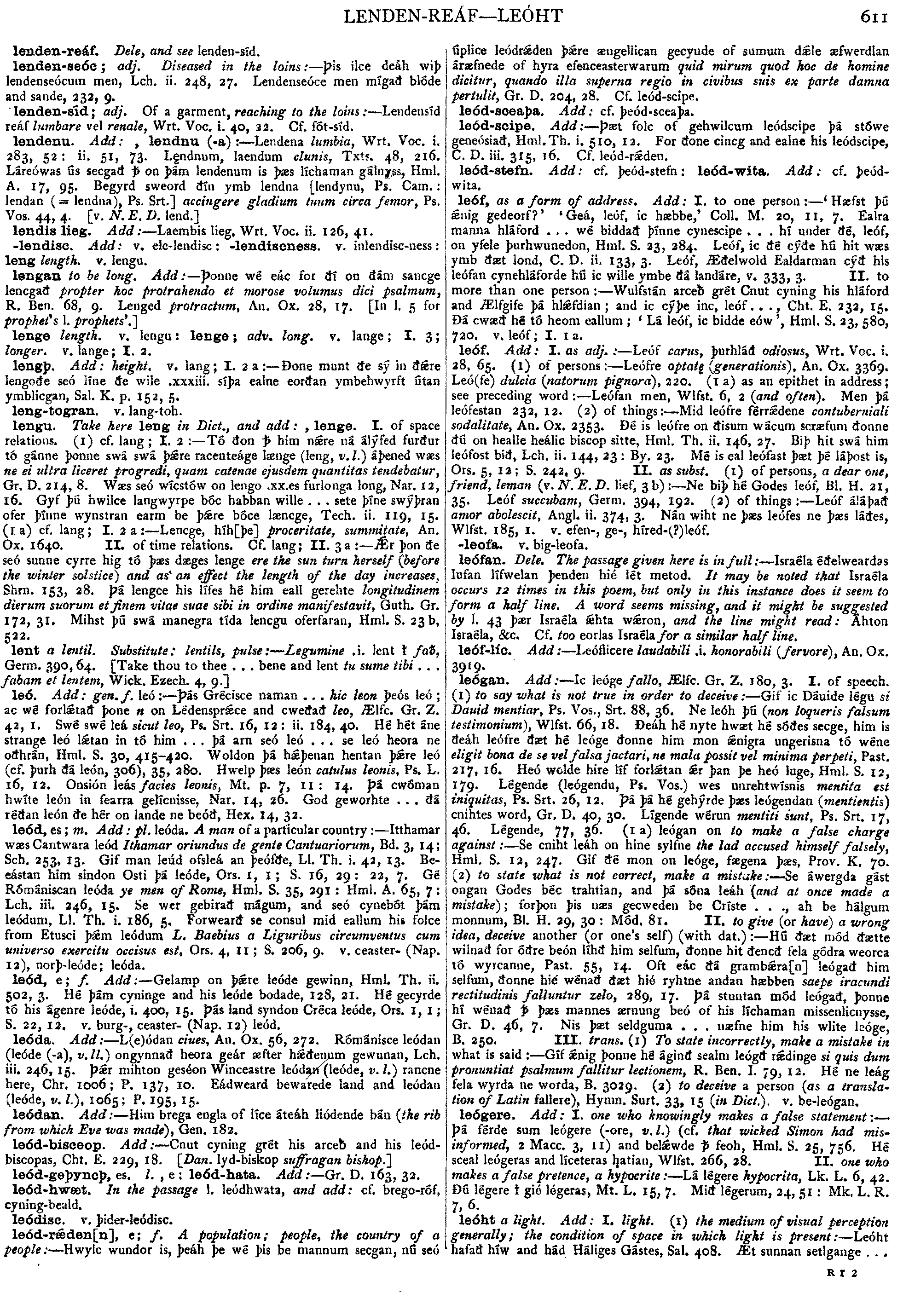
leógan.
Add
:--
Ic
leóge
fallo,
Ælfc.
Gr.
Z.
180,
3.
I.
of
speech.
(1)
to
say
what
is
not
true
in
order
to
deceive
:--
Gif
ic
Dáuide
légu
si
Dauid
mentiar.
Ps.
Vos.
,
Srt.
88,
36.
Ne
leóh
þú
(non
loqueris
falsum
testimonium),
Wlfst.
66,
18.
Ðeáh
hé
nyte
hwæt
hé
sóðes
secge,
him
is
ðeáh
leófre
ðæt
hé
leóge
ðonne
him
mon
nigra
ungerisna
tó
wéne
eligit
bona
de
se
vel
falsa
jactari,
ne
mala
possit
vel
minima
perpeti,
Past.
217,
16.
Heó
wolde
hire
líf
forltan
r
þan
þe
heó
luge,
Hml.
S.
12,
179.
Légende
(leógendu,
Ps.
Vos.)
wes
unrehtwísnis
mentita
est
iniquitas,
Ps.
Srt.
26,
12.
Þá
þá
hé
gehýrde
þæs
leógendan
(mentientis)
cnihtes
word,
Gr.
D.
40,
30.
Lígende
wérun
mentiti
sunt,
Ps.
Srt.
17,
46.
Légende,
77,
36.
(1
a)
leógan
on
to
make
a
false
charge
against
:--
Se
cniht
leáh
on
hine
sylfne
the
lad
accused
himself
falsely,
Hml.
S.
12,
247.
Gif
ðé
mon
on
leóge,
fægena
þæs,
Prov.
K.
70.
(2)
to
state
what
is
not
correct,
make
a
mistake
:--
Se
áwergda
gást
ongan
Godes
béc
trahtian,
and
þá
sóna
leáh
(
and
at
once
made
a
mistake);
forþon
þis
næs
gecweden
be
Críste
.
.
.
,
ah
be
hálgum
monnum,
Bl.
H.
29,
30
:
Mód.
81.
II.
to
give
(or
have)
a
wrong
idea,
deceive
another
(or
one's
self)
(with
dat.)
:--
Hú
ðæt
mód
ðætte
wilnað
for
óðre
beón
líhð
him
selfum,
ðonne
hit
ðencð
fela
gódra
weorca
tó
wyrcanne,
Past.
55,
14.
Oft
eác
ðá
grambra[n]
leógað
him
selfum,
ðonne
hié
wénað
ðæt
hié
ryhtne
andan
hæbben
saepe
iracundi
rectitudinis
falluntur
zelo,
289,
17.
Þá
stuntan
mód
leógað,
þonne
hí
wénað
þæs
mannes
ærnung
beó
of
his
líchaman
missenlicnysse,
Gr.
D.
46,
7.
Nis
þæt
seldguma
,
.
.
næfne
him
his
wlite
leóge,
B.
250.
III.
trans,
(l)
To
state
incorrectly,
make
a
mistake
in
what
is
said
:--
Gíf
nig
þonne
hé
áginð
sealm
leógð
rdinge
si
quis
dum
pronuntiat
psalmum
fallitur
lectionem,
R.
Ben.
l.
79,
12.
Hé
ne
leág
fela
wyrda
ne
worda,
B.
3029.
(2)
to
deceive
a
person
(
as
a
translation
of
Latin
fallere),
Hymn.
Surt.
33,
15
(in
Dict.).
v.
be-leógan.
|
Source: Bosworth/Toller, page d0652, entry 1 View original page image as: [TIFF] [PNG] [View previous entry] [View next entry] |
[Comment on this entry] [View comments] |
The following entry has been hand-corrected once. |
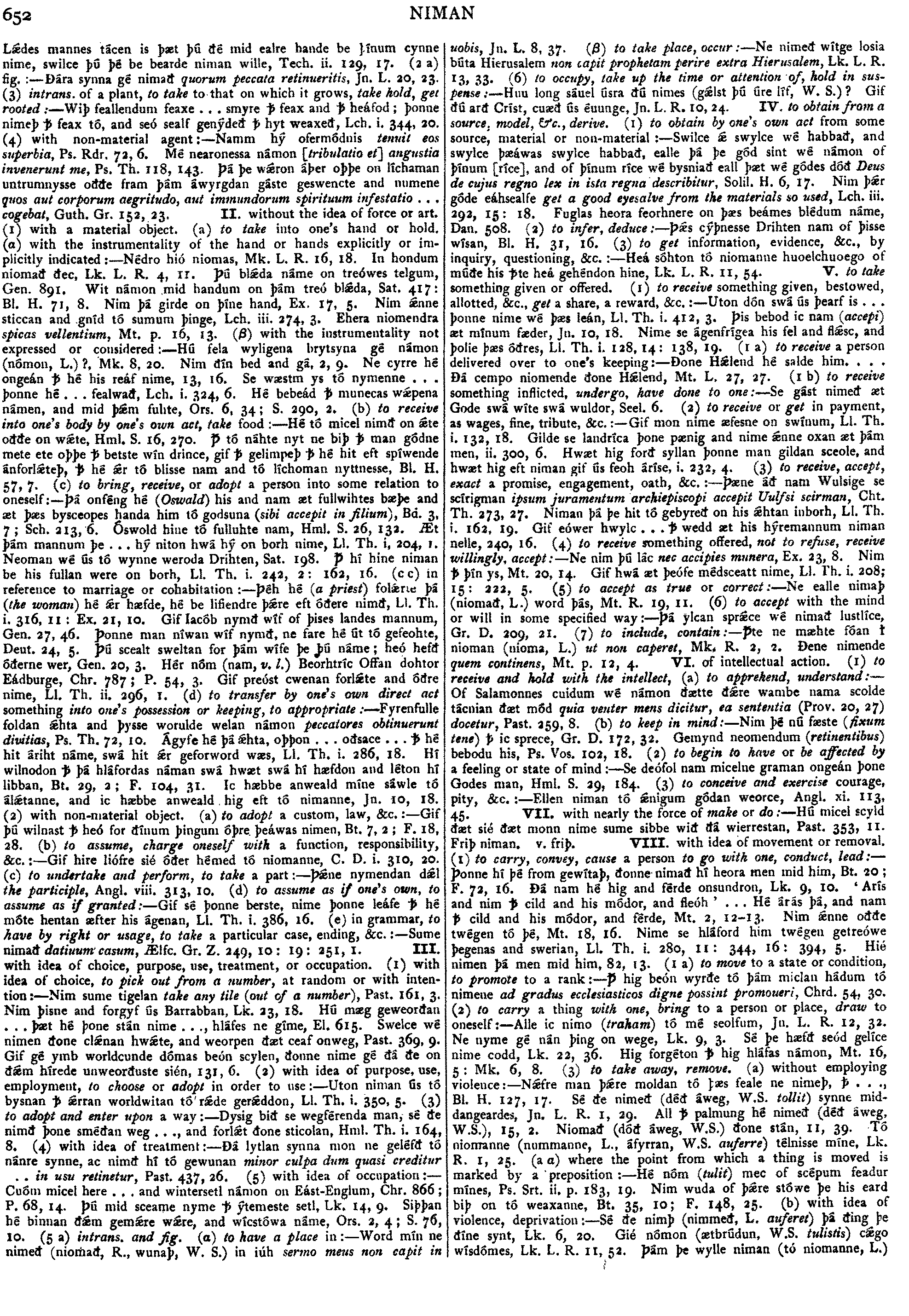
Ldes
mannes
tácen
is
þæt
þú
ðé
mid
ealre
hande
be
þínum
cynne
nime,
swilce
þú
þé
be
bearde
niman
wille,
Tech.
ii.
129,
17.
(2
a)
fig.
:--
Ðára
synna
gé
nimað
quorum
peccata
retinueritis,
Jn.
L.
20,
23.
(3)
intrans.
of
a
plant,
to
take
to
that
on
which
it
grows,
take
hold,
get
rooted
:--
Wiþ
feallendum
feaxe
.
.
.
smyre
feax
and
heáfod
;
þonne
nimeþ
feax
tó,
and
seó
sealf
genýdeð
hyl
weaxeð,
Lch.
i.
344,
20.
(4)
with
non-material
agent
:--
Namm
hý
ofermódnis
tenuit
eos
superbia,
Ps.
Rdr.
72,
6.
Mé
nearonessa
námon
[tribulatio
et]
angustia
invenerunt
me,
Ps.
Th.
118,
143.
Þá
þe
wron
áþer
oþþe
on
líchaman
untrumnysse
oððe
fram
þám
áwyrgdan
gáste
geswencte
and
numene
quos
aut
corporum
aegritudo,
aut
immundorum
spirituum
infestatio
.
.
.
cogebat,
Guth.
Gr.
152,
23.
II.
without
the
idea
of
force
or
art.
(1)
with
a
material
object,
(a)
to
take
into
one's
hand
or
hold,
( )
with
the
instrumentality
of
the
hand
or
hands
explicitly
or
implicitly
indicated
:--
Nédro
hió
niomas,
Mk.
L.
R.
16,
18.
In
hondum
niomað
ðec,
Lk.
L.
R.
4,
11.
Þú
blda
náme
on
treówes
telgum,
Gen.
891.
Wit
námon
mid
handum
on
þám
treó
blda,
Sat.
417:
Bl.
H.
71,
8.
Nim
þá
girde
on
þíne
hand,
Ex.
17,
5.
Nim
nne
sticcan
and
gníd
tó
sumum
þinge,
Lch.
iii.
274,
3.
Ehera
niomendra
spicas
vellentium,
Mt.
p.
16,
13.
(
)
with
the
instrumentality
of
the
hand
or
hands
explicitly
or
implicitly
indicated
:--
Nédro
hió
niomas,
Mk.
L.
R.
16,
18.
In
hondum
niomað
ðec,
Lk.
L.
R.
4,
11.
Þú
blda
náme
on
treówes
telgum,
Gen.
891.
Wit
námon
mid
handum
on
þám
treó
blda,
Sat.
417:
Bl.
H.
71,
8.
Nim
þá
girde
on
þíne
hand,
Ex.
17,
5.
Nim
nne
sticcan
and
gníd
tó
sumum
þinge,
Lch.
iii.
274,
3.
Ehera
niomendra
spicas
vellentium,
Mt.
p.
16,
13.
( )
with
the
instrumentality
not
expressed
or
considered
:--
Hú
fela
wyligena
brytsyna
gé
námon
(nómon,
L.
)
?,
Mk.
8,
20.
Nim
ðín
bed
and
gá,
2,
9.
Ne
cyrre
hé
ongeán
hé
his
reáf
nime,
13,
16.
Se
wæstm
ys
tó
nymenne
.
.
.
þonne
hé
.
.
.
fealwað,
Lch.
i.
.
.
324,
6.
Hé
bebeád
munecas
wpena
námen,
and
mid
þm
fuhte,
Ors.
6,
34;
S.
290,
2.
(b)
to
receive
into
one's
body
by
one's
own
act,
take
food
:--
Hé
tó
micel
nimð
on
æte
oððe
on
wte,
Hml.
S.
16,
270.
Þ-bar;
tó
náhte
nyt
ne
biþ
man
gódne
mete
ete
oþþe
betste
wín
drince,
gif
gelimpeþ
hé
hit
eft
spíwende
ánforlteþ,
hé
r
tó
blisse
nam
and
tó
líchoman
nyttnesse,
Bl.
H.
57,
7.
(c)
to
bring,
receive,
or
adopt
a
person
into
some
relation
to
oneself
:--
Þá
onféng
hé
(Oswald)
his
and
nam
æt
fullwihtes
bæþe
and
æt
þæs
bysceopes
handa
him
tó
godsuna
(sibi
accepit
in
filium),
Bd.
3,
7
;
Sch.
213,
6.
Óswold
hine
tó
fulluhte
nam,
Hml.
S.
26,
132.
Æt
þám
mannum
þe
.
.
.
hý
niton
hwá
hý
on
borh
nime,
Ll.
Th.
i.
204,
1.
Neoman
wé
ús
tó
wynne
weroda
Drihten,
Sat.
198.
Þ-bar;
hí
hine
niman
be
his
fullan
were
on
borh,
Ll.
Th.
i.
242,
2:
162,
16.
(c
c)
in
reference
to
marriage
or
cohabitation
:--
Þéh
hé
(a
priest)
folrte
þá
(the
woman)
hé
r
hæfde,
hé
be
lifiendre
þre
eft
óðere
nimð,
Ll.
Th.
i.
316,
11
:
Ex.
21,
10.
Gif
Iacób
nymð
wíf
of
þises
landes
mannum,
Gen.
27,
46.Þonne
man
níwan
wíf
nymð,
ne
fare
hé
út
tó
gefeohte,
Deut.
24,
5.
Þú
scealt
sweltan
for
þám
wífe
þe
þú
náme;
heó
hefð
óeth;erne
wer,
Gen.
20,
3.
Hér
nóm
(nam,
v.
l.)
Beorhtríc
Offan
dohtor
Eádburge,
Chr.
787
;
P.
54,
3.
Gif
preóst
cwenan
forlte
and
óðre
nime,
Ll.
Th.
ii.
296,
1.
(d)
to
transfer
by
one's
own
direct
act
something
into
one's
possession
or
keeping,
to
appropriate
:--
Fyrenfulle
foldan
hta
and
þysse
worulde
welan
námon
peccatores
obtinuerunt
divitias,
Ps.
Th.
72,
10.
Ágyfe
hé
þá
hta,
oþþon
.
.
.
oðsace
.
.
.
hé
hit
áriht
náme,
swá
hit
r
geforword
wæs,
Ll.
Th.
i.
286,
18.
Hí
wilnodon
þá
hláfordas
náman
swá
hwæt
swá
hí
hæfdon
and
léton
hí
libban,
Bt.
29,
2
;
F.
104,
31.
Ic
hæbbe
anweald
míne
sáwle
tó
áltanne,
and
ic
hæbbe
anweald
hig
eft
tó
nimanne,
Jn.
10,
18.
(2)
with
non-material
object,
(a)
to
adopt
a
custom,
law,
&c.
:--
Gif
þú
wilnast
heó
for
ðínum
þingum
óþre
þeáwas
nimen.
Bt.
7,
2
;
F.
18,
28.
(b)
to
assume,
charge
oneself
with
a
function,
responsibility,
&c.
:--
Gif
hire
liófre
sié
óðer
hémed
tó
niomanne,
C.
D.
i.
310,
20.
(c)
to
undertake
and
perform,
to
take
a
part
:--
Þne
nymendan
dl
the
participle,
Angl.
viii.
313,
10.
(d)
to
assume
as
if
one's
own,
to
assume
as
if
granted
:--
Gif
sé
þonne
berste,
nime
þonne
leáfe
hé
móte
hentan
æfter
his
ágenan,
Ll.
Th.
i.
386,
16.
(e)
in
grammar,
to
have
by
right
or
usage,
to
take
a
particular
case,
ending,
&c.
:--
Sume
nimað
dativum
casum,
Æ-acute;lfc.
Gr.
Z.
249,
10
:
19:
251,
1.
III.
with
idea
of
choice,
purpose,
use,
treatment,
or
occupation,
(1)
with
idea
of
choice,
to
pick
out
from
a
number,
at
random
or
with
intention
:--
Nim
sume
tigelan
take
any
tile
(out
of
a
number),
Past.
161,
3.
Nim
þisne
and
forgyf
ús
Barrabban,
Lk.
23,
18.
Hú
mæg
geweorðan
.
.
.
þæt
hé
þone
stán
nime
.
.
.
,
hláfes
ne
gíme,
El.
615.
Swelce
wé
nimen
ðone
clnan
hwte,
and
weorpen
ðæt
ceaf
onweg,
Past.
369,
9.
Gif
gé
ymb
worldcunde
dómas
beón
scylen,
ðonne
nime
gé
ðá
ðe
on
ðm
hírede
unweorðuste
sién,
131,
6.
(2)
with
idea
of
purpose,
use,
employment,
to
choose
or
adopt
in
order
to
use
:--
Uton
niman
ús
tó
bysnan
rran
worldwitan
tó
rde
gerddon,
Ll.
Th.
i.
350,
5.
(3)
to
adopt
and
enter
upon
a
way
:--
Dysig
bið
se
wegférenda
man,
sé
ðe
nimð
þone
sméðan
weg
.
.
.
,
and
forlt
ðone
sticolan,
Hml.
Th.
i.
164,
8.
(4)
with
idea
of
treatment
:--
Ðá
lytlan
synna
mon
ne
geléfð
tó
nánre
synne,
ac
nimð
hí
tó
gewunan
minor
culpa
dum
quasi
creditur
.
.
in
usu
retinetur,
Past.
437,
26.
(5)
with
idea
of
occupation
:--
Cuóm
micel
here
.
.
.
and
wintersetl
námon
on
Eást-Englum,
Chr.
866;
P.
68,
14.
Þú
mid
sceame
nyme
ýtemeste
setl,
Lk.
14,
9.
Siþþan
hé
binnan
ðm
gemre
wre,
and
wícstówa
náme,
Ors.
2,
4;
S.
76,
10.
(5
a)
intrans.
and
fig.
()
to
have
a
place
in
:--
Word
mín
ne
nimeð
(niomað,
R.,
wunaþ,
W.
S.)
in
iúh
sermo
meus
non
capit
in
uobis,
Jn.
L.
8,
37.
()
to
take
place,
occur
:--
Ne
nimeð
wítge
losia
búta
Hierusalem
non
capit
prophetam
perire
extra
Hierusalem,
Lk.
L.
R.
13,
33.
(6)
to
occupy,
tale
up
the
time
or
attention
of,
hold
in
suspense
:--
Huu
long
sáuel
úsra
ðú
nimes
(glst
þú
úre
líf,
W.
S.
)?
Gif
ðú
arð
Críst,
cuæð
ús
éuunge,
Jn.
L.
R.
10,
24.
IV.
to
obtain
from
a
source,
model,
&c.,
derive,
(1)
to
obtain
by
one's
own
act
from
some
source,
material
or
non-material
:--
Swilce
swylce
wé
habbað,
and
swylce
þæáwas
swylce
habbað,
ealle
þá
þe
gód
sint
wé
námon
of
þínum
[ríce],
and
of
þínum
ríce
wé
bysniað
eall
þæt
wé
gódes
dóð
Deus
de
cujus
regno
lex
in
ista
regna
describitur,
Solil.
H.
6,
17.
Nim
þr
góde
eáhsealfe
get
a
good
eyesalve
from
the
materials
so
used,
Lch.
iii.
292,
15:
18.
Fuglas
heora
feorhnere
on
þæs
beámes
blédum
náme,
Dan.
508.
(2)
to
infer,
deduce
:--
Þs
cýþnesse
Drihten
nam
of
þisse
wísan,
Bl.
H.
31,
16.
(3)
to
get
information,
evidence,
&c.
,
by
inquiry,
questioning,
&c.
:--
Heá
sóhton
tó
niomanne
huoelchuoego
of
múðe
his
te
heá
gehéndon
hine,
Lk.
L.
R.
11.
54.
V.
to
take
something
given
or
offered,
(1)
to
receive
something
given,
bestowed,
allotted,
&c.
,
get
a
share,
a
reward,
&c.
:--
Uton
dón
swá
ús
þearf
is.
.
.
þonne
nime
wé
þæs
leán,
Ll.
Th.
i.
412,
3.
Þis
bebod
ic
nam
(accepi)
æt
mínum
fæder,
Jn.
10,
18.
Nime
se
ágenfrígea
his
fel
and
flsc,
and
þolie
þæs
óðres,
Ll.
Th.
i.
128,
14:
138,
19.
(1
a)
to
receive
a
person
delivered
over
to
one's
keeping
:--
Ðone
Hlend
hé
salde
him.
.
.
.
Ðá
cempo
niomende
ðone
Hlend,
Mt.
L.
27,
27.
(1
b)
to
receive
something
inflicted,
undergo,
have
done
to
one
:--
Se
gást
nimeð
æt
Gode
swá
wíte
swá
wuldor,
Seel.
6.
(2)
to
receive
or
get
in
payment,
as
wages,
fine,
tribute,
&c.
:--
Gif
mon
nime
æfesne
on
swínum,
Ll.
Th.
i.
132,
18.
Gilde
se
landríca
þone
pænig
and
nime
nne
oxan
æt
þám
men,
ii.
300,
6.
Hwæt
hig
forð
syllan
þonne
man
gildan
sceole,
and
hwæt
hig
eft
niman
gif
ús
feoh
áríse,
i.
232,
4.
(3)
to
receive,
accept,
exact
a
promise,
engagement,
oath,
&c.
:--
Þæne
áð
nam
Wulsige
se
scírigman
ipsum
juramentum
archiepiscopi
accepit
Uulfsi
scirman,
Cht.
Th.
273,
27.
Niman
þá
þe
hit
tó
gebyreð
on
his
htan
inborh,
LI.
Th.
i.
162,
19.
Gif
eówer
hwylc
.
.
.
wedd
æt
his
hýremannum
niman
nelle,
240,
16.
(4)
to
receive
something
offered,
not
to
refuse,
receive
willingly,
accept
:--
Ne
nim
þú
lác
nec
accipies
munera,
Ex.
23,
8.
Nim
þín
ys,
Mt.
20,
14.
Gif
hwá
æt
þeófe
médsceatt
nime,
Ll.
Th.
i.
208;
15:
222,
5.
(5)
to
accept
as
true
or
correct
:--
Ne
ealle
nimaþ
(niomað,
L.
)
word
þás,
Mt.
R.
19,
11.
(6)
to
accept
with
the
mind
or
will
in
some
specified
way
:--
Þá
ylcan
sprce
wé
nimað
lustlíce,
Gr.
D.
209,
21.
(7)
to
include,
contain
:--
Þ-bar;te
ne
mæhte
fóan
nioman
(nioma,
L.
)
ut
non
caperet,
Mk.
R.
2,
2.
Ðene
nimende
quem
continens,
Mt.
p.
12,
4.
VI.
of
intellectual
action.
(1)
to
receive
and
hold
with
the
intellect,
(a)
to
apprehend,
understand
:--
Of
Salamonnes
cuidum
wé
námon
ðætte
ðre
wambe
nama
scolde
tácnian
ðæt
mód
quia
venter
mens
dicitur,
ea
sententia
(Prov.
20,
27)
docetur,
Past.
259,
8.
(b)
to
keep
in
mind
:--
Nim
þé
nú
fæste
(fixum
tene)
ic
sprece,
Gr.
D.
172,
32.
Gemynd
neomendum
(retinentibus)
bebodu
his,
Ps.
Vos.
102,
18.
(2)
to
begin
to
have
or
be
affected
by
a
feeling
or
state
of
mind
:--
Se
deófol
nam
micelne
graman
ongeán
þone
Godes
man,
Hml.
S.
29,
184.
(3)
to
conceive
and
exercise
courage,
pity,
&c.
:--
Ellen
niman
tó
nigum
gódan
weorce,
Angl.
xi.
113,
45.
VII.
with
nearly
the
force
of
make
or
do
:--
Hú
micel
scyld
ðæt
sié
ðæt
monn
nime
sume
sibbe
wið
ðá
wierrestan.
Past.
353,
11.
Friþ
niman.
v.
friþ.
VIII.
with
idea
of
movement
or
removal.
(1)
to
carry,
convey,
cause
a
person
to
go
with
one,
conduct,
lead
:--
Þonne
hí
þé
from
gewítaþ,
ðonne
nimað
hí
heora
men
mid
him,
Bt.
20
;
F.
72,
16.
Ðá
nam
hé
hig
and
férde
onsundron,
Lk.
9,
10.
'Arís
and
nim
cild
and
his
módor,
and
fleóh'
.
.
.
Hé
árás
þá,
and
nam
cild
and
his
módor,
and
férde,
Mt.
2,
12-13.
Nim
nne
oððe
twégen
tó
þé,
Mt.
18,
16.
Nime
se
hláford
him
twégen
getreówe
þegenas
and
swerian,
Ll.
Th.
i.
280,
11:
344,
16:
394,
5.
Hié
nimen
þá
men
mid
him,
82,
13.
(1
a)
to
move
to
a
state
or
condition,
to
promote
to
a
rank
:--
Þ-bar;
hig
beón
wyrðe
tó
þám
miclan
hádum
tó
nimene
ad
gradus
ecclesiasticos
digne
possint
promoueri,
Chrd.
54,
30.
(2)
to
carry
a
thing
with
one,
bring
to
a
person
or
place,
draw
to
oneself
:--
Alle
ic
nimo
(traham)
tó
mé
seolfum,
Jn.
L.
R.
12,
32.
Ne
nyme
gé
nán
þing
on
wege,
Lk.
9,
3.
Sé
þe
hæfð
seód
gelíce
nime
codd,
Lk.
22,
36.
Hig
forgéton
hig
hláfas
námon,
Mt.
16,
5
:
Mk.
6,
8.
(3)
to
take
away,
remove,
(a)
without
employing
violence
:--
Nfre
man
þre
moldan
tó
þæs
feale
ne
nimeþ,
.
.
.
,
Bl.
H.
127,
17.
Sé
ðe
nimeð
(déð
áweg,
W.
S.
tollit)
synne
middangeardes,
Jn.
L.
R.
1,
29.
All
palmung
hé
nimeð
(déð
áweg,
W.
S.
),
15,
2.
Niomað
(dóð
áweg,
W.
S.
)
ðone
stán,
11.
39.
Tó
niomanne
(nummanne.
L.
,
áfyrran,
W.
S.
auferre)
télnisse
míne.
Lk.
R.
1.
25.
(a
)
where
the
point
from
which
a
thing
is
moved
is
marked
by
a
preposition
:--
Hé
nóm
(tulit)
mec
of
scépum
feadur
mínes,
Ps.
Srt.
ii.
p.
183,
19.
Nim
wuda
of
þre
stówe
þe
his
eard
biþ
on
tó
weaxanne,
Bt.
35,
10;
F.
148,
25.
(b)
with
idea
of
violence,
deprivation
:--
Sé
ðe
nimþ
(nimmeð,
L.
auferet)
þá
ðing
þe
ðíne
synt,
Lk.
6,
20.
Gié
nómon
(aetbrúdun,
W.
S.
tulistis)
cgo
wísdómes,
Lk.
L.
R.
11.
52.
Þám
þe
wylle
niman
(tó
niomanne,
L.)
)
with
the
instrumentality
not
expressed
or
considered
:--
Hú
fela
wyligena
brytsyna
gé
námon
(nómon,
L.
)
?,
Mk.
8,
20.
Nim
ðín
bed
and
gá,
2,
9.
Ne
cyrre
hé
ongeán
hé
his
reáf
nime,
13,
16.
Se
wæstm
ys
tó
nymenne
.
.
.
þonne
hé
.
.
.
fealwað,
Lch.
i.
.
.
324,
6.
Hé
bebeád
munecas
wpena
námen,
and
mid
þm
fuhte,
Ors.
6,
34;
S.
290,
2.
(b)
to
receive
into
one's
body
by
one's
own
act,
take
food
:--
Hé
tó
micel
nimð
on
æte
oððe
on
wte,
Hml.
S.
16,
270.
Þ-bar;
tó
náhte
nyt
ne
biþ
man
gódne
mete
ete
oþþe
betste
wín
drince,
gif
gelimpeþ
hé
hit
eft
spíwende
ánforlteþ,
hé
r
tó
blisse
nam
and
tó
líchoman
nyttnesse,
Bl.
H.
57,
7.
(c)
to
bring,
receive,
or
adopt
a
person
into
some
relation
to
oneself
:--
Þá
onféng
hé
(Oswald)
his
and
nam
æt
fullwihtes
bæþe
and
æt
þæs
bysceopes
handa
him
tó
godsuna
(sibi
accepit
in
filium),
Bd.
3,
7
;
Sch.
213,
6.
Óswold
hine
tó
fulluhte
nam,
Hml.
S.
26,
132.
Æt
þám
mannum
þe
.
.
.
hý
niton
hwá
hý
on
borh
nime,
Ll.
Th.
i.
204,
1.
Neoman
wé
ús
tó
wynne
weroda
Drihten,
Sat.
198.
Þ-bar;
hí
hine
niman
be
his
fullan
were
on
borh,
Ll.
Th.
i.
242,
2:
162,
16.
(c
c)
in
reference
to
marriage
or
cohabitation
:--
Þéh
hé
(a
priest)
folrte
þá
(the
woman)
hé
r
hæfde,
hé
be
lifiendre
þre
eft
óðere
nimð,
Ll.
Th.
i.
316,
11
:
Ex.
21,
10.
Gif
Iacób
nymð
wíf
of
þises
landes
mannum,
Gen.
27,
46.Þonne
man
níwan
wíf
nymð,
ne
fare
hé
út
tó
gefeohte,
Deut.
24,
5.
Þú
scealt
sweltan
for
þám
wífe
þe
þú
náme;
heó
hefð
óeth;erne
wer,
Gen.
20,
3.
Hér
nóm
(nam,
v.
l.)
Beorhtríc
Offan
dohtor
Eádburge,
Chr.
787
;
P.
54,
3.
Gif
preóst
cwenan
forlte
and
óðre
nime,
Ll.
Th.
ii.
296,
1.
(d)
to
transfer
by
one's
own
direct
act
something
into
one's
possession
or
keeping,
to
appropriate
:--
Fyrenfulle
foldan
hta
and
þysse
worulde
welan
námon
peccatores
obtinuerunt
divitias,
Ps.
Th.
72,
10.
Ágyfe
hé
þá
hta,
oþþon
.
.
.
oðsace
.
.
.
hé
hit
áriht
náme,
swá
hit
r
geforword
wæs,
Ll.
Th.
i.
286,
18.
Hí
wilnodon
þá
hláfordas
náman
swá
hwæt
swá
hí
hæfdon
and
léton
hí
libban,
Bt.
29,
2
;
F.
104,
31.
Ic
hæbbe
anweald
míne
sáwle
tó
áltanne,
and
ic
hæbbe
anweald
hig
eft
tó
nimanne,
Jn.
10,
18.
(2)
with
non-material
object,
(a)
to
adopt
a
custom,
law,
&c.
:--
Gif
þú
wilnast
heó
for
ðínum
þingum
óþre
þeáwas
nimen.
Bt.
7,
2
;
F.
18,
28.
(b)
to
assume,
charge
oneself
with
a
function,
responsibility,
&c.
:--
Gif
hire
liófre
sié
óðer
hémed
tó
niomanne,
C.
D.
i.
310,
20.
(c)
to
undertake
and
perform,
to
take
a
part
:--
Þne
nymendan
dl
the
participle,
Angl.
viii.
313,
10.
(d)
to
assume
as
if
one's
own,
to
assume
as
if
granted
:--
Gif
sé
þonne
berste,
nime
þonne
leáfe
hé
móte
hentan
æfter
his
ágenan,
Ll.
Th.
i.
386,
16.
(e)
in
grammar,
to
have
by
right
or
usage,
to
take
a
particular
case,
ending,
&c.
:--
Sume
nimað
dativum
casum,
Æ-acute;lfc.
Gr.
Z.
249,
10
:
19:
251,
1.
III.
with
idea
of
choice,
purpose,
use,
treatment,
or
occupation,
(1)
with
idea
of
choice,
to
pick
out
from
a
number,
at
random
or
with
intention
:--
Nim
sume
tigelan
take
any
tile
(out
of
a
number),
Past.
161,
3.
Nim
þisne
and
forgyf
ús
Barrabban,
Lk.
23,
18.
Hú
mæg
geweorðan
.
.
.
þæt
hé
þone
stán
nime
.
.
.
,
hláfes
ne
gíme,
El.
615.
Swelce
wé
nimen
ðone
clnan
hwte,
and
weorpen
ðæt
ceaf
onweg,
Past.
369,
9.
Gif
gé
ymb
worldcunde
dómas
beón
scylen,
ðonne
nime
gé
ðá
ðe
on
ðm
hírede
unweorðuste
sién,
131,
6.
(2)
with
idea
of
purpose,
use,
employment,
to
choose
or
adopt
in
order
to
use
:--
Uton
niman
ús
tó
bysnan
rran
worldwitan
tó
rde
gerddon,
Ll.
Th.
i.
350,
5.
(3)
to
adopt
and
enter
upon
a
way
:--
Dysig
bið
se
wegférenda
man,
sé
ðe
nimð
þone
sméðan
weg
.
.
.
,
and
forlt
ðone
sticolan,
Hml.
Th.
i.
164,
8.
(4)
with
idea
of
treatment
:--
Ðá
lytlan
synna
mon
ne
geléfð
tó
nánre
synne,
ac
nimð
hí
tó
gewunan
minor
culpa
dum
quasi
creditur
.
.
in
usu
retinetur,
Past.
437,
26.
(5)
with
idea
of
occupation
:--
Cuóm
micel
here
.
.
.
and
wintersetl
námon
on
Eást-Englum,
Chr.
866;
P.
68,
14.
Þú
mid
sceame
nyme
ýtemeste
setl,
Lk.
14,
9.
Siþþan
hé
binnan
ðm
gemre
wre,
and
wícstówa
náme,
Ors.
2,
4;
S.
76,
10.
(5
a)
intrans.
and
fig.
()
to
have
a
place
in
:--
Word
mín
ne
nimeð
(niomað,
R.,
wunaþ,
W.
S.)
in
iúh
sermo
meus
non
capit
in
uobis,
Jn.
L.
8,
37.
()
to
take
place,
occur
:--
Ne
nimeð
wítge
losia
búta
Hierusalem
non
capit
prophetam
perire
extra
Hierusalem,
Lk.
L.
R.
13,
33.
(6)
to
occupy,
tale
up
the
time
or
attention
of,
hold
in
suspense
:--
Huu
long
sáuel
úsra
ðú
nimes
(glst
þú
úre
líf,
W.
S.
)?
Gif
ðú
arð
Críst,
cuæð
ús
éuunge,
Jn.
L.
R.
10,
24.
IV.
to
obtain
from
a
source,
model,
&c.,
derive,
(1)
to
obtain
by
one's
own
act
from
some
source,
material
or
non-material
:--
Swilce
swylce
wé
habbað,
and
swylce
þæáwas
swylce
habbað,
ealle
þá
þe
gód
sint
wé
námon
of
þínum
[ríce],
and
of
þínum
ríce
wé
bysniað
eall
þæt
wé
gódes
dóð
Deus
de
cujus
regno
lex
in
ista
regna
describitur,
Solil.
H.
6,
17.
Nim
þr
góde
eáhsealfe
get
a
good
eyesalve
from
the
materials
so
used,
Lch.
iii.
292,
15:
18.
Fuglas
heora
feorhnere
on
þæs
beámes
blédum
náme,
Dan.
508.
(2)
to
infer,
deduce
:--
Þs
cýþnesse
Drihten
nam
of
þisse
wísan,
Bl.
H.
31,
16.
(3)
to
get
information,
evidence,
&c.
,
by
inquiry,
questioning,
&c.
:--
Heá
sóhton
tó
niomanne
huoelchuoego
of
múðe
his
te
heá
gehéndon
hine,
Lk.
L.
R.
11.
54.
V.
to
take
something
given
or
offered,
(1)
to
receive
something
given,
bestowed,
allotted,
&c.
,
get
a
share,
a
reward,
&c.
:--
Uton
dón
swá
ús
þearf
is.
.
.
þonne
nime
wé
þæs
leán,
Ll.
Th.
i.
412,
3.
Þis
bebod
ic
nam
(accepi)
æt
mínum
fæder,
Jn.
10,
18.
Nime
se
ágenfrígea
his
fel
and
flsc,
and
þolie
þæs
óðres,
Ll.
Th.
i.
128,
14:
138,
19.
(1
a)
to
receive
a
person
delivered
over
to
one's
keeping
:--
Ðone
Hlend
hé
salde
him.
.
.
.
Ðá
cempo
niomende
ðone
Hlend,
Mt.
L.
27,
27.
(1
b)
to
receive
something
inflicted,
undergo,
have
done
to
one
:--
Se
gást
nimeð
æt
Gode
swá
wíte
swá
wuldor,
Seel.
6.
(2)
to
receive
or
get
in
payment,
as
wages,
fine,
tribute,
&c.
:--
Gif
mon
nime
æfesne
on
swínum,
Ll.
Th.
i.
132,
18.
Gilde
se
landríca
þone
pænig
and
nime
nne
oxan
æt
þám
men,
ii.
300,
6.
Hwæt
hig
forð
syllan
þonne
man
gildan
sceole,
and
hwæt
hig
eft
niman
gif
ús
feoh
áríse,
i.
232,
4.
(3)
to
receive,
accept,
exact
a
promise,
engagement,
oath,
&c.
:--
Þæne
áð
nam
Wulsige
se
scírigman
ipsum
juramentum
archiepiscopi
accepit
Uulfsi
scirman,
Cht.
Th.
273,
27.
Niman
þá
þe
hit
tó
gebyreð
on
his
htan
inborh,
LI.
Th.
i.
162,
19.
Gif
eówer
hwylc
.
.
.
wedd
æt
his
hýremannum
niman
nelle,
240,
16.
(4)
to
receive
something
offered,
not
to
refuse,
receive
willingly,
accept
:--
Ne
nim
þú
lác
nec
accipies
munera,
Ex.
23,
8.
Nim
þín
ys,
Mt.
20,
14.
Gif
hwá
æt
þeófe
médsceatt
nime,
Ll.
Th.
i.
208;
15:
222,
5.
(5)
to
accept
as
true
or
correct
:--
Ne
ealle
nimaþ
(niomað,
L.
)
word
þás,
Mt.
R.
19,
11.
(6)
to
accept
with
the
mind
or
will
in
some
specified
way
:--
Þá
ylcan
sprce
wé
nimað
lustlíce,
Gr.
D.
209,
21.
(7)
to
include,
contain
:--
Þ-bar;te
ne
mæhte
fóan
nioman
(nioma,
L.
)
ut
non
caperet,
Mk.
R.
2,
2.
Ðene
nimende
quem
continens,
Mt.
p.
12,
4.
VI.
of
intellectual
action.
(1)
to
receive
and
hold
with
the
intellect,
(a)
to
apprehend,
understand
:--
Of
Salamonnes
cuidum
wé
námon
ðætte
ðre
wambe
nama
scolde
tácnian
ðæt
mód
quia
venter
mens
dicitur,
ea
sententia
(Prov.
20,
27)
docetur,
Past.
259,
8.
(b)
to
keep
in
mind
:--
Nim
þé
nú
fæste
(fixum
tene)
ic
sprece,
Gr.
D.
172,
32.
Gemynd
neomendum
(retinentibus)
bebodu
his,
Ps.
Vos.
102,
18.
(2)
to
begin
to
have
or
be
affected
by
a
feeling
or
state
of
mind
:--
Se
deófol
nam
micelne
graman
ongeán
þone
Godes
man,
Hml.
S.
29,
184.
(3)
to
conceive
and
exercise
courage,
pity,
&c.
:--
Ellen
niman
tó
nigum
gódan
weorce,
Angl.
xi.
113,
45.
VII.
with
nearly
the
force
of
make
or
do
:--
Hú
micel
scyld
ðæt
sié
ðæt
monn
nime
sume
sibbe
wið
ðá
wierrestan.
Past.
353,
11.
Friþ
niman.
v.
friþ.
VIII.
with
idea
of
movement
or
removal.
(1)
to
carry,
convey,
cause
a
person
to
go
with
one,
conduct,
lead
:--
Þonne
hí
þé
from
gewítaþ,
ðonne
nimað
hí
heora
men
mid
him,
Bt.
20
;
F.
72,
16.
Ðá
nam
hé
hig
and
férde
onsundron,
Lk.
9,
10.
'Arís
and
nim
cild
and
his
módor,
and
fleóh'
.
.
.
Hé
árás
þá,
and
nam
cild
and
his
módor,
and
férde,
Mt.
2,
12-13.
Nim
nne
oððe
twégen
tó
þé,
Mt.
18,
16.
Nime
se
hláford
him
twégen
getreówe
þegenas
and
swerian,
Ll.
Th.
i.
280,
11:
344,
16:
394,
5.
Hié
nimen
þá
men
mid
him,
82,
13.
(1
a)
to
move
to
a
state
or
condition,
to
promote
to
a
rank
:--
Þ-bar;
hig
beón
wyrðe
tó
þám
miclan
hádum
tó
nimene
ad
gradus
ecclesiasticos
digne
possint
promoueri,
Chrd.
54,
30.
(2)
to
carry
a
thing
with
one,
bring
to
a
person
or
place,
draw
to
oneself
:--
Alle
ic
nimo
(traham)
tó
mé
seolfum,
Jn.
L.
R.
12,
32.
Ne
nyme
gé
nán
þing
on
wege,
Lk.
9,
3.
Sé
þe
hæfð
seód
gelíce
nime
codd,
Lk.
22,
36.
Hig
forgéton
hig
hláfas
námon,
Mt.
16,
5
:
Mk.
6,
8.
(3)
to
take
away,
remove,
(a)
without
employing
violence
:--
Nfre
man
þre
moldan
tó
þæs
feale
ne
nimeþ,
.
.
.
,
Bl.
H.
127,
17.
Sé
ðe
nimeð
(déð
áweg,
W.
S.
tollit)
synne
middangeardes,
Jn.
L.
R.
1,
29.
All
palmung
hé
nimeð
(déð
áweg,
W.
S.
),
15,
2.
Niomað
(dóð
áweg,
W.
S.
)
ðone
stán,
11.
39.
Tó
niomanne
(nummanne.
L.
,
áfyrran,
W.
S.
auferre)
télnisse
míne.
Lk.
R.
1.
25.
(a
)
where
the
point
from
which
a
thing
is
moved
is
marked
by
a
preposition
:--
Hé
nóm
(tulit)
mec
of
scépum
feadur
mínes,
Ps.
Srt.
ii.
p.
183,
19.
Nim
wuda
of
þre
stówe
þe
his
eard
biþ
on
tó
weaxanne,
Bt.
35,
10;
F.
148,
25.
(b)
with
idea
of
violence,
deprivation
:--
Sé
ðe
nimþ
(nimmeð,
L.
auferet)
þá
ðing
þe
ðíne
synt,
Lk.
6,
20.
Gié
nómon
(aetbrúdun,
W.
S.
tulistis)
cgo
wísdómes,
Lk.
L.
R.
11.
52.
Þám
þe
wylle
niman
(tó
niomanne,
L.)
|
Source: Bosworth/Toller, page d0684, entry 30 View original page image as: [TIFF] [PNG] [View previous entry] [View next entry] |
[Comment on this entry] [View comments] |
The following entry has been hand-corrected once. |
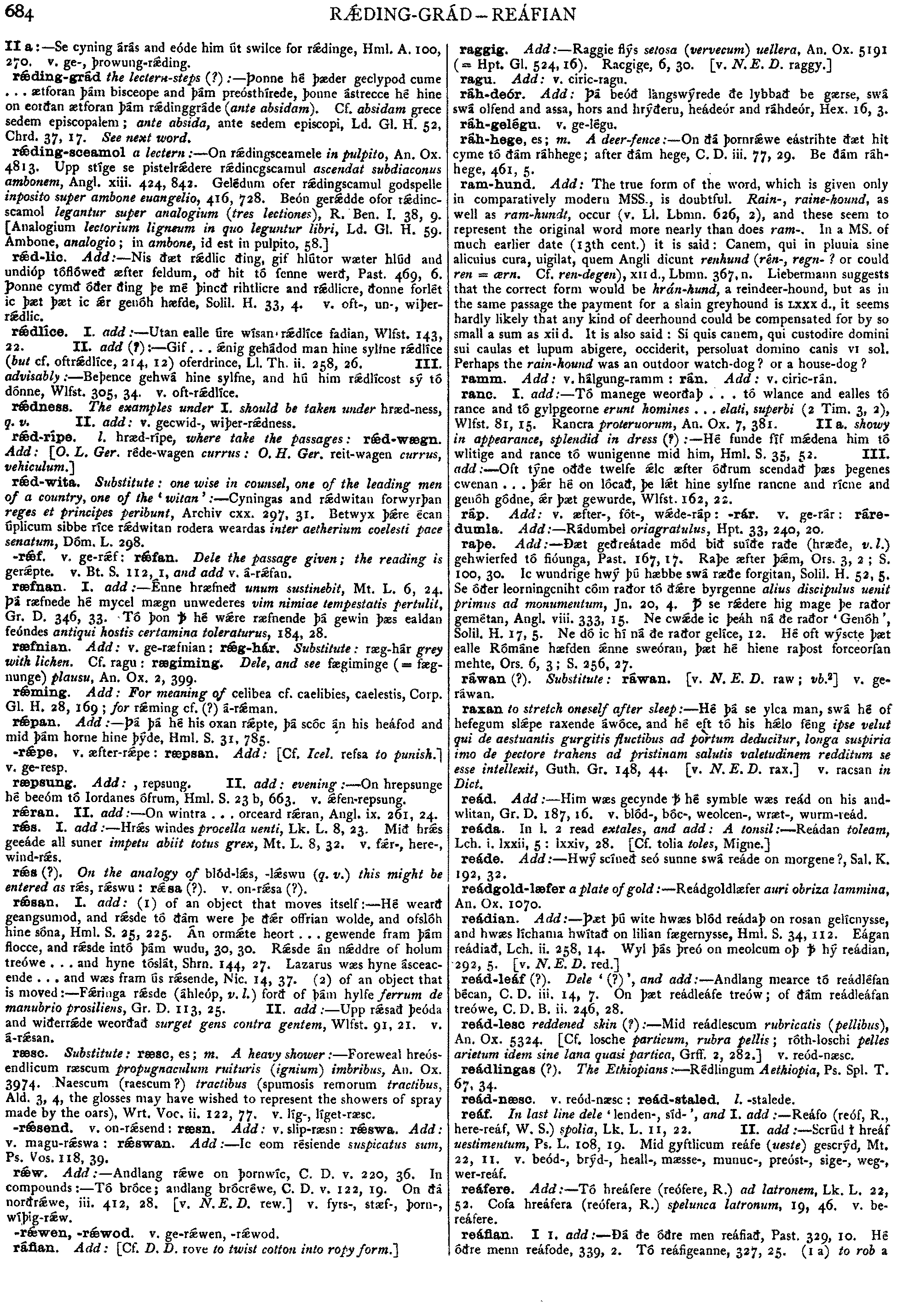
ram-hund. Add: The true form of the word, which is given only in comparatively modern MSS., is doubtful. Rain-, raine-hound, as well as ram-hundt, occur (v. Ll. Lbmn. 626, 2), and these seem to represent the original word more nearly than does ram-. In a MS. of much earlier date (13th cent.) it is said: Canem, qui in pluuia sine alicuius cura, uigilat, quem Angli dicunt renhund (rén-, regn- ? or could ren = ærn. Cf. ren-degen), xii d., Lbmn. 367, n. Liebermann suggests that the correct form would be hrán-hund, a reindeer-hound, but as in the same passage the payment for a slain greyhound is lxxx d. , it seems hardly likely that any kind of deerhound could be compensated for by so small a sum as xii d. It is also said: Si quis canem, qui custodire domini sui caulas et lupum abigere, occiderit, persoluat domino canis vi sol. Perhaps the rain-hound was an outdoor watch-dog? or a house-dog?
| Result Page: |  |
Previous | 1 2 3 4 5 6 7 8 9 10 11 12 | Next |  |
Germanic Lexicon Project (main page)
This search system was written by
Sean Crist
Please consider
volunteering
to correct the data in these online dictionaries.
No rights reserved. Feel free to use these data in any way you please.