|
|

|
Source: Bosworth/Toller, page b1057, entry 3 View original page image as: [TIFF] [PNG] [View previous entry] [View next entry] |
[Comment on this entry] [View comments] |
The following entry has been hand-corrected once. |
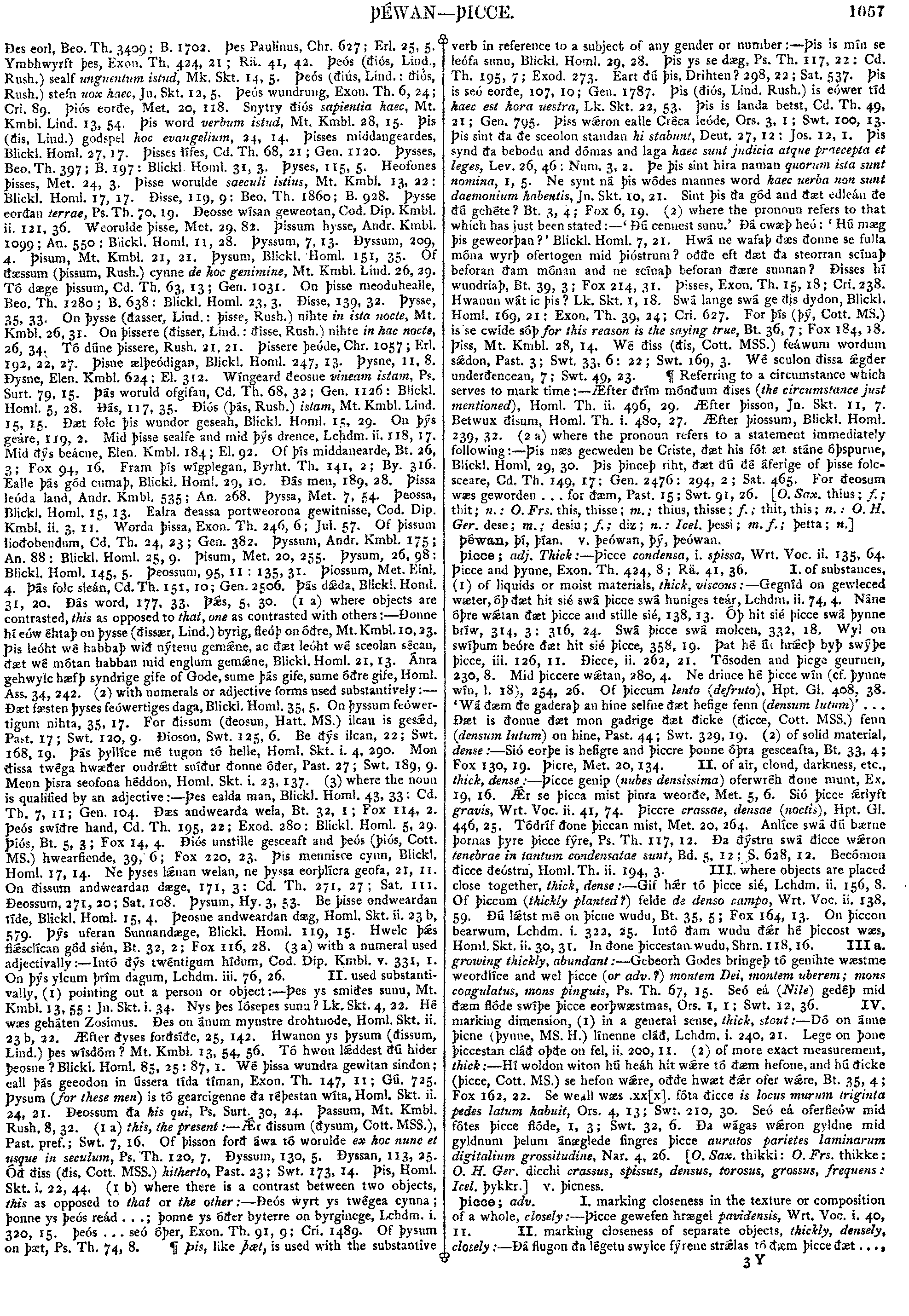
þicce;
adv.
I.
marking
closeness
in
the
texture
or
composition
of
a
whole,
closely
:--
Þicce
gewefen
hrægel
pavidensis,
Wrt.
Voc.
i.
40,
11.
II.
marking
closeness
of
separate
objects,
thickly,
densely,
closely
:--
Ðá
flugon
ða
légetu
swylce
fýrene
str las
tó
ðæm
þicce
ðæt...,
Blickl.
Homl.
203,
10.
Swá
þicce
is
þeó
heofon
mid
steorrum
áfylled
on
dæg
swá
on
niht,
Lchdm.
iii.
234,
31.
Wæl
þicce
gefylled
the
corpses
lying
thick
on
the
ground,
Cd.
Th.
130,
16;
Gen.
2160.
Swá
þicce
hié
áweóllon
swá
æmettan
they
swarmed
as
thick
as
ants,
Nar.
11,
12.
III.
marking
action
that
occurs
with
frequency
or
with
little
intermission
:--
Feónda
feorh
feóllon
ðicce,
Cd.
Th.
124,
20;
Gen.
2065.
Hió
spræc
him
þicce
tó
she
spoke
to
him
again
and
again,
43,
1;
Gen.
684,
IV.
marking
abundance,
thickly
:--
Lege
ðæt
dust
swíþe
þicce
on
cláð,
Lchdm.
ii.
148.
15:
340,
21.
Wearð
beám
monig
blódigum
teárum
birunnen
reáde
and
þicce,
Exon.
Th.
72,
22;
Cri.
1176.
[O.
Sax.
thikko
(mid
thiodu
gisetan):
O.
H.
Ger.
diccho
dense,
frequenter,
saepe.]
v.
þiclíce.
las
tó
ðæm
þicce
ðæt...,
Blickl.
Homl.
203,
10.
Swá
þicce
is
þeó
heofon
mid
steorrum
áfylled
on
dæg
swá
on
niht,
Lchdm.
iii.
234,
31.
Wæl
þicce
gefylled
the
corpses
lying
thick
on
the
ground,
Cd.
Th.
130,
16;
Gen.
2160.
Swá
þicce
hié
áweóllon
swá
æmettan
they
swarmed
as
thick
as
ants,
Nar.
11,
12.
III.
marking
action
that
occurs
with
frequency
or
with
little
intermission
:--
Feónda
feorh
feóllon
ðicce,
Cd.
Th.
124,
20;
Gen.
2065.
Hió
spræc
him
þicce
tó
she
spoke
to
him
again
and
again,
43,
1;
Gen.
684,
IV.
marking
abundance,
thickly
:--
Lege
ðæt
dust
swíþe
þicce
on
cláð,
Lchdm.
ii.
148.
15:
340,
21.
Wearð
beám
monig
blódigum
teárum
birunnen
reáde
and
þicce,
Exon.
Th.
72,
22;
Cri.
1176.
[O.
Sax.
thikko
(mid
thiodu
gisetan):
O.
H.
Ger.
diccho
dense,
frequenter,
saepe.]
v.
þiclíce.
|
Source: Cleasby/Vigfusson, page b0406, entry 54 View original page image as: [TIFF] [PNG] [View previous entry] [View next entry] |
[Comment on this entry] [View comments] |
The following entry has not been hand-corrected. However, the page is reserved and someone is correcting it. |
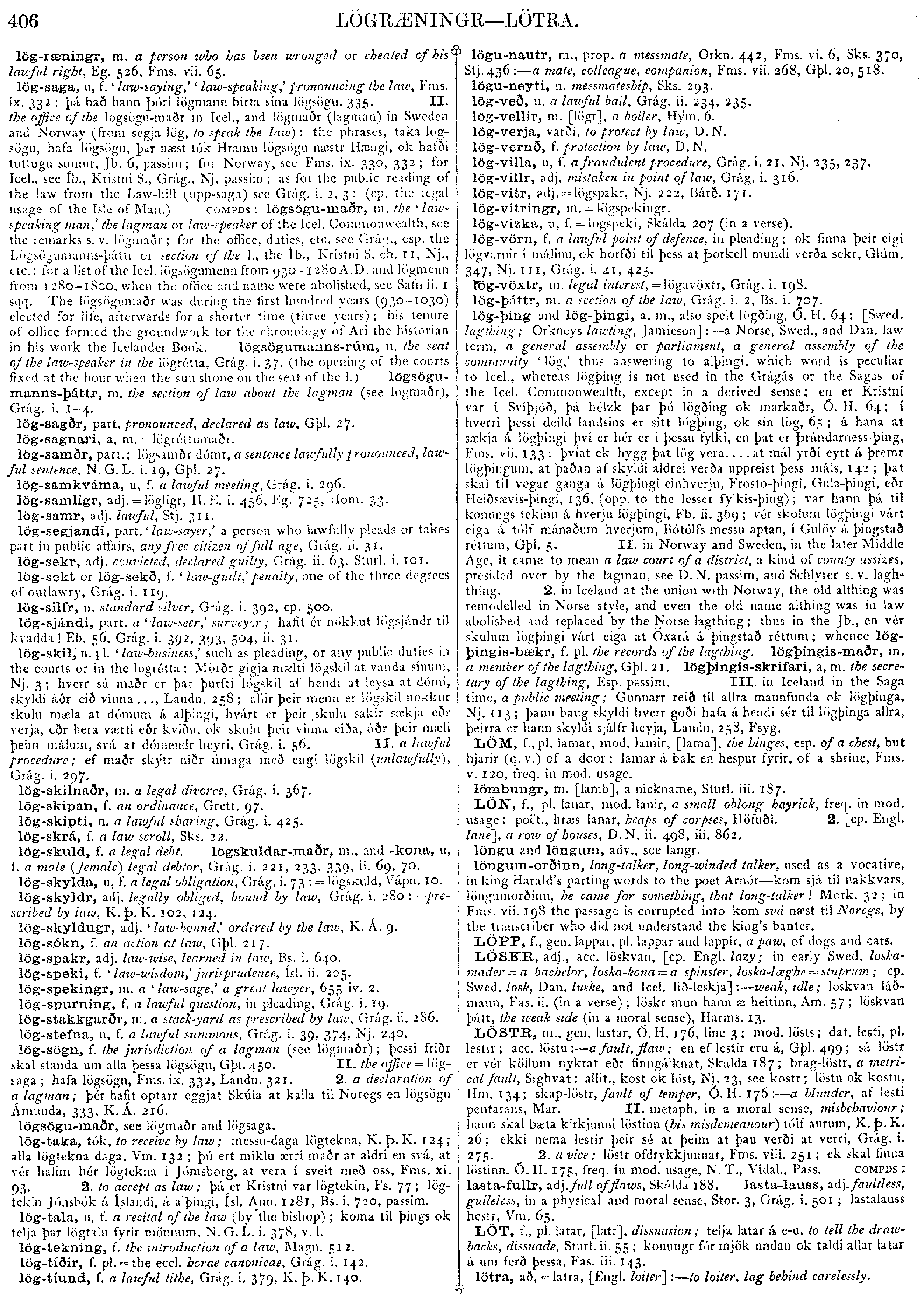
LÖN, f., pl. lanar, mod. lanir, a small oblong hayrick, freq. in mod. usage: poët., hræs lanar, heaps of corpses, ilöfuðl. 2. [cp. Engl. lane~, a row of houses, D. N. ii. 498, iii. 862.
|
Source: Cleasby/Vigfusson, page b0407, entry 7 View original page image as: [TIFF] [PNG] [View previous entry] [View next entry] |
[Comment on this entry] [View comments] |
The following entry has not been hand-corrected. However, the page is reserved and someone is correcting it. |
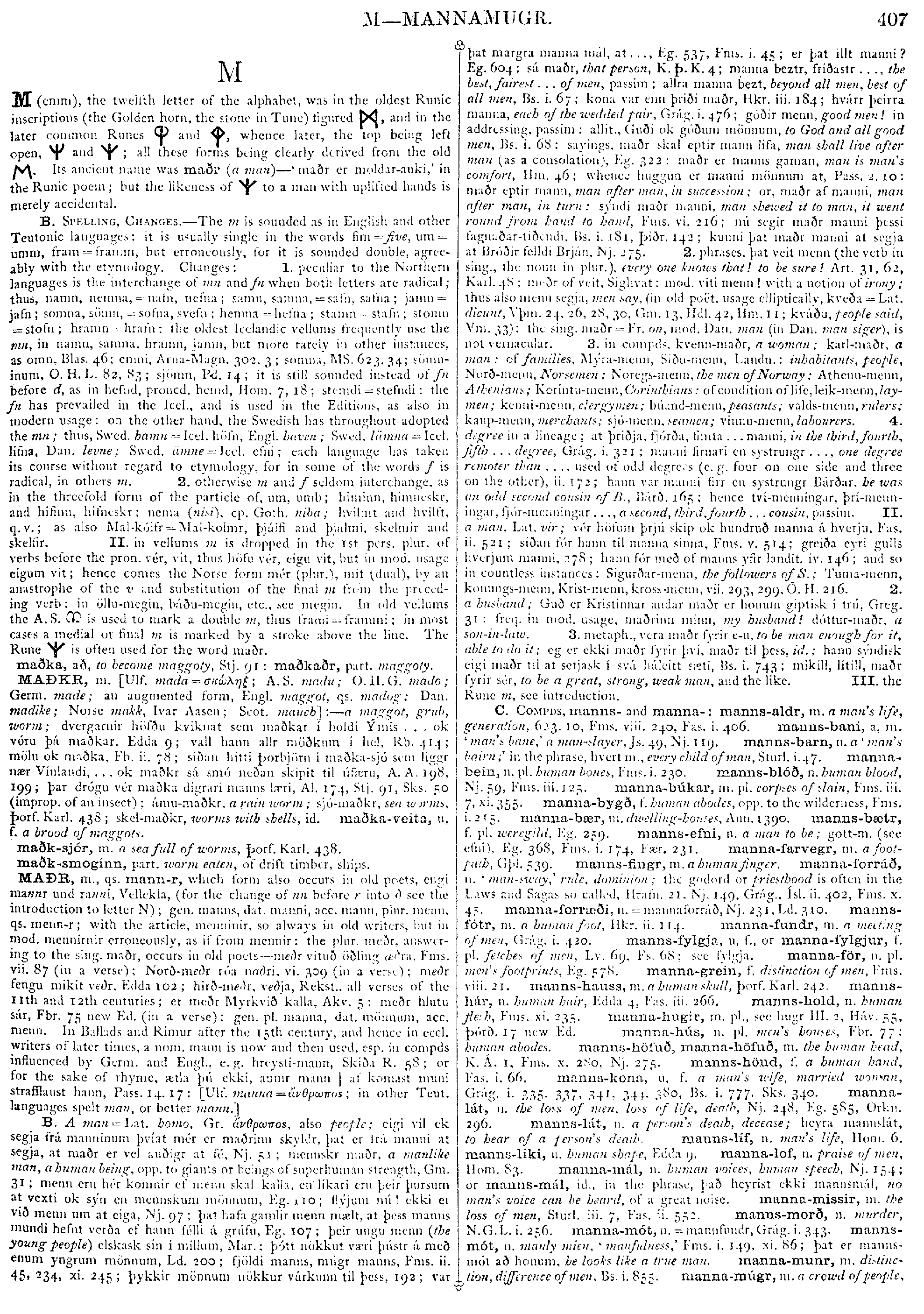
MAÐR, m., qs. mann-r, which form also occurs in old poets, cr. !'i mattnr und nrini, velltkla, (for the change of nn before r into ') see the introduction to letter N); gen. nianns, dat. maiuii, acc. maun, plur. menu, qs. menn-r; with the article, menninir, so always in old writers, but in mod. mennirnir erroneously, as if from niennir: the plur. meðr. answer- ing to the sing, maðr, occurs in old poets -- m e f)r vituð öðlin:; rfj-'Va, P'ms. vii. 87 (in a verse); Norð-m e()r róa nnf)ri. vi. 309 (in a verse); m?()r fengu mikit ve*)r, Edda 102; hirð-m e dr, v e dja, Rekst., all verses of the Ilth and 12th centuries; er ineîSr Myrkvið kalla, Akv. 5: meðr hlutu sár, Fbr. 75 new Ed. (in a verse): gen. pl. manna, dat. iiuiiinmn, acc. menu. In Ballads and Rimur after the 15th century, and hence in eccl. writers of later times, a noni. mann is now and then used, esp. in compels influenced by Germ, and Engl., e. g. hreysti-mann, Skiða R. 58; or for the sake of rhyme, ætla Ju'i ekki, aumr maim | af koinast muni strafflaust hann, Pass. 14. 17: [Ulf. manna = ('w6paiiros; in other Teut. languages spelt man, or better mann. '] B. A man -- Lat. bomo, Gr. avOpu-rros, also people; eigi vil ek segja frá manninum þvíat mér er niaðrinn skyKlr, þat er frá nianni at segja, at maðr er vel auðigr at K, Nj. s; j; n:cnnskr niaðr, a manlike man, ahnman being, opp. to giants or beings of superhuman strength. Gin. 31; menu eru her koinnir ef menu skal kalla, en líkari crn þeir þursum at vexti ok sy'n en mennskum monnum, Eg. ïio; flvjuin mi! ekki er við menn um at eiga, Nj. 97; bat hafa ganilir menn niælî, at þess maims mundi hefnt verôa cf hann fï'lli á gn'tfu, Eg. 107; þeir UUEJU menn (the young people) elskask sin í millum, Mar.; þótt nökkut væri þústr á með enum yngrum münnum, Ld. -200; fjöldi manns, múgr manns, Ems. ii. 45i 234, xi. 245; þykkir mönnum nükkur várkunn til þess, 192; var bat niargra manna nuii, at..., Eg. 537, Eniï. i. 45; er þat illt manni ? Eg. 604; sá maðr, that person, K. p. K. 4; manna beztr, fríðastr ..., the best, fairest... of men, passim; allra manna bezt, beyond all men, best of all men, Bs. i. 67; kona var enn þriði maðr, Hkr. iii. 184; hvárr þeirra manna, each ofthe wedded fair. Gray;, i. 476; góðir menu, good men ! in addressing, passim: allit., Guði ok gúðuni niönnum, to God and all good men, Bs. i. 68: sayings, maðr skal eptir mann lifa, man shall live after man (as a consolation), Eg. 322: maðr er maims gaman, man is man's comfort, 11111. 46; whence huggun er manni monnum at, Pass. 2. 10: maðr eptir mann, man after man, in succession; or, niaðr af manni, man after man, in turn: svndi maðr manni, man shewed it to man, it went round from band to hand, Ems. vi. 216; mi segir maðr manni þessi iagnaðar-tiðendi. Bs. i. 181, foiðr. 142; kunni þat inaðr manni at segja at Bróöir felldi Brjan, Nj. 275. 2. phrases, þat veil menu (the verb in sing., the noun in plur.), every one knows that! to be sure ! Art. 31, 62, Karl. 48; nicôr of veil, Sighvat: mod. viti menn ! with a notion of irony; thus also menu segja, men say, (in old pout, usage elliptically, kveða -- Lat. dicunt, Ybm. 24, 26, 28, 30. Gin. 13, lldl. 42, llni. í I; k'iib'J, people said, Ym. 33): the sing, maör -- Er. on, mod. Dan. man (in Dan. man siger), is not vernacular. 3. in compds. kvenn-maðr, a woman; karl-maðr, a man: (. ii families, Alyra-inenn, Síðu-nicnn, Landn.: inhabitants, people, Norð-menu, Norsemen; Noregs-ineni), / he men of Norway; Athenu-nienn, Athenians; Kcrintu-meim. Oj rin/ h iVi ns; of condition of life, leik-menn, lay- m ew; kenni-ineun, clergymen; biiand-rncnn, pea s ants; valds-rncnn, rulers; kaup-nienn, merchants; sjo-inenn, seamen; vinnu-inenn, labourers. 4. degree in a lineage: at þriðja, fjóröa, iînita ... manni, in the third, fourth, fifth ... degree, Gn'ig. i. 321; manni firnari en systrungr ..., one degree remoter than ... . used ot odd degrees (e. g. four on one side and three on the other), ii. 172; hann var manni firr en systrungr Bárðar, hewax an oild iccond cousin of 1!. . lîárð. 165; hence tvi-inenningar, þrí-incnn- ingar, fjor-menningar ..., a second, third, fourth ... cousin, passim. II. a man. Lat. vir; vi'-r liofum brjii skip ok hundruð manna á hverju. Eas. ii. 521; síðan tor hann til manna sinna, Fms. v. 514; grciða e)-ri gulls hverjum manni,, 178; hann for nicð of maims yfir landit, iv. 146; and so in countless instances: Sigurðar-menn, the followers ofS.; Tuina-ineiin, konungb-inenn, Krist-menn, kross-inenn, vii. 293, 299, 0. II. 216. 2. a husband; Guð er Kristinnar andar inaðr er honum giptisk í tru, Greg. 31: freq. in mod. usage, maðrinn minii, w y husband! dóttur-maðr, a son-in-law. 3. metaph., vera maðr fyrir e-u, to be man enough for it, able to do it; eg er ekki maðr f-rir því, inaðr til þess, id.; hann svndisk eigi maðr til at setja. sk í svá háíeitt sreti, Bs. i. 743; mikill, lítill, niaðr fyrir sur, to be a great, strong, weak man, and the like. III. the Rune m, see introduction. C. COMPDS, inarms- and manna-: manns-aldr, in. a man's life, generation. 6. ', 3. 10, Ems. viii. 240, Eas. i. 406. mauns-bani, a, in. ' man's bane, ' a man-slayer. Js. 49, Ni. 119. manns-barn, n. a ' man's bairn;' in the phrase, hvert in., every child of man, Stud. 1. 47. maniia- bein, n. pl. human bones, Fms. i. 230. manns-blóð, n. human blood, Nj. 59, Ems. iii. j 25. manna-bukar, m. pl. corpses of slain, Ems. iii. 7' x'- 355- manna-bygð, f. human abodes, opp. to the wilderness, Ems. i. 2 15. marma-bter, in. tlwclling-bo;i?ef, Ann. 1390. manns-bsotr, f. pl. weregrlil. Eg. 259. manns-efni, n. a;;; an to be; gott-m. (see efni Eg. 368, Ems. i. 174, Eær. 231. manna-farvegr, in. a foot- pa:h, ('îþi. 539. manns-fmgr, m. a human finger. nianna-forráð, n. ' man-sway ' rule, dominion; the g^dord or priesthood is often in the Laws and Sagas so called, Hrafn. 21, Nj. 149, Gn'ig., Ísl. ii. 402, Ems. x. 45. manna-forrœði. n. -- niannaforráð, Nj. 231, Ld. 3. 10. manns- fótr, m. a human foot, Hkr. ii. 114. inaiina-fundr, m. a meeting of men, (în'ig. i. 420. manns-fylgja, u, f., or manna-i'ylgjur, f. pl. fetches of men, I. v. 69, Es. 68; see íylgja. manna-för, n. pl. men's footprints, Eg. 578. manna-grein, f. distinction of men, Ems. viii. 21. inanns-hauss, m. a human skull, borf. Karl. 242. manns- liar, n. human hair, Edda 4, Eas. iii. 266. manns-hold, n. human Jie:h, Ems. xi. 235. manna-hugir, m. pl., see hugr III. 2, lláv. 55, Jjórð. 17 new Ed. manna-hús, n. pl. men's bonset, Fbr. 77: human abodes. manns-höíuð, manna-höfuð, m. (he human head, K. Á. i. Ems. x. 280, Nj. 275. manns-hönd, f. a human hand, Fas. i. 66. mo. nua-kona, u, f. a man's wife, married w)ii*nn, Gn'ig. i. 335. 337, 34r, 341, 380, Bs. i. 777, Sks. 340. manna- lát, n. the loss of men. loss af life, death, Nj. 248, Eg. 585, Orkn. 296. marms-lát, n. a person's death, decease; heyra inannslut, to bear of a person's ch-atb. raanns-lif, n. man's life, Honi. 6. manns-liki, n. human shape, Edda 9. manna-lof, n. praise of men, Hom. 83. manna-inal, n. human voices, human speech, Nj. 154; or manns-rnal, id., in the phrase, að heyrist ekki inanusmal, no man's voice can be heard, of a great noise. inanna-missir, in. the loss of men, Sturl. iii. 7, Eas. ii. 552. manns-morð, n. murder, N. G. L. i. 256. manna-mót, n. -- mar. nfuudr, (jrag. i. 343. manns- mót, n. manly mien, ' manfnlness, ' Ems. i. 149, xi. 86; þat er inanns- niót að honum, he looks like a true man. manna-munr, m. distinc- ^ /ion, difference of men. 13s. i. 85. 5. mauna-mxigr, m. a crcwd of people.
|
Source: Cleasby/Vigfusson, page b0597, entry 22 View original page image as: [TIFF] [PNG] [View previous entry] [View next entry] |
[Comment on this entry] [View comments (1)] |
The following entry has been hand-corrected once. |
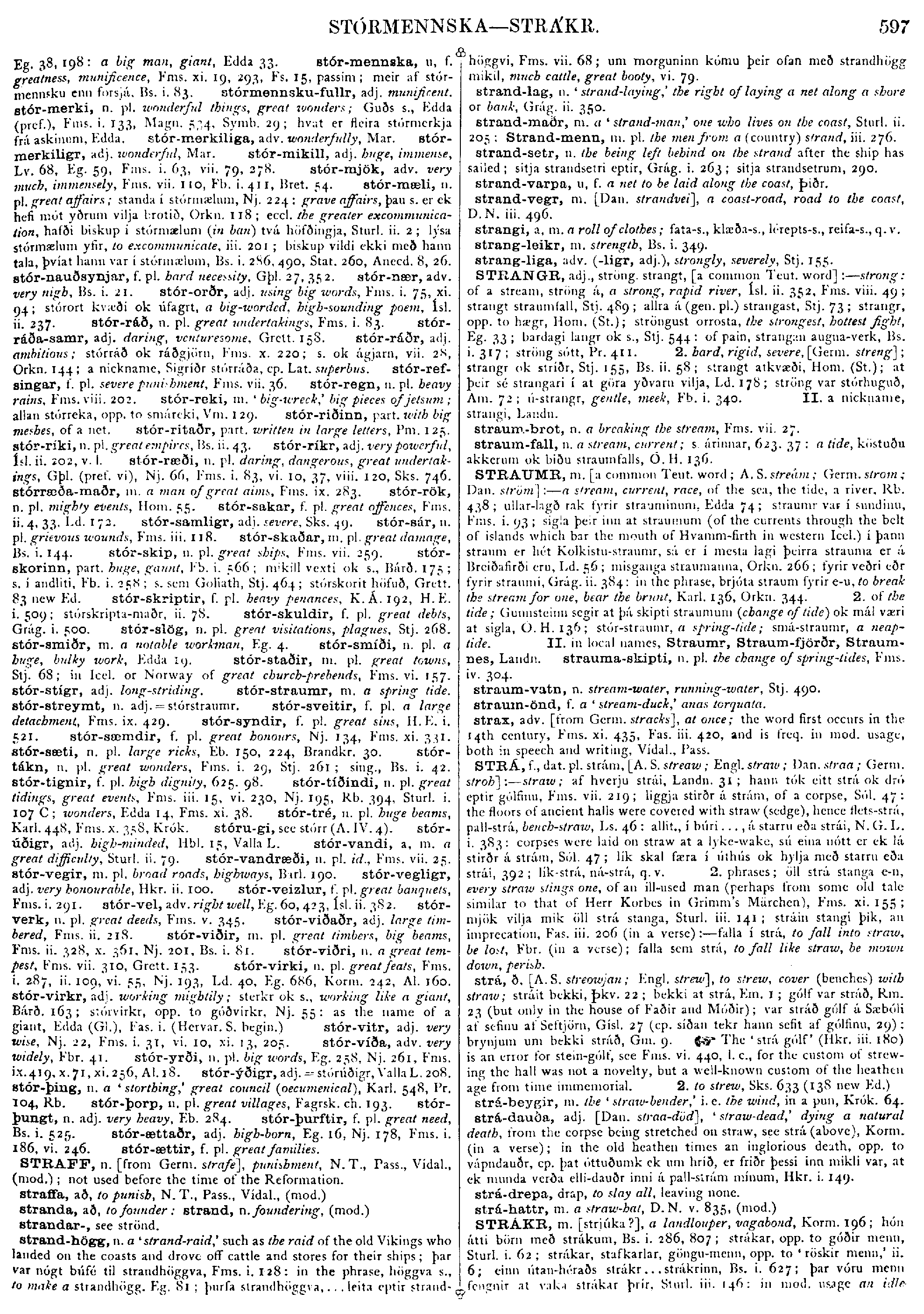
STRÁ, f., dat. pl. strám, [A.S. streaw; Engl. straw; Dan. straa; Germ. stroh] :-- straw; af hverju strái, Landn. 31; hann tók eitt strá ok dró eptir gólfinu, Fms. vii. 219; liggja stirðr á strám, of a corpse, Sól. 47: the floors of ancient halls were covered with straw (sedge), hence flets-strá, pall-strá, bench-straw, Ls. 46: allit., í búri ..., á starru eða strái, N.G.L. i. 383: corpses were laid on straw at a lyke-wake, sú eina nótt er ek lá stirðr á strám, Sól. 47; lík skal færa í úthús ok hylja með starru eða strái, 392; lík-strá, ná-strá, q.v. 2. phrases; öll strá stanga e-n, every straw stings one, of an ill-used man (perhaps from some old tale similar to that of Herr Korbes in Grimm's Märchen), Fms. xi. 155; mjök vilja mik öll strá stanga, Sturl. iii. 141; stráin stangi þik, an imprecation. Fas. iii. 206 (in a verse) :-- falla í strá, to fall into itraw, be lost, Fbr. (in a verse); falla sem strá, to fall like straw, be mown down, perish.
| Result Page: |  |
Previous | 1 2 |
Germanic Lexicon Project (main page)
This search system was written by
Sean Crist
Please consider
volunteering
to correct the data in these online dictionaries.
No rights reserved. Feel free to use these data in any way you please.