|
|

|
Source: Bosworth/Toller, page b0036, entry 34 View original page image as: [TIFF] [PNG] [View previous entry] [View next entry] |
[Comment on this entry] [View comments] |
The following entry has been hand-corrected once. |
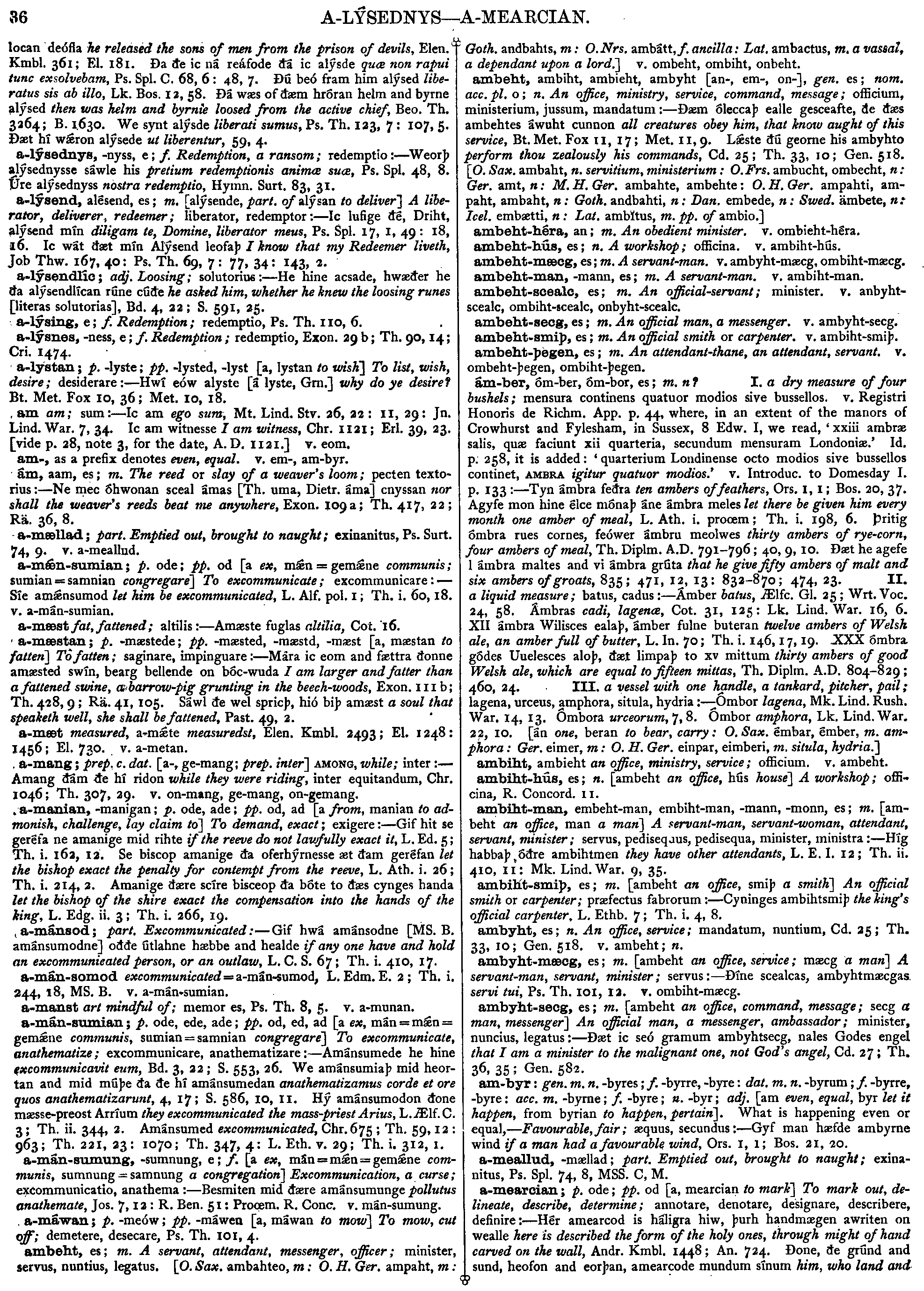
ám-ber, óm-ber, óm-bor, es; m. n? I. a dry measure of four bushels; mensura continens quatuor modios sive bussellos. v. Registri Honoris de Richm. App. p. 44, where, in an extent of the manors of Crowhurst and Fylesham, in Sussex, 8 Edw. I, we read, 'xxiii ambræ salis, quæ faciunt xii quarteria, secundum mensuram Londoniæ.' Id. p: 258, it is added: 'quarterium Londinense octo modios sive bussellos continet, AMBRA igitiur quatuor modios.' v. Introduc. to Domesday I. p. 133 :-- Tyn ámbra feðra ten ambers of feathers, Ors. 1, 1; Bos. 20, 37. Agyfe mon hine élce mónaþ áne ámbra meles let there be given him every month one amber of meal, L. Ath. i. proœm; Th. i. 198, 6. þritig ómbra rues cornes, feówer ámbru meolwes thirty ambers of rye-corn, four ambers of meal, Th. Diplm. A. D. 791-796; 40, 9, 10. Ðæt he agefe l ámbra maltes and vi ámbra grúta that he give fifty ambers of malt and six ambers of groats, 835; 471, 12, 13: 832-870; 474, 23. II. a liquid measure; batus, cadus :-- Ámber batus, Ælfc. Gl. 25 ; Wrt. Voc. 24, 58. Ámbras cadi, lagenæ, Cot. 31, 125: Lk. Lind. War. 16, 6. XII ámbra Wilisces ealaþ, ámber fulne buteran twelve ambers of Welsh ale, an amber full of butter, L. In. 70; Th. i. 146, 17, 19. XXX ómbra gódes Uuelesces aloþ, ðæt limpaþ to xv mittum thirty ambers of good Welsh ale, which are equal to fifteen mittas, Th. Diplm. A. D. 804-829; 460, 24. III. a vessel with one handle, a tankard, pitcher, pail; lagena, urceus, amphora, situla, hydria :-- Ómbor lagena, Mk. Lind. Rush. War, 14, 13. Ombora urceorum, 7, 8. Ómbor amphora. Lk. Lind. War. 22, 10. [án one, beran to bear, carry: O. Sax. émbar, émber, m. amphora : Ger. eimer, m: O. H. Ger. einpar, eimberi, m. situla, hydria.]
|
Source: Bosworth/Toller, page b0166, entry 26 View original page image as: [TIFF] [PNG] [View previous entry] [View next entry] |
[Comment on this entry] [View comments (1)] |
The following entry has been hand-corrected once. |
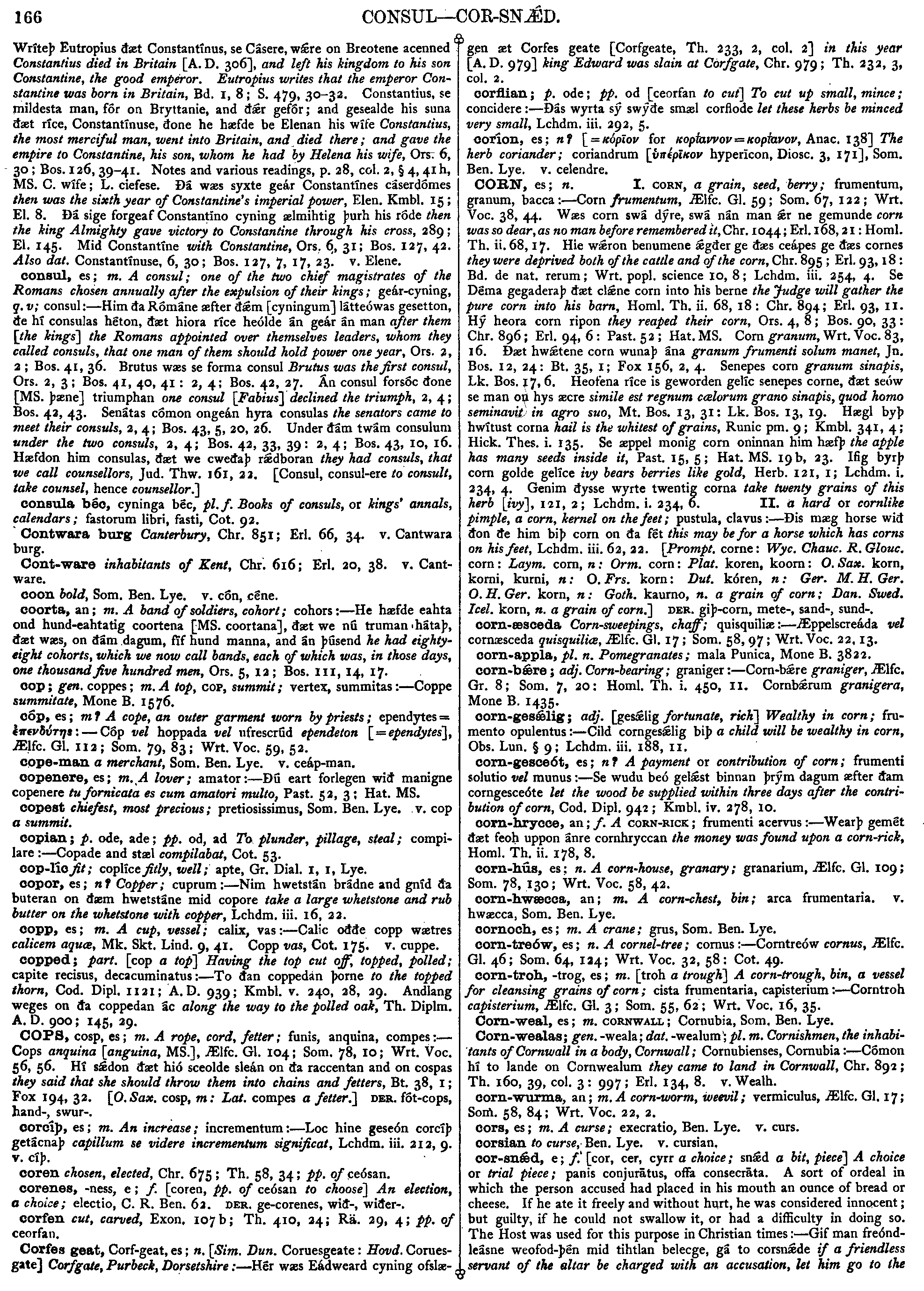
CORN,
es;
n.
I.
CORN,
a
grain,
seed,
berry;
frumentum,
granum,
bacca
:--
Corn
frumentum,
Ælfc.
Gl.
59;
Som.
67,
122;
Wrt.
Voc.
38,
44.
Wæs
corn
swá
dýre,
swá
nán
man
 r
ne
gemunde
corn
was
so
dear,
as
no
man
before
remembered
it,
Chr.
1044;
Erl.
168,
21:
Homl.
Th.
ii.
68,
17.
Hie
wron
benumene
gðer
ge
ðæs
ceápes
ge
ðæs
cornes
they
were
deprived
both
of
the
cattle
and
of
the
corn,
Chr.
895;
Erl.
93,
18:
Bd.
de
nat.
rerum;
Wrt.
popl.
science
10,
8;
Lchdm.
iii.
254,
4.
Se
Déma
gegaderaþ
ðæt
clne
corn
into
his
berne
the
Judge
will
gather
the
pure
corn
into
his
barn,
Homl.
Th.
ii.
68,
18:
Chr.
894;
Erl.
93,
11.
Hý
heora
corn
ripon
they
reaped
their
corn,
Ors.
4,
8;
Bos.
90,
33:
Chr.
896;
Erl.
94,
6:
Past.
52;
Hat.
MS.
Corn
granum,
Wrt.
Voc.
83,
16.
Ðæt
hwtene
corn
wunaþ
ána
granum
frumenti
solum
manet,
Jn.
Bos.
12,
24:
Bt.
35,
1;
Fox
156,
2,
4.
Senepes
corn
granum
sinapis,
Lk.
Bos.
17,
6.
Heofena
ríce
is
geworden
gelíc
senepes
corne,
ðæt
seów
se
man
ou
hys
æcre
simile
est
regnum
cælorum
grano
sinapis,
quod
homo
seminavit
in
agro
suo,
Mt.
Bos.
13,
31:
Lk.
Bos.
13,
19.
Hægl
byþ
hwítust
corna
hail
is
the
whitest
of
grains,
Runic
pm.
9;
Kmbl.
341,
4;
Hick.
Thes.
i.
135.
Se
æppel
monig
corn
oninnan
him
hæfþ
the
apple
has
many
seeds
inside
it,
Past.
15,
5;
Hat.
MS.
19b,
23.
Ifig
byrþ
corn
golde
gelíce
ivy
bears
berries
like
gold,
Herb.
121,
1;
Lchdm.
i.
234,
4.
Genim
ðysse
wyrte
twentig
corna
take
twenty
grains
of
this
herb
[ivy],
121,
2;
Lchdm.
i.
234,
6.
II.
a
hard
or
cornlike
pimple,
a
corn,
kernel
on
the
feet;
pustula,
clavus
:--
Ðis
mæg
horse
wið
ðon
ðe
him
biþ
corn
on
ða
fét
this
may
be
for
a
horse
which
has
corns
on
his
feet,
Lchdm.
iii.
62,
22.
[Prompt.
corne:
Wyc.
Chauc.
R.
Glouc.
corn:
Laym.
corn,
n:
Orm.
corn:
Plat.
koren,
koorn:
O.
Sax.
korn,
korni,
kurni,
n:
O.
Frs.
korn:
Dut.
kóren,
n:
Ger.
M.
H.
Ger.
O.
H.
Ger.
korn,
n
:
Goth.
kaurno,
n.
a
grain
of
corn;
Dan.
Swed.
Icel.
korn,
n.
a
grain
of
corn.]
DER.
giþ-corn,
mete-,
sand-,
sund-.
r
ne
gemunde
corn
was
so
dear,
as
no
man
before
remembered
it,
Chr.
1044;
Erl.
168,
21:
Homl.
Th.
ii.
68,
17.
Hie
wron
benumene
gðer
ge
ðæs
ceápes
ge
ðæs
cornes
they
were
deprived
both
of
the
cattle
and
of
the
corn,
Chr.
895;
Erl.
93,
18:
Bd.
de
nat.
rerum;
Wrt.
popl.
science
10,
8;
Lchdm.
iii.
254,
4.
Se
Déma
gegaderaþ
ðæt
clne
corn
into
his
berne
the
Judge
will
gather
the
pure
corn
into
his
barn,
Homl.
Th.
ii.
68,
18:
Chr.
894;
Erl.
93,
11.
Hý
heora
corn
ripon
they
reaped
their
corn,
Ors.
4,
8;
Bos.
90,
33:
Chr.
896;
Erl.
94,
6:
Past.
52;
Hat.
MS.
Corn
granum,
Wrt.
Voc.
83,
16.
Ðæt
hwtene
corn
wunaþ
ána
granum
frumenti
solum
manet,
Jn.
Bos.
12,
24:
Bt.
35,
1;
Fox
156,
2,
4.
Senepes
corn
granum
sinapis,
Lk.
Bos.
17,
6.
Heofena
ríce
is
geworden
gelíc
senepes
corne,
ðæt
seów
se
man
ou
hys
æcre
simile
est
regnum
cælorum
grano
sinapis,
quod
homo
seminavit
in
agro
suo,
Mt.
Bos.
13,
31:
Lk.
Bos.
13,
19.
Hægl
byþ
hwítust
corna
hail
is
the
whitest
of
grains,
Runic
pm.
9;
Kmbl.
341,
4;
Hick.
Thes.
i.
135.
Se
æppel
monig
corn
oninnan
him
hæfþ
the
apple
has
many
seeds
inside
it,
Past.
15,
5;
Hat.
MS.
19b,
23.
Ifig
byrþ
corn
golde
gelíce
ivy
bears
berries
like
gold,
Herb.
121,
1;
Lchdm.
i.
234,
4.
Genim
ðysse
wyrte
twentig
corna
take
twenty
grains
of
this
herb
[ivy],
121,
2;
Lchdm.
i.
234,
6.
II.
a
hard
or
cornlike
pimple,
a
corn,
kernel
on
the
feet;
pustula,
clavus
:--
Ðis
mæg
horse
wið
ðon
ðe
him
biþ
corn
on
ða
fét
this
may
be
for
a
horse
which
has
corns
on
his
feet,
Lchdm.
iii.
62,
22.
[Prompt.
corne:
Wyc.
Chauc.
R.
Glouc.
corn:
Laym.
corn,
n:
Orm.
corn:
Plat.
koren,
koorn:
O.
Sax.
korn,
korni,
kurni,
n:
O.
Frs.
korn:
Dut.
kóren,
n:
Ger.
M.
H.
Ger.
O.
H.
Ger.
korn,
n
:
Goth.
kaurno,
n.
a
grain
of
corn;
Dan.
Swed.
Icel.
korn,
n.
a
grain
of
corn.]
DER.
giþ-corn,
mete-,
sand-,
sund-.
|
Source: Bosworth/Toller, page b0258, entry 35 View original page image as: [TIFF] [PNG] [View previous entry] [View next entry] |
[Comment on this entry] [View comments] |
The following entry has been hand-corrected once. |
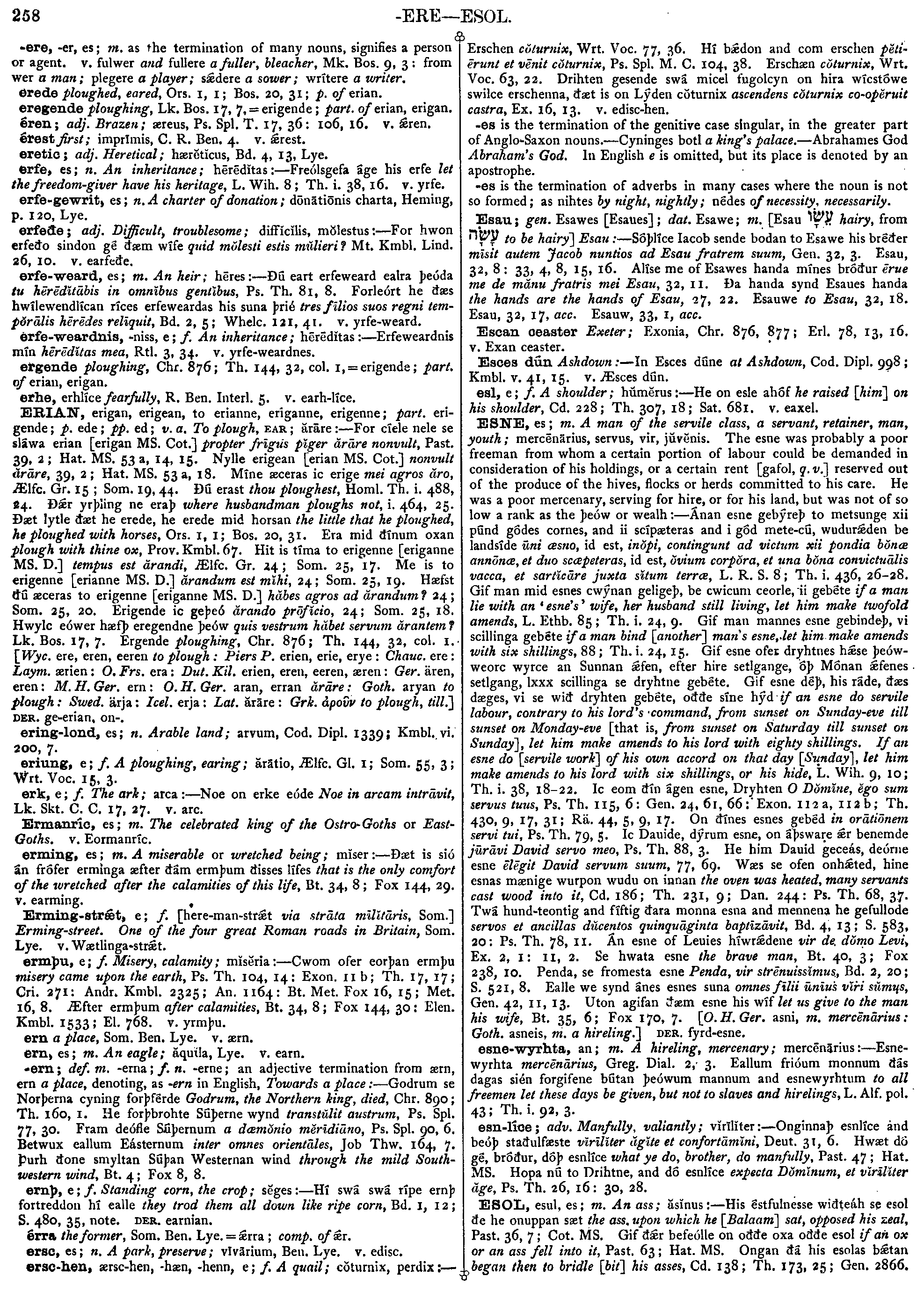
ESNE,
es;
m.
A
man
of
the
servile
class,
a
servant,
retainer,
man,
youth;
merc n
n rius,
servus,
vir,
j
rius,
servus,
vir,
j v
v nis.
The
esne
was
probably
a
poor
freeman
from
whom
a
certain
portion
of
labour
could
be
demanded
in
consideration
of
his
holdings,
or
a
certain
rene
[gafol,
q.
v.]
reserved
out
of
the
produce
of
the
hives,
flocks
or
herds
committed
to
his
care.
He
was
a
poor
mercenary,
serving
for
hire,
or
for
his
land,
but
was
not
of
so
low
a
rank
as
the
þeów
or
wealh
:--
Ánan
esne
gebýreþ
to
metsunge
xii
púnd
gódes
cornes,
and
ii
scípæteras
and
i
gód
mete-cú,
wudurden
be
landsíde
nis.
The
esne
was
probably
a
poor
freeman
from
whom
a
certain
portion
of
labour
could
be
demanded
in
consideration
of
his
holdings,
or
a
certain
rene
[gafol,
q.
v.]
reserved
out
of
the
produce
of
the
hives,
flocks
or
herds
committed
to
his
care.
He
was
a
poor
mercenary,
serving
for
hire,
or
for
his
land,
but
was
not
of
so
low
a
rank
as
the
þeów
or
wealh
:--
Ánan
esne
gebýreþ
to
metsunge
xii
púnd
gódes
cornes,
and
ii
scípæteras
and
i
gód
mete-cú,
wudurden
be
landsíde
 ni
æsno,
id
est,
in
ni
æsno,
id
est,
in pi,
contingent
ad
victum
xii
pondia
bnæ
ann
pi,
contingent
ad
victum
xii
pondia
bnæ
ann næ,
et
duo
scæpeteras,
id
est,
vium
corpra,
et
una
bona
convictulis
vacca,
et
sartícre
juxta
s
næ,
et
duo
scæpeteras,
id
est,
vium
corpra,
et
una
bona
convictulis
vacca,
et
sartícre
juxta
s tum
terræ,
L.
R.
S.
8;
Th.
i.
436,
26-28.
Gif
man
mid
esnes
cwynan
geligeþ,
be
cwicum
ceorle,
ii
gebéte
if
a
man
lie
with
an
'esne's'
wife,
her
husband
still
living,
let
him
make
twofold
amends,
L.
Ethb.
85;
Th.
i.
24,
9.
Gif
man
mannes
esne
gebindeþ,
vi
scillinga
gebéte
if
a
man
bind
[another]
man's
esne,
let
him
make
amends
with
six
shillings,
88
;
Th.
i.
24,
15.
Gif
esne
ofet
dryhtnes
hse
þeów-weorc
wyrce
an
Sunnan
fen,
efter
hire
setlgange,
óþ
Mónan
fenes
setlgang,
lxxx
scillinga
se
dryhtne
gebéte.
Gif
esne
déþ,
his
ráde,
ðæs
dæges,
vi
se
wið
dryhten
gebéte,
oððe
sine
hýd
if
an
esne
do
servile
labour,
contrary
to
his
lord's
command,
from
sunset
on
Sunday-eve
till
sunset
on
Monday-eve
[that
is,
from
sunset
on
Saturday
till
sunset
on
Sunday],
let
him
make
amends
to
his
lord
with
eighty
shillings.
If
an
esne
do
[servile
work]
of
his
own
accord
on
that
day
[Sunday],
let
him
make
amends
to
his
lord
with
six
shillings,
or
his
hide,
L.
Win.
9,
10;
Th.
i.
38,
18-22.
Ic
eom
ðín
ágen
esne,
Dryhten
O
Dmne,
go
sum
servus
tuus,
Ps.
Th.
115,
6:
Gen.
24,
61,
66:
Exon.
112a,
112b;
Th.
430,
9,
17,
31;
Rä.
44,
5,
9,
17.
On
ðínes
esnes
gebéd
in
ortinem
servi
tut,
Ps.
Th.
79,
5.
Ic
Dauide,
dýrum
esne,
on
áþsware
r
benemde
jrvi
David
servo
meo,
Ps.
Th.
88,
3.
He
him
Dauid
geceás,
deórne
esne
lgit
David
servum
suum,
77,
69.
Wæs
se
ofen
onhted,
hine
esnas
mænige
wurpon
wudu
on
innan
the
oven
was
heated,
many
servants
cast
wood
into
it,
Cd.
186;
Th.
231,
9;
Dan.
244:
Ps.
Th.
68,
37.
Twá
hund-teontig
and
fíftig
ðara
monna
esna
and
mennena
he
gefullode
servos
et
ancillas
dcentos
quinquginta
bapt
tum
terræ,
L.
R.
S.
8;
Th.
i.
436,
26-28.
Gif
man
mid
esnes
cwynan
geligeþ,
be
cwicum
ceorle,
ii
gebéte
if
a
man
lie
with
an
'esne's'
wife,
her
husband
still
living,
let
him
make
twofold
amends,
L.
Ethb.
85;
Th.
i.
24,
9.
Gif
man
mannes
esne
gebindeþ,
vi
scillinga
gebéte
if
a
man
bind
[another]
man's
esne,
let
him
make
amends
with
six
shillings,
88
;
Th.
i.
24,
15.
Gif
esne
ofet
dryhtnes
hse
þeów-weorc
wyrce
an
Sunnan
fen,
efter
hire
setlgange,
óþ
Mónan
fenes
setlgang,
lxxx
scillinga
se
dryhtne
gebéte.
Gif
esne
déþ,
his
ráde,
ðæs
dæges,
vi
se
wið
dryhten
gebéte,
oððe
sine
hýd
if
an
esne
do
servile
labour,
contrary
to
his
lord's
command,
from
sunset
on
Sunday-eve
till
sunset
on
Monday-eve
[that
is,
from
sunset
on
Saturday
till
sunset
on
Sunday],
let
him
make
amends
to
his
lord
with
eighty
shillings.
If
an
esne
do
[servile
work]
of
his
own
accord
on
that
day
[Sunday],
let
him
make
amends
to
his
lord
with
six
shillings,
or
his
hide,
L.
Win.
9,
10;
Th.
i.
38,
18-22.
Ic
eom
ðín
ágen
esne,
Dryhten
O
Dmne,
go
sum
servus
tuus,
Ps.
Th.
115,
6:
Gen.
24,
61,
66:
Exon.
112a,
112b;
Th.
430,
9,
17,
31;
Rä.
44,
5,
9,
17.
On
ðínes
esnes
gebéd
in
ortinem
servi
tut,
Ps.
Th.
79,
5.
Ic
Dauide,
dýrum
esne,
on
áþsware
r
benemde
jrvi
David
servo
meo,
Ps.
Th.
88,
3.
He
him
Dauid
geceás,
deórne
esne
lgit
David
servum
suum,
77,
69.
Wæs
se
ofen
onhted,
hine
esnas
mænige
wurpon
wudu
on
innan
the
oven
was
heated,
many
servants
cast
wood
into
it,
Cd.
186;
Th.
231,
9;
Dan.
244:
Ps.
Th.
68,
37.
Twá
hund-teontig
and
fíftig
ðara
monna
esna
and
mennena
he
gefullode
servos
et
ancillas
dcentos
quinquginta
bapt zvit,
Bd.
4,
13;
S.
583,
20:
Ps.
Th.
78,
11.
Án
esne
of
Leuies
híwrdene
vir
de
dmo
ievi,
Ex.
2,
1:
11,
2.
Se
hwata
esne
the
brave
man,
Bt.
40,
3;
Fox
238,
10.
Penda,
se
fromesta
esne
Penda,
vir
strnuissmus,
Bd.
2,
20;
S.
521,
8.
Ealle
we
synd
ánes
esnes
suna
omnes
flli
nus
vri
smus,
Gen.
42,
11,
13.
Uton
agifan
ðæm
esne
his
wíf
let
us
give
to
the
man
his
wife,
Bt.
35,
6;
Fox
170,
7.
[O.
H.
Ger.
asni,
m.
mercnrius:
Goth.
asneis,
m.
a
hireling.]
DER.
fyrd-esne.
zvit,
Bd.
4,
13;
S.
583,
20:
Ps.
Th.
78,
11.
Án
esne
of
Leuies
híwrdene
vir
de
dmo
ievi,
Ex.
2,
1:
11,
2.
Se
hwata
esne
the
brave
man,
Bt.
40,
3;
Fox
238,
10.
Penda,
se
fromesta
esne
Penda,
vir
strnuissmus,
Bd.
2,
20;
S.
521,
8.
Ealle
we
synd
ánes
esnes
suna
omnes
flli
nus
vri
smus,
Gen.
42,
11,
13.
Uton
agifan
ðæm
esne
his
wíf
let
us
give
to
the
man
his
wife,
Bt.
35,
6;
Fox
170,
7.
[O.
H.
Ger.
asni,
m.
mercnrius:
Goth.
asneis,
m.
a
hireling.]
DER.
fyrd-esne.
|
Source: Bosworth/Toller, page b0681, entry 16 View original page image as: [TIFF] [PNG] [View previous entry] [View next entry] |
[Comment on this entry] [View comments] |
The following entry has been hand-corrected once. |
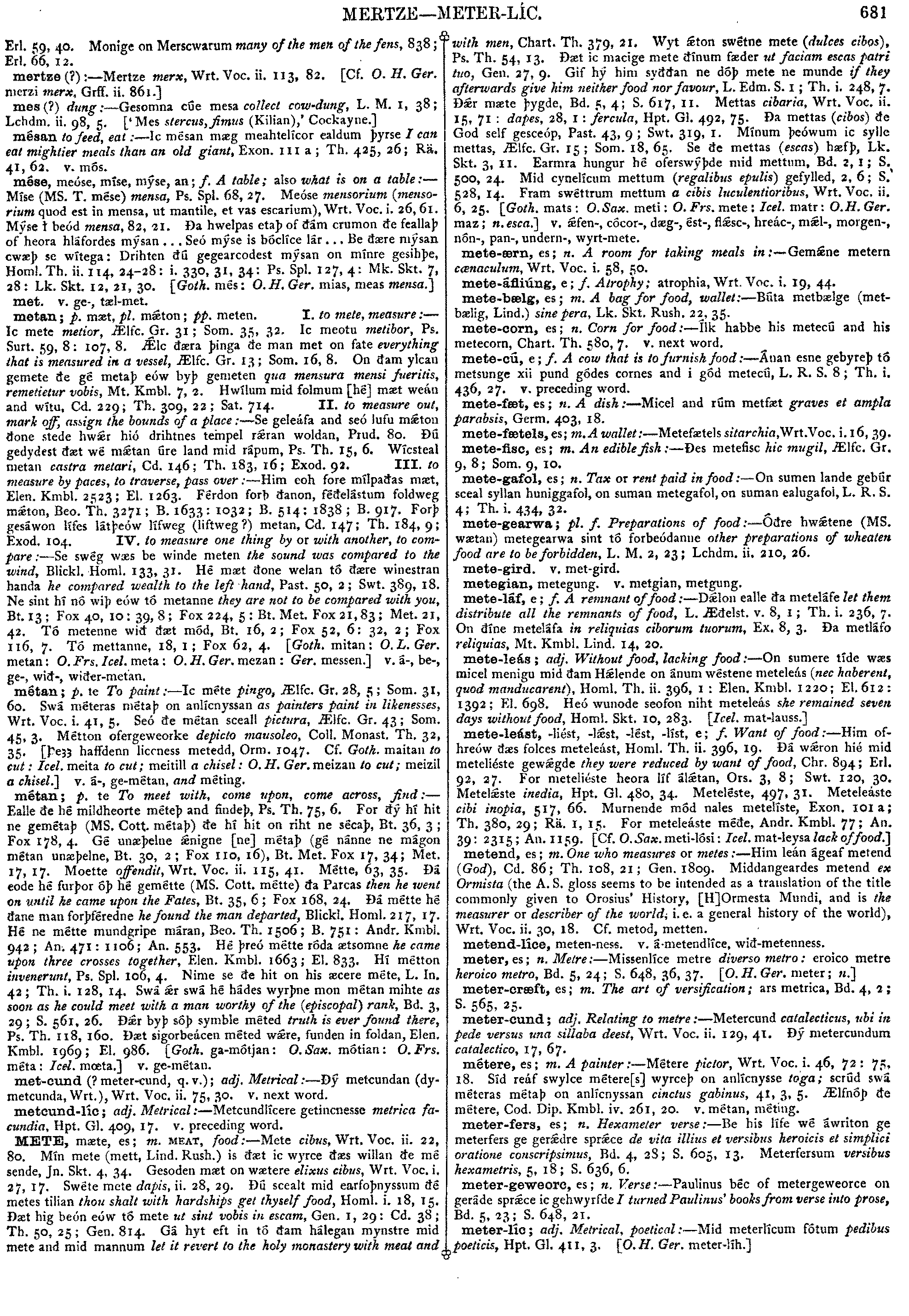
mete-cú, e; f. A cow that is to furnish food :-- Ánan esne gebyreþ tó metsunge xii pund gódes cornes and i gód metecú, L. R. S. 8; Th. i. 436, 27. v. preceding word.
|
Source: Bosworth/Toller, page b0682, entry 30 View original page image as: [TIFF] [PNG] [View previous entry] [View next entry] |
[Comment on this entry] [View comments] |
The following entry has been hand-corrected once. |
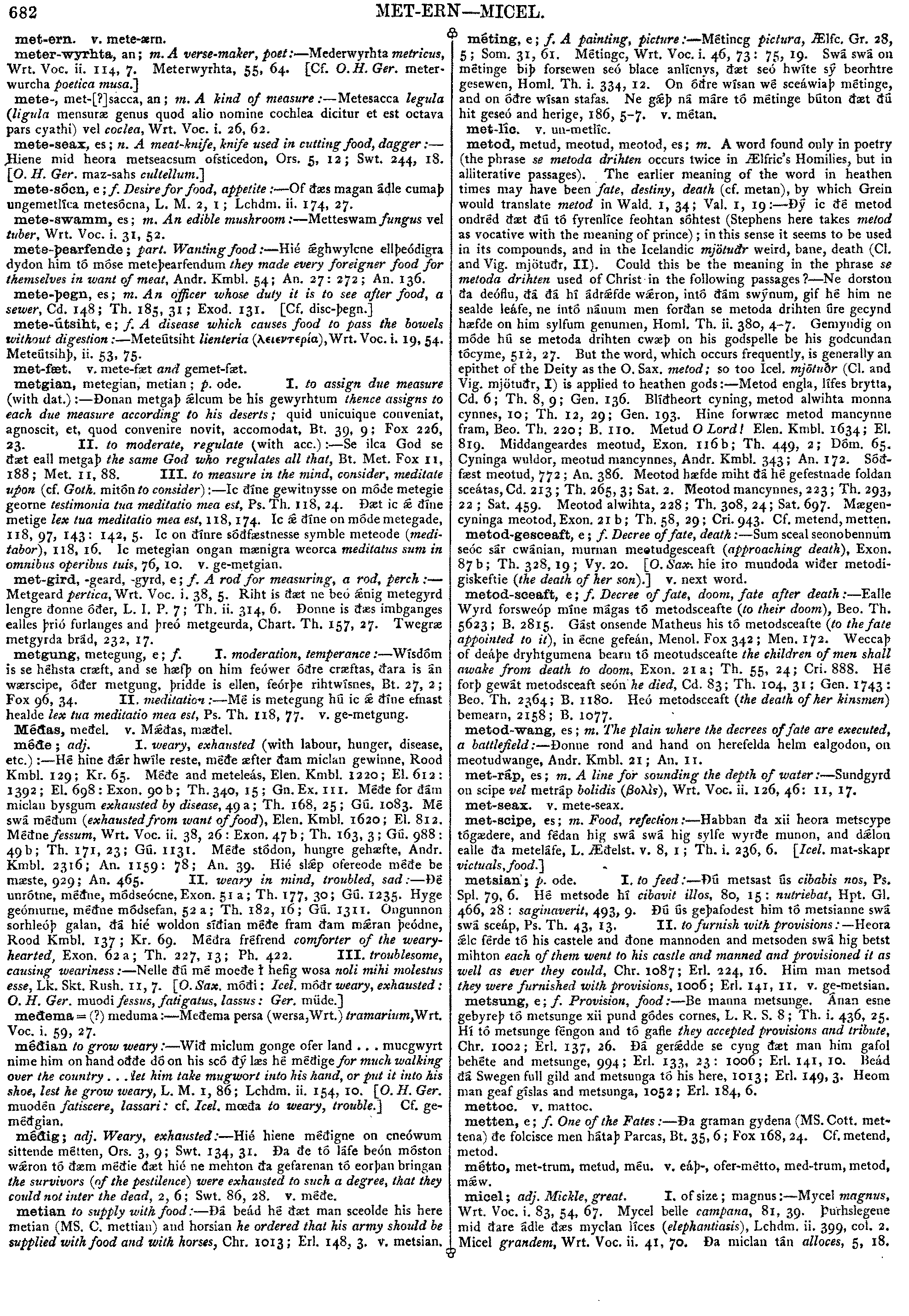
metsung,
e;
f.
Provision,
food
:--
Be
manna
netsunge.
Ánan
esne
gebyreþ
tó
metsunge
xii
pund
gódes
cornes,
L.
R.
S.
8;
Th.
i.
436,
25.
Hí
tó
metsunge
féngon
and
tó
gafle
they
accepted
provisions
and
tribute,
Chr.
1002;
Erl.
137,
26.
Ðá
gerdde
se
cyng
ðæt
man
him
gafol
behéte
and
metsunge,
994;
Erl.
133,
23:
1006;
Erl.
141,
10.
Beád
ðá
Swegen
full
gild
and
metsunga
tó
his
here,
1013;
Erl.
149,
3.
Heom
man
geaf
gíslas
and
metsunga,
1052;
Erl.
184,
6.
|
Source: Bosworth/Toller, page b0788, entry 8 View original page image as: [TIFF] [PNG] [View previous entry] [View next entry] |
[Comment on this entry] [View comments] |
The following entry has been hand-corrected once. |
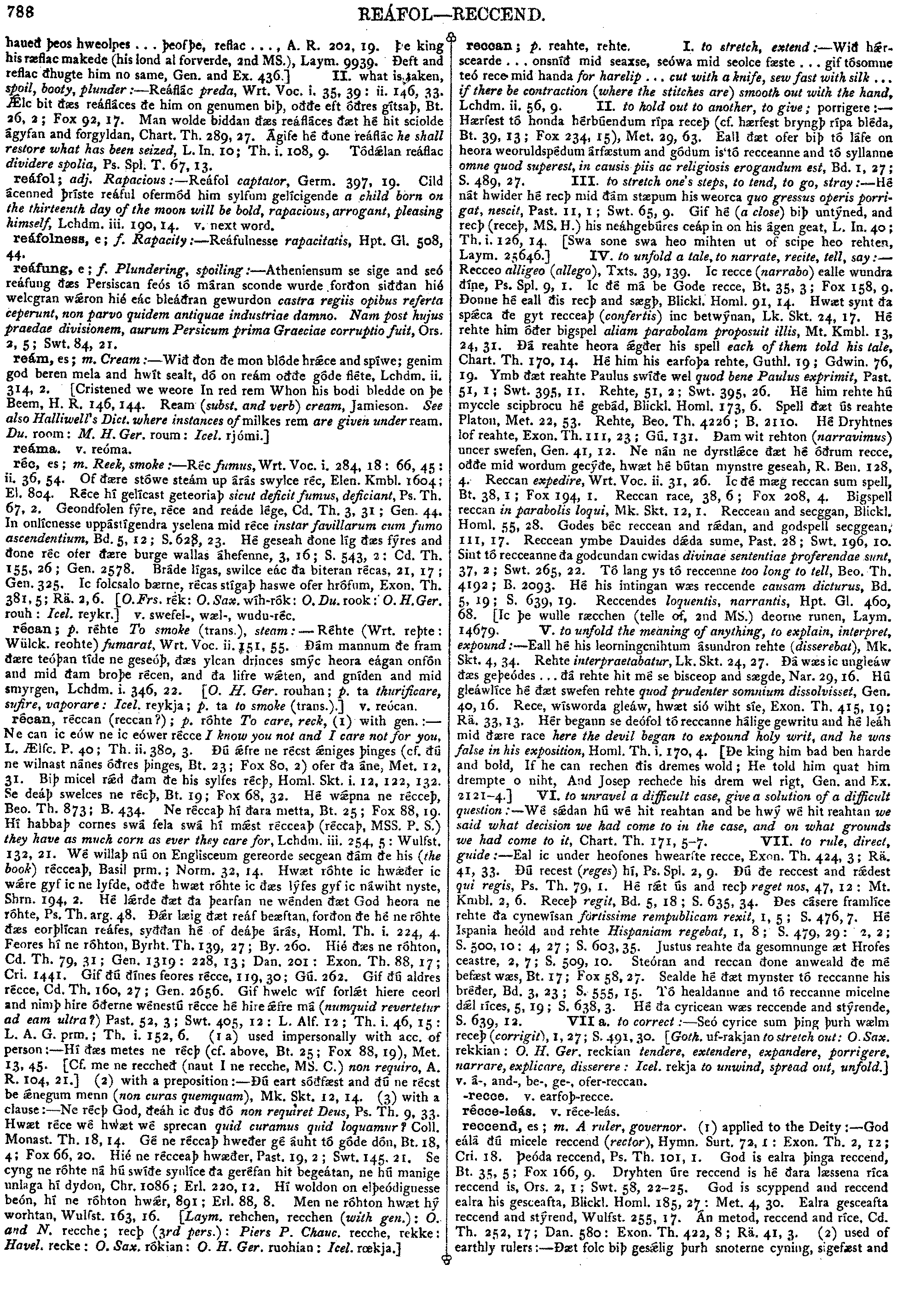
récan,
réccan
(reccan?);
p.
róhte
To
care,
reck,
(1)
with
gen.
:--
Ne
can
ic
eów
ne
ic
eówer
récce
I
know
you
not
and
I
care
not
for
you,
L.
Ælfc.
P.
40;
Th.
ii.
380,
3.
Ðú
fre
ne
récst
niges
þinges
(cf.
ðú
ne
wilnast
nánes
óðres
þinges,
Bt.
23;
Fox
80,
2)
ofer
ða
áne,
Met.
12,
31.
Biþ
micel
rd
ðam
ðe
his
sylfes
récþ,
Homl.
Skt.
i.
12,
122,
132.
Se
deáþ
swelces
ne
récþ,
Bt.
19;
Fox
68,
32.
Hé
wpna
ne
récceþ,
Beo.
Th.
873;
B.
434.
Ne
réccaþ
hí
ðara
metta,
Bt.
25;
Fox
88,
19.
Hí
habbaþ
cornes
swá
fela
swá
hí
mst
récceaþ
(réccaþ,
MSS.
P.
S.)
they
have
as
much
corn
as
ever
they
care
for,
Lchdm.
iii.
254,
5
:
Wulfst.
132,
21.
Wé
willaþ
nú
on
Englisceum
gereorde
secgean
ðám
ðe
his
(the
book)
récceaþ,
Basil
prm.
;
Norm.
32,
14.
Hwæt
róhte
ic
hwæðer
ic
wre
gyf
ic
ne
lyfde,
oððe
hwæt
róhte
ic
ðæs
lýfes
gyf
ic
náwiht
nyste,
Shrn.
194,
2.
Hé
lrde
ðæt
ða
þearfan
ne
wénden
ðæt
God
heora
ne
róhte,
Ps.
Th.
arg.
48.
Ðr
læig
ðæt
reáf
beæftan,
forðon
ðe
hé
ne
róhte
ðæs
eorþlícan
reáfes,
syððan
hé
of
deáþe
árás,
Homl.
Th.
i.
224,
4.
Feores
hí
ne
róhton,
Byrht.
Th.
139,
27;
By.
260.
Hié
ðæs
ne
róhton,
Cd.
Th.
79,
31;
Gen.
1319
:
228,
13;
Dan.
201
:
Exon.
Th.
88,
17;
Cri.
1441.
Gif
ðú
ðínes
feores
récce,
119,
30;
Gú.
262.
Gif
ðú
aldres
récce,
Cd.
Th.
160,
27;
Gen.
2656.
Gif
hwelc
wíf
forlt
hiere
ceorl
and
nimþ
hire
óðerne
wénestú
récce
hé
hire
fre
má
(numquid
revertetur
ad
eam
ultra?)
Past.
52,
3;
Swt.
405,
12
:
L.
Alf.
12;
Th.
i.
46,
15
:
L.
A.
G.
prm.
;
Th.
i.
152,
6.
(1
a)
used
impersonally
with
acc.
of
person
:--
Hí
ðæs
metes
ne
récþ
(cf.
above,
Bt.
25;
Fox
88,
19),
Met.
13,
45.
[Cf.
me
ne
reccheð
(naut
I
ne
recche,
MS.
C.)
non
requiro,
A.
R.
104,
21.]
(2)
with
a
preposition
:--
Ðú
eart
sóðfæst
and
ðú
ne
récst
be
negum
menn
(non
curas
quemquam),
Mk.
Skt.
12,
14.
(3)
with
a
clause
:--
Ne
récþ
God,
ðeáh
ic
ðus
ðó
non
requiret
Deus,
Ps.
Th.
9.
33.
Hwæt
réce
wé
hwæt
wé
sprecan
quid
curamus
quid
loquamur?
Coll.
Monast.
Th.
18,
14.
Gé
ne
réccaþ
hweðer
gé
áuht
tó
góde
dón,
Bt.
18,
4;
Fox
66,
20.
Hié
ne
récceaþ
hwæðer,
Past.
19,
2;
Swt.
145,
21.
Se
cyng
ne
róhte
ná
hú
swíðe
synlíce
ða
geréfan
hit
begeátan,
ne
hú
manige
|
Source: Bosworth/Toller, page b0803, entry 18 View original page image as: [TIFF] [PNG] [View previous entry] [View next entry] |
[Comment on this entry] [View comments] |
The following entry has been hand-corrected once. |
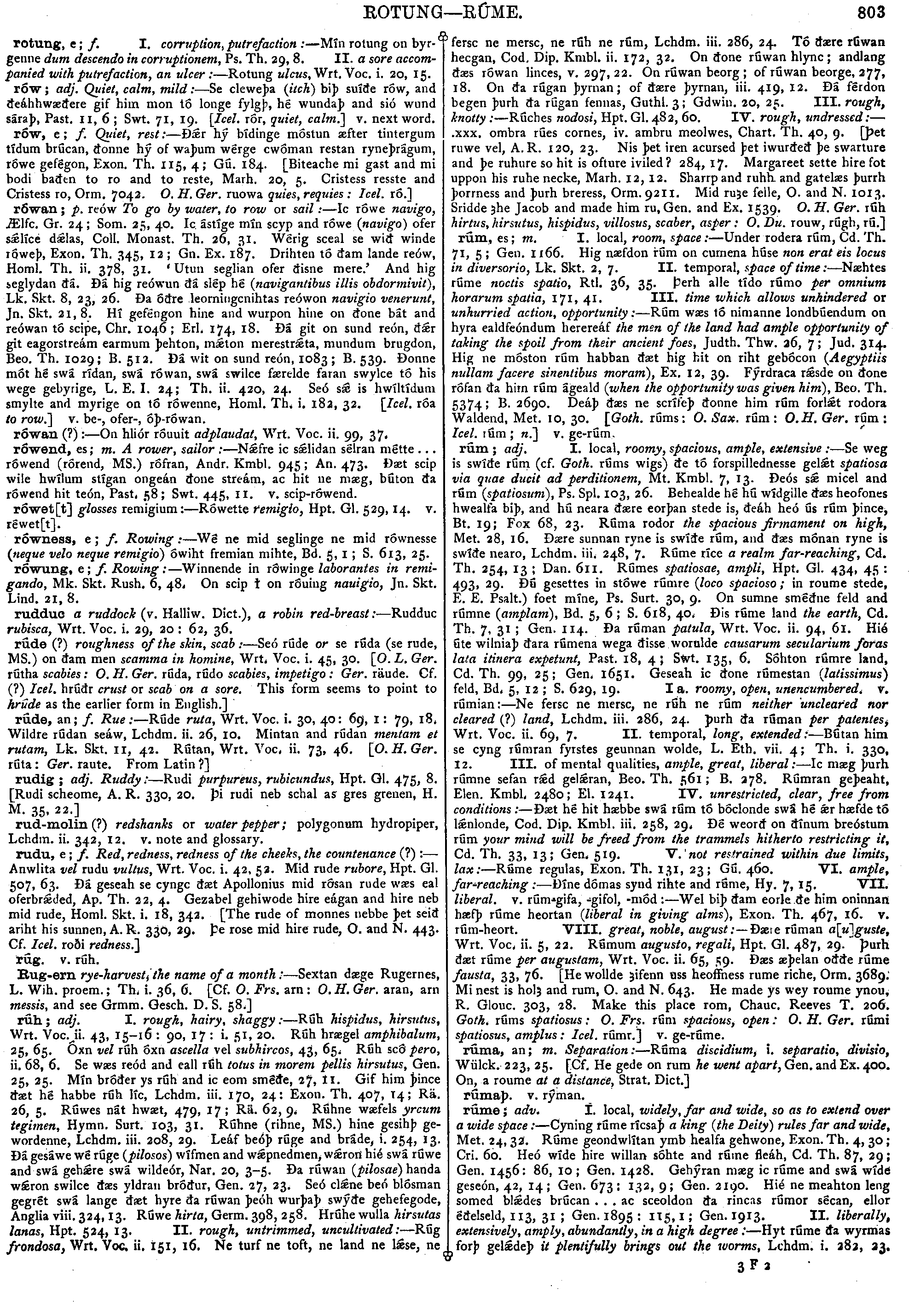
rúh;
adj.
I.
rough,
hairy,
shaggy
:--
Rúh
hispidus,
hirsutus,
Wrt.
Voc.
ii.
43,
15-16
:
90,
17
:
i.
51,
20.
Rúh
hrægel
amphibalum,
25,
65.
Óxn
vel
rúh
óxn
ascella
vel
subhircos,
43,
65.
Rúh
scó
pero,
ii.
68,
6.
Se
wæs
reód
and
eall
rúh
totus
in
morem
pellis
hirsutus,
Gen.
25,
25.
Min
bróðer
ys
rúh
and
ic
eom
sméðe,
27,
11.
Gif
him
þince
ðæt
hé
habbe
rúh
líc,
Lchdm.
iii.
170,
24
:
Exon.
Th.
407,
14;
Rä.
26,
5.
Rúwes
nát
hwæt,
479,
17;
Rä.
62,
9.
Rúhne
wæfels
yrcum
tegimen,
Hymn.
Surt.
103,
31.
Rúhne
(rihne,
MS.)
hine
gesihþ
gewordenne,
Lchdm.
iii.
208,
29.
Leáf
beóþ
rúge
and
bráde,
i.
254,
13.
Ðá
gesáwe
wé
rúge
(pilosos)
wífmen
and
wpnedmen,
wron
hié
swá
rúwe
and
swá
gehre
swá
wildeór,
Nar.
20,
3-5.
Ða
rúwan
(pilosae)
handa
wron
swilce
ðæs
yldran
bróður,
Gen.
27,
23.
Seó
clne
beó
blósman
gegrét
swá
lange
ðæt
hyre
ða
rúwan
þeóh
wurþaþ
swýðe
gehefegode,
Anglia
viii.
324,13.
Rúwe
hirta,
Germ.
398,
258.
Hrúhe
wulla
hirsutas
lanas,
Hpt.
524,
13.
II.
rough,
untrimmed,
uncultivated
:--
Rúg
frondosa,
Wrt.
Voc,
ii.
151,
16.
Ne
turf
ne
toft,
ne
land
ne
lse,
ne
fersc
ne
mersc,
ne
rúh
ne
rúm,
Lchdm.
iii.
286,
24.
Tó
ðære
rúwan
hecgan,
Cod.
Dip.
Kmbl.
ii.
172,
32.
On
ðone
rúwan
hlync;
andlang
ðæs
rówan
linces,
v.
297,
22.
On
rúwan
beorg;
of
rúwan
beorge,
277,
18.
On
ða
rúgan
þyrnan;
of
ðære
þyrnan,
iii.
419,
12.
Ðá
férdon
begen
þurh
ða
rúgan
fennas,
Guthl.
3;
Gdwin.
20,
25.
III.
rough,
knotty
:--
Rúches
nodosi,
Hpt.
G1.
482,
60.
IV.
rough,
undressed
:--
.xxx.
ombra
rúes
cornes,
iv.
ambru
meolwes,
Chart.
Th.
40,
9.
[Þet
ruwe
vel,
A.
R.
120,
23.
Nis
þet
iren
acursed
þet
iwurðeð
þe
swarture
and
þe
ruhure
so
hit
is
ofture
iviled?
284,
17.
Margareet
sette
hire
fot
uppon
his
ruhe
necke,
Marh.
12,
12.
Sharrp
and
ruhh
and
gatelæs
þurrh
þorrness
and
þurh
breress,
Orm.
9211.
Mid
ru e
felle,
O.
and
N.
1013.
Sridde
he
Jacob
and
made
him
ru,
Gen.
and
Ex.
1539.
O.
H.
Ger.
rúh
hirtus,
hirsutus,
hispidus,
villosus,
scaber,
asper
:
O.
Du.
rouw,
rúgh,
rú.]
e
felle,
O.
and
N.
1013.
Sridde
he
Jacob
and
made
him
ru,
Gen.
and
Ex.
1539.
O.
H.
Ger.
rúh
hirtus,
hirsutus,
hispidus,
villosus,
scaber,
asper
:
O.
Du.
rouw,
rúgh,
rú.]
|
Source: Bosworth/Toller, page b0820, entry 14 View original page image as: [TIFF] [PNG] [View previous entry] [View next entry] |
[Comment on this entry] [View comments (1)] |
The following entry has been hand-corrected once. |
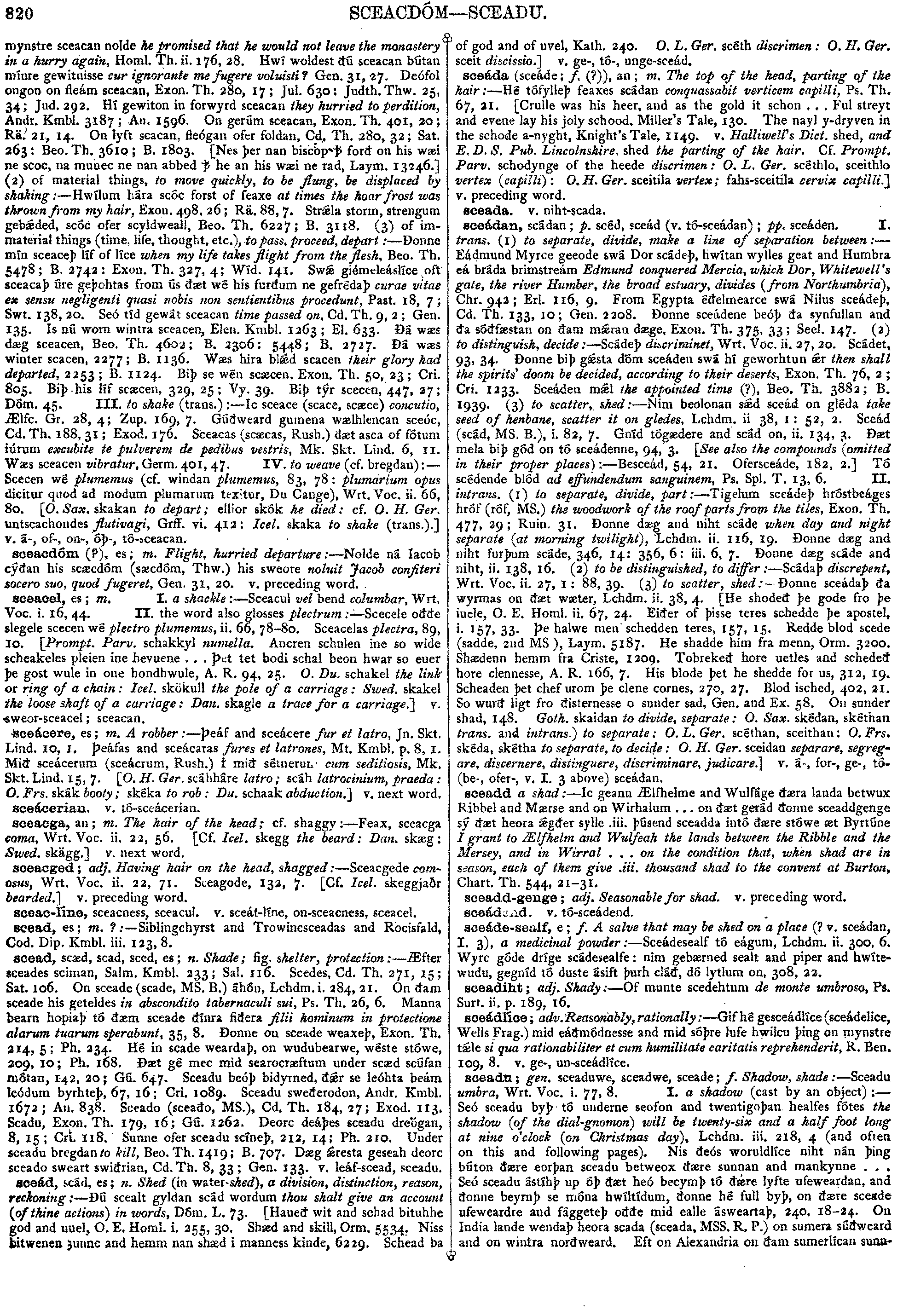
sceádan,
scádan;
p.
scéd,
sceád
(v.
tó-sceádan);
pp.
sceáden.
I.
trans.
(1)
to
separate,
divide,
make
a
line
of
separation
between
:--
Eádmund
Myrce
geeode
swá
Dor
scádeþ,
hwítan
wylles
geat
and
Humbra
eá
bráda
brimstreám
Edmund
conquered
Mercia,
which
Dor,
Whitewell's
gate,
the
river
Humber,
the
broad
estuary,
divides
(from
Northumbria),
Chr.
942;
Erl.
116,
9.
From
Egypta
éðelmearce
swá
Nilus
sceádeþ,
Cd.
Th.
133,
10;
Gen.
2208.
Ðonne
sceádene
beóþ
ða
synfullan
and
ða
sóðfæstan
on
ðam
mran
dæge,
Exon.
Th.
375,
33;
Seel.
147.
(2)
to
distinguish,
decide
:--
Scádeþ
discriminet,
Wrt.
Voc.
ii.
27,
20.
Scádet,
93,
34.
Ðonne
biþ
gsta
dóm
sceáden
swá
hí
geworhtun
r
then
shall
the
spirits'
doom
be
decided,
according
to
their
deserts,
Exon.
Th.
76,
2;
Cri.
1233.
Sceáden
ml
the
appointed
time
(?),
Beo.
Th.
3882;
B.
1939.
(3)
to
scatter,
shed
:--
Nim
beolonan
sd
sceád
on
gléda
take
seed
of
henbane,
scatter
it
on
gledes.
Lchdm.
ii
38,
1:
52,
2.
Sceád
(scád,
MS.
B.),
i.
82,
7.
Gníd
tógædere
and
scád
on,
ii.
134,
3.
Ðæt
mela
biþ
gód
on
tó
sceádenne,
94,
3.
[See
also
the
compounds
(omitted
in
their
proper
places)
:--
Besceád,
54,
21.
Ofersceáde,
182,
2.]
Tó
scédende
blód
ad
effundendum
sanguinem,
Ps.
Spl.
T.
13,
6.
II.
intrans.
(1)
to
separate,
divide,
part
:--
Tigelum
sceádeþ
hróstbeáges
hróf
(róf,
MS.)
the
woodwork
of
the
roof
parts
from
the
tiles.
Exon.
Th.
477,
29;
Ruin.
31.
Ðonne
dæg
and
niht
scáde
when,
day
and
night
separate
(at
morning
twilight),
Lchdm.
ii.
116,
19.
Ðonne
dæg
and
niht
furþum
scáde,
346,
14:
356,
6:
iii.
6,
7.
Ðonne
dæg
scáde
and
niht,
ii.
138,
16.
(2)
to
be
distinguished,
to
differ
:--
Scádaþ
discrepent,
Wrt.
Voc.
ii.
27,
1:
88,
39.
(3)
to
scatter,
shed
:--
Ðonne
sceádaþ
ða
wyrmas
on
ðæt
wæter,
Lchdm.
ii.
38,
4.
[He
shodeð
þe
gode
fro
þe
iuele,
O.
E.
Homl.
ii.
67,
24.
Eiðer
of
þisse
teres
schedde
þe
apostel,
i.
157,
33.
Þe
halwe
men
schedden
teres,
157,
15.
Redde
blod
scede
(sadde,
2nd
MS
),
Laym.
5187.
He
shadde
him
fra
menn,
Orm.
3200.
Shædenn
hemm
fra
Criste,
1209.
Tobrekeð
hore
uetles
and
schedeð
hore
clennesse,
A.
R.
166,
7.
His
blode
þet
he
shedde
for
us,
312,
19.
Scheaden
þet
chef
urom
þe
clene
cornes,
270,
27.
Blod
isched,
402,
21.
So
wurð
ligt
fro
ðisternesse
o
sunder
sad,
Gen.
and
Ex.
58.
On
sunder
shad,
148.
Goth.
skaidan
to
divide,
separate:
O.
Sax.
skédan,
skéthan
trans,
and
intrans.)ERROR
to
separate:
O.
L.
Ger.
scéthan,
sceithan:
O.
Frs.
skéda,
skétha
to
separate,
to
decide:
O.
H.
Ger.
sceidan
separare,
segregare,
discernere,
distinguere,
discriminare,
judicare.]
v.
á-,
for-,
ge-,
tó-
(be-,
ofer-,
v.
I.
3
above)
sceádan.
|
Source: Bosworth/Toller, page b0824, entry 12 View original page image as: [TIFF] [PNG] [View previous entry] [View next entry] |
[Comment on this entry] [View comments] |
The following entry has been hand-corrected once. |
sceáp-tere,
es;
m.
The
carcase
of
a
sheep
(?)
:--Ánan
esne
gebyreþ
tó
metsunge
.xii.
pund
gódes
cornes,
and
.ii.
scípteras,
and
i.
gód
metecú,
L.
R.
S.
8
;
Th.
i.
436,
27.
|
Source: Bosworth/Toller, page b0827, entry 10 View original page image as: [TIFF] [PNG] [View previous entry] [View next entry] |
[Comment on this entry] [View comments] |
The following entry has been hand-corrected once. |
sceatt,
es
;
m.
I.
property,
goods,
wealth,
treasure:--Scaet
bona,
Txts.
44,
157.
Scet
bona,
scettas
bon
[i],
Wrt.
Voc.
ii.
11,
22-23.
Scættas
bo[n]i,
126,
45.
Hé
cwæð
ðæt
ðé
niges
sceates
þearf
ne
wurde
on
worulde,
Cd.
Th.
32,
15;
Gen.
503.
Nys
unc
sceattes
wiht
tó
mete
gemearcod,
50,
24;
Gen.
813.
Nron
hí
bescyrede
sceattes
willan
non
sunt
fraudati
a
desiderio
suo,
Ps.
Th.
77,
29.
[Swá
manega
gersumas
on
sceat
and
on
scrúd
and
on
bókes
swá
nán
man
ne
mæi
tæleln,
Chr.
1070;
Erl.
209,
14.]
Hí
námon
ealle
his
wépna
and
gold
and
seolfor
and
ealle
his
sceattas
ðe
hí
mihton
geáxian,
1064;
Erl.
194,
17:
1069;
Erl.
207,
14:
1071;
Erl.
210,
23.
On
geweald
woroldcyninga
ðæm
sélestan
ðara
ðe
sceattas
dlde,
Beo.
Th.
3377;
B.
1686.
I
a.
of
property
which
is
paid
as
a
price
or
contribution,
price,
gift,
bribe,
tax,
tribute,
money,
goods:--Anweald
on
sibbe
smyltnesse
gehealdan
mid
gefeohte
oððe
mid
scette
(by
fighting
or
by
paying
tribute),
Lchdm.
iii.
436,
15.
Ne
wanda
ðú
for
nánum
scette
for
ðam
médsceattas
áblendaþ
wísra
manna
geþancas
non
accipies
munera,
quia
munera
excoecant
oculos
sapientum.
Deut.
16,
19,
Æt
ðam
lande
ðe
arcebisceop
gebohte
mid
his
ágenan
sceatte
(with
his
own
money),
Cod.
Dip.
Kmbl.
iv.
86,
10.
Godwine
geann
Leófwine
ðæs
dænnes
.
.
.
æt
ðon
sceatte
(at
the
price)
ðe
Leófsunu
him
geldan
scolde,
ðæt
is,
feówertig
penega
and
twá
pund
and
eahta
ámbra
cornes,
vi.
178,
11:
Cod.
Dip.
B.
i.
544,
4.
Hé
begeat
swíðe
mycelne
sceatt
of
his
mannan
.
.
.
férde
syððan
intó
Normandíge
he
(William)
levied
a
large
sum
of
money
from
his
men
.
.
.
and
afterwards
went
into
Normandy,
Chr.
1085;
Erl.
219,
10.
Mænige
gefóþ
hwælas
and
micelne
sceat
ðanon
begytaþ
multi
capiunt
cetos,
et
magnum
pretium
inde
acquirunt,
Coll.
Monast.
Th.
25,
3:
Ps.
Spl.
61,
4.
Mænig
welig
man
is
ðe
wolde
mycelne
scet
and
ungerím
feós
syllan,
gif
hé
hit
gebicgan
mihte,
Homl.
Skt.
i.
12,
101.
Gif
hit
fácne
is
him
man
his
scæt
ágefe
if
the
marriage-contract
be
fraudulent,
what
he
has
paid
shall
be
returned
to
him,
L.
Eth.
77;
Th.
i.
22.
3:
78;
Th.
i.
22,
4.
Gif
man
mannan
ofsleá,
ágene
scætte
and
unfácne
feó
gehwilce
gelde,
30;
Th.
i.
10,
4:
31-5;
Th.
i.
10,
7.
Abram
underféng
fela
sceatta
for
hire
hé
hæfde
ðá
on
orfe
and
on
þeówum
on
olfendum
and
on
assum
micele
hte
Abram
bene
usi
sunt
propter
illam,
fueruntque
ei
oves
et
boves
et
asini
et
servi
et
cameli,
Gen.
12,
16.
Ða
bodan
cómon
mid
sceattum
habentes
divinationis
pretium
in
manibus,
Num.
22,
7.
Gif
ðú
ðæt
gerdest,
ðæt
ðú
wille
syllan
smannum
feoh
.
.
.
wé
willaþ
mid
ðám
sceattum
ús
tó
scype
gangan,
Byrht.
Th.
132,
62;
By.
40.
Hér
fór
se
cyng
ofer
s
and
hæfde
mid
him
gíslas
and
sceattas
(the
contributions
he
had
levied),
Chr.
1067;
Erl.
203,
34.

Teóþa
sceatt
a
tithe:--Ðæs
hereteámes
ealles
teóþan
sceat
sealde
'he
gave
him
tithes
of
all'
(Gen.
14,
20),
Cd.
Th.
128,
5;
Gen.
2122.
Bringaþ
gé
on
mín
beren
eówerne
teóþan
sceat
(Malachi
3,
10),
Blickl.
Homl.
39,
26:
53,
11.
Ðonne
lre
ic
eów,
ðæt
gé
syllon
eówre
teóþan
sceattas
earmum
mannum,
49,
19:
43,
3.
Abram
his
teóþan
sceattas
(decimas)
offrede,
Prud.
5
a:
L.
Alf.
38;
Th.
i.
52,
31.
II.
a
piece
of
money,
a
coin:--Sceat
obulum,
Wrt.
Voc.
ii.
64,
78.
Nis
woruldfeoh
ðe
ic
mé
ágan
wille,
sceat
ne
scilling
(cf.
O.
Frs.
mit
schat
ende
mit
schillinge:
O.
H.
Ger.
scaz
unde
schillinch),
Cd.
Th.
129,
13;
Gen.
2143.
Ne
þearf
ic
N.
sceatt
ne
scilling,
ne
pænig
ne
pæniges
weorð,
L.
O.
11;
Th.
i.
182,
9.
Se
mé
beág
forgeaf
on
ðam
siex
hund
wæs
smtes
goldes
gescyred
sceatta
scillingríme,
Exon.
Th.
324,
9;
Víd.
92.
Hí
behéton
hire
sceattas
dabimus
tibi
singuli
mille
et
centum
argenteos,
Jud.
16,
5.
Wé
ðé
mid
ús
willaþ
ferigan.
.
.
siððan
gé
eówre
gafulrdenne
ágifen
habbaþ,
sceattas
gescrifene,
Andr.
Kmbl.
593
;
An.
297.
II
a.
as
the
name
of
an
English
coin
the
word
is
found
in
the
form
scætt
in
the
laws
of
Ethelbert
of
Kent.
It
is
inferred
from
a
comparison
of
passages
in
these
that
the
value
of
the
scætt
in
Kent
was
one-twentieth
of
a
shilling,
v.
Thorpe's
Glossary.
The
sceatt
is
also
mentioned
in
the
Mercian
law,
Th.
i.
190,
5,
where
'30,
000
sceatta'
is
equivalent
to
'120
punda.'
This
would
give
250
sceatts
to
the
pound.
In
the
Northern
Gospels
dragmas
decem
is
glossed
by
'fíf
sceattas
teásiðum,'
while
the
West-Saxon
version
has
'týn
scyllingas.'
If
the
sums
here
given
may
be
regarded
as
equal,
the
sceatt
would
be
worth
a
West-Saxon
penny,
the
value
which
it
appears
to
have
in
the
Mercian
law.
The
coin
then
seems
to
be
of
different
values
in
Kent
and
in
the
more
northern
parts
of
England.
[Goth.
skatts,
GREEK,
GREEK,
GREEK:
O.
Sax.
skatt
money,
property,
piece
of
money:O.
Frs.
skett:
O.
H.
Ger.
scaz
substantia,
mobilia,
pretium,
lucrum,
pecunia,
aes,
denarius,
quadrans,
obolus:
Icel.
skattr
tribute.]
v.
feoh-,
fere-,
freó-,
geþing-,
gif-,
mán-,
méd-,
ofer-,
teóþing-,
wæstm-sceatt;
scír-gesceatt.
| Result Page: | 1 2 | Next |  |
Germanic Lexicon Project (main page)
This search system was written by
Sean Crist
Please consider
volunteering
to correct the data in these online dictionaries.
No rights reserved. Feel free to use these data in any way you please.