|
|

Search for copiosus again, using less strict matching (6 results)
|
Source: Bosworth/Toller, page b0118, entry 18 View original page image as: [TIFF] [PNG] [View previous entry] [View next entry] |
[Comment on this entry] [View comments (1)] |
The following entry has been hand-corrected once. |
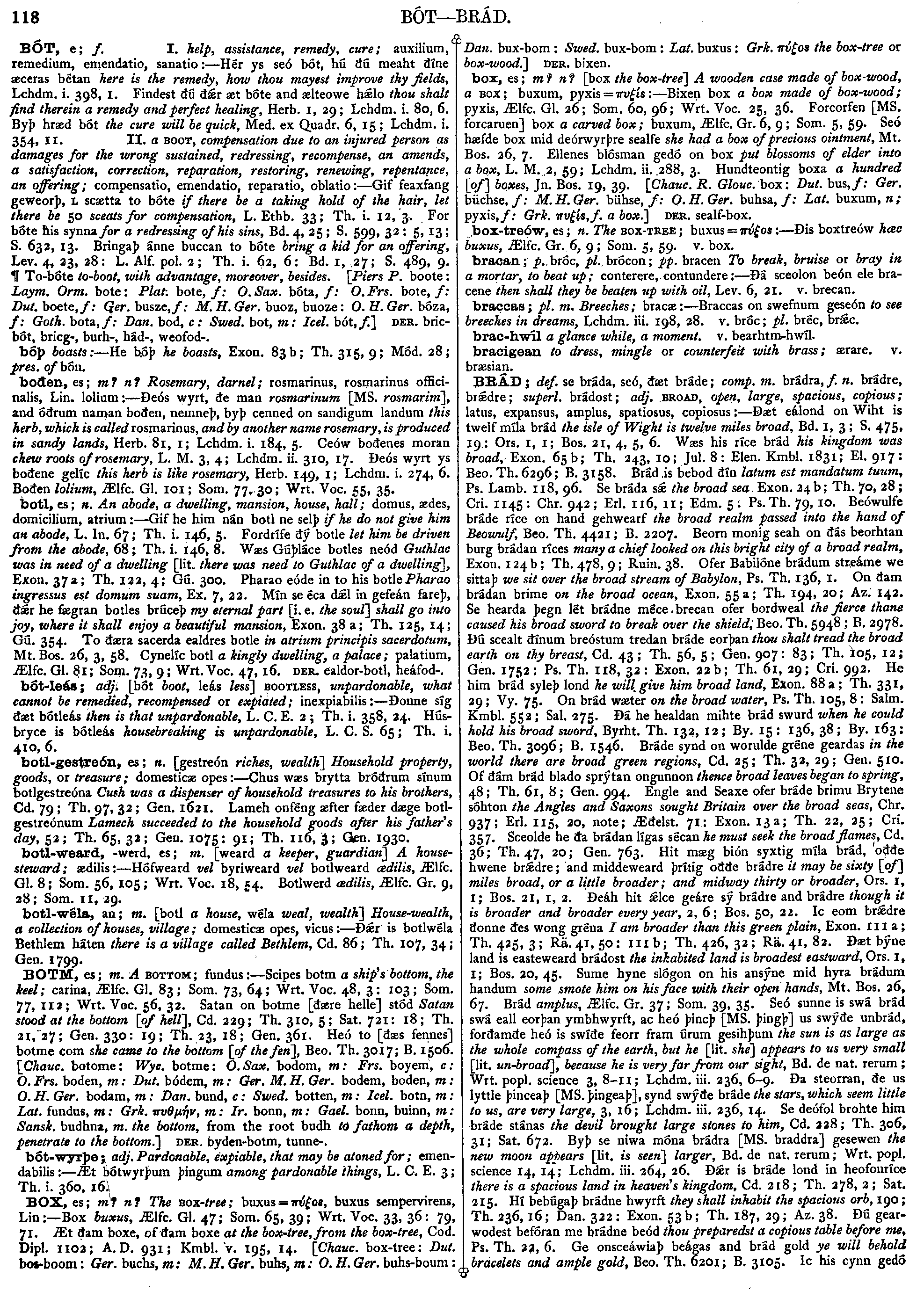
BRÁD;
def.
se
bráda,
seó,
ðæt
bráde;
comp.
m.
brádra,
f.
n.
brádre,
br dre;
superl.
brádost;
adj.
BROAD,
open,
large,
spacious,
copious;
latus,
expansus,
amplus,
spatiosus,
copiosus
:--
Ðæt
eálond
on
Wiht
is
twelif
míla
brád
the
isle
of
Wight
is
twelve
miles
broad,
Bd.
1,
3;
S.
475,
19:
Ors.
1,
1;
Bos.
21,
4,
5,
6.
Was
his
ríce
brád
his
kingdom
was
broad,
Exon.
65
b;
Th.
243,
10;
Jul.
8:
Elen.
Kmbl.
1831;
El.
917:
Beo.
Th.
6296;
B.
3158.
Brád
is
bebod
ðín
latum
est
mandatum
tuum,
Ps.
Lamb.
118,
96.
Se
bráda
s
the
broad
sea.
Exon,
24
b;
Th.
70,
28;
Cri.
1145:
Chr.
942;
Erl.
116,
11;
Edm.
5.
Ps.
Th.
79,
10.
Beówulfe
bráde
ríce
on
hand
gehwearf
the
broad
realm
passed
into
the
hand
of
Beowulf,
Beo.
Th.
4421;
B.
2207.
Beorn
monig
seah
on
ðás
beorhtan
burg
brádan
ríces
many
a
chief
looked
on
this
bright
city
of
a
broad
realm,
Exon.
124
b;
Th,
478,
9;
Ruin.
38.
Ofer
Babilóne
brádum
streáme
we
sittaþ
we
sit
over
the
broad
stream
of
Babylon,
Ps.
Th.
136,
1.
On
ðam
brádan
brime
on
the
broad
ocean,
Exon.
55
a;
Th.
194,
20;
Az:
142.
Se
hearda
þegn
lét
brádne
méce
brecan
ofer
bordweal
the
fierce
thane
caused
his
broad
sword
to
break
over
the
shield,
Beo.
Th.
5948;
B.
2978.
Ðú
scealt
ðínum
breóstum
tredan
bráde
eorþan
thou
shalt
tread
the
broad
earth
on
thy
breast,
Cd,
43;
Th.
56,
5;
Gen.
907:
83;
Th.
105,
12;
Gen.
1752:
Ps.
Th.
118,
32:
Exon.
22
b;
Th.
61,
29;
Cri.
992.
He
him
brád
syleþ
lond
he
will
give
him
broad
land,
Exon.
88
a;
Th.
331,
29;
Vy.
75.
On
brád
wæter
on
the
broad
water,
Ps.
Th.
105,
8:
Salm.
Kmbl.
552;
Sal.
275.
Ðá
he
healdan
mihte
brád
swurd
when
he
could
hold
his
broad
sword,
Byrht.
Th.
132,
12;
By.
15:
136,
38;
By.
163:
Beo.
Th,
3096;
B.
1546.
Bráde
synd
on
worulde
gréne
geardas
in
the
world
there
are
broad
green
regions,
Cd.
25;
Th.
32,
29;
Gen.
510.
Of
ðám
brád
blado
sprýtan
ongunnon
thence
broad
leaves
began
to
spring,
48;
Th.
61,
8
;
Gen.
994.
Engle
and
Seaxe
ofer
bráde
brimu
Brytene
sóhton
the
Angles
and
Saxons
sought
Britain
over
the
broad
seas,
Chr.
937;
Erl.
115,
20,
note;
Æðelst.
71:
Exon.
13
a;
Th.
22,
25;
Cri.
357.
Sceolde
he
ða
brádan
lígas
sécan
he
must
seek
the
broad
flames,
Cd.
36;
Th,
47,
20;
Gen.
763.
Hit
mæg
bión
syxtig
míla
brád,
oððe
hwene
brdre;
and
middeweard
þrítig
oððe
brádre
it
may
be
sixty
[of]
miles
broad,
or
a
little
broader;
and
midway
thirty
or
broader,
Ors.
1,
1;
Bos.
21,
1,
2.
Ðeáh
hit
lce
geáre
sý
brádre
and
brádre
though
it
is
broader
and
broader
every
year,
2,
6;
Bos.
50,
22.
Ic
eom
brdre
ðonne
ðes
wong
gréna
I
am
broader
than
this
green
plain,
Exon.
111
a;
Th.
425,
3;
Rä.
41,
50:
111
b;
Th,
426,
32;
Rä.
41,
82.
Ðæt
býne
land
is
easteweard
brádost
the
inhabited
land
is
broadest
eastward,
Ors.
1,
1;
Bos.
20,
45,
Sume
hyne
slógon
on
his
ansýne
mid
hyra
brádum
handum
some
smote
him
on
his
face
with
their
open
hands,
Mt.
Bos.
26,
67.
Brád
amplus,
Ælfc.
Gr.
37;
Som.
39,
35.
Seó
sunne
is
swá
brád
swá
eall
eorþan
ymbhwyrft,
ac
heó
þincþ
[MS.
þingþ]
us
swýðe
unbrád,
forðamðe
heó
is
swíðe
feorr
fram
úrum
gesihþum
the
sun
is
as
large
as
the
whole
compass
of
the
earth,
but
he
[lit.
she]
appears
to
us
very
small
[lit.
un-broad],
because
he
is
very
far
from
our
sight,
Bd.
de
nat.
rerum;
Wrt.
popl,
science
3,
8-11;
Lchdm.
iii.
236,
6-9.
Ða
steorran,
ðe
us
lyttle
þinceaþ
[MS.
þingeaþ],
synd
swýðe
bráde
the
stars,
which
seem
little
to
us,
are
very
large,
3,
16;
Lchdm.
iii.
236,
14.
Se
deófol
brohte
him
bráde
stánas
the
devil
brought
large
stones
to
him,
Cd.
228;
Th.
306,
31;
Sat.
672.
Byþ
se
niwa
móna
brádra
[MS.
braddra]
gesewen
the
new
moon
appears
[lit.
is
seen]
larger,
Bd.
de
nat.
rerum;
Wrt.
popl.
science
14,
14;
Lchdm.
iii.
264,
26.
Ðr
is
bráde
lond
in
heofonríce
there
is
a
spacious
land
in
heaven's
kingdom,
Cd.
218;
Th.
278,
2;
Sat.
215.
Hí
bebúgaþ
brádne
hwyrft
they
shall
inhabit
the
spacious
orb,
190;
Th.
236,
16;
Dan.
322:
Exon.
53
b;
Th.
187,
29;
Az.
38.
Ðú
gearwodest
befóran
me
brádne
beód
thou
preparedst
a
copious
table
before
me,
Ps.
Th.
22,
6.
Ge
onsceáwiaþ
beágas
and
brád
gold
ye
will
behold
bracelets
and
ample
gold,
Beo.
Th.
6201;
B.
3105.
Ic
his
cyan
gedó
brád
and
bresne
I
will
make
his
race
large
and
powerful,
Cd.
134;
Th.
169,
17;
Gen.
2801.
Brád
earmbeáh
a
broad
or
large
arm-bracelet;
dextrocherium,
Ælfc.
Gl.
114;
Som.
80,
30;
Wrt.
Voc.
61,
10.
[Chauc.
Wyc.
brod,
brood:
R.
Glouc.
brod:
Laym.
braed,
brad,
brod:
Orm.
brad:
Scot.
braid,
brade:
Plat.
breed:
O.
Sax.
bréd:
Frs.
bred:
O.
Frs.
bred,
breid:
Dut.
breed:
Ger.
M.
H.
Ger.
breit:
O.
H.
Ger.
breit:
Goth.
braids:
Dan.
Swed.
bred:
Icel.
breiðr:
Lat.
latus
for
platus:
Grk.
dre;
superl.
brádost;
adj.
BROAD,
open,
large,
spacious,
copious;
latus,
expansus,
amplus,
spatiosus,
copiosus
:--
Ðæt
eálond
on
Wiht
is
twelif
míla
brád
the
isle
of
Wight
is
twelve
miles
broad,
Bd.
1,
3;
S.
475,
19:
Ors.
1,
1;
Bos.
21,
4,
5,
6.
Was
his
ríce
brád
his
kingdom
was
broad,
Exon.
65
b;
Th.
243,
10;
Jul.
8:
Elen.
Kmbl.
1831;
El.
917:
Beo.
Th.
6296;
B.
3158.
Brád
is
bebod
ðín
latum
est
mandatum
tuum,
Ps.
Lamb.
118,
96.
Se
bráda
s
the
broad
sea.
Exon,
24
b;
Th.
70,
28;
Cri.
1145:
Chr.
942;
Erl.
116,
11;
Edm.
5.
Ps.
Th.
79,
10.
Beówulfe
bráde
ríce
on
hand
gehwearf
the
broad
realm
passed
into
the
hand
of
Beowulf,
Beo.
Th.
4421;
B.
2207.
Beorn
monig
seah
on
ðás
beorhtan
burg
brádan
ríces
many
a
chief
looked
on
this
bright
city
of
a
broad
realm,
Exon.
124
b;
Th,
478,
9;
Ruin.
38.
Ofer
Babilóne
brádum
streáme
we
sittaþ
we
sit
over
the
broad
stream
of
Babylon,
Ps.
Th.
136,
1.
On
ðam
brádan
brime
on
the
broad
ocean,
Exon.
55
a;
Th.
194,
20;
Az:
142.
Se
hearda
þegn
lét
brádne
méce
brecan
ofer
bordweal
the
fierce
thane
caused
his
broad
sword
to
break
over
the
shield,
Beo.
Th.
5948;
B.
2978.
Ðú
scealt
ðínum
breóstum
tredan
bráde
eorþan
thou
shalt
tread
the
broad
earth
on
thy
breast,
Cd,
43;
Th.
56,
5;
Gen.
907:
83;
Th.
105,
12;
Gen.
1752:
Ps.
Th.
118,
32:
Exon.
22
b;
Th.
61,
29;
Cri.
992.
He
him
brád
syleþ
lond
he
will
give
him
broad
land,
Exon.
88
a;
Th.
331,
29;
Vy.
75.
On
brád
wæter
on
the
broad
water,
Ps.
Th.
105,
8:
Salm.
Kmbl.
552;
Sal.
275.
Ðá
he
healdan
mihte
brád
swurd
when
he
could
hold
his
broad
sword,
Byrht.
Th.
132,
12;
By.
15:
136,
38;
By.
163:
Beo.
Th,
3096;
B.
1546.
Bráde
synd
on
worulde
gréne
geardas
in
the
world
there
are
broad
green
regions,
Cd.
25;
Th.
32,
29;
Gen.
510.
Of
ðám
brád
blado
sprýtan
ongunnon
thence
broad
leaves
began
to
spring,
48;
Th.
61,
8
;
Gen.
994.
Engle
and
Seaxe
ofer
bráde
brimu
Brytene
sóhton
the
Angles
and
Saxons
sought
Britain
over
the
broad
seas,
Chr.
937;
Erl.
115,
20,
note;
Æðelst.
71:
Exon.
13
a;
Th.
22,
25;
Cri.
357.
Sceolde
he
ða
brádan
lígas
sécan
he
must
seek
the
broad
flames,
Cd.
36;
Th,
47,
20;
Gen.
763.
Hit
mæg
bión
syxtig
míla
brád,
oððe
hwene
brdre;
and
middeweard
þrítig
oððe
brádre
it
may
be
sixty
[of]
miles
broad,
or
a
little
broader;
and
midway
thirty
or
broader,
Ors.
1,
1;
Bos.
21,
1,
2.
Ðeáh
hit
lce
geáre
sý
brádre
and
brádre
though
it
is
broader
and
broader
every
year,
2,
6;
Bos.
50,
22.
Ic
eom
brdre
ðonne
ðes
wong
gréna
I
am
broader
than
this
green
plain,
Exon.
111
a;
Th.
425,
3;
Rä.
41,
50:
111
b;
Th,
426,
32;
Rä.
41,
82.
Ðæt
býne
land
is
easteweard
brádost
the
inhabited
land
is
broadest
eastward,
Ors.
1,
1;
Bos.
20,
45,
Sume
hyne
slógon
on
his
ansýne
mid
hyra
brádum
handum
some
smote
him
on
his
face
with
their
open
hands,
Mt.
Bos.
26,
67.
Brád
amplus,
Ælfc.
Gr.
37;
Som.
39,
35.
Seó
sunne
is
swá
brád
swá
eall
eorþan
ymbhwyrft,
ac
heó
þincþ
[MS.
þingþ]
us
swýðe
unbrád,
forðamðe
heó
is
swíðe
feorr
fram
úrum
gesihþum
the
sun
is
as
large
as
the
whole
compass
of
the
earth,
but
he
[lit.
she]
appears
to
us
very
small
[lit.
un-broad],
because
he
is
very
far
from
our
sight,
Bd.
de
nat.
rerum;
Wrt.
popl,
science
3,
8-11;
Lchdm.
iii.
236,
6-9.
Ða
steorran,
ðe
us
lyttle
þinceaþ
[MS.
þingeaþ],
synd
swýðe
bráde
the
stars,
which
seem
little
to
us,
are
very
large,
3,
16;
Lchdm.
iii.
236,
14.
Se
deófol
brohte
him
bráde
stánas
the
devil
brought
large
stones
to
him,
Cd.
228;
Th.
306,
31;
Sat.
672.
Byþ
se
niwa
móna
brádra
[MS.
braddra]
gesewen
the
new
moon
appears
[lit.
is
seen]
larger,
Bd.
de
nat.
rerum;
Wrt.
popl.
science
14,
14;
Lchdm.
iii.
264,
26.
Ðr
is
bráde
lond
in
heofonríce
there
is
a
spacious
land
in
heaven's
kingdom,
Cd.
218;
Th.
278,
2;
Sat.
215.
Hí
bebúgaþ
brádne
hwyrft
they
shall
inhabit
the
spacious
orb,
190;
Th.
236,
16;
Dan.
322:
Exon.
53
b;
Th.
187,
29;
Az.
38.
Ðú
gearwodest
befóran
me
brádne
beód
thou
preparedst
a
copious
table
before
me,
Ps.
Th.
22,
6.
Ge
onsceáwiaþ
beágas
and
brád
gold
ye
will
behold
bracelets
and
ample
gold,
Beo.
Th.
6201;
B.
3105.
Ic
his
cyan
gedó
brád
and
bresne
I
will
make
his
race
large
and
powerful,
Cd.
134;
Th.
169,
17;
Gen.
2801.
Brád
earmbeáh
a
broad
or
large
arm-bracelet;
dextrocherium,
Ælfc.
Gl.
114;
Som.
80,
30;
Wrt.
Voc.
61,
10.
[Chauc.
Wyc.
brod,
brood:
R.
Glouc.
brod:
Laym.
braed,
brad,
brod:
Orm.
brad:
Scot.
braid,
brade:
Plat.
breed:
O.
Sax.
bréd:
Frs.
bred:
O.
Frs.
bred,
breid:
Dut.
breed:
Ger.
M.
H.
Ger.
breit:
O.
H.
Ger.
breit:
Goth.
braids:
Dan.
Swed.
bred:
Icel.
breiðr:
Lat.
latus
for
platus:
Grk.


 &upsilon-tonos;s:
Lith.
platus:
Zend
frath-anh
breadth:
Sansk.
prithu
broad,
wide;
prith
to
extend.]
DER.
un-brád,
wíd-.
&upsilon-tonos;s:
Lith.
platus:
Zend
frath-anh
breadth:
Sansk.
prithu
broad,
wide;
prith
to
extend.]
DER.
un-brád,
wíd-.
|
Source: Bosworth/Toller, page b0423, entry 20 View original page image as: [TIFF] [PNG] [View previous entry] [View next entry] |
[Comment on this entry] [View comments] |
The following entry has been hand-corrected once. |
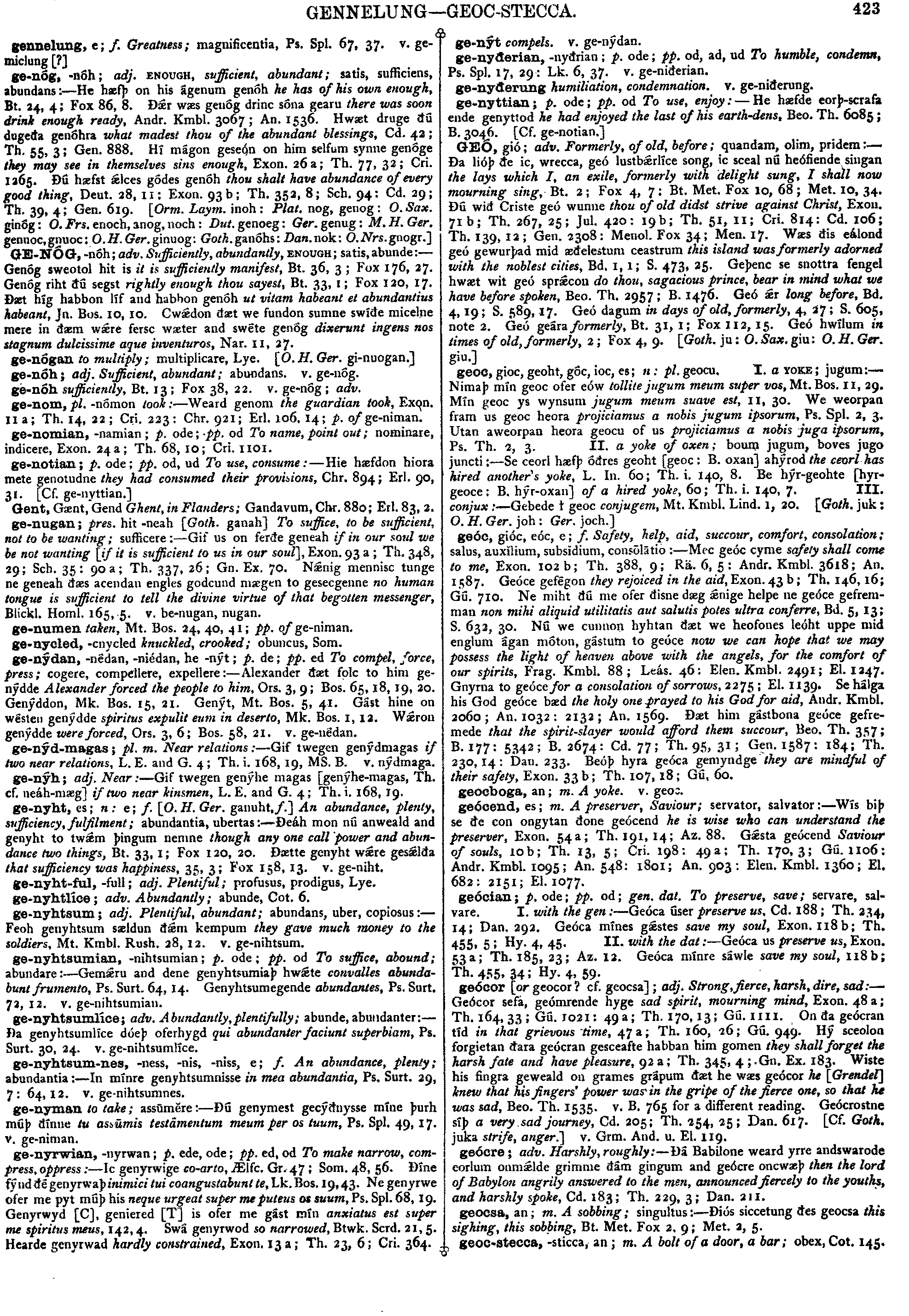
ge-nyhtsum;
adj.
Plentiful,
abundant;
abundans,
uber,
copiosus
:--
Feoh
genyhtsum
sældun
ðm
kempum
they
gave
much
money
to
the
soldiers,
Mt.
Kmbl.
Rush.
28,
12.
v.
ge-nihtsum.
|
Source: Bosworth/Toller, page b0446, entry 26 View original page image as: [TIFF] [PNG] [View previous entry] [View next entry] |
[Comment on this entry] [View comments] |
The following entry has been hand-corrected once. |
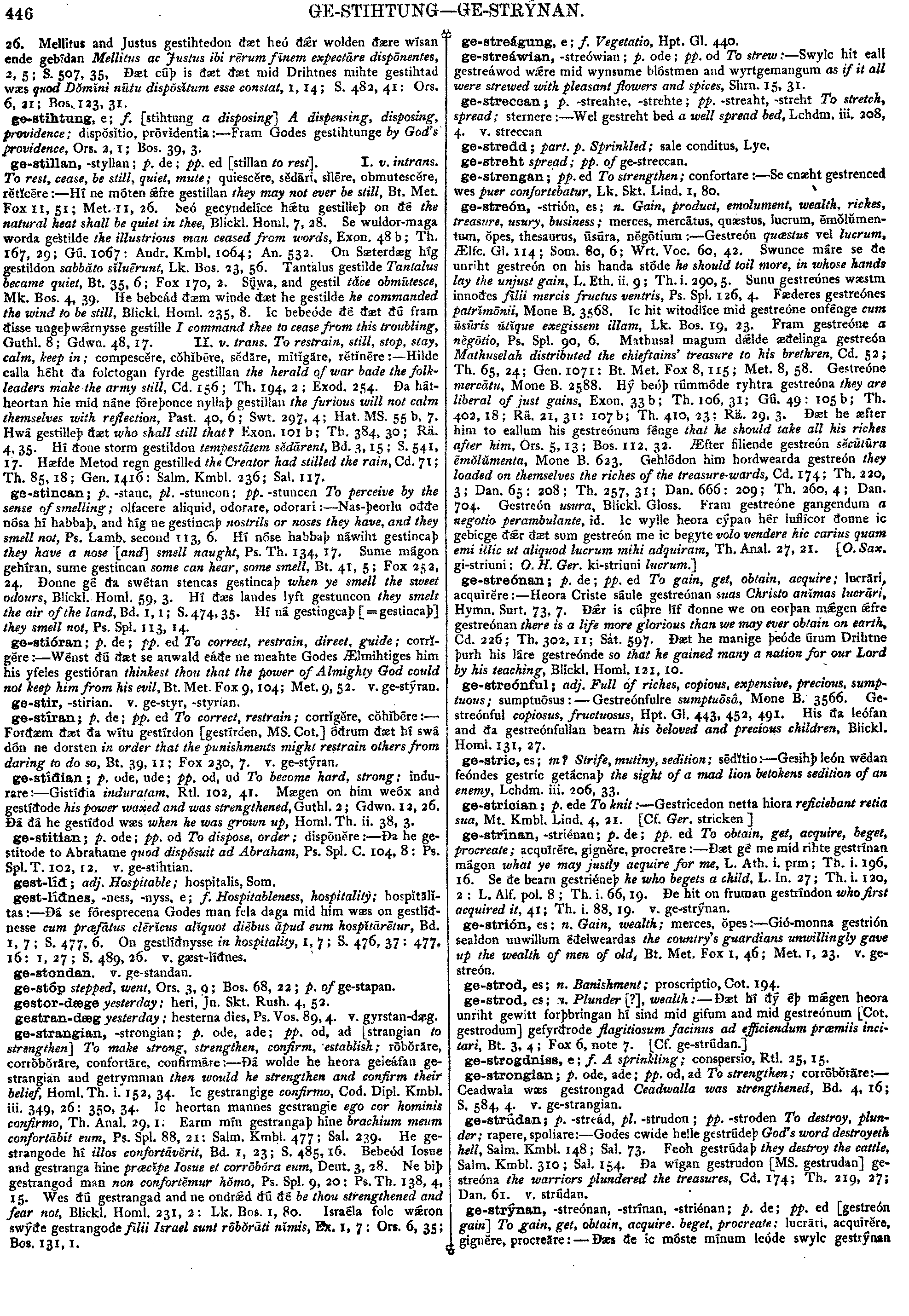
ge-streónful;
adj.
Full
of
riches,
copious,
expensive,
precious,
sumptuous;
sumptu sus
:--
Gestreónfulre
sumptusâ,
Mone
B.
3566.
Gestreónful
copiosus,
fructuosus,
Hpt.
Gl.
443,
452,
491.
His
ða
leófan
and
ða
gestreónfullan
bearn
his
beloved
and
precious
children,
Blickl.
Homl.
131,
27.
sus
:--
Gestreónfulre
sumptusâ,
Mone
B.
3566.
Gestreónful
copiosus,
fructuosus,
Hpt.
Gl.
443,
452,
491.
His
ða
leófan
and
ða
gestreónfullan
bearn
his
beloved
and
precious
children,
Blickl.
Homl.
131,
27.
|
Source: Bosworth/Toller, page b1028, entry 11 View original page image as: [TIFF] [PNG] [View previous entry] [View next entry] |
[Comment on this entry] [View comments] |
The following entry has been hand-corrected once. |
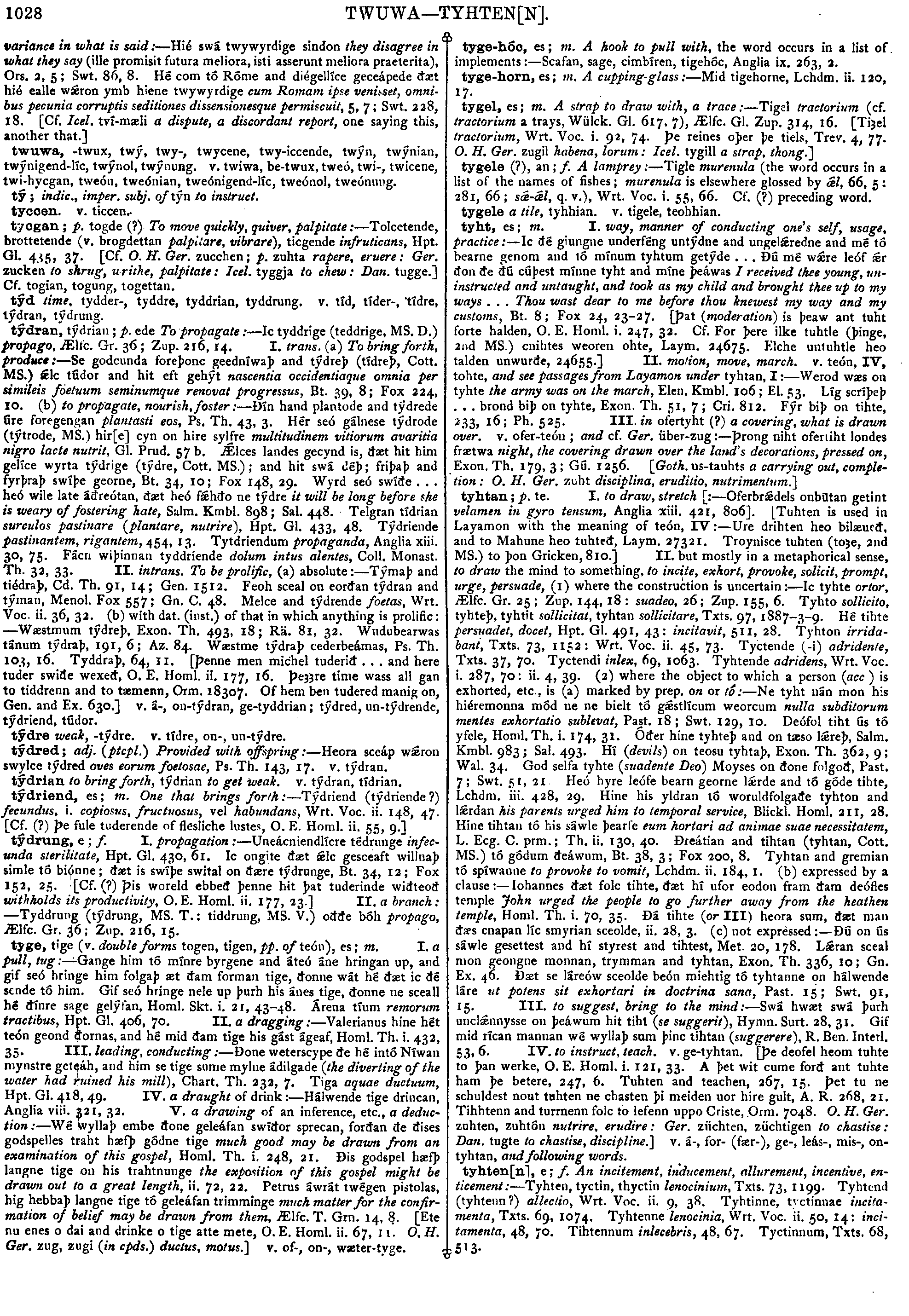
týdriend, es; m. One that brings forth :-- Týdriend (týdriende ?) fecundus, i. copiosus, fructuostus, vel habundans, Wrt. Voc. ii. 148, 47. [Cf. (?) Þe fule tuderende of flesliche lustes, O.E. Homl. ii. 55, 9.]
|
Source: Bosworth/Toller, page d0383, entry 1 View original page image as: [TIFF] [PNG] [View previous entry] [View next entry] |
[Comment on this entry] [View comments] |
The following entry has been hand-corrected once. |
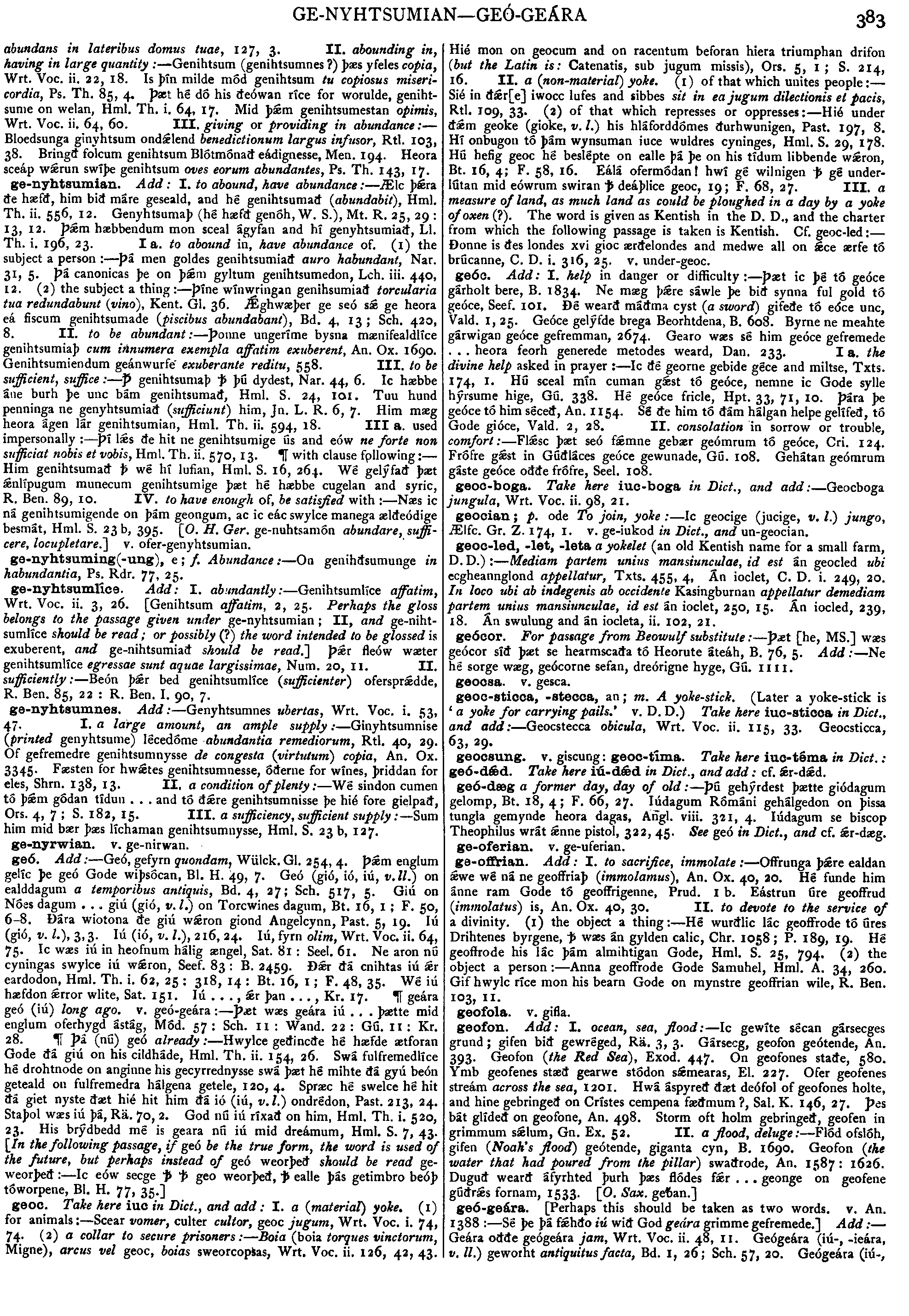
abundans
in
lateribus
domus
tuae,
127,
3.
II.
abounding
in,
having
in
large
quantity:--Genihtsum
(genihtsumnes?)
þæs
yfeles
copia,
Wrt.
Voc.
ii.
22,
18.
Is
þín
milde
mód
genihtsum
tu
copiosus
misericordia,
Ps.
Th.
85,
4.
Þæt
hé
dó
his
ðeówan
ríce
for
worulde,
genihtsume
on
welan,
Hml.
Th.
i.
64,
17.
Mid
þm
genihtsumestan
opimis,
Wrt.
Voc.
ii.
64,
60.
III.
giving
or
providing
in
abundance:--Bloedsunga
ginyhtsum
ondlend
benedictionum
largus
infusor,
Rtl.
103,
38.
Bringð
folcum
genihtsum
Blótmónað
eádignesse,
Men.
194.
Heora
sceáp
wrun
swíþe
genihtsum
oves
eorum
abundantes,
Ps.
Th.
143,
17.
Germanic Lexicon Project (main page)
This search system was written by
Sean Crist
Please consider
volunteering
to correct the data in these online dictionaries.
No rights reserved. Feel free to use these data in any way you please.