|
|

Tip: In the search results, you can click on any word or abbreviation for more information.
|
Source: Cleasby/Vigfusson, page b0088, entry 6 View original page image as: [TIFF] [PNG] [View previous entry] [View next entry] |
[Comment on this entry] [View comments] |
The following entry has been hand-corrected once. |
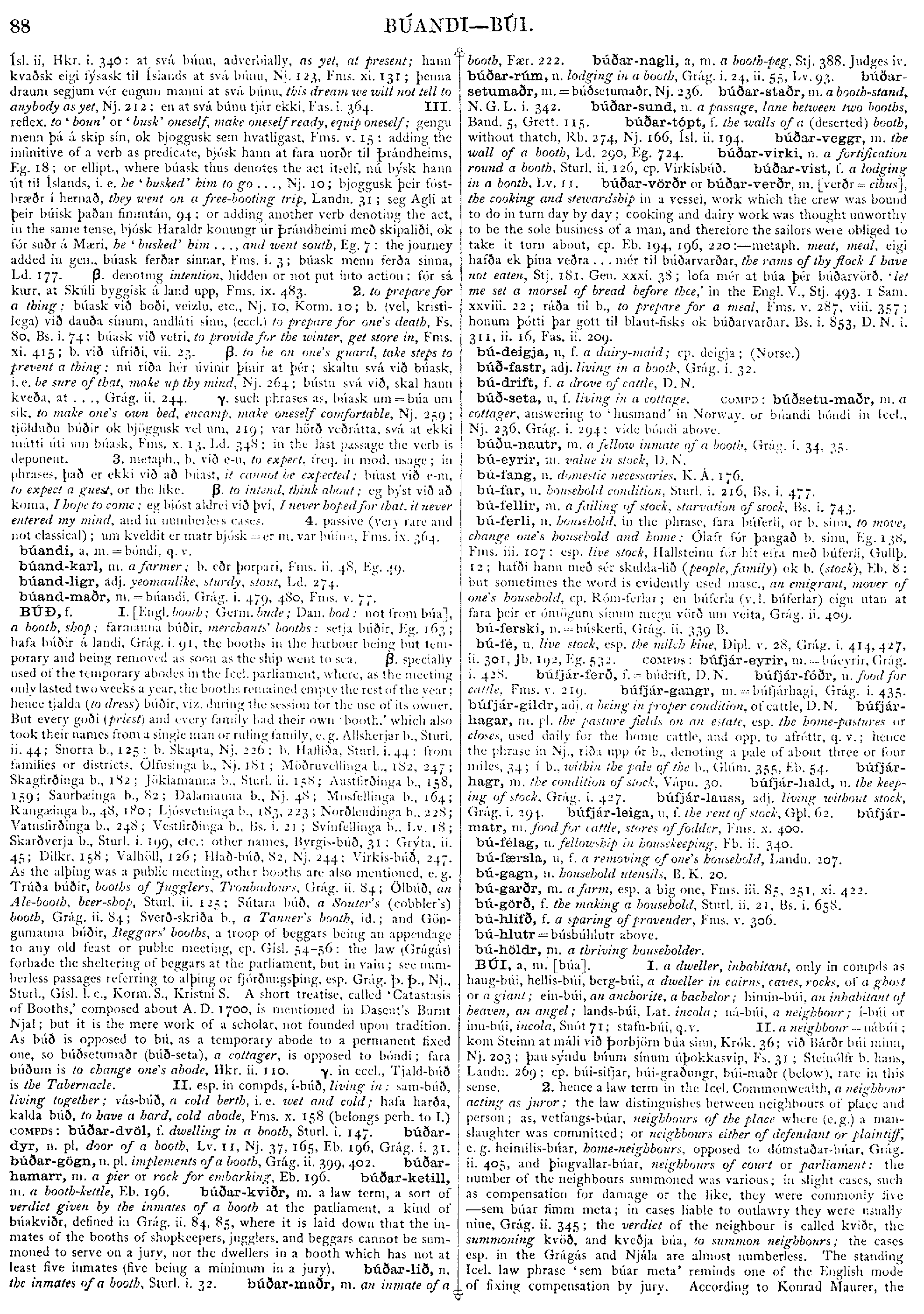
BÚÐ,
f.
I.
[Engl.
booth;
Germ.
bude;
Dan.
bod:
not
from
búa],
a
booth,
shop;
farmanna
búðir,
merchants'
booths:
setja
búðir,
Eg.
163;
hafa
búðir
á
landi,
Grág.
i.
91,
the
booths
in
the
harbour
being
but
temporary
and
being
removed
as
soon
as
the
ship
went
to
sea.
 .
specially
used
of
the
temporary
abodes
in
the
Icel.
parliament,
where,
as
the
meeting
only
lasted
two
weeks
a
year,
the
booths
remained
empty
the
rest
of
the
year;
hence
tjalda
(to
dress)
búðir,
viz.
during
the
session
for
the
use
of
its
owner.
But
every
goði
(priest)
and
every
family
had
their
own
'booth,'
which
also
took
their
names
from
a
single
man
or
ruling
family,
e.g.
Allsherjar
b.,
Sturl.
ii.
44;
Snorra
b.,
125;
b.
Skapta,
Nj.
220;
b.
Hafliða,
Sturl.
i.
44:
from
families
or
districts,
Ölfusinga
b.,
Nj.
181;
Möðruvellinga
b.,
182,
247;
Skagfirðinga
b.,
182;
Jöklamanna
b.,
Sturl.
ii.
158;
Austfirðinga
b.,
158,
159;
Saurbæinga
b.,
82;
Dalamanna
b.,
Nj.
48;
Mosfellinga
b.,
164;
Rangæinga
b.,
48,
180;
Ljósvetninga
b.,
183,
223;
Norðlendinga
b.,
228;
Vatnsfirðinga
b.,
248;
Vestfirðingu
b.,
Bs.
i.
21;
Svínfellinga
b.,
Lv.
18;
Skarðverja
b.,
Sturl.
i.
199,
etc.:
other
names,
Byrgis-búð,
31;
Grýta,
ii.
45;
Dilkr,
158;
Valhöll,
126;
Hlað-búð,
82,
Nj.
244;
Virkis-búð,
247.
As
the
alþing
was
a
public
meeting,
other
booths
are
also
mentioned,
e.g.
Trúða
búðir,
booths
of
Jugglers,
Troubadours,
Grág.
ii.
84;
Ölbúð,
an
Ale-booth,
beer-shop,
Sturl.
ii.
125;
Sútara
búð,
a
Souter's
(cobbler's)
booth,
Grág.
ii.
84;
Sverð-skriða
b.,
a
Tanner's
booth,
id.;
and
Göngumanna
búðir,
Beggars'
booths,
a
troop
of
beggars
being
an
appendage
to
any
old
feast
or
public
meeting,
cp.
Gísl.
54-56:
the
law
(Grágás)
forbade
the
sheltering
of
beggars
at
the
parliament,
but
in
vain;
see
numberless
passages
referring
to
alþing
or
fjórðungsþing,
esp.
Grág.
Þ.
Þ.,
Nj.,
Sturl.,
Gísl.
l.c.,
Korm.
S.,
Kristni
S.
A
short
treatise,
called
'Catastasis
of
Booths,'
composed
about
A.D.
1700,
is
mentioned
in
Dasent's
Burnt
Njal;
but
it
is
the
mere
work
of
a
scholar,
not
founded
upon
tradition.
As
búð
is
opposed
to
bú,
as
a
temporary
abode
to
a
permanent
fixed
one,
so
búðsetumaðr
(búð-seta),
a
cottager,
is
opposed
to
bóndi;
fara
búðum
is
to
change
one's
abode,
Hkr.
ii.
110.
.
specially
used
of
the
temporary
abodes
in
the
Icel.
parliament,
where,
as
the
meeting
only
lasted
two
weeks
a
year,
the
booths
remained
empty
the
rest
of
the
year;
hence
tjalda
(to
dress)
búðir,
viz.
during
the
session
for
the
use
of
its
owner.
But
every
goði
(priest)
and
every
family
had
their
own
'booth,'
which
also
took
their
names
from
a
single
man
or
ruling
family,
e.g.
Allsherjar
b.,
Sturl.
ii.
44;
Snorra
b.,
125;
b.
Skapta,
Nj.
220;
b.
Hafliða,
Sturl.
i.
44:
from
families
or
districts,
Ölfusinga
b.,
Nj.
181;
Möðruvellinga
b.,
182,
247;
Skagfirðinga
b.,
182;
Jöklamanna
b.,
Sturl.
ii.
158;
Austfirðinga
b.,
158,
159;
Saurbæinga
b.,
82;
Dalamanna
b.,
Nj.
48;
Mosfellinga
b.,
164;
Rangæinga
b.,
48,
180;
Ljósvetninga
b.,
183,
223;
Norðlendinga
b.,
228;
Vatnsfirðinga
b.,
248;
Vestfirðingu
b.,
Bs.
i.
21;
Svínfellinga
b.,
Lv.
18;
Skarðverja
b.,
Sturl.
i.
199,
etc.:
other
names,
Byrgis-búð,
31;
Grýta,
ii.
45;
Dilkr,
158;
Valhöll,
126;
Hlað-búð,
82,
Nj.
244;
Virkis-búð,
247.
As
the
alþing
was
a
public
meeting,
other
booths
are
also
mentioned,
e.g.
Trúða
búðir,
booths
of
Jugglers,
Troubadours,
Grág.
ii.
84;
Ölbúð,
an
Ale-booth,
beer-shop,
Sturl.
ii.
125;
Sútara
búð,
a
Souter's
(cobbler's)
booth,
Grág.
ii.
84;
Sverð-skriða
b.,
a
Tanner's
booth,
id.;
and
Göngumanna
búðir,
Beggars'
booths,
a
troop
of
beggars
being
an
appendage
to
any
old
feast
or
public
meeting,
cp.
Gísl.
54-56:
the
law
(Grágás)
forbade
the
sheltering
of
beggars
at
the
parliament,
but
in
vain;
see
numberless
passages
referring
to
alþing
or
fjórðungsþing,
esp.
Grág.
Þ.
Þ.,
Nj.,
Sturl.,
Gísl.
l.c.,
Korm.
S.,
Kristni
S.
A
short
treatise,
called
'Catastasis
of
Booths,'
composed
about
A.D.
1700,
is
mentioned
in
Dasent's
Burnt
Njal;
but
it
is
the
mere
work
of
a
scholar,
not
founded
upon
tradition.
As
búð
is
opposed
to
bú,
as
a
temporary
abode
to
a
permanent
fixed
one,
so
búðsetumaðr
(búð-seta),
a
cottager,
is
opposed
to
bóndi;
fara
búðum
is
to
change
one's
abode,
Hkr.
ii.
110.
 .
in
eccl.,
Tjald-búð
is
the
Tabernacle.
II.
esp.
in
compds,
í-búð,
living
in;
sam-búð,
living
together;
vás-búð,
a
cold
berth,
i.e.
wet
and
cold;
hafa
harða,
kalda
búð,
to
have
a
hard,
cold
abode,
Fms.
x.
158
(belongs
perh.
to
I.)
COMPDS:
búðar-dvöl,
f.
dwelling
in
a
booth,
Sturl.
i.
147.
búðar-dyr,
n.
pl.
door
of
a
booth,
Lv.
11,
Nj.
37,
165,
Eb.
196,
Grág.
i.
31.
búðar-gögn,
n.
pl.
implements
of
a
booth,
Grág.
ii.
399,
402.
búðar-hamarr,
m.
a
pier
or
rock
for
embarking,
Eb.
196.
búðar-ketill,
m.
a
booth-kettle,
Eb.
196.
búðar-kviðr,
m.
a
law
term,
a
sort
of
verdict
given
by
the
inmates
of
a
booth
at
the
parliament,
a
kind
of
búakviðr,
defined
in
Grág.
ii.
84,
85,
where
it
is
laid
down
that
the
inmates
of
the
booths
of
shopkeepers,
jugglers,
and
beggars
cannot
be
summoned
to
serve
on
a
jury,
nor
the
dwellers
in
a
booth
which
has
not
at
least
five
inmates
(five
being
a
minimum
in
a
jury).
búðar-lið,
n.
the
inmates
of
a
booth,
Sturl.
i.
32.
búðar-maðr,
m.
an
inmate
of
a
booth,
Fær.
222.
búðar-nagli,
a,
m.
a
booth-peg,
Stj.
388.
Judges
iv.
búðar-rúm,
n.
lodging
in
a
booth,
Grág.
i.
24,
ii.
55,
Lv.
93.
búðar-setumaðr,
m.
=
búðsetumaðr,
Nj.
236.
búðar-staðr,
m.
a
booth-stand,
N.
G.
L.
i.
342.
búðar-sund,
n.
a
passage,
lane
between
two
booths,
Band.
5,
Grett.
115.
búðar-tópt,
f.
the
walls
of
a
(deserted)
booth,
without
thatch,
Rb.
274,
Nj.
166,
Ísl.
ii.
194.
búðar-veggr,
m.
the
wall
of
a
booth,
Ld.
290,
Eg.
724.
búðar-virki,
n.
a
fortification
round
a
booth,
Sturl.
ii.
126,
cp.
Virkisbúð.
búðar-vist,
f.
a
lodging
in
a
booth,
Lv.
11.
búðar-vörðr
or
búðar-verðr,
m.
[verðr
=
cibus],
the
cooking
and
stewardship
in
a
vessel,
work
which
the
crew
was
bound
to
do
in
turn
day
by
day;
cooking
and
dairy
work
was
thought
unworthy
to
be
the
sole
business
of
a
man,
and
therefore
the
sailors
were
obliged
to
take
it
turn
about,
cp.
Eb.
194,
196,
220
:--
metaph.
meat,
meal,
eigi
hafða
ek
þina
veðra
...
mér
til
búðarvarðar,
the
rams
of
thy
flock
I
have
not
eaten,
Stj.
181.
Gen.
xxxi.
38;
lofa
mér
at
búa
þér
búðarvörð,
'let
me
set
a
morsel
of
bread
before
thee,'
in
the
Engl.
V.,
Stj.
493.
1
Sam.
xxviii.
22;
ráða
til
b.,
to
prepare
for
a
meal,
Fms.
v.
287,
viii.
357;
honum
þótti
þar
gott
til
blaut-fisks
ok
búðarvarðar,
Bs.
i.
853,
D.
N.
i.
311,
ii.
16,
Fas.
ii.
209.
.
in
eccl.,
Tjald-búð
is
the
Tabernacle.
II.
esp.
in
compds,
í-búð,
living
in;
sam-búð,
living
together;
vás-búð,
a
cold
berth,
i.e.
wet
and
cold;
hafa
harða,
kalda
búð,
to
have
a
hard,
cold
abode,
Fms.
x.
158
(belongs
perh.
to
I.)
COMPDS:
búðar-dvöl,
f.
dwelling
in
a
booth,
Sturl.
i.
147.
búðar-dyr,
n.
pl.
door
of
a
booth,
Lv.
11,
Nj.
37,
165,
Eb.
196,
Grág.
i.
31.
búðar-gögn,
n.
pl.
implements
of
a
booth,
Grág.
ii.
399,
402.
búðar-hamarr,
m.
a
pier
or
rock
for
embarking,
Eb.
196.
búðar-ketill,
m.
a
booth-kettle,
Eb.
196.
búðar-kviðr,
m.
a
law
term,
a
sort
of
verdict
given
by
the
inmates
of
a
booth
at
the
parliament,
a
kind
of
búakviðr,
defined
in
Grág.
ii.
84,
85,
where
it
is
laid
down
that
the
inmates
of
the
booths
of
shopkeepers,
jugglers,
and
beggars
cannot
be
summoned
to
serve
on
a
jury,
nor
the
dwellers
in
a
booth
which
has
not
at
least
five
inmates
(five
being
a
minimum
in
a
jury).
búðar-lið,
n.
the
inmates
of
a
booth,
Sturl.
i.
32.
búðar-maðr,
m.
an
inmate
of
a
booth,
Fær.
222.
búðar-nagli,
a,
m.
a
booth-peg,
Stj.
388.
Judges
iv.
búðar-rúm,
n.
lodging
in
a
booth,
Grág.
i.
24,
ii.
55,
Lv.
93.
búðar-setumaðr,
m.
=
búðsetumaðr,
Nj.
236.
búðar-staðr,
m.
a
booth-stand,
N.
G.
L.
i.
342.
búðar-sund,
n.
a
passage,
lane
between
two
booths,
Band.
5,
Grett.
115.
búðar-tópt,
f.
the
walls
of
a
(deserted)
booth,
without
thatch,
Rb.
274,
Nj.
166,
Ísl.
ii.
194.
búðar-veggr,
m.
the
wall
of
a
booth,
Ld.
290,
Eg.
724.
búðar-virki,
n.
a
fortification
round
a
booth,
Sturl.
ii.
126,
cp.
Virkisbúð.
búðar-vist,
f.
a
lodging
in
a
booth,
Lv.
11.
búðar-vörðr
or
búðar-verðr,
m.
[verðr
=
cibus],
the
cooking
and
stewardship
in
a
vessel,
work
which
the
crew
was
bound
to
do
in
turn
day
by
day;
cooking
and
dairy
work
was
thought
unworthy
to
be
the
sole
business
of
a
man,
and
therefore
the
sailors
were
obliged
to
take
it
turn
about,
cp.
Eb.
194,
196,
220
:--
metaph.
meat,
meal,
eigi
hafða
ek
þina
veðra
...
mér
til
búðarvarðar,
the
rams
of
thy
flock
I
have
not
eaten,
Stj.
181.
Gen.
xxxi.
38;
lofa
mér
at
búa
þér
búðarvörð,
'let
me
set
a
morsel
of
bread
before
thee,'
in
the
Engl.
V.,
Stj.
493.
1
Sam.
xxviii.
22;
ráða
til
b.,
to
prepare
for
a
meal,
Fms.
v.
287,
viii.
357;
honum
þótti
þar
gott
til
blaut-fisks
ok
búðarvarðar,
Bs.
i.
853,
D.
N.
i.
311,
ii.
16,
Fas.
ii.
209.
|
Source: Cleasby/Vigfusson, page b0152, entry 20 View original page image as: [TIFF] [PNG] [View previous entry] [View next entry] |
[Comment on this entry] [View comments] |
The following entry has been hand-corrected once. |
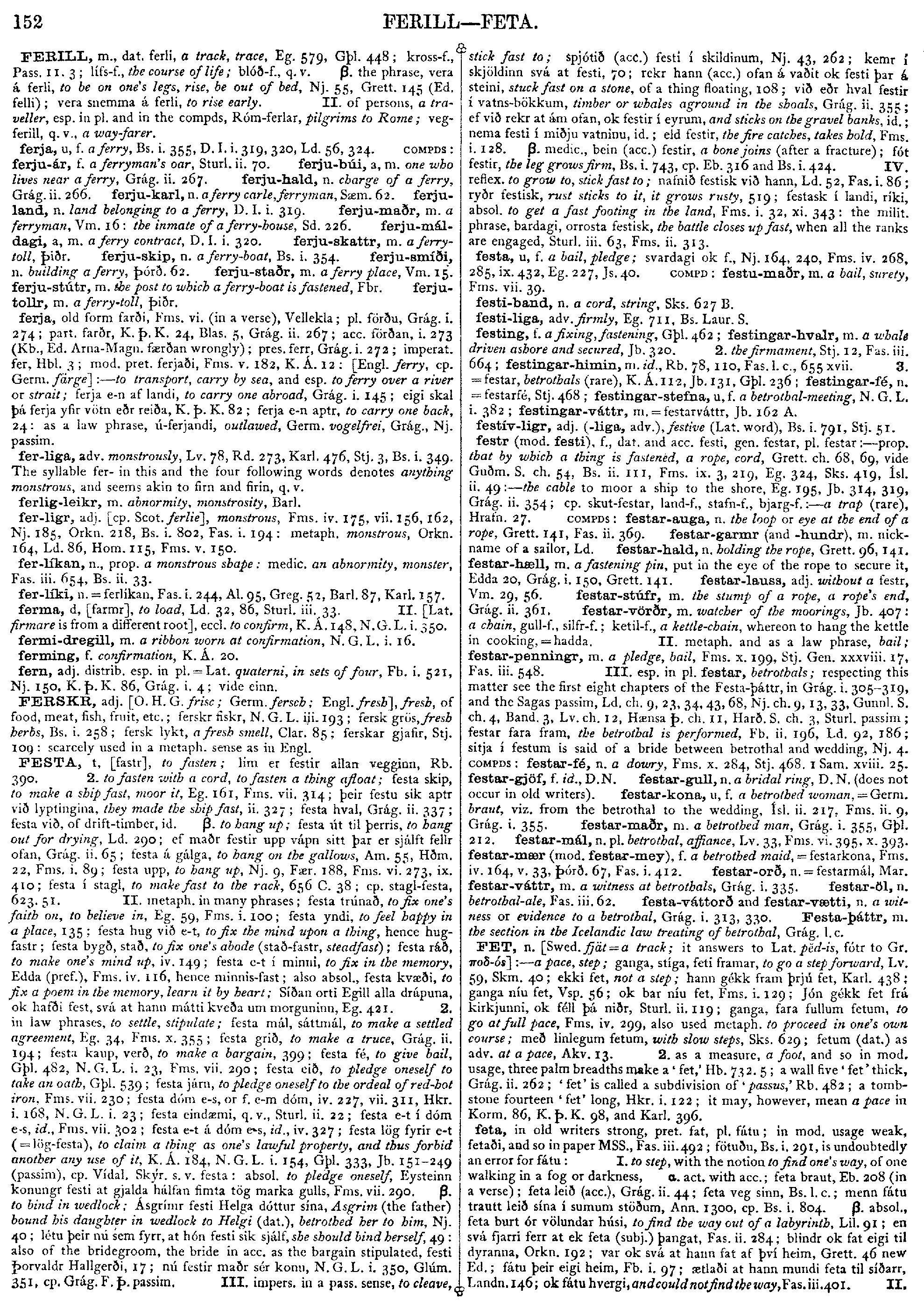
festr (mod. festi), f., dat. and acc. festi, gen. festar, pl. festar :-- prop. that by which a thing is fastened, a rope, cord, Grett. ch. 68, 69, vide Guðm. S. ch. 54, Bs. ii. 111, Fms. ix. 3, 219, Eg. 324, Sks. 419, Ísl. ii. 49 :-- the cable to moor a ship to the shore, Eg. 195, Jb. 314, 319, Grág. ii. 354; cp. skut-festar, land-f., stafn-f., bjarg-f. :-- a trap (rare), Hrafn. 27. COMPDS: festar-auga, n. the loop or eye at the end of a rope, Grett. 141, Fas. ii. 369. festar-garmr (and -hundr), m. nickname of a sailor, Ld. festar-hald, n. holding the rope, Grett. 96, 141. festar-hæll, m. a fastening pin, put in the eye of the rope to secure it, Edda 20, Grág. i. 150, Grett. 141. festar-lauss, adj. without a festr, Vm. 29, 56. festar-stúfr, m. the stump of a rope, a rope's end, Grág. ii. 361. festar-vörðr, m. watcher of the moorings, Jb. 407: a chain, gull-f., silfr-f.; ketil-f., a kettle-chain, whereon to hang the kettle in cooking, = hadda. II. metaph. and as a law phrase, bail; festar-penningr, m. a pledge, bail, Fms. x. 199, Stj. Gen. xxxviii. 17, Fas. iii. 548. III. esp. in pl. festar, betrothals; respecting this matter see the first eight chapters of the Festa-þáttr, in Grág. i. 305-319, and the Sagas passim, Ld. ch. 9, 23, 34, 43, 68, Nj. ch. 9, 13, 33, Gunnl. S. ch. 4, Band. 3, Lv. ch. 12, Hænsa Þ. ch. 11, Harð. S. ch. 3, Sturl. passim; festar fara fram, the betrothal is performed, Fb. ii. 196, Ld. 92, 186; sitja í festum is said of a bride between betrothal and wedding, Nj. 4. COMPDS: festar-fé, n. a dowry, Fms. x. 284, Stj. 468. 1 Sam. xviii. 25. festar-gjöf, f. id., D. N. festar-gull, n. a bridal ring, D. N. (does not occur in old writers). festar-kona, u, f. a betrothed woman, = Germ. braut, viz. from the betrothal to the wedding, Ísl. ii. 217. Fms. ii. 9, Grág. i. 355. festar-maðr, m. a betrothed man, Grág. i. 355, Gþl. 212. festar-mál, n. pl. betrothal, affiance, Lv. 33, Fms. vi. 395, x. 393. festar-mær (mod. festar-mey), f. a betrothed maid, = festarkona, Fms. iv. 164, v. 33, Þórð. 67, Fas. i. 412. festar-orð, n. = festarmál, Mar. festar-váttr, m. a witness at betrothals, Grág. i. 335. festar-öl, n. betrothal-ale, Fas. iii. 62. festa-váttorð and festar-vætti, n. a witness or evidence to a betrothal, Grág. i. 313, 330. Festa-þáttr, m. the section in the Icelandic law treating of betrothal, Grág. l.c.
|
Source: Cleasby/Vigfusson, page b0184, entry 39 View original page image as: [TIFF] [PNG] [View previous entry] [View next entry] |
[Comment on this entry] [View comments] |
The following entry has been hand-corrected once. |
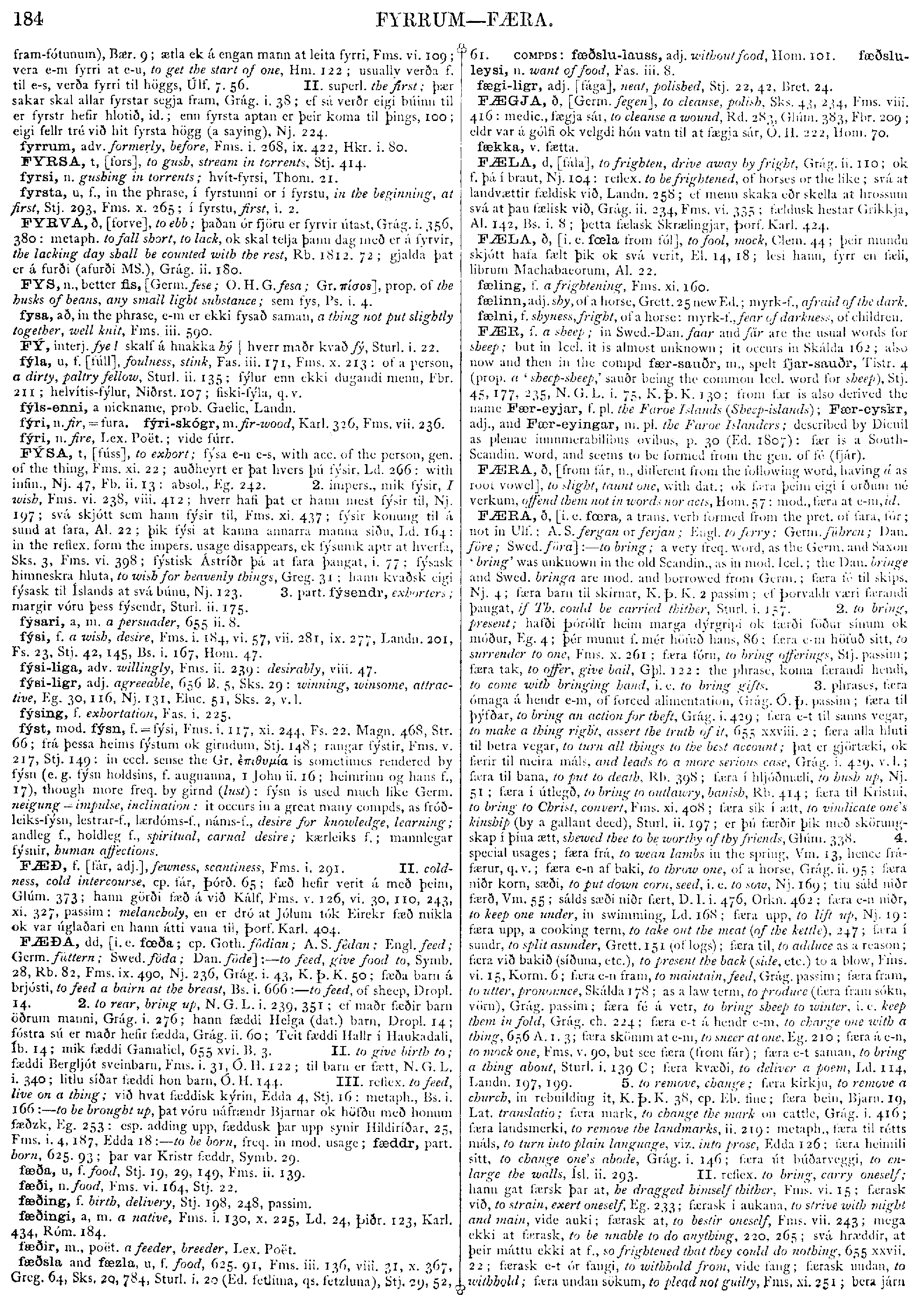
FÆRA, ð, [i.e. fœra, a trans. verb formed from the pret. of fara, fór; not in Ulf.; A. S. fergan or ferjan; Engl. to ferry; Germ. führen; Dan. före; Swed. föra] :-- to bring; a very freq. word, as the Germ. and Saxon 'bring' was unknown in the old Scandin., as in mod. Icel.; the Dan. bringe and Swed. bringa are mod. and borrowed from Germ.; færa fé til skips, Nj. 4; færa barn til skírnar, K. Þ. K. 2 passim; ef Þorvaldr væri færandi þangat, if Th. could be carried thither, Sturl. i. 157. 2. to bring, present; hafði Þórólfr heim marga dýrgripi ok færði föður sínum ok móður, Eg. 4; þér munut f. mér höfuð hans, 86; færa e-m höfuð sitt, to surrender to one, Fms. x. 261; færa fórn, to bring offerings, Stj. passim; færa tak, to offer, give bail, Gþl. 122: the phrase, koma færandi hendi, to come with bringing hand, i.e. to bring gifts. 3. phrases, færa ómaga á hendr e-m, of forced alimentation, Grág. Ó. Þ. passim; færa til þýfðar, to bring an action for theft, Grág. i. 429; færa e-t til sanns vegar, to make a thing right, assert the truth of it, 655 xxviii. 2; færa alla hluti til betra vegar, to turn all things to the best account; þat er gjörtæki, ok færir til meira máls, and leads to a more serious case, Grág. i. 429, v.l.; færa til bana, to put to death, Rb. 398; færa í hljóðmæli, to hush up, Nj. 51; færa í útlegð, to bring to outlawry, banish, Rb. 414; færa til Kristni, to bring to Christ, convert, Fms. xi. 408; færa sik í ætt, to vindicate one's kinship (by a gallant deed), Sturl. ii. 197; er þú færðir þik með skörungskap í þína ætt, shewed thee to be worthy of thy friends, Glúm. 338. 4. special usages; færa frá, to wean lambs in the spring, Vm. 13, hence frá-færur, q.v.; færa e-n af baki, to throw one, of a horse, Grág. ii. 95: færa niðr korn, sæði, to put down corn, seed, i.e. to sow, Nj. 169; tiu sáld niðr færð, Vm. 55; sálds sæði niðr fært, D. I. i. 476, Orkn. 462; færa e-n niðr, to keep one under, in swimming, Ld. 168; færa upp, to lift up, Nj. 19: færa upp, a cooking term, to take out the meat (of the kettle), 247; færa í sundr, to split asunder, Grett. 151 (of logs); færa til, to adduce as a reason; færa við bakið (síðuna, etc.), to present the back (side, etc.) to a blow, Fms. vi. 15, Korm. 6; færa e-n fram, to maintain, feed, Grág. passim; færa fram, to utter, pronounce, Skálda 178; as a law term, to produce (færa fram sókn, vörn), Grág. passim; færa fé á vetr, to bring sheep to winter, i.e. keep them in fold, Grág. ch. 224; færa e-t á hendr e-m, to charge one with a thing, 656 A. 1. 3; færa skömm at e-m, to sneer at one, Eg. 210; færa á e-n, to mock one, Fms. v. 90, but see færa (from fár); færa e-t saman, to bring a thing about, Sturl. i. 139 C; færa kvæði, to deliver a poem, Ld. 114, Landn. 197, 199. 5. to remove, change; færa kirkju, to remove a church, in rebuilding it, K. Þ. K. 38, cp. Eb. fine; færa bein, Bjarn. 19, Lat. translatio; færa mark, to change the mark on cattle, Grág. i. 416; færa landsmerki, to remove the landmarks, ii. 219: metaph., færa til rétts máls, to turn into plain language, viz. into prose, Edda 126; færa heimili sitt, to change one's abode, Grág. i. 146; færa út búðarveggi, to enlarge the walls, Ísl. ii. 293. II. reflex. to bring, carry oneself; hann gat færsk þar at, he dragged himself thither, Fms. vi. 15; færask við, to strain, exert oneself, Eg. 233; færask í aukana, to strive with might and main, vide auki; færask at, to bestir oneself, Fms. vii. 243; mega ekki at færask, to be unable to do anything, 220, 265; svá hræddir, at þeir máttu ekki at f., so frightened that they could do nothing, 655 xxvii. 22; færask e-t ór fangi, to withhold from, vide fang; færask undan, to withhold; færa undan sökum, to plead not guilty, Fms. xi. 251; bera járn
|
Source: Cleasby/Vigfusson, page b0212, entry 1 View original page image as: [TIFF] [PNG] [View previous entry] [View next entry] |
[Comment on this entry] [View comments] |
The following entry has been hand-corrected once. |
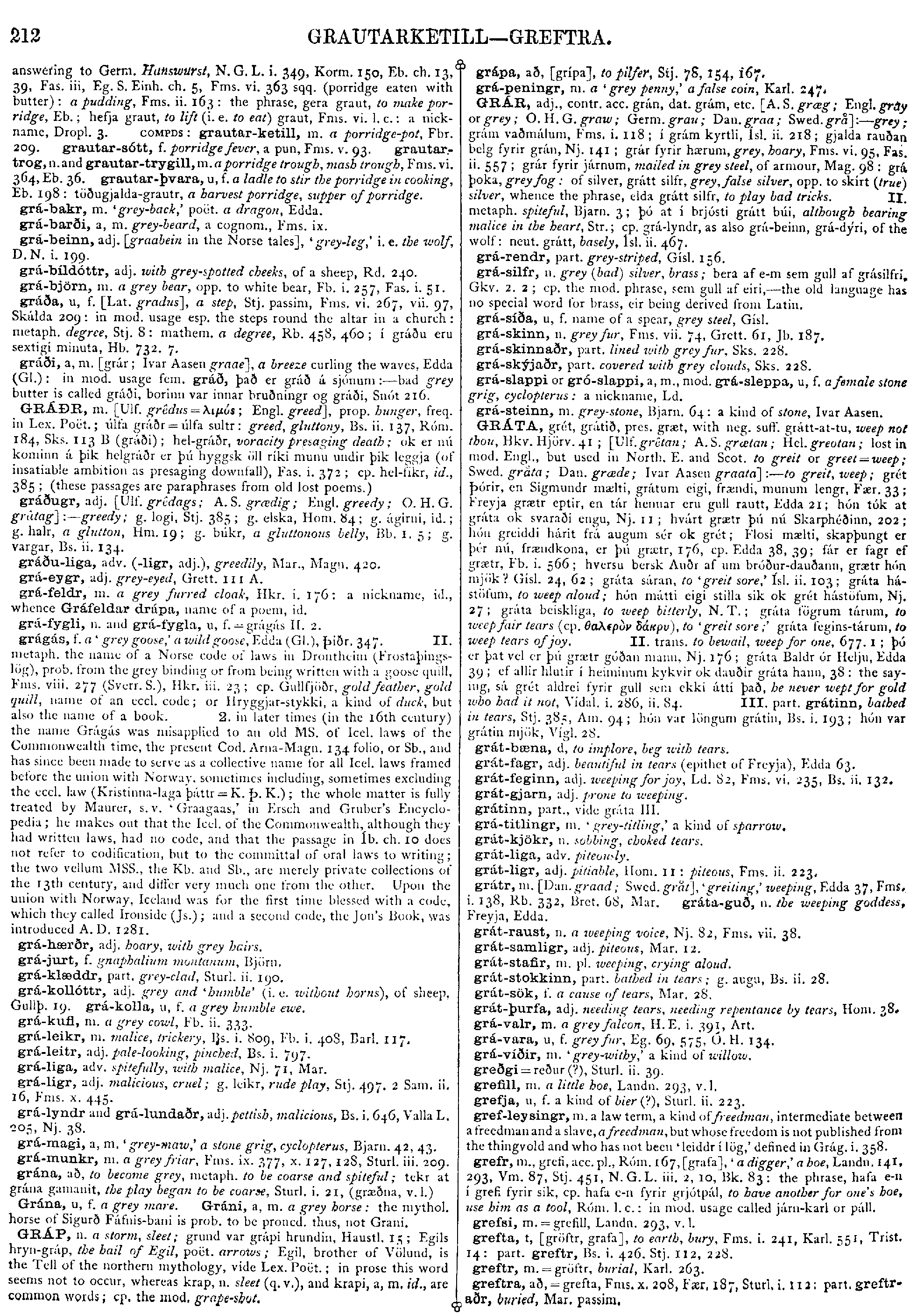
answering to Germ. Hanswurst, N.G.L. i. 349, Korm. 150, Eb. ch. 13, 39, Fas. iii, Eg. S. Einh. ch. 5, Fms. vi. 363 sqq. (porridge eaten with butter) : a pudding, Fms. ii. 163 : the phrase, gera graut, to make porridge, Eb.; hefja graut, to lift (i.e. to eat) graut, Fms. vi. l.c. : a nickname, Dropl. 3. COMPDS: grautar-ketill, m. a porridge-pot, Fbr. 209. grautar-sótt, f. porridge fever, a pun, Fms. v. 93. grautar- trog, n. and grautar-trygill, m. a porridge trough, mash trough, Fms. vi. 364, Eb. 36. grautar-þvara, u, f. a ladle to stir the porridge in cooking, Eb. 198 : töðugjalda-grautr, a harvest porridge, supper of porridge.
|
Source: Cleasby/Vigfusson, page b0226, entry 3 View original page image as: [TIFF] [PNG] [View previous entry] [View next entry] |
[Comment on this entry] [View comments] |
The following entry has been hand-corrected once. |
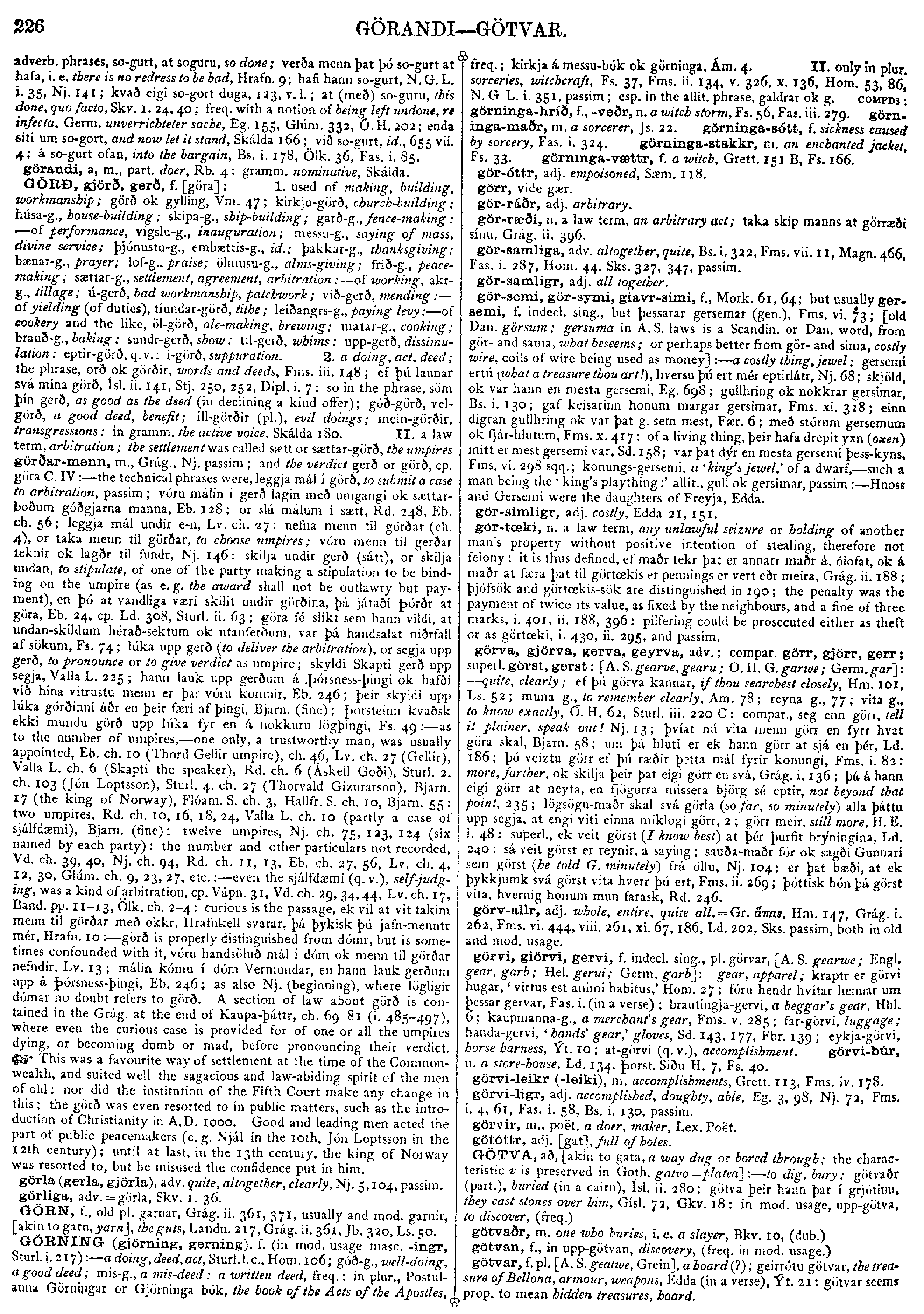
GÖRÐ, gjörð, gerð, f. [göra]: 1. used of making, building, workmanship; görð ok gylling, Vm. 47; kirkju-görð, church-building; húsa-g., house-building; skipa-g., ship-building; garð-g., fence-making :-- of performance, vígslu-g., inauguration; messu-g., saying of mass, divine service; þjónustu-g., embættis-g., id.; þakkar-g., thanksgiving; bænar-g., prayer; lof-g., praise; ölmusu-g., alms-giving; frið-g., peace-making; sættar-g., settlement, agreement, arbitration :-- of working, akr-g., tillage; ú-gerð, bad workmanship, patchwork; við-gerð, mending :-- of yielding (of duties), tíundar-görð, tithe; leiðangrs-g., paying levy :-- of cookery and the like, öl-görð, ale-making, brewing; matar-g., cooking; brauð-g., baking: sundr-gerð, show: til-gerð, whims: upp-gerð, dissimulation: eptir-görð, q.v.: í-görð, suppuration. 2. a doing, act, deed; the phrase, orð ok görðir, words and deeds, Fms. iii. 148; ef þú launar svá mína görð, Ísl. ii. 141, Stj. 250, 252, Dipl. i. 7: so in the phrase, söm þín gerð, as good as the deed (in declining a kind offer); góð-görð, vel-görð, a good deed, benefit; íll-görðir (pl.), evil doings; mein-görðir, transgressions: in gramm. the active voice, Skálda 180. II. a law term, arbitration; the settlement was called sætt or sættar-görð, the umpires görðar-menn, m., Grág., Nj. passim; and the verdict gerð or görð, cp. göra C. IV :-- the technical phrases were, leggja mál í görð, to submit a case to arbitration, passim; vóru málin í gerð lagin með umgangi ok sættarboðum góðgjarna manna, Eb. 128; or slá málum í sætt, Rd. 248, Eb. ch. 56; leggja mál undir e-n, Lv. ch. 27: nefna menn til görðar (ch. 4), or taka menn til görðar, to choose umpires; vóru menn til gerðar teknir ok lagðr til fundr, Nj. 146: skilja undir gerð (sátt), or skilja undan, to stipulate, of one of the party making a stipulation to be binding on the umpire (as e.g. the award shall not be outlawry but payment), en þó at vandliga væri skilit undir görðina, þá játaði Þórðr at göra, Eb. 24, cp. Ld. 308, Sturl. ii. 63; göra fé slíkt sem hann vildi, at undan-skildum hérað-sektum ok utanferðum, var þá handsalat niðrfall af sökum, Fs. 74; lúka upp gerð (to deliver the arbitration), or segja upp gerð, to pronounce or to give verdict as umpire; skyldi Skapti gerð upp segja, Valla L. 225; hann lauk upp gerðum á Þórsness-þingi ok hafði við hina vitrustu menn er þar vóru komnir, Eb. 246; þeir skyldi upp lúka görðinni áðr en þeir færi af þingi, Bjarn. (fine); Þorsteinn kvaðsk ekki mundu görð upp lúka fyr en á nokkuru lögþingi, Fs. 49 :-- as to the number of umpires, -- one only, a trustworthy man, was usually appointed, Eb. ch. 10 (Thord Gellir umpire), ch. 46, Lv. ch. 27 (Gellir), Valla L. ch. 6 (Skapti the speaker), Rd. ch. 6 (Áskell Goði), Sturl. 2. ch. 103 (Jón Loptsson), Sturl. 4. ch. 27 (Thorvald Gizurarson), Bjarn. 17 (the king of Norway), Flóam. S. ch. 3, Hallfr. S. ch. 10, Bjarn. 55: two umpires, Rd. ch. 10, 16, 18, 24, Valla L. ch. 10 (partly a case of sjálfdæmi), Bjarn. (fine): twelve umpires, Nj. ch. 75, 123, 124 (six named by each party): the number and other particulars not recorded, Vd. ch. 39, 40, Nj. ch. 94, Rd. ch. 11, 13, Eb. ch. 27, 56, Lv. ch. 4, 12, 30, Glúm. ch. 9, 23, 27, etc. :-- even the sjálfdæmi (q.v.), self-judging, was a kind of arbitration, cp. Vápn. 31, Vd. ch. 29, 34, 44, Lv. ch. 17, Band. pp. 11-13, Ölk. ch. 2-4: curious is the passage, ek vil at vit takim menn til görðar með okkr, Hrafnkell svarar, þá þykisk þú jafn-menntr mér, Hrafn. 10 :-- görð is properly distinguished from dómr, but is sometimes confounded with it, vóru handsöluð mál í dóm ok menn til görðar nefndir, Lv. 13; málin kómu í dóm Vermundar, en hann lauk gerðum upp á Þórsness-þingi, Eb. 246; as also Nj. (beginning), where lögligir dómar no doubt refers to görð. A section of law about görð is contained in the Grág. at the end of Kaupa-þáttr, ch. 69-81 (i. 485-497), where even the curious case is provided for of one or all the umpires dying, or becoming dumb or mad, before pronouncing their verdict. UNCERTAIN This was a favourite way of settlement at the time of the Commonwealth, and suited well the sagacious and law-abiding spirit of the men of old: nor did the institution of the Fifth Court make any change in this; the görð was even resorted to in public matters, such as the introduction of Christianity in A. D. 1000. Good and leading men acted the part of public peacemakers (e.g. Njál in the 10th, Jón Loptsson in the 12th century); until at last, in the 13th century, the king of Norway was resorted to, but he misused the confidence put in him.
|
Source: Cleasby/Vigfusson, page b0276, entry 24 View original page image as: [TIFF] [PNG] [View previous entry] [View next entry] |
[Comment on this entry] [View comments] |
The following entry has been hand-corrected once. |
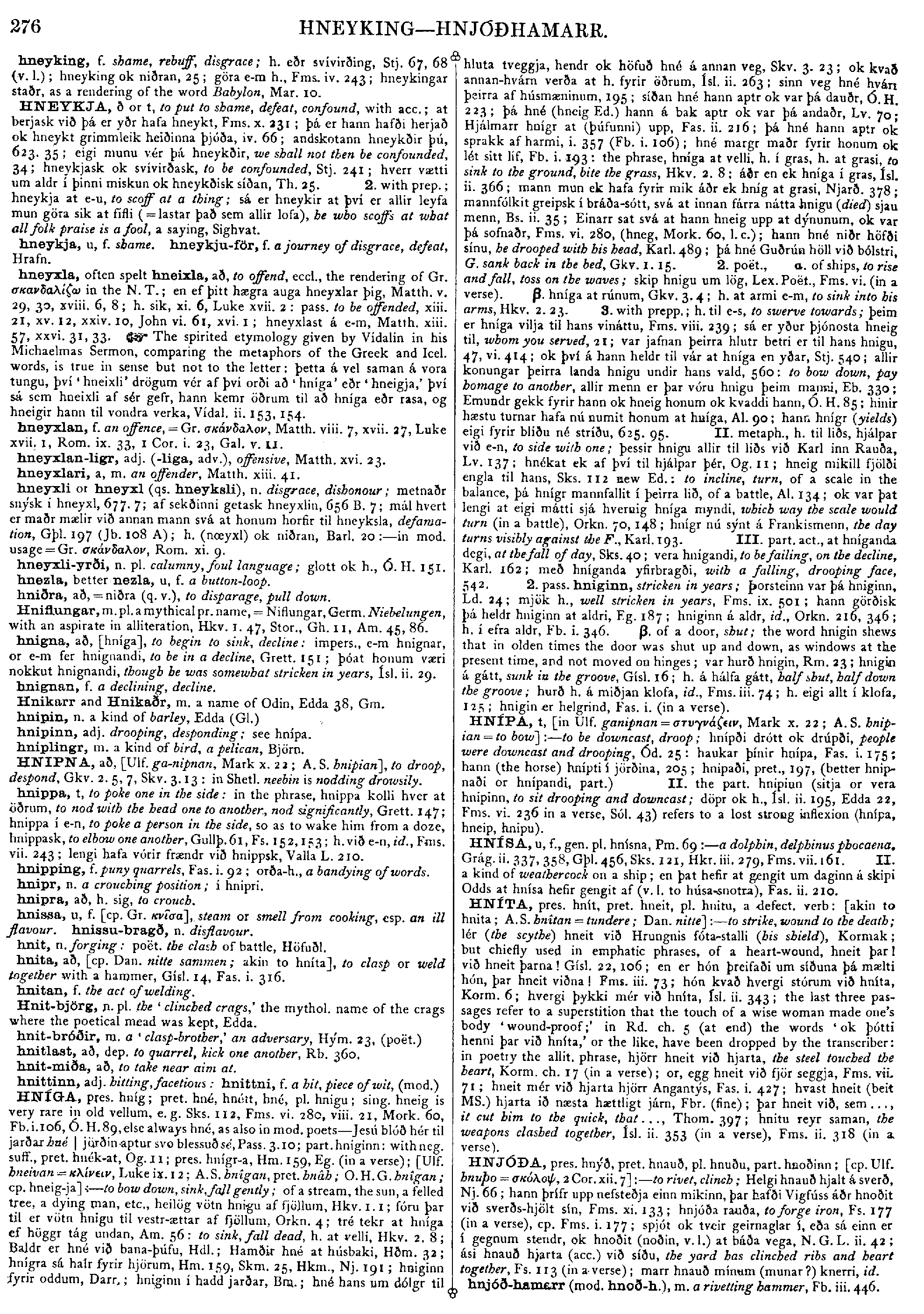
hnissa, u, f. [cp. Gr. GREEK], steam or smell from cooking, esp. an ill flavour. hnissu-bragð, n. disflavour.
|
Source: Cleasby/Vigfusson, page b0281, entry 4 View original page image as: [TIFF] [PNG] [View previous entry] [View next entry] |
[Comment on this entry] [View comments] |
The following entry has been hand-corrected once. |
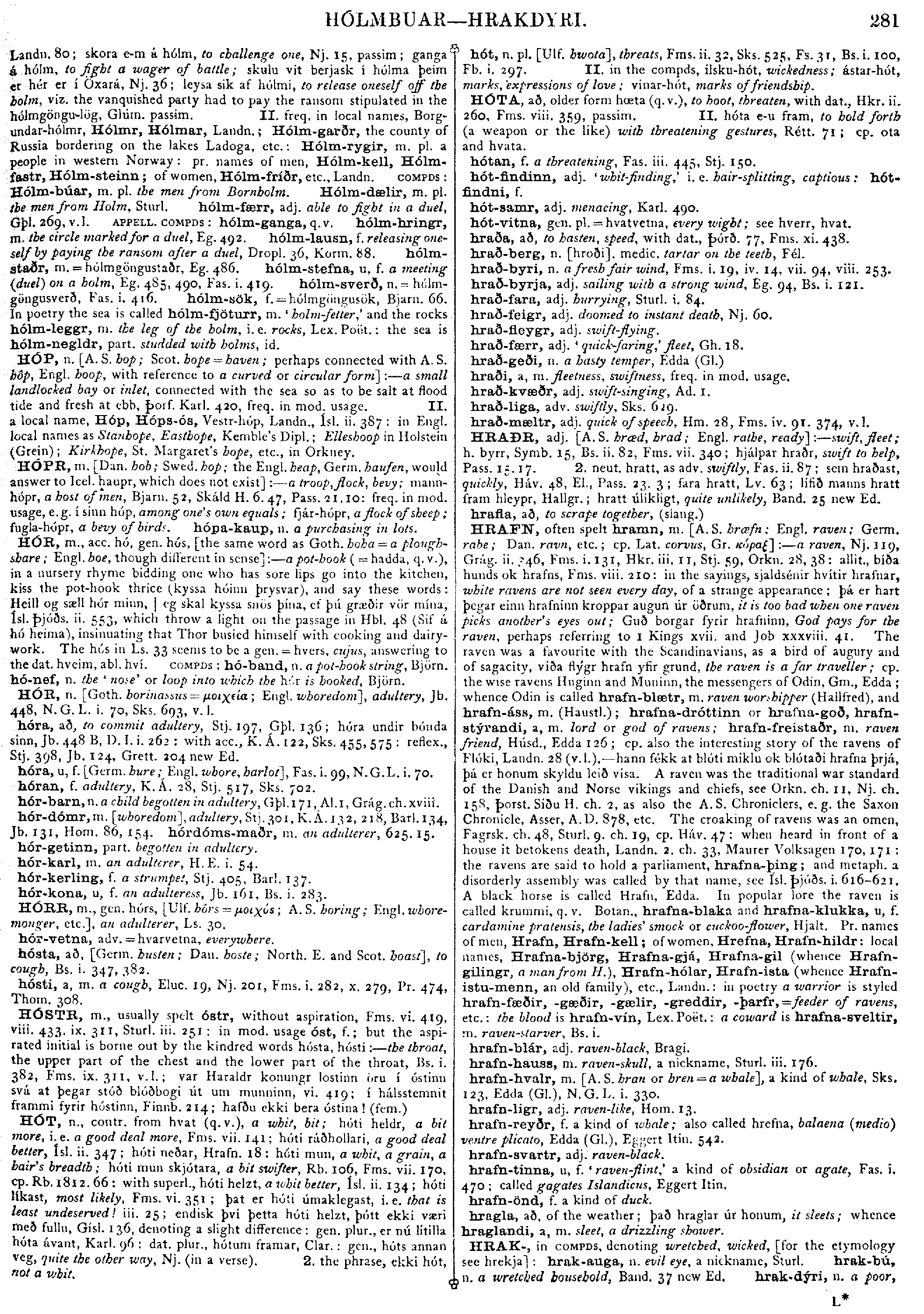
HÓR, m., acc. hó, gen. hós, [the same word as Goth. hoha = a plough-share; Engl. hoe, though different in sense] :-- a pot-hook ( = hadda, q.v.), in a nursery rhyme bidding one who has sore lips go into the kitchen, kiss the pot-hook thrice (kyssa hóinn þrysvar), and say these words: Heill og sæll hór minn, | eg skal kyssa snös þína, ef þú græðir vör mína, Ísl. Þjóðs. ii. 553, which throw a light ou the passage in Hbl. 48 (Sif á hó heima), insinuating that Thor busied himself with cooking and dairy-work. The hós in Ls. 33 seems to be a gen. = hvers, cujus, answering to the dat. hveim, abl. hví. COMPDS: hó-band, n. a pot-hook string, Björn. hó-nef, n. the 'nose' or loop into which the hór is hooked, Björn.
|
Source: Cleasby/Vigfusson, page b0289, entry 23 View original page image as: [TIFF] [PNG] [View previous entry] [View next entry] |
[Comment on this entry] [View comments] |
The following entry has been hand-corrected once. |
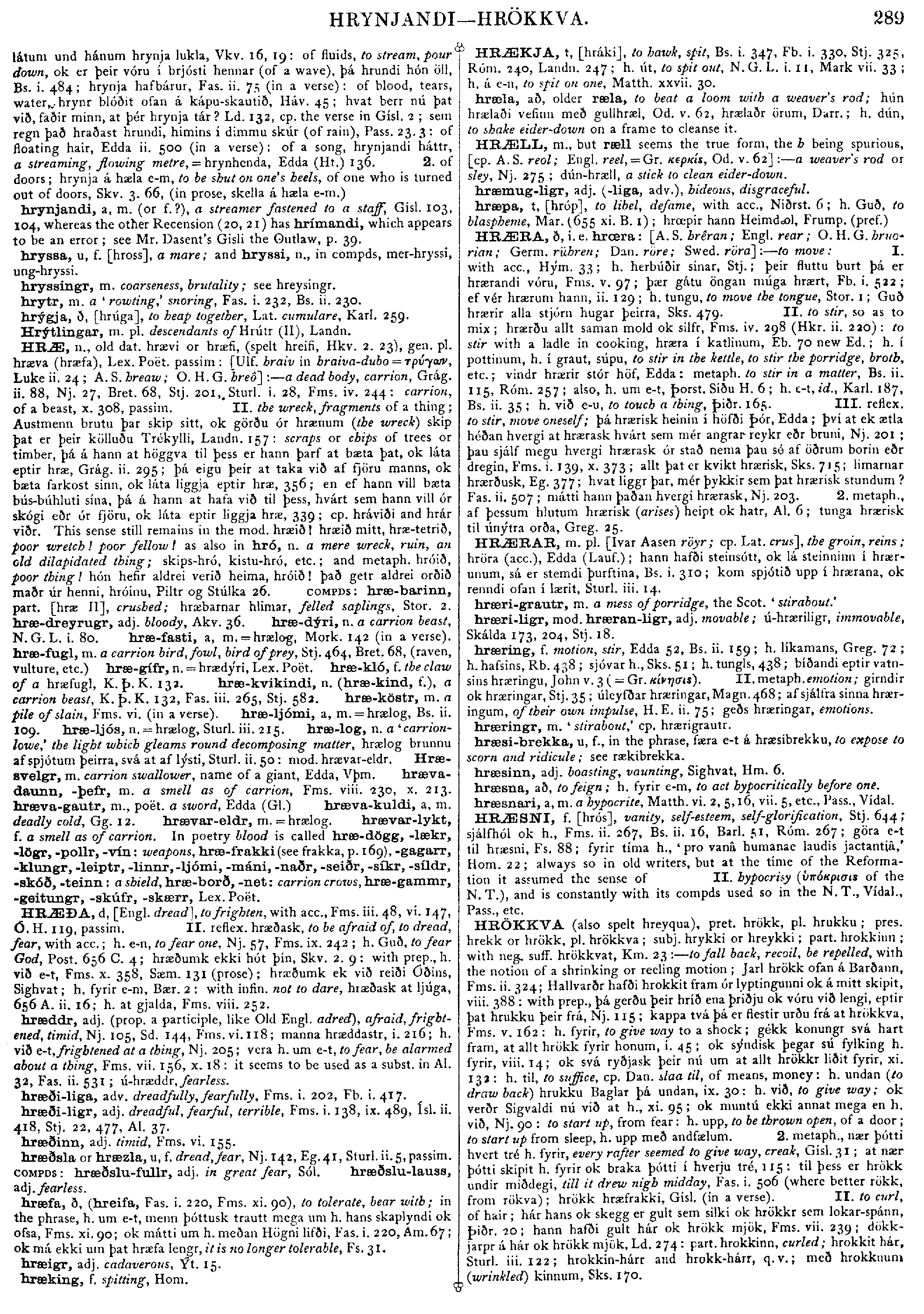
HRÆRA, ð, i.e. hrœra: [A. S. hrêran; Engl. rear; O. H. G. hruorian; Germ. rühren; Dan. röre; Swed. röra] :-- to move: I. with acc., Hým. 33; h. herbúðir sínar, Stj.; þeir fluttu burt þá er hrærandi vóru, Fms. v. 97; þær gátu öngan múga hrært, Fb. i. 522; ef vér hrærum hann, ii. 129; h. tungu, to move the tongue, Stor. 1; Guð hrærir alla stjórn hugar þeirra, Sks. 479. II. to stir, so as to mix; hrærðu allt saman mold ok silfr, Fms. iv. 298 (Hkr. ii. 220): to stir with a ladle in cooking, hræra í katlinum, Eb. 70 new Ed.; h. í pottinum, h. í graut, súpu, to stir in the kettle, to stir the porridge, broth, etc.; vindr hrærir stór höf, Edda: metaph. to stir in a matter, Bs. ii. 115, Róm. 257; also, h. um e-t, Þorst. Síðu H. 6; h. e-t, id., Karl. 187, Bs. ii. 35; h. við e-u, to touch a thing, Þiðr. 165. III. reflex. to stir, move oneself; þá hrærisk heinin í höfði Þór, Edda; því at ek ætla héðan hvergi at hrærask hvárt sem mér angrar reykr eðr bruni, Nj. 201; þau sjálf megu hvergi hrærask ór stað nema þau sé af öðrum borin eðr dregin, Fms. i. 139, x. 373; allt þat er kvikt hrærisk, Sks. 715; limarnar hrærðusk, Eg. 377; hvat liggr þar, mér þykkir sem þat hrærisk stundum? Fas. ii. 507; mátti hann þaðan hvergi hrærask, Nj. 203. 2. metaph., af þessum hlutum hrærisk (arises) heipt ok hatr, Al. 6; tunga hrærisk til únýtra orða, Greg. 25.
|
Source: Cleasby/Vigfusson, page b0414, entry 27 View original page image as: [TIFF] [PNG] [View previous entry] [View next entry] |
[Comment on this entry] [View comments] |
The following entry has been hand-corrected once. |
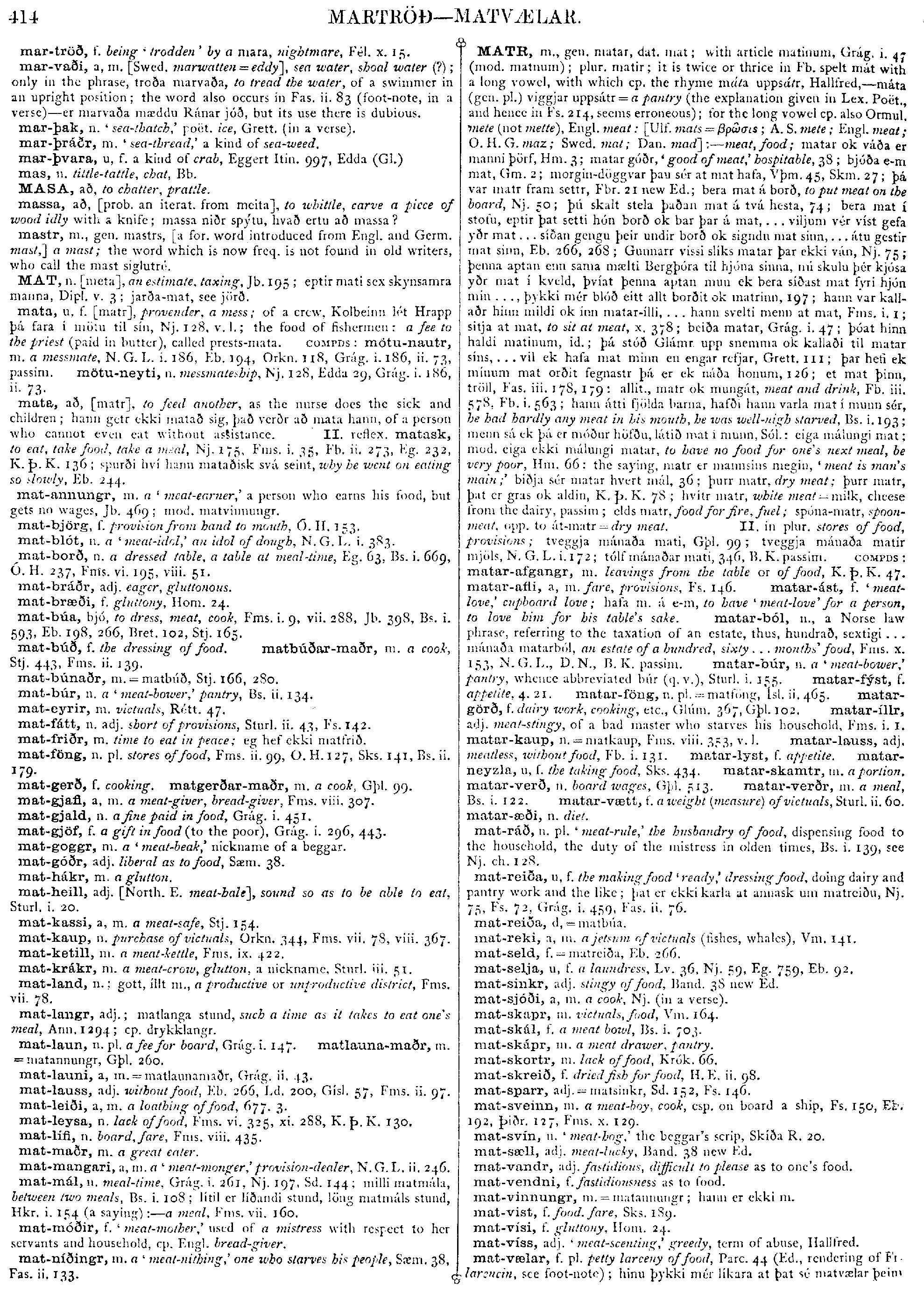
mat-gerð, f. cooking, matgerðar-maðr, m. a cook, Gþl. 99.
|
Source: Cleasby/Vigfusson, page b0414, entry 52 View original page image as: [TIFF] [PNG] [View previous entry] [View next entry] |
[Comment on this entry] [View comments] |
The following entry has been hand-corrected once. |
MATR, m., gen. matar, dat. mat; with article matinum, Grág. i. 47 (mod. matnum); plur. matir; it is twice or thrice in Fb. spelt mát with a long vowel, with which cp. the rhyme máta uppsátr, Hallfred, -- máta (gen. pl.) viggjar uppsátr = a pantry (the explanation given in Lex. Poët. and hence in Fs. 214, seems erroneous); for the long vowel cp. also Ormul. mete (not mette), Engl. meat: [Ulf. mats = GREEK; A.S. mete; Engl. meat; O.H.G. maz; Swed. mat; Dan. mad] :-- meat, food; matar ok váða er manni þörf, Hm. 3; matar góðr, 'good of meat,' hospitable, 38; bjóða e-m mat, Gm. 2; morgin-döggvar þau sér at mat hafa, Vþm. 45, Skm. 27; þá var matr fram settr, Fbr. 21 new Ed.; bera mat á borð, to put meat on the board, Nj. 50; þú skalt stela þaðan mat á tvá hesta, 74; bera mat í stofu, eptir þat setti hón borð ok bar þar á mat, ... viljum vér víst gefa yðr mat ... síðan gengu þeir undir borð ok signdu mat sinn, ... átu gestir mat sinn, Eb. 266, 268; Gunnarr vissi slíks matar þar ekki ván, Nj. 75; þenna aptan enn sama mælti Bergþóra til hjóna sinna, nú skulu þér kjósa yðr mat í kveld, þvíat þenna aptan mun ek bera síðast mat fyri hjón mín ..., þykki mér blóð eitt allt borðit ok matrinn, 197; hann var kallaðr hinn mildi ok inn matar-ílli, ... hann svelti menn at mat, Fms. i. 1; sitja at mat, to sit at meat, x. 378; beiða matar, Grág. i. 47; þóat hinn haldi matinum, id.; þá stóð Glámr. upp snemma ok kallaði til matar síns, ... vil ek hafa mat minn en engar refjar, Grett. 111; þar hefi ek mínum mat orðit fegnastr þá er ek náða honum, 126; et mat þinn, tröll, Fas. iii. 178, 179: allit., matr ok mungát, meat and drink, Fb. iii. 578. Fb. i. 563; hann átti fjölda barna, hafði hann varla mat í munn sér, he had hardly any meat in his mouth, he was well-nigh starved, Bs. i. 193; menn sá ek þá er móður höfðu, látið mat í munn, Sól.: eiga máiungi mat; mod. eiga ekki málungi matar, to have no food for one's next meal, be very poor, Hm. 66: the saying, matr tr mannsins megin, 'meat is man's main;' biðja sér matar hvert mál, 36; þurr matr, dry meat; þurr matr, þat er gras ok aldin, K.Þ.K. 78; hvítr matr, white meat = milk, cheese from the dairy, passim; elds matr, food for fire, fuel; spóna-matr, spoon-meat, opp. to át-matr = dry meat. II. in plur. stores of food, provisions; tveggja mánaða mati, Gþl. 99; tveggja mánaða matir mjöls, N.G.L. i. 172; tólf mánaðar mati, 346, B.K. passim. COMPDS: matar-afgangr, m. leavings from the table or of food, K.Þ.K. 47. matar-afli, a, m. fare, provisions, Fs. 146. matar-ást, f. 'meat-love' cupboard love; hafa m. á e-m, to have 'meat-love' for a person, to love him for his table's sake. matar-ból, n., a Norse law phrase, referring to the taxation of an estate, thus, hundrað, sextigi ... mánaða matarból, an estate of a hundred, sixty ... months' food, Fms. x. 153, N.G.L., D.N., B.K. passim. matar-búr, n. a 'meat-bower,' pantry, whence abbreviated búr (q.v.), Sturl. i. 355. matar-fýst, f. appetite, 4. 21. matar-föng, n. pl. = matföng, Ísl. ii. 465. matar-görð, f. dairy work, cooking, etc., Glúm. 367, Gþl. 102. matar-íllr, adj. meat-stingy, of a bad master who starves his household, Fms. i. 1. matar-kaup, n. = matkaup, Fms. viii. 353, v.l. matar-lauss, adj. meatless, without food, Fb. i. 131. matar-lyst, f. appetite. matar-neyzla, u, f. the taking food, Sks. 434. matar-skamtr, m. a portion. matar-verð, n. board wages, Gþl. 513. matar-verðr, m. a meal, Bs. i. 122. matar-vætt, f. a weight (measure) of victuals, Sturl. ii. 60. matar-æði, n. diet.
| Result Page: |  |
Previous | 1 2 3 | Next |  |
Germanic Lexicon Project (main page)
This search system was written by
Sean Crist
Please consider
volunteering
to correct the data in these online dictionaries.
No rights reserved. Feel free to use these data in any way you please.