|
|

|
Source: Cleasby/Vigfusson, page b0592, entry 12 View original page image as: [TIFF] [PNG] [View previous entry] [View next entry] |
[Comment on this entry] [View comments] |
The following entry has been hand-corrected once. |
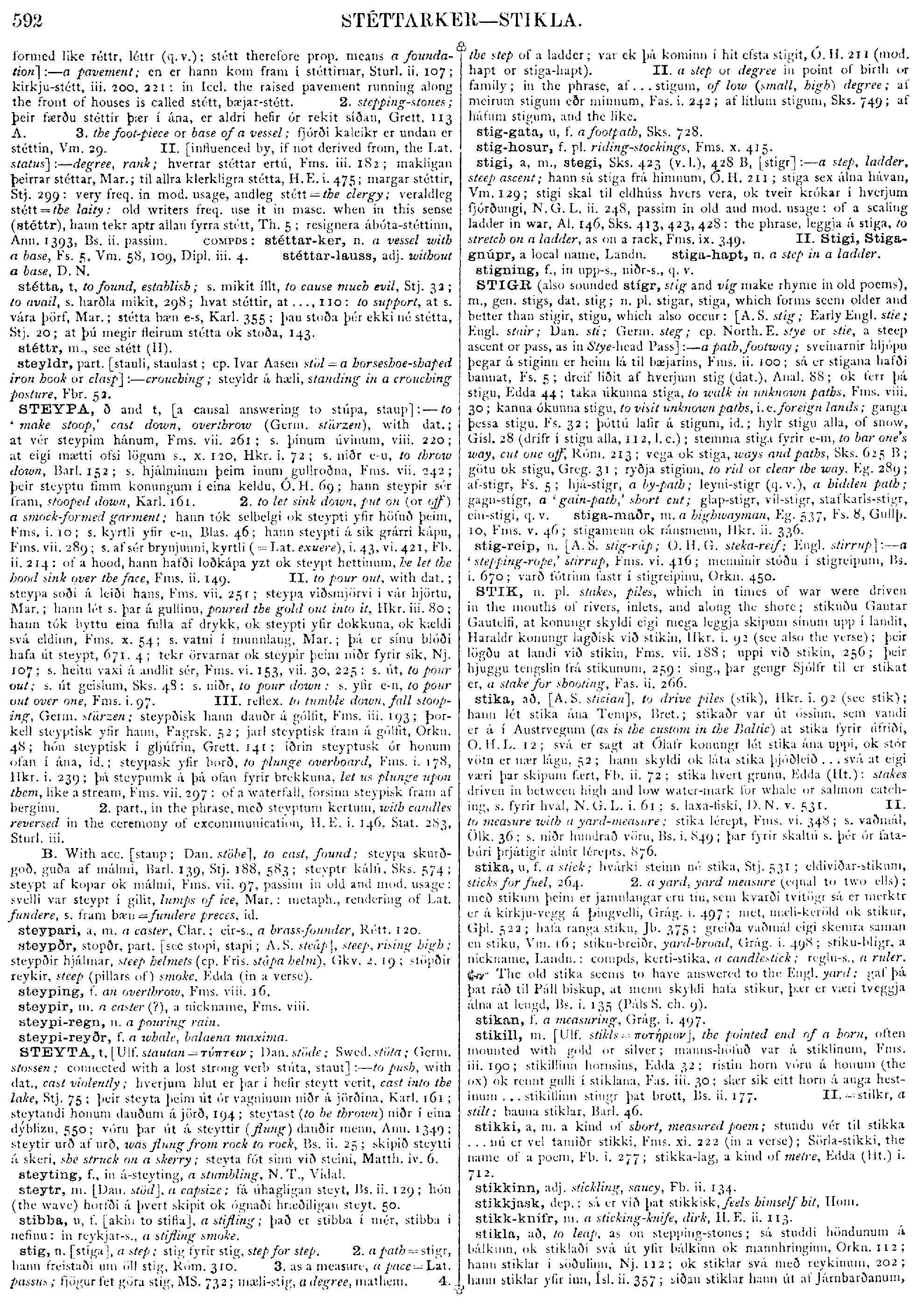
STEYTA, t, [Ulf. stautan = GREEK; Dan. stöde; Swed. stöta; Germ. stossen; connected with a lost strong verb stúta, staut] :-- to push, with dat., cast violently; hverjum hlut er þar í hefir steytt verit, cast into the lake, Stj. 75; þeir steyta þeim út ór vagninum niðr á jörðina, Karl. 161; steytandi honum dauðum á jörð, 194; steytast (to be thrown) niðr í eina dýblizu, 550; vóru þar út á steyttir (flung) dauðir menn, Ann. 1349; steytir urð at urð, was flung from rock to rock, Bs. ii. 25; skipið steytti á skeri, she struck on a skerry; steyta fót sinn við steini, Matth. iv. 6.
|
Source: Cleasby/Vigfusson, page b0638, entry 24 View original page image as: [TIFF] [PNG] [View previous entry] [View next entry] |
[Comment on this entry] [View comments] |
The following entry has been hand-corrected once. |
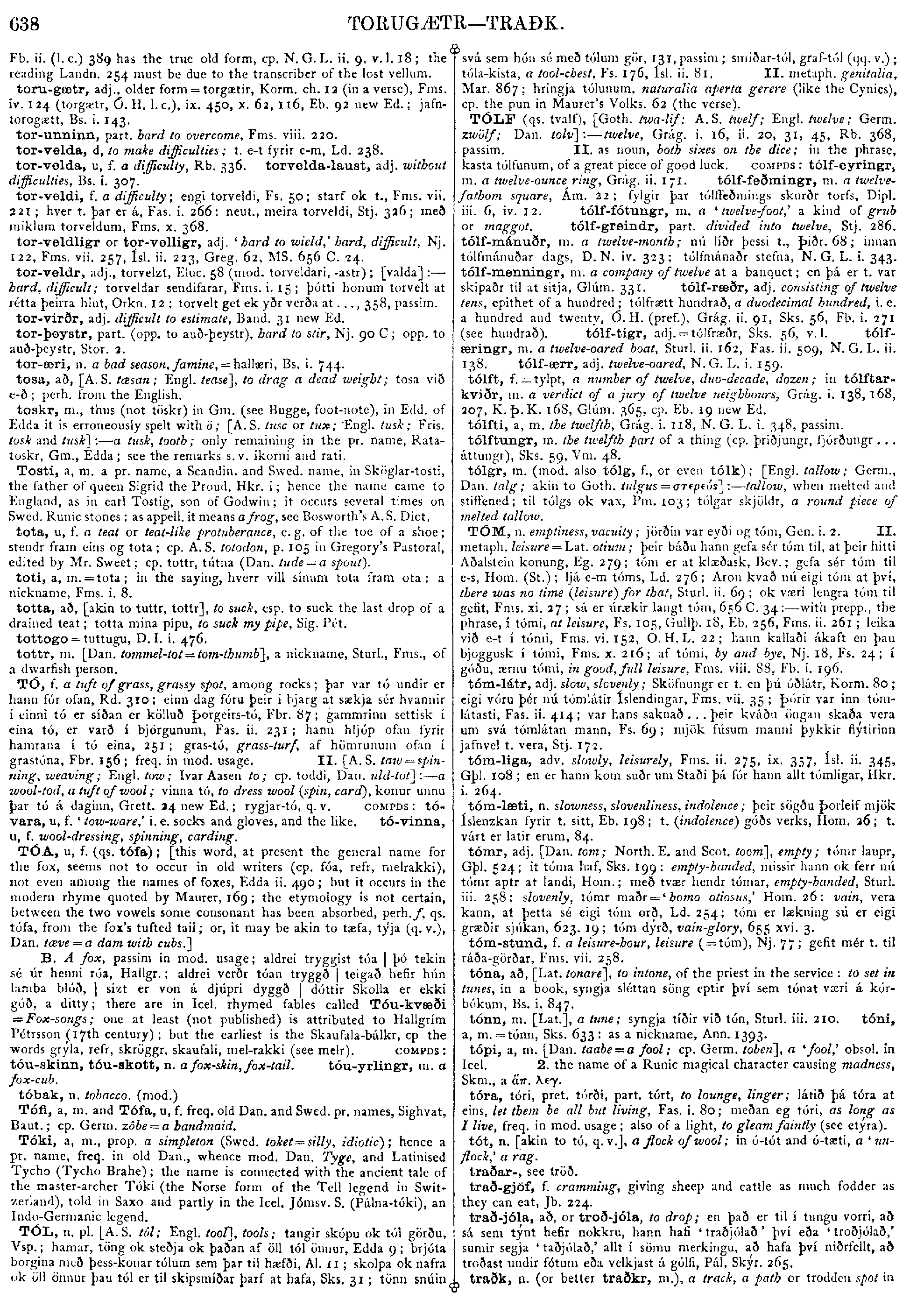
Tóki, a, m., prop. a simpleton (Swed. toket = silly, idiotic); hence a pr. name, freq. in old Dan., whence mod. Dan. Tyge, and Latinised Tycho (Tycho Brahe); the name is connected with the ancient tale of the master-archer Tóki (the Norse form of the Tell legend in Switzerland), told in Saxo and partly in the Icel. Jómsv. S. (Pálna-tóki), an Indo-Germanic legend.
|
Source: Cleasby/Vigfusson, page b0674, entry 28 View original page image as: [TIFF] [PNG] [View previous entry] [View next entry] |
[Comment on this entry] [View comments] |
The following entry has been hand-corrected once. |
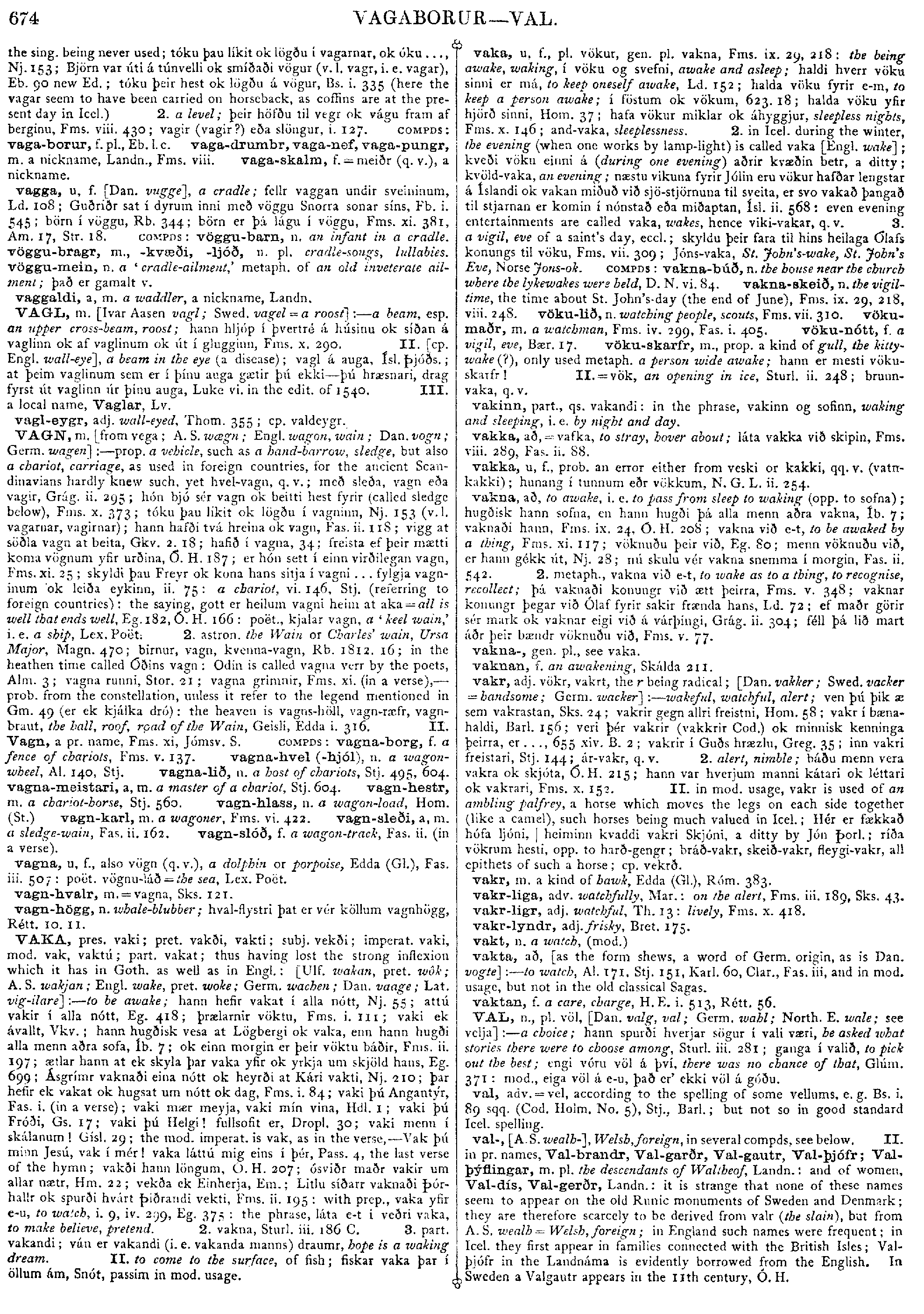
val-, [A.S. wealh-], Welsh, foreign, in several compds, see below. II. in pr. names, Val-brandr, Val-garðr, Val-gautr, Val-þjófr; Val-þýflingar, m. pl. the descendants of Waltheof, Landn.: and of women, Val-dís, Val-gerðr, Landn.: it is strange that none of these names seem to appear on the old Runic monuments of Sweden and Denmark; they are therefore scarcely to be derived from valr (the slain), but from A.S. wealh = Welsh, foreign; in England such names were frequent; in Icel. they first appear in families connected with the British Isles; Valþjófr in the Landnáma is evidently borrowed from the English. In Sweden a Valgautr appears in the 11th century, Ó.H.
|
Source: Cleasby/Vigfusson, page b0682, entry 1 View original page image as: [TIFF] [PNG] [View previous entry] [View next entry] |
[Comment on this entry] [View comments] |
The following entry has been hand-corrected once. |
vaz,
vazt,
Clem.
148,
l.
32;
the
mod.
sound
is
vass;
in
the
Editions,
however,
the
etymological
form
vatns
has
mostly
been
restored;
all
the
South
Teut.
languages
use
a
form
with
an
r.
The
form
vatr
only
occurs
in
two
instances,
perhaps
used
only
for
the
rhyme's
sake,
in
hvatr
vátri,
a
poem
of
the
beginning
of
the
12th
century;
and
hélt
und
vatr
enn
vitri,
Sighvat;
but
vatn
vitni
in
another
verse
cf
the
same
poet:
[A.S.
wæter;
Engl.
and
Dutch
water;
Hel.
watar;
O.H.G.
wazar;
Germ.
wasser;
cp.
Gr.
GREEK;
Lat.
udus:
on
the
other
hand,
Icel.
vatn;
Swed.
vatten;
Dan.
vand,
qs.
vadn.]
A.
Water,
fresh
water;
jörð,
vatn,
lopt,
eldr,
Eluc.
19;
spratt
þar
vatn
upp,
Edda
(pref.);
blóð
ok
vatn,
Rb.
334;
grafa
til
vatz,
Edda
(pref.);
taka
vatn
upp
at
sínum
hluta,
Vm.
168;
þá
er
vötnin
vóru
sköpuð,
655.
1;
drepa
í
vatn
eða
hella
á
vatni,
K.Þ.K.;
ef
vatn
er
svá
mikit
at
þar
má
barn
í
hylja,
N.G.L.
i.
363.
2.
phrases;
ausa
vatni,
to
besprinkle
infants
with
water,
see
ausa
I.
2.
 ;
to
which
add,
þar
stendr
þú,
Özorr,
kvað
Helgi,
ok
mun
ek
ekki
við
þér
sjá,
þvíat
þú
jóst
mik
vatni,
Dropl.
25;
mærin
var
vatni
ausin
ok
þetta
nafn
gefit,
Nj.
25:
ganga
til
vatns,
to
go
to
the
water,
to
go
to
the
'trapiza,'
q.v.,
of
washing
before
meals,
Ld.
296:
þá
er
sól
gengr
at
vatni.
when
the
sun
goes
into
the
water,
sets
in
the
sea,
K.Þ.K.
96;
sér
ekki
högg
á
vatni,
a
blow
in
the
water
is
not
seen,
of
a
useless
effort:
á
vatni,
afloat,
Fas.
ii.
532;
svá
skjótt,
at
ekki
tók
á
vatni,
Fms.
vii.
344.
3.
of
tears;
halda
ekki
vatni,
could
not
forbear
weeping,
Fms.
vi.
236
(in
a
verse),
viii.
232.
II.
a
lake;
[cp.
North.
E.
Derwent-water,
etc.];
uppí
vatnið
Væni,
Fms.
vi.
333;
lét
flytja
sik
út
í
vatn
eitt,
ok
leyndisk
þar
í
hólma
nökkurum,
i.
66;
er
í
norðanverðum
flóanum
vatn
þat
er
nes
liggr
í,
Ísl.
ii.
345;
til
vatz
þess
er
Á
en
Helga
fellr
ór,
Ó.H.
163;
sjór
eða
vatn,
a
sea
or
lake,
Edda.
III.
streams,
waters,
esp.
in
plur.
of
large
streams;
hnigu
heilög
vötn
af
Himin-fjöllum,
Hkv.
1.
1;
þaðan
eigu
vötn
öll
vega,
Gm.;
þar
er
djúpt
vatn
(deep
water)
er
umhverfis,
Grág.
ii.
131;
geysask
vötn
at
þeim
með
forsfalli
...
vötnin
flutu
um
völluna
alla,
Ó.H.
164;
brúar
um
ár
eða
vötn,
Grág.
i.
149;
vötn
þau
er
ór
jöklum
höfðu
fallit,
Eg.
133;
fjörðr
sá
er
flóir
allr
af
vötnum,
Fs.
26;
en
nú
falla
vötn
öll
til
Dýrafjarðar,
Gísl.
20;
fóru
þar
til
er
vötn
hnigu
til
vestr-ættar
af
fjöllum,
Orkn.
4.
IV.
in
local
names,
Vatn,
Vatna-hverfi,
Vatns-lausa,
Vatns-á,
Vatns-dalr,
Vatns-endi,
Vatns-fell,
Vatns-fjörðr,
Vatns-nes,
Vatns-horn,
Vatns-skarð,
etc.,
Landn.;
Vatns-dælir,
Vatns-firðingar,
the
men
from
Vatnsfjörðr,
Vatnsdalr,
id.,
Sturl.:
of
lakes,
Gríms-vötn,
Fiski-vötn,
Elliða-vatn,
Mý-vatn,
Ólvus-vatn,
Landn.,
map
of
Icel.;
more
seldom
of
rivers,
as
Héraðsvötn
in
north
of
Icel.:
Vatns-dælskr,
adj.
from
Vatnsdalr,
Finnb.
334,
Ísl.
ii.
335;
Vatnsfirðinga-kyn,
-búð,
Nj.
248,
Ld.
120
(see
búð).
B.
COMPDS,
with
gen.
vatna-,
vatns-,
in
vellums
vatz-,
vaz-:
vatns-agi,
a,
m.
dampness.
vatns-bakki,
a,
m.
a
bank,
shore
of
a
water
or
lake,
Grág.
ii.
355,
Jb.
315,
Fms.
viii.
32,
Fas.
i.
360.
vatns-beri,
a,
m.
the
water-bearer,
Aquarius
in
the
zodiac,
Rb.
vatns-blandaðr,
part.
mixed
with
water.
vatns-bolli,
a,
m.
a
water-jug,
Am.
35.
vatns-borinn,
part.
mixed
with
water.
vatns-botn,
m.
the
foot
of
a
lake,
Hrafn,
11,
Fms.
ix.
367.
vatns-ból,
n.
a
watering-place,
well,
where
drinking-water
is
drawn.
vatns-bóla,
u,
f.
a
water-bubble,
vatns-bragð,
n.
a
taste
of
water.
vatns-burðr,
m.
carrying
water,
Bs.
i.
vatns-dauði,
a,
m.
water-death,
death
by
drowning
in
fresh
water.
vatna-djúp,
n.
a
water-deep,
abyss,
Skálda
209.
vatns-dropi,
a,
m.
a
drop
of
water,
Stj.
154.
vatns-drykkr,
m.
a
drink
of
water,
Stj.
150,
581,
Edda
24.
vatns-dæld,
f.
a
watery
hollow.
vatns-endi,
a,
m.
the
end
of
a
lake,
Fms.
ix.
406.
vatns-fall,
n.
a
stream,
river;
lítið
vatnsfall,
a
small
river,
Eg.
134,
v.l.:
of
rain,
vindr
ok
vatnsfall,
Art.
85.
vatns-farvegr,
m.
a
'water's
fairway,'
the
bed
of
a
river,
Grág.
ii.
291.
vatns-fata,
u,
f.
a
water-pail,
Fb.
i.
258,
O.H.L.
ch.
96.
vatna-flaumr,
m.
[Norse
vand-flom],
a
water-flood,
swell
of
water,
D.N.
vi.
148.
vatns-flóð,
n.
water-flood.
vatna-gangr,
m.
a
flood,
Stj.
59,
Grág.
i.
219,
Landn.
251:
a
fall
of
rain,
=
vatnfall,
veðrátta
ok
v.,
Grett.
24
new
Ed.
vatns-heldr,
adj.
water-tight.
vatns-hestr,
m.
=
nykr,
q.v.,
Landn.
93,
v.l.;
but
vatna-hestr,
m.
a
good
horse
to
cross
rivers.
vatna-hlaup,
n.
floods,
a
rushing
forth
of
waters,
Landn.
250.
vatns-horn,
n.
a
water-horn,
a
vessel
for
holy
water
in
church,
Pm.
6:
the
end
or
angle
of
a
lake,
and
as
a
local
name,
Ld.,
Landn.
vatns-hríð,
f.
a
storm,
Ann.
1336
C.
vatns-íss,
m.
ice
on
a
lake,
Stj.
510,
Fms.
viii.
398,
ix.
367.
vatns-kanna,
u,
f.
a
water-can,
Vm.
86.
vatns-karl,
m.
a
water-can
shaped
like
a
man;
vatnskarl
til
vígðs
vatns,
Vm.
21;
vatnskarl
ok
munnlaug,
Fb.
i.
359,
D.N.
iv.
457.
vatns-ker,
n.
a
water-jug,
Stj.
vatns-kerald,
n.
=
vatnsker,
Fms.
i.
127,
Vm.
21,
Jb.
409,
vatns-ketill,
m.
a
water-kettle,
Vm.
21,
114,
B.K.
83.
vatns-kottr,
m.
a
water-insect,
in
foul
pools.
vatns-lauss,
adj.
waterless,
without
water,
Barl.
196.
vatns-leysi,
n.
lack
of
water.
vatns-litr,
m.
water-colour,
Rb.
336.
vatns-megin,
n.
fulness
of
water.
vatns-mikill,
adj.
swelling
with
water,
of
a
river.
vatns-minni,
n.
the
inlet
of
a
lake,
Fms.
ix.
394.
vatns-munnlaug,
f.
a
water
hand-basin,
Pm.
60.
vatns-ósa,
adj.
soaked
with
water.
vatns-óss,
m.
the
mouth
of
a
lake
connected
with
the
sea,
Landn.
207.
vatns-rás,
f.
a
trench,
water-course,
Bs.
i.
148,
Stj.
593.
vatns-sár,
m.
a
font,
Vm.
110,
N.G.L.
i.
327.
vatns-skál,
f.
a
water-jug,
D.N.
vatns-skírn,
f.
baptism
in
water,
Barl.
116,
144
(vatnz-skírn).
vatns-skortr,
m.
lack
of
water,
Barl.
196.
vatns-sótt,
f
water-sickness,
dropsy,
medic.,
Post.
vatns-steinn,
m.
a
font
of
stone,
Vm.
110.
vatns-strönd,
f.
the
bank
of
a
lake,
Fms.
viii.
32,
MS.
623.
33,
Vkv.
(prose,
vaz-strouds).
vatns-stökkull,
m.
a
watering-pot,
a
vessel
or
brush
for
sprinkling
water,
Bs.
i.
464.
vatns-tjörn,
f.
a
'water-tarn,'
pool,
Sks.
682.
vatna-tunna,
u,
f.
a
water-tub.
vatns-uppspretta,
u,
f.
a
jet
of
water,
Stj.
646.
vatns-veita,
u,
f.
a
drain,
trench,
aqueduct,
Grág.
ii.
289.
vatns-veiting,
f.
a
draining.
vatns-vetr,
m.
a
winter
of
floods,
Ann.
1191
C.
vatns-vígsla,
u,
f.
consecration
of
water,
Bs.
i.
97.
vatns-vík,
f.
a
creek
in
a
lake,
Fms.
viii.
67.
vatna-vöxtr,
m.
'water-growth,'
a
flood,
Bs.
i.
138,
Grett.
133
A,
D.N.
ii.
35,
passim.
vatna-þytr,
m.
the
thud,
sound
of
falling
waters,
Skálda.
vatns-æðr,
f.
a
vein
of
water,
Stj.
29,
205.
C.
REAL
COMPDS,
with
the
root
word
vatn-
prefixed:
vatn-bátr,
m.
a
lake-boat,
Jb.
410
B.
vatn-beri,
a,
m.
=
vatnsberi,
Rb.
(1812)
65,
66.
vatn-dauðr,
adj.
drowned
in
fresh
water,
Grág.
i.
223.
vatn-dragari,
a,
m.
a
drawer
of
water,
Stj.
358.
vatn-dragi,
a,
m.
id.,
Fas.
iii.
21
(in
a
verse).
vatn-dýr,
n.
water-animals,
Al.
167.
vatn-fall,
n.
a
waterfall,
stream;
vatnföll
deilir:
a
torrent,
stream,
í
bráða-þeyjum
var
þar
vatnfall
mikit,
a
great
torrent,
Eg.
766;
lítið
v.,
134;
var
v.
þat
fullt
af
fiskum,
Fms.
i.
253;
svá
mikit
v.
sem
áin
Níð
er,
v.
182;
deilir
norðr
vatnföllum
til
héraða,
Ísl.
ii.
345;
er
vatnföll
deila
til
sjóvar,
Eg.
131,
Grág.
i.
440;
með
öllum
vatnföllum,
Nj.
265:
of
rain,
fyrir
vatnfalli
ok
regni,
Gullþ.
8;
vatnfall
fylgði
hér
svá
mikit
ór
lopti,
torrents
of
rain,
Gísl.
105,
Fms.
x.
250.
vatn-fátt,
n.
adj.
short
of
water,
Landn.
34,
Fms.
ix.
45.
vatn-fiskr,
m.
a
fresh-water
fish,
Fs.
165.
vatn-gangr,
m.
a
swelling
of
water,
Vápn.
24.
vatn-horn,
n.
a
water-horn,
as
church
inventory,
Vm.
110.
vatn-kakki,
a,
m.
=
trapiza,
q.v.;
gékk
hann
til
vatnkakka
ok
þó
sér,
Korm.
24.
vatn-karl,
m.
a
jug,
Stj.
153,
D.I.
i.
597,
Dipl.
v.
18;
vatnkarlar
fjórir,
könnur
sextán,
iii.
4,
Rb.
(of
the
zodiacal
Aquarius).
vatn-kálfr,
m.
dropsy;
þá
sótt
er
heitir
idropicus,
þat
köllu
vér
vatnkálf,
Hom.
25,
150;
hann
er
góðr
við
vatnkálfi,
Hb.
544.
39.
vatn-ker,
vatn-kerald,
vatn-ketill,
n.
a
water-jug
...,
Grág.
ii.
397,
Stj.
311,
Nj.
134,
Ísl.
ii.
410,
Fms.
xi.
34,
Ám.
29,
Vm.
35.
vatn-lauss,
adj.
=
vatnslauss,
Al.
172,
Stj.
194.
vatn-legill,
m.
a
water-jug,
Stj.
128.
vatn-leysi,
n.
lack
of
water,
Al.
173.
vatn-ormr,
m.
a
water-serpent,
Al.
168;
Hercules
sigraði
v.
(the
Hydra),
MS.
732.
17:
a
pr.
name,
Mork.
vatn-rás,
f.
=
vatnsrás,
Stj.
58,
642.
Ísl.
ii.
92.
vatn-skjóla,
u,
f.
a
water-skeel,
pail,
D.I.
i.
225.
vatn-staðr,
m.
a
water-place,
655
xxviii.
2.
vatn-torf,
n.
soaked
turf,
Ísl.
ii.
412.
vatn-trumba,
u,
f.
a
water-pipe,
Hom.
131.
vatn-veita,
u,
f.
=vatnsveita,
a
drain,
water-trench,
Grág.
ii.
289,
Stj.
498.
vatn-viðri,
n.
=
vátviðri,
Bs.
i.
245.
vatn-vígsla,
u,
f.
the
consecrating
streams
and
wells,
of
bishop
Gudmund,
Bs.
i.
vatn-ærinn,
adj.
plentiful
as
water,
abundant;
vatnærin
hef
ek
vitni,
Sighvat.
;
to
which
add,
þar
stendr
þú,
Özorr,
kvað
Helgi,
ok
mun
ek
ekki
við
þér
sjá,
þvíat
þú
jóst
mik
vatni,
Dropl.
25;
mærin
var
vatni
ausin
ok
þetta
nafn
gefit,
Nj.
25:
ganga
til
vatns,
to
go
to
the
water,
to
go
to
the
'trapiza,'
q.v.,
of
washing
before
meals,
Ld.
296:
þá
er
sól
gengr
at
vatni.
when
the
sun
goes
into
the
water,
sets
in
the
sea,
K.Þ.K.
96;
sér
ekki
högg
á
vatni,
a
blow
in
the
water
is
not
seen,
of
a
useless
effort:
á
vatni,
afloat,
Fas.
ii.
532;
svá
skjótt,
at
ekki
tók
á
vatni,
Fms.
vii.
344.
3.
of
tears;
halda
ekki
vatni,
could
not
forbear
weeping,
Fms.
vi.
236
(in
a
verse),
viii.
232.
II.
a
lake;
[cp.
North.
E.
Derwent-water,
etc.];
uppí
vatnið
Væni,
Fms.
vi.
333;
lét
flytja
sik
út
í
vatn
eitt,
ok
leyndisk
þar
í
hólma
nökkurum,
i.
66;
er
í
norðanverðum
flóanum
vatn
þat
er
nes
liggr
í,
Ísl.
ii.
345;
til
vatz
þess
er
Á
en
Helga
fellr
ór,
Ó.H.
163;
sjór
eða
vatn,
a
sea
or
lake,
Edda.
III.
streams,
waters,
esp.
in
plur.
of
large
streams;
hnigu
heilög
vötn
af
Himin-fjöllum,
Hkv.
1.
1;
þaðan
eigu
vötn
öll
vega,
Gm.;
þar
er
djúpt
vatn
(deep
water)
er
umhverfis,
Grág.
ii.
131;
geysask
vötn
at
þeim
með
forsfalli
...
vötnin
flutu
um
völluna
alla,
Ó.H.
164;
brúar
um
ár
eða
vötn,
Grág.
i.
149;
vötn
þau
er
ór
jöklum
höfðu
fallit,
Eg.
133;
fjörðr
sá
er
flóir
allr
af
vötnum,
Fs.
26;
en
nú
falla
vötn
öll
til
Dýrafjarðar,
Gísl.
20;
fóru
þar
til
er
vötn
hnigu
til
vestr-ættar
af
fjöllum,
Orkn.
4.
IV.
in
local
names,
Vatn,
Vatna-hverfi,
Vatns-lausa,
Vatns-á,
Vatns-dalr,
Vatns-endi,
Vatns-fell,
Vatns-fjörðr,
Vatns-nes,
Vatns-horn,
Vatns-skarð,
etc.,
Landn.;
Vatns-dælir,
Vatns-firðingar,
the
men
from
Vatnsfjörðr,
Vatnsdalr,
id.,
Sturl.:
of
lakes,
Gríms-vötn,
Fiski-vötn,
Elliða-vatn,
Mý-vatn,
Ólvus-vatn,
Landn.,
map
of
Icel.;
more
seldom
of
rivers,
as
Héraðsvötn
in
north
of
Icel.:
Vatns-dælskr,
adj.
from
Vatnsdalr,
Finnb.
334,
Ísl.
ii.
335;
Vatnsfirðinga-kyn,
-búð,
Nj.
248,
Ld.
120
(see
búð).
B.
COMPDS,
with
gen.
vatna-,
vatns-,
in
vellums
vatz-,
vaz-:
vatns-agi,
a,
m.
dampness.
vatns-bakki,
a,
m.
a
bank,
shore
of
a
water
or
lake,
Grág.
ii.
355,
Jb.
315,
Fms.
viii.
32,
Fas.
i.
360.
vatns-beri,
a,
m.
the
water-bearer,
Aquarius
in
the
zodiac,
Rb.
vatns-blandaðr,
part.
mixed
with
water.
vatns-bolli,
a,
m.
a
water-jug,
Am.
35.
vatns-borinn,
part.
mixed
with
water.
vatns-botn,
m.
the
foot
of
a
lake,
Hrafn,
11,
Fms.
ix.
367.
vatns-ból,
n.
a
watering-place,
well,
where
drinking-water
is
drawn.
vatns-bóla,
u,
f.
a
water-bubble,
vatns-bragð,
n.
a
taste
of
water.
vatns-burðr,
m.
carrying
water,
Bs.
i.
vatns-dauði,
a,
m.
water-death,
death
by
drowning
in
fresh
water.
vatna-djúp,
n.
a
water-deep,
abyss,
Skálda
209.
vatns-dropi,
a,
m.
a
drop
of
water,
Stj.
154.
vatns-drykkr,
m.
a
drink
of
water,
Stj.
150,
581,
Edda
24.
vatns-dæld,
f.
a
watery
hollow.
vatns-endi,
a,
m.
the
end
of
a
lake,
Fms.
ix.
406.
vatns-fall,
n.
a
stream,
river;
lítið
vatnsfall,
a
small
river,
Eg.
134,
v.l.:
of
rain,
vindr
ok
vatnsfall,
Art.
85.
vatns-farvegr,
m.
a
'water's
fairway,'
the
bed
of
a
river,
Grág.
ii.
291.
vatns-fata,
u,
f.
a
water-pail,
Fb.
i.
258,
O.H.L.
ch.
96.
vatna-flaumr,
m.
[Norse
vand-flom],
a
water-flood,
swell
of
water,
D.N.
vi.
148.
vatns-flóð,
n.
water-flood.
vatna-gangr,
m.
a
flood,
Stj.
59,
Grág.
i.
219,
Landn.
251:
a
fall
of
rain,
=
vatnfall,
veðrátta
ok
v.,
Grett.
24
new
Ed.
vatns-heldr,
adj.
water-tight.
vatns-hestr,
m.
=
nykr,
q.v.,
Landn.
93,
v.l.;
but
vatna-hestr,
m.
a
good
horse
to
cross
rivers.
vatna-hlaup,
n.
floods,
a
rushing
forth
of
waters,
Landn.
250.
vatns-horn,
n.
a
water-horn,
a
vessel
for
holy
water
in
church,
Pm.
6:
the
end
or
angle
of
a
lake,
and
as
a
local
name,
Ld.,
Landn.
vatns-hríð,
f.
a
storm,
Ann.
1336
C.
vatns-íss,
m.
ice
on
a
lake,
Stj.
510,
Fms.
viii.
398,
ix.
367.
vatns-kanna,
u,
f.
a
water-can,
Vm.
86.
vatns-karl,
m.
a
water-can
shaped
like
a
man;
vatnskarl
til
vígðs
vatns,
Vm.
21;
vatnskarl
ok
munnlaug,
Fb.
i.
359,
D.N.
iv.
457.
vatns-ker,
n.
a
water-jug,
Stj.
vatns-kerald,
n.
=
vatnsker,
Fms.
i.
127,
Vm.
21,
Jb.
409,
vatns-ketill,
m.
a
water-kettle,
Vm.
21,
114,
B.K.
83.
vatns-kottr,
m.
a
water-insect,
in
foul
pools.
vatns-lauss,
adj.
waterless,
without
water,
Barl.
196.
vatns-leysi,
n.
lack
of
water.
vatns-litr,
m.
water-colour,
Rb.
336.
vatns-megin,
n.
fulness
of
water.
vatns-mikill,
adj.
swelling
with
water,
of
a
river.
vatns-minni,
n.
the
inlet
of
a
lake,
Fms.
ix.
394.
vatns-munnlaug,
f.
a
water
hand-basin,
Pm.
60.
vatns-ósa,
adj.
soaked
with
water.
vatns-óss,
m.
the
mouth
of
a
lake
connected
with
the
sea,
Landn.
207.
vatns-rás,
f.
a
trench,
water-course,
Bs.
i.
148,
Stj.
593.
vatns-sár,
m.
a
font,
Vm.
110,
N.G.L.
i.
327.
vatns-skál,
f.
a
water-jug,
D.N.
vatns-skírn,
f.
baptism
in
water,
Barl.
116,
144
(vatnz-skírn).
vatns-skortr,
m.
lack
of
water,
Barl.
196.
vatns-sótt,
f
water-sickness,
dropsy,
medic.,
Post.
vatns-steinn,
m.
a
font
of
stone,
Vm.
110.
vatns-strönd,
f.
the
bank
of
a
lake,
Fms.
viii.
32,
MS.
623.
33,
Vkv.
(prose,
vaz-strouds).
vatns-stökkull,
m.
a
watering-pot,
a
vessel
or
brush
for
sprinkling
water,
Bs.
i.
464.
vatns-tjörn,
f.
a
'water-tarn,'
pool,
Sks.
682.
vatna-tunna,
u,
f.
a
water-tub.
vatns-uppspretta,
u,
f.
a
jet
of
water,
Stj.
646.
vatns-veita,
u,
f.
a
drain,
trench,
aqueduct,
Grág.
ii.
289.
vatns-veiting,
f.
a
draining.
vatns-vetr,
m.
a
winter
of
floods,
Ann.
1191
C.
vatns-vígsla,
u,
f.
consecration
of
water,
Bs.
i.
97.
vatns-vík,
f.
a
creek
in
a
lake,
Fms.
viii.
67.
vatna-vöxtr,
m.
'water-growth,'
a
flood,
Bs.
i.
138,
Grett.
133
A,
D.N.
ii.
35,
passim.
vatna-þytr,
m.
the
thud,
sound
of
falling
waters,
Skálda.
vatns-æðr,
f.
a
vein
of
water,
Stj.
29,
205.
C.
REAL
COMPDS,
with
the
root
word
vatn-
prefixed:
vatn-bátr,
m.
a
lake-boat,
Jb.
410
B.
vatn-beri,
a,
m.
=
vatnsberi,
Rb.
(1812)
65,
66.
vatn-dauðr,
adj.
drowned
in
fresh
water,
Grág.
i.
223.
vatn-dragari,
a,
m.
a
drawer
of
water,
Stj.
358.
vatn-dragi,
a,
m.
id.,
Fas.
iii.
21
(in
a
verse).
vatn-dýr,
n.
water-animals,
Al.
167.
vatn-fall,
n.
a
waterfall,
stream;
vatnföll
deilir:
a
torrent,
stream,
í
bráða-þeyjum
var
þar
vatnfall
mikit,
a
great
torrent,
Eg.
766;
lítið
v.,
134;
var
v.
þat
fullt
af
fiskum,
Fms.
i.
253;
svá
mikit
v.
sem
áin
Níð
er,
v.
182;
deilir
norðr
vatnföllum
til
héraða,
Ísl.
ii.
345;
er
vatnföll
deila
til
sjóvar,
Eg.
131,
Grág.
i.
440;
með
öllum
vatnföllum,
Nj.
265:
of
rain,
fyrir
vatnfalli
ok
regni,
Gullþ.
8;
vatnfall
fylgði
hér
svá
mikit
ór
lopti,
torrents
of
rain,
Gísl.
105,
Fms.
x.
250.
vatn-fátt,
n.
adj.
short
of
water,
Landn.
34,
Fms.
ix.
45.
vatn-fiskr,
m.
a
fresh-water
fish,
Fs.
165.
vatn-gangr,
m.
a
swelling
of
water,
Vápn.
24.
vatn-horn,
n.
a
water-horn,
as
church
inventory,
Vm.
110.
vatn-kakki,
a,
m.
=
trapiza,
q.v.;
gékk
hann
til
vatnkakka
ok
þó
sér,
Korm.
24.
vatn-karl,
m.
a
jug,
Stj.
153,
D.I.
i.
597,
Dipl.
v.
18;
vatnkarlar
fjórir,
könnur
sextán,
iii.
4,
Rb.
(of
the
zodiacal
Aquarius).
vatn-kálfr,
m.
dropsy;
þá
sótt
er
heitir
idropicus,
þat
köllu
vér
vatnkálf,
Hom.
25,
150;
hann
er
góðr
við
vatnkálfi,
Hb.
544.
39.
vatn-ker,
vatn-kerald,
vatn-ketill,
n.
a
water-jug
...,
Grág.
ii.
397,
Stj.
311,
Nj.
134,
Ísl.
ii.
410,
Fms.
xi.
34,
Ám.
29,
Vm.
35.
vatn-lauss,
adj.
=
vatnslauss,
Al.
172,
Stj.
194.
vatn-legill,
m.
a
water-jug,
Stj.
128.
vatn-leysi,
n.
lack
of
water,
Al.
173.
vatn-ormr,
m.
a
water-serpent,
Al.
168;
Hercules
sigraði
v.
(the
Hydra),
MS.
732.
17:
a
pr.
name,
Mork.
vatn-rás,
f.
=
vatnsrás,
Stj.
58,
642.
Ísl.
ii.
92.
vatn-skjóla,
u,
f.
a
water-skeel,
pail,
D.I.
i.
225.
vatn-staðr,
m.
a
water-place,
655
xxviii.
2.
vatn-torf,
n.
soaked
turf,
Ísl.
ii.
412.
vatn-trumba,
u,
f.
a
water-pipe,
Hom.
131.
vatn-veita,
u,
f.
=vatnsveita,
a
drain,
water-trench,
Grág.
ii.
289,
Stj.
498.
vatn-viðri,
n.
=
vátviðri,
Bs.
i.
245.
vatn-vígsla,
u,
f.
the
consecrating
streams
and
wells,
of
bishop
Gudmund,
Bs.
i.
vatn-ærinn,
adj.
plentiful
as
water,
abundant;
vatnærin
hef
ek
vitni,
Sighvat.
|
Source: Cleasby/Vigfusson, page b0684, entry 11 View original page image as: [TIFF] [PNG] [View previous entry] [View next entry] |
[Comment on this entry] [View comments] |
The following entry has been hand-corrected once. |
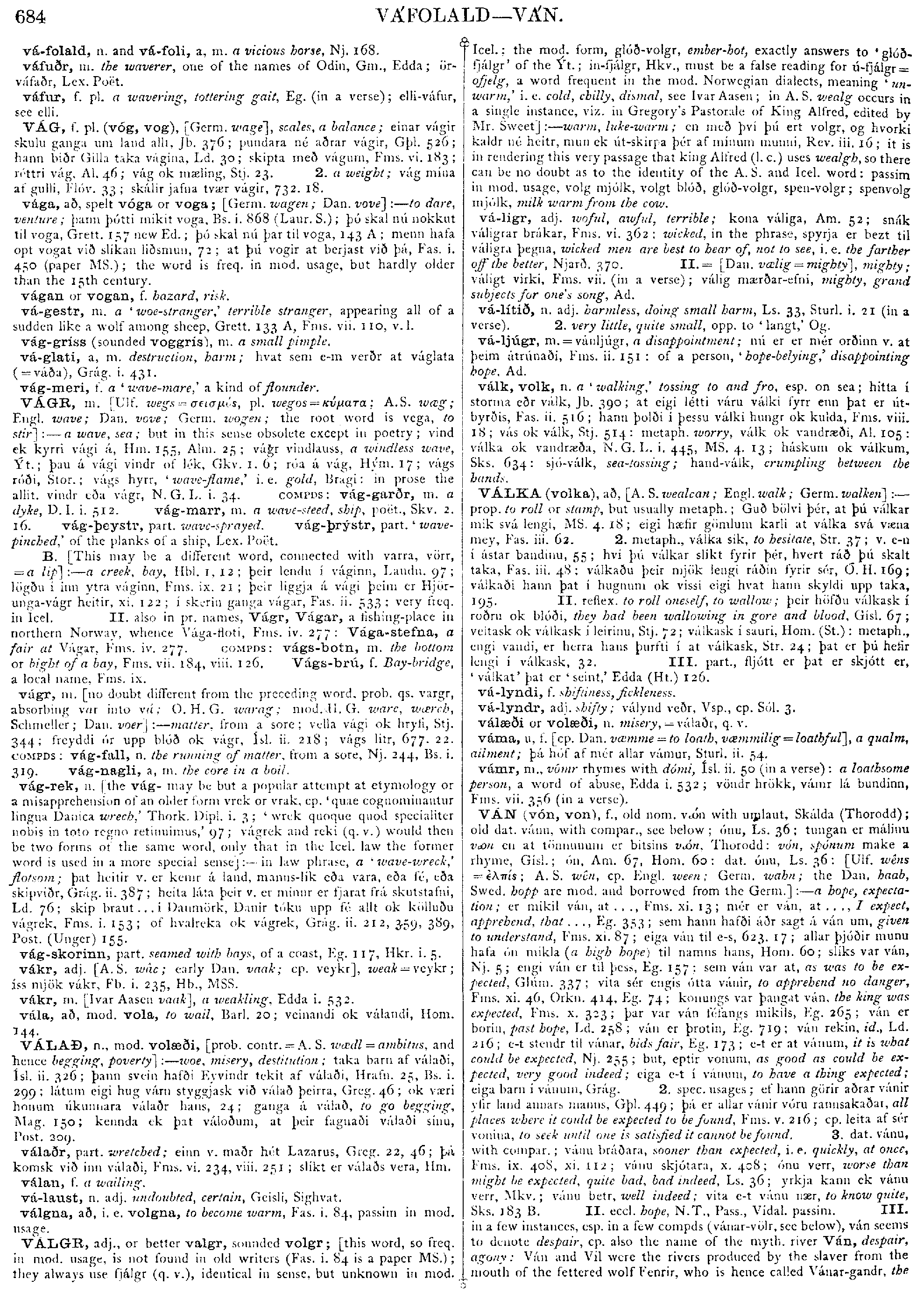
VÁGR, m. [Ulf. wegs = GREEK, pl. wegos = GREEK: A.S. wæg; Engl. wave; Dan. vove; Germ. wogen; the root word is vega, to stir] :-- a wave, sea; but in this sense obsolete except in poetry; vind ek kyrri vági á, Hm. 155, Alm. 25; vágr vindlauss, a windless wave, Ýt.; þau á vági vindr of lék, Gkv. 1. 6; róa á vág, Hým. 17; vágs róði, Stor.; vágs hyrr, 'wave-flame' i.e. gold, Bragi: in prose the allit. vindr eða vágr, N.G.L. i. 34. COMPDS: vág-garðr, m. a dyke, D.I. i. 512. vág-marr, m. a wave-steed, ship, poët., Skv. 2. 16. vág-þeystr, part. wave-sprayed. vág-þrýstr, part. 'wave-pinched,' of the planks of a ship, Lex. Poët. B. [This may be a different word, connected with varra, vörr, = a lip] :-- a creek, bay, Hbl. i, 12; þeir lendu í váginn, Landn. 97; lögðu í inn ytra váginn, Fms. ix. 21; þeir liggja á vági þeim er Hjörunga-vágr heitir, xi. 122; í skerin ganga vágar, Fas. ii. 533; very freq. in Icel. II. also in pr. names, Vágr, Vágar, a fishing-place in northern Norway, whence Vága-floti, Fms. iv. 277: Vága-stefna, a fair at Vágar. Fms. iv. 277. COMPDS: vágs-botn, m. the bottom or bight of a bay, Fms. vii. 184, viii. 126. Vágs-brú, f. Bay-bridge, a local name, Fms. ix.
|
Source: Cleasby/Vigfusson, page b0704, entry 14 View original page image as: [TIFF] [PNG] [View previous entry] [View next entry] |
[Comment on this entry] [View comments] |
The following entry has been hand-corrected once. |
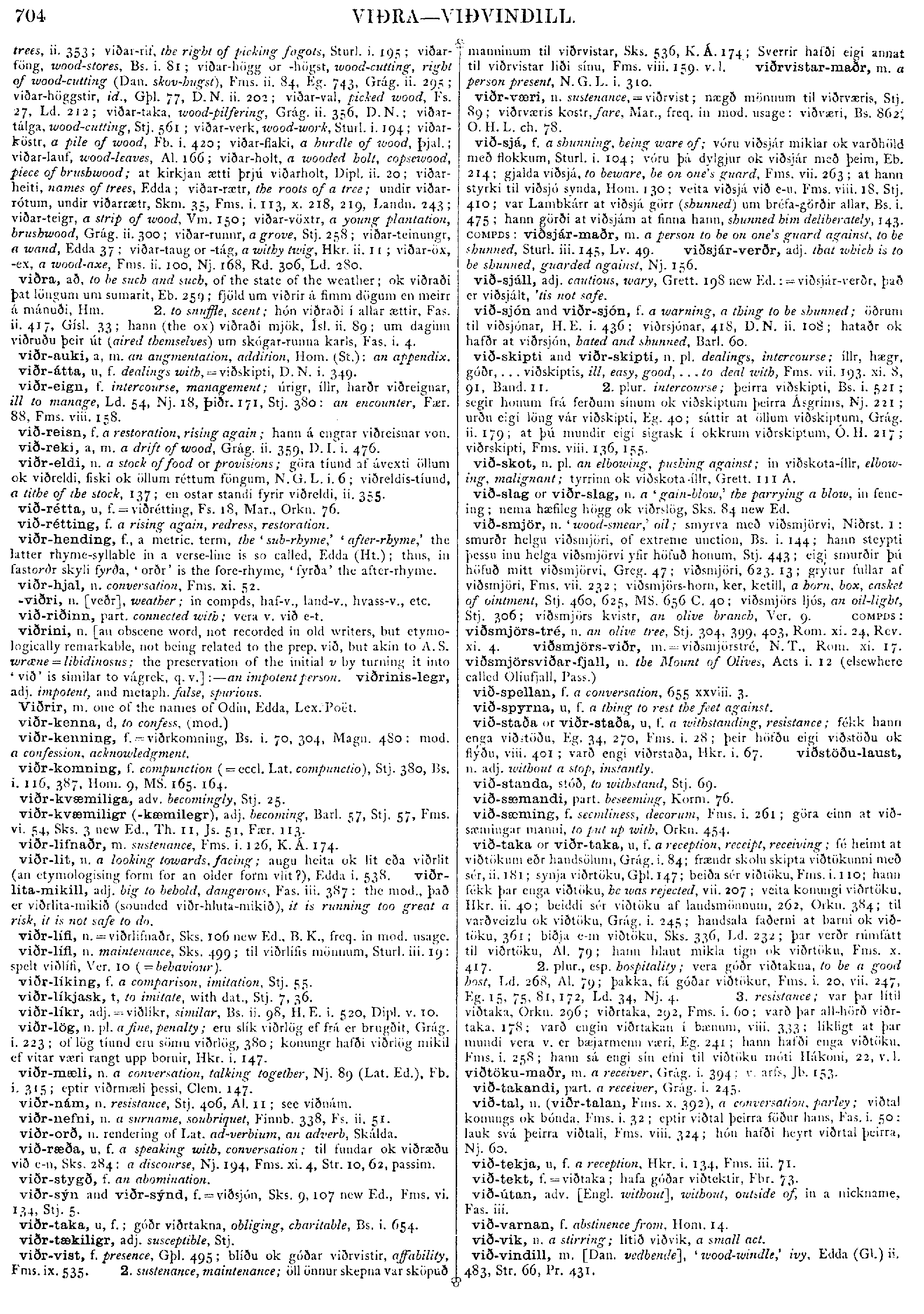
við-riðinn, part. connected with; vera v. við e-t.
|
Source: Cleasby/Vigfusson, page b0742, entry 15 View original page image as: [TIFF] [PNG] [View previous entry] [View next entry] |
[Comment on this entry] [View comments] |
The following entry has been hand-corrected once. |
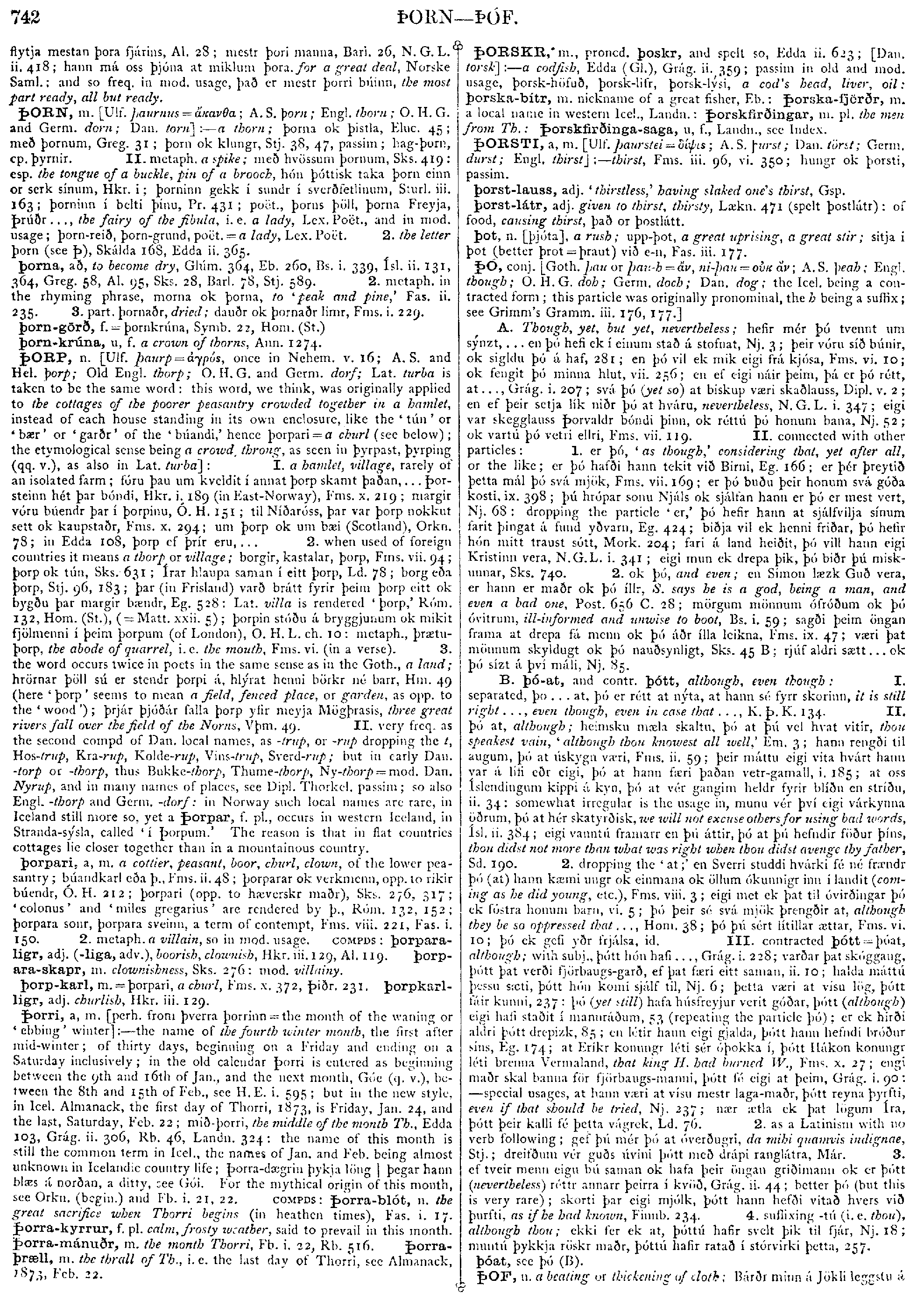
ÞÓ, conj. [Goth. þau or þau-h = GREEK, ni-þau = GREEK; A.S. þeah; Engl. though; O.H.G. doh; Germ, doch; Dan. dog; the Icel. being a contracted form; this particle was originally pronominal, the h being a suffix; see Grimm's Gramm. iii. 176, 177.] A. Though, yet, but yet, nevertheless; hefir mér þó tvennt um sýnzt, ... en þó hefi ek í einum stað á stofnat, Nj. 3; þeir vóru síð búnir, ok sigldu þó á haf, 281; en þó vil ek mik eigi frá kjósa, Fms. vi. 10; ok fengit þó minna hlut, vii. 256; en ef eigi náir þeim, þá er þó rétt, at..., Grág. i. 207; svá þó (yet so) at biskup væri skaðlauss, Dipl. v. 2; en ef þeir setja lík niðr þó at hváru, nevertheless, N.G.L. i. 347; eigi var skegglauss Þorvaldr bóndi þinn, ok réttú þó honum bana, Nj. 52; ok vartú þó vetri ellri, Fms. vii. 119. II. connected with other particles: 1. er þó, 'as though,' considering that, yet after all, or the like; er þó hafði hann tekit við Birni, Eg. 166; er þér þreytið þetta mál þó svá mjök, Fms. vii. 169; er þó buðu þeir honum svá góða kosti, ix. 398; þú hrópar sonu Njáls ok sjálfan hann er þó er mest vert, Nj. 68: dropping the particle 'er,' þó hefir hann at sjálfvilja sínum farit þingat á fund yðvarn, Eg. 424; biðja vil ek henni friðar, þó hefir hón mitt traust sótt, Mork. 204; fari á land heiðit, þó vill hann eigi Kristinn vera, N.G.L. i. 341; eigi mun ek drepa þik, þó biðr þú miskunnar, Sks. 740. 2. ok þó, and even; en Símon læzk Guð vera, er hann er maðr ok þó íllr, S. says he is a god, being a man, and even a bad one. Post. 656 C. 28; mörgum mönnum ófróðum ok þó óvitrum, ill-informed and unwise to boot, Bs. i. 59; sagði þeim öngan frama at drepa fá menn ok þó áðr ílla leikna, Fms. ix. 47; væri þat mönnum skyldugt ok þó nauðsynligt, Sks. 45 B; rjúf aldri sætt ... ok þó sízt á þvi máíi, Nj. 85. B. þó-at, and contr. þótt, although, even though: I. separated, þo ... at, þó er rétt at nýta, at hann sé fyrr skorinn, it is still right ..., even though, even in case that ..., K.Þ.K. 134. II. þó at, although; heimsku mæla skaltu, þó at þú vel hvat vitir, thou speakest vain, 'although thou knowest all well,' Em. 3; hann rengði til augum, þó at úskygn væri, Fms. ii. 59; þeir máttu eigi vita hvárt hann var á lífi eðr eigi, þó at hann færi þaðan vetr-gamall, i. 185; at oss Íslendingum kippi á kyn, þó at vér gangim heldr fyrir blíðu en stríðu, ii. 34: somewhat irregular is the usage in, munu vér því eigi várkynna öðrum, þó at hér skatyrðisk, we will not excuse others for using bad words, Ísl. ii. 384; eigi vanntú framarr en þú áttir, þó at þú hefndir föður þíns, thou didst not more than what was right when thou didst avenge thy father, Sd. 190. 2. dropping the 'at;' en Sverri studdi hvárki fé né frændr þó (at) hann kæmi ungr ok einmana ok öllum ókunnigr inn í landit (coming as he did young, etc.), Fms. viii. 3; eigi met ek þat til óvirðingar þó ek fóstra honum barn, vi. 5; þó þeir sé svá miök þrengðir at, although they be so oppressed that ..., Hom. 38; þó þú sért lítillar ættar, Fms. vi. 10; þó ek gefi yðr frjálsa, id. III. contracted þótt = þóat, although; with subj., þótt hón hafi ..., Grág. i. 228; varðar þat skóggang, þótt þat verði fjörbaugs-garð, ef þat færi eitt saman, ii. 10; halda máttú þessu sæti, þótt hón komi sjálf til, Nj. 6; þetta væri at vísu lög, þótt fáir kunni, 237: þó (yet still) hafa húsfreyjur verit góðar, þótt (although) eigi hafi staðit í mannráðum, 53 (repeating the particle þó); er ek hirði aldri þótt drepizk, 85; en létir hann eigi gjalda, þótt hann hefndi bróður síns, Eg. 174; at Eríkr konungr léti sér óþokka í, þótt Hákon konungr léti brenna Vermaland, that king H. had burned W., Fms. x. 27; engi maðr skal banna för fjörbaugs-manni, þótt fé eigi at þeim, Grág. i. 90: -- special usages, at hann væri at vísu mestr laga-maðr, þótt reyna þyrfti, even if that should be tried, Nj. 237; nær ætla ek þat lögum Íra, þótt þeir kalli fé þetta vágrek, Ld. 76. 2. as a Latinism with no verb following; gef þú mér þó at óverðugri, da mihi quamvis indignae, Stj.; dreifðum vér guðs úvini þótt með drápi ranglátra, Már. 3. ef tveir menn eigu bú saman ok hafa þeir öngan griðimann ok er þótt (nevertheless) réttr annarr þeirra í kvöð, Grág. ii. 44; better þó (but this is very rare); skorti þar eigi mjólk, þótt hann hefði vitað hvers við þurfti, as if he had known, Finnb. 234. 4. suffixing -tú (i.e. thou), although thou; ekki fer ek at, þóttú hafir svelt þik til fjár, Nj. 18; muntú þykkja röskr maðr, þóttú hafir ratað í stórvirki þetta, 257.
|
Source: Cleasby/Vigfusson, page b0761, entry 44 View original page image as: [TIFF] [PNG] [View previous entry] [View next entry] |
[Comment on this entry] [View comments] |
The following entry has been hand-corrected once. |
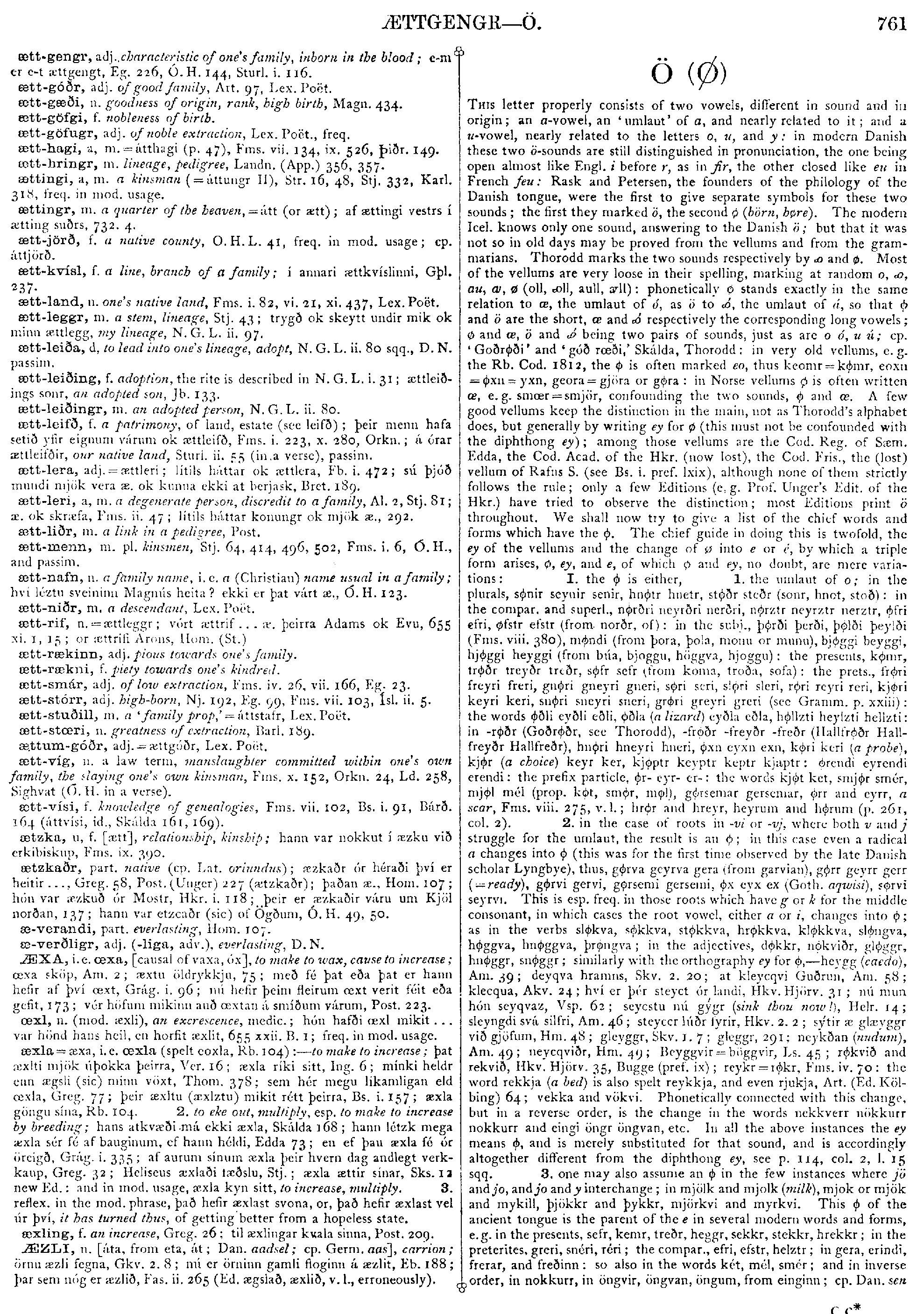
THIS
letter
properly
consists
of
two
vowels,
different
in
sound
and
in
origin;
an
a-vowel,
an
'umlaut'
of
a,
and
nearly
related
to
it;
and
a
u-vowel,
nearly
related
to
the
letters
o,
u,
and
y:
in
modern
Danish
these
two
ö-sounds
are
still
distinguished
in
pronunciation,
the
one
being
open
almost
like
Engl.
i
before
r,
as
in
fir,
the
other
closed
like
eu
in
French
feu:
Rask
and
Petersen,
the
founders
of
the
philology
of
the
Danish
tongue,
were
the
first
to
give
separate
symbols
for
these
two
sounds;
the
first
they
marked
ö,
the
second
ø
(börn,
høre).
The
modern
Icel.
knows
only
one
sound,
answering
to
the
Danish
ö;
but
that
it
was
not
so
in
old
days
may
be
proved
from
the
vellums
and
from
the
grammarians.
Thorodd
marks
the
two
sounds
respectively
by
 and
ø.
Most
of
the
vellums
are
very
loose
in
their
spelling,
marking
at
random
o,
,
au,
(?),
UNCERTAIN
ø
(oll,
ll,
aull,
arll
UNCERTAIN):
phonetically
ø
stands
exactly
in
the
same
relation
to
œ,
the
umlaut
of
ó,
as
ö
to
and
ø.
Most
of
the
vellums
are
very
loose
in
their
spelling,
marking
at
random
o,
,
au,
(?),
UNCERTAIN
ø
(oll,
ll,
aull,
arll
UNCERTAIN):
phonetically
ø
stands
exactly
in
the
same
relation
to
œ,
the
umlaut
of
ó,
as
ö
to
 ,
the
umlaut
of
á,
so
that
ø
and
ö
are
the
short,
œ
and
respectively
the
corresponding
long
vowels;
ø
and
œ,
ö
and
being
two
pairs
of
sounds,
just
as
are
o
ó,
u
ú;
cp.
'Goðrøði'
and
'góð
rœði,'
Skálda,
Thorodd:
in
very
old
vellums,
e.g.
the
Rb.
Cod.
1812,
the
ø
is
often
marked
eo,
thus
keomr
=
kømr,
eoxn
=
øxn
=
yxn,
geora
=
gjöra
or
gøra:
in
Norse
vellums
ø
is
often
written
œ,
e.g.
smœr
=
smjör,
confounding
the
two
sounds,
ø
and
œ.
A
few
good
vellums
keep
the
distinction
in
the
main,
not
as
Thorodd's
alphabet
does,
but
generally
by
writing
ey
for
ø
(this
must
not
be
confounded
with
the
diphthong
ey);
among
those
vellums
are
the
Cod.
Reg.
of
Sæm.
Edda,
the
Cod.
Acad.
of
the
Hkr.
(now
lost),
the
Cod.
Fris.,
the
(lost)
vellum
of
Rafns
S.
(see
Bs.
i.
pref.
lxix),
although
none
of
them
strictly
follows
the
rule;
only
a
few
Editions
(e.g.
Prof.
Unger's
Edit,
of
the
Hkr.)
have
tried
to
observe
the
distinction;
most
Editions
print
ö
throughout.
We
shall
now
try
to
give
a
list
of
the
chief
words
and
forms
which
have
the
ø.
The
chief
guide
in
doing
this
is
twofold,
the
ey
of
the
vellums
and
the
change
of
ø
into
e
or
é,
by
which
a
triple
form
arises,
ø,
ey,
and
e,
of
which
ø
and
ey,
no
doubt,
are
mere
variations:
I.
the
ø
is
either,
1.
the
umlaut
of
o;
in
the
plurals,
sønir
seynir
senir,
hnøtr
hnetr,
støðr
steðr
(sonr,
hnot,
stoð):
in
the
compar.
and
superl.,
nørðri
neyrðri
nerðri,
nørztr
neyrztr
nerztr,
øfri
efri,
øfstr
efstr
(from
norðr,
of):
in
the
subj.,
þørði
þerði,
þølði
þeylði
(Fms.
viii.
380),
møndi
(from
þora,
þola,
monu
or
munu),
bjøggi
beyggi,
hjøggi
heyggi
(from
búa,
bjoggu,
höggva,
hjoggu):
the
presents,
kømr,
trøðr
treyðr
treðr,
søfr
sefr
(from
koma,
troða,
sofa):
the
prets.,
frøri
freyri
freri,
gnøri
gneyri
gneri,
søri
seri,
sløri
sleri,
róri
reyri
reri,
kjøri
keyri
keri,
snøri
sneyri
sneri,
grøri
greyri
greri
(see
Gramm.
p.
xxiii):
the
words
øðli
eyðli
eðli,
øðla
(a
lizard)
eyðla
eðla,
høllzti
heylzti
hellzti:
in
-røðr
(Goðrøðr,
see
Thorodd),
-frøðr
-freyðr
-freðr
(Hallfrøðr
Hallfreyðr
Hallfreðr),
hnøri
hneyri
hneri,
øxn
eyxn
exn,
køri
keri
(a
probe),
kjør
(a
choice)
keyr
ker,
kjøptr
keyptr
keptr
kjaptr:
ørendi
eyrendi
erendi:
the
prefix
particle,
ør-
eyr-
er-:
the
words
kjøt
ket,
smjør
smér,
mjøl
mél
(prop.
køt,
smør,
møl),
gørsemar
gersemar,
ørr
and
eyrr,
a
scar,
Fms.
viii.
275,
v.l.;
hrør
and
hreyr,
heyrum
and
hørum
(p.
261,
col.
2).
2.
in
the
case
of
roots
in
-vi
or
-vj,
where
both
v
and
j
struggle
for
the
umlaut,
the
result
is
an
ø;
in
this
case
even
a
radical
a
changes
into
ø
(this
was
for
the
first
time
observed
by
the
late
Danish
scholar
Lyngbye),
thus,
gørva
geyrva
gera
(from
garvian),
gørr
geyrr
gerr
(=
ready),
gørvi
gervi,
gørsemi
gersemi,
øx
eyx
ex
(Goth.
aqwisi),
sørvi
seyrvi.
This
is
esp.
freq.
in
those
roots
which
have
g
or
k
for
the
middle
consonant,
in
which
cases
the
root
vowel,
either
a
or
i,
changes
into
ø;
as
in
the
verbs
sløkva,
søkkva,
støkkva,
hrøkkva,
kløkkva,
sløngva,
høggva,
hnøggva,
þrøngva;
in
the
adjectives,
døkkr,
nøkviðr,
gløggr,
hnøggr,
snøggr;
similarly
with
the
orthography
ey
for
ø,
--
heygg
(caedo),
Am.
39;
deyqva
hramns,
Skv.
2.
20;
at
kleycqvi
Guðrun,
Am.
58;
klecqua,
Akv.
24;
hví
er
þér
steyct
ór
landi,
Hkv.
Hjörv.
31;
nú
mun
hón
seyqvaz,
Vsp.
62;
seycstu
nú
gýgr
(sink
thou
now!),
Helr.
14;
sleyngdi
svá
silfri,
Am.
46;
steyccr
lúðr
fyrir,
Hkv.
2.
2;
sýtir
æ
glæyggr
við
gjöfum,
Hm.
48;
gleyggr,
Skv.
1.
7;
gleggr,
291;
neykðan
(nudum),
Am.
49;
neycqviðr,
Hm.
49;
Beyggvir
=
böggvir,
Ls.
45;
røkvið
and
rekvið,
Hkv.
Hjörv.
35,
Bugge
(pref.
ix);
reykr
=
røkr,
Fms.
iv.
70:
the
word
rekkja
(a
bed)
is
also
spelt
reykkja,
and
even
rjukja,
Art.
(Ed.
Kölbing)
64;
vekka
and
vökvi.
Phonetically
connected
with
this
change,
but
in
a
reverse
order,
is
the
change
in
the
words
nekkverr
nökkurr
nokkurr
and
eingi
öngr
öngvan,
etc.
In
all
the
above
instances
the
ey
means
ø,
and
is
merely
substituted
for
that
sound,
and
is
accordingly
altogether
different
from
the
diphthong
ey,
see
p.
114,
col.
2,
l.
15
sqq.
3.
one
may
also
assume
an
ø
in
the
few
instances
where
jö
and
jo,
and
jo
and
y
interchange;
in
mjölk
and
mjolk
(milk),
mjok
or
mjök
and
mykill,
þjökkr
and
þykkr,
mjörkvi
and
myrkvi.
This
ø
of
the
ancient
tongue
is
the
parent
of
the
e
in
several
modern
words
and
forms,
e.g.
in
the
presents,
sefr,
kemr,
treðr,
heggr,
sekkr,
stekkr,
hrekkr;
in
the
preterites,
greri,
snéri,
réri;
the
compar.,
efri,
efstr,
helztr;
in
gera,
erindi,
frerar,
and
freðinn:
so
also
in
the
words
két,
mél,
smér;
and
in
inverse
order,
in
nokkurr,
in
öngvir,
öngvan,
öngum,
from
einginn;
cp.
Dan.
sen
,
the
umlaut
of
á,
so
that
ø
and
ö
are
the
short,
œ
and
respectively
the
corresponding
long
vowels;
ø
and
œ,
ö
and
being
two
pairs
of
sounds,
just
as
are
o
ó,
u
ú;
cp.
'Goðrøði'
and
'góð
rœði,'
Skálda,
Thorodd:
in
very
old
vellums,
e.g.
the
Rb.
Cod.
1812,
the
ø
is
often
marked
eo,
thus
keomr
=
kømr,
eoxn
=
øxn
=
yxn,
geora
=
gjöra
or
gøra:
in
Norse
vellums
ø
is
often
written
œ,
e.g.
smœr
=
smjör,
confounding
the
two
sounds,
ø
and
œ.
A
few
good
vellums
keep
the
distinction
in
the
main,
not
as
Thorodd's
alphabet
does,
but
generally
by
writing
ey
for
ø
(this
must
not
be
confounded
with
the
diphthong
ey);
among
those
vellums
are
the
Cod.
Reg.
of
Sæm.
Edda,
the
Cod.
Acad.
of
the
Hkr.
(now
lost),
the
Cod.
Fris.,
the
(lost)
vellum
of
Rafns
S.
(see
Bs.
i.
pref.
lxix),
although
none
of
them
strictly
follows
the
rule;
only
a
few
Editions
(e.g.
Prof.
Unger's
Edit,
of
the
Hkr.)
have
tried
to
observe
the
distinction;
most
Editions
print
ö
throughout.
We
shall
now
try
to
give
a
list
of
the
chief
words
and
forms
which
have
the
ø.
The
chief
guide
in
doing
this
is
twofold,
the
ey
of
the
vellums
and
the
change
of
ø
into
e
or
é,
by
which
a
triple
form
arises,
ø,
ey,
and
e,
of
which
ø
and
ey,
no
doubt,
are
mere
variations:
I.
the
ø
is
either,
1.
the
umlaut
of
o;
in
the
plurals,
sønir
seynir
senir,
hnøtr
hnetr,
støðr
steðr
(sonr,
hnot,
stoð):
in
the
compar.
and
superl.,
nørðri
neyrðri
nerðri,
nørztr
neyrztr
nerztr,
øfri
efri,
øfstr
efstr
(from
norðr,
of):
in
the
subj.,
þørði
þerði,
þølði
þeylði
(Fms.
viii.
380),
møndi
(from
þora,
þola,
monu
or
munu),
bjøggi
beyggi,
hjøggi
heyggi
(from
búa,
bjoggu,
höggva,
hjoggu):
the
presents,
kømr,
trøðr
treyðr
treðr,
søfr
sefr
(from
koma,
troða,
sofa):
the
prets.,
frøri
freyri
freri,
gnøri
gneyri
gneri,
søri
seri,
sløri
sleri,
róri
reyri
reri,
kjøri
keyri
keri,
snøri
sneyri
sneri,
grøri
greyri
greri
(see
Gramm.
p.
xxiii):
the
words
øðli
eyðli
eðli,
øðla
(a
lizard)
eyðla
eðla,
høllzti
heylzti
hellzti:
in
-røðr
(Goðrøðr,
see
Thorodd),
-frøðr
-freyðr
-freðr
(Hallfrøðr
Hallfreyðr
Hallfreðr),
hnøri
hneyri
hneri,
øxn
eyxn
exn,
køri
keri
(a
probe),
kjør
(a
choice)
keyr
ker,
kjøptr
keyptr
keptr
kjaptr:
ørendi
eyrendi
erendi:
the
prefix
particle,
ør-
eyr-
er-:
the
words
kjøt
ket,
smjør
smér,
mjøl
mél
(prop.
køt,
smør,
møl),
gørsemar
gersemar,
ørr
and
eyrr,
a
scar,
Fms.
viii.
275,
v.l.;
hrør
and
hreyr,
heyrum
and
hørum
(p.
261,
col.
2).
2.
in
the
case
of
roots
in
-vi
or
-vj,
where
both
v
and
j
struggle
for
the
umlaut,
the
result
is
an
ø;
in
this
case
even
a
radical
a
changes
into
ø
(this
was
for
the
first
time
observed
by
the
late
Danish
scholar
Lyngbye),
thus,
gørva
geyrva
gera
(from
garvian),
gørr
geyrr
gerr
(=
ready),
gørvi
gervi,
gørsemi
gersemi,
øx
eyx
ex
(Goth.
aqwisi),
sørvi
seyrvi.
This
is
esp.
freq.
in
those
roots
which
have
g
or
k
for
the
middle
consonant,
in
which
cases
the
root
vowel,
either
a
or
i,
changes
into
ø;
as
in
the
verbs
sløkva,
søkkva,
støkkva,
hrøkkva,
kløkkva,
sløngva,
høggva,
hnøggva,
þrøngva;
in
the
adjectives,
døkkr,
nøkviðr,
gløggr,
hnøggr,
snøggr;
similarly
with
the
orthography
ey
for
ø,
--
heygg
(caedo),
Am.
39;
deyqva
hramns,
Skv.
2.
20;
at
kleycqvi
Guðrun,
Am.
58;
klecqua,
Akv.
24;
hví
er
þér
steyct
ór
landi,
Hkv.
Hjörv.
31;
nú
mun
hón
seyqvaz,
Vsp.
62;
seycstu
nú
gýgr
(sink
thou
now!),
Helr.
14;
sleyngdi
svá
silfri,
Am.
46;
steyccr
lúðr
fyrir,
Hkv.
2.
2;
sýtir
æ
glæyggr
við
gjöfum,
Hm.
48;
gleyggr,
Skv.
1.
7;
gleggr,
291;
neykðan
(nudum),
Am.
49;
neycqviðr,
Hm.
49;
Beyggvir
=
böggvir,
Ls.
45;
røkvið
and
rekvið,
Hkv.
Hjörv.
35,
Bugge
(pref.
ix);
reykr
=
røkr,
Fms.
iv.
70:
the
word
rekkja
(a
bed)
is
also
spelt
reykkja,
and
even
rjukja,
Art.
(Ed.
Kölbing)
64;
vekka
and
vökvi.
Phonetically
connected
with
this
change,
but
in
a
reverse
order,
is
the
change
in
the
words
nekkverr
nökkurr
nokkurr
and
eingi
öngr
öngvan,
etc.
In
all
the
above
instances
the
ey
means
ø,
and
is
merely
substituted
for
that
sound,
and
is
accordingly
altogether
different
from
the
diphthong
ey,
see
p.
114,
col.
2,
l.
15
sqq.
3.
one
may
also
assume
an
ø
in
the
few
instances
where
jö
and
jo,
and
jo
and
y
interchange;
in
mjölk
and
mjolk
(milk),
mjok
or
mjök
and
mykill,
þjökkr
and
þykkr,
mjörkvi
and
myrkvi.
This
ø
of
the
ancient
tongue
is
the
parent
of
the
e
in
several
modern
words
and
forms,
e.g.
in
the
presents,
sefr,
kemr,
treðr,
heggr,
sekkr,
stekkr,
hrekkr;
in
the
preterites,
greri,
snéri,
réri;
the
compar.,
efri,
efstr,
helztr;
in
gera,
erindi,
frerar,
and
freðinn:
so
also
in
the
words
két,
mél,
smér;
and
in
inverse
order,
in
nokkurr,
in
öngvir,
öngvan,
öngum,
from
einginn;
cp.
Dan.
sen
| Result Page: |  |
Previous | 7 8 9 10 11 12 13 14 15 16 |
Germanic Lexicon Project (main page)
This search system was written by
Sean Crist
Please consider
volunteering
to correct the data in these online dictionaries.
No rights reserved. Feel free to use these data in any way you please.