|
|

|
Source: Cleasby/Vigfusson, page b0211, entry 41 View original page image as: [TIFF] [PNG] [View previous entry] [View next entry] |
[Comment on this entry] [View comments] |
The following entry has been hand-corrected once. |
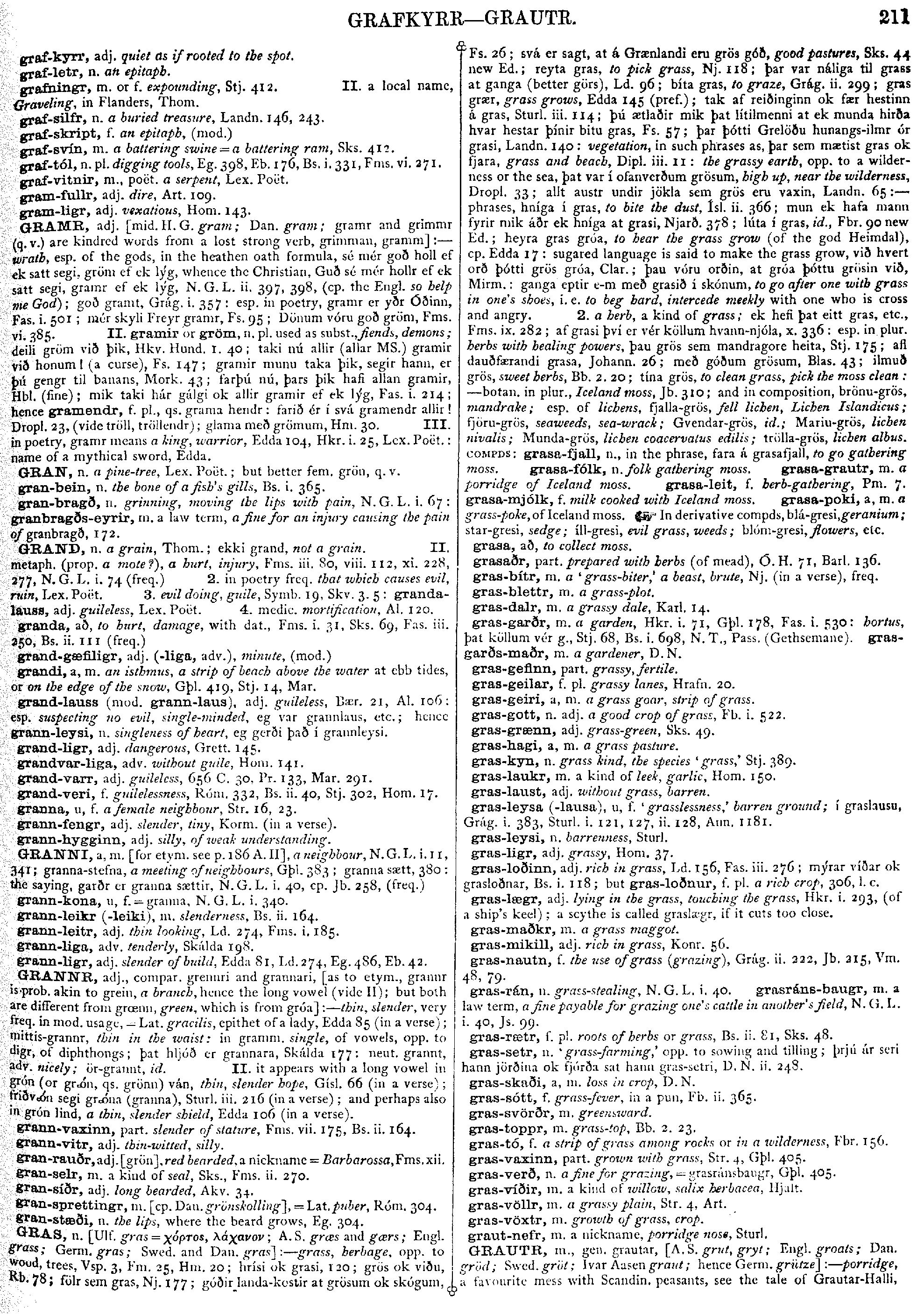
GRAS, n. [Ulf. gras = GREEK ; A.S. græ and gærs; Engl. grass; Germ, gras; Swed. and Dan. gras] :-- grass, herbage, opp. to wood, trees, Vsp. 3, Fm. 25, Hm. 20; hrísi ok grasi, 120; grös ok viðu, Rb. 78; fölr sem gras, Nj. 177; góðir landa-kostir at grösum ok skógum, Fs. 26; svá er sagt, at á Grænlandi eru grös góð, good pastures, Sks. 44 new Ed.; reyta gras, to pick grass, Nj. 118; þar var náliga til grass at ganga (better görs), Ld. 96; bíta gras, to graze, Grág. ii. 299; gras grær, grass grows, Edda 145 (pref.); tak af reiðinginn ok fær hestinn á gras, Sturl. iii. 114; þú ætlaðir mik þat lítilmenni at ek munda hirða hvar hestar þínir bitu gras, Fs. 57; þar þótti Grelöðu hunangs-ilmr ór grasi, Landn. 140 : vegetation, in such phrases as, þar sem mætist gras ok fjara, grass and beach, Dipl. iii. 11 : the grassy earth, opp. to a wilderness or the sea, þat var í ofanverðum grösum, high up, near the wilderness, Dropl. 33; allt austr undir jökla sem grös eru vaxin, Landn. 65 :-- phrases, hníga í gras, to bite the dust, Ísl. ii. 366; mun ek hafa mann fyrir mik áðr ek hníga at grasi, Njarð. 378; lúta í gras, id., Fbr. 90 new Ed.; heyra gras gróa, to hear the grass grow (of the god Heimdal), cp. Edda 17 : sugared language is said to make the grass grow, við hvert orð þótti grös gróa, Clar.; þau vóru orðin, at gróa þóttu grösin við, Mirm. : ganga eptir e-m með grasið í skónum, to go after one with grass in one's shoes, i.e. to beg hard, intercede meekly with one who is cross and angry. 2. a herb, a kind of grass; ek hefi þat eitt gras, etc., Fms. ix. 282; af grasi því er vér köllum hvann-njóla, x. 336 : esp. in plur. herbs with healing powers, þau grös sem mandragore heita, Stj. 175; afl dauðfærandi grasa, Johann. 26; með góðum grösum, Blas. 43; ilmuð grös, sweet herbs, Bb. 2. 20; tína grös, to clean grass, pick the moss clean : -- botan. in plur., Iceland moss, Jb. 310; and in composition, brönu-grös, mandrake; esp. of lichens, fjalla-grös, fell lichen, Lichen Islandicus; fjöru-grös, seaweeds, sea-wrack; Gvendar-grös, id.; Mariu-grös, lichen nivalis; Munda-grös, lichen coacervatus edilis; trölla-grös, lichen albus. COMPDS: grasa-fjall, n., in the phrase, fara á grasafjall, to go gathering moss. grasa-fó1k, n. folk gathering moss. grasa-grautr, m. a porridge of Iceland moss. grasa-leit, f. herb-gathering, Pm. 7. grasa-mjólk, f. milk cooked with Iceland moss. grasa-poki, a, m. a grass-poke, of Iceland moss. UNCERTAIN In derivative compds, blá-gresi, geranium; star-gresi, sedge; íll-gresi, evil grass, weeds; blóm-gresi, flowers, etc.
|
Source: Cleasby/Vigfusson, page b0350, entry 9 View original page image as: [TIFF] [PNG] [View previous entry] [View next entry] |
[Comment on this entry] [View comments] |
The following entry has been hand-corrected once. |
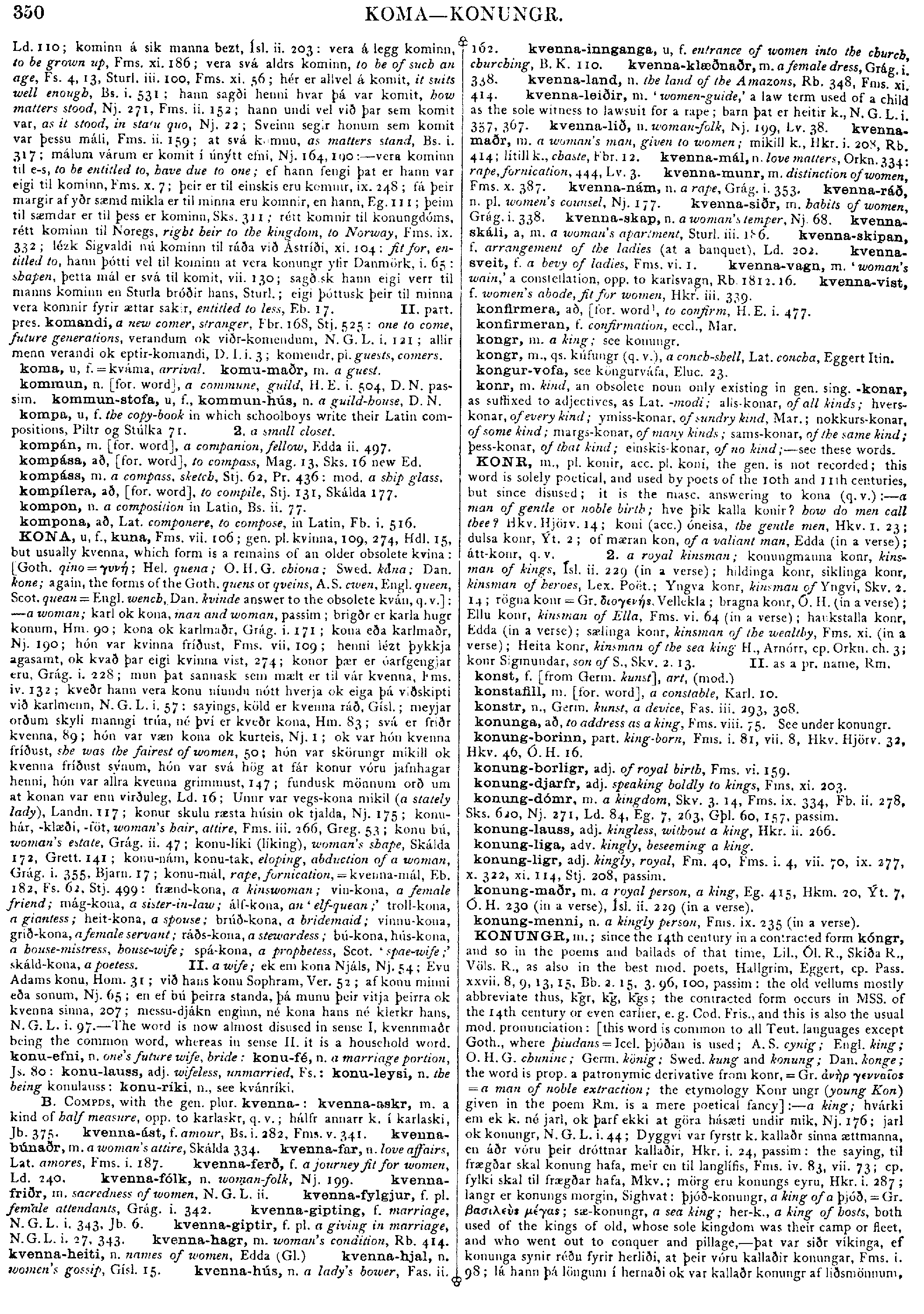
kompon, n. a composition in Latin, Bs. ii. 77.
|
Source: Cleasby/Vigfusson, page b0378, entry 7 View original page image as: [TIFF] [PNG] [View previous entry] [View next entry] |
[Comment on this entry] [View comments] |
The following entry has not been hand-corrected. However, the page is reserved and someone is correcting it. |
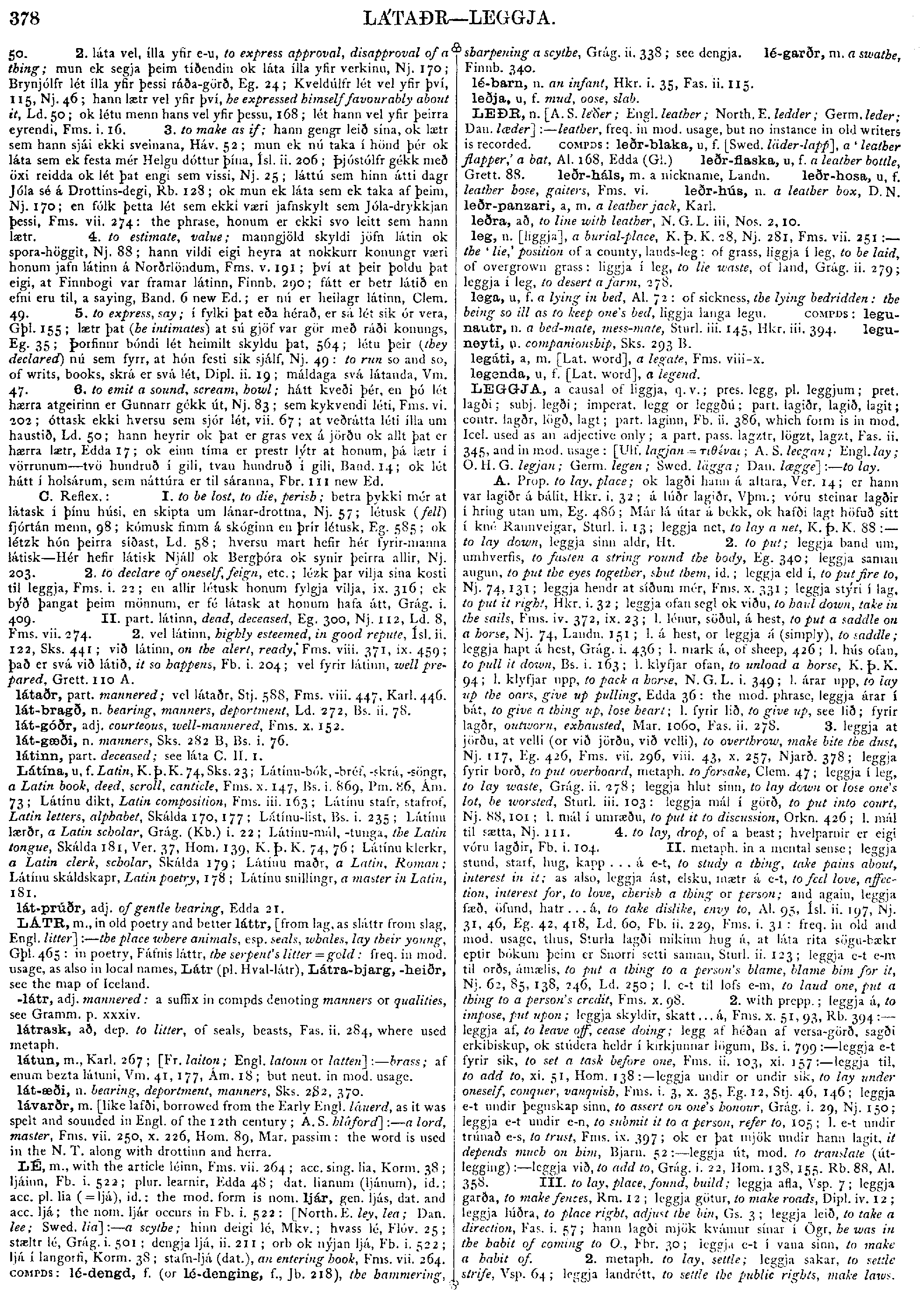
Látína, u, f. Latin, K. þ. K. 74, Sks. 23; Látínn-bók, -brúf, -fkrá, -söngr, a Latin book, deed, scroll, canticle, Fms. x. 147, Bs. i. 869, Pm. 86, Am. 73; Latinu dikt, Latin composition, Fms. iii. 163; Látínu stafr, stafrof, L atin letters, alphabet, Skulda 170, 177; L;ítínu-list, Bs. i. 235; Latinu lærðr, a L atin scholar, Grág. (Kb.) i. 22; Látínu-múl, -tunga, the Latin tongue, Skálda 181, Ver. 37, Hom. 139, K. þ. K. 74, 76; Lau'nn klerkr, a Latin clerk, scholar, Skálda 179; Látíuu maðr, a Latin, Roman; Latinu skáldskapr, Latin poetry, 1 78; Latinu snillingr, a master in Latin, 181.
|
Source: Cleasby/Vigfusson, page b0404, entry 118 View original page image as: [TIFF] [PNG] [View previous entry] [View next entry] |
[Comment on this entry] [View comments] |
The following entry has been hand-corrected once. |
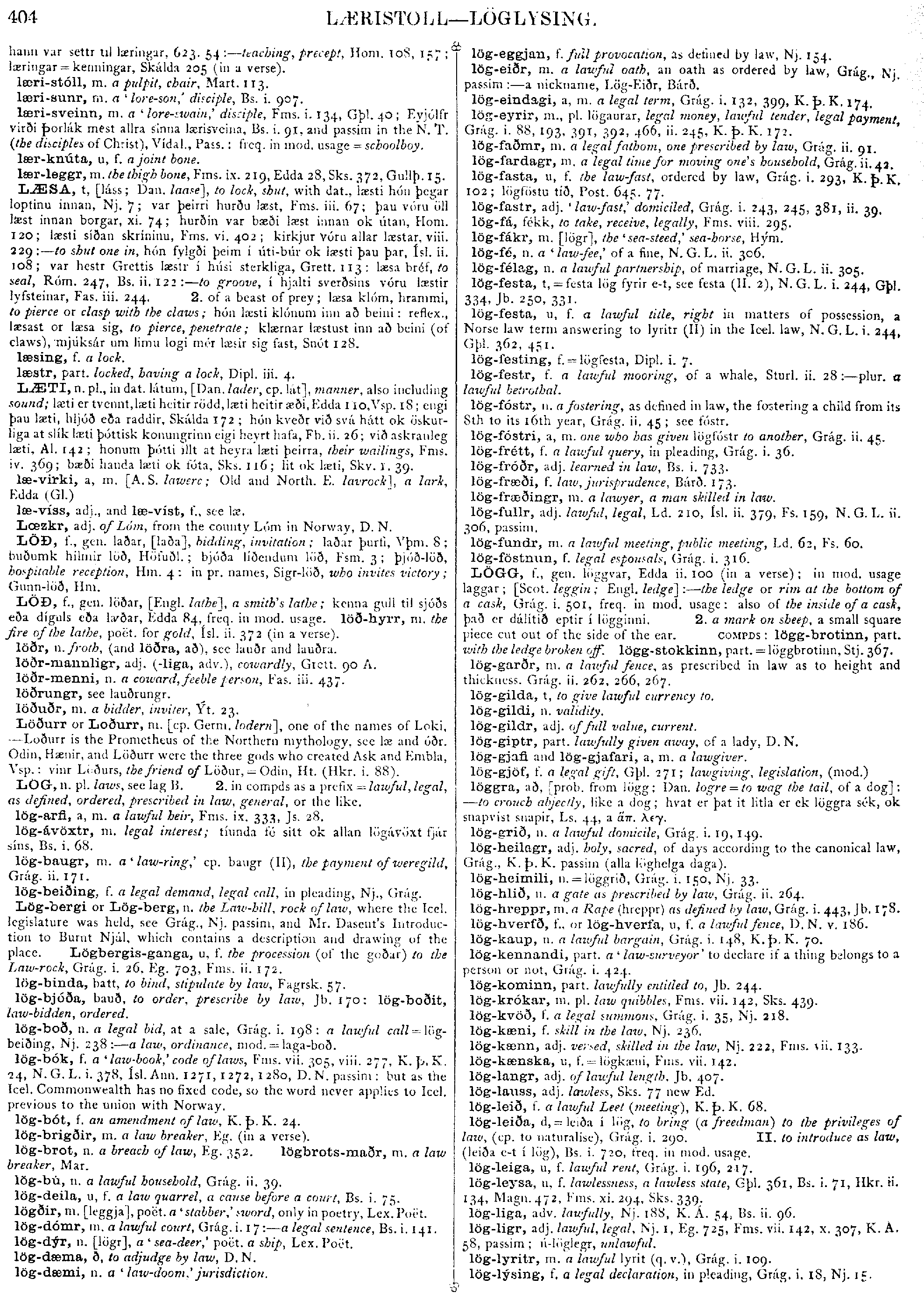
lög-rétta, u, f. I. ' law-mending, ' an ordinance; þat væri gáð lögrétta er konungrinn gaf um konunglega refsing, Sks. 670. II. as a law term, the name of the legislature of the Icel. Commonwealth, either from rétta log, to make the law right, or perh. better from róU, a fence, qs. a law-fence, law-yard, law-court, from being held within the sacred circle, called ve-bond; for the word is used of the place as well as of the body sitting there, e. g. ganga til Kigréttu, to proceed to the 1., Nj. 150. 2. in the Norse law, as also in Iceland after the union with Norway, lögrétta was the public court of law held during the general assembly (þing), and presided over by the lagman; the members (lög- rettu menn) were delegated from all the counties represented in the assembly, see N. G. L. ii. 10 sqq., as also Jb. þingfara-balk, ch. 2, . 3. in the Icel. Commonwealth the lögrétta was the legislative held during the althing on the lögbergi (q. v.), and consisted of the forty-eight Goðar (see goði); it was presided over by the lögsögu-maðr (see lögmaðr), and controlled all laws and licences (ráða lögum, ok lofiim), and was the supreme power in the land; for its power, composition, and duties, see esp. Ib. ch. 5, Grág. passim, esp. the Lögrêttu-þáttr or -section of the lögrétta, the |)ingskapa-þáttr, the Njála, and the Sagas passim; of mod. writers, Maurer's Beitrage, Dasent's Introduc- tion to Burnt Njál. COMPDS: lögréttu-fé, n. the treasury of the 1., from which the lögsögu-maðr was paid, Grág. i. 3. lögréttu- maðr, n. [lagraetman, Jamiesonl, a member of the lögrétta, in Icel. sense, Grág. i. 8; in Norse sense, Jb. i. lögréttu-seta, u, f. a seat in the 1., Grág. i. 4. l^grettu-skipan, f. the or der, constitution of the 1., as to the number of its members, Jb. 9, Nj. 150. lögréttu-þáttr, m. the section of law of the ., Grág. i.
|
Source: Cleasby/Vigfusson, page b0449, entry 48 View original page image as: [TIFF] [PNG] [View previous entry] [View next entry] |
[Comment on this entry] [View comments] |
The following entry has been hand-corrected once. |
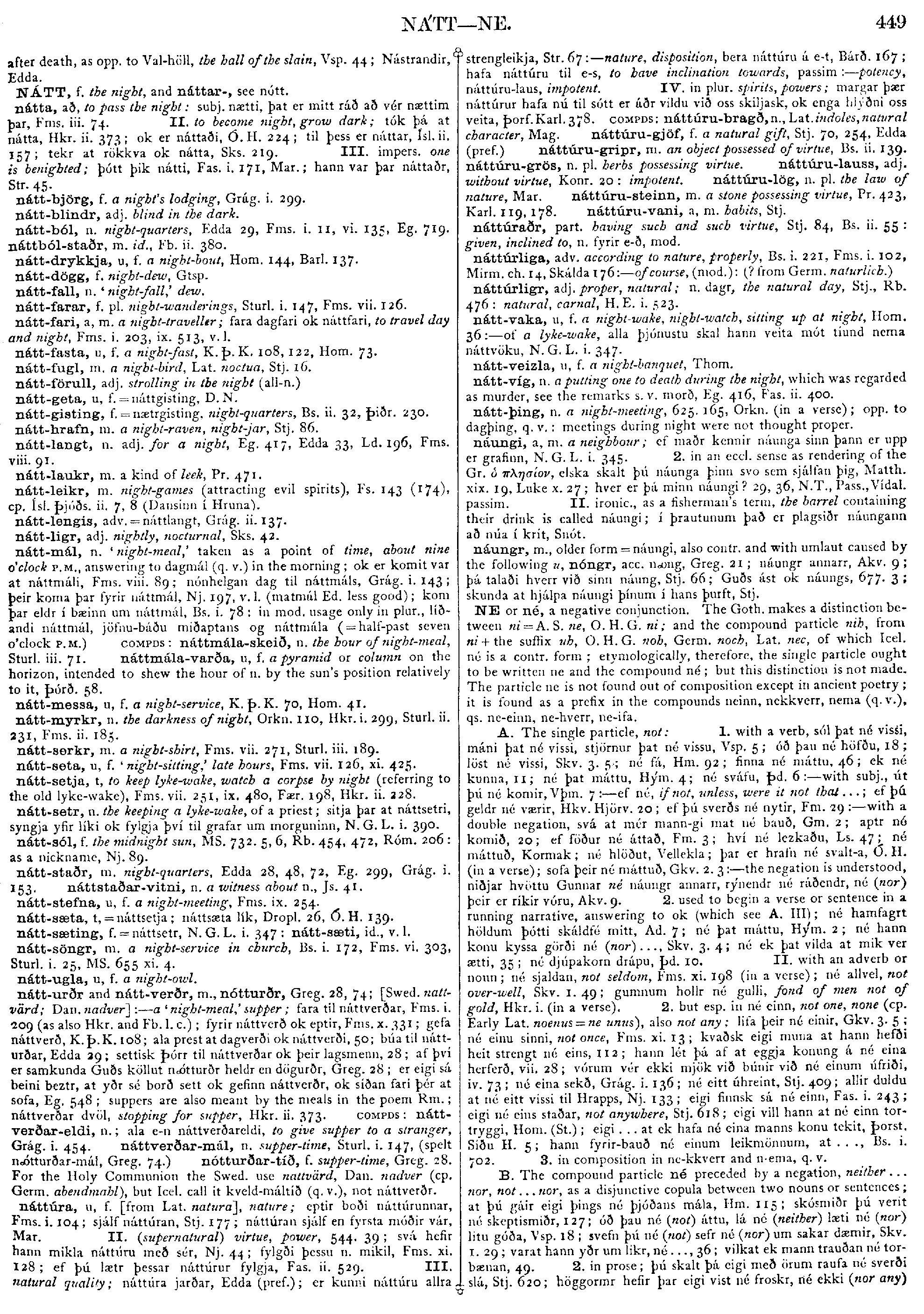
NE or né, a negative conjunction. The Goth. makes a distinction between ni = A. S. ne, O. H. G. ni; and the compound particle nih, from ni + the suffix uh, O. H. G. noh, Germ, noch, Lat. nec, of which Icel. né is a contr. form; etymologically, therefore, the single particle ought to be written ne and the compound né; but this distinction is not made. The particle ne is not found out of composition except in ancient poetry; it is found as a prefix in the compounds neinn, nekkverr, nema (q. v.), qs. ne-einn, ne-hverr, ne-ifa. A. The single particle, not: 1. with a verb, sól þat né vissi, máni þat né vissi, stjörnur þat né vissu, Vsp. 5; óð þau né höfðu, 18; löst né vissi, Skv. 3. 5; né fá, Hm. 92; finna né máttu, 46; ek né kunna, 11; né þat máttu, Hým. 4; né sváfu, Þd. 6 :-- with subj., út þú né komir, Vþm. 7 :-- ef né, if not, unless, were it not that . . .; ef þú geldr né værir, Hkv. Hjörv. 20; ef þú sverðs né nytir, Fm. 29 :-- with a double negation, svá at mér mann-gi mat né bauð, Gm. 2; aptr né komið, 20; ef föður né áttað, Fm. 3; hví né lezkaðu, Ls. 47; né máttuð, Kormak; né hlöðut, Vellekla; þar er hrafn né svalt-a, Ó. H. (in a verse); sofa þeir né máttuð, Gkv. 2. 3 :-- the negation is understood, niðjar hvöttu Gunnar né náungr annarr, rýnendr né ráðendr, né (nor) þeir er ríkir vóru, Akv. 9, 2. used to begin a verse or sentence in a running narrative, answering to ok (which see A. III); né hamfagrt höldum þótti skáldfé mitt, Ad. 7; né þat máttu, Hým. 2; né hann konu kyssa görði né (nor) . . ., Skv. 3. 4; né ek þat vilda at mik ver ætti, 35; né djúpakorn drápu, Þd. 10. II. with an adverb or noun; né sjaldan, not seldom, Fms. xi. 198 (in a verse); né allvel, not over-well, Skv. 1. 49; gumnum hollr né gulli, fond of men not of gold, Hkr. i. (in a verse). 2. but esp. in né einn, not one, none (cp. Early Lat. noenus = ne unus), also not any; lifa þeir né einir, Gkv. 3. 5; né einu sinni, not once, Fms. xi. 13; kvaðsk eigi muna at hann hefði heit strengt né eins, 112; hann lét þá af at eggja konung á né eina herferð, vii. 28; vórum vér ekki mjök við búnir við né einum lífriði, iv. 73; né eina sekð, Grág. i. 136; né eitt úhreint, Stj. 409; allir duldu at né eitt vissi til Hrapps, Nj. 133; eigi finnsk sá né einn, Fas. i. 243; eigi né eins staðar, not anywhere, Stj. 618; eigi vill hann at né einn tortryggi, Hom. (St.); eigi . . . at ek hafa né eina manns konu tekit, Þorst. Síðu H. 5; hann fyrir-bauð né einum leikmönnum, at . . ., Bs. i. 702. 3. in composition in ne-kkverr and n-ema, q. v. B. The compound particle né preceded by a negation, neither . . . nor, not . . . nor, as a disjunctive copula between two nouns or sentences; at þú gáir eigi þings né þjóðans mála, Hm. 115; skósmiðr þú verit né skeptismiðr, 127; óð þau né (not) áttu, lá né (neither) læti né (nor) litu góða, Vsp. 18; svefn þú né (not) sefr né (nor) um sakar dæmir, Skv. I. 29; varat harm yðr um likr, né . . ., 36; vilkat ek mann trauðan né torbænan, 49. 2. in prose; þú skalt þá eigi með örum raufa né sverði slá, Stj. 620; höggormr hefir þar eigi vist né froskr, né ekki (nor any)
|
Source: Cleasby/Vigfusson, page b0467, entry 21 View original page image as: [TIFF] [PNG] [View previous entry] [View next entry] |
[Comment on this entry] [View comments] |
The following entry has been hand-corrected once. |
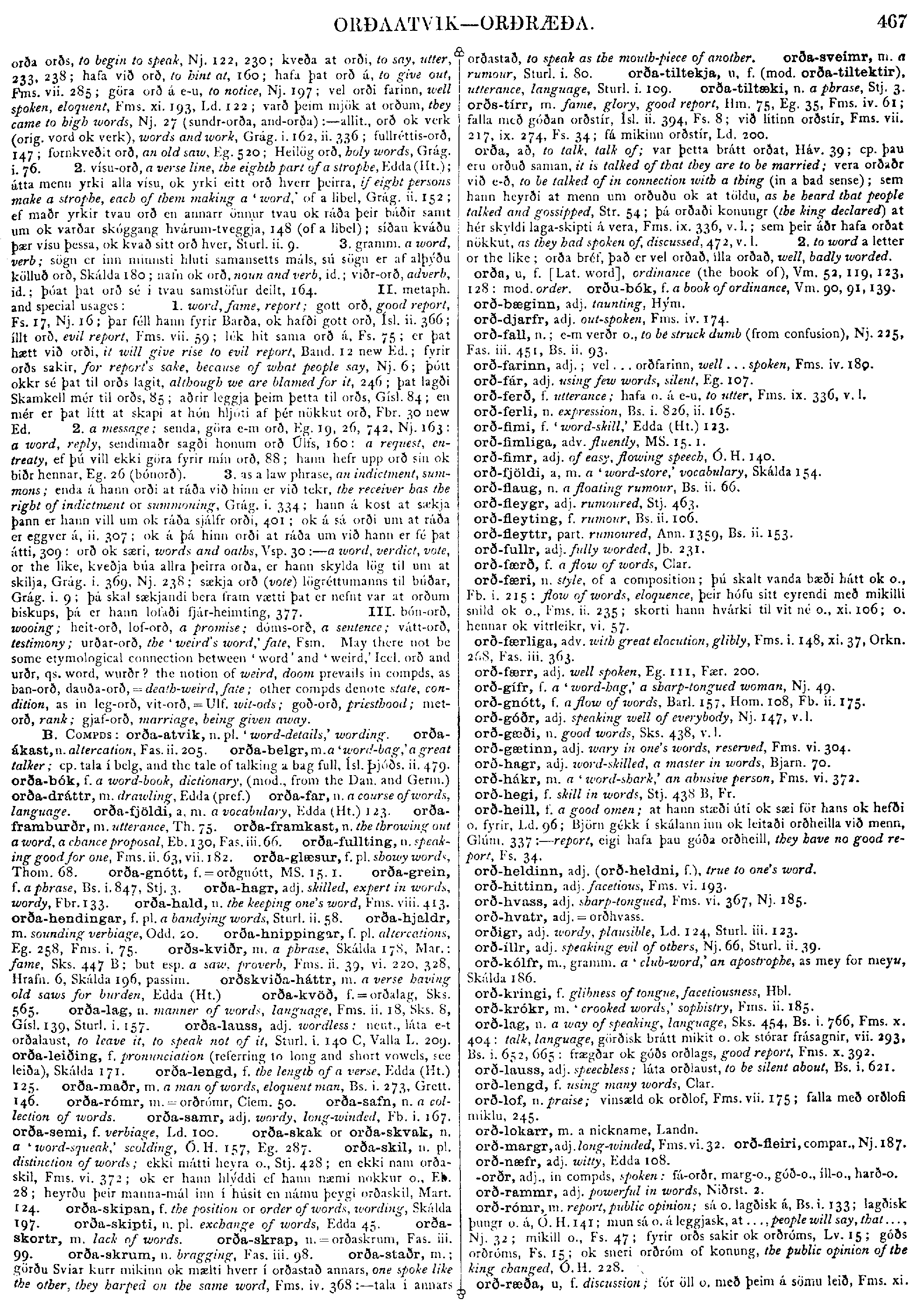
orð-færi, n. style, of a composition; þú skalt vanda bæði hátt ok o., Fb. i. 215: flow of words, eloquence, þeir hófu sitt eyrendi með mikilli snild ok o., Fms. ii. 235; skorti hann hvárki til vit né o., xi. 106; o. hennar ok vitrleikr, vi. 57.
|
Source: Cleasby/Vigfusson, page b0500, entry 13 View original page image as: [TIFF] [PNG] [View previous entry] [View next entry] |
[Comment on this entry] [View comments] |
The following entry has been hand-corrected once. |
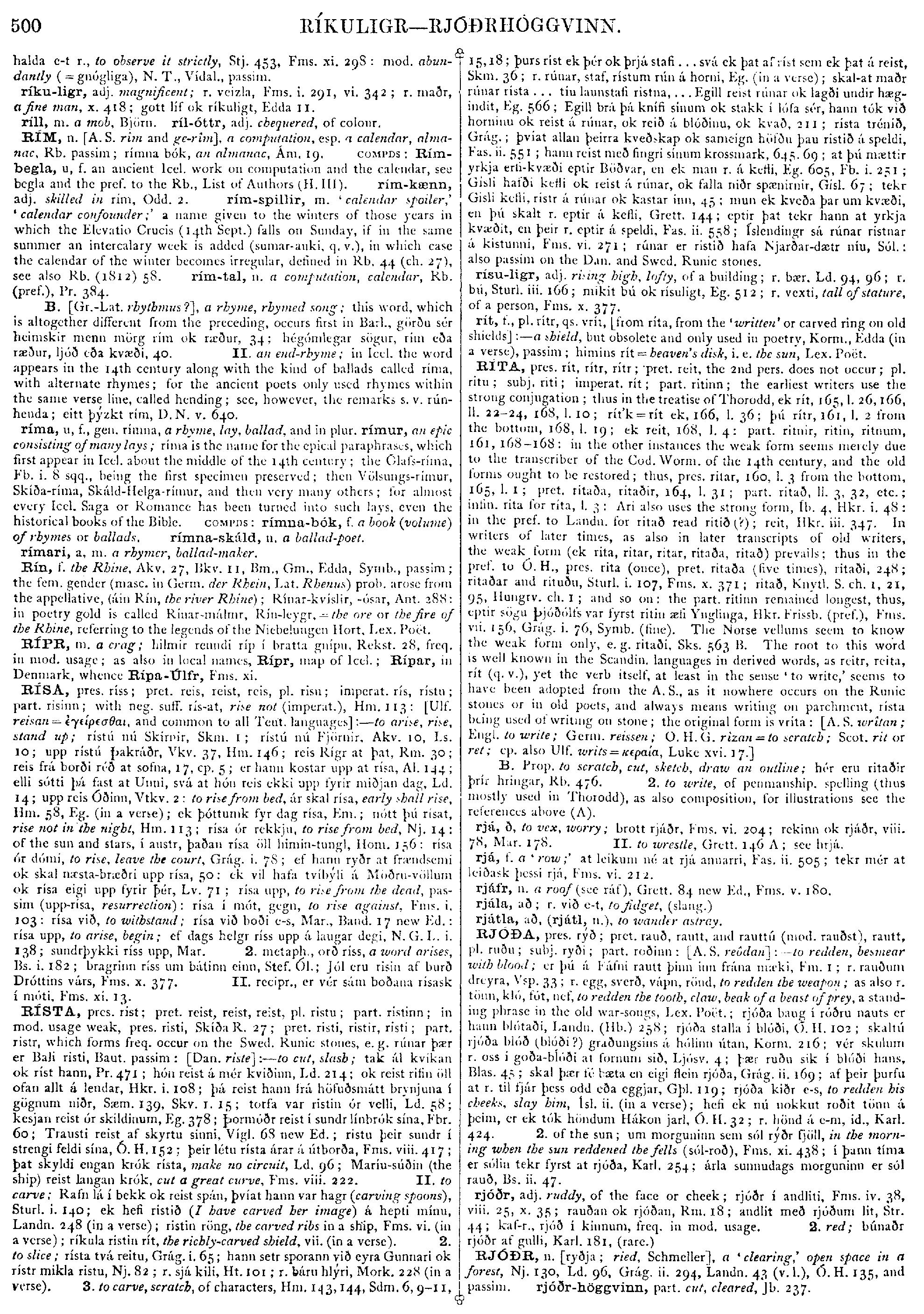
RÍTA, pres. rít, rítr, rítr; pret. reit, the 2nd pers. does not occur; pl. ritu; subj. riti; imperat. rít; part, ritinn; the earliest writers use the strong conjugation; thus in the treatise of Thorodd, ek rít, 165, l. 26, 166, ll. 22-24, 168, l. 10; rít'k = rít ek, 166, 1. 36; þú rítr, 161, l. 2 from the bottom, 168, l. 19; ek reit, 168, l. 4: part, ritnir, ritin, ritnum,161, 168-168: in the other instances the weak form seems merely due to the transcriber of the Cod. Worm, of the 14th century, and the old forms ought to be restored; thus, pres. ritar, 160, l. 3 from the bottom,165, l. 1; pret. ritaða, ritaðir, 164, l. 31; part, ritað, ll. 3, 32, etc.; intin. rita for ríta, l. 3: Ari also uses the strong form, Íb. 4, Hkr. i. 48: in the pref. to Landn. for ritað read ritið(?); reit, Hkr. iii. 347. In writers of later times, as also in later transcripts of old writers, the weak form (ek rita, ritar, ritar, ritaða, ritað) prevails; thus in the pref. to Ó.H., pres. rita (once), pret. ritaða (five times), ritaði, 248; ritaðar and rituðu, Sturl. i. 107, Fms. x. 371; ritað, Knytl. S. ch. 1, 21, 95, Hungrv, ch. 1; and so on: the part, ritinn remained longest, thus, eptir sögu Þjóðólfs var fyrst ritin æli Ynglinga, Hkr. Frissb. (pref.), Fms. vii. 156, Grág. i. 76, Symb. (fine). The Norse vellums seem to know the weak form only, e.g. ritaði, Sks. 563 B. The root to this word is well known in the Scandin. languages in derived words, as reitr, reita, rít (q.v.), yet the verb itself, at least in the sense 'to write,' seems to have been adopted from the A.S., as it nowhere occurs on the Runic stones or in old poets, and always means writing on parchment, rísta being used of writing on stone; the original form is vríta: [A.S. wrítan; Engl. to write; Germ. reissen; O.H.G. rízan = to scratch; Scot. rit or ret; cp. also Ulf. writs = GREEK, Luke xvi. 17.] B. Prop. to scratch, cut, sketch, draw an outline; hér eru ritaðir þrír hringar, Rb. 476. 2. to write, of penmanship, spelling (thus mostly used in Thorodd), as also composition, for illustrations see the references above (A).
|
Source: Cleasby/Vigfusson, page b0504, entry 15 View original page image as: [TIFF] [PNG] [View previous entry] [View next entry] |
[Comment on this entry] [View comments] |
The following entry has been hand-corrected once. |
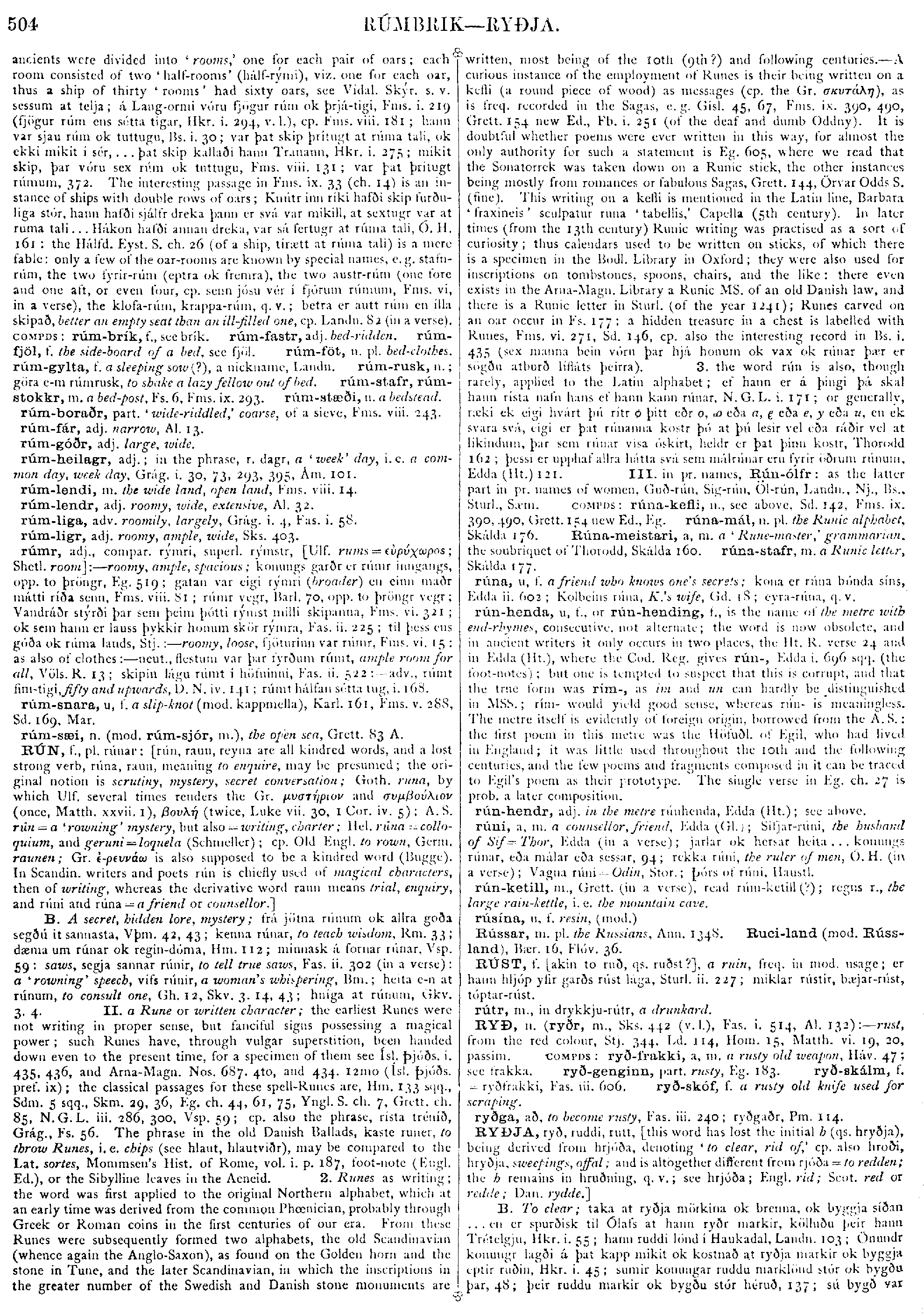
rún-henda, u, f., or rún-hending, f., is the name of the metre with end-rhymes, consecutive, not alternate; the word is now obsolete, and in ancient writers it only occurs in two places, the Ht. R. verse 24 and in Edda (Ht.), where the Cod. Reg. gives rún-, Edda i. 696 sqq. (the foot-notes); but one is tempted to suspect that this is corrupt, and that the true form was rim-, as im and un can hardly be distinguishedin MSS.; rím- would yield good sense, whereas rúm- is meaningless. The metre itself is evidently of foreign origin, borrowed from the A.S.: the first poem in this metre was the Höfuðl. of Egil, who had lived in England; it was little used throughout the 10th and the following centuries, and the few poems and fragments composed in it can be traced to Egil's poem as their prototype. The single verse in Eg. ch. 27 is prob. a later composition.
|
Source: Cleasby/Vigfusson, page b0510, entry 17 View original page image as: [TIFF] [PNG] [View previous entry] [View next entry] |
[Comment on this entry] [View comments] |
The following entry has been hand-corrected once. |
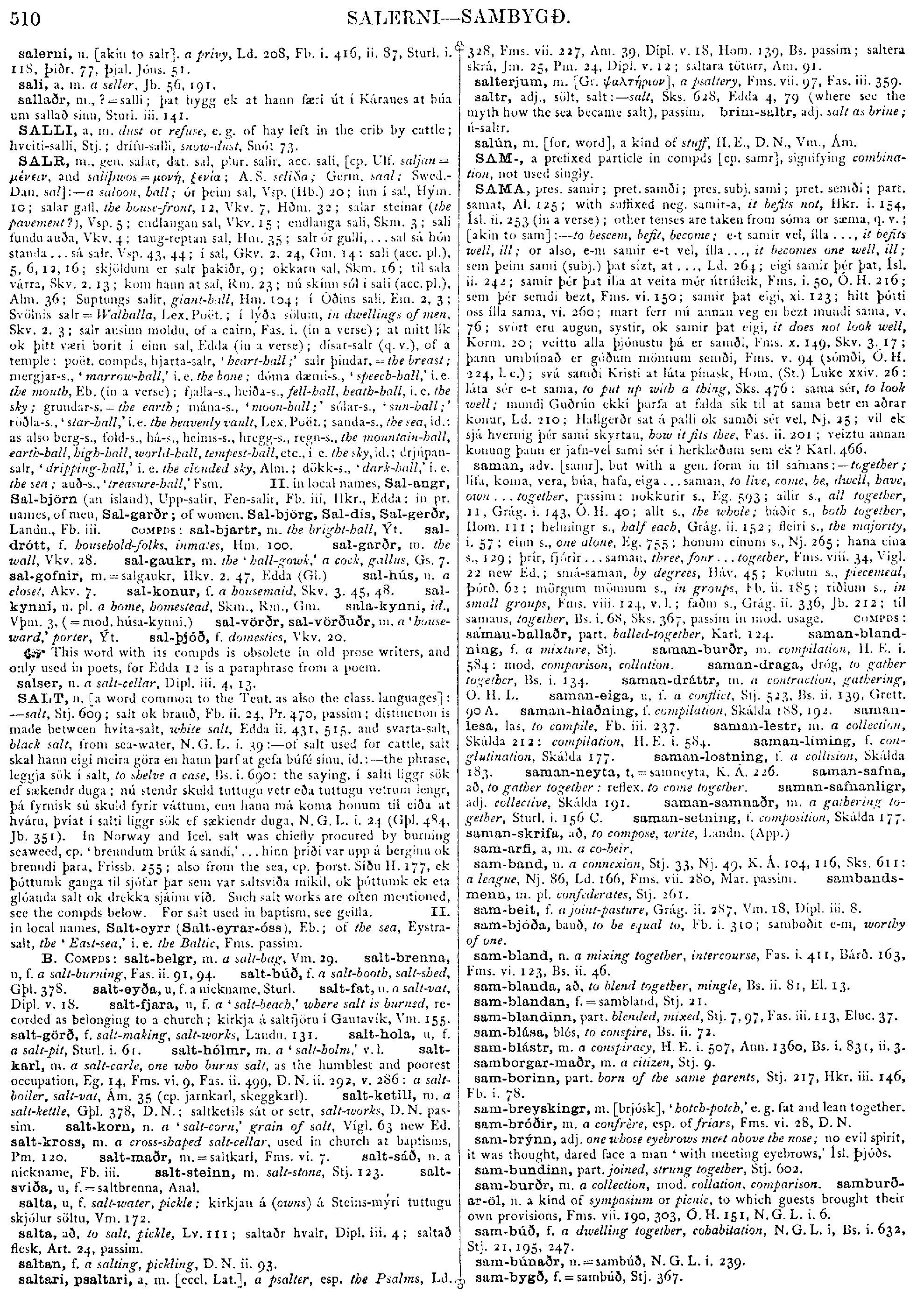
saman, adv. [samr], but with a gen. form in til samans :-- together; lífa, koma, vera, búa, hafa, eiga ... saman, to live, come, be., dwell, have, own ... together, passim: nokkurir s., Eg. 593; allir s., all together, 11, Grág. i. 143, Ó.H. 40; allt s., the whole; báðir s., both together, Hom, 111; helmingr s., half each, Grág. ii. 152; fleiri s., the majority, i. 57; einn s., one alone, Eg. 755; honum einum s., Nj. 265; hana eina s., 129; þrír, fjórir ... saman, three, four ... together, Fms. viii. 34, Vígl. 22 new Ed.; smá-saman, by degrees, Háv. 45; kötlum s., piecemeal, Þórð. 62; mörgum mönnum s., in groups, Fb. ii. 185; riðlum s., in small groups, Fms. viii. 124, v.l.; faðm s., Grág. ii. 336, Jb. 212; til samans, together, Bs. i. 68, Sks. 367, passim in mod. usage. COMPDS: saman-ballaðr, part. balled-together, Karl. 124. saman-blandning, f. a mixture, Stj. saman-burðr, m. compilation, H.E. i. 584: mod. comparison, collation. saman-draga, dróg, to gather together, Bs. i. 134. saman-dráttr, m. a contraction, gathering, O.H.L. saman-eiga, u, f. a conflict, Stj. 523, Bs. ii. 139, Grett. 90 A. saman-hlaðning, f. compilation, Skákla 188, 192. saman-lesa, las, to compile, Fb. iii. 237. saman-lestr, m. a collection, Skálda 212: compilation, H.E. i. 584. saman-líming, f. conglutination, Skálda 177. saman-lostning, f. a collision, Skálda 183. saman-neyta, t, = samneyta, K.Á. 226. saman-safna, að, to gather together: reflex, to come together. saman-safnanligr, adj. collective, Skálda 191. saman-samnaðr, m. a gathering together, Sturl. i. 156 C. saman-setning, f. composition, Skálda 177. saman-skrifa, að, to compose, write, Landn. (App.)
|
Source: Cleasby/Vigfusson, page b0512, entry 56 View original page image as: [TIFF] [PNG] [View previous entry] [View next entry] |
[Comment on this entry] [View comments] |
The following entry has been hand-corrected once. |
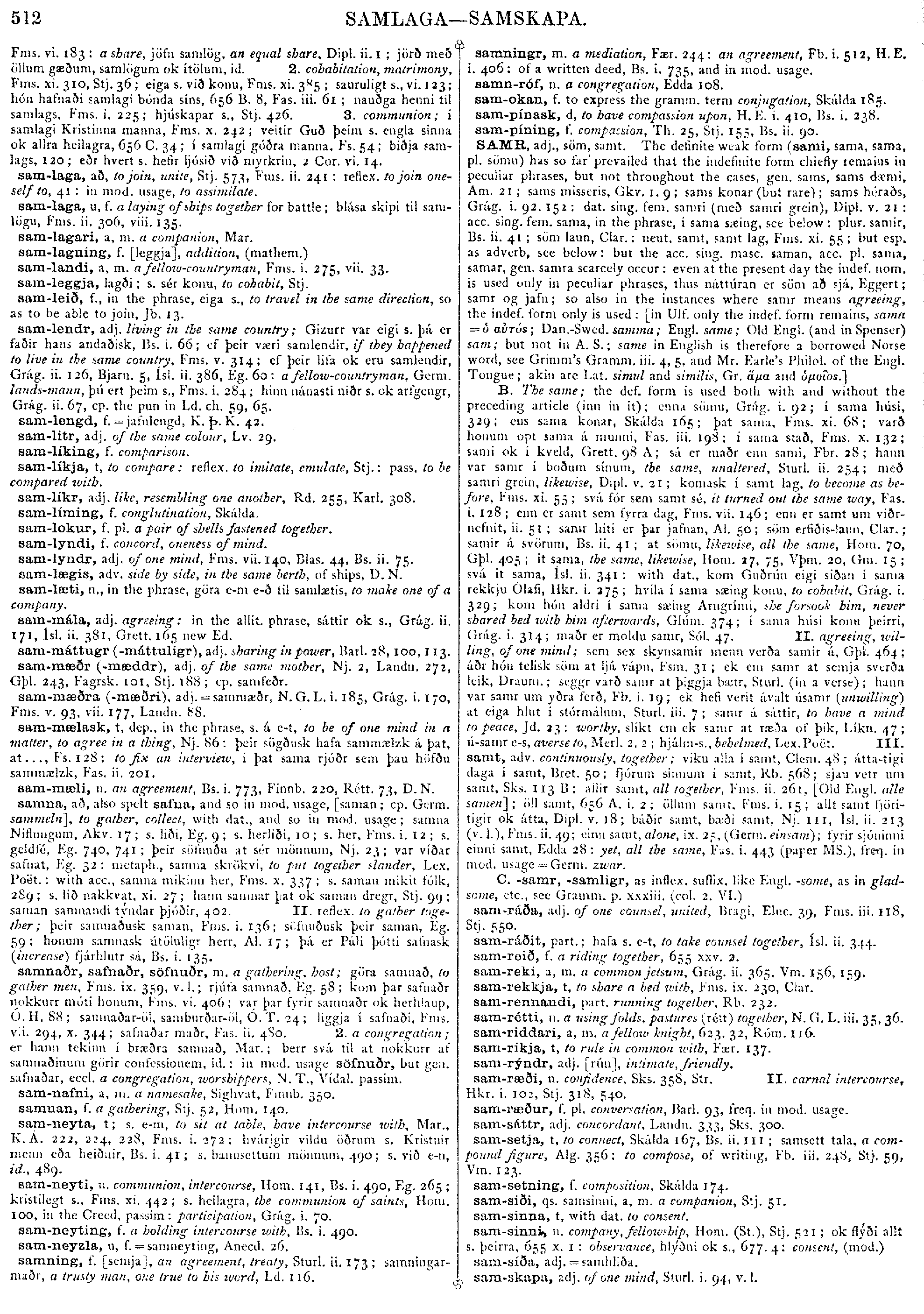
sam-setning, f. composition, Skálda 174.
| Result Page: |  |
Previous | 1 2 3 4 5 6 7 8 9 | Next |  |
Germanic Lexicon Project (main page)
This search system was written by
Sean Crist
Please consider
volunteering
to correct the data in these online dictionaries.
No rights reserved. Feel free to use these data in any way you please.