|
|

Tip: In the search results, you can click on any word or abbreviation for more information.
|
Source: Cleasby/Vigfusson, page b0017, entry 80 View original page image as: [TIFF] [PNG] [View previous entry] [View next entry] |
[Comment on this entry] [View comments] |
The following entry has been hand-corrected once. |
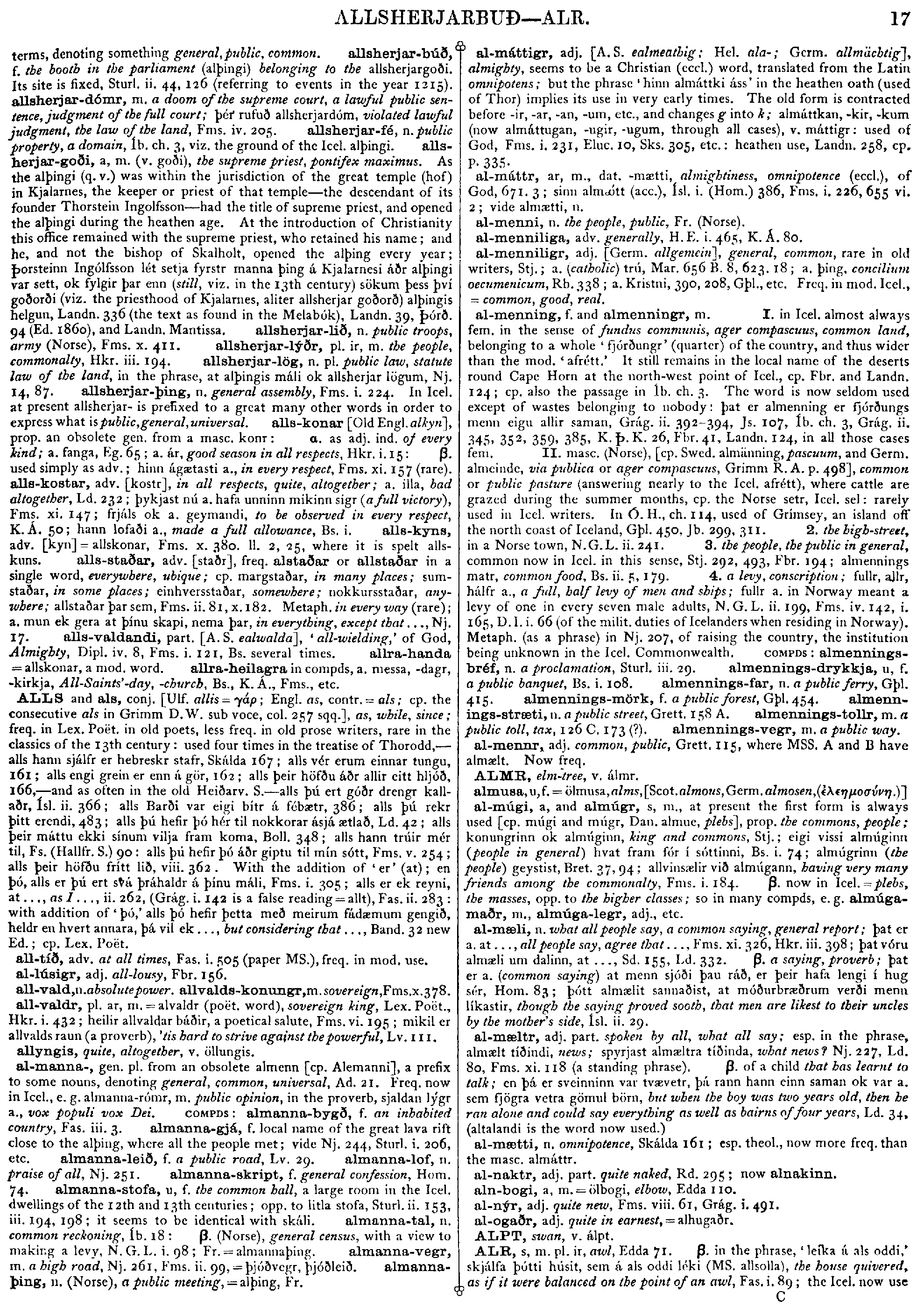
al-væpni, n. [vápn], complete arms; hafa a., to be in full armour, fully armed, Nj. 93, 107, Eg. 46, 74, 88; með a., fully armed, Íb. ch. 7.
|
Source: Cleasby/Vigfusson, page b0155, entry 10 View original page image as: [TIFF] [PNG] [View previous entry] [View next entry] |
[Comment on this entry] [View comments] |
The following entry has been hand-corrected once. |
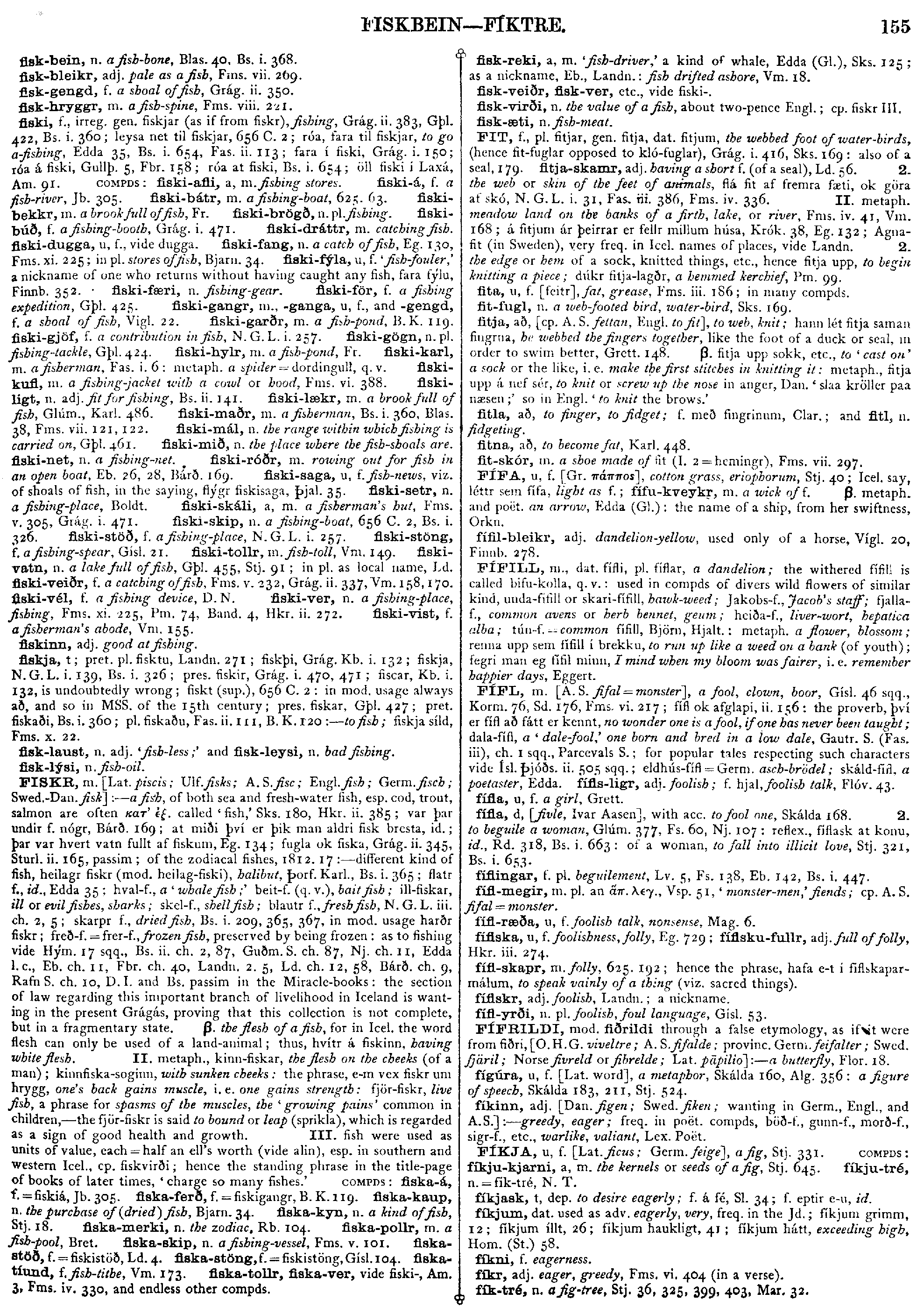
FISKR,
m.
[Lat.
piscis;
Ulf.
fisks;
A.
S.
fisc;
Engl.
fish;
Germ.
fisch;
Swed.-Dan.
fisk]
:--
a
fish,
of
both
sea
and
fresh-water
fish,
esp.
cod,
trout,
salmon
are
often
GREEK
called
'fish,'
Sks.
180,
Hkr.
ii.
385;
var
þar
undir
f.
nógr,
Bárð.
169;
at
miði
því
er
þik
man
aldri
fisk
bresta,
id.;
þar
var
hvert
vatn
fullt
af
fiskum,
Eg.
134;
fugla
ok
fiska,
Grág.
ii.
345,
Sturl.
ii.
165,
passim;
of
the
zodiacal
fishes,
1812.
17
:--
different
kind
of
fish,
heilagr
fiskr
(mod.
heilag-fiski),
halibut,
Þorf.
Karl.,
Bs.
i.
365;
flatr
f.,
id.,
Edda
35;
hval-f.,
a
'whale
fish;'
beit-f.
(q.v.),
bait
fish;
ill-fiskar,
ill
or
evil
fishes,
sharks;
skel-f.,
shell
fish;
blautr
f.,
fresh
fish,
N.
G.
L.
iii.
ch.
2,
5;
skarpr
f.,
dried
fish,
Bs.
i.
209,
365,
367,
in
mod.
usage
harðr
fiskr;
freð-f.
=
frer-f.,
frozen
fish,
preserved
by
being
frozen:
as
to
fishing
vide
Hým.
17
sqq.,
Bs.
ii.
ch.
2,
87,
Guðm.
S.
ch.
87,
Nj.
ch.
11,
Edda
l.c.,
Eb.
ch.
11,
Fbr.
ch.
40,
Landn.
2.
5,
Ld.
ch.
12,
58,
Bárð.
ch.
9,
Rafn
S.
ch.
10,
D.
I.
and
Bs.
passim
in
the
Miracle-books:
the
section
of
law
regarding
this
important
branch
of
livelihood
in
Iceland
is
wanting
in
the
present
Grágás,
proving
that
this
collection
is
not
complete,
but
in
a
fragmentary
state.
 .
the
flesh
of
a
fish,
for
in
Icel.
the
word
flesh
can
only
be
used
of
a
land-animal;
thus,
hvítr
á
fiskinn,
having
white
flesh.
II.
metaph.,
kinn-fiskar,
the
flesh
on
the
cheeks
(of
a
man);
kinnfiska-soginn,
with
sunken
cheeks:
the
phrase,
e-m
vex
fiskr
um
hrygg,
one's
back
gains
muscle,
i.e.
one
gains
strength:
fjör-fiskr,
live
fish,
a
phrase
for
spasms
of
the
muscles,
the
'growing
pains'
common
in
children,
--
the
fjör-fiskr
is
said
to
bound
or
leap
(sprikla),
which
is
regarded
as
a
sign
of
good
health
and
growth.
III.
fish
were
used
as
units
of
value,
each
=
half
an
ell's
worth
(vide
alin),
esp.
in
southern
and
Western
Icel.,
cp.
fiskvirði;
hence
the
standing
phrase
in
the
title-page
of
books
of
later
times,
'charge
so
many
fishes.'
COMPDS:
fiska-á,
f.
=
fiskiá,
Jb.
305.
fiska-ferð,
f.
=
fiskigangr,
B.
K.
119.
fiska-kaup,
n.
the
purchase
of
(dried)
fish,
Bjarn.
34.
fiska-kyn,
n.
a
kind
of
fish,
Stj.
18.
fiska-merki,
n.
the
zodiac,
Rb.
104.
fiska-pollr,
m.
a
fish-pool,
Bret.
fiska-skip,
n.
a
fishing-vessel,
Fms.
v.
101.
fiska-stöð,
f.
=
fiskistöð,
Ld.
4.
fiska-stöng,
f.
=
fiskistöng,
Gísl.
104.
fiska-tíund,
f.
fish-tithe,
Vm.
173.
fiska-tollr,
fiska-ver,
vide
fiski-,
Am.
3,
Fms.
iv.
330,
and
endless
other
compds.
.
the
flesh
of
a
fish,
for
in
Icel.
the
word
flesh
can
only
be
used
of
a
land-animal;
thus,
hvítr
á
fiskinn,
having
white
flesh.
II.
metaph.,
kinn-fiskar,
the
flesh
on
the
cheeks
(of
a
man);
kinnfiska-soginn,
with
sunken
cheeks:
the
phrase,
e-m
vex
fiskr
um
hrygg,
one's
back
gains
muscle,
i.e.
one
gains
strength:
fjör-fiskr,
live
fish,
a
phrase
for
spasms
of
the
muscles,
the
'growing
pains'
common
in
children,
--
the
fjör-fiskr
is
said
to
bound
or
leap
(sprikla),
which
is
regarded
as
a
sign
of
good
health
and
growth.
III.
fish
were
used
as
units
of
value,
each
=
half
an
ell's
worth
(vide
alin),
esp.
in
southern
and
Western
Icel.,
cp.
fiskvirði;
hence
the
standing
phrase
in
the
title-page
of
books
of
later
times,
'charge
so
many
fishes.'
COMPDS:
fiska-á,
f.
=
fiskiá,
Jb.
305.
fiska-ferð,
f.
=
fiskigangr,
B.
K.
119.
fiska-kaup,
n.
the
purchase
of
(dried)
fish,
Bjarn.
34.
fiska-kyn,
n.
a
kind
of
fish,
Stj.
18.
fiska-merki,
n.
the
zodiac,
Rb.
104.
fiska-pollr,
m.
a
fish-pool,
Bret.
fiska-skip,
n.
a
fishing-vessel,
Fms.
v.
101.
fiska-stöð,
f.
=
fiskistöð,
Ld.
4.
fiska-stöng,
f.
=
fiskistöng,
Gísl.
104.
fiska-tíund,
f.
fish-tithe,
Vm.
173.
fiska-tollr,
fiska-ver,
vide
fiski-,
Am.
3,
Fms.
iv.
330,
and
endless
other
compds.
|
Source: Cleasby/Vigfusson, page b0177, entry 37 View original page image as: [TIFF] [PNG] [View previous entry] [View next entry] |
[Comment on this entry] [View comments] |
The following entry has been hand-corrected once. |
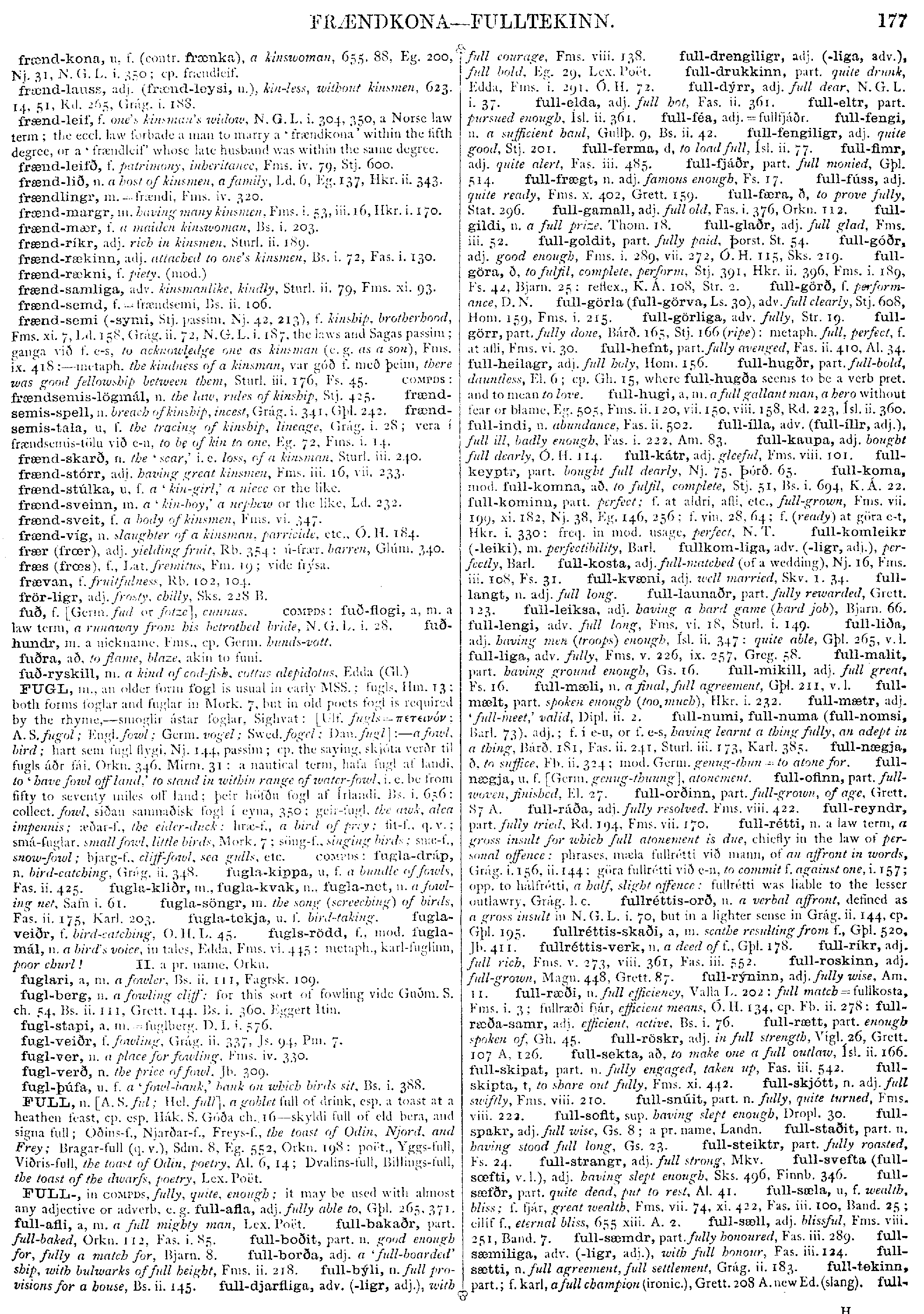
FULL-, in COMPDS, fully, quite, enough; it may be used with almost any adjective or adverb, e.g. full-afla, adj. fully able to, Gþl. 265, 371. full-afli, a, m. a full mighty man, Lex. Poët. full-bakaðr, part. full-baked, Orkn. 112, Fas. i. 85. full-boðit, part. n. good enough for, fully a match for, Bjarn. 8. full-borða, adj. a 'full-boarded' ship, with bulwarks of full height, Fms. ii. 218. full-býli, n. full provisions for a house, Bs. ii. 145. full-djarfliga, adv. (-ligr, adj.), with full courage, Fms. viii. 138. full-drengiligr, adj. (-liga, adv.), full bold, Eg. 29, Lex. Poët. full-drukkinn, part. quite drunk, Edda, Fms. i. 291, Ó. H. 72. full-dýrr, adj. full dear, N. G. L. i. 37. full-elda, adj. full hot, Fas. ii. 361. full-eltr, part. pursued enough, Ísl. ii. 361. full-féa, adj. = fullfjáðr. full-fengi, n. a sufficient haul, Gullþ. 9, Bs. ii. 42. full-fengiligr, adj. quite good, Stj. 201. full-ferma, d, to load full, Ísl. ii. 77. full-fimr, adj. quite alert, Fas. iii. 485. full-fjáðr, part. full monied, Gþl. 514. full-frægt, n. adj. famous enough, Fs. 17. full-fúss, adj. quite ready, Fms. x. 402, Grett. 159. full-færa, ð, to prove fully, Stat. 296. full-gamall, adj. full old, Fas. i. 376, Orkn. 112. full-gildi, n. a full prize, Thom. 18. full-glaðr, adj. full glad, Fms. iii. 52. full-goldit, part. fully paid, Þorst. St. 54. full-góðr, adj. good enough, Fms. i. 289, vii. 272, Ó. H. 115, Sks. 219. full-göra, ð, to fulfil, complete, perform, Stj. 391, Hkr. ii. 396, Fms. i. 189, Fs. 42, Bjarn. 25: reflex., K. Á. 108, Str. 2. full-görð, performance, D. N. full-görla (full-görva, Ls. 30), adv. full clearly, Stj. 608, Hom. 159, Fms. i. 215. full-görliga, adv. fully, Str. 19. full-görr, part. fully done, Bárð. 165, Stj. 166 (ripe): metaph. full, perfect, f. at afli, Fms. vi. 30. full-hefnt, part. fully avenged, Fas. ii. 410, Al. 34. full-heilagr, adj. full holy, Hom. 156. full-hugðr, part. full-bold, dauntless, El. 6; cp. Gh. 15, where full-hugða seems to be a verb pret. and to mean to love. full-hugi, a, m. a full gallant man, a hero without fear or blame, Eg. 505, Fms. ii. 120, vii. 150, viii. 158, Rd. 223, Ísl. ii. 360. full-indi, n. abundance, Fas. ii. 502. full-ílla, adv. (full-íllr, adj.), full ill, badly enough, Fas. i. 222, Am. 83. full-kaupa, adj. bought full dearly, Ó. H. 114. full-kátr, adj. gleeful, Fms. viii. 101. full-keyptr, part. bought full dearly, Nj. 75, Þórð. 65. full-koma, mod. full-komna, að, to fulfil, complete, Stj. 51, Bs. i. 694, K. Á. 22. full-kominn, part. perfect; f. at aldri, afli, etc., full-grown, Fms. vii. 199, xi. 182, Nj. 38, Eg. 146, 256; f. vin, 28, 64; f. (ready) at göra e-t, Hkr. i. 330: freq. in mod. usage, perfect, N. T. full-komleikr (-leiki), m. perfectibility, Barl. fullkom-liga, adv. (-ligr, adj.), perfectly, Barl. full-kosta, adj. full-matched (of a wedding), Nj. 16, Fms. iii. 108, Fs. 31. full-kvæni, adj. well married, Skv. 1. 34. full-langt, n. adj. full long. full-launaðr, part. fully rewarded, Grett. 123. full-leiksa, adj. having a hard game (hard job), Bjarn. 66. full-lengi, adv. full long, Fms. vi. 18, Sturl. i. 149. full-liða, adj. having men (troops) enough, Ísl. ii. 347: quite able, Gþl. 265, v.l. full-liga, adv. fully, Fms. v. 226, ix. 257, Greg. 58. full-malit, part. having ground enough, Gs. 16. full-mikill, adj. full great, Fs. 16. full-mæli, n. a final, full agreement, Gþl. 211, v.l. full-mælt, part. spoken enough (too much), Hkr. i. 232. full-mætr, adj. 'full-meet,' valid, Dipl. ii. 2. full-numi, full-numa (full-nomsi, Barl. 73), adj.; f. í e-u, or f. e-s, having learnt a thing fully, an adept in a thing, Bárð. 181, Fas. ii. 241, Sturl. iii. 173, Karl. 385. full-nægja, ð, to suffice, Fb. ii. 324; mod. Germ. genug-thun = to alone for. full-nægja, u, f. [Germ. genug-thuung], atonement. full-ofinn, part. full-woven, finished, El. 27. full-orðinn, part. full-grown, of age, Grett. 87 A. full-ráða, adj. fully resolved, Fms. viii. 422. full-reyndr, part. fully tried, Rd. 194, Fms. vii. 170. full-rétti, n. a law term, a gross insult for which full atonement is due, chiefly in the law of personal offence: phrases, mæla fullrétti við mann, of an affront in words, Grág. i. 156, ii. 144; göra fullrétti við e-n, to commit f. against one, i. 157; opp. to hálfrétti, a half, slight offence: fullrétti was liable to the lesser outlawry, Grág. l.c. fullréttis-orð, n. a verbal affront, defined as a gross insult in N. G. L. i. 70, but in a lighter sense in Grág. ii. 144, cp. Gþl. 195. fullréttis-skaði, a, m. scathe resulting from f., Gþl. 520, Jb. 411. fullréttis-verk, n. a deed of f., Gþl. 178. full-ríkr, adj. full rich, Fms. v. 273, viii. 361, Fas. iii. 552. full-roskinn, adj. full-grown, Magn. 448, Grett. 87. full-rýninn, adj. fully wise, Am. 11. full-ræði, n. full efficiency, Valla L. 202: full match = fullkosta, Fms. i. 3; fullræði fjár, efficient means, Ó. H. 134, cp. Fb. ii. 278: fullræða-samr, adj. efficient, active, Bs. i. 76. full-rætt, part. enough spoken of, Gh. 45. full-röskr, adj. in full strength, Vígl. 26, Grett. 107 A, 126. full-sekta, að, to make one a full outlaw, Ísl. ii. 166. full-skipat, part. n. fully engaged, taken up, Fas. iii. 542. full-skipta, t, to share out fully, Fms. xi. 442. full-skjótt, n. adj. full swiftly, Fms. viii. 210. full-snúit, part. n. fully, quite turned, Fms. viii. 222. full-sofit, sup. having slept enough, Dropl. 30. full-spakr, adj. full wise, Gs. 8; a pr. name, Landn. full-staðit, part. n. having stood full long, Gs. 23. full-steiktr, part. fully roasted, Fs. 24. full-strangr, adj. full strong, Mkv. full-svefta (full-sæfti, v.l.), adj. having slept enough, Sks. 496, Finnb. 346. full-sæfðr, part. quite dead, put to rest, Al. 41. full-sæla, u, f. wealth, bliss; f. fjár, great wealth, Fms. vii. 74, xi. 422, Fas. iii. 100, Band. 25; eilíf f., eternal bliss, 655 xiii. A. 2. full-sæll, adj. blissful, Fms. viii. 251, Band. 7. full-sæmdr, part. fully honoured, Fas. iii. 289. full-sæmiliga, adv. (-ligr, adj.), with full honour, Fas. iii. 124. full-sætti, n. full agreement, full settlement, Grág. ii. 183. full-tekinn, part.; f. karl, a full champion (ironic.), Grett. 208 A. new Ed. (slang). full-
|
Source: Cleasby/Vigfusson, page b0178, entry 4 View original page image as: [TIFF] [PNG] [View previous entry] [View next entry] |
[Comment on this entry] [View comments] |
The following entry has been hand-corrected once. |
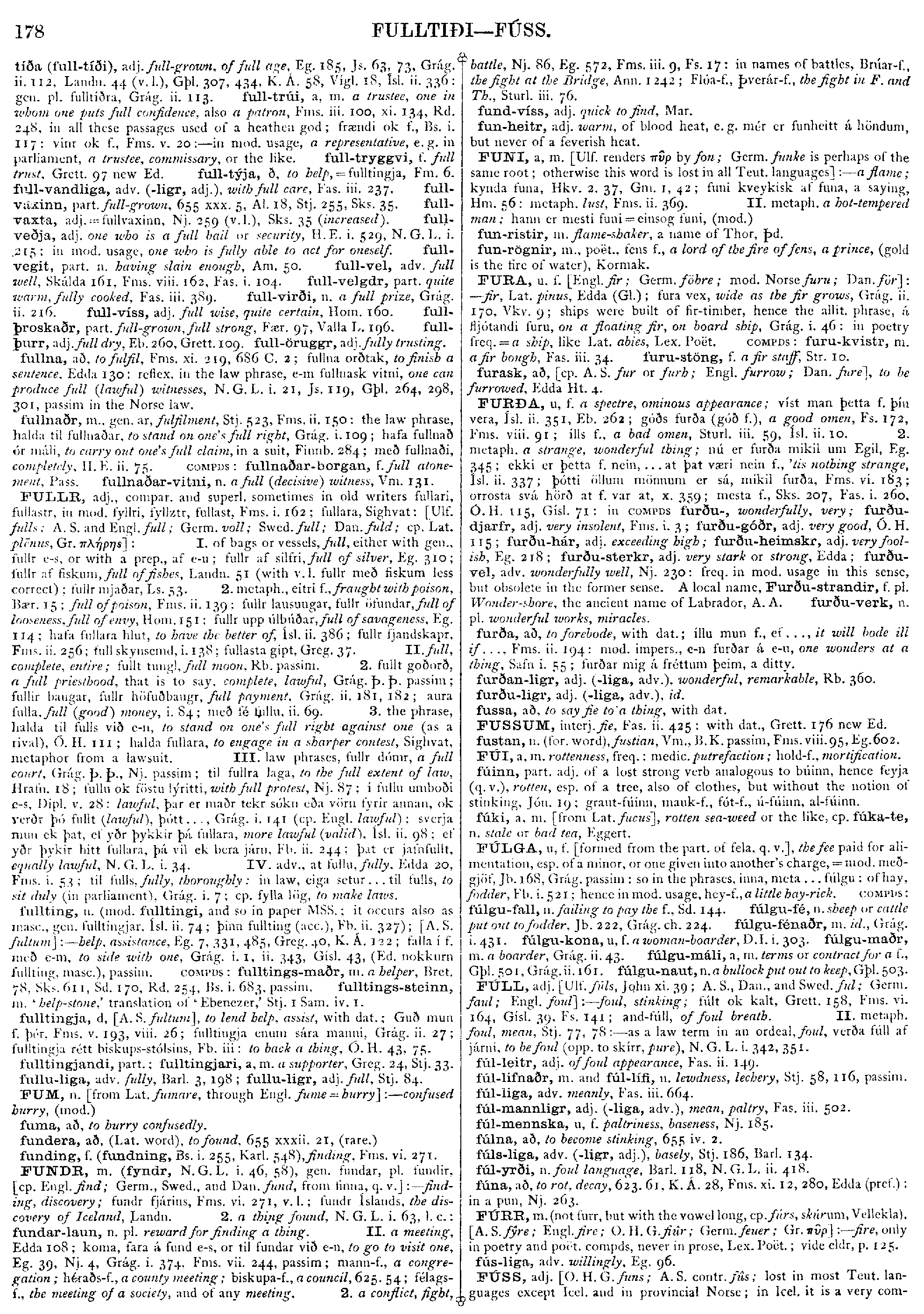
FULLR,
adj.,
compar.
and
superl.
sometimes
in
old
writers
fullari,
fullastr,
in
mod.
fyllri,
fyllztr,
fullast,
Fms.
i.
162;
fullara,
Sighvat:
[Ulf.
fulls:
A.
S.
and
Engl.
full;
Germ.
voll;
Swed.
full;
Dan.
fuld;
cp.
Lat.
pl nus,
Gr.
GREEK]:
I.
of
bags
or
vessels,
full,
either
with
gen.,
fullr
e-s,
or
with
a
prep.,
af
e-u;
fullr
af
silfri,
full
of
silver,
Eg.
310;
fullr
af
fiskum,
full
of
fishes,
Landn.
51
(with
v.l.
fullr
með
fiskum
less
correct);
fullr
mjaðar,
Ls.
53.
2.
metaph.,
eitri
f.,
fraught
with
poison,
Bær.
15;
full
of
poison,
Fms.
ii.
139;
fullr
lausungar,
fullr
öfundar,
full
of
looseness,
full
of
envy,
Hom.
151:
fullr
upp
úlbúðar,
full
of
savageness,
Eg.
114;
hafa
fullara
hlut,
to
have
the
better
of,
Ísl.
ii.
386;
fullr
fjandskapr,
Fms.
ii.
256;
full
skynsemd,
i.
138;
fullasta
gipt,
Greg.
37.
II.
full,
complete,
entire;
fullt
tungl,
full
moon,
Rb.
passim.
2.
fullt
goðorð,
a
full
priesthood,
that
is
to
say,
complete,
lawful,
Grág.
Þ.
Þ.
passim;
fullir
baugar,
fullr
höfuðbaugr,
full
payment,
Grág.
ii.
181,
182;
aura
fulla,
full
(good)
money,
i.
84;
með
fé
fullu,
ii.
69.
3.
the
phrase,
halda
til
fulls
við
e-n,
to
stand
on
one's
full
right
against
one
(as
a
rival),
Ó.
H.
111;
halda
fullara,
to
engage
in
a
sharper
contest,
Sighvat,
metaphor
from
a
lawsuit.
III.
law
phrases,
fullr
dómr,
a
full
court,
Grág.
Þ.
Þ.,
Nj.
passim;
til
fullra
laga,
to
the
full
extent
of
law,
Hrafn.
18;
fulln
ok
föstu
lýritti,
with
full
protest,
Nj.
87;
í
fullu
umboði
e-s,
Dipl.
v.
28:
lawful,
þar
er
maðr
tekr
sókn
eða
vörn
fyrir
annan,
ok
verðr
þó
fullt
(lawful),
þótt
...,
Grág.
i.
141
(cp.
Engl.
lawful);
sverja
mun
ek
þat,
ef
yðr
þykkir
þá
fullara,
more
lawful
(valid),
Ísl.
ii.
98;
ef
yðr
þykir
hitt
fullara,
þá
vil
ek
bera
járn,
Fb.
ii.
244;
þat
er
jafnfullt,
equally
lawful,
N.
G.
L.
i.
34.
IV.
adv.,
at
fullu,
fully,
Edda
20,
Fms.
i.
53;
til
fulls,
fully,
thoroughly:
in
law,
eiga
setur
...
til
fulls,
to
sit
duly
(in
parliament),
Grág.
i.
7;
cp.
fylla
lög,
to
make
laws.
nus,
Gr.
GREEK]:
I.
of
bags
or
vessels,
full,
either
with
gen.,
fullr
e-s,
or
with
a
prep.,
af
e-u;
fullr
af
silfri,
full
of
silver,
Eg.
310;
fullr
af
fiskum,
full
of
fishes,
Landn.
51
(with
v.l.
fullr
með
fiskum
less
correct);
fullr
mjaðar,
Ls.
53.
2.
metaph.,
eitri
f.,
fraught
with
poison,
Bær.
15;
full
of
poison,
Fms.
ii.
139;
fullr
lausungar,
fullr
öfundar,
full
of
looseness,
full
of
envy,
Hom.
151:
fullr
upp
úlbúðar,
full
of
savageness,
Eg.
114;
hafa
fullara
hlut,
to
have
the
better
of,
Ísl.
ii.
386;
fullr
fjandskapr,
Fms.
ii.
256;
full
skynsemd,
i.
138;
fullasta
gipt,
Greg.
37.
II.
full,
complete,
entire;
fullt
tungl,
full
moon,
Rb.
passim.
2.
fullt
goðorð,
a
full
priesthood,
that
is
to
say,
complete,
lawful,
Grág.
Þ.
Þ.
passim;
fullir
baugar,
fullr
höfuðbaugr,
full
payment,
Grág.
ii.
181,
182;
aura
fulla,
full
(good)
money,
i.
84;
með
fé
fullu,
ii.
69.
3.
the
phrase,
halda
til
fulls
við
e-n,
to
stand
on
one's
full
right
against
one
(as
a
rival),
Ó.
H.
111;
halda
fullara,
to
engage
in
a
sharper
contest,
Sighvat,
metaphor
from
a
lawsuit.
III.
law
phrases,
fullr
dómr,
a
full
court,
Grág.
Þ.
Þ.,
Nj.
passim;
til
fullra
laga,
to
the
full
extent
of
law,
Hrafn.
18;
fulln
ok
föstu
lýritti,
with
full
protest,
Nj.
87;
í
fullu
umboði
e-s,
Dipl.
v.
28:
lawful,
þar
er
maðr
tekr
sókn
eða
vörn
fyrir
annan,
ok
verðr
þó
fullt
(lawful),
þótt
...,
Grág.
i.
141
(cp.
Engl.
lawful);
sverja
mun
ek
þat,
ef
yðr
þykkir
þá
fullara,
more
lawful
(valid),
Ísl.
ii.
98;
ef
yðr
þykir
hitt
fullara,
þá
vil
ek
bera
járn,
Fb.
ii.
244;
þat
er
jafnfullt,
equally
lawful,
N.
G.
L.
i.
34.
IV.
adv.,
at
fullu,
fully,
Edda
20,
Fms.
i.
53;
til
fulls,
fully,
thoroughly:
in
law,
eiga
setur
...
til
fulls,
to
sit
duly
(in
parliament),
Grág.
i.
7;
cp.
fylla
lög,
to
make
laws.
|
Source: Cleasby/Vigfusson, page b0179, entry 20 View original page image as: [TIFF] [PNG] [View previous entry] [View next entry] |
[Comment on this entry] [View comments] |
The following entry has been hand-corrected once. |
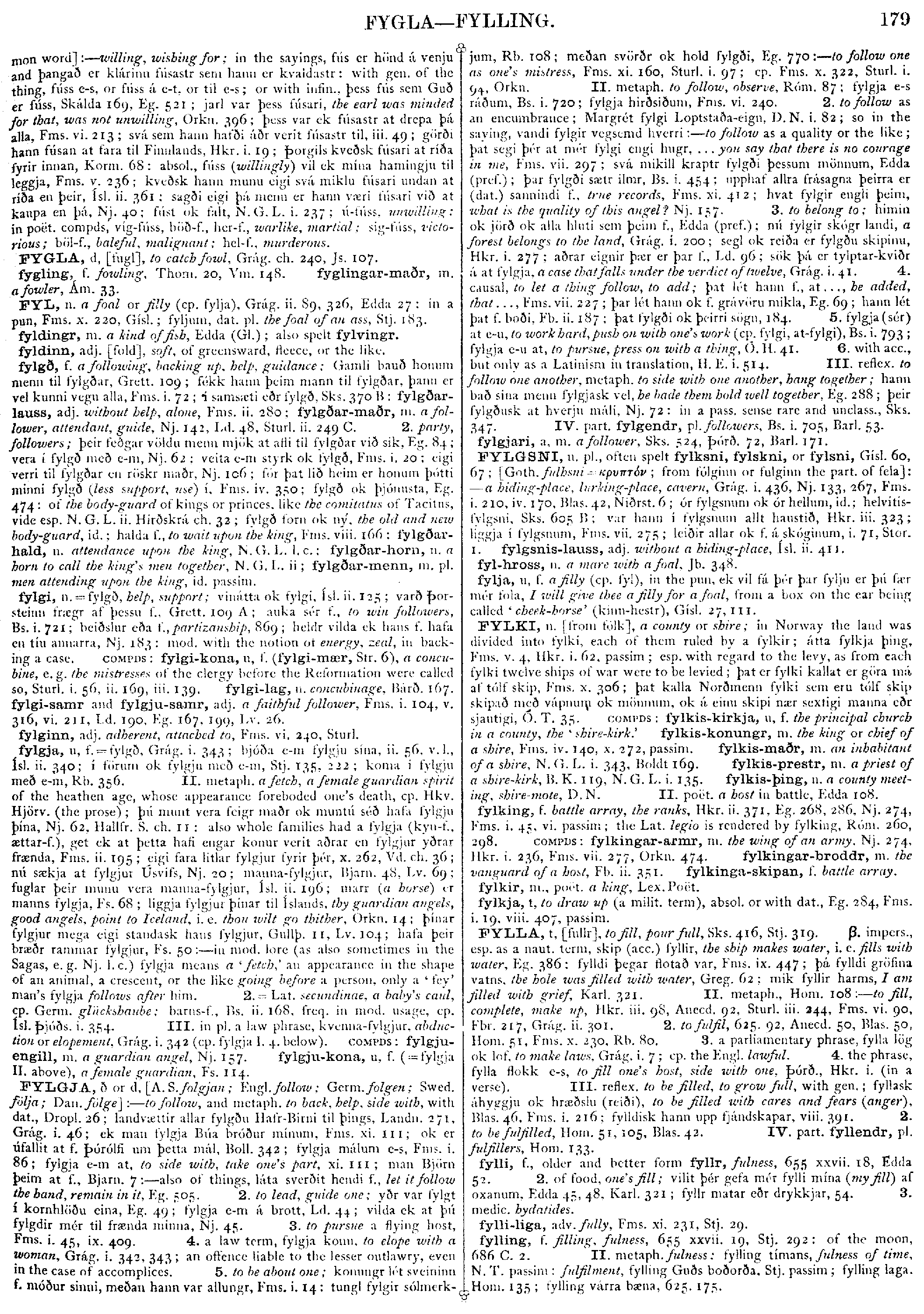
FYLLA,
t,
[fullr],
to
fill,
pour
full,
Sks.
416,
Stj.
319.
.
impers.,
esp.
as
a
naut.
term,
skip
(acc.)
fyllir,
the
ship
makes
water,
i.e.
fills
with
water,
Eg.
386;
fylldi
þegar
flotað
var,
Fms.
ix.
447;
þá
fylldi
gröfina
vatns,
the
hole
was
filled
with
water,
Greg.
62;
mik
fyllir
harms,
I
am
filled
with
grief,
Karl.
321.
II.
metaph.,
Hom.
108
:--
to
fill,
complete,
make
up,
Hkr.
iii.
98,
Anecd.
92,
Sturl.
iii.
244,
Fms.
vi.
90,
Fbr.
217,
Grág.
ii.
301.
2.
to
fulfil,
625.
92,
Anecd.
50,
Blas.
50,
Hom.
51,
Fms.
x.
230,
Rb.
80.
3.
a
parliamentary
phrase,
fylla
lög
ok
lof,
to
make
laws,
Grág.
i.
7;
cp.
the
Engl.
lawful.
4.
the
phrase,
fylla
flokk
e-s,
to
fill
one's
host,
side
with
one,
Þórð.,
Hkr.
i.
(in
a
verse).
III.
reflex.
to
be
filled,
to
grow
full,
with
gen.;
fyllask
áhyggju
ok
hræðslu
(reiði),
to
be
filled
with
cares
and
fears
(anger),
Blas.
46,
Fms.
i.
216;
fylldisk
hann
upp
fjándskapar,
viii.
391.
2.
to
be
fulfilled,
Hom.
51,
105,
Blas.
42.
IV.
part.
fyllendr,
pl.
fulfillers,
Hom.
133.
|
Source: Cleasby/Vigfusson, page b0195, entry 3 View original page image as: [TIFF] [PNG] [View previous entry] [View next entry] |
[Comment on this entry] [View comments] |
The following entry has been hand-corrected once. |
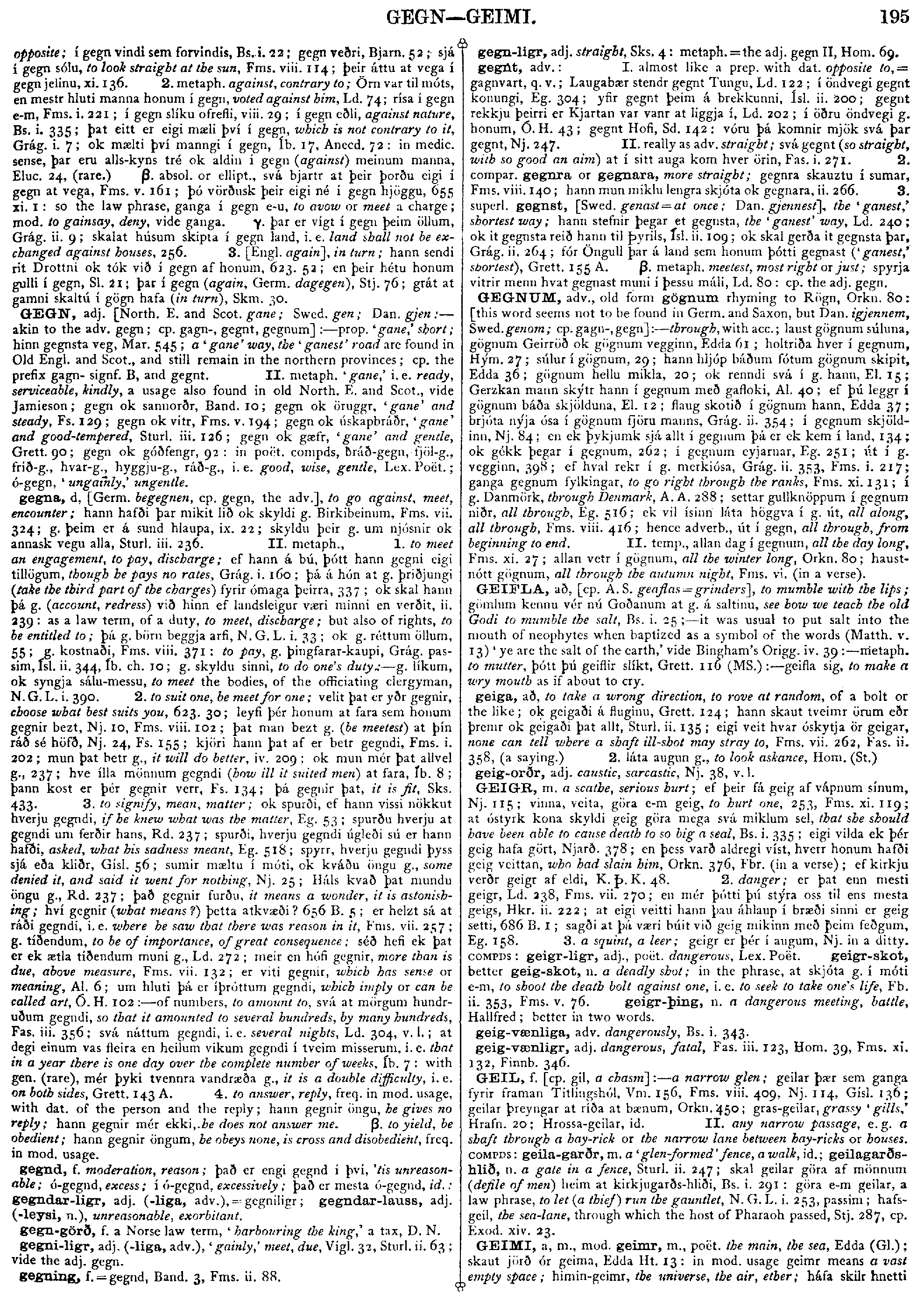
gegna,
d,
[Germ.
begegnen,
cp.
gegn,
the
adv.],
to
go
against,
meet,
encounter;
hann
hafði
þar
mikit
lið
ok
skyldi
g.
Birkibeinum,
Fms.
vii.
324;
g.
þeim
er
á
sund
hlaupa,
ix.
22;
skyldu
þeir
g.
um
njósnir
ok
annask
vegu
alla,
Sturl.
iii.
236.
II.
metaph.,
1.
to
meet
an
engagement,
to
pay,
discharge;
ef
hann
á
bú,
þótt
hann
gegni
eigi
tillögum,
though
he
pays
no
rates,
Grág.
i.
160;
þá
á
hón
at
g.
þriðjungi
(take
the
third
part
of
the
charges)
fyrir
ómaga
þeirra,
337;
ok
skal
hann
þá
g.
(account,
redress)
við
hinn
ef
landsleigur
væri
minni
en
verðit,
ii.
239:
as
a
law
term,
of
a
duty,
to
meet,
discharge;
but
also
of
rights,
to
be
entitled
to;
þá
g.
börn
beggja
arfi,
N.
G.
L.
i.
33;
ok
g.
réttum
öllum,
55;
g.
kostnaði,
Fms.
viii.
371:
to
pay,
g.
þingfarar-kaupi,
Grág.
passim,
Ísl.
ii.
344,
Íb.
ch.
10;
g.
skyldu
sinni,
to
do
one's
duty
:--
g.
líkum,
ok
syngja
sálu-messu,
to
meet
the
bodies,
of
the
officiating
clergyman,
N.
G.
L.
i.
390.
2.
to
suit
one,
be
meet
for
one;
velit
þat
er
yðr
gegnir,
choose
what
best
suits
you,
623.
30;
leyfi
þér
honum
at
fara
sem
honum
gegnir
bezt,
Nj.
10,
Fms.
viii.
102;
þat
man
bezt
g.
(be
meetest)
at
þín
ráð
sé
höfð,
Nj.
24,
Fs.
155;
kjöri
hann
þat
af
er
betr
gegndi,
Fms.
i.
202;
mun
þat
betr
g.,
it
will
do
better,
iv.
209;
ok
mun
mér
þat
allvel
g.,
237;
hve
ílla
mönnum
gegndi
(how
ill
it
suited
men)
at
fara,
Íb.
8;
þann
kost
er
þér
gegnir
verr,
Fs.
134;
þá
gegnir
þat,
it
is
fit,
Sks.
433.
3.
to
signify,
mean,
matter;
ok
spurði,
ef
hann
vissi
nökkut
hverju
gegndi,
if
he
knew
what
was
the
matter,
Eg.
53;
spurðu
hverju
at
gegndi
um
ferðir
hans,
Rd.
237;
spurði,
hverju
gegndi
úgleði
sú
er
hann
hafði,
asked,
what
his
sadness
meant,
Eg.
518;
spyrr,
hverju
gegndi
þyss
sjá
eða
kliðr,
Gísl.
56;
sumir
maeltu
í
móti,
ok
kváðu
öngu
g.,
some
denied
it,
and
said
it
went
for
nothing,
Nj.
25;
Háls
kvað
þat
mundu
öngu
g.,
Rd.
237;
það
gegnir
furðu,
it
means
a
wonder,
it
is
astonishing;
hví
gegnir
(what
means?)
þetta
atkvæði?
656
B.
5;
er
helzt
sá
at
ráði
gegndi,
i.e.
where
he
saw
that
there
was
reason
in
it,
Fms.
vii.
257;
g.
tíðendum,
to
be
of
importance,
of
great
consequence;
séð
hefi
ek
þat
er
ek
ætla
tíðendum
muni
g.,
Ld.
272;
meir
en
hófi
gegnir,
more
than
is
due,
above
measure,
Fms.
vii.
132;
er
viti
gegnir,
which
has
sense
or
meaning,
Al.
6;
um
hluti
þá
er
íþróttum
gegndi,
which
imply
or
can
be
called
art,
Ó.
H.
102
:--
of
numbers,
to
amount
to,
svá
at
mörgum
hundruðum
gegndi,
so
that
it
amounted
to
several
hundreds,
by
many
hundreds,
Fas.
iii.
356;
svá
náttum
gegndi,
i.e.
several
nights,
Ld.
304,
v.l.;
at
degi
einum
vas
fleira
en
heilum
vikum
gegndi
í
tveim
misserum,
i.e.
that
in
a
year
there
is
one
day
over
the
complete
number
of
weeks,
Íb.
7:
with
gen.
(rare),
mér
þyki
tvennra
vandræða
g.,
it
is
a
double
difficulty,
i.e.
on
both
sides,
Grett.
143
A.
4.
to
answer,
reply,
freq.
in
mod.
usage,
with
dat.
of
the
person
and
the
reply;
hann
gegnir
öngu,
he
gives
no
reply;
hann
gegnir
mér
ekki,
he
does
not
answer
me.
.
to
yield,
be
obedient;
hann
gegnir
öngum,
he
obeys
none,
is
cross
and
disobedient,
freq.
in
mod.
usage.
|
Source: Cleasby/Vigfusson, page b0200, entry 7 View original page image as: [TIFF] [PNG] [View previous entry] [View next entry] |
[Comment on this entry] [View comments] |
The following entry has been hand-corrected once. |
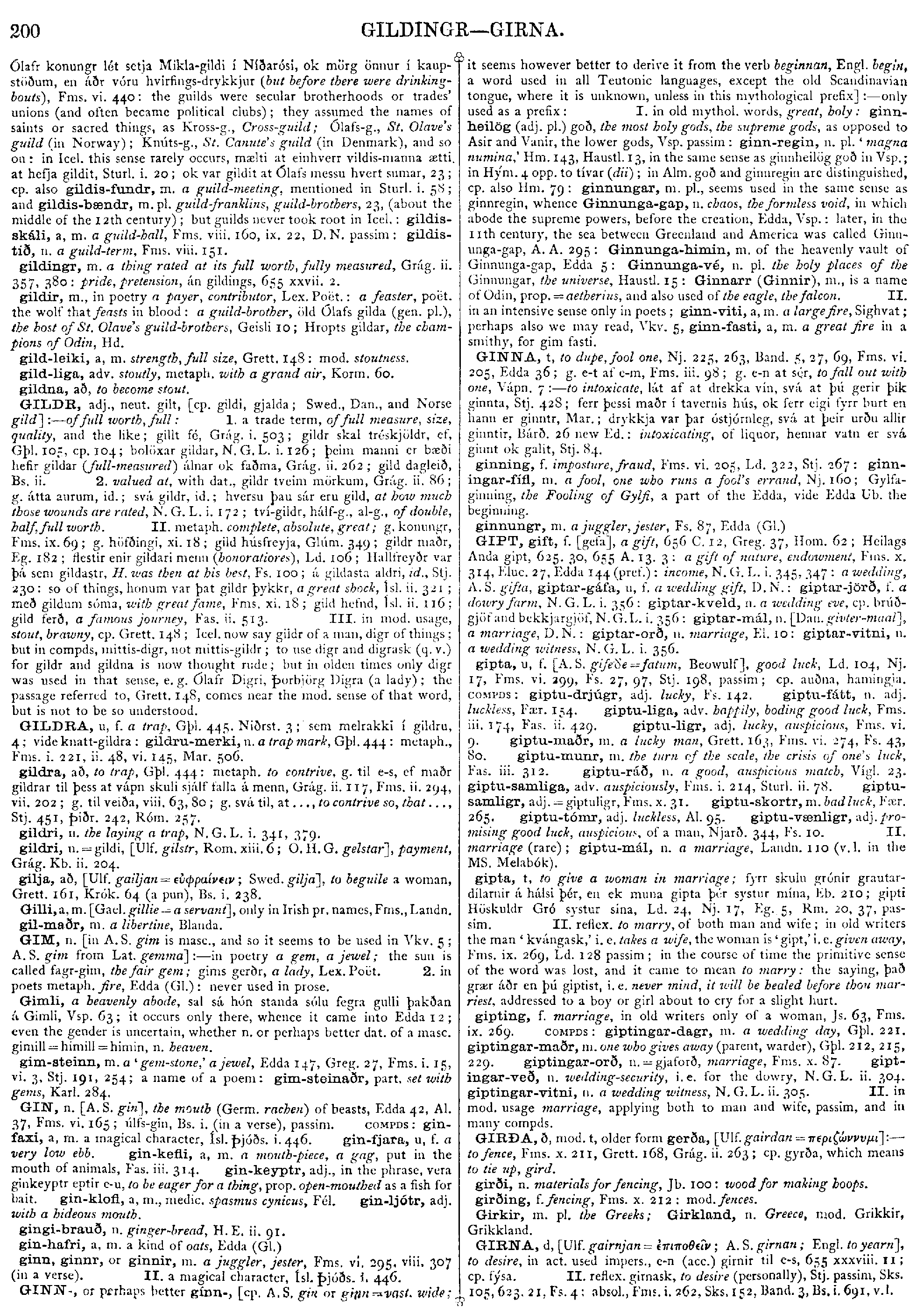
GILDR, adj., neut. gilt, [cp. gildi, gjalda; Swed., Dan., and Norse gild] :-- of full worth, full: 1. a trade term, of full measure, size, quality, and the like; gillt fé, Grág. i. 503; gildr skal tréskjöldr, ef, Gþl. 105, cp. 104; bolöxar gildar, N.G.L. i. 126; þeim manni er bæði hefir gildar (full-measured) álnar ok faðma, Grág. ii. 262; gild dagleið, Bs. ii. 2. valued at, with dat., gildr tveim mörkum, Grág. ii. 86; g. átta aurum, id.; svá gildr, id.; hversu þau sár eru gild, at how much those wounds are rated, N.G.L. i. 172; tví-gildr, hálf-g., al-g., of double, half, full worth. II. metaph. complete, absolute, great; g. konungr, Fms. ix. 69; g. höfðingi, xi. 18; gild húsfreyja, Glúm. 349; gildr maðr, Eg. 182; flestir enir gildari menn (honoratiores), Ld. 106; Hallfreyðr var þá sem gildastr, H. was then at his best, Fs. 100; á gildasta aldri, id., Stj. 230: so of things, honum var þat gildr þykkr, a great shock, Ísl. ii. 321; með gildum sóma, with great fame, Fms. xi. 18; gild hefnd, Ísl. ii. 116; gild ferð, a famous journey, Fas. ii. 513. III. in mod. usage, stout, brawny, cp. Grett. 148; Icel. now say gildr of a man, digr of things; but in compds, mittis-digr, not mittis-gildr; to use digr and digrask (q.v.) for gildr and gildna is now thought rude; but in olden times only digr was used in that sense, e.g. Ólafr Digri, Þorbjörg Digra (a lady); the passage referred to, Grett. 148, comes near the mod. sense of that word, but is not to be so understood.
|
Source: Cleasby/Vigfusson, page b0223, entry 37 View original page image as: [TIFF] [PNG] [View previous entry] [View next entry] |
[Comment on this entry] [View comments] |
The following entry has been hand-corrected once. |
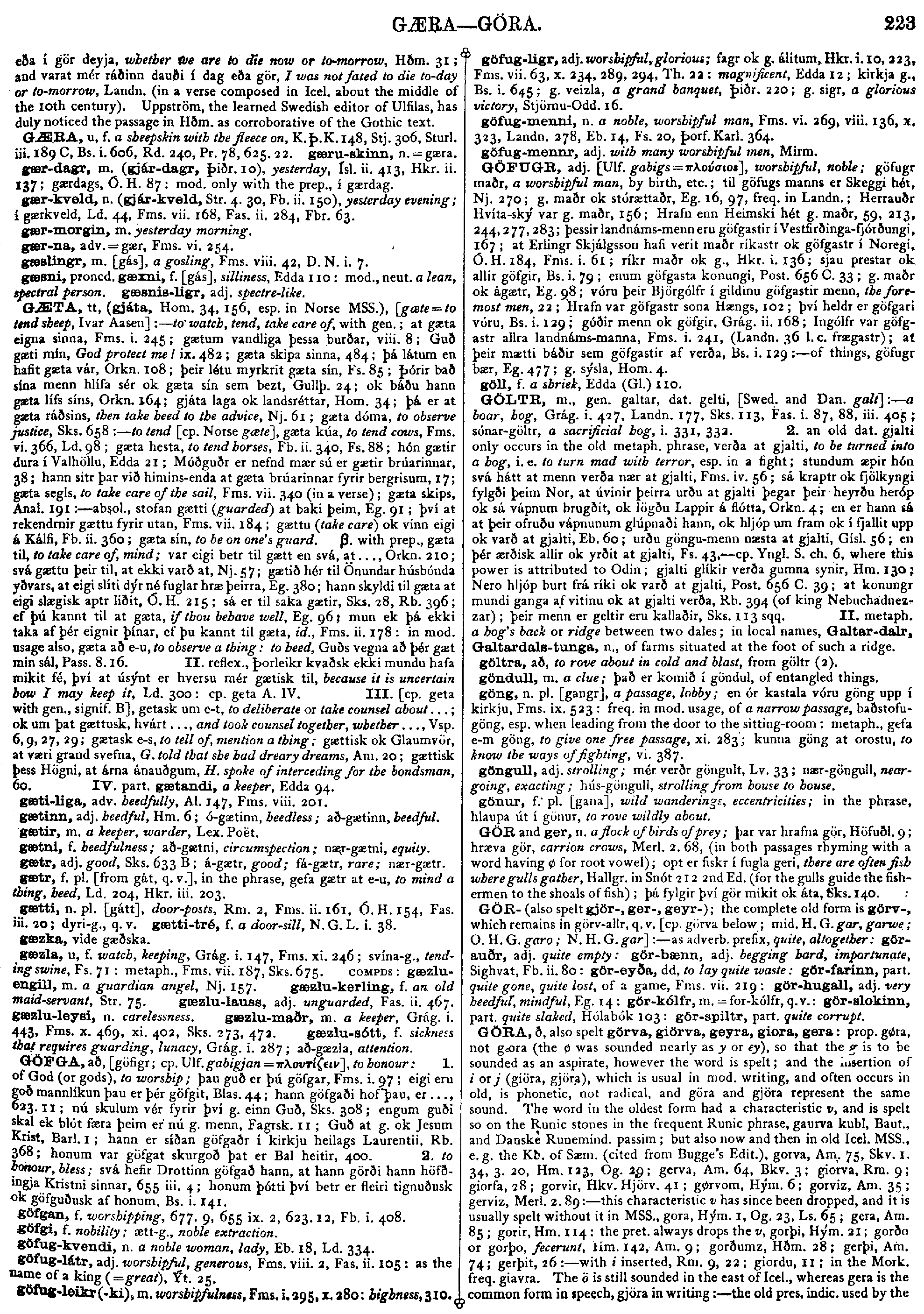
GÖR- (also spelt gjör-, ger-, geyr-); the complete old form is görv-, which remains in görv-allr, q.v. [cp. görva below; mid. H. G. gar, garwe; O. H. G. garo; N. H. G. gar] :-- as adverb. prefix, quite, altogether: gör-auðr, adj. quite empty: gör-bænn, adj. begging hard, importunate, Sighvat, Fb. ii. 80: gör-eyða, dd, to lay quite waste: gör-farinn, part. quite gone, quite lost, of a game, Fms. vii. 219: gör-hugall, adj. very heedful, mindful, Eg. 14: gör-kólfr, m. = for-kólfr, q.v.: gör-slokinn, part. quite slaked, Hólabók 103: gör-spiltr, part. quite corrupt.
|
Source: Cleasby/Vigfusson, page b0332, entry 14 View original page image as: [TIFF] [PNG] [View previous entry] [View next entry] |
[Comment on this entry] [View comments] |
The following entry has been hand-corrected once. |
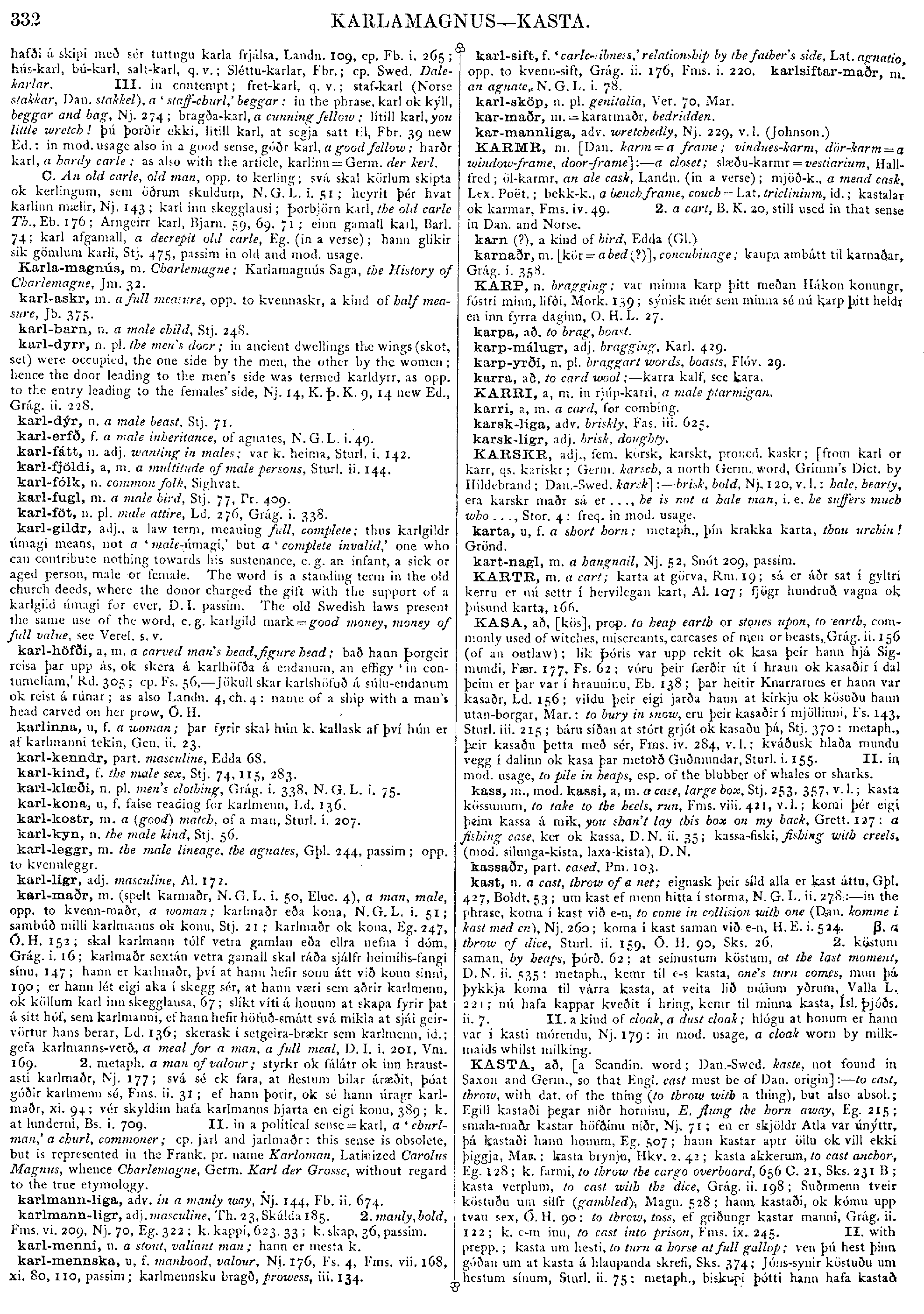
karl-gildr, adj., a law term, meaning full, complete; thus karlgildr úmagi means, not a 'male-úmagi,' but a 'complete invalid,' one who can contribute nothing towards his sustenance, e.g. an infant, a sick or aged person, male or female. The word is a standing term in the old church deeds, where the donor charged the gift with the support of a karlgild úmagi for ever, D. I. passim. The old Swedish laws present the same use of the word, e.g. karlgild mark = good money, money of full value, see Verel. s.v.
|
Source: Cleasby/Vigfusson, page b0418, entry 33 View original page image as: [TIFF] [PNG] [View previous entry] [View next entry] |
[Comment on this entry] [View comments] |
The following entry has been hand-corrected once. |
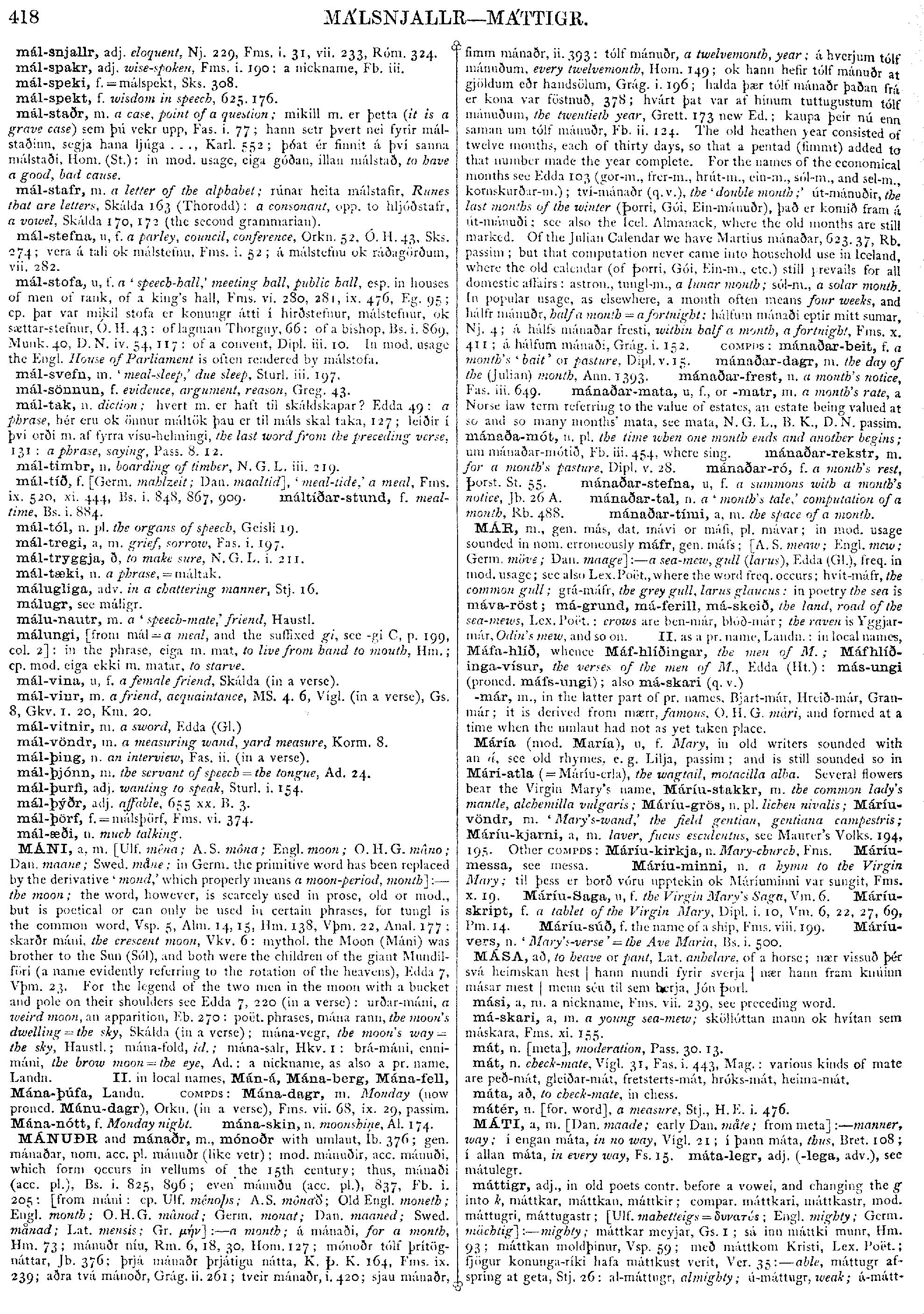
MÁNUÐR, and mánaðr, m., mónoðr with umlaut, Íb. 376; gen. mánaðar, nom. acc. pl. mánuðr (like vetr); mod. mánuðir, acc. mánuði, which form occurs in vellums of the 15th century; thus, mánaði (acc. pl.), Bs. i. 825, 896; even mánuðu (acc. pl.), 837, Fb. i. 205: [from máni: cp. Ulf. mênoþs; A.S. mônað; Old Engl. moneth; Engl. month; O.H.G. mânod; Germ. monat; Dan. maaned; Swed. månad; Lat. mensis; Gr. GREEK] :-- a month; á mánaði, for a month, Hm. 73; mánuðr níu, Rm. 6, 18, 30, Hom. 127; mónoðr tólf þritög-náttar, Jb. 376; þrjá mánaðr þrjátigu nátta, K.Þ.K. 164, Fms. ix. 239; aðra tvá mánoðr, Grág. ii. 261; tveir mánaðr, i. 420; sjau mánaðr, fimm mánaðr, ii. 393: tólf mánuðr, a twelvemonth, year; á hverjum tólf mánuðum, every twelvemonth, Hom. 149; ok hann hefir tólf mánuðr at gjöldum eðr handsölum, Grág. i. 196; halda þær tólf mánaðr þaðan frá er kona var föstnuð, 378; hvárt þat var af hinum tuttugustum tólf mánuðum, the twentieth year, Grett. 173 new Ed.; kaupa þeir nú enn saman um tólf mánuðr, Fb. ii. 124. The old heathen year consisted of twelve months, each of thirty days, so that a pentad (fimmt) added to that number made the year complete. For the names of the economical months see Edda 103 (gor-m., frer-m., hrút-m., ein-m., sól-m., and sel-m., kornskurðar-m.); tví-mánaðr (q.v.), the 'double month;' út-mánuðir, the last months of the winter (of Þorri, Gói, Ein-mánuðr), það er komið fram á út-mánuði; see also the Icel. Almanack, where the old months are still marked. Of the Julian Calendar we have Martius mánaðar, 623. 37, Rb. passim; but that computation never came into household use in Iceland, where the old calendar (of Þorri, Gói, Ein-m., etc.) still prevails for all domestic affairs: astron., tungl-m., a lunar month; sól-m., a solar month. In popular usage, as elsewhere, a month often means four weeks, and hálfr mánuðr, half a month = a fortnight; hálfum mánaði eptir mitt sumar, Nj. 4; á hálfs mánaðar fresti, within half a month, a fortnight, Fms. x. 411; á hálfum mánaði, Grág. i. 152. COMPDS: mánaðar-beit, f. a month's 'bait' or pasture, Dipl. v. 15. mánaðar-dagr, m. the day of the (Julian) month, Ann. 1393. mánaðar-frest, n. a month's notice, Fas. iii. 649. mánaðar-mata, u, f., or -matr, m. a month's rate, a Norse law term referring to the value of estates, an estate being valued at so and so many months' mata, see mata, N.G.L., B.K., D.N. passim. mánaða-mót, n. pl. the time when one month ends and another begins; um mánaðar-mótið, Fb. iii. 454, where sing. mánaðar-rekstr, m. for a month's pasture, Dipl. v. 28. mánaðar-ró, f. a month's rest, Þorst. St. 55. mánaðar-stefna, u, f. a summons with a month's notice, Jb. 26 A. mánaðar-tal, n. a 'month's tale,' computation of a month, Rb. 488. mánaðar-tími, a, m. the space of a month.
| Result Page: |  |
Previous | 1 2 3 4 5 6 7 8 | Next |  |
Germanic Lexicon Project (main page)
This search system was written by
Sean Crist
Please consider
volunteering
to correct the data in these online dictionaries.
No rights reserved. Feel free to use these data in any way you please.