|
|

Tip: In the search results, you can click on any word or abbreviation for more information.
|
Source: Cleasby/Vigfusson, page b0041, entry 131 View original page image as: [TIFF] [PNG] [View previous entry] [View next entry] |
[Comment on this entry] [View comments] |
The following entry has been hand-corrected once. |
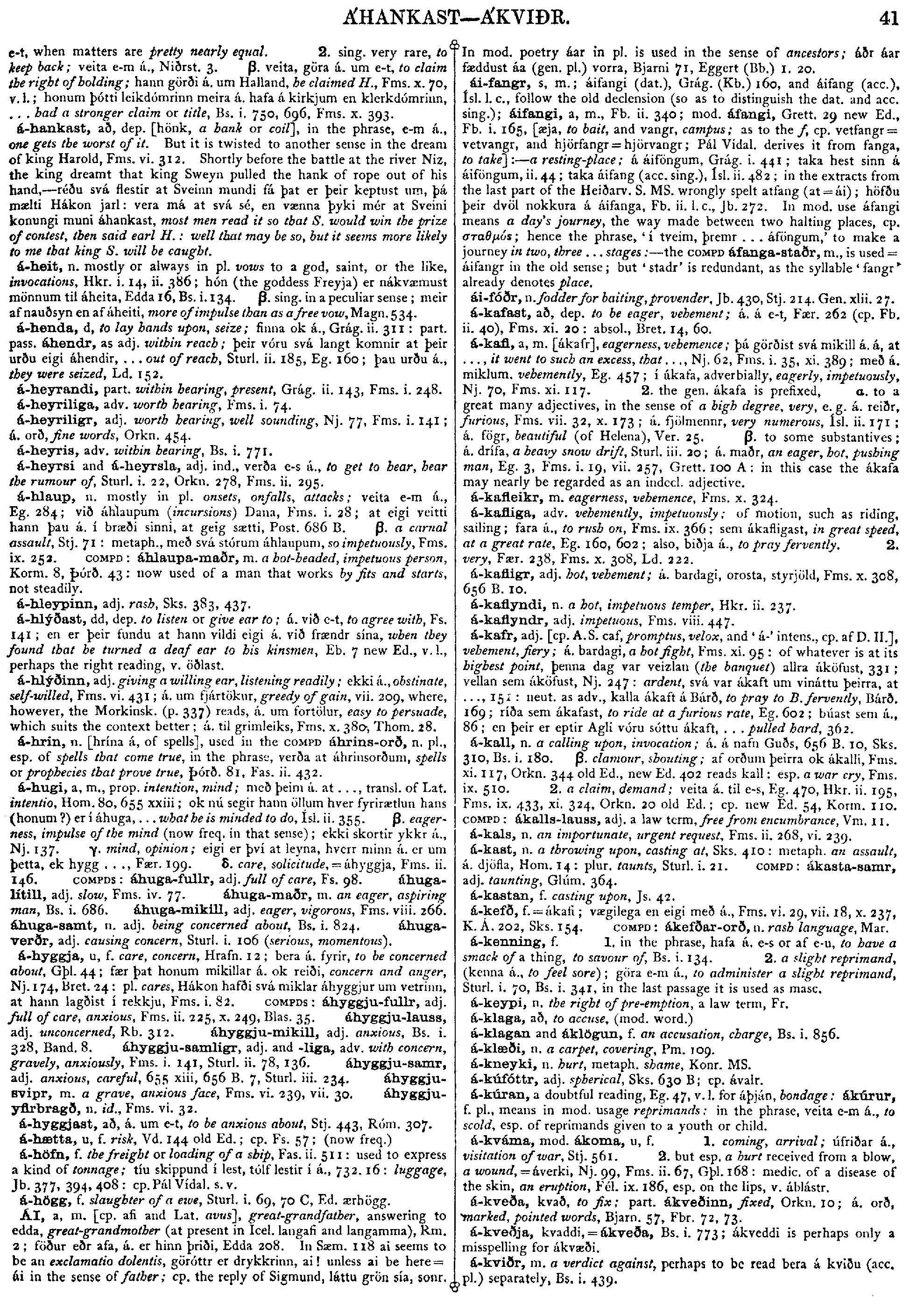
ÁR, n. [Goth. jêr; A. S. gear; Engl. year; Germ. jabr; the Scandin. idioms all drop the j, as in ungr, young; cp. also the Gr. GREEK; Lat. hora; Ulf. renders not only GREEK but also sometimes GREEK and GREEK by jêr]. I. a year, = Lat. annus, divided into twelve lunar months, each of 30 days, with four intercalary days, thus making 364 days; as the year was reckoned about the middle of the 10th century (the original calculation probably only reckoned 360 days, and made up the difference by irregular intercalary months). About the year 960 Thorstein Surt introduced the sumarauki (intercalary week), to be inserted every seventh year, thus bringing the year up to 365 days. After the introduction of Christianity (A. D. 1000) the sumarauki was made to harmonize with the Julian calendar; but from A. D. 1700 with the Gregorian calendar; v. the words sumarauki, hlaupár, mánuðr, vika, etc., Íb. ch. 4, Rb. 6, Fms. i. 67; telja árum, to count the time by years, Vsp. 6; í ári, used adverb., at present, as yet, Ó. H. 41, 42 (in a verse). II. = Lat. annona, plenty, abundance, fruitfulness; the phrase, friðr ok ár, Fms. vii. 174, Hkr. Yngl. ch. 8-12; ár ok fésæla, Hkr. l. c.; þá var ár urn öll lönd, id.; létu hlaða skip mörg af korni ok annarri gæzku, ok flytja svá ár í Dan- mörku, Fms. xi. 8, Sks. 323, Fas. i. 526, Hom. 68; gott ár, Eg. 39; blota til árs, Fms. i. 34. III. the name of the Rune RUNE (a), Skálda 176; in the A. S. and Goth. Runes the j has the name jêr, gêr, according to the Germ. and Engl. pronunciation of this word; vide p. 2, col. 1. COMPDS: ára-tal, n. and ára-tala, u, f. number of years; fimtugr at áratali, Stj. 110, Rb. 484, Mar. 656 A. i. 29; hann (Ari Frodi) hafði áratal fyrst til þess er Kristni kom á Ísland, en síðan allt til sinna daga, Hkr. (pref.), seems to mean that Ari in respect of chronology divided his Íslendingabók into two periods, that before and that after the introduction of Christianity; Stj. 112 (periode). árs-bót, f. = árbót, Bs. i. 343, q. v.
|
Source: Cleasby/Vigfusson, page b0292, entry 23 View original page image as: [TIFF] [PNG] [View previous entry] [View next entry] |
[Comment on this entry] [View comments] |
The following entry has been hand-corrected once. |
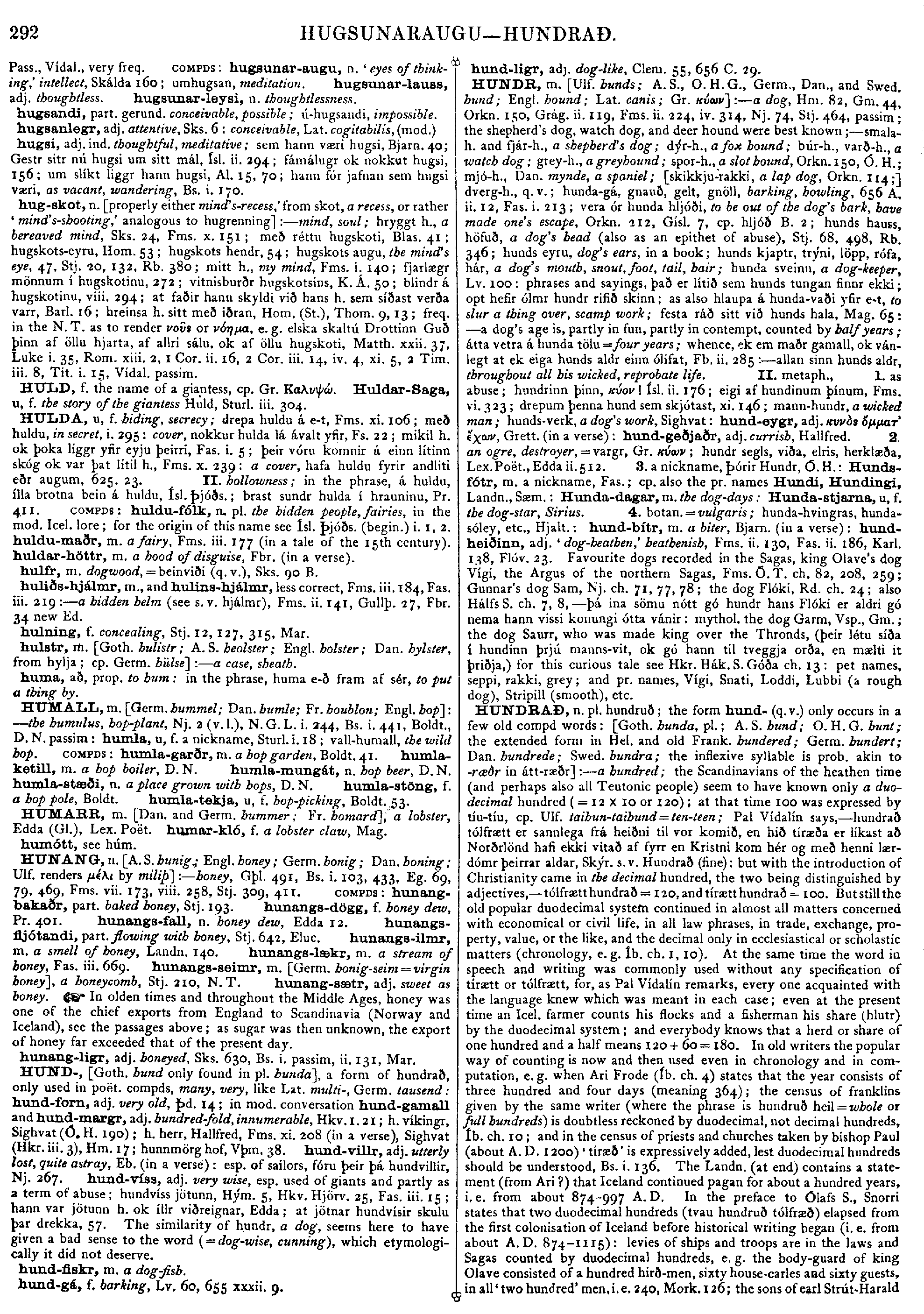
HUNDRAÐ, n. pl. hundruð; the form hund- (q.v.) only occurs in a few old compd words: [Goth. hunda, pl.; A. S. hund; O. H. G. hunt; the extended form in Hel. and old Frank, hundered; Germ. hundert; Dan. hundrede; Swed. hundra; the inflexive syllable is prob. akin to -ræðr in átt-ræðr] :-- a hundred; the Scandinavians of the heathen time (and perhaps also all Teutonic people) seem to have known only a duo-decimal hundred ( = 12 × 10 or 120); at that time 100 was expressed by tíu-tíu, cp. Ulf. taihun-taihund = ten-teen; Pal Vídalín says, -- hundrað tólfrætt er sannlega frá heiðni til vor komið, en hið tíræða er líkast að Norðrlönd hafi ekki vitað af fyrr en Kristni kom hér og með henni lærdómr þeirrar aldar, Skýr. s.v. Hundrað (fine): but with the introduction of Christianity came in the decimal hundred, the two being distinguished by adjectives, -- tólfrætt hundrað = 120, and tírætt hundrað = 100. But still the old popular duodecimal system continued in almost all matters concerned with economical or civil life, in all law phrases, in trade, exchange, property, value, or the like, and the decimal only in ecclesiastical or scholastic matters (chronology, e.g. Íb. ch. 1, 10). At the same time the word in speech and writing was commonly used without any specification of tírætt or tólfrætt, for, as Pal Vídalín remarks, every one acquainted with the language knew which was meant in each case; even at the present time an Icel. farmer counts his flocks and a fisherman his share (hlutr) by the duodecimal system; and everybody knows that a herd or share of one hundred and a half means 120 + 60 = 180. In old writers the popular way of counting is now and then used even in chronology and in computation, e.g. when Ari Frode (Íb. ch. 4) states that the year consists of three hundred and four days (meaning 364); the census of franklins given by the same writer (where the phrase is hundruð heil = whole or full hundreds) is doubtless reckoned by duodecimal, not decimal hundreds, Íb. ch. 10; and in the census of priests and churches taken by bishop Paul (about A.D. 1200) 'tíræð' is expressively added, lest duodecimal hundreds should be understood, Bs. i. 136. The Landn. (at end) contains a statement (from Ari?) that Iceland continued pagan for about a hundred years, i.e. from about 874-997 A.D. In the preface to Ólafs S., Snorri states that two duodecimal hundreds (tvau hundruð tólfræð) elapsed from the first colonisation of Iceland before historical writing began (i.e. from about A.D. 874-1115): levies of ships and troops are in the laws and Sagas counted by duodecimal hundreds, e.g. the body-guard of king Olave consisted of a hundred hirð-men, sixty house-carles and sixty guests, in all 'two hundred' men, i.e. 240, Mork. 126; the sons of earl Strút-Harald
|
Source: Cleasby/Vigfusson, page b0406, entry 2 View original page image as: [TIFF] [PNG] [View previous entry] [View next entry] |
[Comment on this entry] [View comments] |
The following entry has not been hand-corrected. However, the page is reserved and someone is correcting it. |
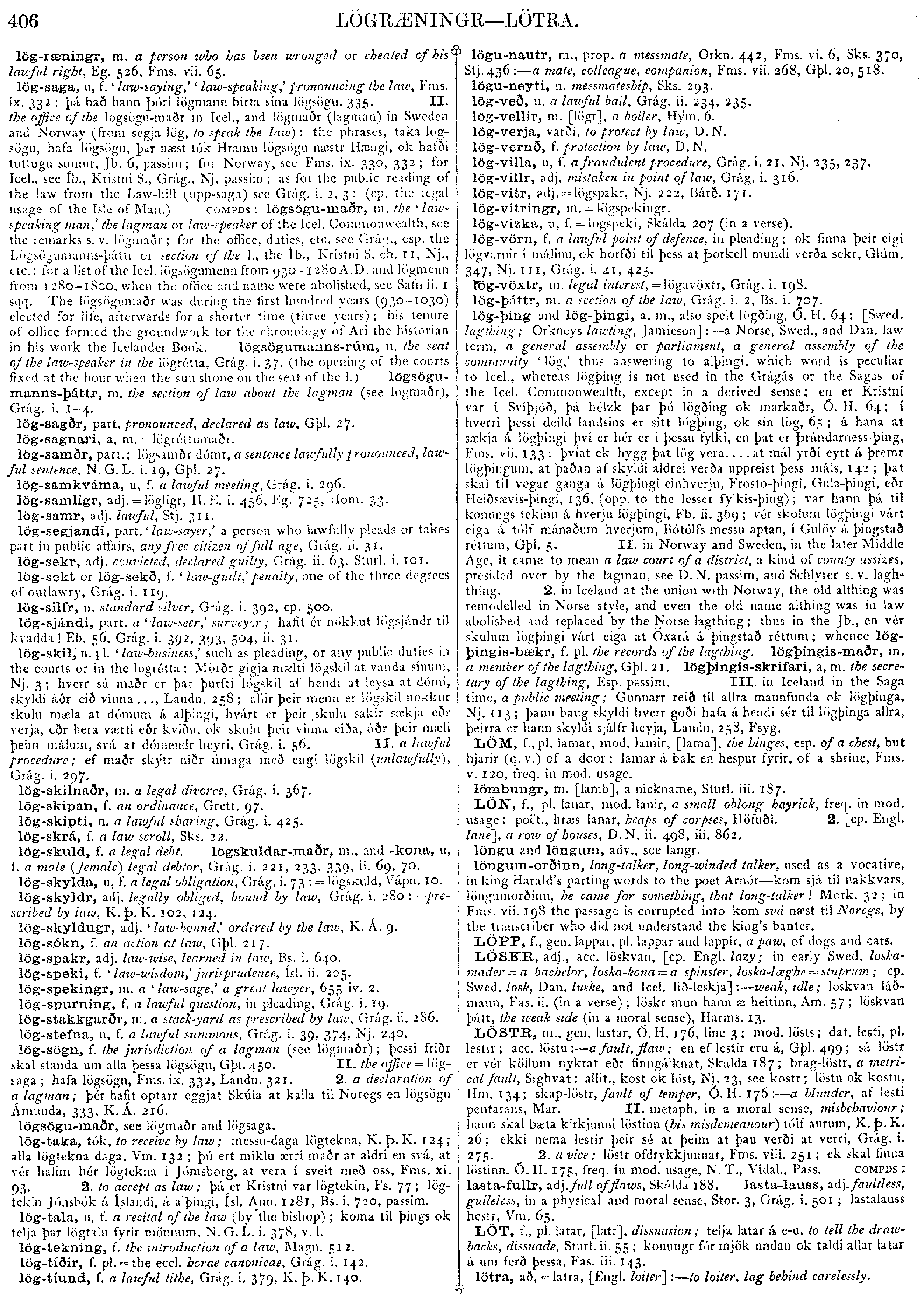
lög-saga, u, f. ' law-saying'' law-speaking, ' pronouncing /he laiu, Fms. ix. 332; þá bað hann þóri lögmann birta sina lögsögu, 335. II. the office of the lögsögu-rnaðr in Icel., and lögmaðr (lagman) in Sweden and Norway (from segja log, to speak the law): the phrases, taka log- sögu, hafa logsugu, þar næst tók Hramn lügsiigu næstr Hængi, ok hafði tuttugu suniur, Jb. 6, passim; for Norway, see Fms. ix. 330, 332; for IceL, see íb., Kristni S., Grág., Nj. passim; as for the public reading of the law from the Law-lull (upp-saga) see Grág. i. 2, 3: (op. the legal usage of the Isle of Man.) COMPDS: lögsögu-rnaðr, m. ike ' law- speaking man, ' the lagman or law-r-penker of the Icel. Commonwealth, see the remarks s. v. lí'gmaðr; for the office, duties, etc. see Grág., esp. the L("(gsÍ!gumanns-þúttr or section rf the ., the tb., Kristni S. ch. II, Nj., etc.; for a list of the Icel. lögsó'gumenn from 930 -1280 A. D. and logmenn from í 280-1800, when the oliice and name were abolished, see Safn ii. I sqq. The liigsí. tgiïinaðr was during the first hundred years (930-1030) elected for life, afterwards for a shorter time (three years); his tenure of oilice formed the groundwork for the chronology of Ari the historian in his work the Icelander Book. lögsögumanns-rúm., n. the seat of the law-speaker in the Kigrótta, Grág. i. 37, (the opening of the courts fixed at the hour when the sun shone on the seat of the 1.) lögsögu- inanns-þáttr, m. the section of law about the lagman (see lognwðr), Grág. i. 1-4.
|
Source: Cleasby/Vigfusson, page b0630, entry 1 View original page image as: [TIFF] [PNG] [View previous entry] [View next entry] |
[Comment on this entry] [View comments] |
The following entry has been hand-corrected once. |
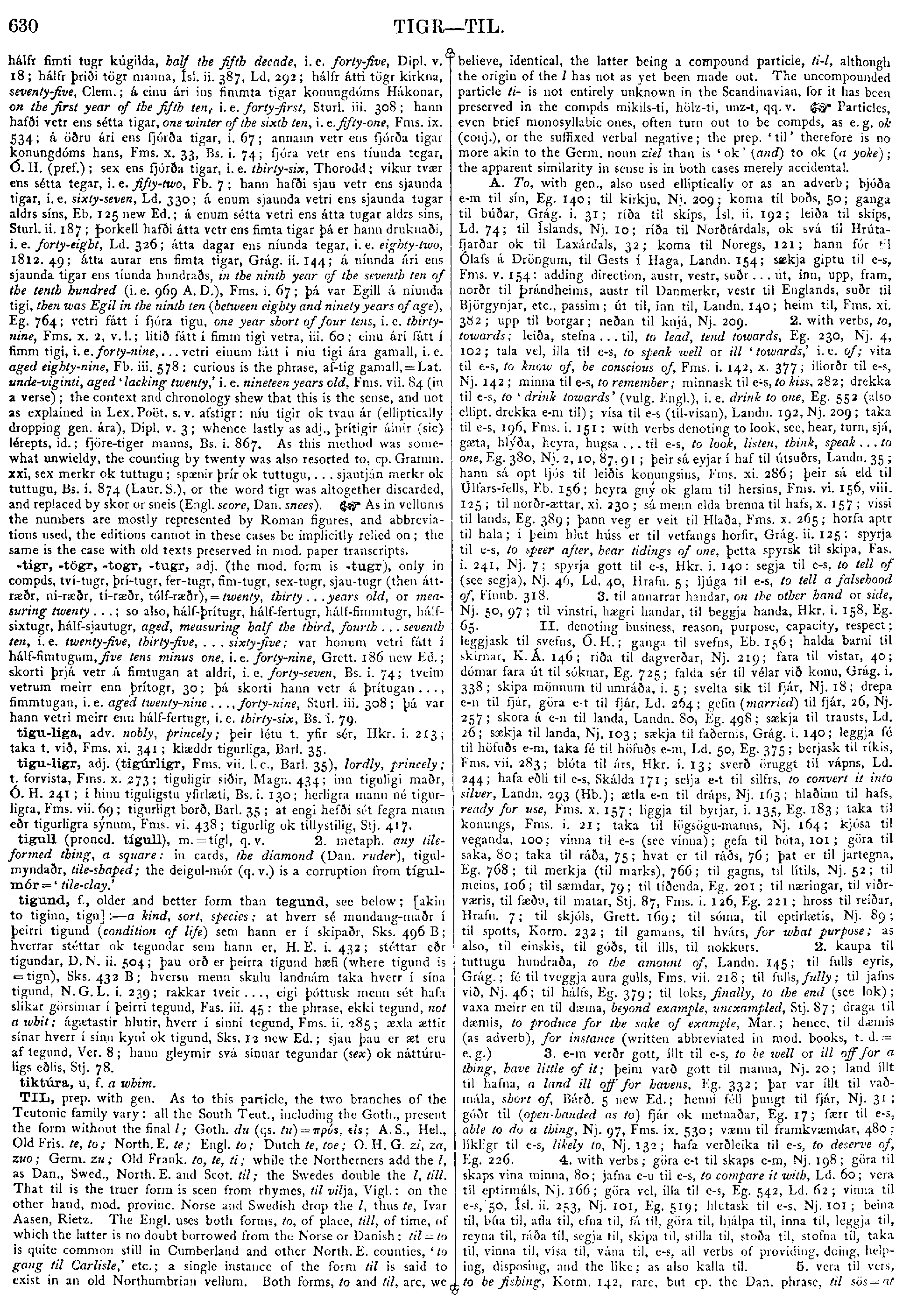
hálfr fimti tugr kúgilda, half the fifth decade, i.e. forty-five, Dipl. v. 18; hálfr þriði tögr manna, Ísl. ii. 387, Ld. 292; hálfr átti tögr kirkna, seventy-five, Clem.; á einu ári ins fimmta tigar konungdóms Hákonar, on the first year of the fifth ten, i.e. forty-first, Sturl. iii. 308; hann hafði vetr ens sétta tigar, one winter of the sixth ten, i.e. fifty-one, Fms. ix. 534; á öðru ári ens fjórða tigar, i. 67; annann vetr ens fjórða tigar konungdóms hans, Fms. x. 33, Bs. i. 74; fjóra vetr ens tíunda tegar, Ó.H. (pref.); sex ens fjórða tigar, i.e. thirty-six, Thorodd; vikur tvær ens sétta tegar, i.e. fifty-two, Fb. 7; hann hafði sjau vetr ens sjaunda tigar, i.e. sixty-seven, Ld. 330; á enum sjaunda vetri ens sjaunda tugar aldrs síns, Eb. 125 new Ed.; á enum sétta vetri ens átta tugar aldrs síns, Sturl. ii. 187; Þorkell hafði átta vetr ens fimta tigar þá er hann druknaði, i.e. forty-eight, Ld. 326; átta dagar ens níunda tegar, i.e. eighty-two, 1812. 49; átta aurar ens fimta tigar, Grág. ii. 144; á níunda ári ens sjaunda tigar ens tíunda hundraðs, in the ninth year of the seventh ten of the tenth hundred (i.e. 969 A.D.), Fms. i. 67; þá var Egill á níunda tigi, then was Egil in the ninth ten (between eighty and ninety years of age), Eg. 764; vetri fátt í fjóra tigu, one year short of four tens, i.e. thirty-nine, Fms. x. 2, v.l.; lítið fátt í fimm tigi vetra, iii. 60; einu ári fátt í fimm tigi, i.e. forty-nine, ... vetri einum fátt í níu tigi ára gamall, i.e. aged eighty-nine, Fb. iii. 578: curious is the phrase, af-tig gamall, = Lat. unde-viginti, aged 'lacking twenty,' i.e. nineteen years old, Fms. vii. 84 (in a verse); the context and chronology shew that this is the sense, and not as explained in Lex. Poët. s.v. afstigr: níu tigir ok tvau ár (elliptically dropping gen. ára), Dipl. v. 3; whence lastly as adj., þrítigir álnir (sic) lérepts, id.; fjöre-tiger manns, Bs. i. 867. As this method was somewhat unwieldy, the counting by twenty was also resorted to, cp. Gramm. xxi, sex merkr ok tuttugu; spænir þrír ok tuttugu, ... sjautján merkr ok tuttugu, Bs. i. 874 (Laur. S.), or the word tigr was altogether discarded, and replaced by skor or sneis (Engl. score, Dan. snees). &FINGER; As in vellums the numbers are mostly represented by Roman figures, and abbreviations used, the editions cannot in these cases be implicitly relied on; the same is the case with old texts preserved in mod. paper transcripts.
|
Source: Cleasby/Vigfusson, page b0634, entry 7 View original page image as: [TIFF] [PNG] [View previous entry] [View next entry] |
[Comment on this entry] [View comments] |
The following entry has been hand-corrected once. |
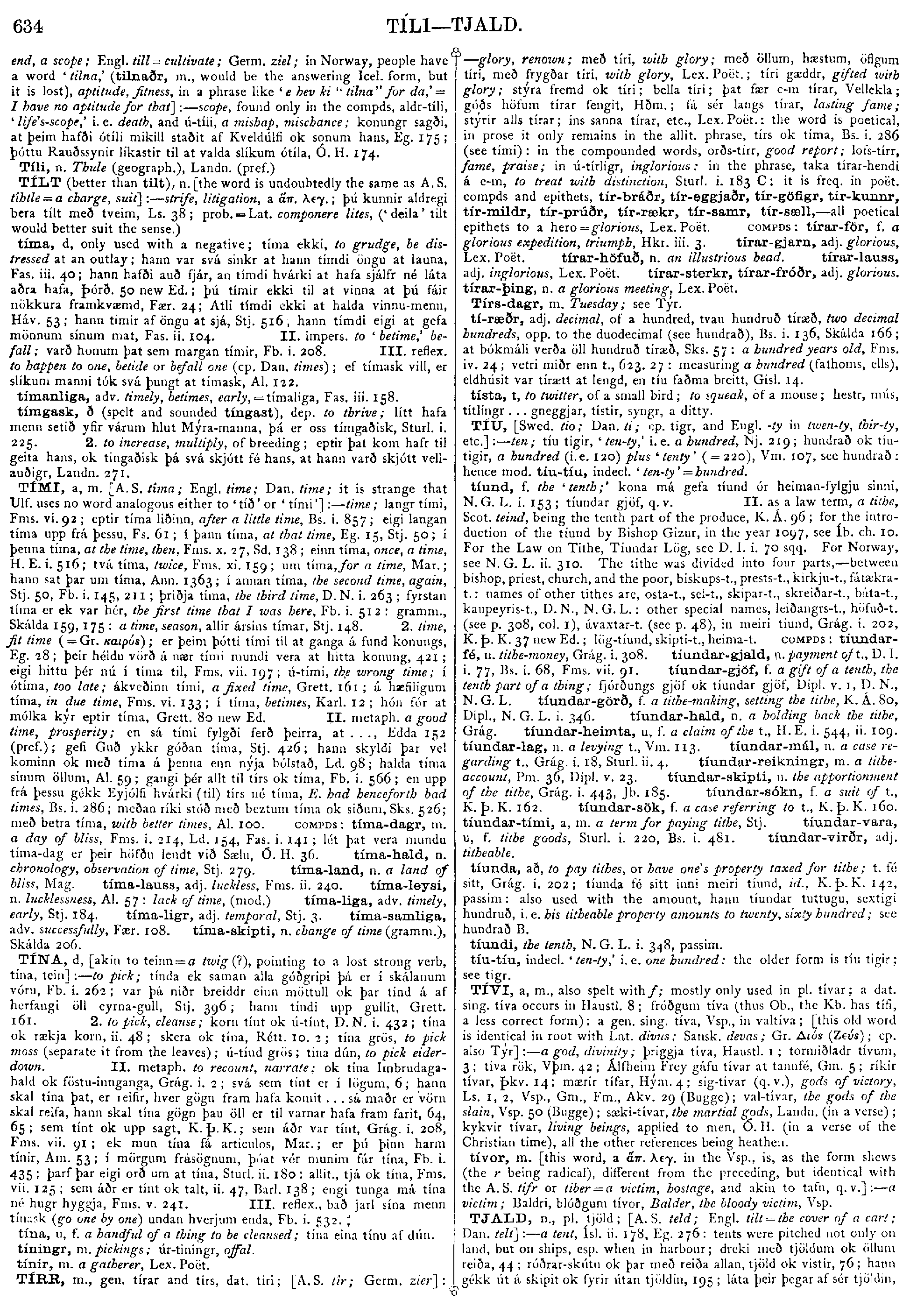
TÍMI, a, m. [A.S. tîma; Engl. time; Dan. time; it is strange that Ulf. uses no word analogous either to 'tíð' or 'tími'] :-- time; langr tími, Fms. vi. 92; eptir tíma liðinn, after a little time, Bs. i. 857; eigi langan tíma upp frá þessu, Fs. 61; í þann tíma, at that time, Eg. 15, Stj. 50; í þenna tíma, at the time, then, Fms. x. 27, Sd. 138; einn tíma, once, a time, H.E. i. 516; tvá tíma, twice, Fms. xi. 159; um tíma, for a time, Mar.; hann sat þar um tíma, Ann. 1363; í annan tíma, the second time, again, Stj. 50, Fb. i. 145, 211; þriðja tíma, the third time, D.N. i. 263; fyrstan tíma er ek var hér, the first time that I was here, Fb. i. 512: gramm., Skálda 159, 175; a time, season, allir ársins tímar, Stj. 148. 2. time, fit time (= Gr. GREEK); er þeim þótti tími til at ganga á fund konungs, Eg. 28; þeir héldu vörð á nær tími mundi vera at hitta konung, 421; eigi hittu þér nú í tíma til, Fms. vii. 197; ú-tími, the wrong time; í ótíma, too late; ákveðinn tími, a fixed time, Grett. 161; á hæfiligum tíma, in due time, Fms. vi. 133; í tíma, betimes, Karl. 12; hón fór at mólka kýr eptir tíma, Grett. 80 new Ed. II. metaph. a good time, prosperity; en sá tími fylgði ferð þeirra, at ..., Edda 152 (pref.); gefi Guð ykkr góðan tíma, Stj. 426; hann skyldi þar vel kominn ok með tíma á þenna enn nýja bólstað, Ld. 98; halda tíma sínum öllum, Al. 59; gangi þér allt til tírs ok tíma, Fb. i. 566; en upp frá þessu gékk Eyjólfi hvárki (til) tírs né tíma, E. had henceforth bad times, Bs. i. 286; meðan ríki stóð með beztum tíma ok siðum, Sks. 526; með betra tíma, with better times, Al. 100. COMPDS: tíma-dagr, m. a day of bliss, Fms. i. 214, Ld. 154, Fas. i. 141; lét þat vera mundu tíma-dag er þeir höfðu lendt við Sælu, Ó.H. 36. tíma-hald, n. chronology, observation of time, Stj. 279. tíma-land, n. a land of bliss, Mag. tíma-lauss, adj. luckless, Fms. ii. 240. tíma-leysi, n. lucklessness, Al. 57: lack of time, (mod.) tíma-liga, adv. timely, early, Stj. 184. tíma-ligr, adj. temporal, Stj. 3. tíma-samliga, adv. successfully, Fær. 108. tíma-skipti, n. change of time (gramm.), Skálda 206.
|
Source: Cleasby/Vigfusson, page b0736, entry 4 View original page image as: [TIFF] [PNG] [View previous entry] [View next entry] |
[Comment on this entry] [View comments] |
The following entry has been hand-corrected once. |
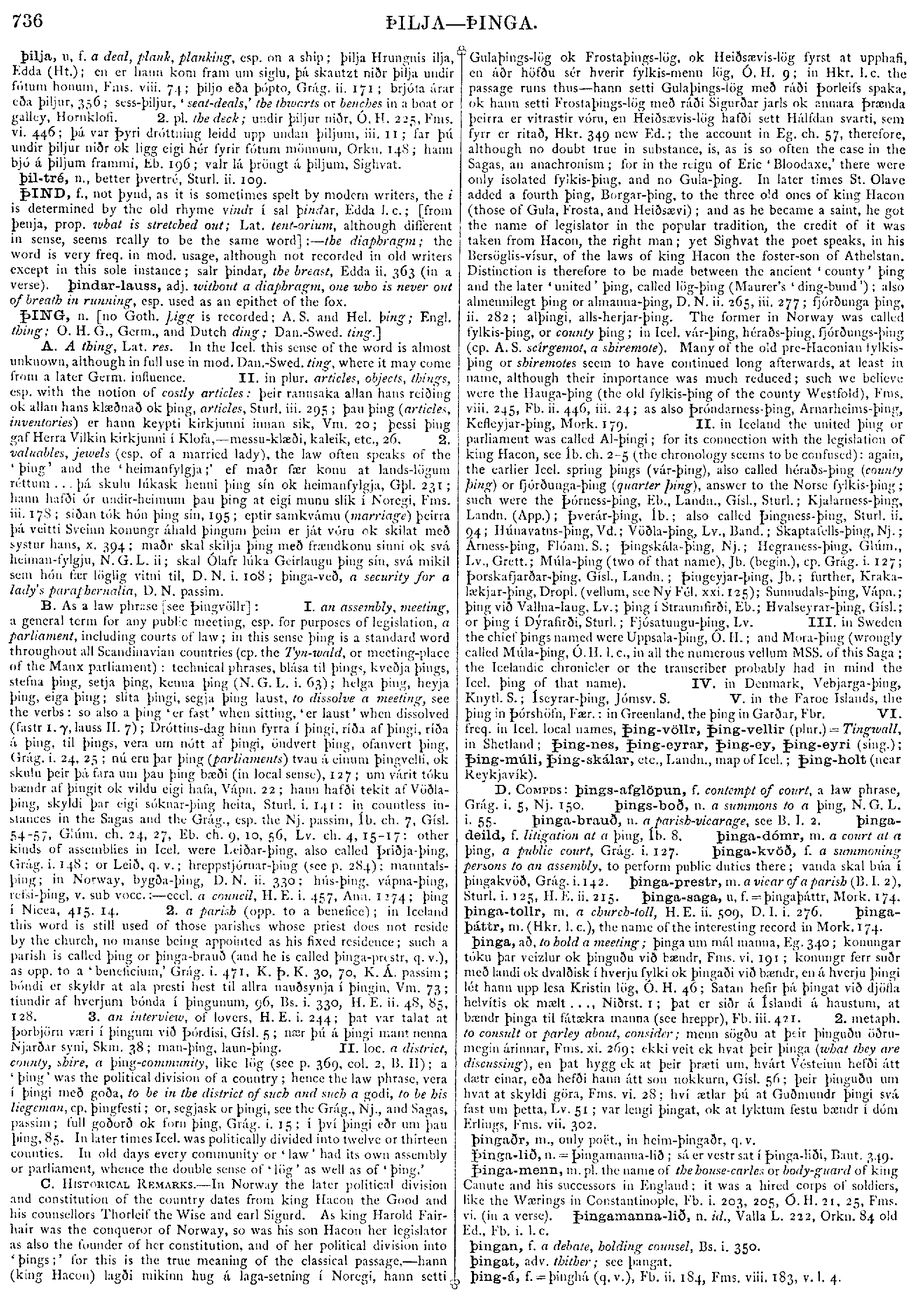
ÞING,
n.
[no
Goth.
þigg
is
recorded;
A.S.
and
Hel.
þing;
Engl.
thing;
O.H.G.,
Germ.,
and
Dutch
ding;
Dan.-Swed.
ting]
A.
A
thing,
Lat.
res.
In
the
Icel.
this
sense
of
the
word
is
almost
unknown,
although
in
full
use
in
mod.
Dan.-Swed.
ting,
where
it
may
come
from
a
later
Germ.
influence.
II.
in
plur.
articles,
objects,
things,
esp.
with
the
notion
of
costly
articles:
þeir
rannsaka
allan
hans
reiðing
ok
allan
hans
klæðnað
ok
þing,
articles,
Sturl.
iii.
295;
þau
þing
(articles,
inventories)
er
hann
keypti
kirkjunni
innan
sik,
Vm.
20;
þessi
þing
gaf
Herra
Vilkin
kirkjunni
í
Klofa,
--
messu-klæði,
kaleik,
etc.,
26.
2.
valuables,
jewels
(esp.
of
a
married
lady),
the
law
often
speaks
of
the
'þing'
and
the
'heimanfylgja;'
ef
maðr
fær
konu
at
lands-lögum
réttum
...
þá
skulu
lúkask
henni
þing
sín
ok
heimanfylgja,
Gþl.
231;
hann
hafði
ór
undir-heimum
þau
þing
at
eigi
munu
slík
í
Noregi,
Fms.
iii.
178;
siðan
tók
hón
þing
sín,
195;
eptir
samkvámu
(marriage)
þeirra
þá
veitti
Sveinn
konungr
áhald
þingum
þeim
er
ját
vóru
ok
skilat
með
systur
hans,
x.
394;
maðr
skal
skilja
þing
með
frændkonu
sinni
ok
svá
heiman-fylgju,
N.G.L.
ii;
skal
Ólafr
lúka
Geirlaugu
þing
sín,
svá
mikil
sem
hón
fær
löglig
vitni
til,
D.N.
i.
108;
þinga-veð,
a
security
for
a
lady's
paraphernalia,
D.N.
passim.
B.
As
a
law
phrase
[see
Þingvöllr]:
I.
an
assembly,
meeting,
a
general
term
for
any
public
meeting,
esp.
for
purposes
of
legislation,
a
parliament,
including
courts
of
law;
in
this
sense
þing
is
a
standard
word
throughout
all
Scandinavian
countries
(cp.
the
Tyn-wald,
or
meeting-place
of
the
Manx
parliament):
technical
phrases,
blása
til
þings,
kveðja
þings,
stefna
þing,
setja
þing,
kenna
þing
(N.G.L.
i.
63);
helga
þing,
heyja
þing,
eiga
þing;
slíta
þingi,
segja
þing
laust,
to
dissolve
a
meeting,
see
the
verbs:
so
also
a
þing
'er
fast'
when
sitting,
'er
laust'
when
dissolved
(fastr
I.
 ,
lauss
II.
7);
Dróttins-dag
hinn
fyrra
í
þingi,
ríða
af
þingi,
ríða
á
þing,
til
þings,
vera
um
nótt
af
þingi,
öndvert
þing,
ofanvert
þing,
Grág.
i.
24,
25;
nú
eru
þar
þing
(parliaments)
tvau
á
einum
þingvelli,
ok
skulu
þeir
þá
fara
um
þau
þing
bæði
(in
local
sense),
127;
um
várit
tóku
bændr
af
þingit
ok
vildu
eigi
hafa,
Vápn.
22;
hann
hafði
tekit
af
Vöðla-þing,
skyldi
þar
eigi
sóknar-þing
heita,
Sturl.
i.
141:
in
countless
instances
in
the
Sagas
and
the
Grág.,
esp.
the
Nj.
passim,
Íb.
ch.
7,
Gísl.
54-57,
Glúm.
ch.
24,
27,
Eb.
ch.
9,
10,
56,
Lv.
ch.
4,
15-17:
other
kinds
of
assemblies
in
Icel.
were
Leiðar-þing,
also
called
Þriðja-þing,
Grág.
i.
148;
or
Leið,
q.v.;
hreppstjórnar-þing
(see
p.
284);
manntals-þing;
in
Norway,
bygða-þing,
D.N.
ii.
330;
hús-þing,
vápna-þing,
refsi-þing,
v.
sub
vocc.
:--
eccl.
a
council,
H.E.
i.
457,
Ann.
1274;
þing
í
Nicea,
415.
14.
2.
a
parish
(opp.
to
a
benefice);
in
Iceland
this
word
is
still
used
of
those
parishes
whose
priest
does
not
reside
by
the
church,
no
manse
being
appointed
as
his
fixed
residence;
such
a
parish
is
called
þing
or
þinga-brauð
(and
he
is
called
þinga-prestr,
q.v.),
as
opp.
to
a
'beneficium,'
Grág.
i.
471,
K.Þ.K.
30,
70,
K.Á.
passim;
bóndi
er
skyldr
at
ala
presti
hest
til
allra
nauðsynja
í
þingin,
Vm.
73;
tíundir
af
hverjum
bónda
í
þingunum,
96,
Bs.
i.
330,
H.E.
ii.
48,
85,
128.
3.
an
interview,
of
lovers,
H.E.
i.
244;
þat
var
talat
at
Þorbjörn
væri
í
þingum
við
Þórdísi,
Gísl.
5;
nær
þú
á
þingi
mant
nenna
Njarðar
syni,
Skm.
38;
man-þing,
laun-þing.
II.
loc.
a
district,
county,
shire,
a
þing-community,
like
lög
(sec
p.
369,
col.
2,
B.
II);
a
'þing'
was
the
political
division
of
a
country;
hence
the
law
phrase,
vera
í
þingi
með
goða,
to
be
in
the
district
of
such
and
such
a
godi,
to
be
his
liegeman,
cp.
þingfesti;
or,
segjask
or
þingi,
see
the
Grág.,
Nj.,
and
Sagas,
passim;
full
goðorð
ok
forn
þing,
Grág.
i.
15;
í
því
þingi
eðr
um
þau
þing,
85.
In
later
times
Icel.
was
politically
divided
into
twelve
or
thirteen
counties.
In
old
days
every
community
or
'law'
had
its
own
assembly
or
parliament,
whence
the
double
sense
of
'lög'
as
well
as
of
'þing.'
C.
HISTORICAL
REMARKS.
--
In
Norway
the
later
political
division
and
constitution
of
the
country
dates
from
king
Hacon
the
Good
and
his
counsellors
Thorleif
the
Wise
and
earl
Sigurd.
As
king
Harold
Fairhair
was
the
conqueror
of
Norway,
so
was
his
son
Hacon
her
legislator
as
also
the
founder
of
her
constitution,
and
of
her
political
division
into
'þings;'
for
this
is
the
true
meaning
of
the
classical
passage,
--
hann
(king
Hacon)
lasgði
mikinn
hug
á
laga-setning
í
Noregi,
hann
setti
Gulaþings-lög
ok
Frostaþings-lög,
ok
Heiðsævis-lög
fyrst
at
upphafi,
en
áðr
höfðu
sér
hverir
fylkis-menn
lög,
Ó.H.
9;
in
Hkr.
l.c.
the
passage
runs
thus
--
hann
setti
Gulaþings-lög
með
ráði
Þorleifs
spaka,
ok
hann
setti
Frostaþings-lög
með
ráði
Sigurðar
jarls
ok
annara
Þrænda
þeirra
er
vitrastir
vóru,
en
Heiðsævis-lög
hafði
sett
Hálfdan
svarti,
sem
fyrr
er
ritað,
Hkr.
349
new
Ed.;
the
account
in
Eg.
ch.
57,
therefore,
although
no
doubt
true
in
substance,
is,
as
is
so
often
the
case
in
the
Sagas,
an
anachronism;
for
in
the
reign
of
Eric
'Bloodaxe,'
there
were
only
isolated
fylkis-þing,
and
no
Gula-þing.
In
later
times
St.
Olave
added
a
fourth
þing,
Borgar-þing,
to
the
three
old
ones
of
king
Hacon
(those
of
Gula,
Frosta,
and
Heiðsævi);
and
as
he
became
a
saint,
he
got
the
name
of
legislator
in
the
popular
tradition,
the
credit
of
it
was
taken
from
Hacon,
the
right
man;
yet
Sighvat
the
poet
speaks,
in
his
Bersöglis-vísur,
of
the
laws
of
king
Hacon
the
foster-son
of
Athelstan.
Distinction
is
therefore
to
be
made
between
the
ancient
'county'
þing
and
the
later
'united'
þing,
called
lög-þing
(Maurer's
'ding-bund');
also
almennilegt
þing
or
almanna-þing,
D.N.
ii.
265,
iii.
277;
fjórðunga
þing,
ii.
282;
alþingi,
alls-herjar-þing.
The
former
in
Norway
was
called
fylkis-þing,
or
county
þing;
in
Icel.
vár-þing,
héraðs-þing,
fjórðungs-þing
(cp.
A.S.
scîrgemot,
a
shiremote).
Many
of
the
old
pre-Haconian
fylkis-þing
or
shiremotes
seem
to
have
continued
long
afterwards,
at
least
in
name,
although
their
importance
was
much
reduced;
such
we
believe
were
the
Hauga-þing
(the
old
fylkis-þing
of
the
county
Westfold),
Fms.
viii.
245,
Fb.
ii.
446,
iii.
24;
as
also
Þróndarness-þing,
Arnarheims-þing,
Kefleyjar-þing,
Mork.
179.
II.
in
Iceland
the
united
þing
or
parliament
was
called
Al-þingi;
for
its
connection
with
the
legislation
of
king
Hacon,
see
Íb.
ch.
2-5
(the
chronology
seems
to
be
confused):
again,
the
earlier
Icel.
spring
þings
(vár-þing),
also
called
héraðs-þing
(county
þing)
or
fjórðunga-þing
(quarter
þing),
answer
to
the
Norse
fylkis-þing;
such
were
the
Þórness-þing,
Eb.,
Landn.,
Gísl.,
Sturl.;
Kjalarness-þing,
Landn.
(App.);
Þverár-þing,
Íb.;
also
called
Þingness-þing,
Sturl.
ii.
94;
Húnavatns-þing,
Vd.;
Vöðla-þing,
Lv.,
Band.;
Skaptafells-þing,
Nj.;
Árness-þing,
Flóam.
S.;
þingskála-þing,
Nj.;
Hegraness-þing,
Glúm.,
Lv.,
Grett.;
Múla-þing
(two
of
that
name),
Jb.
(begin.),
cp.
Grág.
i.
127;
Þorskafjarðar-þing,
Gísl.,
Landn.;
Þingeyjar-þing,
Jb.;
further,
Krakalækjar-þing,
Dropl.
(vellum,
see
Ny
Fél.
xxi.
125);
Sunnudals-þing,
Vápn.;
þing
við
Vallna-laug,
Lv.;
þing
í
Straumfirði,
Eb.;
Hvalseyrar-þing,
Gísl.;
or
þing
í
Dýrafirði,
Sturl.;
Fjósatungu-þing,
Lv.
III.
in
Sweden
the
chief
þings
named
were
Uppsala-þing,
Ó.H.;
and
Mora-þing
(wrongly
called
Múla-þing,
Ó.H.
l.c.,
in
all
the
numerous
vellum
MSS.
of
this
Saga;
the
Icelandic
chronicler
or
the
transcriber
probably
had
in
mind
the
Icel.
þing
of
that
name).
IV.
in
Denmark,
Vebjarga-þing,
Knytl.
S.;
Íseyrar-þing,
Jómsv.
S.
V.
in
the
Faroe
Islands,
the
þing
in
Þórshöfn,
Fær.:
in
Greenland,
the
þing
in
Garðar,
Fbr.
VI.
freq.
in
Icel.
local
names,
Þing-völlr,
Þing-vellir
(plur.)
=
Tingwall,
in
Shetland;
Þing-nes,
Þing-eyrar,
Þing-ey,
Þing-eyri
(sing.);
Þing-múli,
Þing-skálar,
etc.,
Landn.,
map
of
Icel.;
Þing-holt
(near
Reykjavik).
D.
COMPDS:
þings-afglöpun,
f.
contempt
of
court,
a
law
phrase,
Grág.
i.
5,
Nj.
150.
þings-boð,
n.
a
summons
to
a
þing,
N.G.L.
i.
55.
þinga-brauð,
n.
a
parish-vicarage,
see
B.
I.
2.
þinga-deild,
f.
litigation
at
a
þing,
Íb.
8.
þinga-dómr,
m.
a
court
at
a
þing,
a
public
court,
Grág.
i.
127.
þinga-kvöð,
f.
a
summoning
persons
to
an
assembly,
to
perform
public
duties
there;
vanda
skal
búa
í
þingakvöð,
Grág.
i.
142.
þinga-prestr,
m.
a
vicar
of
a
parish
(B.
I.
2),
Sturl.
i.
125,
H.E.
ii.
215.
þinga-saga,
u,
f.
=
þingaþáttr,
Mork.
174.
þinga-tollr,
m.
a
church-toll,
H.E.
ii.
509,
D.I.
276.
þinga-þáttr,
m.
(Hkr.
l.c.),
the
name
of
the
interesting
record
in
Mork.
174.
,
lauss
II.
7);
Dróttins-dag
hinn
fyrra
í
þingi,
ríða
af
þingi,
ríða
á
þing,
til
þings,
vera
um
nótt
af
þingi,
öndvert
þing,
ofanvert
þing,
Grág.
i.
24,
25;
nú
eru
þar
þing
(parliaments)
tvau
á
einum
þingvelli,
ok
skulu
þeir
þá
fara
um
þau
þing
bæði
(in
local
sense),
127;
um
várit
tóku
bændr
af
þingit
ok
vildu
eigi
hafa,
Vápn.
22;
hann
hafði
tekit
af
Vöðla-þing,
skyldi
þar
eigi
sóknar-þing
heita,
Sturl.
i.
141:
in
countless
instances
in
the
Sagas
and
the
Grág.,
esp.
the
Nj.
passim,
Íb.
ch.
7,
Gísl.
54-57,
Glúm.
ch.
24,
27,
Eb.
ch.
9,
10,
56,
Lv.
ch.
4,
15-17:
other
kinds
of
assemblies
in
Icel.
were
Leiðar-þing,
also
called
Þriðja-þing,
Grág.
i.
148;
or
Leið,
q.v.;
hreppstjórnar-þing
(see
p.
284);
manntals-þing;
in
Norway,
bygða-þing,
D.N.
ii.
330;
hús-þing,
vápna-þing,
refsi-þing,
v.
sub
vocc.
:--
eccl.
a
council,
H.E.
i.
457,
Ann.
1274;
þing
í
Nicea,
415.
14.
2.
a
parish
(opp.
to
a
benefice);
in
Iceland
this
word
is
still
used
of
those
parishes
whose
priest
does
not
reside
by
the
church,
no
manse
being
appointed
as
his
fixed
residence;
such
a
parish
is
called
þing
or
þinga-brauð
(and
he
is
called
þinga-prestr,
q.v.),
as
opp.
to
a
'beneficium,'
Grág.
i.
471,
K.Þ.K.
30,
70,
K.Á.
passim;
bóndi
er
skyldr
at
ala
presti
hest
til
allra
nauðsynja
í
þingin,
Vm.
73;
tíundir
af
hverjum
bónda
í
þingunum,
96,
Bs.
i.
330,
H.E.
ii.
48,
85,
128.
3.
an
interview,
of
lovers,
H.E.
i.
244;
þat
var
talat
at
Þorbjörn
væri
í
þingum
við
Þórdísi,
Gísl.
5;
nær
þú
á
þingi
mant
nenna
Njarðar
syni,
Skm.
38;
man-þing,
laun-þing.
II.
loc.
a
district,
county,
shire,
a
þing-community,
like
lög
(sec
p.
369,
col.
2,
B.
II);
a
'þing'
was
the
political
division
of
a
country;
hence
the
law
phrase,
vera
í
þingi
með
goða,
to
be
in
the
district
of
such
and
such
a
godi,
to
be
his
liegeman,
cp.
þingfesti;
or,
segjask
or
þingi,
see
the
Grág.,
Nj.,
and
Sagas,
passim;
full
goðorð
ok
forn
þing,
Grág.
i.
15;
í
því
þingi
eðr
um
þau
þing,
85.
In
later
times
Icel.
was
politically
divided
into
twelve
or
thirteen
counties.
In
old
days
every
community
or
'law'
had
its
own
assembly
or
parliament,
whence
the
double
sense
of
'lög'
as
well
as
of
'þing.'
C.
HISTORICAL
REMARKS.
--
In
Norway
the
later
political
division
and
constitution
of
the
country
dates
from
king
Hacon
the
Good
and
his
counsellors
Thorleif
the
Wise
and
earl
Sigurd.
As
king
Harold
Fairhair
was
the
conqueror
of
Norway,
so
was
his
son
Hacon
her
legislator
as
also
the
founder
of
her
constitution,
and
of
her
political
division
into
'þings;'
for
this
is
the
true
meaning
of
the
classical
passage,
--
hann
(king
Hacon)
lasgði
mikinn
hug
á
laga-setning
í
Noregi,
hann
setti
Gulaþings-lög
ok
Frostaþings-lög,
ok
Heiðsævis-lög
fyrst
at
upphafi,
en
áðr
höfðu
sér
hverir
fylkis-menn
lög,
Ó.H.
9;
in
Hkr.
l.c.
the
passage
runs
thus
--
hann
setti
Gulaþings-lög
með
ráði
Þorleifs
spaka,
ok
hann
setti
Frostaþings-lög
með
ráði
Sigurðar
jarls
ok
annara
Þrænda
þeirra
er
vitrastir
vóru,
en
Heiðsævis-lög
hafði
sett
Hálfdan
svarti,
sem
fyrr
er
ritað,
Hkr.
349
new
Ed.;
the
account
in
Eg.
ch.
57,
therefore,
although
no
doubt
true
in
substance,
is,
as
is
so
often
the
case
in
the
Sagas,
an
anachronism;
for
in
the
reign
of
Eric
'Bloodaxe,'
there
were
only
isolated
fylkis-þing,
and
no
Gula-þing.
In
later
times
St.
Olave
added
a
fourth
þing,
Borgar-þing,
to
the
three
old
ones
of
king
Hacon
(those
of
Gula,
Frosta,
and
Heiðsævi);
and
as
he
became
a
saint,
he
got
the
name
of
legislator
in
the
popular
tradition,
the
credit
of
it
was
taken
from
Hacon,
the
right
man;
yet
Sighvat
the
poet
speaks,
in
his
Bersöglis-vísur,
of
the
laws
of
king
Hacon
the
foster-son
of
Athelstan.
Distinction
is
therefore
to
be
made
between
the
ancient
'county'
þing
and
the
later
'united'
þing,
called
lög-þing
(Maurer's
'ding-bund');
also
almennilegt
þing
or
almanna-þing,
D.N.
ii.
265,
iii.
277;
fjórðunga
þing,
ii.
282;
alþingi,
alls-herjar-þing.
The
former
in
Norway
was
called
fylkis-þing,
or
county
þing;
in
Icel.
vár-þing,
héraðs-þing,
fjórðungs-þing
(cp.
A.S.
scîrgemot,
a
shiremote).
Many
of
the
old
pre-Haconian
fylkis-þing
or
shiremotes
seem
to
have
continued
long
afterwards,
at
least
in
name,
although
their
importance
was
much
reduced;
such
we
believe
were
the
Hauga-þing
(the
old
fylkis-þing
of
the
county
Westfold),
Fms.
viii.
245,
Fb.
ii.
446,
iii.
24;
as
also
Þróndarness-þing,
Arnarheims-þing,
Kefleyjar-þing,
Mork.
179.
II.
in
Iceland
the
united
þing
or
parliament
was
called
Al-þingi;
for
its
connection
with
the
legislation
of
king
Hacon,
see
Íb.
ch.
2-5
(the
chronology
seems
to
be
confused):
again,
the
earlier
Icel.
spring
þings
(vár-þing),
also
called
héraðs-þing
(county
þing)
or
fjórðunga-þing
(quarter
þing),
answer
to
the
Norse
fylkis-þing;
such
were
the
Þórness-þing,
Eb.,
Landn.,
Gísl.,
Sturl.;
Kjalarness-þing,
Landn.
(App.);
Þverár-þing,
Íb.;
also
called
Þingness-þing,
Sturl.
ii.
94;
Húnavatns-þing,
Vd.;
Vöðla-þing,
Lv.,
Band.;
Skaptafells-þing,
Nj.;
Árness-þing,
Flóam.
S.;
þingskála-þing,
Nj.;
Hegraness-þing,
Glúm.,
Lv.,
Grett.;
Múla-þing
(two
of
that
name),
Jb.
(begin.),
cp.
Grág.
i.
127;
Þorskafjarðar-þing,
Gísl.,
Landn.;
Þingeyjar-þing,
Jb.;
further,
Krakalækjar-þing,
Dropl.
(vellum,
see
Ny
Fél.
xxi.
125);
Sunnudals-þing,
Vápn.;
þing
við
Vallna-laug,
Lv.;
þing
í
Straumfirði,
Eb.;
Hvalseyrar-þing,
Gísl.;
or
þing
í
Dýrafirði,
Sturl.;
Fjósatungu-þing,
Lv.
III.
in
Sweden
the
chief
þings
named
were
Uppsala-þing,
Ó.H.;
and
Mora-þing
(wrongly
called
Múla-þing,
Ó.H.
l.c.,
in
all
the
numerous
vellum
MSS.
of
this
Saga;
the
Icelandic
chronicler
or
the
transcriber
probably
had
in
mind
the
Icel.
þing
of
that
name).
IV.
in
Denmark,
Vebjarga-þing,
Knytl.
S.;
Íseyrar-þing,
Jómsv.
S.
V.
in
the
Faroe
Islands,
the
þing
in
Þórshöfn,
Fær.:
in
Greenland,
the
þing
in
Garðar,
Fbr.
VI.
freq.
in
Icel.
local
names,
Þing-völlr,
Þing-vellir
(plur.)
=
Tingwall,
in
Shetland;
Þing-nes,
Þing-eyrar,
Þing-ey,
Þing-eyri
(sing.);
Þing-múli,
Þing-skálar,
etc.,
Landn.,
map
of
Icel.;
Þing-holt
(near
Reykjavik).
D.
COMPDS:
þings-afglöpun,
f.
contempt
of
court,
a
law
phrase,
Grág.
i.
5,
Nj.
150.
þings-boð,
n.
a
summons
to
a
þing,
N.G.L.
i.
55.
þinga-brauð,
n.
a
parish-vicarage,
see
B.
I.
2.
þinga-deild,
f.
litigation
at
a
þing,
Íb.
8.
þinga-dómr,
m.
a
court
at
a
þing,
a
public
court,
Grág.
i.
127.
þinga-kvöð,
f.
a
summoning
persons
to
an
assembly,
to
perform
public
duties
there;
vanda
skal
búa
í
þingakvöð,
Grág.
i.
142.
þinga-prestr,
m.
a
vicar
of
a
parish
(B.
I.
2),
Sturl.
i.
125,
H.E.
ii.
215.
þinga-saga,
u,
f.
=
þingaþáttr,
Mork.
174.
þinga-tollr,
m.
a
church-toll,
H.E.
ii.
509,
D.I.
276.
þinga-þáttr,
m.
(Hkr.
l.c.),
the
name
of
the
interesting
record
in
Mork.
174.
|
Source: Cleasby/Vigfusson, page b0760, entry 8 View original page image as: [TIFF] [PNG] [View previous entry] [View next entry] |
[Comment on this entry] [View comments] |
The following entry has been hand-corrected once. |
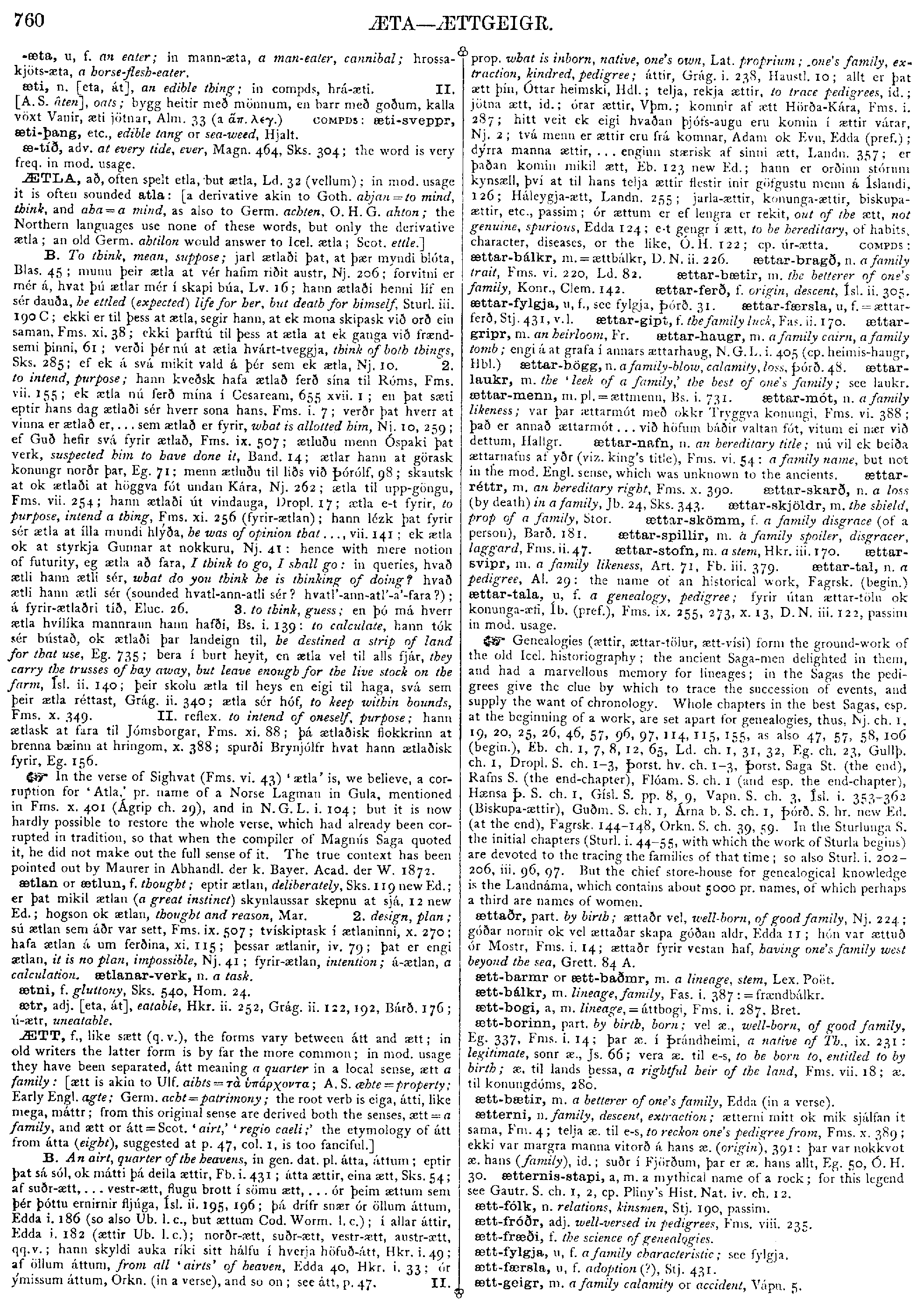
ÆTT, f., like sætt (q.v.), the forms vary between átt and ætt; in old writers the latter form is by far the more common; in mod. usage they have been separated, átt meaning a quarter in a local sense, ætt a family: [ætt is akin to Ulf. aihts = GREEK; A.S. æhte = property; Early Engl. agte; Germ. acht = patrimony; the root verb is eiga, átti, like mega, máttr; from this original sense are derived both the senses, ætt = a family, and ætt or átt = Scot. 'airt,' 'regio caeli;' the etymology of átt from átta (eight), suggested at p. 47, col. 1, is too fanciful.] B. An airt, quarter of the heavens, in gen. dat. pl. átta, áttum; eptir þat sá sól, ok mátti þá deila ættir, Fb. i. 431; átta ættir, eina ætt, Sks. 54; af suðr-ætt, ... vestr-ætt, flugu brott í sömu ætt, ... ór þeim ættum sem þér þóttu ernirnir fljúga, Ísl. ii. 195, 196; þá drífr snær ór öllum áttum, Edda i. 186 (so also Ub. l.c., but ættum Cod. Worm. l.c.); í allar áttir, Edda i. 182 (ættir Ub. l.c.); norðr-ætt, suðr-ætt, vestr-ætt, austr-ætt, qq.v.; hann skyldi auka ríki sitt hálfu í hverja höfuð-átt, Hkr. i. 49; af öllum áttum, from all 'airts' of heaven, Edda 40, Hkr. i. 33; ór ýmissum áttum, Orkn. (in a verse), and so on; see átt, p. 47. II. prop. what is inborn, native, one's own, Lat. proprium; one's family, extraction, kindred, pedigree; áttir, Grág. i. 238, Haustl. 10; allt er þat ætt þín, Óttar heimski, Hdl.; telja, rekja ættir, to trace pedigrees, id.; jötna ætt, id.; órar ættir, Vþm.; komnir af ætt Hörða-Kára, Fms. i. 287; hitt veit ek eigi hvaðan þjófs-augu eru komin í ættir várar, Nj. 2; tvá menn er ættir eru frá komnar, Adam ok Evu, Edda (pref.); dýrra manna ættir, ... enginn stærisk af sinni ætt, Landn. 357; er þaðan komin mikil ætt, Eb. 123 new Ed.; hann er orðinn stórum kynsæll, því at til hans telja ættir flestir inir göfgustu menn á Íslandi, 126; Háleygja-ætt, Landn. 255; jarla-ættir, konunga-ættir, biskupa-ættir, etc., passim; ór ættum er ef lengra er rekit, out of the ætt, not genuine, spurious, Edda 124; e-t gengr í ætt, to be hereditary, of habits, character, diseases, or the like, Ó.H. 122; cp. úr-ætta. COMPDS: ættar-bálkr, m. = ættbálkr, D.N. ii. 226. ættar-bragð, n. a family trait, Fms. vi. 220, Ld. 82. ættar-bætir, m. the betterer of one's family, Konr., Clem. 142. ættar-ferð, f. origin, descent, Ísl. ii. 305. ættar-fylgja, u, f., see fylgja, Þórð. 31. ættar-færsla, u, f. = ættarferð, Stj. 431, v. l. ættar-gipt, f. the family luck, Fas. ii. 170. ættar-gripr, m. an heirloom, Fr. ættar-haugr, m. a family cairn, a family tomb; engi á at grafa í annars ættarhaug, N.G.L. i. 405 (cp. heimis-haugr, Hbl.) ættar-högg, n. a family-blow, calamity, loss, Þórð. 48. ættar-laukr, m. the 'leek of a family,' the best of one's family; see laukr. ættar-menn, m. pl. = ættmenn, Bs. i. 731. ættar-mót, n. a family likeness; var þar ættarmót með okkr Tryggva konungi, Fms. vi. 388; það er annað ættarmót ... við höfum báðir valtan fót, vitum ei nær við dettum, Hallgr. ættar-nafn, n. an hereditary title; nú vil ek beiða ættarnafns af yðr (viz. king's title), Fms. vi. 54: a family name, but not in the mod. Engl. sense, which was unknown to the ancients. ættar-réttr, m. an hereditary right, Fms. x. 390. ættar-skarð, n. a loss (by death) in a family, Jb. 24, Sks. 343. ættar-skjöldr, m. the shield, prop of a family, Stor. ættar-skömm, f. a family disgrace (of a person), Bárð. 181. ættar-spillir, m. a family spoiler, disgracer, laggard, Fms. ii. 47. ættar-stofn, m. a stem, Hkr. iii. 170. ættar-svipr, m. a family likeness, Art. 71, Fb. iii. 379. ættar-tal, n. a pedigree, Al. 29: the name of an historical work, Fagrsk. (begin.) ættar-tala, u, f. a genealogy, pedigree; fyrir útan ættar-tölu ok konunga-æfi, Íb. (pref.), Fms. ix. 255, 273, x. 13, D.N. iii. 122, passim in mod. usage. &FINGER; Genealogies (ættir, ættar-tölur, ætt-vísi) form the ground-work of the old Icel. historiography; the ancient Saga-men delighted in them, and had a marvellous memory for lineages; in the Sagas the pedigrees give the clue by which to trace the succession of events, and supply the want of chronology. Whole chapters in the best Sagas, esp. at the beginning of a work, are set apart for genealogies, thus. Nj. ch. 1, 19, 20, 25, 26, 46, 57, 96, 97, 114, 115, 155, as also 47, 57, 58, 106 (begin.), Eb. ch. 1, 7, 8, 12, 65, Ld. ch. 1, 31, 32, Eg. ch. 23, Gullþ. ch. 1, Dropl. S. ch. 1-3, Þorst. hv. ch. 1-3, Þorst. Saga St. (the end), Rafns S. (the end-chapter), Flóam. S. ch. 1 (and esp. the end-chapter), Hænsa Þ. S. ch. 1, Gísl. S. pp. 8, 9, Vapn. S. ch. 3, Ísl. i. 353-362 (Biskupa-ættir), Guðm. S. ch. 1, Árna b. S. ch. 1, Þórð. S. hr. new Ed. (at the end), Fagrsk. 144-148, Orkn. S. ch. 39, 59. In the Sturlunga S. the initial chapters (Sturl. i. 44-55, with which the work of Sturla begins) are devoted to the tracing the families of that time; so also Sturl. i. 202-206, iii. 96, 97. But the chief store-house for genealogical knowledge is the Landnáma, which contains about 5000 pr. names, of which perhaps a third are names of women.
|
Source: Cleasby/Vigfusson, page b0777, entry 30 View original page image as: [TIFF] [PNG] [View previous entry] [View next entry] |
[Comment on this entry] [View comments] |
The following entry has been hand-corrected once. |
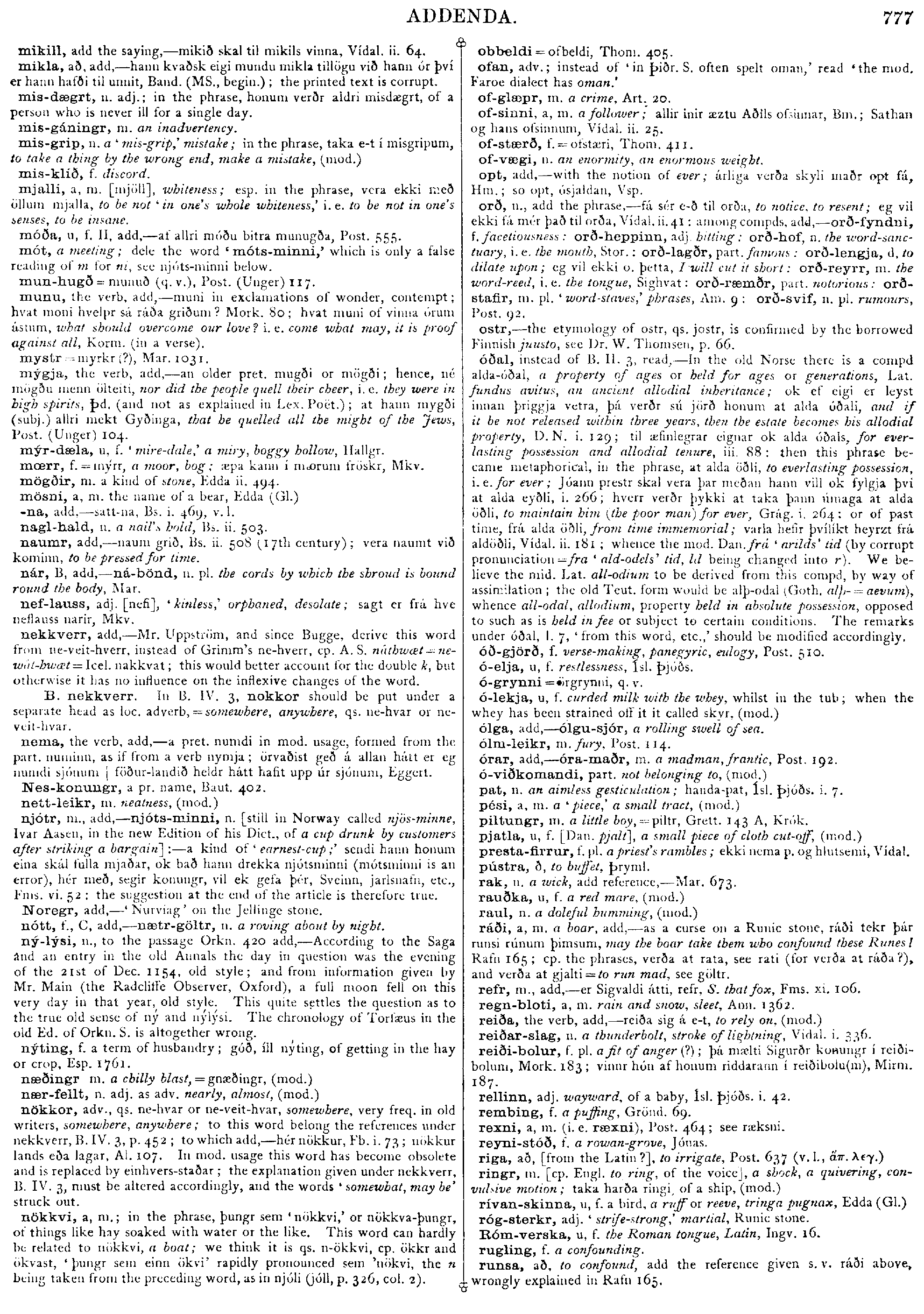
ný-lýsi, n., to the passage Orkn. 420 add, -- According to the Saga and an entry in the old Annals the day in question was the evening of the 21st of Dec. 1154, old style; and from information given by Mr. Main (the Radcliffe Observer, Oxford), a full moon fell on this very day in that year, old style. This quite settles the question as to the true old sense of ný and nýlýsi. The chronology of Torfæus in the old Ed. of Orkn. S. is altogether wrong.
Germanic Lexicon Project (main page)
This search system was written by
Sean Crist
Please consider
volunteering
to correct the data in these online dictionaries.
No rights reserved. Feel free to use these data in any way you please.