|
|

|
Source: Bosworth/Toller, page d0477, entry 26 View original page image as: [TIFF] [PNG] [View previous entry] [View next entry] |
[Comment on this entry] [View comments] |
The following entry has been hand-corrected once. |
god;
m.
and
god;
n.
Take
these
together,
and
add:
I.
of
a
heathen
god:--Heá
gotho
manes,
Archiv
85,
310,
15;
An.
Ox.
53,
15.
Þ ra
hðenra
godas
synd
gramlice
deófla,
Hml.
S.
14,
18.
In
god
in
divos,
Wrt.
Voc.
ii.
93,
57.
Ic
swerige
ðurh
ealle
godas
and
gydena,
Hml.
Th.
i.
426,
7.
Gé
habbað
manega
godas,
Hml.
S.
4,
134.
I
a.
with
a
defining
addition:--Wínes
god
Bachus,
Wrt.
Voc.
ii.
93,
42.
Fýres
god
U[u]lcanus,
95,
6.
II.
on
image
which
is
worshipped,
idol:--Eówer
godas
synd
ágotene
oððe
ágrafene,
Hml.
S.
4,
136.
Þíne
godas
syndon
gyldene
and
sylfrene
.
.
.
manna
handgeweorc,
14,
20.
'Geoftra
ðíne
lác
úrum
gudum
.
.
.
.'
'Ðú
cwyst
þæt
ic
mé
gebiddan
sceole
tó
dumbum
stánum,
ðá
ðe
sind
ágrafene
ðurh
manna
handa,'
Hml.
Th.
i.
422,
35.
III.
of
a
person
having
godlike
attributes:--Æ-acute;lc
geslig
mon
biþ
god
omnis
beatus
deus,
Bt.
34,
5;
F.
140,
2:
35,
5;
F.
164,
23.
Ic
gesette
þé
Pharaone
tó
gode,
Ex.
7,
1.
Ic
sde
gé
synt
godas
(goddo,
L.,
godo,
R.),
Jn.
10,
34.
IV.
in
the
Christian,
monotheistic
sense,
God.
(1)
as
a
proper
name:--On
anginne
gesceóp
God
heofenan
and
eorðan,
Gen.
1,
1.
Goddes
Dei,
Rtl.
109,
11:
Mk.
L.
9,
1:
Jn.
p.
3,
4.
(1
a)
with
epithet:--Se
Ælmihtiga
God
hí
áhredde,
Chr.
1016;
P.
150,
13.
Þone
écan
mildan
God,
Cht.
E.
231,
8.
(2)
where
the
triune
character
of
the
Deity
is
marked.
(a)
of
the
first
person
of
the
Trinity:--Drihten
God,
Fæder
Crístes,
Hml.
Th.
i.
426,
24.
God
.
.
.
Fæder
Ælmihtig,
Cri.
319.
Críst
þæs
lifgendan
Godes
Sunu,
Bl.
H.
11,
30.
(b)
of
the
second
person:--Hlend
Críst,
God
of
Gode,
Hml.
Th.
i.
426,
2.
God
tó
ús
niþer
ástáhg,
Bl.
H.
17,
29.
Hié
God
sylfne
áhéngon,
El.
209.
(c)
where
the
three
persons
are
given:--Se
Ælmihtiga
Fæder
is
God,
and
his
Sunu
is
Ælmihtig
God,
and
se
Hálga
Gást
is
Ælmihtig
God;
ná
ðrý
Godas,
ac
hí
ealle
án
Ælmihtig
God
untódledlic,
Hml.
Th.
i.
248,
6-9.
(3)
where
the
genitive
is
used
with
a
noun
as
an
intensive:--Þonne
is
ra
hðenra
godas
synd
gramlice
deófla,
Hml.
S.
14,
18.
In
god
in
divos,
Wrt.
Voc.
ii.
93,
57.
Ic
swerige
ðurh
ealle
godas
and
gydena,
Hml.
Th.
i.
426,
7.
Gé
habbað
manega
godas,
Hml.
S.
4,
134.
I
a.
with
a
defining
addition:--Wínes
god
Bachus,
Wrt.
Voc.
ii.
93,
42.
Fýres
god
U[u]lcanus,
95,
6.
II.
on
image
which
is
worshipped,
idol:--Eówer
godas
synd
ágotene
oððe
ágrafene,
Hml.
S.
4,
136.
Þíne
godas
syndon
gyldene
and
sylfrene
.
.
.
manna
handgeweorc,
14,
20.
'Geoftra
ðíne
lác
úrum
gudum
.
.
.
.'
'Ðú
cwyst
þæt
ic
mé
gebiddan
sceole
tó
dumbum
stánum,
ðá
ðe
sind
ágrafene
ðurh
manna
handa,'
Hml.
Th.
i.
422,
35.
III.
of
a
person
having
godlike
attributes:--Æ-acute;lc
geslig
mon
biþ
god
omnis
beatus
deus,
Bt.
34,
5;
F.
140,
2:
35,
5;
F.
164,
23.
Ic
gesette
þé
Pharaone
tó
gode,
Ex.
7,
1.
Ic
sde
gé
synt
godas
(goddo,
L.,
godo,
R.),
Jn.
10,
34.
IV.
in
the
Christian,
monotheistic
sense,
God.
(1)
as
a
proper
name:--On
anginne
gesceóp
God
heofenan
and
eorðan,
Gen.
1,
1.
Goddes
Dei,
Rtl.
109,
11:
Mk.
L.
9,
1:
Jn.
p.
3,
4.
(1
a)
with
epithet:--Se
Ælmihtiga
God
hí
áhredde,
Chr.
1016;
P.
150,
13.
Þone
écan
mildan
God,
Cht.
E.
231,
8.
(2)
where
the
triune
character
of
the
Deity
is
marked.
(a)
of
the
first
person
of
the
Trinity:--Drihten
God,
Fæder
Crístes,
Hml.
Th.
i.
426,
24.
God
.
.
.
Fæder
Ælmihtig,
Cri.
319.
Críst
þæs
lifgendan
Godes
Sunu,
Bl.
H.
11,
30.
(b)
of
the
second
person:--Hlend
Críst,
God
of
Gode,
Hml.
Th.
i.
426,
2.
God
tó
ús
niþer
ástáhg,
Bl.
H.
17,
29.
Hié
God
sylfne
áhéngon,
El.
209.
(c)
where
the
three
persons
are
given:--Se
Ælmihtiga
Fæder
is
God,
and
his
Sunu
is
Ælmihtig
God,
and
se
Hálga
Gást
is
Ælmihtig
God;
ná
ðrý
Godas,
ac
hí
ealle
án
Ælmihtig
God
untódledlic,
Hml.
Th.
i.
248,
6-9.
(3)
where
the
genitive
is
used
with
a
noun
as
an
intensive:--Þonne
is
 Godes
riht
hé
beó
clne
it
is
the
most
perfect
justice,
that
he
be
clear,
Ll.
Th.
i.
418,
12.
V.
a
Being
such
as
is
understood
by
the
proper
name
God,
God
according
to
some
particular
conception
or
in
regard
to
some
special
attribute
or
relation:--Ic
eom
Abrahames
God,
and
Isaaces
God,
and
Iacóbes
God.
Nys
God
ná
deádra,
ac
lybbendra,
Mt.
22,
32.
Se
góda
God,
Bt.
36,
1;
F.
172,
5.
Se
ána
sóða
God
.
.
.
sé
án
is
sóð
God
þe
ealle
ðing
gescóp,
Wlfst.
105,
27-31.
Þone
God
ic
eów
bodige
þone
ðe
gé
hátad
uncúðne
.
.
.
hé
sitt
on
his
Fæder
swíðran
hand
sóð
God
and
sóð
man,
Hml.
S.
29,
37-42.
Tó
Abrahames
Gode,
Ps.
Th.
46,
9.
Hig
gesáwon
Israhéla
God,
Ex.
24,
10.
VI.
in
special
forms
of
speech.
(1)
where
a
strong
wish
is
expressed:--God
him
geunne
.
.
.,
Chr.
959;
P.
115,
14.
God
eów
gehealde,
Ll.
Lbmn.
486,
14.
Áwende
hine
God
Ælmihtig
hrædlice
of
þisan
lnan
lífe
intó
helle
wíte,
C.
D.
iv.
87,
10.
(2)
where
dependence
on,
or
gratitude
to,
the
Deity
is
expressed:--Mid
Godes
gæfe,
C.
D.
i.
292,
21:
299,
12.
Gode
Ælmihtigum
sié
ðonc
ðætte
.
.
.,
Past.
3,
18.
Sw
gelrede
biscepas
sw
nú,
Gode
ðonc,
siendon,
9,
4.
Næfde
se
here,
Godes
þonces,
Angelcyn
ealles
for
swíðe
gebrocod,
Chr.
897;
P.
89,
30.
(3)
where
there
is
pious
intention,
conduct
influenced
by
religion:--Æ-acute;ghwæt
þæs
þe
him
nig
mon
for
Godes
noman
geselle,
Ll.
Th.
i.
92,
11.
Þæt
hé
his
freónd
ná
for
middangearde,
ac
for
Gode
lufige,
Hml.
Th.
i.
584,
7.
Seó
is
sóð
lufu,
þæt
gehwá
his
freónd
lufie
on
Gode,
and
his
feónd
for
Gode,
528,
32.
(4)
in
earnest
appeal,
affirmation
or
exhortation:--Ic
bebióde
on
Godes
naman
ðæt
.
.
.,
Past.
9,
2.
Ic
eów
bidde
on
Godes
naman
.
.
.
.
.
.,
Ll.
Th.
i.
194,
4.
Wé
biddað
and
on
Godes
naman
beódað
.
.
.,
364,
21.
On
Godes
Ælmihtiges
naman,
Cht.
E.
231,
11:
Ll.
Th.
i.
180,
22:
182,
6.
Nú
hálsige
ic
ðé
þurh
God
þ
.
.
.,
Hml.
Th.
i.
426,
31.
Gif
hwelc
mon
hine
on
Godes
naman
geandette,
Ll.
Th.
i.
64,
21.
VII.
in
language
concerned
with
church
matters.
(1)
of
spiritual
things:--Wé
habbað
áne
gástlice
módor,
seó
is
Ecclesia
genamod,
is
Godes
cirice,
Ll.
Th.
i.
336,
8.
Biscopas
syndon
Godes
lage
(the
doctrines
of
Christianity)
láreówas,
332,
27.
Hé
Godes
lage
smeáde,
Chr.
963;
P.
115,
4.
Godes
lof
rran
to
promote
the
Christian
religion,
5:
Cht.
E.
229,
25.
(2)
of
ecclesiastical
procedure,
arrangement,
constitution:--Þá
hálgan
hádas
þe
Godes
folc
(the
Christian
laity)
lran
scylan,
Ll.
Th.
i.
244,
9.
Þridda
dl
þáre
teóðunge
þe
tó
circan
gebyrige
gá
.
.
.
Godes
þearfum
(the
needy
to
whom
church-alms
are
given),
342,
9.
From
lcum
Godes
dle
áworpene
cast
out
from
church-communion,
Godes
riht
hé
beó
clne
it
is
the
most
perfect
justice,
that
he
be
clear,
Ll.
Th.
i.
418,
12.
V.
a
Being
such
as
is
understood
by
the
proper
name
God,
God
according
to
some
particular
conception
or
in
regard
to
some
special
attribute
or
relation:--Ic
eom
Abrahames
God,
and
Isaaces
God,
and
Iacóbes
God.
Nys
God
ná
deádra,
ac
lybbendra,
Mt.
22,
32.
Se
góda
God,
Bt.
36,
1;
F.
172,
5.
Se
ána
sóða
God
.
.
.
sé
án
is
sóð
God
þe
ealle
ðing
gescóp,
Wlfst.
105,
27-31.
Þone
God
ic
eów
bodige
þone
ðe
gé
hátad
uncúðne
.
.
.
hé
sitt
on
his
Fæder
swíðran
hand
sóð
God
and
sóð
man,
Hml.
S.
29,
37-42.
Tó
Abrahames
Gode,
Ps.
Th.
46,
9.
Hig
gesáwon
Israhéla
God,
Ex.
24,
10.
VI.
in
special
forms
of
speech.
(1)
where
a
strong
wish
is
expressed:--God
him
geunne
.
.
.,
Chr.
959;
P.
115,
14.
God
eów
gehealde,
Ll.
Lbmn.
486,
14.
Áwende
hine
God
Ælmihtig
hrædlice
of
þisan
lnan
lífe
intó
helle
wíte,
C.
D.
iv.
87,
10.
(2)
where
dependence
on,
or
gratitude
to,
the
Deity
is
expressed:--Mid
Godes
gæfe,
C.
D.
i.
292,
21:
299,
12.
Gode
Ælmihtigum
sié
ðonc
ðætte
.
.
.,
Past.
3,
18.
Sw
gelrede
biscepas
sw
nú,
Gode
ðonc,
siendon,
9,
4.
Næfde
se
here,
Godes
þonces,
Angelcyn
ealles
for
swíðe
gebrocod,
Chr.
897;
P.
89,
30.
(3)
where
there
is
pious
intention,
conduct
influenced
by
religion:--Æ-acute;ghwæt
þæs
þe
him
nig
mon
for
Godes
noman
geselle,
Ll.
Th.
i.
92,
11.
Þæt
hé
his
freónd
ná
for
middangearde,
ac
for
Gode
lufige,
Hml.
Th.
i.
584,
7.
Seó
is
sóð
lufu,
þæt
gehwá
his
freónd
lufie
on
Gode,
and
his
feónd
for
Gode,
528,
32.
(4)
in
earnest
appeal,
affirmation
or
exhortation:--Ic
bebióde
on
Godes
naman
ðæt
.
.
.,
Past.
9,
2.
Ic
eów
bidde
on
Godes
naman
.
.
.
.
.
.,
Ll.
Th.
i.
194,
4.
Wé
biddað
and
on
Godes
naman
beódað
.
.
.,
364,
21.
On
Godes
Ælmihtiges
naman,
Cht.
E.
231,
11:
Ll.
Th.
i.
180,
22:
182,
6.
Nú
hálsige
ic
ðé
þurh
God
þ
.
.
.,
Hml.
Th.
i.
426,
31.
Gif
hwelc
mon
hine
on
Godes
naman
geandette,
Ll.
Th.
i.
64,
21.
VII.
in
language
concerned
with
church
matters.
(1)
of
spiritual
things:--Wé
habbað
áne
gástlice
módor,
seó
is
Ecclesia
genamod,
is
Godes
cirice,
Ll.
Th.
i.
336,
8.
Biscopas
syndon
Godes
lage
(the
doctrines
of
Christianity)
láreówas,
332,
27.
Hé
Godes
lage
smeáde,
Chr.
963;
P.
115,
4.
Godes
lof
rran
to
promote
the
Christian
religion,
5:
Cht.
E.
229,
25.
(2)
of
ecclesiastical
procedure,
arrangement,
constitution:--Þá
hálgan
hádas
þe
Godes
folc
(the
Christian
laity)
lran
scylan,
Ll.
Th.
i.
244,
9.
Þridda
dl
þáre
teóðunge
þe
tó
circan
gebyrige
gá
.
.
.
Godes
þearfum
(the
needy
to
whom
church-alms
are
given),
342,
9.
From
lcum
Godes
dle
áworpene
cast
out
from
church-communion,
|
Source: Bright's OE Grammar, page b0264, entry 8 View original page image as: [TIFF] [PNG] [View previous entry] [View next entry] |
[Comment on this entry] [View comments] |
The following entry has been hand-corrected once. |
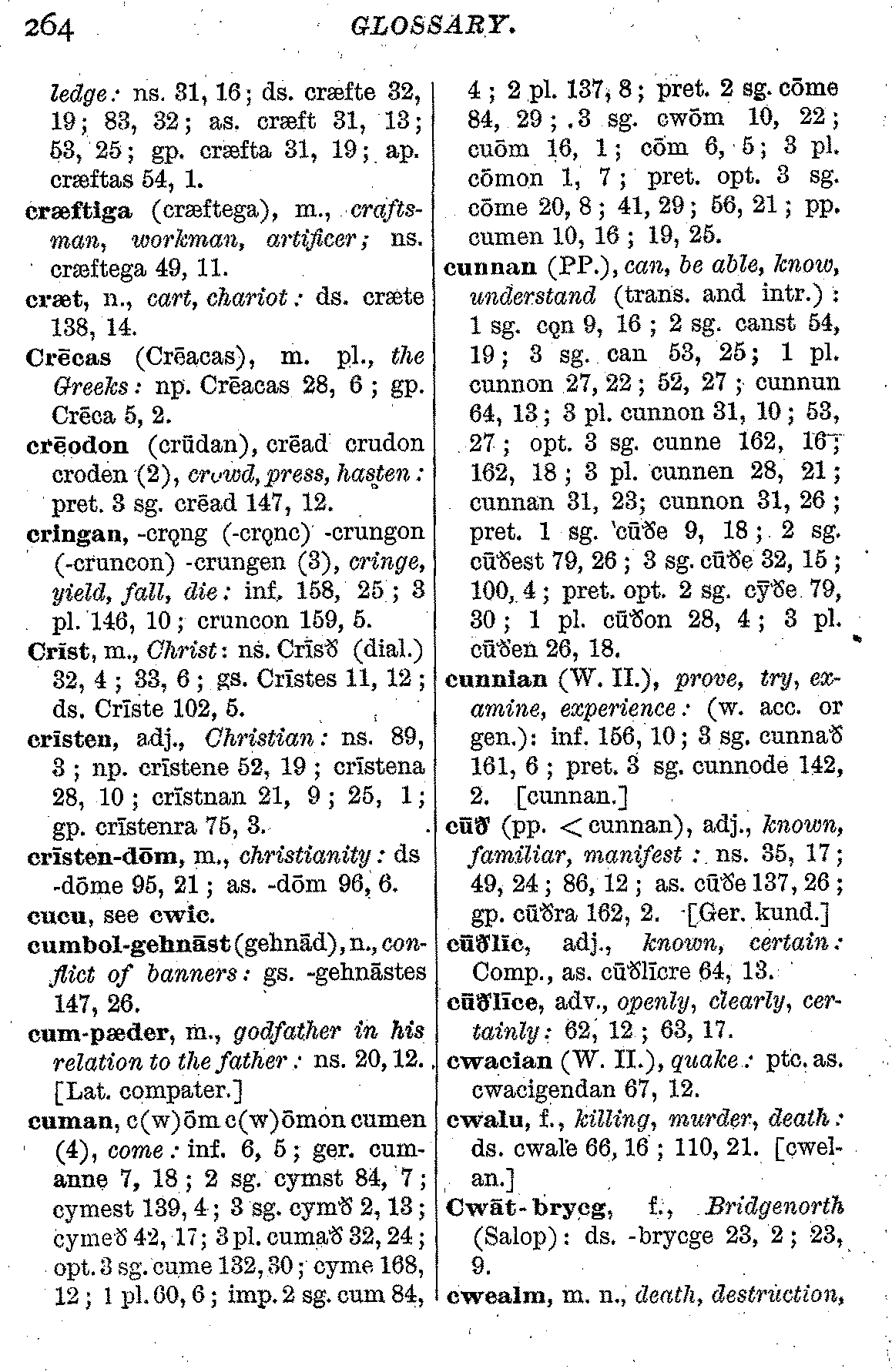
 sten-d
 m
m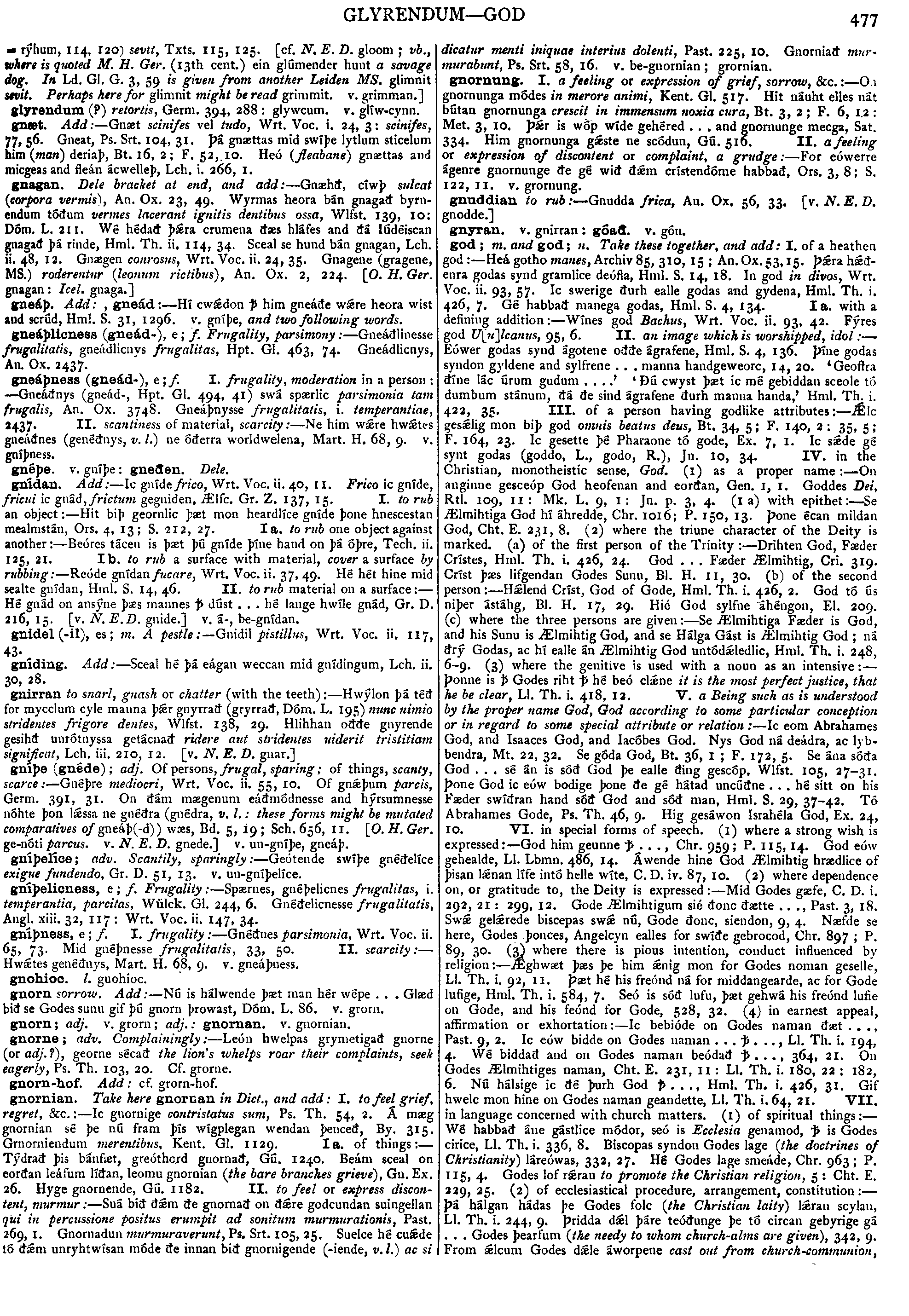
|
Source: Cleasby/Vigfusson, page b0002, entry 3 View original page image as: [TIFF] [PNG] [View previous entry] [View next entry] |
[Comment on this entry] [View comments] |
The following entry has been hand-corrected once. |
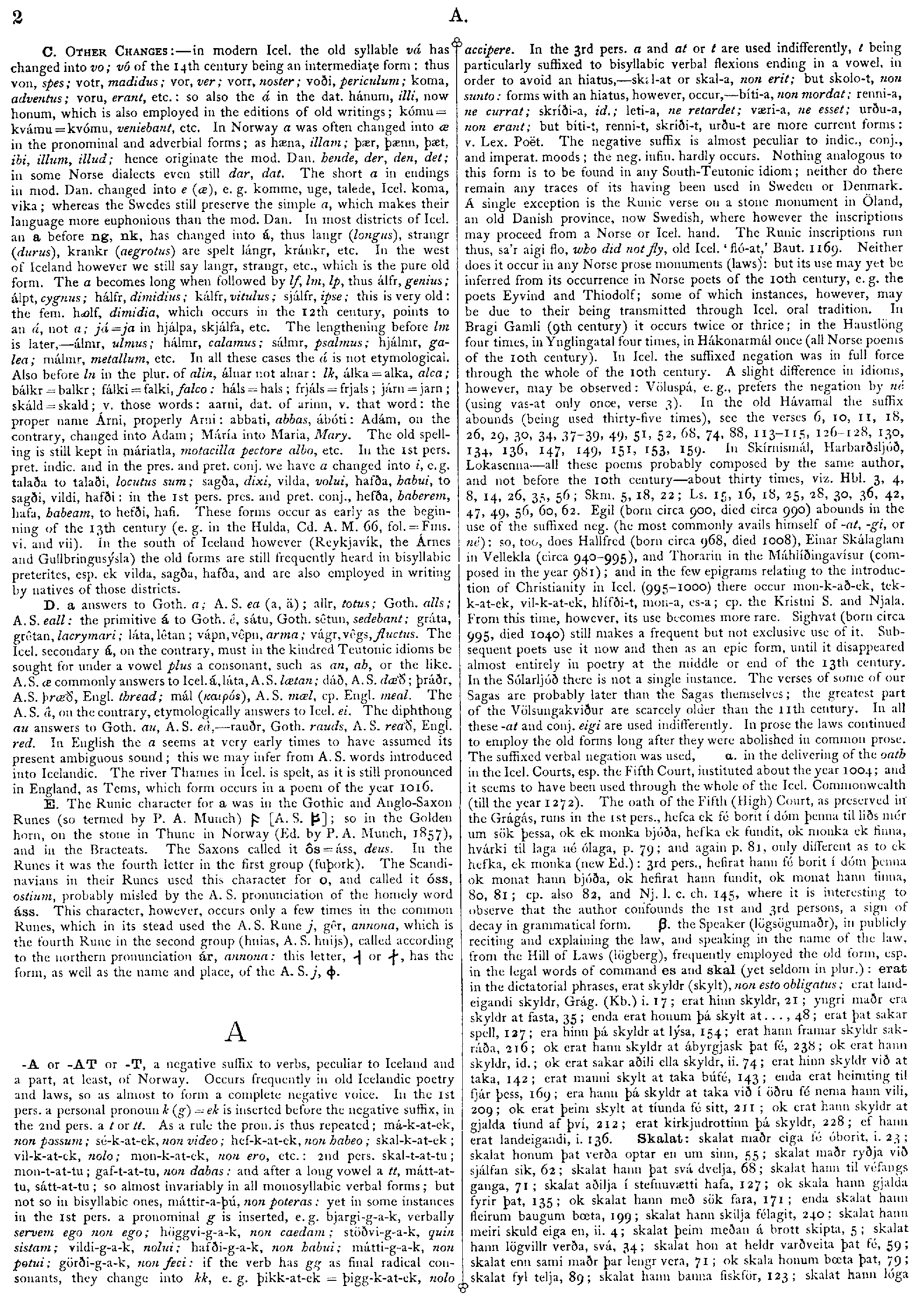
-A
or
-AT
or
-T,
a
negative
suffix
to
verbs,
peculiar
to
Iceland
and
a
part,
at
least,
of
Norway.
Occurs
frequently
in
old
Icelandic
poetry
and
laws,
so
as
almost
to
form
a
complete
negative
voice.
In
the
1st
pers.
a
personal
pronoun
k
(g)
=
ek
is
inserted
before
the
negative
suffix,
in
the
2nd
pers.
a
t
or
tt.
As
a
rule
the
pron.
as
thus
repeated;
má-k-at-ek,
non
possum;
sé-k-at-ek,
non
video;
hef-k-at-ek,
non
habeo;
skal-k-at-ek;
vil-k-at-ek,
nolo;
mon-k-at-ek,
non
ero,
etc.:
2nd
pers.
skal-t-at-tu;
mon-t-at-tu;
gaf-t-at-tu,
non
dabas:
and
after
a
long
vowel
a
tt,
mátt-at-
tu,
sátt-at-tu;
so
almost
invariably
in
all
monosyllabic
verbal
forms;
but
not
so
in
bisyllabic
ones,
máttir-a-þú,
non
poteras:
yet
in
some
instances
in
the
1st
pers.
a
pronominal
g
is
inserted,
e.
g.
bjargi-g-a-k,
verbally
servem
ego
non
ego;
höggvi-g-a-k,
non
cædam;
stöðvi-g-a-k,
quin
sistam;
vildi-g-a-k,
nolui;
hafði-g-a-k,
non
babui;
mátti-g-a-k,
non
potui;
görði-g-a-k,
non
feci:
if
the
verb
has
gg
as
final
radical
con-
sonants,
they
change
into
kk,
e.
g.
þikk-at-ek
=
þigg-k-at-ek,
nolo
accipere.
In
the
3rd
pers.
a
and
at
or
t
are
used
indifferently,
t
being
particularly
suffixed
to
bisyllabic
verbal
flexions
ending
in
a
vowel,
in
order
to
avoid
an
hiatus,
--
skal-at
or
skal-a,
non
erit;
but
skolo-t,
non
sunto:
forms
with
an
hiatus,
however,
occur,
--
bítí-a,
non
mordat;
renni-a,
ne
currat;
skríði-a,
id.;
leti-a,
ne
retardet;
vaeri-a,
ne
esset;
urðu-a,
non
erant;
but
bíti-t,
renni-t,
skríði-t,
urðu-t
are
more
current
forms:
v.
Lex.
Poët.
The
negative
suffix
is
almost
peculiar
to
indic.,
conj.,
and
imperat.
moods;
the
neg.
infin.
hardly
occurs.
Nothing
analogous
to
this
form
is
to
be
found
in
any
South-Teutonic
idiom;
neither
do
there
remain
any
traces
of
its
having
been
used
in
Sweden
or
Denmark.
A
single
exception
is
the
Runic
verse
on
a
stone
monument
in
Öland,
an
old
Danish
province,
now
Swedish,
where
however
the
inscriptions
may
proceed
from
a
Norse
or
Icel.
hand.
The
Runic
inscriptions
run
thus,
sár
aigi
flo,
who
did
not
fly,
old
Icel.
'flo-at,'
Baut.
1169.
Neither
does
it
occur
in
any
Norse
prose
monuments
(laws):
but
its
use
may
yet
be
inferred
from
its
occurrence
in
Norse
poets
of
the
10th
century,
e.
g.
the
poets
Eyvind
and
Thiodolf;
some
of
which
instances,
however,
may
be
due
to
their
being
transmitted
through
Icel.
oral
tradition.
In
Bragi
Gamli
(9th
century)
it
occurs
twice
or
thrice;
in
the
Haustlöng
four
times,
in
Ynglingatal
four
times,
in
Hákonarmál
once
(all
Norse
poems
of
the
10th
century).
In
Icel.
the
suffixed
negation
was
in
full
force
through
the
whole
of
the
10th
century.
A
slight
difference
in
idioms,
however,
may
be
observed:
Völuspá,
e.
g.,
prefers
the
negation
by
né
(using
vas-at
only
once,
verse
3).
In
the
old
Hávamal
the
suffix
abounds
(being
used
thirty-five
times),
see
the
verses
6,
10,
11,
18,
26,
29,
30,
34,
37-39,
49,
51,
52,
68,
74,
88,
113-115,
126-128,
130,
134,
136,
147,
149,
151,
153,
159.
In
Skírnismál,
Harbarðsljóð,
Lokasenna
--
all
these
poems
probably
composed
by
the
same
author,
and
not
before
the
loth
century
--
about
thirty
times,
viz.
Hbl.
3,
4,
8,
14,
26,
35,
56;
Skm.
5,
18,
22;
Ls.
15,
16,
18,
25,
28,
30,
36,
42,
47,
49,
56,
60,
62.
Egil
(born
circa
900,
died
circa
990)
abounds
in
the
use
of
the
suffixed
neg.
(he
most
commonly
avails
himself
of
-at,
-gi,
or
né;
so,
too,
does
Hallfred
(born
circa
968,
died
1008),
Einar
Skálaglam
in
Vellekla
(circa
940-995),
and
Thorarin
in
the
Máhlíðingavísur
(com-
posed
in
the
year
981);
and
in
the
few
epigrams
relating
to
the
introduc-
tion
of
Christianity
in
Icel.
(995-1000)
there
occur
mon-k-að-ek,
tek-
k-at-ek,
vil-k-at-ek,
hlífði-t,
mon-a,
es-a;
cp.
the
Kristni
S.
and
Njala.
From
this
time,
however,
its
use
becomes
more
rare.
Sighvat
(born
circa
995,
died
1040)
still
makes
a
frequent
but
not
exclusive
use
of
it.
Sub-
sequent
poets
use
it
now
and
then
as
an
epic
form,
until
it
disappeared
almost
entirely
in
poetry
at
the
middle
or
end
of
the
13th
century.
In
the
Sólarljóð
there
is
not
a
single
instance.
The
verses
of
some
of
our
Sagas
are
probably
later
than
the
Sagas
themselves;
the
greatest
part
of
the
Völsungakviður
are
scarcely
older
than
the
11th
century.
In
all
these
-at
and
conj.
eigi
are
used
indifferently.
In
prose
the
laws
continued
to
employ
the
old
forms
long
after
they
were
abolished
in
common
prose.
The
suffixed
verbal
negation
was
used,
a.
in
the
delivering
of
the
oath
in
the
Icel.
Courts,
esp.
the
Fifth
Court,
instituted
about
the
year
1004;
and
it
seems
to
have
been
used
through
the
whole
of
the
Icel.
Commonwealth
(till
the
year
1272).
The
oath
of
the
Fifth
(High)
Court,
as
preserved
in
the
Grágás,
runs
in
the
1st
pers.,
hefka
ek
fé
borit
í
dóm
þenna
til
liðs
mér
um
sök
þessa,
ok
ek
monka
bjóða,
hefka
ek
fundit,
ok
monka
ek
finna,
hvárki
til
laga
né
ólaga,
p.
79;
and
again
p.
81,
only
different
as
to
ek
hefka,
ek
monka
(new
Ed.):
3rd
pers.,
hefirat
hann
fé;
borit
í
dóm
þenna
ok
monat
hann
bjóða,
ok
hefirat
hann
fundit,
ok
monat
hann
tinna,
80,
81;
cp.
also
82,
and
Nj.
l.
c.
ch.
145,
where
it
is
interesting
to
observe
that
the
author
confounds
the
ist
and
3rd
persons,
a
sign
of
decay
in
grammatical
form.
 .
the
Speaker
(lögsögumaðr),
in
publicly
reciting
and
explaining
the
law,
and
speaking
in
the
name
of
the
law,
from
the
Hill
of
Laws
(lögberg),
frequently
employed
the
old
form,
esp.
in
the
legal
words
of
command
es
and
skal
(yet
seldom
in
plur.):
erat
in
the
dictatorial
phrases,
erat
skyldr
(skylt),
non
esto
obligatus;
erat
land-
eigandi
skyldr,
Grág.
(Kb.)
i.
17;
erat
hinn
skyldr,
21;
yngri
maðr
era
skyldr
at
fasta,
35;
enda
erat
honum
þá
skylt
at
...,
48;
erat
þat
sakar
spell,
127;
era
hinn
þá
skyldr
at
lýsa,
154;
erat
hann
framar
skyldr
sak-
ráða,
216;
ok
erat
hann
skyldr
at
ábyrgjask
þat
fé,
238;
ok
erat
hann
skyldr,
id.;
ok
erat
sakar
aðili
ella
skyldr,
ii.
74;
erat
hinn
skyldr
við
at
taka,
142;
erat
manni
skylt
at
taka
búfé,
143;
enda
erat
heimting
til
fjár
þess,
169;
era
hann
þá
skyldr
at
taka
við
í
öðru
fé
nema
hann
vili,
209;
ok
erat
þeim
skylt
at
tíunda
fé
sitt,
211;
ok
erat
hann
skyldr
at
gjalda
tíund
af
því,
212;
erat
kirkjudrottinn
þá
skyldr,
228;
ef
hann
erat
landeigaadi,
i.
136.
Skalat:
skalat
maðr
eiga
fó
óborit,
i.
23;
skalat
homum
þat
verða
optar
en
um
siun,
55;
skalat
maðr
ryðja
við
sjálfan
sik,
62;
skalat
hann
þat
svá
dvelja,
68;
skalat
hann
til
véfangs
ganga,
71;
skalat
aðilja
í
stefnuvætti
hafa,
127;
ok
skala
hann
gjalda
fyrir
þat,
135;
ok
skalat
hann
með
sök
fara,
171;
enda
skalat
hann
fleirum
baugum
bœta,
199;
skalat
hann
skilja
félagit,
240;
skalat
hann
meiri
skuld
eiga
en,
ii.
4;
skalat
þeim
meðan
á
brott
skipta,
5;
skalat
hann
lögvillr
verða,
svá,
34;
skalat
hon
at
heldr
varðveita
þat
fé,
59;
í
skalat
enn
sami
maðr
þar
lengr
vera,
71;
ok
skala
honum
bæta
þat,
79;
skalat
fyl
telja,
89;
skalat
hann
banna
fiskför,
123;
skalat
hann
lóga
.
the
Speaker
(lögsögumaðr),
in
publicly
reciting
and
explaining
the
law,
and
speaking
in
the
name
of
the
law,
from
the
Hill
of
Laws
(lögberg),
frequently
employed
the
old
form,
esp.
in
the
legal
words
of
command
es
and
skal
(yet
seldom
in
plur.):
erat
in
the
dictatorial
phrases,
erat
skyldr
(skylt),
non
esto
obligatus;
erat
land-
eigandi
skyldr,
Grág.
(Kb.)
i.
17;
erat
hinn
skyldr,
21;
yngri
maðr
era
skyldr
at
fasta,
35;
enda
erat
honum
þá
skylt
at
...,
48;
erat
þat
sakar
spell,
127;
era
hinn
þá
skyldr
at
lýsa,
154;
erat
hann
framar
skyldr
sak-
ráða,
216;
ok
erat
hann
skyldr
at
ábyrgjask
þat
fé,
238;
ok
erat
hann
skyldr,
id.;
ok
erat
sakar
aðili
ella
skyldr,
ii.
74;
erat
hinn
skyldr
við
at
taka,
142;
erat
manni
skylt
at
taka
búfé,
143;
enda
erat
heimting
til
fjár
þess,
169;
era
hann
þá
skyldr
at
taka
við
í
öðru
fé
nema
hann
vili,
209;
ok
erat
þeim
skylt
at
tíunda
fé
sitt,
211;
ok
erat
hann
skyldr
at
gjalda
tíund
af
því,
212;
erat
kirkjudrottinn
þá
skyldr,
228;
ef
hann
erat
landeigaadi,
i.
136.
Skalat:
skalat
maðr
eiga
fó
óborit,
i.
23;
skalat
homum
þat
verða
optar
en
um
siun,
55;
skalat
maðr
ryðja
við
sjálfan
sik,
62;
skalat
hann
þat
svá
dvelja,
68;
skalat
hann
til
véfangs
ganga,
71;
skalat
aðilja
í
stefnuvætti
hafa,
127;
ok
skala
hann
gjalda
fyrir
þat,
135;
ok
skalat
hann
með
sök
fara,
171;
enda
skalat
hann
fleirum
baugum
bœta,
199;
skalat
hann
skilja
félagit,
240;
skalat
hann
meiri
skuld
eiga
en,
ii.
4;
skalat
þeim
meðan
á
brott
skipta,
5;
skalat
hann
lögvillr
verða,
svá,
34;
skalat
hon
at
heldr
varðveita
þat
fé,
59;
í
skalat
enn
sami
maðr
þar
lengr
vera,
71;
ok
skala
honum
bæta
þat,
79;
skalat
fyl
telja,
89;
skalat
hann
banna
fiskför,
123;
skalat
hann
lóga
|
Source: Cleasby/Vigfusson, page b0017, entry 1 View original page image as: [TIFF] [PNG] [View previous entry] [View next entry] |
[Comment on this entry] [View comments] |
The following entry has been hand-corrected once. |
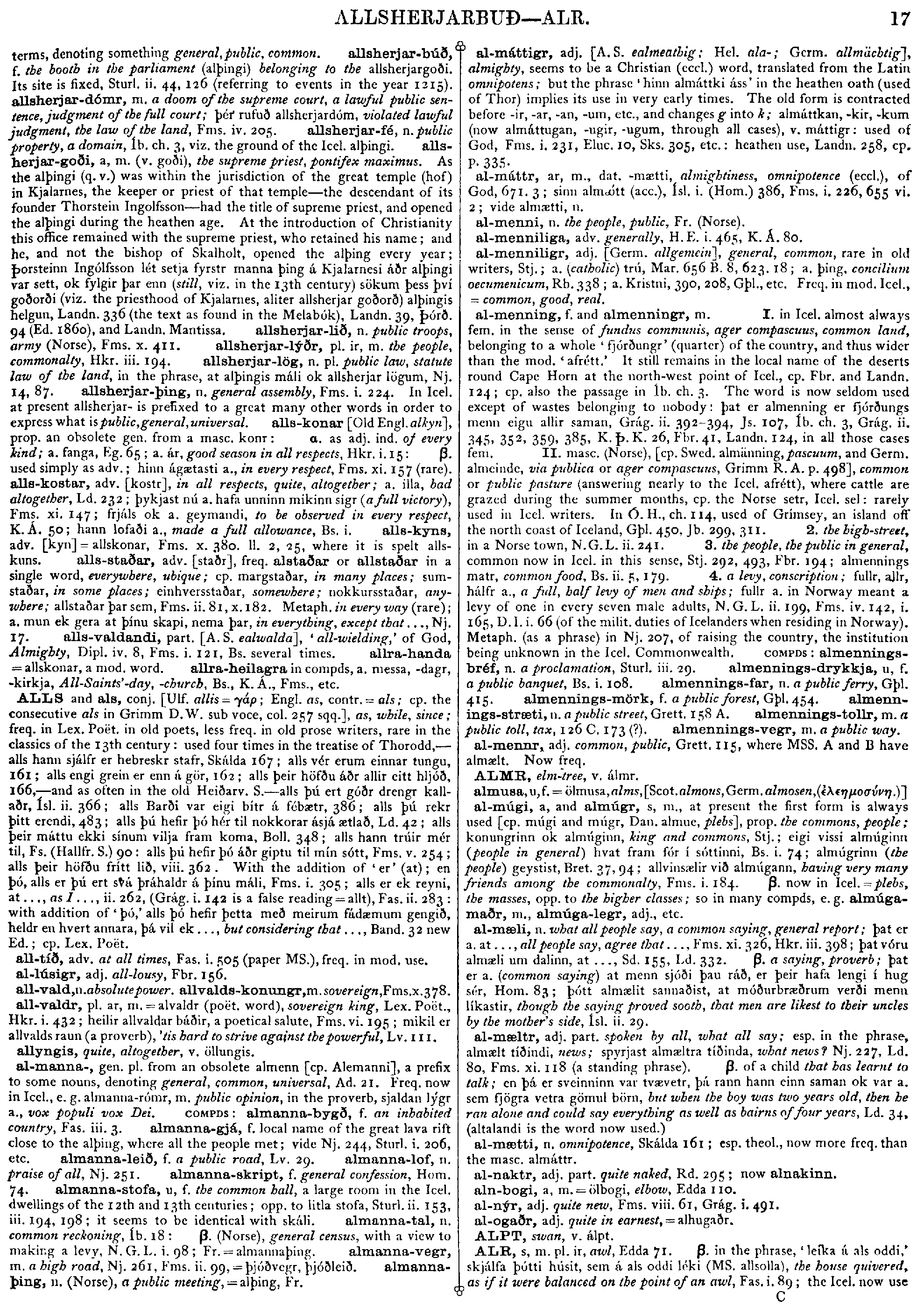
terms,
denoting
something
general,
public,
common.
allsherjar-búð,
f.
the
booth
in
the
parliament
(alþingi)
belonging
to
the
allsherjargoði.
Its
site
is
fixed,
Sturl.
ii.
44,
126
(referring
to
events
in
the
year
1215).
allsherjar-dómr,
m.
a
doom
of
the
supreme
court,
a
lawful
public
sen-
tence,
judgment
of
the
full
court;
þér
rufuð
allsherjardóm,
violated
lawful
judgment,
the
law
of
the
land,
Fms.
iv.
205.
allsherjar-fé,
n.
public
property,
a
domain,
Íb.
ch.
3,
viz.
the
ground
of
the
Icel.
alþingi.
alls-
herjar-goði,
a,
m.
(v.
goði),
the
supreme
priest,
pontifex
maximus.
As
the
alþingi
(q.
v.)
was
within
the
jurisdiction
of
the
great
temple
(hof)
in
Kjalarnes,
the
keeper
or
priest
of
that
temple
--
the
descendant
of
its
founder
Thorstein
Ingolfsson
--
had
the
title
of
supreme
priest,
and
opened
the
alþingi
during
the
heathen
age.
At
the
introduction
of
Christianity
this
office
remained
with
the
supreme
priest,
who
retained
his
name;
and
he,
and
not
the
bishop
of
Skalholt,
opened
the
alþing
every
year;
Þorsteinn
Ingólfsson
lét
setja
fyrstr
manna
þing
á
Kjalarnesi
áðr
alþingi
var
sett,
ok
fylgir
þar
enn
(still,
viz.
in
the
13th
century)
sökum
þess
því
goðorði
(viz.
the
priesthood
of
Kjalarnes,
aliter
allsherjar
goðorð)
alþingis
helgun,
Landn.
336
(the
text
as
found
in
the
Melabók),
Landn.
39,
Þórð.
94
(Ed.
1860),
and
Landn.
Mantissa.
allsherjar-lið,
n.
public
troops,
army
(Norse),
Fms.
x.
411.
allsherjar-lýðr,
pl.
ir,
m.
the
people,
commonalty,
Hkr.
iii.
194.
allsherjar-lög,
n.
pl.
public
law,
statute
law
of
the
land,
in
the
phrase,
at
alþingis
máli
ok
allsherjar
lögum,
Nj.
14,
87.
allsherjar-þing,
n.
general
assembly,
Fms.
i.
224.
In
Icel.
at
present
allsherjar-
is
prefixed
to
a
great
many
other
words
in
order
to
express
what
is
public,
general,
universal.
alls-konar
[Old
Engl.
alkyn],
prop.
an
obsolete
gen.
from
a
masc.
konr:
 .
as
adj.
ind.
of
every
kind;
a.
fanga,
Eg.
65;
a.
ár,
good
season
in
all
respects,
Hkr.
1.
15:
.
used
simply
as
adv.;
hinn
ágætasti
a.,
in
every
respect,
Fms.
xi.
157
(rare).
alls-kostar,
adv.
[kostr],
in
all
respects,
quite,
altogether;
a.
illa,
bad
altogether,
Ld.
232;
þykjast
nú
a.
hafa
unninn
mikinn
sigr
(a
full
victory),
Fms.
xi.
147;
frjáls
ok
a.
geymandi,
to
be
observed
in
every
respect,
K.
Á.
50;
hann
lofaði
a.,
made
a
full
allowance,
Bs.
i.
alls-kyns,
adv.
[kyn]
=
allskonar,
Fms.
x.
380.
11.
UNCERTAIN
2,
25,
where
it
is
spelt
alls-
kuns.
alls-staðar,
adv.
[staðr],
freq.
alstaðar
or
allstaðar
in
a
single
word,
everywhere,
ubique;
cp.
margstaðar,
in
many
places;
sum-
staðar,
in
so
me
places;
einhversstaðar,
somewhere;
nokkursstaðar,
any-
where;
allstaðar
þar
sem,
Fms.
ii.
81,
x.
182.
Metaph.
in
every
way
(rare);
a.
mun
ek
gera
at
þínu
skapi,
nema
þar,
in
everything,
except
that...,
Nj.
17.
alls-valdandi,
part.
[A.
S.
ealwalda],
'all-wielding,'
of
God,
Almighty,
Dipl.
iv.
8,
Fms.
i.
121,
Bs.
several
times.
allra-handa
=
allskonar,
a
mod.
word.
allra-heilagra
in
compds,
a.
messa,
-dagr,
-kirkja,
All-Saints'-day,
-church,
Bs.,
K.
Á.,
Fms.,
etc.
.
as
adj.
ind.
of
every
kind;
a.
fanga,
Eg.
65;
a.
ár,
good
season
in
all
respects,
Hkr.
1.
15:
.
used
simply
as
adv.;
hinn
ágætasti
a.,
in
every
respect,
Fms.
xi.
157
(rare).
alls-kostar,
adv.
[kostr],
in
all
respects,
quite,
altogether;
a.
illa,
bad
altogether,
Ld.
232;
þykjast
nú
a.
hafa
unninn
mikinn
sigr
(a
full
victory),
Fms.
xi.
147;
frjáls
ok
a.
geymandi,
to
be
observed
in
every
respect,
K.
Á.
50;
hann
lofaði
a.,
made
a
full
allowance,
Bs.
i.
alls-kyns,
adv.
[kyn]
=
allskonar,
Fms.
x.
380.
11.
UNCERTAIN
2,
25,
where
it
is
spelt
alls-
kuns.
alls-staðar,
adv.
[staðr],
freq.
alstaðar
or
allstaðar
in
a
single
word,
everywhere,
ubique;
cp.
margstaðar,
in
many
places;
sum-
staðar,
in
so
me
places;
einhversstaðar,
somewhere;
nokkursstaðar,
any-
where;
allstaðar
þar
sem,
Fms.
ii.
81,
x.
182.
Metaph.
in
every
way
(rare);
a.
mun
ek
gera
at
þínu
skapi,
nema
þar,
in
everything,
except
that...,
Nj.
17.
alls-valdandi,
part.
[A.
S.
ealwalda],
'all-wielding,'
of
God,
Almighty,
Dipl.
iv.
8,
Fms.
i.
121,
Bs.
several
times.
allra-handa
=
allskonar,
a
mod.
word.
allra-heilagra
in
compds,
a.
messa,
-dagr,
-kirkja,
All-Saints'-day,
-church,
Bs.,
K.
Á.,
Fms.,
etc.
|
Source: Cleasby/Vigfusson, page b0019, entry 1 View original page image as: [TIFF] [PNG] [View previous entry] [View next entry] |
[Comment on this entry] [View comments] |
The following entry has been hand-corrected once. |
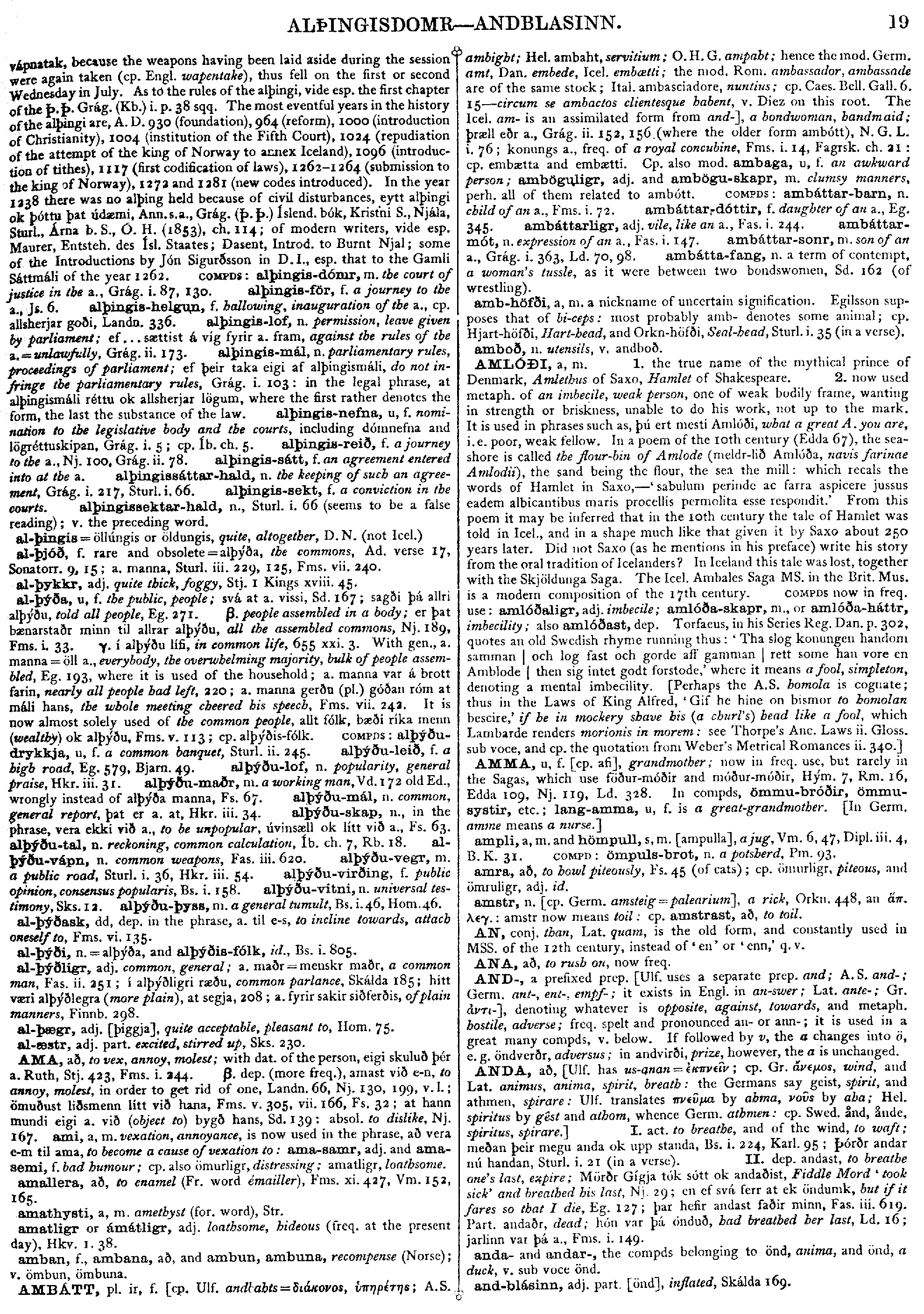
vápnatak, because the weapons having been laid aside during the session were again taken (cp. Engl. wapentake), thus fell on the first or second Wednesday in July. As to the rules of the alþingi, vide esp. the first chapter of the Þ. Þ. Grág. (Kb.) i. p. 38 sqq. The most eventful years in the history of the alþingi are, A. D. 930 (foundation), 964 (reform), 1000 (introduction of Christianity), 1004 (institution of the Fifth Court), 1024 (repudiation of the attempt of the king of Norway to annex Iceland), 1096 (introduc- tion of tithes), 1117 (first codification of laws), 1262-1264 (submission to the king of Norway), 1272 and 1281 (new codes introduced). In the year 1338 there was no alþing held because of civil disturbances, eytt alþingi ok þóttu þat údærni, Ann. s. a., Grág. (Þ. Þ.) Íslend. bók, Kristni S., Njála, Sturl., Árna b. S., Ó. H. (1853), ch. 114; of modern writers, vide esp. Maurer, Entsteh. des Ísl. Staates; Dasent, Introd. to Burnt Njal; some of the Introductions by Jón Sigurðsson in D. I., esp. that to the Gamli Sáttmáli of the year 1262. COMPDS: alþingis-dómr, m. the court of justice in the a., Grág. i. 87, 130, alþingis-för, f. a journey to the a., Js. 6. alþingis-helgun, f. hallowing, inauguration of the a., cp. allsherjar goði, Landn. 336. alþingis-lof, n. permission, leave given by parliament; ef... sættist á víg fyrir a. fram, against the rules of the a. = unlawfully, Grág. ii. 173. alþingis-mál, n. parliamentary rules, proceedings of parliament; ef þeir taka eigi af alþingismáli, do not in- fringe the parliamentary rules, Grág. i. 103: in the legal phrase, at alþingismáli réttu ok allsherjar lögum, where the first rather denotes the form, the last the substance of the law. alþingis-nefna, u, f. nomi- nation to the legislative body and the courts, including dómnefna and lögréttuskipan, Grág. i. 5; cp. Íb. ch. 5. alþingis-reið, f. a journey to the a., Nj. 100, Grág. ii. 78. alþingis-sátt, f. an agreement entered into at the a. alþingiasáttar-hald, n. the keeping of sucb an agree- ment, Grág. i. 217, Sturl. i. 66. alþingis-sekt, f. a conviction in the courts. alþingissektar-hald, n., Stud. i. 66 (seems to be a false reading); v. the preceding word.
|
Source: Cleasby/Vigfusson, page b0041, entry 76 View original page image as: [TIFF] [PNG] [View previous entry] [View next entry] |
[Comment on this entry] [View comments] |
The following entry has been hand-corrected once. |
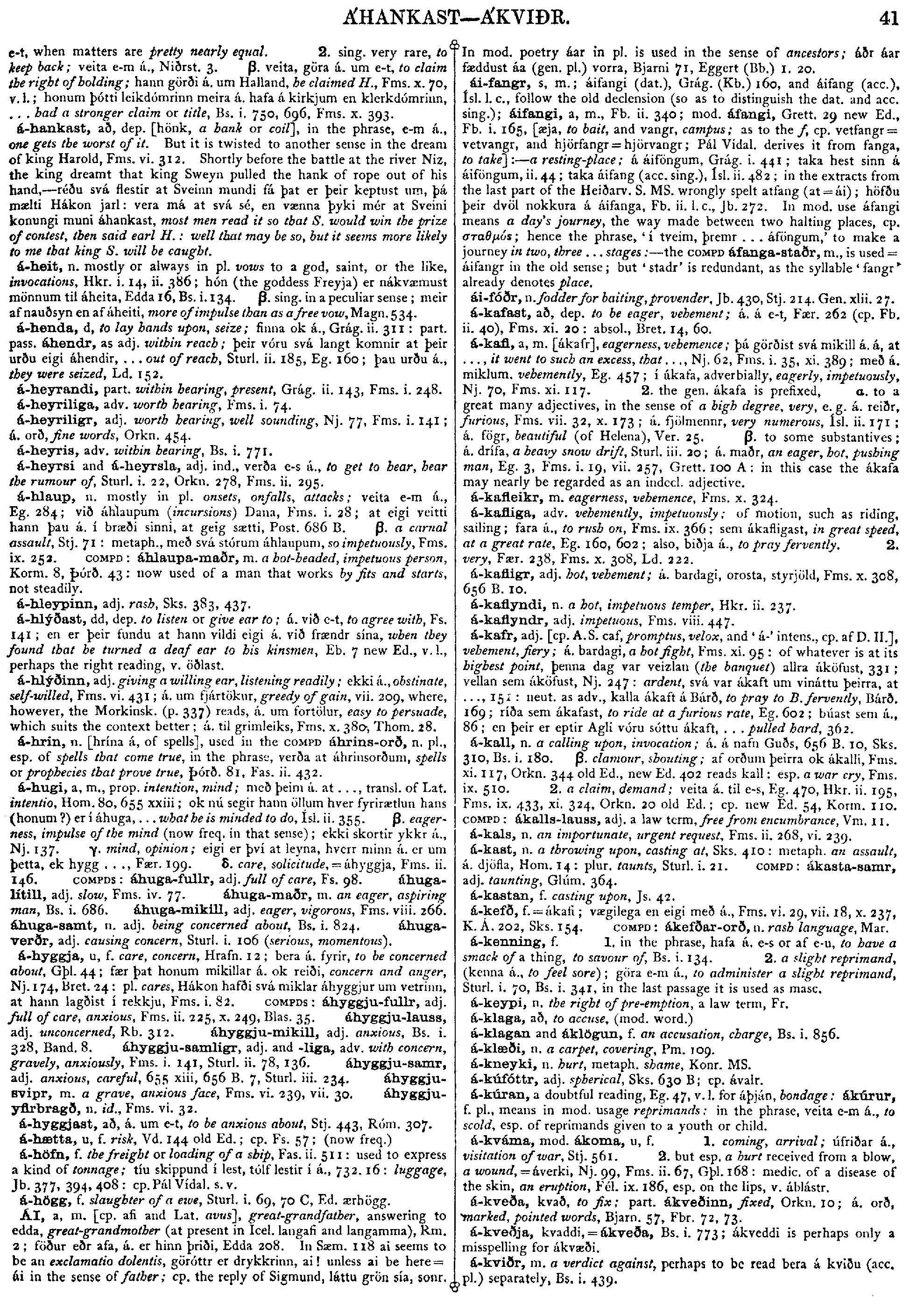
ÁLFR, s, m. [A. S. ælf, munt-ælfen, sæ-ælfen, wudu-ælfen, etc.; Engl. elf, elves, in Shakespeare ouphes are 'fairies;' Germ. alb and elfen, Erl- in Erlkönig (Göthe) is, according to Grimm, a corrupt form from the Danish Ellekonge qs. Elver-konge]; in the west of Icel. also pronounced álbr: I. mythically, an elf, fairy; the Edda distinguishes between Ljósálfar, the elves of light, and Dökkálfar, of darkness (the last not elsewhere mentioned either in mod. fairy tales or in old writers), 12; the Elves and Ases are fellow gods, and form a favourite alliteration in the old mythical poems, e.g. Vsp. 53, Hm. 144, 161, Gm. 4, Ls. 2, 13, Þkv. 7, Skm. 7, 17, Sdm. 18. In the Alvismál Elves and Dwarfs are clearly distinguished as different. The abode of the elves in the Edda is Álfheimar, fairy land, and their king the god Frey (the god of light), Edda 12; see the poem Gm. 12, Álfheim Frey gáfu í árdaga tívar at tannfé. In the fairy tales the Elves haunt the hills, hence their name Huldufólk, hidden people: respecting their origin, life, and customs, v. Ísl. Þjóðs. i. I sqq. In old writers the Elves are rarely mentioned; but that the same tales were told as at present is clear;-- Hallr mælti, hvi brosir þú nú? þórhallr svarar, af því brosir ek, at margr hóll opnast ok hvert kvikindi býr sinn bagga bæði smá ok stór, ok gera fardaga (a foreboding of the introduction of Christianity), Fms. ii. 197, cp. landvættir; álfamenn, elves, Bs. i. 417, Fas. i. 313, 96; hóll einn er hér skamt í brott er álfar búa í, Km. 216: álfrek, in the phrase, ganga álfreka, cacare, means dirt, excrements, driving the elves away through contamination, Eb. 12, cp. Landn. 97, Fms. iv. 308, Bárð. ch. 4: álfröðull, elfin beam or light, a poët. name of the sun; álfavakir, elf-holes, the small rotten holes in the ice in spring-time in which the elves go a fishing; the white stripes in the sea in calm weather are the wakes of elfin fishing boats, etc.: medic. álfabruni is an eruption in the face, Fél. ix. 186: Ivar Aasen mentions 'alvgust, alveblaastr, alveld,' the breath, fire of elves (cp. St. Vitus' dance or St. Anthony's fire); 'alvskot,' a sort of cancer in the bone :-- græti álfa, elfin tears, Hðm. I, is dubious; it may mean some flower with dew-drops glittering in the morning sun, vide s. v. glýstamr (glee-steaming). Jamieson speaks of an elf's cup, but elf tears are not noticed elsewhere; cp. Edda 39. In Sweden, where the worship of Frey prevailed, sacrifices, álfa-blót, were made to the elves, stóð húsfreyja í dyrum ok bað hann (the guest) eigi þar innkoma, segir at þau ætti álfa blót, Hkr. ii. 124 (referring to the year 1018), cp. Korm. ch. 22. 2. metaph., as the elves had the power to bewitch men, a silly, vacant person is in Icel. called álfr; hence álfalegr, silly álfaskapr and álfaháttr, silly behaviour. II. in historical sense, the Norse district situated between the two great rivers Raumelfr and Gautelfr (Alhis Raumarum, et Gotharum) was in the mythical times called Álfheimar, and its inhabitants Álfar, Fas. i. 413, 384, 387, Fb. i. 23, vide also P. A. Munch, Beskrivelse over Norge, p. 7. For the compds v. above.
|
Source: Cleasby/Vigfusson, page b0041, entry 131 View original page image as: [TIFF] [PNG] [View previous entry] [View next entry] |
[Comment on this entry] [View comments] |
The following entry has been hand-corrected once. |
ÁR, n. [Goth. jêr; A. S. gear; Engl. year; Germ. jabr; the Scandin. idioms all drop the j, as in ungr, young; cp. also the Gr. GREEK; Lat. hora; Ulf. renders not only GREEK but also sometimes GREEK and GREEK by jêr]. I. a year, = Lat. annus, divided into twelve lunar months, each of 30 days, with four intercalary days, thus making 364 days; as the year was reckoned about the middle of the 10th century (the original calculation probably only reckoned 360 days, and made up the difference by irregular intercalary months). About the year 960 Thorstein Surt introduced the sumarauki (intercalary week), to be inserted every seventh year, thus bringing the year up to 365 days. After the introduction of Christianity (A. D. 1000) the sumarauki was made to harmonize with the Julian calendar; but from A. D. 1700 with the Gregorian calendar; v. the words sumarauki, hlaupár, mánuðr, vika, etc., Íb. ch. 4, Rb. 6, Fms. i. 67; telja árum, to count the time by years, Vsp. 6; í ári, used adverb., at present, as yet, Ó. H. 41, 42 (in a verse). II. = Lat. annona, plenty, abundance, fruitfulness; the phrase, friðr ok ár, Fms. vii. 174, Hkr. Yngl. ch. 8-12; ár ok fésæla, Hkr. l. c.; þá var ár urn öll lönd, id.; létu hlaða skip mörg af korni ok annarri gæzku, ok flytja svá ár í Dan- mörku, Fms. xi. 8, Sks. 323, Fas. i. 526, Hom. 68; gott ár, Eg. 39; blota til árs, Fms. i. 34. III. the name of the Rune RUNE (a), Skálda 176; in the A. S. and Goth. Runes the j has the name jêr, gêr, according to the Germ. and Engl. pronunciation of this word; vide p. 2, col. 1. COMPDS: ára-tal, n. and ára-tala, u, f. number of years; fimtugr at áratali, Stj. 110, Rb. 484, Mar. 656 A. i. 29; hann (Ari Frodi) hafði áratal fyrst til þess er Kristni kom á Ísland, en síðan allt til sinna daga, Hkr. (pref.), seems to mean that Ari in respect of chronology divided his Íslendingabók into two periods, that before and that after the introduction of Christianity; Stj. 112 (periode). árs-bót, f. = árbót, Bs. i. 343, q. v.
|
Source: Cleasby/Vigfusson, page b0057, entry 37 View original page image as: [TIFF] [PNG] [View previous entry] [View next entry] |
[Comment on this entry] [View comments] |
The following entry has been hand-corrected once. |
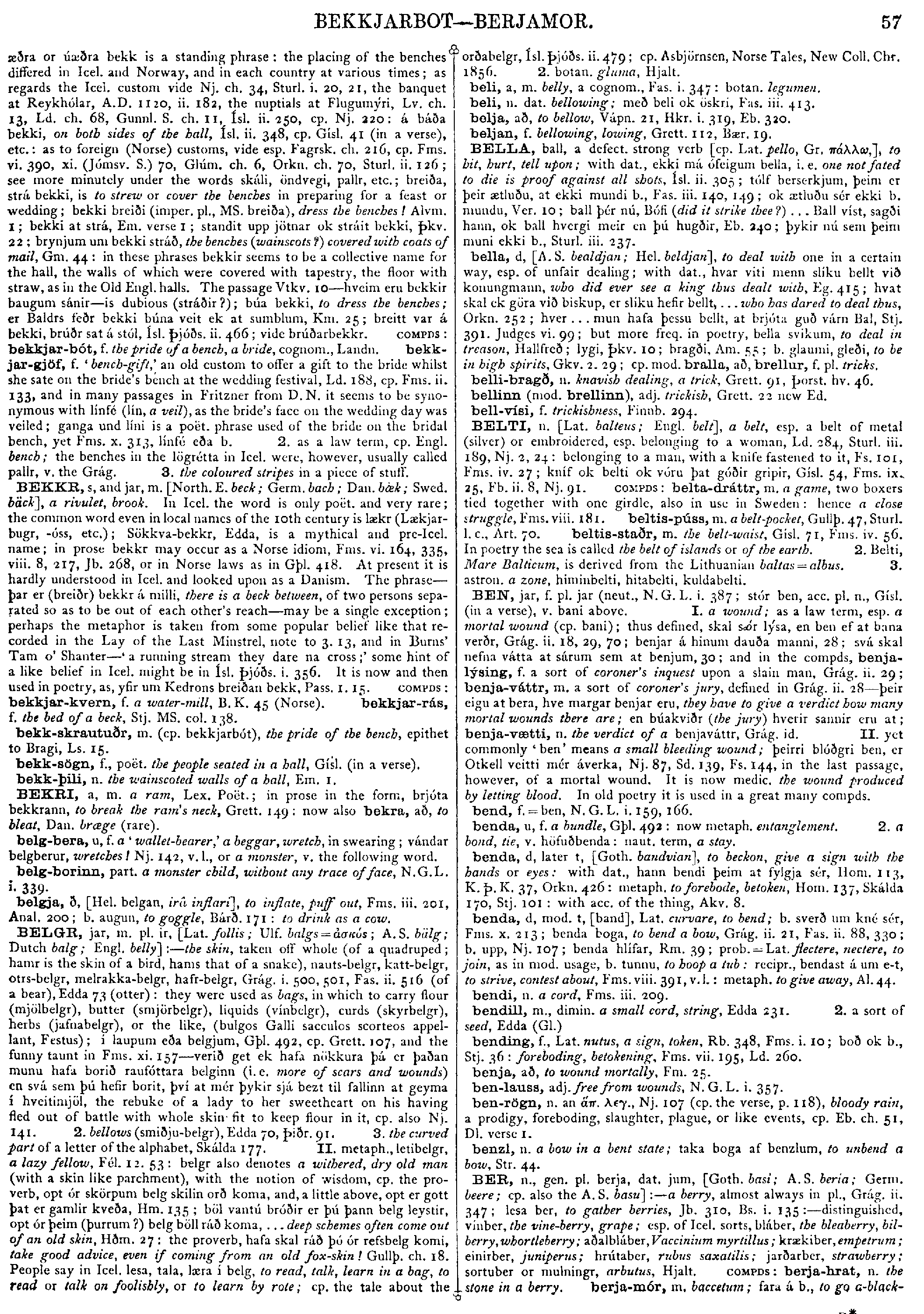
BERA,
bar,
báru,
borit,
pres.
berr,
--
poët,
forms
with
the
suffixed
negative;
3rd
pers.
sing.
pres.
Indic.
berrat,
Hm.
10;
3rd
pers.
sing.
pret.
barat,
Vellekla;
1st
pers.
sing.
barkak,
Eb.
62
(in
a
verse);
barkat
ek,
Hs.
8;
2nd
pers.
sing.
bartattu;
3rd
pers.
pl.
bárut,
etc.,
v.
Lex.
Poët.
[Gr.
GREEK
Lat.
ferre;
Ulf.
bairan;
A.
S.
beran;
Germ,
gebären;
Engl.
bear;
Swed.
bära;
Dan.
bære].
A.
Lat.
ferre,
portare:
I.
prop,
with
a
sense
of
motion,
to
bear,
carry,
by
means
of
the
body,
of
animals,
of
vehicles,
etc.,
with
acc.,
Egil
tók
mjöðdrekku
eina
mikla,
ok
bar
undir
hendi
sér,
Eg.
237;
bar
hann
heim
hrís,
Rm.
9;
konungr
lét
bera
inn
kistur
tvær,
báru
tveir
menn
hverja,
Eg.
310;
bera
farm
af
skipi,
to
unload
a
ship,
Ld.
32;
bera
(farm)
á
skip,
to
load
a
ship,
Nj.
182;
tóku
alla
ösku
ok
báru
á
á
(amnem)
út,
623,
36;
ok
bar
þat
(carried
it)
í
kerald,
43,
K.
Þ.
K.
92;
b.
mat
á
borð,
í
stofu,
to
put
the
meat
on
table,
in
the
oven;
b.
mat
af
borði,
to
take
it
off
table,
Eb.
36,
266,
Nj.
75,
Fms.
ix.
219,
etc.
2.
Lat.
gestare,
ferre,
denoting
to
wear
clothes,
to
carry
weapons;
skikkja
dýr
er
konungr
hafði
borit,
Eg.
318;
b.
kórónu,
to
wear
the
crown,
Fms.
x.
16;
atgeir,
Nj.
119;
vápn,
209:
metaph.,
b.
ægishjálm,
to
inspire
fear
and
awe;
b.
merki,
to
carry
the
flag
in
a
battle,
Nj.
274,
Orkn.
28,
30,
38,
Fms.
v.
64,
vi.
413;
bera
fram
merki,
to
advance,
move
in
a
battle,
vi.
406.
3.
b.
e-t
á
hesti
(áburðr),
to
carry
on
horseback;
Auðunn
bar
mat
á
hesti,
Grett.
107;
ok
bar
hrís
á
hesti,
76
new
Ed.;
þeir
báru
á
sjau
hestum,
98
new
Ed.
II.
without
a
sense
of
motion:
1.
to
give
birth
to;
[the
root
of
barn,
bairn;
byrja,
incipere;
burðr,
partus;
and
burr,
filius:
cp.
Lat.
par re;
also
Gr.
GREEK
Lat.
ferre,
of
child-bearing.]
In
Icel.
prose,
old
as
well
as
mod.,
'ala'
and
'fæða'
are
used
of
women;
but
'bera,'
of
cows
and
sheep;
hence
sauðburðr,
casting
of
lambs,
kýrburðr;
a
cow
is
snembær,
siðbær,
Jólabær,
calves
early,
late,
at
Yule
time,
etc.;
var
ekki
ván
at
hon
(the
cow)
mundi
b.
fyr
en
um
várit,
Bs.
i.
193,
194;
kýr
hafði
borit
kálf,
Bjarn.
32;
bar
hvárrtveggi
sauðrinn
sinn
burð,
Stj.
178:
the
participle
borinn
is
used
of
men
in
a
great
many
compds
in
a
general
sense,
aptrborinn,
árborinn,
endrborinn,
frjálsborinn,
goðborinn,
höldborinn,
hersborinn,
konungborinn,
óðalborinn,
samborinn,
sundrborinn,
velborinn,
úborinn,
þrælborinn,
etc.;
also
out
of
compds,
mun
ek
eigi
upp
gefa
þann
sóma,
sem
ek
em
til
borinn,
...
entitled
to
by
inheritance,
Ld.
102;
hann
hafði
blindr
verit
borinn,
born
blind,
Nj.
152,
Hdl.
34,
42,
Vsp.
2:
esp.
borinn
e-m,
born
of
one,
Rm.
39,
Hdl.
12,
23,
27,
Hðm.
2,
Gs.
9,
Vþm.
25,
Stor.
16,
Vkv.
15;
borinn
frá
e-m,
Hdl.
24:
the
other
tenses
are
in
theol.
Prose
used
of
Christ,
hans
blezaða
son
er
virðist
at
láta
berast
hingað
í
heim
af
sinni
blezaðri
móður,
Fms.
i.
281;
otherwise
only
in
poetry,
eina
dóttur
(acc.)
berr
álfröðull
(viz.
the
sun,
regarded
as
the
mother),
Vþm.
47;
hann
Gjálp
um
bar,
hann
Greip
um
bar
...,
Hdl.
36:
borit
(sup.),
Hkv.
1.
1.
.
of
trees,
flowers;
b.
ávöxt,
blóm
...,
to
bear
fruit,
flower
...
(freq.);
bar
aldinviðrinn
tvennan
blóma,
Fms.
ix.
265;
cp.
the
phrase,
bera
sitt
barr,
v.
barr.
2.
denoting
to
load,
with
acc.
of
the
person
and
dat.
of
the
thing:
.
in
prop.
sense;
hann
hafði
borit
sik
mjök
vápnum,
he
had
loaded
himself
with
arms,
i.
e.
wore
heavy
armour,
Sturl.
iii.
250.
.
but
mostly
in
a
metaph.
sense;
b.
e-n
ofrafli,
ofrmagni,
ofrliði,
ofríki,
magni,
to
bear
one
down,
to
overcome,
oppress
one,
by
odds
or
superior
force,
Grág.
i.
101,
ii.
195,
Nj.
80,
Hkr.
ii.
371,
Gþl.
474,
Stj.
512,
Fms.
iii.
175
(in
the
last
passage
a
dat.
pers.
badly);
b.
e-n
ráðum,
to
overrule
one,
Nj.
198,
Ld.
296;
b.
e-n
málum,
to
bearhim
down
(wrongfully)
in
a
lawsuit,
Nj.
151;
b.
e-n
bjóri,
to
make
drunk,
Vkv.
26:
medic.,
borinn
verkjum,
sótt,
Bjarn.
68,
Og.
5;
bölvi,
Gg.
2:
borne
down,
feeling
heavy
pains;
þess
er
borin
ván,
no
hope,
all
hope
is
gone,
Ld.
250;
borinn
sök,
charged
with
a
cause,
Fms.
v.
324,
H.
E.
i.
561;
bráðum
borinn,
to
be
taken
by
surprise,
Fms.
iv.
111;
b.
fé,
gull
á
e-n,
to
bring
one
a
fee,
gold,
i.
e.
to
bribe
one,
Nj.
62;
borinn
baugum,
bribed,
Alvm.
5;
always
in
a
bad
sense,
cp.
the
law
phrase,
b.
fé
í
dóm,
to
bribe
a
court,
Grág.,
Nj.
240.
3.
to
bear,
support,
sustain,
Lat.
sustinere,
lolerare,
ferre:
.
properly,
of
a
ship,
horse,
vehicle,
to
bear,
be
capable
of
bearing;
þeir
hlóðu
bæði
skipin
sem
borð
báru,
all
that
they
could
carry,
Eb.
302;
--
a
ship
'berr'
(carries)
such
and
such
a
weight;
but
'tekr'
(takes)
denotes
a
measure
of
fluids.
.
metaph.
to
sustain,
support;
dreif
þannig
svá
mikill
mannfjöldi
at
landit
fékk
eigi
borit,
Hkr.
i.
56;
but
metaph.
to
bear
up
against,
endure,
support
grief,
sorrow,
etc.,
sýndist
öllum
at
Guð
hefði
nær
ætlað
hvat
hann
mundi
b.
mega,
Bs.
i.
139;
biðr
hann
friðar
ok
þykist
ekki
mega
b.
reiði
hans,
Fms.
iii.
80:
the
phrase,
b.
harm
sinn
í
hljóði,
to
suffer
silently;
b.
svívirðing,
x.
333:
absol.,
þótti
honum
mikit
víg
Kjartans,
en
þó
bar
hann
drengilega,
he
bore
it
manfully,
Ld.
226;
er
þat
úvizka,
at
b.
eigi
slíkt,
not
to
bear
or
put
up
with,
Glúm.
327;
b.
harm,
to
grieve,
Fms.
xi.
425:
in
the
phrases,
b.
sik,
b.
af
sér,
berask,
berask
vel
(illa,
lítt),
to
bear
oneself,
to
bear
up
against
misfortune;
Guðrúnu
þótti
mikit
fráfall
Þorkels,
en
þó
bar
hon
sköruliga
af
sér,
she
bore
her
bravely
up,
Ld.
326-328;
lézt
hafa
spurt
at
ekkjan
bæri
vel
af
sér
harmana,
Eb.
88;
berask
af;
hversu
bersk
Auðr
af
um
bróðurdauðann?
(how
does
she
bear
it?);
hón
bersk
af
lítt
(she
is
much
borne
down)
ok
þykir
mikit,
Gísl.
24;
niun
oss
vandara
gört
en
öðrum
at
vér
berim
oss
vel
(Lat.
fortiter
ferre),
Nj.
197;
engi
maðr
hefði
þar
jamvel
borit
sik,
none
bad
borne
himself
so
boldly,
Sturl.
iii.
132;
b.
sik
vel
upp,
to
bear
well
up
against,
bear
a
stout
heart,
Hrafn.
17;
b.
sik
beiskliga
(sorely),
Stj.
143;
b.
sik
lítt,
to
be
downcast,
Fms.
ii.
61;
b.
sik
at
göra
e-t,
to
do
one's
best,
try
a
thing.
III.
in
law
terms
or
modes
of
procedure:
1.
bera
járn,
the
ordeal
of
bearing
hot
iron
in
the
hand,
cp.
járnburðr,
skírsla.
This
custom
was
introduced
into
Scandinavia
together
with
Christianity
from
Germany
and
England,
and
superseded
the
old
heathen
ordeals
'hólmganga,'
and
'ganga
undir
jarðarmen,'
v.
this
word.
In
Norway,
during
the
civil
wars,
it
was
esp.
used
in
proof
of
paternity
of
the
various
pretenders
to
the
crown,
Fms.
vii.
164,
200,
ix.
Hák.
S.
ch.
14,
41-45,
viii.
(Sverr.
S.)
ch.
150,
xi.
(Jómsv.
S.)
ch.
11,
Grett.
ch.
41,
cp.
N.
G.
L.
i.
145,
389.
Trial
by
ordeal
was
abolished
in
Norway
A.
D.
1247.
In
Icel.
It
was
very
rarely
mentioned,
vide
however
Lv.
ch.
23
(paternity),
twice
or
thrice
in
the
Sturl.
i.
56,
65,
147,
and
Grág.
i.
341,
361;
it
seems
to
have
been
very
seldom
used
there,
(the
passage
in
Grett.
S.
l.
c.
refers
to
Norway.)
2.
bera
út
(hence
útburðr,
q.
v.),
to
expose
children;
on
this
heathen
custom,
vide
Grimm
R.
A.
In
heathen
Icel.,
as
in
other
parts
of
heathen
Scandinavia,
it
was
a
lawful
act,
but
seldom
exercised;
the
chief
passages
on
record
are,
Gunnl.
S.
ch.
3
(ok
þat
var
þá
siðvandi
nokkurr,
er
land
var
allt
alheiðit,
at
þeir
menn
er
félitlir
vórn,
en
stóð
ómegð
mjök
til
handa
létu
út
bera
börn
sín,
ok
þótti
þó
illa
gört
ávalt),
Fs.
Vd.
ch.
37,
Harð.
S.
ch.
8,
Rd.
ch.
7,
Landn.
v.
ch.
6,
Finnb.
ch.
2,
Þorst.
Uxaf.
ch.
4,
Hervar.
S.
ch.
4,
Fas.
i.
547
(a
romance);
cp.
Jómsv.
S.
ch.
1.
On
the
introduction
of
Christianity
into
Icel.
A.
D.
1000,
it
was
resolved
that,
in
regard
to
eating
of
horse-flesh
and
exposure
of
children,
the
old
laws
should
remain
in
force,
Íb.
ch.
9;
as
Grimm
remarks,
the
exposure
must
take
place
immediately
after
birth,
before
the
child
had
tasted
food
of
any
kind
whatever,
and
before
it
was
besprinkled
with
water
(ausa
vatni)
or
shown
to
the
father,
who
had
to
fix
its
name;
exposure,
after
any
of
these
acts,
was
murder,
cp.
the
story
of
Liafburga
told
by
Grimm
R.
A.);
v.
Also
a
Latin
essay
at
the
end
of
the
Gunnl.
S.
(Ed.
1775).
The
Christian
Jus
Eccl.
put
an
end
to
this
heathen
barbarism
by
stating
at
its
very
beginning,
ala
skal
barn
hvert
er
borit
verðr,
i.
e.
all
children,
if
not
of
monstrous
shape,
shall
be
brought
up,
N.
G.
L.
i.
339,
363.
.
b.
út
(now
more
usual,
hefja
út,
Am.
100),
to
carry
out
for
burial;
vera
erfðr
ok
tit
borinn,
Odd.
20;
var
hann
heygðr,
ok
út
borinn
at
fornum
sið,
Fb.
i.
123;
b.
á
bál,
to
place
(the
body
and
treasures)
upon
the
pile,
the
mode
of
burying
in
the
old
heathen
time,
Fas.
i.
487
(in
a
verse);
var
hon
borin
á
bálit
ok
slegit
í
eldi,
Edda
38.
B.
Various
and
metaph.
cases.
I.
denoting
motion:
1.
'bera'
is
in
the
Grág.
the
standing
law
term
for
delivery
of
a
verdict
by
a
jury
(búar),
either
'bera'
absol.
or
adding
kvið
(verdict);
bera
á
e-n,
or
b.
kvið
á
e-n,
to
give
a
verdict
against,
declare
guilty;
bera
af
e-m,
or
b.
af
e-m
kviðinn,
to
give
a
verdict
for;
or
generally,
bera,
or
b.
um
e-t,
to
give
a
verdict
in
a
case;
bera,
or
b.
vitni,
vætti,
also
simply
means
to
testify,
to
witness,
Nj.
111,
cp.
kviðburðr
(delivering
of
verdict),
vitnisburðr
(bearing
witness),
Grág.
ii.
28;
eigi
eigu
búar
(jurors)
enn
at
b.
um
þat
hvat
lög
eru
á
landi
hér,
the
jurors
have
not
to
give
verdict
in
(to
decide)
what
is
law
in
the
country,
cp.
the
Engl.
maxim,
that
jurors
have
only
to
decide
the
question
of
evidence,
not
of
law,
Grág.
(Kb.)
ch.
85;
eigi
eru
búar
skildir
at
b.
um
hvatvetna;
um
engi
mál
eigu
þeir
at
skilja,
þau
er
erlendis
(abroad)
hafa
görzt,
id.;
the
form
in
delivering
the
verdict
--
höfum
vér
(the
jurors),
orðit
á
eitt
sáttir,
berum
á
kviðburðinn,
berum
hann
sannan
at
sökinni,
Nj.
238,
Grág.
i.
49,
22,
138,
etc.;
í
annat
sinn
báru
þeir
á
Flosa
kviðinn,
id.;
b.
annattveggja
af
eðr
á;
b.
undan,
to
discharge,
Nj.
135;
b.
kvið
í
hag
(for),
Grág.
i.
55;
b.
lýsingar
vætti,
Nj.
87;
b.
vitni
ok
vætti,
28,
43,
44;
b.
ljúgvitni,
to
bear
false
witness,
Grág.
i.
28;
b.
orð,
to
bear
witness
to
a
speech,
43;
bera
frændsemi
sundr,
to
prove
that
they
are
not
relations,
N.
G.
L.
i.
147:
reflex.,
berask
ór
vætti,
to
prove
that
oneself
is
wrongly
summoned
to
bear
witness
or
to
give
a
verdict,
44:
berask
in
a
pass.
sense,
to
be
proved
by
evidence,
ef
vanefni
b.
þess
manns
er
á
hönd
var
lýst,
Grág.
i.
257;
nema
jafnmæli
berisk,
229;
þótt
þér
berisk
þat
faðerni
er
þú
segir,
Fms.
vii.
164;
hann
kvaðst
ætla,
at
honum
mundi
berask,
that
he
would
be
able
to
get
evidence
for,
Fs.
46.
.
gener.
and
not
as
a
law
term;
b.
á,
b.
á
hendr,
to
charge;
b.
e-n
undan,
to
discharge,
Fs.
95;
eigi
erum
vér
þessa
valdir
er
þú
berr
á
oss,
Nj.
238,
Ld.
206,
Fms.
iv.
380,
xi.
251,
Th.
78;
b.
e-m
á
brýnn,
to
throw
in
one's
face,
to
accuse,
Greg.
51;
b.
af
sér,
to
deny;
eigi
mun
ek
af
mér
b.,
at...
(non
diffitebor),
Nj.
271;
re;
also
Gr.
GREEK
Lat.
ferre,
of
child-bearing.]
In
Icel.
prose,
old
as
well
as
mod.,
'ala'
and
'fæða'
are
used
of
women;
but
'bera,'
of
cows
and
sheep;
hence
sauðburðr,
casting
of
lambs,
kýrburðr;
a
cow
is
snembær,
siðbær,
Jólabær,
calves
early,
late,
at
Yule
time,
etc.;
var
ekki
ván
at
hon
(the
cow)
mundi
b.
fyr
en
um
várit,
Bs.
i.
193,
194;
kýr
hafði
borit
kálf,
Bjarn.
32;
bar
hvárrtveggi
sauðrinn
sinn
burð,
Stj.
178:
the
participle
borinn
is
used
of
men
in
a
great
many
compds
in
a
general
sense,
aptrborinn,
árborinn,
endrborinn,
frjálsborinn,
goðborinn,
höldborinn,
hersborinn,
konungborinn,
óðalborinn,
samborinn,
sundrborinn,
velborinn,
úborinn,
þrælborinn,
etc.;
also
out
of
compds,
mun
ek
eigi
upp
gefa
þann
sóma,
sem
ek
em
til
borinn,
...
entitled
to
by
inheritance,
Ld.
102;
hann
hafði
blindr
verit
borinn,
born
blind,
Nj.
152,
Hdl.
34,
42,
Vsp.
2:
esp.
borinn
e-m,
born
of
one,
Rm.
39,
Hdl.
12,
23,
27,
Hðm.
2,
Gs.
9,
Vþm.
25,
Stor.
16,
Vkv.
15;
borinn
frá
e-m,
Hdl.
24:
the
other
tenses
are
in
theol.
Prose
used
of
Christ,
hans
blezaða
son
er
virðist
at
láta
berast
hingað
í
heim
af
sinni
blezaðri
móður,
Fms.
i.
281;
otherwise
only
in
poetry,
eina
dóttur
(acc.)
berr
álfröðull
(viz.
the
sun,
regarded
as
the
mother),
Vþm.
47;
hann
Gjálp
um
bar,
hann
Greip
um
bar
...,
Hdl.
36:
borit
(sup.),
Hkv.
1.
1.
.
of
trees,
flowers;
b.
ávöxt,
blóm
...,
to
bear
fruit,
flower
...
(freq.);
bar
aldinviðrinn
tvennan
blóma,
Fms.
ix.
265;
cp.
the
phrase,
bera
sitt
barr,
v.
barr.
2.
denoting
to
load,
with
acc.
of
the
person
and
dat.
of
the
thing:
.
in
prop.
sense;
hann
hafði
borit
sik
mjök
vápnum,
he
had
loaded
himself
with
arms,
i.
e.
wore
heavy
armour,
Sturl.
iii.
250.
.
but
mostly
in
a
metaph.
sense;
b.
e-n
ofrafli,
ofrmagni,
ofrliði,
ofríki,
magni,
to
bear
one
down,
to
overcome,
oppress
one,
by
odds
or
superior
force,
Grág.
i.
101,
ii.
195,
Nj.
80,
Hkr.
ii.
371,
Gþl.
474,
Stj.
512,
Fms.
iii.
175
(in
the
last
passage
a
dat.
pers.
badly);
b.
e-n
ráðum,
to
overrule
one,
Nj.
198,
Ld.
296;
b.
e-n
málum,
to
bearhim
down
(wrongfully)
in
a
lawsuit,
Nj.
151;
b.
e-n
bjóri,
to
make
drunk,
Vkv.
26:
medic.,
borinn
verkjum,
sótt,
Bjarn.
68,
Og.
5;
bölvi,
Gg.
2:
borne
down,
feeling
heavy
pains;
þess
er
borin
ván,
no
hope,
all
hope
is
gone,
Ld.
250;
borinn
sök,
charged
with
a
cause,
Fms.
v.
324,
H.
E.
i.
561;
bráðum
borinn,
to
be
taken
by
surprise,
Fms.
iv.
111;
b.
fé,
gull
á
e-n,
to
bring
one
a
fee,
gold,
i.
e.
to
bribe
one,
Nj.
62;
borinn
baugum,
bribed,
Alvm.
5;
always
in
a
bad
sense,
cp.
the
law
phrase,
b.
fé
í
dóm,
to
bribe
a
court,
Grág.,
Nj.
240.
3.
to
bear,
support,
sustain,
Lat.
sustinere,
lolerare,
ferre:
.
properly,
of
a
ship,
horse,
vehicle,
to
bear,
be
capable
of
bearing;
þeir
hlóðu
bæði
skipin
sem
borð
báru,
all
that
they
could
carry,
Eb.
302;
--
a
ship
'berr'
(carries)
such
and
such
a
weight;
but
'tekr'
(takes)
denotes
a
measure
of
fluids.
.
metaph.
to
sustain,
support;
dreif
þannig
svá
mikill
mannfjöldi
at
landit
fékk
eigi
borit,
Hkr.
i.
56;
but
metaph.
to
bear
up
against,
endure,
support
grief,
sorrow,
etc.,
sýndist
öllum
at
Guð
hefði
nær
ætlað
hvat
hann
mundi
b.
mega,
Bs.
i.
139;
biðr
hann
friðar
ok
þykist
ekki
mega
b.
reiði
hans,
Fms.
iii.
80:
the
phrase,
b.
harm
sinn
í
hljóði,
to
suffer
silently;
b.
svívirðing,
x.
333:
absol.,
þótti
honum
mikit
víg
Kjartans,
en
þó
bar
hann
drengilega,
he
bore
it
manfully,
Ld.
226;
er
þat
úvizka,
at
b.
eigi
slíkt,
not
to
bear
or
put
up
with,
Glúm.
327;
b.
harm,
to
grieve,
Fms.
xi.
425:
in
the
phrases,
b.
sik,
b.
af
sér,
berask,
berask
vel
(illa,
lítt),
to
bear
oneself,
to
bear
up
against
misfortune;
Guðrúnu
þótti
mikit
fráfall
Þorkels,
en
þó
bar
hon
sköruliga
af
sér,
she
bore
her
bravely
up,
Ld.
326-328;
lézt
hafa
spurt
at
ekkjan
bæri
vel
af
sér
harmana,
Eb.
88;
berask
af;
hversu
bersk
Auðr
af
um
bróðurdauðann?
(how
does
she
bear
it?);
hón
bersk
af
lítt
(she
is
much
borne
down)
ok
þykir
mikit,
Gísl.
24;
niun
oss
vandara
gört
en
öðrum
at
vér
berim
oss
vel
(Lat.
fortiter
ferre),
Nj.
197;
engi
maðr
hefði
þar
jamvel
borit
sik,
none
bad
borne
himself
so
boldly,
Sturl.
iii.
132;
b.
sik
vel
upp,
to
bear
well
up
against,
bear
a
stout
heart,
Hrafn.
17;
b.
sik
beiskliga
(sorely),
Stj.
143;
b.
sik
lítt,
to
be
downcast,
Fms.
ii.
61;
b.
sik
at
göra
e-t,
to
do
one's
best,
try
a
thing.
III.
in
law
terms
or
modes
of
procedure:
1.
bera
járn,
the
ordeal
of
bearing
hot
iron
in
the
hand,
cp.
járnburðr,
skírsla.
This
custom
was
introduced
into
Scandinavia
together
with
Christianity
from
Germany
and
England,
and
superseded
the
old
heathen
ordeals
'hólmganga,'
and
'ganga
undir
jarðarmen,'
v.
this
word.
In
Norway,
during
the
civil
wars,
it
was
esp.
used
in
proof
of
paternity
of
the
various
pretenders
to
the
crown,
Fms.
vii.
164,
200,
ix.
Hák.
S.
ch.
14,
41-45,
viii.
(Sverr.
S.)
ch.
150,
xi.
(Jómsv.
S.)
ch.
11,
Grett.
ch.
41,
cp.
N.
G.
L.
i.
145,
389.
Trial
by
ordeal
was
abolished
in
Norway
A.
D.
1247.
In
Icel.
It
was
very
rarely
mentioned,
vide
however
Lv.
ch.
23
(paternity),
twice
or
thrice
in
the
Sturl.
i.
56,
65,
147,
and
Grág.
i.
341,
361;
it
seems
to
have
been
very
seldom
used
there,
(the
passage
in
Grett.
S.
l.
c.
refers
to
Norway.)
2.
bera
út
(hence
útburðr,
q.
v.),
to
expose
children;
on
this
heathen
custom,
vide
Grimm
R.
A.
In
heathen
Icel.,
as
in
other
parts
of
heathen
Scandinavia,
it
was
a
lawful
act,
but
seldom
exercised;
the
chief
passages
on
record
are,
Gunnl.
S.
ch.
3
(ok
þat
var
þá
siðvandi
nokkurr,
er
land
var
allt
alheiðit,
at
þeir
menn
er
félitlir
vórn,
en
stóð
ómegð
mjök
til
handa
létu
út
bera
börn
sín,
ok
þótti
þó
illa
gört
ávalt),
Fs.
Vd.
ch.
37,
Harð.
S.
ch.
8,
Rd.
ch.
7,
Landn.
v.
ch.
6,
Finnb.
ch.
2,
Þorst.
Uxaf.
ch.
4,
Hervar.
S.
ch.
4,
Fas.
i.
547
(a
romance);
cp.
Jómsv.
S.
ch.
1.
On
the
introduction
of
Christianity
into
Icel.
A.
D.
1000,
it
was
resolved
that,
in
regard
to
eating
of
horse-flesh
and
exposure
of
children,
the
old
laws
should
remain
in
force,
Íb.
ch.
9;
as
Grimm
remarks,
the
exposure
must
take
place
immediately
after
birth,
before
the
child
had
tasted
food
of
any
kind
whatever,
and
before
it
was
besprinkled
with
water
(ausa
vatni)
or
shown
to
the
father,
who
had
to
fix
its
name;
exposure,
after
any
of
these
acts,
was
murder,
cp.
the
story
of
Liafburga
told
by
Grimm
R.
A.);
v.
Also
a
Latin
essay
at
the
end
of
the
Gunnl.
S.
(Ed.
1775).
The
Christian
Jus
Eccl.
put
an
end
to
this
heathen
barbarism
by
stating
at
its
very
beginning,
ala
skal
barn
hvert
er
borit
verðr,
i.
e.
all
children,
if
not
of
monstrous
shape,
shall
be
brought
up,
N.
G.
L.
i.
339,
363.
.
b.
út
(now
more
usual,
hefja
út,
Am.
100),
to
carry
out
for
burial;
vera
erfðr
ok
tit
borinn,
Odd.
20;
var
hann
heygðr,
ok
út
borinn
at
fornum
sið,
Fb.
i.
123;
b.
á
bál,
to
place
(the
body
and
treasures)
upon
the
pile,
the
mode
of
burying
in
the
old
heathen
time,
Fas.
i.
487
(in
a
verse);
var
hon
borin
á
bálit
ok
slegit
í
eldi,
Edda
38.
B.
Various
and
metaph.
cases.
I.
denoting
motion:
1.
'bera'
is
in
the
Grág.
the
standing
law
term
for
delivery
of
a
verdict
by
a
jury
(búar),
either
'bera'
absol.
or
adding
kvið
(verdict);
bera
á
e-n,
or
b.
kvið
á
e-n,
to
give
a
verdict
against,
declare
guilty;
bera
af
e-m,
or
b.
af
e-m
kviðinn,
to
give
a
verdict
for;
or
generally,
bera,
or
b.
um
e-t,
to
give
a
verdict
in
a
case;
bera,
or
b.
vitni,
vætti,
also
simply
means
to
testify,
to
witness,
Nj.
111,
cp.
kviðburðr
(delivering
of
verdict),
vitnisburðr
(bearing
witness),
Grág.
ii.
28;
eigi
eigu
búar
(jurors)
enn
at
b.
um
þat
hvat
lög
eru
á
landi
hér,
the
jurors
have
not
to
give
verdict
in
(to
decide)
what
is
law
in
the
country,
cp.
the
Engl.
maxim,
that
jurors
have
only
to
decide
the
question
of
evidence,
not
of
law,
Grág.
(Kb.)
ch.
85;
eigi
eru
búar
skildir
at
b.
um
hvatvetna;
um
engi
mál
eigu
þeir
at
skilja,
þau
er
erlendis
(abroad)
hafa
görzt,
id.;
the
form
in
delivering
the
verdict
--
höfum
vér
(the
jurors),
orðit
á
eitt
sáttir,
berum
á
kviðburðinn,
berum
hann
sannan
at
sökinni,
Nj.
238,
Grág.
i.
49,
22,
138,
etc.;
í
annat
sinn
báru
þeir
á
Flosa
kviðinn,
id.;
b.
annattveggja
af
eðr
á;
b.
undan,
to
discharge,
Nj.
135;
b.
kvið
í
hag
(for),
Grág.
i.
55;
b.
lýsingar
vætti,
Nj.
87;
b.
vitni
ok
vætti,
28,
43,
44;
b.
ljúgvitni,
to
bear
false
witness,
Grág.
i.
28;
b.
orð,
to
bear
witness
to
a
speech,
43;
bera
frændsemi
sundr,
to
prove
that
they
are
not
relations,
N.
G.
L.
i.
147:
reflex.,
berask
ór
vætti,
to
prove
that
oneself
is
wrongly
summoned
to
bear
witness
or
to
give
a
verdict,
44:
berask
in
a
pass.
sense,
to
be
proved
by
evidence,
ef
vanefni
b.
þess
manns
er
á
hönd
var
lýst,
Grág.
i.
257;
nema
jafnmæli
berisk,
229;
þótt
þér
berisk
þat
faðerni
er
þú
segir,
Fms.
vii.
164;
hann
kvaðst
ætla,
at
honum
mundi
berask,
that
he
would
be
able
to
get
evidence
for,
Fs.
46.
.
gener.
and
not
as
a
law
term;
b.
á,
b.
á
hendr,
to
charge;
b.
e-n
undan,
to
discharge,
Fs.
95;
eigi
erum
vér
þessa
valdir
er
þú
berr
á
oss,
Nj.
238,
Ld.
206,
Fms.
iv.
380,
xi.
251,
Th.
78;
b.
e-m
á
brýnn,
to
throw
in
one's
face,
to
accuse,
Greg.
51;
b.
af
sér,
to
deny;
eigi
mun
ek
af
mér
b.,
at...
(non
diffitebor),
Nj.
271;
|
Source: Cleasby/Vigfusson, page b0061, entry 17 View original page image as: [TIFF] [PNG] [View previous entry] [View next entry] |
[Comment on this entry] [View comments] |
The following entry has been hand-corrected once. |
ber-serkr,
s,
m.,
pl.
ir:
[the
etymology
of
this
word
has
been
much
contested;
some
--
upon
the
authority
of
Snorri,
hans
menn
fóru
'bryn julausir,'
Hkr.
i.
11
--
derive
it
from
'berr'
(bare)
and
'serkr'
[cp.
sark,
Scot,
for
shirt];
but
this
etymology
is
inadmissible,
because
'serkr'
is
a
subst.
not
an
adj.:
others
derive
it
from
'berr'
(Germ,
bär
=
ursus),
which
is
greatly
to
be
preferred,
for
in
olden
ages
athletes
and
champions
used
to
wear
hides
of
bears,
wolves,
and
reindeer
(as
skins
of
lions
in
the
south),
hence
the
names
Bjálfi,
Bjarnhéðinn,
Úlfhéðinn,
(héðinn,
pellis,)
--
'pellibus
aut
parvis
rhenonum
tegimentis
utuntur,
'Caes.
Bell.
Gall.
vi.
22:
even
the
old
poets
understood
the
name
so,
as
may
be
seen
in
the
poem
of
Hornklofi
(beginning
of
10th
century),
a
dialogue
between
a
Valkyrja
and
a
raven,
where
the
Valkyrja
says,
at
berserkja
reiðu
vil
ek
þik
spyrja,
to
which
the
raven
replies,
Úlfhéðnar
heita,
they
are
called
Wolfcoats,
cp.
the
Vd.
ch.
9;
þeir
berserkir
er
Úlfhéðnar
vóru
kallaðir,
þeir
höfðu
vargstakka
(coats
of
wild
beasts)
fyrir
brynjur,
Fs.
17
:--
a
'bear-sark,'
'bear-coat,'
i.
e.
a
wild
warrior
or
champion
of
the
heathen
age;
twelve
berserkers
are
mentioned
as
the
chief
followers
of
several
kings
of
antiquity,
e.
g.
of
the
Dan.
king
Rolf
Krake,
Edda
82;
a
Swed.
king,
Gautr.
S.
Fas.
iii.
36;
king
Adils,
Hrólf.
Kr.
S.
ch.
16
sqq.;
Harald
Hárfagri,
Eg.
ch.
9,
Grett.
ch.
2,
Vd.
l.
c.
(Hornklofi,
v.
above);
the
twelve
sons
of
Arngrim,
Hervar.
S.
ch.
3-5,
Hdl.
22,
23;
the
two
berserkers
sent
as
a
present
by
king
Eric
at
Upsala
to
earl
Hakon
of
Norway,
and
by
him
presented
to
an
Icel.
nobleman,
Eb.
ch.
25.
In
battle
the
berserkers
were
subject
to
fits
of
frenzy,
called
berserksgangr
(furor
bersercicus,
cp.
the
phrase,
ganga
berserksgang),
when
they
howled
like
wild
beasts,
foamed
at
the
mouth
and
gnawed
the
iron
rim
of
their
shields;
during
these
fits
they
were,
according
to
popular
belief,
proof
against
steel
and
fire,
and
made
great
havoc
in
the
ranks
of
the
enemy;
but
when
the
fever
abated
they
were
weak
and
tame.
A
graphical
description
of
the
'furor
bersercicus'
is
found
in
the
Sagas,
Yngl.
S.
ch.
6,
Hervar.
S.
l.
c.,
Eg.
ch.
27,
67,
Grett.
ch.
42,
Eb.
ch.
25,
Nj.
ch.
104,
Kristni
S.
ch.
2,
8
(Vd.
ch.
46);
cp.
also
a
passage
in
the
poem
of
Hornklofi
|
grenjuðu
berserkir,
|
guðr
var
þeim
á
sinnum,
|
emjaðu
Úlfhéðnar
|
ok
ísarn
gniiðu
--
which
lines
recall
to
the
mind
Roman
descriptions
of
the
Cimbric
war-cry.
In
the
Icel.
Jus
Eccles.
the
berserksgangr,
as
connected
with
the
heathen
age,
is
liable
to
the
lesser
outlawry,
K.
Þ.
K.
78;
it
is
mentioned
as
a
sort
of
possession
in
Vd.
ch.
37,
and
as
healed
by
a
vow
to
God.
In
the
Dropl.
S.
Major
(in
MS.)
it
is
medically
described
as
a
disease
(v.
the
whole
extract
in
the
essay
'De
furore
Bersercico,'
Kristni
S.
old
Ed.
in
cake);
but
this
Saga
is
modern,
probably
of
the
first
part
of
the
17th
century.
The
description
of
these
champions
has
a
rather
mythical
character.
A
somewhat
different
sort
of
berserker
is
also
recorded
in
Norway
as
existing
in
gangs
of
professional
bullies,
roaming
about
from
house
to
house,
challenging
husbandmen
to
'holmgang'
(duel),
extorting
ransom
(leysa
sik
af
hólmi),
and,
in
case
of
victory,
carrying
off
wives,
sisters,
or
daughters;
but
in
most
cases
the
damsel
is
happily
rescued
by
some
travelling
Icelander,
who
fights
and
kills
the
berserker.
The
most
curious
passages
are
Glúm,
ch.
4,
6,
Gísl.
ch.
1
(cp.
Sir
Edm.
Head's
and
Mr.
Dasent's
remarks
in
the
prefaces),
Grett.
ch.
21,
42,
Eg.
ch.
67,
Flóam.
S.
ch.
15,
17;
according
to
Grett.
ch.
21,
these
banditti
were
made
outlaws
by
earl
Eric,
A.
D.
1012.
It
is
worth
noticing
that
no
berserker
is
described
as
a
native
of
Icel.;
the
historians
are
anxious
to
state
that
those
who
appeared
in
Icel.
(Nj.,
Eb.,
Kr.
S.
l.
c.)
were
born
Norse
(or
Swedes),
and
they
were
looked
upon
with
fear
and
execration.
That
men
of
the
heathen
age
were
taken
with
fits
of
the
'furor
athleticus'
is
recorded
in
the
case
of
Thorir
in
the
Vd.,
the
old
Kveldulf
in
Eg.,
and
proved
by
the
fact
that
the
law
set
a
penalty
upon
it.
Berserkr
now
and
then
occurs
as
a
nickname,
Glúm.
378.
The
author
of
the
Yngl.
S.
attributes
the
berserksgangr
to
Odin
and
his
followers,
but
this
is
a
sheer
misinterpretation,
or
perhaps
the
whole
passage
is
a
rude
paraphrase
of
Hm.
149
sqq.
In
the
old
Hbl.
37
berserkr
and
giant
are
used
synonymously.
The
berserkers
are
the
representatives
of
mere
brute
force,
and
it
therefore
sounds
almost
blasphemous,
when
the
Norse
Barl.
S.
speaks
of
Guðs
berserkr
(a'bear-coat'
or
champion
of
God),
(Jesus
Kristr
gleymdi
eigi
hólmgöngu
sins
berserks),
54,
197.
With
the
introduction
of
Christianity
this
championship
disappeared
altogether.
julausir,'
Hkr.
i.
11
--
derive
it
from
'berr'
(bare)
and
'serkr'
[cp.
sark,
Scot,
for
shirt];
but
this
etymology
is
inadmissible,
because
'serkr'
is
a
subst.
not
an
adj.:
others
derive
it
from
'berr'
(Germ,
bär
=
ursus),
which
is
greatly
to
be
preferred,
for
in
olden
ages
athletes
and
champions
used
to
wear
hides
of
bears,
wolves,
and
reindeer
(as
skins
of
lions
in
the
south),
hence
the
names
Bjálfi,
Bjarnhéðinn,
Úlfhéðinn,
(héðinn,
pellis,)
--
'pellibus
aut
parvis
rhenonum
tegimentis
utuntur,
'Caes.
Bell.
Gall.
vi.
22:
even
the
old
poets
understood
the
name
so,
as
may
be
seen
in
the
poem
of
Hornklofi
(beginning
of
10th
century),
a
dialogue
between
a
Valkyrja
and
a
raven,
where
the
Valkyrja
says,
at
berserkja
reiðu
vil
ek
þik
spyrja,
to
which
the
raven
replies,
Úlfhéðnar
heita,
they
are
called
Wolfcoats,
cp.
the
Vd.
ch.
9;
þeir
berserkir
er
Úlfhéðnar
vóru
kallaðir,
þeir
höfðu
vargstakka
(coats
of
wild
beasts)
fyrir
brynjur,
Fs.
17
:--
a
'bear-sark,'
'bear-coat,'
i.
e.
a
wild
warrior
or
champion
of
the
heathen
age;
twelve
berserkers
are
mentioned
as
the
chief
followers
of
several
kings
of
antiquity,
e.
g.
of
the
Dan.
king
Rolf
Krake,
Edda
82;
a
Swed.
king,
Gautr.
S.
Fas.
iii.
36;
king
Adils,
Hrólf.
Kr.
S.
ch.
16
sqq.;
Harald
Hárfagri,
Eg.
ch.
9,
Grett.
ch.
2,
Vd.
l.
c.
(Hornklofi,
v.
above);
the
twelve
sons
of
Arngrim,
Hervar.
S.
ch.
3-5,
Hdl.
22,
23;
the
two
berserkers
sent
as
a
present
by
king
Eric
at
Upsala
to
earl
Hakon
of
Norway,
and
by
him
presented
to
an
Icel.
nobleman,
Eb.
ch.
25.
In
battle
the
berserkers
were
subject
to
fits
of
frenzy,
called
berserksgangr
(furor
bersercicus,
cp.
the
phrase,
ganga
berserksgang),
when
they
howled
like
wild
beasts,
foamed
at
the
mouth
and
gnawed
the
iron
rim
of
their
shields;
during
these
fits
they
were,
according
to
popular
belief,
proof
against
steel
and
fire,
and
made
great
havoc
in
the
ranks
of
the
enemy;
but
when
the
fever
abated
they
were
weak
and
tame.
A
graphical
description
of
the
'furor
bersercicus'
is
found
in
the
Sagas,
Yngl.
S.
ch.
6,
Hervar.
S.
l.
c.,
Eg.
ch.
27,
67,
Grett.
ch.
42,
Eb.
ch.
25,
Nj.
ch.
104,
Kristni
S.
ch.
2,
8
(Vd.
ch.
46);
cp.
also
a
passage
in
the
poem
of
Hornklofi
|
grenjuðu
berserkir,
|
guðr
var
þeim
á
sinnum,
|
emjaðu
Úlfhéðnar
|
ok
ísarn
gniiðu
--
which
lines
recall
to
the
mind
Roman
descriptions
of
the
Cimbric
war-cry.
In
the
Icel.
Jus
Eccles.
the
berserksgangr,
as
connected
with
the
heathen
age,
is
liable
to
the
lesser
outlawry,
K.
Þ.
K.
78;
it
is
mentioned
as
a
sort
of
possession
in
Vd.
ch.
37,
and
as
healed
by
a
vow
to
God.
In
the
Dropl.
S.
Major
(in
MS.)
it
is
medically
described
as
a
disease
(v.
the
whole
extract
in
the
essay
'De
furore
Bersercico,'
Kristni
S.
old
Ed.
in
cake);
but
this
Saga
is
modern,
probably
of
the
first
part
of
the
17th
century.
The
description
of
these
champions
has
a
rather
mythical
character.
A
somewhat
different
sort
of
berserker
is
also
recorded
in
Norway
as
existing
in
gangs
of
professional
bullies,
roaming
about
from
house
to
house,
challenging
husbandmen
to
'holmgang'
(duel),
extorting
ransom
(leysa
sik
af
hólmi),
and,
in
case
of
victory,
carrying
off
wives,
sisters,
or
daughters;
but
in
most
cases
the
damsel
is
happily
rescued
by
some
travelling
Icelander,
who
fights
and
kills
the
berserker.
The
most
curious
passages
are
Glúm,
ch.
4,
6,
Gísl.
ch.
1
(cp.
Sir
Edm.
Head's
and
Mr.
Dasent's
remarks
in
the
prefaces),
Grett.
ch.
21,
42,
Eg.
ch.
67,
Flóam.
S.
ch.
15,
17;
according
to
Grett.
ch.
21,
these
banditti
were
made
outlaws
by
earl
Eric,
A.
D.
1012.
It
is
worth
noticing
that
no
berserker
is
described
as
a
native
of
Icel.;
the
historians
are
anxious
to
state
that
those
who
appeared
in
Icel.
(Nj.,
Eb.,
Kr.
S.
l.
c.)
were
born
Norse
(or
Swedes),
and
they
were
looked
upon
with
fear
and
execration.
That
men
of
the
heathen
age
were
taken
with
fits
of
the
'furor
athleticus'
is
recorded
in
the
case
of
Thorir
in
the
Vd.,
the
old
Kveldulf
in
Eg.,
and
proved
by
the
fact
that
the
law
set
a
penalty
upon
it.
Berserkr
now
and
then
occurs
as
a
nickname,
Glúm.
378.
The
author
of
the
Yngl.
S.
attributes
the
berserksgangr
to
Odin
and
his
followers,
but
this
is
a
sheer
misinterpretation,
or
perhaps
the
whole
passage
is
a
rude
paraphrase
of
Hm.
149
sqq.
In
the
old
Hbl.
37
berserkr
and
giant
are
used
synonymously.
The
berserkers
are
the
representatives
of
mere
brute
force,
and
it
therefore
sounds
almost
blasphemous,
when
the
Norse
Barl.
S.
speaks
of
Guðs
berserkr
(a'bear-coat'
or
champion
of
God),
(Jesus
Kristr
gleymdi
eigi
hólmgöngu
sins
berserks),
54,
197.
With
the
introduction
of
Christianity
this
championship
disappeared
altogether.
|
Source: Cleasby/Vigfusson, page b0064, entry 22 View original page image as: [TIFF] [PNG] [View previous entry] [View next entry] |
[Comment on this entry] [View comments] |
The following entry has been hand-corrected once. |
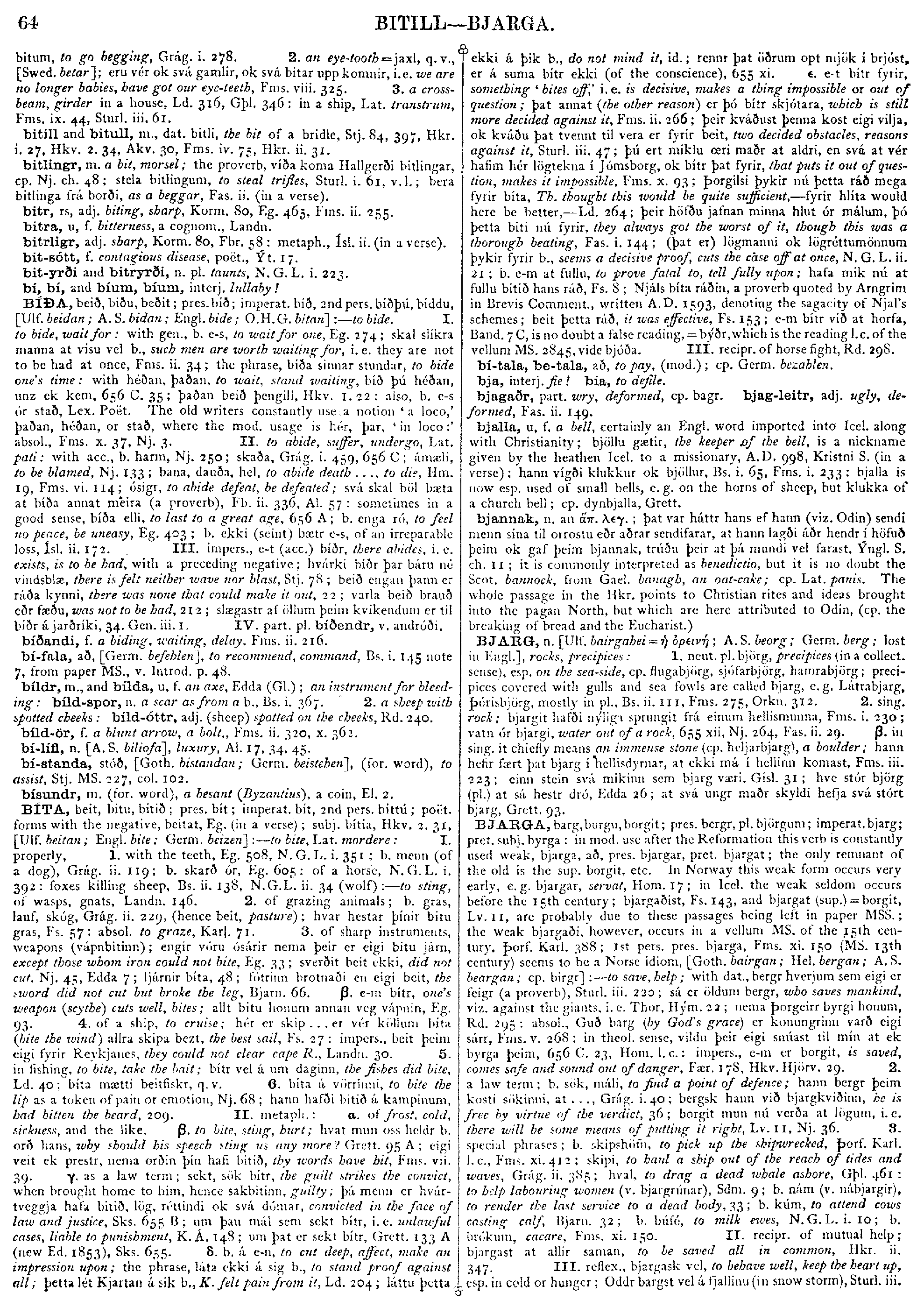
bjalla, u, f. a bell, certainly an Engl. word imported into Icel. along with Christianity; bjöllu gætir, the keeper of the bell, is a nickname given by the heathen Icel. to a missionary, A.D. 998, Kristni S. (in a verse): hann vígði klukkur ok bjöllur, Bs. i. 65, Fms. i. 233: bjalla is now esp. used of small bells, e.g. on the horns of sheep, but klukka of a church bell; cp. dynbjalla, Grett.
| Result Page: |  |
Previous | 1 2 3 4 5 6 7 8 | Next |  |
Germanic Lexicon Project (main page)
This search system was written by
Sean Crist
Please consider
volunteering
to correct the data in these online dictionaries.
No rights reserved. Feel free to use these data in any way you please.