|
|

Tip: In the search results, you can click on any word or abbreviation for more information.
|
Source: Bosworth/Toller, page b0060, entry 30 View original page image as: [TIFF] [PNG] [View previous entry] [View next entry] |
[Comment on this entry] [View comments] |
The following entry has been hand-corrected once. |
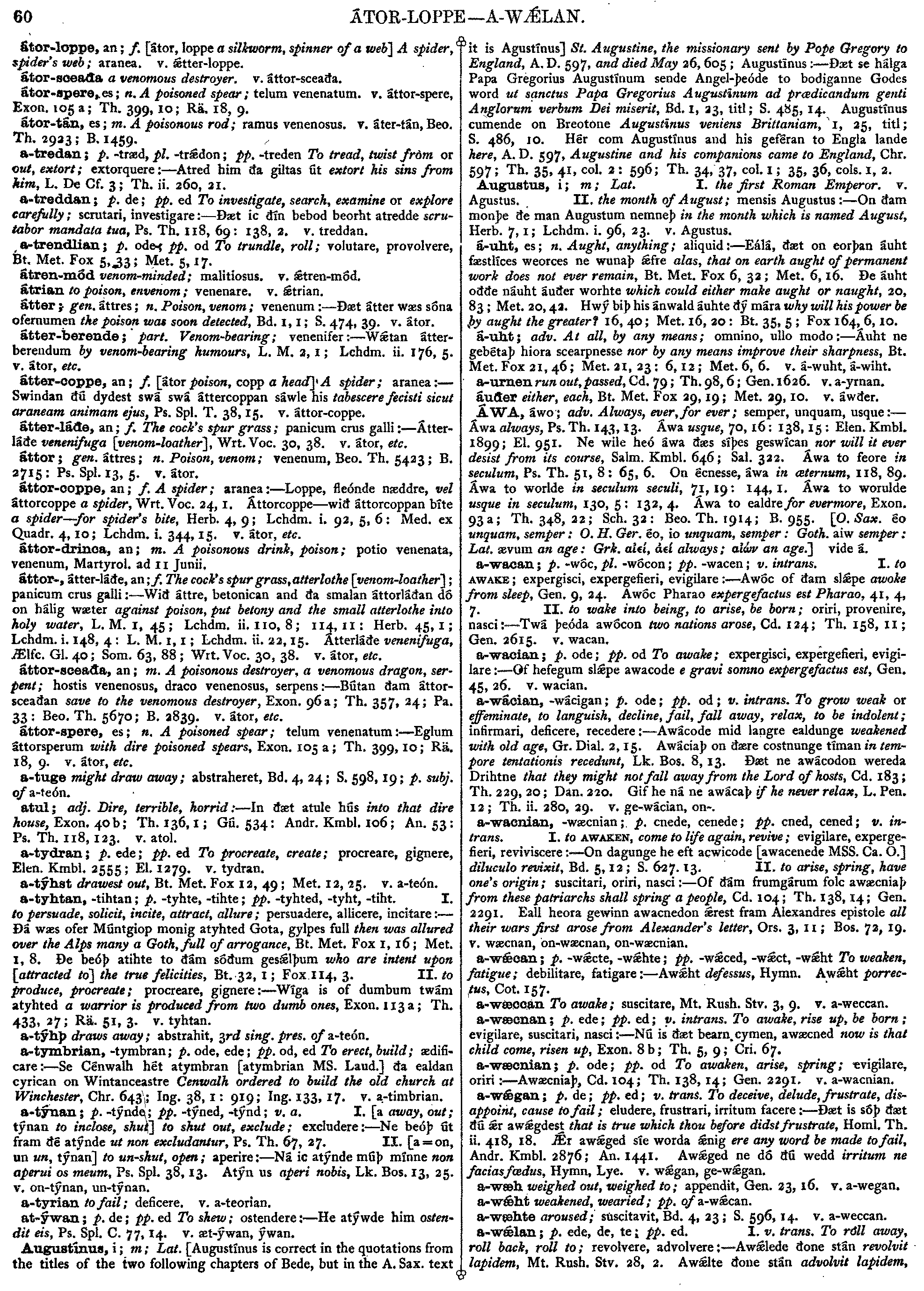
Augustínus, i ; m; Lat. [Augustinus is correct in the quotations from the titles of the two following chapters of Bede, but in the A. Sax. text it is Agustínus] St. Augustine, the missionary sent by Pope Gregory to England, A. D. 597, and died May 26, 605; Augustínus :-- Ðæt se hálga Papa Gregorius Augustínum sende Angel-þeóde to bodiganne Godes word ut sanctus Papa Gregorius Augustinum ad prædicandum genti Anglorum verbum Dei miserit, Bd. 1, 23, titl; S. 485, 14. Augustínus cumende on Breotone Augustinus veniens Brittaniam, 1, 25, titl ; S. 486, 10. Hér com Augustinus and his geféran to Engla lande here, A. D. 597, Augustine and his companions came to England, Chr. 597; Th. 35, 41, col. 2 : 596; Th. 34, 37, col. 1 ; 35, 36, cols.1, 2.
|
Source: Bosworth/Toller, page b0768, entry 10 View original page image as: [TIFF] [PNG] [View previous entry] [View next entry] |
[Comment on this entry] [View comments] |
The following entry has been hand-corrected once. |
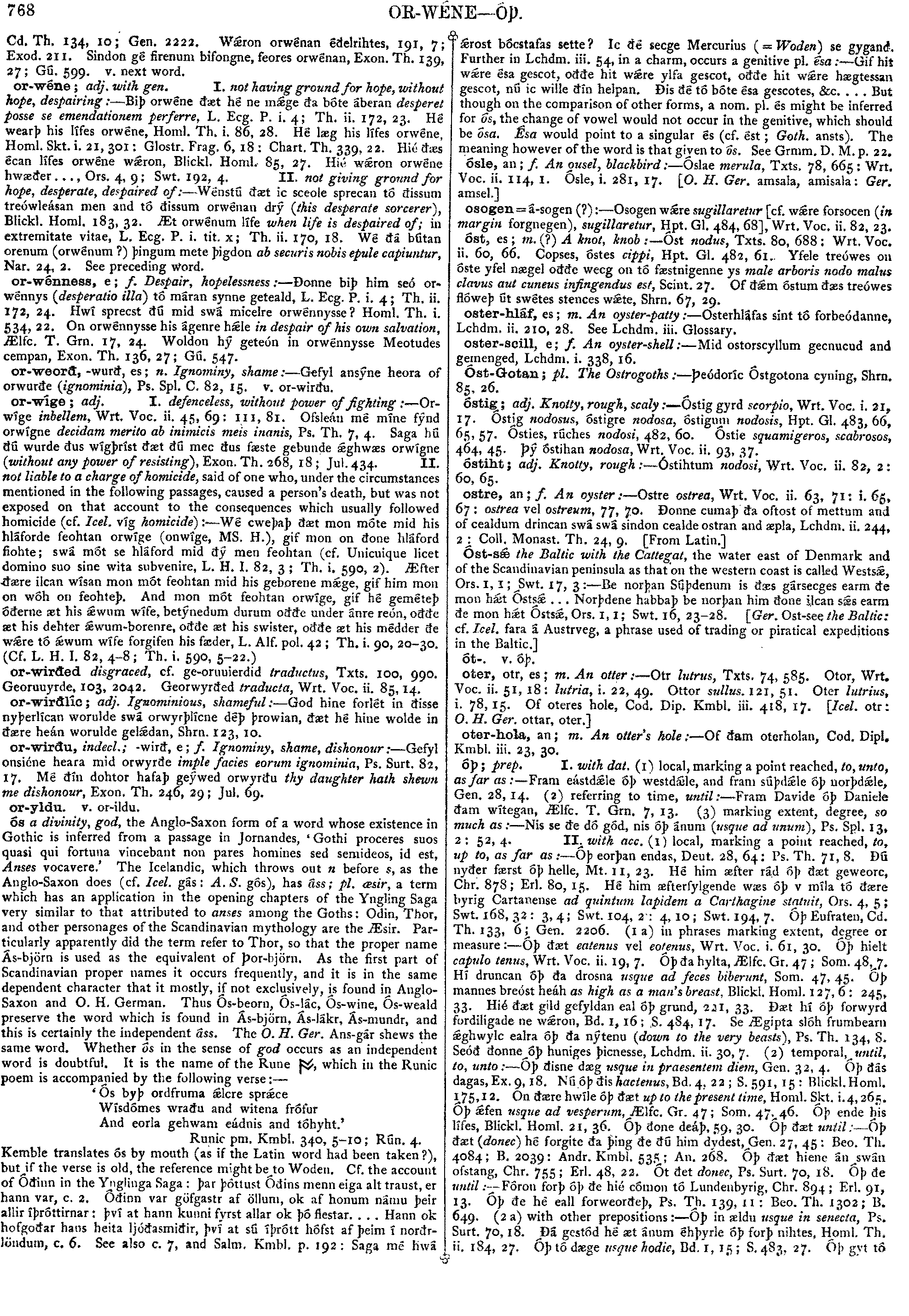
ós
a
divinity,
god,
the
Anglo-Saxon
form
of
a
word
whose
existence
in
Gothic
is
inferred
from
a
passage
in
Jornandes,
'Gothi
proceres
suos
quasi
qui
fortuna
vincebant
non
pares
homines
sed
semideos,
id
est,
Anses
vocavere.'
The
Icelandic,
which
throws
out
n
before
s,
as
the
Anglo-Saxon
does
(cf.
Icel.
gás:
A.
S.
gós),
has
áss;
pl.
æsir,
a
term
which
has
an
application
in
the
opening
chapters
of
the
Yngling
Saga
very
similar
to
that
attributed
to
anses
among
the
Goths:
Odin,
Thor,
and
other
personages
of
the
Scandinavian
mythology
are
the
Æsir.
Particularly
apparently
did
the
term
refer
to
Thor,
so
that
the
proper
name
Ás-björn
is
used
as
the
equivalent
of
Þor-björn.
As
the
first
part
of
Scandinavian
proper
names
it
occurs
frequently,
and
it
is
in
the
same
dependent
character
that
it
mostly,
if
not
exclusively,
is
found
in
Anglo-Saxon
and
O.
H.
German.
Thus
Ós-beorn,
Ós-lác,
Ós-wine,
Ós-weald
preserve
the
word
which
is
found
in
Ás-björn,
Ás-lákr,
Ás-mundr,
and
this
is
certainly
the
independent
áss.
The
O.
H.
Ger.
Ans-gár
shews
the
same
word.
Whether
ós
in
the
sense
of
god
occurs
as
an
independent
word
is
doubtful.
It
is
the
name
of
the
Rune
RUNE,
which
in
the
Runic
poem
is
accompanied
by
the
following
verse:--
'Ós
byþ
ordfruma
 lcre
sprce
Wísdómes
wraðu
and
witena
frófur
And
eorla
gehwam
eádnís
and
tóhyht.'
Runic
pm.
Kmbl.
340,
5-10;
Rún.
4.
Kemble
translates
ós
by
mouth
(as
if
the
Latin
word
had
been
taken?),
but
if
the
verse
is
old,
the
reference
might
be
to
Woden.
Cf.
the
account
of
Óðinn
in
the
Yngfinga
Saga:
þar
þóttust
Ódins
menn
eiga
ale
traust,
er
hann
var,
c.
2.
Óðinn
var
göfgastr
af
öllum,
ok
af
honum
námu
þeir
allir
íþróttirnar:
því
at
hann
kunni
fyrst
allar
ok
þó
fiestar.
.
.
.
Hann
ok
hofgoðar
hans
heita
ljóðasmiðir,
því
at
sfi
íþrótt
hófst
af
þeim
í
norðrlöndum,
c.
6.
See
also
c.
7,
and
Salm.
Kmbl.
p.
192:
Saga
mé
hwá
rost
bócstafas
sette?
Ic
ðe
secge
Mercurius
(
=
Woden)
se
gygand.
Further
in
Lchdm.
iii.
54,
in
a
charm,
occurs
a
genitive
pl.
ésa:--Gif
hit
wre
ésa
gescot,
oððe
hit
wre
ylfa
gescot,
oððe
hit
wre
hægtessan
gescot,
nú
ic
wille
ðín
helpan.
Ðis
Ðis
ðé
tó
bóte
ésa
gescotes,
&c.
.
.
.
But
though
on
the
comparison
of
other
forms,
a
nom.
pl.
és
might
be
inferred
for
Ís,
the
change
of
vowel
would
not
occur
in
the
genitive,
which
should
be
ósa.
Ésa
would
point
to
a
singular
és
(cf.
ést;
Goth.
ansts).
The
meaning
however
of
the
word
is
that
given
to
ós.
See
Grmm.
D.
M.
p.
22.
lcre
sprce
Wísdómes
wraðu
and
witena
frófur
And
eorla
gehwam
eádnís
and
tóhyht.'
Runic
pm.
Kmbl.
340,
5-10;
Rún.
4.
Kemble
translates
ós
by
mouth
(as
if
the
Latin
word
had
been
taken?),
but
if
the
verse
is
old,
the
reference
might
be
to
Woden.
Cf.
the
account
of
Óðinn
in
the
Yngfinga
Saga:
þar
þóttust
Ódins
menn
eiga
ale
traust,
er
hann
var,
c.
2.
Óðinn
var
göfgastr
af
öllum,
ok
af
honum
námu
þeir
allir
íþróttirnar:
því
at
hann
kunni
fyrst
allar
ok
þó
fiestar.
.
.
.
Hann
ok
hofgoðar
hans
heita
ljóðasmiðir,
því
at
sfi
íþrótt
hófst
af
þeim
í
norðrlöndum,
c.
6.
See
also
c.
7,
and
Salm.
Kmbl.
p.
192:
Saga
mé
hwá
rost
bócstafas
sette?
Ic
ðe
secge
Mercurius
(
=
Woden)
se
gygand.
Further
in
Lchdm.
iii.
54,
in
a
charm,
occurs
a
genitive
pl.
ésa:--Gif
hit
wre
ésa
gescot,
oððe
hit
wre
ylfa
gescot,
oððe
hit
wre
hægtessan
gescot,
nú
ic
wille
ðín
helpan.
Ðis
Ðis
ðé
tó
bóte
ésa
gescotes,
&c.
.
.
.
But
though
on
the
comparison
of
other
forms,
a
nom.
pl.
és
might
be
inferred
for
Ís,
the
change
of
vowel
would
not
occur
in
the
genitive,
which
should
be
ósa.
Ésa
would
point
to
a
singular
és
(cf.
ést;
Goth.
ansts).
The
meaning
however
of
the
word
is
that
given
to
ós.
See
Grmm.
D.
M.
p.
22.
|
Source: Bosworth/Toller, page b1032, entry 25 View original page image as: [TIFF] [PNG] [View previous entry] [View next entry] |
[Comment on this entry] [View comments (1)] |
The following entry has been hand-corrected once. |
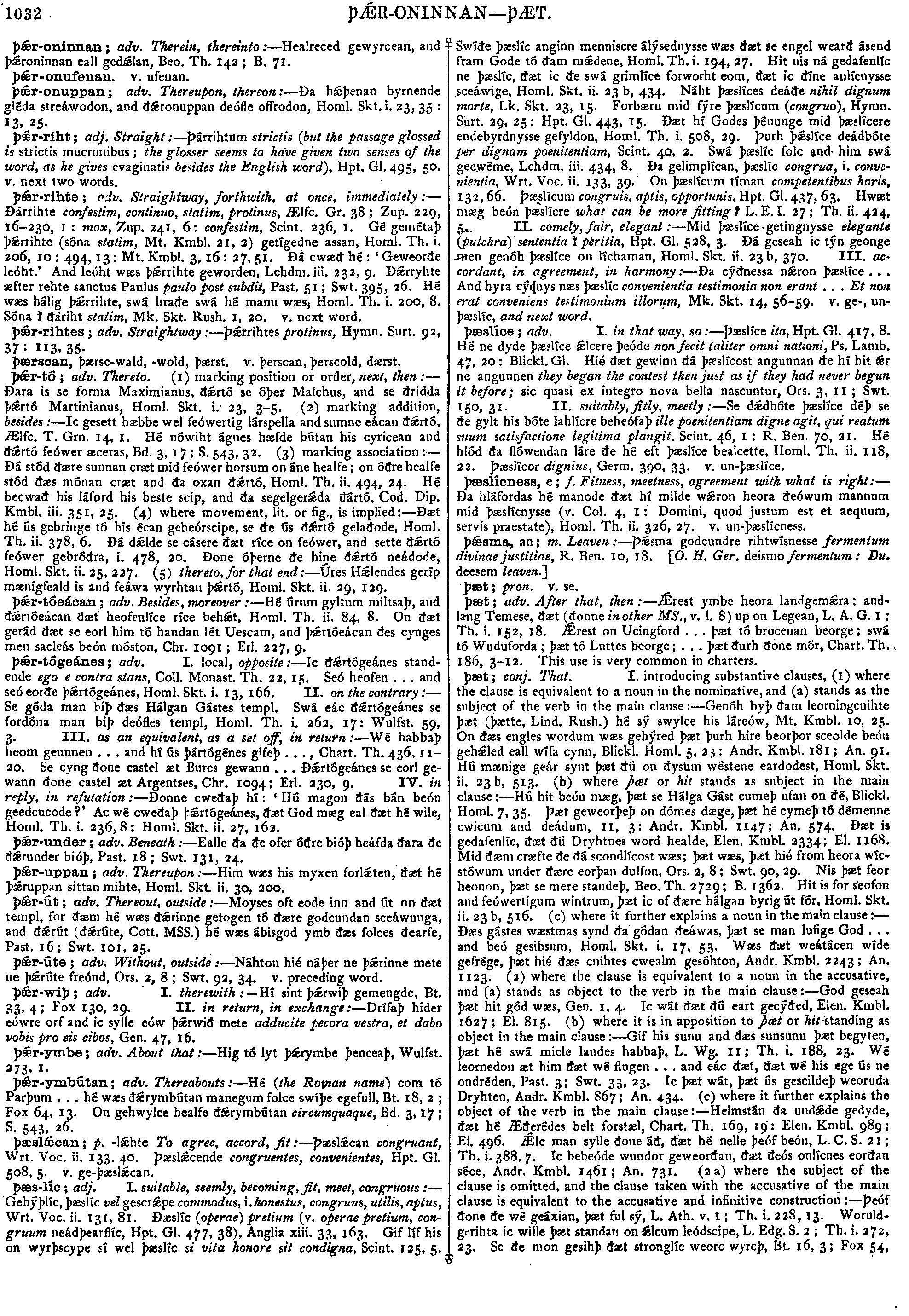
þæt;
conj.
That.
I.
introducing
substantive
clauses,
(1)
where
the
clause
is
equivalent
to
a
noun
in
the
nominative,
and
(a)
stands
as
the
subject
of
the
verb
in
the
main
clause
:--
Genóh
byþ
ðam
leorningcnihte
þæt
(þætte,
Lind.
Rush.)
hé
sý
swylce
his
láreów,
Mt.
Kmbl.
10.
25.
On
ðæs
engles
wordum
wæs
gehýred
þæt
þurh
hire
beorþor
sceolde
beón
gehled
wall
wífa
cynn,
Blickl.
Homl.
5,
23
:
Andr.
Kmbl.
181;
An.
91.
Hú
mænige
geár
synt
þæt
ðú
on
ðysúm
wéstene
eardodest,
Homl.
Skt.
ii.
23
b,
513.
(b)
where
þæt
or
hit
stands
as
subject
in
the
main
clause
:--
Hú
hit
beón
mæg,
þæt
se
Hálga
Gást
cumeþ
ufan
on
ðé,
Blickl.
Homl.
7,
35.
Þæt
geweorþeþ
on
dómes
dæge,
þæt
hé
cymeþ
tó
démenne
cwicum
and
deádum,
11,
3
:
Andr.
Kmbl.
1147;
An.
574.
Ðæt
is
gedafenlíc,
ðæt
ðú
Dryhtnes
word
healde,
Elen.
Kmbl.
2334;
El.
1168.
Mid
ðæm
cræfte
ðe
ðá
scondlícost
wæs;
þæt
wæs,
þæt
hié
from
heora
wícstówum
under
ðære
eorþan
dulfon,
Ors.
2,
8;
Swt.
90,
29.
Nis
þæt
feor
heonon,
þæt
se
mere
standeþ,
Beo.
Th.
2729;
B.
1362.
Hit
is
for
seofon
and
feówertigum
wintrum,
þæt
ic
of
ðære
hálgan
byrig
út
fór,
Homl.
Skt.
ii.
23
b,
516.
(c)
where
it
further
explains
a
noun
in
the
main
clause
:--
Ðæs
gástes
wæstmas
synd
ða
gódan
ðeáwas,
þæt
se
man
lufige
God
...
and
beó
gesibsum,
Homl.
Skt.
i.
17,
53.
Wæs
ðæt
weátácen
wíde
gefrége,
þæt
hié
ðæs
cnihtes
cwealm
gesóhton,
Andr.
Kmbl.
2243;
An.
1123.
(2)
where
the
clause
is
equivalent
to
a
noun
in
the
accusative,
and
(a)
stands
as
object
to
the
verb
in
the
main
clause
:--
God
geseah
þæt
hit
gód
wæs,
Gen.
1,
4.
Ic
wát
ðæt
ðú
eart
gecýðed,
Elen.
Kmbl.
1627;
El.
815.
(b)
where
it
is
in
apposition
to
þæt
or
hit
standing
as
object
in
the
main
clause
:--
Gif
his
sunu
and
ðæs
sunsunu
þæt
begyten,
þæt
hé
swá
micle
landes
habbaþ,
L.
Wg.
11;
Th.
i.
188,
23.
Wé
leornedon
æt
him
ðæt
wé
flugen
.
.
.
and
eác
ðæt,
ðæt
wé
his
ege
ús
ne
ondréden,
Past.
3;
Swt.
33,
23,
Ic
þæt
wát,
þæt
ús
gescildeþ
weoruda
Dryhten,
Andr.
Kmbl.
867;
An.
434.
(c)
where
it
further
explains
the
object
of
the
verb
in
the
main
clause
:--
Helmstán
ða
undde
gedyde,
ðæt
hé
Æðerédes
belt
forstæl,
Chart.
Th.
169,
19
:
Elen.
Kmbl.
989;
El.
496.
Æ-acute;lc
man
sylle
ðone
áð,
ðæt
hé
nelle
þeóf
beón,
L.
C.
S.
21;
Th.
i.
388,
7.
Ic
bebeóde
wundor
geweorðan,
ðæt
ðeós
onlícnes
eorðan
séce,
Andr.
Kmbl.
1461;
An.
731.
(2
a)
where
the
subject
of
the
clause
is
omitted,
and
the
clause
taken
with
the
accusative
of
the
main
clause
is
equivalent
to
the
accusative
and
infinitive
construction
:--
Þeóf
ðone
ðe
wé
geáxian,
þæt
ful
sý,
L.
Ath.
v.
1;
Th.
i.
228,
13.
Woruld-gerihta
ic
wille
þæt
standan
on
lcum
leódscipe,
L.
Edg.
S.
2;
Th.
i.
272,
23.
Se
ðe
mon
gesihþ
ðæt
stronglíc
weorc
wyrcþ,
Bt.
16,
3;
Fox
54,
29
:
Homl.
Th.
i.
234,
3.
Gif
gé
gesáwen
hwelce
mús
þæt
wre
hláford
ofer
óþre
mýs,
Bt.
16,
2;
Fox
52,
2.
Ealle
ða
weód
ðe
hé
geseó
ðæt
ðám
æcerum
derigen,
23;
Fox
78,
23.
Swá
fela
manna
swá
man
wite
þæt
ungelygne
sýn,
L.
Ath.
iv.
1;
Th.
i.
222,
10.
(3)
where
the
clause
is
equivalent
to
a
noun
in
the
genitive
or
dative.
(a)
where
in
the
main
clause
is
a
verb,
verbal
noun,
or
adjective
taking
after
it
such
a
case,
and
(a)
where
the
substantive
clause
stands
as
object
:--
Æ-acute;nig
ne
wénde,
ðæt
hé
lifgende
land
begéte,
Andr.
Kmbl.
755;
An.
378.
Saga
þonc
ðæt
ic
his
módor
gewearð,
Exon.
Th.
13,
30;
Cri.
210.
Is
nú
þearf
micel
þæt
wé
wísfæstra
wordum
hýran,
Andr.
Kmbl.
2335;
An.
1169.
Ic
áhebbe
míne
hand
.
.
.
þæt
is
ne
underfó
ánne
þwang
I
lift
my
hand
(in
testimony
of
this)
that
I
will
not
take
a
thing,
Gen.
14,
23.
Ðonne
hió
geornast
biþ
þæt
heó
áfre
fleógan,
Ps.
Th.
89,
10
:
Elen.
Kmbl.
536;
El.
268.
(a
1)
where
the
subject
is
omitted
:--
Æ-acute;lc
mynetere
ðe
man
tíhþ
þæt
fals
feoh
slóge,
L.
Eth.
iii.
8;
Th.
i.
296,
12.
(b)
where
the
main
clause
contains
a
case
of
a
pronoun
in
apposition
to
the
substantive
clause
:--
Ne
ðurfon
wé
ðæs
wénan,
þæt
ús
wuldorcyning
wille
eard
áléfan,
Cd.
Th.
272,
5;
Sat.
115.
Nánne
mon
ðæs
ne
tweóþ,
ðæt
se
seó
strong,
Bt.
16,
3;
Fox
54,
28.
Hié
þæs
ðone
willan
næfdon,
þæt
hié
heora
noman
hié
benmon,
Ors.
2,
8;
Swt.
94,
7.
Gif
þæs
geweorðe
gesíðcundne
mannan,
þæt
hé
unrihthmed
genime,
L.
Wih.
5;
Th.
i.
38,
4
:
Andr.
Kmbl.
615;
An.
308.
Ne
magon
wé
þæs
wrace
gefremman,
þæt
he
ús
hafaþ
ðæs
leóhtes
bescyrede,
Cd.
Th.
25,
16;
Gen.
394.
(c)
where
the
clause
explains
the
noun
in
the
main
clause
:--
Wolde
ic
ánes
tó
ðé
cræftes
neósan,
þæt
ðú
mé
gethte
hú
.
.
.,
Andr.
Kmbl.
969;
An.
485.
Gé
wiðsócon
sóðe
and
rihte,
ðæt
in
Bethleme
bearn
cenned
wre,
Elen.
Kmbl.
781;
El.
391.
( )
where
the
clause
is
equivalent
to
a
phrase,
preposition
and
noun,
with
adjectival
force,
(a)
defining
the
noun
in
the
main
clause
:--
Hit
wæs
ðá
se
tíma,
þæt
wínberian
rípodon
now
the
time
was
the
time
of
the
first-ripe
grapes
(A.
V.),
Num.
13,
21.
Nis
seó
þráh
micel,
þæt
ðé
wrlogan
swencan
móton
the
time
of
your
affliction
is
not
long,
Andr.
Kmbl.
215;
An.
108.
Nis
seó
stund
latu,
þæt
ðé
wælreówe
wítum
belecgaþ,
2423;
An.
1213.
Nú
is
se
dæg
cumen,
þæt
úre
mandryhten
mægenes
behófaþ,
Beo.
Th.
5297;
B.
2646
:
Val.
1,
9.
(b)
in
apposition
to
a
pronoun
in
the
main
clause
:--
Wæs
seó
hwíl
þæs
lang,
þæt
ic
Gode
þegnode
the
time
of
my
serving
God
was
long
(or
þæs
=
so?),
Cd.
Th.
37,
5;
Gen.
585.
II.
introducing
clauses
expressing
end
or
purpose,
that,
in
order
that
:--
Sete
ðíne
hand
ofer
hí
þæt
(þætte,
Lind.
Rush.)
heó
hál
sý
ut
salva
sit,
Mk.
Skt.
5,
23.
Ðr
se
bisceop
oft
wæs,
þæt
hé
fullade
ðæt
folc,
Bd.
2,
14;
S.
518,
15.
Se
deófol
genam
ðæt
wíf
him
tó
gefylstan,
þæt
hé
ðone
hálgan
wer
ðurh
hí
geswice,
Homl.
Th.
ii.
454,
1.
Hí
cómon
him
tó,
þæt
hí
hine
geneósodon,
7.
II
a.
with
a
negative,
that
...
not,
lest
:--
Ic
ne
underfó
ánne
þwang,
þæt
ðú
ne
secge
eft
(ne
dicas)
:
'Ic
gewelegode
Abram,'
Gen.
14,
23
:
Lk.
Skt.
8,
12.
Waciaþ
and
gebiddaþ
þæt
(þætte,
Lind.
Rush.)
gé
on
costnunge
ne
gán
(ut
non
intretis),
Mk.
Skt.
14,
38.
Hig
ne
eodon
intó
ðam
dómerne,
þæt
(þætte,
Lind.
Rush.)
hyg
nron
besmitene
ut
non
contaminarentur,
Jn.
Skt.
18,
28.
III.
introducing
clauses
denoting
result,
manner,
kind,
degree,
(1)
where
no
demonstrative
word
in
the
main
clause
is
antecedent
to
the
subordinate
clause,
that,
so
that,
so
as
(with
infin.)
:--
Hú
mihtest
ðú
sittan
on
middum
gemnum
ríce,
þæt
ðú
ne
sceoldest
ðæt
ilce
geþolian
ðæt
óðre
men?
Bt.
7,
3;
Fox
22,
17
:
Homl.
Skt.
ii.
23
b,
522.
Asyrie
hæfdon
LX
wintra
and
án
hund
and
án
þúsend,
þæt
hit
ná
búton
gewinne
næs,
Ors.
1,
8;
Swt.
42,
4.
Nis
nnigu
gecynd,
....
ðæt
he
ne
sý
fýres
cynnes,
Salm.
Kmbl.
847;
Sal.
423.
Hé
rád
þæt
hé
wæs
et
Ceastre
he
rode
so
that
he
was
at
Worcester,
Chart.
Th.
71,
11
:
Andr.
Kmbl.
1576;
An.
789
:
1474;
An.
738.
Man
gecwman
ne
mæg
twám
hláfordum
ætsomne,
þæt
hé
ne
forseó
þone
óðerne,
Homl.
Skt.
i.
17,
220,
224.
Þr
is
án
mgð
þæt
hí
magon
cyle
gewyrcan,
Ors.
1,
1;
Swt.
21,
13.
Tó
ðám
handum
ðæt
ðæt
fel
of
gþ,
Lchdm.
iii.
114,
3.
Hwylc
man
is
þonne
fre,
þæt
hé
wéne
...
whatever
man
is
there
(of
such
a
kind),
that
he
can
suppose
...
,
Wulfst.
214,
14
:
Cd.
Th.
227,
20;
Dan.
189.
Hyge
wæs
oncyrred,
þæt
hié
ne
murndon,
Andr.
Kmbl.
73;
An.
37.
Gif
mon
sié
dumb
oþþe
deáf
geboren,
þæt
hé
ne
mæge
his
synna
andettan,
L.
Alf.
pol.
14;
Th.
i.
70,
14.
Æfter
ðære
gebysnunge
wurdon
árrede
muneclíf
mid
ðære
gehealdsumnysse,
þæt
hí
drohtnian
on
clnnesse,
Homl.
Th.
i.
318,
8.
Gewunige
hé
fæstende,
þæt
hé
wite
þæt
seó
mæsse
sý
gesungen
let
him
continue
his
fast
so,
that
he
may
know
the
mass
has
been
sung,
L.
E.
I.
39;
Th.
ii.
438,
3.
Gif
ceorlisc
man
geþeó,
þæt
hé
hæbbe
.v.
hída
landes,
L.
Wg.
9;
Th.
i.
188,
5
:
10;
Th.
i.
188,
7.
Ða
Gotan
læssan
hwíle
hergedan,
þæt
hié
þurh
Godes
ege
þæt
hié
náþer
ne
þa
burg
ne
bærndon
ne
þæs
þone
willan
næfdon
....
Ors.
2,
8;
Swt.
94,
5.
(1
a)
where
the
subject
of
the
clause
is
omitted
:--
Nemne
him
mon
.v.
men,
and
begite
þara
.v.
.1.,
þæt
him
mid
swerige,
L.
Ath.
i.
9;
Th.
i.
204,
11.
Hwylc
is
manna
þæt
feores
neóte
.
.
.
oððe
hwylc
manna
is
þæt
his
ágene
sáwle
genérige,
Ps.
Th.
88,
41
:
Elen.
Kmbl.
750;
El.
375
:
Exon.
Th.
273,
20;
Jul.
519.
(2)
where
the
clause
stands
as
relative
to
a
preceding
demonstrative
word
:--
Hé
lrde
hig
swá
þæt
(ita
ut)
hig
wundredon,
Mt.
Kmbl.
13,
54.
Þæt
wíte
wæs
tó
þæs
strang,
ðæt
ghwelc
man
sceolde
mid
sáre
on
þás
world
cuman,
Blickl.
Homl.
5,
28.
Swelc
wæs
þeáw
hira
þæt
hié
ghwylcne
ellþeódigra
dydon
him
tó
móse,
Andr.
Kmbl.
51;
An.
26.
Swá
is
þære
menigo
þeáw,
þæt
.
.
.
,
355;
An.
178.
Ðýn
mægen
is
swá
mre,
mihtig
Drihten,
swá
þæt
nig
ne
wát
eorðbúende
þa
deópnesse
Drihtnes
mihta,
ne
þæt
nig
ne
wát
engla
hádes
þa
heáhnisse
heofena
kyninges,
Hy.
3,
31-35.
Gif
his
sunu
and
his
sunu
sunu
þæt
geþeóþ,
þæt
hí
swá
micel
landes
habban,
L.
Wg.
11;
Th.
i.
188,
10.
(2
a)
where
the
subject
of
the
clause
is
omitted
:--
Nis
nnig
swá
snotor,
ne
þæs
swá
gleáw,
þæt
ásecgan
mæge,
Cd.
Th.
286,
12;
Sat.
351.
(See
also
se,
V,
swá.)
IV.
introducing
clauses
expressing
cause,
reason
:--
Hwæt
þence
gé
betwux
eów,
þæt
(forðon,
Lind.
:
forþon
þæt,
Rush.)
gé
hláfas
nabbaþ
why
reason
ye
among
yourselves,
because
ye
have
brought
no
bread?
Mt.
Kmbl.
16,
8.
Byþ
ðé
meorð,
þæt
ðú
ús
on
láde
líðe
weorðe,
Andr.
Kmbl.
551;
An.
276.
V.
where
the
main
clause
is
not
expressed,
(1)
in
narrative
:--
Æ-acute;rþon
ðe
seó
heánnes
ðæs
walles
gefylled
wre,
þæt
se
cyning
ofslegen
wæs
and
þæt
ylce
geweorc
Óswalde
forlét
(some
form
equivalent
to
it
happened
appears
necessary
before
þæt,
which
word
there
is
nothing
in
the
Latin
to
suggest
:
Priusquam
altitudo
parietis
esset
consummata,
rex
ipse
occisus
opus
idem
Osualdo
reliquit),
Bd.
2,
14;
S.
517,
31.
Ðá
æt
nýhstan
mid
fultume
his
freónda
þæt
hé
gelýfde,
3,
22;
S.
552,
26
:
3,
24;
S.
556,
21
:
4,
27;
S.
604,
32
(cf.
3,
9;
S.
533,
16-19
:
4,
3;
S.
569,
1-3).
And
þæs
embe
áne
niht
ðæt
wé
Marian
mæssan
healdaþ,
Menol.
Fox
39;
Men.
20
and
often.
Nó
þæt
ðín
aldor
wolde
Godes
goldfatu
in
gylp
beran,
Cd.
Th.
262,
34;
Dan.
754
:
288,
9;
Sat.
378
:
304,
24;
Sat.
634.
(2)
in
the
titles
of
chapters
:--
Caput
II.
Ðæt
se
rra
Rómwara
Cásere
Breotene
gesóhte,
Bd.
1,
2;
S.
475,
2
and
often.
(3)
in
exclamations
:--
Wá
þæt
ðes
tówyrpþ
Godes
templ,
Mt.
Kmbl.
27,
40.
Eálá
þæt
nán
wuht
nis
fæste
stondendes
weorces,
Bt.
9;
Fox
26,
21
:
Met.
9,
55
:
18,
1.
Eálá,
mín
Drihten,
þæt
ðú
eart
ælmihtig,
20,
1.
Eálá,
þæt
ic
eam
ealles
leás
écan
dreámes,
Cd.
Th.
275,
7;
Sat.
168.
VI.
where
the
construction
is
elliptical
:--
Þrý
dagas
tó
láfe
syndon
þæt
hié
þé
willaþ
acwellan
three
days
remain
before
the
day
comes
on
which
they
mean
to
kill
you,
Blickl.
Homl.
237,
26.
[O.
Sax.
that
:
O.
Frs.
thet
:
O.
H.
Ger.
daz
:
Icel.
at.]
v.
þætte;
conj.
)
where
the
clause
is
equivalent
to
a
phrase,
preposition
and
noun,
with
adjectival
force,
(a)
defining
the
noun
in
the
main
clause
:--
Hit
wæs
ðá
se
tíma,
þæt
wínberian
rípodon
now
the
time
was
the
time
of
the
first-ripe
grapes
(A.
V.),
Num.
13,
21.
Nis
seó
þráh
micel,
þæt
ðé
wrlogan
swencan
móton
the
time
of
your
affliction
is
not
long,
Andr.
Kmbl.
215;
An.
108.
Nis
seó
stund
latu,
þæt
ðé
wælreówe
wítum
belecgaþ,
2423;
An.
1213.
Nú
is
se
dæg
cumen,
þæt
úre
mandryhten
mægenes
behófaþ,
Beo.
Th.
5297;
B.
2646
:
Val.
1,
9.
(b)
in
apposition
to
a
pronoun
in
the
main
clause
:--
Wæs
seó
hwíl
þæs
lang,
þæt
ic
Gode
þegnode
the
time
of
my
serving
God
was
long
(or
þæs
=
so?),
Cd.
Th.
37,
5;
Gen.
585.
II.
introducing
clauses
expressing
end
or
purpose,
that,
in
order
that
:--
Sete
ðíne
hand
ofer
hí
þæt
(þætte,
Lind.
Rush.)
heó
hál
sý
ut
salva
sit,
Mk.
Skt.
5,
23.
Ðr
se
bisceop
oft
wæs,
þæt
hé
fullade
ðæt
folc,
Bd.
2,
14;
S.
518,
15.
Se
deófol
genam
ðæt
wíf
him
tó
gefylstan,
þæt
hé
ðone
hálgan
wer
ðurh
hí
geswice,
Homl.
Th.
ii.
454,
1.
Hí
cómon
him
tó,
þæt
hí
hine
geneósodon,
7.
II
a.
with
a
negative,
that
...
not,
lest
:--
Ic
ne
underfó
ánne
þwang,
þæt
ðú
ne
secge
eft
(ne
dicas)
:
'Ic
gewelegode
Abram,'
Gen.
14,
23
:
Lk.
Skt.
8,
12.
Waciaþ
and
gebiddaþ
þæt
(þætte,
Lind.
Rush.)
gé
on
costnunge
ne
gán
(ut
non
intretis),
Mk.
Skt.
14,
38.
Hig
ne
eodon
intó
ðam
dómerne,
þæt
(þætte,
Lind.
Rush.)
hyg
nron
besmitene
ut
non
contaminarentur,
Jn.
Skt.
18,
28.
III.
introducing
clauses
denoting
result,
manner,
kind,
degree,
(1)
where
no
demonstrative
word
in
the
main
clause
is
antecedent
to
the
subordinate
clause,
that,
so
that,
so
as
(with
infin.)
:--
Hú
mihtest
ðú
sittan
on
middum
gemnum
ríce,
þæt
ðú
ne
sceoldest
ðæt
ilce
geþolian
ðæt
óðre
men?
Bt.
7,
3;
Fox
22,
17
:
Homl.
Skt.
ii.
23
b,
522.
Asyrie
hæfdon
LX
wintra
and
án
hund
and
án
þúsend,
þæt
hit
ná
búton
gewinne
næs,
Ors.
1,
8;
Swt.
42,
4.
Nis
nnigu
gecynd,
....
ðæt
he
ne
sý
fýres
cynnes,
Salm.
Kmbl.
847;
Sal.
423.
Hé
rád
þæt
hé
wæs
et
Ceastre
he
rode
so
that
he
was
at
Worcester,
Chart.
Th.
71,
11
:
Andr.
Kmbl.
1576;
An.
789
:
1474;
An.
738.
Man
gecwman
ne
mæg
twám
hláfordum
ætsomne,
þæt
hé
ne
forseó
þone
óðerne,
Homl.
Skt.
i.
17,
220,
224.
Þr
is
án
mgð
þæt
hí
magon
cyle
gewyrcan,
Ors.
1,
1;
Swt.
21,
13.
Tó
ðám
handum
ðæt
ðæt
fel
of
gþ,
Lchdm.
iii.
114,
3.
Hwylc
man
is
þonne
fre,
þæt
hé
wéne
...
whatever
man
is
there
(of
such
a
kind),
that
he
can
suppose
...
,
Wulfst.
214,
14
:
Cd.
Th.
227,
20;
Dan.
189.
Hyge
wæs
oncyrred,
þæt
hié
ne
murndon,
Andr.
Kmbl.
73;
An.
37.
Gif
mon
sié
dumb
oþþe
deáf
geboren,
þæt
hé
ne
mæge
his
synna
andettan,
L.
Alf.
pol.
14;
Th.
i.
70,
14.
Æfter
ðære
gebysnunge
wurdon
árrede
muneclíf
mid
ðære
gehealdsumnysse,
þæt
hí
drohtnian
on
clnnesse,
Homl.
Th.
i.
318,
8.
Gewunige
hé
fæstende,
þæt
hé
wite
þæt
seó
mæsse
sý
gesungen
let
him
continue
his
fast
so,
that
he
may
know
the
mass
has
been
sung,
L.
E.
I.
39;
Th.
ii.
438,
3.
Gif
ceorlisc
man
geþeó,
þæt
hé
hæbbe
.v.
hída
landes,
L.
Wg.
9;
Th.
i.
188,
5
:
10;
Th.
i.
188,
7.
Ða
Gotan
læssan
hwíle
hergedan,
þæt
hié
þurh
Godes
ege
þæt
hié
náþer
ne
þa
burg
ne
bærndon
ne
þæs
þone
willan
næfdon
....
Ors.
2,
8;
Swt.
94,
5.
(1
a)
where
the
subject
of
the
clause
is
omitted
:--
Nemne
him
mon
.v.
men,
and
begite
þara
.v.
.1.,
þæt
him
mid
swerige,
L.
Ath.
i.
9;
Th.
i.
204,
11.
Hwylc
is
manna
þæt
feores
neóte
.
.
.
oððe
hwylc
manna
is
þæt
his
ágene
sáwle
genérige,
Ps.
Th.
88,
41
:
Elen.
Kmbl.
750;
El.
375
:
Exon.
Th.
273,
20;
Jul.
519.
(2)
where
the
clause
stands
as
relative
to
a
preceding
demonstrative
word
:--
Hé
lrde
hig
swá
þæt
(ita
ut)
hig
wundredon,
Mt.
Kmbl.
13,
54.
Þæt
wíte
wæs
tó
þæs
strang,
ðæt
ghwelc
man
sceolde
mid
sáre
on
þás
world
cuman,
Blickl.
Homl.
5,
28.
Swelc
wæs
þeáw
hira
þæt
hié
ghwylcne
ellþeódigra
dydon
him
tó
móse,
Andr.
Kmbl.
51;
An.
26.
Swá
is
þære
menigo
þeáw,
þæt
.
.
.
,
355;
An.
178.
Ðýn
mægen
is
swá
mre,
mihtig
Drihten,
swá
þæt
nig
ne
wát
eorðbúende
þa
deópnesse
Drihtnes
mihta,
ne
þæt
nig
ne
wát
engla
hádes
þa
heáhnisse
heofena
kyninges,
Hy.
3,
31-35.
Gif
his
sunu
and
his
sunu
sunu
þæt
geþeóþ,
þæt
hí
swá
micel
landes
habban,
L.
Wg.
11;
Th.
i.
188,
10.
(2
a)
where
the
subject
of
the
clause
is
omitted
:--
Nis
nnig
swá
snotor,
ne
þæs
swá
gleáw,
þæt
ásecgan
mæge,
Cd.
Th.
286,
12;
Sat.
351.
(See
also
se,
V,
swá.)
IV.
introducing
clauses
expressing
cause,
reason
:--
Hwæt
þence
gé
betwux
eów,
þæt
(forðon,
Lind.
:
forþon
þæt,
Rush.)
gé
hláfas
nabbaþ
why
reason
ye
among
yourselves,
because
ye
have
brought
no
bread?
Mt.
Kmbl.
16,
8.
Byþ
ðé
meorð,
þæt
ðú
ús
on
láde
líðe
weorðe,
Andr.
Kmbl.
551;
An.
276.
V.
where
the
main
clause
is
not
expressed,
(1)
in
narrative
:--
Æ-acute;rþon
ðe
seó
heánnes
ðæs
walles
gefylled
wre,
þæt
se
cyning
ofslegen
wæs
and
þæt
ylce
geweorc
Óswalde
forlét
(some
form
equivalent
to
it
happened
appears
necessary
before
þæt,
which
word
there
is
nothing
in
the
Latin
to
suggest
:
Priusquam
altitudo
parietis
esset
consummata,
rex
ipse
occisus
opus
idem
Osualdo
reliquit),
Bd.
2,
14;
S.
517,
31.
Ðá
æt
nýhstan
mid
fultume
his
freónda
þæt
hé
gelýfde,
3,
22;
S.
552,
26
:
3,
24;
S.
556,
21
:
4,
27;
S.
604,
32
(cf.
3,
9;
S.
533,
16-19
:
4,
3;
S.
569,
1-3).
And
þæs
embe
áne
niht
ðæt
wé
Marian
mæssan
healdaþ,
Menol.
Fox
39;
Men.
20
and
often.
Nó
þæt
ðín
aldor
wolde
Godes
goldfatu
in
gylp
beran,
Cd.
Th.
262,
34;
Dan.
754
:
288,
9;
Sat.
378
:
304,
24;
Sat.
634.
(2)
in
the
titles
of
chapters
:--
Caput
II.
Ðæt
se
rra
Rómwara
Cásere
Breotene
gesóhte,
Bd.
1,
2;
S.
475,
2
and
often.
(3)
in
exclamations
:--
Wá
þæt
ðes
tówyrpþ
Godes
templ,
Mt.
Kmbl.
27,
40.
Eálá
þæt
nán
wuht
nis
fæste
stondendes
weorces,
Bt.
9;
Fox
26,
21
:
Met.
9,
55
:
18,
1.
Eálá,
mín
Drihten,
þæt
ðú
eart
ælmihtig,
20,
1.
Eálá,
þæt
ic
eam
ealles
leás
écan
dreámes,
Cd.
Th.
275,
7;
Sat.
168.
VI.
where
the
construction
is
elliptical
:--
Þrý
dagas
tó
láfe
syndon
þæt
hié
þé
willaþ
acwellan
three
days
remain
before
the
day
comes
on
which
they
mean
to
kill
you,
Blickl.
Homl.
237,
26.
[O.
Sax.
that
:
O.
Frs.
thet
:
O.
H.
Ger.
daz
:
Icel.
at.]
v.
þætte;
conj.
|
Source: Bosworth/Toller, page d0117, entry 7 View original page image as: [TIFF] [PNG] [View previous entry] [View next entry] |
[Comment on this entry] [View comments] |
The following entry has been hand-corrected once. |
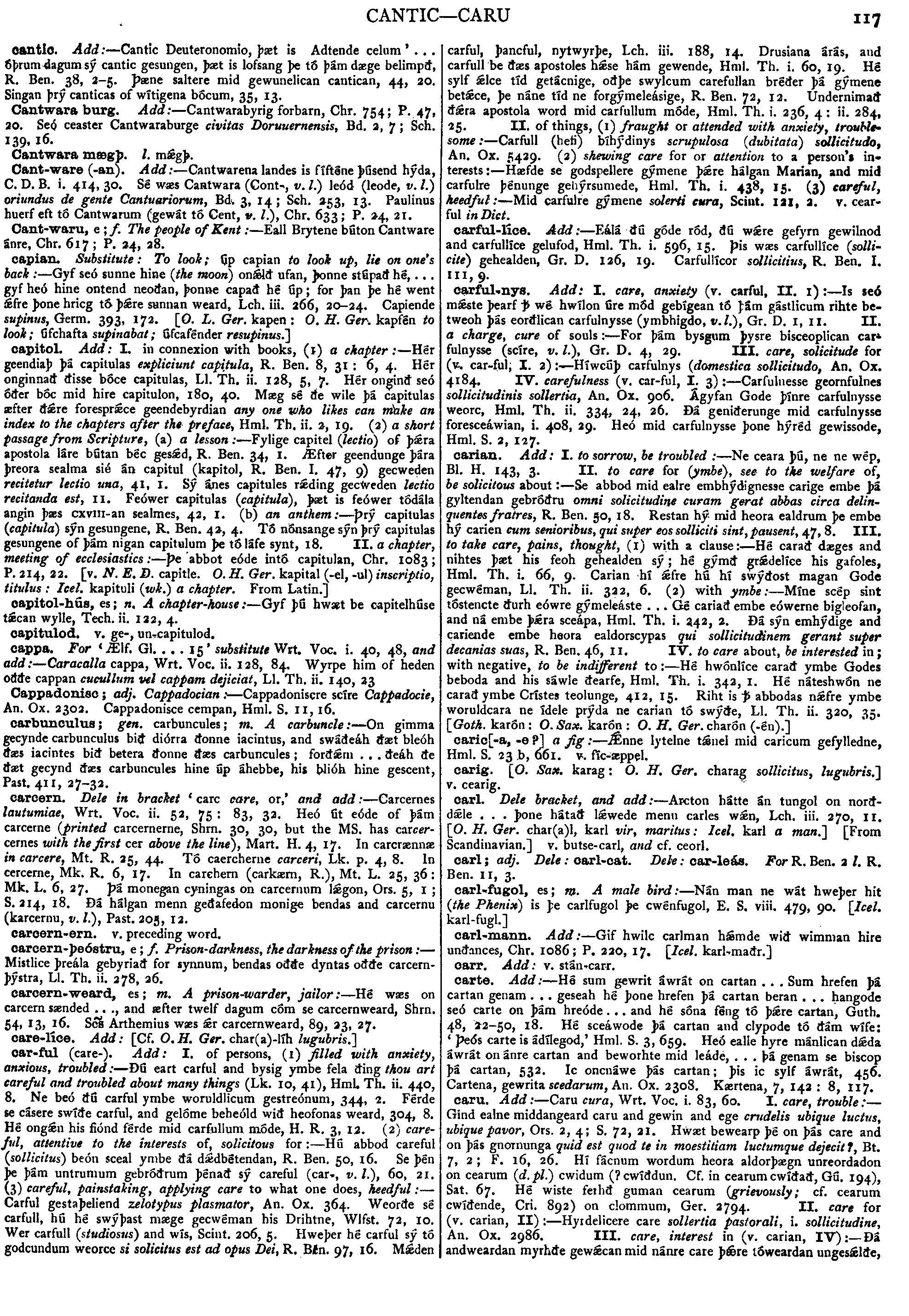
capitol.
Add:
I.
in
connexion
with
books,
(1)
a
chapter
:--
Hér
geendiaþ
þá
capitulas
expliciunt
capitula,
R.
Ben.
8,
31:
6,
4.
Hér
onginnað
ðisse
bóce
capitulas,
Ll.
Th.
ii.
128,
5,
7.
Hér
onginð
seó
óðer
bóc
mid
hire
capitulon,
180,
40.
Mæg
sé
ðe
wile
þá
capitulas
æfter
ðre
foresprce
geendebyrdian
any
one
who
likes
can
make
an
index
to
the
chapters
after
the
preface,
Hml.
Th.
ii.
2,
19.
(2)
a
short
passage
from
Scripture,
(a)
a
lesson
:--
Fylige
capitel
(lectio)
of
þra
apostola
láre
bútan
béc
gesd,
R.
Ben.
34,
1.
Æfter
geendunge
þára
þreora
sealma
sié
án
capitul
(kapitol,
R.
Ben.
I.
47,
9)
gecweden
recitetur
lectio
una,
41,
1.
Sý
ánes
capitules
rding
gecweden
lectio
recitanda
est,
11.
Feówer
capitulas
(capitula),
þæt
is
feówer
tódála
angin
þæs
cxviii-an
sealmes,
42,
1.
(b)
an
anthem
:--
Þrý
capitulas
(capitula)
sýn
gesungene,
R.
Ben.
42,
4.
Tó
nónsange
sýn
þrý
capitulas
gesungene
of
þám
nigan
capitulum
þe
tó
láfe
synt,
18.
II.
a
chapter,
meeting
of
ecclesiastics
:--
Þe
abbot
eóde
intó
capitulan,
Chr.
1083;
P.
214,
22.
[v.
N.
E.
D.
capitle.
O.
H.
Ger.
kapital
(-el,
-ul)
inscriptio,
titulus:
Icel.
kapituli
(wk.)
a
chapter.
From
Latin.]
|
Source: Cleasby/Vigfusson, page b0101, entry 39 View original page image as: [TIFF] [PNG] [View previous entry] [View next entry] |
[Comment on this entry] [View comments] |
The following entry has not been hand-corrected. However, the page is reserved and someone is correcting it. |
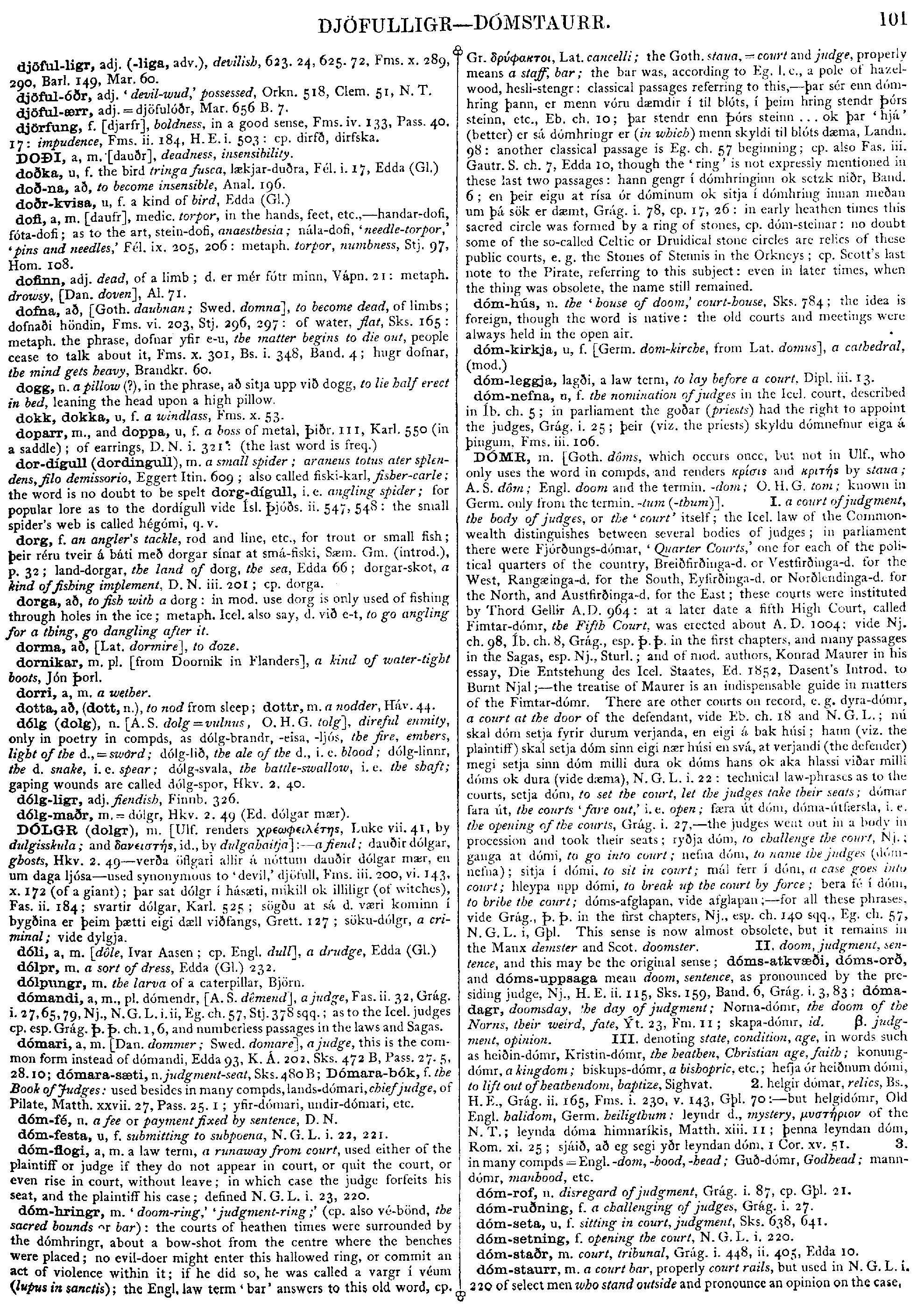
DÓMR, in. [Goth, dams, which occurs once, but not in Ulf., vvho only uses the word in compds, and renders Kpiais and Kptrris by siaua; A. S. dôm; F, ngl. d oow and the termin. -dom; O. H. G. torn; known in Germ, only from the termin. -turn (-thum)'] . I. a court of judgment, the body of judges, or the 'court' itself; the Icel. law of the Common- wealth distinguishes between several bodies of judges; in parliament there were Fjórðungs-dómar, ' Quarter Courts, ' one for each of the poli- tical quarters of the country, Breiðfirðinga-d. or Vesttirðinga-d. for the West, Rangaeinga-d. for the South, Eyiîrðinga-d. or Norðlendinga-d. lor the North, and Austfirðinga-d. for the East; these courts were instituted by Thord Gellir A. D. 964: at a later date a fifth High Court, called Fimtar-domr, the Fifth Court, was erected about A. D. 1004; vide Nj. ch. 98, íb. ch. 8, Grág., esp. f). fx in the first chapters, and many passages in the Sagas, esp. Nj., Sturl.; and of mod. authors, Konrad Maurer in his essay, Die Entstehung des Icel. Staates, Ed. 1852, Dasent's Introd. to Burnt Njal; -- the treatise of Maurer is an indispensable guide in matters of the Fimtar-domr. There are other courts on record, e. g. dyra-dómr, a court at the door of the defendant, vide Eb. ch. 18 and N. G. L.; mi skal dóm setja fyrir durum verjanda, en eigi á. bak hnsi; hann (viz. the plaintiff) skal setja dóm sinn eigi nær húsi en svá, at verjandi (the defender) megi setja sinn dóm milli dura ok dóms hans ok aka hlassi viðar milli dóms ok dura (vide dæma), N. G. L. i. 22: technical law-phrases as to the courts, setja dom, to set the court, let the judges take their seats; durmr fara lit, the courts 'fare out, ' i. e. open; faera lit dom, dúma-iitfærsla, i. e. the opening of the courts, Grug. i. 27, -- the judges went out in a body in procession and took their seats; ryðja dóm, to challenge the court, Nj.; ganga at dúmi, to go info court; nefna dom, to name the judges (iK'. ui- nefna); sitja í dómi, t o s it in court; múl ferr í dom, a case goes into court; hleypa upp dómi, to break up the court by force; bera K i dóm, to bribe the court; dóms-afglapan, vide afglapan; -- for all these phrase?, vide Grág., |x þ. in the first chapters, Nj., esp. ch. 140 sqq., Eg. ch. 57, N. G. L. i, Gþl. This sense is now almost obsolete, but it remains in the Manx demster and Scot, dooinster. II. doom, judgment, sen- tence, and this may be the original sense; dóms-atkvæði, dóms-orð, and dóms-uppsaga mean doom, sentence, as pronounced by the pre- siding judge, Nj., H. E. ii. 115, Sks. 159, Band. 6, Grág. i. 3, 83; dóma- dagr, doomsday, 'he day of judgment; Norna-dómr, the doom of the Norns, their weird, fate, Ýt. 23, Fm. 11; skapa-dómr, id. (3. judg- ment, opinion. III. denoting s t a te, condition, age, in words such as heiðin-dómr, Kristin-dómr, the heathen, Christian age, faith; konung- domr, a kingdom; biskups-dómr, a bishopric, etc.; hefja ór heiðnum dómi, to lift out of heathendom, baptize, Sighvat. 2. helgir dómar, relics, Bs., H. F, ., Grág. ii. 165, Fms. i. 230, v. 143, Gpl. 70 :-- but helgidómr, Old Engl. halidom, Germ, heiligthum: leyndr d., mystery, fjiiaTrjpl. ov of the N. T.; leynda donia hirnnarikis, Matth. xiii. ii; þenna leyndan dom, Rom. xi. 25; sjáið, að eg segi yðr leyndan dom, í Cor. xv. 51. 3. in many compds = Engl. -dom, -hood, -head; Guð-dómr, Godhead; mann- dómr, manhood,
|
Source: Cleasby/Vigfusson, page b0150, entry 15 View original page image as: [TIFF] [PNG] [View previous entry] [View next entry] |
[Comment on this entry] [View comments] |
The following entry has been hand-corrected once. |
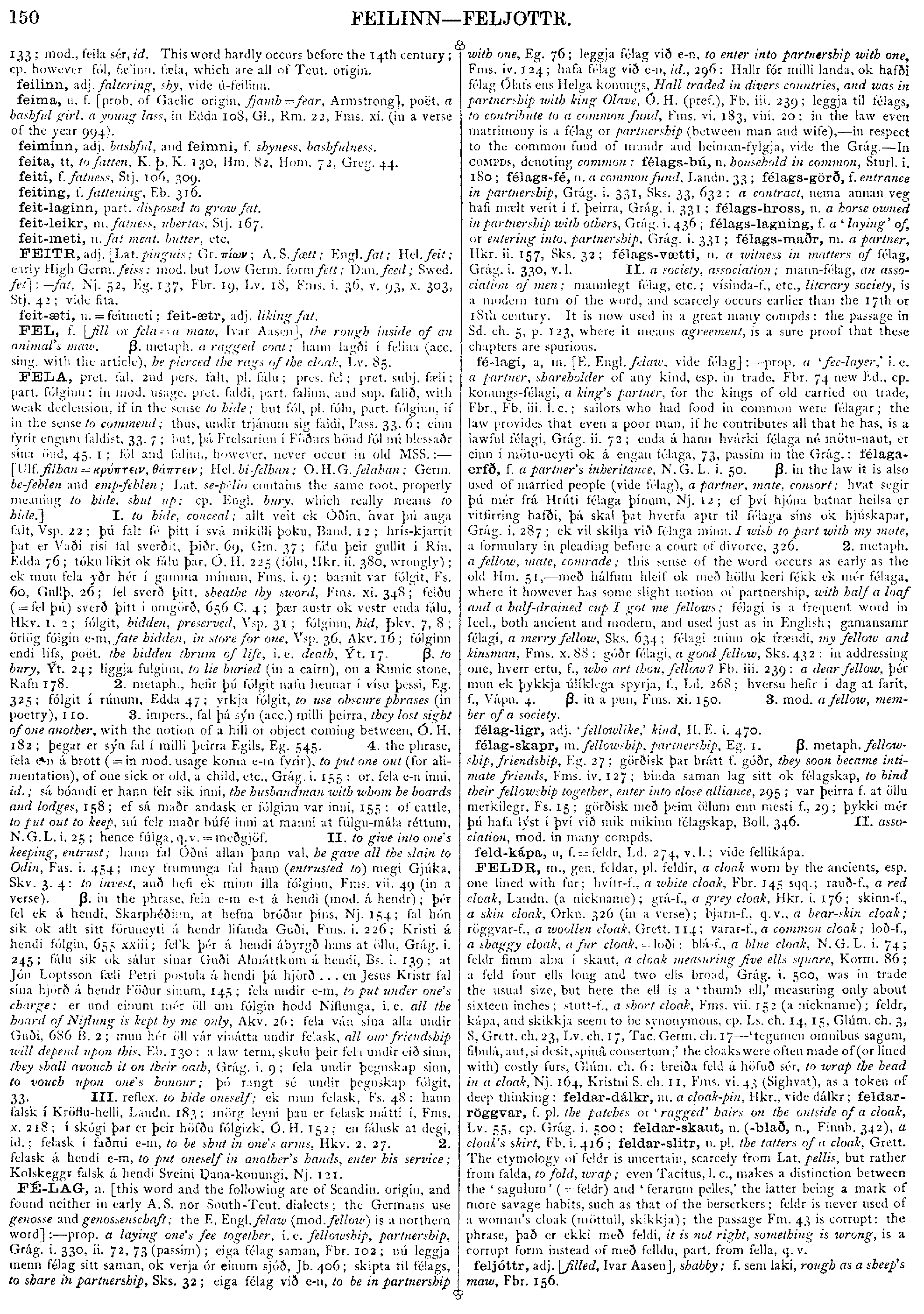
FÉ-LAG, n. [this word and the following are of Scandin. origin, and found neither in early A. S. nor South-Teut. dialects; the Germans use genosse and genossenschaft; the E. Engl. felaw (mod. fellow) is a northern word] :-- prop. a laying one's fee together, i.e. fellowship, partnership, Grág. i. 330, ii. 72, 73 (passim); eiga félag saman, Fbr. 102; nú leggja menn félag sitt saman, ok verja ór einum sjóð, Jb. 406; skipta til félags, to share in partnership, Sks. 32; eiga félag við e-n, to be in partnership with one, Eg. 76; leggja félag við e-n, to enter into partnership with one, Fms. iv. 124; hafa félag við e-n, id., 296: Hallr fór milli landa, ok hafði félag Ólafs ens Helga konungs, Hall traded in divers countries, and was in partnership with king Olave, Ó. H. (pref.), Fb. iii. 239; leggja til félags, to contribute to a common fund, Fms. vi. 183, viii. 20: in the law even matrimony is a félag or partnership (between man and wife),--in respect to the common fund of mundr and heiman-fylgja, vide the Grág.--In COMPDS, denoting common: félags-bú, n. household in common, Sturl. i. 180; félags-fé, n. a common fund, Landn. 33; félags-görð, f. entrance in partnership, Grág. i. 331, Sks. 33, 632: a contract, nema annan veg hafi mælt verít í f. þeirra, Grág. i. 331; félags-hross, n. a horse owned in partnership with others, Grág. i. 436; félags-lagning, f. a 'laying' of, or entering into, partnership, Grág. i. 331; félags-maðr, m. a partner, Hkr. ii. 157, Sks. 32; félags-vætti, n. a witness in matters of félag, Grág. i. 330, v.l. II. a society, association; mann-félag, an association of men; mannlegt félag, etc.; vísinda-f., etc., literary society, is a modern turn of the word, and scarcely occurs earlier than the 17th or 18th century. It is now used in a great many compds: the passage in Sd. ch. 5, p. 123, where it means agreement, is a sure proof that these chapters are spurious.
|
Source: Cleasby/Vigfusson, page b0152, entry 20 View original page image as: [TIFF] [PNG] [View previous entry] [View next entry] |
[Comment on this entry] [View comments] |
The following entry has been hand-corrected once. |
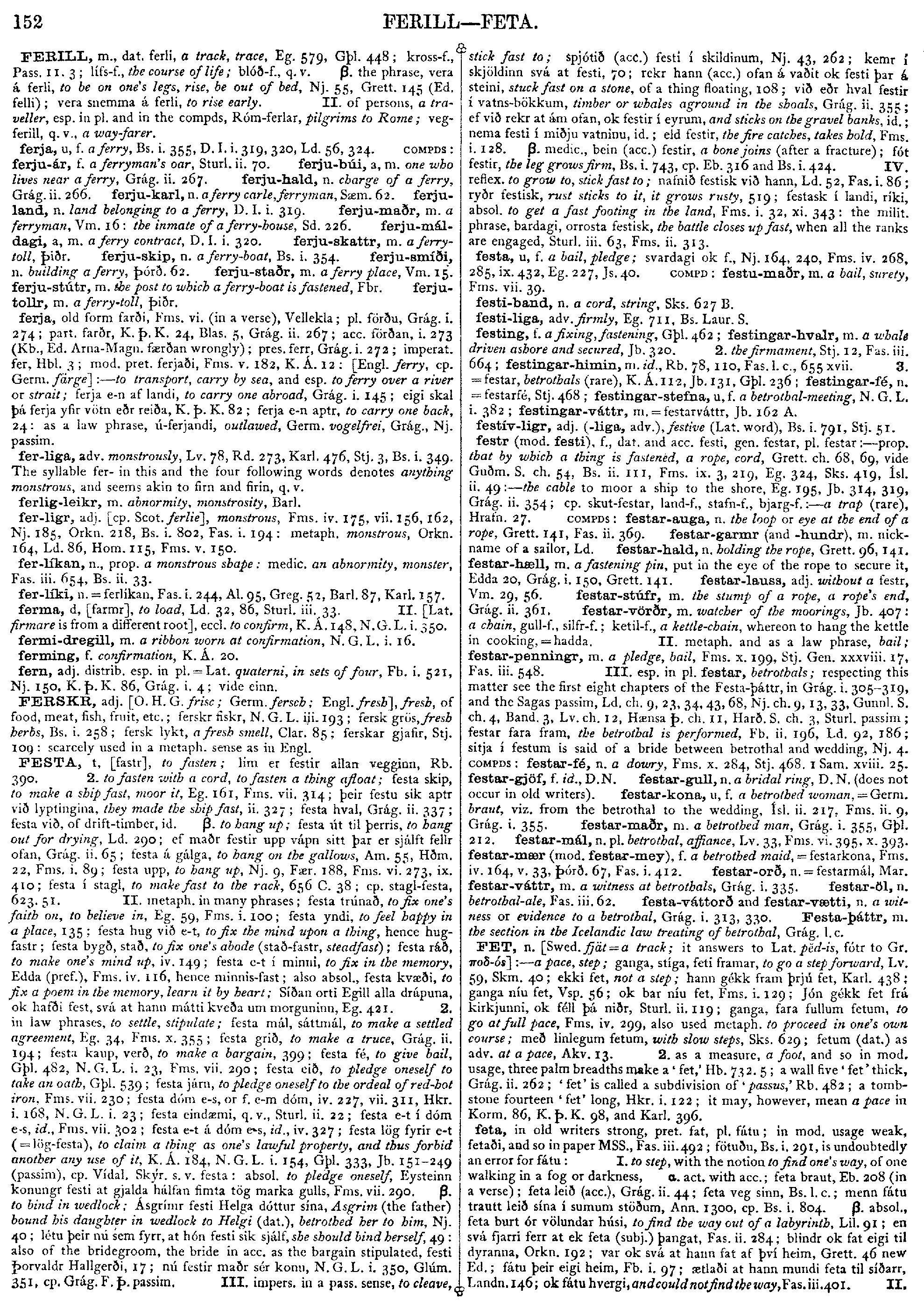
festr (mod. festi), f., dat. and acc. festi, gen. festar, pl. festar :-- prop. that by which a thing is fastened, a rope, cord, Grett. ch. 68, 69, vide Guðm. S. ch. 54, Bs. ii. 111, Fms. ix. 3, 219, Eg. 324, Sks. 419, Ísl. ii. 49 :-- the cable to moor a ship to the shore, Eg. 195, Jb. 314, 319, Grág. ii. 354; cp. skut-festar, land-f., stafn-f., bjarg-f. :-- a trap (rare), Hrafn. 27. COMPDS: festar-auga, n. the loop or eye at the end of a rope, Grett. 141, Fas. ii. 369. festar-garmr (and -hundr), m. nickname of a sailor, Ld. festar-hald, n. holding the rope, Grett. 96, 141. festar-hæll, m. a fastening pin, put in the eye of the rope to secure it, Edda 20, Grág. i. 150, Grett. 141. festar-lauss, adj. without a festr, Vm. 29, 56. festar-stúfr, m. the stump of a rope, a rope's end, Grág. ii. 361. festar-vörðr, m. watcher of the moorings, Jb. 407: a chain, gull-f., silfr-f.; ketil-f., a kettle-chain, whereon to hang the kettle in cooking, = hadda. II. metaph. and as a law phrase, bail; festar-penningr, m. a pledge, bail, Fms. x. 199, Stj. Gen. xxxviii. 17, Fas. iii. 548. III. esp. in pl. festar, betrothals; respecting this matter see the first eight chapters of the Festa-þáttr, in Grág. i. 305-319, and the Sagas passim, Ld. ch. 9, 23, 34, 43, 68, Nj. ch. 9, 13, 33, Gunnl. S. ch. 4, Band. 3, Lv. ch. 12, Hænsa Þ. ch. 11, Harð. S. ch. 3, Sturl. passim; festar fara fram, the betrothal is performed, Fb. ii. 196, Ld. 92, 186; sitja í festum is said of a bride between betrothal and wedding, Nj. 4. COMPDS: festar-fé, n. a dowry, Fms. x. 284, Stj. 468. 1 Sam. xviii. 25. festar-gjöf, f. id., D. N. festar-gull, n. a bridal ring, D. N. (does not occur in old writers). festar-kona, u, f. a betrothed woman, = Germ. braut, viz. from the betrothal to the wedding, Ísl. ii. 217. Fms. ii. 9, Grág. i. 355. festar-maðr, m. a betrothed man, Grág. i. 355, Gþl. 212. festar-mál, n. pl. betrothal, affiance, Lv. 33, Fms. vi. 395, x. 393. festar-mær (mod. festar-mey), f. a betrothed maid, = festarkona, Fms. iv. 164, v. 33, Þórð. 67, Fas. i. 412. festar-orð, n. = festarmál, Mar. festar-váttr, m. a witness at betrothals, Grág. i. 335. festar-öl, n. betrothal-ale, Fas. iii. 62. festa-váttorð and festar-vætti, n. a witness or evidence to a betrothal, Grág. i. 313, 330. Festa-þáttr, m. the section in the Icelandic law treating of betrothal, Grág. l.c.
|
Source: Cleasby/Vigfusson, page b0470, entry 21 View original page image as: [TIFF] [PNG] [View previous entry] [View next entry] |
[Comment on this entry] [View comments] |
The following entry has been hand-corrected once. |
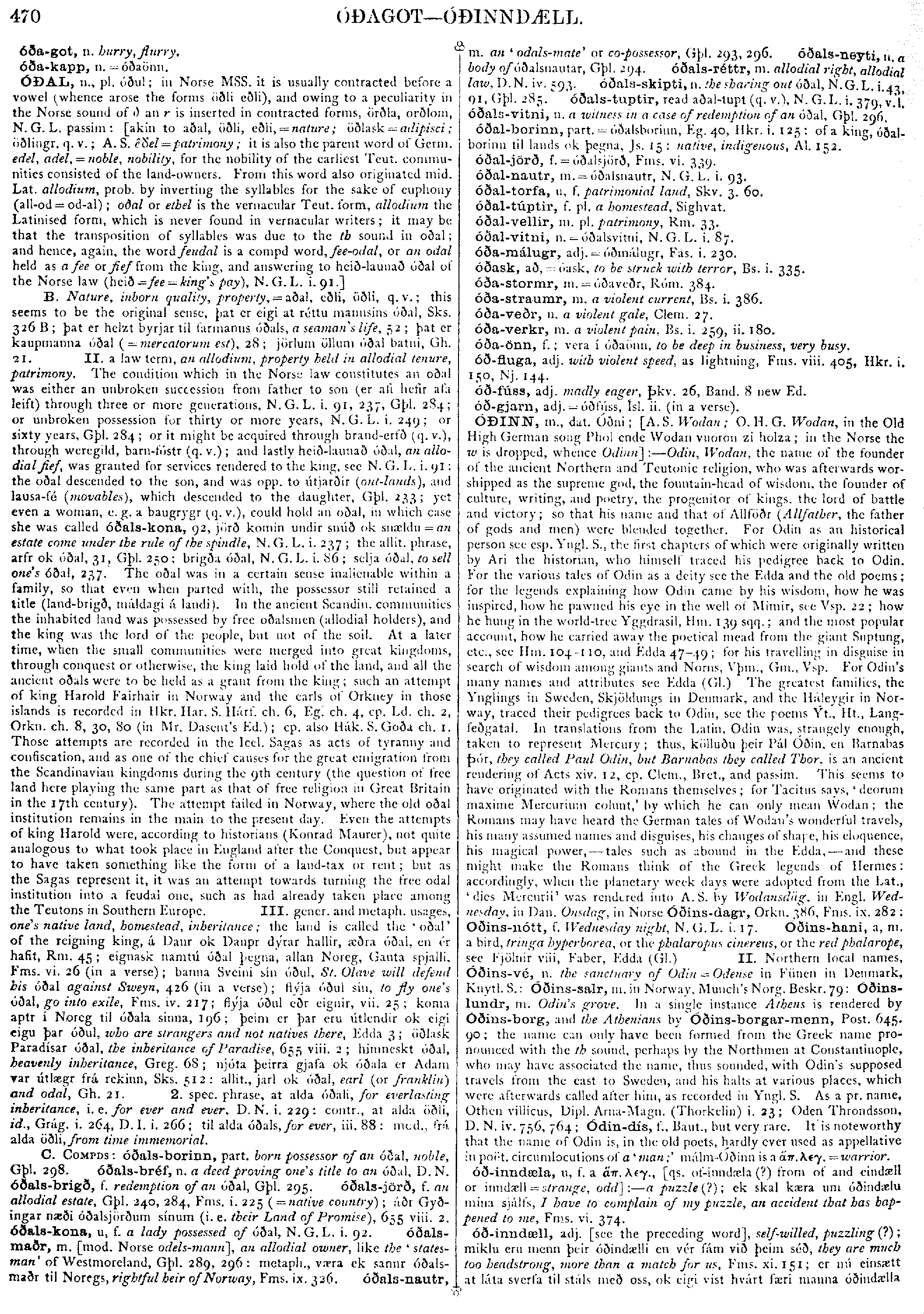
ÓÐINN, m., dat. Óðni; [A.S. Wodan; O.H.G. Wodan, in the Old High German song Phol ende Wodan vuoron zi holza; in the Norse the w is dropped, whence Odinn] :-- Odin, Wodan, the name of the founder of the ancient Northern and Teutonic religion, who was afterwards worshipped as the supreme god, the fountain-head of wisdom, the founder of culture, writing, and poetry, the progenitor of kings, the lord of battle and victory; so that his name and that of Allföðr (Allfather, the father of gods and men) were blended together. For Odin as an historical person see esp. Yngl. S., the first chapters of which were originally written by Ari the historian, who himself traced his pedigree back to Odin. For the various tales of Odin as a deity see the Edda and the old poems; for the legends explaining how Odin came by his wisdom, how he was inspired, how he pawned his eye in the well of Mimir, see Vsp. 22; how he hung in the world-tree Yggdrasil, Hm. 139 sqq.; and the most popular account, how he carried away the poetical mead from the giant Suptung, etc., see Hm. 104-110. and Edda 47-49; for his travelling in disguise in search of wisdom among giants and Norns, Vþm., Gm., Vsp. For Odin's many names and attributes see Edda (Gl.) The greatest families, the Ynglings in Sweden, Skjöldungs in Denmark, and the Háleygir in Norway, traced their pedigrees back to Odin, see the poems Ýt., Ht., Langfeðgatal. In translations from the Latin, Odin was, strangely enough, taken to represent Mercury; thus, kölluðu þeir Pál Óðin, en Barnabas Þór, they called Paul Odin, but Barnabas they called Thor, is an ancient rendering of Acts xiv. 12, cp. Clem., Bret., and passim. This seems to have originated with the Romans themselves; for Tacitus says, 'deorum maxime Mercurium colunt,' by which he can only mean Wodan; the Romans may have heard the German tales of Wodan's wonderful travels, his many assumed names and disguises, his changes of shape, his eloquence, his magical power, -- tales such as abound in the Edda, -- and these might make the Romans think of the Greek legends of Hermes: accordingly, when the planetary week days were adopted from the Lat., 'dies Mercurii' was rendered into A.S. by Wodansdäg, in Engl. Wednesday, in Dan. Onsdag, in Norse Óðins-dagr, Orkn. 386, Fms. ix. 282: Óðins-nótt, f. Wednesday night, N.G.L. i. 17. Óðins-hani, a, m. a bird, tringa hyperborea, or the phalaropus cinereus, or the red phalarope, see Fjölnir viii, Faber, Edda (Gl.) II. Northern local names, Óðins-vé, n. the sanctuary of Odin = Odense in Fünen in Denmark, Knytl. S.: Óðins-salr, m. in Norway. Munch's Norg. Beskr. 79: Óðins-lundr, m. Odin's grove. In a single instance Athens is rendered by Óðins-borg, and the Athenians by Óðins-borgar-menn, Post. 645. 90; the name can only have been formed from the Greek name pronounced with the th sound, perhaps by the Northmen at Constantinople, who may have associated the name, thus sounded, with Odin's supposed travels from the east to Sweden, and his halts at various places, which were afterwards called after him, as recorded in Yngl. S. As a pr. name, Othen villicus, Dipl. Arna-Magn. (Thorkelin) i. 23; Oden Throndsson, D.N. iv. 756, 764; Ódin-dís, f., Baut., but very rare. It is noteworthy that the name of Odin is, in the old poets, hardly ever used as appellative in poët. circumlocutions of a 'man;' málm-Óðinn is a GREEK = warrior.
|
Source: Cleasby/Vigfusson, page b0541, entry 13 View original page image as: [TIFF] [PNG] [View previous entry] [View next entry] |
[Comment on this entry] [View comments] |
The following entry has been hand-corrected once. |
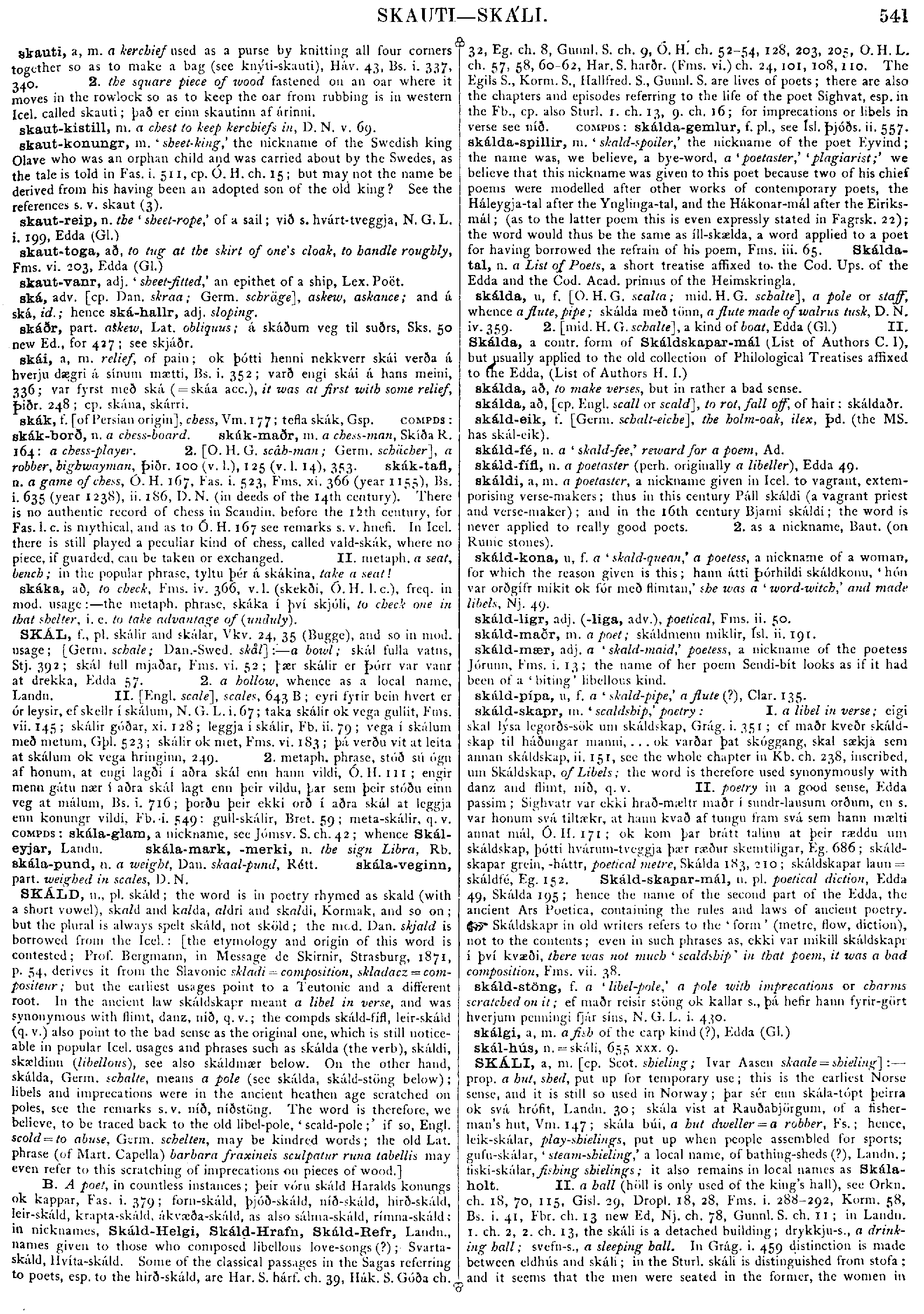
SKÁLD, n., pl. skáld; the word is in poetry rhymed as skald (with a short vowel), skald and kalda, aldri and skaldi, Kormak, and so on; but the plural is always spelt skáld, not sköld; the mod. Dan. skjald is borrowed from the Icel.: [the etymology and origin of this word is contested; Prof. Bergmann, in Message de Skirnir, Strasburg, 1871, p. 54, derives it from the Slavonic skladi = composition, skladacz = compositeur; but the earliest usages point to a Teutonic and a different root. In the ancient law skáldskapr meant a libel in verse, and was synonymous with flimt, danz, níð, q.v.; the compds skáld-fífl, leir-skáld (q.v.) also point to the bad sense as the original one, which is still noticeable in popular Icel. usages and phrases such as skálda (the verb), skáldi, skældinn (libellous), see also skáldmær below. On the other hand, skálda, Germ. schalte, means a pole (sec skálda, skáld-stöng below); libels and imprecations were in the ancient heathen age scratched on poles, see the remarks s.v. níð, níðstöng. The word is therefore, we believe, to be traced back to the old libel-pole, 'scald-pole;' if so, Engl. scold = to abuse, Germ. schelten, may be kindred words; the old Lat. phrase (of Mart. Capella) barbara fraxineis sculpatur runa tabellis may even refer to this scratching of imprecations on pieces of wood.] B. A poet, in countless instances; þeir vóru skáld Haralds komings ok kappar, Fas. i. 379; forn-skáld, þjóð-skáld, níð-skáld, hirð-skáld, leir-skáld, krapta-skáld, ákvæða-skáld, as also sálma-skáld, rímna-skáld; in nicknames, Skáld-Helgi, Skáld-Hrafn, Skáld-Refr, Landn., names given to those who composed libellous love-songs(?); Svarta-skáld, Hvíta-skúld. Some of the classical passages in the Sagas referring to poets, esp. to the hirð-skáld, are Har. S. hárf. ch. 39, Hák. S. Góða ch. 32, Eg. ch. 8, Gunnl. S. ch. 9, Ó.H. ch. 52-54, 128, 203, 205, O.H.L. ch. 57, 58, 60-62, Har. S. harðr. (Fms. vi.) ch. 24, 101, 108, 110. The Egils S., Korm. S., Hallfred. S., Gunnl. S. are lives of poets; there are also the chapters and episodes referring to the life of the poet Sighvat, esp. in the Fb., cp. also Sturl. 1. ch. 13, 9. ch. 16; for imprecations or libels in verse see níð. COMPDS: skálda-gemlur, f. pl., see Ísl. Þjóðs. ii. 557. skálda-spillir, m. 'skald-spoiler,' the nickname of the poet Eyvind; the name was, we believe, a bye-word, a 'poetaster,' 'plagiarist;' we believe that this nickname was given to this poet because two of his chief poems were modelled after other works of contemporary poets, the Háleygja-tal after the Ynglinga-tal, and the Hákonar-mál after the Eiriks-mál; (as to the latter poem this is even expressly stated in Fagrsk. 22); the word would thus be the same as íll-skælda, a word applied to a poet for having borrowed the refrain of his poem, Fms. iii. 65. Skálda-tal, n. a List of Poets, a short treatise affixed to. the Cod. Ups. of the Edda and the Cod. Acad. primus of the Heimskringla.
|
Source: Cleasby/Vigfusson, page b0649, entry 1 View original page image as: [TIFF] [PNG] [View previous entry] [View next entry] |
[Comment on this entry] [View comments] |
The following entry has been hand-corrected once. |
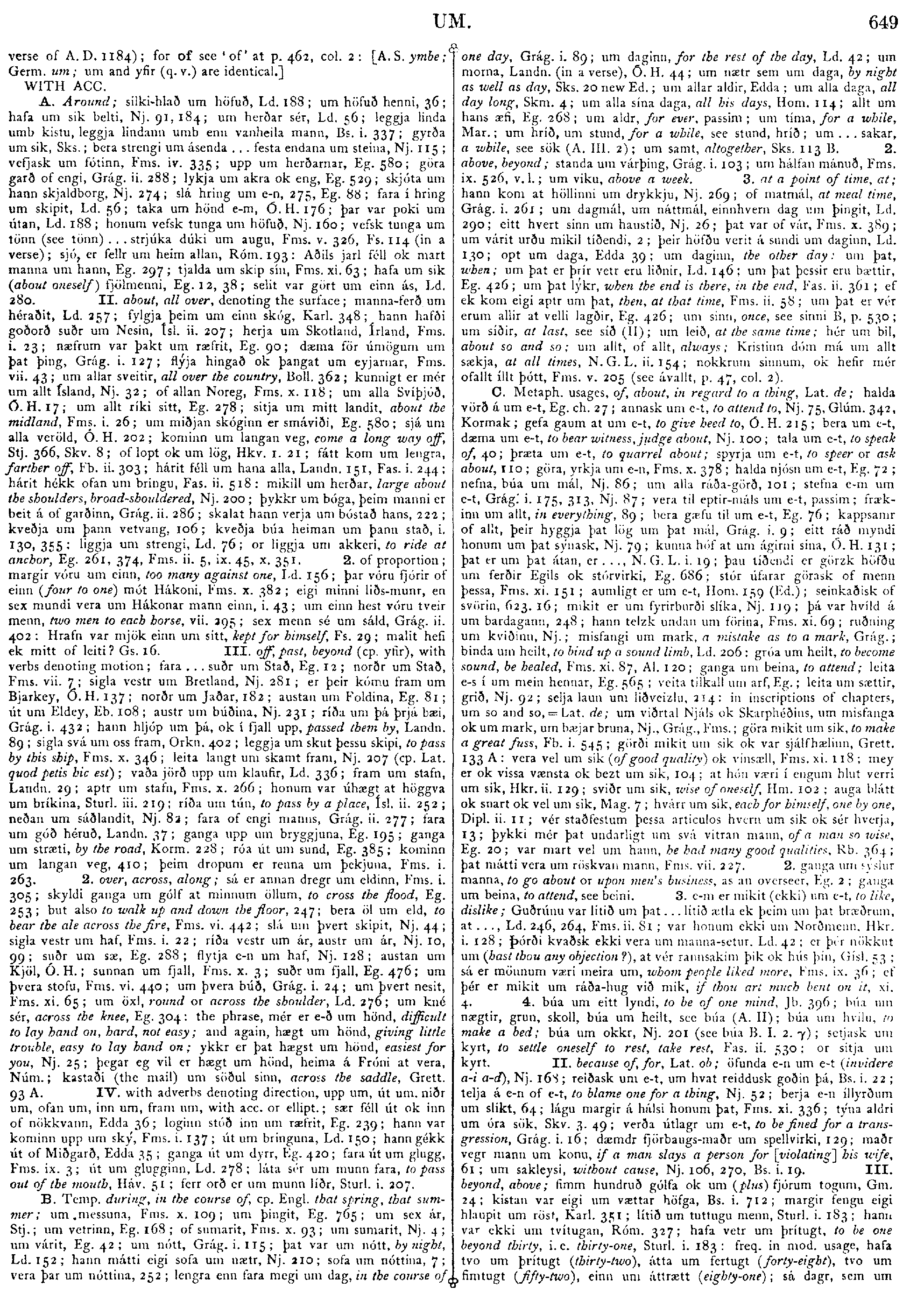
verse
of
A.D.
1184);
for
of
see
'of'
at
p.
462,
col.
2:
[A.S.
ymbe;
Germ.
um;
um
and
yfir
(q.v.)
are
identical.]
WITH
ACC.
A.
Around;
silki-hlað
um
höfuð,
Ld.
188;
um
höfuð
henni,
36;
hafa
um
sik
belti,
Nj.
91,
184;
um
herðar
sér,
Ld.
56;
leggja
linda
umb
kistu,
leggja
lindann
umb
enn
vanheila
mann,
Bs.
i.
337;
gyrða
um
sik,
Sks.;
beta
strengi
um
ásenda
...
festa
endana
um
steina,
Nj.
115;
vefjask
um
fótinn,
Fms.
iv.
335;
upp
um
herðarnar,
Eg.
580;
göra
garð
of
engi,
Grág.
ii.
288;
lykja
um
akra
ok
eng,
Eg.
529;
skjóta
um
hann
skjaldborg,
Nj.
274;
slá
hring
um
e-n,
275,
Eg.
88;
fara
í
hring
um
skipit,
Ld.
56;
taka
um
hönd
e-m,
Ó.H.
176;
þar
var
poki
um
útan,
Ld.
188;
honum
vefsk
tunga
um
höfuð,
Nj.
160;
vefsk
tunga
um
tönn
(see
tönn)
...
strjúka
dúki
um
augu,
Fms.
v.
326,
Fs.
114
(in
a
verse);
sjó,
er
fellr
um
heim
allan,
Róm.
193:
Aðils
jarl
féll
ok
mart
manna
um
hann,
Eg.
297;
tjalda
um
skip
sín,
Fms.
xi.
63;
hafa
um
sik
(about
oneself)
fjölmenni,
Eg.
12,
38;
selit
var
gört
um
einn
ás,
Ld.
280.
II.
about,
all
over,
denoting
the
surface;
manna-ferð
um
héraðit,
Ld.
257;
fylgja
þeim
um
einn
skóg,
Karl.
348;
hann
hafði
goðorð
suðr
um
Nesin,
Ísl.
ii.
207;
herja
um
Skotland,
Írland,
Fms.
i.
23;
næfrum
var
þakt
um
ræfrit,
Eg.
90;
dæma
för
úmögum
um
þat
þing,
Grág.
i.
127;
flýja
hingað
ok
þangat
um
eyjarnar,
Fms.
vii.
43;
um
allar
sveitir,
all
over
the
country,
Boll.
362;
kunnigt
er
mér
um
allt
Ísland,
Nj.
32;
of
allan
Noreg,
Fms.
x.
118;
um
alla
Svíþjóð,
Ó.H.
17;
um
allt
ríki
sitt,
Eg.
278;
sitja
um
mitt
landit,
about
the
midland,
Fms.
i.
26;
um
miðjan
skóginn
er
smáviði,
Eg.
580;
sjá
um
alla
veröld,
Ó.H.
202;
kominn
um
langan
veg,
come
a
long
way
off,
Stj.
366,
Skv.
8;
of
lopt
ok
um
lög,
Hkv.
1.
21;
fátt
kom
um
lengra,
farther
off,
Fb.
ii.
303;
hárit
féll
um
hana
alla,
Landn.
151,
Fas.
i.
244;
hárit
hékk
ofan
um
bringu,
Fas.
ii.
518:
mikill
um
herðar,
large
about
the
shoulders,
broad-shouldered,
Nj.
200;
þykkr
um
bóga,
þeim
manni
er
beit
á
of
garðinn,
Grág.
ii.
286;
skalat
hann
verja
um
bóstað
hans,
222;
kveðja
um
þann
vetvang,
106;
kveðja
búa
heiman
um
þann
stað,
i.
130,
355:
liggja
um
strengi,
Ld.
76;
or
liggja
um
akkeri,
to
ride
at
anchor,
Eg.
261,
374,
Fms.
ii.
5,
ix.
45,
x.
351.
2.
of
proportion;
margir
vóru
um
einn,
too
many
against
one,
Ld.
156;
þar
vóru
fjórir
of
einn
(four
to
one)
mót
Hákoni,
Fms.
x.
382;
eigi
minni
liðs-munr,
en
sex
mundi
vera
um
Hákonar
mann
einn,
i.
43;
um
einn
hest
vóru
tveir
menn,
two
men
to
each
horse,
vii.
295;
sex
menn
sé
um
sáld,
Grág.
ii.
402:
Hrafn
var
mjök
einn
um
sitt,
kept
for
himself,
Fs.
29;
malit
hefi
ek
mitt
of
leiti?
Gs.
16.
III.
off,
past,
beyond
(cp.
yfir),
with
verbs
denoting
motion;
fara
...
suðr
um
Stað,
Eg.
12;
norðr
um
Stað,
Fms.
vii.
7;
sigla
vestr
um
Bretland,
Nj.
281;
er
þeir
kómu
fram
um
Bjarkey,
Ó.H.
137;
norðr
um
Jaðar,
182;
austan
um
Foldina,
Eg.
81;
út
um
Eldey,
Eb.
108;
austr
um
búðina,
Nj.
231;
ríða
um
þá
þrjá
bæi,
Grág.
i.
432;
hann
hljóp
um
þá,
ok
í
fjall
upp,
passed
them
by,
Landn.
89;
sigla
svá
um
oss
fram,
Orkn.
402;
leggja
um
skut
þessu
skipi,
to
pass
by
this
ship,
Fms.
x.
346;
leita
langt
um
skamt
fram,
Nj.
207
(cp.
Lat.
quod
petis
hic
est);
vaða
jörð
upp
um
klaufir,
Ld.
336;
fram
um
stafn,
Landn.
29;
aptr
um
stafn,
Fms.
x.
266;
honum
var
úhægt
at
höggva
um
bríkina,
Sturl.
iii.
219;
ríða
um
tún,
to
pass
by
a
place,
Ísl.
ii.
252;
neðan
um
sáðlandit,
Nj.
82;
fara
of
engi
manns,
Grág.
ii.
277;
fara
um
góð
héruð,
Landn.
37;
ganga
upp
um
bryggjuna,
Eg.
195;
ganga
um
stræti,
by
the
road,
Korm.
228;
róa
út
um
sund,
Eg.
385;
kominn
um
langan
veg,
410;
þeim
dropum
er
renna
um
þekjuna,
Fms.
i.
263.
2.
over,
across,
along;
sá
er
annan
dregr
um
eldinn,
Fms.
i.
305;
skyldi
ganga
um
gólf
at
minnum
öllum,
to
cross
the
flood,
Eg.
253;
but
also
to
walk
up
and
down
the
floor,
247;
bera
öl
um
eld,
to
bear
the
ale
across
the
fire,
Fms.
vi.
442;
slá
um
þvert
skipit,
Nj.
44;
sigla
vestr
um
haf,
Fms.
i.
22;
ríða
vestr
um
ár,
austr
um
ár,
Nj.
10,
99;
suðr
um
sæ,
Eg.
288;
flytja
e-n
um
haf,
Nj.
128;
austan
um
Kjöl,
Ó.H.;
sunnan
um
fjall,
Fms.
x.
3;
suðr
um
fjall,
Eg.
476;
um
þvera
stofu,
Fms.
vi.
440;
um
þvera
búð,
Grág.
i.
24;
um
þvert
nesit,
Fms.
xi.
65;
um
öxl,
round
or
across
the
shoulder,
Ld.
276;
um
kné
sér,
across
the
knee,
Eg.
304:
the
phrase,
mér
er
e-ð
um
hönd,
difficult
to
lay
hand
on,
hard,
not
easy;
and
again,
hægt
um
hönd,
giving
little
trouble,
easy
to
lay
hand
on;
ykkr
er
þat
hægst
um
hönd,
easiest
for
you,
Nj.
25;
þegar
eg
vil
er
hægt
um
hönd,
heima
á
Fróni
at
vera,
Núm.;
kastaði
(the
mail)
um
söðul
sinn,
across
the
saddle,
Grett.
93
A.
IV.
with
adverbs
denoting
direction,
upp
um,
út
um,
niðr
um,
ofan
um,
inn
um,
fram
um,
with
acc.
or
ellipt.;
sær
féll
út
ok
inn
of
nökkvann,
Edda
36;
loginn
stóð
inn
um
ræfrit,
Eg.
239;
hann
var
kominn
upp
um
ský,
Fms.
i.
137;
út
um
bringuna,
Ld.
150;
hann
gékk
út
of
Miðgarð,
Edda
35;
ganga
út
um
dyrr,
Eg.
420;
fara
út
um
glugg,
Fms.
ix.
3;
út
um
glugginn,
Ld.
278;
láta
sér
um
munn
fara,
to
pass
out
of
the
mouth,
Háv.
51;
ferr
orð
er
um
munn
líðr,
Sturl.
i.
207.
B.
Temp.
during,
in
the
course
of,
cp.
Engl.
that
spring,
that
summer;
um
messuna,
Fms.
x.
109;
um
þingit,
Eg.
765;
um
sex
ár,
Stj.;
um
vetrinn,
Eg.
168;
of
sumarit,
Fms.
x.
93;
um
sumarit,
Nj.
4;
um
várit,
Eg.
42;
um
nótt,
Grág.
i.
115;
þat
var
um
nótt,
by
night,
Ld.
152;
hann
mátti
eigi
sofa
um
nætr,
Nj.
210;
sofa
um
nóttina,
7;
vera
þar
um
nóttina,
252;
lengra
enn
fara
megi
um
dag,
in
the
course
of
one
day,
Grág.
i.
89;
um
daginn,
for
the
rest
of
the
day,
Ld.
42;
um
morna,
Landn.
(in
a
verse),
Ó.H.
44;
um
nætr
sem
um
daga,
by
night
as
well
as
day,
Sks.
20
new
Ed.;
um
allar
aldir,
Edda;
um
alla
daga,
all
day
long,
Skm.
4;
um
alla
sína
daga,
all
his
days,
Hom.
114;
allt
um
hans
æfi,
Eg.
268;
um
aldr,
for
ever,
passim;
um
tíma,
for
a
while,
Mar.;
um
hríð,
um
stund,
for
a
while,
see
stund,
hríð;
um
...
sakar,
a
while,
see
sök
(A.
III.
2);
um
samt,
altogether,
Sks.
113
B.
2.
above,
beyond;
standa
um
várþing,
Grág.
i.
103;
um
hálfan
mánuð,
Fms.
ix.
526,
v.l.;
um
viku,
above
a
week.
3.
at
a
point
of
time,
at;
hann
kom
at
höllinni
um
drykkju,
Nj.
269;
of
matmál,
at
meal
time,
Grág.
i.
261;
um
dagmál,
um
náttmál,
einnhvern
dag
um
þingit,
Ld.
290;
eitt
hvert
sinn
um
haustið,
Nj.
26;
þat
var
of
vár,
Fms.
x.
389;
um
várit
urðu
mikil
tíðendi,
2;
þeir
höfðu
verit
á
sundi
um
daginn,
Ld.
130;
opt
um
daga,
Edda
39;
um
daginn,
the
other
day:
um
þat,
when;
um
þat
er
þrír
vetr
eru
liðnir,
Ld.
146;
um
þat
þessir
eru
bættir,
Eg.
426;
um
þat
lýkr,
when
the
end
is
there,
in
the
end,
Fas.
ii.
361;
ef
ek
kom
eigi
aptr
um
þat,
then,
at
that
time,
Fms.
ii.
58;
um
þat
er
vér
erum
allir
at
velli
lagðir,
Eg.
426;
um
sinn,
once,
see
sinni
B,
p.
530;
um
síðir,
at
last,
see
síð
(II);
um
leið,
at
the
same
time;
hér
um
bil,
about
so
and
so;
um
allt,
of
allt,
always;
Kristinn
dóin
má
um
allt
sækja,
at
all
times,
N.G.L.
ii.
154;
nokkrum
sinnum,
ok
hefir
mér
ofallt
íllt
þótt,
Fms.
v.
205
(see
ávallt,
p.
47,
col.
2).
C.
Metaph.
usages,
of,
about,
in
regard
to
a
thing,
Lat.
de;
halda
vörð
á
um
e-t,
Eg.
ch.
27;
annask
um
e-t,
to
attend
to,
Nj.
75,
Glúm.
342,
Kormak;
gefa
gaum
at
um
e-t,
to
give
heed
to,
Ó.H.
215;
bera
um
e-t,
dæma
um
e-t,
to
bear
witness,
judge
about,
Nj.
100;
tala
um
e-t,
to
speak
of,
40;
þræta
um
e-t,
to
quarrel
about;
spyrja
um
e-t,
to
speer
or
ask
about,
110;
göra,
yrkja
um
e-n,
Fms.
x.
378;
halda
njósn
um
e-t,
Eg.
72;
nefna,
búa
um
mál,
Nj.
86;
um
alla
ráða-görð,
101;
stefna
e-m
um
e-t,
Grág.
i.
175,
313,
Nj.
87;
vera
til
eptir-máls
um
e-t,
passim;
frækinn
um
allt,
in
everything,
89;
bera
gæfu
til
um
e-t,
Eg.
76;
kappsamr
of
allt,
þeir
hyggja
þat
lög
um
þat
mál,
Grág.
i.
9;
eitt
ráð
myndi
honum
um
þat
sýnask,
Nj.
79;
kunna
hóf
at
um
ágirni
sína,
Ó.H.
131;
þat
er
um
þat
átan,
er
...,
N.G.L.
i.
19;
þau
tíðendi
er
görzk
höfðu
um
ferðir
Egils
ok
stórvirki,
Eg.
686;
stór
úfarar
görask
of
menn
þessa,
Fms.
xi.
151;
aumligt
er
um
e-t,
Hom.
159
(Ed.);
seinkaðisk
of
svörin,
623.
16;
mikit
er
um
fyrirburði
slíka,
Nj.
119;
þá
var
hvíld
á
um
bardagann,
248;
hann
telzk
undan
um
förina,
Fms.
xi.
69;
ruðning
um
kviðinn,
Nj.;
misfangi
um
mark,
a
mistake
as
to
a
mark,
Grág.;
binda
um
heilt,
to
bind
up
a
sound
limb,
Ld.
206:
gróa
um
heilt,
to
become
sound,
be
healed,
Fms.
xi.
87,
Al.
120;
ganga
um
beina,
to
attend;
leita
e-s
í
um
mein
hennar,
Eg.
565;
veita
tilkall
um
arf,
Eg.;
leita
um
sættir,
grið,
Nj.
92;
selja
laun
um
liðveizlu,
214:
in
inscriptions
of
chapters,
um
so
and
so,
=
Lat.
de;
um
viðrtal
Njáls
ok
Skarphéðins,
um
misfanga
ok
um
mark,
um
bæjar
bruna,
Nj.,
Grág.,
Fms.;
göra
mikit
um
sik,
to
make
a
great
fuss,
Fb.
i.
545;
görði
mikit
um
sik
ok
var
sjálfhælinn,
Grett.
133
A:
vera
vel
um
sik
(of
good
quality)
ok
vinsæll,
Fms.
xi.
118;
mey
er
ok
vissa
vænsta
ok
bezt
um
sik,
104;
at
hón
væri
í
engum
hlut
verri
um
sik,
Hkr.
ii.
129;
sviðr
um
sik,
wise
of
oneself,
Hm.
102;
auga
blátt
ok
snart
ok
vel
um
sik,
Mag.
7;
hvárr
um
sik,
each
for
himself,
one
by
one,
Dipl.
ii.
11;
vér
staðfestum
þessa
articulos
hvern
um
sik
ok
sér
hverja,
13;
þykki
mér
þat
undarligt
um
svá
vitran
mann,
of
a
man
so
wise,
Eg.
20;
var
mart
vel
um
hann,
he
had
many
good
qualities,
Rb.
364;
þat
mátti
vera
um
röskvan
mann,
Fms.
vii.
227.
2.
ganga
um
sýslur
manna,
to
go
about
or
upon
men's
business,
as
an
overseer.
Eg.
2;
ganga
um
beina,
to
attend,
see
beini.
3.
e-m
er
mikit
(ekki)
um
e-t,
to
like,
dislike;
Guðrúnu
var
lítið
um
þat
...
lítið
ætla
ek
þeim
um
þat
bræðrum,
at
...,
Ld.
246,
264,
Fms.
ii.
81;
var
honum
ekki
um
Norðmenn,
Hkr.
i.
128;
Þórði
kvaðsk
ekki
vera
um
manna-setur,
Ld.
42;
er
þér
nökkut
um
(hast
thou
any
objection?),
at
vér
rannsakim
þik
ok
hús
þin,
Gísl.
53;
sá
er
mönnum
væri
meira
um,
whom
people
liked
more,
Fms,
ix.
36;
ef
þór
er
mikit
um
ráða-hug
við
mik,
if
thou
art
much
bent
on
it,
xi.
4.
4.
búa
um
eitt
lyndi,
to
be
of
one
mind,
Jb.
396;
búa
um
nægtir,
grun,
skoll,
búa
um
heilt,
see
búa
(A.
II);
búa
um
hvilu,
to
make
a
bed;
búa
um
okkr,
Nj.
201
(see
búa
B.
I.
2.
 );
setjask
um
kyrt,
to
settle
oneself
to
rest,
take
rest,
Fas.
ii.
530;
or
sitja
um
kyrt.
II.
because
of,
for,
Lat.
ob;
öfunda
e-n
um
e-t
(invidere
a-i
a-d),
Nj.
168;
reiðask
um
e-t,
um
hvat
reiddusk
goðin
þá,
Bs.
i.
22;
telja
á
e-n
of
e-t,
to
blame
one
for
a
thing,
Nj.
52;
berja
e-n
íllyrðum
um
slikt,
64;
lágu
margir
á
hálsi
honum
þat,
Fms.
xi.
336;
týna
aldri
um
óra
sök,
Skv.
3.
49;
verða
útlagr
um
e-t,
to
be
fined
for
a
transgression,
Grág.
i.
16;
dæmdr
fjörbaugs-maðr
um
spellvirki,
129;
maðr
vegr
mann
um
konu,
if
a
man
slays
a
person
for
[violating]
his
wife,
61;
um
sakleysi,
without
cause,
Nj.
106,
270,
Bs.
i.
19.
III.
beyond,
above;
fimm
hundruð
gólfa
ok
um
(plus)
fjórum
togum,
Gm.
24;
kistan
var
eigi
um
vættar
höfga,
Bs.
i.
712;
margir
fengu
eigi
hlaupit
um
röst,
Karl.
351;
lítið
um
tuttugu
menn,
Sturl.
i.
183;
hann
var
ekki
um
tvítugan,
Róm.
327;
hafa
vetr
um
þrítugt,
to
be
one
beyond
thirty,
i.e.
thirty-one,
Sturl.
i.
183:
freq.
in
mod.
usage,
hafa
tvo
um
þrítugt
(thirty-two),
átta
um
fertugt
(forty-eight),
tvo
um
fimtugt
(fifty-two),
einn
um
áttrætt
(eighty-one);
sá
dagr,
sem
um
);
setjask
um
kyrt,
to
settle
oneself
to
rest,
take
rest,
Fas.
ii.
530;
or
sitja
um
kyrt.
II.
because
of,
for,
Lat.
ob;
öfunda
e-n
um
e-t
(invidere
a-i
a-d),
Nj.
168;
reiðask
um
e-t,
um
hvat
reiddusk
goðin
þá,
Bs.
i.
22;
telja
á
e-n
of
e-t,
to
blame
one
for
a
thing,
Nj.
52;
berja
e-n
íllyrðum
um
slikt,
64;
lágu
margir
á
hálsi
honum
þat,
Fms.
xi.
336;
týna
aldri
um
óra
sök,
Skv.
3.
49;
verða
útlagr
um
e-t,
to
be
fined
for
a
transgression,
Grág.
i.
16;
dæmdr
fjörbaugs-maðr
um
spellvirki,
129;
maðr
vegr
mann
um
konu,
if
a
man
slays
a
person
for
[violating]
his
wife,
61;
um
sakleysi,
without
cause,
Nj.
106,
270,
Bs.
i.
19.
III.
beyond,
above;
fimm
hundruð
gólfa
ok
um
(plus)
fjórum
togum,
Gm.
24;
kistan
var
eigi
um
vættar
höfga,
Bs.
i.
712;
margir
fengu
eigi
hlaupit
um
röst,
Karl.
351;
lítið
um
tuttugu
menn,
Sturl.
i.
183;
hann
var
ekki
um
tvítugan,
Róm.
327;
hafa
vetr
um
þrítugt,
to
be
one
beyond
thirty,
i.e.
thirty-one,
Sturl.
i.
183:
freq.
in
mod.
usage,
hafa
tvo
um
þrítugt
(thirty-two),
átta
um
fertugt
(forty-eight),
tvo
um
fimtugt
(fifty-two),
einn
um
áttrætt
(eighty-one);
sá
dagr,
sem
um
| Result Page: | 1 2 | Next |  |
Germanic Lexicon Project (main page)
This search system was written by
Sean Crist
Please consider
volunteering
to correct the data in these online dictionaries.
No rights reserved. Feel free to use these data in any way you please.