|
|

|
Source: Cleasby/Vigfusson, page b0369, entry 4 View original page image as: [TIFF] [PNG] [View previous entry] [View next entry] |
[Comment on this entry] [View comments] |
The following entry has been hand-corrected once. |
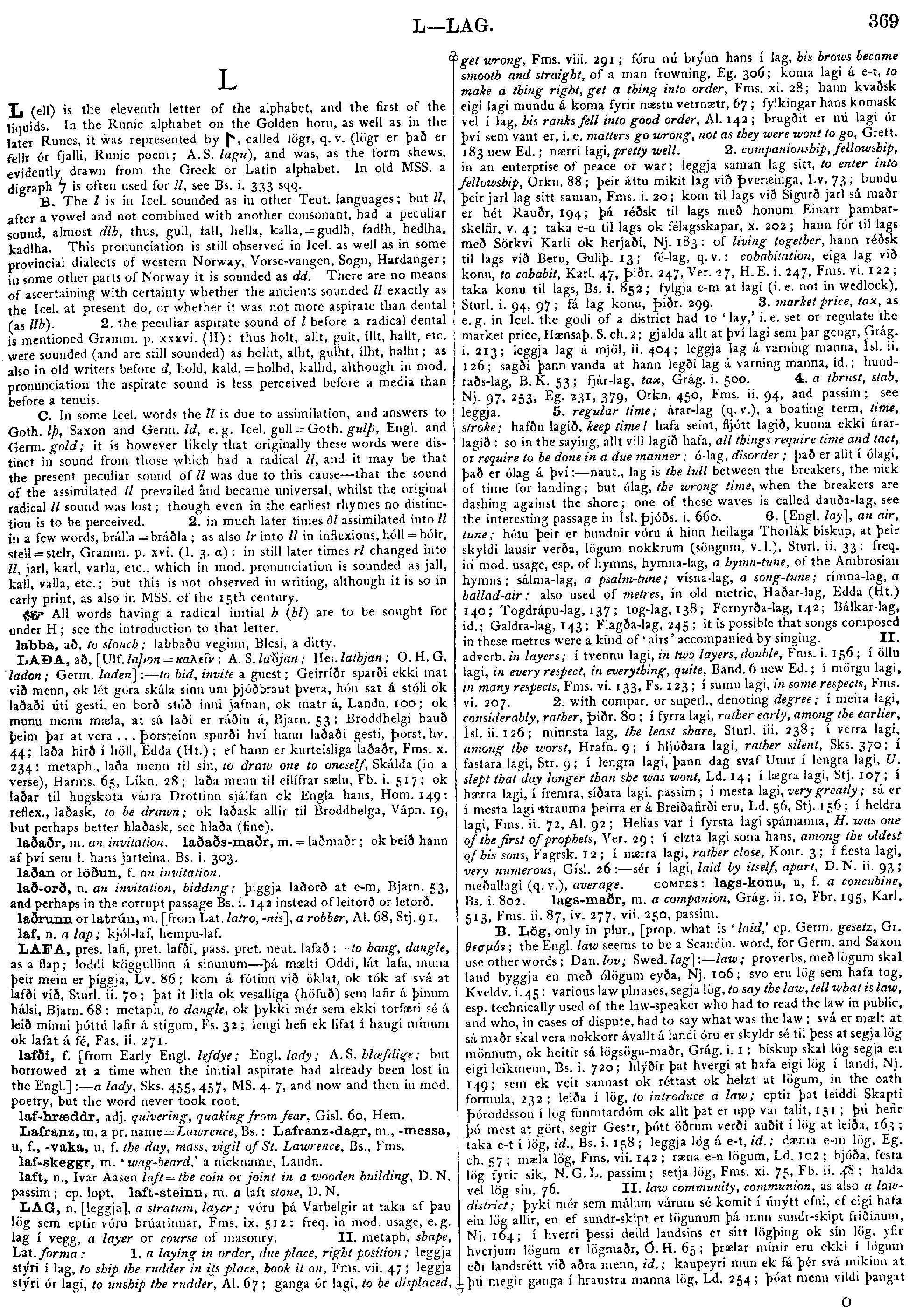
C.
In
some
Icel.
words
the
ll
is
due
to
assimilation,
and
answers
to
Goth.
lþ,
Saxon
and
Germ.
ld,
e.g.
Icel.
gull
=
Goth.
gulþ,
Engl.
and
Germ.
gold;
it
is
however
likely
that
originally
these
words
were
distinct
in
sound
from
those
which
had
a
radical
ll,
and
it
may
be
that
the
present
peculiar
sound
of
ll
was
due
to
this
cause
--
that
the
sound
of
the
assimilated
ll
prevailed
and
became
universal,
whilst
the
original
radical
ll
sound
was
lost;
though
even
in
the
earliest
rhymes
no
distinction
is
to
be
perceived.
2.
in
much
later
times
ðl
assimilated
into
ll
in
a
few
words,
brálla
=
bráðla;
as
also
lr
into
ll
in
inflexions,
hóll
=
hólr,
stell
=
stelr,
Gramm.
p.
xvi.
(I.
3.
 ):
in
still
later
times
rl
changed
into
ll,
jarl,
karl,
varla,
etc.,
which
in
mod.
pronunciation
is
sounded
as
jall,
kall,
valla,
etc.;
but
this
is
not
observed
in
writing,
although
it
is
so
in
early
print,
as
also
in
MSS.
of
the
15th
century.
):
in
still
later
times
rl
changed
into
ll,
jarl,
karl,
varla,
etc.,
which
in
mod.
pronunciation
is
sounded
as
jall,
kall,
valla,
etc.;
but
this
is
not
observed
in
writing,
although
it
is
so
in
early
print,
as
also
in
MSS.
of
the
15th
century.
|
Source: Cleasby/Vigfusson, page b0390, entry 18 View original page image as: [TIFF] [PNG] [View previous entry] [View next entry] |
[Comment on this entry] [View comments] |
The following entry has been hand-corrected once. |
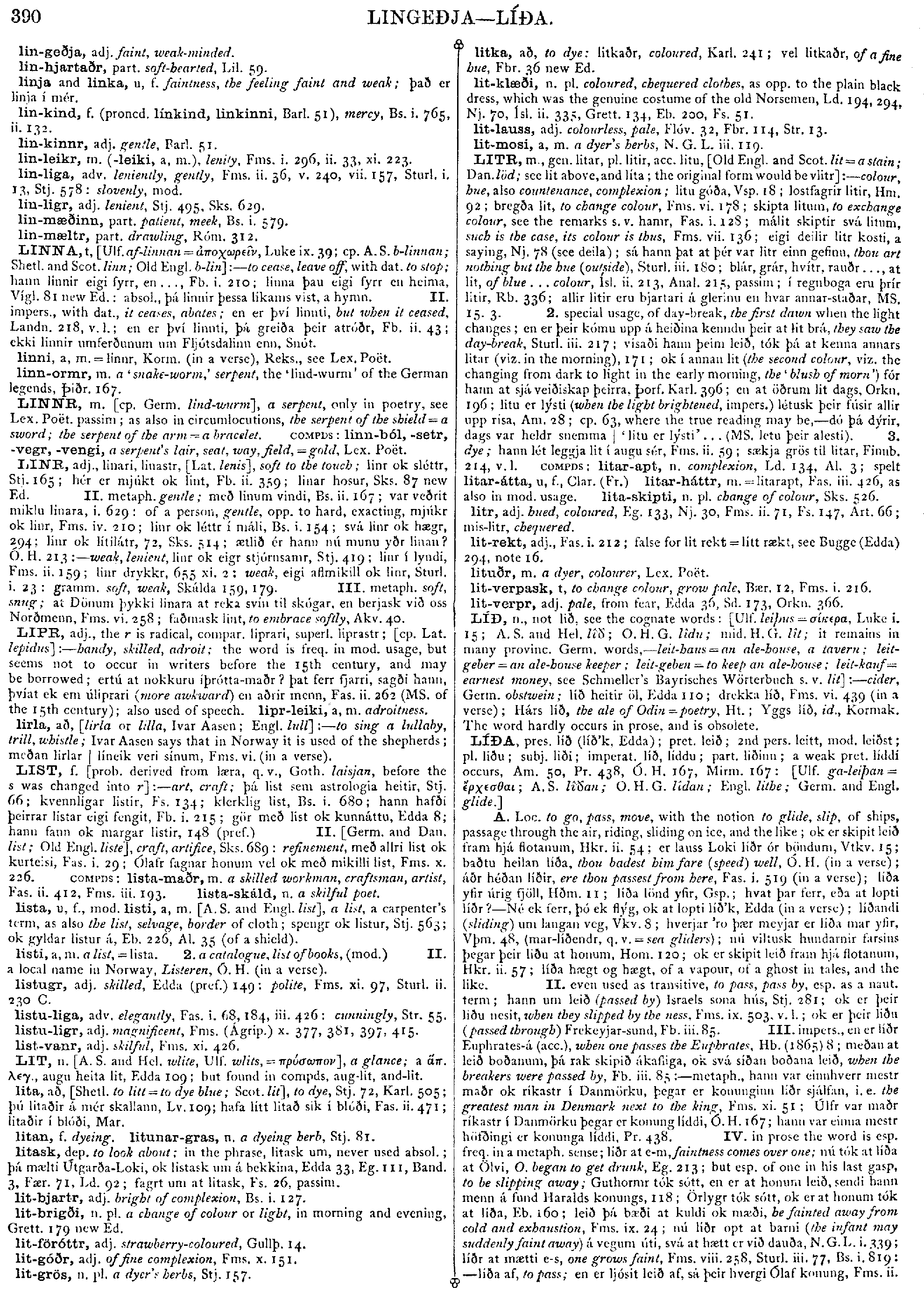
LIST, f. [prob. derived from læra, q.v., Goth. laisjan, before the s was changed into r] :-- art, craft; þá list sem astrologia heitir, Stj. 66; kvennligar listir, Fs. 134; klerklig list, Bs. i. 680; hann hafði þeirrar listar eigi fengit, Fb. i. 215; gör með list ok kunnáttu, Edda 8; hann fann ok margar listir, 148 (pref.) II. [Germ. and Dan. list; Old Engl. liste], craft, artifice, Sks. 689: refinement, með allri list ok kurteisi, Fas. i. 29; Ólafr fagnar honum vel ok með mikilli list, Fms. x. 226. COMPDS: lista-maðr, m. a skilled workman, craftsman, artist, Fas. ii. 412, Fms. iii. 193. lista-skáld, n. a skilful poet.
|
Source: Cleasby/Vigfusson, page b0409, entry 16 View original page image as: [TIFF] [PNG] [View previous entry] [View next entry] |
[Comment on this entry] [View comments] |
The following entry has not been hand-corrected. However, the page is reserved and someone is correcting it. |
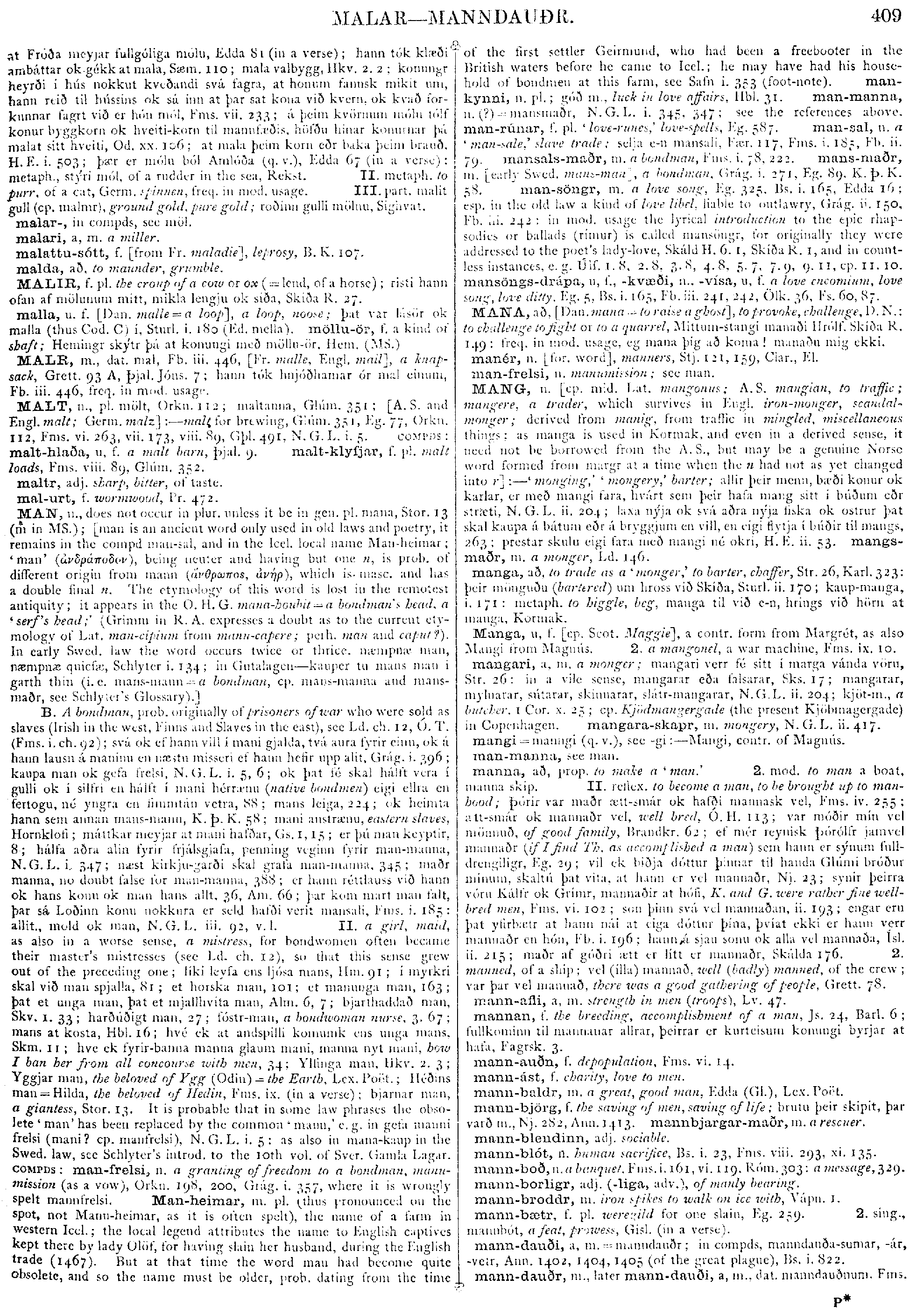
MANG, n. [cp. mid. I. at. man^omis; A. S. mangian, to traffic; mangere, a trader, which survives in I-ngl. iron-monger, scandal- monger; derived from manig, from traflic in mingled, miscellaneous thimrs; as manga is used in Kormak, and even in a derived sense, it need not be borrowed from the A. S., but ma)' be a genuine Norse word formed from margr at a time when the n had not as yet changed into;•] :-- ' motiving, ' ' moitgery, ' barter; allir þeir menu, ba'ði konur ok karlar, er með mangi fara, hvurt sem þeir hafa mar. g sitt í búðum eðr strîcti, N. G. L. ii. 204; la. a nyja ok svá aðra nyja iiska ok ostrur þat skal kaupa á bátiini eðr á bryggjum en viii, en eigi flylja í biiðir til niangs, ^63; prestar skulu eigi fara með mangi no okri, H. K. ii. 53. mangs- maðr, m. a monger, Ld. 146.
|
Source: Cleasby/Vigfusson, page b0412, entry 23 View original page image as: [TIFF] [PNG] [View previous entry] [View next entry] |
[Comment on this entry] [View comments] |
The following entry has been hand-corrected once. |
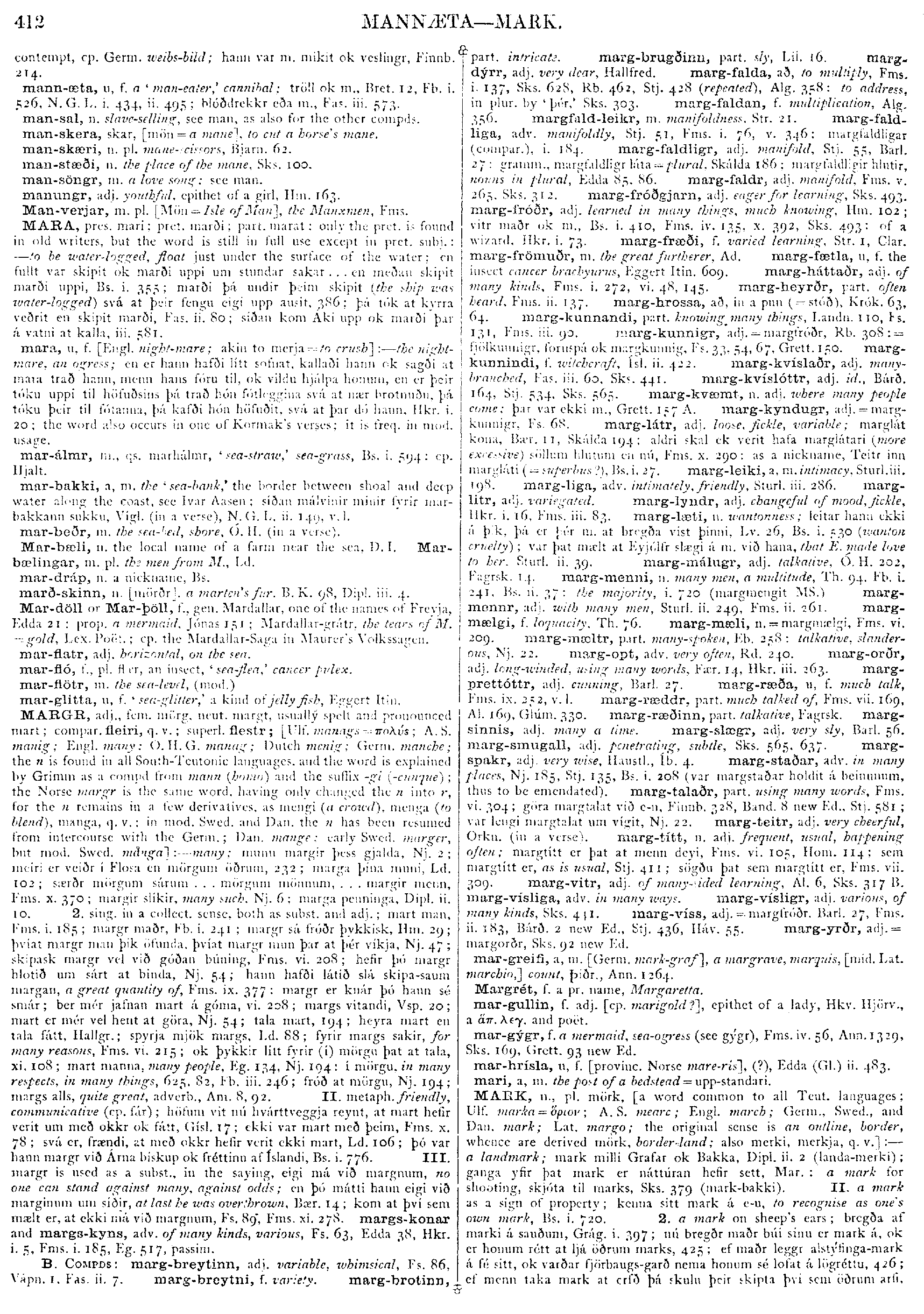
MARGR, adj., fem. mörg. neut. margt, usually spelt and pronounced mart; compar. fleiri, q.v.; superl. flestr; [Ulf. manags = GREEK; A.S. manig; Engl. many: O.H.G. manag; Dutch mennig; Germ. manche; the n is found in all South-Teutonic languages, and the word is explained by Grimm as a compd from mann (homo) and the suffix -gi (-cunque); the Norse margr is the same word, having only changed the n into r, for the n remains in a few derivatives, as mengi (a crowd), menga (to blend), manga, q.v.: in mod. Swed. and Dan. the n has been resumed from intercourse with the Germ.; Dan. mange; early Swed. marger, but mod. Swed. mânga] :-- -many; munu margir þess gjalda, Nj. 2; meiri er veiðr í Flosa en mörgum öðrum, 232; marga þína muni, Ld. 102; særðr mörgum sárum ... mörgum mönnum, ... margir menn, Fms. x. 370; margir slíkir, many such. Nj. 6; marga penninga, Dipl. ii. 10. 2. sing. in a collect. sense, both as subst. and adj.; mart man, Fms. i. 185; margr maðr, Fb. i. 241; margr sá fróðr þvkkisk, Hm. 29; þviat margr man þik öfunda, þvíat margr mun þar at þér víkja, Nj. 47; skipask margr vel við góðan búning, Fms. vi. 208; hefir þó margr hlotið um sárt at binda, Nj. 54; hann hafði látið slá skipa-saum margan, a great quantity of, Fms. ix. 377: margr er knár þó hann sé smár; ber mér jafnan mart á góma, vi. 208; margs vitandi, Vsp. 20; mart er mér vel hent at göra, Nj. 54; tala mart, 194; heyra mart en tala fátt, Hallgr.; spyrja mjök margs, Ld. 88; fyrir margs sakir, for many reasons, Fms. vi. 215; ok þykkir lítt fyrir (í) mörgu þat at tala, xi. 108; mart manna, many people, Eg. 134, Nj. 194: í mörgu, in many respects, in many things, 625. 82, Fb. iii. 246; fróð at mörgu, Nj. 194; margs alls, quite great, adverb., Am. 8, 92. II. metaph. friendly, communicative (cp. fár); höfum vit nú hvarttveggja reynt, at mart hefir verit um með okkr ok fátt, Gísl. 17; ekki var mart með þeim, Fms. x. 78; svá er, frændi, at með okkr hefir verit ekki mart, Ld. 106; þó var hann margr við Árna biskup ok fréttinn af Íslandi, Bs. i. 776. III. margr is used as a subst., in the saying, eigi má við margnum, no one can stand against many, against odds; en þó mátti hann eigi við marginum um síðir, at last he was overthrown, Bær. 14; kom at því sem mælt er, at ekki má við margnum, Fs. 89, Fms. xi. 278. margs-konar and margs-kyns, adv. of many kinds, various, Fs. 63, Edda 38, Hkr. i. 5, Fms. i. 185, Eg. 517, passim. B. COMPDS: marg-breytinn, adj. variable, whimsical, Fs. 86, Vápn. 1. Fas. ii. 7. marg-breytni, f. variety, marg-brotinn, part. intricate. marg-brugðinn, part. sly, Lil. 16. marg-dýrr, adj. very dear, Hallfred. marg-falda, að, to multiply, Fms. i. 137, Sks. 628, Rb. 462, Stj. 428 (repeated), Alg. 358: to address, in plur. by 'þér,' Sks. 303. marg-faldan, f. multiplication, Alg. 356. margfald-leikr, m. manifoldness. Str. 21. marg-faldliga, adv. manifoldly, Stj. 51, Fms. i. 76, v. 346: margfaldligar (compar.), i. 184. marg-faldligr, adj. manifold, Stj. 55, Barl. 27: gramm., margfaldligr láta = plural, Skálda 186; margfaldligar hlutir, nouns in plural, Edda 85. 86. marg-faldr; adj. manifold, Fms. v. 265. Sks. 312. marg-fróðgjarn, adj. eager for learning, Sks. 493. marg-fróðr, adj. learned in many things, much knowing, Hm. 102; vitr maðr ok m., Bs. i. 410, Fms. iv. 135, x. 392, Sks. 493: of a wizard, Hkr. i. 73. marg-fræði, f. varied learning, Str. 1, Clar. marg-frömuðr, m. the great furtherer. Ad. marg-fætla, u, f. the insect cancer brachyurus, Eggert Itin. 609. marg-háttaðr, adj. of many kinds, Fms. i. 272, vi. 48. 145. marg-heyrðr, part. often heard. Fms. ii. 137. marg-hrossa, að, in a pun (= stóð), Krók. 63, 64. marg-kunnandi, part. knowing many things, Landn. 110, Fs. 131, Fms. iii. 90. marg-kunnigr, adj. = margfróðr, Rb. 308: = fjölkunnigr, foruspá ok margkunnig, Fs. 33. 54, 67, Grett. 150. marg-kunnindi, f. witchcraft, Ísl. ii. 422. marg-kvíslaðr, adj. many-branched, Fas. iii. 60, Sks. 441. marg-kvíslóttr, adj. id., Bárð. 164, Stj. 534, Sks. 565. marg-kvæmt, n. adj. where many people come; þar var ekki m., Grett. 157 A. marg-kyndugr, adj. = margkunnigr, Fs. 68. marg-látr, adj. loose, fickle, variable; marglát kona, Bær. 11, Skálda 194; aldri skal ek verit hafa marglátari (more excessive) söllum hlutum en nú, Fms. x. 290: as a nickname, Teitr inn margláti (= superbus?), Bs. i. 27. marg-leiki, a. m. intimacy, Sturl. iii. 198. marg-liga, adv. intimately, friendly, Sturl. iii. 286. marg-litr, adj. variegated. marg-lyndr, adj. changeful of mood, fickle, Hkr. i. 16, Fms. iii. 83. marg-læti, n. wantonness; leitar hann ekki á þik, þá er þér m. at bregða vist þinni, Lv. 26, Bs. i. 530 (wanton cruelty); var þat mælt at Eyjólfr slægi á m. við hana, that E. made love to her. Sturl. ii. 39. marg-málugr, adj. talkative, Ó.H. 202, Fagrsk. 14. marg-menni, n. many men, a multitude, Th. 94, Fb. i. 241, Bs. ii. 37: the majority, i. 720 (margmengit MS.) marg-mennr, adj. with many men, Sturl. ii. 249, Fms. ii. 261. marg-mælgi, f. loquacity. Th. 76. marg-mæli, n. = margmælgi, Fms. vi. 209. marg-mæltr, part. many-spoken, Eb. 258: talkative, slanderous, Nj. 22. marg-opt, adv. very often, Rd. 240. marg-orðr, adj. long-winded, using many words. Fær. 14, Hkr. iii. 263. marg-prettóttr, adj. cunning, Barl. 27. marg-ræða, u, f.; much talk, Fms. ix. 252, v.l. marg-ræddr, part. much talked of, Fms. vii. 169, Al. 169, Glúm. 330. marg-ræðinn, part. talkative, Fagrsk. marg-sinnis, adj. many a time. marg-slægr, adj. very sly, Barl. 56. marg-smugall, adj. penetrating, subtle, Sks. 565. 637. marg-spakr, adj. very wise, Haustl., Íb. 4. marg-staðar, adv. in many places, Nj. 185, Stj. 135, Bs. i. 208 (var margstaðar holdit á beinunum, thus to be emendated). marg-talaðr, part. using many words, Fms. vi. 304; göra margtalat við e-n, Finnb. 328, Band. 8 new Ed., Stj. 581; var lengi margtalat um vígit, Nj. 22. marg-teitr, adj. very cheerful, Orkn. (in a verse). marg-títt, n. adj. frequent, usual, happening often; margtítt er þat at menn deyi, Fms. vi. 105, Hom. 114: sem margtítt er, as is usual, Stj. 411; sögðu þat sem margtítt er, Fms. vii. 309. marg-vitr, adj. of many-sided learning, Al. 6, Sks. 317 B. marg-vísliga, adv. in many ways. marg-vísligr, adj. various, of many kinds, Sks. 411. marg-víss, adj. = margfróðr. Barl. 27, Fms. ii. 183, Bárð. 2 new Ed., Stj. 436, Háv. 55. marg-yrðr, adj. = margorðr, Sks. 92 new Ed.
|
Source: Cleasby/Vigfusson, page b0451, entry 33 View original page image as: [TIFF] [PNG] [View previous entry] [View next entry] |
[Comment on this entry] [View comments] |
The following entry has been hand-corrected once. |
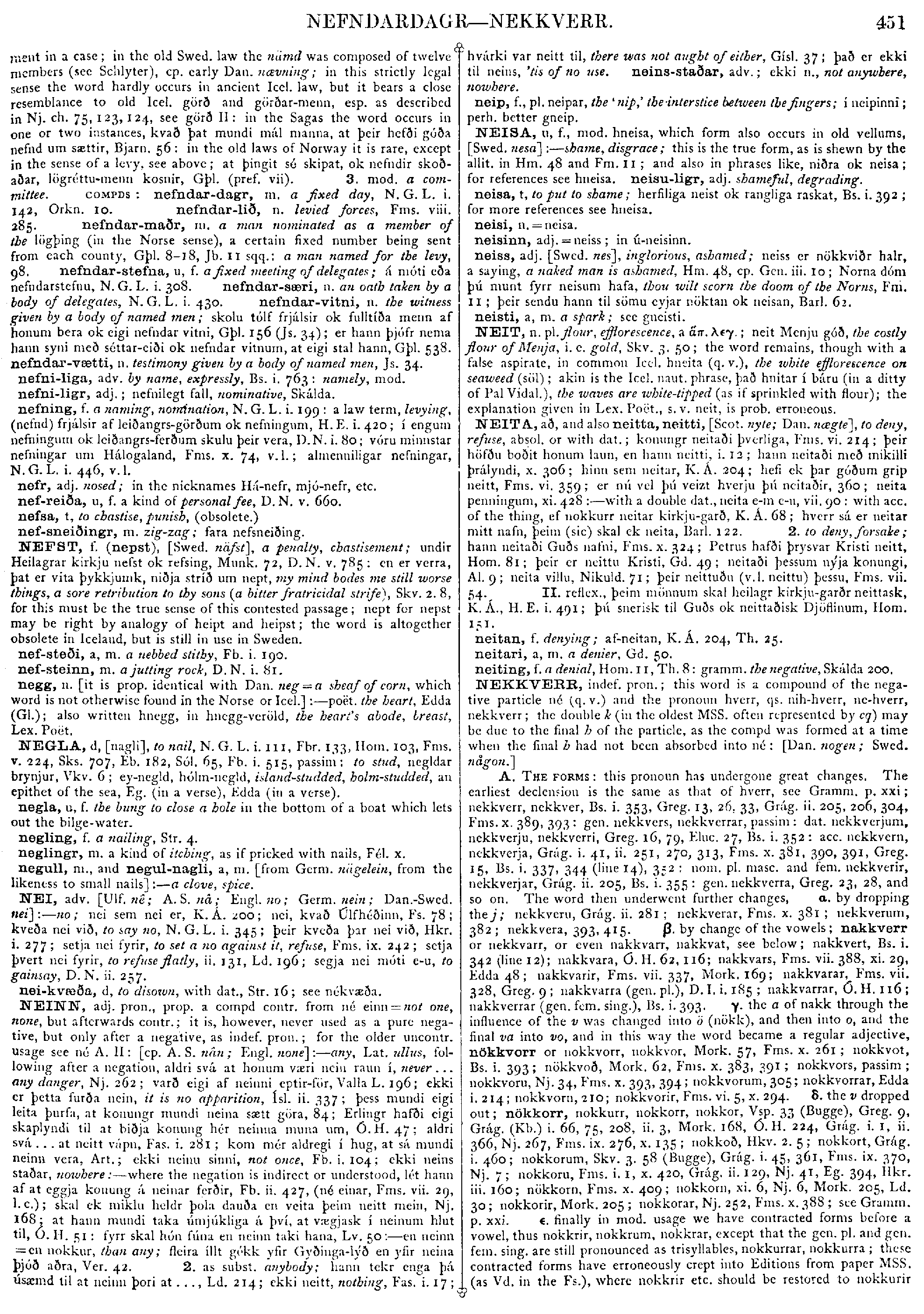
NEKKVERR,
indef.
pron.;
this
word
is
a
compound
of
the
negative
particle
né
(q.
v.)
and
the
pronoun
hverr,
qs.
nih-hverr,
ne-hverr,
nekkverr;
the
double
k
(in
the
oldest
MSS.
often
represented
by
cq)
may
be
due
to
the
final
h
of
the
particle,
as
the
compd
was
formed
at
a
time
when
the
final
h
had
not
been
absorbed
into
né:
[Dan.
nogen;
Swed.
någon.]
A.
THE
FORMS:
this
pronoun
has
undergone
great
changes.
The
earliest
declension
is
the
same
as
that
of
hverr,
see
Gramm.
p.
xxi;
nekkverr,
nekkver,
Bs.
i.
353,
Greg.
13,
26,
33,
Grág.
ii.
205,
206,
304,
Fms.
x.
389,
393:
gen.
nekkvers,
nekkverrar,
passim:
dat.
nekkverjum,
nekkverju,
nekkverri,
Greg.
16,
79,
Eluc.
27,
Bs.
i.
352:
acc.
nekkvern,
nekkverja,
Grág.
i.
41,
ii.
251,
270,
313,
Fms.
x.
381,
390,
391,
Greg.
15,
Bs.
i.
337,
344
(line
14),
352:
nom.
pl.
masc.
and
fem,
nekkverir,
nekkverjar,
Grág.
ii.
205,
Bs.
i.
355:
gen.
nekkverra,
Greg.
23,
28,
and
so
on.
The
word
then
underwent
further
changes,
.
by
dropping
the
j;
nekkveru,
Grág.
ii.
281;
nekkverar,
Fms.
x.
381;
nekkverum,
382;
nekkvera,
393,
415.
 .
by
change
of
the
vowels;
nakkverr
or
nekkvarr,
or
even
nakkvarr,
nakkvat,
see
below;
nakkvert,
Bs.
i.
342
(line
12);
nakkvara,
Ó.
H.
62,
116;
nakkvars,
Fms.
vii.
388,
xi.
29,
Edda
48;
nakkvarir,
Fms.
vii.
337,
Mork.
169;
nakkvarar,
Fms.
vii.
328,
Greg.
9;
nakkvarra
(gen.
pl.),
D.
I.
i.
185;
nakkvarrar,
Ó.
H.
116;
nakkverrar
(gen.
fem.
sing.),
Bs.
i.
393.
.
by
change
of
the
vowels;
nakkverr
or
nekkvarr,
or
even
nakkvarr,
nakkvat,
see
below;
nakkvert,
Bs.
i.
342
(line
12);
nakkvara,
Ó.
H.
62,
116;
nakkvars,
Fms.
vii.
388,
xi.
29,
Edda
48;
nakkvarir,
Fms.
vii.
337,
Mork.
169;
nakkvarar,
Fms.
vii.
328,
Greg.
9;
nakkvarra
(gen.
pl.),
D.
I.
i.
185;
nakkvarrar,
Ó.
H.
116;
nakkverrar
(gen.
fem.
sing.),
Bs.
i.
393.
 .
the
a
of
nakk
through
the
influence
of
the
v
was
changed
into
ö
(nökk),
and
then
into
o,
and
the
final
va
into
vo,
and
in
this
way
the
word
became
a
regular
adjective,
nökkvorr
or
nokkvorr,
nokkvor,
Mork.
57,
Fms.
x.
261;
nokkvot,
Bs.
i.
393;
nökkvoð,
Mork.
62,
Fms.
x.
383,
391;
nokkvors,
passim;
nokkvoru,
Nj.
34,
Fms.
x.
393,
394;
nokkvorum,
305;
nokkvorrar,
Edda
i.
214;
nokkvorn,
210;
nokkvorir,
Fms.
vi.
5,
x.
294.
.
the
a
of
nakk
through
the
influence
of
the
v
was
changed
into
ö
(nökk),
and
then
into
o,
and
the
final
va
into
vo,
and
in
this
way
the
word
became
a
regular
adjective,
nökkvorr
or
nokkvorr,
nokkvor,
Mork.
57,
Fms.
x.
261;
nokkvot,
Bs.
i.
393;
nökkvoð,
Mork.
62,
Fms.
x.
383,
391;
nokkvors,
passim;
nokkvoru,
Nj.
34,
Fms.
x.
393,
394;
nokkvorum,
305;
nokkvorrar,
Edda
i.
214;
nokkvorn,
210;
nokkvorir,
Fms.
vi.
5,
x.
294.
 .
the
v
dropped
out;
nökkorr,
nokkurr,
nokkorr,
nokkor,
Vsp.
33
(Bugge),
Greg.
9,
Grág.
(Kb.)
i.
66,
75,
208,
ii.
3,
Mork.
168,
Ó.
H.
224,
Grág.
i.
1,
ii.
366,
Nj.
267,
Fms.
ix.
276,
x.
135;
nokkoð,
Hkv.
2.
5;
nokkort,
Grág.
i.
460;
nokkorum,
Skv.
3.
58
(Bugge),
Grág.
i.
45,
361,
Fms.
ix.
370,
Nj.
7;
nokkoru,
Fms.
i.
1,
x.
420,
Grág.
ii.
129,
Nj.
41,
Eg.
394,
Hkr.
iii.
160;
nökkorn,
Fms.
x.
409;
nokkorn,
xi.
6,
Nj.
6,
Mork.
205,
Ld.
30;
nokkorir,
Mork.
205;
nokkorar,
Nj.
252,
Fms.
x.
388;
see
Gramm.
p.
xxi.
.
the
v
dropped
out;
nökkorr,
nokkurr,
nokkorr,
nokkor,
Vsp.
33
(Bugge),
Greg.
9,
Grág.
(Kb.)
i.
66,
75,
208,
ii.
3,
Mork.
168,
Ó.
H.
224,
Grág.
i.
1,
ii.
366,
Nj.
267,
Fms.
ix.
276,
x.
135;
nokkoð,
Hkv.
2.
5;
nokkort,
Grág.
i.
460;
nokkorum,
Skv.
3.
58
(Bugge),
Grág.
i.
45,
361,
Fms.
ix.
370,
Nj.
7;
nokkoru,
Fms.
i.
1,
x.
420,
Grág.
ii.
129,
Nj.
41,
Eg.
394,
Hkr.
iii.
160;
nökkorn,
Fms.
x.
409;
nokkorn,
xi.
6,
Nj.
6,
Mork.
205,
Ld.
30;
nokkorir,
Mork.
205;
nokkorar,
Nj.
252,
Fms.
x.
388;
see
Gramm.
p.
xxi.
 .
finally
in
mod.
usage
we
have
contracted
forms
before
a
vowel,
thus
nokkrir,
nokkrum,
nokkrar,
except
that
the
gen.
pl.
and
gen.
fem.
sing.
are
still
pronounced
as
trisyllables,
nokkurrar,
nokkurra;
these
contracted
forms
have
erroneously
crept
into
Editions
from
paper
MSS.
(as
Vd.
in
the
Fs.),
where
nokkrir
etc.
should
be
restored
to
nokkurir
.
finally
in
mod.
usage
we
have
contracted
forms
before
a
vowel,
thus
nokkrir,
nokkrum,
nokkrar,
except
that
the
gen.
pl.
and
gen.
fem.
sing.
are
still
pronounced
as
trisyllables,
nokkurrar,
nokkurra;
these
contracted
forms
have
erroneously
crept
into
Editions
from
paper
MSS.
(as
Vd.
in
the
Fs.),
where
nokkrir
etc.
should
be
restored
to
nokkurir
|
Source: Cleasby/Vigfusson, page b0462, entry 2 View original page image as: [TIFF] [PNG] [View previous entry] [View next entry] |
[Comment on this entry] [View comments] |
The following entry has been hand-corrected once. |
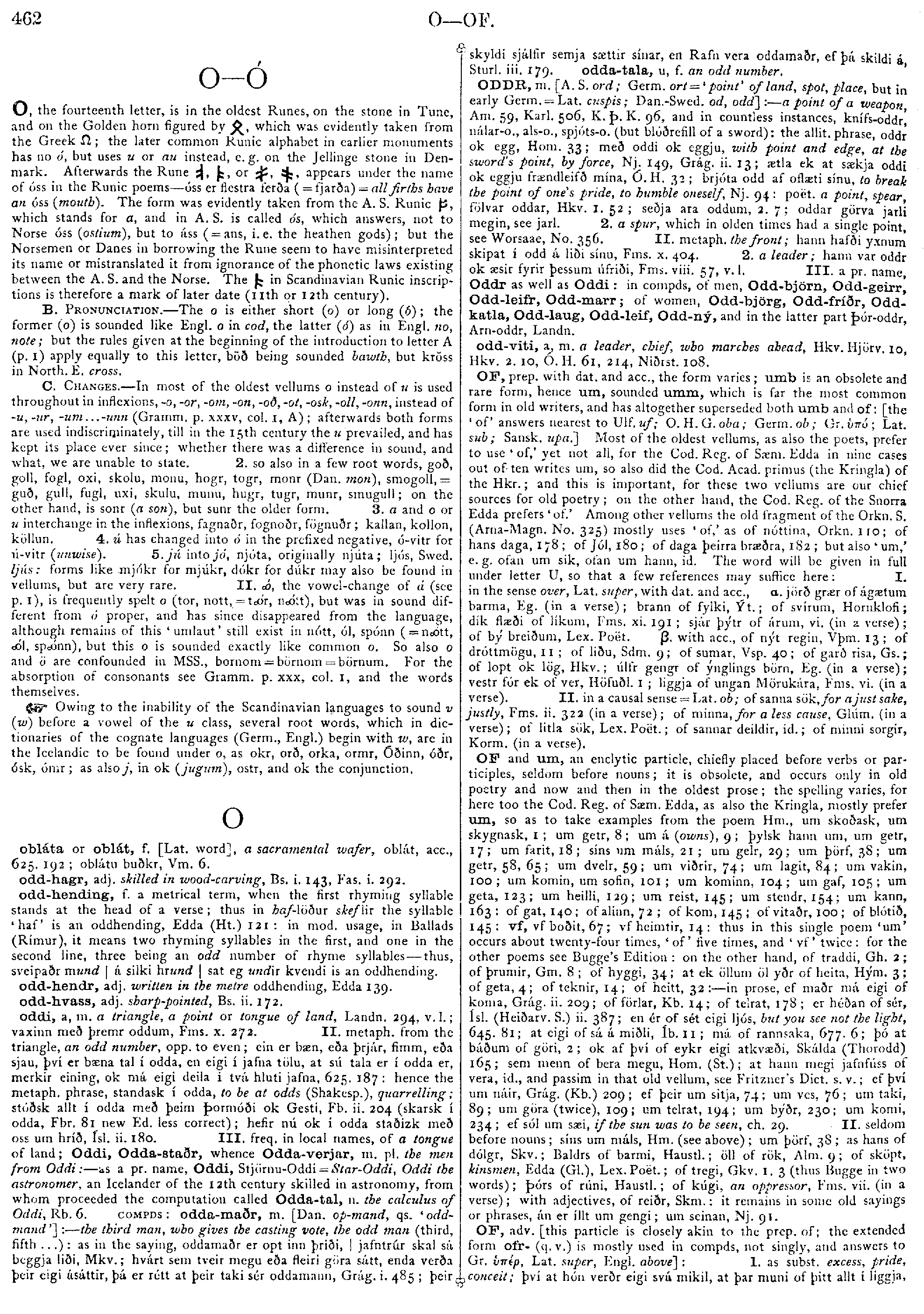
O,
the
fourteenth
letter,
is
in
the
oldest
Runes,
on
the
stone
in
Tune,
and
on
the
Golden
horn
figured
by
RUNE,
which
was
evidently
taken
from
the
Greek
Ω
the
later
common
Runic
alphabet
in
earlier
monuments
has
no
ó,
but
uses
u
or
au
instead,
e.g.
on
the
Jellinge
stone
in
Denmark.
Afterwards
the
Rune
RUNE,
RUNE,
or
RUNE,
RUNE,
appears
under
the
name
of
óss
in
the
Runic
poems
--
óss
er
flestra
ferða
(=
fjarða)
=
all
firths
have
an
óss
(mouth).
The
form
was
evidently
taken
from
the
A.S.
Runic
RUNE,
which
stands
for
a,
and
in
A.S.
is
called
ós,
which
answers,
not
to
Norse
óss
(ostium),
but
to
áss
(=
ans,
i.e.
the
heathen
gods);
but
the
Norsemen
or
Danes
in
borrowing
the
Rune
seem
to
have
misinterpreted
its
name
or
mistranslated
it
from
ignorance
of
the
phonetic
laws
existing
between
the
A.S.
and
the
Norse.
The
RUNE
in
Scandinavian
Runic
inscriptions
is
therefore
a
mark
of
later
date
(11th
or
12th
century).
B.
PRONUNCIATION.
--
The
o
is
either
short
(o)
or
long
(ó);
the
former
(o)
is
sounded
like
Engl.
o
in
cod,
the
latter
(ó)
as
in
Engl.
no,
note;
but
the
rules
given
at
the
beginning
of
the
introduction
to
letter
A
(p.
l)
apply
equally
to
this
letter,
b ð
being
sounded
bawth,
but
kr
ð
being
sounded
bawth,
but
kr ss
in
North.
E.
cross.
C.
CHANGES.
--
In
most
of
the
oldest
vellums
o
instead
of
u
is
used
throughout
in
inflexions,
-o,
-or,
-om,
-on,
-oð,
-ot,
-osk,
-oll,
-onn,
instead
of
-u,
-ur,
-um
...
-unn
(Gramm.
p.
xxxv,
col.
1,
A);
afterwards
both
forms
are
used
indiscriminately,
till
in
the
15th
century
the
u
prevailed,
and
has
kept
its
place
ever
since;
whether
there
was
a
difference
in
sound,
and
what,
we
are
unable
to
state.
2.
so
also
in
a
few
root
words,
goð,
goll,
fogl,
oxi,
skolu,
monu,
hogr,
togr,
monr
(Dan.
mon),
smogoll,
=
guð,
gull,
fugl,
uxi,
skulu,
munu,
hugr,
tugr,
munr,
smugull;
on
the
other
hand,
is
sonr
(a
son),
but
sunr
the
older
form.
3.
a
and
o
or
u
interchange
in
the
inflexions,
fagnaðr,
fognoðr,
fögnuðr;
kallan,
kollon,
köllun.
4.
ú
has
changed
into
ó
in
the
prefixed
negative,
ó-vitr
for
ú-vitr
(unwise).
5.
jú
into
jó,
njóta,
originally
njúta;
ljós,
Swed.
ljús:
forms
like
mjókr
for
mjúkr,
dókr
for
dúkr
may
also
be
found
in
vellums,
but
are
very
rare.
II.
ss
in
North.
E.
cross.
C.
CHANGES.
--
In
most
of
the
oldest
vellums
o
instead
of
u
is
used
throughout
in
inflexions,
-o,
-or,
-om,
-on,
-oð,
-ot,
-osk,
-oll,
-onn,
instead
of
-u,
-ur,
-um
...
-unn
(Gramm.
p.
xxxv,
col.
1,
A);
afterwards
both
forms
are
used
indiscriminately,
till
in
the
15th
century
the
u
prevailed,
and
has
kept
its
place
ever
since;
whether
there
was
a
difference
in
sound,
and
what,
we
are
unable
to
state.
2.
so
also
in
a
few
root
words,
goð,
goll,
fogl,
oxi,
skolu,
monu,
hogr,
togr,
monr
(Dan.
mon),
smogoll,
=
guð,
gull,
fugl,
uxi,
skulu,
munu,
hugr,
tugr,
munr,
smugull;
on
the
other
hand,
is
sonr
(a
son),
but
sunr
the
older
form.
3.
a
and
o
or
u
interchange
in
the
inflexions,
fagnaðr,
fognoðr,
fögnuðr;
kallan,
kollon,
köllun.
4.
ú
has
changed
into
ó
in
the
prefixed
negative,
ó-vitr
for
ú-vitr
(unwise).
5.
jú
into
jó,
njóta,
originally
njúta;
ljós,
Swed.
ljús:
forms
like
mjókr
for
mjúkr,
dókr
for
dúkr
may
also
be
found
in
vellums,
but
are
very
rare.
II.
 ,
the
vowel-change
of
á
(see
p.
1),
is
frequently
spelt
o
(tor,
nott,
=
tr,
ntt),
but
was
in
sound
different
from
ó
proper,
and
has
since
disappeared
from
the
language,
although
remains
of
this
'umlaut'
still
exist
in
nótt,
ól,
spónn
(=
ntt,
l,
spnn),
but
this
o
is
sounded
exactly
like
common
o.
So
also
o
and
ö
are
confounded
in
MSS.,
bornom
=
börnom
=börnum.
For
the
absorption
of
consonants
see
Gramm.
p.
xxx,
col.
1,
and
the
words
themselves.
&FINGER;
Owing
to
the
inability
of
the
Scandinavian
languages
to
sound
v
(w)
before
a
vowel
of
the
u
class,
several
root
words,
which
in
dictionaries
of
the
cognate
languages
(Germ.,
Engl.)
begin
with
w,
are
in
the
Icelandic
to
be
found
under
o,
as
okr,
orð,
orka,
ormr,
Óðinn,
óðr,
ósk,
ómr;
as
also
j,
in
ok
(jugum),
ostr,
and
ok
the
conjunction.
,
the
vowel-change
of
á
(see
p.
1),
is
frequently
spelt
o
(tor,
nott,
=
tr,
ntt),
but
was
in
sound
different
from
ó
proper,
and
has
since
disappeared
from
the
language,
although
remains
of
this
'umlaut'
still
exist
in
nótt,
ól,
spónn
(=
ntt,
l,
spnn),
but
this
o
is
sounded
exactly
like
common
o.
So
also
o
and
ö
are
confounded
in
MSS.,
bornom
=
börnom
=börnum.
For
the
absorption
of
consonants
see
Gramm.
p.
xxx,
col.
1,
and
the
words
themselves.
&FINGER;
Owing
to
the
inability
of
the
Scandinavian
languages
to
sound
v
(w)
before
a
vowel
of
the
u
class,
several
root
words,
which
in
dictionaries
of
the
cognate
languages
(Germ.,
Engl.)
begin
with
w,
are
in
the
Icelandic
to
be
found
under
o,
as
okr,
orð,
orka,
ormr,
Óðinn,
óðr,
ósk,
ómr;
as
also
j,
in
ok
(jugum),
ostr,
and
ok
the
conjunction.
|
Source: Cleasby/Vigfusson, page b0465, entry 50 View original page image as: [TIFF] [PNG] [View previous entry] [View next entry] |
[Comment on this entry] [View comments] |
The following entry has been hand-corrected once. |
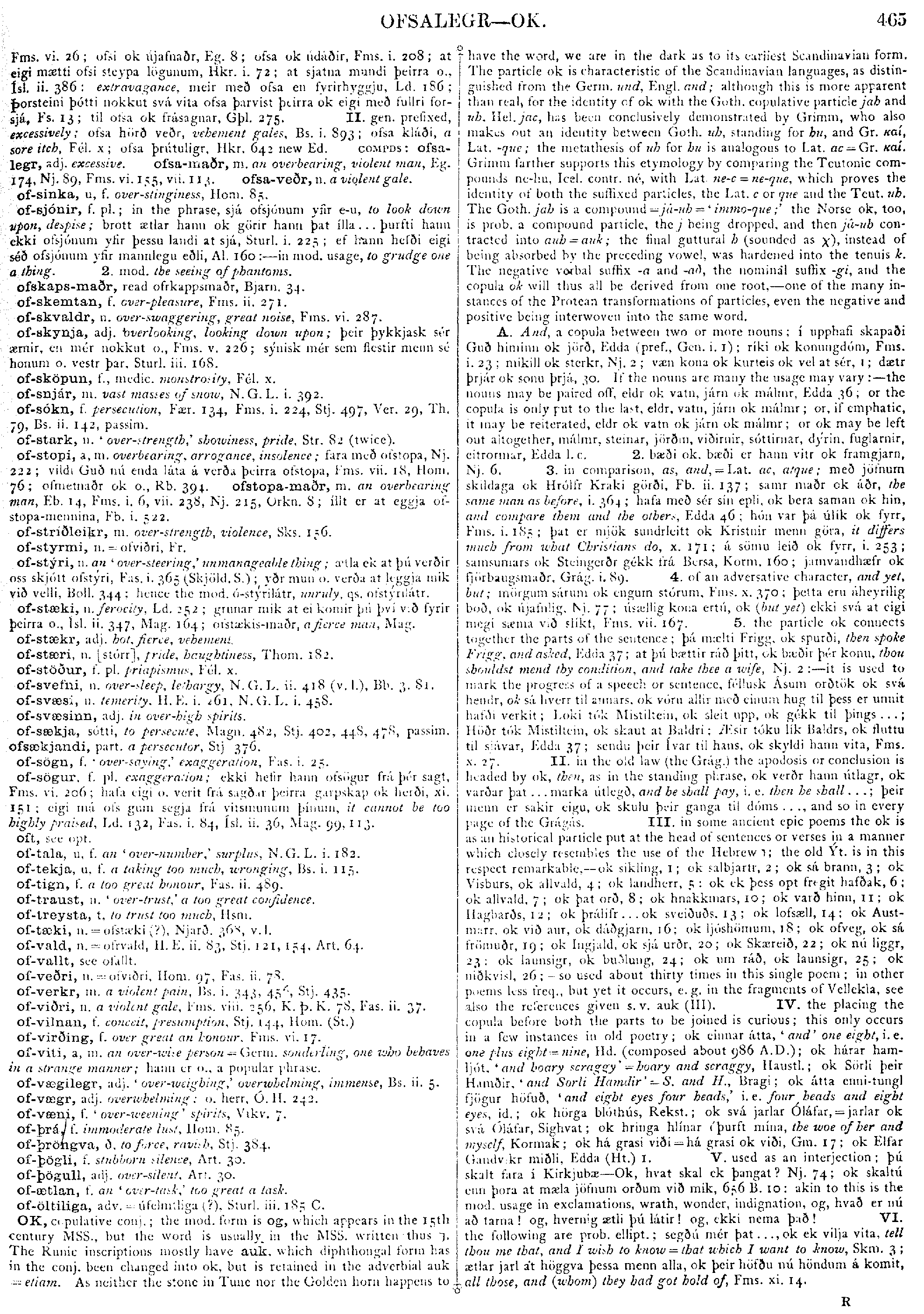
OK, copulative conj.; the mod. form is og, which appears in the 15th century MSS., but the word is usually in the MSS. written thus RUNE. The Runic inscriptions mostly have auk, which diphthongal form has in the conj. been changed into ok, but is retained in the adverbial auk = etiam. As neither the stone in Tune nor the Golden horn happens to have the word, we are in the dark as to its earliest Scandinavian form. The particle ok is characteristic of the Scandinavian languages, as distinguished from the Germ. und, Engl. and; although this is more apparent than real, for the identity of ok with the Goth. copulative particle jah and uh. Hel. jac, has been conclusively demonstrated by Grimm, who also makes out an identity between Goth. uh, standing for hu, and Gr. GREEK, Lat. -que; the metathesis of uh for hu is analogous to Lat. ac = Gr. GREEK. Grimm farther supports this etymology by comparing the Teutonic compounds ne-hu, Icel. contr. né, with Lat. ne-c = ne-que, which proves the identity of both the suffixed particles, the Lat. c or que and the Teut. uh. The Goth. jah is a compound = jâ-uh = 'immo-que;' the Norse ok, too, is prob. a compound particle, the j being dropped, and then jâ-uh contracted into auh = auk; the final guttural h (sounded as RUNE), instead of being absorbed by the preceding vowel, was hardened into the tenuis k. The negative verbal suffix -a and -að, the nominal suffix -gi, and the copula ok will thus all be derived from one root, -- one of the many instances of the Protean transformations of particles, even the negative and positive being interwoven into the same word. A. And, a copula between two or more nouns; í upphafi skapaði Guð himinn ok jörð, Edda (pref., Gen. i. 1); ríki ok konungdóm, Fms. i. 23; mikill ok sterkr, Nj. 2; væn kona ok kurteis ok vel at sér, 1; dætr þrjár ok sonu þrá, 30. If the nouns are many the usage may vary :-- the nouns may be paired off, eldr ok vatn, járn ok málmr, Edda 36; or the copula is only put to the last, eldr, vatn, járn ok málmr; or, if emphatic, it may be reiterated, eldr ok vatn ok járn ok málmr; or ok may be left out altogether, málmr. steinar, jörðin, viðirnir, sóttirnar, dýrin, fuglarnir, eitrormar, Edda l.c. 2. bæði ok, bæði er hann vitr ok framgjarn, Nj. 6. 3. in comparison, as, and, = Lat. ac, atque; með jöfnum skildaga ok Hrólfr Kraki görði, Fb. ii. 137; samr maðr ek áðr, the same man as before, i. 364; hafa með sér sín epli, ok bera saman ok hin, and compare them and the others, Edda 46; hón var þá úlík ok fyrr, Fms. i. 185; þat er mjök sundrleitt ok Kristnir menn göra, it differs much from what Christians do, x. 171; á sömu leið ok fyrr, i. 253; samsumars ok Steingerðr gékk frá Bersa, Korm. 160; jamvandhæfr ok flörbaugsmaðr, Grág. i. 89. 4. of an adversative character, and yet, but; mörgum sárum ok engum stórum, Fms. x. 370; þetta eru áheyrilig boð, ok újafnlig. Nj. 77; úsællig kona ertú, ok (but yet) ekki svá at eigi megi sæma við slíkt, Fms. vii. 167. 5. the particle ok connects together the parts of the sentence; þá mælti Frigg, ok spurði, then spoke Frigg, and asked, Edda 37; at þú bættir ráð þitt, ok bæðir þér konu, thou shouldst mend thy condition, and take thee a wife, Nj. 2 :-- it is used to mark the progress of a speech or sentence, féllusk Ásum orðtök ok svá hendr, ok sá hverr til annars, ok vóru allir með einum hug til þess er unnit hafði verkit; Loki tók. Mistiltein, ok sleit upp, ok gékk til þings ...; Höðr tók Mistiltein, ok skaut at Baldri; Æsir tóku lík Baldrs, ok fluttu til sjávar, Edda 37; sendu þeir Ívar til hans, ok skyldi hann vita, Fms. x. 27. II. in the old law (the Grág.) the apodosis or conclusion is headed by ok, then, as in the standing phrase, ok verðr hann útlagr, ok varðar þat ... marka útlegð, and he shall pay, i.e. then he shall ...; þeir menn er sakir eigu, ok skulu þeir ganga til dóms ..., and so in every page of the Grágás. III. in some ancient epic poems the ok is as an historical particle put at the head of sentences or verses in a manner which closely resembles the use of the Hebrew HEBREW; the old Ýt. is in this respect remarkable, -- ok sikling, I; ok salbjartr, 2; ok sá brann, 3; ok Visburs, ok allvald, 4; ok landherr, 5: ok ek þess opt fregit hafðak, 6; ok allvald, 7; ok þat orð, 8; ok hnakkmars, 10; ok varð hinn, 11; ok Hagbarðs, 12; ok þrálífr ... ok sveiðuðs. 13; ok lofsæll, 14; ok Austmarr, ok við aur, ok dáðgjarn, 16; ok ljóshömum, 18; ok ofveg, ok sá frömuðr, 19; ok Ingjald, ok sjá urðr, 20; ok Skæreið, 22; ok nú liggr, 23: ok launsigr, ok buðlung, 24; ok um ráð, ok launsigr, 25; ok niðkvisl, 26; - so used about thirty times in this single poem; in other poems less freq., but yet it occurs, e.g. in the fragments of Vellekla, see also the references given s.v. auk (III). IV. the placing the copula before both the parts to be joined is curious; this only occurs in a few instances in old poetry; ok einnar átta, 'and' one eight, i.e. one plus eight = nine, Hd. (composed about 986 A.D.); ok hárar hamljót, 'and hoary scraggy' = hoary and scraggy, Haustl.; ok Sörli þeir Hamðir, 'and Sorli Hamdir' = S. and H., Bragi; ok átta enni-tungl fjögur höfuð, 'and eight eyes four heads' i.e. four heads and eight eyes, id.; ok hörga blóthús, Rekst.; ok svá jarlar Óláfar, = jarlar ok svá Óláfar, Sighvat; ok hringa hlínar óþurft mína, the woe of her and myself, Kormak; ok há grasi viði = há grasi ok viði, Gm. 17; ok Elfar Gandvikr miðli, Edda (Ht.) 1. V. used as an interjection; þú skalt fara í Kirkjubæ -- Ok, hvat skal ek þangat? Nj. 74; ok skaltú enn þora at mæla jöfnum orðum við mik, 656 B. 10: akin to this is the mod. usage in exclamations, wrath, wonder, indignation, og, hvað er nú að tarna! og, hvernig ætli þú látir! og, ekki nema það! VI. the following are prob. ellipt.; segðú mér þat ..., ok ek vilja vita, tell thou me that, and I wish to know = that which I want to know, Skm. 3; ætlar jarl at höggva þessa menn alla, ok þeir hofðu nú höndum á komit, all those, and (whom) they had got hold of, Fms. xi. 14.
|
Source: Cleasby/Vigfusson, page b0467, entry 51 View original page image as: [TIFF] [PNG] [View previous entry] [View next entry] |
[Comment on this entry] [View comments] |
The following entry has been hand-corrected once. |
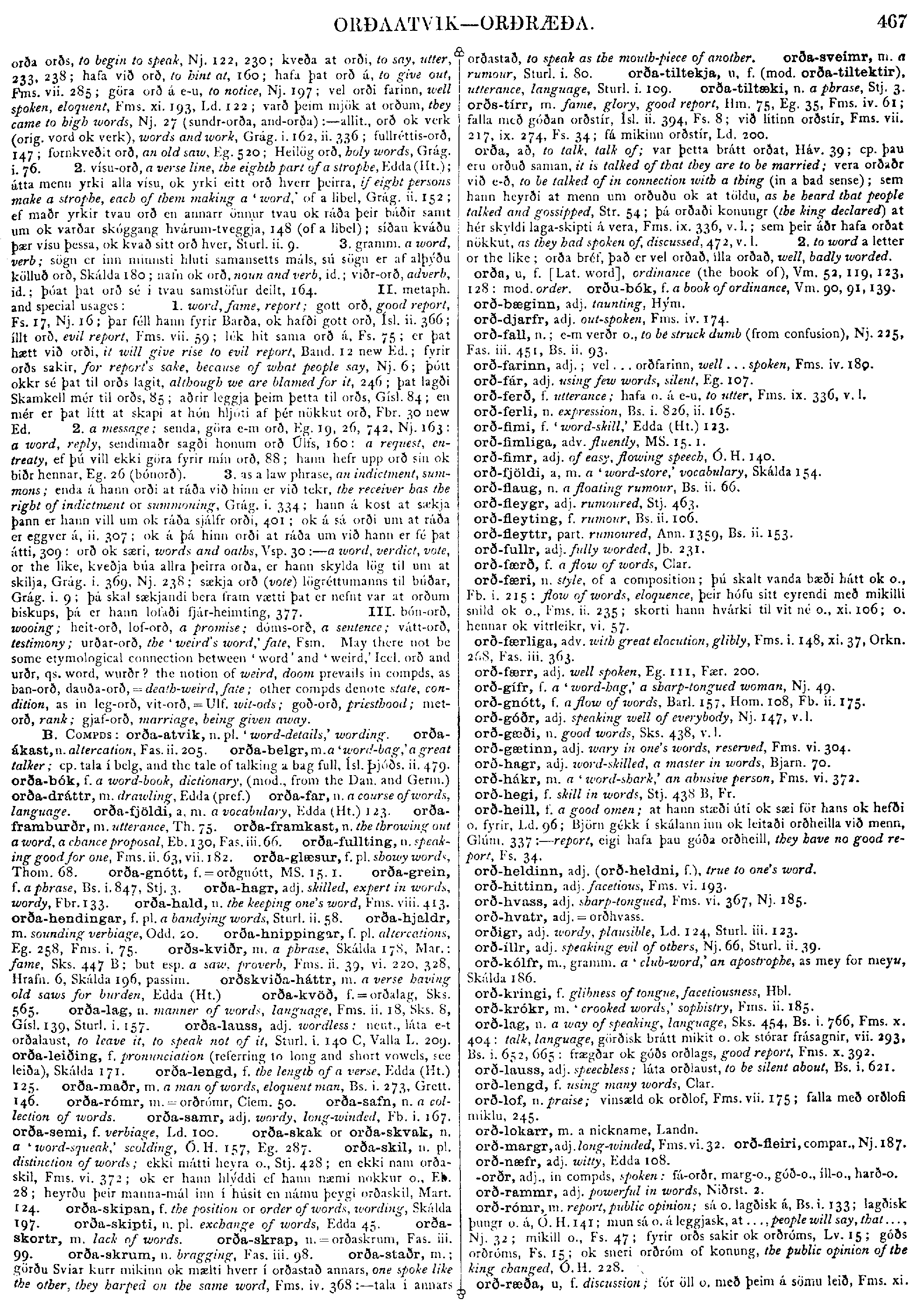
orð-rómr, m. report, public opinion; sá o. lagðisk á, Bs. i. 133; lagðisk þungr o. á, Ó.H. 141; mun sá o. á leggjask, at ..., people will say, that ..., Nj. 32; mikill o., Fs. 47; fyrir orðs sakir ok orðróms, Lv. 15; góðs orðróms, Fs. 15; ok sneri orðróm of konung, the public opinion of the king changed, Ó.H. 228.
|
Source: Cleasby/Vigfusson, page b0469, entry 21 View original page image as: [TIFF] [PNG] [View previous entry] [View next entry] |
[Comment on this entry] [View comments] |
The following entry has been hand-corrected once. |
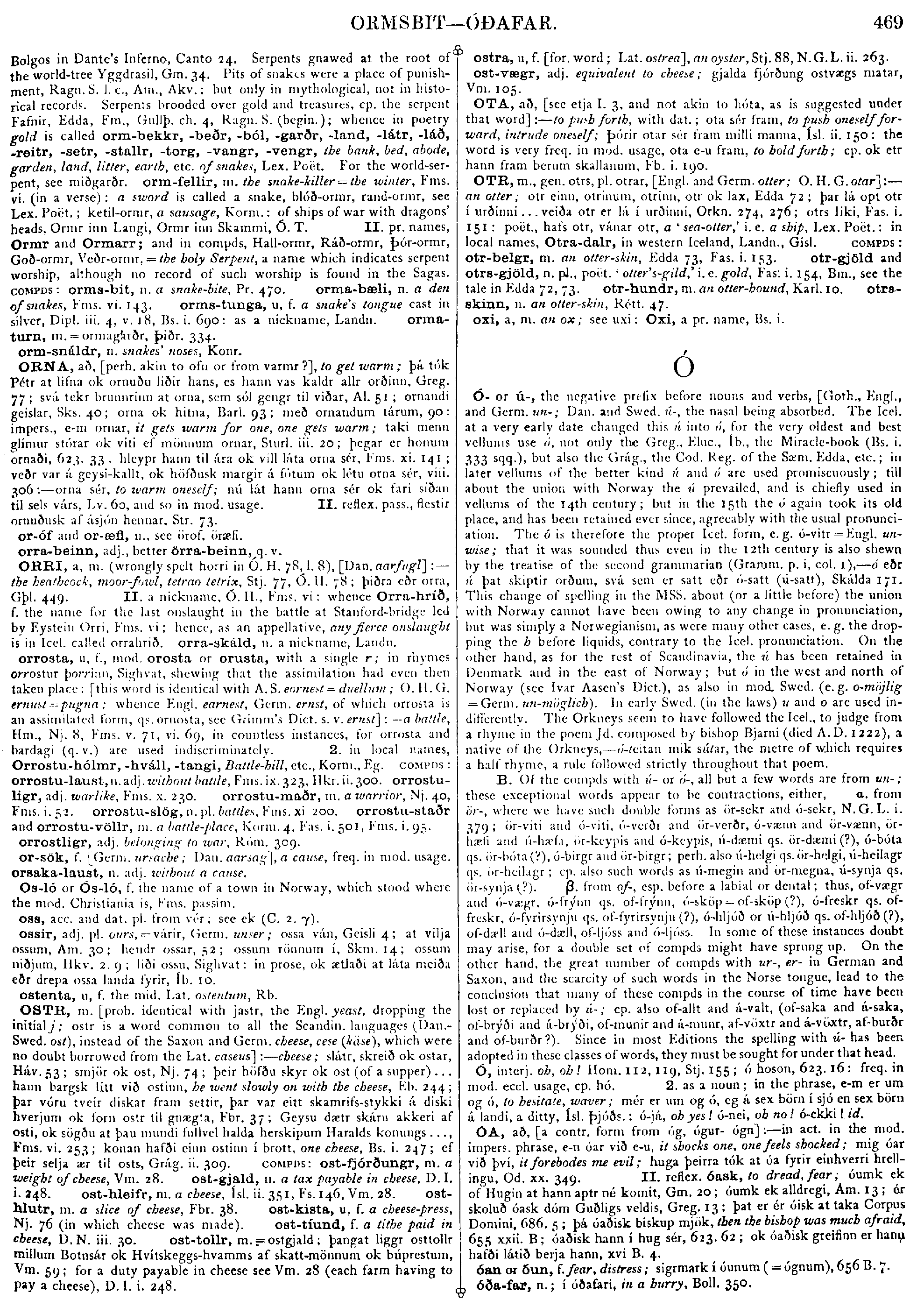
Ó-
or
ú-,
the
negative
prefix
before
nouns
and
verbs,
[Goth.,
Engl.,
and
Germ.
un-;
Dan.
and
Swed.
û-,
the
nasal
being
absorbed.
The
Icel.
at
a
very
early
date
changed
this
ú
into
ó,
for
the
very
oldest
and
best
vellums
use
ó,
not
only
the
Greg.,
Eluc.,
Íb.,
the
Miracle-book
(Bs.
i.
333
sqq.),
but
also
the
Grág.,
the
Cod.
Reg.
of
the
Sæm.
Edda,
etc.;
in
later
vellums
of
the
better
kind
ú
and
ó
are
used
promiscuously;
till
about
the
union
with
Norway
the
ú
prevailed,
and
is
chiefly
used
in
vellums
of
the
14th
century;
but
in
the
15th
the
ó
again
took
its
old
place,
and
has
been
retained
ever
since,
agreeably
with
the
usual
pronunciation.
The
ó
is
therefore
the
proper
Icel.
form,
e.g.
ó-vitr
=
Engl.
un-wise;
that
it
was
sounded
thus
even
in
the
12th
century
is
also
shewn
by
the
treatise
of
the
second
grammarian
(Gramm.
p.
i,
col.
1),
--
ó
eðr
ú
þat
skiptir
orðum,
svá
sem
er
satt
eðr
ó-satt
(ú-satt),
Skálda
171.
This
change
of
spelling
in
the
MSS.
about
(or
a
little
before)
the
union
with
Norway
cannot
have
been
owing
to
any
change
in
pronunciation,
but
was
simply
a
Norwegianism,
as
were
many
other
cases,
e.g.
the
dropping
the
h
before
liquids,
contrary
to
the
Icel.
pronunciation.
On
the
other
hand,
as
for
the
rest
of
Scandinavia,
the
ú
has
been
retained
in
Denmark
and
in
the
east
of
Norway;
but
ó
in
the
west
and
north
of
Norway
(see
Ivar
Aasen's
Dict.),
as
also
in
mod,
Swed.
(e.g.
o-möjlig
=
Germ.
un-möglich).
In
early
Swed.
(in
the
laws)
u
and
o
are
used
indifferently.
The
Orkneys
seem
to
have
followed
the
Icel.,
to
judge
from
a
rhyme
in
the
poem
Jd.
composed
by
bishop
Bjarni
(died
A.D.
1222),
a
native
of
the
Orkneys,
--
ó-teitan
mik
sútar,
the
metre
of
which
requires
a
half
rhyme,
a
rule
followed
strictly
throughout
that
poem.
B.
Of
the
compds
with
ú-
or
ó-,
all
but
a
few
words
are
from
un-;
these
exceptional
words
appear
to
be
contractions,
either,
.
from
ör-,
where
we
have
such
double
forms
as
ör-sekr
and
ó-sekr,
N.G.L.
i.
379;
ör-viti
and
ó-viti,
ó-verðr
and
ör-verðr,
ó-vænn
and
ör-vænn,
ör-hæfi
and
ú-hæfa,
ör-keypis
and
ó-keypis,
ú-dæmi
qs.
ör-dæmi(?),
ó-bóta
qs.
ör-bóta(?),
ó-birgr
and
ör-birgr;
perh.
also
ú-helgi
qs.
ör-helgi,
ú-heilagr
qs.
ör-heilagr;
cp.
also
such
words
as
ú-megin
and
ör-megna,
ú-synja
qs.
ör-synja(?).
.
from
of-,
esp.
before
a
labial
or
dental;
thus,
of-vægr
and
ó-vægr,
ó-frýnn
qs.
of-frýnn,
ó-skö;p
=
of-sköp(?),
ó-freskr
qs.
of-freskr,
ó-fyrirsynju
qs.
of-fyrirsynju(?),
ó-hljóð
or
ú-hljóð
qs.
of-hljóð(?),
of-dæll
and
ó-dæll,
of-ljóss
and
ó-ljóss.
In
some
of
these
instances
doubt
may
arise,
for
a
double
set
of
compds
might
have
sprung
up.
On
the
other
hand,
the
great
number
of
compds
with
ur-,
er-
in
German
and
Saxon,
and
the
scarcity
of
such
words
in
the
Norse
tongue,
lead
to
the
conclusion
that
many
of
these
compds
in
the
course
of
time
have
been
lost
or
replaced
by
ú-;
cp.
also
of-allt
and
á-valt,
(of-saka
and
á-saka,
of-brýði
and
á-brýði,
of-munir
and
á-munr,
af-vöxtr
and
á-vöxtr,
af-burðr
and
of-burðr?).
Since
in
most
Editions
the
spelling
with
ú-
has
been
adopted
in
these
classes
of
words,
they
must
be
sought
for
under
that
head.
|
Source: Cleasby/Vigfusson, page b0471, entry 32 View original page image as: [TIFF] [PNG] [View previous entry] [View next entry] |
[Comment on this entry] [View comments] |
The following entry has been hand-corrected once. |
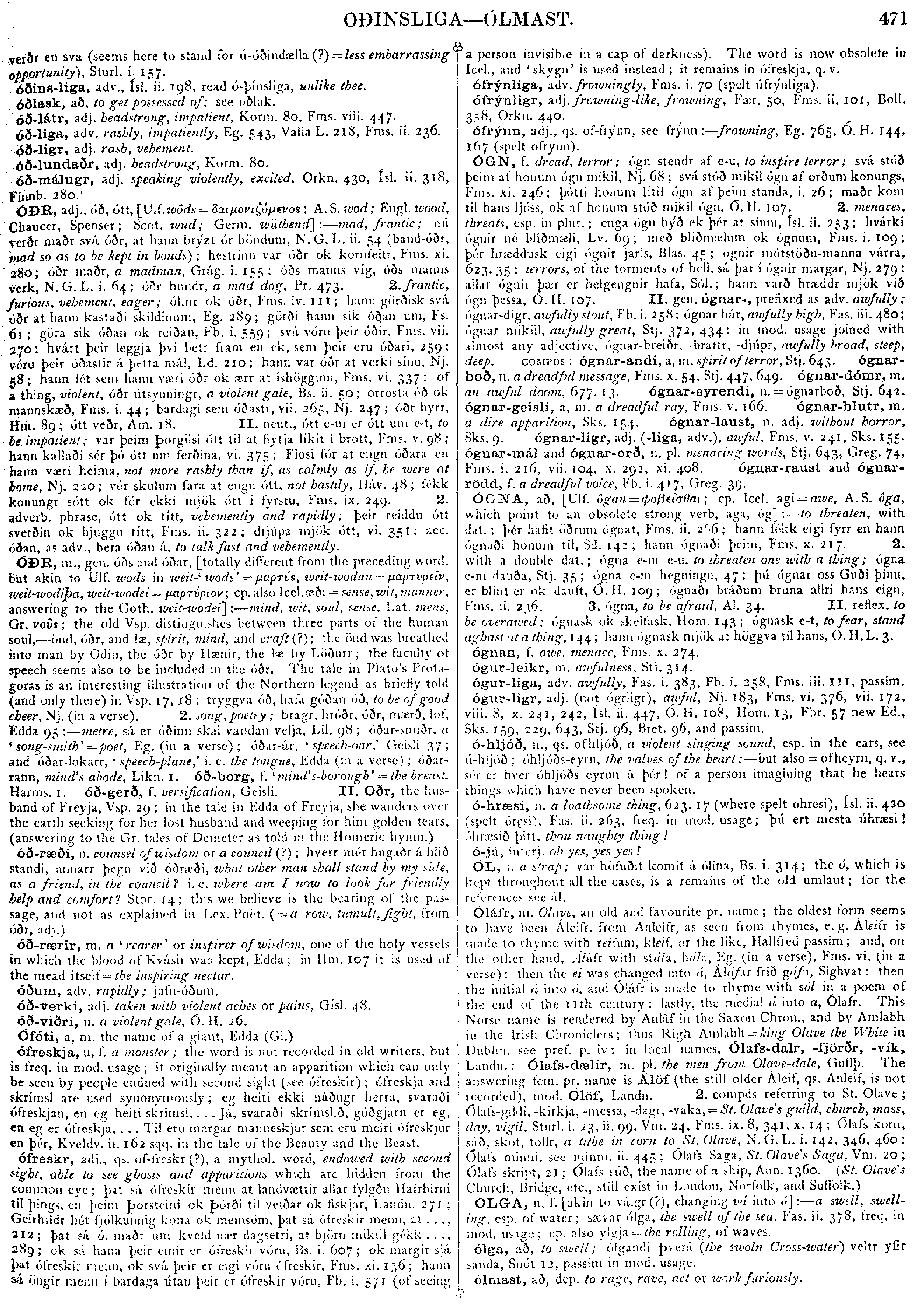
Óláfr, m. Olave, an old and favourite pr. name; the oldest form seems to have been Áleifr, from Anleifr, as seen from rhymes, e.g. Áleifr is made to rhyme with reifum, kleif, or the like, Hallfred passim; and, on the other hand, Áláfr with stála, hála, Eg. (in a verse), Fms. vi. (in a verse): then the ei was changed into á, Áláfar frið gálu, Sighvat: then the initial á into ó, and Óláfr is made to rhyme with sól in a poem of the end of the 11th century: lastly, the medial á into a, Ólafr. This Norse name is rendered by Anlâf in the Saxon Chron., and by Amlabh in the Irish Chroniclers; thus Righ Amlabh = king Olave the White in Dublin, see pref. p. iv: in local names, Ólafs-dalr, -fjörðr, -vík, Landn.: Ólafs-dælir, m. pl. the men from Olave-dale, Gullþ. The answering fem. pr. name is Álöf (the still older Áleif, qs. Anleif, is not recorded), mod. Ólöf, Landn. 2. compds referring to St. Olave; Ólafs-gildi, -kirkja, -messa, -dagr, -vaka, = St. Olave's guild, church, mass, day, vigil, Sturl. i. 23, ii. 99, Vm. 24, Fms. ix. 8, 341, x. 14; Ólafs korn, sáð, skot, tollr, a tithe in corn to St. Olave, N.G.L. i. 142, 346, 460; Ólafs minni, see minni, ii. 445; Ólafs Saga, St. Olave's Saga, Vm. 20; Ólafs skript, 21; Ólafs súð, the name of a ship, Ann. 1360. (St. Olave's Church, Bridge, etc., still exist in London, Norfolk, and Suffolk.)
| Result Page: |  |
Previous | 1 2 3 4 5 6 7 8 9 | Next |  |
Germanic Lexicon Project (main page)
This search system was written by
Sean Crist
Please consider
volunteering
to correct the data in these online dictionaries.
No rights reserved. Feel free to use these data in any way you please.