|
|

|
Source: Bosworth/Toller, page b0068, entry 40 View original page image as: [TIFF] [PNG] [View previous entry] [View next entry] |
[Comment on this entry] [View comments] |
The following entry has been hand-corrected once. |
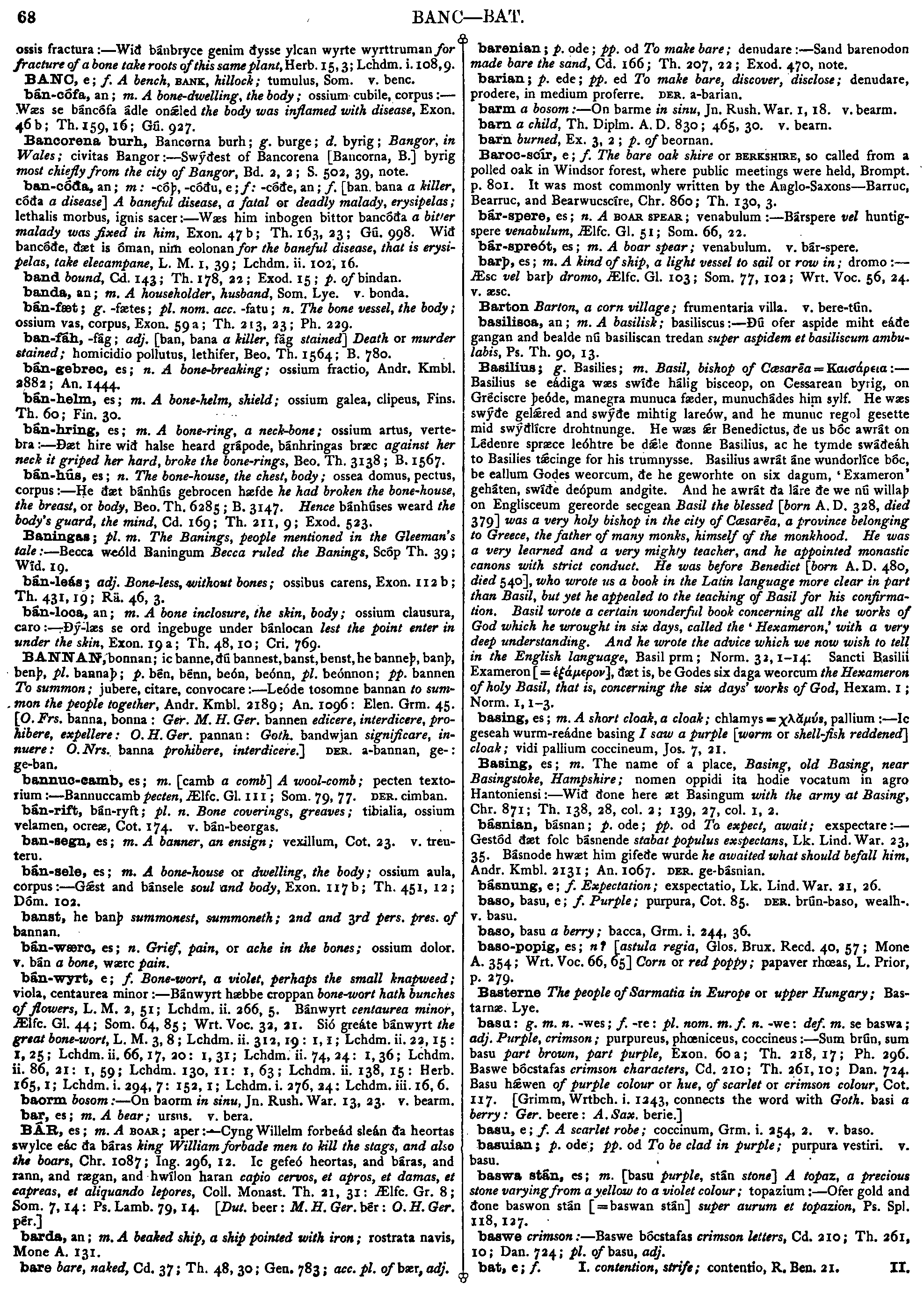
Basilius;
g.
Basilies;
m.
Basil,
bishop
of
Cæsaréa
=
K

 &alpha-tonos;
 :--
Basilius
se
eádiga
wæs
swíðe
hálig
bisceop,
on
Cessarean
byrig,
on
Gréciscre
þeóde,
manegra
munuca
fæder,
munuchádes
him
sylf.
He
wæs
swýðe
gel
:--
Basilius
se
eádiga
wæs
swíðe
hálig
bisceop,
on
Cessarean
byrig,
on
Gréciscre
þeóde,
manegra
munuca
fæder,
munuchádes
him
sylf.
He
wæs
swýðe
gel red
and
swýðe
mihtig
lareów,
and
he
munuc
regol
gesette
mid
swýðlícre
drohtnunge.
He
wæs
r
Benedictus,
ðe
us
bóc
awrát
on
Lédenre
spræce
leóhtre
be
dle
ðonne
Basilius,
ac
he
tymde
swáðeáh
to
Basilies
tcinge
for
his
trumnysse.
Basilius
awrát
áne
wundorlíce
bóc,
be
eallum
Godes
weorcum,
ðe
he
geworhte
on
six
dagum,
'Exameron'
geháten,
swíðe
deópum
andgite.
And
he
awrát
ða
láre
ðe
we
nú
willaþ
on
Englisceum
gereorde
secgean
Basil
the
blessed
[born
A.D.
328,
died
379]
was
a
very
holy
bishop
in
the
city
of
Cæsaréa,
a
province
belonging
to
Greece,
the
father
of
many
monks,
himself
of
the
monkhood.
He
was
a
very
learned
and
a
very
mighty
teacher,
and
he
appointed
monastic
canons
with
strict
conduct.
He
was
before
Benedict
[born
A.D.
480,
died
540],
who
wrote
us
a
book
in
the
Latin
language
more
clear
in
part
than
Basil,
but
yet
he
appealed
to
the
teaching
of
Basil
for
his
confirmation.
Basil
wrote
a
certain
wonderful
book
concerning
all
the
works
of
God
which
he
wrought
in
six
days,
called
the
'Hexameron,'
with
a
very
deep
understanding.
And
he
wrote
the
advice
which
we
now
wish
to
tell
in
the
English
language,
Basil
prm;
Norm.
32,
1-14:
Sancti
Basilii
Exameron
[
=
&epsilon-tonos;
red
and
swýðe
mihtig
lareów,
and
he
munuc
regol
gesette
mid
swýðlícre
drohtnunge.
He
wæs
r
Benedictus,
ðe
us
bóc
awrát
on
Lédenre
spræce
leóhtre
be
dle
ðonne
Basilius,
ac
he
tymde
swáðeáh
to
Basilies
tcinge
for
his
trumnysse.
Basilius
awrát
áne
wundorlíce
bóc,
be
eallum
Godes
weorcum,
ðe
he
geworhte
on
six
dagum,
'Exameron'
geháten,
swíðe
deópum
andgite.
And
he
awrát
ða
láre
ðe
we
nú
willaþ
on
Englisceum
gereorde
secgean
Basil
the
blessed
[born
A.D.
328,
died
379]
was
a
very
holy
bishop
in
the
city
of
Cæsaréa,
a
province
belonging
to
Greece,
the
father
of
many
monks,
himself
of
the
monkhood.
He
was
a
very
learned
and
a
very
mighty
teacher,
and
he
appointed
monastic
canons
with
strict
conduct.
He
was
before
Benedict
[born
A.D.
480,
died
540],
who
wrote
us
a
book
in
the
Latin
language
more
clear
in
part
than
Basil,
but
yet
he
appealed
to
the
teaching
of
Basil
for
his
confirmation.
Basil
wrote
a
certain
wonderful
book
concerning
all
the
works
of
God
which
he
wrought
in
six
days,
called
the
'Hexameron,'
with
a
very
deep
understanding.
And
he
wrote
the
advice
which
we
now
wish
to
tell
in
the
English
language,
Basil
prm;
Norm.
32,
1-14:
Sancti
Basilii
Exameron
[
=
&epsilon-tonos; &alpha-tonos;

 ],
ðæt
is,
be
Godes
six
daga
weorcum
the
Hexameron
of
holy
Basil,
that
is,
concerning
the
six
days'
works
of
God,
Hexam.
1;
Norm.
1,
1-3.
],
ðæt
is,
be
Godes
six
daga
weorcum
the
Hexameron
of
holy
Basil,
that
is,
concerning
the
six
days'
works
of
God,
Hexam.
1;
Norm.
1,
1-3.
|
Source: Bosworth/Toller, page b0098, entry 22 View original page image as: [TIFF] [PNG] [View previous entry] [View next entry] |
[Comment on this entry] [View comments] |
The following entry has been hand-corrected once. |
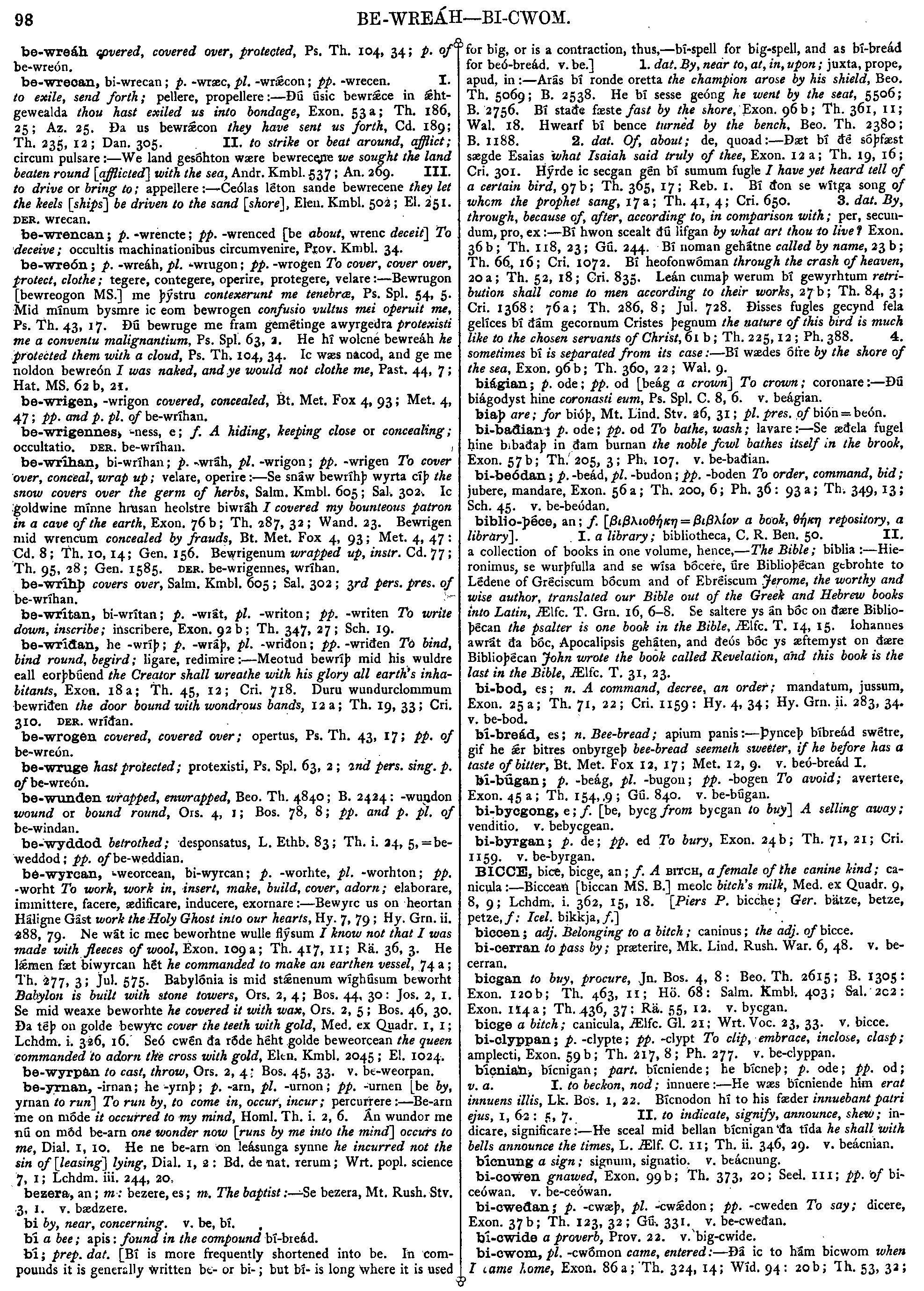
B. 1188. 2. dat. Of, about; de, quoad :-- Ðæt bí ðé sóþfæst sægde Esaias what Isaiah said truly of thee, Exon. 12 a; Th. 19, 16; Cri, 301. Hýrde ic secgan gén bí sumum fugle I have yet heard tell of a certain bird, 97 b; Th. 365, 17; Reb. 1. Bí ðon se wítga song of whom the prophet sang, 17 a; Th. 41, 4; Cri. 650. 3. dat. By, through, because of, after, according to, in comparison with; per, secundum, pro, ex :-- Bí hwon scealt ðú lifgan by what art thou to live? Exon. 36 b; Th. 118, 23; Gú. 244. Bí noman gehátne called by name, 23 b; Th. 66, 16; Cri. 1072. Bí heofonwóman through the crash of heaven, 20 a; Th. 52, 18; Cri. 835. Leán cumaþ werum bí gewyrhtum retribution shall come to men according to their works, 27 b; Th. 84, 3; Cri. 1368 : 76 a; Th. 286, 8; Jul. 728. Ðisses fugles gecynd fela gelíces bí ðám gecornum Cristes þegnum the nature of this bird is much like to the chosen servants of Christ, 61 b; Th. 225, 12; Ph. 388. 4. sometimes bí is separated from its case :-- Bí wædes ófre by the shore of the sea, Exon. 96 b; Th. 360, 22; Wal. 9.
|
Source: Bosworth/Toller, page b0115, entry 9 View original page image as: [TIFF] [PNG] [View previous entry] [View next entry] |
[Comment on this entry] [View comments] |
The following entry has been hand-corrected once. |
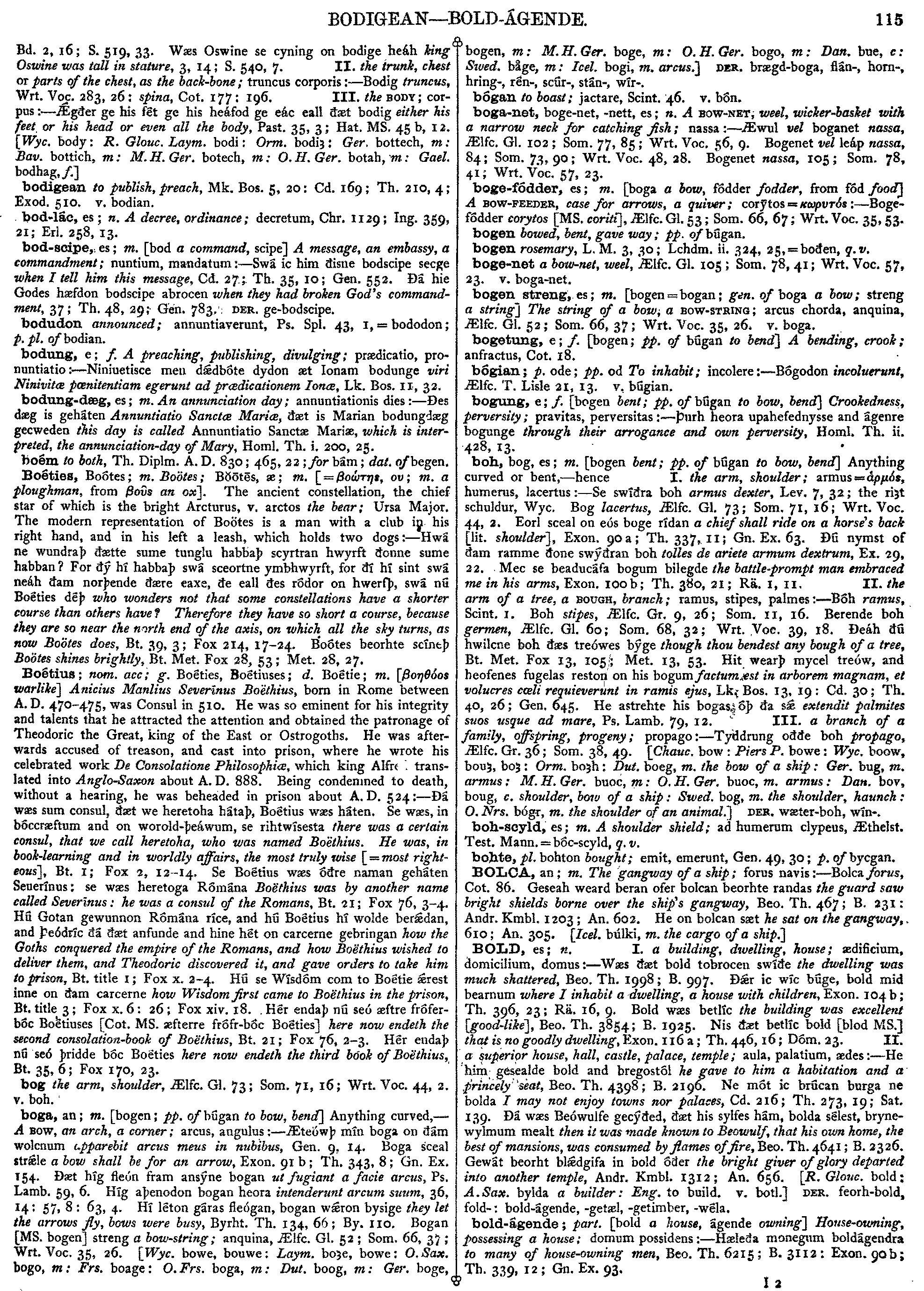
Boétius;
nom.
acc;
g.
Boéties,
Boétiuses;
d.
Boétie;
m.
[ o
o
 &omicron-tonos;os
warlike]
Anicius
Manlius
Sever
&omicron-tonos;os
warlike]
Anicius
Manlius
Sever nus
Boëthius,
born
in
Rome
between
A.
D.
470-475,
was
Consul
in
510.
He
was
so
eminent
for
his
integrity
and
talents
that
he
attracted
the
attention
and
obtained
the
patronage
of
Theodoric
the
Great,
king
of
the
East
or
Ostrogoths.
He
was
afterwards
accused
of
treason,
and
cast
into
prison,
where
he
wrote
his
celebrated
work
De
Consolatione
Philosophiæ,
which
king
Alfred
translated
into
Anglo-Saxon
about
A.
D.
888.
Being
condemned
to
death,
without
a
hearing,
he
was
beheaded
in
prison
about
A.
D.
524
:--
Ðá
wæs
sum
consul,
ðæt
we
heretoha
hitaþ,
Boétius
wæs
háten.
Se
wæs,
in
bóccræftum
and
on
worold-þeáwum,
se
rihtwísesta
there
was
a
certain
consul,
that
we
call
heretoha,
who
was
named
Boëthius.
He
was,
in
book-learning
and
in
worldly
affairs,
the
most
truly
wise
[
=
most
righteous],
Bt.
1;
Fox
2,
12-14.
Se
Boétius
wæs
óðre
naman
geháten
Seuerínus:
se
wæs
heretoga
Rómina
Boëthius
was
by
another
name
called
Severnus:
he
was
a
consul
of
the
Romans,
Bt.
21;
Fox
76,
3-4.
Hú
Gotan
gewunnon
Rómána
ríce,
and
hú
Boétius
hí
wolde
berdan,
and
Þeódríc
ðá
ðæt
anfunde
and
hine
hét
on
carcerne
gebringan
how
the
Goths
conquered
the
empire
of
the
Romans,
and
how
Boëthius
wished
to
deliver
them,
and
Theodoric
discovered
it,
and
gave
orders
to
take
him
to
prison,
Bt.
title
1;
Fox
x.
2-4.
Hú
se
Wísdóm
com
to
Boétie
rest
inne
on
ðam
carcerne
how
Wisdom
first
came
to
Boëthius
in
the
prison,
Bt.
title
3;
Fox
x.
6:
26;
Fox
xiv.
18.
Hér
endaþ
nú
seó
æftre
fróferbóc
Boétiuses
[Cot.
MS.
æfterre
frófr-bóc
Boéties]
here
now
endeth
the
second
consolation-book
of
Boëthius,
Bt.
21;
Fox
76,
2-3.
Hér
endaþ
nú
seó
þridde
bóc
Boéties
here
now
endeth
the
third
book
of
Boëthius,
Bt.
35,
6;
Fox
170,
23.
nus
Boëthius,
born
in
Rome
between
A.
D.
470-475,
was
Consul
in
510.
He
was
so
eminent
for
his
integrity
and
talents
that
he
attracted
the
attention
and
obtained
the
patronage
of
Theodoric
the
Great,
king
of
the
East
or
Ostrogoths.
He
was
afterwards
accused
of
treason,
and
cast
into
prison,
where
he
wrote
his
celebrated
work
De
Consolatione
Philosophiæ,
which
king
Alfred
translated
into
Anglo-Saxon
about
A.
D.
888.
Being
condemned
to
death,
without
a
hearing,
he
was
beheaded
in
prison
about
A.
D.
524
:--
Ðá
wæs
sum
consul,
ðæt
we
heretoha
hitaþ,
Boétius
wæs
háten.
Se
wæs,
in
bóccræftum
and
on
worold-þeáwum,
se
rihtwísesta
there
was
a
certain
consul,
that
we
call
heretoha,
who
was
named
Boëthius.
He
was,
in
book-learning
and
in
worldly
affairs,
the
most
truly
wise
[
=
most
righteous],
Bt.
1;
Fox
2,
12-14.
Se
Boétius
wæs
óðre
naman
geháten
Seuerínus:
se
wæs
heretoga
Rómina
Boëthius
was
by
another
name
called
Severnus:
he
was
a
consul
of
the
Romans,
Bt.
21;
Fox
76,
3-4.
Hú
Gotan
gewunnon
Rómána
ríce,
and
hú
Boétius
hí
wolde
berdan,
and
Þeódríc
ðá
ðæt
anfunde
and
hine
hét
on
carcerne
gebringan
how
the
Goths
conquered
the
empire
of
the
Romans,
and
how
Boëthius
wished
to
deliver
them,
and
Theodoric
discovered
it,
and
gave
orders
to
take
him
to
prison,
Bt.
title
1;
Fox
x.
2-4.
Hú
se
Wísdóm
com
to
Boétie
rest
inne
on
ðam
carcerne
how
Wisdom
first
came
to
Boëthius
in
the
prison,
Bt.
title
3;
Fox
x.
6:
26;
Fox
xiv.
18.
Hér
endaþ
nú
seó
æftre
fróferbóc
Boétiuses
[Cot.
MS.
æfterre
frófr-bóc
Boéties]
here
now
endeth
the
second
consolation-book
of
Boëthius,
Bt.
21;
Fox
76,
2-3.
Hér
endaþ
nú
seó
þridde
bóc
Boéties
here
now
endeth
the
third
book
of
Boëthius,
Bt.
35,
6;
Fox
170,
23.
|
Source: Bosworth/Toller, page b0139, entry 1 View original page image as: [TIFF] [PNG] [View previous entry] [View next entry] |
[Comment on this entry] [View comments (2)] |
The following entry has been hand-corrected once. |
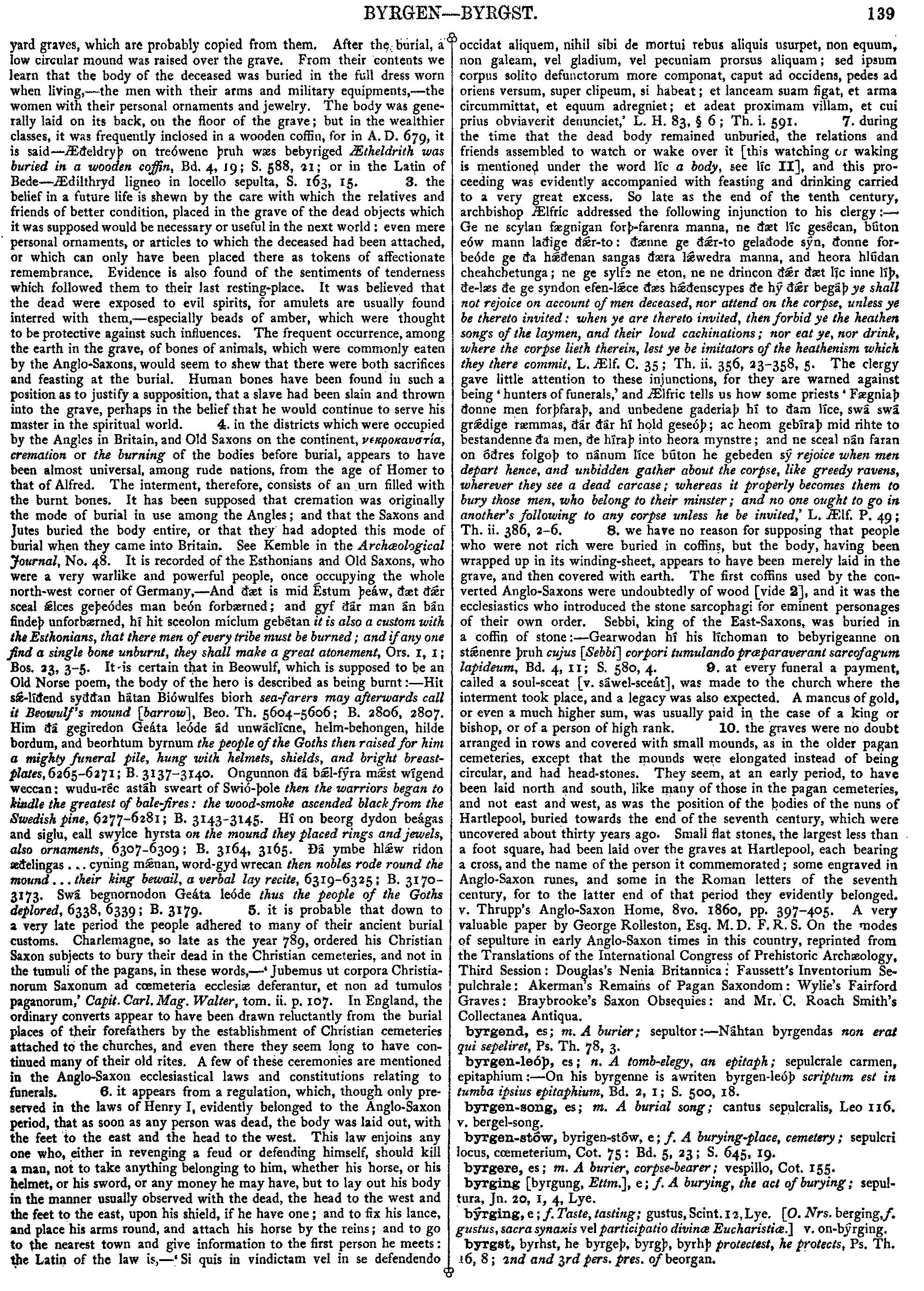
yard
graves,
which
arc
probably
copied
from
them.
After
the.
burial,
a
low
circular
mound
was
raised
over
the
grave.
From
their
contents
we
learn
that
the
body
of
the
deceased
was
buried
in
the
full
dress
worn
when
living,
--
the
men
with
their
arms
and
military
equipments,
--
the
women
with
their
personal
ornaments
and
jewelry.
The
body
was
generally
laid
on
its
back,
on
the
floor
of
the
grave;
but
in
the
wealthier
classes,
it
was
frequently
inclosed
in
a
wooden
coffin,
for
in
A.
D.
679,
it
is
said
--
Æðeldryþ
on
treówene
þruh
wæs
bebyriged
Ætheldrith
was
buried
in
a
wooden
coffin,
Bd.
4,
19;
S.
588,
2l;
or
in
the
Latin
of
Bede
--
Ædilthryd
ligneo
in
locello
sepulta,
S.
163,
15.
3.
the
belief
in
a
future
life
is
shewn
by
the
care
with
which
the
relatives
and
friends
of
better
condition,
placed
in
the
grave
of
the
dead
objects
which
it
was
supposed
would
be
necessary
or
useful
in
the
next
world:
even
mere
personal
ornaments,
or
articles
to
which
the
deceased
had
been
attached,
or
which
can
only
have
been
placed
there
as
tokens
of
affectionate
remembrance.
Evidence
is
also
found
of
the
sentiments
of
tenderness
which
followed
them
to
their
last
resting-place.
It
was
believed
that
the
dead
were
exposed
to
evil
spirits,
for
amulets
are
usually
found
interred
with
them,
--
especially
beads
of
amber,
which
were
thought
to
be
protective
against
such
influences.
The
frequent
occurrence,
among
the
earth
in
the
grave,
of
bones
of
animals,
which
were
commonly
eaten
by
the
Anglo-Saxons,
would
seem
to
shew
that
there
were
both
sacrifices
and
feasting
at
the
burial.
Human
bones
have
been
found
in
such
a
position
as
to
justify
a
supposition,
that
a
slave
had
been
slain
and
thrown
into
the
grave,
perhaps
in
the
belief
that
he
would
continue
to
serve
his
master
in
the
spiritual
world.
4.
in
the
districts
which
were
occupied
by
the
Angles
in
Britain,
and
Old
Saxons
on
the
continent,
GREEK,
cremation
or
the
burning
of
the
bodies
before
burial,
appears
to
have
been
almost
universal,
among
rude
nations,
from
the
age
of
Homer
to
that
of
Alfred.
The
interment,
therefore,
consists
of
an
urn
filled
with
the
burnt
bones.
It
has
been
supposed
that
cremation
was
originally
the
mode
of
burial
in
use
among
the
Angles;
and
that
the
Saxons
and
Jutes
buried
the
body
entire,
or
that
they
had
adopted
this
mode
of
burial
when
they
came
into
Britain.
See
Kemble
in
the
Archæolgical
Journal,
No.
48.
It
is
recorded
of
the
Esthonians
and
Old
Saxons,
who
were
a
very
warlike
and
powerful
people,
once
occupying
the
whole
north-west
corner
of
Germany,
--
And
ðæt
is
mid
Éstum
þeáw,
ðæt
ðr
sceal
lces
geþeódes
man
beón
forbærned;
and
gyf
ðár
man
án
bán
findeþ
unforbærned,
hí
hit
sceolon
miclum
gebétan
it
is
also
a
custom
with
the
Esthonians,
that
there
men
of
every
tribe
must
be
burned;
and
if
any
one
find
a
single
bone
unburnt,
they
shall
make
a
great
atonement,
Ors.
1.
1;
Bos.
23,
3-5.
It
is
certain
that
in
Beowulf,
which
is
supposed
to
be
an
Old
Norse
poem,
the
body
of
the
hero
is
described
as
being
burnt
:--
Hit
s-liðend
syððan
hátan
Biówulfes
biorh
sea-farers
may
afterwards
call
it
Beowulf's
mound
[barrow],
Beo.
Th.
5604-5606;
B.
2806,
2807.
Him
ðá
gegiredon
Geáta
leóde
ád
unwáclícne,
helm-behongen,
hilde
bordum,
and
beorhtum
byrnum
the
people
of
the
Goths
then
raised
for
him
a
mighty
funeral
pile,
hung
with
helmets,
shields,
and
bright
breast-plates,
6265-6271;
B.
3137-3140.
Ongunnon
ðá
bl-fýra
mst
wígend
weccan:
wudu-réc
astáh
sweart
of
Swió-þole
then
the
warriors
began
to
kindle
the
greatest
of
bale-fires:
the
wood-smoke
ascended
black
from
the
Swedish
pine,
6277-6281;
B.
3143-3145.
Hí
on
beorg
dydon
beágas
and
siglu,
eall
swylce
hyrsta
on
the
mound
they
placed
rings
and
jewels,
also
ornaments,
6307-6309;
B.
3164,
3165.
Ðá
ymbe
hlw
ridon
æðelingas
.
.
.
cyring
mnan,
word-gyd
wrecan
then
nobles
rode
round
the
mound.
.
.
their
king
bewail,
a
verbal
lay
recite,
6319-6325;
B.
3170-3173.
Swá
begnomodon
Geáta
leóde
thus
the
people
of
the
Goths
deplored,
6338,
6339;
B.
3179.
5.
it
is
probable
that
down
to
a
very
late
period
the
people
adhered
to
many
of
their
ancient
burial
customs.
Charlemagne,
so
late
as
the
year
789,
ordered
his
Christian
Saxon
subjects
to
bury
their
dead
in
the
Christian
cemeteries,
and
not
in
the
tumuli
of
the
pagans,
in
these
words,
--
Jubemus
ut
corpora
Christianorum
Saxonum
ad
cœmeteria
ecclesiæ
deferantur,
et
non
ad
tumulos
paganorum,
Capit.
Carl.
Mag.
Walter,
tom.
ii.
p.
107.
In
England,
the
ordinary
converts
appear
to
have
been
drawn
reluctantly
from
the
burial
places
of
their
forefathers
by
the
establishment
of
Christian
cemeteries
attached
to
the
churches,
and
even
there
they
seem
long
to
have
continued
many
of
their
old
rites.
A
few
of
these
ceremonies
are
mentioned
in
the
Anglo-Saxon
ecclesiastical
laws
and
constitutions
relating
to
funerals.
6.
it
appears
from
a
regulation,
which,
though
only
preserved
in
the
laws
of
Henry
I,
evidently
belonged
to
the
Anglo-Saxon
period,
that
as
soon
as
any
person
was
dead,
the
body
was
laid
out,
with
the
feet
to
the
east
and
the
head
to
the
west.
This
law
enjoins
any
one
who,
either
in
revenging
a
feud
or
defending
himself,
should
kill
a
man,
not
to
take
anything
belonging
to
him,
whether
his
horse,
or
his
helmet,
or
his
sword,
or
any
money
he
may
have,
but
to
lay
out
his
body
in
the
manner
usually
observed
with
the
dead,
the
head
to
the
west
and
the
feet
to
the
east,
upon
his
shield,
if
he
have
one;
and
to
fix
his
lance,
and
place
his
arms
round,
and
attach
his
horse
by
the
reins;
and
to
go
to
the
nearest
town
and
give
information
to
the
first
person
he
meets;
the
Latin
of
the
law
is,
--
'Si
quis
in
vindictam
vel
in
se
defendendo
occidat
aliquem,
nihil
sibi
de
mortui
rebus
aliquis
usurpet,
non
equum,
non
galeam,
vel
gladium,
vel
pecuniam
prorsus
aliquam;
sed
ipsum
corpus
solito
defunctorum
more
componat,
caput
ad
occidens,
pedes
ad
oriens
versum,
super
clipeum,
si
habeat;
et
lanceam
suatn
figat,
et
arma
circummittat,
et
equum
adregniet;
et
adeat
proxtmam
villam,
et
eni
prius
obviaverit
denunciet,'
L.
H.
83,
§
6;
Th.
i.
591.
7.
during
the
time
that
the
dead
body
remained
unburied,
the
relations
and
friends
assembled
to
watch
or
wake
over
it
[this
watching
or
waking
is
mentioned
under
the
word
líc
a
body,
see
líc
II],
and
this
proceeding
was
evidently
accompanied
with
feasting
and
drinking
carried
to
a
very
great
excess.
So
late
as
the
end
of
the
tenth
century,
archbishop
Ælfric
addressed
the
following
injunction
to
his
clergy
:--
Ge
ne
scylan
fægnigan
forþ-farenra
manna,
ne
ðæt
líc
gesécan,
búton
eów
mann
laðige
ðr-to:
ðænne
ge
ðr-to
gelaðode
sýn,
ðonne
forbeóde
ge
ða
hðenan
sangas
ðæra
lwedra
manna,
and
heora
hlúdan
cheahchetunga;
ne
ge
sylfe
ne
eton,
ne
ne
drincon
ðr
ðæt
líc
inne
líþ,
ðe-læs
ðe
ge
syndon
efen-lce
ðæs
hðenscypes
ðe
hý
ðr
begáþ
ye
shall
not
rejoice
on
account
of
men
deceased,
nor
attend
on
the
corpse,
unless
ye
be
thereto
invited:
when
ye
are
thereto
invited,
then
forbid
ye
the
heathen
songs
of
the
laymen,
and
their
loud
cachinations;
nor
eat
ye,
nor
drink,
where
the
corpse
lieth
therein,
lest
ye
be
imitators
of
the
heathenism
which
they
there
commit,
L.
Ælf.
C.
35;
Th.
ii.
356,
23-358,
5.
The
clergy
gave
little
attention
to
these
injunctions,
for
they
are
warned
against
being
'hunters
of
funerals,'
and
Ælfric
tells
us
how
some
priests
'Fægniaþ
ðonne
men
forþfaraþ,
and
unbedene
gaderiaþ
hí
to
ðam
líce,
swá
swá
grdige
ræmmas,
ðár
ðár
hí
hold
geseóþ;
ac
heom
gebíraþ
mid
rihte
to
bestandenne
ða
men,
ðe
híraþ
into
heora
mynstre;
and
ne
sceal
nán
faran
on
ððres
folgoþ
to
nánum
líce
búton
he
gebeden
sý
rejoice
when
men
depart
hence,
and
unbidden
gather
about
the
corpse,
Kite
greedy
ravens,
wherever
they
see
a
dead
carcase;
whereas
it
properly
becomes
them
to
bury
those
men,
who
belong
to
their
minster;
and
no
one
ought
to
go
in
another's
following
to
any
corpse
unless
he
be
invited,'
L.
Ælf.
P.
49;
Th.
ii.
386,
2-6.
8.
we
have
no
reason
for
supposing
that
people
who
were
not
rich
were
buried
in
coffins,
but
the
body,
having
been
wrapped
up
in
its
winding-sheet,
appears
to
have
been
merely
laid
in
the
grave,
and
then
covered
with
earth.
The
first
coffins
used
by
the
converted
Anglo-Saxons
were
undoubtedly
of
wood
[vide
2],
and
it
was
the
ecclesiastics
who
introduced
the
stone
sarcophagi
for
eminent
personages
of
their
own
order.
Sebbi,
king
of
the
East-Saxons,
was
buried
in
a
coffin
of
stone
:--
Gearwodan
hí
his
líchoman
to
bebyrigeanne
on
stnenre
þruh
cujus
[Sebbi]
corpori
tumulando
præparaverant
sarcofagum
lapideum,
Bd.
4,
11;
S.
580,
4.
9.
at
every
funeral
a
payment,
called
a
soul-sceat
[v.
sáwel-sceát],
was
made
to
the
church
where
the
interment
took
place,
and
a
legacy
was
also
expected.
A
mancus
of
gold,
or
even
a
much
higher
sum,
was
usually
paid
in
the
case
of
a
king
or
bishop,
or
of
a
person
of
high
rank.
10.
the
graves
were
no
doubt
arranged
in
rows
and
covered
with
small
mounds,
as
in
the
older
pagan
cemeteries,
except
that
the
mounds
were
elongated
instead
of
being
circular,
and
had
head-stones.
They
seem,
at
an
early
period,
to
have
been
laid
north
and
south,
like
many
of
those
in
the
pagan
cemeteries,
and
not
east
and
west,
as
was
the
position
of
the
bodies
of
the
nuns
of
Hartlepool,
buried
towards
the
end
of
the
seventh
century,
which
were
uncovered
about
thirty
years
ago.
Small
flat
stones,
the
largest
less
than
a
foot
square,
had
been
laid
over
the
graves
at
Hartlepool,
each
bearing
a
cross,
and
the
name
of
the
person
it
commemorated;
some
engraved
in
Anglo-Saxon
runes,
and
some
in
the
Roman
letters
of
the
seventh
century,
for
to
the
latter
end
of
that
period
they
evidently
belonged.
v.
Thrupp's
Anglo-Saxon
Home,
8vo.
1860,
pp.
397-405.
A
very
valuable
paper
by
George
Rolleston,
Esq.
M.D.
F.R.S.
On
the
modes
of
sepulture
in
early
Anglo-Saxon
times
in
this
country,
reprinted
from
the
Translations
of
the
International
Congress
of
Prehistoric
Archæeology,
Third
Session:
Douglas's
Nenia
Britannica:
Faussett's
Inventorium
Sepulchrale:
Akerman's
Remains
of
Pagan
Saxondom:
Wylie's
Fairford
Graves:
Braybrooke's
Saxon
Obsequies:
and
Mr.
C.
Roach
Smith's
Collectanea
Antíqua.
|
Source: Bosworth/Toller, page b0143, entry 30 View original page image as: [TIFF] [PNG] [View previous entry] [View next entry] |
[Comment on this entry] [View comments (2)] |
The following entry has been hand-corrected once. |
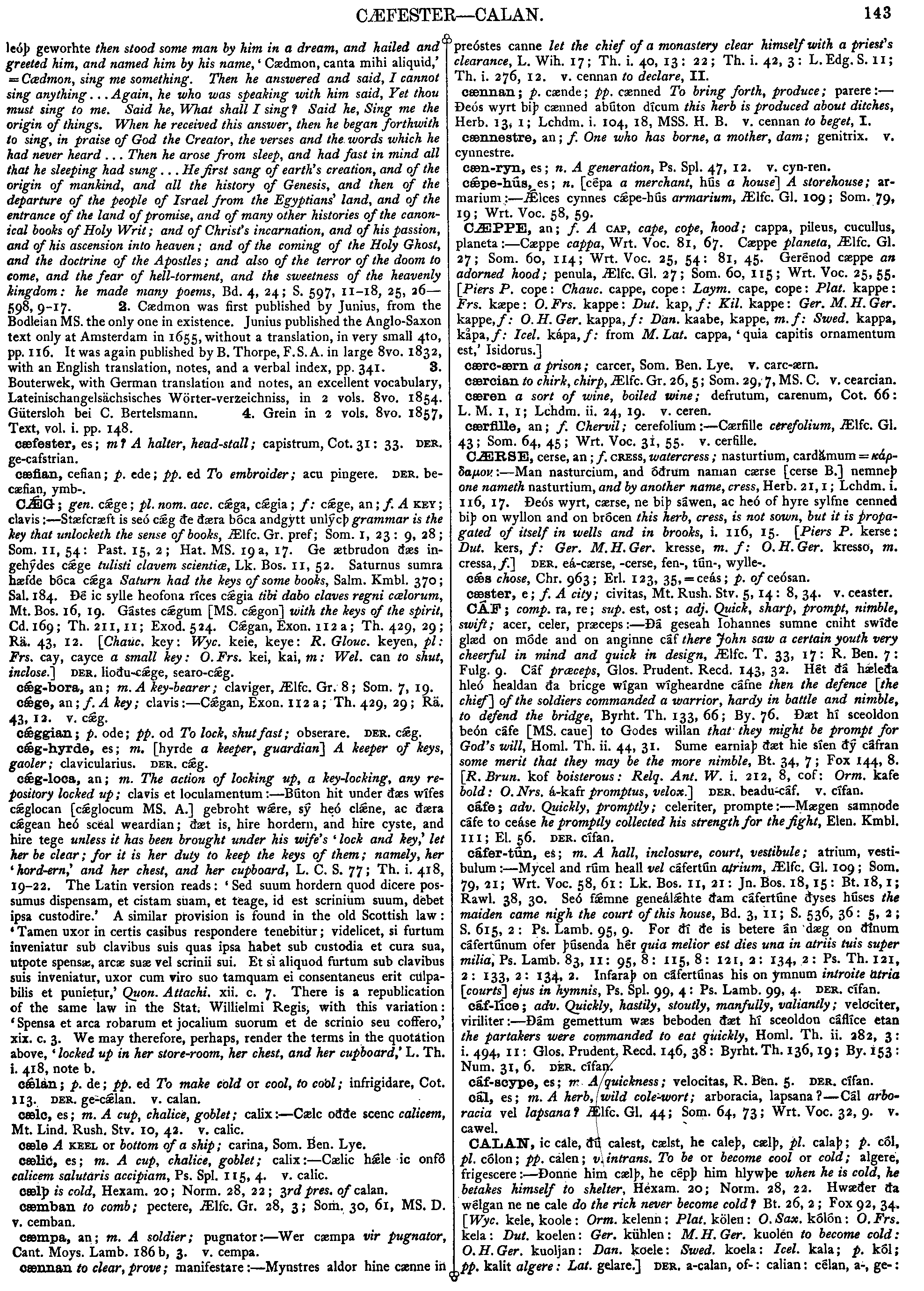
CÁF;
comp,
ra,
re;
sup.
est,
ost;
adj.
Quick,
sharp,
prompt,
nimble,
swift;
acer,
celer,
præceps
:--
Ðá
geseah
Iohannes
sumne
cniht
swíðe
glæd
on
móde
and
on
anginne
cáf
there
John
saw
a
certain
youth
very
cheerful
in
mind
and
quick
in
design,
Ælfc.
T.
33,
17:
R.
Ben.
7:
Fulg.
9.
Cáf
præceps,
Glos.
Prudent.
Recd.
143,
32.
Hét
ðá
hleða
UNCERTAIN
hleó
healdan
ða
bricge
wígan
wígheardne
cáfne
then
the
defence
[the
chief]
of
the
soldiers
commanded
a
warrior,
hardy
in
battle
and
nimble,
to
defend
the
bridge,
Byrht.
Th.
133,
66;
By.
76.
Ðæt
hí
sceoldon
beón
cáfe
[MS.
caue]
to
Godes
willan
that
they
might
be
prompt
for
God's
will,
Homl.
Th.
ii.
44,
31.
Sume
earniaþ
ðæt
hie
síen
ðý
cáfran
some
merit
that
they
may
be
the
more
nimble,
Bt.
34,
7;
Fox
144,
8.
[R.
Brun.
kof
boisterous:
Relq.
Ant.
W.
i.
212,
8,
cof:
Orm.
kafe
bold:
O.
Nrs.
á-kafr
promptus,
velox.]
DER.
Beadu-cáf.
v.
cífan.
|
Source: Bosworth/Toller, page b0175, entry 24 View original page image as: [TIFF] [PNG] [View previous entry] [View next entry] |
[Comment on this entry] [View comments] |
The following entry has been hand-corrected once. |
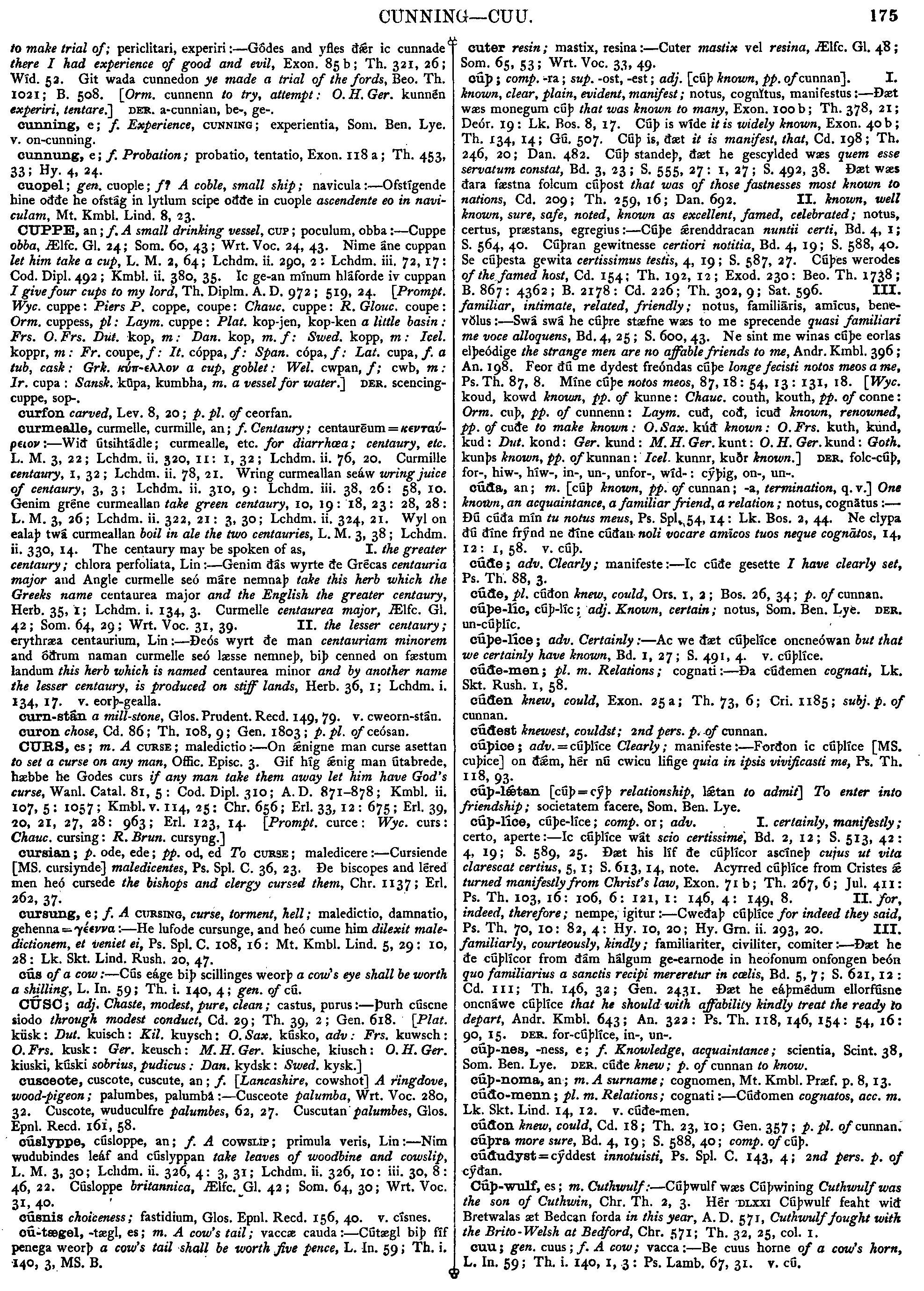
cúþe-líc, cúþ-líc; adj. Known, certain; notus, Som. Ben. Lye. DER. un-cúþlíc.
|
Source: Bosworth/Toller, page b0188, entry 2 View original page image as: [TIFF] [PNG] [View previous entry] [View next entry] |
[Comment on this entry] [View comments (1)] |
The following entry has been hand-corrected once. |
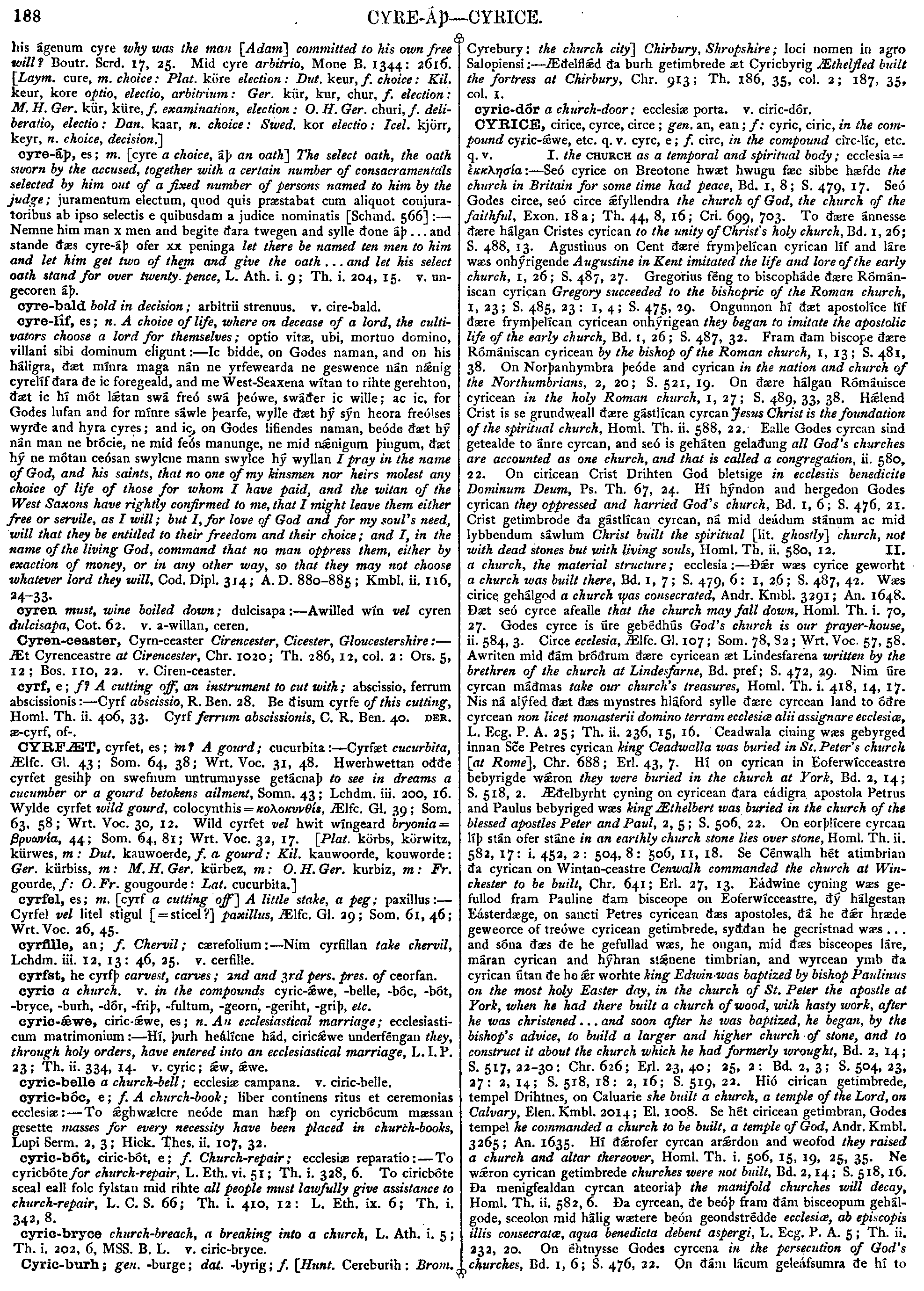
cyre-áþ,
es;
m.
[cyre
a
choice,
áþ
an
oath]
The
select
oath,
the
oath
sworn
by
the
accused,
together
with
a
certain
number
of
consacramentals
selected
by
him
out
of
a
fixed
number
of
persons
named
to
him
by
the
judge;
juramentum
electum,
quod
quis
præstabat
cum
aliquot
coujura-toribus
ab
ipso
selectis
e
quibusdam
a
judice
nominatis
[Schmd.
566]
:--
Nemne
him
man
x
men
and
begite
ðara
twegen
and
sylle
ðone
áþ
.
.
.
and
stande
ðæs
cyre-áþ
ofer
xx
peninga
let
there
be
named
ten
men
to
him
and
let
him
get
two
of
them
and
give
the
oath
.
.
.
and
let
his
select
oath
stand
for
over
twenty
pence,
L.
Ath.
i.
9;
Th.
i.
204,
15.
v.
un gecoren
áþ.
gecoren
áþ.
|
Source: Bosworth/Toller, page b0189, entry 19 View original page image as: [TIFF] [PNG] [View previous entry] [View next entry] |
[Comment on this entry] [View comments] |
The following entry has been hand-corrected once. |
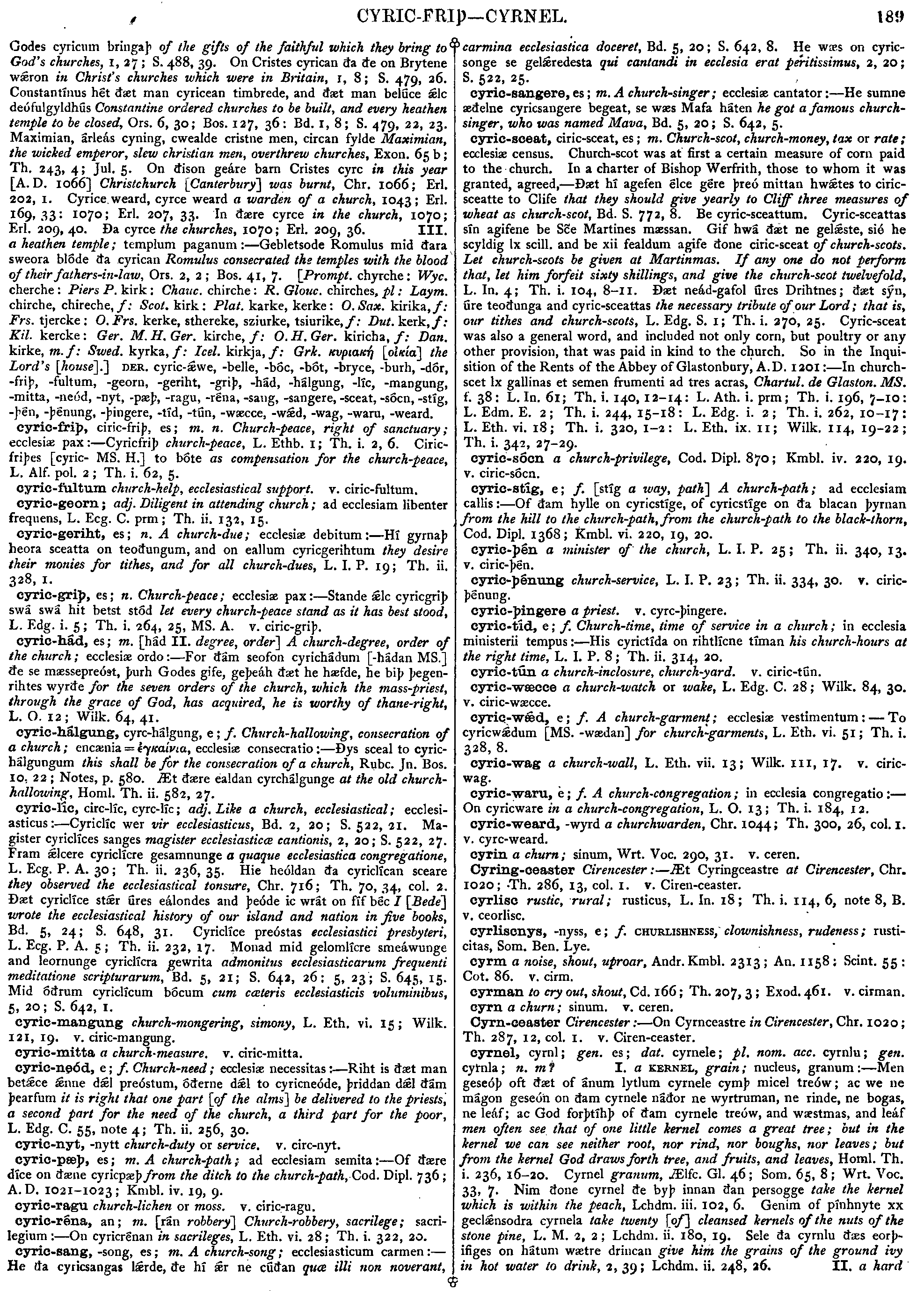
cyric-sceat,
ciric-sceat,
es;
m.
Church-scot,
church-money,
tax
or
rate;
ecclesiæ
census.
Church-scot
was
at
first
a
certain
measure
of
corn
paid
to
the
church.
In
a
charter
of
Bishop
Werfrith,
those
to
whom
it
was
granted,
agreed,
--
Ðæt
hí
agefen
élce
gére
þreó
mittan
hwtes
to
ciric-sceatte
to
Clife
that
they
should
give
yearly
to
Cliff
three
measures
of
wheat
as
church-scot,
Bd.
S.
772,
8.
Be
cyric-sceattum.
Cyric-sceattas
sín
agifene
be
S e
Martines
mæssan.
Gif
hwá
ðæt
ne
gelste,
sié
he
scyldig
lx
scill
and
be
xii
fealdum
agife
ðone
ciric-sceat
of
church-scots.
Let
church-scots
be
given
at
Martinmas.
If
any
one
do
not
perform
that,
let
him
forfeit
sixty
shillings,
and
give
the
church-scot
twelvefold,
L.
In.
4;
Th.
i.
104,
8-11.
Ðæt
neád-gafol
úres
Drihtnes;
ðæt
sýn,
úre
teoðunga
and
cyric-sceattas
the
necessary
tribute
of
our
Lord;
that
is,
our
tithes
and
church-scots,
L.
Edg.
S.
1;
Th.
i.
270,
25.
Cyric-sceat
was
also
a
general
word,
and
included
not
only
corn,
but
poultry
or
any
other
provision,
that
was
paid
in
kind
to
the
church.
So
in
the
Inquisition
of
the
Rents
of
the
Abbey
of
Glastonbnry,
A.
D.
1201
:--
In
church-scet
lx
gallinas
et
semen
frumenti
ad
tres
acras,
Chartul.
de
Glaston.
MS.
f.
38:
L.
In.
61;
Th.
i.
140,
12-14:
L.
Ath.
i.
prm;
Th.
i.
196,
7-10:
L.
Edm.
E.
2;
Th.
i.
244,
15-18:
L.
Edg.
i.
2;
Th.
i.
262,
10-17:
L.
Eth.
vi.
18;
Th.
i.
320,
1-2:
L.
Eth.
ix.
11;
Wilk.
114,
19-22;
Th.
i.
342,
27-29.
e
Martines
mæssan.
Gif
hwá
ðæt
ne
gelste,
sié
he
scyldig
lx
scill
and
be
xii
fealdum
agife
ðone
ciric-sceat
of
church-scots.
Let
church-scots
be
given
at
Martinmas.
If
any
one
do
not
perform
that,
let
him
forfeit
sixty
shillings,
and
give
the
church-scot
twelvefold,
L.
In.
4;
Th.
i.
104,
8-11.
Ðæt
neád-gafol
úres
Drihtnes;
ðæt
sýn,
úre
teoðunga
and
cyric-sceattas
the
necessary
tribute
of
our
Lord;
that
is,
our
tithes
and
church-scots,
L.
Edg.
S.
1;
Th.
i.
270,
25.
Cyric-sceat
was
also
a
general
word,
and
included
not
only
corn,
but
poultry
or
any
other
provision,
that
was
paid
in
kind
to
the
church.
So
in
the
Inquisition
of
the
Rents
of
the
Abbey
of
Glastonbnry,
A.
D.
1201
:--
In
church-scet
lx
gallinas
et
semen
frumenti
ad
tres
acras,
Chartul.
de
Glaston.
MS.
f.
38:
L.
In.
61;
Th.
i.
140,
12-14:
L.
Ath.
i.
prm;
Th.
i.
196,
7-10:
L.
Edm.
E.
2;
Th.
i.
244,
15-18:
L.
Edg.
i.
2;
Th.
i.
262,
10-17:
L.
Eth.
vi.
18;
Th.
i.
320,
1-2:
L.
Eth.
ix.
11;
Wilk.
114,
19-22;
Th.
i.
342,
27-29.
|
Source: Bosworth/Toller, page b0215, entry 40 View original page image as: [TIFF] [PNG] [View previous entry] [View next entry] |
[Comment on this entry] [View comments] |
The following entry has been hand-corrected once. |
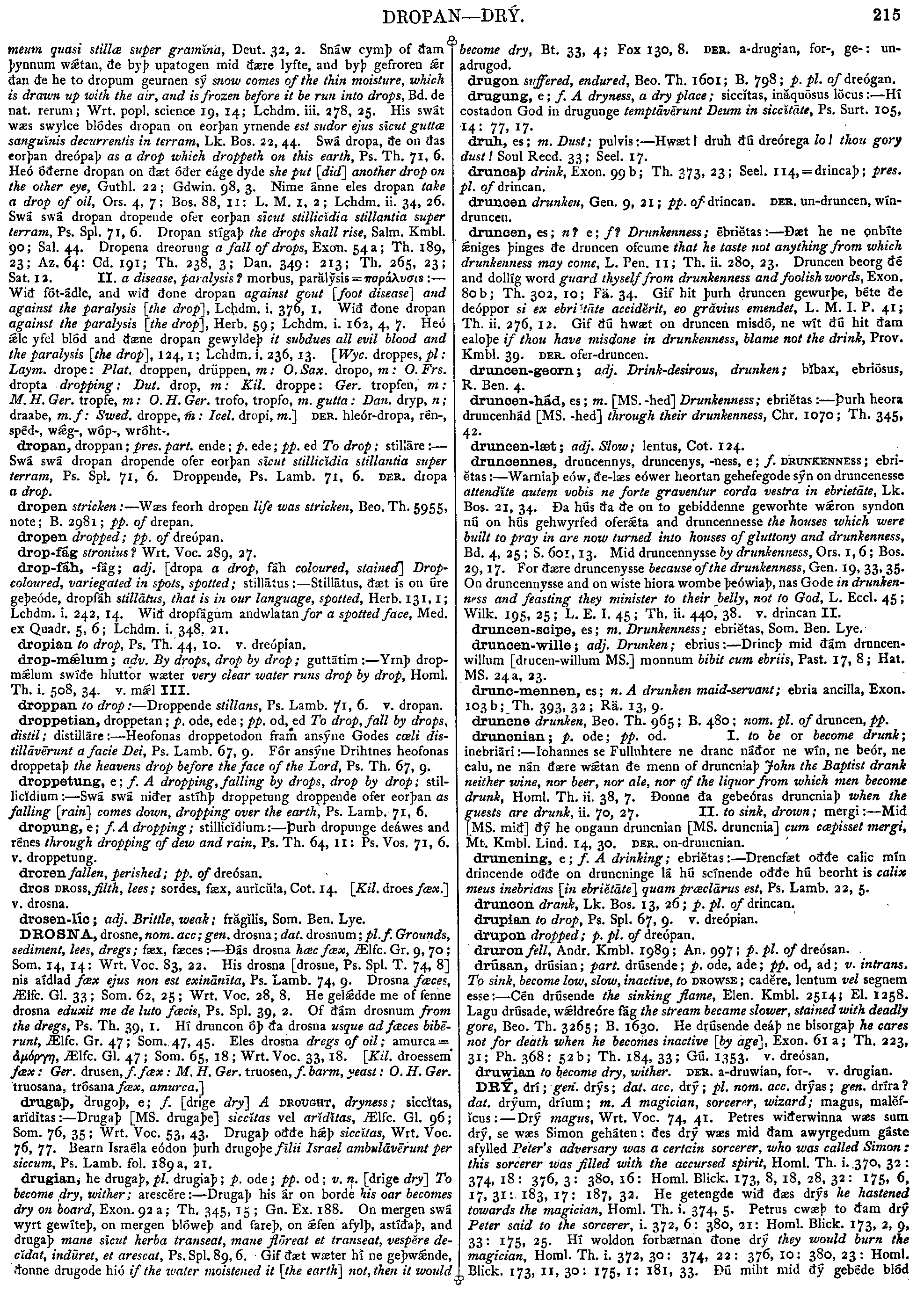
DRÝ,
drí;
gen.
drýs;
dat.
acc.
drý;
pl.
nom.
acc.
drýas;
gen.
dríra?
dat.
drýum,
dríum;
m.
A
magician,
sorcerer,
wizard;
magus,
mal f
f cus
:--
Drý
magus,
Wrt.
Voc.
74,
41.
Petres
wiðerwinna
wæs
sum
drý,
se
wæs
Simon
geháten:
ðes
drý
wæs
mid
ðam
awyrgedum
gáste
afylled
Peter's
adversary
was
a
certain
sorcerer,
who
was
called
Simon:
this
sorcerer
was
filled
with
the
accursed
spirit,
Homl.
Th.
i.
370,
32:
374,
18:
376,
3:
380,
16:
Homl.
Blick.
173,
8,
18,
28,
32:
175,
6,
17,
31:
183,
17:
187,
32.
He
getengde
wið
ðæs
drýs
he
hastened
towards
the
magician,
Homl.
Th.
i.
374,
5.
Petrus
cwæþ
to
ðam
drý
Peter
said
to
the
sorcerer,
i.
372,
6:
380,
21:
Homl.
Blick.
173,
2,
9,
33:
175,
25.
Hí
woldon
forbærnan
ðone
drý
they
would
burn
the
magician,
Homl.
Th.
i.
372,
30:
374,
22:
376,
10:
380,
23:
Homl.
Blick.
173,
11,
30:
175,
1:
181,
33.
Ðú
miht
mid
ðý
gebéde
blóð
onhtan
ðæs
deófles
drý
thou
mayest
with
prayer
heat
the
blood
of
the
devil's
wizard,
Salm.
Kmbl.
89;
Sal.
44.
Hý
drýas
wron
they
were
sorcerers,
Exon.
70
a;
Th.
260,
23;
Jul.
301:
Andr.
Kmbl.
67;
An.
34.
Hý
getrymedon
hyra
drýas
their
magicians
encouraged
them,
Ors.
1,
7;
Bos.
30,
21.
Cwdon
ða
drýas
to
Pharaone
dix
cus
:--
Drý
magus,
Wrt.
Voc.
74,
41.
Petres
wiðerwinna
wæs
sum
drý,
se
wæs
Simon
geháten:
ðes
drý
wæs
mid
ðam
awyrgedum
gáste
afylled
Peter's
adversary
was
a
certain
sorcerer,
who
was
called
Simon:
this
sorcerer
was
filled
with
the
accursed
spirit,
Homl.
Th.
i.
370,
32:
374,
18:
376,
3:
380,
16:
Homl.
Blick.
173,
8,
18,
28,
32:
175,
6,
17,
31:
183,
17:
187,
32.
He
getengde
wið
ðæs
drýs
he
hastened
towards
the
magician,
Homl.
Th.
i.
374,
5.
Petrus
cwæþ
to
ðam
drý
Peter
said
to
the
sorcerer,
i.
372,
6:
380,
21:
Homl.
Blick.
173,
2,
9,
33:
175,
25.
Hí
woldon
forbærnan
ðone
drý
they
would
burn
the
magician,
Homl.
Th.
i.
372,
30:
374,
22:
376,
10:
380,
23:
Homl.
Blick.
173,
11,
30:
175,
1:
181,
33.
Ðú
miht
mid
ðý
gebéde
blóð
onhtan
ðæs
deófles
drý
thou
mayest
with
prayer
heat
the
blood
of
the
devil's
wizard,
Salm.
Kmbl.
89;
Sal.
44.
Hý
drýas
wron
they
were
sorcerers,
Exon.
70
a;
Th.
260,
23;
Jul.
301:
Andr.
Kmbl.
67;
An.
34.
Hý
getrymedon
hyra
drýas
their
magicians
encouraged
them,
Ors.
1,
7;
Bos.
30,
21.
Cwdon
ða
drýas
to
Pharaone
dix runt
malefci
ad
Phara
runt
malefci
ad
Phara nem,
Ex.
8,
19:
9,
11.
Dríra
[dría?]
magrum,
Mone
B.
4018.
Herodes
biswicen
wæs
from
drýum
oððe
tungulcræftgum
Herdes
insulsus
erat
a
magis,
Mt.
Kmbl.
Lind.
2,
16.
Ðýlæs-ðe
se
deófol
us
be
dríum
[MS.
drian]
máge
lest
the
devil
have
power
over
us
by
sorcerers,
Glostr.
Frag.
l0,
30.
[Orm.
drig-menn
magicians:
Gael.
draoi,
draoidh,
druidh,
m.
a
druid,
magician.]
nem,
Ex.
8,
19:
9,
11.
Dríra
[dría?]
magrum,
Mone
B.
4018.
Herodes
biswicen
wæs
from
drýum
oððe
tungulcræftgum
Herdes
insulsus
erat
a
magis,
Mt.
Kmbl.
Lind.
2,
16.
Ðýlæs-ðe
se
deófol
us
be
dríum
[MS.
drian]
máge
lest
the
devil
have
power
over
us
by
sorcerers,
Glostr.
Frag.
l0,
30.
[Orm.
drig-menn
magicians:
Gael.
draoi,
draoidh,
druidh,
m.
a
druid,
magician.]
|
Source: Bosworth/Toller, page b0248, entry 1 View original page image as: [TIFF] [PNG] [View previous entry] [View next entry] |
[Comment on this entry] [View comments] |
The following entry has been hand-corrected once. |
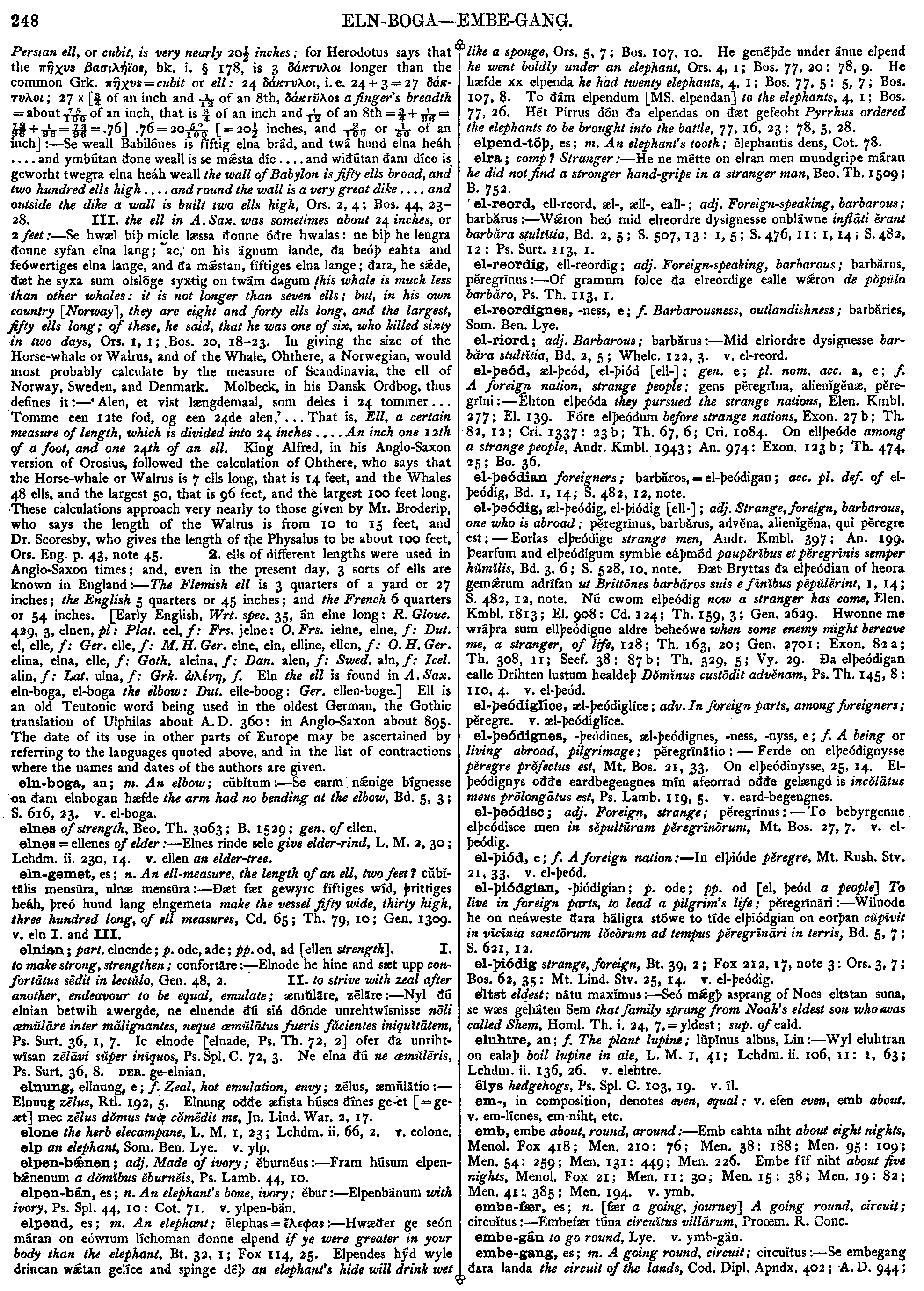
Persian
ell,
or
cubit,
is
very
nearly
20-1/2
inches;
for
Herodotus
says
that
the
GREEK,
bk.
i.
§
178,
is
3
GREEK
longer
than
the
common
Grk.
GREEK
=
cubit
or
ell:
24
GREEK,
i.
e.
24
+
3
=
27
GREEK;
27
×
3/4
of
an
inch
and
1/12
of
an
8th,
GREEK
a
finger's
breadth
=
about
75/100
of
an
inch,
that
is
3/4
of
an
inch
and
1/12
of
an
8th
=
3/4
+
1/96
=
72/96
+
1/96
=
.76]
.76
=
20-50/100
[
=
20-1/2
inches,
and
2/100
or
1/50
of
an
inch]
:--
Se
weall
Babilónes
is
fíftig
elna
brád,
and
twá
hund
elna
heáh
...
and
ymbútan
ðone
weall
is
se
msta
díc
...
and
wiðútan
ðani
díce
is
geworht
twegra
elna
heáh
weall
the
wall
of
Babylon
is
fifty
ells
broad,
and
two
hundred
ells
high
...
and
round
the
wall
is
a
very
great
dike
...
and
outside
the
dike
a
wall
is
built
two
ells
high,
Ors.
2,
4;
Bos.
44,
23-28.
III.
the
ell
in
A.
Sax.
was
sometimes
about
24
inches,
or
2
feet
:--
Se
hwæl
biþ
micle
læssa
ðonne
óðre
hwalas:
ne
biþ
he
lengra
ðonne
syfan
elna
lang;
ac,
on
his
ágnum
lande,
ða
beóþ
eahta
and
feówertiges
elna
lange,
and
ða
mstan,
fíftiges
elna
lange;
ðara,
he
sde,
ðæt
he
syxa
sum
ofslóge
syxtig
on
twám
dagum
this
whale
is
much
less
than
other
whales:
it
is
not
longer
than
seven
ells;
but,
in
his
own
country
[Norway],
they
are
eight
and
forty
ells
long,
and
the
largest,
fifty
ells
long;
of
these,
he
said,
that
he
was
one
of
six,
who
killed
sixty
in
two
days.
Ors.
1,
1;
Bos.
20,
18-23.
In
giving
the
size
of
the
Horse-whale
or
Walrus,
and
of
the
Whale,
Ohthere,
a
Norwegian,
would
most
probably
calculate
by
the
measure
of
Scandinavia,
the
ell
of
Norway,
Sweden,
and
Denmark.
Molbeck,
in
his
Dansk
Ordbog,
thus
defines
it
:--
'Alen,
et
vist
længdemaal,
som
deles
i
24
tommer
...
Tomme
een
12te
fod,
og
een
24de
alen,'
...
That
is,
Ell,
a
certain
measure
of
length,
which
is
divided
into
24
inches
...
An
inch
one
12th
of
a
foot,
and
one
24th
of
an
ell.
King
Alfred,
in
his
Anglo-Saxon
version
of
Orosius,
followed
the
calculation
of
Ohthere,
who
says
that
the
Horse-whale
or
Walrus
is
7
ells
long,
that
is
14
feet,
and
the
Whales
48
ells,
and
the
largest
50,
that
is
96
feet,
and
the
largest
100
feet
long.
These
calculations
approach
very
nearly
to
those
given
by
Mr.
Broderip,
who
says
the
length
of
the
Walrus
is
from
10
to
15
feet,
and
Dr.
Scoresby,
who
gives
the
lengen
of
the
Physalus
to
be
about
100
feet,
Ors.
Eng.
p.
43,
note
45.
2.
ells
of
different
lengths
were
used
in
Anglo-Saxon
times;
and,
even
in
the
present
day,
3
sorts
of
ells
are
known
in
England
:--
The
Flemish
ell
is
3
quarters
of
a
yard
or
27
inches;
the
English
5
quarters
or
45
inches;
and
the
French
6
quarters
or
54
inches.
[Early
English,
Wrt.
spec.
35,
án
elne
long:
R.
Glouc.
429,
3,
elnen,
pl:
Plat.
eel,
f:
Frs.
jelne;
O.
Frs.
ielne,
elne,
f:
Dut.
el,
elle,
f:
Ger.
elle,
f:
M.
H.
Ger.
elne,
eln,
elline,
ellen,
f:
O.
H.
Ger.
elina,
elna,
elle,
f:
Goth.
aleina,
f:
Dan.
alen,
f:
Swed.
aln,
f:
Icel.
alin,
f:
Lat.
ulna.
f:
Grk.
GREEK,
f.
Eln
the
ell
is
found
in
A.
Sax.
eln-boga,
el-boga
the
elbow:
Dut.
elle-boog:
Ger.
ellen-boge.]
Ell
is
an
old
Teutonic
word
being
used
in
the
oldest
German,
the
Gothic
translation
of
Ulphilas
about
A.
D.
360:
in
Anglo-Saxon
about
895.
The
date
of
its
use
in
other
parts
of
Europe
may
be
ascertained
by
referring
to
the
languages
quoted
above,
and
in
the
list
of
contractions
where
the
names
and
dates
of
the
authors
are
given.
| Result Page: |  |
Previous | 1 2 3 4 5 6 7 8 9 10 11 | Next |  |
Germanic Lexicon Project (main page)
This search system was written by
Sean Crist
Please consider
volunteering
to correct the data in these online dictionaries.
No rights reserved. Feel free to use these data in any way you please.