|
|

Tip: In the search results, you can click on any word or abbreviation for more information.
|
Source: Bosworth/Toller, page b1218, entry 1 View original page image as: [TIFF] [PNG] [View previous entry] [View next entry] |
[Comment on this entry] [View comments (1)] |
The following entry has been hand-corrected once. |
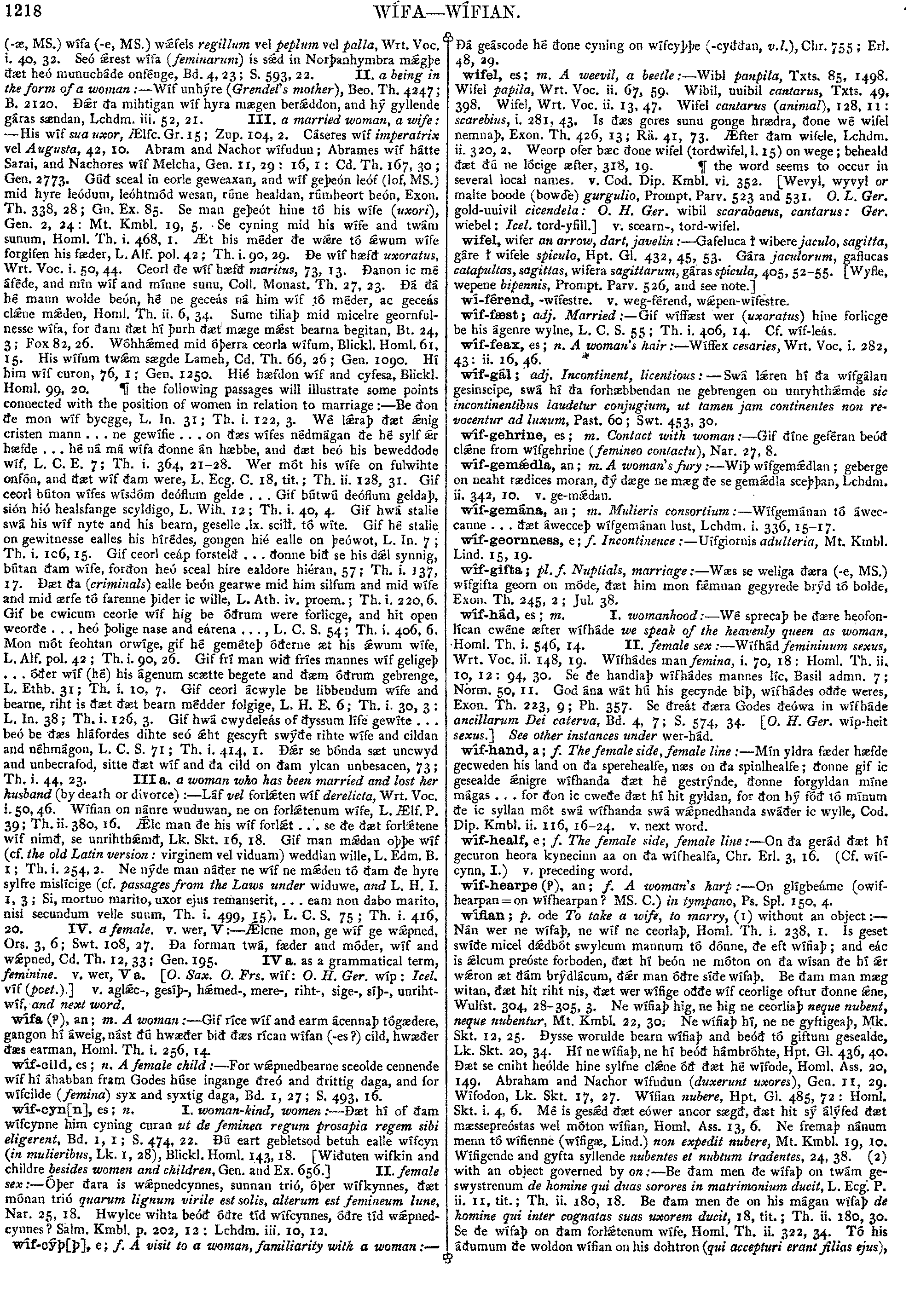
(-æ,
MS.)
wífa
(-e,
MS.)
w fels
regillum
vel
peplum
vel
palla,
Wrt.
Voc.
i.
40,
32.
Seó
rest
wífa
(feminarum)
ís
sd
in
Norþanhymbra
mgþe
ðæt
heó
munucháde
onfénge,
Bd.
4,
23
;
S.
593,
22.
II.
a
being
in
the
form
of
a
woman
:--
Wíf
unhýre
(Grendel's
mother),
Beo.
Th.
4247;
B.
2120.
Ðr
ða
mihtigan
wíf
hyra
mægen
berddon,
and
hý
gyllende
gáras
sndan.
Lchdm.
iii.
52,
21.
III.
a
married
woman,
a
wife:
--
His
wíf
sua
uxor,
Ælfc.
Gr.
15;
Zup.
104,
2.
Cáseres
wíf
imperatrix
vel
Augusta,
42,
10.
Abram
and
Nachor
wífudun;
Abrames
wíf
hátte
Sarai,
and
Nachores
wíf
Melcha,
Gen.
11,
29:
16,
1:
Cd.
Th.
167,
30;
Gen.
2773.
Gúð
sceal
in
eorle
geweaxan,
and
wíf
geþeón
leóf
(lof,
MS.)
mid
hyre
leódum,
leóhtmód
wesan,
rúne
healdan,
rúmheort
beón,
Exon.
Th.
338,
28;
Gn.
Ex.
85.
Se
man
geþeót
hine
tó
his
wífe
(uxori),
Gen.
2,
24:
Mt.
Kmbl.
19,
5.
Se
cyning
mid
his
wífe
and
twám
sunum.
Homl.
Th.
i.
468,
1.
Æt
his
méder
ðe
wre
tó
wum
wífe
forgifen
his
fæder,
L.
Alf.
pol.
42
;
Th.
i.
90,
29.
Ðe
wíf
hæfð
uxoratus,
Wrt.
Voc.
i.
50,
44.
Ceorl
ðe
wíf
hæfð
maritus,
73,
13.
Ðanon
ic
mé
áféde,
and
mín
wíf
and
mínne
sunu,
Coll.
Monast.
Th.
27,
23.
Ðá
ðá
hé
mann
wolde
beón,
hé
ne
geceás
ná
him
wíf
tó
méder,
ac
geceás
clne
mden,
Homl.
Th.
ii.
6,
34.
Sume
tiliaþ
mid
micelre
geornfulnesse
wífa,
for
ðam
ðæt
hí
þurh
ðæt
mæge
mst
bearna
begitan,
Bt.
24,
3
;
Fox
82,
26.
Wóhhmed
mid
óþerra
ceorla
wífum,
Blickl.
Homl.
61,
15.
His
wífum
twm
sægde
Lameh,
Cd.
Th.
66,
26
;
Gen.
1090.
Hí
him
wíf
curon,
76,
1;
Gen.
1250.
Hié
hæfdon
wíf
and
cyfesa,
Blickl.
Homl.
99,
20.

the
following
passages
will
illustrate
some
points
connected
with
the
position
of
women
in
relation
to
marriage
:--
Be
ðon
ðe
mon
wíf
bycgge,
L.
In.
31;
Th.
i.
122,
3.
Wé
lraþ
ðæt
nig
cristen
mann
.
.
.
ne
gewífie
.
.
.
on
ðæs
wífes
nédmágan
ðe
hé
sylf
r
hæfde
.
.
.
hé
ná
má
wífa
ðonne
án
hæbbe,
and
dæt
beó
his
beweddode
wíf,
L.
C.
E.
7;
Th.
i.
364,
21-28.
Wer
mót
his
wífe
on
fulwihte
onfón,
and
ðæt
wíf
ðam
were,
L.
Ecg.
C.
18,
tit.;
Th.
ii.
128,
31.
Gif
ceorl
búton
wífes
wísdóm
deóflum
gelde
.
.
.
Gif
bútwú
deóflum
geldaþ,
sión
hió
healsfange
scyldigo,
L.
Win.
12
;
Th.
i.
40,
4.
Gif
hwá
stalie
swá
his
wíf
nyte
and
his
bearn,
geselle
.
lx.
Sci
fels
regillum
vel
peplum
vel
palla,
Wrt.
Voc.
i.
40,
32.
Seó
rest
wífa
(feminarum)
ís
sd
in
Norþanhymbra
mgþe
ðæt
heó
munucháde
onfénge,
Bd.
4,
23
;
S.
593,
22.
II.
a
being
in
the
form
of
a
woman
:--
Wíf
unhýre
(Grendel's
mother),
Beo.
Th.
4247;
B.
2120.
Ðr
ða
mihtigan
wíf
hyra
mægen
berddon,
and
hý
gyllende
gáras
sndan.
Lchdm.
iii.
52,
21.
III.
a
married
woman,
a
wife:
--
His
wíf
sua
uxor,
Ælfc.
Gr.
15;
Zup.
104,
2.
Cáseres
wíf
imperatrix
vel
Augusta,
42,
10.
Abram
and
Nachor
wífudun;
Abrames
wíf
hátte
Sarai,
and
Nachores
wíf
Melcha,
Gen.
11,
29:
16,
1:
Cd.
Th.
167,
30;
Gen.
2773.
Gúð
sceal
in
eorle
geweaxan,
and
wíf
geþeón
leóf
(lof,
MS.)
mid
hyre
leódum,
leóhtmód
wesan,
rúne
healdan,
rúmheort
beón,
Exon.
Th.
338,
28;
Gn.
Ex.
85.
Se
man
geþeót
hine
tó
his
wífe
(uxori),
Gen.
2,
24:
Mt.
Kmbl.
19,
5.
Se
cyning
mid
his
wífe
and
twám
sunum.
Homl.
Th.
i.
468,
1.
Æt
his
méder
ðe
wre
tó
wum
wífe
forgifen
his
fæder,
L.
Alf.
pol.
42
;
Th.
i.
90,
29.
Ðe
wíf
hæfð
uxoratus,
Wrt.
Voc.
i.
50,
44.
Ceorl
ðe
wíf
hæfð
maritus,
73,
13.
Ðanon
ic
mé
áféde,
and
mín
wíf
and
mínne
sunu,
Coll.
Monast.
Th.
27,
23.
Ðá
ðá
hé
mann
wolde
beón,
hé
ne
geceás
ná
him
wíf
tó
méder,
ac
geceás
clne
mden,
Homl.
Th.
ii.
6,
34.
Sume
tiliaþ
mid
micelre
geornfulnesse
wífa,
for
ðam
ðæt
hí
þurh
ðæt
mæge
mst
bearna
begitan,
Bt.
24,
3
;
Fox
82,
26.
Wóhhmed
mid
óþerra
ceorla
wífum,
Blickl.
Homl.
61,
15.
His
wífum
twm
sægde
Lameh,
Cd.
Th.
66,
26
;
Gen.
1090.
Hí
him
wíf
curon,
76,
1;
Gen.
1250.
Hié
hæfdon
wíf
and
cyfesa,
Blickl.
Homl.
99,
20.

the
following
passages
will
illustrate
some
points
connected
with
the
position
of
women
in
relation
to
marriage
:--
Be
ðon
ðe
mon
wíf
bycgge,
L.
In.
31;
Th.
i.
122,
3.
Wé
lraþ
ðæt
nig
cristen
mann
.
.
.
ne
gewífie
.
.
.
on
ðæs
wífes
nédmágan
ðe
hé
sylf
r
hæfde
.
.
.
hé
ná
má
wífa
ðonne
án
hæbbe,
and
dæt
beó
his
beweddode
wíf,
L.
C.
E.
7;
Th.
i.
364,
21-28.
Wer
mót
his
wífe
on
fulwihte
onfón,
and
ðæt
wíf
ðam
were,
L.
Ecg.
C.
18,
tit.;
Th.
ii.
128,
31.
Gif
ceorl
búton
wífes
wísdóm
deóflum
gelde
.
.
.
Gif
bútwú
deóflum
geldaþ,
sión
hió
healsfange
scyldigo,
L.
Win.
12
;
Th.
i.
40,
4.
Gif
hwá
stalie
swá
his
wíf
nyte
and
his
bearn,
geselle
.
lx.
Sci .
tó
wíte.
Gif
hé
stalie
on
gewitnesse
ealles
his
hírédes,
gongen
hié
ealle
on
þeówot,
L.
In.
7
;
Th.
i.
106,
15.
Gif
ceorl
ceáp
forstelð
.
.
.
ðonne
bið
se
his
dl
synnig,
bútan
ðam
wífe,
forðon
heó
sceal
hire
ealdore
hiéran,
57;
Th.
i.
137,
17.
Ðæt
ða
(criminals)
ealle
beón
gearwe
mid
him
silfum
and
mid
wífe
and
mid
ærfe
tó
farenne
þider
ic
wille,
L.
Ath.
iv.
proem,
;
Th.
i.
220,
6.
Gif
be
cwicum
ceorle
wíf
hig
be
óðrum
were
forlicge,
and
hit
open
weorðe
.
.
.
heó
þolige
nase
and
eárena
.
.
.
,
L.
C.
S.
54;
Th.
i.
406,
6.
Mon
mót
feohtan
orwíge,
gif
hé
geméteþ
óðerne
æt
his
wum
wífe,
L.
Alf.
pol.
42
;
Th.
i.
90,
26.
Gif
frí
man
wið
fríes
mannes
wíf
geligeþ
.
.
.
ððer
wíf
(hé)
his
ágenum
scætte
begete
and
ðæm
óðrum
gebrenge,
L.
Ethb.
31;
Th.
i.
10,
7.
Gif
ceorl
ácwyle
be
libbendum
wífe
and
bearne,
riht
is
ðæt
ðæt
bearn
médder
folgige,
L.
H.
E.
6;
Th.
i.
30,
3
:
L.
In.
38;
Th.
i.
126,
3.
Gif
hwá
cwydeleás
of
ðyssum
lífe
gewíte
.
.
.
beó
be
ðæs
hláfordes
dihte
seó
ht
gescyft
swýðe
rihte
wífe
and
cildan
and
néhmágon,
L.
C.
S.
71;
Th.
i.
414,
1.
Ðr
se
bónda
sæt
uncwyd
and
unbecrafod,
sitte
ðæt
wíf
and
ða
cild
on
ðam
ylcan
unbesacen,
73
;
Th.
i.
44,
23.
IIIa.
a.
a
woman
who
has
been
married
and
lost
her
husband
(by
death
or
divorce)
:--
Láf
vel
forlten
wíf
derelicta,
Wrt.
Voc.
i.
50,
46.
Wífian
on
nánre
wuduwan,
ne
on
forltenum
wífe,
L.
Ælf.
P.
39;
Th.
ii.
380,
16.
Æ-acute;lc
man
ðe
his
wíf
forlt.
.
.
se
ðe
ðæt
forltene
wíf
nimð,
se
unrihthmð,
Lk.
Skt.
16,
18.
Gif
man
mdan
oþþe
wíf
(cf.
the
old
Latin
version:
virginem
vel
viduam)
weddian
wille,
L.
Edm.
B.
1;
Th.
i.
254,
2.
Ne
nýde
man
náðer
ne
wíf
ne
mden
tó
ðam
ðe
hyre
sylfre
mislícige
(cf.
passages
from
the
Laws
under
widuwe,
and
L.
H.
I.
1.
3;
Si,
mortuo
marito,
uxor
ejus
remanserit,
.
.
.
eam
non
dabo
marito,
nisi
secundum
velle
sunm,
Th.
i.
499,
15),
L.
C.
S.
75
;
Th.
i.
416,
20.
IV.
a
female,
v.
wer,
V
:--
Æ-acute;lcne
mon,
ge
wíf
ge
wpned,
Ors.
3,
6;
Swt.
108,
27.
Ða
forman
twá,
fæder
and
móder,
wíf
and
wpned,
Cd.
Th.
12,
33;
Gen.
195.
IV
a.
as
a
grammatical
term,
feminine,
v.
wer,
V
a.
[O.
Sax.
O.
Frs.
wíf:
O.
H.
Ger.
wíp
:
Icel.
víf
(poet.).]
v.
aglc-,
gesíþ-,
hmed-,
mere-,
riht-,
sige-,
síþ-,
unriht
.
tó
wíte.
Gif
hé
stalie
on
gewitnesse
ealles
his
hírédes,
gongen
hié
ealle
on
þeówot,
L.
In.
7
;
Th.
i.
106,
15.
Gif
ceorl
ceáp
forstelð
.
.
.
ðonne
bið
se
his
dl
synnig,
bútan
ðam
wífe,
forðon
heó
sceal
hire
ealdore
hiéran,
57;
Th.
i.
137,
17.
Ðæt
ða
(criminals)
ealle
beón
gearwe
mid
him
silfum
and
mid
wífe
and
mid
ærfe
tó
farenne
þider
ic
wille,
L.
Ath.
iv.
proem,
;
Th.
i.
220,
6.
Gif
be
cwicum
ceorle
wíf
hig
be
óðrum
were
forlicge,
and
hit
open
weorðe
.
.
.
heó
þolige
nase
and
eárena
.
.
.
,
L.
C.
S.
54;
Th.
i.
406,
6.
Mon
mót
feohtan
orwíge,
gif
hé
geméteþ
óðerne
æt
his
wum
wífe,
L.
Alf.
pol.
42
;
Th.
i.
90,
26.
Gif
frí
man
wið
fríes
mannes
wíf
geligeþ
.
.
.
ððer
wíf
(hé)
his
ágenum
scætte
begete
and
ðæm
óðrum
gebrenge,
L.
Ethb.
31;
Th.
i.
10,
7.
Gif
ceorl
ácwyle
be
libbendum
wífe
and
bearne,
riht
is
ðæt
ðæt
bearn
médder
folgige,
L.
H.
E.
6;
Th.
i.
30,
3
:
L.
In.
38;
Th.
i.
126,
3.
Gif
hwá
cwydeleás
of
ðyssum
lífe
gewíte
.
.
.
beó
be
ðæs
hláfordes
dihte
seó
ht
gescyft
swýðe
rihte
wífe
and
cildan
and
néhmágon,
L.
C.
S.
71;
Th.
i.
414,
1.
Ðr
se
bónda
sæt
uncwyd
and
unbecrafod,
sitte
ðæt
wíf
and
ða
cild
on
ðam
ylcan
unbesacen,
73
;
Th.
i.
44,
23.
IIIa.
a.
a
woman
who
has
been
married
and
lost
her
husband
(by
death
or
divorce)
:--
Láf
vel
forlten
wíf
derelicta,
Wrt.
Voc.
i.
50,
46.
Wífian
on
nánre
wuduwan,
ne
on
forltenum
wífe,
L.
Ælf.
P.
39;
Th.
ii.
380,
16.
Æ-acute;lc
man
ðe
his
wíf
forlt.
.
.
se
ðe
ðæt
forltene
wíf
nimð,
se
unrihthmð,
Lk.
Skt.
16,
18.
Gif
man
mdan
oþþe
wíf
(cf.
the
old
Latin
version:
virginem
vel
viduam)
weddian
wille,
L.
Edm.
B.
1;
Th.
i.
254,
2.
Ne
nýde
man
náðer
ne
wíf
ne
mden
tó
ðam
ðe
hyre
sylfre
mislícige
(cf.
passages
from
the
Laws
under
widuwe,
and
L.
H.
I.
1.
3;
Si,
mortuo
marito,
uxor
ejus
remanserit,
.
.
.
eam
non
dabo
marito,
nisi
secundum
velle
sunm,
Th.
i.
499,
15),
L.
C.
S.
75
;
Th.
i.
416,
20.
IV.
a
female,
v.
wer,
V
:--
Æ-acute;lcne
mon,
ge
wíf
ge
wpned,
Ors.
3,
6;
Swt.
108,
27.
Ða
forman
twá,
fæder
and
móder,
wíf
and
wpned,
Cd.
Th.
12,
33;
Gen.
195.
IV
a.
as
a
grammatical
term,
feminine,
v.
wer,
V
a.
[O.
Sax.
O.
Frs.
wíf:
O.
H.
Ger.
wíp
:
Icel.
víf
(poet.).]
v.
aglc-,
gesíþ-,
hmed-,
mere-,
riht-,
sige-,
síþ-,
unriht wíf,
and
next
word.
wíf,
and
next
word.
|
Source: Bosworth/Toller, page b1240, entry 10 View original page image as: [TIFF] [PNG] [View previous entry] [View next entry] |
[Comment on this entry] [View comments (1)] |
The following entry has been hand-corrected once. |
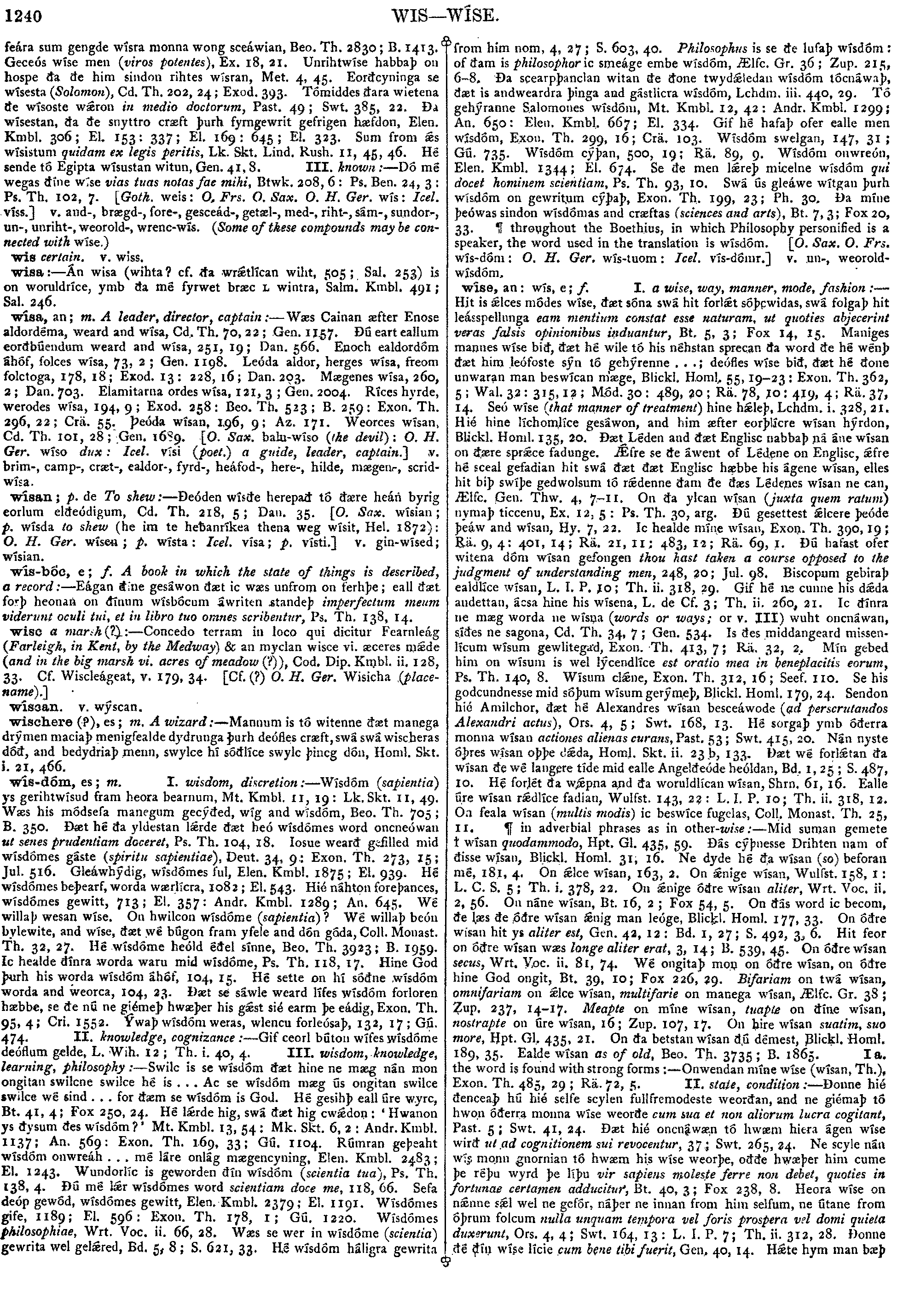
w s-d
s-d m,
es;
m.
I.
wisdom,
discretion
:--
Wsdm
(sapientia)
ys
gerihtwsud
fram
heora
bearnum,
Mt.
Kmbl.
II,
19:
Lk.
Skt.
II,
49.
Wæs
his
mdsefa
manegum
gec
m,
es;
m.
I.
wisdom,
discretion
:--
Wsdm
(sapientia)
ys
gerihtwsud
fram
heora
bearnum,
Mt.
Kmbl.
II,
19:
Lk.
Skt.
II,
49.
Wæs
his
mdsefa
manegum
gec
 ed,
wg
and
wsdm,
Beo.
Th.
705
;
B.
350.
Ðæt
h
ed,
wg
and
wsdm,
Beo.
Th.
705
;
B.
350.
Ðæt
h a
yldestan
l
a
yldestan
l rde
æt
heó
wsdmes
word
oncneówan
ut
senes
prudentiam
doceret,
Ps.
Th.
104,
18.
Iosue
wear
gefilled
mid
wsdmes
g
rde
æt
heó
wsdmes
word
oncneówan
ut
senes
prudentiam
doceret,
Ps.
Th.
104,
18.
Iosue
wear
gefilled
mid
wsdmes
g ste
(spiritu
sapientiae),
Deut.
34,
9.
:
Exon.
Th.
273,
15;
Jul.
516.
Gleáwhdig,
wsdmes
ful,
Elen.
Kmbl.
1875;
El.
939.
H
wsdmes
beþearf,
worda
wærlcra,
1082
;
El.
543.
Hié
nhton
foreþances,
wsdmes
gewitt,
713;
El.
357:
Andr.
Kmbl.
1289;
An.
645.
W
willaþ
wesan
wse.
On
hwilcon
wsd;me
(sapientia)
?
W
willaþ
beón
bylewite,
and
wse,
æt
w
b
ste
(spiritu
sapientiae),
Deut.
34,
9.
:
Exon.
Th.
273,
15;
Jul.
516.
Gleáwhdig,
wsdmes
ful,
Elen.
Kmbl.
1875;
El.
939.
H
wsdmes
beþearf,
worda
wærlcra,
1082
;
El.
543.
Hié
nhton
foreþances,
wsdmes
gewitt,
713;
El.
357:
Andr.
Kmbl.
1289;
An.
645.
W
willaþ
wesan
wse.
On
hwilcon
wsd;me
(sapientia)
?
W
willaþ
beón
bylewite,
and
wse,
æt
w
b gon
fram
yfele
and
dn
gda,
Coll.
Monast.
Th.
32,
27.
H
wsdme
heóld
el
snne,
Beo.
Th.
3923;
B.
1959.
Ic
healde
nra
worda
wam
mid
wsdme,
Ps.
Th.
118,
17.
Hine
God
þurh
his
worda
wsdm
hf,
104,
15.
H
sette
on
h
sne
wsdm
worda
and
weorca,
104,
23.
Ðæt
se
swle
weard
lfes
wsdm
forloren
hæbbe,
se
e
n
ne
giémeþ
hwæþer
his
gst
sié
earm
þe
eádig,
Exon.
Th.
95,
4;
Cri.
1552.
&Y-long;waþ
wsdm
weras,
wlencu
forleósaþ,
132,
17;
G.
474.
II.
knowledge,
cognizance
:--
Gif
ceorl
bton
wfes
wsdme
deóflum
gelde,
L.
Wih.
12
;
Th.
i.
40,
4.
III.
wisdom,
knowledge,
learning,
philosophy
:--
Swilc
is
se
wsdm
æt
hine
ne
mæg
nn
mon
ongitan
swilcne
swilce
h
is
.
.
.
Ac
se
wsdm
mæg
s
ongitan
swilce
swilce
w
sind
.
.
.
for
æm
se
wsdm
is
God.
H
gesihþ
eall
re
wyrc,
Bt.
41,
4;
Fox
250,
24.
H
lrde
hig,
sw
æt
hig
cwdon
:
'
Hwanon
ys
ysum
es
wsdm
?'
Mt.
Kmbl.
13,
54:
Mk.
Skt.
6,
2
:
Andr.
Kmbl.
1137;
An.
569:
Exon.
Th.
1.
69,
33;
G.
1104.
Rmran
geþeaht
wsdm
onwreáh
.
.
.
m
lre
onlg
mægencyning.
Elen.
Kmbl.
2483;
El.
1243.
Wundorlc
is
geworden
n
wsdm
(scientia
tua),
Ps.
138,
4.
Ð
m
lr
wsdmes
word
scientiam
dace
me,
118,
66.
Sefa
deóp
gewd,
wsdmes
gewitt,
Elen.
Kmbl.
2379;
El.
1191.
Wsdmes
gife,
1189;
El.
596:
Exon.
Th.
178,
1;
G.
1220.
Wsdmes
philosophiae,
Wrt.
Voc.
ii.
66,
28.
Wæs
se
wer
in
wsdme
(scientia)
gewrita
wel
gelred,
Bd.
5,
8;
S.
621,
33.
H
wsdm
hligra
gewrita
from
hm
nom,
4,
27;
S.
603,
40.
Philosophus
is
se
e
lufaþ
wsdm
:
of
am
is
philosopher
ic
smeáge
embe
wsdm,
Ælfc.
Gr.
36;
Zup.
215,
6-8,
Ða
scearpþanclan
witan
e
one
twydledan
wsdm
tcnwaþ,
æt
is
andweardra
þinga
and
gstlicra
wsdm,
Lchdm.
iii.
440,
29.
T
gehranne
Salomones
wsdm,
Mt.
Kmbl.
12,
42:
Andr.
Kmbl.
1299;
An.
650:
Elen.
Kmbl.
667;
El.
334.
Gif
h
hafaþ
ofer
ealle
men
wsdm,
Exon.
Th.
299,
16;
Crä.
103.
Wsdm
swelgan.
147,
31
;
G.
735.
Wsdm
cþan,
500,
19;
Rä.
89,
9.
Wsdm
onwreón.
Elen.
Kmbl.
1344;
El.
674.
Se
e
men
lreþ
micelne
wsdm
qui
docet
hominem
scientiam.
Ps.
Th.
93,
10.
Sw
s
gleáwe
wtgan
þurh
wsdm
on
gewritum
cþaþ,
Exon.
Th.
199,
23;
Ph.
30.
Ða
mne
þeówas
sindon
wsdmas
and
cræftas
(sciences
and
arts),
Bt.
7,
3;
Fox
20,
33.

throughout
the
Boethius,
in
which
Philosophy
personified
is
a
speaker,
the
word
used
in
the
translation
is
wsdm.
[O.
Sax.
O.
Frs.
ws-d;m:
O.
H.
Ger.
ws-tuom:
Icel.
vs-dmr.]
v.
un-,
weorold-wsdm,
gon
fram
yfele
and
dn
gda,
Coll.
Monast.
Th.
32,
27.
H
wsdme
heóld
el
snne,
Beo.
Th.
3923;
B.
1959.
Ic
healde
nra
worda
wam
mid
wsdme,
Ps.
Th.
118,
17.
Hine
God
þurh
his
worda
wsdm
hf,
104,
15.
H
sette
on
h
sne
wsdm
worda
and
weorca,
104,
23.
Ðæt
se
swle
weard
lfes
wsdm
forloren
hæbbe,
se
e
n
ne
giémeþ
hwæþer
his
gst
sié
earm
þe
eádig,
Exon.
Th.
95,
4;
Cri.
1552.
&Y-long;waþ
wsdm
weras,
wlencu
forleósaþ,
132,
17;
G.
474.
II.
knowledge,
cognizance
:--
Gif
ceorl
bton
wfes
wsdme
deóflum
gelde,
L.
Wih.
12
;
Th.
i.
40,
4.
III.
wisdom,
knowledge,
learning,
philosophy
:--
Swilc
is
se
wsdm
æt
hine
ne
mæg
nn
mon
ongitan
swilcne
swilce
h
is
.
.
.
Ac
se
wsdm
mæg
s
ongitan
swilce
swilce
w
sind
.
.
.
for
æm
se
wsdm
is
God.
H
gesihþ
eall
re
wyrc,
Bt.
41,
4;
Fox
250,
24.
H
lrde
hig,
sw
æt
hig
cwdon
:
'
Hwanon
ys
ysum
es
wsdm
?'
Mt.
Kmbl.
13,
54:
Mk.
Skt.
6,
2
:
Andr.
Kmbl.
1137;
An.
569:
Exon.
Th.
1.
69,
33;
G.
1104.
Rmran
geþeaht
wsdm
onwreáh
.
.
.
m
lre
onlg
mægencyning.
Elen.
Kmbl.
2483;
El.
1243.
Wundorlc
is
geworden
n
wsdm
(scientia
tua),
Ps.
138,
4.
Ð
m
lr
wsdmes
word
scientiam
dace
me,
118,
66.
Sefa
deóp
gewd,
wsdmes
gewitt,
Elen.
Kmbl.
2379;
El.
1191.
Wsdmes
gife,
1189;
El.
596:
Exon.
Th.
178,
1;
G.
1220.
Wsdmes
philosophiae,
Wrt.
Voc.
ii.
66,
28.
Wæs
se
wer
in
wsdme
(scientia)
gewrita
wel
gelred,
Bd.
5,
8;
S.
621,
33.
H
wsdm
hligra
gewrita
from
hm
nom,
4,
27;
S.
603,
40.
Philosophus
is
se
e
lufaþ
wsdm
:
of
am
is
philosopher
ic
smeáge
embe
wsdm,
Ælfc.
Gr.
36;
Zup.
215,
6-8,
Ða
scearpþanclan
witan
e
one
twydledan
wsdm
tcnwaþ,
æt
is
andweardra
þinga
and
gstlicra
wsdm,
Lchdm.
iii.
440,
29.
T
gehranne
Salomones
wsdm,
Mt.
Kmbl.
12,
42:
Andr.
Kmbl.
1299;
An.
650:
Elen.
Kmbl.
667;
El.
334.
Gif
h
hafaþ
ofer
ealle
men
wsdm,
Exon.
Th.
299,
16;
Crä.
103.
Wsdm
swelgan.
147,
31
;
G.
735.
Wsdm
cþan,
500,
19;
Rä.
89,
9.
Wsdm
onwreón.
Elen.
Kmbl.
1344;
El.
674.
Se
e
men
lreþ
micelne
wsdm
qui
docet
hominem
scientiam.
Ps.
Th.
93,
10.
Sw
s
gleáwe
wtgan
þurh
wsdm
on
gewritum
cþaþ,
Exon.
Th.
199,
23;
Ph.
30.
Ða
mne
þeówas
sindon
wsdmas
and
cræftas
(sciences
and
arts),
Bt.
7,
3;
Fox
20,
33.

throughout
the
Boethius,
in
which
Philosophy
personified
is
a
speaker,
the
word
used
in
the
translation
is
wsdm.
[O.
Sax.
O.
Frs.
ws-d;m:
O.
H.
Ger.
ws-tuom:
Icel.
vs-dmr.]
v.
un-,
weorold-wsdm,
|
Source: Bosworth/Toller, page b1277, entry 16 View original page image as: [TIFF] [PNG] [View previous entry] [View next entry] |
[Comment on this entry] [View comments] |
The following entry has been hand-corrected once. |
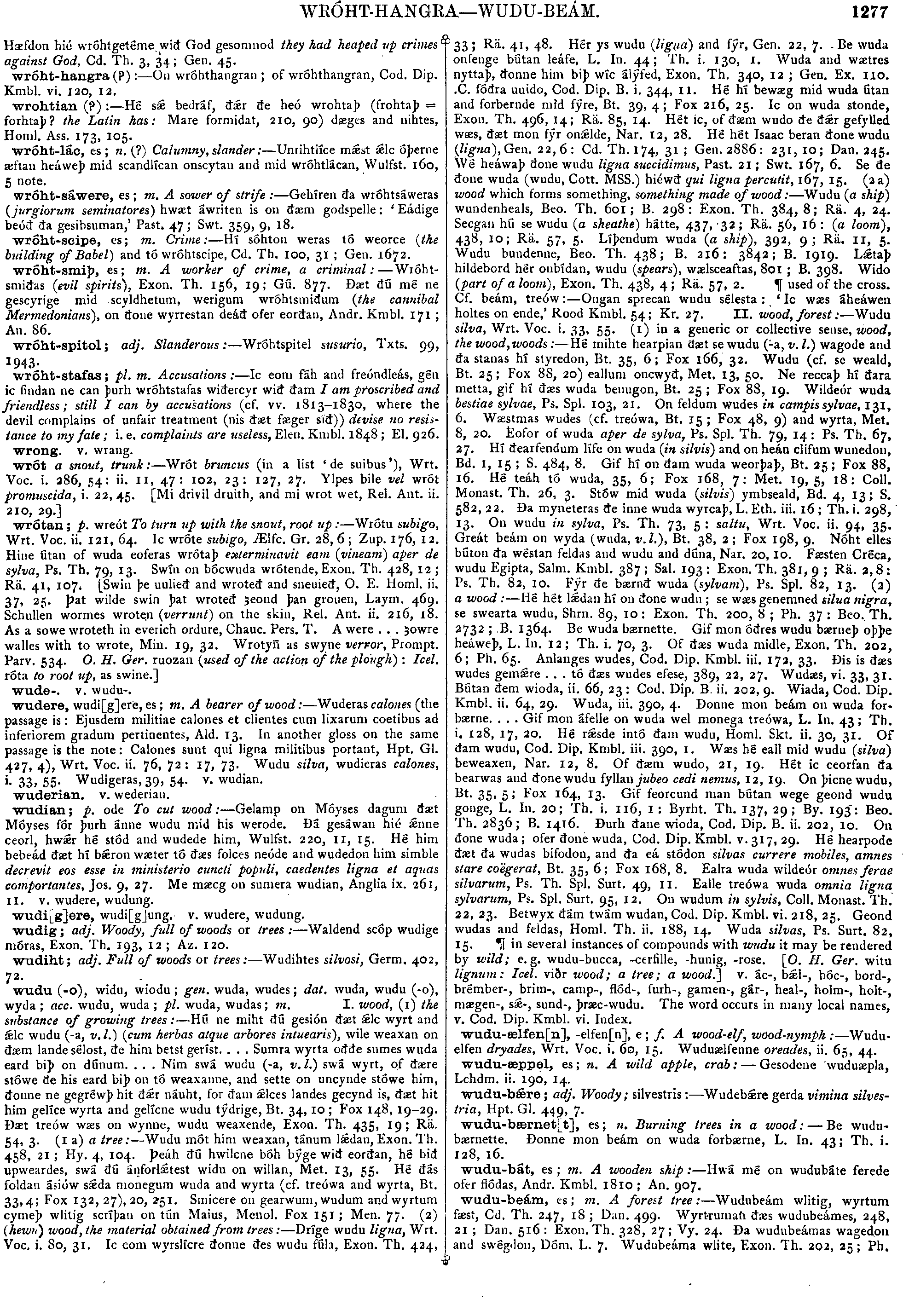
wudian;
p.
ode
To
cut
wood
:--
Gelamp
on
Móyses
dagum
ðæt
Móyses
fór
þurh
ánne
wudu
mid
his
werode.
Ðá
gesáwan
hié
nne
ceorl,
hwr
hé
stód
and
wudede
him,
Wulfst.
2
20,
11,
15.
Hé
him
bebeád
ðæt
hí
bron
wæter
tó
ðæs
folces
neóde
and
wudedon
him
simble
decrevit
eos
esse
in
ministerio
cuncti
populi,
caedentes
ligna
et
aquas
comportantes.
Jos.
9,
27.
Me
mæcg
on
sumera
wudian,
Anglia
ix.
261,
11.
v.
wudere,
wudung.
|
Source: Bosworth/Toller, page b1296, entry 21 View original page image as: [TIFF] [PNG] [View previous entry] [View next entry] |
[Comment on this entry] [View comments (1)] |
The following entry has been hand-corrected once. |
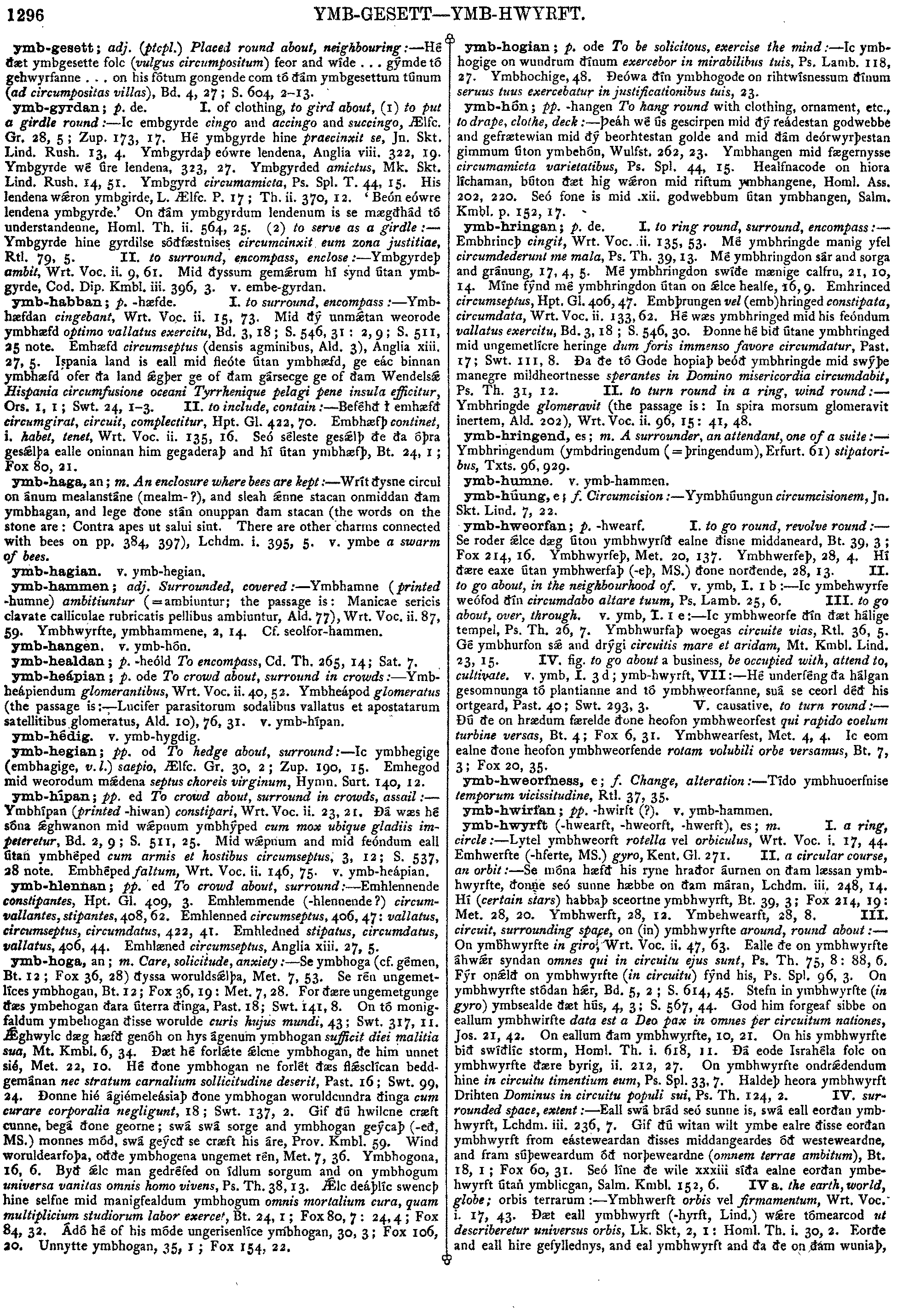
ymb-hweorfan;
p.
-hwearf.
I.
to
go
round,
revolve
round
:--Se
roder
lce
dæg
úton
ymbhwyrfð
ealne
ðisne
middaneard,
Bt.
39,
3
;
Fox
214,
16.
Ymbhwyrfeþ,
Met.
20,
137.
Ymbhwerfeþ,
28,
4.
Hí
ðære
eaxe
útan
ymbhwerfaþ
(-eþ,
MS.
)
ðone
norðende,
28,
13.
II.
to
go
about,
in
the
neighbourhood
of.
v.
ymb,
I.
1
b
:--Ic
ymbehwyrfe
weófod
ðín
circumdabo
altare
tuum,
Ps.
Lamb.
25,
6.
III.
to
go
about,
over,
through,
v.
ymb,
I.
1
e
:--Ic
ymbhweorfe
ðín
ðæt
hálige
tempel.
Ps.
Th.
26,
7.
Ymbhwurfaþ
woegas
circuits
vias,
Rtl.
36,
5.
Gé
ymbhurfon
s
and
drýgi
circuitis
mare
et
aridam,
Mt.
Kmbl.
Lind.
23,
15.
IV.
fig.
to
go
about
a
business,
be
occupied
with,
attend
to,
cultivate,
v.
ymb,
I.
3
d
;
ymb-hwyrft,
VII
:--Hé
underféng
ða
hálgan
gesomnunga
tó
plantianne
and
tó
ymbhweorfanne,
suá
se
ceorl
déð
his
ortgeard,
Past.
40
;
Swt.
293,
3.
V.
causative,
to
turn
round
:--Ðú
ðe
on
hrædum
færelde
ðone
heofon
ymbhweorfest
qwi
rapido
coelum
turbine
versas,
Bt.
4
;
Fox
6,
31.
Ymbhwearfest,
Met.
4,
4.
Ic
eom
ealne
ðone
heofon
ymbhweorfende
rotam
volubili
orbe
versamus,
Bt.
7,
3
;
Fox
20,
35.
|
Source: Bosworth/Toller, page d0006, entry 34 View original page image as: [TIFF] [PNG] [View previous entry] [View next entry] |
[Comment on this entry] [View comments] |
The following entry has been hand-corrected once. |
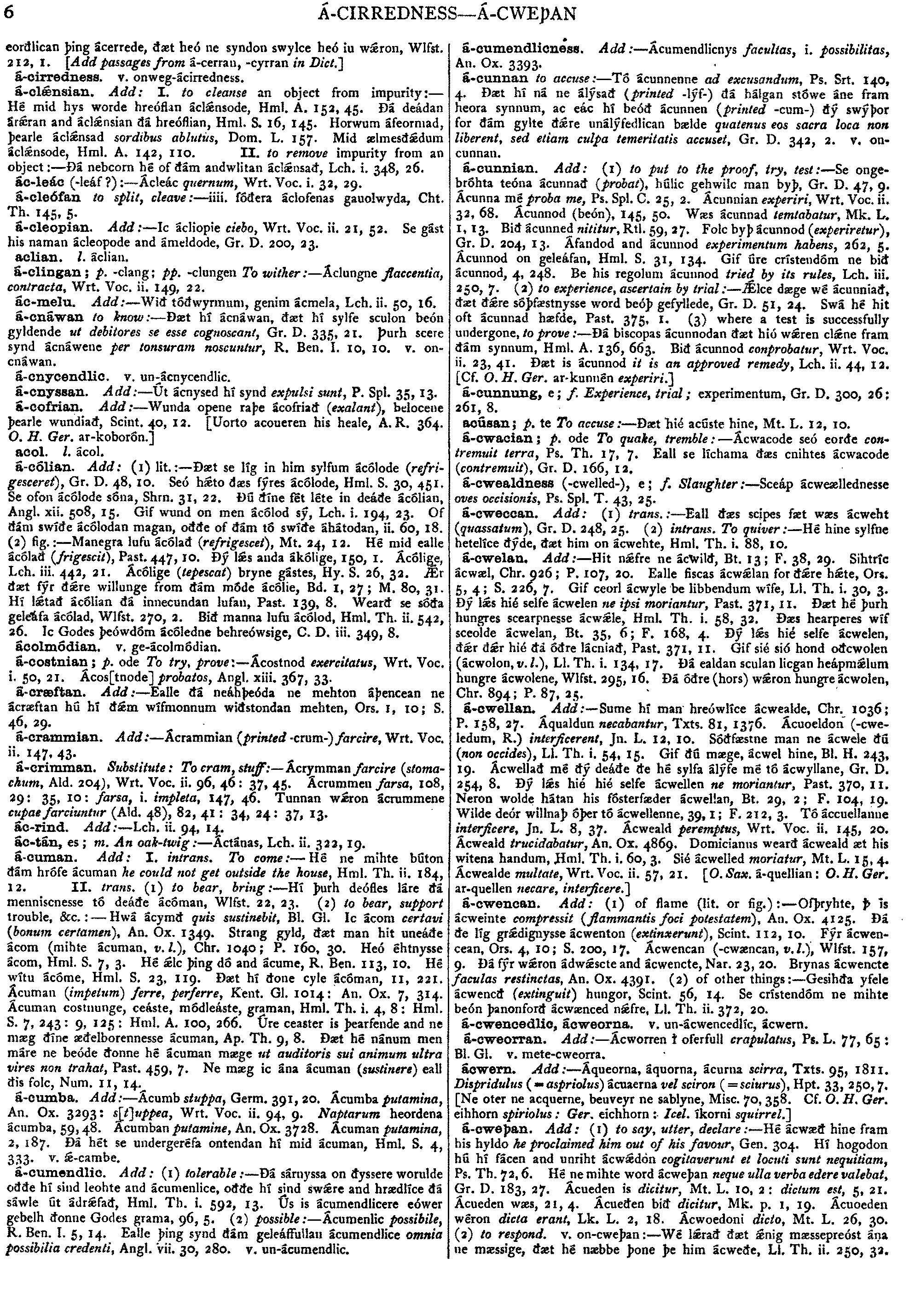
á-cwelan.
Add:--Hit
nfre
ne
ácwilð,
Bt.
13;
F.
38,
29.
Sihtríc
ácwæl,
Chr.
926;
P.
107,
20.
Ealle
fiscas
ácwlan
for
ðre
hte,
Ors.
5,
4;
S.
226,
7.
Gif
ceorl
ácwyle
be
libbendum
wífe,
Ll.
Th.
i.
30,
3.
Ðý
ls
hié
selfe
ácwelen
ne
ipsi
moriantur,
Past.
371,
11.
Ðæt
hé
þurh
hungres
scearpnesse
ácwle,
Hml.
Th.
i.
58,
32.
Ðæs
hearperes
wíf
sceolde
ácwelan,
Bt.
35,
6;
F.
168,
4.
Ðý
ls
hié
selfe
ácwelen,
ðr
ðr
hié
ðá
óðre
lácniað,
Past.
371,
11.
Gif
sié
sió
hond
oðcwolen
(ácwolon,
v.
l.),
Ll.
Th.
i.
134,
17.
Ðá
ealdan
sculan
licgan
heápmlum
hungre
ácwolene,
Wlfst.
295,
16.
Ðá
óðre
(hors)
wron
hungre
ácwolen,
Chr.
894;
P.
87,
25.
|
Source: Bosworth/Toller, page d0014, entry 20 View original page image as: [TIFF] [PNG] [View previous entry] [View next entry] |
[Comment on this entry] [View comments] |
The following entry has been hand-corrected once. |
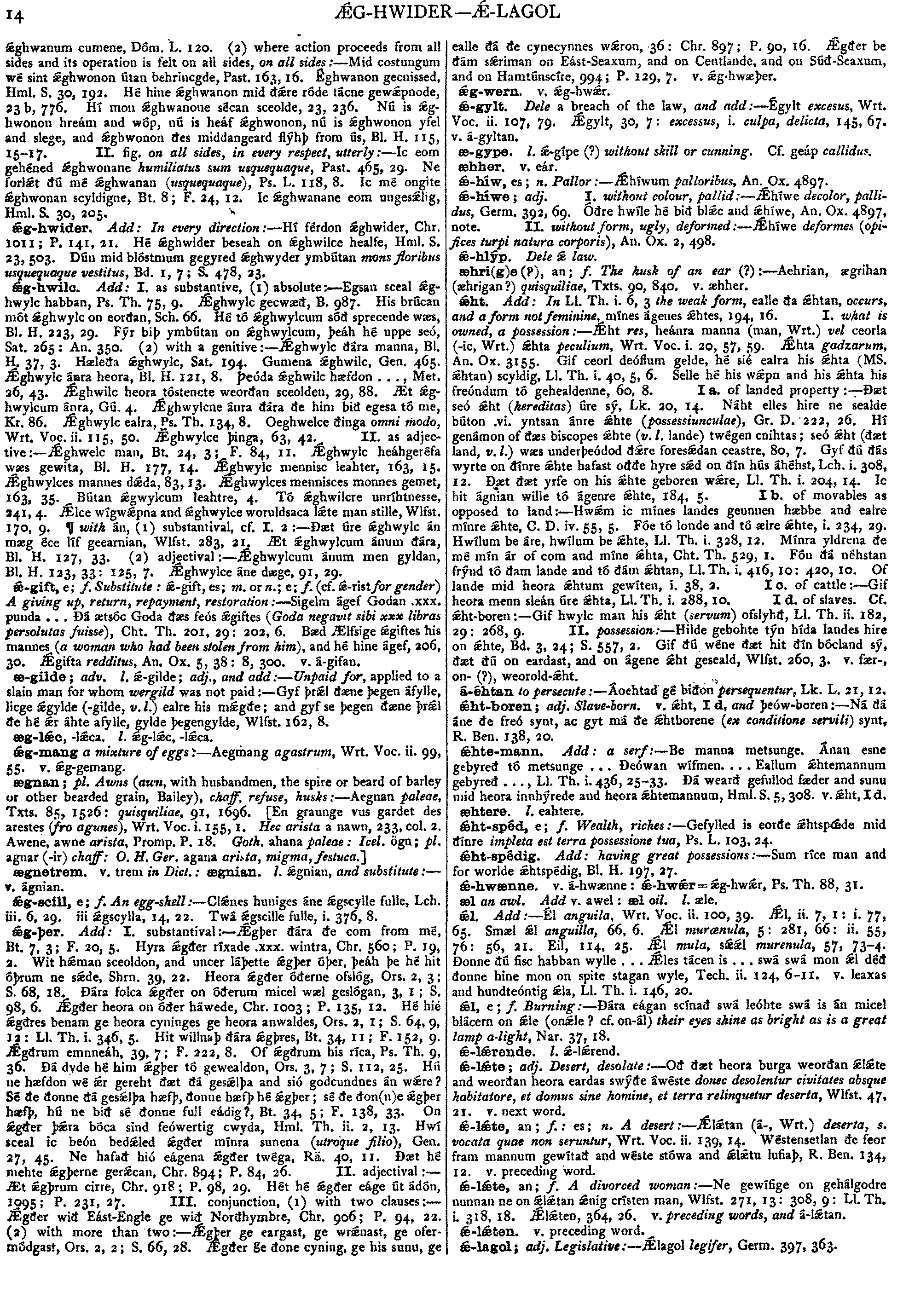
ht.
Add:
In
Ll.
Th.
i.
6,
3
the
weak
form,
ealle
ða
htan,
occurs,
and
a
form
not
feminine,
mínes
ágenes
htes,
194,
16.
I.
what
is
owned,
a
possession:--Æ-acute;ht
res,
heánra
manna
(man,
Wrt.)
vel
ceorla
(-ic,
Wrt.)
hta
peculium,
Wrt.
Voc.
i.
20,
57,
59.
Æ-acute;hta
gadzarum,
An.
Ox.
3155.
Gif
ceorl
deóflum
gelde,
hé
sié
ealra
his
hta
(MS.
htan)
scyldig,
Ll.
Th.
i.
40,
5,
6.
Selle
hé
his
wpn
and
his
hta
his
freóndum
tó
gehealdenne,
60,
8.
I
a.
of
landed
property:--Ðæt
seó
ht
(hereditas)
úre
sý,
Lk.
20,
14.
Náht
elles
hire
ne
sealde
búton
.vi.
yntsan
ánre
hte
(possesiunculae),
Gr.
D.
222,
26.
Hí
genámon
of
ðæs
biscopes
hte
(v.
l.
lande)
twégen
cnihtas;
seó
ht
(ðæt
land,
v.
l.)
wæs
undecþeódod
ðre
foresdan
ceastre,
80,
7.
Gyf
ðú
ðás
wyrte
on
ðínre
hte
hafast
oððe
hyre
sd
on
ðín
hús
áhéhst,
Lch.
i.
308,
12.
Ðæt
ðæt
yrfe
on
his
hte
geboren
wre,
Ll.
Th.
i.
204,
14.
Ic
hit
ágnian
wille
tó
ágenre
hte,
184,
5.
I
b.
of
movables
as
opposed
to
land:--Hwm
ic
mínes
landes
geunnen
hæbbe
and
ealre
mínre
hte,
C.
D.
iv.
55,
5.
Fóe
tó
londe
and
tó
ælre
hte,
i.
234,
29.
Hwílum
be
áre,
hwílum
be
hte,
Ll.
Th.
i.
328,
12.
Mínra
yldrena
ðe
mé
mín
ár
of
com
and
míne
hta,
Cht.
Th.
529,
1.
Fón
ðá
néhstan
frýnd
tó
ðam
lande
and
tó
ðám
htan,
Ll.
Th.
i.
416,
10:
420,
10.
Of
lande
mid
heora
htum
gewíten,
i.
38,
2.
I
c.
of
cattle:--Gif
heora
menn
sleán
úre
hta,
Ll.
Th.
i.
288,
10.
I
d.
of
slaves.
Cf.
ht-boren:--Gif
hwylc
man
his
ht
(servum)
ofslyhð,
Ll.
Th.
ii.
182,
29:
268,
9.
II.
possession:--Hilde
gebohte
týn
hída
landes
hire
on
hte,
Bd.
3,
24;
S.
557,
2.
Gif
ðú
wéne
ðæt
hit
ðín
bócland
sý,
ðæt
ðú
on
eardast,
and
on
ágene
ht
geseald,
Wlfst.
260,
3.
v.
fær-,
on-
(?),
weorold-ht.
|
Source: Bosworth/Toller, page d0032, entry 23 View original page image as: [TIFF] [PNG] [View previous entry] [View next entry] |
[Comment on this entry] [View comments] |
The following entry has been hand-corrected once. |
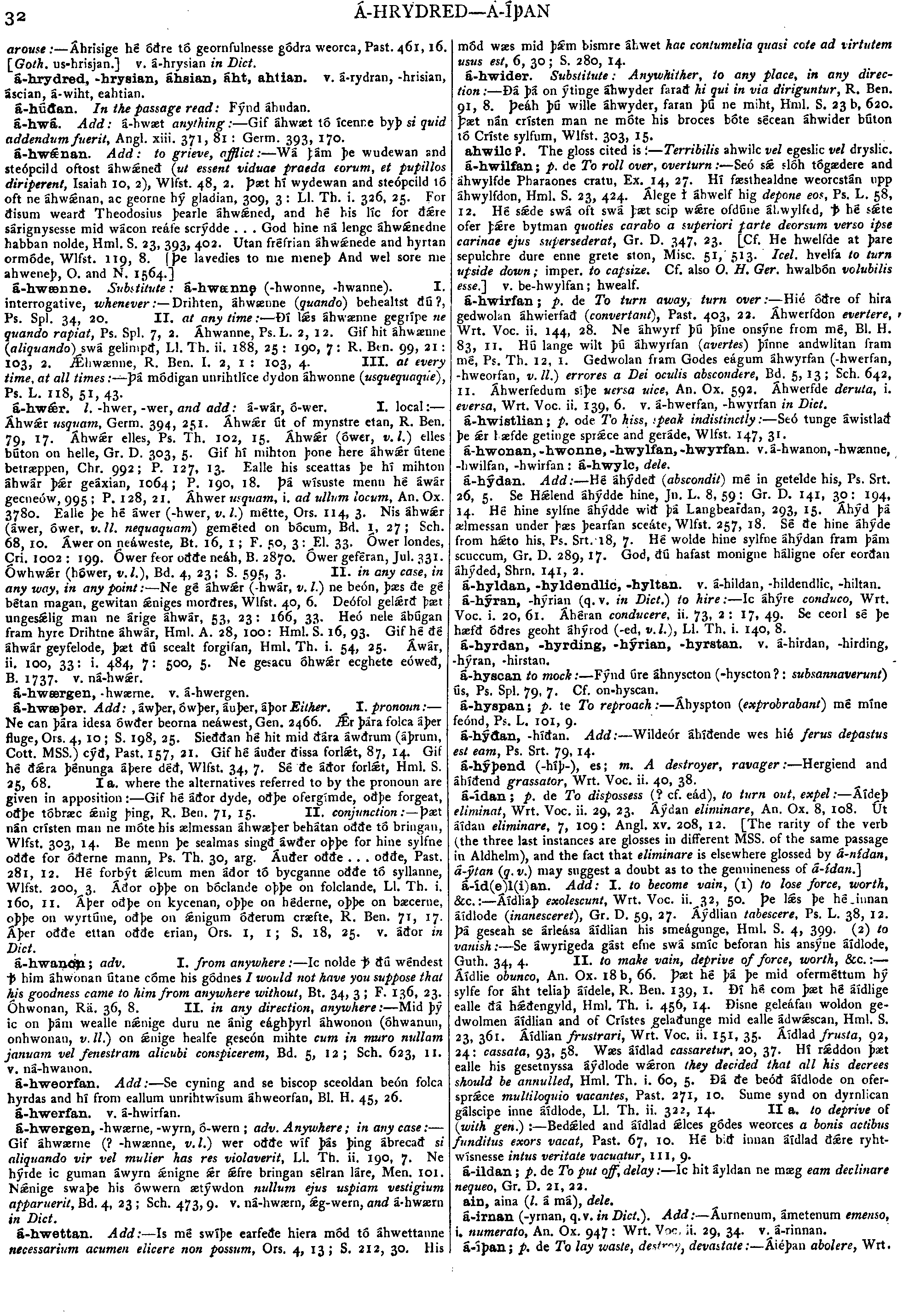
á-hýran, -hýrian (q. v. in Dict.) to hire:--Ic áhýre conduco, Wrt. Voc. i. 20, 61. Áhéran conducere, ii. 73, 2: 17, 49. Se ceorl sé þe hæfð óðres geoht áhýrod (-ed, v. l.), Ll. Th. i. 140, 8.
|
Source: Bosworth/Toller, page d0033, entry 21 View original page image as: [TIFF] [PNG] [View previous entry] [View next entry] |
[Comment on this entry] [View comments] |
The following entry has been hand-corrected once. |
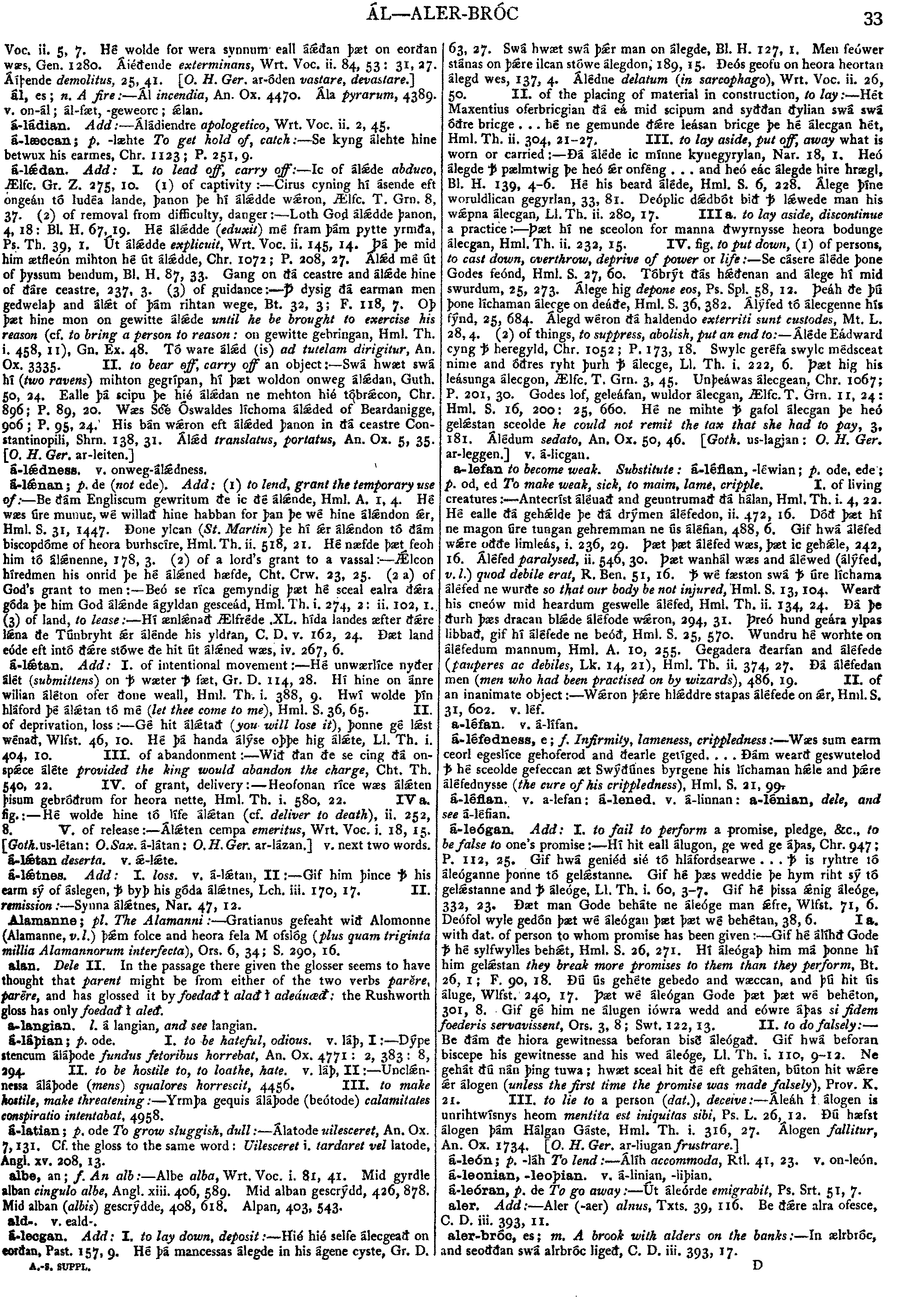
á-léfedness,
e;
f.
Infirmity,
lameness,
crippledness:--Wæs
sum
earm
ceorl
egeslíce
gehoferod
and
ðearle
getíged.
.
.
.
Ðám
wearð
geswutelod
 hé
sceolde
gefeccan
æt
Swýðúnes
byrgene
his
líchaman
hle
and
þre
áléfednysse
(the
cure
of
his
crippledness),
Hml.
S.
21,
99.
hé
sceolde
gefeccan
æt
Swýðúnes
byrgene
his
líchaman
hle
and
þre
áléfednysse
(the
cure
of
his
crippledness),
Hml.
S.
21,
99.
|
Source: Bosworth/Toller, page d0053, entry 2 View original page image as: [TIFF] [PNG] [View previous entry] [View next entry] |
[Comment on this entry] [View comments] |
The following entry has been hand-corrected once. |
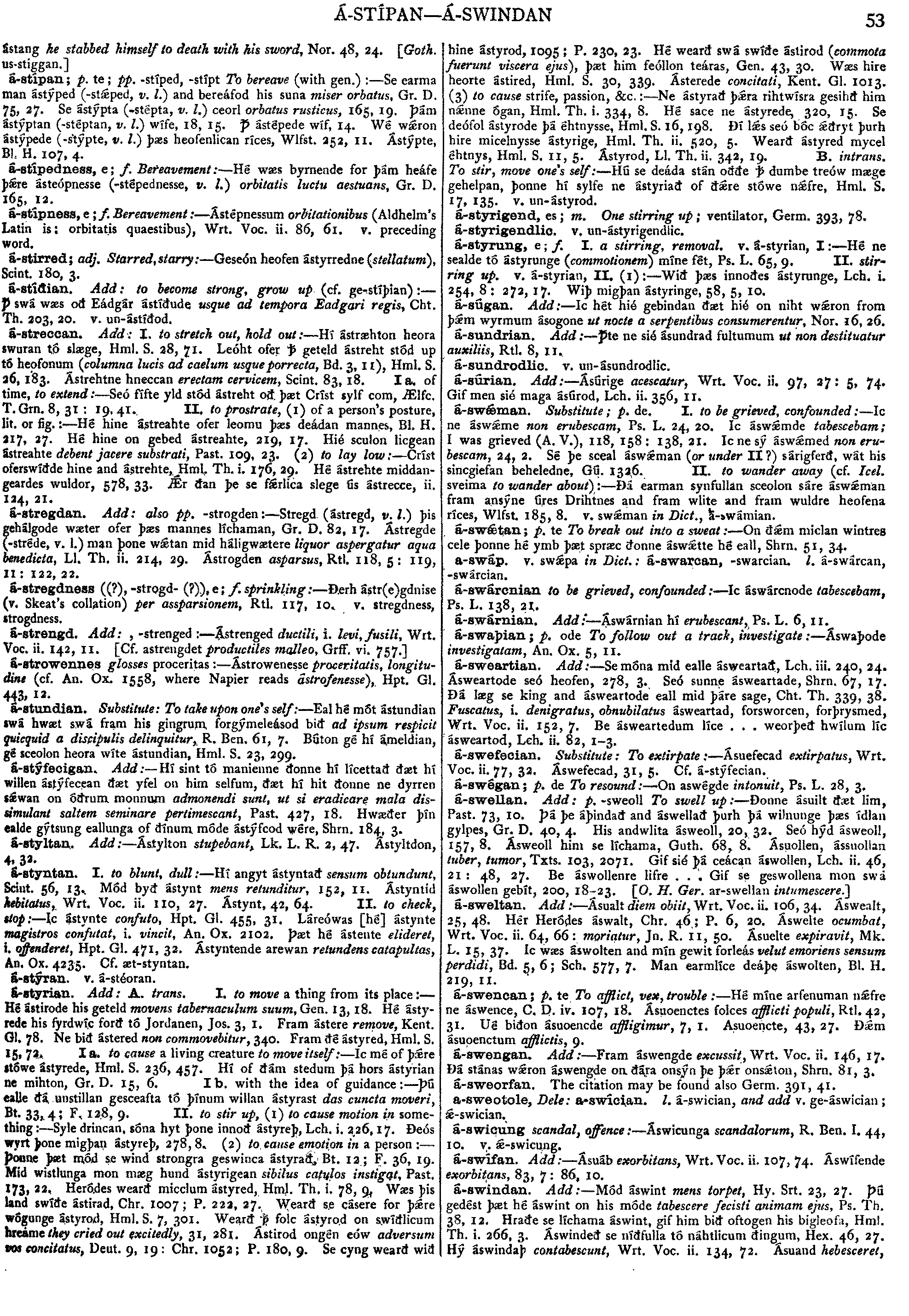
á-stípan;
p.
te;
pp.
-stíped,
-stípt
To
bereave
(with
gen.)
:--Se
earma
man
ástýped
(-stped,
v.
l.)
and
bereáfod
his
suna
miser
orbatus,
Gr.
D.
75,
27.
Se
ástýpta
(-stépta,
v.
l.)
ceorl
orbatus
rusticus,
165,
19.
þám
ástýptan
(-stéptan,
v.
l.)
wífe,
18,
15.
Þ
ástépede
wíf,
14.
Wé
wron
ástýpede
(-stýpte,
v.
/.
)
þæs
heofenlican
ríces,
Wlfst.
252,
II.
Astýpte,
Bl.
H.
107,
4.
|
Source: Bosworth/Toller, page d0063, entry 17 View original page image as: [TIFF] [PNG] [View previous entry] [View next entry] |
[Comment on this entry] [View comments] |
The following entry has been hand-corrected once. |
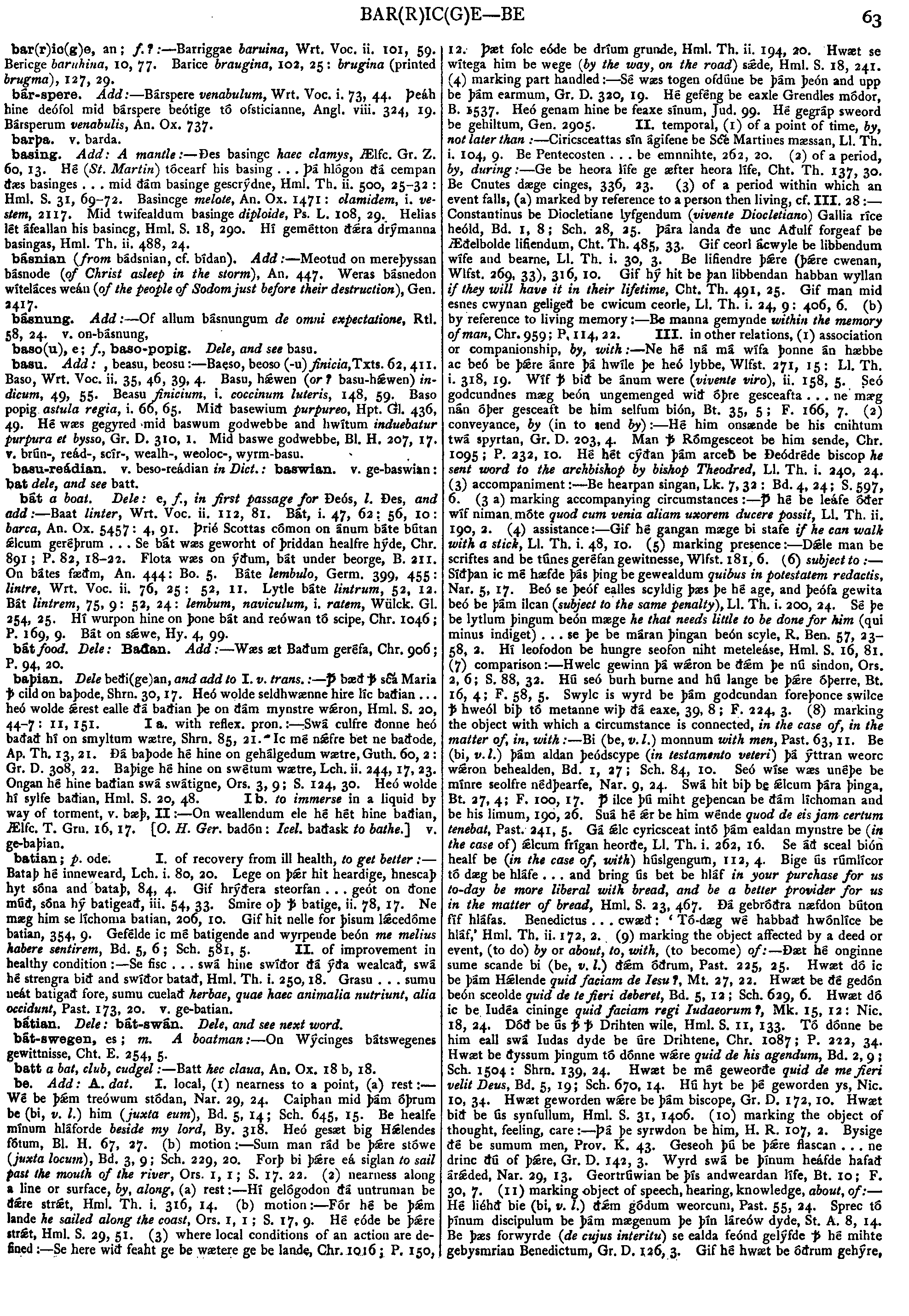
be.
Add:
A.
dat.
I.
local,
(1)
nearness
to
a
point,
(a)
rest:--Wé
be
þm
treówum
stódan,
Nar.
29,
24.
Caiphan
mid
þám
óþrum
be
(bi,
v.
l.)
him
(juxta
eum),
Bd.
5,
14;
Sch.
645,
15.
Be
healfe
mínum
hláforde
beside
my
lord,
By.
318.
Heó
gesæt
big
Hlendes
fótum,
Bl.
H.
67,
27.
(b)
motion:--Sum
man
rád
be
þre
stówe
(juxta
locum),
Bd.
3,
9;
Sch.
229,
20.
Forþ
bi
þre
eá
siglan
to
sail
past
the
mouth
of
the
river,
Ors.
1,
1;
S.
17,
22.
(2)
nearness
along
a
line
or
surface,
by,
along,
(a)
rest:--Hí
gelógodon
ðá
untruman
be
ðre
strt,
Hml.
Th.
i.
316,
14.
(b)
motion:--Fór
hé
be
þm
lande
he
sailed
along
the
coast,
Ors.
1,
1;
S.
17,
9.
Hé
eóde
be
þre
strt,
Hml.
S.
29,
51.
(3)
where
local
conditions
of
an
action
are
defined:--Se
here
wið
feaht
ge
be
wætere
ge
be
lande,
Chr.
1016;
P.
150,
12.
Þæt
folc
eóde
be
dríum
grunde,
Hml.
Th.
ii.
194,
20.
Hwæt
se
wítega
him
be
wege
(by
the
way,
on
the
road)
sde,
Hml.
S.
18,
241.
(4)
marking
part
handled:--Se
wæs
togen
ofdúne
be
þám
þeón
and
upp
be
þám
earmum,
Gr.
D.
320,
19.
Hé
geféng
be
eaxle
Grendles
módor,
B.
1537.
Heó
genam
hine
be
feaxe
sínum,
Jud.
99.
Hé
gegráp
sweord
be
gehiltum,
Gen.
2905.
II.
temporal,
(1)
of
a
point
of
time,
by,
not
later
than:--Ciricsceattas
sín
ágifene
be
S e
Martines
mæssan,
Ll.
Th.
i.
104,
9.
Be
Pentecosten
.
.
.
be
emnnihte,
262,
20.
(2)
of
a
period,
by,
during:--Ge
be
heora
lífe
ge
æfter
heora
lífe,
Cht.
Th.
137,
30.
Be
Cnutes
dæge
cinges,
336,
33.
(3)
of
a
period
within
which
an
event
falls,
(a)
marked
by
reference
to
a
person
then
living,
cf.
III.
28:--Constantinus
be
Diocletiane
lyfgendum
(vivente
Diocletiano)
Gallia
ríce
heóld,
Bd.
1,
8;
Sch.
28,
25.
Þára
landa
ðe
unc
Aðulf
forgeaf
be
Æðelbolde
lifiendum,
Cht.
Th.
485,
33.
Gif
ceorl
ácwyle
be
libbendum
wífe
and
bearne,
Ll.
Th.
i.
30,
3.
Be
lifiendre
þre
(þre
cwenan,
Wlfst.
269,
33),
316,
10.
Gif
hý
hit
be
þan
libbendan
habban
wyllan
if
they
will
have
it
in
their
lifetime,
Cht.
Th.
491,
25.
Gif
man
mid
esnes
cwynan
geligeð
be
cwicum
ceorle,
Ll.
Th.
i.
24,
9:
406,
6.
(b)
by
reference
to
living
memory:--Be
manna
gemynde
within
the
memory
of
man,
Chr.
959;
P.
114,
22.
III.
in
other
relations,
(1)
association
or
companionship,
by,
with:--Ne
hé
ná
má
wífa
þonne
án
hæbbe
ac
beó
be
þre
ánre
þá
hwíle
þe
heó
lybbe,
Wlfst.
271,
15:
Ll.
Th.
i.
318,
19.
Wíf
bið
be
ánum
were
(vivente
viro),
ii.
158,
5.
Seó
godcundnes
mæg
beón
ungemenged
wið
óþre
gesceafta
.
.
.
ne
mæg
nán
óþer
gesceaft
be
him
selfum
bión,
Bt.
35,
5;
F.
166,
7.
(2)
conveyance,
by
(in
to
send
by):--Hé
him
onsænde
be
his
cnihtum
twá
spyrtan,
Gr.
D.
203,
4.
Man
Rómgesceot
be
him
sende,
Chr.
1095;
P.
232,
10.
Hé
hét
cýðan
þám
arce
e
Martines
mæssan,
Ll.
Th.
i.
104,
9.
Be
Pentecosten
.
.
.
be
emnnihte,
262,
20.
(2)
of
a
period,
by,
during:--Ge
be
heora
lífe
ge
æfter
heora
lífe,
Cht.
Th.
137,
30.
Be
Cnutes
dæge
cinges,
336,
33.
(3)
of
a
period
within
which
an
event
falls,
(a)
marked
by
reference
to
a
person
then
living,
cf.
III.
28:--Constantinus
be
Diocletiane
lyfgendum
(vivente
Diocletiano)
Gallia
ríce
heóld,
Bd.
1,
8;
Sch.
28,
25.
Þára
landa
ðe
unc
Aðulf
forgeaf
be
Æðelbolde
lifiendum,
Cht.
Th.
485,
33.
Gif
ceorl
ácwyle
be
libbendum
wífe
and
bearne,
Ll.
Th.
i.
30,
3.
Be
lifiendre
þre
(þre
cwenan,
Wlfst.
269,
33),
316,
10.
Gif
hý
hit
be
þan
libbendan
habban
wyllan
if
they
will
have
it
in
their
lifetime,
Cht.
Th.
491,
25.
Gif
man
mid
esnes
cwynan
geligeð
be
cwicum
ceorle,
Ll.
Th.
i.
24,
9:
406,
6.
(b)
by
reference
to
living
memory:--Be
manna
gemynde
within
the
memory
of
man,
Chr.
959;
P.
114,
22.
III.
in
other
relations,
(1)
association
or
companionship,
by,
with:--Ne
hé
ná
má
wífa
þonne
án
hæbbe
ac
beó
be
þre
ánre
þá
hwíle
þe
heó
lybbe,
Wlfst.
271,
15:
Ll.
Th.
i.
318,
19.
Wíf
bið
be
ánum
were
(vivente
viro),
ii.
158,
5.
Seó
godcundnes
mæg
beón
ungemenged
wið
óþre
gesceafta
.
.
.
ne
mæg
nán
óþer
gesceaft
be
him
selfum
bión,
Bt.
35,
5;
F.
166,
7.
(2)
conveyance,
by
(in
to
send
by):--Hé
him
onsænde
be
his
cnihtum
twá
spyrtan,
Gr.
D.
203,
4.
Man
Rómgesceot
be
him
sende,
Chr.
1095;
P.
232,
10.
Hé
hét
cýðan
þám
arce be
Ðeódréde
biscop
he
sent
word
to
the
archbishop
by
bishop
Theodred,
Ll.
Th.
i.
240,
24.
(3)
accompaniment:--Be
hearpan
singan,
Lk.
7,
32:
Bd.
4,
24;
S.
597,
6.
(3
a)
marking
accompanying
circumstances:--Þ-bar;
hé
be
leáfe
óðer
wíf
niman
móte
quod
cum
venia
aliam
uxorem
ducere
possit,
Ll.
Th.
ii.
190,
2.
(4)
assistance:--Gif
hé
gangan
mæge
bi
stafe
if
he
can
walk
with
a
stick,
Ll.
Th.
i.
48,
10.
(5)
marking
presence:--Dle
man
be
scriftes
and
be
túnes
geréfan
gewitnesse,
Wlfst.
181,
6.
(6)
subject
to:--Síðþan
ic
mé
hæfde
þás
þing
be
gewealdum
quibus
in
potestatem
redactis,
Nar.
5,
17.
Beó
se
þeóf
ealles
scyldig
þæs
þe
hé
age,
and
þeófa
gewita
beó
be
þám
ilcan
(subject
to
the
same
penalty),
Ll.
Th.
i.
200,
24.
Sé
þe
be
lytlum
þingum
beón
mæge
he
that
needs
little
to
be
done
for
him
(qui
minus
indiget)
.
.
.
se
þe
be
máran
þingan
beón
scyle,
R.
Ben.
57,
23-58,
2.
Hí
leofodon
be
hungre
seofon
niht
meteleáse,
Hml.
S.
16,
81.
(7)
comparison:--Hwelc
gewinn
þá
wron
be
ðm
þe
nú
sindon,
Ors.
2,
6;
S.
88,
32.
Hú
seó
burh
burne
and
hú
lange
be
þre
óþerre,
Bt.
16,
4;
F.
58,
5.
Swylc
is
wyrd
be
þám
godcundan
foreþonce
swilce
hweól
biþ
tó
metanne
wiþ
ðá
eaxe,
39,
8;
F.
224,
3.
(8)
marking
the
object
with
which
a
circumstance
is
connected,
in
the
case
of,
in
the
matter
of,
in,
with:--Bi
(be,
v.
l.)
monnum
with
men,
Past.
63,
11.
Be
(bi,
v.
l.)
þám
aldan
þeódscype
(in
testamento
veteri)
þá
ýttran
weorc
wron
behealden,
Bd.
1,
27;
Sch.
84,
10.
Seó
wíse
wæs
unéþe
be
mínre
seolfre
nédþearfe,
Nar.
9,
24.
Swá
hit
biþ
be
lcum
þára
þinga,
Bt.
27,
4;
F.
100,
17.
Þ-bar;
ilce
þú
miht
geþencan
be
ðám
líchoman
and
be
his
limum,
190,
26.
Suá
hé
r
be
him
wénde
quod
de
eis
jam
certum
tenebat,
Past.
241,
5.
Gá
lc
cyricsceat
intó
þám
ealdan
mynstre
be
(in
the
case
of)
lcum
frígan
heorðe,
Ll.
Th.
i.
262,
16.
Se
áð
sceal
bión
healf
be
(in
the
case
of,
with)
húslgengum,
112,
4.
Bige
ús
rumlícor
tó
dæg
be
hláfe
.
.
.
and
bring
ús
bet
be
hláf
in
your
purchase
for
us
to-day
be
more
liberal
with
bread,
and
be
a
better
provider
for
us
in
the
matter
of
bread,
Hml.
S.
23,
467.
Ðá
gebróðra
næfdon
búton
fíf
hláfas.
Benedictus
.
.
.
cwæð:
'Tó-dæg
wé
habbað
hwónlíce
be
hláf,'
Hml.
Th.
ii.
172,
2.
(9)
marking
the
object
affected
by
a
deed
or
event,
(to
do)
by
or
about,
to,
with,
(to
become)
of:--Ðæt
hé
onginne
sume
scande
bi
(be,
v.
l.)
ðm
óðrum,
Past.
225,
25.
Hwæt
dó
ic
be
þám
Hlende
quid
faciam
de
Iesu?,
Mt.
27,
22.
Hwæt
be
ðé
gedón
beón
sceolde
quid
de
te
fieri
deberet,
Bd.
5,
12;
Sch.
629,
6.
Hwæt
dó
ic
be
Iudéa
cininge
quid
faciam
regi
Iudaeorum?,
Mk.
15,
12:
Nic.
18,
24.
Dóð
be
ús
Drihten
wile,
Hml.
S.
11,
133.
Tó
dónne
be
him
eall
swá
Iudas
dyde
be
úre
Drihtene,
Chr.
1087;
P.
222,
34.
Hwæt
be
ðyssum
þingum
tó
dónne
wre
quid
de
his
agendum,
Bd.
2,
9;
Sch.
1504:
Shrn.
139,
24.
Hwæt
be
mé
geweorðe
quid
de
me
fieri
velit
Deus,
Bd.
5,
19;
Sch.
670,
14.
Hú
hyt
be
þé
geworden
ys,
Nic.
10,
34.
Hwæt
geworden
wre
be
þám
biscope,
Gr.
D.
172,
10.
Hwæt
bið
be
ús
synfullum,
Hml.
S.
31,
1406.
(io)
marking
the
object
of
thought,
feeling,
care:--Þá
þe
syrwdon
be
him,
H.
R.
107,
2.
Bysige
ðé
be
sumum
men,
Prov.
K.
43.
Geseoh
þú
be
þre
flascan
.
.
.
ne
drinc
ðú
of
þre,
Gr.
D.
142,
3.
Wyrd
swá
be
þínum
heáfde
hafað
árded,
Nar.
29,
13.
Geortrúwian
be
þís
andweardan
lífe,
Bt.
10;
F.
30,
7.
(11)
marking
object
of
speech,
hearing,
knowledge,
about,
of:--Hé
liéhð
bie
(bi,
v.
l.)
ðm
gódum
weorcum,
Past.
55,
24.
Sprec
tó
þínum
discipulum
be
þám
mægenum
þe
þín
láreów
dyde,
St.
A.
8,
14.
Be
þæs
forwyrde
(de
cujus
interitu)
se
ealda
feónd
gelýfde
hé
mihte
gebysmrian
Benedictum,
Gr.
D.
126,
3.
Gif
hé
hwæt
be
óðrum
gehýre,
be
Ðeódréde
biscop
he
sent
word
to
the
archbishop
by
bishop
Theodred,
Ll.
Th.
i.
240,
24.
(3)
accompaniment:--Be
hearpan
singan,
Lk.
7,
32:
Bd.
4,
24;
S.
597,
6.
(3
a)
marking
accompanying
circumstances:--Þ-bar;
hé
be
leáfe
óðer
wíf
niman
móte
quod
cum
venia
aliam
uxorem
ducere
possit,
Ll.
Th.
ii.
190,
2.
(4)
assistance:--Gif
hé
gangan
mæge
bi
stafe
if
he
can
walk
with
a
stick,
Ll.
Th.
i.
48,
10.
(5)
marking
presence:--Dle
man
be
scriftes
and
be
túnes
geréfan
gewitnesse,
Wlfst.
181,
6.
(6)
subject
to:--Síðþan
ic
mé
hæfde
þás
þing
be
gewealdum
quibus
in
potestatem
redactis,
Nar.
5,
17.
Beó
se
þeóf
ealles
scyldig
þæs
þe
hé
age,
and
þeófa
gewita
beó
be
þám
ilcan
(subject
to
the
same
penalty),
Ll.
Th.
i.
200,
24.
Sé
þe
be
lytlum
þingum
beón
mæge
he
that
needs
little
to
be
done
for
him
(qui
minus
indiget)
.
.
.
se
þe
be
máran
þingan
beón
scyle,
R.
Ben.
57,
23-58,
2.
Hí
leofodon
be
hungre
seofon
niht
meteleáse,
Hml.
S.
16,
81.
(7)
comparison:--Hwelc
gewinn
þá
wron
be
ðm
þe
nú
sindon,
Ors.
2,
6;
S.
88,
32.
Hú
seó
burh
burne
and
hú
lange
be
þre
óþerre,
Bt.
16,
4;
F.
58,
5.
Swylc
is
wyrd
be
þám
godcundan
foreþonce
swilce
hweól
biþ
tó
metanne
wiþ
ðá
eaxe,
39,
8;
F.
224,
3.
(8)
marking
the
object
with
which
a
circumstance
is
connected,
in
the
case
of,
in
the
matter
of,
in,
with:--Bi
(be,
v.
l.)
monnum
with
men,
Past.
63,
11.
Be
(bi,
v.
l.)
þám
aldan
þeódscype
(in
testamento
veteri)
þá
ýttran
weorc
wron
behealden,
Bd.
1,
27;
Sch.
84,
10.
Seó
wíse
wæs
unéþe
be
mínre
seolfre
nédþearfe,
Nar.
9,
24.
Swá
hit
biþ
be
lcum
þára
þinga,
Bt.
27,
4;
F.
100,
17.
Þ-bar;
ilce
þú
miht
geþencan
be
ðám
líchoman
and
be
his
limum,
190,
26.
Suá
hé
r
be
him
wénde
quod
de
eis
jam
certum
tenebat,
Past.
241,
5.
Gá
lc
cyricsceat
intó
þám
ealdan
mynstre
be
(in
the
case
of)
lcum
frígan
heorðe,
Ll.
Th.
i.
262,
16.
Se
áð
sceal
bión
healf
be
(in
the
case
of,
with)
húslgengum,
112,
4.
Bige
ús
rumlícor
tó
dæg
be
hláfe
.
.
.
and
bring
ús
bet
be
hláf
in
your
purchase
for
us
to-day
be
more
liberal
with
bread,
and
be
a
better
provider
for
us
in
the
matter
of
bread,
Hml.
S.
23,
467.
Ðá
gebróðra
næfdon
búton
fíf
hláfas.
Benedictus
.
.
.
cwæð:
'Tó-dæg
wé
habbað
hwónlíce
be
hláf,'
Hml.
Th.
ii.
172,
2.
(9)
marking
the
object
affected
by
a
deed
or
event,
(to
do)
by
or
about,
to,
with,
(to
become)
of:--Ðæt
hé
onginne
sume
scande
bi
(be,
v.
l.)
ðm
óðrum,
Past.
225,
25.
Hwæt
dó
ic
be
þám
Hlende
quid
faciam
de
Iesu?,
Mt.
27,
22.
Hwæt
be
ðé
gedón
beón
sceolde
quid
de
te
fieri
deberet,
Bd.
5,
12;
Sch.
629,
6.
Hwæt
dó
ic
be
Iudéa
cininge
quid
faciam
regi
Iudaeorum?,
Mk.
15,
12:
Nic.
18,
24.
Dóð
be
ús
Drihten
wile,
Hml.
S.
11,
133.
Tó
dónne
be
him
eall
swá
Iudas
dyde
be
úre
Drihtene,
Chr.
1087;
P.
222,
34.
Hwæt
be
ðyssum
þingum
tó
dónne
wre
quid
de
his
agendum,
Bd.
2,
9;
Sch.
1504:
Shrn.
139,
24.
Hwæt
be
mé
geweorðe
quid
de
me
fieri
velit
Deus,
Bd.
5,
19;
Sch.
670,
14.
Hú
hyt
be
þé
geworden
ys,
Nic.
10,
34.
Hwæt
geworden
wre
be
þám
biscope,
Gr.
D.
172,
10.
Hwæt
bið
be
ús
synfullum,
Hml.
S.
31,
1406.
(io)
marking
the
object
of
thought,
feeling,
care:--Þá
þe
syrwdon
be
him,
H.
R.
107,
2.
Bysige
ðé
be
sumum
men,
Prov.
K.
43.
Geseoh
þú
be
þre
flascan
.
.
.
ne
drinc
ðú
of
þre,
Gr.
D.
142,
3.
Wyrd
swá
be
þínum
heáfde
hafað
árded,
Nar.
29,
13.
Geortrúwian
be
þís
andweardan
lífe,
Bt.
10;
F.
30,
7.
(11)
marking
object
of
speech,
hearing,
knowledge,
about,
of:--Hé
liéhð
bie
(bi,
v.
l.)
ðm
gódum
weorcum,
Past.
55,
24.
Sprec
tó
þínum
discipulum
be
þám
mægenum
þe
þín
láreów
dyde,
St.
A.
8,
14.
Be
þæs
forwyrde
(de
cujus
interitu)
se
ealda
feónd
gelýfde
hé
mihte
gebysmrian
Benedictum,
Gr.
D.
126,
3.
Gif
hé
hwæt
be
óðrum
gehýre,
| Result Page: |  |
Previous | 1 2 3 4 5 6 7 8 9 10 11 | Next |  |
Germanic Lexicon Project (main page)
This search system was written by
Sean Crist
Please consider
volunteering
to correct the data in these online dictionaries.
No rights reserved. Feel free to use these data in any way you please.