|
|

|
Source: Bosworth/Toller, page d0146, entry 32 View original page image as: [TIFF] [PNG] [View previous entry] [View next entry] |
[Comment on this entry] [View comments] |
The following entry has been hand-corrected once. |
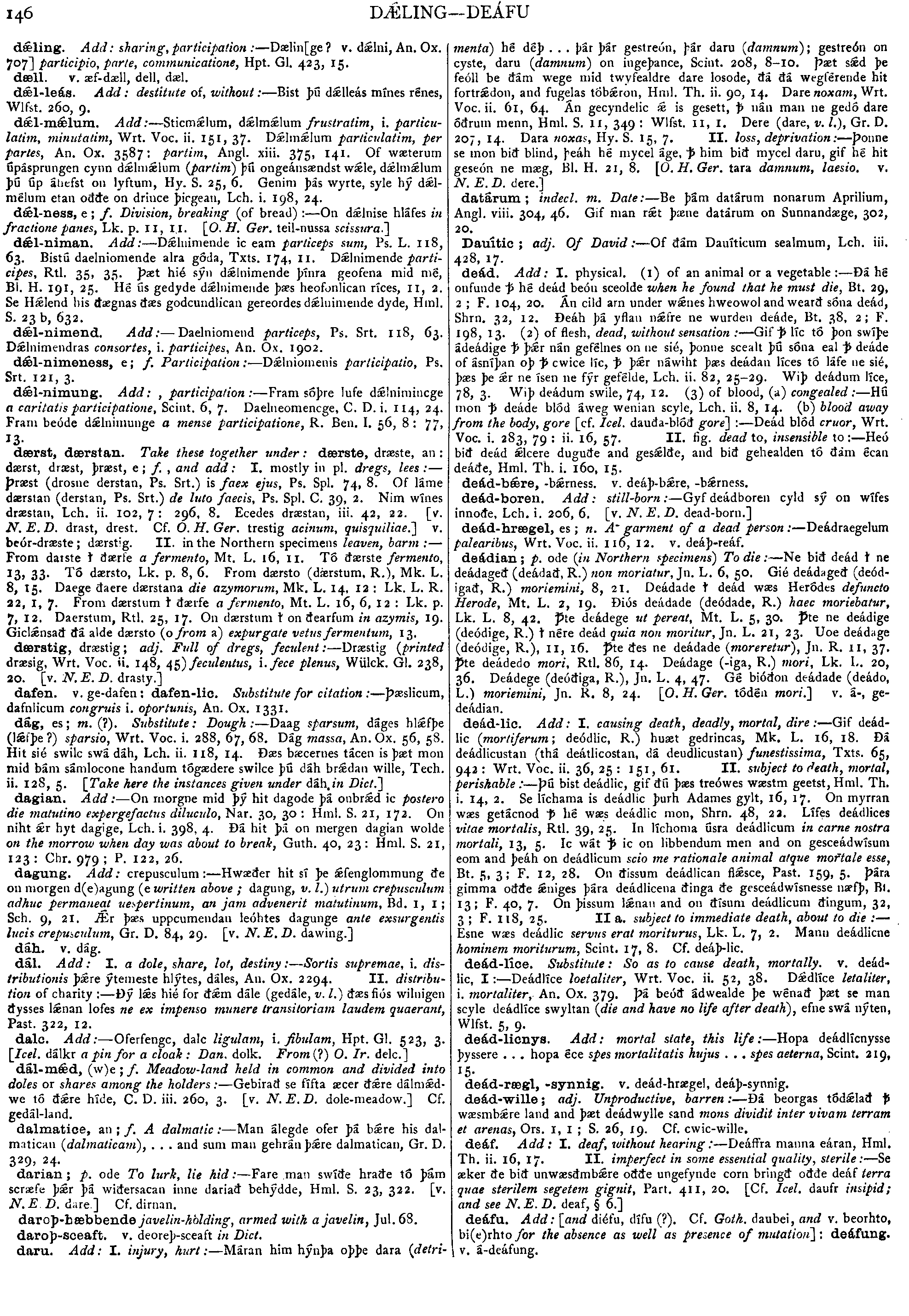
deád-lic.
Add:
I.
causing
death,
deadly,
mortal,
dire:--Gif
deád lic
(mortiferum;
deódlic,
R.)
huæt
gedrincas,
Mk.
L.
16,
18.
Ðá
deádlicustan
(thá
deátlicostan,
dá
deudlicustan)
funestissima,
Txts.
65,
942:
Wrt.
Voc.
ii.
36,
25:
151,
61.
II.
subject
to
death,
mortal,
perishable:--Þú
bist
deádlic,
gif
ðú
þæs
treówes
wæstm
geetst,
Hml.
Th.
i.
14,
2.
Se
líchama
is
deádlic
þurh
Adames
gylt,
16,
17.
On
myrran
wæs
getácnod
lic
(mortiferum;
deódlic,
R.)
huæt
gedrincas,
Mk.
L.
16,
18.
Ðá
deádlicustan
(thá
deátlicostan,
dá
deudlicustan)
funestissima,
Txts.
65,
942:
Wrt.
Voc.
ii.
36,
25:
151,
61.
II.
subject
to
death,
mortal,
perishable:--Þú
bist
deádlic,
gif
ðú
þæs
treówes
wæstm
geetst,
Hml.
Th.
i.
14,
2.
Se
líchama
is
deádlic
þurh
Adames
gylt,
16,
17.
On
myrran
wæs
getácnod
 hé
wæs
deádlic
mon,
Shrn.
48,
22.
Lífes
deádlices
vitae
mortalis,
Rtl.
39,
25.
In
líchoma
úsra
deádlicum
in
carne
nostra
mortali,
13,
5.
Ic
wát
ic
on
libbendum
men
and
on
gesceádwísum
eom
and
þeáh
on
deádlicum
scio
me
rationale
animal
atque
mortale
esse,
Bt.
5,
3;
F.
12,
28.
On
ðissum
deádlican
fl
hé
wæs
deádlic
mon,
Shrn.
48,
22.
Lífes
deádlices
vitae
mortalis,
Rtl.
39,
25.
In
líchoma
úsra
deádlicum
in
carne
nostra
mortali,
13,
5.
Ic
wát
ic
on
libbendum
men
and
on
gesceádwísum
eom
and
þeáh
on
deádlicum
scio
me
rationale
animal
atque
mortale
esse,
Bt.
5,
3;
F.
12,
28.
On
ðissum
deádlican
fl sce,
Past.
159,
5.
Þára
gimma
oððe
niges
þára
deádlicena
ðinga
ðe
gesceádwísnesse
næfþ,
Bl.
13;
F.
40,
7.
On
þissum
lnan
and
on
ðísum
deádlicum
ðingum,
32,
3;
F.
118,
25.
II
a.
subject
to
immediate
death,
about
to
die:--Esne
wæs
deádlic
servus
erat
moriturus,
Lk.
L.
7,
2.
Mann
deádlicne
hominem
moriturum,
Scint.
17,
8.
Cf.
deáþ-lic.
sce,
Past.
159,
5.
Þára
gimma
oððe
niges
þára
deádlicena
ðinga
ðe
gesceádwísnesse
næfþ,
Bl.
13;
F.
40,
7.
On
þissum
lnan
and
on
ðísum
deádlicum
ðingum,
32,
3;
F.
118,
25.
II
a.
subject
to
immediate
death,
about
to
die:--Esne
wæs
deádlic
servus
erat
moriturus,
Lk.
L.
7,
2.
Mann
deádlicne
hominem
moriturum,
Scint.
17,
8.
Cf.
deáþ-lic.
|
Source: Bosworth/Toller, page d0147, entry 18 View original page image as: [TIFF] [PNG] [View previous entry] [View next entry] |
[Comment on this entry] [View comments] |
The following entry has been hand-corrected once. |
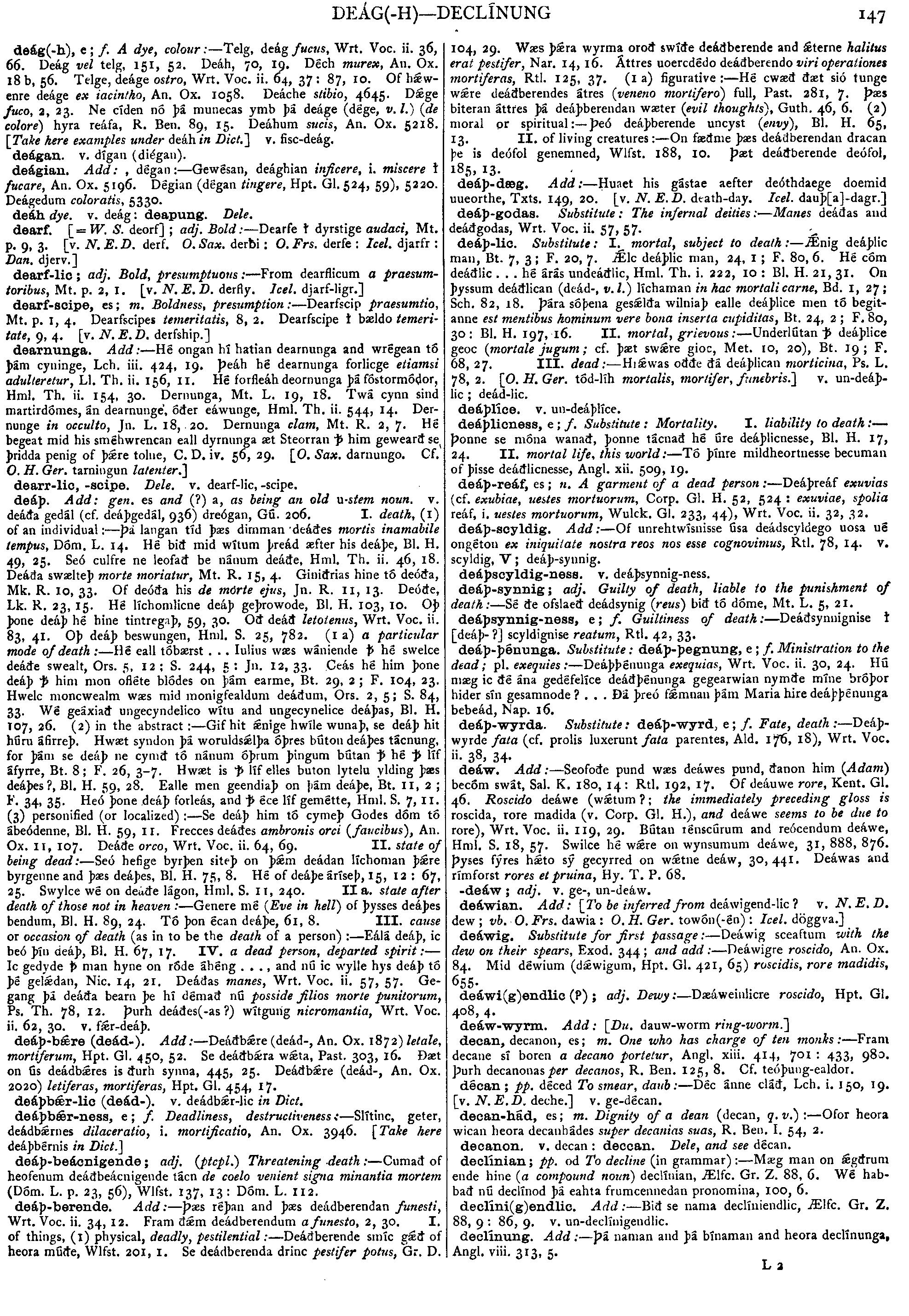
deáþ-lic.
Substitute:
I.
mortal,
subject
to
death:--Æ-acute;nig
deáþlic
man,
Bt.
7,
3;
F.
20,
7.
Æ-acute;lc
deáþlic
man,
24,
1;
F.
80,
6.
Hé
cóm
deáðlic
.
.
.
hé
árás
undeáðlic,
Hml.
Th.
i.
222,
10:
Bl.
H.
21,
31.
On
þyssum
deáðlican
(deád-,
v.
l.)
líchaman
in
hac
mortali
carne,
Bd.
1,
27;
Sch.
82,
18.
Þára
sóþena
geslða
wilniaþ
ealle
deáþlice
men
tó
begitanne
est
mentibus
hominum
vere
bona
inserta
cupiditas,
Bt.
24,
2;
F.
80,
30:
Bl.
H.
197,
16.
II.
mortal,
grievous:--Underlútan
deáþlice
geoc
(mortale
jugunt;
cf.
þæt
swre
gioc,
Met.
10,
20),
Bt.
19;
F.
68,
27.
III.
dead:--Hrwas
oððe
ðá
deáþlican
morticina,
Ps.
L.
78,
2.
[O.
H.
Ger.
tód-líh
mortalis,
mortifer,
funebris.]
v.
un-deáþ-lic;
deád-lic.
|
Source: Bosworth/Toller, page d0179, entry 27 View original page image as: [TIFF] [PNG] [View previous entry] [View next entry] |
[Comment on this entry] [View comments (1)] |
The following entry has been hand-corrected once. |
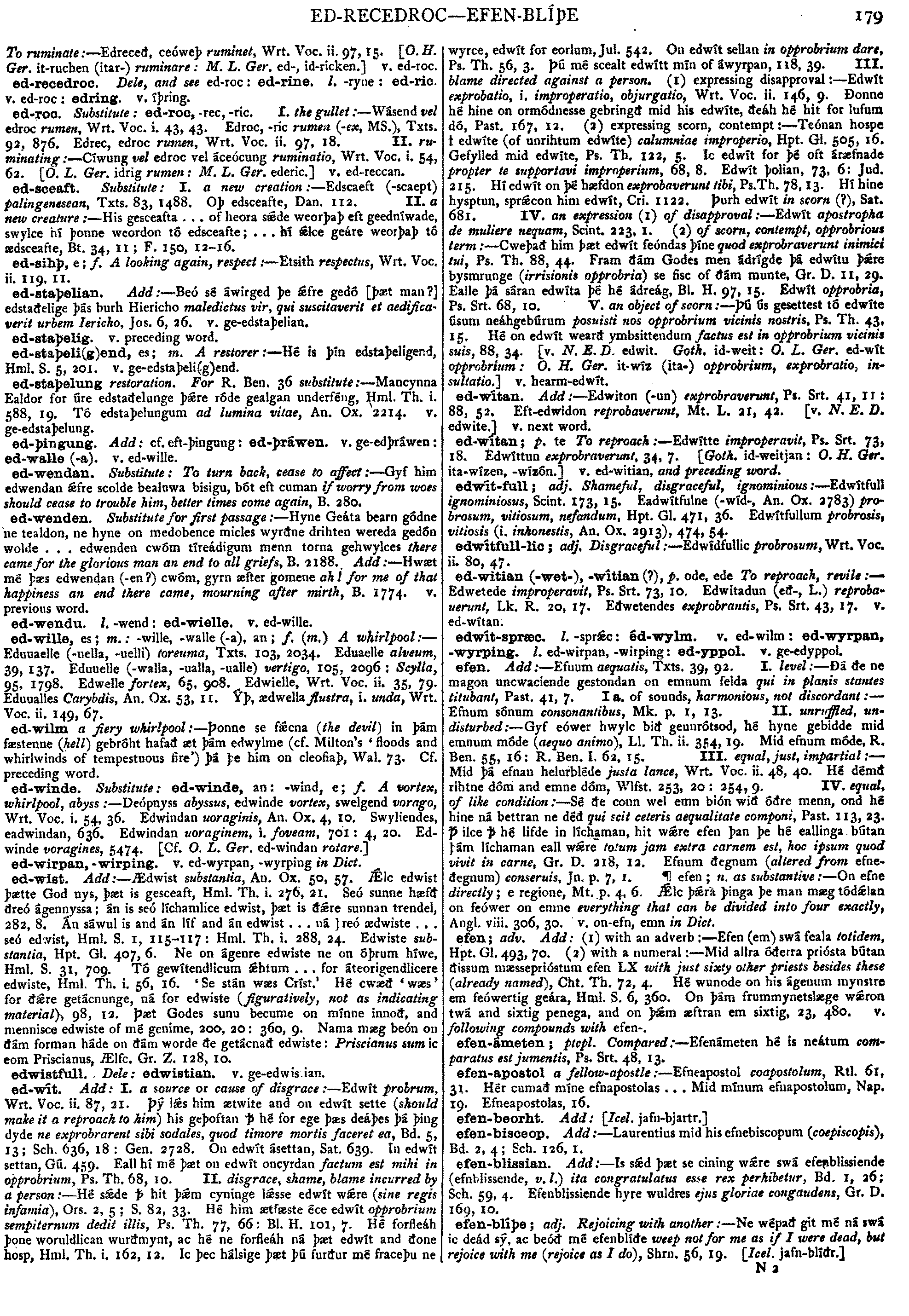
efen.
Add:--Efnum
aequatis,
Txts.
39,
92.
I.
level:--Ðá
ðe
ne
magon
uncwaciende
gestondan
on
emnum
felda
qui
in
planis
stantes
titubant,
Past.
41,
7.
I
a.
of
sounds,
harmonious,
not
discordant:--Efnum
sónum
consonantibus,
Mk.
p.
1,
13.
II.
unruffled,
undisturbed:--Gyf
eówer
hwylc
bið
geunrótsod,
hé
hyne
gebidde
mid
emnum
móde
(aequo
animo),
Ll.
Th.
ii.
354,
19.
Mid
efnum
móde,
R.
Ben.
55,
16:
R.
Ben.
I.
62,
15.
III.
equal,
just,
impartial:--Mid
þá
efnan
helurbléde
justa
lance,
Wrt.
Voc.
ii.
48,
40.
Hé
démð
rihtne
dóm
and
emne
dóm,
Wlfst.
253,
20:
254,
9.
IV.
equal,
of
like
condition:--Sé
ðe
conn
wel
emn
bión
wið
óðre
menn,
ond
hé
hine
ná
bettran
ne
déð
qui
scit
ceteris
aequalitate
componi,
Past.
113,
23.
Þ-bar;
ilce
hé
lifde
in
líchaman,
hit
wre
efen
þan
þe
hé
eallinga
bútan
þám
líchaman
eall
wre
totum
jam
extra
carnem
est,
hoc
ipsum
quod
vivit
in
carne,
Gr.
D.
218,
12.
Efnum
ðegnum
(altered
from
efneðegnum)
conseruis,
Jn.
p.
7,
1.

efen;
n.
as
substantive:--On
efne
directly;
e
regione,
Mt.
p.
4,
6.
Æ-acute;lc
þra
þinga
þe
man
mæg
tódlan
on
feówer
on
emne
everything
that
can
be
divided
into
four
exactly,
Angl.
viii.
306,
30.
v.
on-efn,
emn
in
Dict.
|
Source: Bosworth/Toller, page d0223, entry 13 View original page image as: [TIFF] [PNG] [View previous entry] [View next entry] |
[Comment on this entry] [View comments] |
The following entry has been hand-corrected once. |
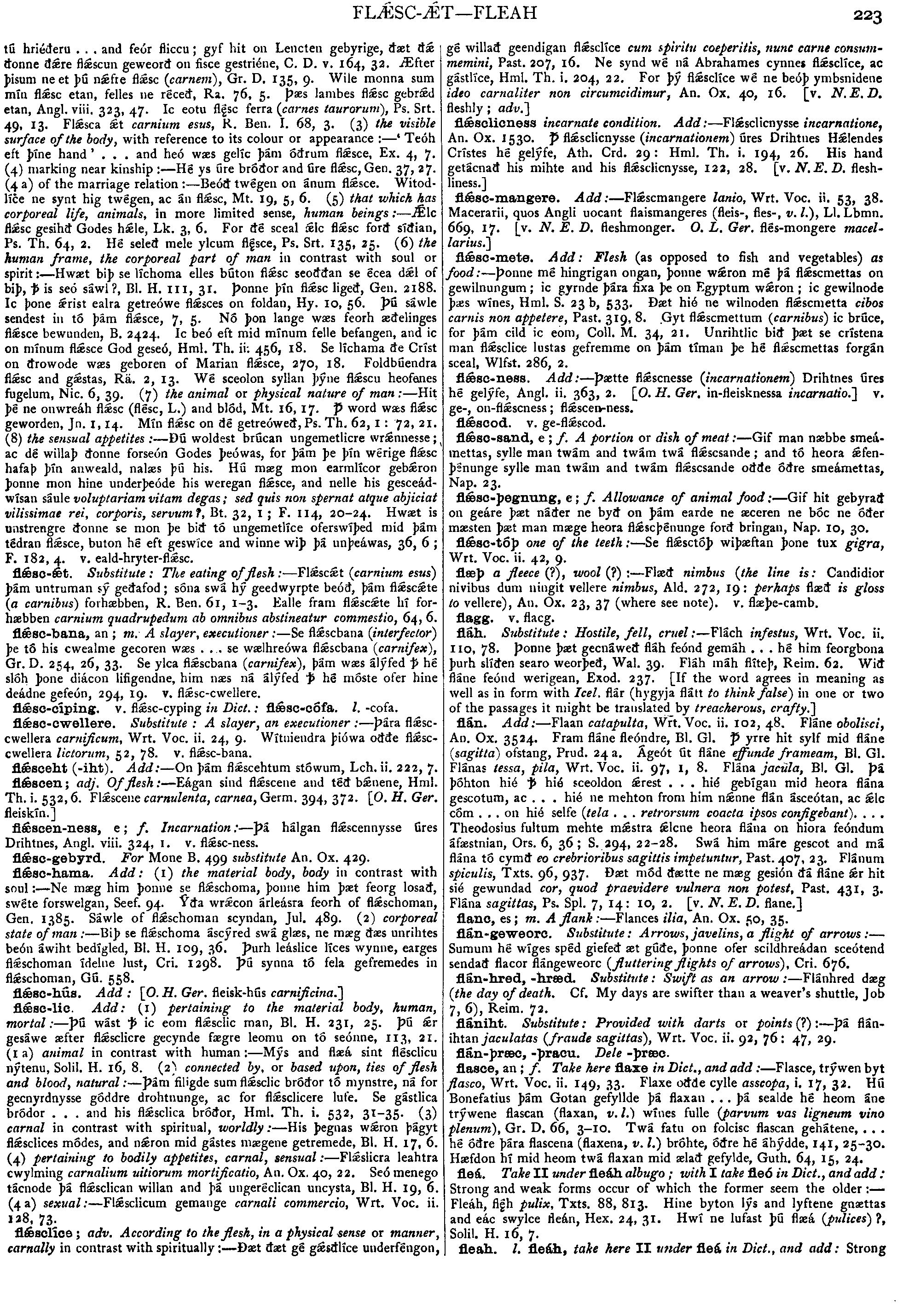
flsclíce;
adv.
According
to
the
flesh,
in
a
physical
sense
or
manner,
carnally
in
contrast
with
spiritually
:--
Ðæt
ðæt
gé
gsðlíce
underféngon,
gé
willað
geendigan
flsclíce
cum
spirítu
coeperitis,
nune
carne
consummemini,
Past.
207,
16.
Ne
synd
wé
ná
Abrahames
cynnet
flsclíce,
ac
gástlíce,
Hml.
Th.
i.
204,
22.
For
þý
flsclíce
wé
ne
beóþ
ymbsnidene
ideo
carnaliter
non
circumcidimur,
An.
Ox.
40,
16.
[v.
N.
E.
D.
fleshly
;
adv.]
|
Source: Bosworth/Toller, page d0242, entry 15 View original page image as: [TIFF] [PNG] [View previous entry] [View next entry] |
[Comment on this entry] [View comments] |
The following entry has been hand-corrected once. |
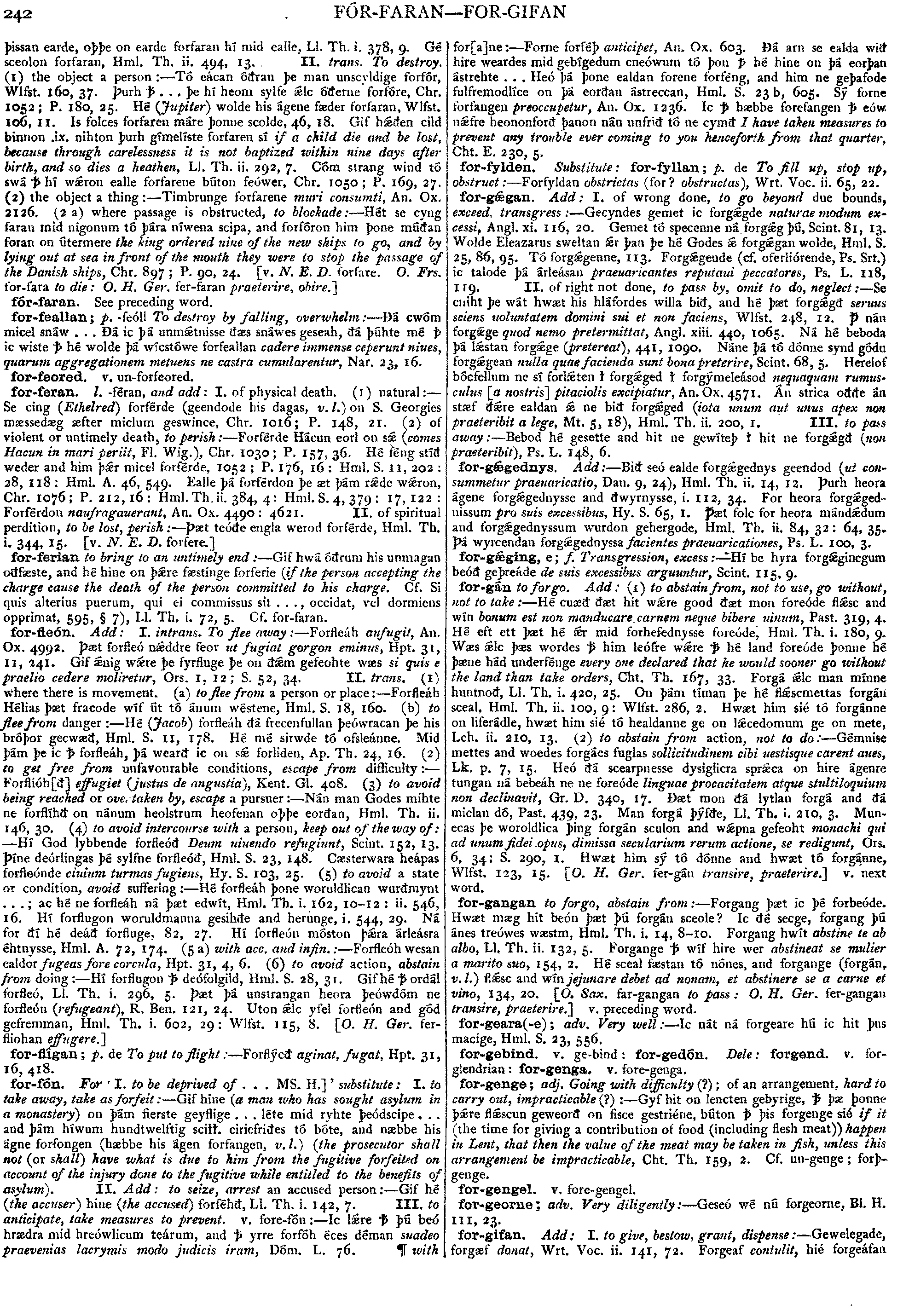
for-gangan
to
forgo,
abstain
from:--Forgang
þæt
ic
þé
forbeóde.
Hwæt
mæg
hit
beón
þæt
þú
forgán
sceole?
Ic
ðé
secge,
forgang
þú
ánes
treówes
wæstm,
Hml.
Th.
i.
14,
8-10.
Forgang
hwít
abstine
te
ab
albo,
Ll.
Th.
ii.
132,
5.
Forgange
wíf
hire
wer
abstineat
se
mulier
a
marito
suo,
154,
2.
Hé
sceal
fæstan
tó
nónes,
and
forgange
(forgán,
v.
l.)
flsc
and
wín
jejunare
debet
ad
nonam,
et
abstinere
se
a
carne
et
vino,
134,
20.
[O.
Sax.
far-gangan
to
pass:
O.
H.
Ger.
fer-gangan
transire,
praeterire.]
v.
preceding
word.
|
Source: Bosworth/Toller, page d0283, entry 18 View original page image as: [TIFF] [PNG] [View previous entry] [View next entry] |
[Comment on this entry] [View comments] |
The following entry has been hand-corrected once. |
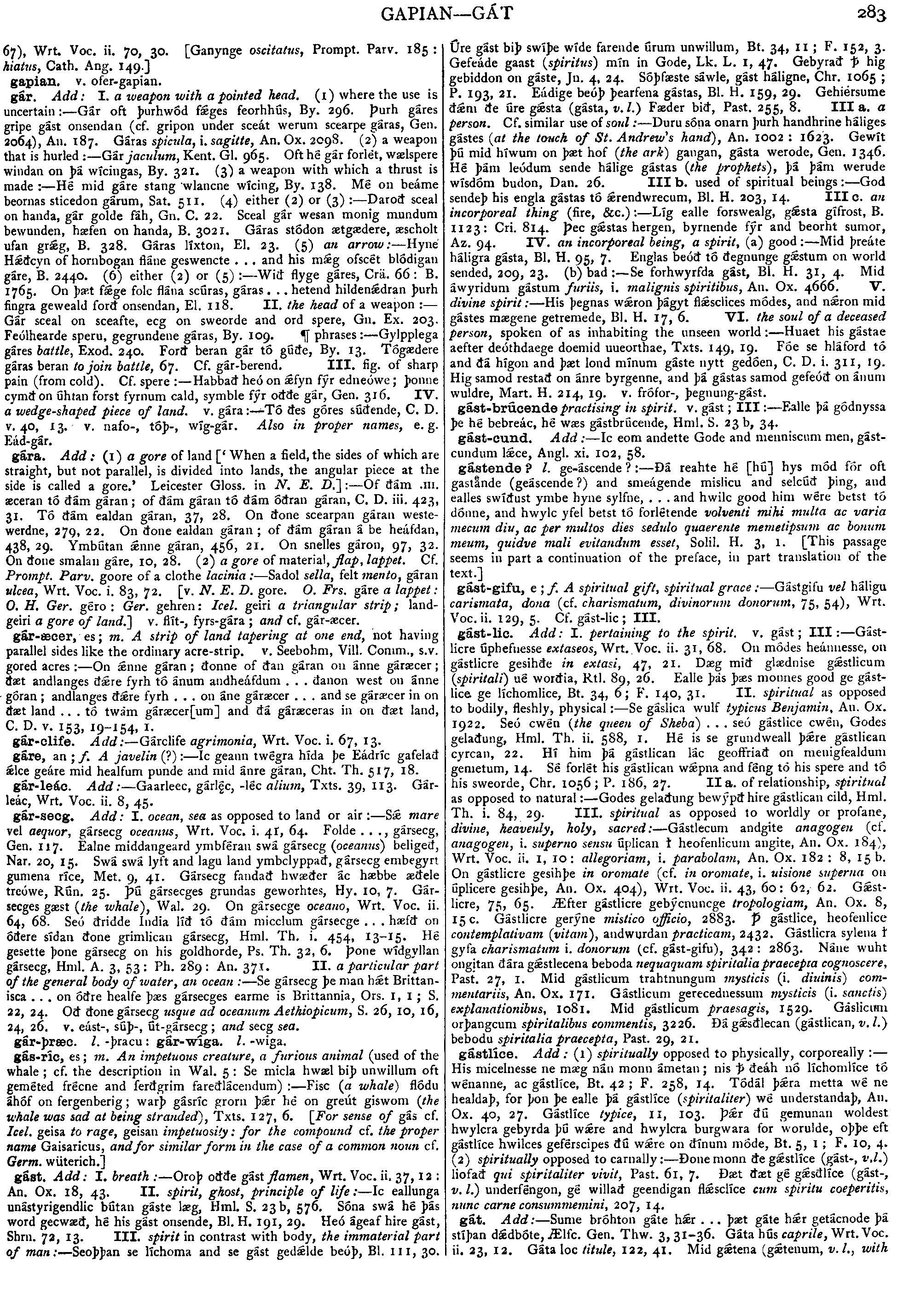
g stl
stl ce.
Add:
(1)
spiritually
opposed
to
physically,
corporeally
:--
His
micelnesse
ne
mæg
nn
monn
metan;
nis
ce.
Add:
(1)
spiritually
opposed
to
physically,
corporeally
:--
His
micelnesse
ne
mæg
nn
monn
metan;
nis
 eáh
no
lchomlce
t
eáh
no
lchomlce
t w
w nanne,
ac
gstlce,
Bt.
42
;
F.
258,
14.
Tdl
þ
nanne,
ac
gstlce,
Bt.
42
;
F.
258,
14.
Tdl
þ ra
metta
w
ne
healdaþ,
for
þon
þe
ealle
þ
gstlce
(spiritaliter)
w
understandaþ,
An.
Ox.
40,
27.
Gstlce
typice,
II,
103.
Þr
u
gemunan
woldest
hwylcra
gebyrda
þ
ra
metta
w
ne
healdaþ,
for
þon
þe
ealle
þ
gstlce
(spiritaliter)
w
understandaþ,
An.
Ox.
40,
27.
Gstlce
typice,
II,
103.
Þr
u
gemunan
woldest
hwylcra
gebyrda
þ wre
and
hwylcra
burgwara
for
worulde,
oþþe
eft
gstlce
hwilces
gefrscipes
wre
on
num
mde,
Bt.
5,
l
;
F.
10,
4.
(2)
spiritually
opposed
to
carnally
:--
Ðone
monn
e
gstlce
(gst-,
v.
l.)
liofa
qui
spiritaliter
vivit,
Past.
61,
7.
Ðæt
æt
g
gslce
(gst-,
v.
l.)
underfngon,
g
willa
geendigan
flsclce
cum
spiritu
coeperitis,
nunc
carne
consummemini,
207,
14.
wre
and
hwylcra
burgwara
for
worulde,
oþþe
eft
gstlce
hwilces
gefrscipes
wre
on
num
mde,
Bt.
5,
l
;
F.
10,
4.
(2)
spiritually
opposed
to
carnally
:--
Ðone
monn
e
gstlce
(gst-,
v.
l.)
liofa
qui
spiritaliter
vivit,
Past.
61,
7.
Ðæt
æt
g
gslce
(gst-,
v.
l.)
underfngon,
g
willa
geendigan
flsclce
cum
spiritu
coeperitis,
nunc
carne
consummemini,
207,
14.
|
Source: Bosworth/Toller, page d0313, entry 11 View original page image as: [TIFF] [PNG] [View previous entry] [View next entry] |
[Comment on this entry] [View comments] |
The following entry has been hand-corrected once. |
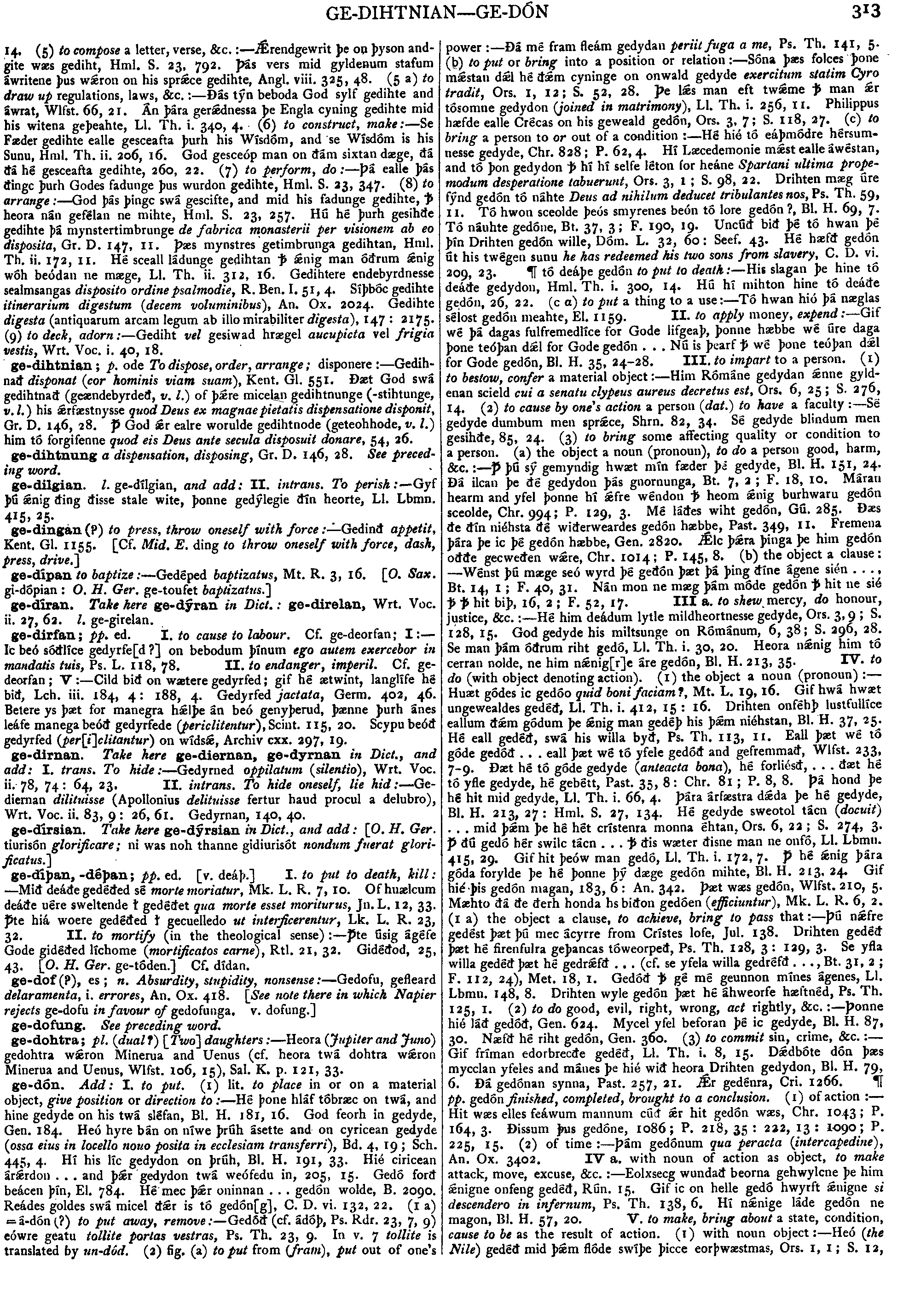
ge-díþan,
-déþan;
pp.
ed.
[v.
deáþ.]
I.
to
put
to
death,
kill
:--
Mið
deáðe
gedéðed
sé
morte
moriatur,
Mk.
L.
R.
7,
10.
Of
huælcum
deáðe
uére
sweltende
 gedéðet
qua
morte
esset
moriturus,
Jn.
L.
12,
33.
Þte
UNCERTAIN
hiá
woere
gedéðed
gecuelledo
ut
interfaerentur,
Lk.
L.
R.
23,
32.
II.
to
mortify
(in
the
theological
sense)
:--
Þte
UNCERTAIN
úsig
ágéfe
Gode
gidéðed
líchome
(mortificatos
carne),
Rtl.
21,
32.
Gidéðod,
25,
43.
[O.
H.
Ger.
ge-tóden.]
Cf.
dídan.
gedéðet
qua
morte
esset
moriturus,
Jn.
L.
12,
33.
Þte
UNCERTAIN
hiá
woere
gedéðed
gecuelledo
ut
interfaerentur,
Lk.
L.
R.
23,
32.
II.
to
mortify
(in
the
theological
sense)
:--
Þte
UNCERTAIN
úsig
ágéfe
Gode
gidéðed
líchome
(mortificatos
carne),
Rtl.
21,
32.
Gidéðod,
25,
43.
[O.
H.
Ger.
ge-tóden.]
Cf.
dídan.
|
Source: Bosworth/Toller, page d0361, entry 15 View original page image as: [TIFF] [PNG] [View previous entry] [View next entry] |
[Comment on this entry] [View comments] |
The following entry has been hand-corrected once. |
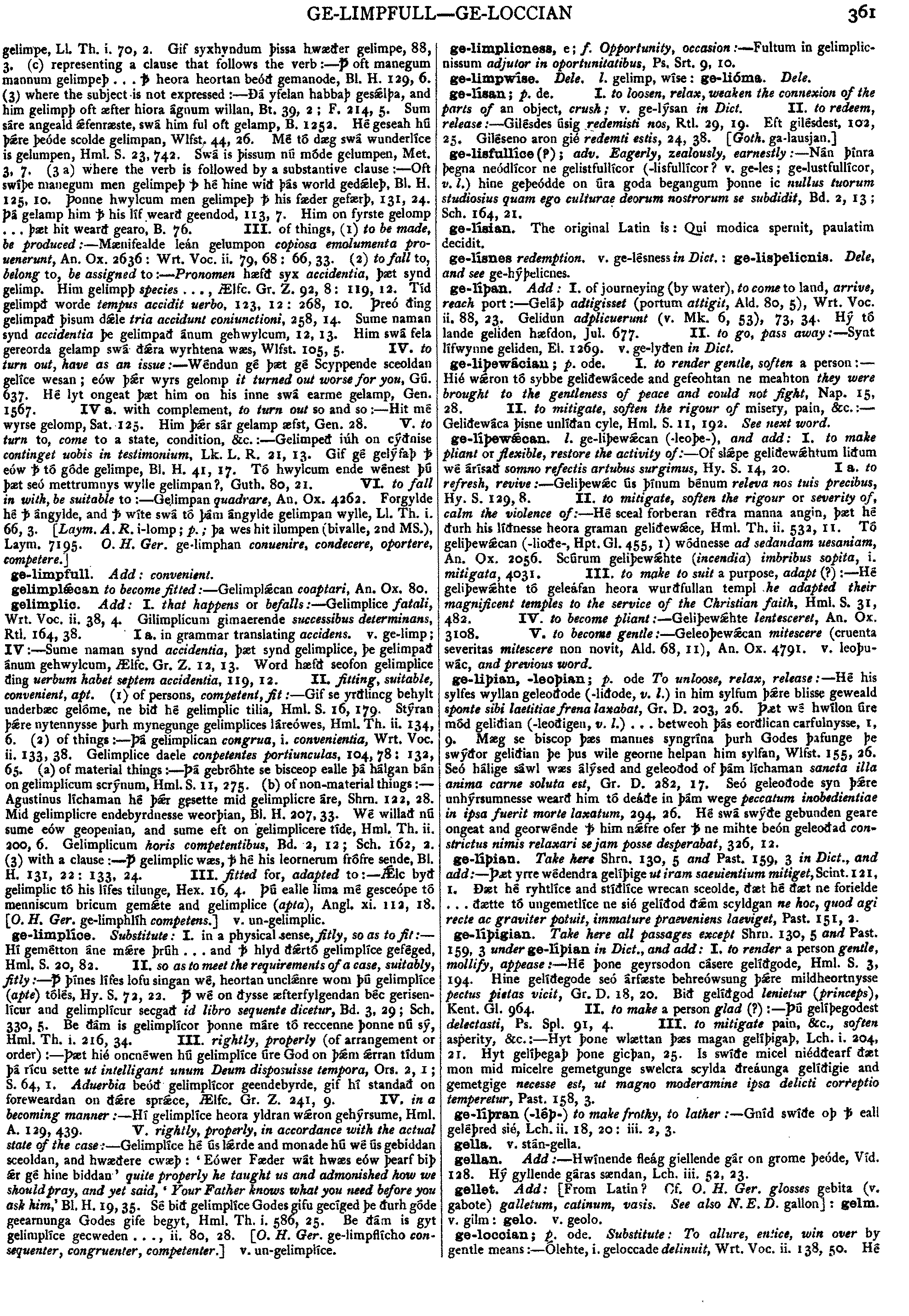
ge-liþian,
-leoþian;
p.
ode
To
unloose,
relax,
release
:--
Hé
his
sylfes
wyllan
geleoðode
(-liðode,
v.
l.)
in
him
sylfum
þre
blisse
geweald
sponte
sibi
laetitiae
frena
laxabat,
Gr.
D.
203,
26.
Þæt
wé
hwílon
úre
mód
geliðian
(-leoðigen,
v.
l.)
.
.
.
betweoh
þás
eorðlican
carfulnysse,
l,
9.
Mæg
se
biscop
þæs
mannes
syngrína
þurh
Godes
þafunge
þe
swýðor
geliðian
þe
þus
wile
georne
helpan
him
sylfan,
Wlfst.
155,
26.
Seó
hálige
sáwl
wæs
álysed
and
geleoðod
of
þám
líchaman
sancta
illa
anima
carne
soluta
est,
Gr.
D.
282,
17.
Seó
geleoðode
syn
þre
unhýrsumnesse
wearð
him
tó
deáde
in
þám
wege
peccatum
inobedientiae
in
ipsa
fuerit
morte
laxatum,
294,
26.
Hé
swá
swýðe
gebunden
geare
ongeat
and
georwénde
him
nfre
ofer
ne
mihte
beón
geleoðad
con-strictus
nimis
relaxari
sejam
posse
desperabat,
326,
12.
|
Source: Bosworth/Toller, page d0404, entry 5 View original page image as: [TIFF] [PNG] [View previous entry] [View next entry] |
[Comment on this entry] [View comments] |
The following entry has been hand-corrected once. |
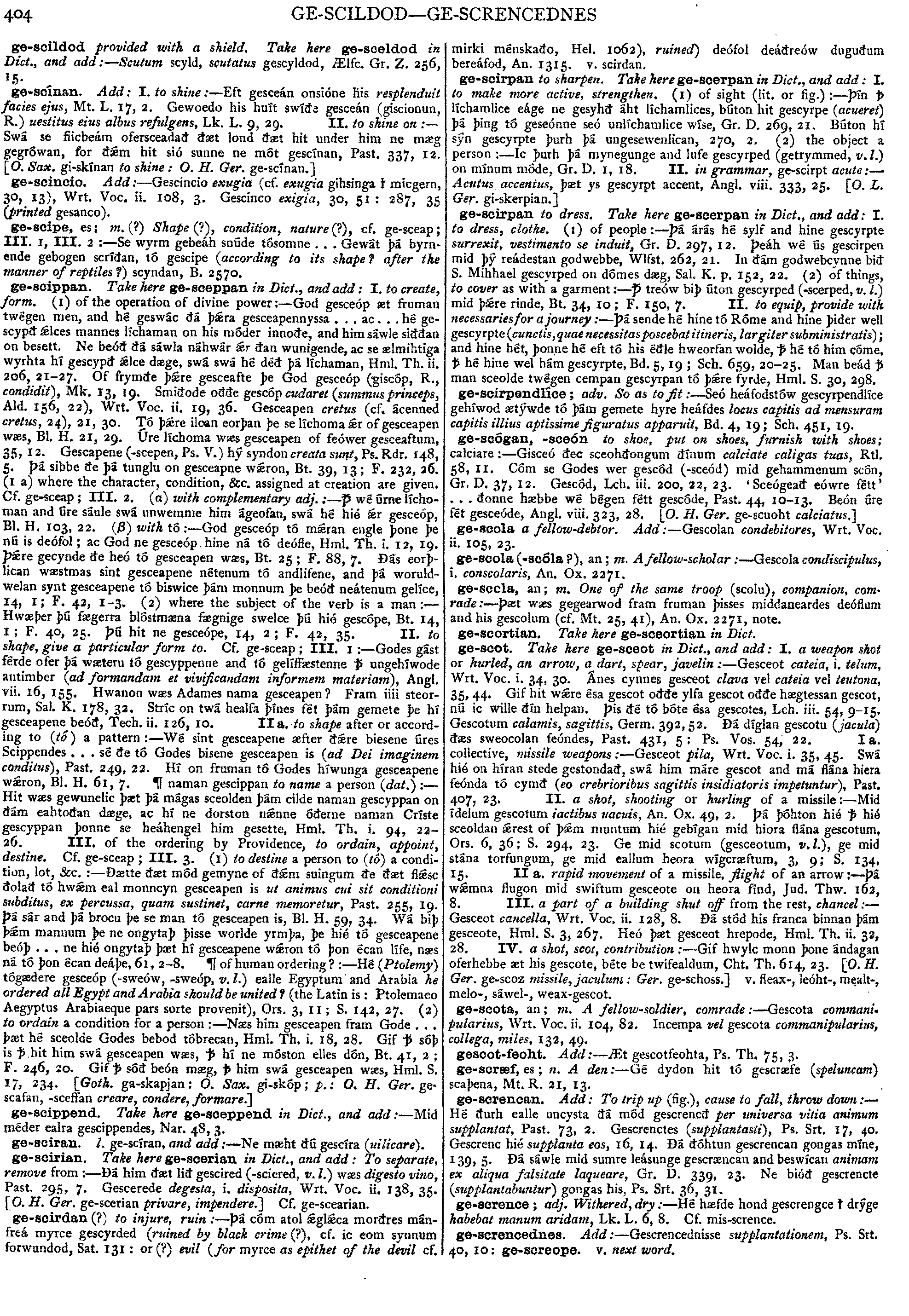
ge-scippan.
Take
here
ge-sceppan
in
Dict.,
and
add:
I.
to
create,
form.
(l)
of
the
operation
of
divine
power
:--
God
gesceóp
æt
fruman
twégen
men,
and
hé
geswác
ðá
þra
gesceapennyssa
.
.
.
ac
.
.
.
hé
gescypð
lces
mannes
líchaman
on
his
móder
innoðe,
and
him
sáwle
siððan
on
besett.
Ne
beóð
ðá
sáwla
náhwár
r
ðan
wunigende,
ac
se
ælmihtiga
wyrhta
hí
gescypð
lce
dæge,
swá
swá
hé
déð
þá
líchaman,
Hml.
Th.
ii.
206,
21-27.
Of
frymðe
þre
gesceafte
þe
God
gesceóp
(giscóp,
R.,
condidit),
Mk.
13,
19.
Smiðode
oððe
gescóp
cudaret
(summus
princeps,
Ald.
156,
22),
Wrt.
Voc.
ii.
19,
36.
Gesceapen
cretus
(cf.
ácenned
cretus,
24),
21,
30.
Tó
þre
ilcan
eorþan
þe
se
líchoma
r
of
gesceapen
wæs,
Bl.
H.
21,
29.
Úre
líchoma
wæs
gesceapen
of
feówer
gesceaftum,
35,
12.
Gescapene
(-scepen,
Ps.V.)
hý
syndon
creata
sunt,
Ps.
Rdr.
148,
5.
Þá
sibbe
ðe
þá
tunglu
on
gesceapne
wron,
Bt.
39,
13;
F.
232,
26.
(l
a)
where
the
character,
condition,
&c.
assigned
at
creation
are
given.
Cf.
ge-sceap
;
III.
2.
(a)
with
complementary
adj.
:--
Þ
UNCERTAIN
weé
úrne
líchoman
and
úre
sáule
swá
unwemme
him
ágeofan,
swá
hé
hié
r
gesceóp,
Bl.
H.
103,
22.
( )
with
tó
:--
God
gesceóp
tó
mran
engle
þone
þe
nú
is
deófol;
ac
God
ne
gesceóp
hine
ná
tó
deófle,
Hml.
Th.
i.
12,
19.
Þre
gecynde
ðe
heó
tó
gesceapen
wæs,
Bt.
25
;
F.
88,
7.
Ðás
eorþlican
wæstmas
sint
gesceapene
nétenum
tó
andlifene,
and
þá
woruldwelan
synt
gesceapene
tó
biswice
þám
monnum
þe
beóð
neátenum
gelíce,
14,
i;
F.
42,
1-3.
(2)
where
the
subject
of
the
verb
is
a
man
:--
Hwæþer
þú
fægerra
blóstmæna
fægnige
swelce
þú
hié
gescópe.
Bt.
14,
I
;
F.
40,
25.
Þú
hit
ne
gesceópe,
14,
2
;
F.
42,
35.
II.
to
shape,
give
a
particular
form
to.
Cf.
ge-sceap
;
III.
I
:--
Godes
gást
férde
ofer
þá
wæteru
tó
gescyppenne
and
tó
gelíffæstenne
ungehíwode
antimber
(ad
formandam
et
vivificandam
informem
materiam),
Angl.
vii.
16,
155.
Hwanon
wæs
Adames
nama
gesceapen?
Fram
iiii
steorrum,
Sal.
K.
178,
32.
Stríc
on
twá
healfa
þínes
fét
þám
gemete
þe
hí
gesceapene
beóð,
Tech.
ii.
126,
10.
II
a.
to
shape
after
or
according
to
(to)
a
pattern
:--
Wé
sint
gesceapene
æfter
ðre
biesene
úres
Scippendes.
.
.
sé
ðe
tó
Godes
bisene
gesceapen
is
(ad
Dei
imaginem
conditus),
Past.
249,
22.
Hí
on
fruman
tó
Godes
híwunga
gesceapene
wron,
Bl.
H.
61,
7.

naman
gescippan
to
name
a
person
(dat.)
:--
Hit
wæs
gewunelic
þæt
þá
mágas
sceolden
þám
cilde
naman
gescyppan
on
ðám
eahtoðan
dæge,
ac
hí
ne
dorston
nnne
óðerne
naman
Críste
gescyppan
þonne
se
heáhengel
him
gesette.
Hml.
Th.
i.
94,
22-26.
III.
of
the
ordering
by
Providence,
to
ordain,
appoint,
destine.
Cf.
ge-sceap
;
III.
3.
(l)
to
destine
a
person
to
(tó)
a
condition,
lot,
&c.
:--
Ðætte
ðæt
mód
gemyne
of
ðm
suingum
ðe
ðæt
flsc
ðolað
tó
hwm
eal
monncyn
gesceapen
is
ut
animus
cui
sit
conditioni
snbditus,
ex
percussa,
quam
sustinet,
carne
memoretur,
Past.
255,
19.
Þá
sár
and
þá
brocu
þe
se
man
tó
gesceapen
is,
Bl.
H.
59,
34.
Wá
biþ
þm
mannum
þe
ne
ongytaþ
þisse
worlde
yrmþa,
þe
hié
tó
gesceapene
beóþ
.
.
.
ne
hié
ongytaþ
þæt
hí
gesceapene
wron
tó
þon
écan
lífe,
næs
ná
tó
þon
écan
deáþe,
6i,
2-8.

of
human
ordering
?
:--
Hé
(Ptolemy)
tógædere
gesceóp
(-sweów,
-sweóp,
v.l.)
ealle
Egyptum
and
Arabia
he
ordered
all
Egypt
and
Arabia
should
be
united
?
(the
Latin
is:
Ptolemaeo
Aegyptus
Arabiaeque
pars
sorte
provenit),
Ors.
3,
II;
S.
142,
27.
(2)
to
ordain
a
condition
for
a
person
:--
Næs
him
gesceapen
fram
Gode
.
,
.
þæt
hé
sceolde
Godes
bebod
tóbrecan,
Hml.
Th.
i.
18,
28.
Gif
sóþ
is
hit
him
swá
gesceapen
wæs,
hí
ne
móston
elles
dón,
Bt.
41,
2
;
F.
246,
20.
Gif
sóð
beón
mæg,
him
swá
gesceapen
wæs,
Hml.
S.
17,
234.
(Goth.
ga-skapjan:
O.Sax.
gi-skóp;
p.
;
O.H.Ger.
ge-scafan,
-sceffan
creare,
condere,
formare.)
)
with
tó
:--
God
gesceóp
tó
mran
engle
þone
þe
nú
is
deófol;
ac
God
ne
gesceóp
hine
ná
tó
deófle,
Hml.
Th.
i.
12,
19.
Þre
gecynde
ðe
heó
tó
gesceapen
wæs,
Bt.
25
;
F.
88,
7.
Ðás
eorþlican
wæstmas
sint
gesceapene
nétenum
tó
andlifene,
and
þá
woruldwelan
synt
gesceapene
tó
biswice
þám
monnum
þe
beóð
neátenum
gelíce,
14,
i;
F.
42,
1-3.
(2)
where
the
subject
of
the
verb
is
a
man
:--
Hwæþer
þú
fægerra
blóstmæna
fægnige
swelce
þú
hié
gescópe.
Bt.
14,
I
;
F.
40,
25.
Þú
hit
ne
gesceópe,
14,
2
;
F.
42,
35.
II.
to
shape,
give
a
particular
form
to.
Cf.
ge-sceap
;
III.
I
:--
Godes
gást
férde
ofer
þá
wæteru
tó
gescyppenne
and
tó
gelíffæstenne
ungehíwode
antimber
(ad
formandam
et
vivificandam
informem
materiam),
Angl.
vii.
16,
155.
Hwanon
wæs
Adames
nama
gesceapen?
Fram
iiii
steorrum,
Sal.
K.
178,
32.
Stríc
on
twá
healfa
þínes
fét
þám
gemete
þe
hí
gesceapene
beóð,
Tech.
ii.
126,
10.
II
a.
to
shape
after
or
according
to
(to)
a
pattern
:--
Wé
sint
gesceapene
æfter
ðre
biesene
úres
Scippendes.
.
.
sé
ðe
tó
Godes
bisene
gesceapen
is
(ad
Dei
imaginem
conditus),
Past.
249,
22.
Hí
on
fruman
tó
Godes
híwunga
gesceapene
wron,
Bl.
H.
61,
7.

naman
gescippan
to
name
a
person
(dat.)
:--
Hit
wæs
gewunelic
þæt
þá
mágas
sceolden
þám
cilde
naman
gescyppan
on
ðám
eahtoðan
dæge,
ac
hí
ne
dorston
nnne
óðerne
naman
Críste
gescyppan
þonne
se
heáhengel
him
gesette.
Hml.
Th.
i.
94,
22-26.
III.
of
the
ordering
by
Providence,
to
ordain,
appoint,
destine.
Cf.
ge-sceap
;
III.
3.
(l)
to
destine
a
person
to
(tó)
a
condition,
lot,
&c.
:--
Ðætte
ðæt
mód
gemyne
of
ðm
suingum
ðe
ðæt
flsc
ðolað
tó
hwm
eal
monncyn
gesceapen
is
ut
animus
cui
sit
conditioni
snbditus,
ex
percussa,
quam
sustinet,
carne
memoretur,
Past.
255,
19.
Þá
sár
and
þá
brocu
þe
se
man
tó
gesceapen
is,
Bl.
H.
59,
34.
Wá
biþ
þm
mannum
þe
ne
ongytaþ
þisse
worlde
yrmþa,
þe
hié
tó
gesceapene
beóþ
.
.
.
ne
hié
ongytaþ
þæt
hí
gesceapene
wron
tó
þon
écan
lífe,
næs
ná
tó
þon
écan
deáþe,
6i,
2-8.

of
human
ordering
?
:--
Hé
(Ptolemy)
tógædere
gesceóp
(-sweów,
-sweóp,
v.l.)
ealle
Egyptum
and
Arabia
he
ordered
all
Egypt
and
Arabia
should
be
united
?
(the
Latin
is:
Ptolemaeo
Aegyptus
Arabiaeque
pars
sorte
provenit),
Ors.
3,
II;
S.
142,
27.
(2)
to
ordain
a
condition
for
a
person
:--
Næs
him
gesceapen
fram
Gode
.
,
.
þæt
hé
sceolde
Godes
bebod
tóbrecan,
Hml.
Th.
i.
18,
28.
Gif
sóþ
is
hit
him
swá
gesceapen
wæs,
hí
ne
móston
elles
dón,
Bt.
41,
2
;
F.
246,
20.
Gif
sóð
beón
mæg,
him
swá
gesceapen
wæs,
Hml.
S.
17,
234.
(Goth.
ga-skapjan:
O.Sax.
gi-skóp;
p.
;
O.H.Ger.
ge-scafan,
-sceffan
creare,
condere,
formare.)
|
Source: Bosworth/Toller, page d0435, entry 11 View original page image as: [TIFF] [PNG] [View previous entry] [View next entry] |
[Comment on this entry] [View comments] |
The following entry has been hand-corrected once. |
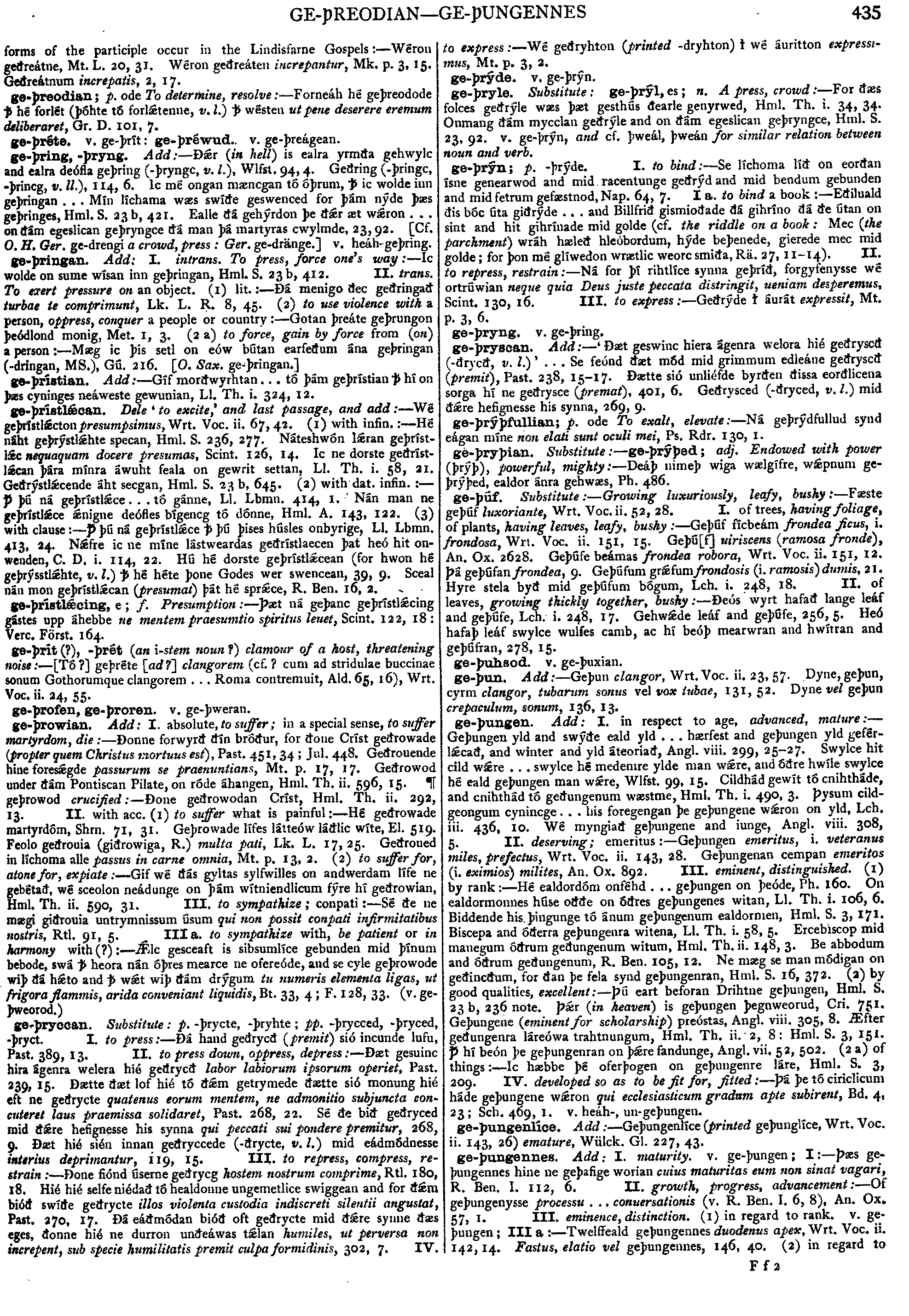
ge-þrowian.
Add:
I.
absolute,
to
suffer;
in
a
special
sense,
to
suffer
martyrdom,
die
:--
Ðonne
forwyrð
ðín
bróður,
for
ðone
Críst
geðrowade
(propter
quem
Christus
mortuus
est),
Past.
451,
34;
Jul.
448.
Geðrouende
hine
foresgde
passurum
se
praenuntians,
Mt.
p.
17,
17.
Geðrowod
under
ðám
Pontiscan
Pilate,
on
róde
áhangen,
Hml.
Th.
ii.
596,
15.

geþrowod
crucified
:--
Ðone
geðrowodan
Críst,
Hml.
Th.
ii.
292,
13.
II.
with
acc.
(1)
to
suffer
what
is
painful
:--
Hé
geðrowade
martyrdóm,
Shrn.
71,
31.
Geþrowade
lífes
látteów
láðlic
wíte,
El.
519.
Feolo
geðrouia
(giðrowiga,
R.)
multa
pati,
Lk.
L.
17,
25.
Geðroued
in
líchoma
alle
passus
in
carne
omnia,
Mt.
p.
13,
2.
(2)
to
suffer
for,
atone
for,
expiate
:--
Gif
wé
ðás
gyltas
sylfwilles
on
andwerdam
lífe
ne
gebétað,
wé
sceolon
neádunge
on
þám
wítniendlicum
fýre
hí
geðrowian,
Hml.
Th.
ii.
590,
31.
III.
to
sympathize;
conpati
:--
Sé
ðe
ne
mægi
giðrouia
untrymnissum
úsum
qui
non
possit
conpati
infirmitatibus
nostris,
Rtl.
91,
5.
III
a.
to
sympathize
with,
be
patient
or
in
harmony
with
(?)
:--
Æ-acute;lc
gesceaft
is
sibsumlíce
gebunden
mid
þínum
bebode,
swá
heora
nán
óþres
mearce
ne
ofereóde,
and
se
cyle
geþrowode
wiþ
ðá
hto
and
wt
wiþ
ðám
drýgum
tu
numeris
elementa
ligas,
ut
frigora
flammis,
arida
conveniant
liquidis,
Bt.
33,
4;
F.
128,
33.
(v.
ge-þweorod.)
| Result Page: |  |
Previous | 1 2 3 | Next |  |
Germanic Lexicon Project (main page)
This search system was written by
Sean Crist
Please consider
volunteering
to correct the data in these online dictionaries.
No rights reserved. Feel free to use these data in any way you please.