|
|

Search for caput again, using less strict matching (96 results)
|
Source: Bosworth/Toller, page d0252, entry 13 View original page image as: [TIFF] [PNG] [View previous entry] [View next entry] |
[Comment on this entry] [View comments] |
The following entry has been hand-corrected once. |
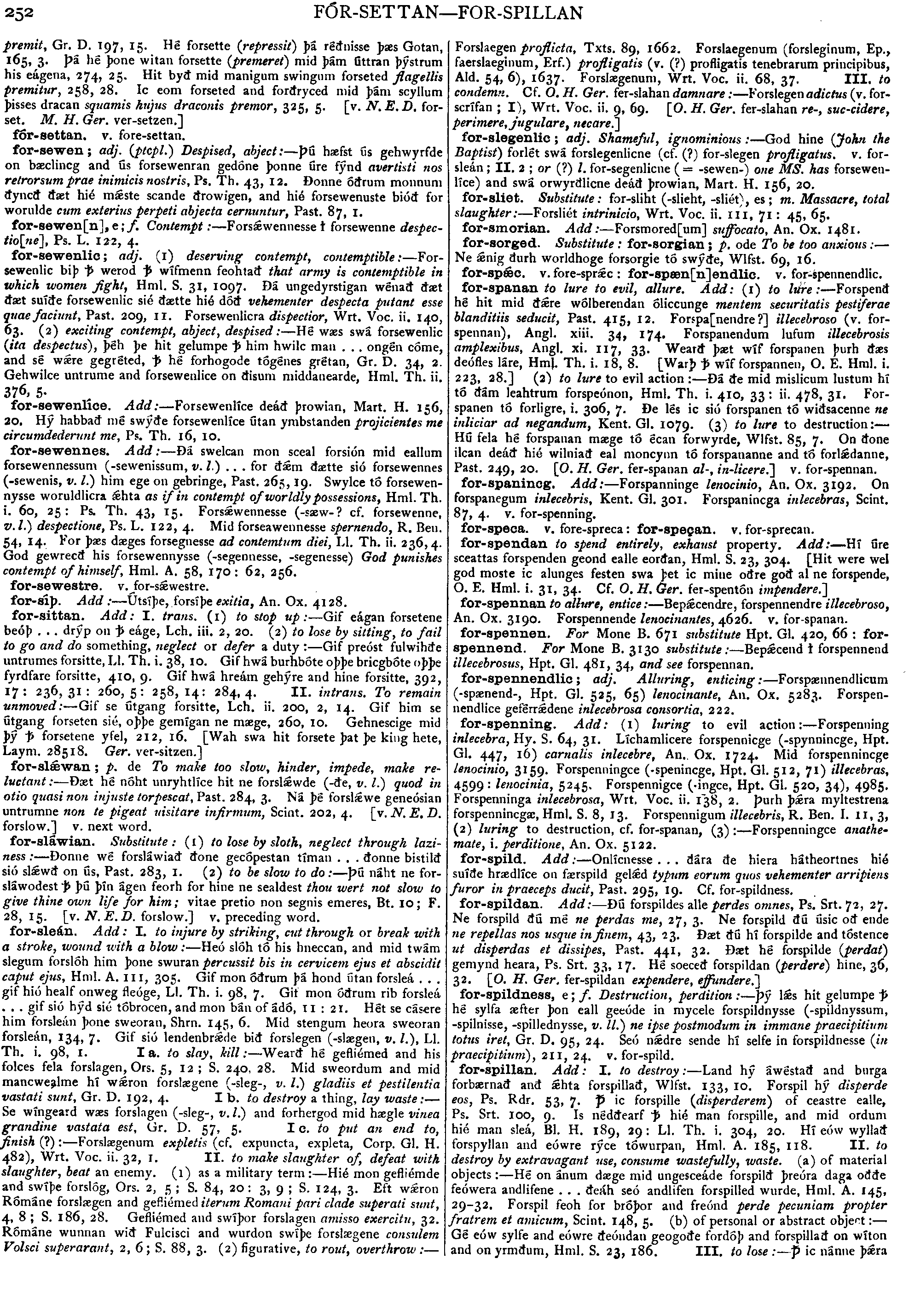
for-sleán.
Add:
I.
to
injure
by
striking,
cut
through
or
break
with
a
stroke,
wound
with
a
blow
:--
Heó
slóh
tó
his
hneccan,
and
mid
twám
slegum
forslóh
him
þone
swuran
percussit
bis
in
cervicem
ejus
et
abscidit
caput
ejus,
Hml.
A.
111,
305.
Gif
mon
óðrum
þá
hond
útan
forsleá
...
gif
hió
healf
onweg
fleóge,
Ll.
Th.
i.
98,
7.
Gif
mon
óðrum
rib
forsleá
...
gif
sió
hýd
sié
tóbrocen,
and
mon
bán
of
ádó,
11:
21.
Hét
se
cásere
him
forsleán
þone
sweoran,
Shrn.
145,
6.
Mid
stengum
heora
sweoran
forsleán,
134,
7.
Gif
sió
lendenbr de
bið
forslegen
(-slægen,
v.
l.),
Ll.
Th.
i.
98,
1.
I
a.
to
slay,
kill
:--
Wearð
hé
gefliémed
and
his
folces
fela
forslagen,
Ors.
5,
12;
S.
240,
28.
Mid
sweordum
and
mid
mancwealme
hí
wron
forslægene
(-sleg-,
v.
l.)
gladiis
et
pestilentia
vastati
sunt,
Gr.
D.
192,
4.
I
b.
to
destroy
a
thing,
lay
waste
:--
Se
wíngeard
wæs
forslagen
(-sleg-,
v.
l.)
and
forhergod
mid
hægle
vinea
grandine
vastata
est,
Gr.
D.
57,
5.
I
c.
to
put
an
end
to,
finish
(?)
:--
Forslægenum
expletis
(cf.
expuncta,
expleta,
Corp.
Gl.
H.
482),
Wrt.
Voc.
ii.
32,
1.
II.
to
make
slaughter
of,
defeat
with
slaughter,
beat
an
enemy.
(1)
as
a
military
term
:--
Hié
mon
gefliémde
and
swíþe
forslóg,
Ors.
2,
5;
S.
84,
20:
3,
9;
S.
124,
3.
Eft
wron
Rómáne
forslægen
and
gefliémed
iterum
Romani
pari
clade
superati
sunt,
4,
8;
S.
186,
28.
Gefliémed
and
swíþor
forslagen
amisso
exercitu,
32.
Rómáne
wunnan
wið
Fulcisci
and
wurdon
swíþe
forslægene
consulem
Volsci
superarant,
2,
6;
S.
88,
3.
(2)
figurative,
to
rout,
overthrow
:--
Forslaegen
proflicta,
Txts.
89,
1662.
Forslaegenum
(forsleginum,
Ep.,
faerslaeginum,
Erf.)
profligatis
(v.
(?)
profligatis
tenebrarum
principibus,
Ald.
54,
6),
1637.
Forslægenum,
Wrt.
Voc.
ii.
68,
37.
III.
to
condemn.
Cf.
O.
H.
Ger.
fer-slahan
damnare
:--
forslegen
adictus
(v.
for-scrífan;
I),
Wrt.
Voc.
ii.
9,
69.
[O.
H.
Ger.
fer-slahan
re-,
suc-cidere,
perimere,
jugulare,
necare.]
de
bið
forslegen
(-slægen,
v.
l.),
Ll.
Th.
i.
98,
1.
I
a.
to
slay,
kill
:--
Wearð
hé
gefliémed
and
his
folces
fela
forslagen,
Ors.
5,
12;
S.
240,
28.
Mid
sweordum
and
mid
mancwealme
hí
wron
forslægene
(-sleg-,
v.
l.)
gladiis
et
pestilentia
vastati
sunt,
Gr.
D.
192,
4.
I
b.
to
destroy
a
thing,
lay
waste
:--
Se
wíngeard
wæs
forslagen
(-sleg-,
v.
l.)
and
forhergod
mid
hægle
vinea
grandine
vastata
est,
Gr.
D.
57,
5.
I
c.
to
put
an
end
to,
finish
(?)
:--
Forslægenum
expletis
(cf.
expuncta,
expleta,
Corp.
Gl.
H.
482),
Wrt.
Voc.
ii.
32,
1.
II.
to
make
slaughter
of,
defeat
with
slaughter,
beat
an
enemy.
(1)
as
a
military
term
:--
Hié
mon
gefliémde
and
swíþe
forslóg,
Ors.
2,
5;
S.
84,
20:
3,
9;
S.
124,
3.
Eft
wron
Rómáne
forslægen
and
gefliémed
iterum
Romani
pari
clade
superati
sunt,
4,
8;
S.
186,
28.
Gefliémed
and
swíþor
forslagen
amisso
exercitu,
32.
Rómáne
wunnan
wið
Fulcisci
and
wurdon
swíþe
forslægene
consulem
Volsci
superarant,
2,
6;
S.
88,
3.
(2)
figurative,
to
rout,
overthrow
:--
Forslaegen
proflicta,
Txts.
89,
1662.
Forslaegenum
(forsleginum,
Ep.,
faerslaeginum,
Erf.)
profligatis
(v.
(?)
profligatis
tenebrarum
principibus,
Ald.
54,
6),
1637.
Forslægenum,
Wrt.
Voc.
ii.
68,
37.
III.
to
condemn.
Cf.
O.
H.
Ger.
fer-slahan
damnare
:--
forslegen
adictus
(v.
for-scrífan;
I),
Wrt.
Voc.
ii.
9,
69.
[O.
H.
Ger.
fer-slahan
re-,
suc-cidere,
perimere,
jugulare,
necare.]
|
Source: Bosworth/Toller, page d0268, entry 1 View original page image as: [TIFF] [PNG] [View previous entry] [View next entry] |
[Comment on this entry] [View comments (1)] |
The following entry has been hand-corrected once. |
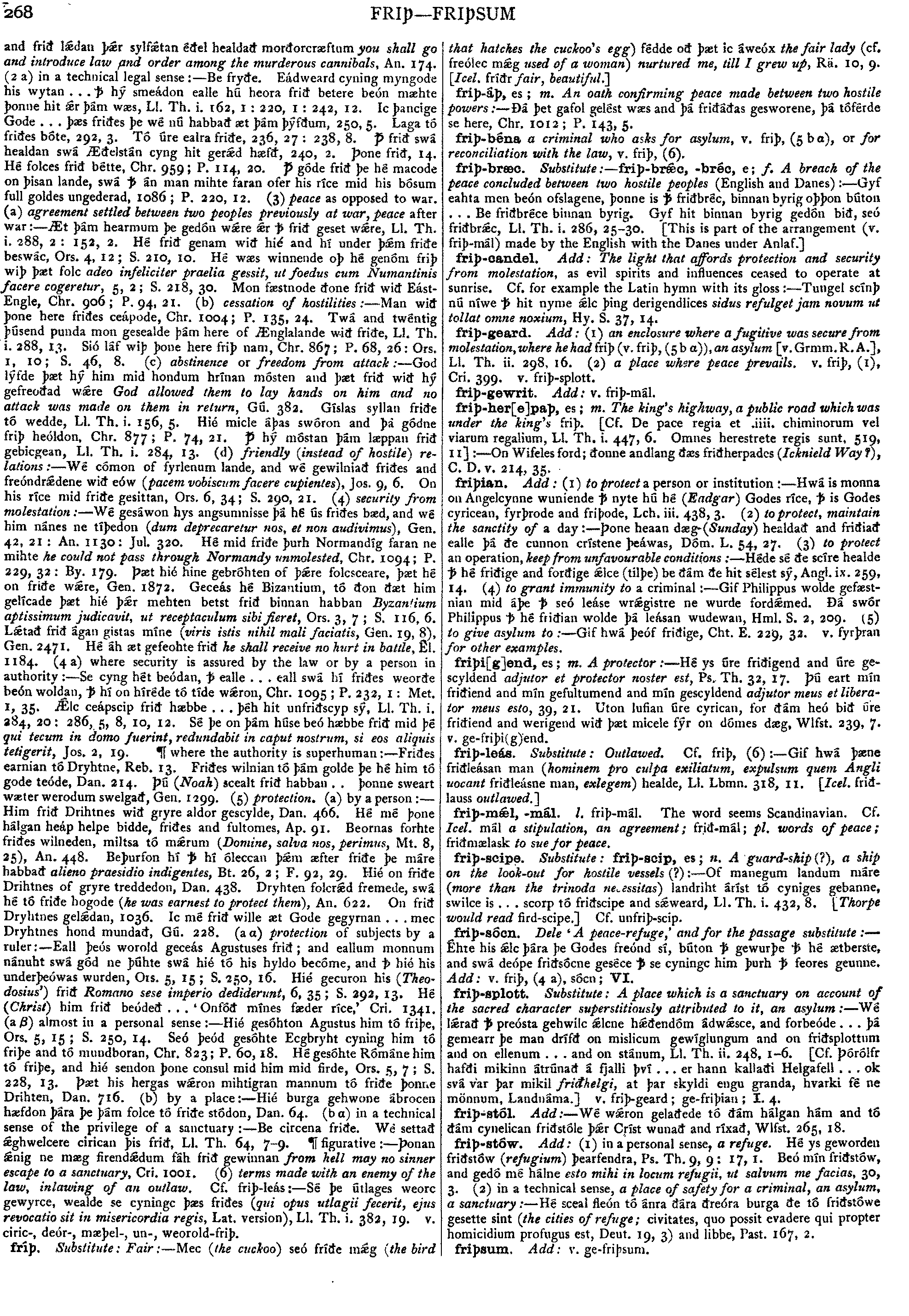
and
frið
ldan
þr
sylftan
éðel
healdað
morðorcræftum
you
shall
go
and
introduce
law
and
order
among
the
murderous
cannibals,
An.
174.
(2
a)
in
a
technical
legal
sense
:--
Be
fryðe.
Eádweard
cyning
myngode
his
wytan
.
.
.
 hý
smeádon
ealle
hú
heora
frið
betere
beón
mæhte
þonne
hit
r
þám
wæs,
Ll.
Th.
i.
162,
I
:
220,
I
:
242,
12.
Icþancige
Gode
.
.
.
þæs
friðes
þe
wé
nú
habbað
æt
þám
þýfðum,
250,
5.
Laga
tó
friðes
bóte,
292,
3.
Tó
úre
ealra
friðe,
236,
27
:
238,
8.
Þ
UNCERTAIN
frið
swá
healdan
swá
Æðelstán
cyng
hit
gerd
hæfð,
240,
2.
Þone
frið,
14.
Hé
folces
frið
bétte.
Chr.
959;
P.
114,
20.
Þ
UNCERTAIN
góde
frið
þe
hé
macode
on
þisan
lande,
swá
án
man
mihte
faran
ofer
his
ríce
mid
his
bósum
full
goldes
ungederad,
1086
;
P.
220,
12.
(3)
peace
as
opposed
to
war.
(a)
agreement
settled
between
two
peoples
previously
at
war,
peace
after
war
:--
Æt
þám
hearmum
þe
gedón
wre
r
frið
geset
wre,
Ll.
Th.
i.
288,
2
:
152,
2.
Hé
frið
genam
wið
hié
and
hí
under
þm
friðe
beswác,
Ors.
4,
12;
S.
210,
10.
Hé
wæs
winnende
oþ
hé
genóm
friþ
wiþ
þæt
folc
adeo
infeliciter
praelia
gessit,
ut
foedus
cum
Numantinis
facere
cogeretur,
5,
2;
S.
218,
30.
Mon
fæstnode
ðone
frið
wið
Eást-Engle,
Chr.
906;
P.
94,
21.
(b)
cessation
of
hostilities
:--
Man
wið
þone
here
friðes
ceápode,
Chr.
1004;
P.
135,
24.
Twá
and
twéntig
þúsend
punda
mon
gesealde
þám
here
of
Ænglalande
wið
friðe,
Ll.
Th.
i.
288,
13.
Sió
láf
wiþ
þone
here
friþ
nam,
Chr.
867;
P.
68,
26:
Ors.
I.
10;
S.
46,
8.
(c)
abstinence
or
freedom
from
attack
:--
God
lýfde
þæt
hý
him
mid
hondum
hrínan
mósten
and
þæt
frið
wið
hý
gefreoðad
wre
God
allowed
them
to
lay
hands
on
him
and
no
attack
was
made
on
them
in
return,
Gú.
382.
Gíslas
syllan
friðe
tó
wedde,
Ll.
Th.
i.
156,
5.
Hié
micle
áþas
swóron
and
þá
gódne
friþ
heóldon,
Chr.
877
;
P.
74,
21.
Þ
UNCERTAIN
hý
móstan
þám
læppan
frið
gebicgean,
Ll.
Th.
i.
284,
13.
(d)
friendly
(instead
of
hostile)
relations
:--
Wé
cómon
of
fyrlenum
lande,
and
wé
gewilniað
friðes
and
freóndrdene
wið
eów
(pacem
vobiscum
facere
capieníes),
Jos.
9,
6.
On
his
ríce
mid
friðe
gesittan,
Ors.
6,
34;
S.
290,
21.
(4)
security
from
molestation
:--
Wé
gesáwon
hys
angsunmisse
þá
hé
ús
friðes
bæd,
and
wé
him
nánes
ne
tíþedon
(dam
deprecaretur
nos,
et
non
audivimus),
Gen.
42,
21
:
An.
1130:
Jul.
320.
Hé
mid
friðe
þurh
Normandíg
faran
ne
mihte
he
could
not
pass
through
Normandy
unmolested.
Chr.
1094;
P.
229,
32
:
By.
179.
Þæt
hié
hine
gebróhten
of
þre
folcsceare,
þæt
hé
on
friðe
wre,
Gen.
1872.
Geceás
hé
Bizantium,
tó
ðon
ðæt
him
gelícade
þæt
hié
þr
mehten
betst
frið
binnan
habban
Byzantium
aptissimum
judicavit,
ut
receptaculum
sibi
fieret,
Ors.
3,
7
;
S.
116,
6.
Ltað
frið
ágan
gistas
míne
(viris
istis
nihil
mali
faciatis,
Gen.
19,
8),
Gen.
2471.
Hé
áh
æt
gefeohte
frið
he
shall
receive
no
hurt
in
battle,
El.
1184.
(4
a)
where
security
is
assured
by
the
law
or
by
a
person
in
authority
:--
Se
cyng
hét
beódan,
ealle
.
.
.
eall
swá
hí
friðes
weorðe
beón
woldan,
hí
on
híréde
tó
tíde
wron,
Chr.
1095
;
P.
232,
l:
Met.
l,
35.
Æ-acute;lc
ceápscip
frið
hæbbe
.
.
.
þéh
hit
unfriðscyp
sý,
Ll.
Th.
i.
384,
20
:
286,
5,
8,
10,
12.
Sé
þe
on
þám
húse
beó
hæbbe
frið
mid
þé
qui
eccum
in
domo
fuerint,
redundabit
in
caput
nostrum,
si
eos
aliquis
tetigerit,
Jos.
2,
19.

where
the
authority
is
superhuman
:--
Friðes
earnian
tó
Dryhtne,
Reb.
13.
Friðes
wilnian
tó
þám
golde
þe
hé
him
tó
gode
teode,
Dan.
214.
Þú
(Noah)
scealt
frið
habban
.
.
þonne
sweart
wæter
werodum
swelgað,
Gen.
1299.
(5)
protection,
(a)
by
a
person
:--
Him
frið
Drihtnes
wið
gryre
aldor
gescylde,
Dan.
466.
Hé
mé
þone
hálgan
heap
helpe
bidde,
friðes
and
fultomes,
Ap.
91.
Beornas
forhte
friðes
wilneden,
miltsa
tó
mrum
(Domine,
salva
nos,
perimus,
Mt.
8,
25),
An.
448.
Beþurfon
hí
hí
óleccan
þm
æfter
friðe
þe
máre
habbað
alieno
praesidio
indigentes,
Bt.
26,
2
;
F.
92,
29.
Hié
on
friðe
Drihtnes
of
gryre
treddedon,
Dan.
438.
Dryhten
folcrd
fremede,
swá
hé
tó
friðe
hogode
(he
was
earnest
to
protect
them),
An.
622.
On
frið
Drylitnes
geldan,
1036.
Ic
mé
frið
wille
æt
Gode
gegyrnan
.
.
.
mec
Dryhtnes
hond
mundað,
Gú.
228.
(a
hý
smeádon
ealle
hú
heora
frið
betere
beón
mæhte
þonne
hit
r
þám
wæs,
Ll.
Th.
i.
162,
I
:
220,
I
:
242,
12.
Icþancige
Gode
.
.
.
þæs
friðes
þe
wé
nú
habbað
æt
þám
þýfðum,
250,
5.
Laga
tó
friðes
bóte,
292,
3.
Tó
úre
ealra
friðe,
236,
27
:
238,
8.
Þ
UNCERTAIN
frið
swá
healdan
swá
Æðelstán
cyng
hit
gerd
hæfð,
240,
2.
Þone
frið,
14.
Hé
folces
frið
bétte.
Chr.
959;
P.
114,
20.
Þ
UNCERTAIN
góde
frið
þe
hé
macode
on
þisan
lande,
swá
án
man
mihte
faran
ofer
his
ríce
mid
his
bósum
full
goldes
ungederad,
1086
;
P.
220,
12.
(3)
peace
as
opposed
to
war.
(a)
agreement
settled
between
two
peoples
previously
at
war,
peace
after
war
:--
Æt
þám
hearmum
þe
gedón
wre
r
frið
geset
wre,
Ll.
Th.
i.
288,
2
:
152,
2.
Hé
frið
genam
wið
hié
and
hí
under
þm
friðe
beswác,
Ors.
4,
12;
S.
210,
10.
Hé
wæs
winnende
oþ
hé
genóm
friþ
wiþ
þæt
folc
adeo
infeliciter
praelia
gessit,
ut
foedus
cum
Numantinis
facere
cogeretur,
5,
2;
S.
218,
30.
Mon
fæstnode
ðone
frið
wið
Eást-Engle,
Chr.
906;
P.
94,
21.
(b)
cessation
of
hostilities
:--
Man
wið
þone
here
friðes
ceápode,
Chr.
1004;
P.
135,
24.
Twá
and
twéntig
þúsend
punda
mon
gesealde
þám
here
of
Ænglalande
wið
friðe,
Ll.
Th.
i.
288,
13.
Sió
láf
wiþ
þone
here
friþ
nam,
Chr.
867;
P.
68,
26:
Ors.
I.
10;
S.
46,
8.
(c)
abstinence
or
freedom
from
attack
:--
God
lýfde
þæt
hý
him
mid
hondum
hrínan
mósten
and
þæt
frið
wið
hý
gefreoðad
wre
God
allowed
them
to
lay
hands
on
him
and
no
attack
was
made
on
them
in
return,
Gú.
382.
Gíslas
syllan
friðe
tó
wedde,
Ll.
Th.
i.
156,
5.
Hié
micle
áþas
swóron
and
þá
gódne
friþ
heóldon,
Chr.
877
;
P.
74,
21.
Þ
UNCERTAIN
hý
móstan
þám
læppan
frið
gebicgean,
Ll.
Th.
i.
284,
13.
(d)
friendly
(instead
of
hostile)
relations
:--
Wé
cómon
of
fyrlenum
lande,
and
wé
gewilniað
friðes
and
freóndrdene
wið
eów
(pacem
vobiscum
facere
capieníes),
Jos.
9,
6.
On
his
ríce
mid
friðe
gesittan,
Ors.
6,
34;
S.
290,
21.
(4)
security
from
molestation
:--
Wé
gesáwon
hys
angsunmisse
þá
hé
ús
friðes
bæd,
and
wé
him
nánes
ne
tíþedon
(dam
deprecaretur
nos,
et
non
audivimus),
Gen.
42,
21
:
An.
1130:
Jul.
320.
Hé
mid
friðe
þurh
Normandíg
faran
ne
mihte
he
could
not
pass
through
Normandy
unmolested.
Chr.
1094;
P.
229,
32
:
By.
179.
Þæt
hié
hine
gebróhten
of
þre
folcsceare,
þæt
hé
on
friðe
wre,
Gen.
1872.
Geceás
hé
Bizantium,
tó
ðon
ðæt
him
gelícade
þæt
hié
þr
mehten
betst
frið
binnan
habban
Byzantium
aptissimum
judicavit,
ut
receptaculum
sibi
fieret,
Ors.
3,
7
;
S.
116,
6.
Ltað
frið
ágan
gistas
míne
(viris
istis
nihil
mali
faciatis,
Gen.
19,
8),
Gen.
2471.
Hé
áh
æt
gefeohte
frið
he
shall
receive
no
hurt
in
battle,
El.
1184.
(4
a)
where
security
is
assured
by
the
law
or
by
a
person
in
authority
:--
Se
cyng
hét
beódan,
ealle
.
.
.
eall
swá
hí
friðes
weorðe
beón
woldan,
hí
on
híréde
tó
tíde
wron,
Chr.
1095
;
P.
232,
l:
Met.
l,
35.
Æ-acute;lc
ceápscip
frið
hæbbe
.
.
.
þéh
hit
unfriðscyp
sý,
Ll.
Th.
i.
384,
20
:
286,
5,
8,
10,
12.
Sé
þe
on
þám
húse
beó
hæbbe
frið
mid
þé
qui
eccum
in
domo
fuerint,
redundabit
in
caput
nostrum,
si
eos
aliquis
tetigerit,
Jos.
2,
19.

where
the
authority
is
superhuman
:--
Friðes
earnian
tó
Dryhtne,
Reb.
13.
Friðes
wilnian
tó
þám
golde
þe
hé
him
tó
gode
teode,
Dan.
214.
Þú
(Noah)
scealt
frið
habban
.
.
þonne
sweart
wæter
werodum
swelgað,
Gen.
1299.
(5)
protection,
(a)
by
a
person
:--
Him
frið
Drihtnes
wið
gryre
aldor
gescylde,
Dan.
466.
Hé
mé
þone
hálgan
heap
helpe
bidde,
friðes
and
fultomes,
Ap.
91.
Beornas
forhte
friðes
wilneden,
miltsa
tó
mrum
(Domine,
salva
nos,
perimus,
Mt.
8,
25),
An.
448.
Beþurfon
hí
hí
óleccan
þm
æfter
friðe
þe
máre
habbað
alieno
praesidio
indigentes,
Bt.
26,
2
;
F.
92,
29.
Hié
on
friðe
Drihtnes
of
gryre
treddedon,
Dan.
438.
Dryhten
folcrd
fremede,
swá
hé
tó
friðe
hogode
(he
was
earnest
to
protect
them),
An.
622.
On
frið
Drylitnes
geldan,
1036.
Ic
mé
frið
wille
æt
Gode
gegyrnan
.
.
.
mec
Dryhtnes
hond
mundað,
Gú.
228.
(a
 )
protection
of
subjects
by
a
ruler
:--
Eall
þeós
worold
geceás
Agustuses
frið
;
and
eallum
monnum
nánuht
swá
gód
ne
þúhte
swá
hié
tó
his
hyldo
becóme,
and
hié
his
underþeówas
wurden,
Ors.
5,
15
;
S.
250,
16.
Hié
gecuron
his
(Theodosius')
frið
Romano
sese
imperio
dediderunt,
6,
35
;
S.
292,
13,
Hé
(Christ)
him
frið
beódeð
.
.
.
'Onfóð
mínes
fæder
ríce,
'
Cri.
1341.
(a
)
protection
of
subjects
by
a
ruler
:--
Eall
þeós
worold
geceás
Agustuses
frið
;
and
eallum
monnum
nánuht
swá
gód
ne
þúhte
swá
hié
tó
his
hyldo
becóme,
and
hié
his
underþeówas
wurden,
Ors.
5,
15
;
S.
250,
16.
Hié
gecuron
his
(Theodosius')
frið
Romano
sese
imperio
dediderunt,
6,
35
;
S.
292,
13,
Hé
(Christ)
him
frið
beódeð
.
.
.
'Onfóð
mínes
fæder
ríce,
'
Cri.
1341.
(a
 )
almost
in
a
personal
sense
:--
Hié
gesóhton
Agustus
him
tó
friþe,
Ors.
5,
15;
S.
250,
14.
Seá
þeóð
gesóhte
Ecgbryht
cyning
him
tó
friþe
and
tó
mundboran,
Chr.
823;
P.
60,
18.
Hé
gesóhte
Rðmáne
him
tó
friþe,
and
hié
sendon
þone
consul
mid
him
mid
firde,
Ors.
5,
7
;
S.
228,
13.
Þæt
his
hergas
wron
mihtígran
mannum
tó
friðe
þonne
Drihten,
Dan.
716.
(b)
by
a
place
:--
Hié
burga
gehwone
ábrocen
hæfdon
þára
þe
þám
folce
tó
friðe
stódon,
Dan.
64.
(b
)
in
a
technical
sense
of
the
privilege
of
a
sanctuary
:--
Be
circena
friðe.
We
settað
ghwelcere
cirican
þis
frið,
Ll.
Th.
64,
7-9.

figurative
:--
Þonan
nig
ne
mæg
firenddum
fáh
frið
gewinnan
from
hell
may
no
sinner
escape
to
a
sanctuary,
Cri.
1001.
(6)
terms
made
with
an
enemy
of
the
law.
Mowing
of
an
outlaw.
Cf.
friþ-Ieás
:--
Sé
þe
útlages
weorc
gewyrce,
wealde
se
cyningc
þæs
friðes
(qui
opus
utlagii
fecerit,
ejus
revocatio
sit
in
misericordia
regis,
Lat.
version),
Ll.
Th.
i.
382,
19.
v.
ciric-,
deór-,
mæþel-,
un-,
weorold-friþ.
)
almost
in
a
personal
sense
:--
Hié
gesóhton
Agustus
him
tó
friþe,
Ors.
5,
15;
S.
250,
14.
Seá
þeóð
gesóhte
Ecgbryht
cyning
him
tó
friþe
and
tó
mundboran,
Chr.
823;
P.
60,
18.
Hé
gesóhte
Rðmáne
him
tó
friþe,
and
hié
sendon
þone
consul
mid
him
mid
firde,
Ors.
5,
7
;
S.
228,
13.
Þæt
his
hergas
wron
mihtígran
mannum
tó
friðe
þonne
Drihten,
Dan.
716.
(b)
by
a
place
:--
Hié
burga
gehwone
ábrocen
hæfdon
þára
þe
þám
folce
tó
friðe
stódon,
Dan.
64.
(b
)
in
a
technical
sense
of
the
privilege
of
a
sanctuary
:--
Be
circena
friðe.
We
settað
ghwelcere
cirican
þis
frið,
Ll.
Th.
64,
7-9.

figurative
:--
Þonan
nig
ne
mæg
firenddum
fáh
frið
gewinnan
from
hell
may
no
sinner
escape
to
a
sanctuary,
Cri.
1001.
(6)
terms
made
with
an
enemy
of
the
law.
Mowing
of
an
outlaw.
Cf.
friþ-Ieás
:--
Sé
þe
útlages
weorc
gewyrce,
wealde
se
cyningc
þæs
friðes
(qui
opus
utlagii
fecerit,
ejus
revocatio
sit
in
misericordia
regis,
Lat.
version),
Ll.
Th.
i.
382,
19.
v.
ciric-,
deór-,
mæþel-,
un-,
weorold-friþ.
|
Source: Bosworth/Toller, page d0269, entry 22 View original page image as: [TIFF] [PNG] [View previous entry] [View next entry] |
[Comment on this entry] [View comments] |
The following entry has been hand-corrected once. |
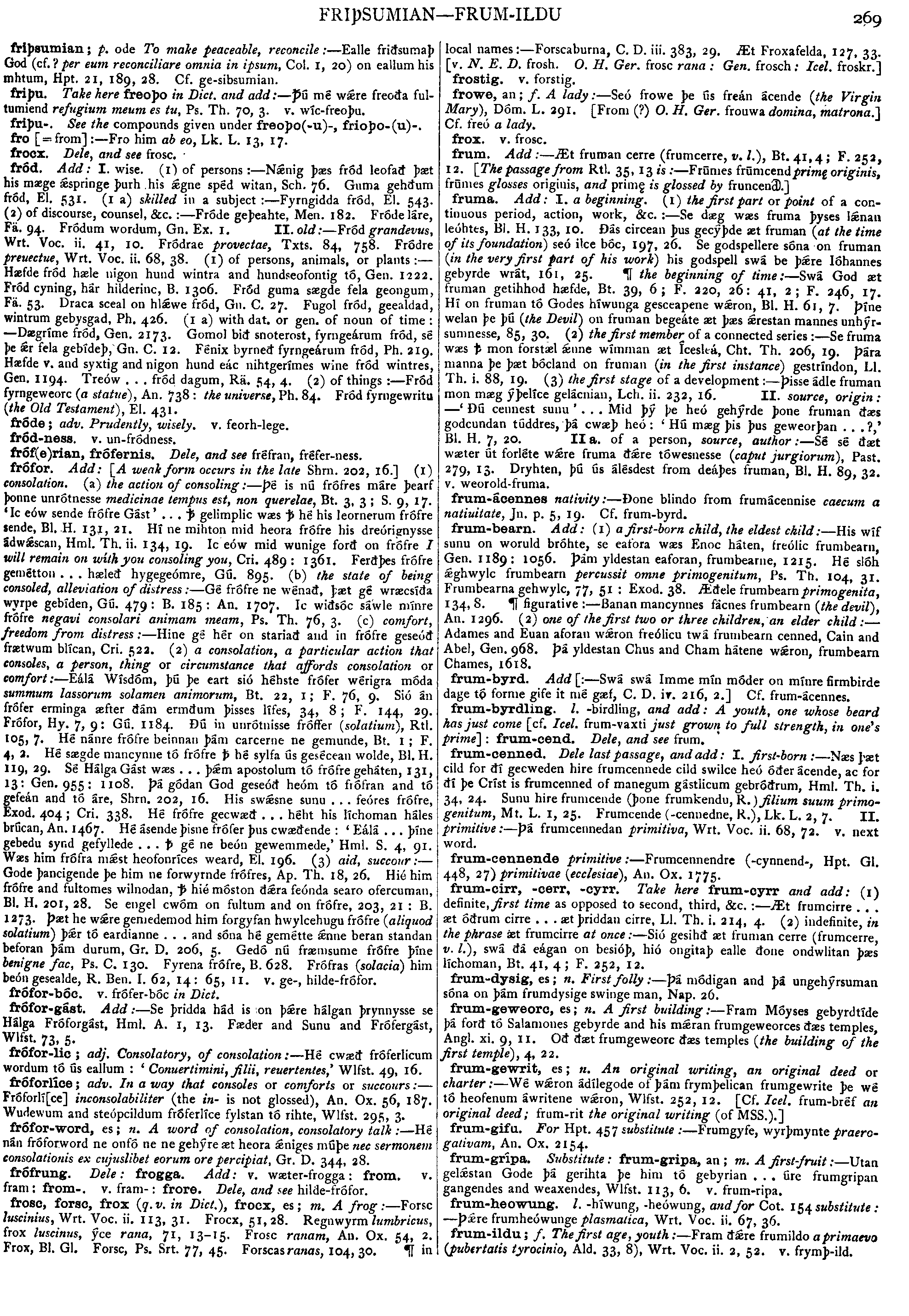
fruma.
Add:
I.
a
beginning.
(1)
the
first
part
or
point
of
a
continuous
period,
action,
work,
&c.:--Se
dæg
wæs
fruma
þyses
lnan
leóhtes,
Bl.
H.
133,
10.
Ðás
circean
þus
gecýþde
æt
fruman
(at
the
time
of
its
foundation)
seó
ilce
bóc,
197,
26.
Se
godspellere
sóna
on
fruman
(in
the
very
first
part
of
his
work)
his
godspell
swá
be
þre
Ióhannes
gebyrde
wrát,
161,
25.

the
beginning
of
time:--Swá
God
æt
fruman
getihhod
hæfde,
Bt.
39,
6;
F.
220,
26:
41,
2;
F.
246,
17.
Hí
on
fruman
tó
Godes
híwunga
gesceapene
wron,
Bl.
H.
61,
7.
Þíne
welan
þe
þú
(the
Devil)
on
fruman
begeáte
æt
þæs
restan
mannes
unhýrsumnesse,
85,
30.
(2)
the
first
member
of
a
connected
series:--Se
fruma
wæs
mon
forstæl
nne
wímman
æt
Ícesleá,
Cht.
Th.
206,
19.
Þára
manna
þe
þæt
bócland
on
fruman
(in
the
first
instance)
gestríndon,
Ll.
Th.
i.
88,
19.
(3)
the
first
stage
of
a
development:--Þisse
ádle
fruman
mon
mæg
ýþelíce
gelácnian,
Lch.
ii.
232,
16.
II.
source,
origin:--'Ðú
cennest
sunu'
.
.
.
Mid
þý
þe
heó
gehýrde
þone
fruman
ðæs
godcundan
túddres,
þá
cwæþ
heó:
'Hú
mæg
þis
þus
geweorþan
.
.
.?,'
Bl.
H.
7,
20.
II
a.
of
a
person,
source,
author:--Sé
sé
ðæt
wæter
út
forléte
wre
fruma
ðre
tówesnesse
(caput
jurgiorum),
Past.
279,
13.
Dryhten,
þú
ús
álésdest
from
deáþes
fruman,
Bl.
H.
89,
32.
v.
weorold-fruma.
|
Source: Bosworth/Toller, page d0272, entry 17 View original page image as: [TIFF] [PNG] [View previous entry] [View next entry] |
[Comment on this entry] [View comments] |
The following entry has been hand-corrected once. |
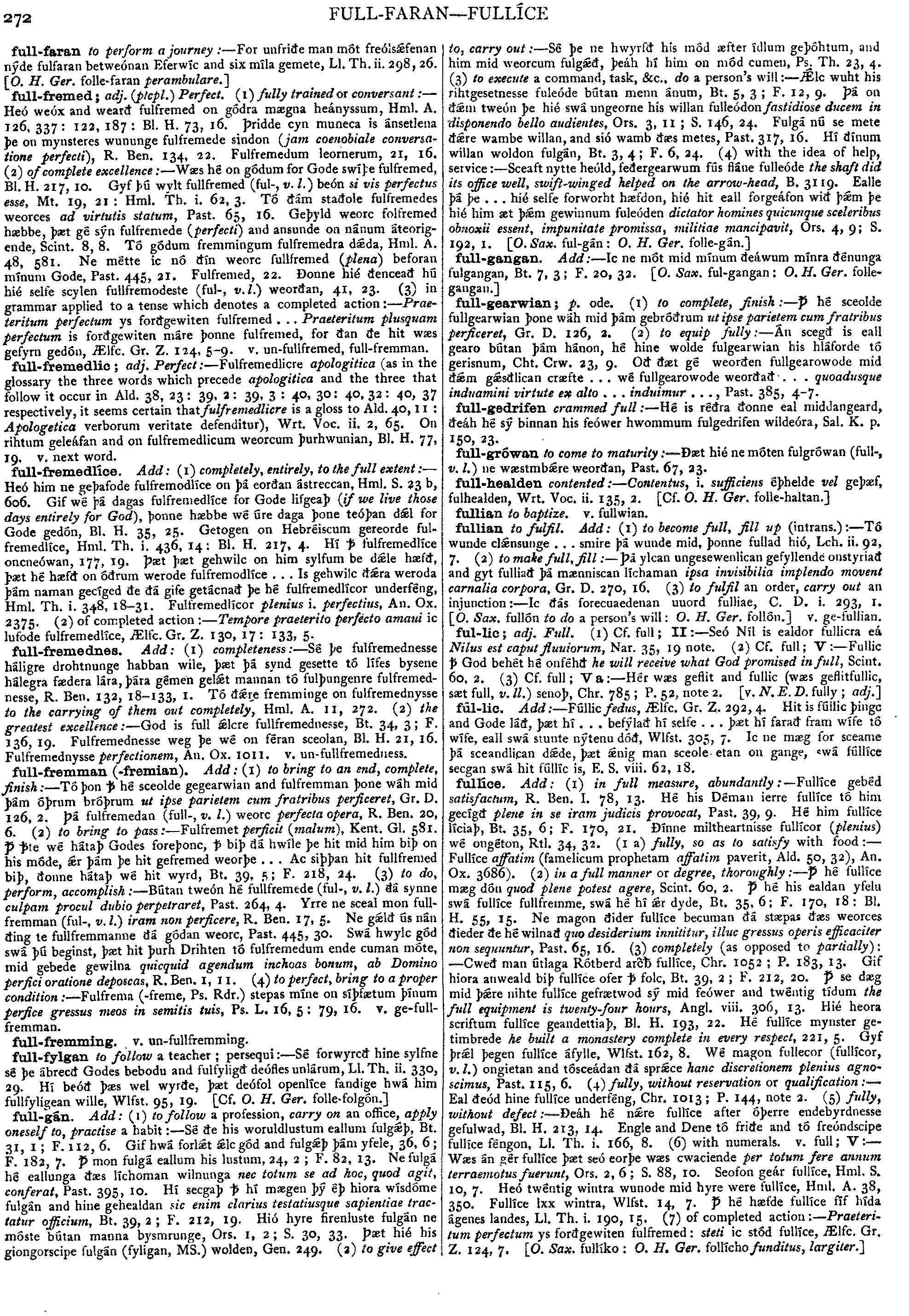
ful-lic;
adj.
Full.
(1)
Cf.
full;
II:--Seó
Níl
is
ealdor
fullícra
eá
Nilus
est
caput
fluuiorum,
Nar.
35,
19
note.
(2)
Cf.
full;
V:--Fullíc
God
behét
hé
onféhð
he
will
receive
what
God
promised
in
full,
Scint.
60,
2.
(3)
Cf.
full;
V
a:--Hér
wæs
geflit
and
fullíc
(wæs
geflitfullíc,
sæt
full,
v.
ll.)
senoþ,
Chr.
785;
P.
52,
note
2.
[v.
N.
E.
D.
fully;
adj.]
|
Source: Bosworth/Toller, page d0306, entry 30 View original page image as: [TIFF] [PNG] [View previous entry] [View next entry] |
[Comment on this entry] [View comments] |
The following entry has been hand-corrected once. |
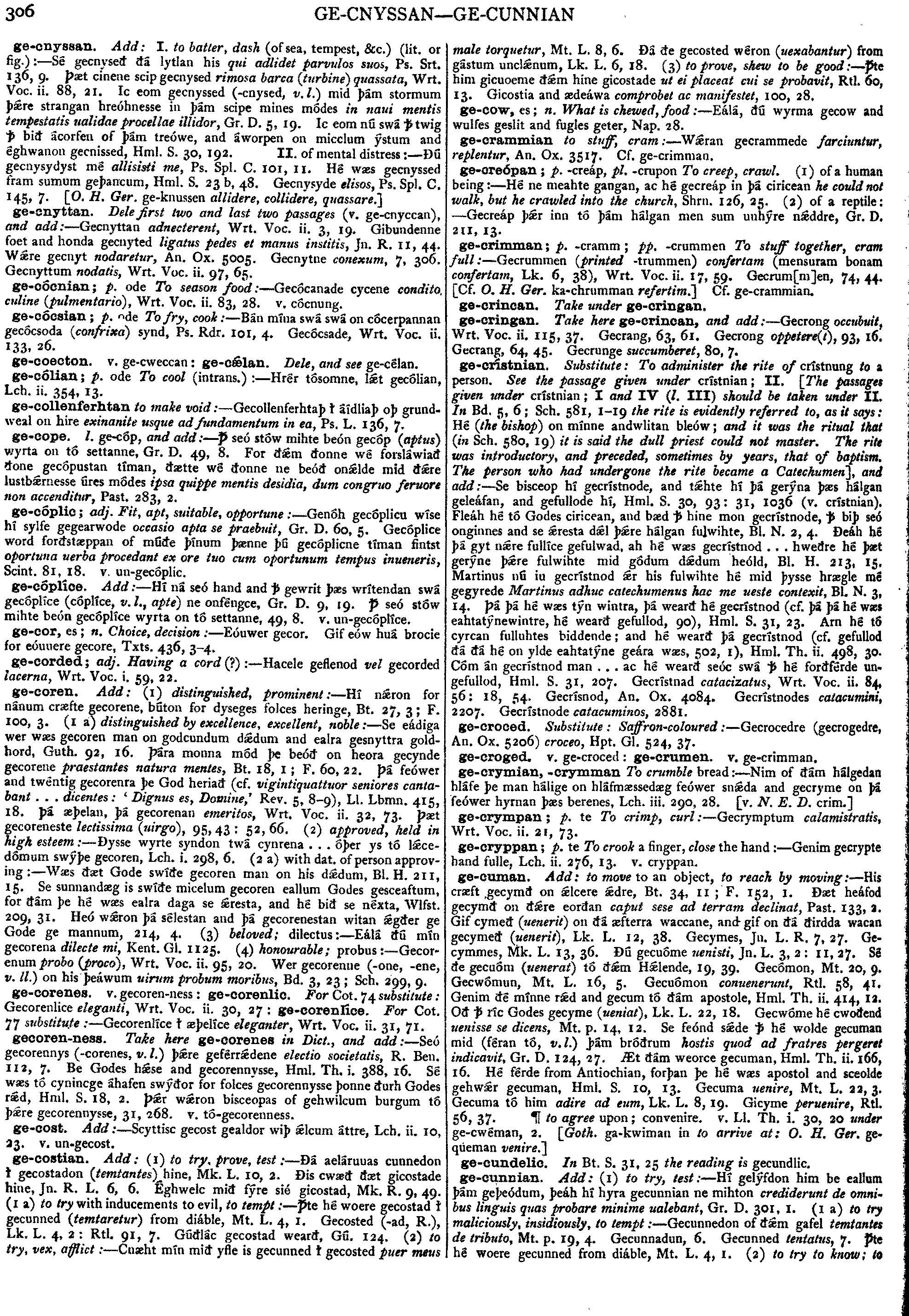
ge-cuman.
Add;
to
move
to
an
object,
to
reach
by
moving
:--
His
cræft
.
gecymð
on
lcere
dre,
Bt.
34,
11;
F.
152,
1.
Ðæt
heáfod
gecymð
on
ðre
eorðan
caput
sese
ad
terram
declinat,
Past.
133,
2.
Gif
cymeð
(uenerit)
on
ðá
æfterra
waccane,
and
gif
on
ðá
ðirdda
wacan
gecymeð
(uenerit),
Lk.
L.
12,
38.
Gecymes,
Jn.
L.R.
7,
27.
Gecymmes,
Mk.
L.
13,
36.
Ðú
gecuóme
uenisti,
Jn.
L.
3,
2:
11,
27.
Sé
ðe
gecuóm
(uenerat)
tó
ðm
Hlende,
19,
39.
Gecómon,
Mt.
20,
9.
Gecwómun,
Mt.
L.
16,
5.
Gecuómon
conuenerunt,
Rtl.
58,
41.
Genim
ðé
mínne
rd
and
gecum
tó
ðám
apostole.
Hml.
Th.
ii.
414,
12.
Oð
ríc
Godes
gecyme
(ueniat),
Lk.
L.
22,
18.
Gecwóme
hé
cwoðend
uenisse
se
dicens,
Mt.
p.
14,
12.
Se
feónd
sde
hé
wolde
gecuman
mid
(féran
tó,
v.l.)
þám
bróðrum
hostis
quod
ad
fratres
pergeret
indicavit,
Gr.
D.
124,
27.
Æt
ðám
weorce
gecuman,
Hml.
Th.
ii.
166,
16.
Hé
férde
from
Antiochian,
forþan
þe
hé
wæs
apostol
and
sceolde
gehwr
gecuman,
Hml.
S.
10,
13.
Gecuma
uenire,
Mt.
L.
22,
3.
Gecuma
tó
him
adire
ad
eum,
Lk.
L.
8,
19.
Gicyme
peruenire,
Rtl.
56,
37.

to
agree
upon;
convenire.
v.
Ll.
Th.
i.
30,
20
under
ge-cwérnan,
2.
[Goth.
ga-kwiman
in
to
arrive
at:
O.H.
Ger.
ge-queman
venire.]
|
Source: Bosworth/Toller, page d0325, entry 15 View original page image as: [TIFF] [PNG] [View previous entry] [View next entry] |
[Comment on this entry] [View comments] |
The following entry has been hand-corrected once. |
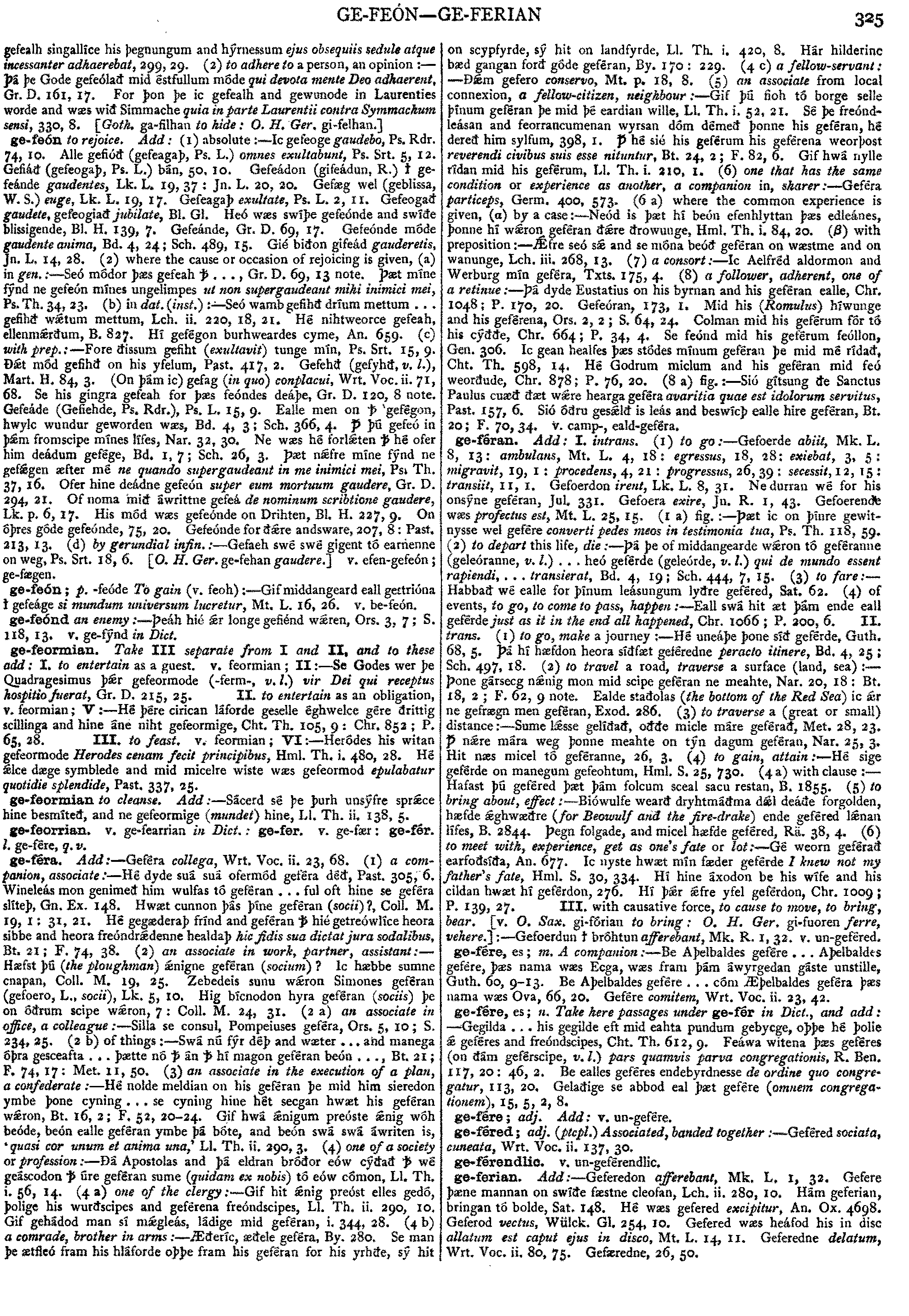
ge-ferian. Add :-- Geferedon afferebant, Mk. L. I. 32. Gefere þæne mannan on swíðe fæstne cleofan, Lch. ii. 280, 10. Hám geferian, bringan tó bolde, Sae. 148. Hé wæs gefered excipitur, An. Ox. 4698. Geferod vectus, Wülck. Gl. 254, 10. Gefered wæs heáfod his in disc allatum est caput ejus in disco, Mt. L. 14, ii. Geferedne delatum, Wrt. Voc. ii. 80, 75. Gefæredne, 26, 50.
|
Source: Bosworth/Toller, page d0336, entry 1 View original page image as: [TIFF] [PNG] [View previous entry] [View next entry] |
[Comment on this entry] [View comments] |
The following entry has been hand-corrected once. |
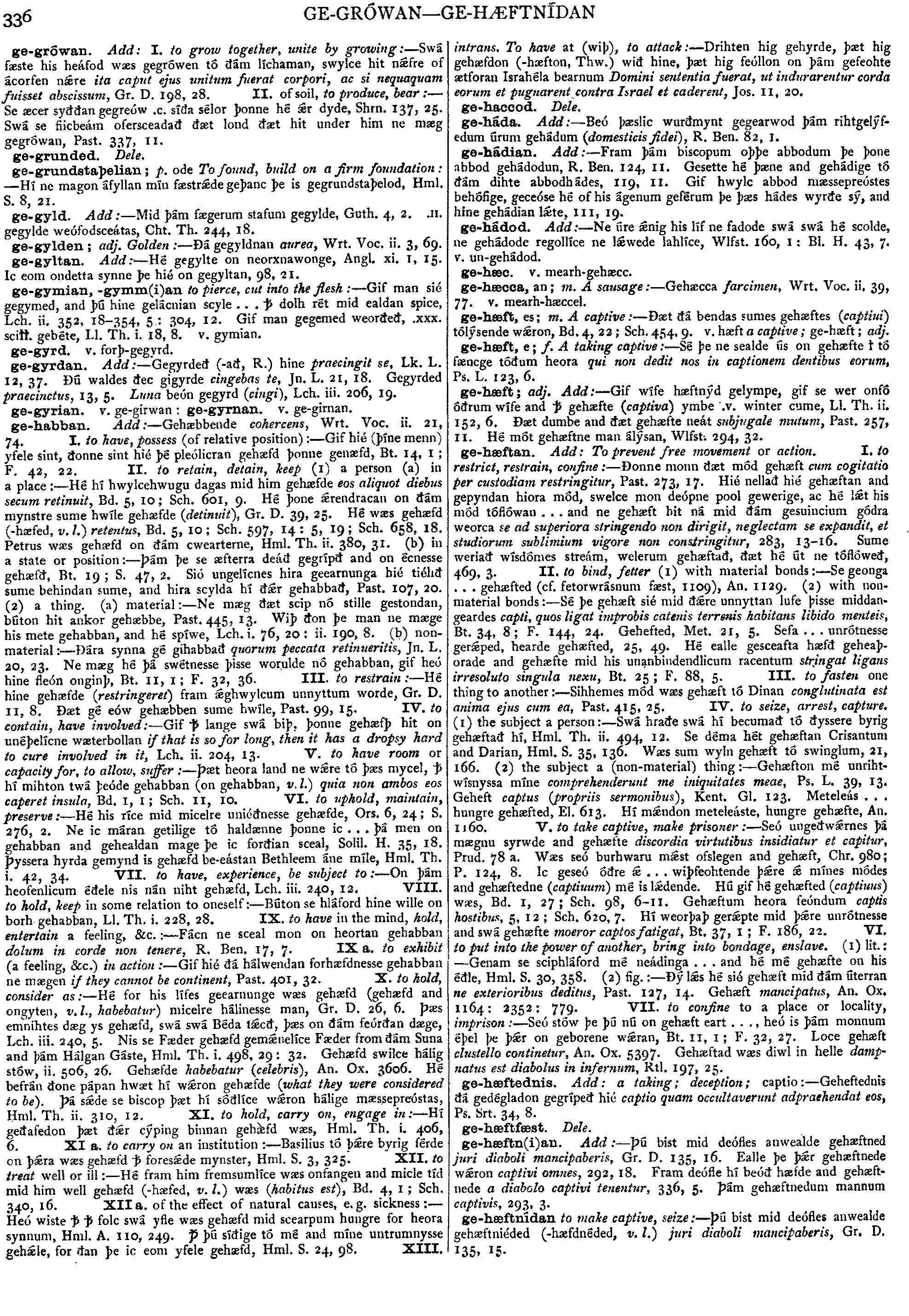
ge-grówan.
Add:
I.
to
grow
together,
unite
by
growing:--Swá
fæste
his
heáfod
wæs
gegrówen
tó
ðám
líchaman,
swylce
hit
nfre
of
ácorfen
nre
ita
caput
ejus
unitum
fuerat
corpori,
ac
si
nequaquam
fuisset
abscissum,
Gr.
D.
198,
28.
II.
of
soil,
to
produce,
bear:--Se
æcer
syððan
gegreów
.c.
síða
sélor
þonne
hé
r
dyde,
Shrn.
137,
25.
Swá
se
fiicbeám
ofersceadað
ðæt
lond
ðæt
hit
under
him
ne
mæg
gegrówan,
Past.
337,
11.
|
Source: Bosworth/Toller, page d0349, entry 12 View original page image as: [TIFF] [PNG] [View previous entry] [View next entry] |
[Comment on this entry] [View comments] |
The following entry has been hand-corrected once. |
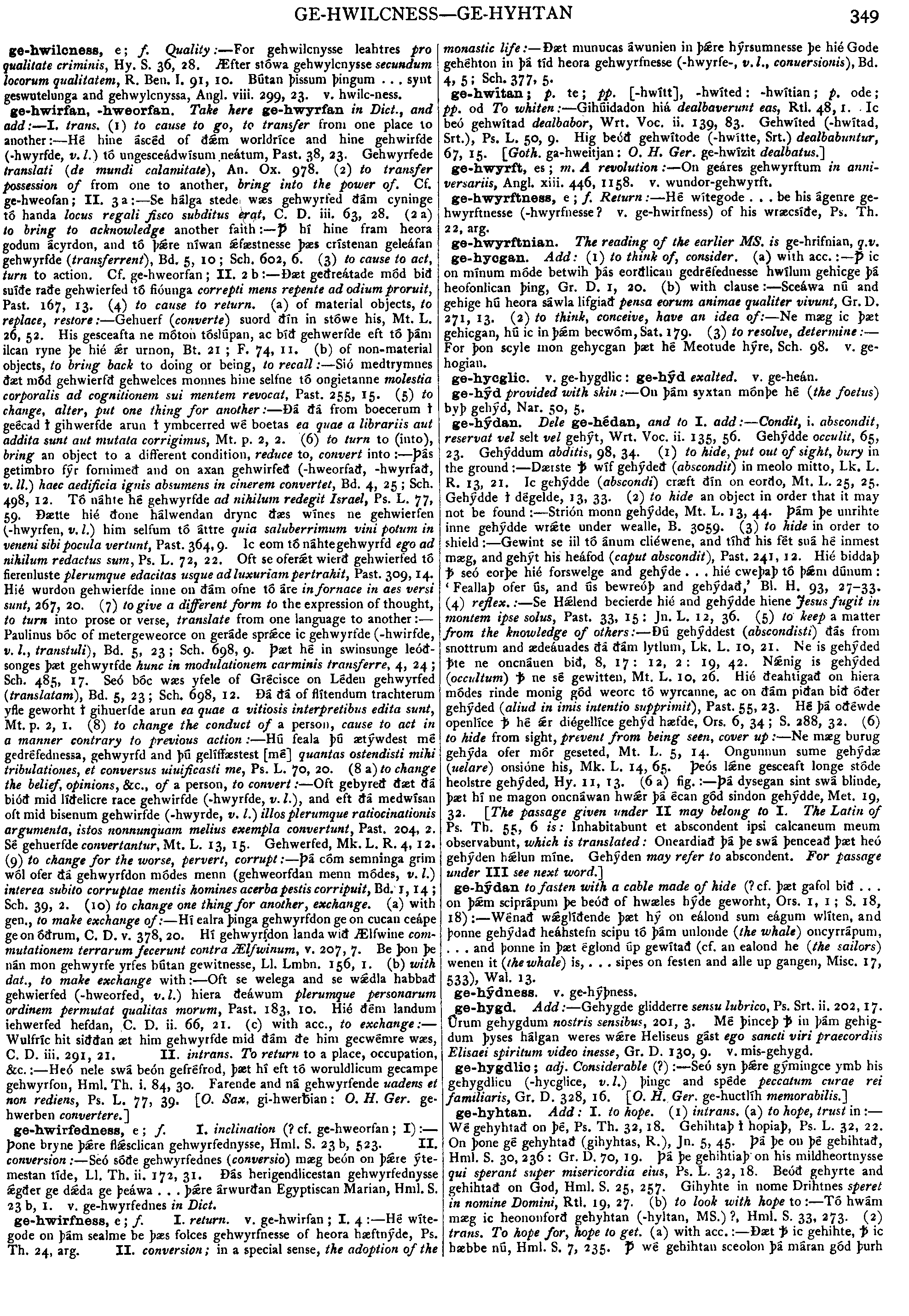
ge-h dan.
Dele
ge-h
dan.
Dele
ge-h dan,
and
to
I.
add
:--
Condit,
i.
abscondit,
reservat
vel
sell
vel
geht,
Wrt.
Voc.
ii.
135,
56.
Gehdde
occulit,
65,
23.
Gehddum
abditis,
98,
34.
(I)
to
hide,
put
out
of
sight,
bury
in
the
ground
:--
Dætste
w
dan,
and
to
I.
add
:--
Condit,
i.
abscondit,
reservat
vel
sell
vel
geht,
Wrt.
Voc.
ii.
135,
56.
Gehdde
occulit,
65,
23.
Gehddum
abditis,
98,
34.
(I)
to
hide,
put
out
of
sight,
bury
in
the
ground
:--
Dætste
w f
gehde
f
gehde (abscondit)
in
meolo
mitto,
Lk.
L.
R.
13,
21.
Ic
gehdde
(abscondi)
cræft
n
on
eoro,
Mt.
L.
25,
25.
Gehdde
(abscondit)
in
meolo
mitto,
Lk.
L.
R.
13,
21.
Ic
gehdde
(abscondi)
cræft
n
on
eoro,
Mt.
L.
25,
25.
Gehdde
 dgelde,
13,
33.
(2)
to
hide
an
object
in
order
that
it
may
not
be
found
:--
Strión
monn
gehdde,
Mt.
L.
13,
44.
Þ
dgelde,
13,
33.
(2)
to
hide
an
object
in
order
that
it
may
not
be
found
:--
Strión
monn
gehdde,
Mt.
L.
13,
44.
Þ m
þe
unrihte
inne
gehdde
wr
m
þe
unrihte
inne
gehdde
wr te
under
wealle,
B.
3059.
(3)
to
hide
in
order
to
shield
:--
Gewint
se
iil
t
te
under
wealle,
B.
3059.
(3)
to
hide
in
order
to
shield
:--
Gewint
se
iil
t num
cliéwene,
and
th
his
ft
su
h
inmest
mæg,
and
geht
his
heáfod
(caput
abscondit),
Past.
241,
12.
Hié
biddaþ
seó
eorþe
hié
forswelge
and
gehde
.
.
.
hié
cweþaþ
t;
þm
d
num
cliéwene,
and
th
his
ft
su
h
inmest
mæg,
and
geht
his
heáfod
(caput
abscondit),
Past.
241,
12.
Hié
biddaþ
seó
eorþe
hié
forswelge
and
gehde
.
.
.
hié
cweþaþ
t;
þm
d num
:
'
Feallaþ
ofer
s,
and
s
bewreóþ
and
gehda,
'
Bl.
H.
93,
27-33.
(4)
reflex.
:--
Se
Hlend
becierde
hié
and
gehdde
hiene
Jesus
fugit
in
montem
ipse
solus,
Past.
33,
15:
Jn.
L.
12,
36.
(5)
to
keep
a
matter
from
the
knowledge
of
others
:--
Ð
gehddest
(abscondisti)
s
from
snottrum
and
ædeánades
m
lytlum,
Lk.
L.
10,
21.
Ne
is
gehded
ne
oncnuen
bi,
8,
17:
12,
2:
19,
42.
Nnig
is
gehded
(occultum)
ne
s
gewitten,
Mt.
L.
10,
26.
Hié
eahtiga
on
hiera
mdes
rinde
monig
gd
weorc
t
wyrcanne,
ac
on
m
pian
bi
er
gehded
(aliud
in
imis
intentio
supprimit),
Past.
55,
23.
H
þ
owde
openlce
h
r
diégellce
gehd
hæfde.
Ors.
6,
34;
S.
388,
32.
(6)
to
hide
from
sight,
prevent
from
being
seen,
cover
up
:--
Ne
mæg
burug
gehda
ofer
mr
geseted.
Mt.
L.
5,
14.
Ongunnun
sume
gehdæ
(uelare)
onsióne
his,
Mk.
L.
14,
65.
Þeós
line
gesceaft
longe
ste
heolstre
gehded,
Hy.
II,
13.
(6
a)
fig.
:--
Þ
dysegan
sint
sw
hlince,
þæt
h
ne
magon
oncnwan
hwr
þ
can
gd
sindon
gehdde,
Met.
19,
32.
[The
passage
given
under
II
may
belong
to
I.
The
Latin
of
Ps.
Th.
55,
6
is:
Inhabitabunt
et
abscondent
ipsi
calcaneurn
meum
observabunt,
which
is
translated:
Oneardia
þ
þe
sw
þencea
þæt
heó
gehden
hlun
mne.
Gehden
may
refer
to
abscondent.
For
passage
under
III
see
next
word.]
num
:
'
Feallaþ
ofer
s,
and
s
bewreóþ
and
gehda,
'
Bl.
H.
93,
27-33.
(4)
reflex.
:--
Se
Hlend
becierde
hié
and
gehdde
hiene
Jesus
fugit
in
montem
ipse
solus,
Past.
33,
15:
Jn.
L.
12,
36.
(5)
to
keep
a
matter
from
the
knowledge
of
others
:--
Ð
gehddest
(abscondisti)
s
from
snottrum
and
ædeánades
m
lytlum,
Lk.
L.
10,
21.
Ne
is
gehded
ne
oncnuen
bi,
8,
17:
12,
2:
19,
42.
Nnig
is
gehded
(occultum)
ne
s
gewitten,
Mt.
L.
10,
26.
Hié
eahtiga
on
hiera
mdes
rinde
monig
gd
weorc
t
wyrcanne,
ac
on
m
pian
bi
er
gehded
(aliud
in
imis
intentio
supprimit),
Past.
55,
23.
H
þ
owde
openlce
h
r
diégellce
gehd
hæfde.
Ors.
6,
34;
S.
388,
32.
(6)
to
hide
from
sight,
prevent
from
being
seen,
cover
up
:--
Ne
mæg
burug
gehda
ofer
mr
geseted.
Mt.
L.
5,
14.
Ongunnun
sume
gehdæ
(uelare)
onsióne
his,
Mk.
L.
14,
65.
Þeós
line
gesceaft
longe
ste
heolstre
gehded,
Hy.
II,
13.
(6
a)
fig.
:--
Þ
dysegan
sint
sw
hlince,
þæt
h
ne
magon
oncnwan
hwr
þ
can
gd
sindon
gehdde,
Met.
19,
32.
[The
passage
given
under
II
may
belong
to
I.
The
Latin
of
Ps.
Th.
55,
6
is:
Inhabitabunt
et
abscondent
ipsi
calcaneurn
meum
observabunt,
which
is
translated:
Oneardia
þ
þe
sw
þencea
þæt
heó
gehden
hlun
mne.
Gehden
may
refer
to
abscondent.
For
passage
under
III
see
next
word.]
|
Source: Bosworth/Toller, page d0421, entry 12 View original page image as: [TIFF] [PNG] [View previous entry] [View next entry] |
[Comment on this entry] [View comments] |
The following entry has been hand-corrected once. |
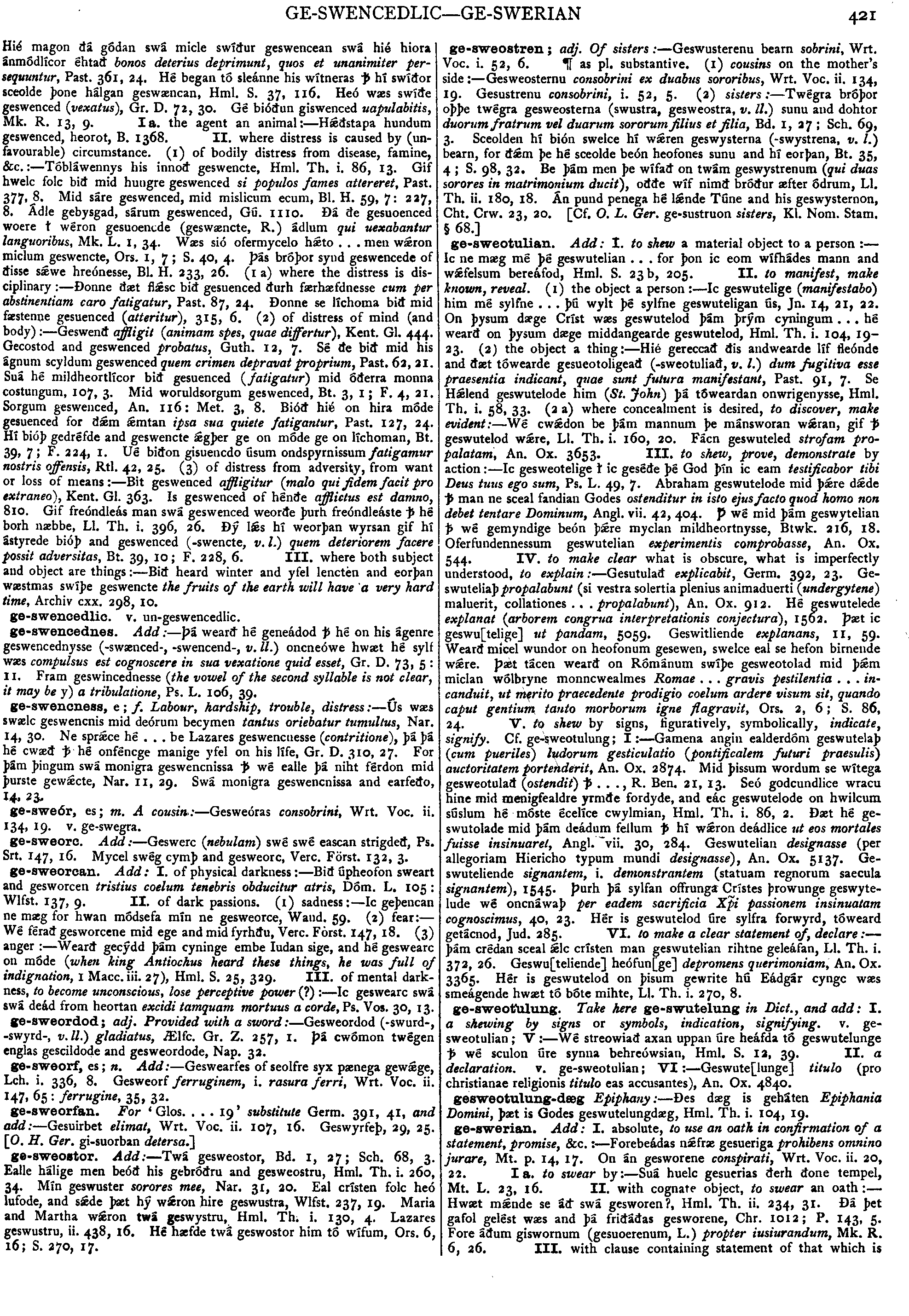
ge-sweotulian.
Add:
I.
to
shew
a
material
object
to
a
person
:--
Ic
ne
mæg
mé
þé
geswutelian
.
.
.
for
þon
ic
eom
wífhádes
mann
and
wfelsum
bereáfod,
Hml.
S.
23
b,
205.
II.
to
manifest,
make
known,
reveal.
(1)
the
object
a
person
:--
Ic
geswutelige
(manifestabo)
him
mé
sylfne
.
.
.
þú
wylt
þé
sylfne
geswuteligan
us,
Jn.
14,
21,
22.
On
þysum
dæge
Críst
wæs
geswutelod
þám
þrým
cyningum
.
.
.
hé
wearð
on
þysum
dæge
middangearde
geswutelod,
Hml.
Th.
i.
104,
19-23.
(2)
the
object
a
thing
:--
Hié
gereccað
ðis
andwearde
líf
fleónde
and
ðæt
tówearde
gesueotoligeað
(-sweotuliað,
v.
l.)
dum
fugitiva
esse
praesentia
indicant,
quae
sunt
futura
manifestant,
Past.
91,
7.
Se
Hlend
geswutelode
him
(St.
John)
þá
tóweardan
onwrigenysse,
Hml.
Th.
i.
58,
33.
(2
a)
where
concealment
is
desired,
to
discover,
make
evident
:--
Wé
cwdon
be
þám
mannum
þe
mánsworan
wran,
gif
geswutelod
wre,
Ll.
Th.
i.
160,
20.
Fácn
geswuteled
strofam
pro palatam,
An.
Ox.
3653.
III.
to
shew,
prove,
demonstrate
by
action
:--
Ic
gesweotelige
ic
geséde
þé
God
þín
ic
eam
testificabor
tibi
Deus
tuus
ego
sum,
Ps.
L.
49,
7.
Abraham
geswutelode
mid
þre
dde
man
ne
sceal
fandian
Godes
ostenditur
in
isto
ejus
facto
quod
homo
non
debet
tenare
are
Dominum,
Angl.
vii.
42,
404.
wé
mid
þám
geswytelian
we
gemyndige
beón
þre
myclan
mildheortnysse,
Btwk.
216,
18.
Oferfundennessum
geswutelian
experimentis
comprobasse,
An.
Ox.
544.
IV.
to
make
clear
what
is
obscure,
what
is
imperfectly
understood,
to
explain
:--
Gesutulað
explicabit,
Germ.
392,
23.
Ge-swuteliaþ
propalabunt
(si
vestra
solertia
plenius
animaduerti
(undergytene)
maluerit,
collationes
.
.
.
propalabunt),
An.
Ox.
912.
Hé
geswutelede
explanat
(arborem
congrua
interpretations
conjectura),
1562.
Þæt
ic
geswu[telige]
tit
pandam,
5059.
Geswitliende
explanans,
11,
59.
Wearð
micel
wundor
on
heofonum
gesewen,
swelce
eal
se
hefon
birnende
wre.
þæt
tácen
wearð
on
Rómánum
swíþe
gesweotolad
mid
þm
miclan
wólbryne
monncwealmes
Romae
.
.
.gravis
pestilentia
.
.
.
inconduit,
ut
meríto
praecedente
prodigio
coelum
ardere
visum
sit,
quando
caput
gentium
tanto
morborum
igne
flagravit,
Ors.
2,
6;
S.
86,
24.
V.
to
shew
by
signs,
figuratively,
symbolically,
indicate,
signify.
Cf.
ge-sweotulung;
I
:--
Gamena
angin
ealderdóm
geswutelaþ
(cum
pueriles)
ludorum
gesticulatio
(pontificalem
futuri
praesulis)
auctoritatem
portenderit,
An.
Ox.
2874.
Mid
þissum
wordum
se
wítega
gesweotulað
(ostendit)
.
.
.
,
R.
Ben.
21,
13.
Seó
godcundlice
wracu
hine
mid
menigfealdre
yrmðe
fordyde,
and
eác
geswutelode
on
hwilcum
súslum
hé
móste
écelíce
cwylmian,
Hml.
Th.
i.
86,
2.
Ðæt
hé
geswutolade
mid
þám
deádum
fellum
hi
wron
deádlice
ut
eos
mortales
fuisse
insinuarel,
Angl.
vii.
30,
284.
Geswutelian
designasse
(per
allegoriam
Hiericho
typum
mundi
designasse),
An.
Ox.
5137.
Ge-swuteliende
signantem,
i.
demonstrantem
(statuam
regnorum
saecula
signantem),
1545.
þurh
þá
sylfan
offrungá
Crístes
þrowunge
geswyte-lude
wé
oncnáwaþ
per
eadem
sacrificia
Xpi
passionem
insinuatam
cognoscimus,
40,
23.
Hér
is
geswutelod
úre
sylfra
forwyrd,
tóweard
getácnod,
Jud.
285.
VI.
to
make
a
clear
statement
of,
declare
:--
þám
crédan
sceal
lc
crísten
man
geswutelian
rihtne
geleáfan,
Ll.
Th.
i.
372,
26.
Geswu[teliende]
heófun[ge]
depromens
querimoniam,
An.
Ox.
3365.
Hér
is
geswutelod
on
þisum
gewrite
hú
Eádgár
cyngc
wæs
smeágende
hwæt
tó
bóte
mihte.
Ll.
Th.
i.
270,
8.
palatam,
An.
Ox.
3653.
III.
to
shew,
prove,
demonstrate
by
action
:--
Ic
gesweotelige
ic
geséde
þé
God
þín
ic
eam
testificabor
tibi
Deus
tuus
ego
sum,
Ps.
L.
49,
7.
Abraham
geswutelode
mid
þre
dde
man
ne
sceal
fandian
Godes
ostenditur
in
isto
ejus
facto
quod
homo
non
debet
tenare
are
Dominum,
Angl.
vii.
42,
404.
wé
mid
þám
geswytelian
we
gemyndige
beón
þre
myclan
mildheortnysse,
Btwk.
216,
18.
Oferfundennessum
geswutelian
experimentis
comprobasse,
An.
Ox.
544.
IV.
to
make
clear
what
is
obscure,
what
is
imperfectly
understood,
to
explain
:--
Gesutulað
explicabit,
Germ.
392,
23.
Ge-swuteliaþ
propalabunt
(si
vestra
solertia
plenius
animaduerti
(undergytene)
maluerit,
collationes
.
.
.
propalabunt),
An.
Ox.
912.
Hé
geswutelede
explanat
(arborem
congrua
interpretations
conjectura),
1562.
Þæt
ic
geswu[telige]
tit
pandam,
5059.
Geswitliende
explanans,
11,
59.
Wearð
micel
wundor
on
heofonum
gesewen,
swelce
eal
se
hefon
birnende
wre.
þæt
tácen
wearð
on
Rómánum
swíþe
gesweotolad
mid
þm
miclan
wólbryne
monncwealmes
Romae
.
.
.gravis
pestilentia
.
.
.
inconduit,
ut
meríto
praecedente
prodigio
coelum
ardere
visum
sit,
quando
caput
gentium
tanto
morborum
igne
flagravit,
Ors.
2,
6;
S.
86,
24.
V.
to
shew
by
signs,
figuratively,
symbolically,
indicate,
signify.
Cf.
ge-sweotulung;
I
:--
Gamena
angin
ealderdóm
geswutelaþ
(cum
pueriles)
ludorum
gesticulatio
(pontificalem
futuri
praesulis)
auctoritatem
portenderit,
An.
Ox.
2874.
Mid
þissum
wordum
se
wítega
gesweotulað
(ostendit)
.
.
.
,
R.
Ben.
21,
13.
Seó
godcundlice
wracu
hine
mid
menigfealdre
yrmðe
fordyde,
and
eác
geswutelode
on
hwilcum
súslum
hé
móste
écelíce
cwylmian,
Hml.
Th.
i.
86,
2.
Ðæt
hé
geswutolade
mid
þám
deádum
fellum
hi
wron
deádlice
ut
eos
mortales
fuisse
insinuarel,
Angl.
vii.
30,
284.
Geswutelian
designasse
(per
allegoriam
Hiericho
typum
mundi
designasse),
An.
Ox.
5137.
Ge-swuteliende
signantem,
i.
demonstrantem
(statuam
regnorum
saecula
signantem),
1545.
þurh
þá
sylfan
offrungá
Crístes
þrowunge
geswyte-lude
wé
oncnáwaþ
per
eadem
sacrificia
Xpi
passionem
insinuatam
cognoscimus,
40,
23.
Hér
is
geswutelod
úre
sylfra
forwyrd,
tóweard
getácnod,
Jud.
285.
VI.
to
make
a
clear
statement
of,
declare
:--
þám
crédan
sceal
lc
crísten
man
geswutelian
rihtne
geleáfan,
Ll.
Th.
i.
372,
26.
Geswu[teliende]
heófun[ge]
depromens
querimoniam,
An.
Ox.
3365.
Hér
is
geswutelod
on
þisum
gewrite
hú
Eádgár
cyngc
wæs
smeágende
hwæt
tó
bóte
mihte.
Ll.
Th.
i.
270,
8.
|
Source: Bosworth/Toller, page d0428, entry 18 View original page image as: [TIFF] [PNG] [View previous entry] [View next entry] |
[Comment on this entry] [View comments (1)] |
The following entry has been hand-corrected once. |
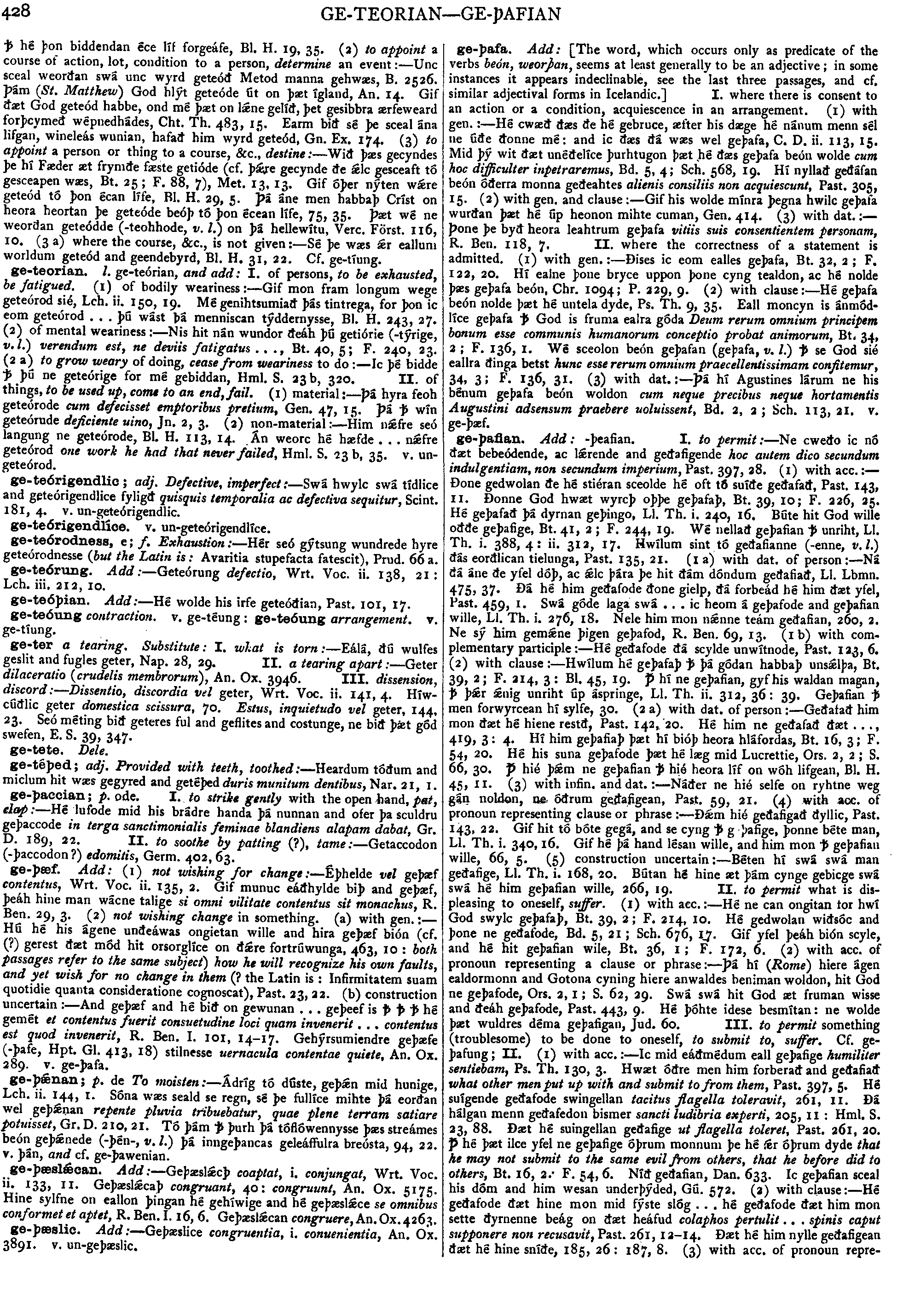
ge-þafian.
Add:
-þeafian.
I.
to
permit
:--
Ne
cweðo
ic
nó
ðæt
bebeódende,
ac
lrende
and
geðafigende
hoc
autem
dico
secundum
indulgentiam,
non
secundum
imperium,
Past.
397,
28.
(1)
with
acc.
:--
Ðone
gedwolan
ðe
hé
stiéran
sceolde
hé
oft
tó
suíðe
geðafað,
Past.
143,
11.
Ðonne
God
hwæt
wyrcþ
oþþe
geþafaþ.
Bt.
39,
10;
F.
226,
25.
Hé
geþafað
þá
dyrnan
geþingo,
Ll.
Th.
i.
240,
16.
Búte
hit
God
wille
oððe
geþafige.
Bt.
41,
2
;
F.
244,
19.
Wé
nellað
geþafian
unriht,
Ll.
Th.
i.
388,
4:
ii.
312,
17.
Hwílum
sint
tó
geðafianne
(-enne,
v.
l.)
ðás
eorðlican
tielunga,
Past.
135,
21.
(I
a)
with
dat.
of
person
:--
Ná
ðá
áne
ðe
yfel
dóþ,
ac
lc
þára
þe
hit
ðám
dóndum
geðafiað,
Ll.
Lbmn.
475,
37-
Ð
á
hé
him
geðafode
ðone
gielp,
ðá
forbeád
hé
him
ðæt
yfel,
Past.
459,
1.
Swá
góde
laga
swá
.
.
.
ic
heom
á
geþafode
and
geþafian
wille,
Ll.
Th.
i.
276,
18.
Nele
him
mon
nnne
teám
geðafian,
260,
2.
Ne
sý
him
gemne
þigen
geþafod,
R.
Ben.
69,
13.
(I
b)
with
complementary
participle
:--
Hé
geðafode
ðá
scylde
unwítnode,
Past.
12.
3,
6.
(2)
with
clause
:--
Hwílum
hé
geþafaþ
þá
gódan
habbaþ
unslþa,
Bt.
39,
2;
F.
214,
3
:
Bl.
45,
19.
hí
ne
geþafian,
gyf
his
waldan
magan,
þr
nig
unriht
úp
áspringe,
Ll.
Th.
ii.
312,
36:
39.
Geþafian
men
forwyrcean
hí
sylfe,
30.
(2
a)
with
dat.
of
person
:--
Geðafað
him
mon
ðæt
hé
hiene
restð,
Past.
142,
20.
Hé
him
ne
geðafað
ðæt
.
.
.
,
419,
3:4.
Hí
him
geþafiaþ
þæt
hí
bióþ
heora
hláfordas.
Bt.
16,
3;
F.
54,
20.
Hé
his
suna
geþafode
þæt
hé
læg
mid
Lucrettie,
Ors.
2,
2
;
S.
66,
30.
hié
þm
ne
geþafian
hié
heora
líf
on
wóh
lifgean,
Bl.
H.
45,
11.
(3)
with
infin.
and
dat.
:--
Náðer
ne
hié
selfe
on
ryhtne
weg
gán
noldon,
ne
óðrum
geðafigean,
Past.
59,
21.
(4)
with
acc.
of
pronoun
representing
clause
or
phrase
:--
Ðm
hié
geðafigað
ðyllic,
Past.
143,
22.
Gif
hit
tó
bóte
gegá,
and
se
cyng
g
þafige,
þonne
béte
man,
Ll.
Th.
i.
340,
16.
Gif
hé
þá
hand
lésan
wille,
and
him
mon
geþafian
wille,
66,
5.
(5)
construction
uncertain
:--
Béten
hi
swá
swá
man
geðafige,
Ll.
Th.
i.
168,
20.
Bútan
hé
hine
æt
þám
cynge
gebicge
swá
swá
hé
him
geþafian
wille,
266,
19.
II.
to
permit
what
is
displeasing
to
oneself,
suffer.
(l)
with
acc.
:--
Hé
ne
can
ongitan
tor
hwí
God
swylc
geþafaþ,
Bt.
39,
2;
F.
214,
10.
Hé
gedwolan
wiðsóc
and
þone
ne
geðafode,
Bd.
5,
21;
Sch.
676,
17.
Gif
yfel
þeáh
bión
scyle,
and
hé
hit
geþafian
wile,
Bt.
36,
1
;
F.
172,
6.
(2)
with
acc.
of
pronoun
representing
a
clause
or
phrase
:--
Þ
á
hí
(Rome)
hiere
ágen
ealdormonn
and
Gotona
cyning
hiere
anwaldes
beniman
woldon,
hit
God
ne
geþafode,
Ors.
2,
1;
S.
62,
29.
Swá
swá
hit
God
æt
fruman
wisse
and
ðeáh
geþafode,
Past.
443,
9.
Hé
þóhte
idese
besmítan:
ne
wolde
þæt
wuldres
déma
geþafigan,
Jud.
60.
III.
to
permit
something
(troublesome)
to
be
done
to
oneself,
to
submit
to,
suffer.
Cf.
ge-þafung;
II.
(1)
with
acc.
:--
Ic
mid
eáðmédum
eall
geþafige
humiliter
sentiebam,
Ps.
Th.
130,
3.
Hwæt
óðre
men
him
forberaðand
geðafiað
what
other
men
put
up
with
and
submit
to
from
them,
Past.
397,
5.
Hé
sulgende
geðafode
swingellan
tacitus
flagella
toleravit,
261,
11.
Ða
hálgan
menn
geðafedon
bismer
sancti
ludibria
experti,
205,
11
:
Hml.
S.
23,
88.
Ðæt
hé
suingellan
geðafige
ut
flagella
toleret.
Fast.
261,
20.
hé
þæt
ilce
yfel
ne
geþafige
óþrum
monnum
þe
hé
r
óþrum
dyde
that
he
may
not
submit
to
the
same
evil
from
others,
that
he
before
did
to
others,
Bt.
16,
2:
F.
54,
6.
Níð
geðafian,
Dan.
633.
Ic
geþafian
sceal
his
dóm
and
him
wesan
imdcrþýded,
Gú.
572.
(2)
with
clause
:--
Hé
geðafode
ðæt
hine
mon
mid
fýste
slóg
.
.
.
hé
geðafode
ðæt
him
mon
sette
ðyrnenne
beág
on
ðæt
heáfud
colaphos
pertulit.
.
.
spinis
caput
supponere
non
recusavit,
Past.
261,
12-14.
Ðæt
him
nylle
geðafigean
ðæt
hé
hine
sníðe,
185,
26:
187,
8.
(3)
with
acc.
of
pronoun
repre-
| Result Page: |  |
Previous | 1 2 3 4 5 6 7 8 9 | Next |  |
Germanic Lexicon Project (main page)
This search system was written by
Sean Crist
Please consider
volunteering
to correct the data in these online dictionaries.
No rights reserved. Feel free to use these data in any way you please.