|
|

|
Source: Bosworth/Toller, page b0014, entry 14 View original page image as: [TIFF] [PNG] [View previous entry] [View next entry] |
[Comment on this entry] [View comments (2)] |
The following entry has been hand-corrected once. |
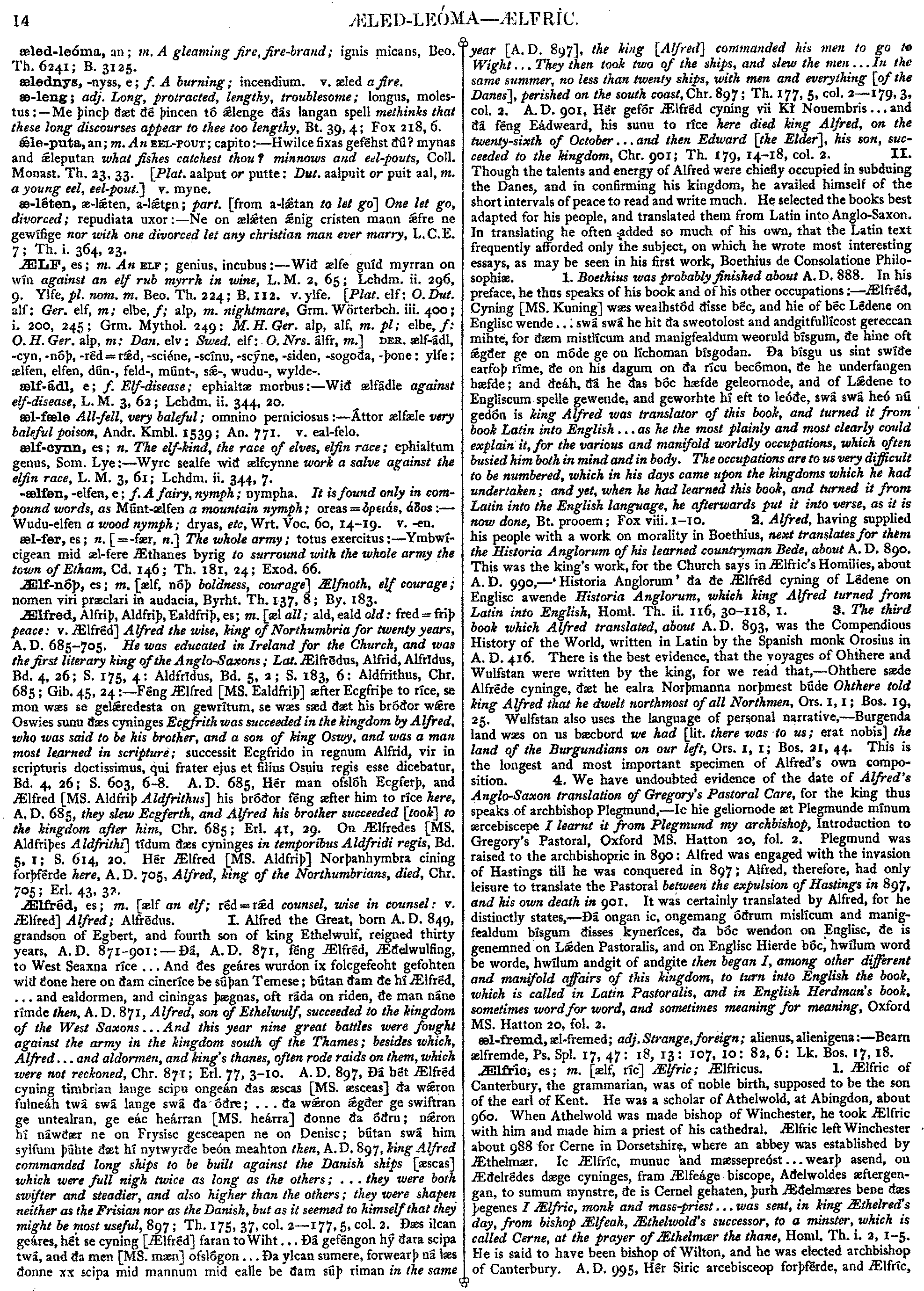
Ælfréd,
es;
m.
[ælf
an
elf;
réd
=
r d
counsel,
wise
in
counsel:
v.
Ælfred]
Alfred;
Alfrédus.
I.
Alfred
the
Great,
born
A.D.
849,
grandson
of
Egbert,
and
fourth
son
of
king
Ethelwulf,
reigned
thirty
years,
A.D.
871-901:
--
Ða,
A.D.
871,
féng
Ælfréd,
Æðelwulfing,
to
West
Seaxna
ríce
...
And
ðes
geáres
wurdon
ix
folcgefeoht
gefohten
wið
ðone
here
on
ðam
cineríce
be
súþan
Temese;
bútan
ðam
ðe
hí
Ælfréd,
...
and
ealdormen,
and
ciningas
þægnas,
oft
ráda
on
riden,
ðe
man
náne
rímde
then,
A.D.
871,
Alfred,
son
of
Ethelwulf,
succeeded
to
the
kingdom
of
the
West
Saxons...And
this
year
nine
great
battles
were
fought
against
the
army
in
the
kingdom
south
of
the
Thames;
besides
which,
Alfred...
and
aldormen,
and
king's
thanes,
often
rode
raids
on
them,
which
were
not
reckoned,
Chr.
871;
Erl.
77,
3-10.
A.
D.
897,
Ðá
hét
Ælfréd
cyning
timbrian
lange
scipu
ongeán
ðas
æscas
[MS.
æsceas]
ða
wron
fulneáh
twá
swá
lange
swá
ða
óðre;
.
.
.
ða
wron
gðer
ge
swiftran
ge
untealran,
ge
eác
heárran
[MS.
heárra]
ðonne
ða
óðru;
nron
hí
ráwðær
ne
on
Frysisc
gesceapen
ne
on
Denisc;
bútan
swá
him
sylfum
þúhte
ðæt
hí
nytwyrðe
beón
meahton
then,
A.D.
897,
king
Alfred
commanded
long
ships
to
be
built
against
the
Danish
ships
[æscas]
which
were
full
nigh
twice
as
long
as
the
others;
.
..
they
were
both
swifter
and
steadier,
and
also
higher
than
the
others;
they
were
shapen
neither
as
the
Frisian
nor
as
the
Danish,
but
as
it
seemed
to
himself
that
they
might
be
most
useful,
897;
Th.
175,
37,
col.
2
--
177,5,
col.
2.
Ðæs
ilcan
geares,
hét
se
cyning
[Ælfréd]
faran
to
Wiht...
Ðá
geféngon
hy
ðara
scipa
twa,
and
ða
men
[MS.
mæn]
ofslógon...
Ða
ylcan
sumere,
forwearþ
ná
læs
ðonne
xx
scipa
mid
mannum
mid
ealle
be
ðam
súþ.
riman
in
the
same
year
[A.D.
897],
the
king
[Alfred]
commanded
his
men
to
go
to
Wight...
They
then
took
two
of
the
ships,
and
slew
the
men
...
In
the
same
summer,
no
less
than
twenty
ships,
with
men
and
everything
[of
the
Danes],
perished
on
the
south
coast,
Chr.
897;
Th.
177,
5,
col.
2
--
179,
3,
col.
2.
A.D.
901,
Hér
gefór
Ælfréd
cyning
vii
Kl
Nouembris...
and
ðá
feng
Eádweard,
his
sunu
to
ríce
here
died
king
Alfred,
on
the
twenty-sixth
of
October...
and
then
Edward
[the
Elder],
his
son,
suc-
ceeded
to
the
kingdom,
Chr.
901;
Th.
179,
14-18,
col.
2.
II.
Though
the
talents
and
energy
of
Alfred
were
chiefly
occupied
in
subduing
the
Danes,
and
in
confirming
his
kingdom,
he
availed
himself
of
the
short
intervals
of
peace
to
read
and
write
much.
He
selected
the
books
best
adapted
for
his
people,
and
translated
them
from
Latin
into
Anglo-Saxon.
In
translating
he
often
added
so
much
of
his
own,
that
the
Latin
text
frequently
afforded
only
the
subject,
on
which
he
wrote
most
interesting
essays,
as
may
be
seen
in
his
first
work,
Boethius
de
Consolatione
Philosophiæ.
1.
Boethius
was
probably
finished
about
A.D.
888.
In
his
preface,
he
thus
speaks
of
his
book
and
of
his
other
occupations
:--
Ælfréd,
Cyning
[MS.
Kuning]
wæs
wealhstód
ðisse
béc,
and
hie
of
béc
Lédene
on
Englisc
wende
...
swá
swá
he
hit
ða
sweotolost
and
andgitfullícost
gereccan
mihte,
for
ðæm
mistlícum
and
manigfealdum
weoruld
bísgum,
ðe
hine
oft
gðer
ge
on
móde
ge
on
líchoman
bísgodan.
Ða
bísgu
us
sint
swíðe
earfoþ
ríme,
ðe
on
his
dagum
on
ða
rícu
becómon,
ðe
he
underfangen
hæfde;
and
ðeáh,
ðá
he
ðas
bóc
hæfde
geleornode,
and
of
Lædene
to
Engliscum
spelle
gewende,
and
geworhte
hí
eft
to
leóðe,
swá
swá
heó
nú
gedón
is
king
Alfred
was
translator
of
this
book,
and
turned
it
from
book
Latin
into
English
...as
he
the
most
plainly
and
most
clearly
could
explain
it,
for
the
various
and
manifold
worldly
occupations,
which
often
busied
him
both
in
mind
and
in
body.
The
occupations
are
to
us
very
difficult
to
be
numbered,
which
in
his
days
came
upon
the
kingdoms
which
he
had
undertaken;
and
yet,
when
he
had
learned
this
book,
and
turned
it
from
Latin
into
the
English
language,
he
afterwards
put
it
into
verse,
as
it
is
now
done,
Bt.
prooem;
Fox
viii.
1-10.
2.
Alfred,
having
supplied
his
people
with
a
work
on
morality
in
Boethius,
next
translates
for
them
the
Historia
Anglorum
of
his
learned
countryman
Bede,
about
A.D.
890.
This
was
the
king's
work,
for
the
Church
says
in
Ælfric's
Homilies,
about
A.
D.
990,
--
'Historia
Anglorum'
ða
ðe
Ælfréd
cyning
of
Lédene
on
Englisc
awende
Historia
Anglorum,
which
king
Alfred
turned
from
Latin
into
English,
Homl.
Th.
ii.
116,
30-118,
l.
3.
The
third
book
which
Alfred
translated,
about
A.
D.
893,
was
the
Compendious
History
of
the
World,
written
in
Latin
by
the
Spanish
monk
Orosius
in
A.
D.
416.
There
is
the
best
evidence,
that
the
voyages
of
Ohthere
and
Wulfstan
were
written
by
the
king,
for
we
read
that,
--
Ohthere
sæde
Alfréde
cyninge,
ðæt
he
ealra
Norþmanna
norþmest
búde
Ohthere
told
king
Alfred
that
he
dwelt
northmost
of
all
Northmen,
Ors.
1,
1;
Bos.
19,
25.
Wulfstan
also
uses
the
language
of
personal
narrative,
--
Burgenda
land
wæs
on
us
bæcbord
we
had
[lit.
there
was
to
us;
erat
nobis]
the
land
of
the
Burgundians
on
our
left,
Ors.
i,
i;
Bos.
21,
44.
This
is
the
longest
and
most
important
specimen
of
Alfred's
own
composition.
4.
We
have
undoubted
evidence
of
the
date
of
Alfred's
Anglo-Saxon
translation
of
Gregory's
Pastoral
Care,
for
the
king
thus
speaks
of
archbishop
Plegmund,
--
Ic
hie
geliornode
æt
Plegmunde
mínum
ærcebiscepe
I
learnt
it
from
Plegmund
my
archbishop,
Introduction
to
Gregory's
Pastoral,
Oxford
MS.
Hatton
20,
fol.
2.
Plegmund
was
raised
to
the
archbishopric
in
890:
Alfred
was
engaged
with
the
invasion
of
Hastings
till
he
was
conquered
in
897;
Alfred,
therefore,
had
only
leisure
to
translate
the
Pastoral
between
the
expulsion
of
Hastings
in
897,
and
his
own
death
in
901.
It
was
certainly
translated
by
Alfred,
for
he
distinctly
states,
--
Ða
ongan
ic,
ongemang
óðrum
mislícum
and
manigfealdum
bísgum
ðisses
kyneríces,
ða
bóc
wendon
on
Englisc,
ðe
is
genemned
on
Lden
Pastoralis,
and
on
Englisc
Hierde
bóc,
hwílum
word
be
worde,
hwílum
andgit
of
andgite
then
began
I,
among
other
different
and
manifold
affairs
of
this
kingdom,
to
turn
into
English
the
book,
which
is
called
in
Latin
Pastoralis,
and
in
English
Herdman's
book,
sometimes
word
for
word,
and
sometimes
meaning
for
meaning,
Oxford
MS.
Hatton
20,
fol.
2.
d
counsel,
wise
in
counsel:
v.
Ælfred]
Alfred;
Alfrédus.
I.
Alfred
the
Great,
born
A.D.
849,
grandson
of
Egbert,
and
fourth
son
of
king
Ethelwulf,
reigned
thirty
years,
A.D.
871-901:
--
Ða,
A.D.
871,
féng
Ælfréd,
Æðelwulfing,
to
West
Seaxna
ríce
...
And
ðes
geáres
wurdon
ix
folcgefeoht
gefohten
wið
ðone
here
on
ðam
cineríce
be
súþan
Temese;
bútan
ðam
ðe
hí
Ælfréd,
...
and
ealdormen,
and
ciningas
þægnas,
oft
ráda
on
riden,
ðe
man
náne
rímde
then,
A.D.
871,
Alfred,
son
of
Ethelwulf,
succeeded
to
the
kingdom
of
the
West
Saxons...And
this
year
nine
great
battles
were
fought
against
the
army
in
the
kingdom
south
of
the
Thames;
besides
which,
Alfred...
and
aldormen,
and
king's
thanes,
often
rode
raids
on
them,
which
were
not
reckoned,
Chr.
871;
Erl.
77,
3-10.
A.
D.
897,
Ðá
hét
Ælfréd
cyning
timbrian
lange
scipu
ongeán
ðas
æscas
[MS.
æsceas]
ða
wron
fulneáh
twá
swá
lange
swá
ða
óðre;
.
.
.
ða
wron
gðer
ge
swiftran
ge
untealran,
ge
eác
heárran
[MS.
heárra]
ðonne
ða
óðru;
nron
hí
ráwðær
ne
on
Frysisc
gesceapen
ne
on
Denisc;
bútan
swá
him
sylfum
þúhte
ðæt
hí
nytwyrðe
beón
meahton
then,
A.D.
897,
king
Alfred
commanded
long
ships
to
be
built
against
the
Danish
ships
[æscas]
which
were
full
nigh
twice
as
long
as
the
others;
.
..
they
were
both
swifter
and
steadier,
and
also
higher
than
the
others;
they
were
shapen
neither
as
the
Frisian
nor
as
the
Danish,
but
as
it
seemed
to
himself
that
they
might
be
most
useful,
897;
Th.
175,
37,
col.
2
--
177,5,
col.
2.
Ðæs
ilcan
geares,
hét
se
cyning
[Ælfréd]
faran
to
Wiht...
Ðá
geféngon
hy
ðara
scipa
twa,
and
ða
men
[MS.
mæn]
ofslógon...
Ða
ylcan
sumere,
forwearþ
ná
læs
ðonne
xx
scipa
mid
mannum
mid
ealle
be
ðam
súþ.
riman
in
the
same
year
[A.D.
897],
the
king
[Alfred]
commanded
his
men
to
go
to
Wight...
They
then
took
two
of
the
ships,
and
slew
the
men
...
In
the
same
summer,
no
less
than
twenty
ships,
with
men
and
everything
[of
the
Danes],
perished
on
the
south
coast,
Chr.
897;
Th.
177,
5,
col.
2
--
179,
3,
col.
2.
A.D.
901,
Hér
gefór
Ælfréd
cyning
vii
Kl
Nouembris...
and
ðá
feng
Eádweard,
his
sunu
to
ríce
here
died
king
Alfred,
on
the
twenty-sixth
of
October...
and
then
Edward
[the
Elder],
his
son,
suc-
ceeded
to
the
kingdom,
Chr.
901;
Th.
179,
14-18,
col.
2.
II.
Though
the
talents
and
energy
of
Alfred
were
chiefly
occupied
in
subduing
the
Danes,
and
in
confirming
his
kingdom,
he
availed
himself
of
the
short
intervals
of
peace
to
read
and
write
much.
He
selected
the
books
best
adapted
for
his
people,
and
translated
them
from
Latin
into
Anglo-Saxon.
In
translating
he
often
added
so
much
of
his
own,
that
the
Latin
text
frequently
afforded
only
the
subject,
on
which
he
wrote
most
interesting
essays,
as
may
be
seen
in
his
first
work,
Boethius
de
Consolatione
Philosophiæ.
1.
Boethius
was
probably
finished
about
A.D.
888.
In
his
preface,
he
thus
speaks
of
his
book
and
of
his
other
occupations
:--
Ælfréd,
Cyning
[MS.
Kuning]
wæs
wealhstód
ðisse
béc,
and
hie
of
béc
Lédene
on
Englisc
wende
...
swá
swá
he
hit
ða
sweotolost
and
andgitfullícost
gereccan
mihte,
for
ðæm
mistlícum
and
manigfealdum
weoruld
bísgum,
ðe
hine
oft
gðer
ge
on
móde
ge
on
líchoman
bísgodan.
Ða
bísgu
us
sint
swíðe
earfoþ
ríme,
ðe
on
his
dagum
on
ða
rícu
becómon,
ðe
he
underfangen
hæfde;
and
ðeáh,
ðá
he
ðas
bóc
hæfde
geleornode,
and
of
Lædene
to
Engliscum
spelle
gewende,
and
geworhte
hí
eft
to
leóðe,
swá
swá
heó
nú
gedón
is
king
Alfred
was
translator
of
this
book,
and
turned
it
from
book
Latin
into
English
...as
he
the
most
plainly
and
most
clearly
could
explain
it,
for
the
various
and
manifold
worldly
occupations,
which
often
busied
him
both
in
mind
and
in
body.
The
occupations
are
to
us
very
difficult
to
be
numbered,
which
in
his
days
came
upon
the
kingdoms
which
he
had
undertaken;
and
yet,
when
he
had
learned
this
book,
and
turned
it
from
Latin
into
the
English
language,
he
afterwards
put
it
into
verse,
as
it
is
now
done,
Bt.
prooem;
Fox
viii.
1-10.
2.
Alfred,
having
supplied
his
people
with
a
work
on
morality
in
Boethius,
next
translates
for
them
the
Historia
Anglorum
of
his
learned
countryman
Bede,
about
A.D.
890.
This
was
the
king's
work,
for
the
Church
says
in
Ælfric's
Homilies,
about
A.
D.
990,
--
'Historia
Anglorum'
ða
ðe
Ælfréd
cyning
of
Lédene
on
Englisc
awende
Historia
Anglorum,
which
king
Alfred
turned
from
Latin
into
English,
Homl.
Th.
ii.
116,
30-118,
l.
3.
The
third
book
which
Alfred
translated,
about
A.
D.
893,
was
the
Compendious
History
of
the
World,
written
in
Latin
by
the
Spanish
monk
Orosius
in
A.
D.
416.
There
is
the
best
evidence,
that
the
voyages
of
Ohthere
and
Wulfstan
were
written
by
the
king,
for
we
read
that,
--
Ohthere
sæde
Alfréde
cyninge,
ðæt
he
ealra
Norþmanna
norþmest
búde
Ohthere
told
king
Alfred
that
he
dwelt
northmost
of
all
Northmen,
Ors.
1,
1;
Bos.
19,
25.
Wulfstan
also
uses
the
language
of
personal
narrative,
--
Burgenda
land
wæs
on
us
bæcbord
we
had
[lit.
there
was
to
us;
erat
nobis]
the
land
of
the
Burgundians
on
our
left,
Ors.
i,
i;
Bos.
21,
44.
This
is
the
longest
and
most
important
specimen
of
Alfred's
own
composition.
4.
We
have
undoubted
evidence
of
the
date
of
Alfred's
Anglo-Saxon
translation
of
Gregory's
Pastoral
Care,
for
the
king
thus
speaks
of
archbishop
Plegmund,
--
Ic
hie
geliornode
æt
Plegmunde
mínum
ærcebiscepe
I
learnt
it
from
Plegmund
my
archbishop,
Introduction
to
Gregory's
Pastoral,
Oxford
MS.
Hatton
20,
fol.
2.
Plegmund
was
raised
to
the
archbishopric
in
890:
Alfred
was
engaged
with
the
invasion
of
Hastings
till
he
was
conquered
in
897;
Alfred,
therefore,
had
only
leisure
to
translate
the
Pastoral
between
the
expulsion
of
Hastings
in
897,
and
his
own
death
in
901.
It
was
certainly
translated
by
Alfred,
for
he
distinctly
states,
--
Ða
ongan
ic,
ongemang
óðrum
mislícum
and
manigfealdum
bísgum
ðisses
kyneríces,
ða
bóc
wendon
on
Englisc,
ðe
is
genemned
on
Lden
Pastoralis,
and
on
Englisc
Hierde
bóc,
hwílum
word
be
worde,
hwílum
andgit
of
andgite
then
began
I,
among
other
different
and
manifold
affairs
of
this
kingdom,
to
turn
into
English
the
book,
which
is
called
in
Latin
Pastoralis,
and
in
English
Herdman's
book,
sometimes
word
for
word,
and
sometimes
meaning
for
meaning,
Oxford
MS.
Hatton
20,
fol.
2.
|
Source: Bosworth/Toller, page b0141, entry 15 View original page image as: [TIFF] [PNG] [View previous entry] [View next entry] |
[Comment on this entry] [View comments] |
The following entry has been hand-corrected once. |
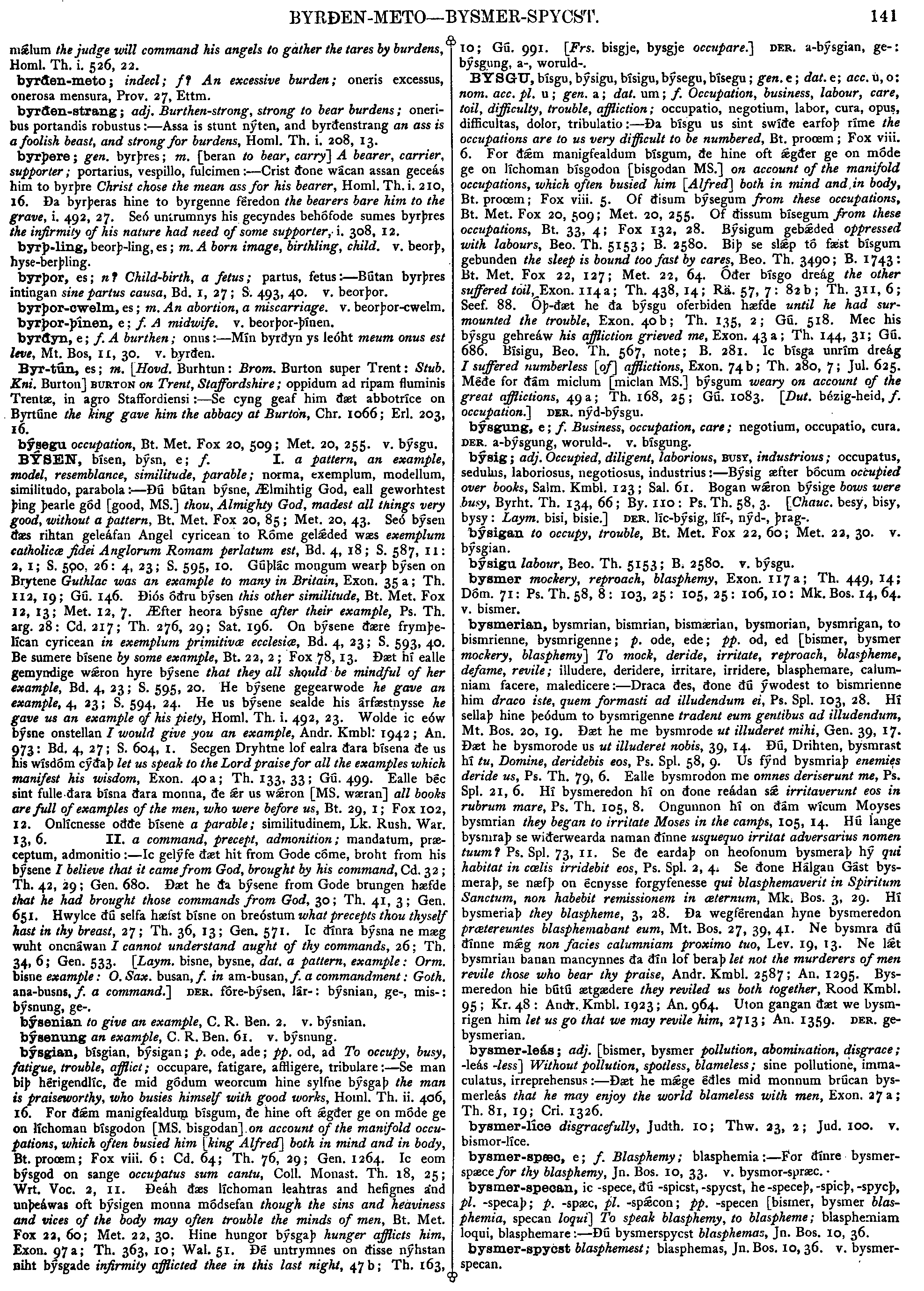
býsgian,
bísgian,
býsigan;
p.
ode,
ade;
pp.
od,
ad
To
occupy,
busy,
fatigue,
trouble,
afflict;
occupare,
fatigare,
affligere,
tribulare
:--
Se
man
biþ
hérigendlíc,
ðe
mid
gódum
weorcum
hine
sylfne
býsgaþ
the
man
is
praiseworthy,
who
busies
himself
with
good
works,
Homl.
Th.
ii.
406,
16.
For
ðm
manigfealdum
bísgum,
ðe
hine
oft
gðer
ge
on
móde
ge
on
líchoman
bísgodon
[MS.
bisgodan].
on
account
of
the
manifold
occupations,
which
often
busied
him
[king
Alfred]
both
in
mind
and
in
body,
Bt.
proœm;
Fox
viii.
6:
Cd.
64;
Th.
76,
29;
Gen.
1264.
Ic
eom
býsgod
on
sange
occupatus
sum
cantu,
Coll.
Monast.
Th.
18,
25;
Wrt.
Voc.
2,
11.
Ðeáh
ðæs
líchoman
leahtras
and
hefignes
and
unþeáwas
oft
býsigen
monna
módsefan
though
the
sins
and
heaviness
and
vices
of
the
body
may
often
trouble
the
minds
of
men,
Bt.
Met.
Fox
22,
60;
Met.
22,
30.
Hine
hunger
býsgaþ
hunger
afflicts
him,
Exon.
97a;
Th.
363,
10;
Wal.
51.
Ðé
untrymnes
on
ðisse
nýhstan
niht
býsgade
infirmity
afflicted
thee
in
this
last
night,
47
b;
Th.
163,
10;
Gú.
991.
[Frs.
bisgje,
bysgje
occupare.]
DER.
a-býsgian,
ge-:
býsgung,
a-,
woruld-.
|
Source: Bosworth/Toller, page b0141, entry 16 View original page image as: [TIFF] [PNG] [View previous entry] [View next entry] |
[Comment on this entry] [View comments (2)] |
The following entry has been hand-corrected once. |
BTSGU,
bísgu,
býsigu,
bísigu,
býsegu,
bísegu;
gen.
e;
dat.
e;
acc.
u,
o:
nom.
acc.
pl.
u;
gen.
a;
dat.
um;
f.
Occupation,
business,
labour,
care,
toil,
difficulty,
trouble,
affliction;
occupatio,
negotium,
labor,
cura,
opus,
difficultas,
dolor,
tribulatio
:--
Ða
bísgu
us
sint
swíðe
earfoþ
ríme
the
occupations
are
to
us
very
difficult
to
be
numbered,
Bt.
proœm;
Fox
viii.
6.
For
ðm
manigfealdum
bísgum,
ðe
hine
oft
gðer
ge
on
móde
ge
on
líchoman
bísgodon
[bisgodan
MS.]
on
account
of
the
manifold
occupations,
which
often
busied
him
[Alfred]
both
in
mind
and
in
body,
Bt.
proœm;
Fox
viii.
5.
Of
ðisum
býsegum
from
these
occupations,
Bt.
Met.
Fox
20,
509;
Met.
20,
255.
Of
ðissum
bísegum
from
these
occupations,
Bt.
33,
4;
Fox
132,
28.
Býsigum
gebded
oppressed
with
labours,
Beo.
Th.
5153;
B.
2580.
Biþ
se
slp
tó
fæst
bísgum
gebunden
the
sleep
is
bound
too
fast
by
cares,
Beo.
Th.
3490;
B.
1743:
Bt.
Met.
Fox
22,
127;
Met.
22,
64.
Óðer
bísgo
dreág
the
other
suffered
toil,
Exon.
114a;
Th.
438,
14;
Rä.
57,
7:
82b;
Th.
311,
6;
Seef.
88.
Óþ-ðæt
he
ða
býsgu
oferbiden
hæfde
until
he
had
surmounted
the
trouble,
Exon.
40b;
Th.
135,
2;
Gú.
518.
Mec
his
býsgu
gehreáw
his
affliction
grieved
me,
Exon.
43a;
Th.
144,
31;
Gú.
686.
Bísigu,
Beo.
Th.
567,
note;
B.
281.
Ic
bísga
unrím
dreág
I
suffered
numberless
[of]
afflictions,
Exon.
74b;
Th.
280,
7;
Jul.
625.
Méðe
for
ðám
miclum
[miclan
MS.]
býsgum
weary
on
account
of
the
great
afflictions,
49a;
Th.
168,
25;
Gú.
1083.
[Dut.
bézig-heid,
f.
occupation.]
DER.
nýd-býsgu.
|
Source: Bosworth/Toller, page b0190, entry 4 View original page image as: [TIFF] [PNG] [View previous entry] [View next entry] |
[Comment on this entry] [View comments] |
The following entry has been hand-corrected once. |
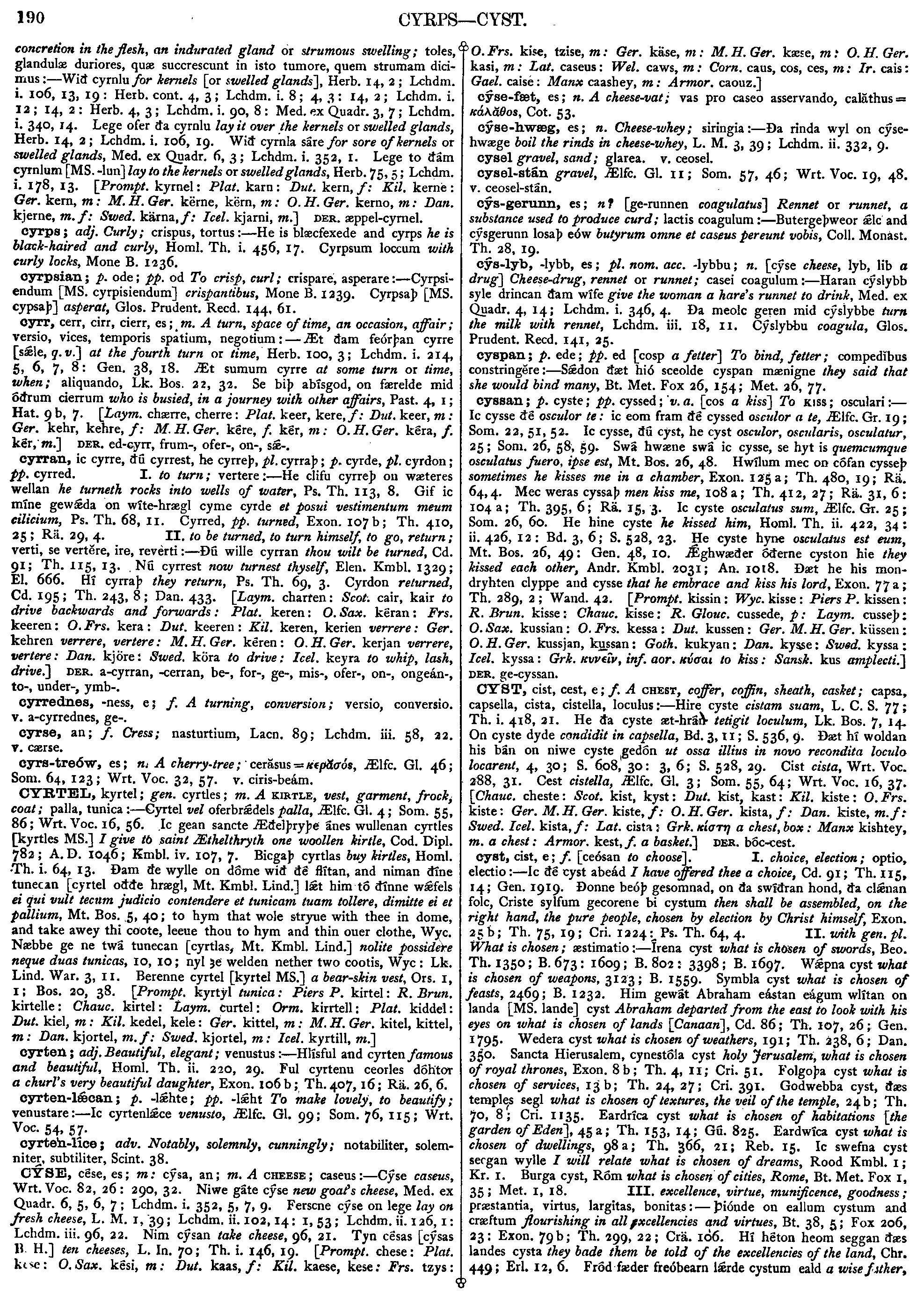
cyrr,
cerr,
cirr,
cierr,
es;
m.
A
turn,
space
of
time,
an
occasion,
affair;
versio,
vices,
temporis
spatium,
negotium
:--
Æt
ðam
feórþan
cyrre
[sle,
q.
v.]
at
the
fourth
turn
or
time,
Herb.
100,
3;
Lchdm.
i.
214,
5,
6,
7,
8:
Gen.
38,
18.
Æt
sumum
cyrre
at
some
turn
or
time,
when;
aliquando,
Lk.
Bos.
22,
32.
Se
biþ
abísgod,
on
færelde
mid
óðrum
cierrum
who
is
busied,
in
a
journey
with
other
affairs,
Past.
4,
1;
Hat.
9b,
7.
[Laym.
chærre,
cherre:
Plat.
keer,
kere,
f:
Dut.
keer,
m:
Ger.
kehr,
kehre,
f:
M.
H.
Ger.
kére,
f.
kér,
m:
O.
H.
Ger.
kéra,
f.
kér,
m.]
DER.
ed-cyrr,
frum-,
ofer-,
on-,
s-.
|
Source: Bosworth/Toller, page b0263, entry 30 View original page image as: [TIFF] [PNG] [View previous entry] [View next entry] |
[Comment on this entry] [View comments] |
The following entry has been hand-corrected once. |
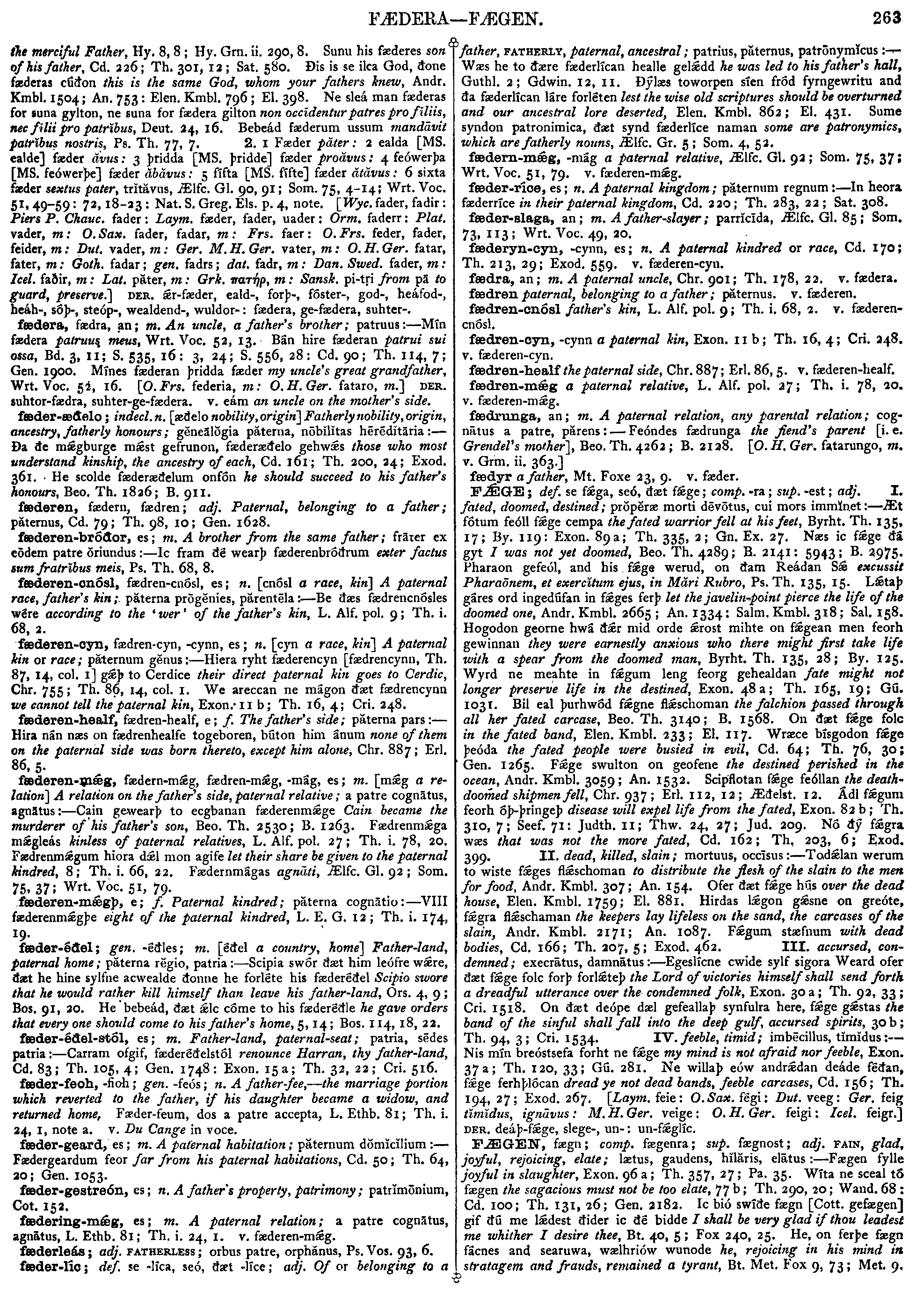
FÆ-acute;GE;
def.
se
fga,
seó,
ðæt
fge;
comp.
-ra;
sup.
-est;
adj.
I.
fated,
doomed,
destined;
pr p
p ræ
morti
d
ræ
morti
d v
v tus,
cui
mors
imm
tus,
cui
mors
imm net
:--
Æt
fótum
feóll
fge
cempa
the
fated
warrior
fell
at
his
feet,
Byrht.
Th.
135,
17;
By.
119
:
Exon.
89
a;
Th.
335,
2;
Gn.
Ex.
27.
Næs
ic
fge
ðá
gyt
I
was
not
yet
doomed,
Beo.
Th.
4289;
B.
2141
:
5943;
B.
2975.
Pharaon
gefeól,
and
his
fge
werud,
on
ðam
Reádan
S
excussit
Pharanem,
et
exerctum
ejus,
in
M
net
:--
Æt
fótum
feóll
fge
cempa
the
fated
warrior
fell
at
his
feet,
Byrht.
Th.
135,
17;
By.
119
:
Exon.
89
a;
Th.
335,
2;
Gn.
Ex.
27.
Næs
ic
fge
ðá
gyt
I
was
not
yet
doomed,
Beo.
Th.
4289;
B.
2141
:
5943;
B.
2975.
Pharaon
gefeól,
and
his
fge
werud,
on
ðam
Reádan
S
excussit
Pharanem,
et
exerctum
ejus,
in
M ri
Rubro,
Ps.
Th.
135,
15.
Ltaþ
gáres
ord
ingedúfan
in
fges
ferþ
let
the
javelin-point
pierce
the
life
of
the
doomed
one,
Andr.
Kmbl.
2665;
An.
1334
:
Salm.
Kmbl.
318;
Sal.
158.
Hogodon
georne
hwá
ðr
mid
orde
rost
mihte
on
fgean
men
feorh
gewinnan
they
were
earnestly
anxious
who
there
might
first
take
life
with
a
spear
from
the
doomed
man,
Byrht.
Th.
135,
28;
By.
125.
Wyrd
ne
meahte
in
fgum
leng
feorg
gehealdan
fate
might
not
longer
preserve
life
in
the
destined,
Exon.
48
a;
Th.
165,
19;
Gú.
1031.
Bil
eal
þurhwód
fgne
flschoman
the
falchion
passed
through
all
her
fated
carcase,
Beo.
Th.
3140;
B.
1568.
On
ðæt
fge
folc
in
the
fated
band,
Elen.
Kmbl.
233;
El.
117.
Wræce
bísgodon
fge
þeóda
the
fated
people
were
busied
in
evil,
Cd.
64;
Th.
76,
30;
Gen.
1265.
Fge
swulton
on
geofene
the
destined
perished
in
the
ocean,
Andr.
Kmbl.
3059;
An.
1532.
Scipflotan
fge
feóllan
the
death-doomed
shipmen
fell,
Chr.
937;
Erl.
112,
12;
Æðelst.
12.
Ádl
fgum
feorh
óþ-þringeþ
disease
will
expel
life
from
the
fated,
Exon.
82
b;
Th.
310,
7;
Seef.
71
:
Judth.
11;
Thw.
24,
27;
Jud.
209.
Nó
ðý
fgra
wæs
that
was
not
the
more
fated,
Cd.
162;
Th,
203,
6;
Exod.
399.
II.
dead,
killed,
slain;
mortuus,
occ
ri
Rubro,
Ps.
Th.
135,
15.
Ltaþ
gáres
ord
ingedúfan
in
fges
ferþ
let
the
javelin-point
pierce
the
life
of
the
doomed
one,
Andr.
Kmbl.
2665;
An.
1334
:
Salm.
Kmbl.
318;
Sal.
158.
Hogodon
georne
hwá
ðr
mid
orde
rost
mihte
on
fgean
men
feorh
gewinnan
they
were
earnestly
anxious
who
there
might
first
take
life
with
a
spear
from
the
doomed
man,
Byrht.
Th.
135,
28;
By.
125.
Wyrd
ne
meahte
in
fgum
leng
feorg
gehealdan
fate
might
not
longer
preserve
life
in
the
destined,
Exon.
48
a;
Th.
165,
19;
Gú.
1031.
Bil
eal
þurhwód
fgne
flschoman
the
falchion
passed
through
all
her
fated
carcase,
Beo.
Th.
3140;
B.
1568.
On
ðæt
fge
folc
in
the
fated
band,
Elen.
Kmbl.
233;
El.
117.
Wræce
bísgodon
fge
þeóda
the
fated
people
were
busied
in
evil,
Cd.
64;
Th.
76,
30;
Gen.
1265.
Fge
swulton
on
geofene
the
destined
perished
in
the
ocean,
Andr.
Kmbl.
3059;
An.
1532.
Scipflotan
fge
feóllan
the
death-doomed
shipmen
fell,
Chr.
937;
Erl.
112,
12;
Æðelst.
12.
Ádl
fgum
feorh
óþ-þringeþ
disease
will
expel
life
from
the
fated,
Exon.
82
b;
Th.
310,
7;
Seef.
71
:
Judth.
11;
Thw.
24,
27;
Jud.
209.
Nó
ðý
fgra
wæs
that
was
not
the
more
fated,
Cd.
162;
Th,
203,
6;
Exod.
399.
II.
dead,
killed,
slain;
mortuus,
occ sus
:--
Todlan
werum
to
wiste
fges
flschoman
to
distribute
the
flesh
of
the
slain
to
the
men
for
food,
Andr.
Kmbl.
307;
An.
154.
Ofer
ðæt
fge
hús
over
the
dead
house,
Elen.
Kmbl.
1759;
El.
881.
Hirdas
lgon
gsne
on
greóte,
fgra
flschaman
the
keepers
lay
lifeless
on
the
sand,
the
carcases
of
the
slain,
Andr.
Kmbl.
2171;
An.
1087.
Fgum
stæfnum
with
dead
bodies,
Cd.
166;
Th.
207,
5;
Exod.
462.
III.
accursed,
condemned;
execr
sus
:--
Todlan
werum
to
wiste
fges
flschoman
to
distribute
the
flesh
of
the
slain
to
the
men
for
food,
Andr.
Kmbl.
307;
An.
154.
Ofer
ðæt
fge
hús
over
the
dead
house,
Elen.
Kmbl.
1759;
El.
881.
Hirdas
lgon
gsne
on
greóte,
fgra
flschaman
the
keepers
lay
lifeless
on
the
sand,
the
carcases
of
the
slain,
Andr.
Kmbl.
2171;
An.
1087.
Fgum
stæfnum
with
dead
bodies,
Cd.
166;
Th.
207,
5;
Exod.
462.
III.
accursed,
condemned;
execr tus,
damntus
:--
Egeslícne
cwide
sylf
sigora
Weard
ofer
ðæt
fge
folc
forþ
forlteþ
the
Lord
of
victories
himself
shall
send
forth
a
dreadful
utterance
over
the
condemned
folk,
Exon.
30
a;
Th.
92,
33;
Cri.
1518.
On
ðæt
deópe
dæl
gefeallaþ
synfulra
here,
fge
gstas
the
band
of
the
sinful
shall
fall
into
the
deep
gulf,
accursed
spirits,
30
b;
Th.
94,
3;
Cri.
1534.
IV.
feeble,
timid;
imbcillus,
tmdus
:--
Nis
mín
breóstsefa
forht
ne
fge
my
mind
is
not
afraid
nor
feeble,
Exon.
37
a;
Th.
120,
33;
Gú.
281.
Ne
willaþ
eów
andrdan
deáde
féðan,
fge
ferhþlócan
dread
ye
not
dead
bands,
feeble
carcases,
Cd.
156;
Th.
194,
27;
Exod.
267.
[Laym.
feie
:
O.
Sax.
fégi
:
Dut.
veeg
:
Ger.
feig
tmdus,
ignvus
:
M.
H.
Ger.
veige
:
O.
H.
Ger.
feigi
:
Icel.
feigr.]
DER.
deáþ-fge,
slege-,
un-
:
un-fglíc.
tus,
damntus
:--
Egeslícne
cwide
sylf
sigora
Weard
ofer
ðæt
fge
folc
forþ
forlteþ
the
Lord
of
victories
himself
shall
send
forth
a
dreadful
utterance
over
the
condemned
folk,
Exon.
30
a;
Th.
92,
33;
Cri.
1518.
On
ðæt
deópe
dæl
gefeallaþ
synfulra
here,
fge
gstas
the
band
of
the
sinful
shall
fall
into
the
deep
gulf,
accursed
spirits,
30
b;
Th.
94,
3;
Cri.
1534.
IV.
feeble,
timid;
imbcillus,
tmdus
:--
Nis
mín
breóstsefa
forht
ne
fge
my
mind
is
not
afraid
nor
feeble,
Exon.
37
a;
Th.
120,
33;
Gú.
281.
Ne
willaþ
eów
andrdan
deáde
féðan,
fge
ferhþlócan
dread
ye
not
dead
bands,
feeble
carcases,
Cd.
156;
Th.
194,
27;
Exod.
267.
[Laym.
feie
:
O.
Sax.
fégi
:
Dut.
veeg
:
Ger.
feig
tmdus,
ignvus
:
M.
H.
Ger.
veige
:
O.
H.
Ger.
feigi
:
Icel.
feigr.]
DER.
deáþ-fge,
slege-,
un-
:
un-fglíc.
|
Source: Bosworth/Toller, page b0549, entry 3 View original page image as: [TIFF] [PNG] [View previous entry] [View next entry] |
[Comment on this entry] [View comments (2)] |
The following entry has been hand-corrected once. |
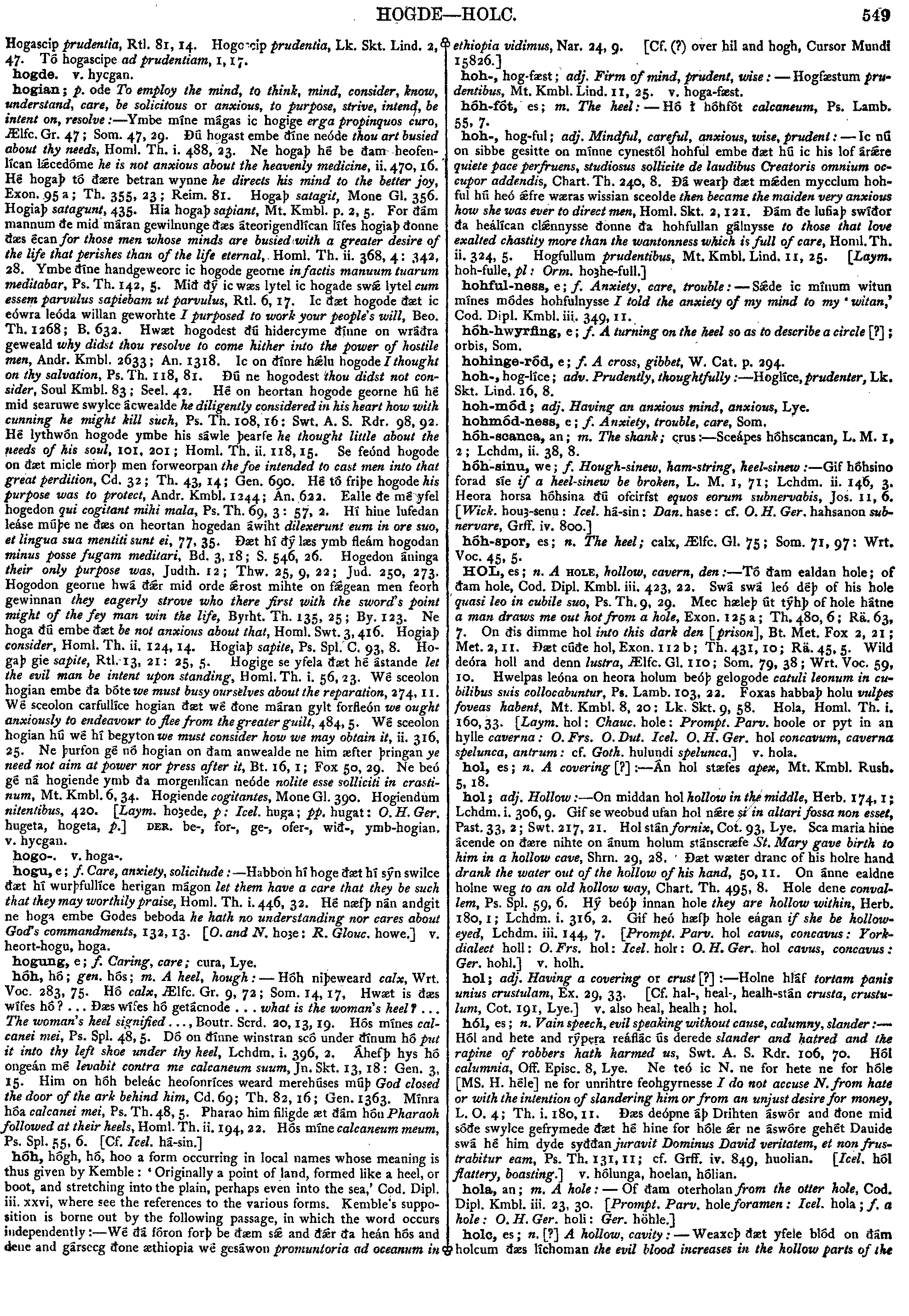
hogian;
p.
ode
To
employ
the
mind,
to
think,
mind,
consider,
know,
understand,
care,
be
solicitous
or
anxious,
to
purpose,
strive,
intend,
be
intent
on,
resolve
:--
Ymbe
míne
mágas
ic
hogige
erga
propinquos
curo,
Ælfc.
Gr.
47;
Som.
47,
29.
Ðú
hogast
embe
ðíne
neóde
thou
art
busied
about
thy
needs,
Homl.
Th.
i.
488,
23.
Ne
hogaþ
hé
be
ðam
heofenlícan
lcedðme
he
is
not
anxious
about
the
heavenly
medicine,
ii.
470,
16.
Hé
hogaþ
tó
ðære
betran
wynne
he
directs
his
mind
to
the
better
joy,
Exon.
95
a;
Th.
355,
23;
Reim.
81.
Hogaþ
satagit,
Mone
Gl.
356.
Hogiaþ
satagunt,
435.
Hia
hogaþ
sapiant,
Mt.
Kmbl.
p.
2,
5.
For
ðám
mannum
ðe
mid
máran
gewilnunge
ðæs
áteorigendlícan
lífes
hogiaþ
ðonne
ðæs
écan
for
those
men
whose
minds
are
busied
with
a
greater
desire
of
the
life
that
perishes
than
of
the
life
eternal,
Homl.
Th.
ii.
368,
4:
342,
28.
Ymbe
ðíne
handgeweorc
ic
hogode
georne
in
factis
manuum
tuarum
meditabar,
Ps.
Th.
142,
5.
Mið
ðý
ic
wæs
lytel
ic
hogade
sw
lytel
cum
essem
parvulus
sapiebam
ut
parvulus,
Rtl.
6,
17.
Ic
ðæt
hogode
ðæt
ic
eówra
leóda
willan
geworhte
I
purposed
to
work
your
people's
will,
Beo.
Th.
1268;
B.
632.
Hwæt
hogodest
ðú
hidercyme
ðínne
on
wráðra
geweald
why
didst
thou
resolve
to
come
hither
into
the
power
of
hostile
men,
Andr.
Kmbl.
2633;
An.
1318.
Ic
on
ðínre
hlu
hogode
I
thought
on
thy
salvation,
Ps.
Th.
118,
81.
Ðú
ne
hogodest
thou
didst
not
consider,
Soul
Kmbl.
83;
Seel.
42.
Hé
on
heortan
hogode
georne
hú
hé
mid
searuwe
swylce
ácwealde
he
diligently
considered
in
his
heart
how
with
cunning
he
might
kill
such,
Ps.
Th.
108,
16:
Swt.
A.
S.
Rdr.
98,
92.
Hé
lythwón
hogode
ymbe
his
sáwle
þearfe
he
thought
little
about
the
needs
of
his
soul,
101,
201;
Homl.
Th.
ii.
118,
15.
Se
feónd
hogode
on
ðæt
micle
morþ
men
forweorpan
the
foe
intended
to
cast
men
into
that
great
perdition,
Cd.
32;
Th.
43,
14;
Gen.
690.
Hé
tó
friþe
hogode
his
purpose
was
to
protect,
Andr.
Kmbl.
1244;
An.
622.
Ealle
dé
mé
yfel
hogedon
qui
cogitant
mihi
mala,
Ps.
Th.
69,
3:
57,
2.
Hí
hine
lufedan
leáse
múþe
ne
ðæs
on
heortan
hogedan
áwiht
dilexerunt
eum
in
ore
suo,
et
lingua
sua
mentiti
sunt
ei,
77,
35.
Ðæt
hí
ðý
læs
ymb
fleám
hogodan
minus
posse
fugam
meditari,
Bd.
3,
18;
S.
546,
26.
Hogedon
áninga
their
only
purpose
was,
Judth.
12;
Thw.
25,
9,
22;
Jud.
250,
273.
Hogodon
georne
hwá
ðr
mid
orde
rost
mihte
on
fgean
men
feorh
gewinnan
they
eagerly
strove
who
there
first
with
the
sword's
point
might
of
the
fey
man
win
the
life,
Byrht.
Th.
135,
25;
By.
123.
Ne
hoga
ðú
embe
ðæt
be
not
anxious
about
that,
Homl.
Swt.
3,
416.
Hogiaþ
consider,
Homl.
Th.
ii.
124,
14.
Hogiaþ
sapite,
Ps.
Spl.
C.
93,
8.
Hogaþ
gie
sapite,
Rtl.
13,
21:
25,
5.
Hogige
se
yfela
ðæt
hé
ástande
let
the
evil
man
be
intent
upon
standing,
Homl.
Th.
i.
56,
23.
Wé
sceolon
hogian
embe
ða
bóte
we
must
busy
ourselves
about
the
reparation,
274,
11.
Wé
sceolon
carfullíce
hogian
ðæt
we
ðone
máran
gylt
forfleón
we
ought
anxiously
to
endeavour
to
flee
from
the
greater
guilt,
484,
5.
Wé
sceolon
hogian
hú
wé
hí
begyton
we
must
consider
how
we
may
obtain
it,
ii.
316,
25.
Ne
þurfon
gé
nó
hogian
on
ðam
anwealde
ne
him
æfter
þringan
ye
need
not
aim
at
power
nor
press
after
it,
Bt.
16,
1;
Fox
50,
29.
Ne
beó
gé
ná
hogiende
ymb
ða
morgenlícan
neóde
nolite
esse
solliciti
in
crastinum,
Mt.
Kmbl.
6,
34.
Hogiende
cogitantes,
Mone
Gl.
390.
Hogiendum
nitentibus,
420.
[Laym.
ho ede,
p:
Icel.
huga;
pp.
hugat:
O.
H.
Ger.
hugeta,
hogeta,
p.]
DER.
be-,
for-,
ge-,
ofer-,
wið-,
ymb-hogian.
v.
hycgan.
ede,
p:
Icel.
huga;
pp.
hugat:
O.
H.
Ger.
hugeta,
hogeta,
p.]
DER.
be-,
for-,
ge-,
ofer-,
wið-,
ymb-hogian.
v.
hycgan.
|
Source: Bosworth/Toller, page b0641, entry 24 View original page image as: [TIFF] [PNG] [View previous entry] [View next entry] |
[Comment on this entry] [View comments (1)] |
The following entry has been hand-corrected once. |
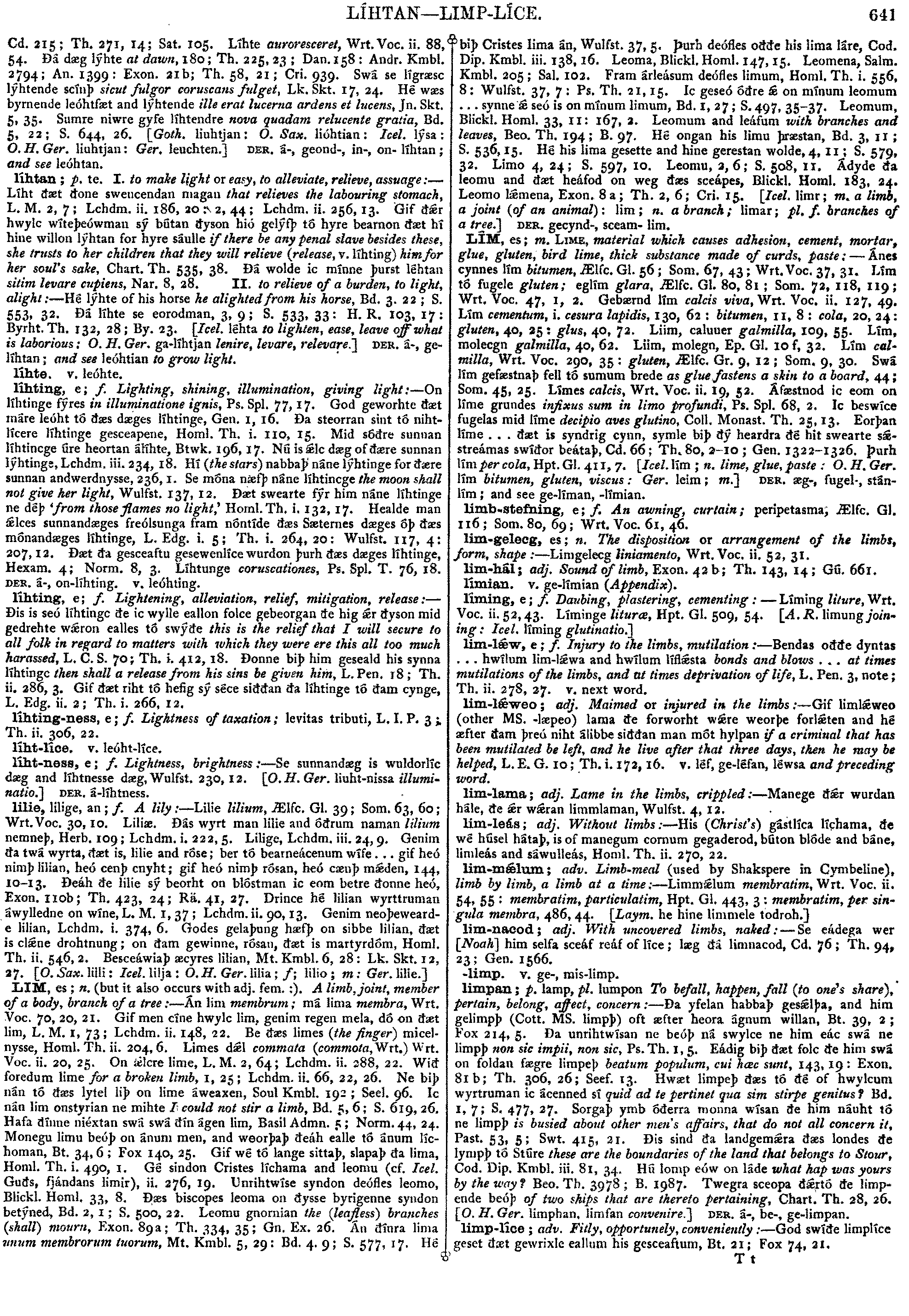
limpan;
p.
lamp,
pl.
lumpon
To
befall,
happen,
fall
(to
one's
share),
pertain,
belong,
affect,
concern
:--
Ða
yfelan
habbaþ
geslþa,
and
him
gelimpþ
(Cott.
MS.
limpþ)
oft
æfter
heora
ágnum
willan,
Bt.
39,
2;
Fox
214,
5.
Ða
unrihtwísan
ne
beóþ
ná
swylce
ne
him
eác
swá
ne
limpþ
non
sic
impii,
non
sic,
Ps.
Th.
1,
5.
Eádig
biþ
ðæt
folc
ðe
him
swá
on
foldan
fægre
limpeþ
beatum
populum,
cui
hæc
sunt,
143,
19:
Exon.
81
b;
Th.
306,
26;
Seef.
13.
Hwæt
limpeþ
ðæs
tó
ðé
of
hwylcum
wyrtruman
ic
ácenned
sí
quid
ad
te
pertinet
qua
sim
stirpe
genitus?
Bd.
1,
7;
S.
477,
27,
Sorgaþ
ymb
óðerra
monna
wísan
ðe
him
náuht
tó
ne
limpþ
is
busied
about
other
men's
affairs,
that
do
not
all
concern
it,
Past.
53,
5;
Swt.
415,
21.
Ðis
sind
ða
landgemra
ðæs
londes
ðe
lympþ
tó
Stúre
these
are
the
boundaries
of
the
land
that
belongs
to
Stour,
Cod.
Dip.
Kmbl,
iii.
81,
34.
Hú
lomp
eów
on
láde
what
hap
was
yours
by
the
way?
Beo.
Th.
3978;
B.
1987.
Twegra
sceopa
ðrtó
ðe
limpende
beóþ
of
two
ships
that
are
thereto
pertaining,
Chart.
Th.
28,
26.
[O.
H.
Ger.
limphan,
limfan
convenire.]
DER.
á-,
be-,
ge-limpan.
|
Source: Cleasby/Vigfusson, page b0281, entry 4 View original page image as: [TIFF] [PNG] [View previous entry] [View next entry] |
[Comment on this entry] [View comments] |
The following entry has been hand-corrected once. |
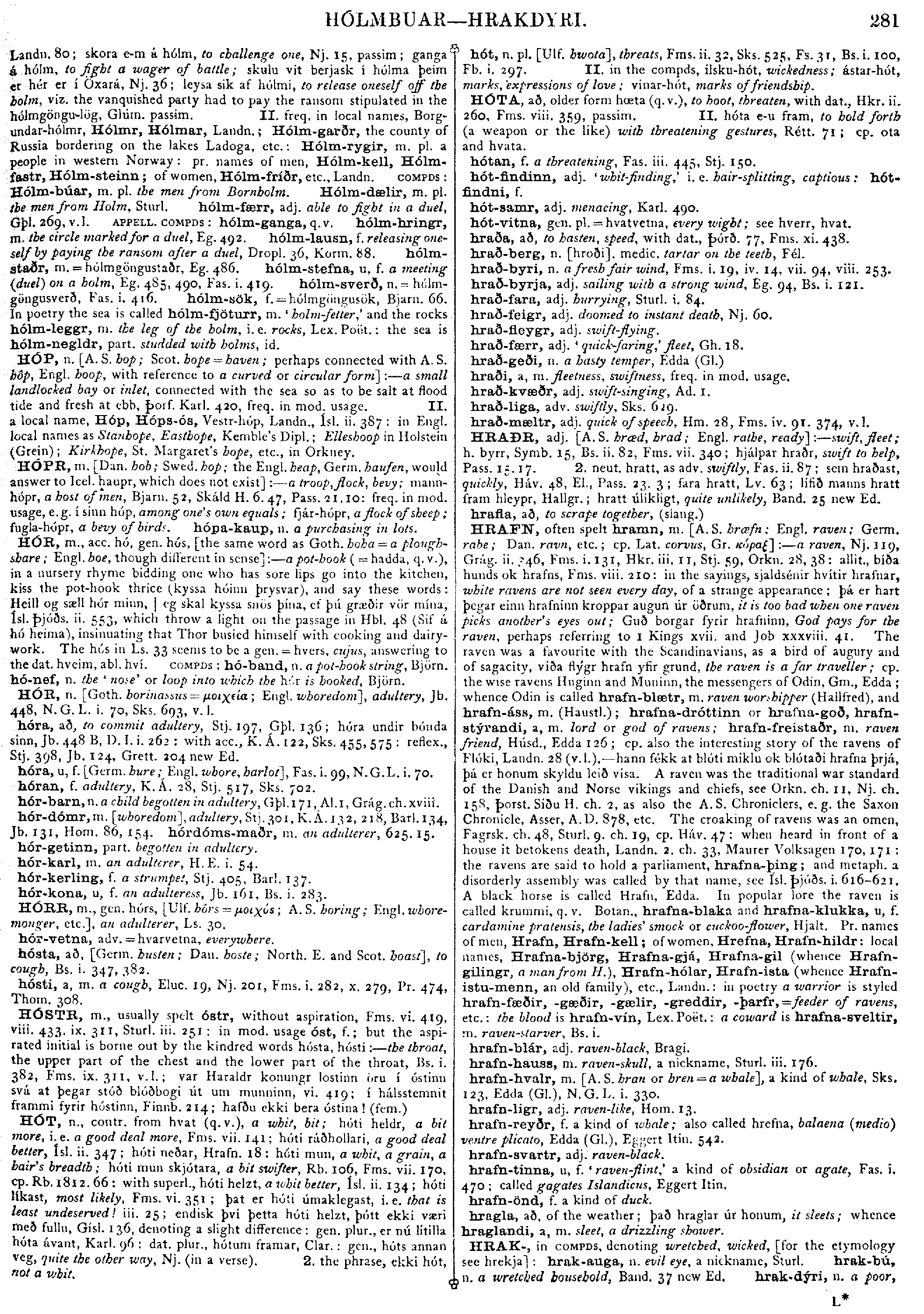
HÓR, m., acc. hó, gen. hós, [the same word as Goth. hoha = a plough-share; Engl. hoe, though different in sense] :-- a pot-hook ( = hadda, q.v.), in a nursery rhyme bidding one who has sore lips go into the kitchen, kiss the pot-hook thrice (kyssa hóinn þrysvar), and say these words: Heill og sæll hór minn, | eg skal kyssa snös þína, ef þú græðir vör mína, Ísl. Þjóðs. ii. 553, which throw a light ou the passage in Hbl. 48 (Sif á hó heima), insinuating that Thor busied himself with cooking and dairy-work. The hós in Ls. 33 seems to be a gen. = hvers, cujus, answering to the dat. hveim, abl. hví. COMPDS: hó-band, n. a pot-hook string, Björn. hó-nef, n. the 'nose' or loop into which the hór is hooked, Björn.
|
Source: Cleasby/Vigfusson, page b0616, entry 8 View original page image as: [TIFF] [PNG] [View previous entry] [View next entry] |
[Comment on this entry] [View comments] |
The following entry has been hand-corrected once. |
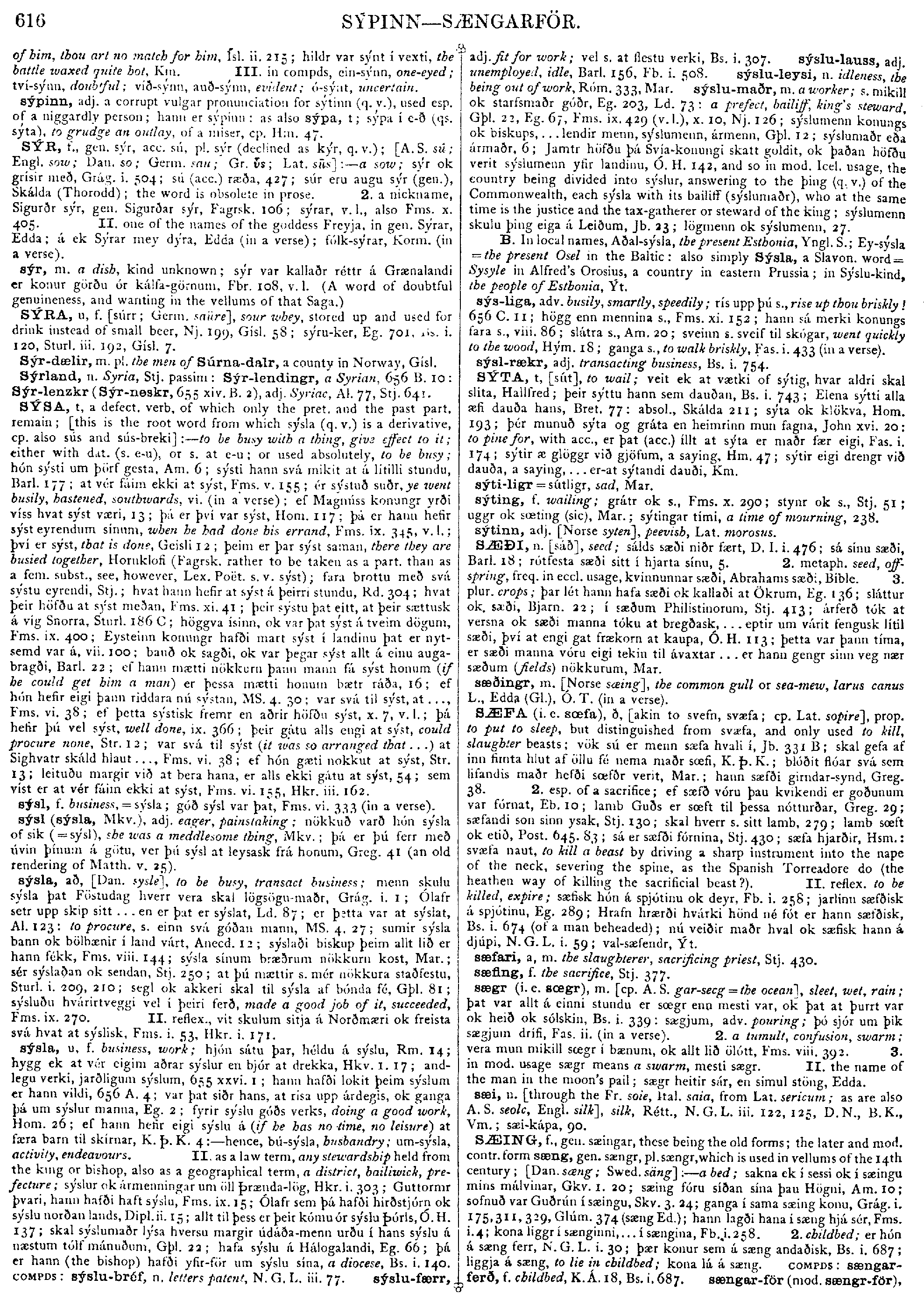
SÝSA, t, a defect. verb, of which only the pret. and the past part. remain; [this is the root word from which sýsla (q.v,) is a derivative, cp. also sús and sús-breki] :-- to be busy with a thing, give effect to it; either with dat. (s. e-u), or s. at e-u; or used absolutely, to be busy; hón sýsti um þörf gesta. Am. 6; sýsti hann svá mikit at á lítilli stundu, Barl. 177; at vér fáim ekki at sýst, Fms. v. 155; ér sýstuð suðr, ye went busily, hastened, southwards, vi. (in a verse); ef Magnúss konungr yrði víss hvat sýst væri, 13; þá er því var sýst, Hom. 117; þá er hann hefir sýst eyrendum sínum, when he had done his errand, Fms. ix. 345, v.l.; því er sýst, that is done, Geisli 12; þeim er þar sýst saman, there they are busied together, Hornklofi (Fagrsk. rather to be taken as a part. than as a fem, subst., see, however, Lex. Poët. s.v. sýst); fara brottu með svá sýstu eyrendi, Stj.; hvat hann hefir at sýst á þeirri stundu, Rd. 304; hvat þeir höfðu at sýst meðan, Fms. xi. 41; þeir sýstu þat eitt, at þeir sættusk á víg Snorra, Sturl. 186 C; höggva ísinn, ok var þat sýst á tveim dögum, Fms. ix. 400; Eysteinn konungr hafði mart sýst í landinu þat er nytsemd var á, vii. 100; bauð ok sagði, ok var þegar sýst allt á einu auga-bragði, Barl. 22; ef hann mætti nökkum þann mann fá sýst honum (if he could get him a man) er þessa mætti honum bætr ráða, 16; ef hón hefir eigi þann riddara nú sýstan, MS. 4. 30; var svá til sýst, at ..., Fms. vi. 38; ef þetta sýstisk fremr en aðrir höfðu sýst, x. 7, v.l.; þá hefir þú vel sýst, well done, ix. 366; þeir gátu alls engi at sýst, could procure none, Str. 12; var svá til sýst (it was so arranged that ...) at Sighvatr skáld hlaut ..., Fms. vi. 38; ef hón gæti nokkut at sýst, Str. 13; leituðu margir við at bera hana, er alls ekki gátu at sýst, 54; sem víst er at vér fáim ekki at sýst, Fms. vi. 155, Hkr. iii. 162.
|
Source: Cleasby/Vigfusson, page b0626, entry 1 View original page image as: [TIFF] [PNG] [View previous entry] [View next entry] |
[Comment on this entry] [View comments] |
The following entry has been hand-corrected once. |
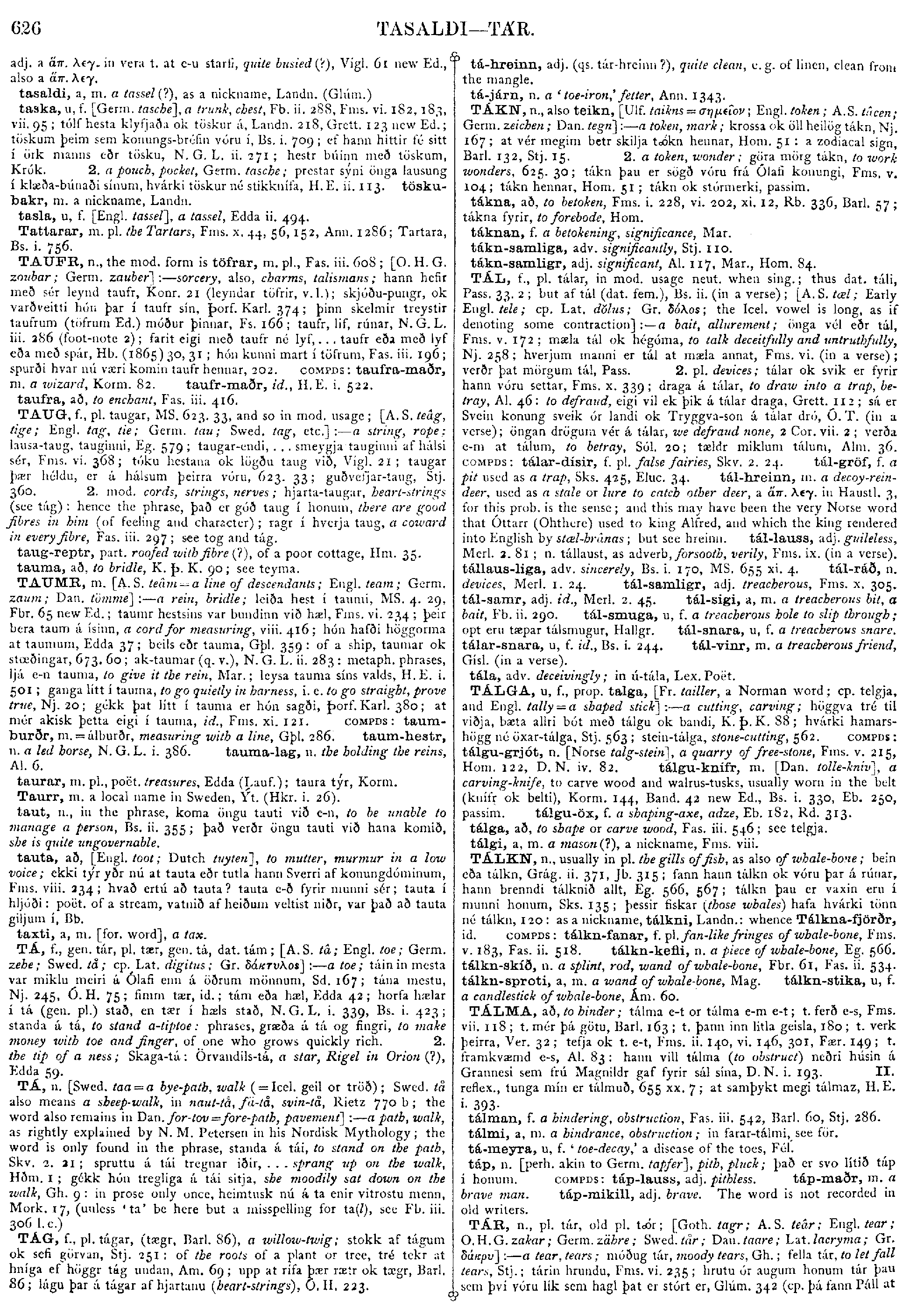
adj. a GREEK in vera t. at e-u starfi, quite busied(?), Vígl. 61 new Ed., also a GREEK.
Germanic Lexicon Project (main page)
This search system was written by
Sean Crist
Please consider
volunteering
to correct the data in these online dictionaries.
No rights reserved. Feel free to use these data in any way you please.