|
|

Tip: In the search results, you can click on any word or abbreviation for more information.
|
Source: Bosworth/Toller, page b0712, entry 13 View original page image as: [TIFF] [PNG] [View previous entry] [View next entry] |
[Comment on this entry] [View comments] |
The following entry has been hand-corrected once. |
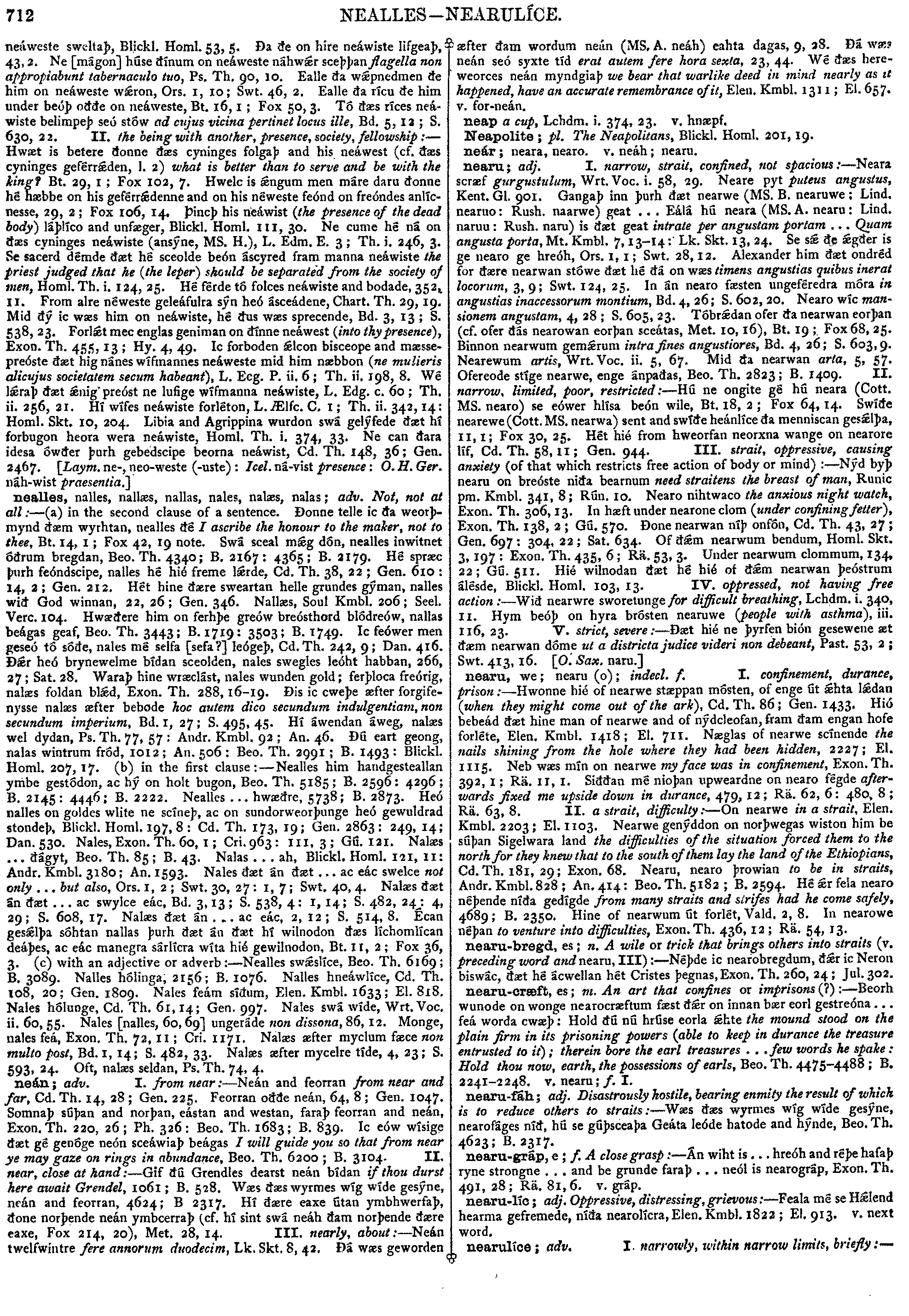
nearulíce;
adv.
I.
narrowly,
within
narrow
limits,
briefly
:--
Nearolíce
strictim,
Ælfc.
Gr.
38
;
Som.
41,
60.
Ys
seó
fores de
bóc
(Genesis)
on
manegum
stówum
swíde
nærolíce
gesett
(is
a
mere
narrative
of
events),
and
ðeáh
swíde
deóplíce
on
ðam
gástlícum
andgite,
Ælfc.
Gen.
Thor.
4,
3.
II.
oppressively,
grievously
:--
Ða
ðe
nearwlícast
cúðan
swician
those
who
knew
how
to
cheat
in
most
oppressive
manner,
L.
I.
P.
12
;
Th.
ii.
320,
24.
III.
narrowly,
exactly,
strictly
:--
Manegu
díglu
þing
sindon
nearolíce
(subtiliter)
tó
smeáganne
many
secret
things
are
to
be
narrowly
examined,
Past.
21,
3
;
Swt.
153,
13.
Swá
swýðe
nearwelíce
hé
hit
létt
út
áspyrian
(of
the
enquiry
which
was
made
when
Doomsday
Book
was
compiled),
Chr.
1085
;
Erl.
218,
34.
[He
nule
nout
so
neruhliche
demen
ase
de
bóc
(Genesis)
on
manegum
stówum
swíde
nærolíce
gesett
(is
a
mere
narrative
of
events),
and
ðeáh
swíde
deóplíce
on
ðam
gástlícum
andgite,
Ælfc.
Gen.
Thor.
4,
3.
II.
oppressively,
grievously
:--
Ða
ðe
nearwlícast
cúðan
swician
those
who
knew
how
to
cheat
in
most
oppressive
manner,
L.
I.
P.
12
;
Th.
ii.
320,
24.
III.
narrowly,
exactly,
strictly
:--
Manegu
díglu
þing
sindon
nearolíce
(subtiliter)
tó
smeáganne
many
secret
things
are
to
be
narrowly
examined,
Past.
21,
3
;
Swt.
153,
13.
Swá
swýðe
nearwelíce
hé
hit
létt
út
áspyrian
(of
the
enquiry
which
was
made
when
Doomsday
Book
was
compiled),
Chr.
1085
;
Erl.
218,
34.
[He
nule
nout
so
neruhliche
demen
ase
 e
siggeð,
A.
R.
334,
14.]
e
siggeð,
A.
R.
334,
14.]
|
Source: Bosworth/Toller, page b0839, entry 17 View original page image as: [TIFF] [PNG] [View previous entry] [View next entry] |
[Comment on this entry] [View comments] |
The following entry has been hand-corrected once. |
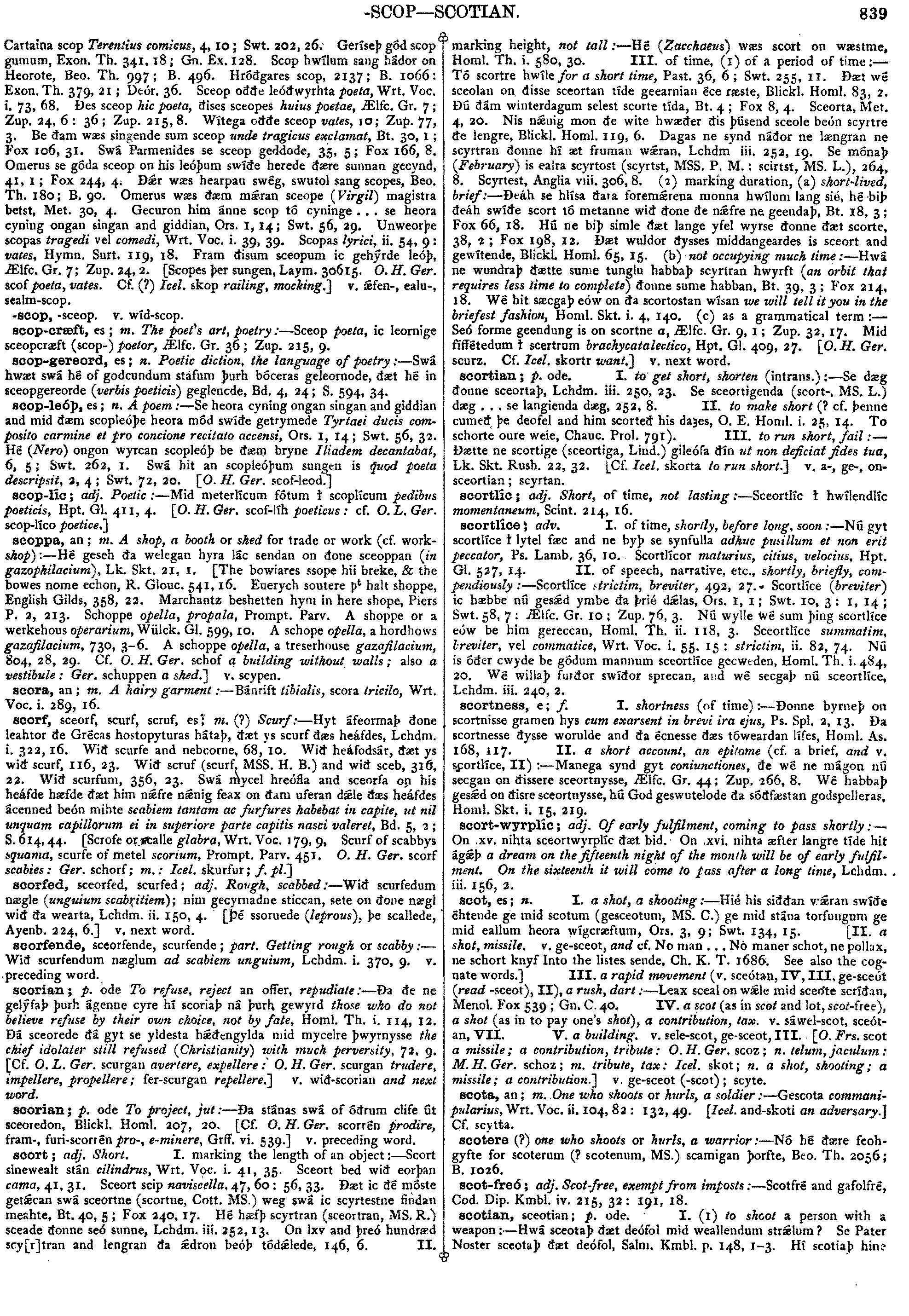
scortlíce
;
adv.
I.
of
time,
shortly,
before
long,
soon
:--Nú
gyt
scortlíce
 lytel
fæc
and
ne
byþ
se
synfulla
adhuc
pusillum
et
non
erit
peccator,
Ps.
Lamb.
36,
10.
Scortlícor
maturius,
citius,
velocius.
Hpt.
Gl.
527,
14.
II.
of
speech,
narrative,
etc.,
shortly,
briefly,
compendiously
:--Scortlíce
strictim,
breviter,
492,
27.
Scortlíce
(breviter)
ic
hæbbe
nú
gesd
yrabe
ða
brié
dlas,
Ors.
l,
l
;
Swt.
10,
3
:
l,
14
;
Swt.
58,
7
:
Ælfc.
Gr.
10
;
Zup.
76,
3.
Nú
wylle
wé
sum
þing
scortlíce
eów
be
him
gereccan,
Homl.
Th.
ii.
118,
3.
Sceortlíce
summatim,
breviter,
vel
commatice,
Wrt.
Voc.
i.
55,
15
:
strictim,
ii.
82,
74.
Nú
is
óðer
cwyde
be
gódum
mannum
sceortlíce
gecweden,
Homl.
Th.
i.
484,
20.
Wé
willaþ
furðor
swíðor
sprecan,
and
wé
secgaþ
nú
sceortlíce,
Lchdm.
iii.
240,
2.
lytel
fæc
and
ne
byþ
se
synfulla
adhuc
pusillum
et
non
erit
peccator,
Ps.
Lamb.
36,
10.
Scortlícor
maturius,
citius,
velocius.
Hpt.
Gl.
527,
14.
II.
of
speech,
narrative,
etc.,
shortly,
briefly,
compendiously
:--Scortlíce
strictim,
breviter,
492,
27.
Scortlíce
(breviter)
ic
hæbbe
nú
gesd
yrabe
ða
brié
dlas,
Ors.
l,
l
;
Swt.
10,
3
:
l,
14
;
Swt.
58,
7
:
Ælfc.
Gr.
10
;
Zup.
76,
3.
Nú
wylle
wé
sum
þing
scortlíce
eów
be
him
gereccan,
Homl.
Th.
ii.
118,
3.
Sceortlíce
summatim,
breviter,
vel
commatice,
Wrt.
Voc.
i.
55,
15
:
strictim,
ii.
82,
74.
Nú
is
óðer
cwyde
be
gódum
mannum
sceortlíce
gecweden,
Homl.
Th.
i.
484,
20.
Wé
willaþ
furðor
swíðor
sprecan,
and
wé
secgaþ
nú
sceortlíce,
Lchdm.
iii.
240,
2.
|
Source: Bosworth/Toller, page d0036, entry 7 View original page image as: [TIFF] [PNG] [View previous entry] [View next entry] |
[Comment on this entry] [View comments] |
The following entry has been hand-corrected once. |
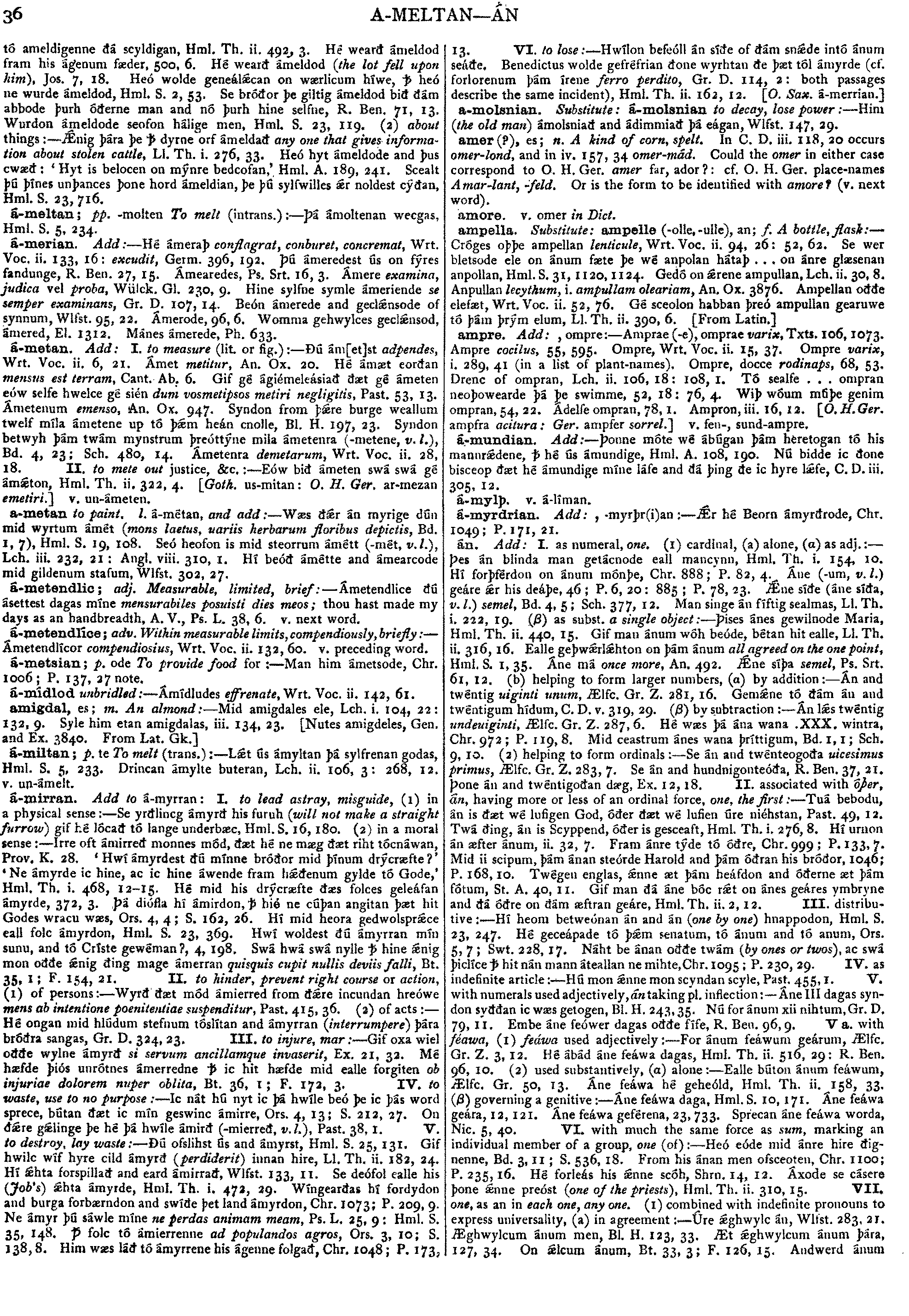
á-metendlíce; adv. Within measurable limits, compendiously, briefly:--Ámetendlícor compendiosius, Wrt. Voc. ii. 132, 60. v. preceding word.
|
Source: Bosworth/Toller, page d0077, entry 13 View original page image as: [TIFF] [PNG] [View previous entry] [View next entry] |
[Comment on this entry] [View comments] |
The following entry has been hand-corrected once. |
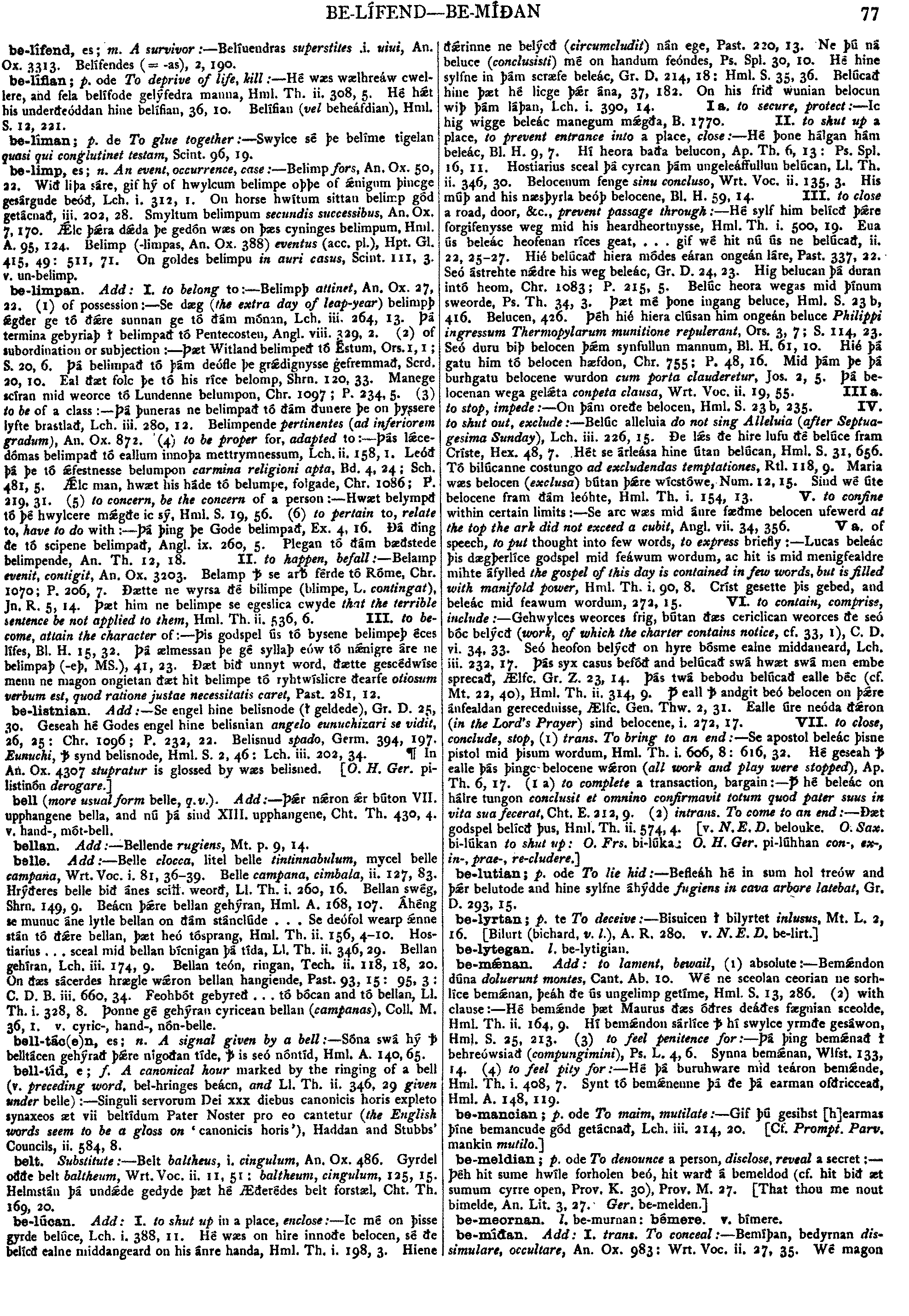
be-lúcan.
Add:
I.
to
shut
up
in
a
place,
enclose:--Ic
mé
on
þisse
gyrde
belúce,
Lch.
i.
388,
II.
Hé
wæs
on
hire
innoðe
belocen,
sé
ðe
belícð
ealne
middangeard
on
his
ánre
handa,
Hml.
Th.
i.
198,
3.
Hiene
ðrinne
ne
belýcð
(circumcludit)
nán
ege,
Past.
220,
13.
Ne
þú
ná
beluce
(conclasisti)
mé
on
handum
feóndes,
Ps.
Spl.
30,
10.
Hé
hine
sylfne
in
þám
scræfe
beleác,
Gr.
D.
214,
18:
Hml.
S.
35,
36.
Belúcað
hine
þæt
hé
licge
þr
ána,
37,
182.
On
his
frið
wunian
belocun
wiþ
þám
láþan,
Lch.
i.
390,
14.
Ia.
to
secure,
protect:--Ic
hig
wigge
beleác
manegum
mgða,
B.
1770.
II.
to
shut
up
a
place,
to
prevent
entrance
into
a
place,
close:--Hé
þone
hálgan
hám
beleác,
Bl.
H.
9,
7.
Hí
heora
baða
belucon,
Ap.
Th.
6,
13:
Ps.
Spl.
16,
II.
Hostiarius
sceal
þá
cyrcan
þám
ungeleáffullun
belúcan,
Ll.
Th.
ii.
346,
30.
Belocenum
fenge
sinu
concluso,
Wrt.
Voc.
ii.
135,
3.
His
múþ
and
his
næsþyrla
beóþ
belocene.
Bl.
H.
59,
14.
III.
to
close
a
road,
door,
&c.,
prevent
passage
through:--Hé
sylf
him
belícð
þre
forgifenysse
weg
mid
his
heardheortnysse,
Hml.
Th.
i.
500,
19.
Eua
ús
beleác
heofenan
ríces
geat,
.
.
.
gif
wé
hit
nú
ús
ne
belúcað,
ii.
22,
25-27.
Hié
belúcað
hiera
módes
eáran
ongeán
láre,
Past.
337,
22.
Seó
ástrehte
ndre
his
weg
beleác,
Gr.
D.
24,
23.
Hig
belucan
þá
duran
intó
heom.
Chr.
1083;
P.
215,
5.
Belúc
heora
wegas
mid
þínun.
sweorde,
Ps.
Th.
34,
3.
Þæt
mé
þone
ingang
beluce,
Hml.
S.
23
b,
416.
Belucen,
426.
Þéh
hié
hiera
clúsan
him
ongeán
beluce
Philippi
ingressum
Thermopylarum
munitione
repulerant,
Ors.
3,
7;
S.
114,
23.
Seó
duru
biþ
belocen
þm
synfullun
mannum,
Bl.
H.
61,
10.
Hié
þá
gatu
him
tó
belocen
hæfdon,
Chr.
755;
P.
48,
16.
Mid
þám
þe
þá
burhgatu
belocene
wurdon
cum
porta
clauderetur.
Jos.
2,
5.
Þá
be-locenan
wega
gelta
conpeta
clausa,
Wrt.
Voc.
ii.
19,
55.
IIIa.
to
stop,
impede:--On
þám
oreðe
belocen,
Hml.
S.
23b,
235.
IV.
to
shut
out,
exclude:--Belúc
alleluia
do
not
sing
Alleluia
(after
Septua-gesima
Sunday),
Lch.
iii.
226,
15.
Ðe
ls
ðe
hire
lufu
ðé
belúce
fram
Críste,
Hex.
48,
7.
Hét
se
árleása
hine
útan
belúcan,
Hml.
S.
31,
656.
Tó
bilúcanne
costungo
ad
excludendas
temptationes,
Rtl.
118,
9.
Maria
wæs
belocen
(exclusa)
bútan
þære
wícstówe,
Num.
12,
15.
Sind
wé
úte
belocene
fram
ðám
leóhte,
Hml.
Th.
i.
154,
13.
V.
to
confine
within
certain
limits:--Se
arc
wæs
mid
ánre
fæðme
belocen
ufewerd
at
the
top
the
ark
did
not
exceed
a
cubit,
Angl.
vii.
34,
356.
V
a.
of
speech,
to
put
thought
into
few
words,
to
express
briefly:--Lucas
beleác
þis
dægþerlíce
godspel
mid
feáwum
wordum,
ac
hit
is
mid
menigfealdre
mihte
áfylled
the
gospel
of
this
day
is
contained
in
few
words,
but
is
fitted
with
manifold
power,
Hml.
Th.
i.
90,
8.
Críst
gesette
þis
gebed,
and
beleác
mid
feawum
wordum,
272,
15.
VI.
to
contain,
comprise,
include:--Gehwylces
weorces
frig,
bútan
ðæs
cericlican
weorces
ðe
seó
bóc
belýcð
(work,
of
which
the
charter
contains
notice,
cf.
33,
I),
C.
D.
vi-
34.
33.
Seó
heofon
belýcð
on
hyre
bósme
ealne
middaneard,
Lch.
iii.
232,
17.
Þás
syx
casus
befóð
and
belúcað
swá
hwæt
swá
men
embe
sprecað,
Ælfc.
Gr.
Z.
23,
14.
Þás
twá
bebodu
belúcað
ealle
béc
(cf.
Mt.
22,
40),
Hml.
Th.
ii.
314,
9.
 eall
andgit
beó
belocen
on
þre
ánfealdan
gerecednisse,
Ælfc.
Gen.
Thw.
2,
31.
Ealle
úre
neóda
ðron
(in
the
Lord's
Prayer)
sind
belocene,
i.
272,
17.
VII.
to
close,
conclude,
stop,
(I)
trans.
To
bring
to
an
end:--Se
apostol
beleác
þisne
pistol
mid
þisum
wordum,
Hml.
Th.
i.
606,
8:
616,
32.
Hé
geseah
ealle
þás
þingc
belocene
wron
(all
work
and
play
were
stopped),
Ap.
Th.
6,
17.
(Ia)
to
complete
a
transaction,
bargain:--
hé
beleác
on
hálre
tungon
conclusit
et
omnino
confirmavit
totum
quod
pater
suus
in
vita
sua
fecerat,
Cht.
E.
212,
9.
(2)
intrans.
To
come
to
an
end:--Ðæt
godspel
belícð
þus,
Hml.
Th.
ii.
574,
4.
[v.
N.
E.
D.
belouke.
O.
Sax.
bi-lúkan
to
shut
up:
O.
Frs.
bi-lúka:
O.
H.
Ger.
pi-lúhhan
con-,
ex-,
in-,
prae-,
re-cludere.]
eall
andgit
beó
belocen
on
þre
ánfealdan
gerecednisse,
Ælfc.
Gen.
Thw.
2,
31.
Ealle
úre
neóda
ðron
(in
the
Lord's
Prayer)
sind
belocene,
i.
272,
17.
VII.
to
close,
conclude,
stop,
(I)
trans.
To
bring
to
an
end:--Se
apostol
beleác
þisne
pistol
mid
þisum
wordum,
Hml.
Th.
i.
606,
8:
616,
32.
Hé
geseah
ealle
þás
þingc
belocene
wron
(all
work
and
play
were
stopped),
Ap.
Th.
6,
17.
(Ia)
to
complete
a
transaction,
bargain:--
hé
beleác
on
hálre
tungon
conclusit
et
omnino
confirmavit
totum
quod
pater
suus
in
vita
sua
fecerat,
Cht.
E.
212,
9.
(2)
intrans.
To
come
to
an
end:--Ðæt
godspel
belícð
þus,
Hml.
Th.
ii.
574,
4.
[v.
N.
E.
D.
belouke.
O.
Sax.
bi-lúkan
to
shut
up:
O.
Frs.
bi-lúka:
O.
H.
Ger.
pi-lúhhan
con-,
ex-,
in-,
prae-,
re-cludere.]
|
Source: Bosworth/Toller, page d0278, entry 13 View original page image as: [TIFF] [PNG] [View previous entry] [View next entry] |
[Comment on this entry] [View comments] |
The following entry has been hand-corrected once. |
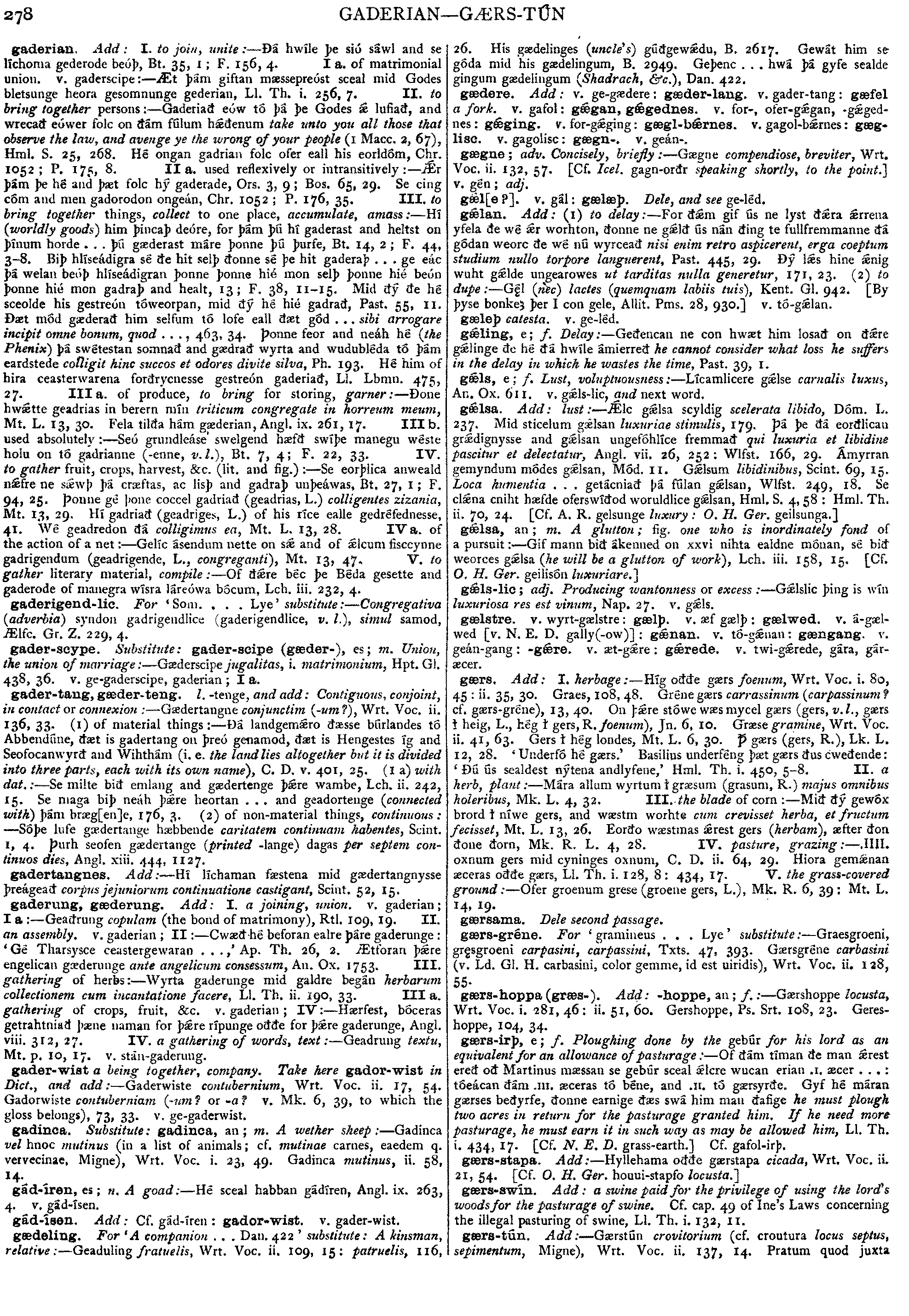
gægne; adv. Concisely, briefly:--Gægne compendiose, breviter, Wrt. Voc. ii. 132, 57. [Cf. Icel. gagn-orðr speaking shortly, to the point.] v. gén; adj.
|
Source: Bosworth/Toller, page d0298, entry 11 View original page image as: [TIFF] [PNG] [View previous entry] [View next entry] |
[Comment on this entry] [View comments] |
The following entry has been hand-corrected once. |
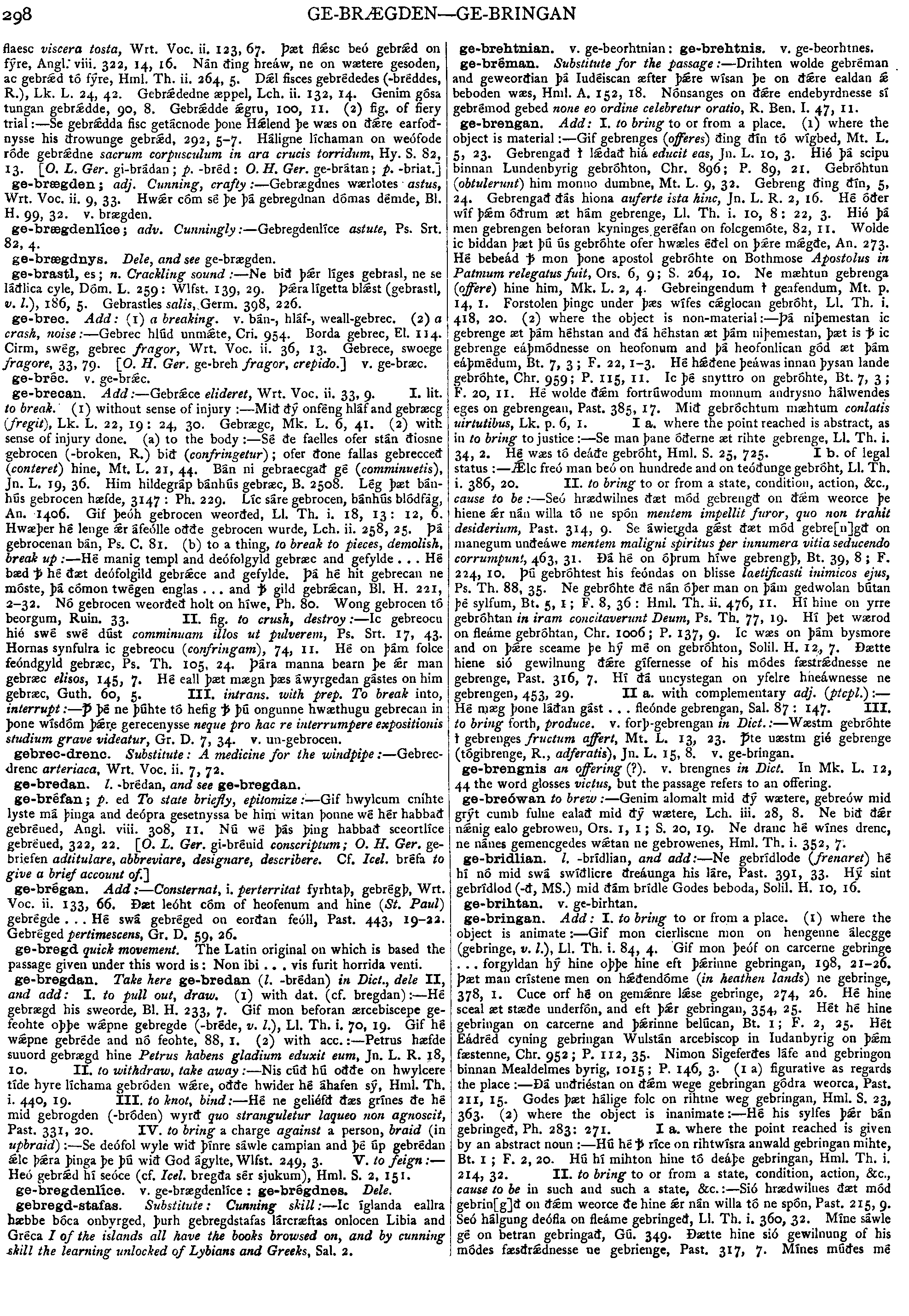
ge-bréfan; p. ed To state briefly, epitomize: -- Gif hwylcum cnihte lyste má þinga and deópra gesetnyssa be him witan þonne wé hér habbað gebréued, Angl. viii. 308, 11. Nú wé þás þing habbað sceortlíce gebréued, 322, 22. [O. L. Ger. gi-bréuid conscriptium; O. H. Ger. ge-briefen adtitulare, abbreviare, designare, describere. Cf. Icel. bréfa to give a brief account of.]
|
Source: Bosworth/Toller, page d0562, entry 1 View original page image as: [TIFF] [PNG] [View previous entry] [View next entry] |
[Comment on this entry] [View comments] |
The following entry has been hand-corrected once. |
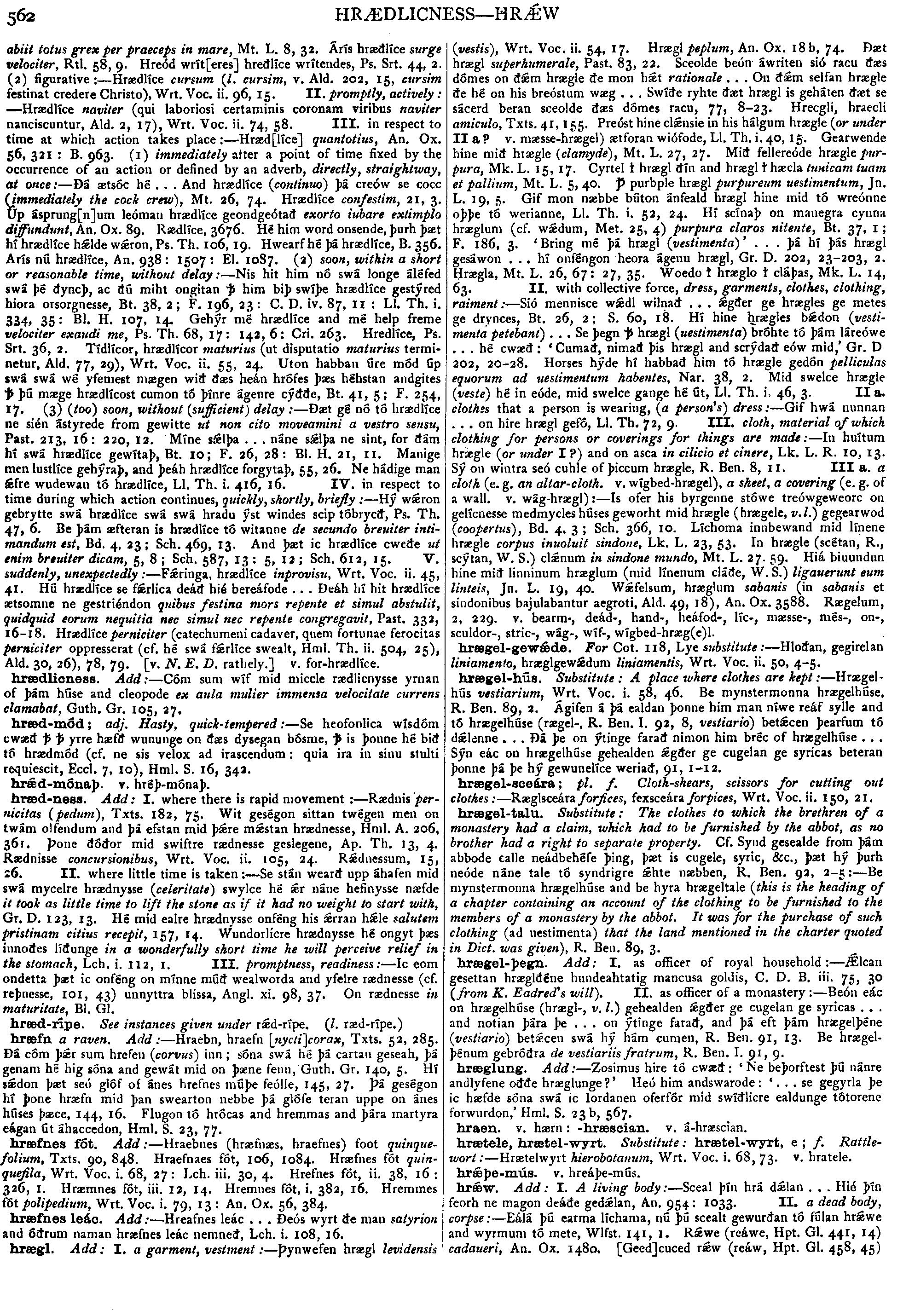
abiit
totus
grex
per
praeceps
in
mare,
Mt.
L.
8,
32.
Árís
hræðlíce
surge
velociter,
Rtl.
58,
9.
Hreód
wrít[eres]
hreðlíce
wrítendes,
Ps.
Srt.
44,
2.
(2)
figurative:--Hrædlíce
cursum
(l.
cursim,
v.
Ald.
202,
15,
cursim
festinat
credere
Christo),
Wrt.
Voc.
ii.
96,
15.
II.
promptly,
actively:--Hrædlíce
naviter
(qui
laboriosi
certaminis
coronam
viribus
naviter
nanciscuntur,
Ald.
2,
17),
Wrt.
Voc.
ii.
74,
58.
III.
in
respect
to
time
at
which
action
takes
place:--Hræd[líce]
quantotius,
An.
Ox.
56,
321:
B.
963.
(1)
immediately
after
a
point
of
time
fixed
by
the
occurrence
of
an
action
or
defined
by
an
adverb,
directly,
straightway,
at
once:--Ðá
ætsóc
hé
.
.
.
And
hrædlíce
(continuo)
þá
creów
se
cocc
(immediately
the
cock
crew),
Mt.
26,
74.
Hrædlíce
confestim,
21,
3.
Úp
ásprung[n]um
leóman
hrædlíce
geondgeótað
exorto
iubare
extimplo
diffundunt,
An.
Ox.
89.
Rædlíce,
3676.
Hé
him
word
onsende,
þurh
þæt
hí
hrædlíce
hlde
wron,
Ps.
Th.
106,
19.
Hwearf
hé
þá
hrædlíce,
B.
356.
Arís
nú
hrædlíce,
An.
938:
1507:
El.
1087.
(2)
soon,
within
a
short
or
reasonable
time,
without
delay:--Nis
hit
him
nó
swá
longe
áléfed
swá
þé
ðyncþ,
ac
ðú
miht
ongitan
him
biþ
swíþe
hrædlíce
gestýred
hiora
orsorgnesse,
Bt.
38,
2;
F.
196,
23:
C.
D.
iv.
87,
11:
Ll.
Th.
i.
334,
35:
Bl.
H.
107,
14.
Gehýr
mé
hrædlíce
and
mé
help
freme
velociter
exaudi
me,
Ps.
Th.
68,
17:
142,
6:
Cri.
263.
Hredlíce,
Ps.
Srt.
36,
2.
Tídlícor,
hrædlícor
maturius
(ut
disputatio
maturius
terminetur,
Ald.
77,
29),
Wrt.
Voc.
ii.
55,
24.
Uton
habban
úre
mód
úp
swá
swá
wé
yfemest
mægen
wið
ðæs
heán
hrófes
þæs
héhstan
andgites
þú
mæge
hrædlícost
cumon
tó
þínre
ágenre
cýððe,
Bt.
41,
5;
F.
254,
17.
(3)
(too)
soon,
without
(sufficient)
delay:--Ðæt
gé
nó
tó
hrædlíce
ne
sién
ástyrede
from
gewitte
ut
non
cito
moveamini
a
vestro
sensu,
Past.
213,
16:
220,
12.
Míne
slþa
.
.
.
náne
slþa
ne
sint,
for
ðám
hí
swá
hrædlíce
gewítaþ,
Bt.
10;
F.
26,
28:
Bl.
H.
21,
11.
Manige
men
lustlíce
gehýraþ,
and
þeáh
hrædlíce
forgytaþ,
55,
26.
Ne
hádige
man
fre
wudewan
tó
hrædlíce,
Ll.
Th.
i.
416,
16.
IV.
in
respect
to
time
during
which
action
continues,
quickly,
shortly,
briefly:--Hý
wron
gebrytte
swá
hrædlíce
swá
swá
hradu
ýst
windes
scip
tóbrycð,
Ps.
Th.
47,
6.
Be
þám
æfteran
is
hrædlíce
tó
witanne
de
secundo
breuiter
intimandum
est,
Bd.
4,
23;
Sch.
469,
13.
And
þæt
ic
hrædlíce
cweðe
ut
enim
breuiter
dicam,
5,
8;
Sch.
587,
13:
5,
12;
Sch.
612,
15.
V.
suddenly,
unexpectedly:--Fringa,
hrædlíce
inprovisu,
Wrt.
Voc.
ii.
45,
41.
Hú
hrædlíce
se
frlica
deáð
hié
bereáfode
.
.
.
Ðeáh
hí
hit
hrædlíce
ætsomne
ne
gestriéndon
quibus
festina
mors
repente
et
simul
abstulit,
quidquid
eorum
nequitia
nec
simul
nec
repente
congregavit,
Past.
332,
16-18.
Hrædlíce
perniciter
(catechumeni
cadaver,
quem
fortunae
ferocitas
perniciter
oppresserat
(cf.
hé
swá
frlíce
swealt,
Hml.
Th.
ii.
504,
25),
Ald.
30,
26),
78,
79.
[v.
N.
E.
D.
rathely.]
v.
for-hrædlíce.
|
Source: Bright's OE Grammar, page b0347, entry 25 View original page image as: [TIFF] [PNG] [View previous entry] [View next entry] |
[Comment on this entry] [View comments] |
The following entry has been hand-corrected once. |
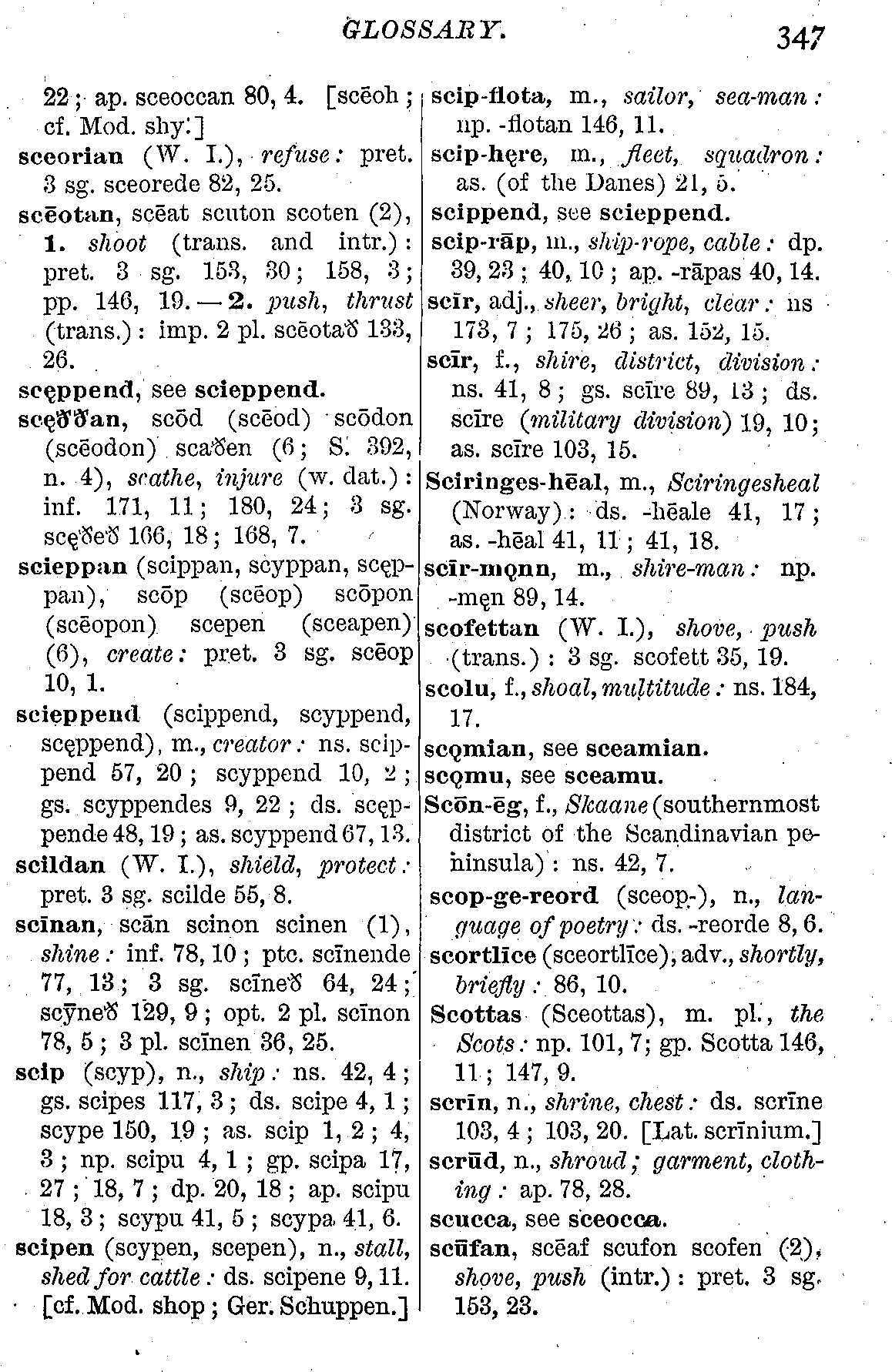
scortl ce
(sceortlce)
adv
shortly,
briefly
ce
(sceortlce)
adv
shortly,
briefly
|
Source: Cleasby/Vigfusson, page b0471, entry 10 View original page image as: [TIFF] [PNG] [View previous entry] [View next entry] |
[Comment on this entry] [View comments] |
The following entry has been hand-corrected once. |
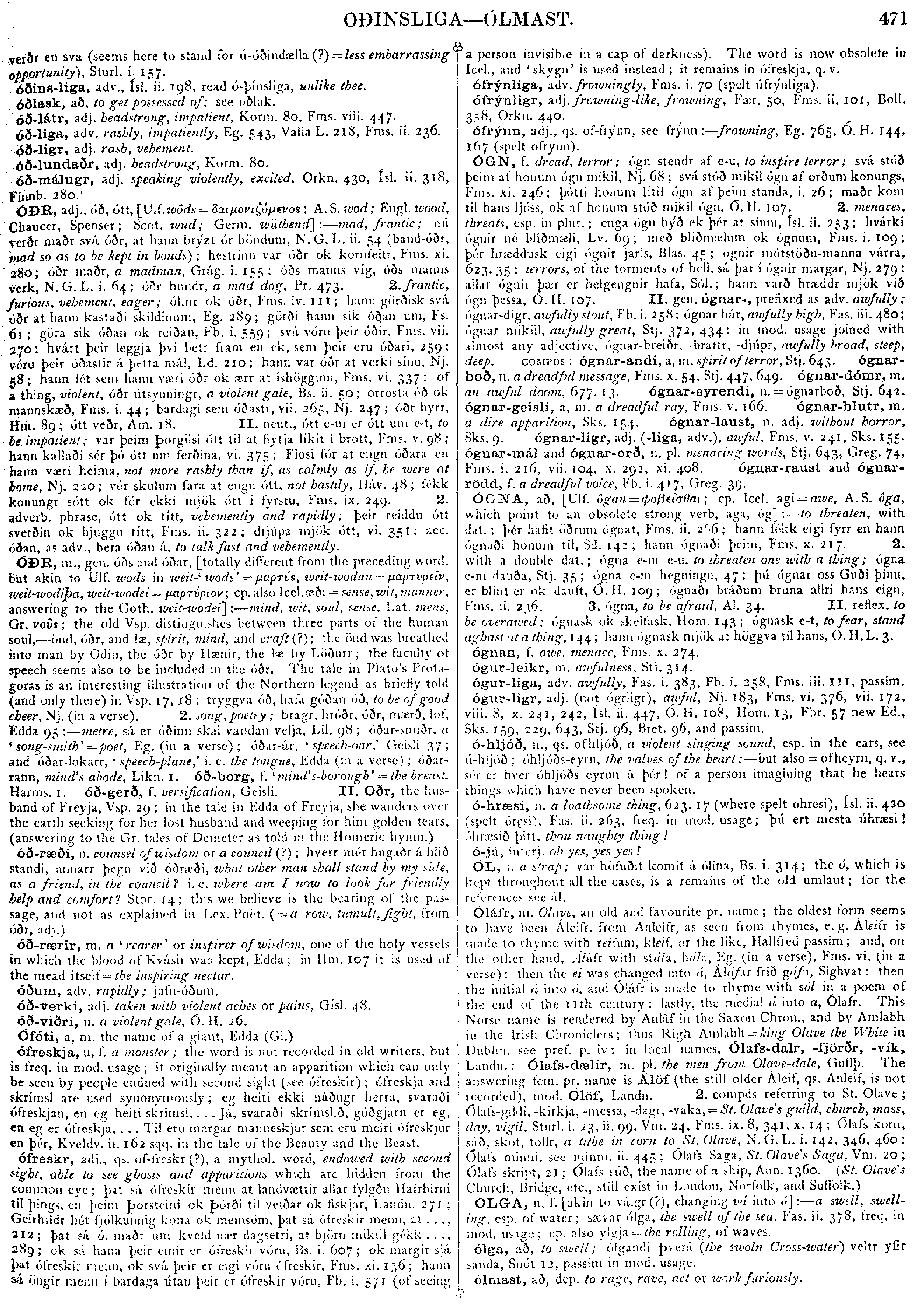
ÓÐR, m., gen. óðs and óðar, [totally different from the preceding word, but akin to Ulf. wods in weit-'wods' = GREEK, weit-wodan = GREEK, weit-wodiþa, weit-wodei = GREEK; cp. also Icel. æði = sense, wit, manner, answering to the Goth. weit-wodei] :-- mind, wit, soul, sense, Lat. mens, Gr. GREEK; the old Vsp. distinguishes between three parts of the human soul, -- önd, óðr, and læ, spirit, mind, and craft(?); the önd was breathed into man by Odin, the óðr by Hænir, the læ by Löðurr; the faculty of speech seems also to be included in the óðr. The tale in Plato's Protagoras is an interesting illustration of the Northern legend as briefly told (and only there) in Vsp. 17, 18: tryggva óð, hafa góðan óð, to be of good cheer, Nj. (in a verse). 2. song, poetry; bragr, hróðr, óðr, mærð, lof, Edda 95 :-- metre, sá er óðinn skal vandan velja, Lil. 98; óðar-smiðr, a 'song-smith' = poet, Eg. (in a verse); óðar-ár, 'speech-oar,' Geisli 37; and óðar-lokarr, 'speech-plane,' i.e. the tongue, Edda (in a verse); óðar-rann, mind's abode, Likn. 1. óð-borg, f, 'mind's-borough' = the breast, Harms, 1. óð-gerð, f. versification, Geisli. II. Óðr, the husband of Freyja, Vsp. 29; in the tale in Edda of Freyja, she wanders over the earth seeking for her lost husband and weeping for him golden tears, (answering to the Gr. tales of Demeter as told in the Homeric hymn.)
Germanic Lexicon Project (main page)
This search system was written by
Sean Crist
Please consider
volunteering
to correct the data in these online dictionaries.
No rights reserved. Feel free to use these data in any way you please.