|
|

Tip: In the search results, you can click on any word or abbreviation for more information.
|
Source: Bosworth/Toller, page b0256, entry 24 View original page image as: [TIFF] [PNG] [View previous entry] [View next entry] |
[Comment on this entry] [View comments] |
The following entry has been hand-corrected once. |
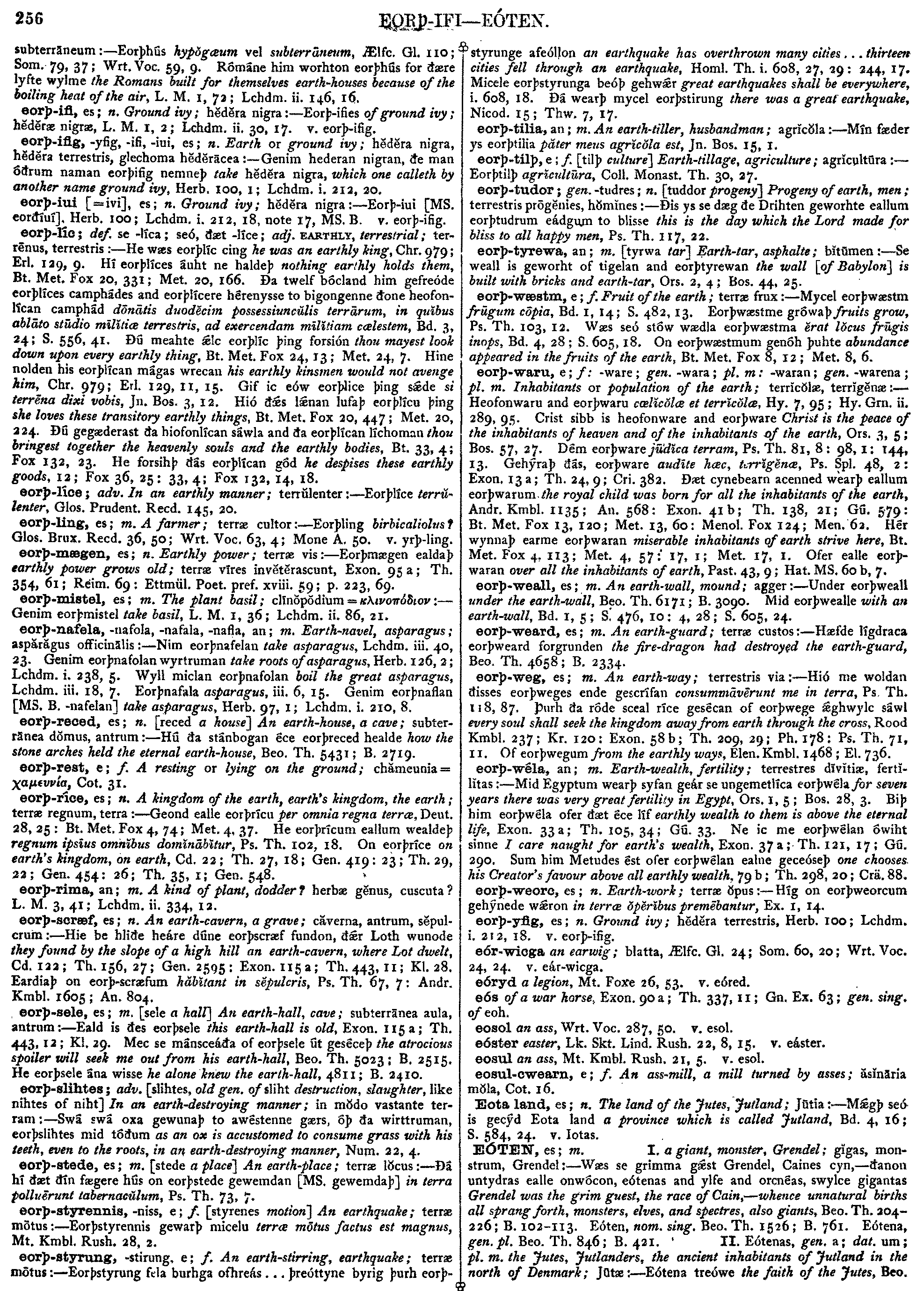
eorþ-tyrewa,
an;
m.
[tyrwa
tar]
Earth-tar,
asphalte;
b t
t men
:--
Se
weall
is
geworht
of
tigelan
and
eorþtyrewan
the
wall
[of
Babylon]
is
built
with
bricks
and
earth-tar,
Ors.
2,
4;
Bos.
44,
25.
men
:--
Se
weall
is
geworht
of
tigelan
and
eorþtyrewan
the
wall
[of
Babylon]
is
built
with
bricks
and
earth-tar,
Ors.
2,
4;
Bos.
44,
25.
|
Source: Bosworth/Toller, page b0983, entry 20 View original page image as: [TIFF] [PNG] [View previous entry] [View next entry] |
[Comment on this entry] [View comments] |
The following entry has been hand-corrected once. |
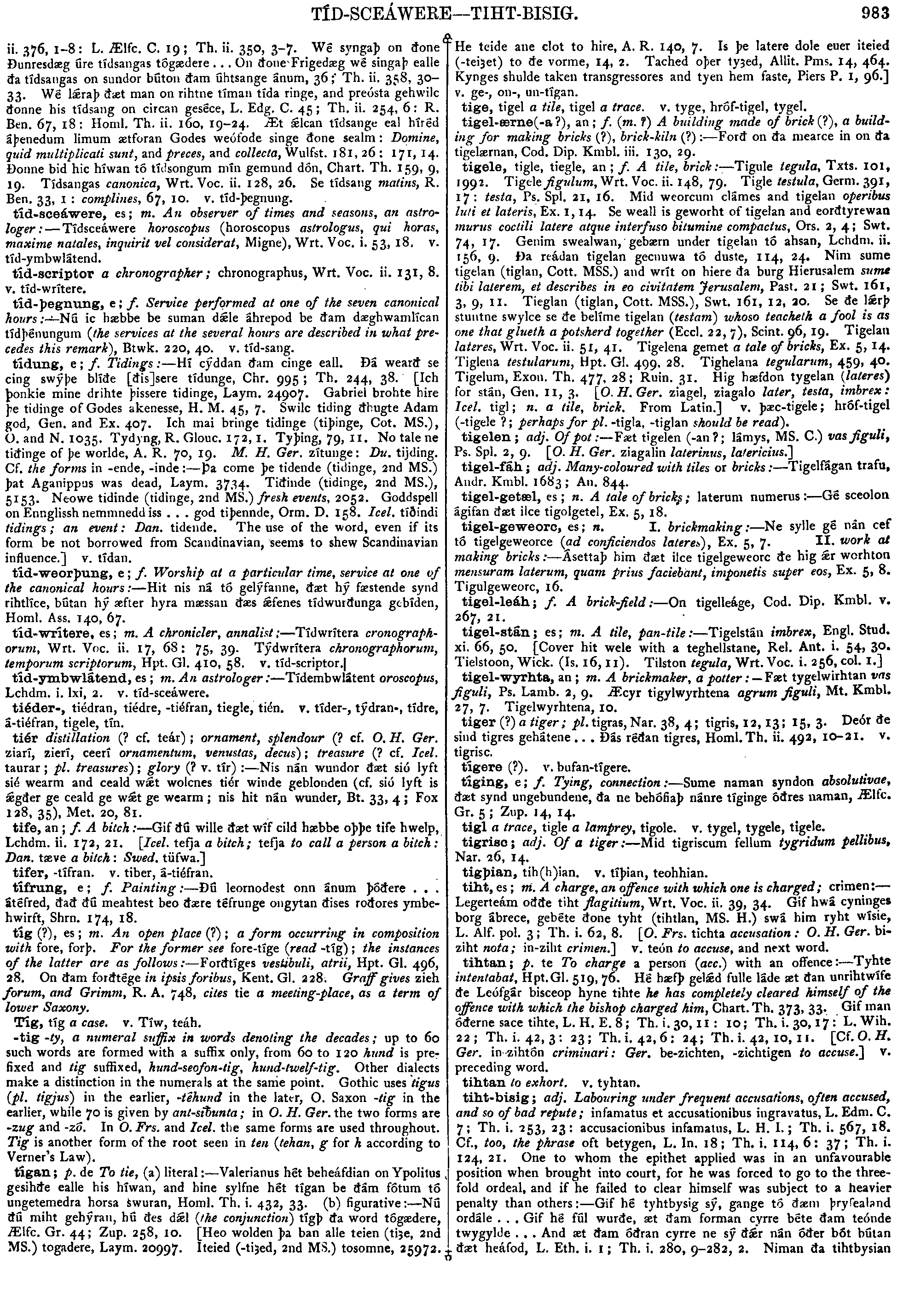
tigel-ærne(-a?), an; f. (m.?) A building made of brick (?), a building for making bricks (?), brick-kiln (?):-- Forð on ða mearce in on ða tigelærnan, Cod. Dip. Kmbl. iii. 130, 29.
|
Source: Bosworth/Toller, page b0983, entry 21 View original page image as: [TIFF] [PNG] [View previous entry] [View next entry] |
[Comment on this entry] [View comments] |
The following entry has been hand-corrected once. |
tigele,
tigle,
tiegle,
an;
f.
A
tile,
brick:--Tigule
tegula,
Txts.
101,
1992.
Tigele
figulum,
Wrt.
Voc.
ii.
148,
79.
Tigle
testula,
Germ.
391,
17:
testa,
Ps.
Spl.
21,
16.
Mid
weorcum
clámes
and
tigelan
operibus
luti
et
lateris,
Ex.
1,
14.
Se
weall
is
geworht
of
tigelan
and
eorðtyrewan
murus
coctili
latere
atque
interfuso
bitumine
compactus,
Ors.
2,
4;
Swt.
74,
17.
Genim
swealwan,
gebærn
under
tigelan
tó
ahsan,
Lchdm.
ii.
156,
9.
Ða
reádan
tigelan
gecnuwa
tó
duste,
114,
24.
Nim
sume
tigelan
(tiglan,
Cott.
MSS.)
and
wrít
on
hiere
ða
burg
Hierusalem
sume
tibi
laterem,
et
describes
in
eo
civitatem
Jerusalem,
Past.
21;
Swt.
161,
3,
9,
11.
Tieglan
(tiglan,
Cott.
MSS.),
Swt.
161,
12,
20.
Se
ðe
l rþ
stuntne
swylce
se
ðe
belíme
tigelan
(testam)
whoso
teacheth
a
fool
is
as
one
that
glueth
a
potsherd
together
(Eccl.
22,
7),
Scint.
96,
19.
Tigelan
lateres,
Wrt.
Voc.
ii.
51,
41.
Tigelena
gemet
a
tale
of
bricks,
Ex.
5,
14.
Tiglena
testularum,
Hpt.
Gl.
499,
28.
Tighelana
tegularum,
459,
40.
Tigelum,
Exon.
Th.
477,
28;
Ruin.
31.
Hig
hæfdon
tygelan
(lateres)
for
stán,
Gen.
11,
3.
[O.
H.
Ger.
ziagel,
ziagalo
later,
testa,
imbrex:
Icel.
tigl;
n.
a
tile,
brick.
From
Latin.]
v.
þæc-tigele;
hróf-tigel
(-tigele
?;
perhaps
for
pl.
-tigla,
-tiglan
should
be
read).
rþ
stuntne
swylce
se
ðe
belíme
tigelan
(testam)
whoso
teacheth
a
fool
is
as
one
that
glueth
a
potsherd
together
(Eccl.
22,
7),
Scint.
96,
19.
Tigelan
lateres,
Wrt.
Voc.
ii.
51,
41.
Tigelena
gemet
a
tale
of
bricks,
Ex.
5,
14.
Tiglena
testularum,
Hpt.
Gl.
499,
28.
Tighelana
tegularum,
459,
40.
Tigelum,
Exon.
Th.
477,
28;
Ruin.
31.
Hig
hæfdon
tygelan
(lateres)
for
stán,
Gen.
11,
3.
[O.
H.
Ger.
ziagel,
ziagalo
later,
testa,
imbrex:
Icel.
tigl;
n.
a
tile,
brick.
From
Latin.]
v.
þæc-tigele;
hróf-tigel
(-tigele
?;
perhaps
for
pl.
-tigla,
-tiglan
should
be
read).
|
Source: Bosworth/Toller, page b0983, entry 23 View original page image as: [TIFF] [PNG] [View previous entry] [View next entry] |
[Comment on this entry] [View comments (1)] |
The following entry has been hand-corrected once. |
tigel-fáh; adj. Many-coloured with tiles or bricks:--Tigelfágan trafu, Andr. Kmbl. 1683; An. 844.
|
Source: Bosworth/Toller, page b0983, entry 24 View original page image as: [TIFF] [PNG] [View previous entry] [View next entry] |
[Comment on this entry] [View comments] |
The following entry has been hand-corrected once. |
tigel-getæl, es; n. A tale of bricks; laterum numerus:--Gé sceolon ágifan ðæt ilce tigolgetel, Ex. 5, 18.
|
Source: Bosworth/Toller, page b0983, entry 25 View original page image as: [TIFF] [PNG] [View previous entry] [View next entry] |
[Comment on this entry] [View comments] |
The following entry has been hand-corrected once. |
tigel-geweorc,
es;
n.
I.
brickmaking:--Ne
sylle
gé
nán
cef
tó
tigelgeweorce
(ad
conficiendos
lateres),
Ex.
5,
7.
II.
work
at
making
bricks:--Ásettaþ
him
ðæt
ilce
tigelgeweorc
ðe
hig
r
worhton
mensuram
laterum,
quam
prius
faciebant,
imponetis
super
eos,
Ex.
5,
8.
Tigulgeweorc,
16.
|
Source: Cleasby/Vigfusson, page b0216, entry 7 View original page image as: [TIFF] [PNG] [View previous entry] [View next entry] |
[Comment on this entry] [View comments] |
The following entry has been hand-corrected once. |
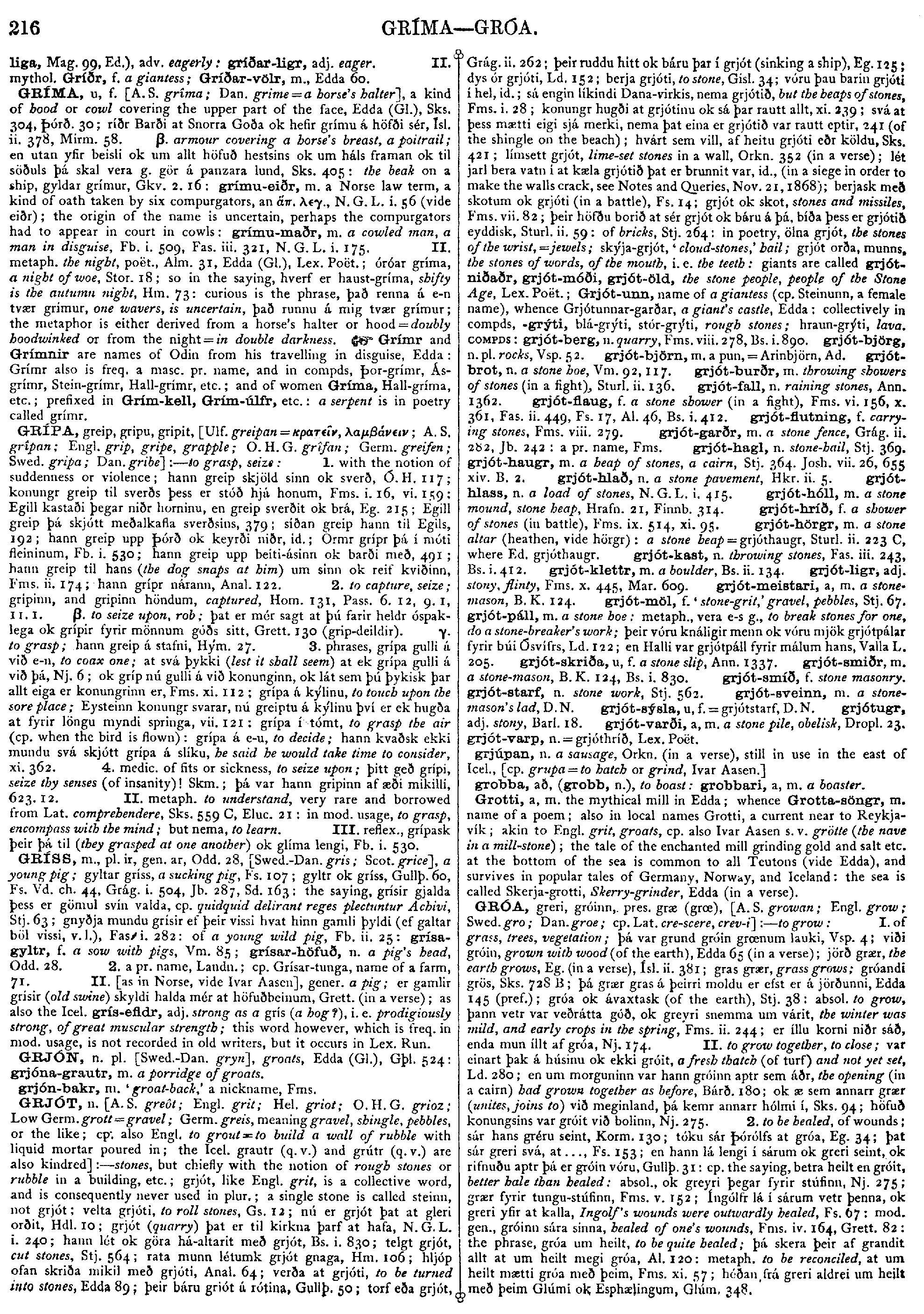
GRJÓT, n. [A. S. greôt; Engl. grit; Hel. griot; O. H. G. grioz; Low Germ. grott = gravel; Germ. greis, meaning gravel, shingle, pebbles, or the like; cp. also Engl. to grout = to build a wall of rubble with liquid mortar poured in; the Icel. grautr (q.v.) and grútr (q.v.) are also kindred] :-- stones, but chiefly with the notion of rough stones or rubble in a building, etc.; grjót, like Engl. grit, is a collective word, and is consequently never used in plur.; a single stone is called steinn, not grjót; velta grjóti, to roll stones, Gs. 12; nú er grjót þat at gleri orðit, Hdl. 10; grjót (quarry) þat er til kirkna þarf at hafa, N. G. L. i. 240; hann lét ok göra há-altarit með grjót, Bs. i. 830; telgt grjót, cut stones, Stj. 564; rata munn létumk grjót gnaga, Hm. 106; hljóp ofan skriða mikil með grjóti, Anal. 64; verða at grjóti, to be turned into stones, Edda 89; þeir báru grjót á rótina, Gullþ. 50; torf eða grjót, Grág. ii. 262; þeir ruddu hitt ok báru þar í grjót (sinking a ship), Eg. 125; dys ór grjóti, Ld. 152; berja grjóti, to stone, Gísl. 34; vóru þau barin grjóti í hel, id.; sá engin líkindi Dana-virkis, nema grjótið, but the heaps of stones, Fms. i. 28; konungr hugði at grjótinu ok sá þar rautt allt, xi. 239; svá at þess mætti eigi sjá merki, nema þat eina er grjótið var rautt eptir, 241 (of the shingle on the beach); hvárt sem vill, af heitu grjóti eðr köldu, Sks. 421; límsett grjót, lime-set stones in a wall, Orkn. 352 (in a verse); lét jarl bera vatn í at kæla grjótið þat er brunnit var, id., (in a siege in order to make the walls crack, see Notes and Queries, Nov. 21, 1868); berjask með skotum ok grjóti (in a battle), Fs. 14; grjót ok skot, stones and missiles, Fms. vii. 82; þeir höfðu borið at sér grjót ok báru á þá, bíða þess er grjótið eyddisk, Sturl. ii. 59: of bricks, Stj. 264: in poetry, ölna grjót, the stones of the wrist, = jewels; skýja-grjót, 'cloud-stones,' hail; grjót orða, munns, the stones of words, of the mouth, i.e. the teeth: giants are called grjót-niðaðr, grjót-móði, grjót-öld, the stone people, people of the Stone Age, Lex. Poët.; Grjót-unn, name of a giantess (cp. Steinunn, a female name), whence Grjótunnar-garðar, a giant's castle, Edda: collectively in compds, -grýti, blá-grýti, stór-grýti, rough stones; hraun-grýti, lava. COMPDS: grjót-berg, n. quarry, Fms. viii. 278, Bs. i. 890. grjót-björg, n. pl. rocks, Vsp. 52. grjót-björn, m. a pun, = Arinbjörn, Ad. grjót-brot, n. a stone hoe, Vm. 92, 117. grjót-burðr, m. throwing showers of stones (in a fight), Sturl. ii. 136. grjót-fall, n. raining stones, Ann. 1362. grjót-flaug, f. a stone shower (in a fight), Fms. vi. 156, x. 361, Fas. ii. 449, Fs. 17, Al. 46, Bs. i. 412. grjót-flutning, f. carrying stones, Fms. viii. 279. grjót-garðr, m. a stone fence, Grág. ii. 282, Jb. 242: a pr. name, Fms. grjót-hagl, n. stone-hail, Stj. 369. grjót-haugr, m. a heap of stones, a cairn, Stj. 364. Josh. vii. 26, 655 xiv. B. 2. grjót-hlað, n. a stone pavement, Hkr. ii. 5. grjót-hlass, n. a load of stones, N. G. L. i. 415. grjót-hóll, m. a stone mound, stone heap, Hrafn. 21, Finnb. 314. grjót-hríð, f. a shower of stones (in battle), Fms. ix. 514, xi. 95. grjót-hörgr, m. a stone altar (heathen, vide hörgr): a stone heap = grjóthaugr, Sturl. ii. 223 C, where Ed. grjóthaugr. grjót-kast, n. throwing stones, Fas. iii. 243, Bs. i. 412. grjót-klettr, m. a boulder, Bs. ii. 134. grjót-ligr, adj. stony, flinty, Fms. x. 445, Mar. 609. grjót-meistari, a, m. a stone-mason, B. K. 124. grjót-möl, f. 'stone-grit,' gravel, pebbles, Stj. 67. grjót-páll, m. a stone hoe: metaph., vera e-s g., to break stones for one, do a stone-breaker's work; þeir vóru knáligir menn ok vóru mjök grjótpálar fyrir búi Ósvífrs, Ld. 122; en Halli var grjótpáll fyrir málum hans, Valla L. 205. grjót-skriða, u, f. a stone slip, Ann. 1337. grjót-smiðr, m. a stone-mason, B. K. 124, Bs. i. 830. grjót-smíð, f. stone masonry. grjót-starf, n. stone work, Stj. 562. grjót-sveinn, m. a stone-mason's lad, D. N. grjót-sýsla, u, f. = grjótstarf, D. N. grjótrugr, adj. stony, Barl. 18. grjót-varði, a, m. a stone pile, obelisk, Dropl. 23. grjót-varp, n. = grjóthríð, Lex. Poët.
|
Source: Cleasby/Vigfusson, page b0440, entry 2 View original page image as: [TIFF] [PNG] [View previous entry] [View next entry] |
[Comment on this entry] [View comments] |
The following entry has been hand-corrected once. |
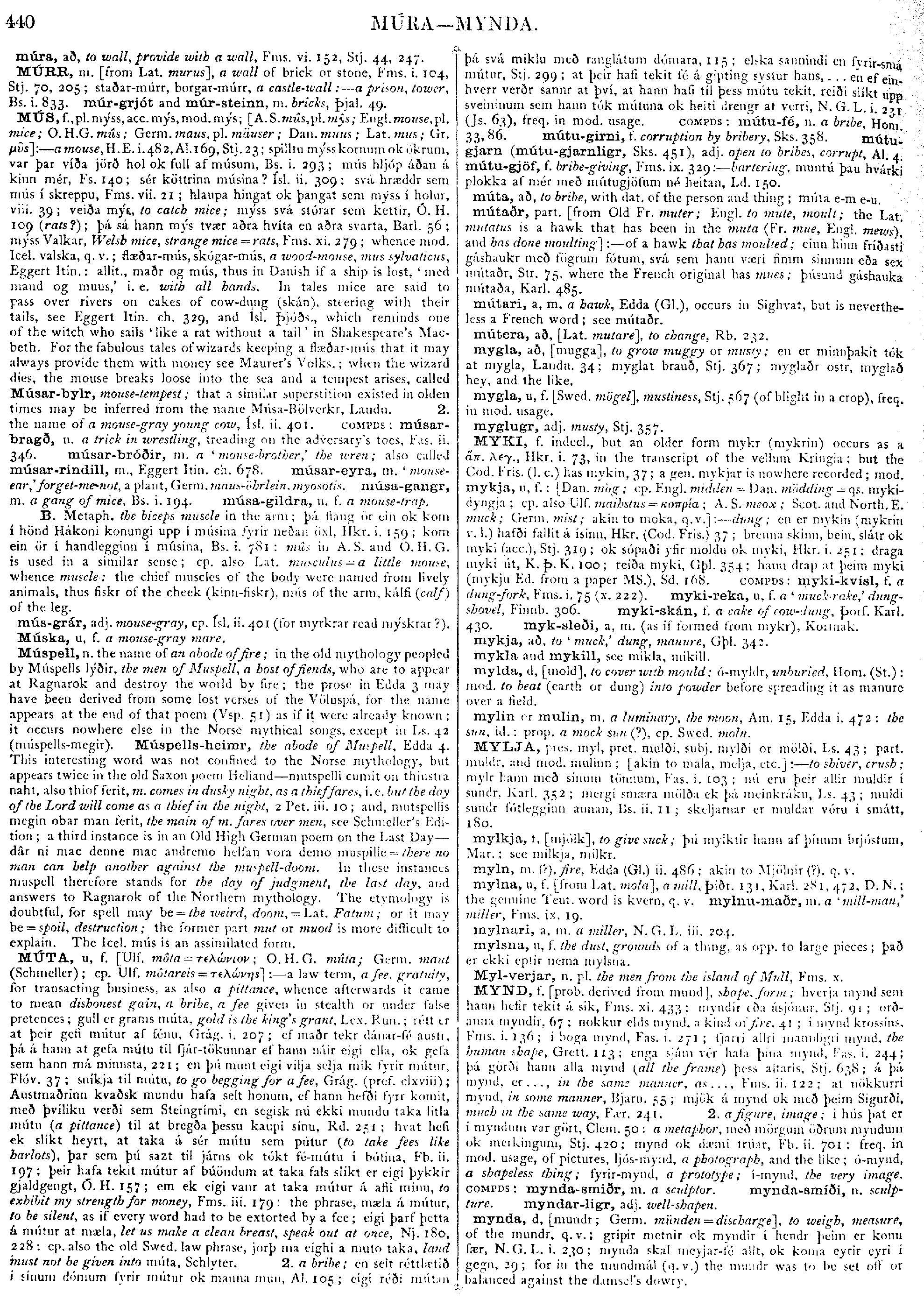
MÚRR, m. [from Lat. murus], a wall of brick or stone, Fms. i. 104, Stj. 70, 205; staðar-múrr, borgar-múrr, a castle-wall :-- a prison, tower, Bs. i. 833. múr-grjót and múr-steinn, m. bricks, Þjal. 49.
|
Source: Cleasby/Vigfusson, page b0464, entry 32 View original page image as: [TIFF] [PNG] [View previous entry] [View next entry] |
[Comment on this entry] [View comments] |
The following entry has been hand-corrected once. |
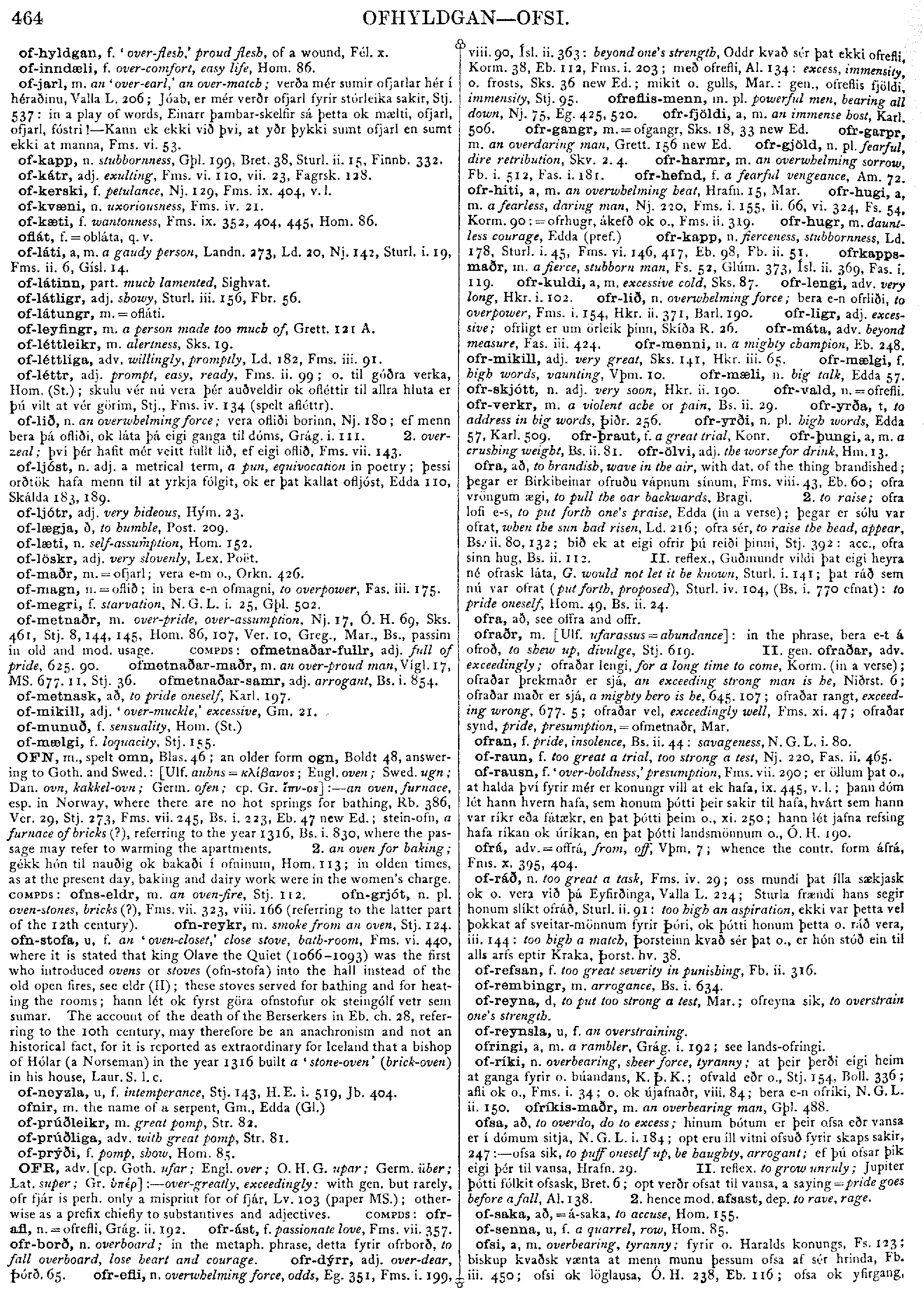
OFN, m., spelt omn, Blas. 46; an older form ogn, Boldt 48, answering to Goth. and Swed.: [Ulf. auhns = GREEK; Engl. oven; Swed. ugn; Dan. ovn, kakkel-ovn; Germ. ofen; cp. Gr. GREEK] :-- an oven, furnace, esp. in Norway, where there are no hot springs for bathing, Rb. 386, Ver. 29, Stj. 273, Fms. vii. 245, Bs. i. 223, Eb. 47 new Ed.; stein-ofn, a furnace of bricks(?), referring to the year 1316, Bs. i. 830, where the passage may refer to warming the apartments. 2. an oven for baking; gékk hón til nauðig ok bakaði í ofninum, Hom. 113; in olden times, as at the present day, baking and dairy work were in the women's charge. COMPDS: ofns-eldr, m. an oven-fire, Stj. 112. ofn-grjót, n. pl. oven-stones, bricks(?), Fms. vii. 323, viii. 166 (referring to the latter part of the 12th century). ofn-reykr, m. smoke from an oven, Stj. 124. ofn-stofa, u, f. an 'oven-closet,' close stove, bath-room, Fms. vi. 440, where it is stated that king Olave the Quiet (1066-1093) was the first who introduced ovens or stoves (ofn-stofa) into the hall instead of the old open fires, see eldr (II); these stoves served for bathing and for heating the rooms; hann lét ok fyrst göra ofnstofur ok steingólf vetr sem sumar. The account of the death of the Berserkers in Eb. ch. 28, referring to the 10th century, may therefore be an anachronism and not an historical fact, for it is reported as extraordinary for Iceland that a bishop of Hólar (a Norseman) in the year 1316 built a 'stone-oven' (brick-oven) in his house, Laur. S. l.c.
|
Source: Cleasby/Vigfusson, page b0629, entry 22 View original page image as: [TIFF] [PNG] [View previous entry] [View next entry] |
[Comment on this entry] [View comments] |
The following entry has been hand-corrected once. |
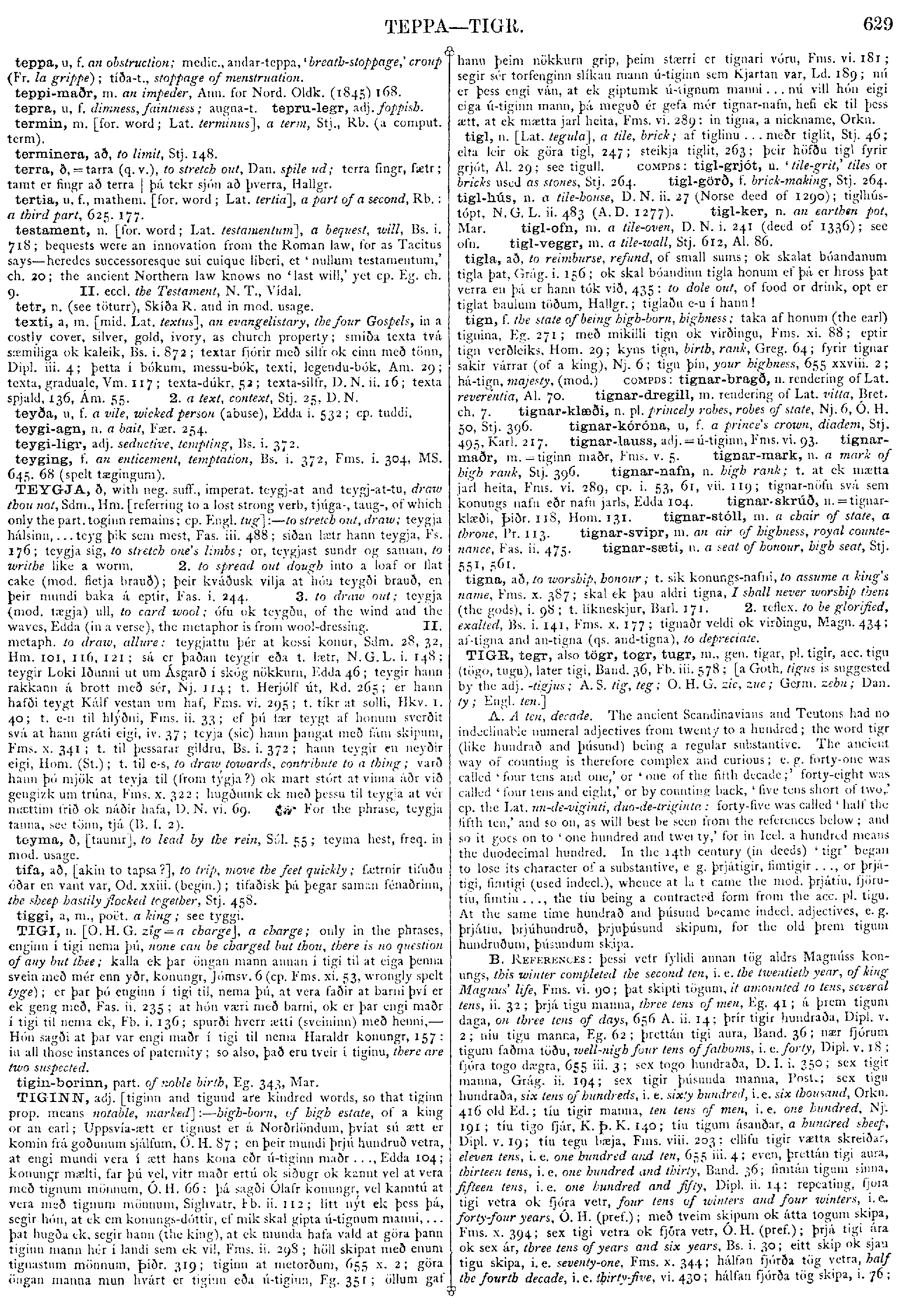
tigl, n. [Lat. tegula], a tile, brick; af tiglinu ... meðr tiglit, Stj. 46; elta leir ok göra tigl, 247; steikja tiglit, 263; þeir höfðu tigl fyrir grjót, Al. 29; see tigull. COMPDS: tigl-grjót, u. 'tile-grit,' tiles or bricks used as stones, Stj. 264. tigl-görð, f. brick-making, Stj. 264. tigl-hús, n. a tile-bouse, D.N. ii. 27 (Norse deed of 1290); tiglhús-tópt, N.G.L. ii. 483 (A.D. 1277). tigl-ker, n. an earthen pot, Mar. tigl-ofn, m. a tile-oven, D.N. i. 241 (deed of 1336); see ofn. tigl-veggr, m. a tile-wall, Stj. 612, Al. 86.
Germanic Lexicon Project (main page)
This search system was written by
Sean Crist
Please consider
volunteering
to correct the data in these online dictionaries.
No rights reserved. Feel free to use these data in any way you please.