|
|

|
Source: Bosworth/Toller, page d0184, entry 32 View original page image as: [TIFF] [PNG] [View previous entry] [View next entry] |
[Comment on this entry] [View comments] |
The following entry has been hand-corrected once. |
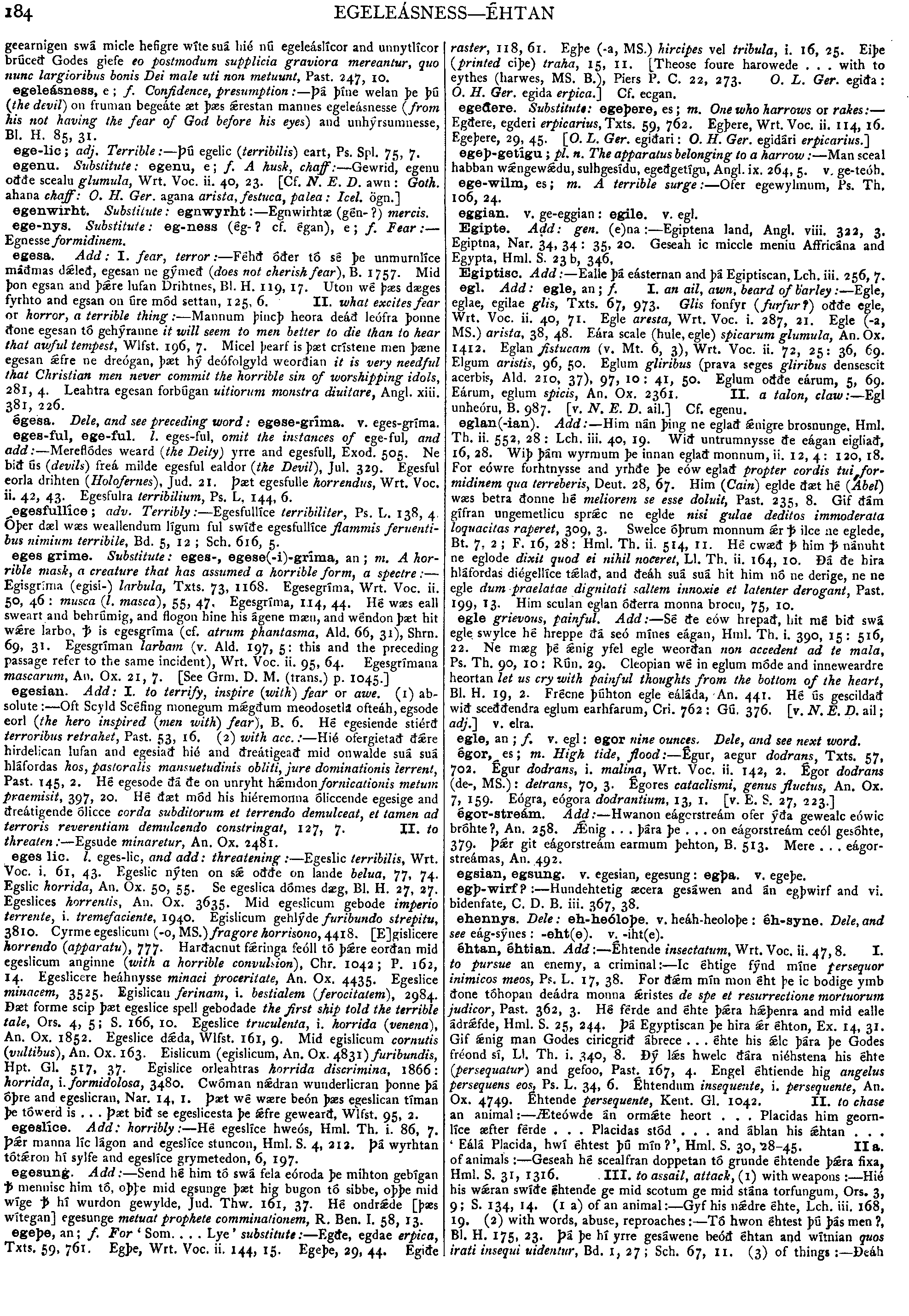
éhtan,
éhtian.
Add:--Éhtende
insectatum,
Wrt.
Voc.
ii.
47,
8.
I.
to
pursue
an
enemy,
a
criminal:--Ic
éhtige
fýnd
míne
persequor
inimicos
meos,
Ps.
L.
17,
38.
For
ð m
mín
mon
éht
þe
ic
bodige
ymb
ðone
tóhopan
deádra
monna
ristes
de
spe
et
resurrections
mortuorum
judicor,
Past.
362,
3.
Hé
férde
and
éhte
þra
hþenra
and
mid
ealle
ádrfde,
Hml.
S.
25,
244.
Þá
Egyptiscan
þe
hira
r
éhton,
Ex.
14,
31.
Gif
nig
man
Godes
ciricgrið
ábrece
.
.
.
éhte
his
lc
þára
þe
Godes
fréond
sí,
Ll.
Th.
i.
340,
8.
Ðý
ls
hwelc
ðára
niéhstena
his
éhte
(persequatur)
and
gefoo,
Past.
167,
4.
Engel
éhtiende
hig
angelus
persequens
eos,
Ps.
L.
34,
6.
Éhtendum
insequente,
i.
persequente,
An.
Ox.
4749.
Éhtende
persequente,
Kent.
Gl.
1042.
II.
to
chase
an
animal:--Æteówde
án
ormte
heort
.
.
.
Placidas
him
geornlíce
æfter
férde
.
.
.
Placidas
stód
.
.
.
and
áblan
his
htan
.
.
.
'Eálá
Placida,
hwí
éhtest
þú
mín?',
Hml.
S.
30,
28-45.
II
a.
of
animals:--Geseah
hé
scealfran
doppetan
tó
grunde
éhtende
þra
fixa,
Hml.
S.
31,
1316.
III.
to
assail,
attack,
(1)
with
weapons:--Hié
his
wran
swíðe
éhtende
ge
mid
scotum
ge
mid
stána
torfungum,
Ors.
3,
9;
S.
134,
14.
(1
a)
of
an
animal:--Gyf
his
ndre
éhte,
Lch.
iii.
168,
19.
(2)
with
words,
abuse,
reproaches:--Tó
hwon
éhtest
þú
þás
men?,
Bl.
H.
175,
23.
Þá
þe
hí
yrre
gesáwene
beóð
éhtan
and
wítnian
quos
irati
insequi
uidentur,
Bd.
1,
27;
Sch.
67,
11.
(3)
of
things:--Ðeáh
m
mín
mon
éht
þe
ic
bodige
ymb
ðone
tóhopan
deádra
monna
ristes
de
spe
et
resurrections
mortuorum
judicor,
Past.
362,
3.
Hé
férde
and
éhte
þra
hþenra
and
mid
ealle
ádrfde,
Hml.
S.
25,
244.
Þá
Egyptiscan
þe
hira
r
éhton,
Ex.
14,
31.
Gif
nig
man
Godes
ciricgrið
ábrece
.
.
.
éhte
his
lc
þára
þe
Godes
fréond
sí,
Ll.
Th.
i.
340,
8.
Ðý
ls
hwelc
ðára
niéhstena
his
éhte
(persequatur)
and
gefoo,
Past.
167,
4.
Engel
éhtiende
hig
angelus
persequens
eos,
Ps.
L.
34,
6.
Éhtendum
insequente,
i.
persequente,
An.
Ox.
4749.
Éhtende
persequente,
Kent.
Gl.
1042.
II.
to
chase
an
animal:--Æteówde
án
ormte
heort
.
.
.
Placidas
him
geornlíce
æfter
férde
.
.
.
Placidas
stód
.
.
.
and
áblan
his
htan
.
.
.
'Eálá
Placida,
hwí
éhtest
þú
mín?',
Hml.
S.
30,
28-45.
II
a.
of
animals:--Geseah
hé
scealfran
doppetan
tó
grunde
éhtende
þra
fixa,
Hml.
S.
31,
1316.
III.
to
assail,
attack,
(1)
with
weapons:--Hié
his
wran
swíðe
éhtende
ge
mid
scotum
ge
mid
stána
torfungum,
Ors.
3,
9;
S.
134,
14.
(1
a)
of
an
animal:--Gyf
his
ndre
éhte,
Lch.
iii.
168,
19.
(2)
with
words,
abuse,
reproaches:--Tó
hwon
éhtest
þú
þás
men?,
Bl.
H.
175,
23.
Þá
þe
hí
yrre
gesáwene
beóð
éhtan
and
wítnian
quos
irati
insequi
uidentur,
Bd.
1,
27;
Sch.
67,
11.
(3)
of
things:--Ðeáh
|
Source: Bosworth/Toller, page d0318, entry 13 View original page image as: [TIFF] [PNG] [View previous entry] [View next entry] |
[Comment on this entry] [View comments] |
The following entry has been hand-corrected once. |
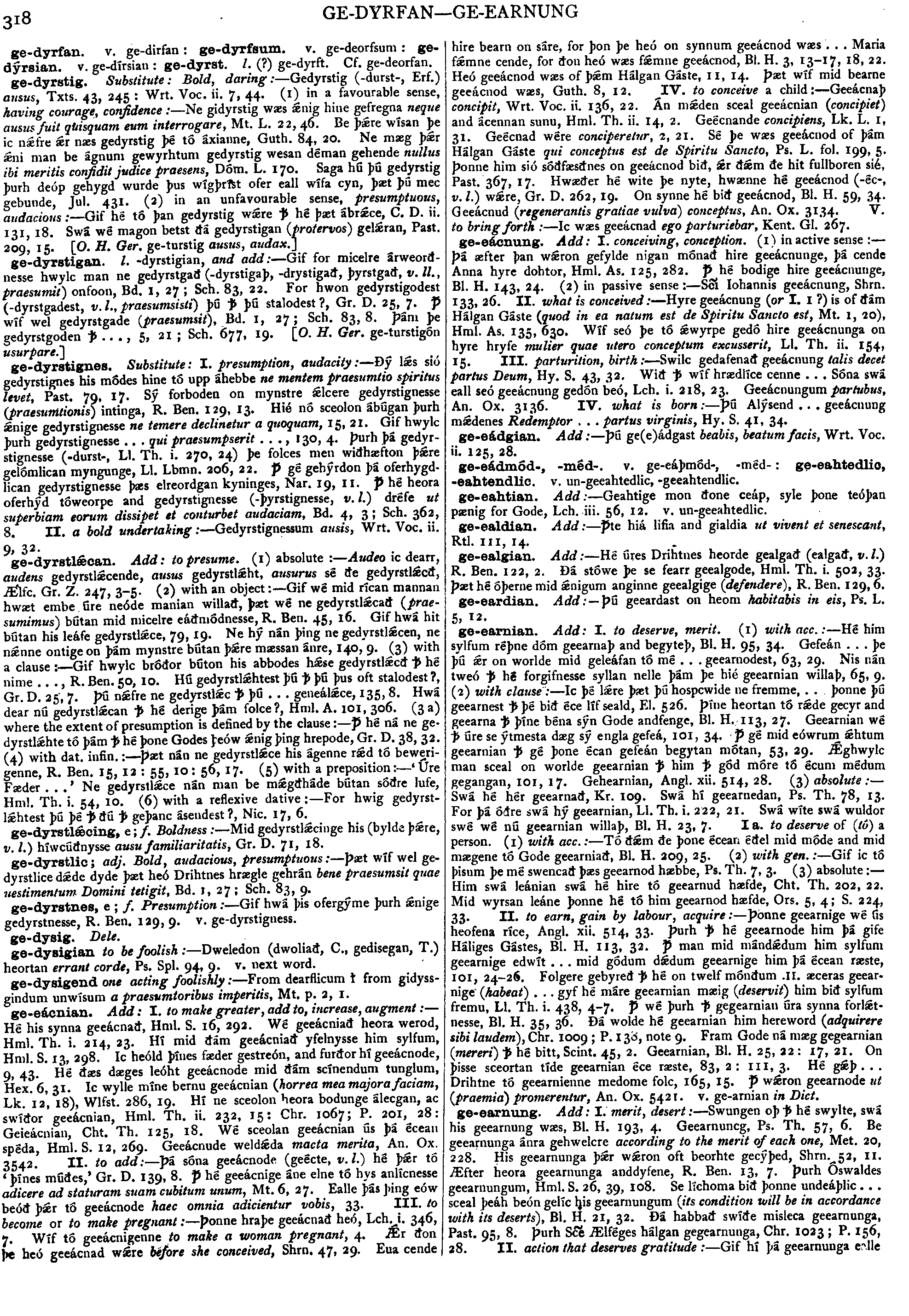
ge-eácnung.
Add:
I.
conceiving,
conception.
(1)
in
active
sense
:--
Þá
æfter
þan
wron
gefylde
nigan
mónað
hire
geeácnunge,
þá
cende
Anna
hyre
dohtor,
Hml.
As.
125,
282.
Þ
UNCERTAIN
hé
bodige
hire
geeácnunge,
Bl.
H.
143,
24.
(2)
in
passive
sense
:--
Sci
UNCERTAIN
Iohannis
geeácnung,
Shrn.
133,
26.
II.
what
is
conceived
:--
Hyre
geeácnung
(or
I.
l
?)
is
of
ðám
Hálgan
Gáste
(quod
in
ea
natum
est
de
Spiritu
Sancto
est,
Mt.
l,
20),
Hml.
As.
135,
630.
Wíf
seó
þe
tó
wyrpe
gedó
hire
geeácnunga
on
hyre
hryfe
mulier
quae
utero
conceptum
excusserit,
Ll.
Th.
ii.
154,
15.
III.
parturition,
birth
:--
Swilc
gedafenað
geeácnung
talis
decet
partus
Deum,
Hy.
S.
43,
32.
Wið
 wíf
hrædlíce
cenne
.
.
.
Sóna
swá
eall
seó
geeácnung
gedón
beó,
Lch.
i.
218,
23.
Geeácnungum
partubus,
An.
Ox.
3136.
IV.
what
is
born
:--
Þú
Alýsend
.
.
.
geeácnung
mdenes
Redemptor
.
.
.
partus
virginis,
Hy.
S.
41,
34.
wíf
hrædlíce
cenne
.
.
.
Sóna
swá
eall
seó
geeácnung
gedón
beó,
Lch.
i.
218,
23.
Geeácnungum
partubus,
An.
Ox.
3136.
IV.
what
is
born
:--
Þú
Alýsend
.
.
.
geeácnung
mdenes
Redemptor
.
.
.
partus
virginis,
Hy.
S.
41,
34.
|
Source: Bosworth/Toller, page d0477, entry 26 View original page image as: [TIFF] [PNG] [View previous entry] [View next entry] |
[Comment on this entry] [View comments] |
The following entry has been hand-corrected once. |
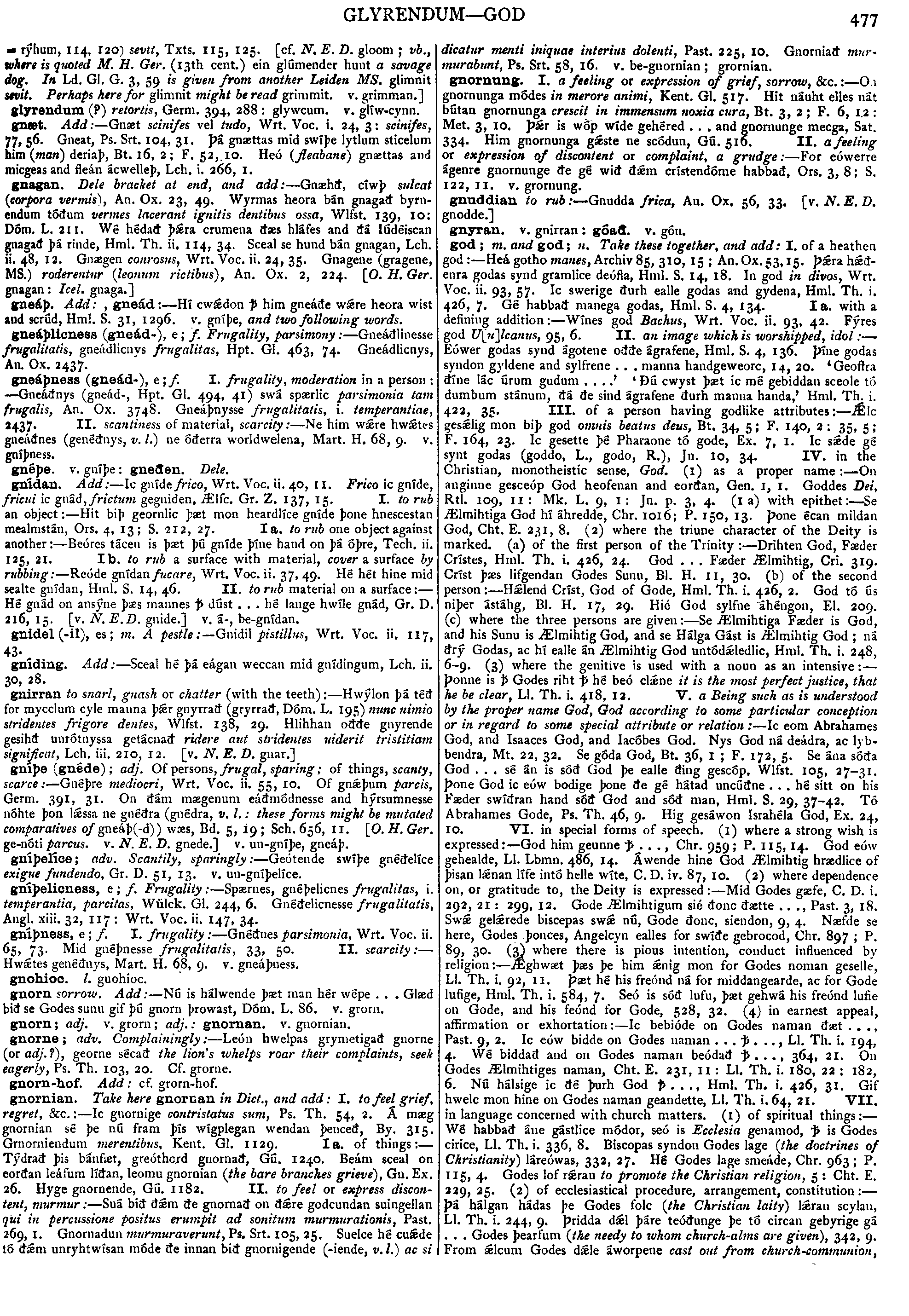
god;
m.
and
god;
n.
Take
these
together,
and
add:
I.
of
a
heathen
god:--Heá
gotho
manes,
Archiv
85,
310,
15;
An.
Ox.
53,
15.
Þra
hðenra
godas
synd
gramlice
deófla,
Hml.
S.
14,
18.
In
god
in
divos,
Wrt.
Voc.
ii.
93,
57.
Ic
swerige
ðurh
ealle
godas
and
gydena,
Hml.
Th.
i.
426,
7.
Gé
habbað
manega
godas,
Hml.
S.
4,
134.
I
a.
with
a
defining
addition:--Wínes
god
Bachus,
Wrt.
Voc.
ii.
93,
42.
Fýres
god
U[u]lcanus,
95,
6.
II.
on
image
which
is
worshipped,
idol:--Eówer
godas
synd
ágotene
oððe
ágrafene,
Hml.
S.
4,
136.
Þíne
godas
syndon
gyldene
and
sylfrene
.
.
.
manna
handgeweorc,
14,
20.
'Geoftra
ðíne
lác
úrum
gudum
.
.
.
.'
'Ðú
cwyst
þæt
ic
mé
gebiddan
sceole
tó
dumbum
stánum,
ðá
ðe
sind
ágrafene
ðurh
manna
handa,'
Hml.
Th.
i.
422,
35.
III.
of
a
person
having
godlike
attributes:--Æ-acute;lc
geslig
mon
biþ
god
omnis
beatus
deus,
Bt.
34,
5;
F.
140,
2:
35,
5;
F.
164,
23.
Ic
gesette
þé
Pharaone
tó
gode,
Ex.
7,
1.
Ic
sde
gé
synt
godas
(goddo,
L.,
godo,
R.),
Jn.
10,
34.
IV.
in
the
Christian,
monotheistic
sense,
God.
(1)
as
a
proper
name:--On
anginne
gesceóp
God
heofenan
and
eorðan,
Gen.
1,
1.
Goddes
Dei,
Rtl.
109,
11:
Mk.
L.
9,
1:
Jn.
p.
3,
4.
(1
a)
with
epithet:--Se
Ælmihtiga
God
hí
áhredde,
Chr.
1016;
P.
150,
13.
Þone
écan
mildan
God,
Cht.
E.
231,
8.
(2)
where
the
triune
character
of
the
Deity
is
marked.
(a)
of
the
first
person
of
the
Trinity:--Drihten
God,
Fæder
Crístes,
Hml.
Th.
i.
426,
24.
God
.
.
.
Fæder
Ælmihtig,
Cri.
319.
Críst
þæs
lifgendan
Godes
Sunu,
Bl.
H.
11,
30.
(b)
of
the
second
person:--Hlend
Críst,
God
of
Gode,
Hml.
Th.
i.
426,
2.
God
tó
ús
niþer
ástáhg,
Bl.
H.
17,
29.
Hié
God
sylfne
áhéngon,
El.
209.
(c)
where
the
three
persons
are
given:--Se
Ælmihtiga
Fæder
is
God,
and
his
Sunu
is
Ælmihtig
God,
and
se
Hálga
Gást
is
Ælmihtig
God;
ná
ðrý
Godas,
ac
hí
ealle
án
Ælmihtig
God
untódledlic,
Hml.
Th.
i.
248,
6-9.
(3)
where
the
genitive
is
used
with
a
noun
as
an
intensive:--Þonne
is
Godes
riht
hé
beó
clne
it
is
the
most
perfect
justice,
that
he
be
clear,
Ll.
Th.
i.
418,
12.
V.
a
Being
such
as
is
understood
by
the
proper
name
God,
God
according
to
some
particular
conception
or
in
regard
to
some
special
attribute
or
relation:--Ic
eom
Abrahames
God,
and
Isaaces
God,
and
Iacóbes
God.
Nys
God
ná
deádra,
ac
lybbendra,
Mt.
22,
32.
Se
góda
God,
Bt.
36,
1;
F.
172,
5.
Se
ána
sóða
God
.
.
.
sé
án
is
sóð
God
þe
ealle
ðing
gescóp,
Wlfst.
105,
27-31.
Þone
God
ic
eów
bodige
þone
ðe
gé
hátad
uncúðne
.
.
.
hé
sitt
on
his
Fæder
swíðran
hand
sóð
God
and
sóð
man,
Hml.
S.
29,
37-42.
Tó
Abrahames
Gode,
Ps.
Th.
46,
9.
Hig
gesáwon
Israhéla
God,
Ex.
24,
10.
VI.
in
special
forms
of
speech.
(1)
where
a
strong
wish
is
expressed:--God
him
geunne
.
.
.,
Chr.
959;
P.
115,
14.
God
eów
gehealde,
Ll.
Lbmn.
486,
14.
Áwende
hine
God
Ælmihtig
hrædlice
of
þisan
lnan
lífe
intó
helle
wíte,
C.
D.
iv.
87,
10.
(2)
where
dependence
on,
or
gratitude
to,
the
Deity
is
expressed:--Mid
Godes
gæfe,
C.
D.
i.
292,
21:
299,
12.
Gode
Ælmihtigum
sié
ðonc
ðætte
.
.
.,
Past.
3,
18.
Sw
gelrede
biscepas
sw
nú,
Gode
ðonc,
siendon,
9,
4.
Næfde
se
here,
Godes
þonces,
Angelcyn
ealles
for
swíðe
gebrocod,
Chr.
897;
P.
89,
30.
(3)
where
there
is
pious
intention,
conduct
influenced
by
religion:--Æ-acute;ghwæt
þæs
þe
him
nig
mon
for
Godes
noman
geselle,
Ll.
Th.
i.
92,
11.
Þæt
hé
his
freónd
ná
for
middangearde,
ac
for
Gode
lufige,
Hml.
Th.
i.
584,
7.
Seó
is
sóð
lufu,
þæt
gehwá
his
freónd
lufie
on
Gode,
and
his
feónd
for
Gode,
528,
32.
(4)
in
earnest
appeal,
affirmation
or
exhortation:--Ic
bebióde
on
Godes
naman
ðæt
.
.
.,
Past.
9,
2.
Ic
eów
bidde
on
Godes
naman
.
.
.
.
.
.,
Ll.
Th.
i.
194,
4.
Wé
biddað
and
on
Godes
naman
beódað
.
.
.,
364,
21.
On
Godes
Ælmihtiges
naman,
Cht.
E.
231,
11:
Ll.
Th.
i.
180,
22:
182,
6.
Nú
hálsige
ic
ðé
þurh
God
þ
.
.
.,
Hml.
Th.
i.
426,
31.
Gif
hwelc
mon
hine
on
Godes
naman
geandette,
Ll.
Th.
i.
64,
21.
VII.
in
language
concerned
with
church
matters.
(1)
of
spiritual
things:--Wé
habbað
áne
gástlice
módor,
seó
is
Ecclesia
genamod,
is
Godes
cirice,
Ll.
Th.
i.
336,
8.
Biscopas
syndon
Godes
lage
(the
doctrines
of
Christianity)
láreówas,
332,
27.
Hé
Godes
lage
smeáde,
Chr.
963;
P.
115,
4.
Godes
lof
rran
to
promote
the
Christian
religion,
5:
Cht.
E.
229,
25.
(2)
of
ecclesiastical
procedure,
arrangement,
constitution:--Þá
hálgan
hádas
þe
Godes
folc
(the
Christian
laity)
lran
scylan,
Ll.
Th.
i.
244,
9.
Þridda
dl
þáre
teóðunge
þe
tó
circan
gebyrige
gá
.
.
.
Godes
þearfum
(the
needy
to
whom
church-alms
are
given),
342,
9.
From
lcum
Godes
dle
áworpene
cast
out
from
church-communion,
|
Source: Bosworth/Toller, page d0563, entry 15 View original page image as: [TIFF] [PNG] [View previous entry] [View next entry] |
[Comment on this entry] [View comments] |
The following entry has been hand-corrected once. |
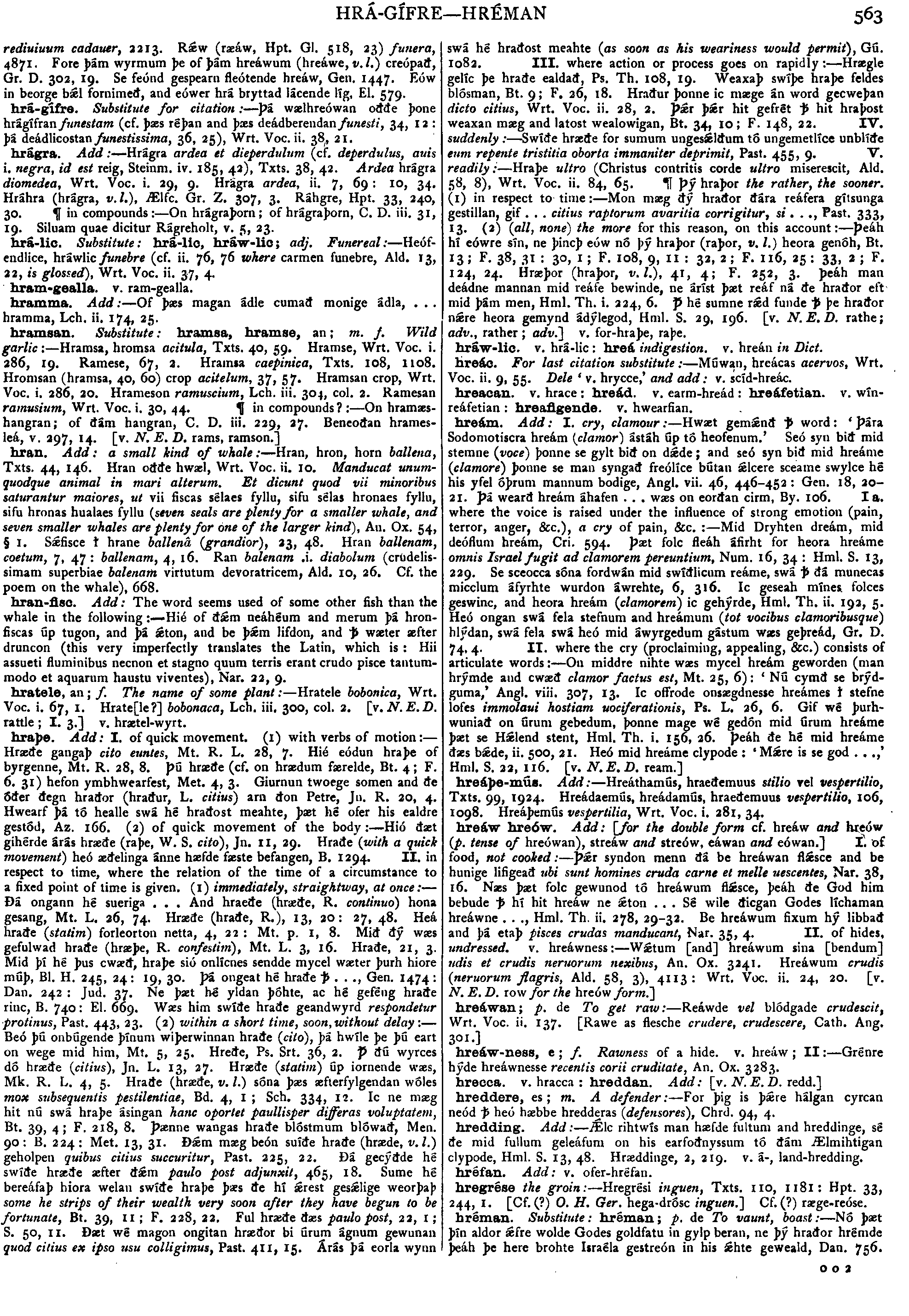
hreám.
Add:
I.
cry,
clamour:--Hwæt
gemnð
word:
'Þára
Sodomotiscra
hreám
(clamor)
ástáh
úp
tó
heofenum.'
Seó
syn
bið
mid
stemne
(voce)
þonne
se
gylt
bið
on
dde;
and
seó
syn
bið
mid
hreáme
(clamore)
þonne
se
man
syngað
freólíce
bútan
lcere
sceame
swylce
hé
his
yfel
óþrum
mannum
bodige,
Angl.
vii.
46,
446-452:
Gen.
18,
20-21.
Þá
wearð
hreám
áhafen
.
.
.
wæs
on
eorðan
cirm,
By.
106.
I
a.
where
the
voice
is
raised
under
the
influence
of
strong
emotion
(pain,
terror,
anger,
&c.),
a
cry
of
pain,
&c.:--Mid
Dryhten
dreám,
mid
deóflum
hreám,
Cri.
594.
Þæt
folc
fleáh
áfirht
for
heora
hreáme
omnis
Israel
fugit
ad
clamorem
pereuntium,
Num.
16,
34:
Hml.
S.
13,
229.
Se
sceocca
sóna
fordwán
mid
swíðlicum
reáme,
swá
ðá
munecas
micclum
áfyrhte
wurdon
áwrehte,
6,
316.
Ic
geseah
mínes
folces
geswinc,
and
heora
hreám
(clamorem)
ic
gehýrde,
Hml.
Th.
ii.
192,
5.
Heó
ongan
swá
fela
stefnum
and
hreámum
(tot
vocibus
clamoribusque)
hlýdan,
swá
fela
swá
heó
mid
áwyrgedum
gástum
wæs
geþreád,
Gr.
D.
74,
4.
II.
where
the
cry
(proclaiming,
appealing,
&c.)
consists
of
articulate
words:--On
middre
nihte
wæs
mycel
hreám
geworden
(man
hrýmde
and
cwæð
clamor
factus
est,
Mt.
25,
6):
'Nú
cymð
se
brýdguma,'
Angl.
viii.
307,
13.
Ic
offrode
onsægdnesse
hreámes
 stefne
lofes
immolaui
hostiam
uociferationis,
Ps.
L.
26,
6.
Gif
wé
þurhwuniað
on
úrum
gebedum,
þonne
mage
wé
gedón
mid
úrum
hreáme
þæt
se
Hlend
stent,
Hml.
Th.
i.
156,
26.
Þeáh
ðe
hé
mid
hreáme
ðæs
bde,
ii.
500,
21.
Heó
mid
hreáme
clypode:
'Mre
is
se
god
.
.
.,'
Hml.
S.
22,
116.
[v.
N.
E.
D.
ream.]
stefne
lofes
immolaui
hostiam
uociferationis,
Ps.
L.
26,
6.
Gif
wé
þurhwuniað
on
úrum
gebedum,
þonne
mage
wé
gedón
mid
úrum
hreáme
þæt
se
Hlend
stent,
Hml.
Th.
i.
156,
26.
Þeáh
ðe
hé
mid
hreáme
ðæs
bde,
ii.
500,
21.
Heó
mid
hreáme
clypode:
'Mre
is
se
god
.
.
.,'
Hml.
S.
22,
116.
[v.
N.
E.
D.
ream.]
| Result Page: |  |
Previous | 1 2 3 |
Germanic Lexicon Project (main page)
This search system was written by
Sean Crist
Please consider
volunteering
to correct the data in these online dictionaries.
No rights reserved. Feel free to use these data in any way you please.