|
|

|
Source: Bosworth/Toller, page b0112, entry 38 View original page image as: [TIFF] [PNG] [View previous entry] [View next entry] |
[Comment on this entry] [View comments] |
The following entry has been hand-corrected once. |
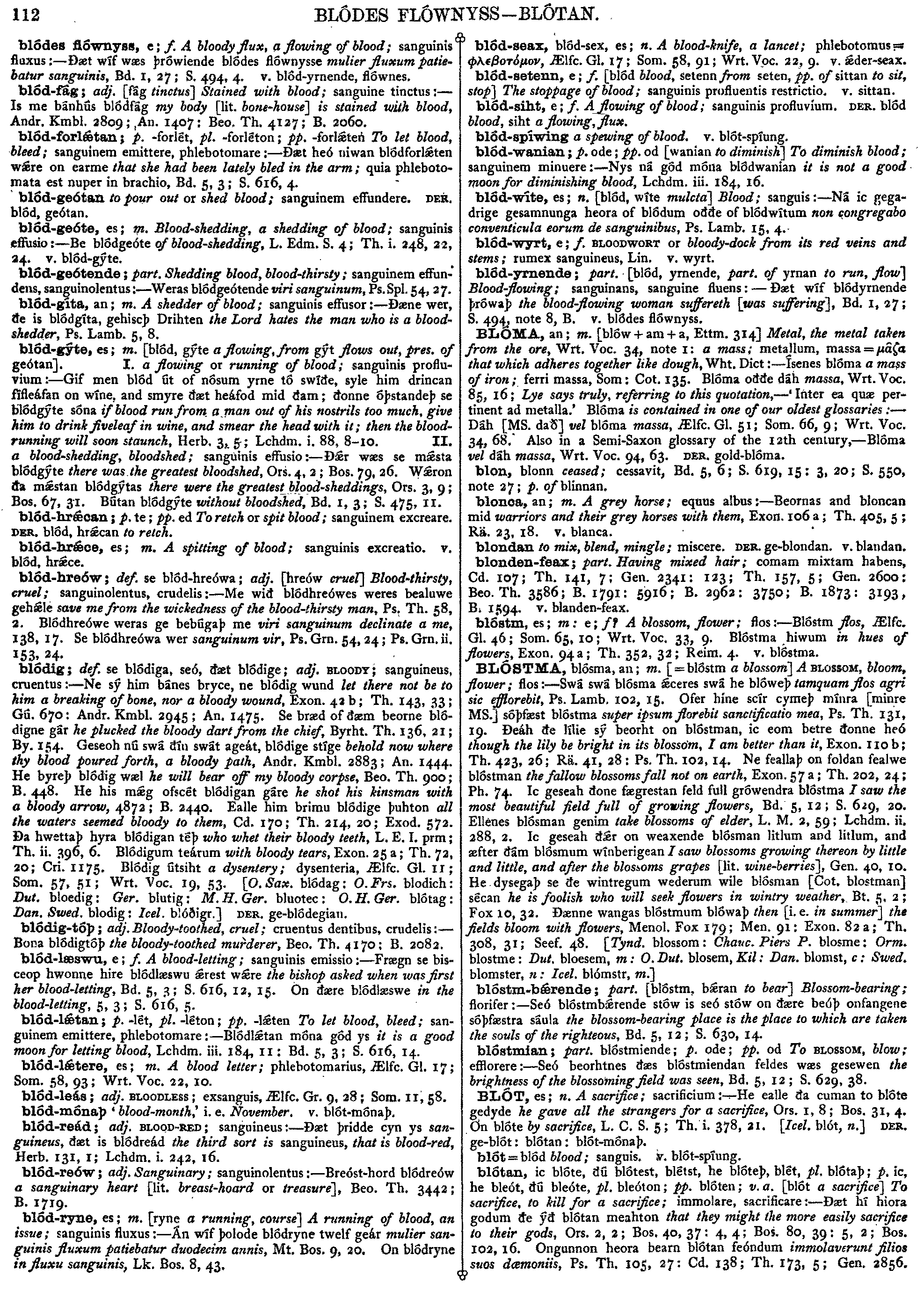
blóstmian; part. blóstmiende; p. ode; pp. od To BLOSSOM, blow; efflorere :-- Seó beorhtnes ðæs blóstmiendan feldes wæs gesewen the brightness of the blossoming field was seen, Bd. 5, 12; S. 629, 38.
|
Source: Bosworth/Toller, page b0113, entry 4 View original page image as: [TIFF] [PNG] [View previous entry] [View next entry] |
[Comment on this entry] [View comments] |
The following entry has been hand-corrected once. |
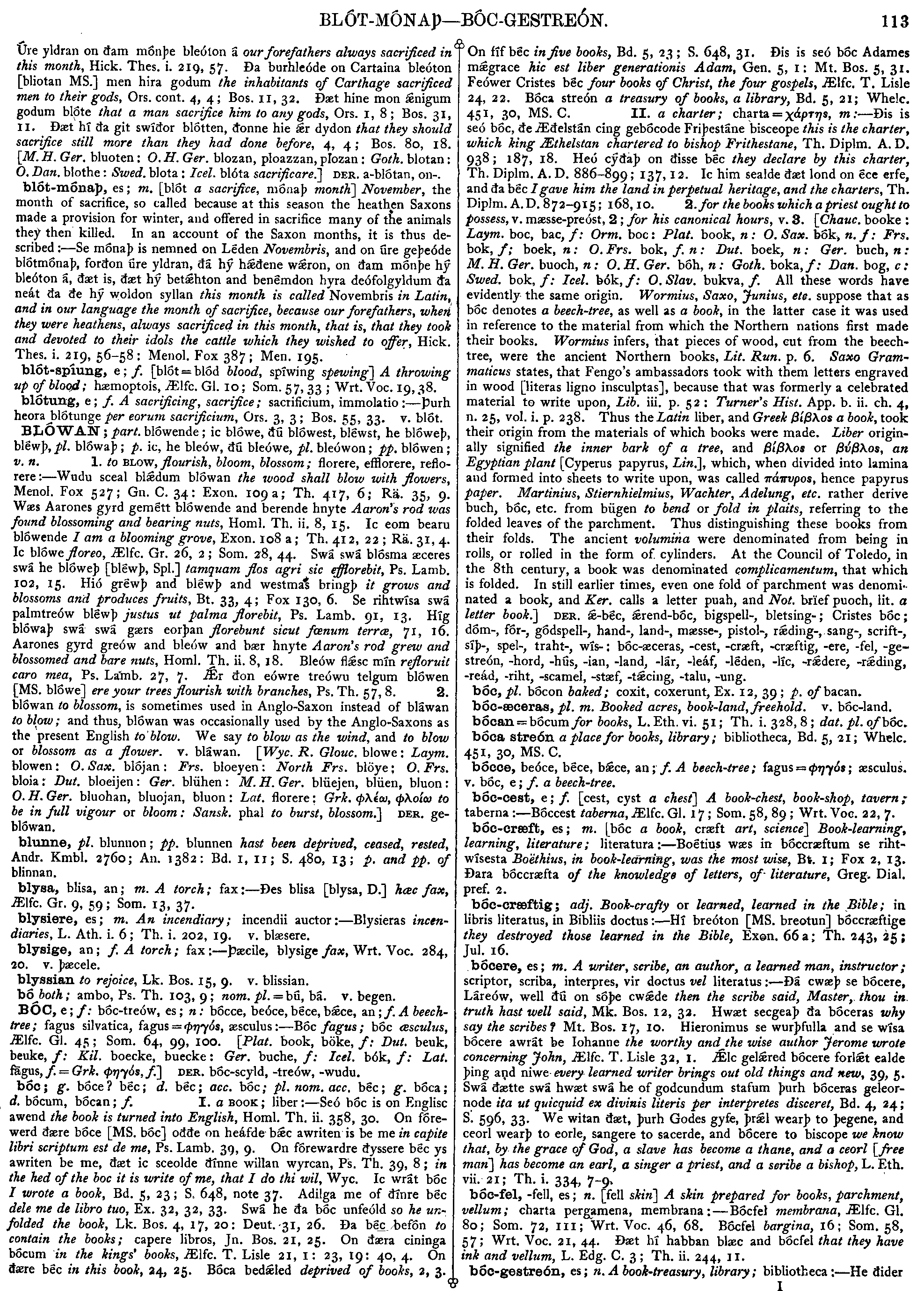
BLÓWAN;
part.
blówende;
ic
blówe,
ðú
blówest,
bléwst,
he
blóweþ,
bléwþ,
pl.
blówaþ;
p.
ic,
he
bleów,
ðú
bleówe,
pl.
bleówon;
pp.
blówen;
v.
n.
1.
to
BLOW,
flourish,
bloom,
blossom;
florere,
efflorere,
reflorere
:--
Wudu
sceal
bl dum
blówan
the
wood
shall
blow
with
flowers,
Menol.
Fox
527;
Gn.
C.
34:
Exon.
109
a;
Th.
417,
6;
Rä.
35,
9.
Wæs
Aarones
gyrd
gemétt
blówende
and
berende
hnyte
Aaron's
rod
was
found
blossoming
and
bearing
nuts,
Homl.
Th.
ii.
8,
15.
Ic
eom
bearu
blówende
I
am
a
blooming
grove,
Exon.
108
a;
Th.
412,
22;
Rä.
31,
4.
Ic
blówe
floreo,
Ælfc.
Gr.
26,
2;
Som.
28,
44.
Swá
swá
blósma
æceres
swá
he
blóweþ
[bléwþ,
Spl.]
tamquam
flos
agri
sic
efflorebit,
Ps.
Lamb.
102,
15.
Hió
gréwþ
and
bléwþ
and
westmas
bringþ
it
grows
and
blossoms
and
produces
fruits,
Bt.
33,
4;
Fox
130,
6.
Se
rihtwísa
swá
palmtreów
bléwþ
justus
ut
palma
florebit,
Ps.
Lamb.
91,
13.
Híg
blówaþ
swá
swá
gærs
eorþan
florebunt
sicut
fœnum
terræ,
71,
16.
Aarones
gyrd
greów
and
bleów
and
bær
hnyte
Aaron's
rod
grew
and
blossomed
and
bare
nuts,
Homl.
Th.
ii.
8,
18.
Bleów
flsc
mín
refloruit
caro
mea,
Ps.
Lamb.
27,
7.
Æ-acute;r
ðon
eówre
treówu
telgum
blówen
[MS.
blówe]
ere
your
trees
flourish
with
branches,
Ps.
Th.
57,
8.
2.
blówan
to
blossom,
is
sometimes
used
in
Anglo-Saxon
instead
of
bláwan
to
blow;
and
thus,
blówan
was
occasionally
used
by
the
Anglo-Saxons
as
the
present
English
to
blow.
We
say
to
blow
as
the
wind,
and
to
blow
or
blossom
as
a
flower.
v.
bláwan.
[Wyc.
R.
Glouc.
blowe:
Laym.
blowen:
O.
Sax.
blójan:
Frs.
bloeyen:
North
Frs.
blöye:
O.
Frs.
bloia:
Dut.
bloeijen:
Ger.
blühen:
M.
H.
Ger.
blüejen,
blüen,
bluon:
O.
H.
Ger.
bluohan,
bluojan,
bluon:
Lat.
florere:
Grk.
dum
blówan
the
wood
shall
blow
with
flowers,
Menol.
Fox
527;
Gn.
C.
34:
Exon.
109
a;
Th.
417,
6;
Rä.
35,
9.
Wæs
Aarones
gyrd
gemétt
blówende
and
berende
hnyte
Aaron's
rod
was
found
blossoming
and
bearing
nuts,
Homl.
Th.
ii.
8,
15.
Ic
eom
bearu
blówende
I
am
a
blooming
grove,
Exon.
108
a;
Th.
412,
22;
Rä.
31,
4.
Ic
blówe
floreo,
Ælfc.
Gr.
26,
2;
Som.
28,
44.
Swá
swá
blósma
æceres
swá
he
blóweþ
[bléwþ,
Spl.]
tamquam
flos
agri
sic
efflorebit,
Ps.
Lamb.
102,
15.
Hió
gréwþ
and
bléwþ
and
westmas
bringþ
it
grows
and
blossoms
and
produces
fruits,
Bt.
33,
4;
Fox
130,
6.
Se
rihtwísa
swá
palmtreów
bléwþ
justus
ut
palma
florebit,
Ps.
Lamb.
91,
13.
Híg
blówaþ
swá
swá
gærs
eorþan
florebunt
sicut
fœnum
terræ,
71,
16.
Aarones
gyrd
greów
and
bleów
and
bær
hnyte
Aaron's
rod
grew
and
blossomed
and
bare
nuts,
Homl.
Th.
ii.
8,
18.
Bleów
flsc
mín
refloruit
caro
mea,
Ps.
Lamb.
27,
7.
Æ-acute;r
ðon
eówre
treówu
telgum
blówen
[MS.
blówe]
ere
your
trees
flourish
with
branches,
Ps.
Th.
57,
8.
2.
blówan
to
blossom,
is
sometimes
used
in
Anglo-Saxon
instead
of
bláwan
to
blow;
and
thus,
blówan
was
occasionally
used
by
the
Anglo-Saxons
as
the
present
English
to
blow.
We
say
to
blow
as
the
wind,
and
to
blow
or
blossom
as
a
flower.
v.
bláwan.
[Wyc.
R.
Glouc.
blowe:
Laym.
blowen:
O.
Sax.
blójan:
Frs.
bloeyen:
North
Frs.
blöye:
O.
Frs.
bloia:
Dut.
bloeijen:
Ger.
blühen:
M.
H.
Ger.
blüejen,
blüen,
bluon:
O.
H.
Ger.
bluohan,
bluojan,
bluon:
Lat.
florere:
Grk.

 &epsilon-tonos;
 ,
o&iota-tonos;
to
be
in
full
vigour
or
bloom:
Sansk.
phal
to
burst,
blossom.]
DER.
geblówan.
,
o&iota-tonos;
to
be
in
full
vigour
or
bloom:
Sansk.
phal
to
burst,
blossom.]
DER.
geblówan.
|
Source: Bosworth/Toller, page b0121, entry 24 View original page image as: [TIFF] [PNG] [View previous entry] [View next entry] |
[Comment on this entry] [View comments] |
The following entry has been hand-corrected once. |
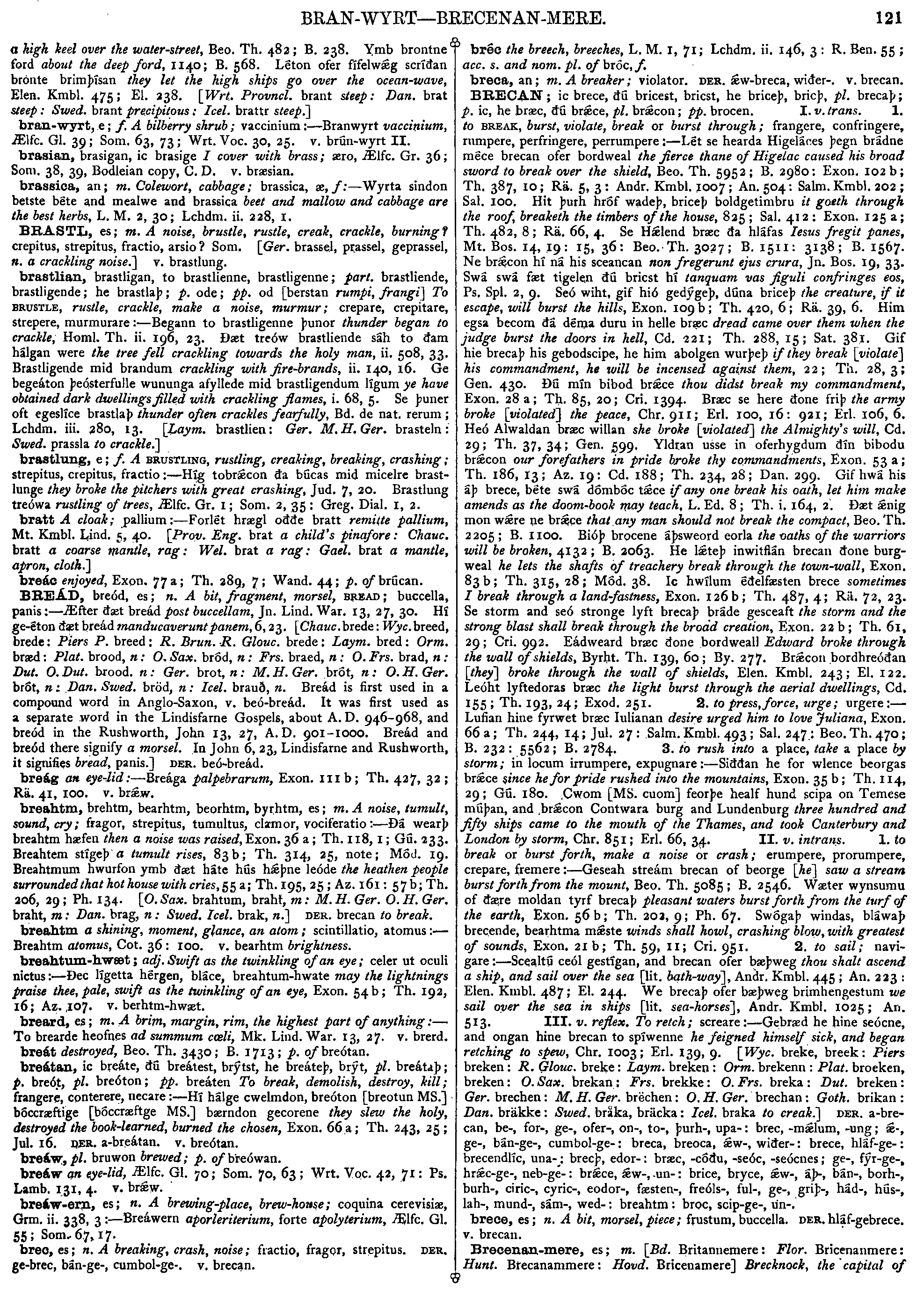
BRECAN;
ic
brece,
ðú
bricest,
bricst,
he
briceþ,
bricþ,
pl.
brecaþ;
p.
ic,
he
bræc,
ðú
brce,
pl.
brcon;
pp.
brocen.
I.
v.
trans.
1.
to
BREAK,
burst,
violate,
break
or
burst
through;
frangere,
confringere,
rumpere,
perfringere,
perrurnpere
:--
Lét
se
hearda
Higeláces
þegn
brádne
méce
brecan
ofer
bordweal
the
fierce
thane
of
Higelac
caused
his
broad
sword
to
break
over
the
shield.
Beo.
Th.
5952;
B.
2980:
Exon.
102
b;
Th.
387,
10;
Rä.
5,
3:
Andr.
Kmbl.
1007;
An.
504:
Salm.
Kmbl.
202
;
Sal.
100.
Hit
þurh
hróf
wadeþ,
briceþ
boldgetimbru
it
goeth
through
the
roof,
breaketh
the
timbers
of
the
house,
825
;
Sal.
412
:
Exon.
125
a;
Th.
482,
8;
Rä.
66,
4.
Se
Hlend
bræc
ða
hláfas
Iesus
fregit
panes,
Mt.
Bos.
14,
19:
15,
36:
Beo.
Th.
3027;
B.
1511:
3138;
B.
1567.
Ne
brcon
hí
ná
his
sceancan
non
fregernt
ejus
crura,
Jn.
Bos.
19,
33.
Swá
swá
fæt
tigelen
ðú
bricst
hi
tanquam
vas
figuli
confringes
eos,
Ps.
Spl.
2,
9.
Seó
wiht,
gif
hió
gedýgeþ,
dúna
briceþ
the
creature,
if
it
escape,
will
burst
the
hills,
Exon.
109
b;
Th.
420,
6;
Rä.
39,
6.
Him
egsa
becom
ðá
déma
duru
in
helle
bræc
dread
came
over
them
when
the
judge
burst
the
doors
in
hell.
Cd.
221;
Th.
288,
15;
Sat.
381.
Gif
hie
brecaþ
his
gebodscipe,
he
him
abolgen
wurþeþ
if
they
break
[violate]
his
commandment,
he
will
be
incensed
against
them,
22;
Th.
28,
3;
Gen.
430.
Ðú
mín
bibod
brce
thou
didst
break
my
commandment,
Exon.
28
a;
Th.
85,
20;
Cri.
1394.
Bræc
se
here
ðone
friþ
the
army
broke
[violated]
the
peace,
Chr.
911;
Erl.
100,
16:
921;
Erl.
106,
6.
Heó
Alwaldan
bræc
willan
she
broke
[violated]
the
Almighty's
will,
Cd.
29;
Th.
37,
34;
Gen.
599.
Yldran
usse
in
oferhygdum
ðín
bibodu
brcon
our
forefathers
in
pride
broke
thy
commandments,
Exon.
53
a;
Th.
186,
13;
Az.
19:
Cd.
188;
Th.
234,
28;
Dan.
299.
Gif
hwá
his
áþ
brece,
béte
swá
dómbóc
tce
if
any
one
break
his
oath,
let
him
make
amends
as
the
doom-book
may
teach,
L.
Ed.
8
;
Th.
i.
164,
2.
Ðæt
nig
mon
wre
ne
brce
that
any
man
should
not
break
the
compact,
Beo.
Th.
2205
;
B.
1100.
Bióþ
brocene
áþsweord
eorla
the
oaths
of
the
warriors
will
be
broken,
4132
;
B.
2063.
He
lteþ
inwitfán
UNCERTAIN
brecan
ðone
burg-weal
he
lets
the
shafts
of
treachery
break
through
the
town-wall,
Exon.
83b;
Th.
315,
28;
Mód.
38.
Ic
hwílum
éðelfæsten
brece
sometimes
I
break
through
a
land-fastness,
Exon.
126
b;
Th.
487,
4;
Rä.
72,
23.
Se
storm
and
seó
stronge
lyft
brecaþ
bráde
gesceaft
the
storm
and
the
strong
blast
shall
break
through
the
broad
creation,
Exon.
22
b
;
Th.
61,
29;
Cri.
992.
Eádweard
bræc
ðone
bordweall
Edward
broke
through
the
wall
of
shields,
Byrht.
Th.
139,
60;
By.
277.
Brcon
bordhreóðan
[they]
broke
through
the
wall
of
shields.
Elen.
Kmbl.
243;
El.
122.
Leóht
lyftedoras
bræc
the
light
burst
through
the
aerial
dwellings,
Cd.
155
;
Th.
193,
24;
Exod.
251.
2.
to
press,
force,
urge;
urgere
:--
Lufian
hine
fyrwet
bræc
lulianan
desire
urged
him
to
love
Juliana,
Exon.
66
a;
Th.
244,
14;
Jul.
27:
Salm.
Kmbl.
493;
Sal.
247:
Beo.
Th.
470;
B.
232:
5562;
B.
2784.
3.
to
rush
into
a
place,
take
a
place
by
storm;
in
locum
irrumpere,
expugnare
:--
Siððan
he
for
wlence
beorgas
brce
since
he
for
pride
rushed
into
the
mountains,
Exon.
35
b;
Th.
114,
29;
Gú.
180.
Cwom
[MS.
cuom]
feorþe
healf
hund
scipa
on
Temese
múþan,
and
brcon
Contwara
burg
and
Lundenburg
three
hundred
and
fifty
ships
came
to
the
mouth
of
the
Thames,
and
took
Canterbury
and
London
by
storm,
Chr.
851;
Erl.
66,
34.
II.
v.
intrans.
1.
to
break
or
burst
forth,
make
a
noise
or
crash;
erumpere,
prorumpere,
crepare,
fremere
:--
Geseah
streám
brecan
of
beorge
[he]
saw
a
stream
burst
forth
from
the
mount,
Bec.
Th.
5085
;
B.
2546.
Wæter
wynsumu
of
ðære
moldan
tyrf
brecaþ
pleasant
waters
burst
forth
from
the
turf
of
the
earth,
Exon.
56
b;
Th.
202,
9;
Ph.
67.
Swógaþ
windas,
bláwaþ
brecende,
bearhtma
mste
winds
shall
howl,
crashing
blow,
with
greatest
of
sounds,
Exon.
21
b;
Th.
59,
II;
Cri.
951.
2.
to
sail;
navi-gare
:--
Scealtú
ceól
gestígan,
and
brecan
ofer
bæþweg
thou
shalt
ascend
a
ship,
and
sail
over
the
sea
[lit.
bath-way],
Andr.
Kmbl.
445
;
An.
223
:
Elen.
Kmbl.
487;
El.
244.
We
brecaþ
ofer
bæþweg
brimhengestum
we
sail
over
the
sea
in
ships
[lit.
sea-horses].
Andr.
Kmbl.
1025;
An.
513.
III.
v.
reflex.
To
retch;
screare
:--
Gebræd
he
hine
seócne,
and
ongan
hine
brecan
to
spíwenne
he
feigned
himself
sick,
and
began
retching
to
spew,
Chr.
1003;
Erl.
139,
9.
[Wyc.
breke,
breek:
Piers
breken:
R.
Glouc.
breke:
Laym.
breken:
Orm.
brekenn:
Plat.
broeken,
breken:
O.
Sax.
brekan:
Frs.
brekke:
O.
Frs.
breka:
Dut.
breken:
Ger.
brechen:
M.
H.
Ger.
brëchen:
O.
H.
Ger.
brechan:
Goth.
brikan
:
Dan.
bräkke:
Swed.
bråka,
bräcka:
Icel.
braka
to
creak.]
DER.
a-brecan,
be-,
for-,
ge-,
ofer-,
on-,
to-,
þurh-,
upa-:
brec,
-mlum,
-ung;
-,
ge-,
bán-ge-,
cumbol-ge-:
breca,
breoca,
w-,
wiðer-:
brece,
hláf-ge-:
brecendlíc,
una-:
brecþ,
edor-:
bræc,
-cóðu,
-seóc,
-seócnes;
ge-,
fýr-ge-,
hrc-ge-,
neb-ge-:
brce,
w-,
-un-:
brice,
bryce,
w-,
áþ-,
bán-,
borh-,
burh-,
ciric-,
cyric-,
eodor-,
fæsten-,
freóls-,
ful-,
ge-,
griþ-,
hád-,
hús-,
lah-,
mund-,
sám-,
wed-:
breahtm:
broc,
scip-ge-,
un-.
|
Source: Bosworth/Toller, page b0197, entry 38 View original page image as: [TIFF] [PNG] [View previous entry] [View next entry] |
[Comment on this entry] [View comments] |
The following entry has been hand-corrected once. |
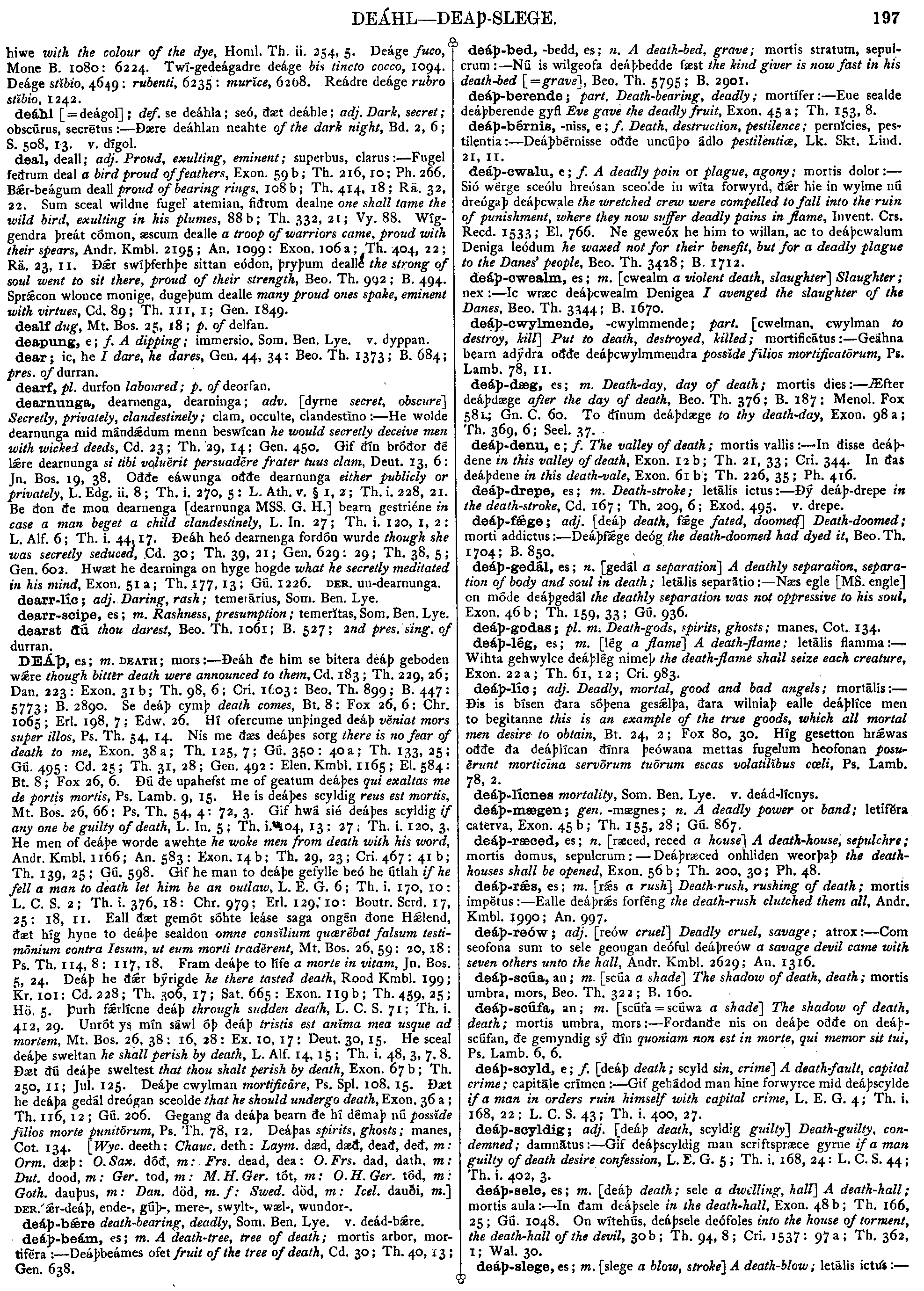
deáþ-slege,
es;
m.
[slege
a
blow,
stroke]
A
death-blow;
let lis
icus
:--
Þurh
deáþslege
through
deadly
stroke,
Exon.
102
b;
Th.
388,
27;
Rä.
6,
14.
lis
icus
:--
Þurh
deáþslege
through
deadly
stroke,
Exon.
102
b;
Th.
388,
27;
Rä.
6,
14.
|
Source: Bosworth/Toller, page b0206, entry 36 View original page image as: [TIFF] [PNG] [View previous entry] [View next entry] |
[Comment on this entry] [View comments] |
The following entry has been hand-corrected once. |
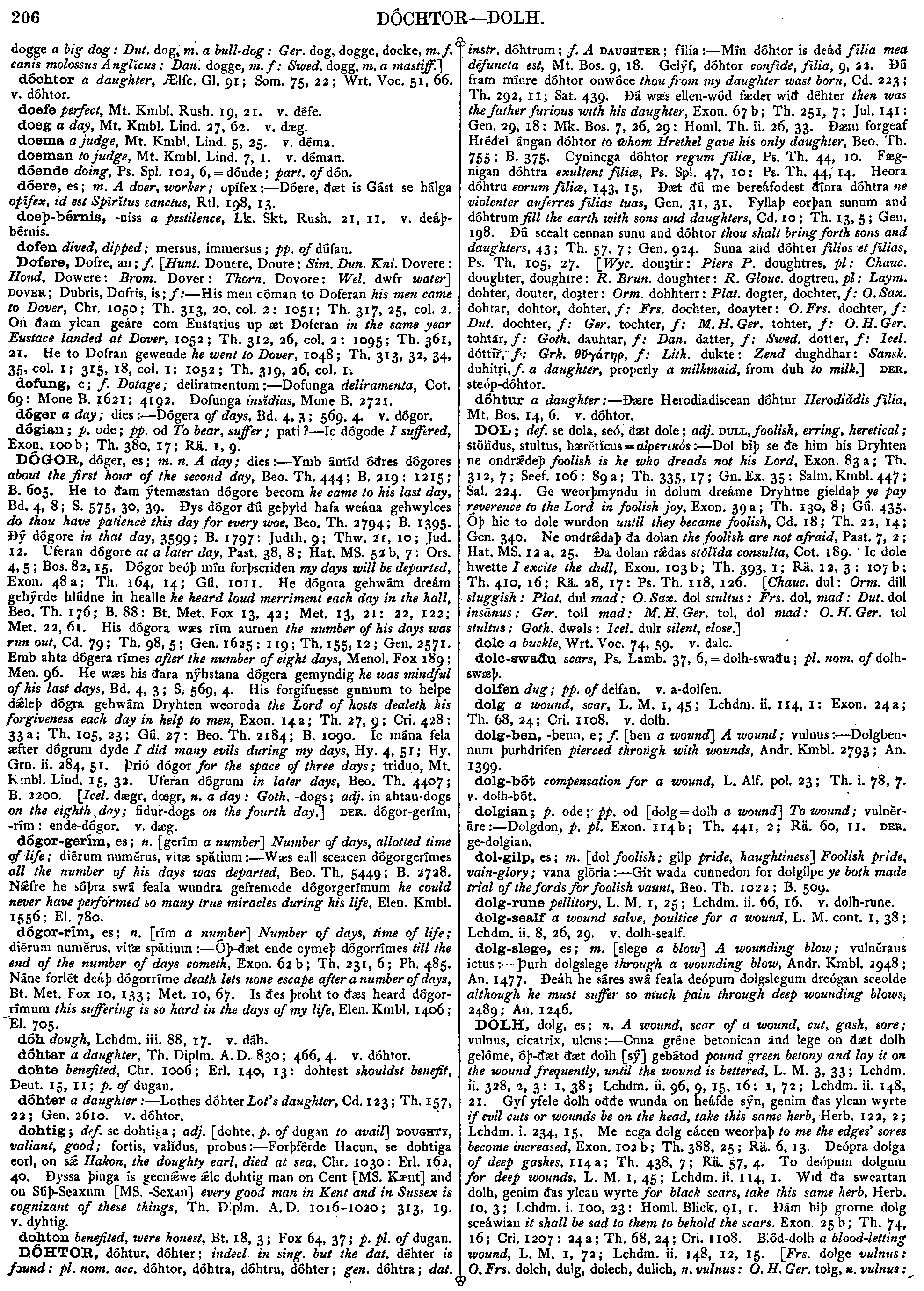
dolg-slege,
es;
m.
[slege
a
blow]
A
wounding
blow;
vuln rans
ictus
:--
Þurh
dolgslege
through
a
wounding
blow,
Andr.
Kmbl.
2948;
An.
1477.
Ðeáh
he
sáres
swá
feala
deópum
dolgslegum
dreógan
sceolde
although
he
must
suffer
so
much
pain
through
deep
wounding
blows;
2489;
An.
1246.
rans
ictus
:--
Þurh
dolgslege
through
a
wounding
blow,
Andr.
Kmbl.
2948;
An.
1477.
Ðeáh
he
sáres
swá
feala
deópum
dolgslegum
dreógan
sceolde
although
he
must
suffer
so
much
pain
through
deep
wounding
blows;
2489;
An.
1246.
|
Source: Bosworth/Toller, page b0207, entry 6 View original page image as: [TIFF] [PNG] [View previous entry] [View next entry] |
[Comment on this entry] [View comments] |
The following entry has been hand-corrected once. |
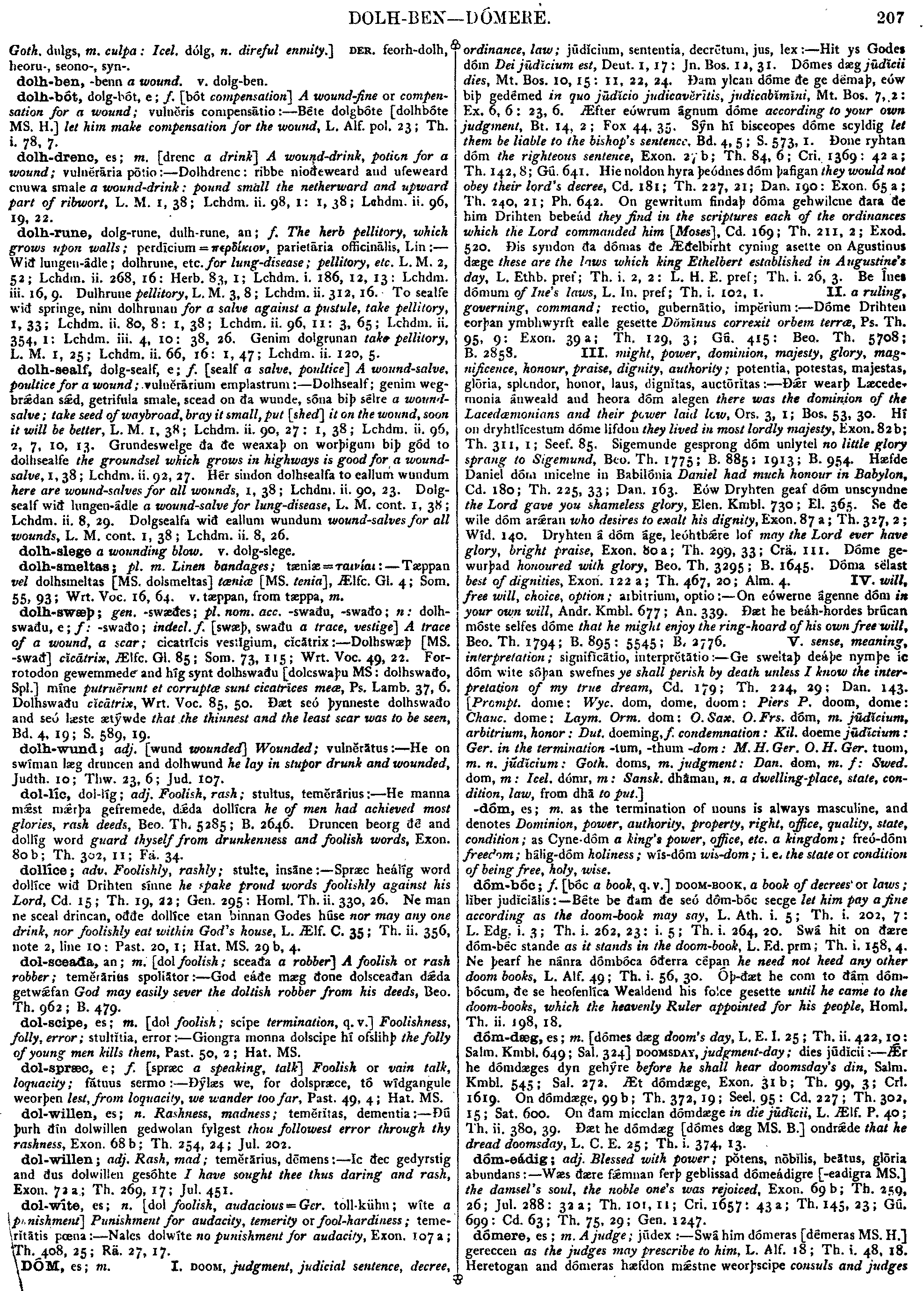
dolh-slege a wounding blow. v. dolg-slege.
|
Source: Bosworth/Toller, page b0217, entry 14 View original page image as: [TIFF] [PNG] [View previous entry] [View next entry] |
[Comment on this entry] [View comments] |
The following entry has been hand-corrected once. |
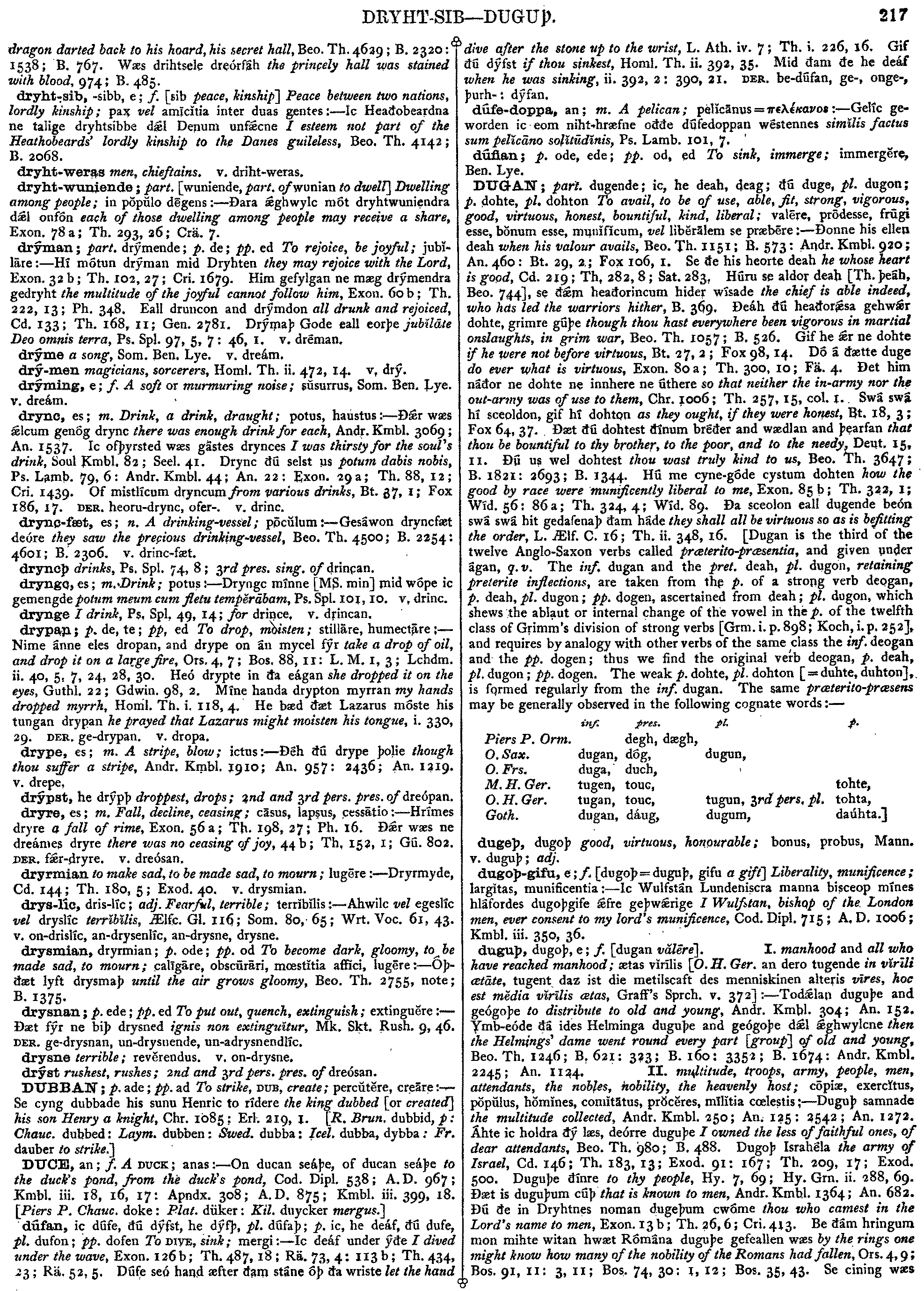
drype, es; m. A stripe, blow; ictus :-- Ðéh ðú drype þolie though thou suffer a stripe, Andr. Kmbl. 1910; An. 957: 2436; An. 1219. v. drepe.
|
Source: Bosworth/Toller, page b0221, entry 41 View original page image as: [TIFF] [PNG] [View previous entry] [View next entry] |
[Comment on this entry] [View comments] |
The following entry has been hand-corrected once. |
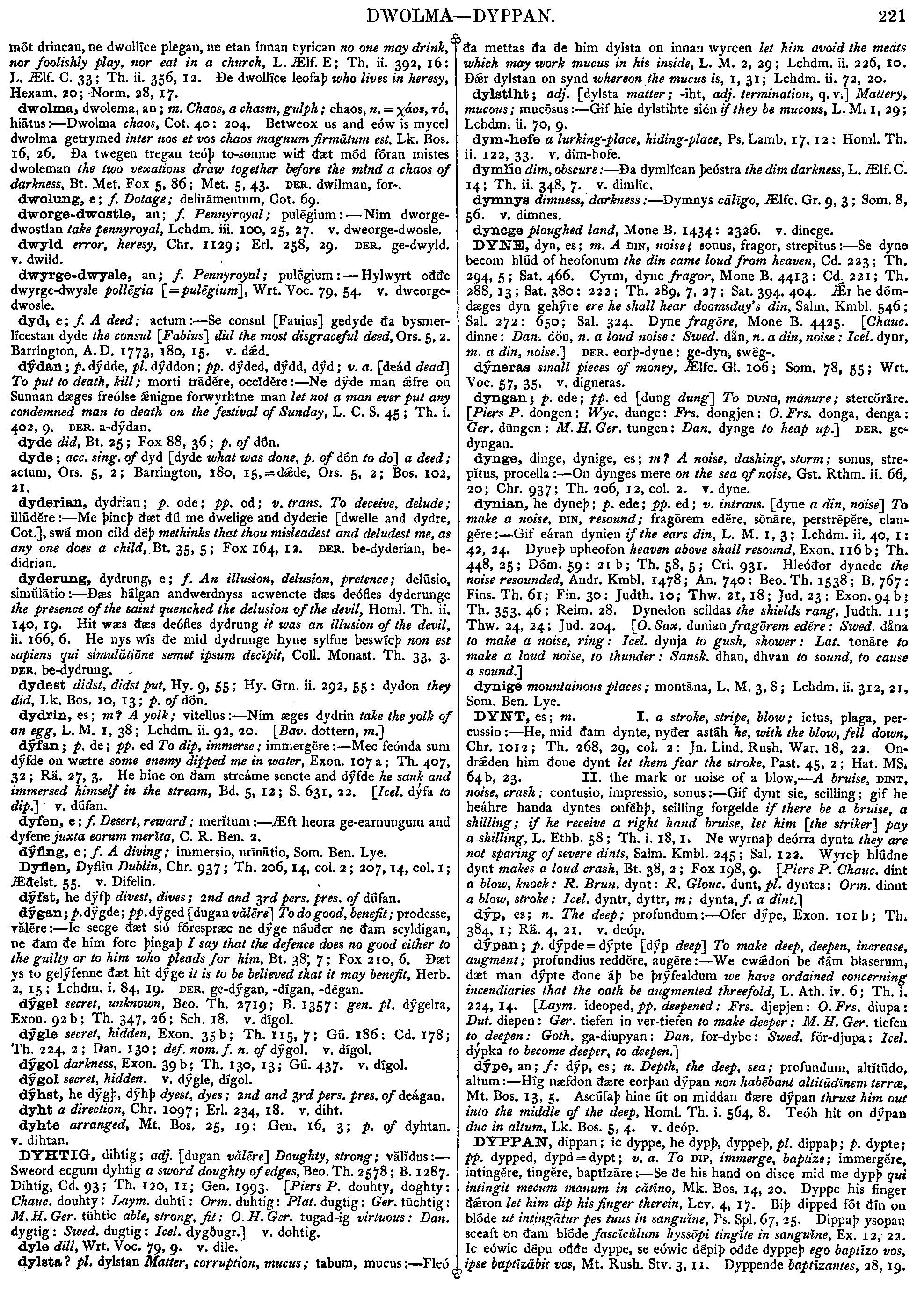
DYNT,
es;
m.
I.
a
stroke,
stripe,
blow;
ictus,
plaga,
percussio
:--
He,
mid
ðam
dynte,
nyðer
astáh
he,
with
the
blow,
fell
down,
Chr.
1012;
Th.
268,
29,
col.
2:
Jn.
Lind.
Rush.
War.
18,
22.
Ondrden
him
ðone
dynt
let
them
fear
the
stroke,
Past.
45,
2;
Hat.
MS.
64
b,
23.
II.
the
mark
or
noise
of
a
blow,-A
bruise,
DINT,
noise,
crash;
contusio,
impressio,
sonus
:--
Gif
dynt
sie,
scilling;
gif
he
heáhre
handa
dyntes
onféhþ,
scilling
forgelde
if
there
be
a
bruise,
a
shilling;
if
he
receive
a
right
hand
bruise,
let
him
[the
striker]
pay
a
shilling,
L.
Ethb.
58;
Th.
i.
18,
1.
Ne
wyrnaþ
deórra
dynta
they
are
not
sparing
of
severe
dints,
Salm.
Kmbl.
245;
Sal.
122.
Wyrcþ
hlúdne
dynt
makes
a
loud
crash,
Bt.
38,
2;
Fox
198,
9.
[Piers
P.
Chauc.
dint
a
blow,
knock:
R.
Brun.
dynt:
R.
Glouc.
dunt,
pl.
dyntes:
Orm.
dinnt
a
blow,
stroke:
Icel.
dyntr,
dyttr,
m;
dynta,
f.
a
dint.]
|
Source: Bosworth/Toller, page b0240, entry 31 View original page image as: [TIFF] [PNG] [View previous entry] [View next entry] |
[Comment on this entry] [View comments] |
The following entry has been hand-corrected once. |
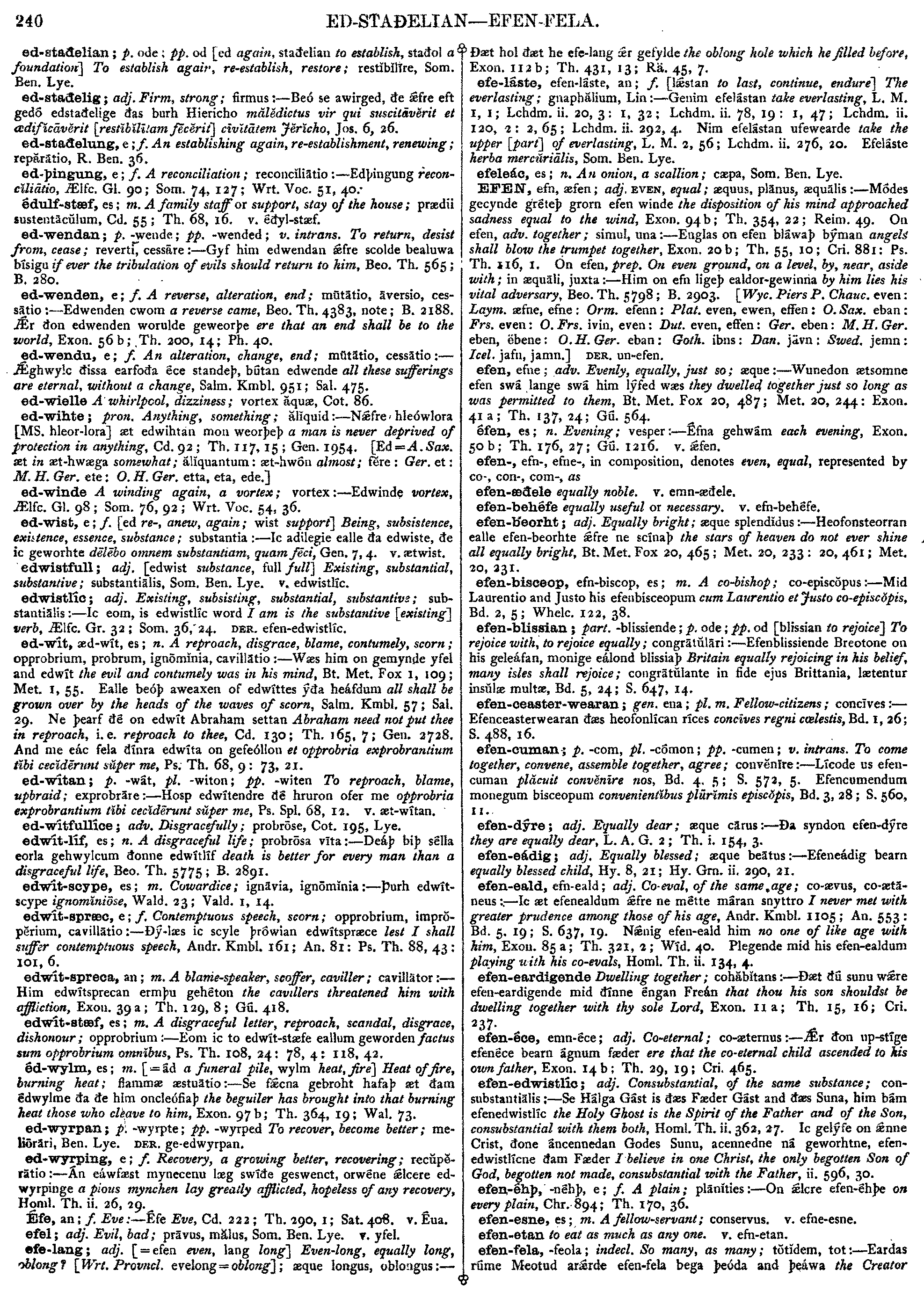
EFEN,
efn,
æfen;
adj.
EVEN,
equal;
æquus,
plnus,
æqulis
:--
Modes
gecynde
gréteþ
grorn
efen
winde
the
disposition
of
his
mind
approached
sadness
equal
to
the
wind,
Exon.
94
b;
Th.
354,
22;
Reim.
49.
On
efen,
adv.
together;
simul,
una
:--
Englas
on
efen
bláwaþ
býman
angels
shall
blow
the
trumpet
together.
Exon.
20
b;
Th.
55,
10;
Cri.
881:
Ps.
Th.
116,
1.
On
efen,
prep.
On
even
ground,
on
a
level,
by,
near,
aside
with;
in
æquli,
juxta
:--
Him
on
efn
ligeþ
ealdor-gewinna
by
him
lies
his
vital
adversary,
Beo.
Th.
5798;
B.
2903.
[Wyc.
Piers
P.
Chauc.
even:
Laym.
æfne,
efne:
Orm.
efenn:.
Plat.
even,
ewen,
effen:
O.
Sax.
eban:
Frs.
even:
O.
Frs.
ivin,
even:
Dut.
even,
effen:
Ger.
eben:
M.
H.
Ger.
eben,
öbene:
O.
H.
Ger.
eban:
Goth.
ibns:
Dan.
jävn:
Swed.
jemn:
Icel.
jafn,
jamn.]
DER.
un-efen.
|
Source: Bosworth/Toller, page b0251, entry 24 View original page image as: [TIFF] [PNG] [View previous entry] [View next entry] |
[Comment on this entry] [View comments (1)] |
The following entry has been hand-corrected once. |
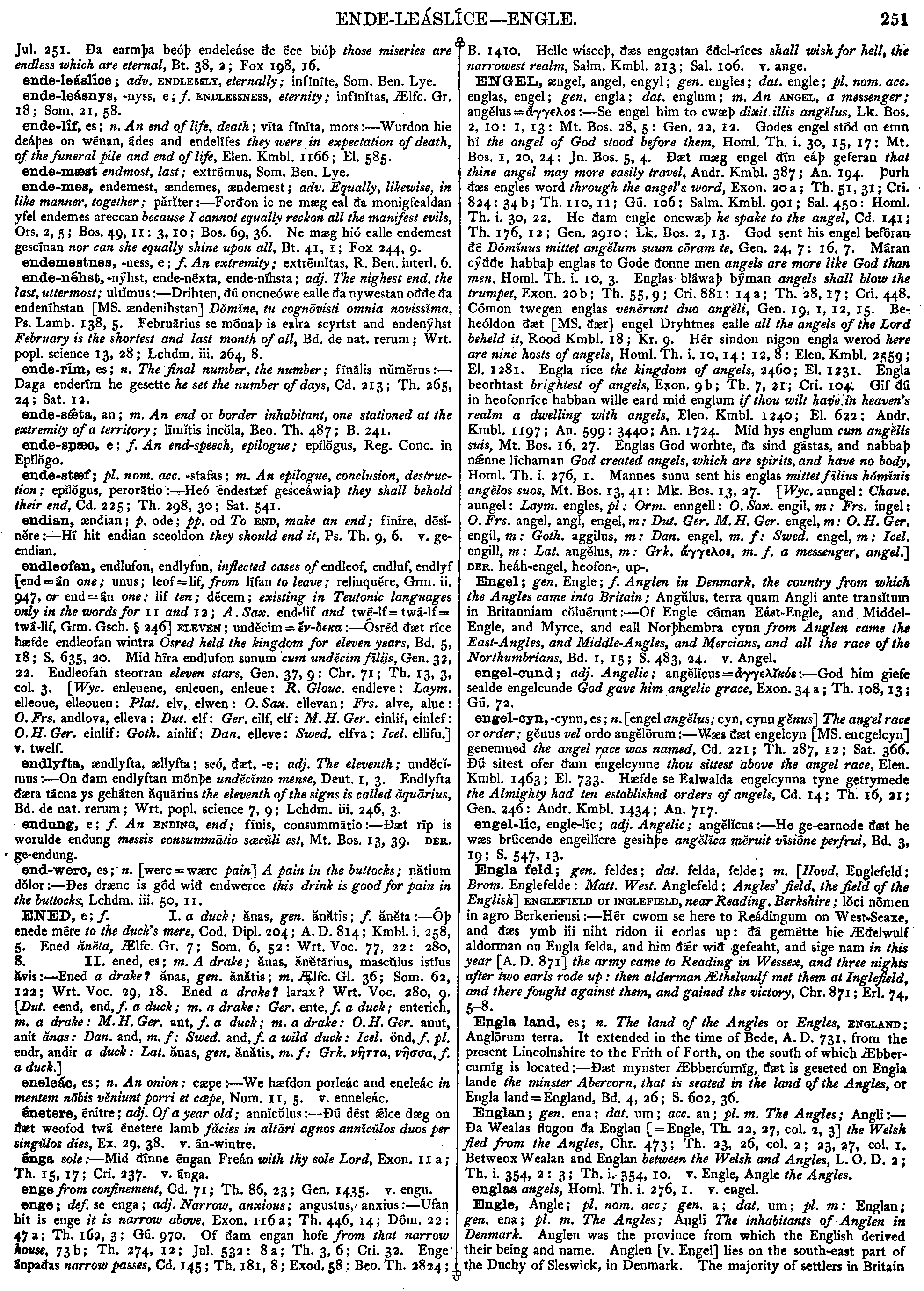
ENGEL,
ængel,
angel,
engyl;
gen.
engles;
dat.
engle;
pl.
nom.
acc.
englas,
engel;
gen.
engla;
dat.
englum;
m.
An
ANGEL,
a
messenger;
angelus
=
GREEK
:--
Se
engel
him
to
cwæþ
dixit
illis
anglus,
Lk.
Bos.
2,
10:
1,
13
:
Mt.
Bos.
28,
5
:
Gen.
22,
12.
Godes
engel
stód
on
emn
hí
the
angel
of
God
stood
before
them,
Homl.
Th.
i.
30,
15,
17:
Mt.
Bos.
1,
20,
24:
Jn.
Bos.
5,
4.
Ðæt
mæg
engel
ðín
eáþ
geferan
that
thine
angel
may
more
easily
travel.
Andr.
Kmbl.
387;
An.
194.
Þurh
ðæs
engles
word
through
the
angel's
word,
Exon.
20a;
Th.
51,
31;
Cri.
824:
34b;
Th.
110,
11;
Gú.
106:
Salm.
Kmbl.
901;
Sal.
450:
Homl.
Th.
i.
30,
22.
He
ðam
engle
oncwæþ
he
spake
to
the
angel,
Cd.
141;
Th.
176,
12
;
Gen.
2910:
Lk.
Bos.
2,
13.
God
sent
his
engel
befóran
ðé
Dóm nus
mittet
anglum
suum
córam
te,
Gen.
24,
7:
16,
7.
Máran
cýððe
habbaþ
englas
to
Gode
ðonne
men
angels
are
more
like
God
than
men.
Homl.
Th.
i.
10,
3.
Englas
bláwaþ
býman
angels
shall
blow
the
trumpet,
Exon.
20b;
Th.
55,
9;
Cri.
881:
14a;
Th.
28,
17;
Cri.
448.
Cómon
twegen
englas
ven
nus
mittet
anglum
suum
córam
te,
Gen.
24,
7:
16,
7.
Máran
cýððe
habbaþ
englas
to
Gode
ðonne
men
angels
are
more
like
God
than
men.
Homl.
Th.
i.
10,
3.
Englas
bláwaþ
býman
angels
shall
blow
the
trumpet,
Exon.
20b;
Th.
55,
9;
Cri.
881:
14a;
Th.
28,
17;
Cri.
448.
Cómon
twegen
englas
ven runt
duo
angli,
Gen.
19,
1,
12,
15.
Be-heóldon
ðæt
[MS.
ðær]
engel
Dryhtnes
ealle
all
the
angels
of
the
Lord
beheld
it,
Rood
Kmbl.
18;
Kr.
9.
Hér
sindon
nigon
engla
werod
here
are
nine
hosts
of
angels,
Homl.
Th.
i.
10,
14:
12,
8
:
Elen.
Kmbl.
2559;
El.
1281.
Engla
ríce
the
kingdom
of
angels,
2460;
El.
1231.
Engla
beorhtast
brightest
of
angels,
Exon.
9b;
Th.
7,
21;
Cri.
104.
Gif
ðú
in
heofonríce
habban
wille
eard
mid
englum
if
thou
wilt
have
in
heaven's
realm
a
dwelling
with
angels,
Elen.
Kmbl.
1240;
El.
622:
Andr.
Kmbl.
1197;
An.
599:
3440;
An.
1724.
Mid
hys
englum
cum
angelis
suis,
Mt.
Bos.
16,
27.
Englas
God
worhte,
ða
sind
gástas,
and
nabbaþ
nnne
líchaman
God
created
angels,
which
are
spirits,
and
have
no
body,
Homl.
Th.
i.
276,
1.
Mannes
sunu
sent
his
englas
mittet
f
runt
duo
angli,
Gen.
19,
1,
12,
15.
Be-heóldon
ðæt
[MS.
ðær]
engel
Dryhtnes
ealle
all
the
angels
of
the
Lord
beheld
it,
Rood
Kmbl.
18;
Kr.
9.
Hér
sindon
nigon
engla
werod
here
are
nine
hosts
of
angels,
Homl.
Th.
i.
10,
14:
12,
8
:
Elen.
Kmbl.
2559;
El.
1281.
Engla
ríce
the
kingdom
of
angels,
2460;
El.
1231.
Engla
beorhtast
brightest
of
angels,
Exon.
9b;
Th.
7,
21;
Cri.
104.
Gif
ðú
in
heofonríce
habban
wille
eard
mid
englum
if
thou
wilt
have
in
heaven's
realm
a
dwelling
with
angels,
Elen.
Kmbl.
1240;
El.
622:
Andr.
Kmbl.
1197;
An.
599:
3440;
An.
1724.
Mid
hys
englum
cum
angelis
suis,
Mt.
Bos.
16,
27.
Englas
God
worhte,
ða
sind
gástas,
and
nabbaþ
nnne
líchaman
God
created
angels,
which
are
spirits,
and
have
no
body,
Homl.
Th.
i.
276,
1.
Mannes
sunu
sent
his
englas
mittet
f lius
h
lius
h mnis
anglos
suos.
Mt.
Bos.
13,
41:
Mk.
Bos.
13,
27.
[Wyc.
aungel:
Chauc.
aungel:
Laym.
engles,
pl:
Orm.
enngell:
O.
Sax.
engil,
m:
Frs.
ingel:
O.
Frs.
angel,
angl,
engel,
m:
Dut.
Ger.
M.
H.
Ger.
engel,
m:
O.
H.
Ger.
engil,
m:
Goth.
aggilus,
m:
Dan.
engel,
m.
f:
Swed.
engel,
m:
Icel.
engill,
m:
Lat.
anglus,
m:
Grk.
GREEK,
m.
f.
a
messenger,
angel.]
DER.
heáh-engel,
heofon-,
up-.
mnis
anglos
suos.
Mt.
Bos.
13,
41:
Mk.
Bos.
13,
27.
[Wyc.
aungel:
Chauc.
aungel:
Laym.
engles,
pl:
Orm.
enngell:
O.
Sax.
engil,
m:
Frs.
ingel:
O.
Frs.
angel,
angl,
engel,
m:
Dut.
Ger.
M.
H.
Ger.
engel,
m:
O.
H.
Ger.
engil,
m:
Goth.
aggilus,
m:
Dan.
engel,
m.
f:
Swed.
engel,
m:
Icel.
engill,
m:
Lat.
anglus,
m:
Grk.
GREEK,
m.
f.
a
messenger,
angel.]
DER.
heáh-engel,
heofon-,
up-.
| Result Page: |  |
Previous | 1 2 3 4 5 6 7 8 9 10 11 12 | Next |  |
Germanic Lexicon Project (main page)
This search system was written by
Sean Crist
Please consider
volunteering
to correct the data in these online dictionaries.
No rights reserved. Feel free to use these data in any way you please.