|
|

|
Source: Bosworth/Toller, page b0110, entry 9 View original page image as: [TIFF] [PNG] [View previous entry] [View next entry] |
[Comment on this entry] [View comments] |
The following entry has been hand-corrected once. |
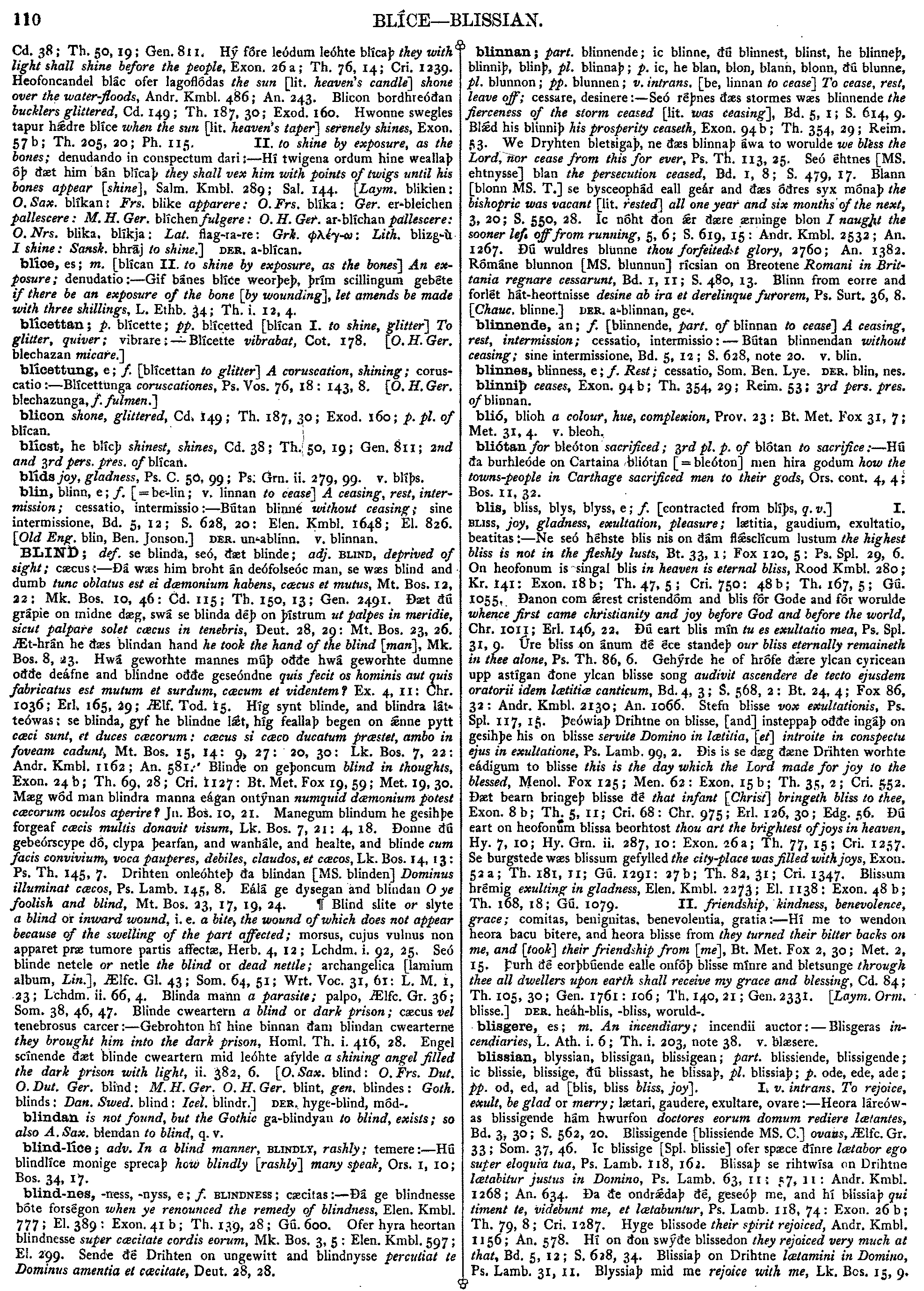
blindan is not found, but the Gothic ga-blindyan to blind, exists; so also A. Sax. blendan to blind, q. v.
|
Source: Bosworth/Toller, page d0097, entry 26 View original page image as: [TIFF] [PNG] [View previous entry] [View next entry] |
[Comment on this entry] [View comments] |
The following entry has been hand-corrected once. |
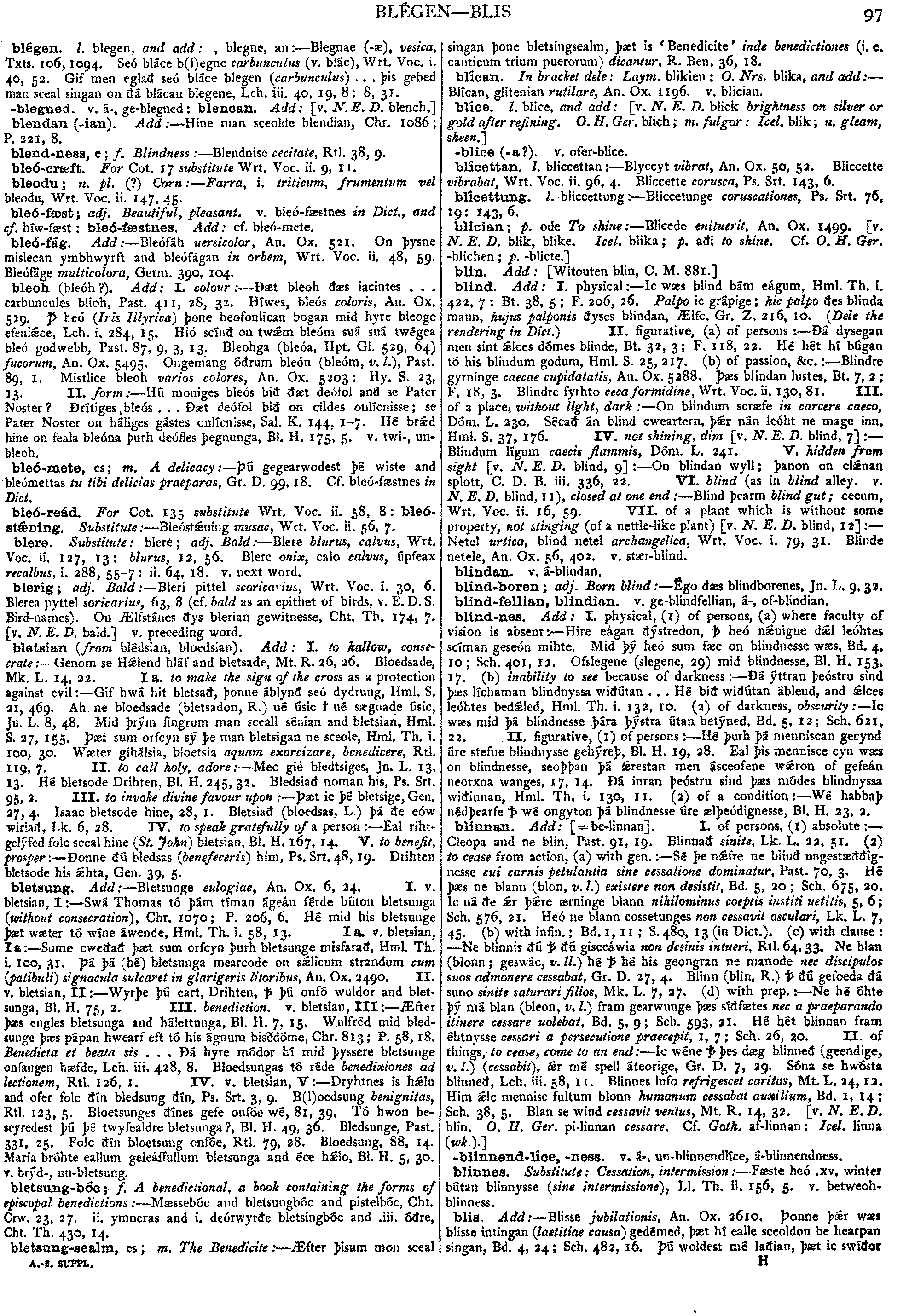
blindan. v. á-blindan.
|
Source: Bosworth/Toller, page b0110, entry 8 View original page image as: [TIFF] [PNG] [View previous entry] [View next entry] |
[Comment on this entry] [View comments] |
The following entry has been hand-corrected once. |
BLIND;
def.
se
blinda,
seó,
ðæt
blinde;
adj.
BLIND,
deprived
of
sight;
cæcus
:--
Ðá
wæs
him
broht
án
deófolseóc
man,
se
wæs
blind
and
dumb
tunc
oblatus
est
ei
dæmonium
habens,
cæcus
et
mutus,
Mt.
Bos.
12,
22:
Mk.
Bos.
10,
46:
Cd.
115;
Th.
150,
13;
Gen.
2491.
Ðæt
ðú
grápie
on
midne
dæg,
swá
se
blinda
déþ
on
þistrum
ut
palpes
in
meridie,
sicut
palpare
solet
cæcus
in
tenebris,
Deut.
28,
29:
Mt.
Bos.
23,
26.
Æt-hrán
he
ðæs
blindan
hand
he
took
the
hand
of
the
blind
[man],
Mk.
Bos.
8,
23.
Hwá
gewothte
mannes
múþ
oððe
hwá
geworhte
dumne
oððe
deáfne
and
blindne
oððe
geseóndne
quis
fecit
os
hominis
aut
quis
fabricatus
est
mutum
et
surdum,
cæcum
et
videntem?
Ex.
4,
11:
Chr.
1036;
Erl.
165,
29;
Ælf.
Tod.
15.
Híg
synt
blinde,
and
blindra
látteówas:
se
blinda,
gyf
he
blindne
l t,
híg
feallaþ
begen
on
nne
pytt
cæci
sunt,
et
duces
cæcorum:
cæcus
si
cæco
ducatum
præstet,
ambo
in
foveam
cadunt,
Mt.
Bos.
15,
14:
9,
27:
20,
30:
Lk.
Bos.
7,
22:
Andr.
Kmbl.
1162;
An.
581.
Blinde
on
geþoncum
blind
in
thoughts,
Exon.
24
b;
Th.
69,
28;
Cri.
1127:
Bt.
Met.
Fox
19,
59;
Met.
19,
30.
Mæg
wód
man
blindra
manna
eágan
ontýnan
numquid
dæmonium
potest
cæcorum
oculos
aperire?
Jn.
Bos.
10,
21.
Manegum
blindum
he
gesihþe
forgeaf
cæcis
multis
donavit
visum,
Lk.
Bos.
7,
21:
4,
18.
Ðonne
ðú
gebeórscype
dó,
clypa
þearfan,
and
wanhále,
and
healte,
and
blinde
cum
facis
convivium,
voca
pauperes,
debiles,
claudos,
et
cæcos,
Lk.
Bos.
14,
13:
Ps.
Th.
145,
7.
Drihten
onleóhteþ
ða
blindan
[MS.
blinden]
Dominus
illuminat
cæcos,
Ps.
Lamb.
145,
8.
Eálá
ge
dysegan
and
blindan
O
ye
foolish
and
blind,
Mt.
Bos.
23,
17,
19,
24.

Blind
slite
or
slyte
a
blind
or
inward
wound,
i.e.
a
bite,
the
wound
of
which
does
not
appear
because
of
the
swelling
of
the
part
affected;
morsus,
cujus
vulnus
non
apparet
præ
tumore
partis
affectæ,
Herb.
4,
12;
Lchdm.
i.
92,
25.
Seó
blinde
netele
or
netle
the
blind
or
dead
nettle;
archangelica
[lamium
album,
Lin.],
Ælfc.
Gl.
43;
Som.
64,
51;
Wrt.
Voc.
31,
61:
L.
M.
1,
23;
Lchdm.
ii.
66,
4.
Blinda
mann
a
parasite;
palpo,
Ælfc.
Gr.
36;
Som.
38,
46,
47.
Blinde
cweartern
a
blind
or
dark
prison;
cæcus
vel
tenebrosus
carcer
:--
Gebrohton
hí
hine
binnan
ðam
blindan
cwearterne
they
brought
him
into
the
dark
prison,
Homl.
Th.
i.
416,
28.
Engel
scínende
ðæt
blinde
cweartern
mid
leóhte
afylde
a
shining
angel
filled
the
dark
prison
with
light,
ii.
382,
6.
[O.
Sax.
blind:
O.
Frs.
Dut.
O.
Dut.
Ger.
blind:
M.
H.
Ger.
O.
H.
Ger.
blint,
gen.
blindes:
Goth.
blinds:
Dan.
Swed.
blind:
Icel.
blindr.]
DER.
hyge-blind,
mód-.
t,
híg
feallaþ
begen
on
nne
pytt
cæci
sunt,
et
duces
cæcorum:
cæcus
si
cæco
ducatum
præstet,
ambo
in
foveam
cadunt,
Mt.
Bos.
15,
14:
9,
27:
20,
30:
Lk.
Bos.
7,
22:
Andr.
Kmbl.
1162;
An.
581.
Blinde
on
geþoncum
blind
in
thoughts,
Exon.
24
b;
Th.
69,
28;
Cri.
1127:
Bt.
Met.
Fox
19,
59;
Met.
19,
30.
Mæg
wód
man
blindra
manna
eágan
ontýnan
numquid
dæmonium
potest
cæcorum
oculos
aperire?
Jn.
Bos.
10,
21.
Manegum
blindum
he
gesihþe
forgeaf
cæcis
multis
donavit
visum,
Lk.
Bos.
7,
21:
4,
18.
Ðonne
ðú
gebeórscype
dó,
clypa
þearfan,
and
wanhále,
and
healte,
and
blinde
cum
facis
convivium,
voca
pauperes,
debiles,
claudos,
et
cæcos,
Lk.
Bos.
14,
13:
Ps.
Th.
145,
7.
Drihten
onleóhteþ
ða
blindan
[MS.
blinden]
Dominus
illuminat
cæcos,
Ps.
Lamb.
145,
8.
Eálá
ge
dysegan
and
blindan
O
ye
foolish
and
blind,
Mt.
Bos.
23,
17,
19,
24.

Blind
slite
or
slyte
a
blind
or
inward
wound,
i.e.
a
bite,
the
wound
of
which
does
not
appear
because
of
the
swelling
of
the
part
affected;
morsus,
cujus
vulnus
non
apparet
præ
tumore
partis
affectæ,
Herb.
4,
12;
Lchdm.
i.
92,
25.
Seó
blinde
netele
or
netle
the
blind
or
dead
nettle;
archangelica
[lamium
album,
Lin.],
Ælfc.
Gl.
43;
Som.
64,
51;
Wrt.
Voc.
31,
61:
L.
M.
1,
23;
Lchdm.
ii.
66,
4.
Blinda
mann
a
parasite;
palpo,
Ælfc.
Gr.
36;
Som.
38,
46,
47.
Blinde
cweartern
a
blind
or
dark
prison;
cæcus
vel
tenebrosus
carcer
:--
Gebrohton
hí
hine
binnan
ðam
blindan
cwearterne
they
brought
him
into
the
dark
prison,
Homl.
Th.
i.
416,
28.
Engel
scínende
ðæt
blinde
cweartern
mid
leóhte
afylde
a
shining
angel
filled
the
dark
prison
with
light,
ii.
382,
6.
[O.
Sax.
blind:
O.
Frs.
Dut.
O.
Dut.
Ger.
blind:
M.
H.
Ger.
O.
H.
Ger.
blint,
gen.
blindes:
Goth.
blinds:
Dan.
Swed.
blind:
Icel.
blindr.]
DER.
hyge-blind,
mód-.
|
Source: Bosworth/Toller, page b0211, entry 10 View original page image as: [TIFF] [PNG] [View previous entry] [View next entry] |
[Comment on this entry] [View comments] |
The following entry has been hand-corrected once. |
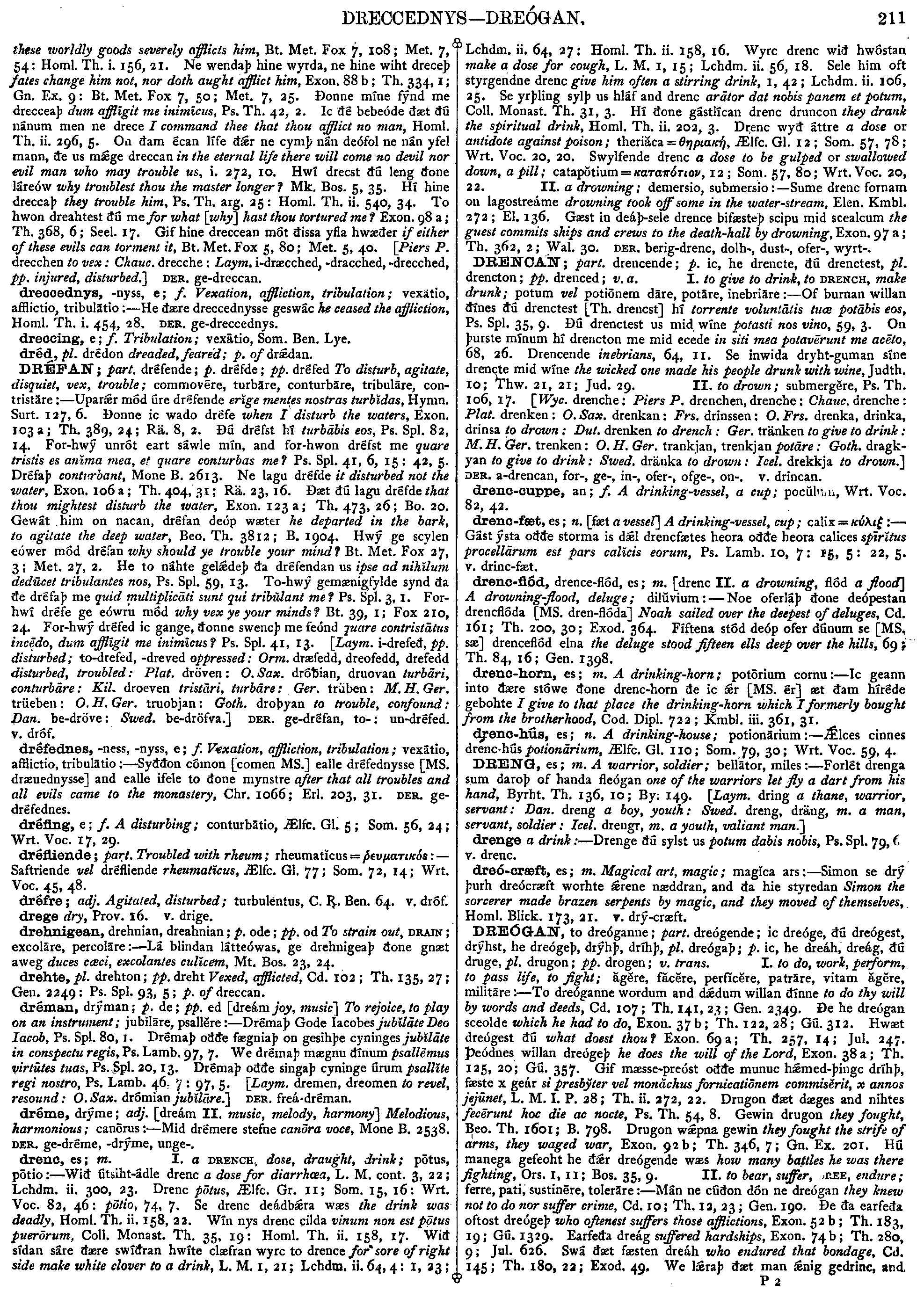
drehnigean,
drehnian,
dreahnian;
p.
ode;
pp.
od
To
strain
out,
DRAIN;
excol re,
percolre
:--
Lá
blindan
látteówas,
ge
drehnigeaþ
ðone
gnæt
aweg
duces
cæci,
excolantes
cul
re,
percolre
:--
Lá
blindan
látteówas,
ge
drehnigeaþ
ðone
gnæt
aweg
duces
cæci,
excolantes
cul cem,
Mt.
Bos.
23,
24.
cem,
Mt.
Bos.
23,
24.
|
Source: Bosworth/Toller, page b0693, entry 8 View original page image as: [TIFF] [PNG] [View previous entry] [View next entry] |
[Comment on this entry] [View comments] |
The following entry has been hand-corrected once. |
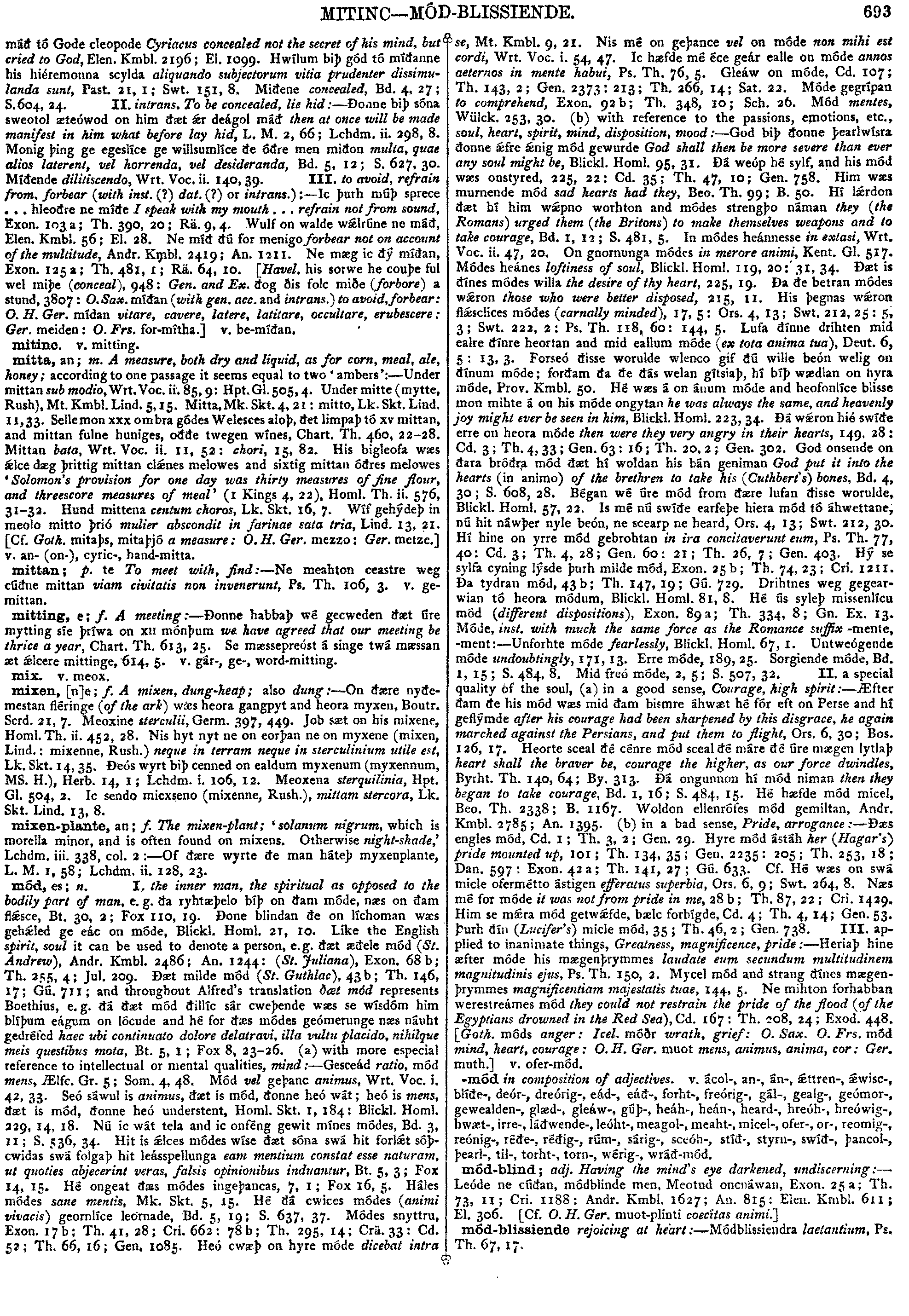
mód,
es;
n.
I.
the
inner
man,
the
spiritual
as
opposed
to
the
bodily
part
of
man,
e.g.
ða
ryhtæþelo
bíþ
on
ðam
móde,
næs
on
ðam
flsce,
Bt.
30,
2;
Fox
110,
19.
Ðone
blindan
ðe
on
líchoman
wæs
gehled
ge
eác
on
móde,
Blickl.
Homl.
21,
10.
Like
the
English
spirit,
soul
it
can
be
used
to
denote
a
person,
e.g.
ðæt
æðele
mód
(St.
Andrew),
Andr.
Kmbl.
2486;
An.
1244:
(St.
Juliana),
Exon.
68
b;
Th.
255,
4;
Jul.
209.
Ðæt
milde
mód
(St.
Guthlac),
43
b;
Th.
146,
17;
Gú.
711;
and
throughout
Alfred's
translation
ðæt
mód
represents
Boethius,
e.
g.
ðá
ðæt
mód
ðillíc
sár
cweþende
wæs
se
wísdóm
him
blíþum
eágum
on
lócude
and
hé
for
ðæs
módes
geómerunge
næs
náuht
gedréfed
haec
ubi
continuato
dolore
delatravi,
illa
vultu
placido,
nihilque
meis
questibus
mota,
Bt.
5,
1;
Fox
8,
23-26.
(a)
with
more
especial
reference
to
intellectual
or
mental
qualities,
mind
:--
Gesceád
ratio,
mód
mens,
Ælfc.
Gr.
5;
Som.
4,
48.
Mód
vel
geþanc
animus,
Wrt.
Voc.
i.
42,
33.
Seó
sáwul
is
animus,
ðæt
is
mód,
ðonne
heó
wát;
heó
is
mens,
ðæt
is
mód,
ðonne
heó
understent,
Homl.
Skt.
1,
184:
Blickl.
Homl.
229,
14,
28.
Nú
ic
wát
tela
and
ic
onféng
gewit
mínes
módes,
Bd.
3,
11;
S.
536,
34.
Hit
is
lces
módes
wíse
ðæt
sóna
swá
hit
forlt
sóþcwidas
swá
folgaþ
hit
leásspellunga
eam
mentium
constat
esse
naturam,
ut
quoties
abjecerint
veras,
falsis
opinionibus
induantur,
Bt.
5,
3;
Fox
14,
15.
Hé
ongeat
ðæs
módes
ingeþancas,
7,
1;
Fox
16,
5.
Háles
módes
sane
mentis,
Mk.
Skt.
5,
15.
Hé
ðá
cwices
módes
(animi
vivacis)
geornlíce
leornade,
Bd.
5,
19;
S.
637,
37.
Módes
snyttru,
Exon.
17
b;
Th.
41,
28;
Cri.
662:
78
b;
Th.
295,
14;
Crä.
33:
Cd.
52;
Th.
66,
26;
Gen.
1085.
Heó
cwæþ
on
hyre
móde
dicebat
intra
se,
Mt.
Kmbl.
9,
21.
Nis
mé
on
geþance
vel
on
móde
non
mihi
est
cordi,
Wrt.
Voc.
i.
54,
47.
Ic
hæfde
mé
éce
geár
ealle
on
móde
annos
aeternos
in
mente
habui,
Ps.
Th.
76,
5.
Gleáw
on
móde,
Cd.
107;
Th.
143,
2;
Gen.
2373:
213;
Th.
266,
14;
Sat.
22.
Móde
gegrípan
to
comprehend,
Exon.
92
b;
Th.
348,
10;
Sch.
26.
Mód
mentes,
Wülck.
253,
30.
(b)
with
reference
to
the
passions,
emotions,
etc.,
soul,
heart,
spirit,
mind,
disposition,
mood
:--
God
biþ
ðonne
þearlwísra
ðonne
fre
nig
mód
gewurde
God
shall
then
be
more
severe
than
ever
any
soul
might
be,
Blickl.
Homl.
95,
31.
Ðá
weóp
hé
sylf,
and
his
mód
wæs
onstyred,
225,
22:
Cd.
35;
Th.
47,
10;
Gen.
758.
Him
wæs
murnende
mód
sad
hearts
had
they,
Beo.
Th.
99;
B.
50.
Hí
lrdon
ðæt
hí
him
wpno
worhton
and
módes
strengþo
náman
they
(the
Romans)
urged
them
(the
Britons)
to
make
themselves
weapons
and
to
take
courage,
Bd.
1,
12;
S.
481,
5.
In
módes
heánnesse
in
extasi,
Wrt.
Voc.
ii.
47,
20.
On
gnornunga
módes
in
merore
animi,
Kent.
Gl.
517.
Módes
heánes
loftiness
of
soul,
Blickl.
Homl.
119,
20:
31,
34.
Ðæt
is
ðínes
módes
willa
the
desire
of
thy
heart,
225,
19.
Ða
ðe
betran
módes
wron
those
who
were
better
disposed,
215,
11.
His
þegnas
wron
flsclices
módes
(carnally
minded),
17,
5:
Ors.
4,
13;
Swt.
212,
25:
5,
3;
Swt.
222,
2:
Ps.
Th.
118,
60:
144,
5.
Lufa
ðínne
drihten
mid
ealre
ðínre
heortan
and
mid
eallum
móde
(ex
tota
anima
tua),
Deut.
6,
5:
13,
3.
Forseó
ðisse
worulde
wlenco
gif
ðú
wille
beón
welig
on
ðínum
móde;
forðam
ða
ðe
ðás
welan
gítsiaþ,
hí
bíþ
wædlan
on
hyra
móde,
Prov.
Kmbl.
50.
Hé
wæs
á
on
ánum
móde
and
heofonlíce
blisse
mon
mihte
á
on
his
móde
ongytan
he
was
always
the
same,
and
heavenly
joy
might
ever
be
seen
in
him,
Blickl.
Homl.
223,
34.
Ðá
wron
hié
swíðe
erre
on
heora
móde
then
were
they
very
angry
in
their
hearts,
149,
28:
Cd.
3;
Th.
4,
33;
Gen.
63:
16;
Th.
20,
2;
Gen.
302.
God
onsende
on
ðara
bróðra
mód
ðæt
hí
woldan
his
bán
geniman
God
put
it
into
the
hearts
(in
animo)
of
the
brethren
to
take
his
(Cuthbert's)
bones,
Bd.
4,
30;
S.
608,
28.
Bégan
wé
úre
mód
from
ðære
lufan
ðisse
worulde,
Blickl.
Homl.
57,
22.
Is
mé
nú
swíðe
earfeþe
hiera
mód
tó
áhwettane,
nú
hit
náwþer
nyle
beón,
ne
scearp
ne
heard,
Ors.
4,
13;
Swt.
212,
30.
Hí
hine
on
yrre
mód
gebrohtan
in
ira
concitaverunt
eum,
Ps.
Th.
77,
40:
Cd.
3;
Th.
4,
28;
Gen.
60:
21;
Th.
26,
7;
Gen.
403.
Hý
se
sylfa
cyning
lýsde
þurh
milde
mód,
Exon.
25
b;
Th.
74,
23;
Cri.
1211.
Ða
tydran
mód,
43
b;
Th.
147,
19;
Gú.
729.
Drihtnes
weg
gegearwian
tó
heora
módum,
Blickl.
Homl.
81,
8.
Hé
ús
syleþ
missenlícu
mód
(different
dispositions),
Exon.
89
a;
Th.
334,
8;
Gn.
Ex.
13.
Móde,
inst.
with
much
the
same
force
as
the
Romance
suffix
-mente,
-ment
:--
Unforhte
móde
fearlessly,
Blickl.
Homl.
67,
1.
Unstweógende
móde
undoubtingly,
171,
13.
Erre
móde,
189,
25.
Sorgiende
móde,
Bd.
1,
15;
S.
484,
8.
Mid
freó
móde,
2,
5;
S.
507,
32.
II.
a
special
quality
of
the
soul,
(a)
in
a
good
sense,
Courage,
high
spirit
:--
Æfter
ðam
ðe
his
mód
wæs
mid
ðam
bismre
áhwæt
hé
fór
eft
on
Perse
and
hí
geflýmde
after
his
courage
had
been
sharpened
by
this
disgrace,
he
again
marched
against
the
Persians,
and
put
them
to
flight,
Ors.
6,
30;
Bos.
126,
17.
Heorte
sceal
ðé
cénre
mód
sceal
ðé
máre
ðé
úre
mægen
lytlaþ
heart
shall
the
braver
be,
courage
the
higher,
as
our
force
dwindles,
Byrht.
Th.
140,
64;
By.
313.
Ðá
ongunnon
hí
mód
niman
then
they
began
to
take
courage,
Bd.
1,
16;
S.
484,
15.
Hé
hæfde
mód
micel,
Beo.
Th.
2338;
B.
1167.
Woldon
ellenrófes
mód
gemiltan,
Andr.
Kmbl.
2785;
An.
1395.
(b)
in
a
bad
sense,
Pride,
arrogance
:--
Ðæs
engles
mód,
Cd.
1;
Th.
3,
2;
Gen.
29.
Hyre
mód
ástáh
her
(Hagar's)
pride
mounted
up,
101;
Th.
134,
35;
Gen.
2235:
205;
Th.
253,
18;
Dan.
597:
Exon.
42
a;
Th.
141,
27;
Gú.
633.
Cf.
Hé
wæs
on
swá
micle
ofermétto
ástigen
efferatus
superbia,
Ors.
6,
9;
Swt.
264,
8.
Næs
mé
for
móde
it
was
not
from
pride
in
me,
28
b;
Th.
87,
22;
Cri.
1429.
Him
se
mra
mód
getwfde,
bælc
forbígde,
Cd.
4;
Th.
4,
14;
Gen.
53.
Þurh
ðín
(Lucifer's)
micle
mód,
35;
Th.
46,
2;
Gen.
738.
III.
applied
to
inanimate
things,
Greatness,
magnificence,
pride
:--
Heriaþ
hine
æfter
móde
his
mægenþrymmes
laudate
eum
secundum
multitudinem
magnitudinis
ejus,
Ps.
Th.
150,
2.
Mycel
mód
and
strang
ðínes
mægen-þrymmes
magnificentiam
majestatis
tuae,
144,
5.
Ne
mihton
forhabban
werestreámes
mód
they
could
not
restrain
the
pride
of
the
flood
(of
the
Egyptians
drowned
in
the
Red
Sea),
Cd.
167:
Th.
208,
24;
Exod.
448.
[Goth.
móds
anger:
Icel.
möðr
wrath,
grief:
O.
Sax.
O.
Frs.
mód
mind,
heart,
courage:
O.
H.
Ger.
muot
mens,
animus,
anima,
cor:
Ger.
muth.]
v.
ofer-mód.
|
Source: Bosworth/Toller, page b0753, entry 6 View original page image as: [TIFF] [PNG] [View previous entry] [View next entry] |
[Comment on this entry] [View comments (1)] |
The following entry has been hand-corrected once. |
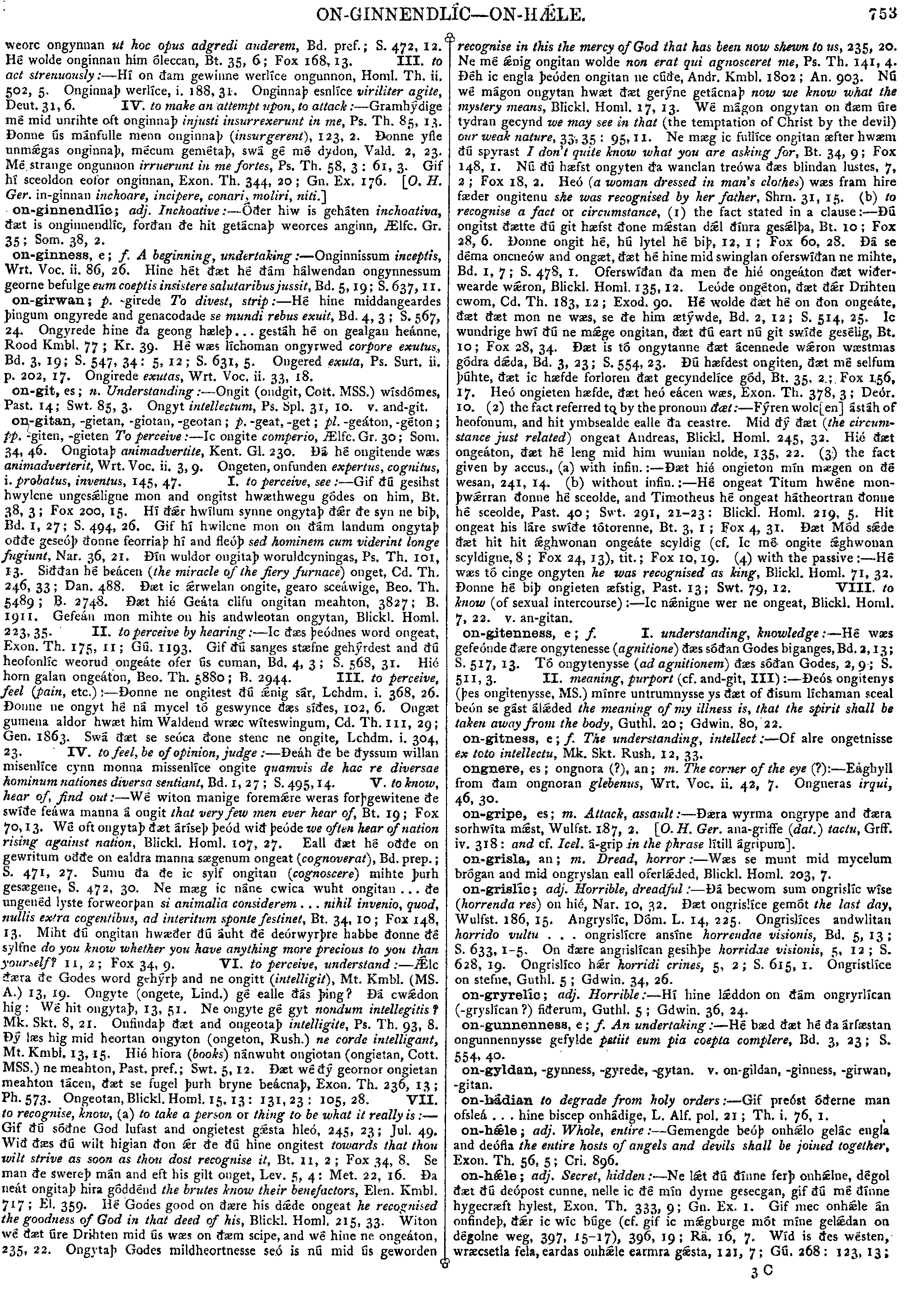
on-gitan,
-gietan,
-giotan,
-geotan
;
p.
-geat,
-get;
pl.
-geáton,
-géton
;
pp.
-giten,
-gieten
To
perceive
:--
Ic
ongite
comperio,
Ælfc.
Gr.
30;
Som.
34,
46.
Ongiotaþ
animadvertite.
Kent.
Gl.
230.
Ða
hé
ongítende
wæs
animadverterit,
Wrt.
Voc.
ii.
3,
9.
Ongeten,
onfunden
expertus,
cognitus,
i.
probatus,
inventus,
145,
47.
I.
to
perceive,
see
:--
Gif
ðú
gesihst
hwylcne
ungesligne
mon
and
ongitst
hwæthwegu
gódes
on
him,
Bt.
38,
3
;
Fox
200,
15.
Hí
ðr
hwílum
synne
ongytaþ
ðr
ðe
syn
ne
biþ,
Bd.
1,
27;
S.
494,
26.
Gif
hí
hwílcne
mon
on
ðám
landum
ongytaþ
oððe
geseóþ
ðonne
feorriaþ
hí
and
fleóþ
sed
hominem
cum
viderint
longe
fugiunt,
Nar.
36,
21.
Ðín
wuldor
ougitaþ
woruldcyningas,
Ps.
Th.
101,
13.
Siððan
hé
beácen
(the
miracle
of
the
fiery
furnace)
onget,
Cd.
Th.
246,
33
;
Dan.
488.
Ðæt
ic
rwelan
ongite,
gearo
sceáwige,
Beo.
Th.
5489;
B.
2748.
Ðæt
hié
Geáta
clifu
ongitan
meahton,
3827;
B.
1911.
Gefeán
mon
mihte
on
his
andwleotan
ongytan,
Blickl.
Homl.
223,
35.
II.
to
perceive
by
hearing
:--
Ic
ðæs
þeódnes
word
ongeat,
Exon.
Th.
175,
11;
Gú.
1193.
Gif
ðú
sanges
stæfne
gehýrdest
and
ðú
heofonlíc
weorud
ongeáte
ofer
us
cuman,
Bd.
4,
3
;
S.
568,
31.
Hié
horn
galan
ongeáton,
Beo.
Th.
5880;
B.
2944.
III.
to
perceive,
feel
(pain,
etc.
)
:--
Ðonne
ne
ongitest
ðú
nig
sár,
Lchdm.
i.
368,
26.
Donne
ne
ongyt
hé
ná
mycel
tó
geswynce
ðæs
síðes,
102,
6.
Ongæt
gumena
aldor
hwæt
him
Waldend
wræc
wíteswingum,
Cd.
Th.
111,
29;
Gen.
1863.
Swá
ðæt
se
seóca
ðone
stenc
ne
ongite,
Lchdm.
i.
304,
23.
IV.
to
feel,
be
of
opinion,
judge
:--
Ðeáh
ðe
be
ðyssum
willan
misenlíce
cynn
monna
missenlíce
ongite
quamvis
de
hac
re
diversae
hominum
nationes
diversa
sentiant,
Bd.
1,
27
;
S.
495,
14.
V.
to
know,
hear
of,
find
out
:--
Wé
witon
manige
foremre
weras
forþgewitene
ðe
swíðe
feáwa
manna
á
ongit
that
very
few
men
ever
hear
of.
Bt.
19;
Fox
70,
13.
Wé
oft
ongytaþ
ðæt
áríseþ
þeód
wið
þeóde
we
often
hear
of
nation
rising
against
nation,
Blickl.
Homl.
107,
27.
Eall
ðæt
hé
oððe
on
gewritum
oððe
on
ealdra
manna
sægenum
ongeat
(cognoverat),
Bd.
prep.
;
S.
471,
27.
Sumu
ða
ðe
ic
sylf
ongitan
(cognoscere)
mihte
þurh
gesægene,
S.
472,
30.
Ne
mæg
ic
náne
cwica
wuht
ongitan
.
.
.
ðe
ungenéd
lyste
forweorpan
si
animalia
considerem
.
.
.
nihil
invenio,
quod,
nullis
extra
cogentibus,
ad
interitum
sponte
festinet,
Bt.
34,
10;
Fox
148,
13.
Miht
ðú
ongitan
hwæðer
ðú
áuht
ðé
deórwyrþre
habbe
ðonne
ðé
sylfne
do
you
know
whether
you
have
anything
more
precious
to
you
than
yourself?
11,
2;
Fox
34,
9.
VI.
to
perceive,
understand:--
Æ-acute;lc
ðæra
ðe
Godes
word
gehýrþ
and
ne
ongitt
(intelligit),
Mt.
Kmbl.
(MS.
A.
)
13,
19.
Ongyte
(ongete,
Lind.
)
gé
ealle
ðás
þing?
Ð
á
cwdon
hig:
Wé
hit
ongytaþ,
13,
51.
Ne
ongyte
gé
gyt
nondum
intellegitis
?
Mk.
Skt.
8,
21.
Onfindaþ
ðæt
and
ongeotaþ
intelligite,
Ps.
Th.
93,
8.
Ðý
læs
hig
mid
heortan
ongyton
(ongeton,
Rush.
)
ne
corde
intelligant,
Mt.
Kmbl.
13,
15.
Hié
hiora
(books)
nánwuht
ongiotan
(ongietan,
Cott.
MSS.
)
ne
meahton,
Past.
pref.
;
Swt.
5,
12.
Ðæt
wé
ðý
geornor
ongietan
meahton
lácen,
ðæt
se
fugel
þurh
bryne
beácnaþ.
Exon.
Th.
236,
13
;
Ph.
573.
Ongeotan,
Blickl.
Homl.
15,
13
:
131,
23
:
105,
28.
VII.
to
recognise,
know,
(a)
to
take
a
person
or
thing
to
be
what
it
really
is
:--
Gif
ðú
sóðne
God
lufast
and
ongietest
gsta
hleó,
245,
23
;
Jul.
49.
Wið
ðæs
ðú
wilt
higian
ðon
r
ðe
ðú
hine
ongitest
towards
that
thou
wilt
strive
as
soon
as
thou
dost
recognise
it,
Bt.
ll,
2
;
Fox
34,
8.
Se
man
ðe
swereþ
man
and
eft
his
gilt
onget,
Lev.
5,
4:
Met.
22,
16.
Ða
neát
ongitaþ
hira
góddénd
the
brutes
know
their
benefactors.
Elen.
Kmbl.
717;
El.
359.
Hé
Godes
good
on
ðære
his
dde
ongeat
he
recognised
the
goodness
of
God
in
that
deed
of
his,
Blickl.
Homl.
215,
33.
Witon
wé
ðæt
úre
Drihten
mid
ús
wæs
on
ðæm
scipe,
and
wé
hine
ne
ongeáton,
235,
22.
Ongytaþ
Godes
mildheortnesse
seó
is
nú
mid
ús
geworden
recognise
in
this
the
mercy
of
God
that
has
been
now
shewn
to
us,
235,
20.
Ne
mé
nig
ongitan
wolde
non
erat
qui
agnosceret
me,
Ps.
Th.
141,
4.
Ðéh
ic
engla
þeóden
ongitan
ne
cúðe,
Andr.
Kmbl.
1802
;
An.
903.
Nú
wé
mágon
ongytan
hwæt
ðæt
gerýne
getácnaþ
now
we
know
what
the
mystery
means,
Blickl.
Homl.
17,
13.
Wé
mágon
ongytan
on
ðæm
úre
tydran
gecynd
we
may
see
in
that
(the
temptation
of
Christ
by
the
devil)
our
weak
nature,
33,
35
:
95,
11.
Ne
mæg
ic
fullíce
ongitan
æfter
hwæm
ðú
spyrast
I
don't
quite
know
what
you
are
asking
for,
Bt.
34,
9;
Fox
148,
1.
Nú
ðú
hæfst
ongyten
ða
wanclan
treówa
ðæs
blindan
lustes,
7,
2
;
Fox
18,
2.
Heó
(a
woman
dressed
in
man's
clothes)
wæs
fram
hire
fæder
ongitenu
she
was
recognised
by
her
father,
Shrn.
31,
15.
(b)
to
recognise
a
fact
or
circumstance,
(1)
the
fact
stated
in
a
clause
:--
Ðú
ongitst
ðætte
ðú
git
hæfst
ðone
mstan
dl
ðínra
geslþa,
Bt.
10
;
Fox
28,
6.
Ðonne
ongit
hé,
hú
lytel
hé
biþ,
12,
1
;
Fox
60,
28.
Ðá
se
déma
oncneów
and
ongæt,
ðæt
hé
hine
mid
swinglan
oferswíðan
ne
mihte,
Bd.
1,
7;
S.
478,
1.
Oferswíðan
ða
men
ðe
hié
ongeáton
ðæt
wiðer-wearde
wron,
Blickl.
Homl.
135,
12.
Leóde
ongéton,
ðæt
ðr
Drihten
cwom,
Cd.
Th.
183,
12;
Exod.
90.
Hé
wolde
ðæt
hé
on
ðon
ongeáte,
ðæt
ðæt
mon
ne
wæs,
se
ðe
him
ætýwde,
Bd.
2,
12;
S.
514,
25.
Ic
wundrige
hwí
ðú
ne
mge
ongitan,
ðæt
ðú
eart
nú
git
swíðe
gesélig,
Bt.
10;
Fox
28,
34.
Ðæt
is
tó
ongytanne
ðaet
ácennede
wron
wæstmas
gódra
dda,
Bd.
3,
23;
S.
554,
23.
Ðú
hæfdest
ongiten,
ðæt
mé
selfum
þúhte,
ðæt
ic
hæfde
forloren
ðæt
gecyndelíce
gód,
Bt.
35,
2.
;
Fox
1,
56,
17.
Heó
ongieten
hæfde,
ðæt
heó
eácen
wæs,
Exon.
Th.
378,
3
;
Deór.
10.
(2)
the
fact
referred
to
by
the
pronoun
etæt
:--
Fýren
wolc[en]
ástáh
of
heofonum,
and
hit
ymbsealde
ealle
ða
ceastre.
Mid
ðý
ðæt
(the
circumstance
just
related)
ongeat
Andreas,
Blickl.
Homl.
245,
32.
Hié
ðaet
ongeáton,
ðæt
hé
leng
mid
him
wunian
nolde,
135,
22.
(3)
the
fact
given
by
accus.,
(a)
with
infin.
:--
Ðæt
hié
ongíeton
mín
mægen
on
ðé
wesan,
241,
14.
(b)
without
infin.
:--
Hé
ongeat
Titum
hwéne
mon-þwrran
ðonne
hé
sceolde,
and
Timotheus
he
ongeat
hátheortran
ðonne
hé
sceolde,
Past.
40;
Swt.
291,
21-23:
Blickl.
Homl.
219,
5.
Hit
ongeat
his
láre
swíðe
tótorenne,
Bt.
3,
1
;
Fox
4,
31.
Ðæt
Mód
sde
ðæt
hit
hit
ghwonan
ongeáte
scyldig
(cf.
Ic
mé-
ongite
ghwonan
scyldigne,
8
;
Fox
24,
13),
tit.
;
Fox
10,
19.
(4)
with
the
passive
:--
He
wæs
tó
cinge
ongyten
he
was
recognised
as
king,
Blickl.
Homl.
71,
32.
Ðonne
hé
biþ
ongieten
æfstig,
Past.
13;
Swt.
79,
12.
VIII.
to
know
(of
sexual
intercourse)
:--
Ic
nnigne
wer
ne
ongeat.
Blickl.
Homl.
7,
22.
v.
an-gitan.
|
Source: Bosworth/Toller, page b0755, entry 8 View original page image as: [TIFF] [PNG] [View previous entry] [View next entry] |
[Comment on this entry] [View comments] |
The following entry has been hand-corrected once. |
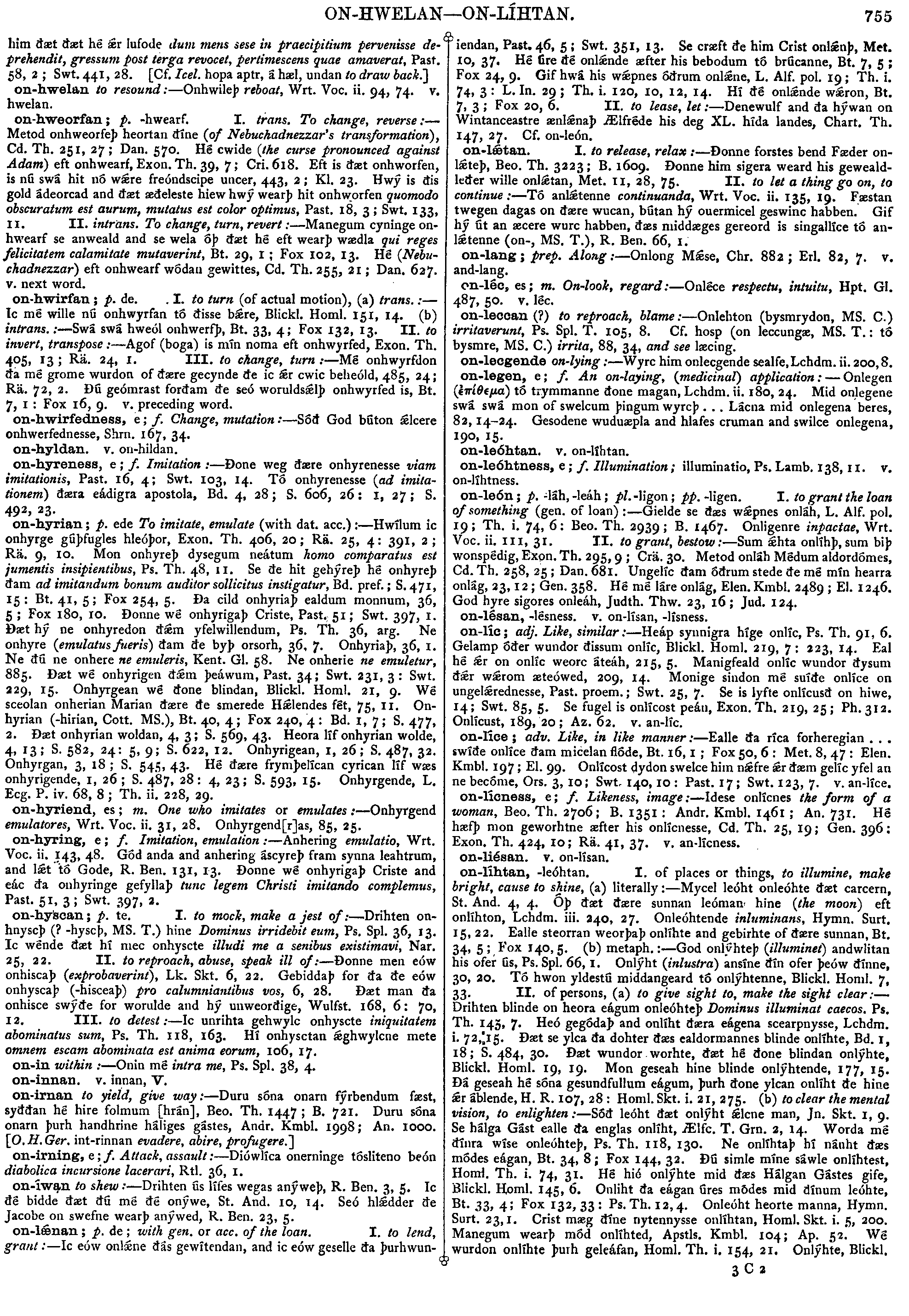
on-hyrian;
p.
ede
To
imitate,
emulate
(with
dat.
acc.):--Hwílum
ic
onhyrge
gúþfugles
hleóþor,
Exon.
Th.
406,
20;
Rä.
25,
4:
391,
2;
Rä.
9,
10.
Mon
onhyreþ
dysegum
neátum
homo
comparatus
est
jumentis
insipientibus,
Ps.
Th.
48,
11.
Se
ðe
hit
gehýreþ
hé
onhyreþ
ðam
ad
imitandum
bonum
auditor
sollicitus
instigatur,
Bd.
pref.;
S.
471,
15:
Bt.
41,
5;
Fox
254,
5.
Ða
cild
onhyriaþ
ealdum
monnum,
36,
5;
Fox
180,
10.
Ðonne
wé
onhyrigaþ
Criste,
Past.
51;
Swt.
397,
1.
Ðæt
hý
ne
onhyredon
ðm
yfelwillendum,
Ps.
Th.
36,
arg.
Ne
onhyre
(emulatus
fueris)
ðam
ðe
byþ
orsorh,
36,
7.
Onhyriaþ,
36,
1.
Ne
ðú
ne
onhere
ne
emuleris,
Kent.
Gl.
58.
Ne
onherie
ne
emuletur,
885.
Ðæt
wé
onhyrigen
ðm
þeáwum,
Past.
34;
Swt.
231,
3:
Swt.
229,
15.
Onhyrgean
wé
ðone
blindan,
Blickl.
Homl.
21,
9.
Wé
sceolan
onherian
Marian
ðære
ðe
smerede
Hlendes
fét,
75,
11.
Onhyrian
(-hirian,
Cott.
MS.),
Bt.
40,
4;
Fox
240,
4:
Bd.
1,
7;
S.
477,
2.
Ðæt
onhyrian
woldan,
4,
3;
S.
569,
43.
Heora
líf
onhyrian
wolde,
4,
13;
S.
582,
24:
5,
9;
S.
622,
12.
Onhyrigean,
1,
26;
S.
487,
32.
Onhyrgan,
3,
18;
S.
545,
43.
Hé
ðære
frymþelícan
cyrican
líf
wæs
onhyrigende,
1,
26;
S.
487,
28:
4,
23;
S.
593,
15.
Onhyrgende,
L.
Ecg.
P.
iv.
68,
8;
Th.
ii.
228,
29.
|
Source: Bosworth/Toller, page b0755, entry 32 View original page image as: [TIFF] [PNG] [View previous entry] [View next entry] |
[Comment on this entry] [View comments] |
The following entry has been hand-corrected once. |
on-líhtan,
-leóhtan.
I.
of
places
or
things,
to
illumine,
make
bright,
cause
to
shine,
(a)
literally:--Mycel
leóht
onleóhte
ðæt
carcern,
St.
And.
4,
4.
Óþ
ðæt
ðære
sunnan
leóman
hine
(the
moon)
eft
onlíhton,
Lchdm.
iii.
240,
27.
Onleóhtende
inluminans,
Hymn.
Surt.
15,
22.
Ealle
steorran
weorþaþ
onlíhte
and
gebirhte
of
ðære
sunnan,
Bt.
34,
5;
Fox
140,
5.
(b)
metaph.:--God
onlýhteþ
(illuminet)
andwlitan
his
ofer
ús,
Ps.
Spl.
66,
1.
Onlýht
(inlustra)
ansíne
ðín
ofer
þeów
ðínne,
30,
20.
Tó
hwon
yldestú
middangeard
tó
onlýhtenne,
Blickl.
Homl.
7,
33.
II.
of
persons,
(a)
to
give
sight
to,
make
the
sight
clear:--Drihten
blinde
on
heora
eágum
onleóhteþ
Dominus
illuminat
caecos.
Ps.
Th.
145,
7.
Heó
gegódaþ
and
onlíht
ðæra
eágena
scearpnysse,
Lchdm.
i.
72,
15.
Ðæt
se
ylca
ða
dohter
ðæs
ealdormannes
blinde
onlíhte,
Bd.
1,
18;
S.
484,
30.
Ðæt
wundor
worhte,
ðæt
hé
ðone
blindan
onlýhte,
Blickl.
Homl.
19,
19.
Mon
geseah
hine
blinde
onlýhtende,
177,
15.
Ðá
geseah
hé
sóna
gesundfullum
eágum,
þurh
ðone
ylcan
onlíht
ðe
hine
r
áblende,
H.
R.
107,
28:
Homl.
Skt.
i.
21,
275.
(b)
to
clear
the
mental
vision,
to
enlighten:--Sóð
leóht
ðæt
onlýht
lcne
man,
Jn.
Skt.
1,
9.
Se
hálga
Gást
ealle
ða
englas
onlíht,
Ælfc.
T.
Grn.
2,
14.
Worda
mé
ðínra
wíse
onleóhteþ,
Ps.
Th.
118,
130.
Ne
onlíhtaþ
hí
nánht
ðæs
módes
eágan,
Bt.
34,
8;
Fox
144,
32.
Ðú
simle
míne
sáwle
onlíhtest,
Homl.
Th.
i.
74,
31.
Hé
hié
onlýhte
mid
ðæs
Hálgan
Gástes
gife,
Blickl.
Homl.
145,
6.
Onliht
ða
eágan
úres
módes
mid
ðínum
leóhte,
Bt.
33,
4;
Fox
132,
33:
Ps.
Th.
12,
4.
Onleóht
heorte
manna,
Hymn.
Surt.
23,
1.
Crist
mæg
ðíne
nytennysse
onlíhtan,
Homl.
Skt.
i.
5,
200.
Manegum
wearþ
mód
onlíhted,
Apstls.
Kmbl.
104;
Ap.
52.
Wé
wurdon
onlíhte
þurh
geleáfan,
Homl.
Th.
i.
154,
21.
Onlýhte,
Blickl.
|
Source: Bosworth/Toller, page b0841, entry 2 View original page image as: [TIFF] [PNG] [View previous entry] [View next entry] |
[Comment on this entry] [View comments (1)] |
The following entry has been hand-corrected once. |
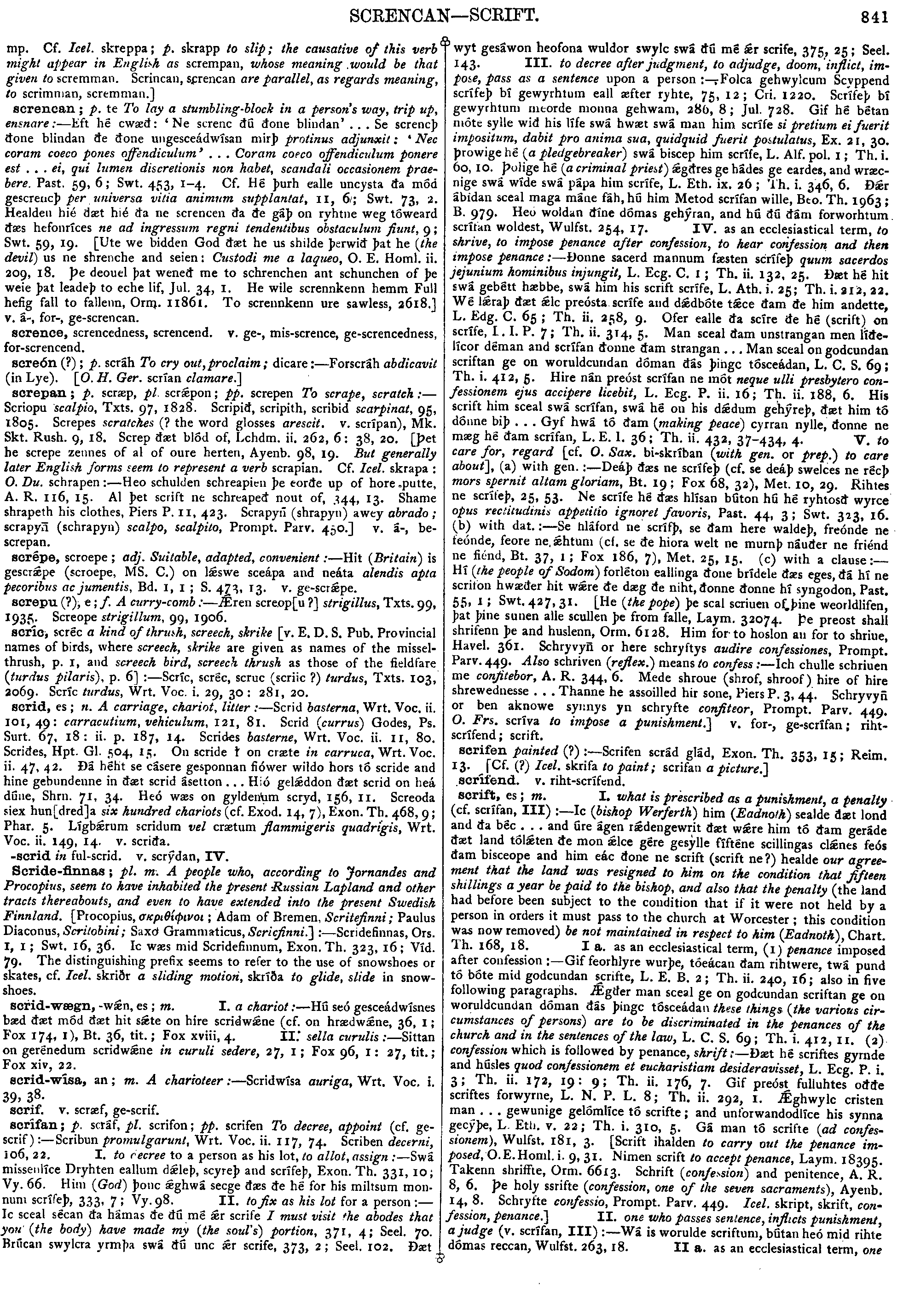
screncan; p. te To lay a stumbling-block in a person's way, trip up, ensnare:--Eft hé cwæð: 'Ne screnc dú ðone blindan' . . . Se screncþ ðone blindan ðe ðone ungesceádwísan mirþ protinus adjunxit: 'Nec coram coeco pones offendiculum' . . . Coram coeco offendiculum ponere est . . . ei, qui lumen discretionis nan habet, scandali occasionem praebere. Past. 59, 6; Swt. 453, 1-4. Cf. Hé þurh ealle uncysta ða mód gescrencþ per universa vitia animum supplantat, 11, 6; Swt. 73, 2. Healden hié dæt hié ða ne screncen ða ðe gáþ on ryhtne weg tóweard ðæs hefonríces ne ad ingressum regni tendentibus obstaculum fiunt, 9; Swt. 59, 19. [Ute we bidden God ðæt he us shilde þerwið þat he (the devil) us ne shrenche and seien: Custodi me a laqueo, O. E. Homl. ii. 209, 18. Þe deouel þat weneð me to schrenchen ant schunchen of þe weie þat leadeþ to eche lif, Jul. 34, l. He wile scrennkenn hemm Full hefig fall to fallenn, Orm. 11861. To scrennkenn ure sawless, 2618.] v. á-, for-, ge-screncan.
|
Source: Bosworth/Toller, page b0848, entry 29 View original page image as: [TIFF] [PNG] [View previous entry] [View next entry] |
[Comment on this entry] [View comments (1)] |
The following entry has been hand-corrected once. |
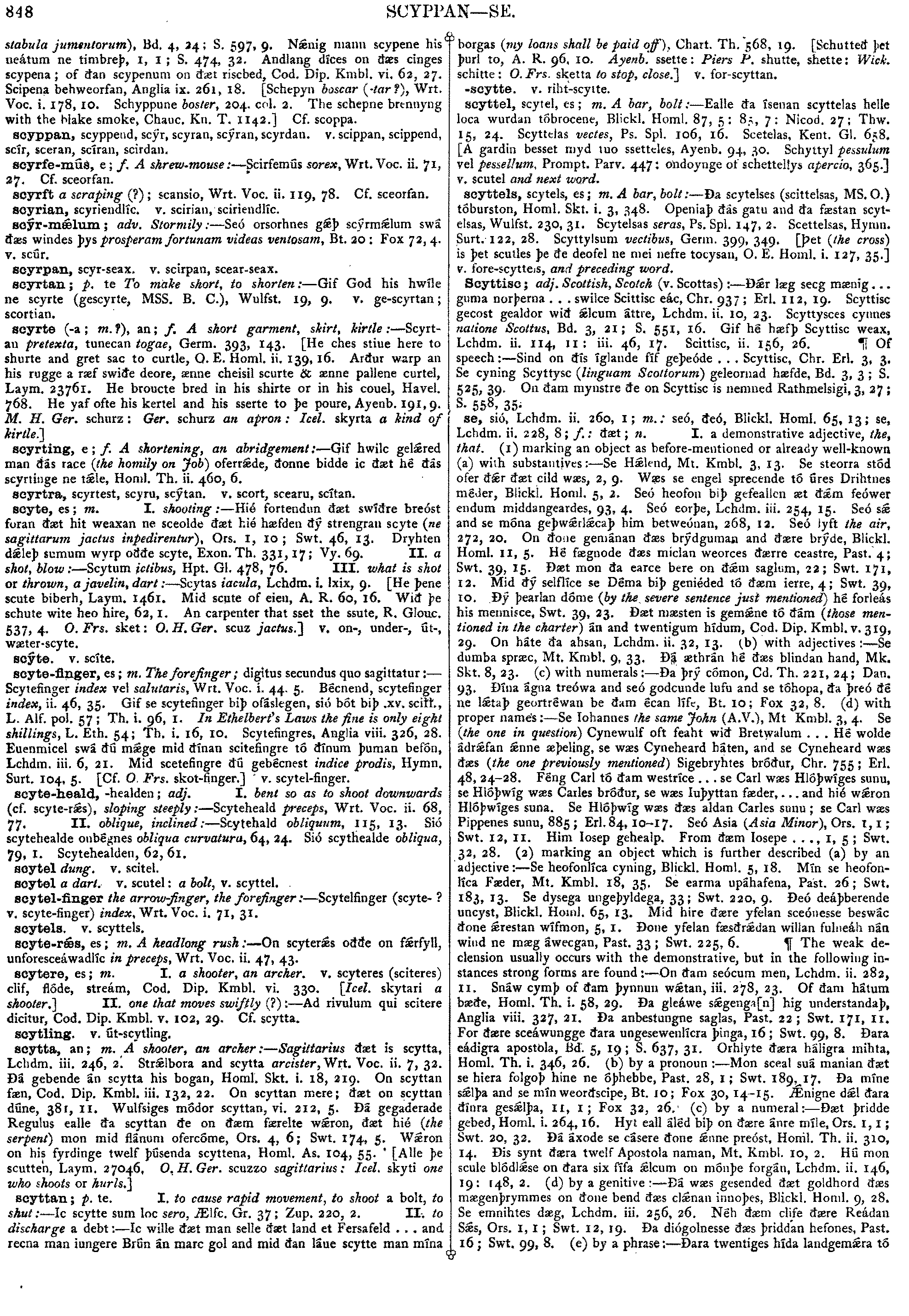
se,
sió,
Lchdm.
ii.
260,
l;
m.:
seó,
ðeó,
Blickl.
Homl.
65,
13;
se,
Lchdm.
ii.
228,
8;
f.:
ðæt;
n.
I.
a
demonstrative
adjective,
the,
that.
(l)
marking
an
object
as
before-mentioned
or
already
well-known
(a)
wilh
substantives:--Se
Hlend,
Mt.
Kmbl.
3,
13.
Se
steorra
stód
ofer
ðr
ðæt
cild
wæs,
2,
9.
Wæs
se
engel
sprecende
tó
úres
Drihtnes
méder,
Blickl.
Homl.
5,
2.
Seó
heofon
biþ
gefeallen
æt
ðm
feówer
endum
middangeardes,
93,
4.
Seó
eorþe,
Lchdm.
iii.
254,
15.
Seó
s
and
se
móna
geþwrlcaþ
him
betweónan,
268,
12.
Seó
lyft
the
air,
272,
20.
On
ðone
gemánan
ðæs
brýdguman
and
ðære
brýde,
Blickl.
Homl.
11,
5.
Hé
fægnode
ðæs
miclan
weorces
ðærre
ceastre,
Past.
4;
Swt.
39,
15.
Ðæt
mon
ða
earce
bere
on
ðm
saglum,
22;
Swt.
171,
12.
Mid
ðý
selflíce
se
Déma
biþ
geniéded
tó
ðæm
ierre,
4;
Swt.
39,
10.
Ðý
þearlan
dóme
(by
the
severe
sentence
just
mentioned)
hé
forleás
his
mennisce,
Swt.
39,
23.
Ðæt
mæsten
is
gemne
tó
ðám
(those
mentioned
in
the
charter)
án
and
twentigum
hídum,
Cod.
Dip.
Kmbl.
v.
319,
29.
On
háte
ða
ahsan,
Lchdm.
ii.
32,
13.
(b)
with
adjectives:--Se
dumba
spræc,
Mt.
Kmbl.
9,
33.
Ðá
æthrán
hé
ðæs
blindan
hand,
Mk.
Skt.
8,
23.
(c)
with
numerals:--Ða
þrý
cómon,
Cd.
Th.
221,
24;
Dan.
93.
Ðína
ágna
treówa
and
seó
godcunde
lufu
and
se
tóhopa,
ða
þreó
ðé
ne
ltaþ
geortréwan
be
ðam
écan
lífe,
Bt.
10;
Fox
32,
8.
(d)
with
proper
names:--Se
Iohannes
the
same
John
(A.
V.),
Mt
Kmbl.
3,
4.
Se
(the
one
in
question)
Cynewulf
oft
feaht
wið
Bretwalum
.
.
.
Hé
wolde
ádræfan
ænne
æþeling,
se
wæs
Cyneheard
háten,
and
se
Cyneheard
wæs
ðæs
(the
one
previously
mentioned)
Sigebryhtes
bróður,
Chr.
755;
Erl.
48,
24-28.
Féng
Carl
tó
ðam
westríce
.
.
.
se
Carl
wæs
Hlóþwíges
sunu,
se
Hlóþwíg
wæs
Cailes
bróður,
se
wæs
luþyttan
fæder,
.
.
.
and
hié
wron
Hlóþwíges
suna.
Se
Hlóþwíg
wæs
ðæs
aldan
Carles
sunu;
se
Carl
wæs
Pippenes
sunu,
885;
Erl.
84,
10-17.
Seó
Asia
(Asia
Minor),
Ors.
l,
1;
Swt.
12,
11.
Him
losep
gehealp.
From
ðæm
losepe
.
.
.
,
1,
5;
Swt.
32,
28.
(2)
marking
an
object
which
is
further
described
(a)
by
an
adjective:--Se
heofonlíca
cyning,
Blickl.
Homl.
5,
18.
Mín
se
heofonlíca
Fæder,
Mt.
Kmbl.
18,
35.
Se
earma
upáhafena,
Past.
26;
Swt.
183,
13.
Se
dysega
ungeþyldega,
33;
Swt.
220,
9.
Ðeó
deáþberende
uncyst,
Blickl.
Homl.
65,
13.
Mid
hire
ðære
yfelan
sceónesse
beswác
ðone
restan
wífmon,
5,
l.
Ðone
yfelan
fæsðrdan
willan
fulneáh
nán
wind
ne
mæg
áwecgan,
Past.
33;
Swt.
225,
6.

The
weak
declension
usually
occurs
with
the
demonstrative,
but
in
the
following
instances
strong
forms
are
found:--On
ðam
seócum
men,
Lchdm.
ii.
282,
11.
Snáw
cymþ
of
ðam
þynnun
wtan,
iii.
278,
23.
Of
ðam
hátum
bæðe,
Homl.
Th.
i.
58,
29.
Ða
gleáwe
sgenga[n]
hig
understandaþ,
Anglia
viii.
327,
21.
Ða
anbestungne
saglas,
Past.
22;
Swt.
171,
11.
For
ðære
sceáwungge
ðara
ungesewenlícra
þinga,
16;
Swt.
99,
8.
Ðara
eádigra
apostola,
Bd.
5,
19;
S.
637,
31.
Orhlyte
ðæra
háligra
mihta,
Homl.
Th.
i.
346,
26.
(b)
by
a
pronoun:--Mon
sceal
suá
manian
ðæt
se
hiera
folgoþ
hine
ne
óþhebbe,
Past.
28,
1;
Swt.
189,
17.
Ða
míne
slþa
and
se
mín
weorðscipe,
Bt.
10;
Fox
30,
14-15.
Æ-acute;nigne
dl
ðara
ðínra
geslþa,
11,
l;
Fox
32,
26.
(c)
by
a
numeral:--Ðæt
þridde
gebed,
Homl.
i.
264,
16.
Hyt
eall
áléd
biþ
on
ðære
ánre
míle,
Ors.
l,
l;
Swt.
20,
32.
Ðá
áxode
se
cásere
ðone
ænne
preóst,
Homl.
Th.
ii.
310,
14.
Ðis
synt
ðæra
twelf
Apostola
naman,
Mt.
Kmbl.
10,
2.
Hú
mon
scule
blódlse
on
ðara
six
fífa
lcum
on
mónþe
forgán,
Lchdm.
ii.
146,
19:
148,
2.
(d)
by
a
genitive:--Ðá
wæs
gesended
ðæt
goldhord
ðæs
mægenþrymmes
on
ðone
bend
ðæs
clnan
innoþes,
Blickl.
Homl.
9,
28.
Se
emnihtes
dæg,
Lchdm.
iii.
256,
26.
Néh
ðæm
clife
ðære
Reádan
Ss,
Ors.
l,
l;
Swt.
12,
19.
Ða
diógolnesse
ðæs
þriddan
hefones,
Past.
16;
Swt.
99,
8.
(e)
by
a
phrase:--Ðara
twentiges
hída
landgemra
tó
| Result Page: | 1 2 3 4 | Next |  |
Germanic Lexicon Project (main page)
This search system was written by
Sean Crist
Please consider
volunteering
to correct the data in these online dictionaries.
No rights reserved. Feel free to use these data in any way you please.