|
|

|
Source: Bosworth/Toller, page d0508, entry 2 View original page image as: [TIFF] [PNG] [View previous entry] [View next entry] |
[Comment on this entry] [View comments] |
The following entry has been hand-corrected once. |
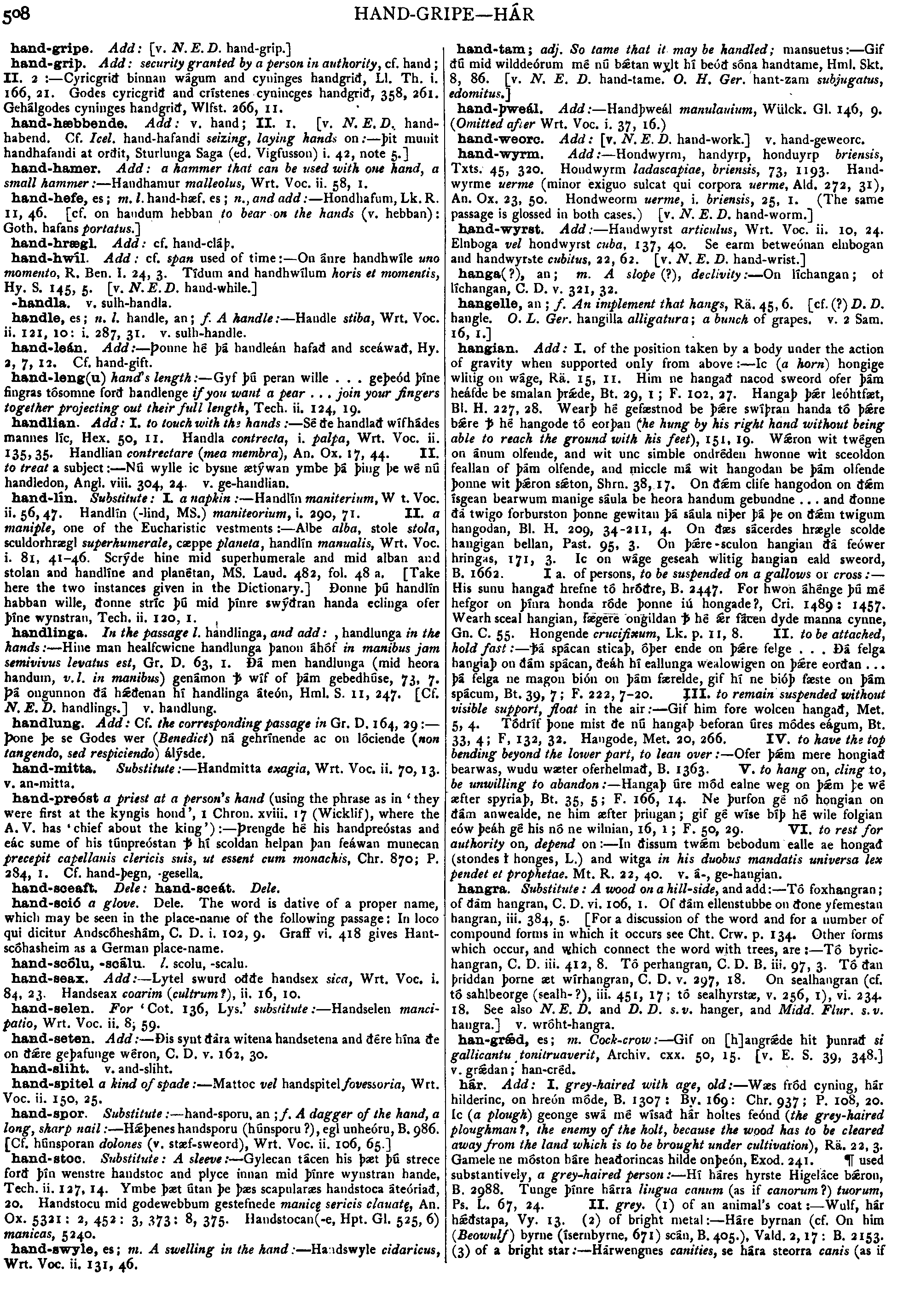
hand-griþ. Add: security granted by a person in authority, cf. hand; II. 2 :-- Cyricgrið binnan wágum and cyninges handgrið, Ll. Th. i. 166, 21. Godes cyricgrið and crístenes cynincges handgrið, 358, 261. Gehálgodes cyninges handgrið, Wlfst. 266, 11.
|
Source: Bosworth/Toller, page d0522, entry 12 View original page image as: [TIFF] [PNG] [View previous entry] [View next entry] |
[Comment on this entry] [View comments (1)] |
The following entry has been hand-corrected once. |
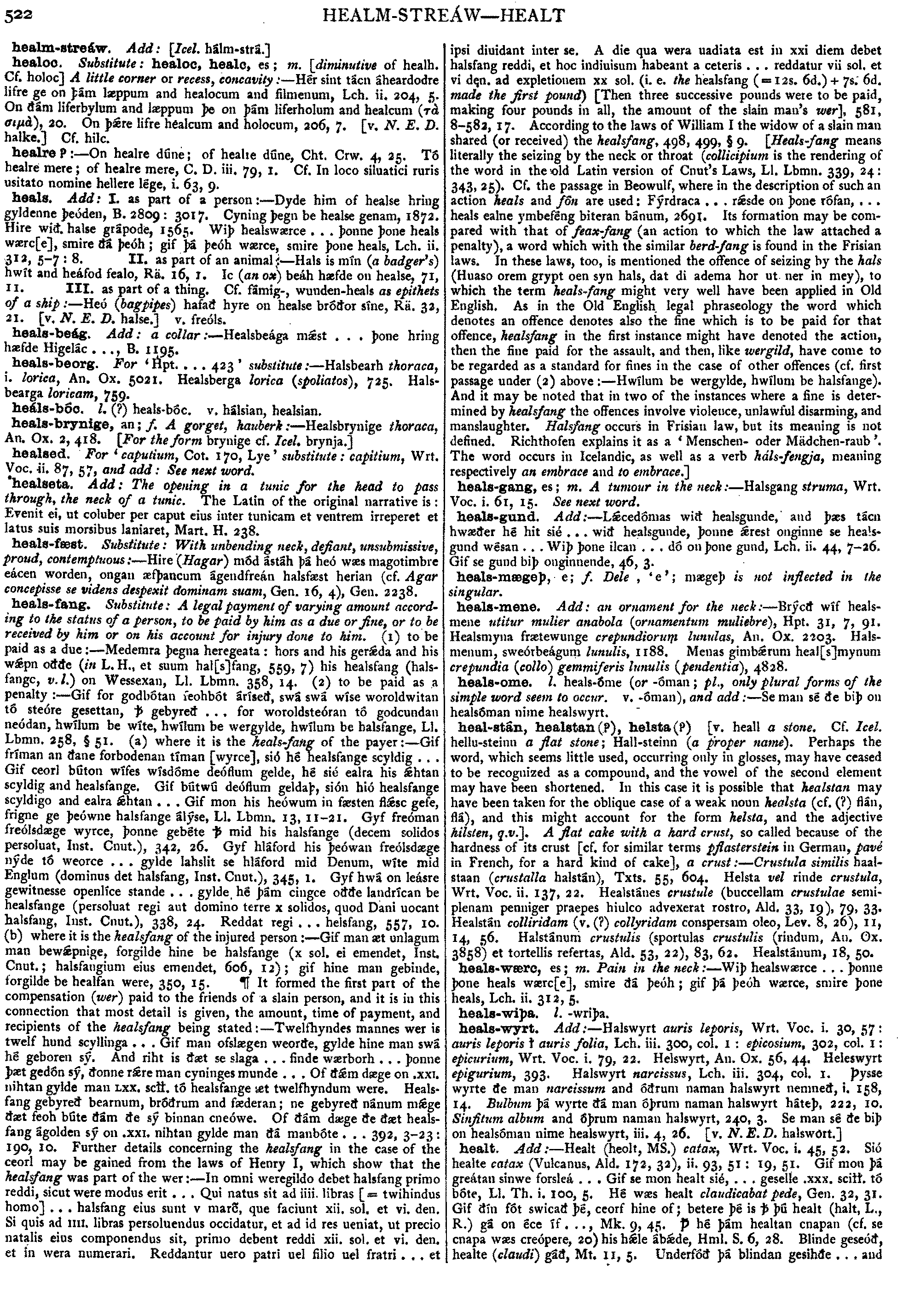
heals-fang.
Substitute:
A
legal
payment
of
varying
amount
according
to
the
status
of
a
person,
to
be
paid
by
him
as
a
due
or
fine,
or
to
be
received
by
him
or
on
his
account
for
injury
done
to
kim,
(1)
to
be
paid
as
a
due
:--
Medemra
þegna
heregeata
:
hors
and
his
ger da
and
his
wpn
oððe
(in
L.
H.,
et
suum
hal[s]fang,
559,
7)
his
healsfang
(halsfangc,
v.
l.)
on
Wessexan,
Ll.
Lbmn.
358,
14.
(2)
to
be
paid
as
a
penalty
:--
Gif
for
godbótan
feohbót
áríseð,
swá
swá
wise
woroldwitan
tó
steóre
gesettan,
da
and
his
wpn
oððe
(in
L.
H.,
et
suum
hal[s]fang,
559,
7)
his
healsfang
(halsfangc,
v.
l.)
on
Wessexan,
Ll.
Lbmn.
358,
14.
(2)
to
be
paid
as
a
penalty
:--
Gif
for
godbótan
feohbót
áríseð,
swá
swá
wise
woroldwitan
tó
steóre
gesettan,
 gebyreð
.
.
.
for
woroldsteóran
tó
godcundan
neódan,
hwílum
be
wíte,
hwílum
be
wergylde,
hwílum
be
halsfange.
Ll.
Lbmn.
258,
§
51.
(a)
where
it
is
the
heals-fang
of
the
payer
:--
Gif
fríman
an
ðane
forbodenan
tíman
[wyrce],
sió
hé
healsfange
scyldig
.
.
.
Gif
ceorl
búton
wífes
wísdóme
deóflum
gelde,
hé
sié
ealra
his
htan
scyldig
and
healsfange.
Gif
bútwú
deóflum
geldaþ,
sión
hió
healsfange
scyldigo
and
ealra
htan
.
.
.
Gif
mon
his
heówum
in
fæsten
flsc
gefe,
frigne
ge
þeówne
halsfange
álýse.
Ll.
Lbmn.
13,
11-21.
Gyf
freóman
freólsdæge
wyrce,
þonne
gebéte
mid
his
halsfange
(decem
solidos
persoluat,
Inst.
Cnut.
),
342,
26.
Gyf
hláford
his
þeówan
freólsdæge
nýde
tó
weorce
.
.
.
gylde
lahslit
se
hláford
mid
Denum,
wíte
mid
Englum
(dominus
det
halsfang,
Inst.
Cnut.
),
345,
1.
Gyf
hwá
on
leásre
gewitnesse
openlíce
stande
.
.
.
gylde
hé
þám
cingce
oððe
landrícan
be
healsfange
(persoluat
regi
aut
domino
terre
x
solidos,
quod
Dam
uocant
halsfang,
Inst.
Cnut.
),
338,
24.
Reddat
regi
.
.
.
helsfang,
557,
10.
(b)
where
it
is
the
healsfang
of
the
injured
person
:--
Gif
man
æt
unlagum
man
bewpnige,
forgilde
hine
be
halsfange
(x
sol.
ei
emendet,
Inst.
Cnut.;
halsfangium
eius
emendet,
606,
12);
gif
hine
man
gebinde,
forgilde
be
healfan
were,
350,
15.
¶It
formed
the
first
part
of
the
compensation
(wer)
paid
to
the
friends
of
a
slain
person,
and
it
is
in
this
connection
that
most
detail
is
given,
the
amount,
time
of
payment,
and
recipients
of
the
healsfang
being
stated
:--
Twelfhyndes
mannes
wer
is
twelf
hund
scyllinga
.
.
.
Gif
man
ofslægen
weorðe,
gylde
hine
man
swá
hé
geboren
sý.
And
riht
is
ðæt
se
slaga
.
.
.
finde
wærborh
.
.
.
þonne
þæt
gedón
sý,
ðonne
rre
man
cyninges
munde
.
.
.
Of
ðm
dæge
on
.xxi.
nihtan
gylde
man
LXX.
sc
gebyreð
.
.
.
for
woroldsteóran
tó
godcundan
neódan,
hwílum
be
wíte,
hwílum
be
wergylde,
hwílum
be
halsfange.
Ll.
Lbmn.
258,
§
51.
(a)
where
it
is
the
heals-fang
of
the
payer
:--
Gif
fríman
an
ðane
forbodenan
tíman
[wyrce],
sió
hé
healsfange
scyldig
.
.
.
Gif
ceorl
búton
wífes
wísdóme
deóflum
gelde,
hé
sié
ealra
his
htan
scyldig
and
healsfange.
Gif
bútwú
deóflum
geldaþ,
sión
hió
healsfange
scyldigo
and
ealra
htan
.
.
.
Gif
mon
his
heówum
in
fæsten
flsc
gefe,
frigne
ge
þeówne
halsfange
álýse.
Ll.
Lbmn.
13,
11-21.
Gyf
freóman
freólsdæge
wyrce,
þonne
gebéte
mid
his
halsfange
(decem
solidos
persoluat,
Inst.
Cnut.
),
342,
26.
Gyf
hláford
his
þeówan
freólsdæge
nýde
tó
weorce
.
.
.
gylde
lahslit
se
hláford
mid
Denum,
wíte
mid
Englum
(dominus
det
halsfang,
Inst.
Cnut.
),
345,
1.
Gyf
hwá
on
leásre
gewitnesse
openlíce
stande
.
.
.
gylde
hé
þám
cingce
oððe
landrícan
be
healsfange
(persoluat
regi
aut
domino
terre
x
solidos,
quod
Dam
uocant
halsfang,
Inst.
Cnut.
),
338,
24.
Reddat
regi
.
.
.
helsfang,
557,
10.
(b)
where
it
is
the
healsfang
of
the
injured
person
:--
Gif
man
æt
unlagum
man
bewpnige,
forgilde
hine
be
halsfange
(x
sol.
ei
emendet,
Inst.
Cnut.;
halsfangium
eius
emendet,
606,
12);
gif
hine
man
gebinde,
forgilde
be
healfan
were,
350,
15.
¶It
formed
the
first
part
of
the
compensation
(wer)
paid
to
the
friends
of
a
slain
person,
and
it
is
in
this
connection
that
most
detail
is
given,
the
amount,
time
of
payment,
and
recipients
of
the
healsfang
being
stated
:--
Twelfhyndes
mannes
wer
is
twelf
hund
scyllinga
.
.
.
Gif
man
ofslægen
weorðe,
gylde
hine
man
swá
hé
geboren
sý.
And
riht
is
ðæt
se
slaga
.
.
.
finde
wærborh
.
.
.
þonne
þæt
gedón
sý,
ðonne
rre
man
cyninges
munde
.
.
.
Of
ðm
dæge
on
.xxi.
nihtan
gylde
man
LXX.
sc UNCERTAIN
,
tó
healsfange
æt
twelfhyndum
were.
Healsfang
gebyreð
bearnum,
bróðrum
and
fæderan;
ne
gebyreð
nánum
mge
ðæt
feoh
búte
ðám
ðe
sý
binnan
cneówe.
Of
ðám
dæge
ðe
ðæt
healsfang
ágolden
sý
on
.xxi.
nihtan
gylde
man
ðá
manbóte
.
.
.
392,
3-23:
190,
10.
Further
details
concerning
the
healsfang
in
the
case
of
the
ceorl
may
be
gained
from
the
laws
of
Henry
I.
which
show
that
the
healsfang
was
part
of
the
wer
:--
In
omni
weregildo
debet
halsfang
primo
reddi,
sicut
were
modus
erit
.
.
.
Qui
natus
sit
ad
iiii.
libras
[=
twihindus
homo]
.
.
.
halsfang
eius
sunt
v
mar
UNCERTAIN
,
tó
healsfange
æt
twelfhyndum
were.
Healsfang
gebyreð
bearnum,
bróðrum
and
fæderan;
ne
gebyreð
nánum
mge
ðæt
feoh
búte
ðám
ðe
sý
binnan
cneówe.
Of
ðám
dæge
ðe
ðæt
healsfang
ágolden
sý
on
.xxi.
nihtan
gylde
man
ðá
manbóte
.
.
.
392,
3-23:
190,
10.
Further
details
concerning
the
healsfang
in
the
case
of
the
ceorl
may
be
gained
from
the
laws
of
Henry
I.
which
show
that
the
healsfang
was
part
of
the
wer
:--
In
omni
weregildo
debet
halsfang
primo
reddi,
sicut
were
modus
erit
.
.
.
Qui
natus
sit
ad
iiii.
libras
[=
twihindus
homo]
.
.
.
halsfang
eius
sunt
v
mar ,
que
faciunt
xii.
sol,
et
vi.
den.
Si
quis
ad
iiii.
UNCERTAIN
libras
persoluendus
occidatur,
et
ad
id
res
ueniat,
ut
precio
natalis
eius
componendus
sit,
primo
debent
reddi
xii.
sol.
et
vi.
den.
et
in
wera
numerari.
Reddantur
uero
patri
uel
filio
uel
fratri
.
.
.
et
ipsi
diuidant
inter
se.
A
die
qua
wera
uadiata
est
in
xxi
diem
debet
halsfang
reddi,
et
hoc
indiuisum
habeant
a
ceteris
.
.
.
reddatur
vii
sol.
et
vi
d
,
que
faciunt
xii.
sol,
et
vi.
den.
Si
quis
ad
iiii.
UNCERTAIN
libras
persoluendus
occidatur,
et
ad
id
res
ueniat,
ut
precio
natalis
eius
componendus
sit,
primo
debent
reddi
xii.
sol.
et
vi.
den.
et
in
wera
numerari.
Reddantur
uero
patri
uel
filio
uel
fratri
.
.
.
et
ipsi
diuidant
inter
se.
A
die
qua
wera
uadiata
est
in
xxi
diem
debet
halsfang
reddi,
et
hoc
indiuisum
habeant
a
ceteris
.
.
.
reddatur
vii
sol.
et
vi
d n.
UNCERTAIN
ad
expletionem
xx
sol.
(i.
e.
the
healsfang
(
=
12s.
6d.
)
+
7s.
6d.
made
the
first
pound)
[Then
three
successive
pounds
were
to
be
paid,
making
four
pounds
in
all,
the
amount
of
the
slain
man's
wer],
581,
8-582,
17.
According
to
the
laws
of
William
I
the
widow
of
a
slain
man
shared
(or
received)
the
healsfang,
498,
499,
§
9.
[Heals-fang
means
literally
the
seizing
by
the
neck
or
throat
(collicipium
is
the
rendering
of
the
word
in
the
old
Latin
version
of
Cnut's
Laws,
Ll.
Lbmn.
339,
24:
343,
25).
Cf.
the
passage
in
Beowulf,
where
in
the
description
of
such
an
action
heals
and
fón
are
used:
Fýrdraca
.
.
.
rsde
on
þone
rófan,
.
.
.
heals
ealne
ymbeféng
biteran
bánum,
2691.
Its
formation
may
be
compared
with
that
of
feax-fang
(an
action
to
which
the
law
attached
a
penalty),
a
word
which
with
the
similar
berd-fang
is
found
in
the
Frisian
laws.
In
these
laws,
too,
is
mentioned
the
offence
of
seizing
by
the
hals
(Huaso
orem
grypt
oen
syn
hals,
dat
di
adema
hor
ut
ner
in
mey),
to
which
the
term
heals-fang
might
very
well
have
been
applied
in
Old
English.
As
in
the
Old
English
legal
phraseology
the
word
which
denotes
an
offence
denotes
also
the
fine
which
is
to
be
paid
for
that
offence,
healsfang
in
the
first
instance
might
have
denoted
the
action,
then
the
fine
paid
for
the
assault,
and
then,
like
wergild,
have
come
to
be
regarded
as
a
standard
for
fines
in
the
case
of
other
offences
(cf.
first
passage
under
(2)
above
:--
Hwílum
be
wergylde,
hwílum
be
halsfange).
And
it
may
be
noted
that
in
two
of
the
instances
where
a
fine
is
determined
by
healsfang
the
offences
involve
violence,
unlawful
disarming,
and
manslaughter.
Halsfang
occurs
in
Frisian
law,
but
its
meaning
is
not
defined.
Richthofen
explains
it
as
a
'Menschen-
oder
Mädchen-raub'.
The
word
occurs
in
Icelandic,
as
well
as
a
verb
háls-fengja,
meaning
respectively
an
embrace
and
to
embrace.]
n.
UNCERTAIN
ad
expletionem
xx
sol.
(i.
e.
the
healsfang
(
=
12s.
6d.
)
+
7s.
6d.
made
the
first
pound)
[Then
three
successive
pounds
were
to
be
paid,
making
four
pounds
in
all,
the
amount
of
the
slain
man's
wer],
581,
8-582,
17.
According
to
the
laws
of
William
I
the
widow
of
a
slain
man
shared
(or
received)
the
healsfang,
498,
499,
§
9.
[Heals-fang
means
literally
the
seizing
by
the
neck
or
throat
(collicipium
is
the
rendering
of
the
word
in
the
old
Latin
version
of
Cnut's
Laws,
Ll.
Lbmn.
339,
24:
343,
25).
Cf.
the
passage
in
Beowulf,
where
in
the
description
of
such
an
action
heals
and
fón
are
used:
Fýrdraca
.
.
.
rsde
on
þone
rófan,
.
.
.
heals
ealne
ymbeféng
biteran
bánum,
2691.
Its
formation
may
be
compared
with
that
of
feax-fang
(an
action
to
which
the
law
attached
a
penalty),
a
word
which
with
the
similar
berd-fang
is
found
in
the
Frisian
laws.
In
these
laws,
too,
is
mentioned
the
offence
of
seizing
by
the
hals
(Huaso
orem
grypt
oen
syn
hals,
dat
di
adema
hor
ut
ner
in
mey),
to
which
the
term
heals-fang
might
very
well
have
been
applied
in
Old
English.
As
in
the
Old
English
legal
phraseology
the
word
which
denotes
an
offence
denotes
also
the
fine
which
is
to
be
paid
for
that
offence,
healsfang
in
the
first
instance
might
have
denoted
the
action,
then
the
fine
paid
for
the
assault,
and
then,
like
wergild,
have
come
to
be
regarded
as
a
standard
for
fines
in
the
case
of
other
offences
(cf.
first
passage
under
(2)
above
:--
Hwílum
be
wergylde,
hwílum
be
halsfange).
And
it
may
be
noted
that
in
two
of
the
instances
where
a
fine
is
determined
by
healsfang
the
offences
involve
violence,
unlawful
disarming,
and
manslaughter.
Halsfang
occurs
in
Frisian
law,
but
its
meaning
is
not
defined.
Richthofen
explains
it
as
a
'Menschen-
oder
Mädchen-raub'.
The
word
occurs
in
Icelandic,
as
well
as
a
verb
háls-fengja,
meaning
respectively
an
embrace
and
to
embrace.]
|
Source: Bosworth/Toller, page d0538, entry 11 View original page image as: [TIFF] [PNG] [View previous entry] [View next entry] |
[Comment on this entry] [View comments] |
The following entry has been hand-corrected once. |
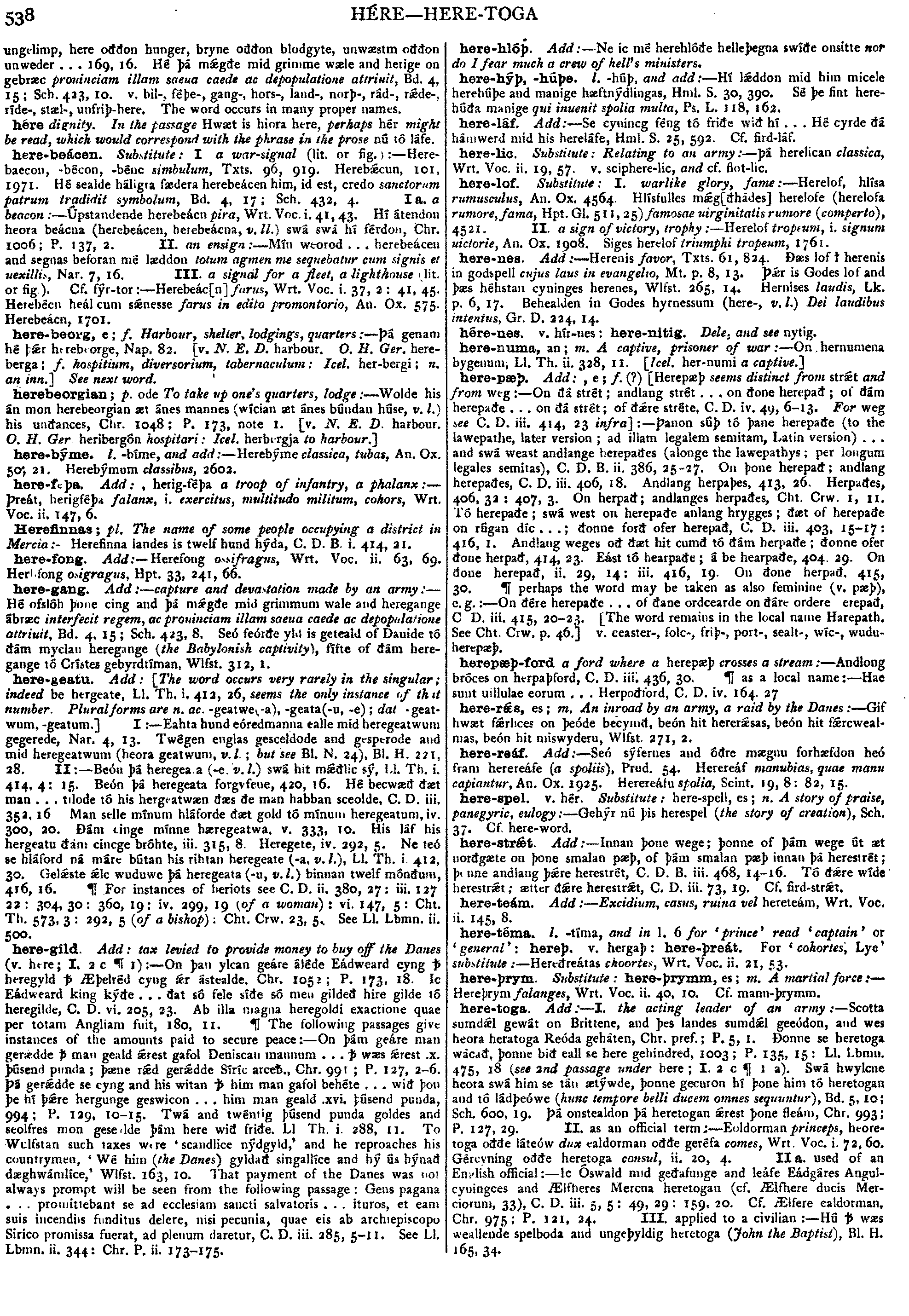
here-geatu.
Add:
[The
word
occurs
very
rarely
in
the
singular;
indeed
be
hergeate,
Ll.
Th.
i.
412,
26,
seems
the
only
instance
that
number.
Plural
forms
are
n.
ac.
-geatwei,(-a),
-geata(-u,
-e);
dat
-geat-wum,
-geatum.]
I
:--
Eahta
hund
eóredmanna
ealle
mid
beregeatwum
gegerede,
Nar.
4,
13.
Twégen
englas
gesceldode
and
gesperode
and
mid
heregeatwum
(heora
geatwum,
v.
l.
;
but
see
Bl.
N.
24),
Bl.
H.
221,
28.
II
:--
Beón
þá
heregea
a
(-e.
v.l.)
swá
hit
mðlic
sý,
Ll.
Th.
i.
414,
4:
15.
Beón
þá
heregeata
forgvfene,
420,
16.
Hé
becwæð
ðæt
man
.
.
.
tilode
tó
his
hergeatwæn
ðæs
ðe
man
habban
sceolde,
C.
D.
iii.
352,
16
Man
selle
mínum
hláforde
ðæt
gold
tó
mínum
heregeatum,
iv.
300,
20.
Ðám
cinge
mínne
hæregeatwa,
v.
333,
10.
His
láf
his
hergeatu
ðám
cincge
bróhte,
iii.
315,
8.
Heregete,
iv.
292,
5.
Ne
teó
se
hláford
ná
máre
bútan
his
rihtan
heregeate
(-a,
v.
l.],
Ll.
Th.
i.
412,
30.
Gelste
lc
wuduwe
þá
heregeata
(-u,
v.
l.
)
binnan
twelf
mónðum,
416,
16.
¶
For
instances
of
heriots
see
C.
D.
ii.
380,
27:
iii.
127
22
:
304,
30:
360,
19:
iv.
299,
19
(of
a
woman)
:
vi.
147,
5
:
Cht.
Th.
573,
3
:
292,
5
(of
a
bishop]
:
Cht.
Crw.
23,
5.
.
See
Ll.
Lbmn.
ii.
500.
|
Source: Bosworth/Toller, page d0540, entry 21 View original page image as: [TIFF] [PNG] [View previous entry] [View next entry] |
[Comment on this entry] [View comments] |
The following entry has been hand-corrected once. |
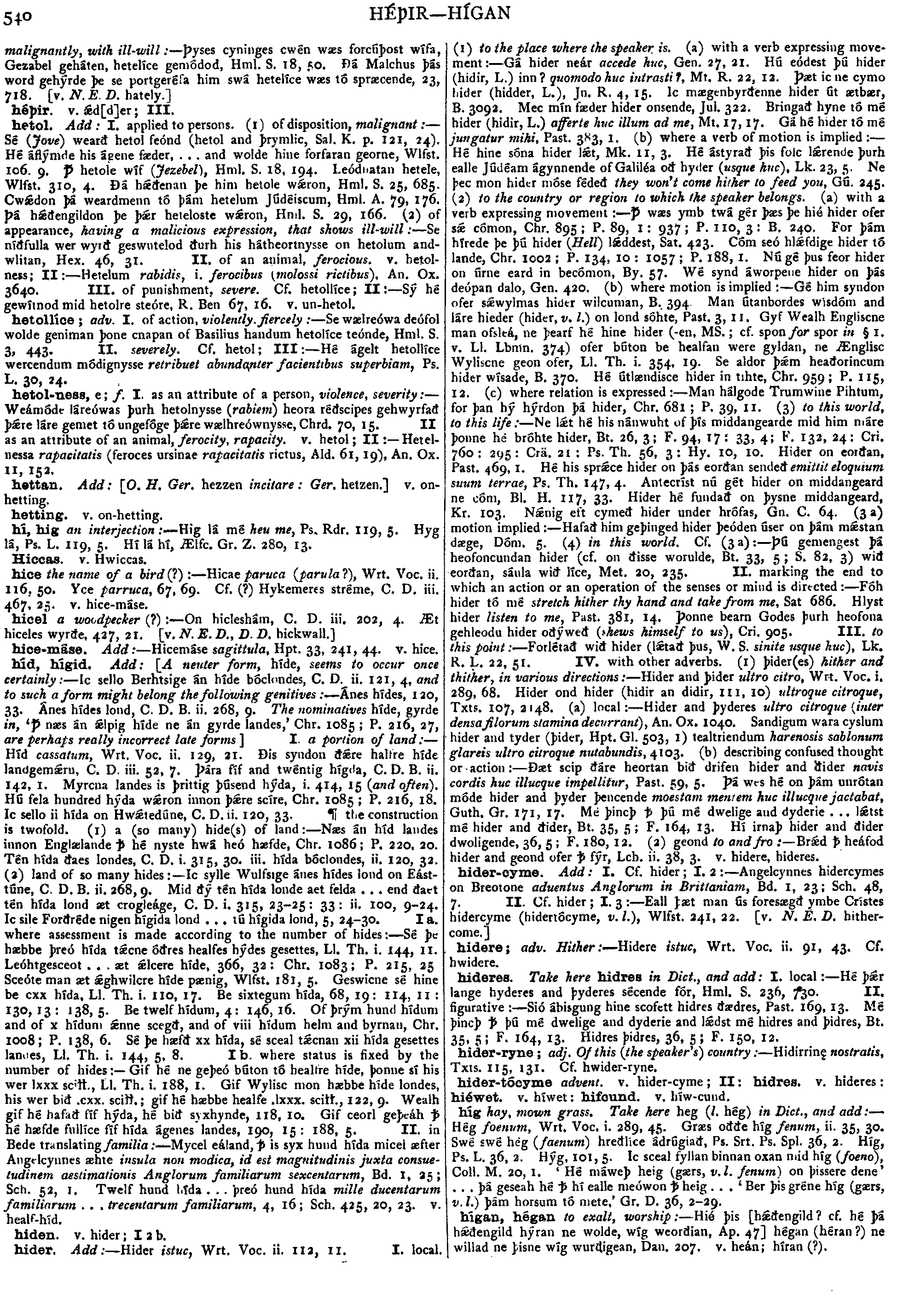
híg
hay,
mown
grass.
Take
here
heg
(l.
hég)
in
Dict.,
and
add
:--
Hég
foenum,
Wrt.
Voc.
i.
289,
45.
Græs
oððe
hig
fenum,
ii.
35,
30.
Swé
swé
hég
(faenum)
hreðlíce
ádrúgiað.
Ps.
Srt.
Ps.
Spl.
36,
2.
Híg,
Ps.
L.
36,
2.
Hýg,
101,
5.
Ic
sceal
fyllan
binnan
oxan
mid
híg
(foeno),
Coll.
M.
20,
l.
'Hé
máweþ
heig
(gærs,
v.l.
fenum)
on
þissere
dene'
.
.
.
þá
geseah
hé
hí
ealle
meówon
heig
.
.
.
'
Ber
þis
gréne
híg
(gærs,
v.l.)
þám
horsum
tó
mete,'
Gr.
D.
36,
2-29.
|
Source: Bosworth/Toller, page d0548, entry 5 View original page image as: [TIFF] [PNG] [View previous entry] [View next entry] |
[Comment on this entry] [View comments] |
The following entry has been hand-corrected once. |
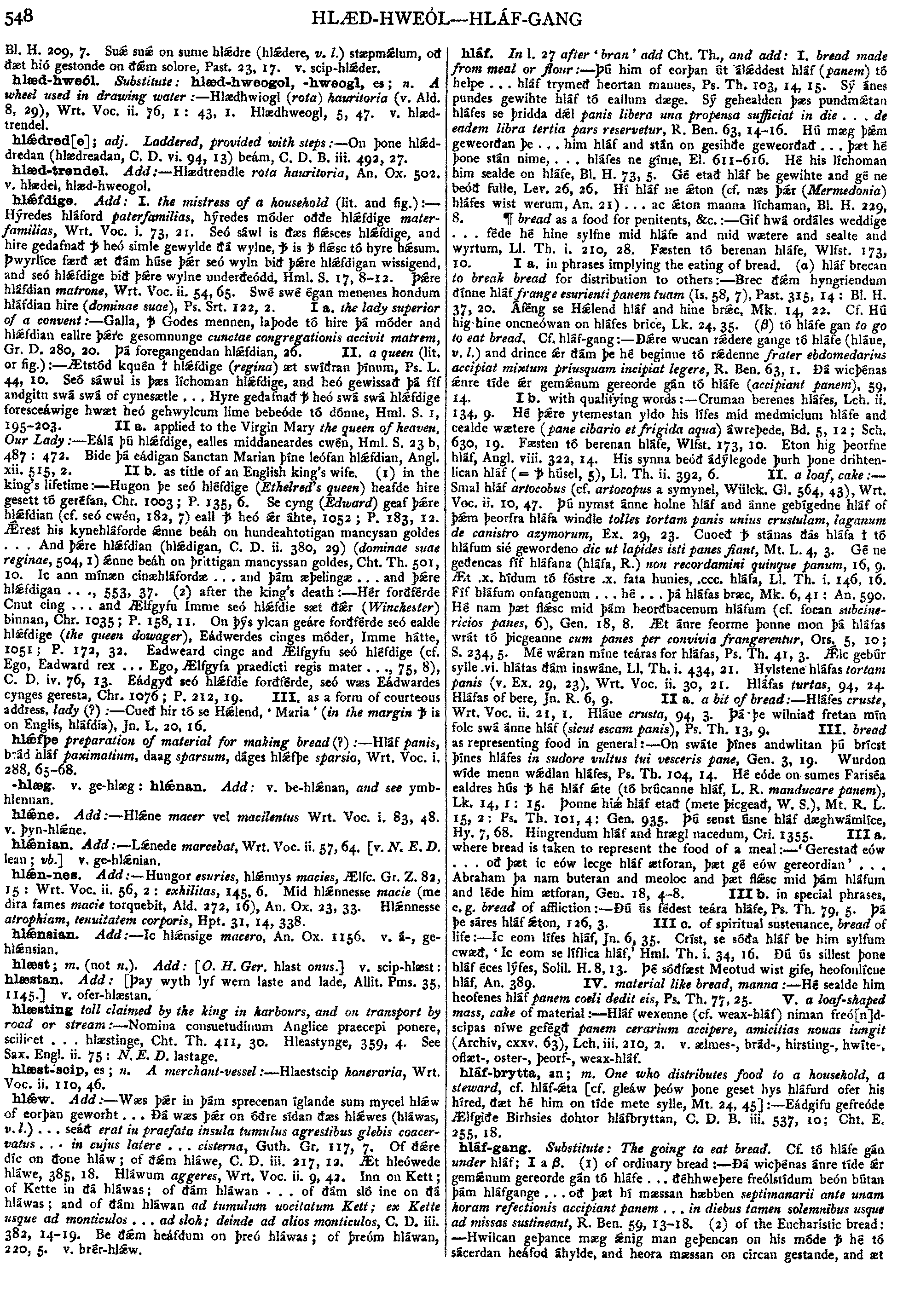
hlfdige.
Add:
I.
the
mistress
of
a
household
(lit.
and
fig.)
:--
Hýredes
hláford
paterfamilias,
hýredes
móder
oððe
hlfdige
materfamilias,
Wrt.
Voc.
i.
73,
21.
Seó
sáwl
is
ðæs
flsces
hlfdige,
and
hire
gedafnað
heó
simle
gewylde
ðá
wylne,
is
flsc
tó
hyre
hsum.
Þwyrlíce
færð
æt
ðám
húse
þr
seó
wyln
bið
þre
hlfdigan
wissigend,
and
seó
hlfdige
bið
þre
wylne
underðeódd.
Hml.
S.
17,
8-12.
Þre
hláfdian
matrone,
Wrt.
Voc.
ii.
54,
65.
Swé
swé
égan
menenes
hondum
hláfdian
hire
(dominae
suae),
Ps.
Srt.
122,
2.
I
a.
the
lady
superior
of
a
convent
:--
Galla,
Godes
mennen,
laþode
tó
hire
þá
móder
and
hlfdian
eallre
þre
gesomnunge
cunctae
congregationis
accivit
matrem,
Gr.
D.
280,
20.
Þá
foregangendan
hlfdian,
26.
II.
a
queen
(lit.
or
fig.)
:--
Ætstód
kquén
hlfdige
(regina)
æt
swíðran
þínum,
Ps.
L.
44,
10.
Seó
sáwul
is
þæs
líchoman
hlfdige,
and
heó
gewissað
þá
fíf
andgitn
swá
swá
of
cynesætle
...
Hyre
gedafnað
heó
swá
swá
hlfdige
foresceáwige
hwæt
heó
gehwylcum
lime
bebeóde
tó
dónne,
Hml.
S.
1,
195-203.
II
a.
applied
to
the
Virgin
Mary
the
queen
of
heaven,
Our
Lady
:--
Eálá
þú
hlfdige,
ealles
middaneardes
cwén,
Hml.
S.
23
b,
487:
472.
Bide
þá
eádigan
Sanctan
Marian
þíne
leófan
hlfdian,
Angl.
xii.
515,
2.
II
b.
as
title
of
an
English
king's
wife.
(1)
in
the
king's
lifetime
:--
Hugon
þe
seó
hléfdige
(Ethelred's
queen)
heafde
hire
gesett
tó
geréfan,
Chr.
1003;
P.
135,
6.
Se
cyng
(Edward)
geaf
þre
hlfdian
(cf.
seó
cwén,
182,
7)
eall
heó
r
áhte,
1052;
P.
183,
12.
Æ-acute;rest
his
kynehláforde
nne
beáh
on
hundeahtotigan
mancysan
goldes
...
And
þre
hlfdian
(hldigan,
C.D.
ii.
380,
29)
(dominae
suae
reginae,
504,
1)
nne
beáh
on
þrittigan
mancyssan
goldes,
Cht.
Th.
501,
10.
Ic
ann
mínæn
cinæhláfordæ
...
and
þám
æþelingæ
...
and
þre
hlfdigan
...,
553,
37.
(2)
after
the
king's
death
:--
Hér
forðférde
Cnut
cing
...
and
Ælfgyfu
Imme
seó
hlfdie
sæt
ðr
(Winchester)
binnan,
Chr.
1035;
P.
158,
11.
On
þýs
ylcan
geáre
forðférde
seó
ealde
hlfdige
(the
queen
dowager),
Eádwerdes
cinges
móder,
Imme
hátte,
1051;
P.
172,
32.
Eadweard
cingc
and
Ælfgyfu
seó
hléfdige
(cf.
Ego,
Eadward
rex
...
Ego,
Ælfgyfa
praedicti
regis
mater
...,
75,
8),
C.D.
iv.
76,
13.
Eádgyð
seó
hlfdie
forðférde,
seó
wæs
Eádwardes
cynges
geresta,
Chr.
1076;
P.
212,
19.
III.
as
a
form
of
courteous
address,
lady(?)
:--
Cueð
hir
tó
se
Hlend,
'Maria'
(in
the
margin
is
on
Englis,
hláfdia),
Jn.
L.
20,
16.
|
Source: Bosworth/Toller, page d0574, entry 1 View original page image as: [TIFF] [PNG] [View previous entry] [View next entry] |
[Comment on this entry] [View comments] |
The following entry has been hand-corrected once. |
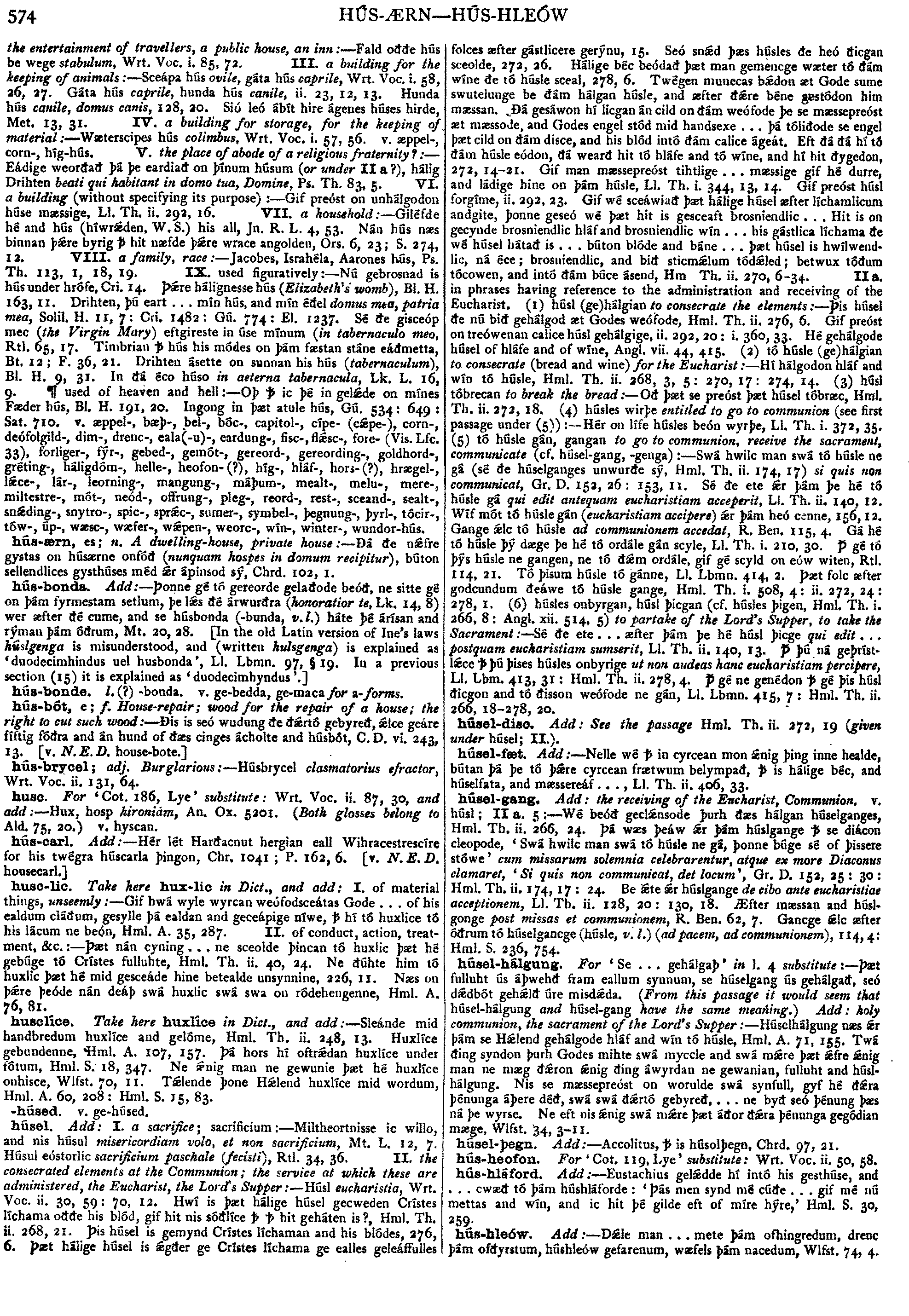
the
entertainment
of
travellers,
a
public
house,
an
inn
:--
Fald
oððe
hús
be
wege
stabulum.
Wrt.
Voc.
i.
85,
72.
III.
a
building
for
the
keeping
of
animals
:--
Sceápa
hús
ovile,
gáta
hús
caprile,
Wrt.
Voc.
i.
58,
26,
27.
Gáta
hús
caprile,
hunda
hús
canile,
ii.
23,
12,
13.
Hunda
hús
canile,
domus
canis,
128,
20.
Sió
leó
ábít
hire
ágenes
húses
hirde,
Met.
13,
31.
IV.
a
building
for
storage,
for
the
keeping
of
material;
--Wæterscipes
hús
colimbus,
Wrt.
Voc.
i.
57,
56.
v.
æppel-,
corn-,
híg-hús.
V.
the
place
of
abode
of
a
religious
fraternity
?
:--
Eádige
weorðað
þá
þe
eardiað
on
þ
ínum
húsum
(or
under
II
a?),
hálig
Drihten
beati
qui
habitant
in
domo
tua,
Domine,
Ps.
Th.
83,
5.
VI.
a
building
(without
specifying
its
purpose)
:--
Gif
preóst
on
unhálgodon
húse
mæssige,
Ll.
Th.
ii.
292,
16.
VII.
a
household
:--
Giléfde
hé
and
hús
(híwrden.
W.S.)
his
all,
Jn.
R.
L.
4,
53.
Nán
hús
næs
binnan
þre
byrig
hit
næfde
þre
wrace
angolden,
Ors.
6,
23;
S.
274,
12.
VIII.
a
family,
race
:--
Jacobes,
Israhéla,
Aarones
hús,
Ps.
Th.
113,
1.
18,
19.
IX.
used
figuratively
:--
Nú
gebrosnad
is
hús
under
hrófe,
Cri.
14.þre
hálignesse
hús
(Elizabeth's
womb),
Bl.
H.
163,
11.
Drihten,
þú
eart
.
.
.
min
hús,
and
nun
éðel
domus
mea,
patria
mea,
Solil.
H.
ii.
7:
Cri.
1482:
Gú.
774:
El.
1237.
Sé
ðe
gisceóp
mec
(the
Virgin
Mary)
eftgireste
in
úse
mínum
(in
tabernaculo
meo,
Rtl.
65,
17.
Timbrian
hús
his
módes
on
þám
fæstan
stáne
eáðmetta,
Bt.
12
;
F.
36,
21.
Drihten
ásette
on
sunnan
his
hús
(tabernaculum),
Bl.
H.
9,
31.
In
ð
á
éco
húso
in
aeterna
tabernacula,
Lk.
L.
16,
9.
used
of
heaven
and
hell
:--
Oþ
ic
þe
in
gelde
on
mínes
Fæder
hús,
Bl.
H.
191,
20.
Ingong
in
þæt
atule
hús,
Gú.
534:
649
:
Sat.
710.
v.
æppel-,
bæþ-,
bel-,
bóc-,
capitol-.
cípe-
(cpe-),
corn-,
deófolgild-,
dim-,
drenc-,
eala(-u)-,
eardung-,
fisc-,
flsc-,
fore-
(Vis.
Lfc.
33),
forliger-,
fyr-,
gebed-,
gemót-,
gereord-,
gereording-,
goldhord-,
gréting-,
háligdóm-,
helle-,
heofon-(?),
híg-,
hláf-,
hors-(?),
hrægel-,
lce-,
lár-,
leorning-,
mangung-,
máþum-,
mealt-,
melu-,
mere-,
miltestre-,
mot-,
neód-,
offrung-,
pleg-,
reord-,
rest-,
sceand-,
sealt-,
snding-,
snytro-,
spic-,
sprc-,
sumer-,
symbel-,
þegnung-,
þyrl-,
tðcir-,
tów-,
úp-,
wxsc-,
wæfer-,
wpen-,
weorc-,
win-,
winter-,
wundor-hús.
|
Source: Bosworth/Toller, page d0577, entry 8 View original page image as: [TIFF] [PNG] [View previous entry] [View next entry] |
[Comment on this entry] [View comments] |
The following entry has been hand-corrected once. |
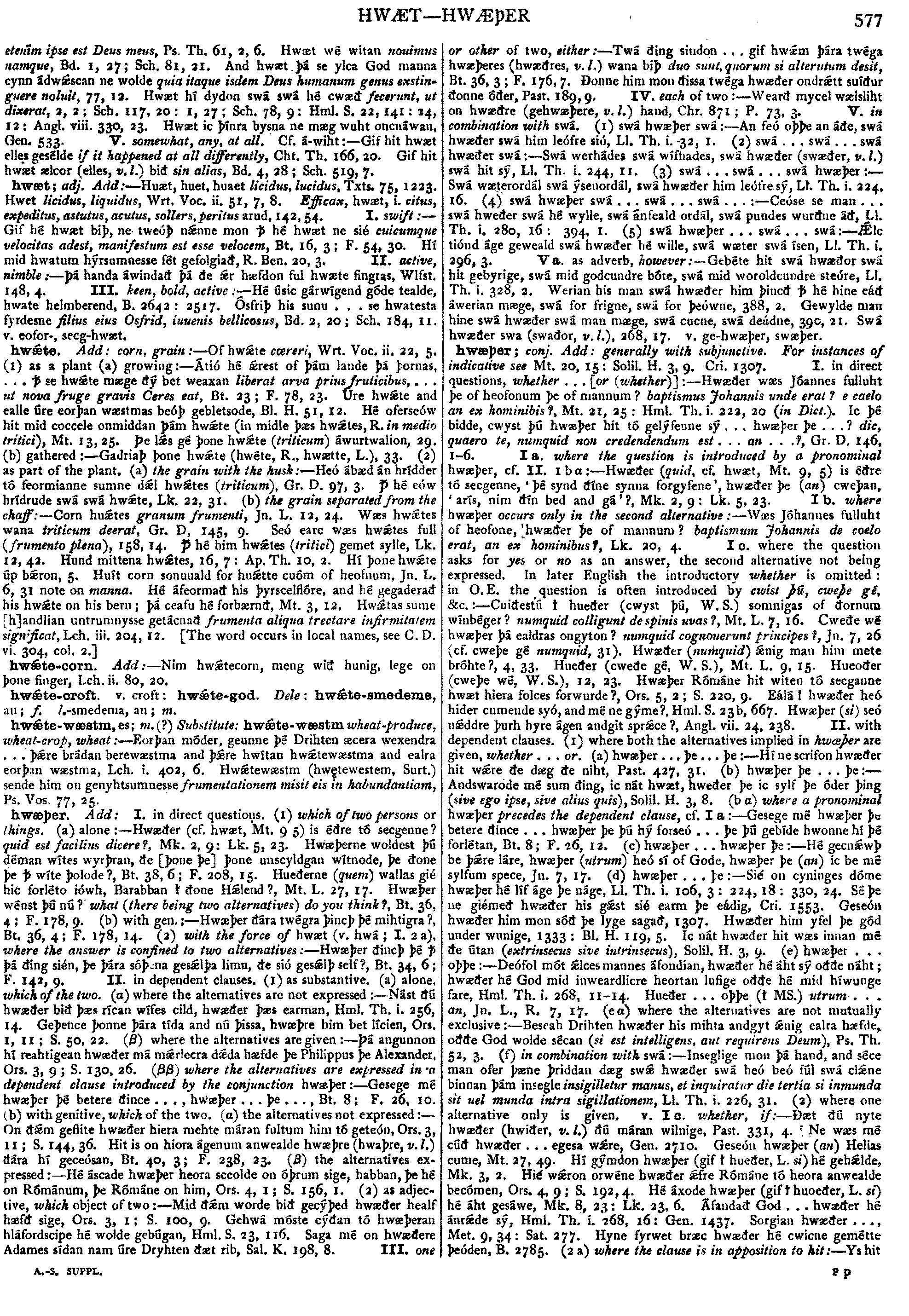
hwæþer;
conj.
Add:
generally
with
subjunctive.
For
instances
of
indicative
see
Mt.
20,
15:
Solil.
H.
3,
9.
Cri.
1307.
I.
in
direct
questions,
whether
...
[or
(whither)]
:--
Hwæðer
wæs
Jóannes
fulluht
þe
of
heofonum
þe
of
mannum?
baptismus
Johannis
unde
erat?
e
caelo
an
ex
hominibis?,
Mt.
21,
25:
Hml.
Th.
i.
222,
20
(in
Dict.).
Ic
þé
bidde,
cwyst
þú
hwæþer
hit
tó
gelýfenne
sý
...
hwæþer
þe
...?
dic,
quaero
te,
numquid
nan
credendendum
est
...
an
...?,
Gr.
D.
146,
1-6.
I
a.
where
the
question
is
introduced
by
a
pronominal
hwæþer,
cf.
II.
1
b
 :--
Hwæðer
(quid,
cf.
hwæt,
Mt.
9,
5)
is
éðre
tó
secgenne,
'þé
synd
ðíne
synna
forgyfene',
hwæðer
þe
(an)
cweþan,
'arís,
nim
ðín
bed
and
gá'?.
Mk.
2,
9:
Lk.
5,
23.
I
b.
where
hwæþer
occurs
only
in
the
second
alternative
:--
Wæs
Jóhannes
fulluht
of
heofone,
hwæðer
þe
of
mannum?
baptismum
Johannis
de
coelo
erat,
an
ex
hominibus?,
Lk.
20,
4.
I
c.
where
the
question
asks
for
yes
or
no
as
an
answer,
the
second
alternative
not
being
expressed.
In
later
English
the
introductory
whether
is
omitted:
in
O.
E.
the
question
is
often
introduced
by
cwist
þú,
cweþe
gé,
&c.:--
Cuiðestú
hueðer
(cwyst
þú,
W.
S.)
somnigas
of
ðornum
wínbéger?
numquid
colligunt
de
spinis
uvas?,
Mt.
L.
7,
16.
Cweðe
wé
hwæþer
þá
ealdras
ongyton?
numquid
cognouerunt
principes?,
Jn.
7,
26
(cf.
cweþe
gé
numquid,
31).
Hwæðer
(numquid)
nig
man
him
mete
bróhte?,
4,
33.
Hueðer
(cweðe
gé,
W.
S.),
Mt.
L.
9,
15.
Hueoðer
(cweþe
wé,
W.
S.),
12,
23.
Hwæþer
Rómáne
hit
witen
tó
secganne
hwæt
hiera
folces
forwurde?,
Ors.
5,
2;
S.
220,
9.
Eálá!
hwæðer
heó
hider
cumende
syó,
and
mé
ne
gýme?,
Hml.
S.
23
b,
667.
Hwæþer
(si)
seó
nddre
þurh
hyre
ágen
andgit
sprce?,
Angl.
vii.
24,
238.
II.
with
dependent
clauses.
(1)
where
both
the
alternatives
implied
in
hwæþer
are
given,
whether
...
or.
(a)
hwæþer
...
þe
...
þe
:--
Hí
ne
scrifon
hwæðer
hit
wre
ðe
dæg
ðe
niht,
Past.
427,
31.
(b)
hwæþer
þe
...
þe
:--
Andswarode
mé
sum
ðing,
ic
nát
hwæt,
hweðer
þe
ic
sylf
þe
óder
þing
(sive
ego
ipse,
sive
alias
quis),
Solil.
H.
3,
8.
(b
)
where
a
pronominal
hwæþer
precedes
the
dependent
clause,
cf.
I
a
:--
Gesege
mé
hwæþer
þe
betere
ðince
...
hwæþer
þe
þú
hý
forseó
...
þe
þú
gebíde
hwonne
hí
þé
forlétan,
Bt.
8;
F.
26,
12.
(c)
hwæþer
...
hwæþer
þe
:--
Hé
gecnwþ
be
þre
láre,
hwæþer
(utrum)
heó
sí
of
Gode,
hwæþer
þe
(an)
ic
be
mé
sylfum
spece,
Jn.
7,
17.
(d)
hwæþer
...
þe
:--
Sié
on
cyninges
dóme
hwæþer
hé
líf
áge
þe
náge,
Ll.
Th.
i.
106,
3:
224,
18:
330,
24.
Sé
þe
ne
giémeð
hwæðer
his
gst
sié
earm
þe
eádig,
Cri.
1553.
Geseón
hwæðer
him
mon
sóð
þe
lyge
sagað,
1307.
Hwæðer
him
yfel
þe
gód
under
wunige,
1333:
Bl.
H.
119,
5.
Ic
nát
hwæðer
hit
wæs
innan
mé
ðe
útan
(extrinsecus
sive
intrinsecus),
Solil.
H.
3,
9.
(e)
hwæþer
...
oþþe
:--
Deófol
mót
lces
mannes
áfondian,
hwæðer
hé
áht
sý
oððe
náht;
hwæðer
hé
God
mid
inweardlicre
heortan
lufige
oððe
hé
mid
híwunge
fare,
Hml.
Th.
i.
268,
11-14.
Hueðer
...
oþþe
(
MS.)
utrum
...
an,
Jn.
L.,
R.
7,
17.
(e
)
where
the
alternatives
are
not
mutually
exclusive
:--
Beseah
Drihten
hwæðer
his
mihta
andgyt
nig
ealra
hæfde,
oððe
God
wolde
sécan
(si
est
intelligens,
aut
requirens
Deum),
Ps.
Th.
52,
3.
(f)
in
combination
with
swá
:--
Inseglige
mon
þá
hand,
and
séce
man
ofér
þæne
þriddan
dæg
sw
hwæðer
swá
heó
beó
fúl
swá
clne
binnan
þám
insegle
insigilletur
manus,
et
inquiratur
die
tertia
si
inmunda
sit
uel
munda
intra
sigillationem,
Ll.
Th.
i.
226,
31.
(2)
where
one
alternative
only
is
given.
v.
I
c.
whether,
if
:--
Ðæt
ðú
nyte
hwæðer
(hwiðer,
v.
l.)
ðú
máran
wilnige,
Past.
331,
4.
Ne
wæs
mé
cúð
hwæðer
...
egesa
wre,
Gen.
2710.
Geseón
hwæþer
(an)
Helias
cume,
Mt.
27,
49.
Hí
gýmdon
hwæþer
(gif
hueðer,
L.
si)
hé
gehlde,
Mk.
3,
2.
Hié
wron
orwéne
hwæðer
fre
Rómáne
tó
heora
anwealde
becómen,
Ors.
4,
9;
S.
192,
4.
Hé
áxode
hwæþer
(gif
huoeðer,
L.
si)
hé
áht
gesáwe,
Mk.
8,
23:
Lk.
23,
6.
Áfandað
God
...
hwæðer
hé
ánrde
sý,
Hml.
Th.
i.
268,
16:
Gen.
1437.
Sorgian
hwæðer
...,
Met.
9,
34:
Sat.
277.
Hyne
fyrwet
bræc
hwæðer
hé
cwicne
gemétte
þeóden,
B.
2785.
(2
a)
where
the
clause
is
in
apposition
to
kit
:--
Ys
hit
:--
Hwæðer
(quid,
cf.
hwæt,
Mt.
9,
5)
is
éðre
tó
secgenne,
'þé
synd
ðíne
synna
forgyfene',
hwæðer
þe
(an)
cweþan,
'arís,
nim
ðín
bed
and
gá'?.
Mk.
2,
9:
Lk.
5,
23.
I
b.
where
hwæþer
occurs
only
in
the
second
alternative
:--
Wæs
Jóhannes
fulluht
of
heofone,
hwæðer
þe
of
mannum?
baptismum
Johannis
de
coelo
erat,
an
ex
hominibus?,
Lk.
20,
4.
I
c.
where
the
question
asks
for
yes
or
no
as
an
answer,
the
second
alternative
not
being
expressed.
In
later
English
the
introductory
whether
is
omitted:
in
O.
E.
the
question
is
often
introduced
by
cwist
þú,
cweþe
gé,
&c.:--
Cuiðestú
hueðer
(cwyst
þú,
W.
S.)
somnigas
of
ðornum
wínbéger?
numquid
colligunt
de
spinis
uvas?,
Mt.
L.
7,
16.
Cweðe
wé
hwæþer
þá
ealdras
ongyton?
numquid
cognouerunt
principes?,
Jn.
7,
26
(cf.
cweþe
gé
numquid,
31).
Hwæðer
(numquid)
nig
man
him
mete
bróhte?,
4,
33.
Hueðer
(cweðe
gé,
W.
S.),
Mt.
L.
9,
15.
Hueoðer
(cweþe
wé,
W.
S.),
12,
23.
Hwæþer
Rómáne
hit
witen
tó
secganne
hwæt
hiera
folces
forwurde?,
Ors.
5,
2;
S.
220,
9.
Eálá!
hwæðer
heó
hider
cumende
syó,
and
mé
ne
gýme?,
Hml.
S.
23
b,
667.
Hwæþer
(si)
seó
nddre
þurh
hyre
ágen
andgit
sprce?,
Angl.
vii.
24,
238.
II.
with
dependent
clauses.
(1)
where
both
the
alternatives
implied
in
hwæþer
are
given,
whether
...
or.
(a)
hwæþer
...
þe
...
þe
:--
Hí
ne
scrifon
hwæðer
hit
wre
ðe
dæg
ðe
niht,
Past.
427,
31.
(b)
hwæþer
þe
...
þe
:--
Andswarode
mé
sum
ðing,
ic
nát
hwæt,
hweðer
þe
ic
sylf
þe
óder
þing
(sive
ego
ipse,
sive
alias
quis),
Solil.
H.
3,
8.
(b
)
where
a
pronominal
hwæþer
precedes
the
dependent
clause,
cf.
I
a
:--
Gesege
mé
hwæþer
þe
betere
ðince
...
hwæþer
þe
þú
hý
forseó
...
þe
þú
gebíde
hwonne
hí
þé
forlétan,
Bt.
8;
F.
26,
12.
(c)
hwæþer
...
hwæþer
þe
:--
Hé
gecnwþ
be
þre
láre,
hwæþer
(utrum)
heó
sí
of
Gode,
hwæþer
þe
(an)
ic
be
mé
sylfum
spece,
Jn.
7,
17.
(d)
hwæþer
...
þe
:--
Sié
on
cyninges
dóme
hwæþer
hé
líf
áge
þe
náge,
Ll.
Th.
i.
106,
3:
224,
18:
330,
24.
Sé
þe
ne
giémeð
hwæðer
his
gst
sié
earm
þe
eádig,
Cri.
1553.
Geseón
hwæðer
him
mon
sóð
þe
lyge
sagað,
1307.
Hwæðer
him
yfel
þe
gód
under
wunige,
1333:
Bl.
H.
119,
5.
Ic
nát
hwæðer
hit
wæs
innan
mé
ðe
útan
(extrinsecus
sive
intrinsecus),
Solil.
H.
3,
9.
(e)
hwæþer
...
oþþe
:--
Deófol
mót
lces
mannes
áfondian,
hwæðer
hé
áht
sý
oððe
náht;
hwæðer
hé
God
mid
inweardlicre
heortan
lufige
oððe
hé
mid
híwunge
fare,
Hml.
Th.
i.
268,
11-14.
Hueðer
...
oþþe
(
MS.)
utrum
...
an,
Jn.
L.,
R.
7,
17.
(e
)
where
the
alternatives
are
not
mutually
exclusive
:--
Beseah
Drihten
hwæðer
his
mihta
andgyt
nig
ealra
hæfde,
oððe
God
wolde
sécan
(si
est
intelligens,
aut
requirens
Deum),
Ps.
Th.
52,
3.
(f)
in
combination
with
swá
:--
Inseglige
mon
þá
hand,
and
séce
man
ofér
þæne
þriddan
dæg
sw
hwæðer
swá
heó
beó
fúl
swá
clne
binnan
þám
insegle
insigilletur
manus,
et
inquiratur
die
tertia
si
inmunda
sit
uel
munda
intra
sigillationem,
Ll.
Th.
i.
226,
31.
(2)
where
one
alternative
only
is
given.
v.
I
c.
whether,
if
:--
Ðæt
ðú
nyte
hwæðer
(hwiðer,
v.
l.)
ðú
máran
wilnige,
Past.
331,
4.
Ne
wæs
mé
cúð
hwæðer
...
egesa
wre,
Gen.
2710.
Geseón
hwæþer
(an)
Helias
cume,
Mt.
27,
49.
Hí
gýmdon
hwæþer
(gif
hueðer,
L.
si)
hé
gehlde,
Mk.
3,
2.
Hié
wron
orwéne
hwæðer
fre
Rómáne
tó
heora
anwealde
becómen,
Ors.
4,
9;
S.
192,
4.
Hé
áxode
hwæþer
(gif
huoeðer,
L.
si)
hé
áht
gesáwe,
Mk.
8,
23:
Lk.
23,
6.
Áfandað
God
...
hwæðer
hé
ánrde
sý,
Hml.
Th.
i.
268,
16:
Gen.
1437.
Sorgian
hwæðer
...,
Met.
9,
34:
Sat.
277.
Hyne
fyrwet
bræc
hwæðer
hé
cwicne
gemétte
þeóden,
B.
2785.
(2
a)
where
the
clause
is
in
apposition
to
kit
:--
Ys
hit
|
Source: Bosworth/Toller, page d0578, entry 1 View original page image as: [TIFF] [PNG] [View previous entry] [View next entry] |
[Comment on this entry] [View comments] |
The following entry has been hand-corrected once. |
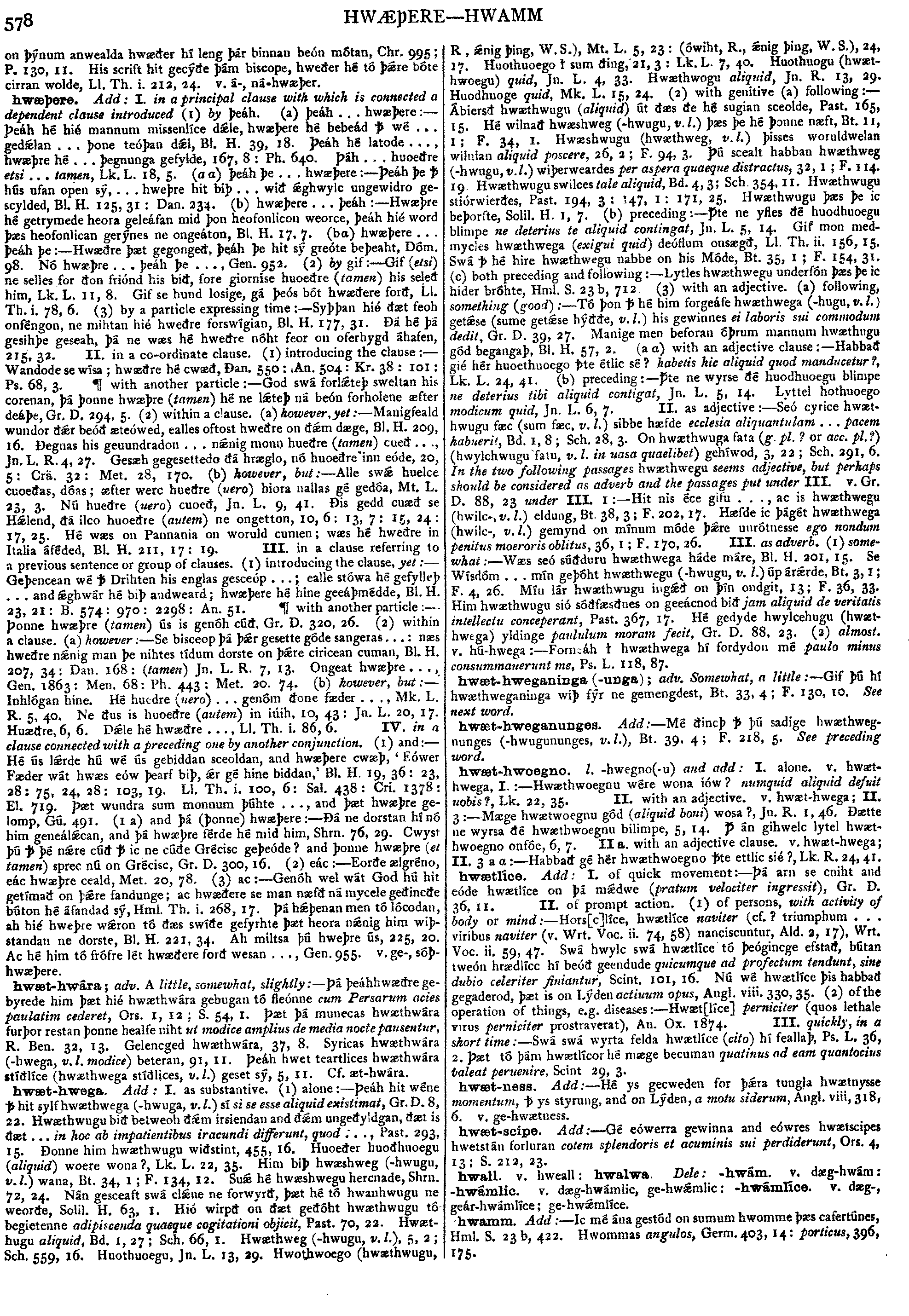
on
þýnum
anwealda
hwæðer
hí
leng
þár
binnan
beón
mótan,
Chr.
995;
P.
130,
11.
His
scrift
hit
gecýðe
þám
biscope,
hweðer
hé
tó
þre
bóte
cirran
wolde,
Ll.
Th.
i.
212,
24.
v.
á-,
ná-hwæþer.
|
Source: Bosworth/Toller, page d0603, entry 13 View original page image as: [TIFF] [PNG] [View previous entry] [View next entry] |
[Comment on this entry] [View comments] |
The following entry has been hand-corrected once. |
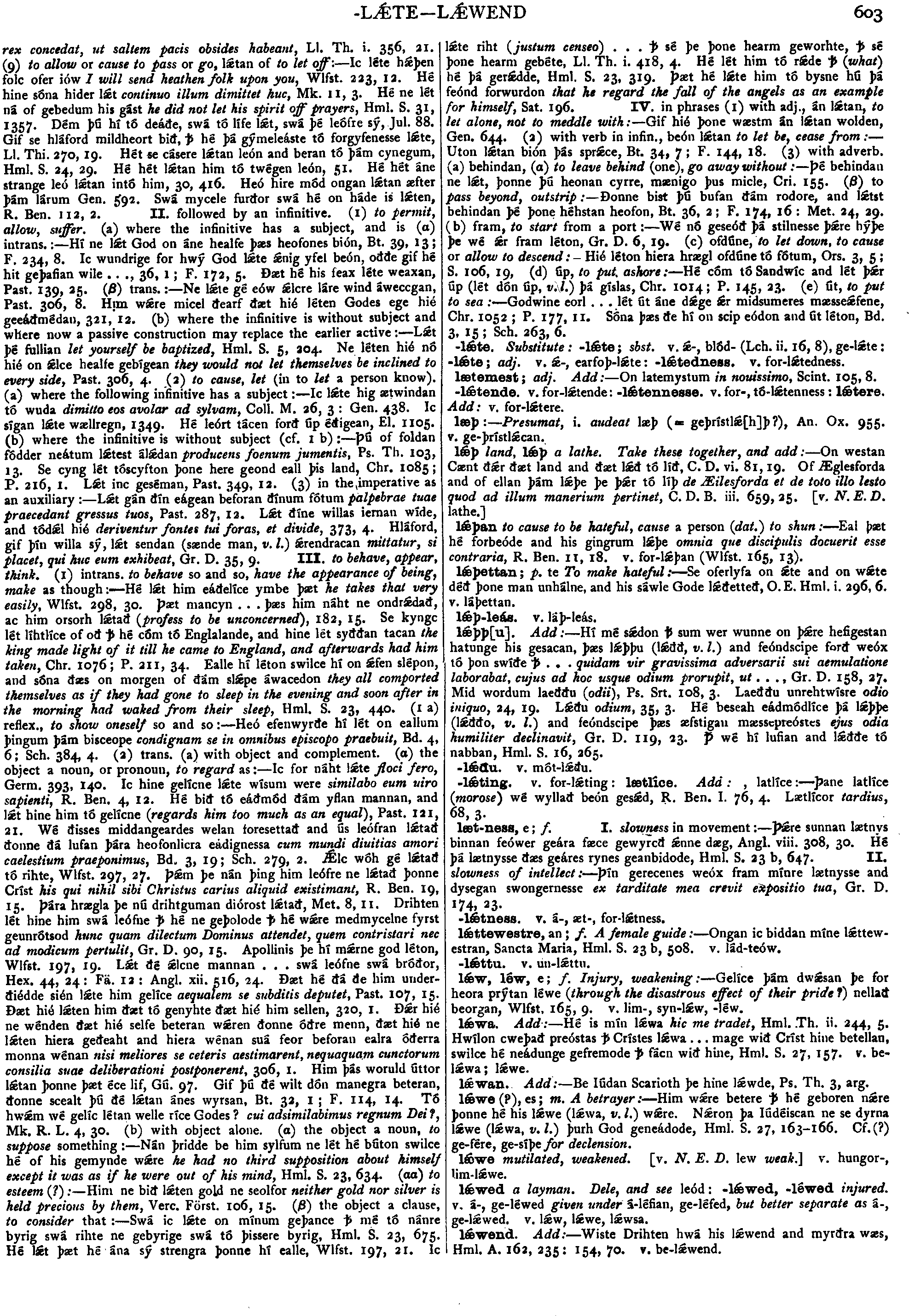
læt-ness,
e;
f.
I.
slowness
in
movement
:--
Þre
sunnan
lætnys
binnan
feówer
geára
fæce
gewyrcð
nne
dæg,
Angl.
viii.
308,
30.
Hé
þá
lætnysse
ðæs
geáres
rynes
geanbidode,
Hml.
S.
23
b,
647.
II.
slowness
of
intellect
:--
Þín
gerecenes
weóx
fram
mínre
lætnysse
and
dysegan
swongernesse
ex
tarditate
mea
crevit
expositio
tua,
Gr.
D.
174.
23.
|
Source: Bosworth/Toller, page d0605, entry 1 View original page image as: [TIFF] [PNG] [View previous entry] [View next entry] |
[Comment on this entry] [View comments] |
The following entry has been hand-corrected once. |
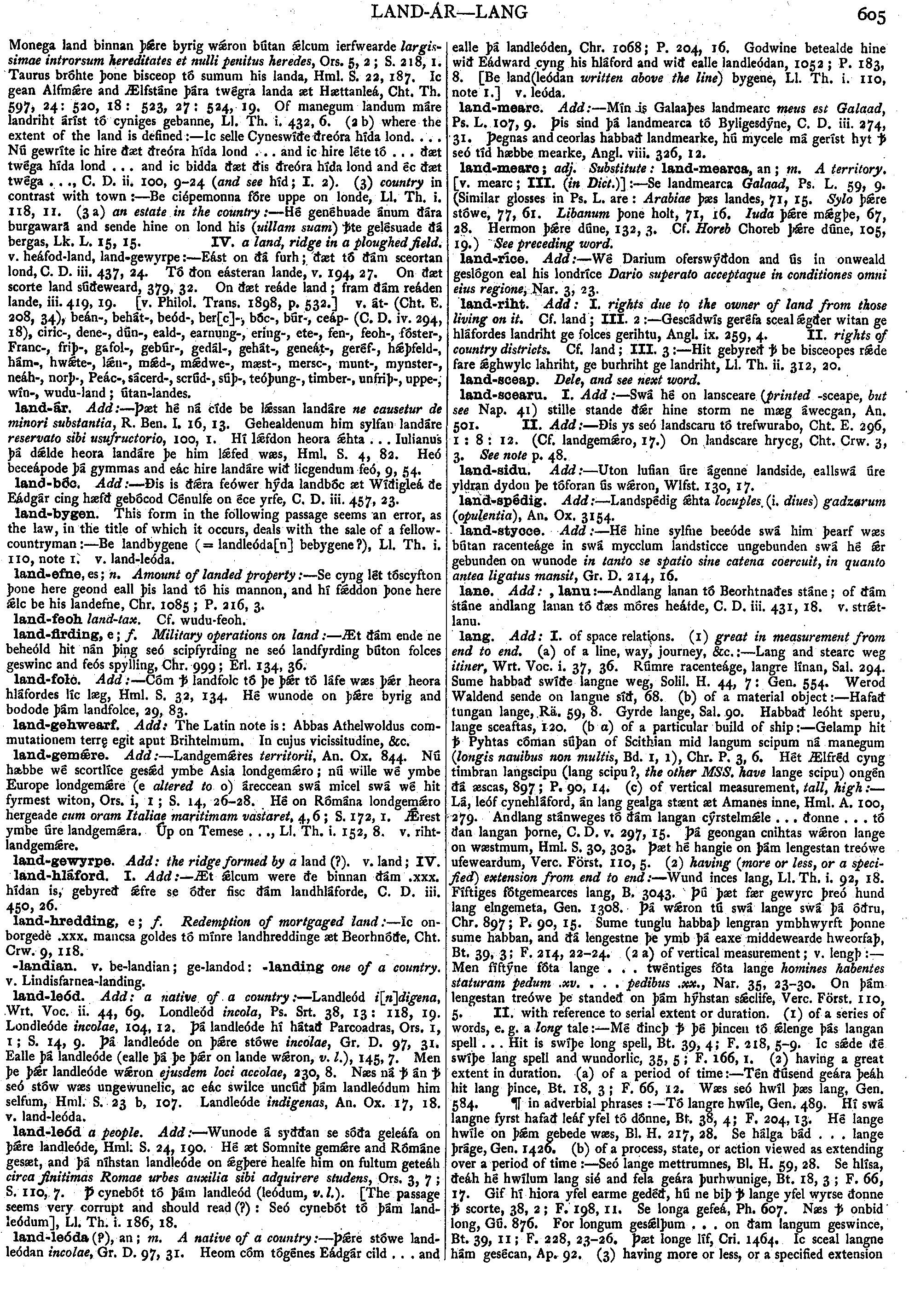
Monega
land
binnan
þre
byrig
wron
bútan
lcum
ierfwearde
largissimae
introrsum
hereditates
et
nulli
penitus
heredes,
Ors.
5,
2
;
S.
218,
1.
Taurus
bróhte
þone
bisceop
tó
sumum
his
landa,
Hml.
S.
22,
187.
Ic
gean
Alfmre
and
Ælfstáne
þára
twégra
landa
æt
Hættanleá,
Cht.
Th.
597,
24:
520,
18
:
523,
27:
524,
19.
Of
manegum
landum
máre
landriht
áríst
tó
cyniges
gebanne,
LI.
Th.
i.
432,
6.
(2
b)
where
the
extent
of
the
land
is
defined
:--
Ic
selle
Cyneswíde
ðreóra
hída
lond.
...
Nú
gewríte
ic
hire
ðæt
ðreóra
hída
lond
.
..
and
ic
hire
léte
tó
.
.
.
ðæt
twéga
hída
lond
.
..
and
ic
bidda
ðæt
ðis
ðreóra
hída
lond
and
éc
ðæt
twéga
.
.
.,
C.
D.
ii.
100,
9-24
(and
see
híd;
I.
2).
(3)
country
in
contrast
with
town
:--
Be
ciépemonna
fóre
uppe
on
londe,
LI.
Th.
i.
118,
11.
(3
a)
on
estate
in
the
country
:--
Hé
genéhuade
ánum
ðára
burgawará
and
sende
hine
on
lond
his
(uillam
suam)
te
gelésuade
ðá
bergas,
Lk.
L.
15,
15.
IV.
a
land,
ridge
in
a
ploughed
field.
v.
heáfod-land,
land-gewyrpe
:--
Eást
on
ðá
furh;
ðæt
tó
ðám
sceortan
lond,
C.
D.
iii.
437,
24.
Tó
ðon
eásteran
lande,
v.
194,
27.
On
ðæt
scorte
land
súðeweard,
379,
32.
On
ðæt
reáde
land;
fram
ðám
reáden
lande,
iii.
419,
19.
[v.
Philol.
Trans.
1898,
p.
532.]
v.
át-
(Cht.
E.
208,
34),
beán-,
behát-,
beód-,
ber[c]-,
bóc-,
búr-,
ceáp-
(C.
D.
iv.
294,
18),
ciric-,
dene-,
dún-,
eald-,
earnung-,
ering-,
ete-,
fen-,
feoh-,
fóster-,
Franc-,
friþ-,
gafol-,
gebúr-,
gedál-,
gehát-,
geneát-,
geréf-,
hþfeld-,
hám-,
hwte-,
ln-,
md-,
mdwe-,
mæst-,
mersc-,
munt-,
mynster-,
neáh-,
norþ-,
Peác-,
sácerd-,
scrúd-,
súþ-,
teóþung-,
timber-,
unfriþ-,
uppe-,
wín-,
wudu-land
;
útan-landes.
| Result Page: |  |
Previous | 10 11 12 13 14 15 16 17 18 19 20 21 22 23 | Next |  |
Germanic Lexicon Project (main page)
This search system was written by
Sean Crist
Please consider
volunteering
to correct the data in these online dictionaries.
No rights reserved. Feel free to use these data in any way you please.