|
|

Tip: In the search results, you can click on any word or abbreviation for more information.
|
Source: Bosworth/Toller, page b0576, entry 15 View original page image as: [TIFF] [PNG] [View previous entry] [View next entry] |
[Comment on this entry] [View comments] |
The following entry has been hand-corrected once. |
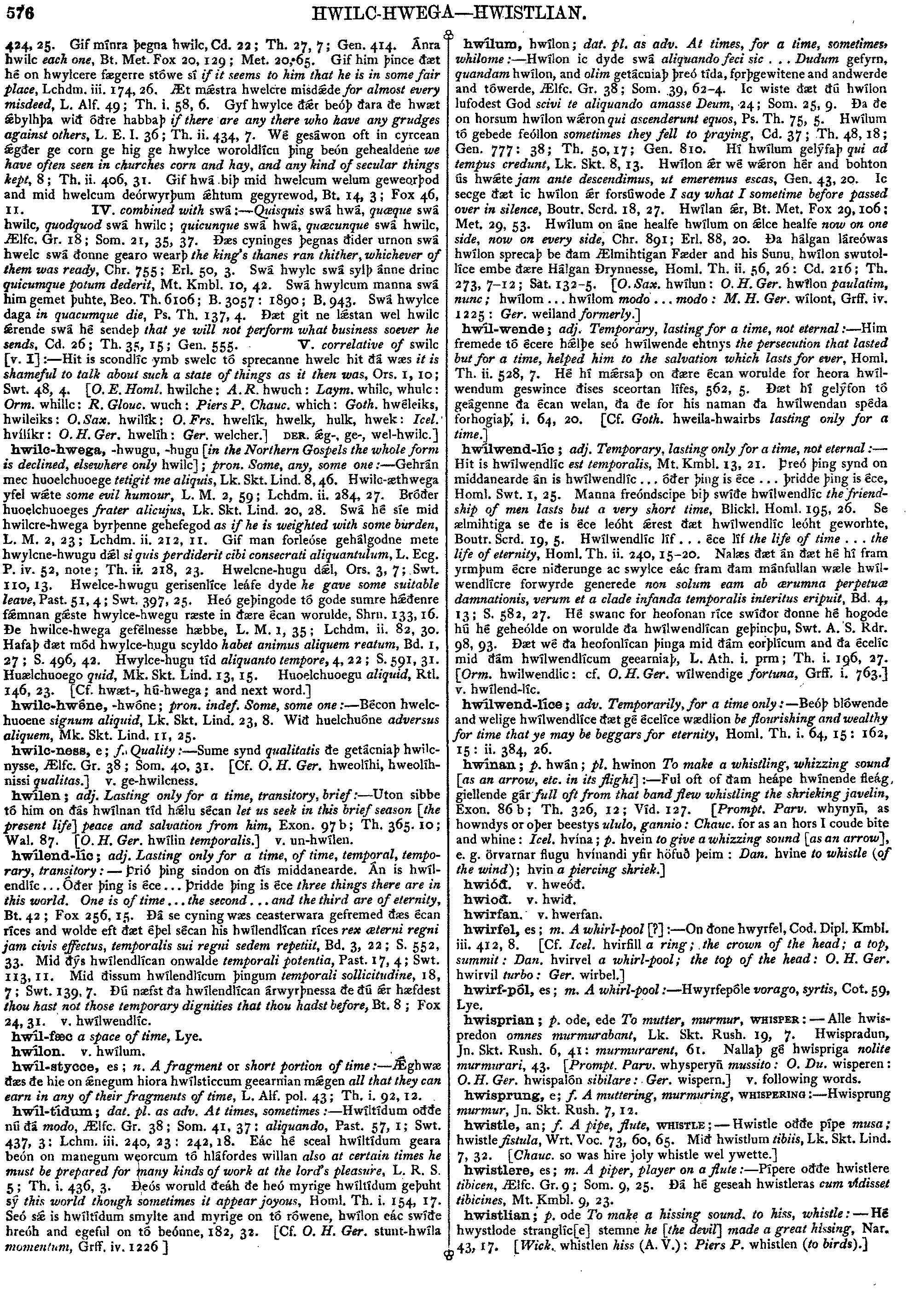
hwínan; p. hwán; pl. hwinon To make a whistling, whizzing sound [as an arrow, etc. in its flight] :-- Ful oft of ðam heápe hwínende fleág, giellende gár full oft from that band flew whistling the shrieking javelin, Exon. 86 b; Th. 326, 12; Víd. 127. [Prompt. Parv. whynyñ, as howndys or oþer beestys ululo, gannio: Chauc. for as an hors I coude bite and whine: Icel. hvina; p. hvein to give a whizzing sound [as an arrow], e.g. örvarnar flugu hvínandi yfir höfuð þeim: Dan. hvine to whistle (of the wind); hvin a piercing shriek.]
|
Source: Bosworth/Toller, page b0663, entry 1 View original page image as: [TIFF] [PNG] [View previous entry] [View next entry] |
[Comment on this entry] [View comments] |
The following entry has been hand-corrected once. |
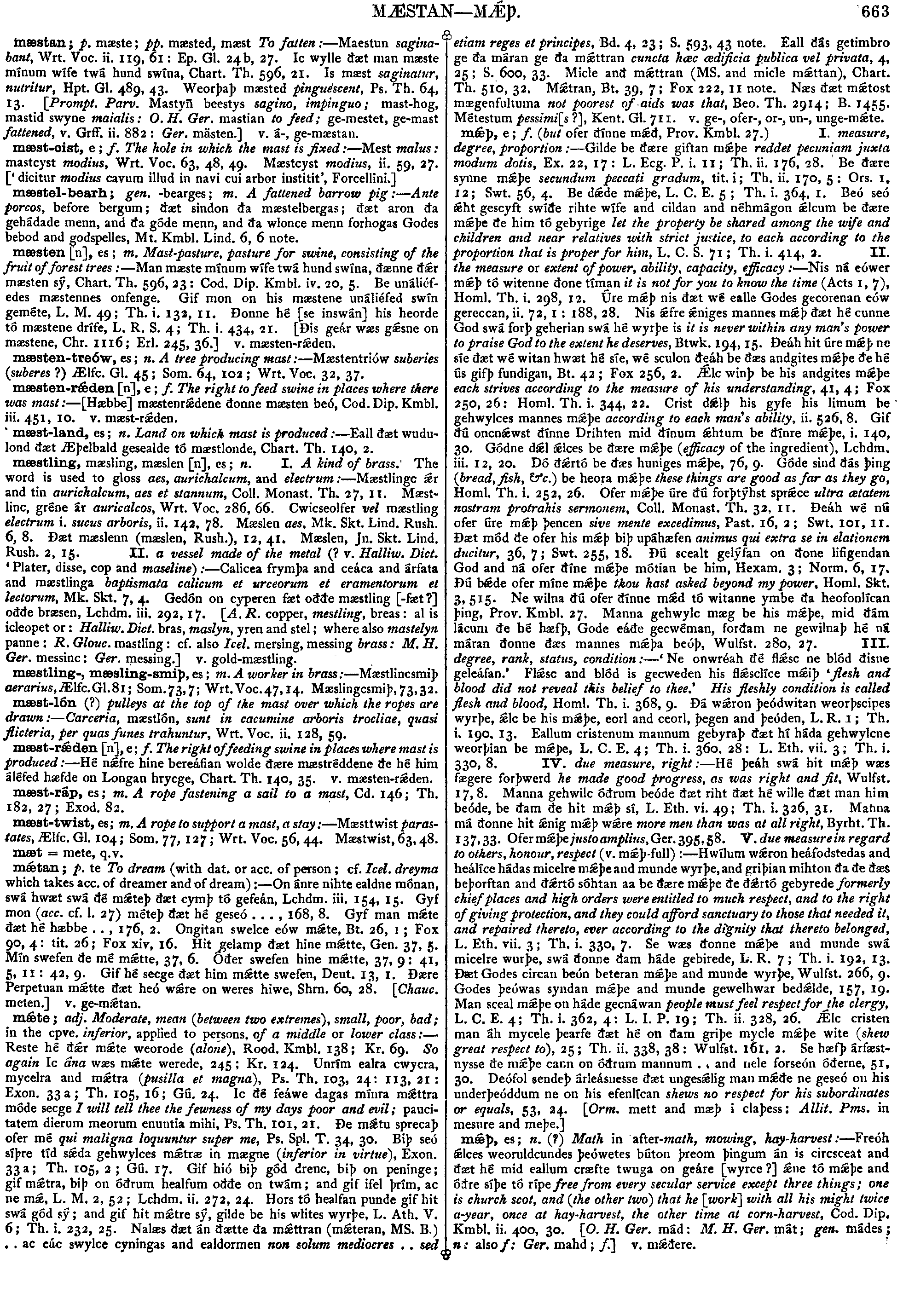
mæstan; p. mæste; pp. mæsted, mæst To fatten :-- Maestun saginabant. Wrt. Voc. ii. 119, 61: Ep. Gl. 24b, 27. Ic wylle ðæt man mæste mínum wífe twá hund swína, Chart. Th. 596, 21. Is mæst saginatur, nutritur, Hpt. Gl. 489, 43. Weorþaþ mæsted pinguescent, Ps. Th. 64, 13. [Prompt. Parv. Masty&n-long; beestys sagino, impinguo; mast-hog, mastid swyne maialis: O. H. Ger. mastian to feed; ge-mestet. ge-mast fattened, v. Grff. ii. 882 : Ger. müsten.] v. á-, ge-mæstan.
|
Source: Bosworth/Toller, page b0813, entry 10 View original page image as: [TIFF] [PNG] [View previous entry] [View next entry] |
[Comment on this entry] [View comments] |
The following entry has been hand-corrected once. |
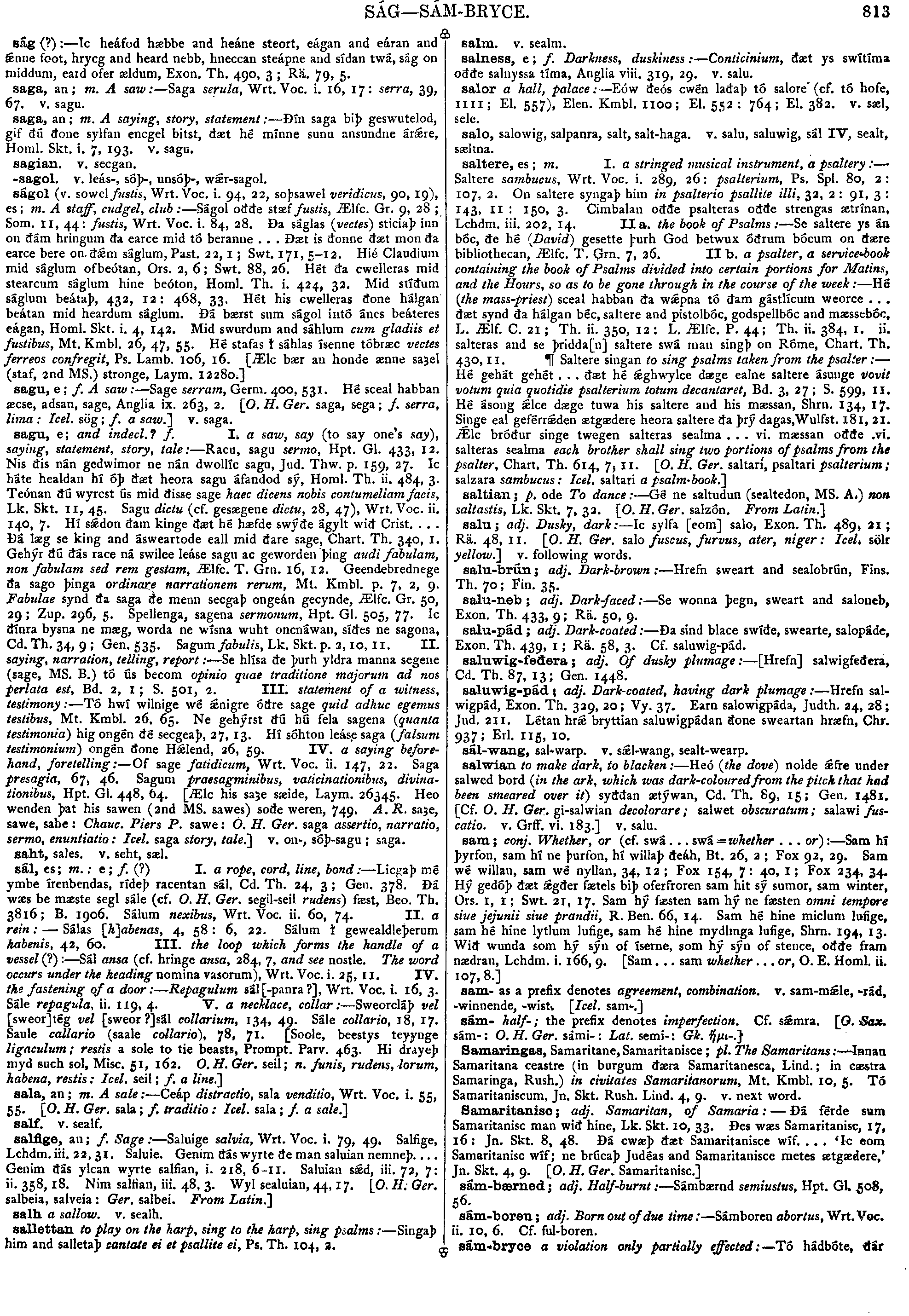
sál,
es;
m.
:
e;
f.
(?)
I.
a
rope,
cord,
line,
bond
:--
Licgaþ
mé
ymbe
írenbendas,
rídeþ
racentan
sál,
Cd.
Th.
24,
3;
Gen.
378.
Ðá
wæs
be
mæste
segl
sále
(cf.
O.
H.
Ger.
segil-seil
rudens)
fæst,
Beo.
Th.
3816;
B.
1906.
Sálum
nexibus,
Wrt.
Voc.
ii.
60,
74.
II.
a
rein
:--
Sálas
[h]
abenas,
4,
58
:
6,
22.
Sálum
 gewealdleþerum
habenis,
42,
60.
III.
the
loop
which
forms
the
handle
of
a
vessel
(?)
:--
Sál
ansa
(cf.
hringe
ansa,
284,
7,
and
see
nostle.
The
word
occurs
under
the
heading
nomina
vasorum),
Wrt.
Voc.
i.
25,
11.
IV.
the
fastening
of
a
door
:--
Repagulum
sál[-panra?],
Wrt.
Voc.
i.
16,
3.
Sále
repagula,
ii.
119,
4.
V.
a
necklace,
collar
:--
Sweorcláþ
vel
[sweor]tég
vel
[sweor?]sál
collarium,
134,
49.
Sále
collario,
18,
17.
Saule
callario
(saale
collario),
78,
71.
[Soole,
beestys
teyynge
ligaculum;
restis
a
sole
to
tie
beasts,
Prompt.
Parv.
463.
Hi
drayeþ
myd
such
sol,
Misc.
51,
162.
O.
H.
Ger.
seil;
n.
funis,
rudens,
lorum,
habena,
restis:
Icel.
seil;
f.
a
line.]
gewealdleþerum
habenis,
42,
60.
III.
the
loop
which
forms
the
handle
of
a
vessel
(?)
:--
Sál
ansa
(cf.
hringe
ansa,
284,
7,
and
see
nostle.
The
word
occurs
under
the
heading
nomina
vasorum),
Wrt.
Voc.
i.
25,
11.
IV.
the
fastening
of
a
door
:--
Repagulum
sál[-panra?],
Wrt.
Voc.
i.
16,
3.
Sále
repagula,
ii.
119,
4.
V.
a
necklace,
collar
:--
Sweorcláþ
vel
[sweor]tég
vel
[sweor?]sál
collarium,
134,
49.
Sále
collario,
18,
17.
Saule
callario
(saale
collario),
78,
71.
[Soole,
beestys
teyynge
ligaculum;
restis
a
sole
to
tie
beasts,
Prompt.
Parv.
463.
Hi
drayeþ
myd
such
sol,
Misc.
51,
162.
O.
H.
Ger.
seil;
n.
funis,
rudens,
lorum,
habena,
restis:
Icel.
seil;
f.
a
line.]
|
Source: Bosworth/Toller, page b1015, entry 9 View original page image as: [TIFF] [PNG] [View previous entry] [View next entry] |
[Comment on this entry] [View comments] |
The following entry has been hand-corrected once. |
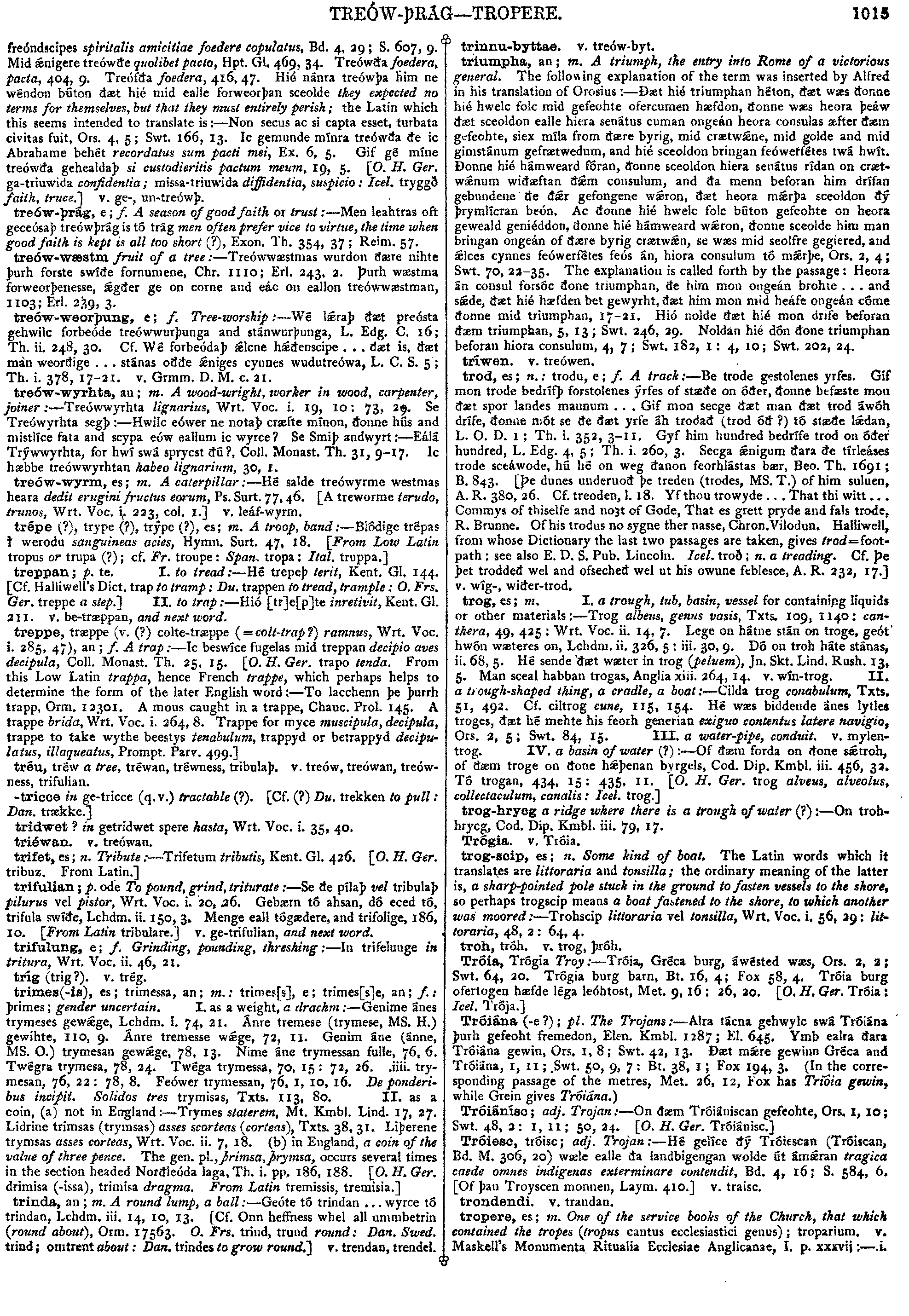
treppe, træppe (v. (?) colte-træppe ( = colt-trap ?) ramnus, Wrt. Voc. i. 285, 47), an; f. A trap :-- Ic beswíce fugelas mid treppan decipio aves decipula, Coll. Monast. Th. 25, 15. [O. H. Ger. trapo tenda. From this Low Latin trappa, hence French trappe, which perhaps helps to determine the form of the later English word :-- To lacchenn þe þutrh trapp, Orm. 12301. A mons caught in a trappe, Chauc. Prol. 145. A trappe brida, Wrt. Voc. i. 264, 8. Trappe for myce muscipula, decipula, trappe to take wythe beestys tenabulum, trappyd or betrappyd decipulatus, illaqueatus, Prompt. Parv. 499.]
Germanic Lexicon Project (main page)
This search system was written by
Sean Crist
Please consider
volunteering
to correct the data in these online dictionaries.
No rights reserved. Feel free to use these data in any way you please.