|
|

Search for been again, using less strict matching (706 results)
|
Source: Cleasby/Vigfusson, page b0705, entry 10 View original page image as: [TIFF] [PNG] [View previous entry] [View next entry] |
[Comment on this entry] [View comments] |
The following entry has been hand-corrected once. |
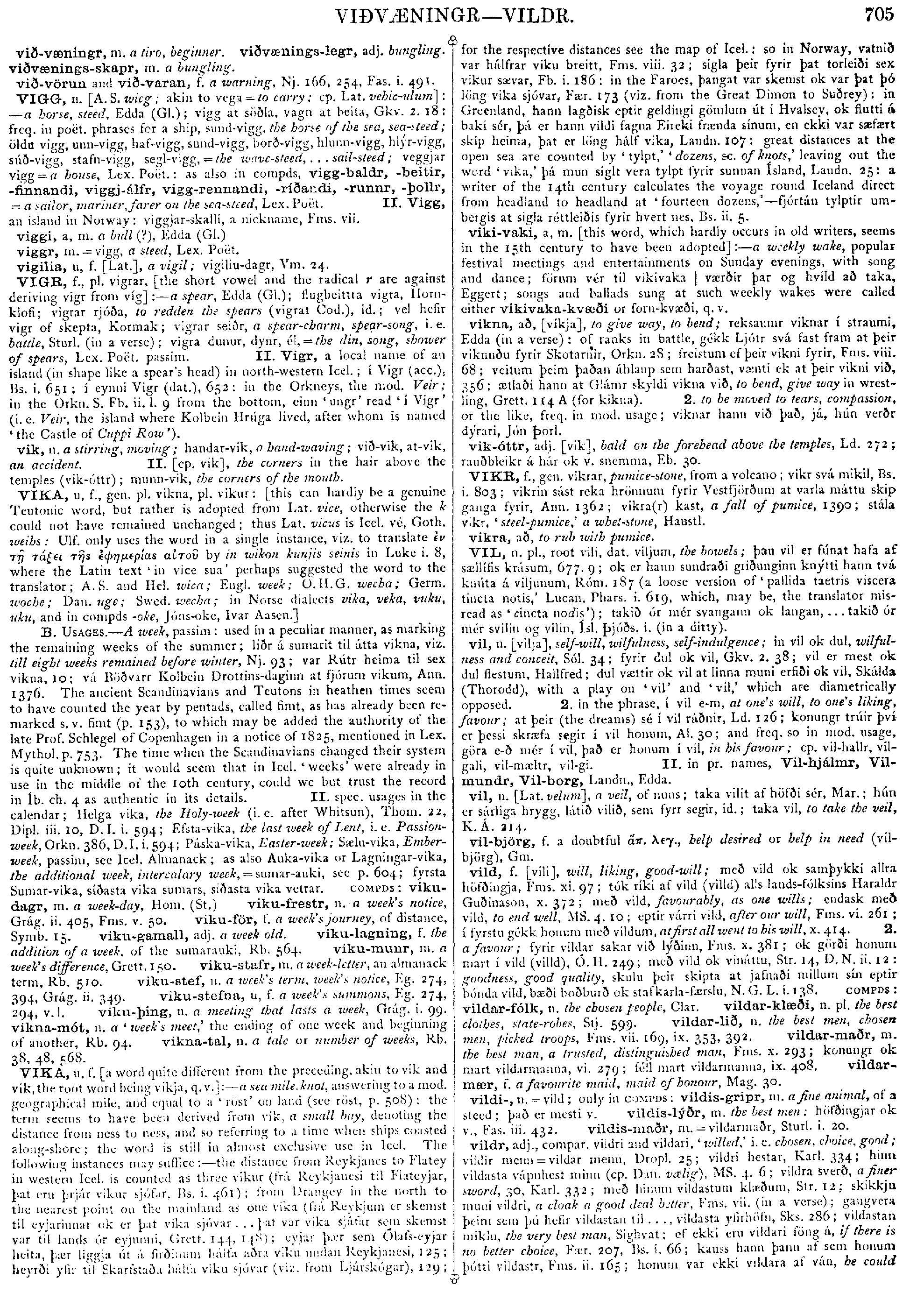
VIKA, u, f. [a word quite different from the preceding, akin to vik and vík, the root word being víkja, q.v.] :-- a sea mile, knot, answering to a mod. geographical mile, and equal to a 'röst' on land (see röst, p. 508): the term seems to have been derived from vík, a small bay, denoting the distance from ness to ness, and so referring to a time when ships coasted along-shore; the word is still in almost exclusive use in Icel. The following instances may suffice :-- the distance from Reykjanes to Flatey in western Icel. is counted as three viknr (frá Reykjanesi til Flateyjar, þat eru þrjár vikur sjófar, Bs. i. 461); from Drangey in the north to the nearest point on the mainland as one vika (frá Revkjum er skemst til eyjarinnar ok er þat vika sjóvar ... þat var vika sjáfar sem skemst var til lands ór eyjunni, Grett. 144, 148); eyjar þær sem Ólafs-eyjar heita, þær liggja út á firðinum hálfa aðra viku undan Reykjanesi, 125; heyrði yfir til Skarfstaða hálfa viku sjóvar (viz. from Ljárskógar), 129; for the respective distances see the map of Icel.: so in Norway, vatnið var hálfrar viku breitt, Fms. viii. 32; sigla þeir fyrir þat torleiði sex vikur sævar, Fb. i. 186: in the Faroes, þangat var skemst ok var þat þó löng vika sjóvar, Fær. 173 (viz. from the Great Dimon to Suðrey): in Greenland, hann lagðisk eptir geldingi gömlum út í Hvalsey, ok flutti á baki sér, þá er hann vildi fagna Eireki frænda sínum, en ekki var sæfært skip heima, þat er löng hálf vika, Landn. 107: great distances at the open sea are counted by 'tylpt,' 'dozens, sc. of knots,' leaving out the word 'vika,' þá mun siglt vera tylpt fyrir sunnan Ísland, Landn. 25: a writer of the 14th century calculates the voyage round Iceland direct from headland to headland at 'fourteen dozens,' -- fjórtan tylptir umbergis at sigla réttleiðis fyrir hvert nes, Bs. ii. 5.
|
Source: Cleasby/Vigfusson, page b0705, entry 11 View original page image as: [TIFF] [PNG] [View previous entry] [View next entry] |
[Comment on this entry] [View comments] |
The following entry has been hand-corrected once. |
viki-vaki, a, m. [this word, which hardly occurs in old writers, seems in the 15th century to have been adopted] :-- a weekly wake, popular festival meetings and entertainments on Sunday evenings, with song and dance; förum vér til vikivaka | værðir þar og hvíld að taka, Eggert; songs and ballads sung at such weekly wakes were called either vikivaka-kvæði or forn-kvæði, q.v.
|
Source: Cleasby/Vigfusson, page b0713, entry 21 View original page image as: [TIFF] [PNG] [View previous entry] [View next entry] |
[Comment on this entry] [View comments] |
The following entry has been hand-corrected once. |
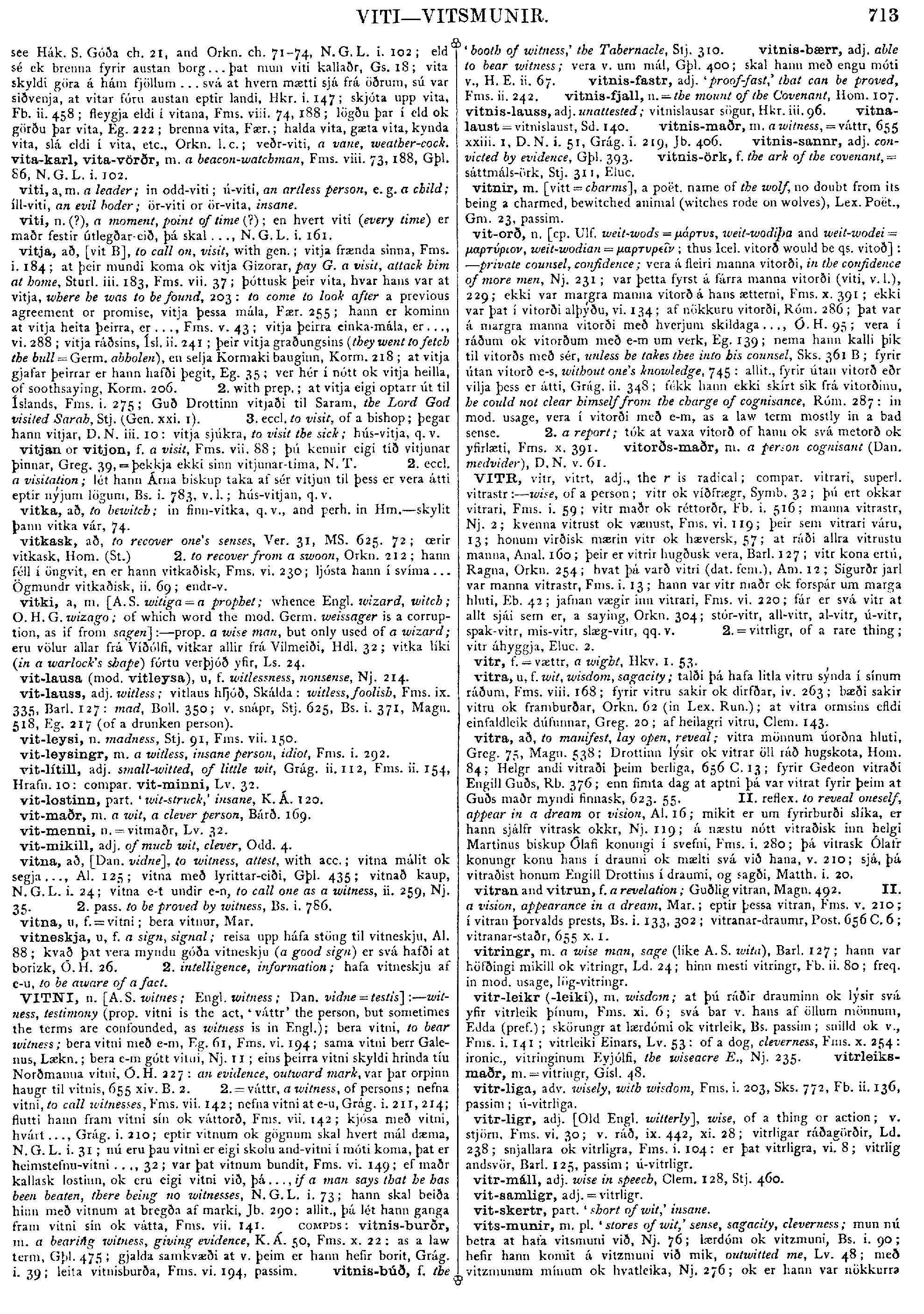
VITNI, n. [A.S. witnes; Engl. witness; Dan. vidne = testis] :-- witness, testimony (prop. vitni is the act, 'váttr' the person, but sometimes the terms are confounded, as witness is in Engl.); bera vitni, to bear witness; bera vitni með e-m, Eg. 61, Fms. vi. 194; sama vitni berr Galenus, Lækn.; bera e-m gótt vitni, Nj. 11; eins þeirra vitni skyldi hrinda tíu Norðmanna vitni, Ó.H. 227: an evidence, outward mark, var þar orpinn haugr til vitnis, 655 xiv. B. 2. 2. = váttr, a witness, of persons; nefna vitni, to call witnesses, Fms. vii. 142; nefna vitni at e-u, Grág. i. 211, 214; flutti hann fram vitni sín ok váttorð, Fms. vii. 142; kjósa með vitni, hvart ..., Grág. i. 210; eptir vitnum ok gögnum skal hvert mál dæma, N.G.L. i. 31; nú eru þau vitni er eigi skolu and-vitni í móti koma, þat er heimstefnu-vitni ..., 32; var þat vitnum bundit, Fms. vi. 149; ef maðr kallask lostinn, ok eru eigi vitni við, þá ..., if a man says that he has been beaten, there being no witnesses, N.G.L. i. 73; hann skal beiða hinn með vitnum at bregða af marki, Jb. 290: allit., þá lét hann ganga fram vitni sín ok vátta, Fms. vii. 141. COMPDS: vitnis-burðr, m. a bearing witness, giving evidence, K.Á. 50, Fms. x. 22: as a law term, Gþl. 475; gjalda samkvæði at v. þeim er hann hefir borit, Grág. i. 39; leita vitnisburða, Fms. vi. 194, passim. vitnis-búð, f. the 'booth of witness,' the Tabernacle, Stj. 310. vitnis-bærr, adj. able to bear witness; vera v. um mál, Gþl. 400; skal hann með engu móti v., H.E. ii. 67. vitnis-fastr, adj. 'proof-fast,' that can be proved, Fms. ii. 242. vitnis-fjall, n. = the mount of the Covenant, Hom. 107. vitnis-lauss, adj. unattested; vitnislausar sögur, Hkr. iii. 96. vitna-laust = vitnislaust, Sd. 140. vitnis-maðr, m. a witness, = váttr, 655 xxiii. 1, D.N. i. 51, Grág. i. 219, Jb. 406. vitnis-sannr, adj. convicted by evidence, Gþl. 393. vitnis-örk, f. the ark of the covenant, = sáttmáls-örk, Stj. 311, Eluc.
|
Source: Cleasby/Vigfusson, page b0715, entry 6 View original page image as: [TIFF] [PNG] [View previous entry] [View next entry] |
[Comment on this entry] [View comments] |
The following entry has been hand-corrected once. |
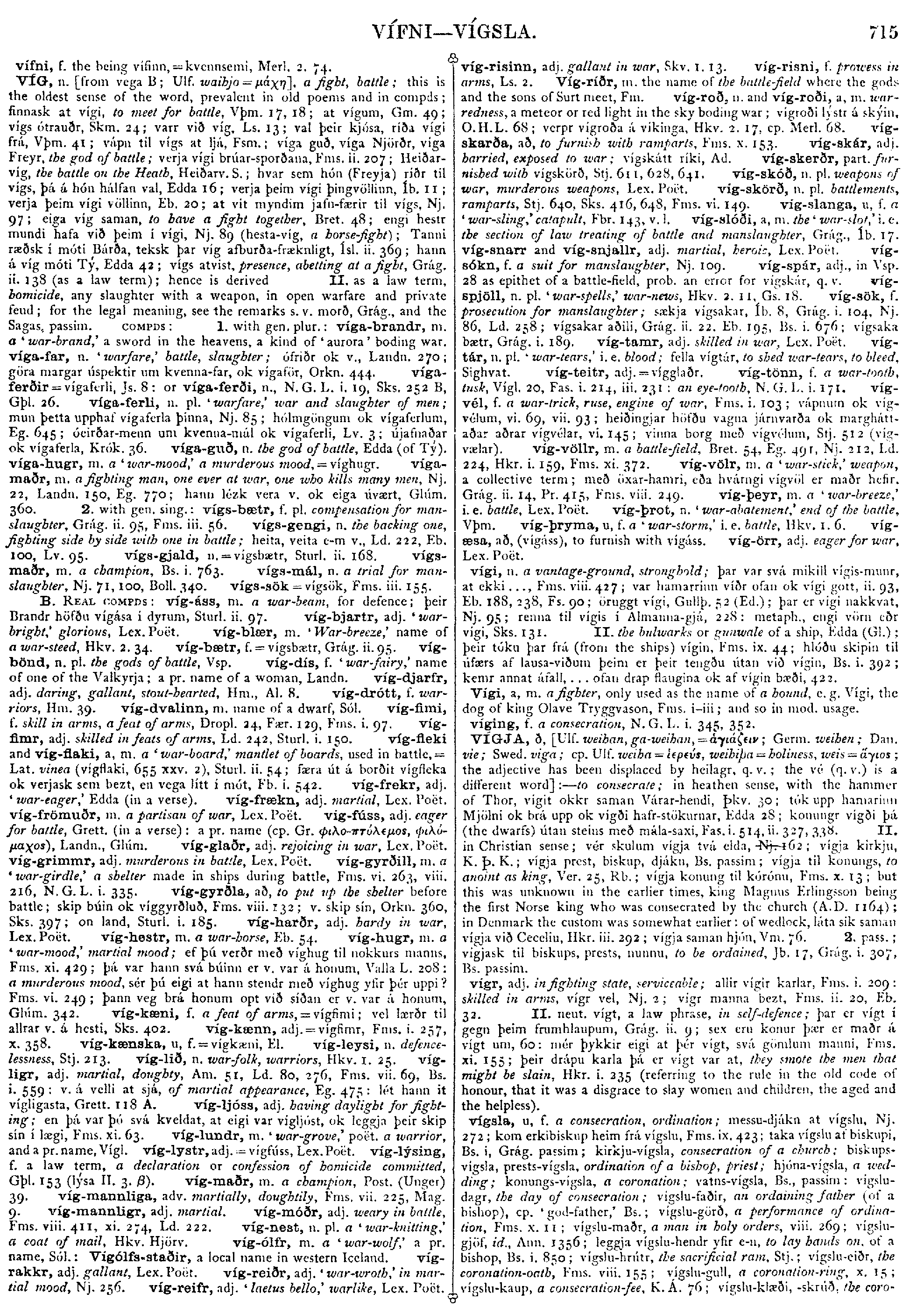
VÍGJA, ð, [Ulf. weihan, ga-weihan, = GREEK; Germ. weihen; Dan. vie; Swed. viga; cp. Ulf. weiha = GREEK, weihiþa = holiness, weis = GREEK; the adjective has been displaced by heilagr, q.v.; the vé (q.v.) is a different word] :-- to consecrate; in heathen sense, with the hammer of Thor, vígit okkr saman Várar-hendi, Þkv. 30; tók upp hamarinn Mjölni ok brá upp ok vígði hafr-stökurnar, Edda 28; konungr vígði þá (the dwarfs) útan steins með mála-saxi, Fas. i. 514, ii. 327, 338. II. in Christian sense; vér skulum vígja tvá elda, Nj. 162; vígja kirkju, K.Þ.K.; vígja prest, biskup, djákn, Bs. passim; vígja til konungs, to anoint as king, Ver. 25, Rb.; vígja konung til kórónu, Fms. x. 13; but this was unknown in the earlier times, king Magnus Erlingsson being the first Norse king who was consecrated by the church (A.D. 1164); in Denmark the custom was somewhat earlier: of wedlock, láta sik saman vígja við Ceceliu, Hkr. iii. 292; vígja saman hjón, Vm. 76. 2. pass.; vígjask til biskups, prests, nunnu, to be ordained, Jb. 17, Grág. i. 307, Bs. passim.
|
Source: Cleasby/Vigfusson, page b0721, entry 33 View original page image as: [TIFF] [PNG] [View previous entry] [View next entry] |
[Comment on this entry] [View comments] |
The following entry has been hand-corrected once. |
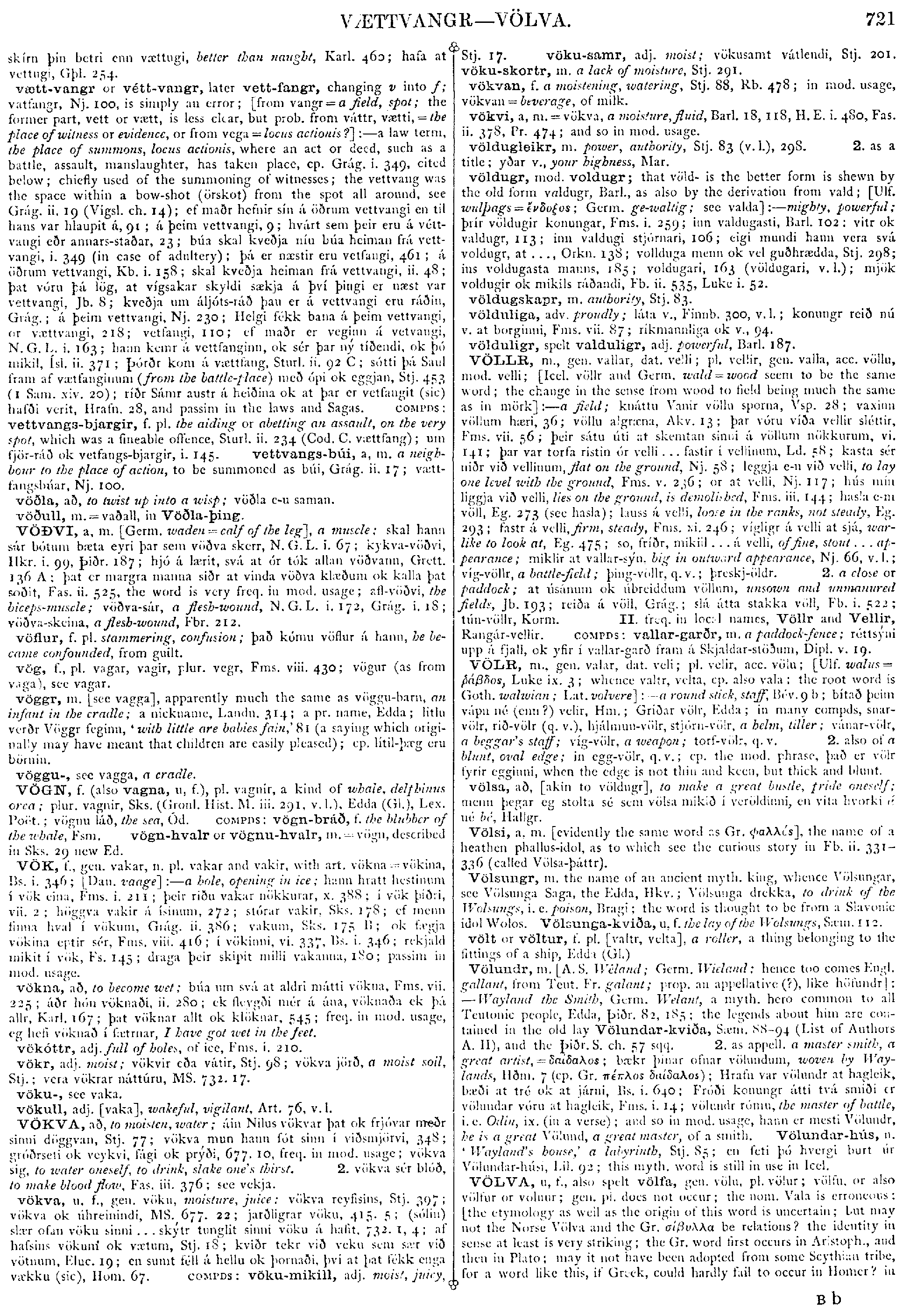
VÖLVA, u, f., also spelt völfa, gen. völu, pl. völur; völfu. or also völfur or voluur; gen. pl. does not occur; the nom. Vala is erroneous: [the etymology as well as the origin of this word is uncertain; but may not the Norse Völva and the Gr. GREEK be relations? the identity in sense at least is very striking; the Gr. word first occurs in Aristoph., and then in Plato; may it not have been adopted from some Scythian tribe, for a word like this, if Greek, could hardly fail to occur in Homer? in
|
Source: Cleasby/Vigfusson, page b0722, entry 1 View original page image as: [TIFF] [PNG] [View previous entry] [View next entry] |
[Comment on this entry] [View comments] |
The following entry has been hand-corrected once. |
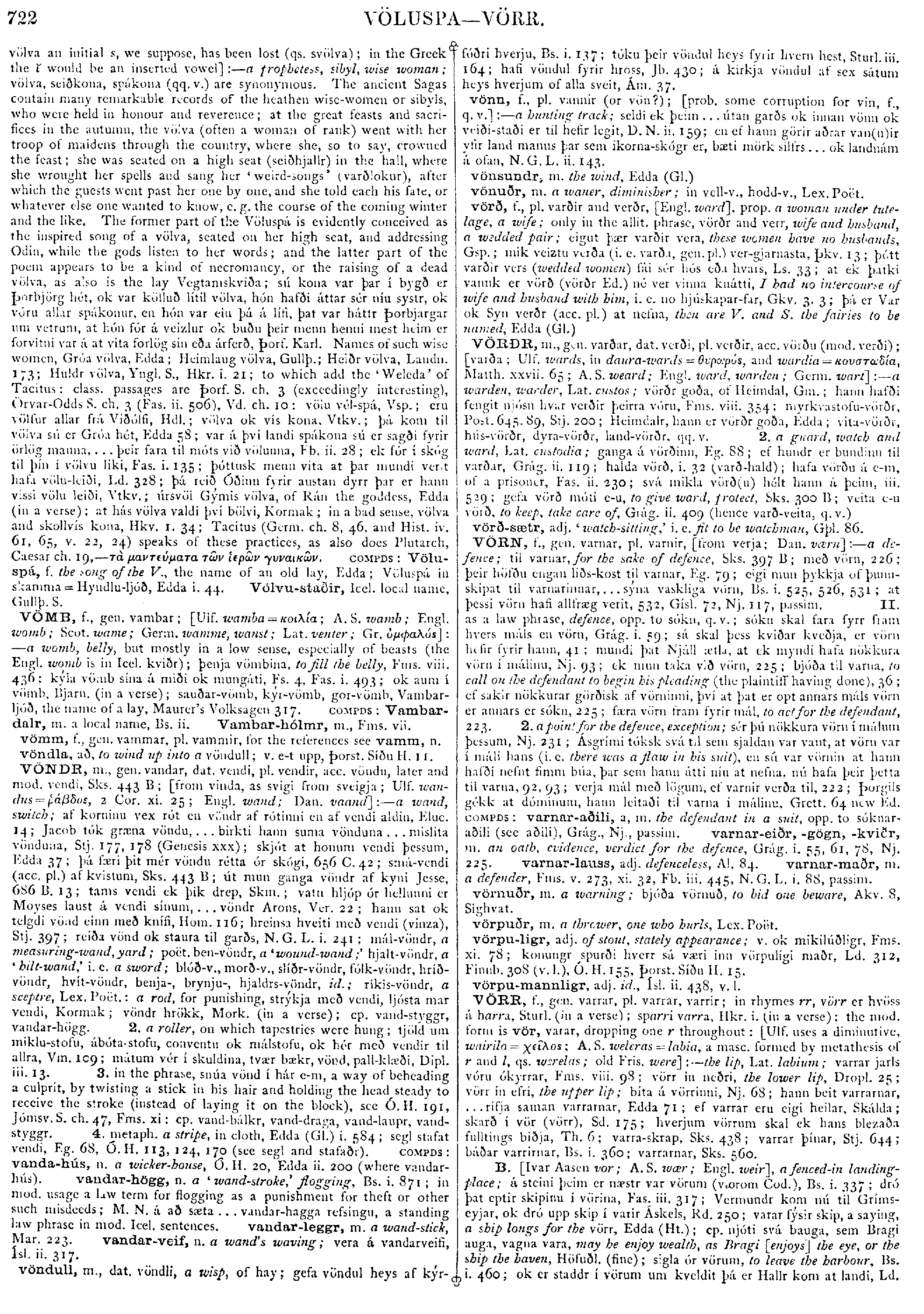
völva
an
initial
s,
we
suppose,
has
been
lost
(qs.
svölva);
in
the
Greek
the
 would
be
an
inserted
vowel]
:--
a
prophetess,
sibyl,
wise
woman;
vöa,
seiðkona,
spákona
(qq.v.)
are
synonymous.
The
ancient
Sagas
contain
many
remarkable
records
of
the
heathen
wise-women
or
sibyls,
who
were
held
in
honour
and
reverence;
at
the
great
feasts
and
sacrifices
in
the
autumn,
the
völva
(often
a
woman
of
rank)
went
with
her
troop
of
maidens
through
the
country,
where
she,
so
to
say,
crowned
the
feast;
she
was
seated
on
a
high
seat
(seiðhjallr)
in
the
hall,
where
she
wrought
her
spells
and
sang
her
'weird-songs'
(varðlokur),
after
which
the
guests
went
past
her
one
by
one,
and
she
told
each
his
fate,
or
whatever
else
one
wanted
to
know,
e.g.
the
course
of
the
coming
winter
and
the
like.
The
former
part
of
the
Völuspá
is
evidently
conceived
as
the
inspired
song
of
a
völva,
seated
on
her
high
seat,
and
addressing
Odin,
while
the
gods
listen
to
her
words;
and
the
latter
part
of
the
poem
appears
to
be
a
kind
of
necromancy,
or
the
raising
of
a
dead
völva,
as
also
is
the
lay
Vegtamskviða;
sú
kona
var
þar
í
bygð
er
Þorbjörg
hét,
ok
var
kölluð
lítil
völva,
hón
hafði
áttar
sér
níu
systr,
ok
vóru
allar
spákonur,
en
hón
var
ein
þá
á
lífi,
þat
var
háttr
Þorbjargar
um
vetrum,
at
hón
fór
á
veizlur
ok
buðu
þeir
menn
henni
mest
heim
er
forvitni
var
á
at
vita
forlög
sín
eða
árferð,
Þorf.
Karl.
Names
of
such
wise
women,
Gróa
völva,
Edda;
Heimlaug
völva,
Gullþ.;
Heiðr
völva,
Landn.
173;
Huldr
völva,
Yngl.
S.,
Hkr.
i.
21;
to
which
add
the
'Weleda'
of
Tacitus:
class.
passages
are
Þorf.
S.
ch.
3
(exceedingly
interesting),
Örvar-Odds
S.
ch.
3
(Fas.
ii.
506),
Vd.
ch.
10:
völu
vél-spá,
Vsp.;
eru
völfur
allar
frá
Víðólfi,
Hdl.;
völva
ok
vís
kona.
Vtkv.;
þá
kom
til
völva
sú
er
Gróa
hét,
Edda
58;
var
á
því
landi
spákona
sú
er
sagði
fyrir
örlög
manna,
...
þeir
fara
til
móts
við
völunna,
Fb.
ii.
28;
ek
fór
í
skóg
til
þín
í
völvu
líki,
Fas.
i.
135;
þóttusk
menn
vita
at
þar
mundi
verst
hafa
völu-leiði,
Ld.
328;
þá
reið
Óðinn
fyrir
austan
dyrr
þar
er
hann
vissi
völu
leiði,
Vtkv.;
úrsvöl
Gýmis
völva,
of
Rán
the
goddess,
Edda
(in
a
verse);
at
hás
völva
valdi
því
bölvi,
Kormak;
in
a
bad
sense,
völva
and
skollvis
kona,
Hkv.
1.
34;
Tacitus
(Germ.
ch.
8,
46,
and
Hist.
iv.
61,
65,
v.
22,
24)
speaks
of
these
practices,
as
also
does
Plutarch,
Caesar
ch.
19,
--
GREEK.
COMPDS:
Völu-spá,
f.
the
song
of
the
V.,
the
name
of
an
old
lay,
Edda;
Völuspá
in
skamma
=
Hyndlu-ljóð,
Edda
i.
44.
Völvu-staðir,
Icel.
local
name,
Gullþ.
S.
would
be
an
inserted
vowel]
:--
a
prophetess,
sibyl,
wise
woman;
vöa,
seiðkona,
spákona
(qq.v.)
are
synonymous.
The
ancient
Sagas
contain
many
remarkable
records
of
the
heathen
wise-women
or
sibyls,
who
were
held
in
honour
and
reverence;
at
the
great
feasts
and
sacrifices
in
the
autumn,
the
völva
(often
a
woman
of
rank)
went
with
her
troop
of
maidens
through
the
country,
where
she,
so
to
say,
crowned
the
feast;
she
was
seated
on
a
high
seat
(seiðhjallr)
in
the
hall,
where
she
wrought
her
spells
and
sang
her
'weird-songs'
(varðlokur),
after
which
the
guests
went
past
her
one
by
one,
and
she
told
each
his
fate,
or
whatever
else
one
wanted
to
know,
e.g.
the
course
of
the
coming
winter
and
the
like.
The
former
part
of
the
Völuspá
is
evidently
conceived
as
the
inspired
song
of
a
völva,
seated
on
her
high
seat,
and
addressing
Odin,
while
the
gods
listen
to
her
words;
and
the
latter
part
of
the
poem
appears
to
be
a
kind
of
necromancy,
or
the
raising
of
a
dead
völva,
as
also
is
the
lay
Vegtamskviða;
sú
kona
var
þar
í
bygð
er
Þorbjörg
hét,
ok
var
kölluð
lítil
völva,
hón
hafði
áttar
sér
níu
systr,
ok
vóru
allar
spákonur,
en
hón
var
ein
þá
á
lífi,
þat
var
háttr
Þorbjargar
um
vetrum,
at
hón
fór
á
veizlur
ok
buðu
þeir
menn
henni
mest
heim
er
forvitni
var
á
at
vita
forlög
sín
eða
árferð,
Þorf.
Karl.
Names
of
such
wise
women,
Gróa
völva,
Edda;
Heimlaug
völva,
Gullþ.;
Heiðr
völva,
Landn.
173;
Huldr
völva,
Yngl.
S.,
Hkr.
i.
21;
to
which
add
the
'Weleda'
of
Tacitus:
class.
passages
are
Þorf.
S.
ch.
3
(exceedingly
interesting),
Örvar-Odds
S.
ch.
3
(Fas.
ii.
506),
Vd.
ch.
10:
völu
vél-spá,
Vsp.;
eru
völfur
allar
frá
Víðólfi,
Hdl.;
völva
ok
vís
kona.
Vtkv.;
þá
kom
til
völva
sú
er
Gróa
hét,
Edda
58;
var
á
því
landi
spákona
sú
er
sagði
fyrir
örlög
manna,
...
þeir
fara
til
móts
við
völunna,
Fb.
ii.
28;
ek
fór
í
skóg
til
þín
í
völvu
líki,
Fas.
i.
135;
þóttusk
menn
vita
at
þar
mundi
verst
hafa
völu-leiði,
Ld.
328;
þá
reið
Óðinn
fyrir
austan
dyrr
þar
er
hann
vissi
völu
leiði,
Vtkv.;
úrsvöl
Gýmis
völva,
of
Rán
the
goddess,
Edda
(in
a
verse);
at
hás
völva
valdi
því
bölvi,
Kormak;
in
a
bad
sense,
völva
and
skollvis
kona,
Hkv.
1.
34;
Tacitus
(Germ.
ch.
8,
46,
and
Hist.
iv.
61,
65,
v.
22,
24)
speaks
of
these
practices,
as
also
does
Plutarch,
Caesar
ch.
19,
--
GREEK.
COMPDS:
Völu-spá,
f.
the
song
of
the
V.,
the
name
of
an
old
lay,
Edda;
Völuspá
in
skamma
=
Hyndlu-ljóð,
Edda
i.
44.
Völvu-staðir,
Icel.
local
name,
Gullþ.
S.
|
Source: Cleasby/Vigfusson, page b0723, entry 13 View original page image as: [TIFF] [PNG] [View previous entry] [View next entry] |
[Comment on this entry] [View comments] |
The following entry has been hand-corrected once. |
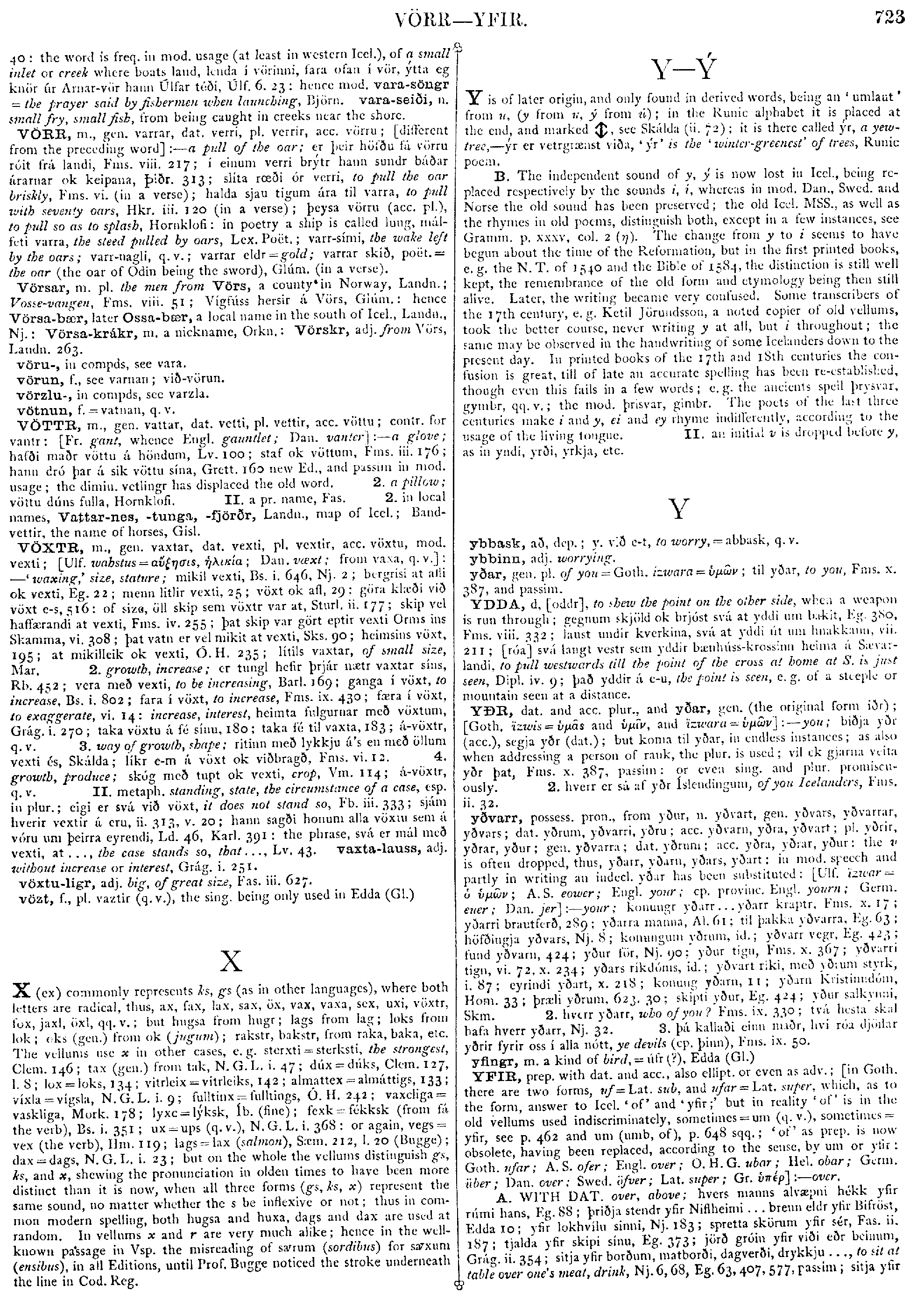
X. (ex) commonly represents ks, gs (as in other languages), where both letters are radical, thus, ax, fax, lax, sax, öx, vax, vaxa, sex, uxi, vöxtr, fox, jaxl, öxl, qq.v.; but hugsa from hugr; lags from lag; loks from lok; oks (gen.) from ok (jugum); rakstr, bakstr, from raka, baka, etc. The vellums use x in other cases, e.g. sterxti = sterksti, the strongest, Clem. 146; tax (gen.) from tak, N.G.L. i. 47; dúx = dúks, Clem. 127, l. 8; lox = loks, 134; vitrleix = vitrleiks, 142; almattex = almáttigs, 133; víxla = vígsla, N.G.L. i. 9; fulltinx = fulltings, ÓH. 242; vaxcliga = vaskliga, Mork. 178; lyxc = lýksk, Íb. (fine); fexk = fékksk (from fá the verb), Bs. i. 351; ux = ups (q.v.), N.G.L. i. 368: or again, vegs = vex (the verb), Hm. 119; lags = lax (salmon), Sæm. 212, l. 20 (Bugge); dax = dags, N.G.L. i, 23; but on the whole the vellums distinguish gs, ks, and x, shewing the pronunciation in olden times to have been more distinct than it is now, when all three forms (gs, ks, x) represent the same sound, no matter whether the s be inflexive or not; thus in common modern spelling, both hugsa and huxa, dags and dax are used at random. In vellums x and r are very much alike: hence in the well-known passage in Vsp. the misreading of sarum (sordibus) for saxum (ensibus), in all Editions, until Prof, Bugge noticed the stroke underneath the line in Cod. Reg.
|
Source: Cleasby/Vigfusson, page b0723, entry 15 View original page image as: [TIFF] [PNG] [View previous entry] [View next entry] |
[Comment on this entry] [View comments] |
The following entry has been hand-corrected once. |
Y
is
of
later
origin,
and
only
found
in
derived
words,
being
an
'umlaut'
from
u,
(y
from
u,
ý
from
ú);
in
the
Runic
alphabet
it
is
placed
at
the
end,
and
marked
RUNE,
see
Skálda
(ii.
72);
it
is
there
called
ýr,
a
yew-tree,
--
ýr
er
vetrgræast
viða,
'ýr'
is
the
'winter-greenest'
of
trees,
Runic
poem.
B.
The
independent
sound
of
y,
ý
is
now
lost
in
Icel.,
being
replaced
respectively
by
the
sounds
i,
í,
whereas
in
mod.
Dan.,
Swed.
and
Norse
the
old
sound
has
been
preserved;
the
old
Icel.
MSS.,
as
well
as
the
rhymes
in
old
poems,
distinguish
both,
except
in
a
few
instances,
see
Gramm.
p.
xxxv,
col.
2
( ).
The
change
from
y
to
i
seems
to
have
begun
about
the
time
of
the
Reformation,
but
in
the
first
printed
books,
e.g.
the
N.
T.
of
1540
and
the
Bible
of
1584,
the
distinction
is
still
well
kept,
the
remembrance
of
the
old
form
and
etymology
being
then
still
alive.
Later,
the
writing
became
very
confused.
Some
transcribers
of
the
17th
century,
e.g.
Ketil
Jörundsson,
a
noted
copier
of
old
vellums,
took
the
better
course,
never
writing
y
at
all,
but
i
throughout;
the
same
may
be
observed
in
the
handwriting
of
some
Icelanders
down
to
the
present
day.
In
printed
books
of
the
17th
and
18th
centuries
the
confusion
is
great,
till
of
late
an
accurate
spelling
has
been
re-established,
though
even
this
fails
in
a
few
words;
e.g.
the
ancients
spell
þrysvar,
gymbr,
qq.v.;
the
mod.
þrisvar,
gimbr.
The
poets
of
the
last
three
centuries
make
i
and
y,
ei
and
ey
rhyme
indifferently,
according
to
the
usage
of
the
living
tongue.
II.
an
initial
v
is
dropped
before
y,
as
in
yndi,
yrði,
yrkja,
etc.
).
The
change
from
y
to
i
seems
to
have
begun
about
the
time
of
the
Reformation,
but
in
the
first
printed
books,
e.g.
the
N.
T.
of
1540
and
the
Bible
of
1584,
the
distinction
is
still
well
kept,
the
remembrance
of
the
old
form
and
etymology
being
then
still
alive.
Later,
the
writing
became
very
confused.
Some
transcribers
of
the
17th
century,
e.g.
Ketil
Jörundsson,
a
noted
copier
of
old
vellums,
took
the
better
course,
never
writing
y
at
all,
but
i
throughout;
the
same
may
be
observed
in
the
handwriting
of
some
Icelanders
down
to
the
present
day.
In
printed
books
of
the
17th
and
18th
centuries
the
confusion
is
great,
till
of
late
an
accurate
spelling
has
been
re-established,
though
even
this
fails
in
a
few
words;
e.g.
the
ancients
spell
þrysvar,
gymbr,
qq.v.;
the
mod.
þrisvar,
gimbr.
The
poets
of
the
last
three
centuries
make
i
and
y,
ei
and
ey
rhyme
indifferently,
according
to
the
usage
of
the
living
tongue.
II.
an
initial
v
is
dropped
before
y,
as
in
yndi,
yrði,
yrkja,
etc.
|
Source: Cleasby/Vigfusson, page b0723, entry 22 View original page image as: [TIFF] [PNG] [View previous entry] [View next entry] |
[Comment on this entry] [View comments] |
The following entry has been hand-corrected once. |
yðvarr, possess. pron., from yður, n. yðvart, gen. yðvars, yðvarrar, yðvars; dat. yðrum, yðvarri, yðru; acc. yðvarn, yðra, yðvart; pl. yörir, yðrar, yður; gen. yðvarra; dat. yðrum; acc. yðra, yðrar, yður: the v is often dropped, thus, yðarr, yðarn, yðars, yðart: in mod. speech and partly in writing an indecl. yðar has been substituted: [Ulf. ïzwar = GREEK; A.S. eower; Engl. your; cp. provinc. Engl. yourn; Germ. euer; Dan. jer] :-- your; konungr yðarr ... yðarr kraptr, Fms. x. 17; yðarri brautferð, 289; yðarra manna, Al. 61; til þakka yðvarra. Eg. 63; höfðingja yðvars, Nj. 8; konungum yðrum, id.; yðvarr vegr, Eg. 423; fund yðvarn, 424; yður för, Nj. 90; yður tign, Fms. x. 367; yðvarri tign, vi. 72, x. 234; yðars ríkdóms, id.; yðvart ríki, með yðrum styrk, i. 87; eyrindi yðart, x. 218; konung yðarn, 11; yðarn Kristinndóm, Hom. 33; þræli yðrum, 623. 30; skipti yður, Eg. 424; yður salkynni, Skm. 2. hverr yðarr, who of you? Fms. ix. 330; tvá hesta skal hafa hverr yðarr, Nj. 32. 3. þá kallaði einn maðr, hví róa djöllar yðrir fyrir oss í alla nótt, ye devils (cp. þinn), Fms. ix. 50.
|
Source: Cleasby/Vigfusson, page b0723, entry 24 View original page image as: [TIFF] [PNG] [View previous entry] [View next entry] |
[Comment on this entry] [View comments] |
The following entry has been hand-corrected once. |
YFIR, prep. with dat. and acc., also ellipt. or even as adv.; [in Goth. there are two forms, uf = Lat. sub, and ufar = Lat. super, which, as to the form, answer to Icel. 'of' and 'yfir;' but in reality 'of' is in the old vellums used indiscriminately, sometimes = um (q.v.), sometimes = yfir, see p. 462 and um (umb, of), p. 648 sqq.; 'of' as prep. is now obsolete, having been replaced, according to the sense, by um or yfir: Goth. ufar; A.S. ofer; Engl. over; O.H.G. ubar; Hel. ubar; Germ. über; Dan. over; Swed. öfver; Lat. super; Gr. GREEK] :-- over. A. WITH DAT. over, above; hvers manns alvæpni hékk yfir rúmi hans, Eg. 88; þriðja stendr yfir Niflheimi ... brenn eldr yfir Bifröst, Edda 10; yfir lokhvílu sinni, Nj. 183; spretta skörum yfir sér, Fas. ii. 187; tjalda yfir skipi sínu. Eg. 373; jörð gróin yfir viði eðr beinum, Grág. ii. 354; sitja yfir borðum, matborði, dagverði, drykkju ..., to sit at table over one's meat, drink; Nj. 6, 68, Eg. 63, 407, 577, passim; sitja yfir
| Result Page: |  |
Previous | 59 60 61 62 63 64 65 66 67 68 69 70 71 | Next |  |
Germanic Lexicon Project (main page)
This search system was written by
Sean Crist
Please consider
volunteering
to correct the data in these online dictionaries.
No rights reserved. Feel free to use these data in any way you please.